4 Ways the Omnicom-IPG Deal Could Upend Ad Industry Power Dynamics
Social Media Week is headed to NYC this May 12–14! Register before December 16 to save 50% on your pass.
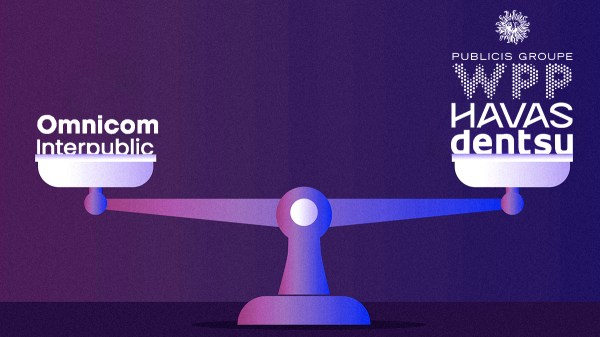
If Omnicom’s acquisition of Interpublic (IPG) goes as planned, the ‘big six’ holding companies will become the ‘big five’ before 2025 is done.
Through its reported $13.25 billion acquisition of its rival, Omnicom will now be the dominant network in the U.S., competing with French powerhouses Publicis Groupe and Havas, U.K.-based WPP, and Japan’s Dentsu for ad budgets.
Ink is expected to dry on the deal within 12 months, pending regulatory approval. Brian Wieser, an advertising industry analyst and founder of consultancy Madison and Wall, said for Omnicom, the sooner the better.
“Speed of completion is important because the longer the two companies are going through the process, the more its competitors will go after employees and clients,” he said.
While competitors reel from the news, announced unexpectedly two weeks before Christmas, ADWEEK spoke to analysts and M&A experts on how the deal might impact long-established holding company power dynamics.
1. Publicis Groupe’s reign at the top might be short-lived
Standing beside Snoop Dogg last week, Publicis Groupe CEO Arthur Sadoun proudly announced the network is poised to claim the title of the world’s largest advertising holding company by revenue by the end of 2024.
Publicis recorded $10.5 billion in revenue for the first nine months of 2024. Comparatively, WPP made around $10.2 billion. Consensus estimates from financial research platform Visible Alpha expect Publicis to pull in sales of $14.5 billion by the end of the year.
Publicis’ reign at the top could be short-lived, though, as Omnicom’s newly combined company boasts revenues of $25.6 billion, based on 2023 figures. This number alone gives it the ability to unseat the French group–and all other members of the big six–next year.
2. Consolidation, consolidation, consolidation
Matt Lacey at M&A advisory firm Waypoint Partners said the acquisition means the three top networks by billings–Publicis, WPP, and Omnicom–will end up looking “quite similar” in their integrated offerings and competing more heavily for big briefs.
He observed that Omnicom and IPG have preserved their individual agency brands the most among the big six, adding that Omnicom has been rationalizing to “some extent.” Earlier this year, the network announced the formation of the Omnicom Advertising Group (OAG) pooling BBDO, DDB, TBWA, Goodby Silverstein & Partners, and others under one business unit.
Lacey added: “Putting more and more separate branded businesses into big silos is not an option in a deal of this kind. Therefore, we’ll likely see significant consolidation of agency brands over the next few years, akin to what WPP has been doing.”
Jay Wilson, vp analyst for Gartner’s marketing practice, agreed the merger would make a rather complex holding company.
“It will be interesting to see how the combined holding companies further consolidate their agency brands. IPG, in particular, has been known for allowing its individual agencies to maintain quite a bit of independence, as has Omnicom.”
3. It’s a double-edged sword for independent networks and consultancies
While Weiser pointed out that the speed of closing will be something competitors watch closely, clients too will be monitoring for any disruptions to service in the next 12 months.
“This probably strengthens the position of larger independent agencies who may appeal to clients who don’t want to deal with a mega-agency holding company,” explained Wilson.
Jay Pattisall, vp and principal analyst at Forrester, concurs that fewer, bigger enterprise choices will facilitate more independent options. He pointed to PE-backed independent agencies including Horizon Media, DEPT, and PMG, which have captured scale in media buying with performance and tech-based services.
“These companies must and will react to a shifting competitive landscape,” he said, noting that the market should brace for independents to double down on innovation to compete.
Lacey said the deal could be an opportunity or a threat to challenger networks like Stagewell, which operate many separate agency brands.
“For any brand not wanting to work with one of the consolidated super networks, Stagwell could step in. But if clients choose not to behave in this way, Stagwell may well find itself up for grabs,” he said.
He added that Accenture could also be vulnerable in a new landscape dominated by three titans.
“It may also look to acquire a newly available asset, especially around data and media where it has limited capabilities,” he said. “For a business like Accenture, with a market cap of $243 billion, that would be eminently doable.”
4. Bringing more tech, creative, and PR chops to the table
The deal will deliver a handful of discipline-specific powerhouses. On the media and tech front, Omnicom’s data and tech propositions (including Acxiom and Flywheel) will help the industry better face up to tech giants like Meta and Google.
On the PR side, IPG’s Weber Shandwick and Golin will soon sit alongside Omnicom’s FleishmanHillard and Ketchum, delivering strategic comms capabilities for clients.
When it comes to creative, IPG brings McCann, FCB, Mullen Lowe to the table. “Of these, only McCann is a decent scale competitor against Omnicom’s TBWA, DDB, or BBDO, which essentially presents four advertising divisions,” argued Lacey.
Combined, these media, tech, PR and creative capabilities could help Omnicom become a more influential force, but only if leaders choose to spend wisely.
“Whether [its] more powerful or improved depends on where it invests its resources,” said Wieser.
Keep up with ADWEEK’s coverage of the Omnicom-IPG takeover here.
https://www.adweek.com/agencies/4-ways-the-omnicom-ipg-deal-could-upend-ad-industry-power-dynamics/