5 Questions for… CNN’s Fred Pleitgen on High-Risk Iran Assignment
Fred Pleitgen, CNN senior international correspondent, alongside Claudia Otto, CNN senior producer and photojournalist, were the first Western journalists to report inside Iran at the height of the nation’s conflict with Israel in June.
The crew, while on the ground, visited and reported from multiple locations, including the Iranian State Broadcasting Company (IRIB) television station, which was hit by an Israeli airstrike. They were also in the Iranian capital, Tehran, when the U.S. military struck three nuclear facilities inside the country on the orders of President Donald Trump.
Now, out of Iran, Pleitgen shared with TVNewser his experiences in the country, both official and unofficial. He also details what it took to get there and the unexpected car trouble they had en route to Tehran.
TVNewser: How did you land the Tehran assignment—was it voluntary?
Pleitgen: Claudia Otto and I have been going to Iran for more than 10 years. When the Israeli attacks started, we immediately filled out a visa application. The visa was granted quickly–about three days–and we left right after getting it stamped at the embassy. We believed it was extremely important to report from the Iranian side, and so we did everything that we could to get there as fast as possible.
How long did it take to get in and out of Iran?
Iran’s airspace was closed due to Israel’s bombing campaign, so we had to fly to eastern Turkey and then drive across the border. The journey was long. We first flew from Berlin to Diyarbakir, Turkey, then drove eight hours to the border—where we spent almost three hours doing paperwork—and then had a 14-hour drive to Tehran. The drive was prolonged because our car broke down somewhere in the mountains between Tabriz and Zanjan. And the journey out of Tehran was the same, minus the broken car, thankfully.
Several things were remarkable about the journey into Iran. Crossing the border itself took a while as those manning it don’t often see foreign TV crews crossing, and it was a high security situation because of the ongoing conflict. Our car then broke down on a mountain highway many miles from the next settlement. We stopped on the side of the road, hoping the engine would cool down, and then kept driving only for it to break down again. Luckily, the first car that stopped was a tow truck, sort of like Iran’s version of AAA. The driver tried to repair the car but said a cylinder was probably broken. So, we just stood there with no working car and no means of communication, as our Western phones had stopped working. The next stroke of luck came when another car stopped, and it was a driver who had just dropped someone off at the Turkish-Iranian border. He was headed back to the capital, so we asked him to take us to Tehran. In total, our travel time from Berlin to Tehran was around 32 hours.
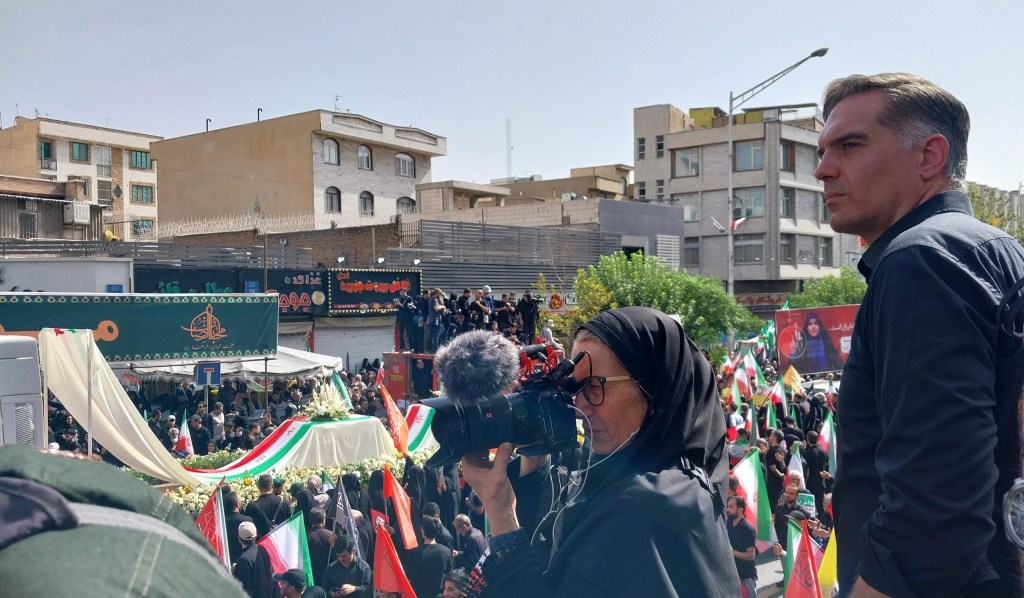 Credit: CNN – CNN’s Fred Pleitgen and Claudia Otto covering the protests in Tehran, Iran.
Were you allowed to freely move around while in Tehran?
Tehran was very empty when we arrived, as a lot of people had already left the city to avoid getting caught up in airstrikes. We drove in late at night there and didn’t see really any people in the streets or lights burning in houses. In the days that followed, we were able to go out and film, but there were some restrictions at the sites damaged by airstrikes. For instance, we needed an escort to enter the premises of Iran’s state broadcaster, which had just been hit by an Israeli airstrike, as it was located on a fenced-in compound. It was also necessary at some of the sites in residential areas where airstrikes had struck, as these were deemed high-security zones. Those were the only times we got an official escort.
At the height of the conflict, what was it like to be reporting on the ground?
We were working day and night as the air campaign was unfolding, especially when the U.S. got involved by bombing Iranian nuclear installations. During the day, we’d go out and film in hospitals treating the wounded, areas that had been hit by strikes, and markets to speak to regular folks about what was happening. The conflict was ever-present, as we frequently heard the thuds of what seemed to be airstrikes, and we saw air defenses firing into the skies, particularly at night. We had a close call one morning when, all of a sudden, jets flew over us, followed by a large explosion in our immediate area. We ran to the basement and heard the jets pass again, followed by more explosions that violently rattled our building. When we emerged to the rooftop, we saw large parts of western Tehran engulfed in smoke. The strikes had hit only about a block from our location.
What about Iranians was not adequately covered?
We saw it as our core mission to help Iranians’ voices get heard. From the Iranians recovering in hospitals after strikes to those we met in public places living in fear, and to those protesting against the air campaign, the message was always the same: anger and disbelief at the air campaign. I interviewed a hardline Iranian politician who said that while many Iranians were not happy with the Islamic Republic, when attacked from the outside, they came together to stand against the bombings, rallying around the flag.
Bonus Question: Please describe an offbeat experience you had while in Iran.
Iran has great food on every level. One of the favorite refreshing desserts is saffron ice cream with carrot juice. Even at the height of the conflict, we still managed to get saffron ice cream and carrot juice.
 Credit: CNN – CNN’s Fred Pleitgen and Claudia Otto in Tehran, Iran.
https://www.adweek.com/tvnewser/5-questions-for-cnns-fred-pleitgen-on-high-risk-iran-assignment/