AI Startup ProRata Now Helps Brands Create and Contextually Serve Ads Across the Web
Social media is evolving. Are you adapting? Connect with a community of brand pros and content creators at Social Media Week, May 12–14 in NYC, to learn how to keep pace with new trends and technology. Register now to save 20% on your pass.
AI startup ProRata is unveiling a new ad platform, ProRata Ads, which ditches traditional keyword bidding in favor of prompts to create AI-generated ads.
Advertisers upload brand URLs, creative briefs, and audience descriptions, and ProRata’s large language model (LLM) generates ad variations, allowing advertisers to choose those that best align with their brand’s tone.
But ProRata’s AI doesn’t just create ads—it also decides where they run. The platform scans 50 million articles in its database, placing ads next to content that aligns with the brand’s brief. So a shoe brand can bid on ads that appear on general shoe-related articles, but also on specific content, like performance running or marathon training.
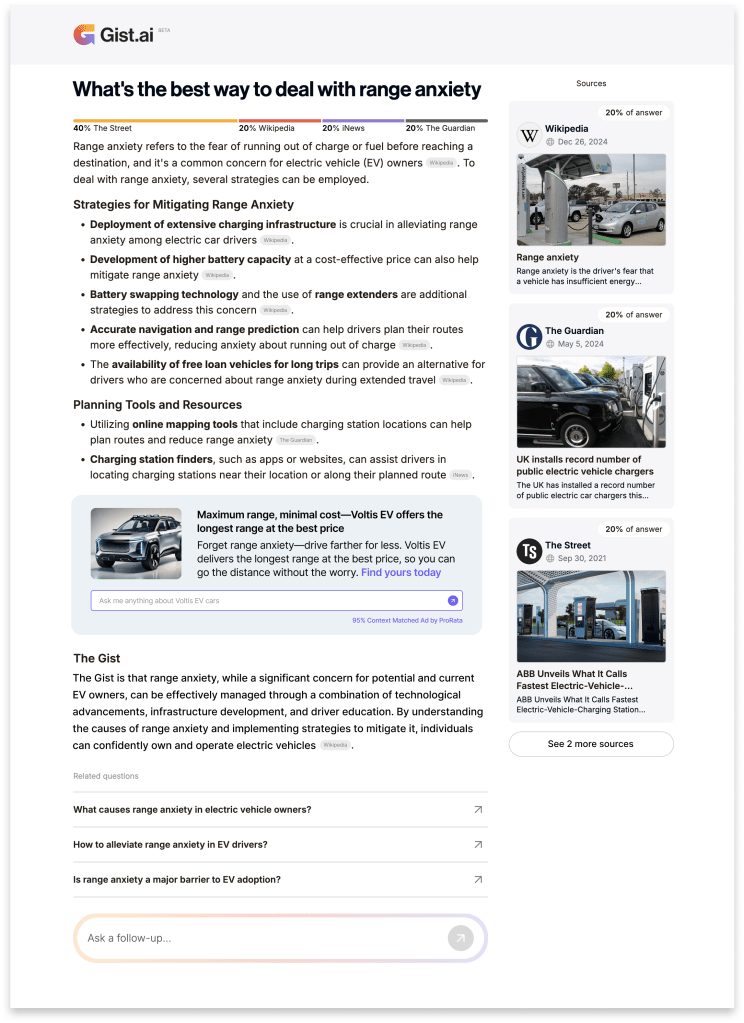
These ads will run across ProRata’s publisher partners, including Time and Fortune, as well as on the startup’s own AI search engine, Gist.ai, alongside relevant queries.
“Ads on the open web must evolve to meet the new user experiences that AI platforms offer,” Mark Howard, Time’s chief operating officer, said in an email statement to ADWEEK. “We see this as a solution for AI to empower a new alignment of messages, interactivity and engagement.”
A recent Bain & Company survey of 1,117 people found that 80% now rely on AI-generated results for at least 40% of their searches, slashing organic web traffic by 15% to 25%. Advertisers want in, but the also want ads that convert without the programmatic headache of landing on junky MFA sites.
“This is the future of advertising,” startup ceo, Bill Gross, told ADWEEK. “Without LLM you couldn’t do this at scale”
ProRata’s ad bidding will use a CPC (cost-per-click) model, with a base CPC set at 10 cents.
“As CPMs are being squeezed by untargeted ads, [with relevant ad placement] we can boost publisher revenue by giving them something that’s context sensitive,” Gross said.
After spending the last month testing its ad products with 100 ad partners and 100,000 products, ProRata has seen a nearly 250% increase in click-through rates with contextual matching, outperforming traditional run-of-site ads, said Gross. The company wouldn’t share specifics on its ad partners. ProRata Ads is now opening its ad tools to all brands.

Real-time interactive banner ads
ProRata is also introducing interactive ad banners that let users engage with brands in real time. These AI-powered display ads, which appear on publisher sites, feature a built-in search bar that lets users ask follow-up questions about the brand directly within the ad. The system surfaces relevant answers immediately, creating a more dynamic and engaging ad experience across publisher sites. Startups like Dappier have released interactive banner ad formats as well.
ProRata plans to share user queries from the interactive banners with advertisers, helping them better understand what people are searching for.
ProRata is also rolling out a slider feature, which lets advertisers set the percentage of ad-to-content relevance they want.
Gross sees ProRata Ads as an answer to privacy concerns, offering a way to target audiences without relying on traditional tracking methods.
“We don’t need to cookie you, track your demographics, or analyze your browsing history,” he said. “It’s all about what you’re reading right now. It’s a win-win-win—for readers, who get relevant content; for publishers, who make double the CPM; and for advertisers, who see a much higher ROI.”

https://www.adweek.com/media/ai-prorata-brands-create-contextually-ads/