Building a Power Trio of Creatives, Marketers, and Tech
This post was created in partnership with Adobe
Marketing and creative teams may work differently, but their goal is the same: deliver fresh, relevant content that drives results—fast and at scale.
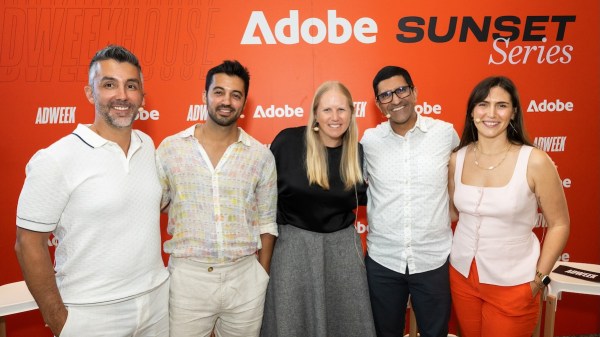
During an ADWEEK House Cannes Sunset Series panel co-hosted with Adobe, industry experts shared how they’re modernizing the content supply chain by uniting creatives, marketers, and technology.
Knocking down the silos
When implemented effectively, technology can tear down barriers between teams. “What we’ve seen is that having both the creative team as well as the marketing team on a single platform brings down the silos that have typically existed,” said Varun Parmar, general manager, of Adobe GenStudio and Firefly for Enterprise at Adobe. “Having them on the same platform and giving visibility to the creator unlocks that you know what’s performing or not.”
Beyond eliminating barriers, Kelly Maclean, VP of engineering, science, and product for Amazon DSP at Amazon Ads, uses tech to deal with the fragmentation inherent in the world of connected TV (CTV). “How do we ensure that we’re building the right tools to reach people on that specific content? That was a big focus for us, ensuring that we’re layering on these trillions of signals.”
Enter AI
Nuno Leal, principal and marketing, product, and data/AI strategist, consulting at EY, views AI as a bridge between creative and marketing, and as an integral component of the modern content supply chain.
“AI has been very active on the performance side. I think there’s a lot of traction there,” he shared. “I think the generative models are going to be much more pervasive on the creative side, and they’re just going to amplify what a creator does. And those workflows coming together—not just the technology but also the process, the skills, the training—it’s all these points getting together that will actually deliver an advantage on marketing.”
While Leal said AI will amplify creator work, other creatives are concerned AI will replace them. “We’ve been really careful to make sure folks understand we’re not trying to replace people,” said Evan Giamanco, SVP of ad product and revenue strategy at Warner Bros. Discovery. “We’re trying to enable people with creative, like automating basic tasks such as brief generation or creative versioning for different markets,” he explained. “These are the kinds of tasks that will free up people to have more time to be creative.”
Training up
Leal contends that the integration of teams and workflows is probably the No. 1 differentiator of great companies. But key to that integration is education: “There are foundational things that you need to know, because even if you work with other functions, you’ve got to learn the language to be able to speak, to be able to understand, and to have context and deliver the best outcomes.”
Parmar saw firsthand how a lack of training impeded results. When Adobe GenStudio began integrating AI into its processes, some of the marketers were dissatisfied with the models and outputs. The issue, however, wasn’t the tech but rather the marketers’ lack of prompt training.
“We came to the realization that we need to actually infuse these marketing teams with AI-native folks,” he recalled. “So, we hired college graduates who were more accepting of using these models. And those were the folks that we paired with our ‘traditional performance marketers’ when it came to creating this content.”
“It’s people, it’s process, it’s platforms,” Giamanco added. “But if you don’t have good training to teach folks how to use these systems, it falls apart quickly.”
Off to a good start
Even when creative and marketing teams have effectively integrated AI into their workflows, organizations can still falter when trying to optimize their modernized content supply chain.
Some may be overly ambitious, others too timid. The most successful companies, Leal said, “find a middle ground where they acknowledge that AI is going to be a key component of their business model—their delivery model. And they pick a couple of areas where they’re going to build a foundational capability on that.”
Parmar said that the best place to start an effective integration is “with an unmet and underserved area, because then you can instantly show the proof point of value. And once you have value shown to internal stakeholders, you suddenly have folks standing by you to go bigger and broader.”
https://www.adweek.com/creativity/building-a-power-trio-of-creatives-marketers-and-tech/