Google AI Mode Prices Differ From Product Carousel For Same Items via @sejournal, @MattGSouthern

Data finds Google AI Mode rarely shows the same products as the regular results carousel, and often lists a different seller when it does.

The post Google AI Mode Prices Differ From Product Carousel For Same Items appeared first on Search Engine Journal.

https://www.searchenginejournal.com/google-ai-mode-prices-differ-from-product-carousel-for-same-items/588227/


Microsoft Advertising Rolls Out AI Max Globally via @sejournal, @brookeosmundson

Microsoft Advertising has started rolling out AI Max for Search campaigns globally, expanding availability after several months of testing.

The rollout follows Microsoft’s April 21 announcement of AI Max and an open pilot that began in May. The feature suite is now becoming generally available across Microsoft Advertising accounts.

Additionally, they’ve provided clearer guidance around how existing campaigns and Google Ads imports will be handled.

The broader rollout builds on the same three AI Max features Microsoft introduced earlier this spring.

AI Max Moves Beyond the Open Pilot

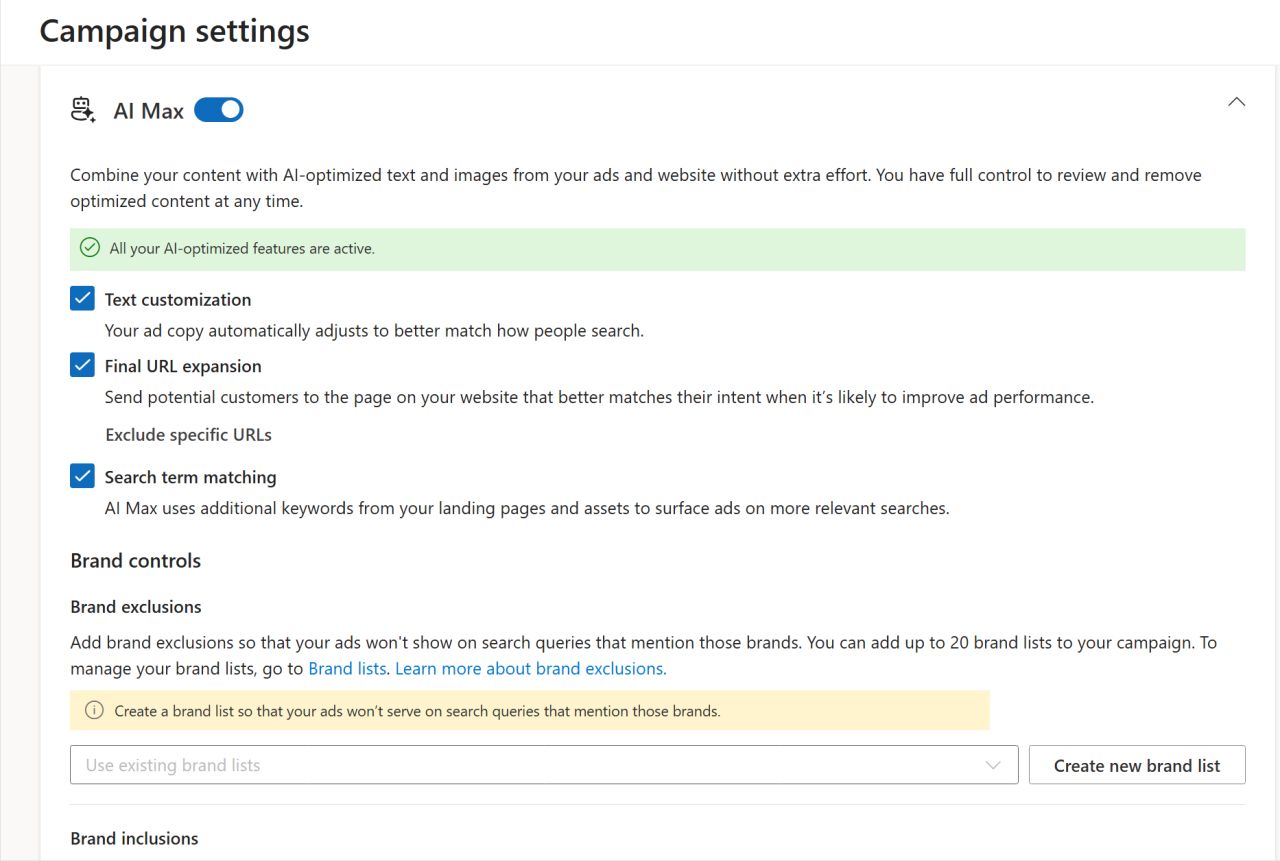
AI Max adds three automation features to existing Search campaigns:

  • search term matching
  • text customization
  • final URL expansion

Search term matching can reach queries beyond an advertiser’s keyword list using signals from keywords, ads, landing pages, and user intent. Microsoft says this can help advertisers appear for more complex conversational searches, including those within Bing and Copilot.

Text customization uses existing assets and website content to generate additional ad messaging. Final URL expansion can select a different landing page when Microsoft determines it better matches the user’s intent.

Microsoft is encouraging advertisers to test the three features together, although each can be tested individually through optimization experiments.

One of the more noteworthy updates is that Microsoft is retaining ad group-level settings, giving advertisers more control over where AI Max features are applied.

Brand Controls and Reporting Available From Day One

Microsoft is emphasizing advertiser controls as AI Max moves beyond the pilot.

Brand inclusions and exclusions are available with the rollout, along with term exclusions for text asset generation. Advertisers can also use URL rules to limit where final URL expansion can send traffic.

Image credit: Microsoft, August 2026

Microsoft Ads Liaison Navah Hopkins said advertiser feedback played a role in making those controls available at launch:

We heard your feedback it’s a really critical tool to include.

Some advertisers may also notice AI Max settings already enabled in existing campaigns.

Microsoft is moving Predictive matching and autogenerated text assets under AI Max. Campaigns already using either feature will have the corresponding AI Max setting enabled automatically.

The remaining AI Max features will not be activated unless an advertiser opts into them.

What Happens With Google Ads Imports?

AI Max settings can also carry over when advertisers import campaigns from Google Ads.

If a Google Search campaign has supported AI Max features enabled, those settings will be enabled in the corresponding Microsoft Advertising campaign after import.

However, there is an exception for campaigns that originated as Dynamic Search Ads (DSA).

If an imported Google AI Max campaign was previously upgraded from DSA, Microsoft will convert it back into a DSA campaign while it continues building additional AI Max functionality.

The main reason behind this shift is that Microsoft has not announced an official sunset date for Dynamic Search Ads, where Google already has a firm date.

What Comes Next For AI Max

AI Max is moving into general availability at a time when both Microsoft and Google are asking advertisers to give Search campaigns more room to find queries beyond traditional keyword targeting.

Microsoft is starting its broader rollout with many of those controls already in place, rather than adding them later in response to advertiser concerns.

Now that AI Max is reaching accounts globally, the next test is whether advertisers see enough incremental value from that additional automation to keep it enabled.

https://www.searchenginejournal.com/microsoft-advertising-rolls-out-ai-max-globally/586459/


HubSpot AEO vs. Scrunch: Which tool fits your workflow?

If you’re evaluating answer engine optimization tools, here’s the short version: HubSpot AEO is an insight-to-execution platform that connects AI visibility data directly to your CRM and content workflows. Scrunch is a focused monitoring and benchmarking tool that excels at multi-engine tracking and competitive share-of-voice analysis.

Get Started with HubSpot's AEO Tool

The right choice depends on whether you need a unified platform that closes the loop from research to action, or a dedicated tracker that feeds data into a workflow you’ve already built elsewhere.

Both tools are built for the same underlying shift: AI-generated answers on platforms like ChatGPT, Gemini, and Perplexity are increasingly the first touchpoint for buyers doing product research — often before they ever reach a brand’s website.

HubSpot reports that organic traffic for its customers fell 27% year-over-year in 2025–2026, while AI referral traffic tripled over the same period. Companies that fail to monitor AI visibility are losing early-funnel opportunities to more attentive competitors.

This comparison is structured as a side-by-side decision guide for marketing leaders, SEO strategists, content teams, and RevOps buyers who are evaluating which tool best fits their workflow, tech stack, and reporting needs. Ready to see HubSpot AEO in action? Start your free 28-day trial — no credit card required.

Table of Contents

TL;DR: HubSpot AEO vs. Scrunch In One Minute

HubSpot AEO is ideal for teams that want to close the visibility gap and publish content without leaving their existing platform. It tracks how your brand appears in ChatGPT, Gemini, and Perplexity, surfaces prioritized recommendations, and — for Marketing Hub Pro and Enterprise customers — connects those recommendations directly to the content tools and CRM data you’re already using.

Pricing starts at $50/month standalone, or it’s included at no extra cost in Marketing Hub Pro and Enterprise plans.

Scrunch is best for teams that need broad AI engine benchmarking and don’t want to change their existing content production stack. Its core strength is monitoring across multiple engines with prompt-level visibility, sentiment analysis, and competitive share-of-voice data.

The core trade-off: HubSpot AEO offers shorter time-to-value for teams already on HubSpot, thanks to native CRM integration and built-in content tooling. Scrunch offers deeper standalone benchmarking across more engines for teams with a more complex, multi-vendor stack — particularly at the enterprise tier.

  • Best for unified execution: HubSpot AEO
  • Best for focused benchmarking: Scrunch

HubSpot AEO vs. Scrunch at a Glance

The table below maps each tool across the stages of a typical AEO workflow. Use this to quickly identify where each platform adds value — and where you’d need to supplement.

Workflow Stage

HubSpot AEO

Scrunch

Research / prompt strategy

CRM-informed prompt suggestions based on your industries, competitors, and customer segments

Manually configured custom prompts; persona segmentation available on paid plans

AI engine coverage

ChatGPT (GPT-5.2), Gemini, Perplexity (3 engines, standalone)

Core: ChatGPT, Perplexity, Google AI Overviews, Copilot (4 engines); Enterprise: up to 9 engines

Content production

Recommendations link directly to HubSpot’s Content Hub and Blog tool (Marketing Hub Pro/Enterprise); content tooling built in

No native content generation; recommendations surface gaps, execution is handled externally

Optimization

Prioritized recommendations (create new page, fix technical gap, publish social post, earn third-party citations)

Site audit, content gap analysis, schema/structured data guidance; optimization workflow is research-oriented

Distribution/collaboration

Native HubSpot workflows; the team can act on recommendations inside the same platform used for social, email, and landing pages

No native distribution; data exports and API available for external workflows

Measurement / reporting

Brand visibility score, share of voice, sentiment, citation analysis; native Marketing Hub reporting for Marketing Hub customers

Prompt-level visibility, sentiment, competitive benchmarking; GA4 integration for AI referral traffic; API for custom dashboards

Integrations

Native HubSpot Smart CRM, Content Hub, Marketing Hub, Breeze Assistant; no additional connector setup for existing HubSpot customers

GA4, Google Search Console, Looker Studio, Tableau, Power BI, Shopify, Webflow; CDN integrations (Cloudflare, Vercel, Akamai) at Enterprise; Data API

Pricing posture

$50/month standalone; included in Marketing Hub Pro ($800/month) and Enterprise

Core: $250/month (annual) / $300 monthly; Enterprise: custom

Free trial

28-day free trial, no credit card required

7-day free trial

Governance / security

HubSpot platform security; SSO and RBAC available within Marketing Hub Enterprise tiers

SOC 2 Type II; SAML/OIDC SSO; RBAC; Enterprise Data API

Legend: “Included” means the capability is native to the tool. “External” means you’d need a separate tool or workflow to accomplish the task. “Enterprise” means the feature requires a custom-priced plan.

Unified platform advantage. For teams already on HubSpot, AEO has a structural time-to-value edge: your CRM, content tools, and reporting are already connected. The tool suggests prompts based on your actual customer segments, not generic industry questions, and recommendations feed directly into the workflows your team already uses.

With Scrunch, the monitoring data is robust, but execution runs in a separate system, adding coordination overhead for most content teams.

HubSpot AEO vs. Scrunch Across Your Workflow

Research and Prompt Strategy

Prompt selection is where these two tools diverge early. In HubSpot AEO, the platform automatically suggests prompts based on your CRM data. Your company profile, the competitors you track, and the customer segments already defined in your HubSpot account.

A B2B SaaS company selling to HR teams gets different default prompts than a professional services firm. You can also add custom prompts at any time, and there’s no hard cap on how many you track (each prompt costs credit toward your plan, and you can buy more).

In Scrunch, prompts are user-configured. The platform doesn’t know your business until you tell it, meaning you define the questions, segment them by persona, and map them to funnel stages. For teams with a well-developed prompt taxonomy and a clear sense of the questions their buyers ask, this is perfectly workable.

For teams just getting started with AEO, it adds a meaningful setup burden.

Pro tip: If you’re building your AEO prompt library from scratch, HubSpot’s AEO Grader can generate a free one-time snapshot of your current visibility across ChatGPT, Perplexity, and Gemini — a useful starting point before you invest in ongoing tracking.

Content Production and Optimization

This is where the two tools diverge the most. HubSpot AEO is designed to move from diagnosis to execution without leaving the platform. Recommendations are prioritized and action-specific. Instead of a vague recommendation like “improve your content,” you’ll get concrete next steps: create a post, fix a page, publish to social media, or earn a third-party mention.

For Marketing Hub Pro and Enterprise customers, those recommendations connect directly to HubSpot’s content tools, where writers, editors, and strategists are already working.

Scrunch surfaces visibility gaps and provides site audit data, but content creation and optimization happen outside the platform.

Scrunch positions itself as the monitoring and analytics layer, rather than the execution layer. Teams using Scrunch need to own the workflow between “insight” and “published content” themselves.

What we like about HubSpot AEO: HubSpot AEO’s recommendations go beyond identification by specifying what to build and explain the reasoning behind prioritization choices. For content teams managing multiple topics and competing priorities, HubSpot AEO turns AEO from a reporting exercise into a production queue.

What we like about Scrunch: The site audit functionality is thorough, and the ability to see diagnostic data (e.g., “Why is my brand absent from this answer?”) is more developed than most tools in the category. If you already have a strong content operation, Scrunch’s gap data feeds it well.

Distribution and Collaboration

HubSpot AEO’s distribution advantage comes from its native integration with the HubSpot platform. Recommendations that involve social posts, landing pages, or blog content connect directly to the tools your team uses for publishing and distribution. There’s no context switching required to act on an AEO insight.

For teams using Marketing Hub Pro or Enterprise, this means AEO recommendations can be turned into tasks, drafts, or published content in the same workflow used for all other content.

Scrunch doesn’t have native distribution tooling. The platform’s strength lies in the monitoring and reporting layer rather than in helping you publish content. Teams that use Scrunch typically maintain a separate content workflow (in Notion, Asana, Contentful, Webflow, etc.) and use Scrunch’s insights to prioritize that backlog.

Pro tip: For teams evaluating Scrunch as a standalone tool, factor in the cost and coordination overhead of maintaining a separate content workflow. The true total cost of the sum of monitoring, production, publishing,+andpublishing + reporting.

Measurement and Reporting

Both tools give you the core AEO metrics: brand visibility score, share of voice, sentiment, and citation analysis. Where they differ is in how those metrics connect to the rest of your reporting stack.

HubSpot AEO’s reporting is built into the HubSpot platform. For Marketing Hub Pro and Enterprise customers, AI referral traffic data appears natively alongside your other marketing analytics. That means you can connect AEO visibility trends to lead volume, contact attribution, and campaign performance without building a custom dashboard.

Scrunch’s reporting strength is in granularity and portability. Its GA4 integration is widely noted as a standout feature, identifying which AI crawlers are visiting your site and how they interact with your content, providing a level of technical detail that traditional analytics tools miss.

Scrunch also offers integrations with Looker Studio, Tableau, and Power BI, plus an enterprise-tier Data API, making it attractive to analytics-forward teams with established BI infrastructure.

Best for: Teams with complex BI stacks who want to own their reporting layer → Scrunch’s API and analytics integrations. Teams that want AEO data in context alongside their marketing performance data benefit from HubSpot’s native AEO reporting.

HubSpot AEO vs. Scrunch Integrations and Ecosystem

HubSpot AEO lives within the HubSpot customer platform, which means its integration story differs from that of a typical point solution. Rather than connecting to external systems, it inherits connections to the tools already in your HubSpot stack: Smart CRM, Marketing Hub, Content Hub, and Breeze Assistant.

For teams already using HubSpot across marketing, sales, and service, this is a significant advantage because there is no additional connector setup, no data syncing, and no separate login.

For teams not on HubSpot, the integration picture is more limited. HubSpot AEO is a standalone product that doesn’t natively connect to Salesforce, HubSpot’s competitors, or third-party content platforms. You get the AEO tracking and recommendations layer, but the CRM-powered intelligence requires a HubSpot CRM subscription to unlock.

Scrunch takes the opposite approach: it’s designed to slot into an existing tech stack as an analytics layer. Native integrations include GA4, Google Search Console, Looker Studio, Tableau, Power BI, Shopify, and Webflow.

At the Enterprise tier, CDN-level integrations with Cloudflare, Vercel, and Akamai enable the Agent Experience Platform (AXP), which delivers AI-optimized content to AI crawlers without compromising the human visitor experience. A Data API is available at enterprise tier for teams that want to build custom pipelines.

Implementation guidance by stack:

  • HubSpot-first stack: HubSpot AEO is the natural fit. Setup is minimal, CRM intelligence is automatic, and the execution workflow is already in place.
  • Salesforce + separate CMS: Scrunch is the stronger fit for monitoring and benchmarking. Pair it with your existing content workflow; use Scrunch’s API or BI integrations to surface data in your reporting stack.
  • Mixed/hybrid stack with strong analytics infrastructure: Scrunch’s portability advantage (GA4, Looker Studio, Data API) makes it the better analytics layer. Consider whether HubSpot AEO’s $50/month standalone edition makes sense as a secondary CRM-informed source of prompts.
  • Agency managing multiple brands: Scrunch’s Agency Core plan ($500/month) includes unlimited seats, three brand workspaces, and three pitch workspaces. HubSpot AEO supports multiple brands via separate $50/month instances.

HubSpot AEO vs. Scrunch Data Coverage and Engines

Why engine coverage matters. Your AI visibility score is only as useful as the engines you’re being measured on. As of mid-2026, the dominant AI answer surfaces for most B2B and B2C buyers are ChatGPT, Google Gemini, and Perplexity — but Claude, Google AI Mode, Microsoft Copilot, and Meta AI are growing fast, and the mix varies significantly by industry and audience.

A tool that only tracks three engines may miss meaningful visibility gaps, or conversely, may report strong performance that doesn’t reflect where your actual buyers are.

HubSpot AEO tracks three engines on all plans:

  • ChatGPT (GPT-5.2)
  • Gemini
  • Perplexity

For most B2B SaaS and mid-market use cases, these three engines cover the majority of high-intent AI-search activity. The trade-off is that Claude, Microsoft Copilot, Google AI Mode, and Meta AI are not currently tracked. For teams where enterprise buyers are using Microsoft Copilot, or where Claude is a material visibility surface, this is a real gap to plan around.

Scrunch offers broader engine coverage, though the actual coverage you get depends heavily on your plan tier. The Core plan covers four engines: ChatGPT, Perplexity, Google AI Overviews, and Microsoft Copilot. Enterprise unlocks up to nine engines, including Claude, Gemini, Meta AI, Google AI Mode, and Grok.

This means the “nine-engine coverage” often cited in Scrunch marketing is an Enterprise-tier number — not what you get at entry pricing.

Practical impact on editorial priorities. Engine coverage directly shapes which visibility gaps surface in your dashboard — and therefore which content you prioritize. A team tracking ChatGPT, Gemini, and Perplexity may identify different gap clusters than one tracking Copilot and AI Mode.

Before committing to either tool, audit which engines your buyers actually use. Industry-specific patterns vary: financial services buyers skew toward Copilot and Gemini; tech buyers use ChatGPT and Perplexity heavily; consumer audiences are increasingly on Meta AI.

Pro tip: Use HubSpot’s free AI Search Sensor to monitor industry-wide AI visibility trends before committing to a prompt taxonomy. This is a useful way to spot which engines are gaining share in your category before you’ve invested in ongoing tracking.

Daily updates and trend tracking. Both tools run prompts on a recurring cadence and give you trend data over time — this is important for understanding whether your visibility is improving, and for identifying which content updates are driving citations. Daily refresh cadences let editorial teams make faster pivots when competitor activity or model updates shift the answer landscape.

HubSpot AEO vs. Scrunch Pricing and Value

Plan structures at a glance:


HubSpot AEO (Standalone)

HubSpot AEO (Marketing Hub Pro)

Scrunch Core

Scrunch Enterprise

Price

$50/month ($45 annual)

Included in Marketing Hub Pro ($800+/month)

$250/month (annual) / $300 monthly

Custom

Prompts

25 (buy more anytime)

Expanded prompt set

125 custom prompts

Custom

Engines

3 (ChatGPT, Gemini, Perplexity)

3 (same)

4 engines

Up to 9 engines

Users/seats

—

Based on Marketing Hub tier

5 seats

Custom

Free trial

28 days, no credit card

N/A (included)

7 days

N/A

Content tooling

Recommendations only (standalone); full content tools (Marketing Hub Pro/Enterprise)

Full HubSpot content tools + CRM-powered recommendations

None

None

CRM integration

Native (HubSpot CRM)

Native (HubSpot Smart CRM)

None

None

How to think about total cost of execution. The prompt-level price comparison understates the full cost picture. With Scrunch, the monitoring cost is one line item — but you still need a content production tool, a publishing workflow, a CMS, and potentially a separate analytics layer.

With HubSpot AEO at Marketing Hub Pro, much of that infrastructure is already in place. For teams that would otherwise pay separately for content tools, CRM, and analytics, the bundled value of Marketing Hub Pro can significantly reduce total workflow cost.

For smaller teams or those evaluating AEO as a new channel, HubSpot AEO offers an extremely low-risk entry point. The 28-day free trial with no credit card requirement reduces evaluation friction further.

Budget callout by team size:

  • Startup / small team (< 5 marketers): HubSpot AEO standalone ($50/month) is the clear starting point. Scrunch Core’s $300/month entry price is difficult to justify at this scale without significant AEO maturity.
  • Mid-market (5–50 marketers): If you’re already on Marketing Hub Pro, AEO is included at no extra cost. If not, evaluate whether the $50/month edition plus your existing stack gets you where you need to be.
  • Enterprise (50+ marketers, complex stack): Scrunch’s Enterprise tier (custom pricing) may be worth the investment if you need nine-engine coverage, SOC 2 compliance, SAML SSO, and a Data API for custom pipelines. Marketing Hub Enterprise also includes AEO and adds the full platform’s security, automation, and CRM infrastructure.

Which should you choose based on your team?

Choose HubSpot AEO if you need unified execution.

HubSpot AEO is the right choice if your primary goal is to close the loop between AI visibility data and content action — without adding a new system to your stack. It’s especially strong for teams that:

  • Are already using HubSpot Marketing Hub (AEO is included at no extra cost in Pro and Enterprise)
  • Want CRM-informed prompt suggestions rather than building a prompt library from scratch
  • Need their AEO recommendations to connect directly to the content tools their writers and strategists already use
  • Are newer to AEO and want clear, prioritized guidance on what to do next rather than raw monitoring data
  • Have a lean team where workflow fragmentation creates real coordination cost
  • Want to start fast: the 28-day free trial and $50/month entry price are the lowest barrier to entry in the category

Start your free trial of HubSpot AEO — 25 prompts across ChatGPT, Gemini, and Perplexity, no credit card required.

Choose Scrunch if you need focused competitor benchmarks.

Scrunch is the stronger choice when your primary need is deep, multi-engine competitive benchmarking — especially if you already have a content production and publishing workflow that you don’t want to disrupt. It fits best for teams that:

  • Need coverage across more than three engines (particularly Microsoft Copilot, Claude, or Google AI Mode)
  • Are already using a Sitecore DXP stack (post-acquisition, Scrunch integrates directly with Sitecore’s digital experience platform)
  • Have an established BI infrastructure and need a Data API to feed AI visibility data into existing dashboards
  • Run an agency managing multiple brand accounts and want per-client workspaces
  • Have a dedicated analytics or SEO team that can translate monitoring data into content briefs independently

When a Hybrid Stack Makes Sense

Some teams run both tools simultaneously — using HubSpot AEO for day-to-day recommendation-driven execution and Scrunch (or another multi-engine tracker) for broader benchmarking and competitive intelligence. This makes practical sense when:

  • You’re on HubSpot Marketing Hub Pro or Enterprise (AEO is already included, so the marginal cost is low)
  • You have specific engines in your buyer journey (e.g., Microsoft Copilot for enterprise prospects) that HubSpot AEO doesn’t currently cover
  • Your SEO or analytics team wants richer raw data feeds alongside the action-oriented recommendations HubSpot surfaces

For most teams, though, the hybrid stack adds coordination overhead that isn’t worth the marginal coverage gain. Start with the tool that fits your primary workflow, validate AEO as a channel, then expand coverage once you’ve established a baseline.

Alternatives to HubSpot AEO and Scrunch

The AEO tool category expanded rapidly in 2025–2026. Depending on your workflow, stack, and budget, several adjacent tools are worth evaluating alongside HubSpot AEO and Scrunch:

  • Profound — Enterprise-grade AEO platform with strong security credentials, broad integrations, and a focus on content workflow automation alongside monitoring. Pricing is custom; suited for large teams with complex compliance requirements.
  • AthenaHQ — Combines monitoring, auditing, and AI-generated content capabilities (briefs, outlines, full articles) in a credit-based system. Self-serve plan starts at $295/month. Good fit for content-heavy teams that want drafting help alongside gap identification.
  • Conductor Intelligence — Extends an established SEO platform with AI visibility insights; best for enterprise teams with large content operations who want AEO as an overlay on an existing SEO workflow.
  • AirOps — Connects AEO monitoring to governed content production workflows, with native CMS integrations for Webflow, WordPress, and Contentful. Positions itself as the execution layer that monitoring-only tools leave open.
  • Semrush AI Visibility — Natively integrated with the Semrush SEO ecosystem; practical for teams already using Semrush who want AEO as an adjacent signal.

How to evaluate: Before testing any tool, answer three qualification questions: (1) Where does your biggest workflow gap actually sit — monitoring, content production, or reporting? (2) Which AI engines do your buyers demonstrably use? (3) What does your existing stack already cover, and what would you be adding net-new?

If the honest answer is “we don’t know yet,” start with a free assessment. The AEO Grader gives you a free snapshot of your current AI visibility across ChatGPT, Perplexity, and Gemini — a useful baseline before you commit to any paid tool.

How AEO differs from SEO

If you’re new to answer engine optimization, here’s a plain-English primer on where it fits alongside your existing search strategy.

SEO (search engine optimization) is the practice of improving how your content ranks in traditional search engine results pages — primarily Google and Bing. It focuses on keywords, backlinks, technical site health, and organic rankings. The goal is to appear high on a results page so users click through to your website.

AEO (answer engine optimization) is the practice of improving how your brand is described, cited, and recommended by AI answer engines — primarily ChatGPT, Gemini, and Perplexity. Instead of ranking on a page of links, the goal is to appear in the answer itself.

AEO focuses on structured content, entity authority, citation signals, and the accuracy of the information AI models use to describe your brand. AEO is compared with SEO not as a replacement, but as a complementary discipline — the two work together in a modern search visibility strategy.

Why teams should run both in parallel. The buyers who use AI search don’t stop using Google, and the buyers who use Google increasingly consult AI as well. A strategy that covers both channels captures more of the discovery journey.

In practice, many of the fundamentals overlap: high-quality structured content, strong E-E-A-T signals, and authoritative third-party coverage help your brand in both traditional search and AI-generated answers.

The practical differences show up in measurement (rank positions versus visibility scores and share of voice), in content format (keyword-optimized copy versus answer-first, structured, citation-ready content), and in the signals that matter most (backlinks and technical SEO versus entity authority, source credibility, and structured data).

Teams evaluating where to start can use the free AEO Grader to assess their current AI visibility before committing to a full optimization strategy. For a deeper dive on the discipline itself, HubSpot’s answer engine optimization guide covers the fundamentals in detail.

Frequently Asked Questions About HubSpot AEO vs. Scrunch

Do I need HubSpot Marketing Hub to use HubSpot AEO?

No. HubSpot AEO is available as a standalone product for $50/month (or $45/month billed annually), with no other HubSpot subscription required. You can track 25 prompts across ChatGPT, Gemini, and Perplexity and access brand visibility scores, citation analysis, and prioritized recommendations without a Marketing Hub plan.

That said, the tool’s most powerful features — CRM-informed prompt suggestions, deeper recommendation intelligence, and the ability to act on recommendations directly within HubSpot’s content tools — require Marketing Hub Pro or Enterprise, which includes AEO at no additional cost.

Start with the standalone plan, then evaluate whether upgrading to Marketing Hub makes sense as your AEO practice matures.

Can I run HubSpot AEO and Scrunch together?

Yes. There’s no technical conflict, and some teams do run both. The most common setup is to use HubSpot AEO as the primary action-oriented tool (recommendations, content workflow) and Scrunch as a broader benchmarking layer for engines that HubSpot doesn’t currently cover (such as Microsoft Copilot or Claude).

Whether the additional coverage justifies the cost depends on how material those engines are in your buyer’s journey. If the engines HubSpot AEO covers — ChatGPT, Gemini, and Perplexity — represent the bulk of your high-intent AI search activity, a hybrid stack may not be necessary.

How quickly will we see impact after implementation?

For HubSpot AEO, you’ll have a working visibility baseline within your first session — the dashboard populates quickly, and prompt-level data is available from day one of your trial. For content-driven impact (actual visibility improvement in AI answers), most teams see measurable movement within 4–8 weeks of acting on recommendations, depending on how quickly they publish and how authoritative their domain is.

For Scrunch, the monitoring baseline is similarly quick to establish, but execution timelines depend on your existing content workflow. Neither tool creates visibility overnight — AEO impact compounds over time as you build a library of citation-worthy, answer-first content.

Which AI engines should we prioritize first?

Start with the three engines where buyer intent is highest in your category: ChatGPT, Gemini, and Perplexity. These three account for the majority of high-intent AI search activity among most B2B and B2C buyers as of mid-2026. Once you’ve established a baseline and a working optimization rhythm, layer in additional engines tailored to your specific audience.

Enterprise buyers in financial services and professional services tend to use Microsoft Copilot more heavily; consumer and SMB audiences are increasingly active on Meta AI. Use HubSpot’s free AI Search Sensor to monitor engine-level trends in your industry before expanding your tracking set.

How should we structure content for AI citations?

AI engines prefer content that directly answers the questions buyers are asking, is structured for readability (clear headings, concise paragraphs, defined terms), comes from authoritative sources, and is supported by third-party citations.

Practically, this means: write answer-first (lead with the direct answer, then add context), use structured data and schema markup where relevant, build E-E-A-T signals through bylines and expert sourcing, and actively earn third-party mentions and links from credible domains.

For a deeper treatment, HubSpot’s answer engine optimization guide covers content structuring, entity building, and AEO-SEO integration in detail.

Source


When AI Takes The Click, Click Worthiness Should Guide Your Strategy via @sejournal, @billhunt

In my previous Search Engine Journal article, I argued that organizations need to build Brand Sovereignty by becoming the most authoritative source of truth for AI. As AI increasingly serves as the intermediary between businesses and customers, the organizations most likely to be recommended will be those that provide the highest-confidence evidence about their products, services, and expertise.

The response to that article quickly converged on a practical executive question:

How do we justify continued investment in SEO, content, structured data, and knowledge management if AI is sending us less traffic?

For more than two decades, the answer to that investment question was relatively straightforward. Search volume represented opportunity. More searches led to more website visits, more visits created more opportunities to influence customer decisions, and traffic became the currency by which the SEO team demonstrated business value. Search demand therefore became the primary mechanism for prioritizing investment.

AI answers have weakened that relationship by increasingly satisfying informational intent before customers ever need to click through to the source.

Search demand still reveals customer interests, emerging problems, and consumer language. What it no longer guarantees is that customers will visit the organization that actually supplied the underlying knowledge. AI Overviews, conversational search, and zero-click experiences increasingly separate information consumption from business engagement on which many business plans were built.

Organizations therefore need a new planning layer that complements search volume by identifying where continued engagement still creates measurable business value.

I believe that planning layer is what I call Click Worthiness.

The name is intentionally provocative because it challenges one of SEO’s longest-held assumptions. Click Worthiness is not a framework for increasing click-through rates, nor is it another methodology for recovering traffic lost to AI. Instead, it asks a much more important strategic question:

If AI answers this query, is there still enough value left for customers to benefit from engaging directly with us?

Search volume measures demand for information. Click Worthiness measures the remaining business value of engagement after AI has already satisfied that demand. That distinction fundamentally changes how organizations should prioritize investment.

When The Answer Ends The Journey

Consider two different and specific questions about the same airline.

Does United Airlines fly to Buenos Aires?

Although the question sits close to a commercial transaction, it is fundamentally a request for a fact. Once AI provides a reliable yes-or-no answer, many customers have everything they need. United naturally prefers that they click to continue to schedules, fares, or booking, but the original question itself provides little incremental value beyond additional engagement.

Now consider a different question more illustrative of one done for AI.

Which United itinerary to Buenos Aires gives me the best connection from Boston while allowing me to use my miles?

The customer is no longer seeking a fact but is evaluating a set of conditions to make a decision. The answer depends upon schedules, connection quality, loyalty rules, pricing, award availability, and personal preferences. AI may narrow the choices, but it cannot confidently complete the decision without richer information and direct interaction.

This more complex and intent-aligned response no longer ends the journey but begins one. This distinction captures the essence of Click Worthiness.

Commercial proximity does not automatically create engagement value. The critical question is whether AI fully satisfies the customer’s need or presents a higher-value decision that warrants continued interaction, benefiting both the customer and the organization.

Why Search Volume No Longer Tells The Whole Story

For more than 20 years, search volume served as an excellent opportunity planning metric because the economics of search were remarkably simple. Websites created content for search engines to consume, and in return, there was the potential for traffic and sales. If organizations ranked well for high-volume queries, customers visited because there were few practical alternatives. Today, organizations must ask whether the potential for deeper interaction itself deserves investment.

AI has fundamentally changed the equation, not by reducing the demand for information, but by reducing the need for the searcher to visit its source. Many organizations have responded to this tectonic shift by trying to recover every lost click or by expanding content to capture new ones through competitive gap analysis. Those activities improve completeness, but they rarely create differentiation or increase the potential for clicks.

When every organization studies the same AI answers, fills the same topical gaps, and publishes increasingly similar content, they become more complete while simultaneously becoming more interchangeable.

Completeness is rapidly becoming the cost of participation rather than the source of competitive advantage.

Lessons We Learned Before AI

Competitive advantage will increasingly come from what happens after AI has answered the customer’s first question. Organizations that create meaningful reasons for customers to continue the journey will outperform those that simply publish more complete information.

Years before AI search became mainstream, I encountered a remarkably similar challenge while working with a global spirits company to drive traffic and brand awareness to their cocktail recipes website. Google rapidly introduced new and richer search experiences for cocktail-related queries through featured snippets, recipe formats, image carousels, and other enhancements that increasingly answered questions without requiring users to visit their website.

Our initial reaction mirrored what many organizations are experiencing today. We focused on recovering the traffic we were losing and debated how to create more content. Eventually, we realized we were solving the wrong problem. Similar to AI Overviews, the search experience had evolved, but our content strategy had not.

Rather than asking how to recover every lost visit due to these new engaging features, we asked how we could dominate them, how we could stand out, and what additional value we could provide to someone after they clicked.  That radical shift transformed our thinking.

Instead of publishing more recipes, we built richer experiences. One of the best examples involved the espresso martini. We learned that the image needed to clearly show a martini glass containing what unmistakably appeared to be an espresso martini, complete with the traditional three coffee beans on top.

For every cocktail category, we optimized for ingredient substitutions, bartender techniques, seasonal collections, visual inspiration, and related cocktails, all of which gave customers reasons to continue exploring after receiving the initial answer.

More importantly, we discovered a different audience altogether: the “drink curious.” These searchers were not looking for a single recipe but for ones that let them explore ingredients, colors, occasions, flavors, and entirely new experiences. We stopped optimizing for retrieval and focused on optimizing for inspiration and curiosity.

While AI platforms have changed the search results landscape, the underlying business principle has not: clicks are earned because continuing the journey creates additional value.

Click Worthiness As A Strategic Planning Framework

Being “Click-Worthy” fundamentally changes how organizations must prioritize their investments. Yes, search volume still matters as it informs us what customers want to know. However, it is their click-worthiness that tells us where continued engagement can create measurable and sustainable business value.

Rather than evaluating opportunities solely by search demand, organizations should assess whether continued interaction creates incremental value once AI has already answered the initial question.

We must accept that some interactions naturally conclude once reliable information has been provided, while others naturally flow into comparison, evaluation, reassurance, configuration, personalization, or purchase decisions, in which the organization’s expertise continues to influence the outcome. Those are the interactions where content and infrastructure investments create competitive advantage.

I must make it clear that Click Worthiness should never be evaluated in isolation. More than 20 years ago, Mike Moran and I argued in Search Engine Marketing, Inc. that successful optimization performance begins with a shared objective. Businesses seek profitable growth, customers seek confidence that they are making the right decision, and search engines, now joined by AI systems, seek sufficient evidence to recommend the most appropriate solution.

It is only when those individual objectives align that there will be a mutual benefit, with the value to each realized. That principle remains just as relevant today: customer intent provides the context for evaluating Click Worthiness. High Click Worthiness interactions reveal the customer decisions most deserving of investment. Those decisions identify the information customers need, the expertise organizations must demonstrate, and the structured knowledge AI requires to represent that expertise confidently.

The practical implication of Click Worthiness is that it changes where planning begins. Rather than moving directly from keyword research into content creation and structured data implementation, organizations should first determine whether the customer’s intent creates sufficient value to justify continued engagement. Click Worthiness becomes the strategic decision point that determines whether additional investment in knowledge modeling, structured data, and AI optimization will produce measurable business outcomes.

The Click Worthiness Planning Model

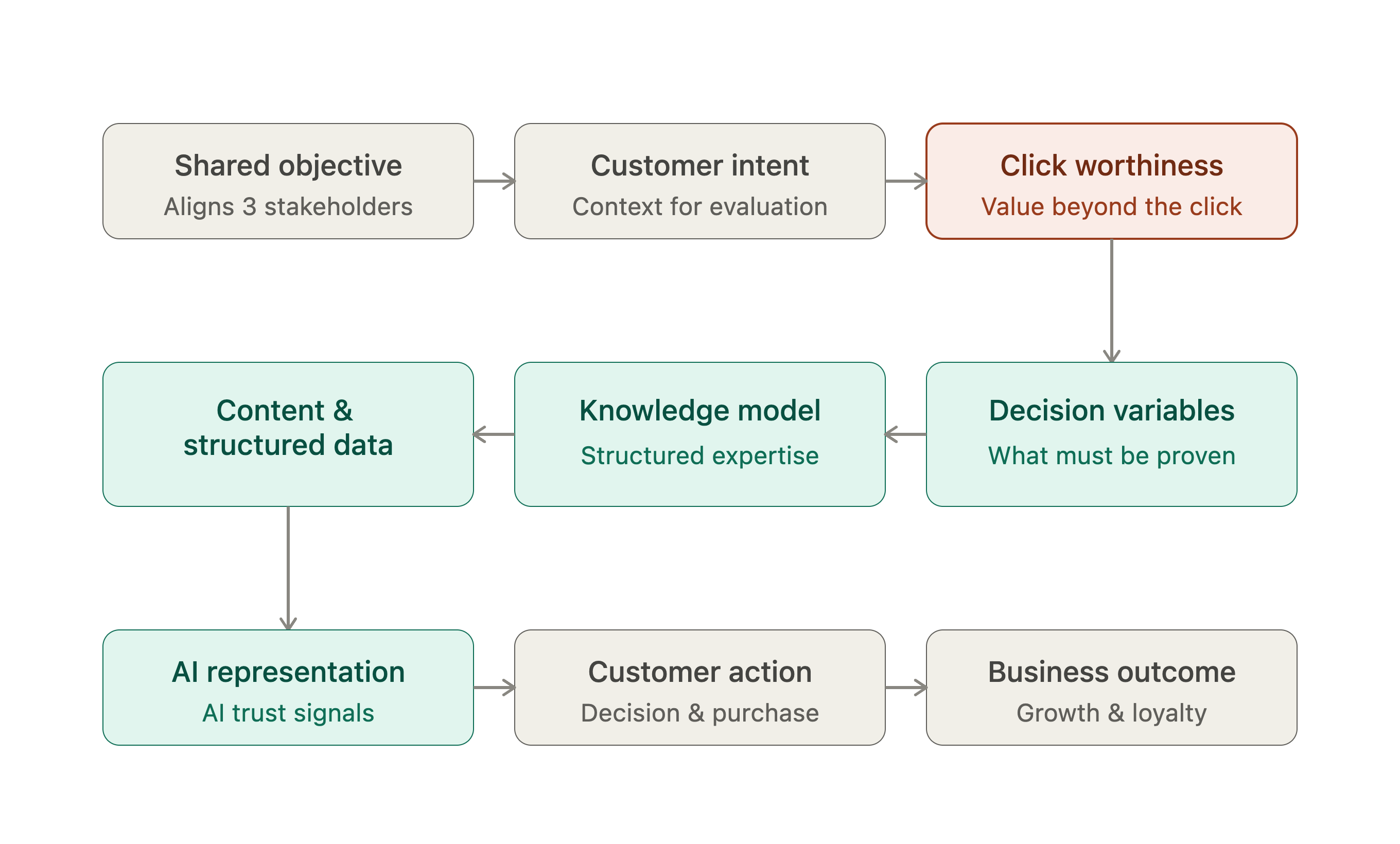
Figure 1 illustrates how Click Worthiness shifts planning from keyword-first optimization toward decision-first optimization.

Image from author, July 2026

Notice where the process begins. The model intentionally starts with a shared objective and customer intent rather than keywords. Click Worthiness sits immediately after intent because it serves as the strategic gate that determines whether the remaining investment is justified. Only after an organization concludes that continued engagement creates measurable value should it invest in defining decision variables, building a knowledge model, implementing structured data, and optimizing AI representation.

Implementation becomes the consequence of strategy rather than the strategy itself.

Measuring Success Beyond Traffic

This planning model also requires organizations to rethink how success is measured.

Traditional SEO metrics such as rankings, impressions, clicks, and traffic remain valuable because they continue to measure visibility. Increasingly, however, they describe only part of the customer journey. Organizations should therefore evaluate success by asking a different set of questions.

  • Are we increasing AI’s confidence in our expertise?
  • Are we improving representation across AI-generated experiences?
  • Are we supporting higher-value customer decisions?
  • Are we creating sufficient incremental value that customers continue engaging after AI has answered the first question?

Brand Sovereignty remains the objective. Click Worthiness provides the planning model that determines where organizations should invest to achieve it. Together, they shift SEO away from maximizing traffic alone and toward maximizing the business value created by trusted knowledge.

In the next article, I’ll examine the knowledge behind those high-value interactions and explain why AI increasingly recommends organizations that model customer decision-making rather than simply publishing product information.

More Resources:


Featured Image: Accogliente Design/Shutterstock

https://www.searchenginejournal.com/when-ai-takes-the-click-click-worthiness-should-guide-your-strategy/582587/


Microsoft Advertising Adds AI Visibility Insights, PMax Testing, And Creative Preview Updates via @sejournal, @brookeosmundson

Microsoft Advertising introduced its first monthly product newsletter on LinkedIn this week. It brings together several features announced over the past few months while introducing new capabilities across AI reporting, Performance Max testing, and creative review.

Rather than focusing on entirely new products, the August update expands existing tools with additional reporting, experimentation, and workflow improvements.

Together, the updates provide a clearer picture of how Microsoft expects advertisers to measure AI visibility, evaluate Performance Max, and review creative before campaigns launch.

Read on to understand what this means for your Microsoft Ads campaigns.

Microsoft Clarity AI Visibility Now Includes Topic Insights

Microsoft is expanding its AI Visibility reporting in Clarity with Topic Insights.

The new reports group AI citations by subject, allowing advertisers to see which topics AI systems associate with their brand, how frequently those topics appear, and where they may have gaps in coverage.

The feature builds on the AI Visibility reporting Microsoft introduced earlier this year by adding another layer of analysis. Instead of reviewing individual citations, advertisers can identify the topics driving those citations and how AI systems understand their content.

The newsletter also defines several AI reporting metrics that advertisers will see inside the new reports, including:

  • Grounding queries: The retrieval searches AI systems generate before producing an answer.
  • Citation share: Measures how frequently a domain appears as a cited source.
  • Share of authority: Shows how often one domain is cited compared with competing sources.

Microsoft also outlined how advertisers can apply those insights to paid search.

They recommend comparing grounding queries with existing search terms, identifying opportunities for new keywords and negative keywords, and adjusting landing pages or ad creative based on competitive AI citation data.

Those recommendations suggest Microsoft views AI visibility reporting as useful beyond organic search by encouraging advertisers to use those insights when optimizing paid campaigns.

While Topic Insights focuses on understanding AI visibility, Microsoft’s next set of updates centers on measuring the impact of AI-powered campaign automation.

Expanding Performance Max Experimentation

Performance Max has become one of Microsoft’s primary AI-powered campaign types, but measuring its incremental impact remains one of the biggest questions for advertisers.

The August newsletter highlights two recently released experiment types designed to help answer that question.

  • Uplift experiments: Measure the impact of adding Performance Max alongside existing campaigns.
  • Upgrade experiments: Compare existing Search or Shopping campaigns against Performance Max after migration.

Together, the two experiment types give advertisers a structured way to evaluate whether Performance Max improves results before making broader campaign changes. The approach also aligns with Microsoft’s recent emphasis on experimentation and measurement across its AI-powered products. Microsoft continues to cite an average 8% increase in incremental conversions from Performance Max campaigns.

Microsoft’s newsletter also included practical guidance for setting up those test. Their recommendation to advertisers:

  • Have at least 30 conversions during the previous 30 days before running experiments.
  • Keep bidding targets, product groups, and campaign settings consistent between test and control groups.
  • Allow 4-12 weeks before evaluating results, depending on conversion volume and conversion lag times.

While these experiments focus on measuring campaign performance, Microsoft’s next update gives advertisers more visibility into how Performance Max creative will appear before launch.

Ad Preview Hub Adds Performance Max Support

Ad Preview Hub previously allowed advertisers to preview Audience ads before launch. The August update extends that functionality to Performance Max while adding Bing Search results page previews.

The expansion could simplify campaign approvals for agencies and in-house teams that rely on creative, legal, or brand reviews before launch.

Teams can generate shareable preview links showing how ads may appear before campaigns go live rather than relying on screenshots captured after ads begin serving. The addition of Bing SERP previews also gives reviewers visibility into Search placements alongside Audience inventory.

Because Performance Max automatically assembles and serves ads across multiple placements, previewing creative before launch can help advertisers identify formatting issues, messaging inconsistencies, or stakeholder concerns before campaigns begin serving.

Taken together with Topic Insights and the new Performance Max experiments, the Ad Preview Hub update reinforces Microsoft’s recent focus on expanding the tools that support AI-powered campaigns, not just the campaign types themselves.

What These Updates Suggest About Microsoft’s Priorities

Looking at these updates together, they point to a consistent pattern across Microsoft’s recent product releases. Rather than introducing entirely new campaign types, Microsoft continues adding reporting, experimentation, and review capabilities around products advertisers are already using.

Across the August updates, Microsoft focuses on helping advertisers answer three necessary questions:

  • How visible is my content in AI experiences?
  • Is Performance Max generating incremental business results?
  • What will my ads look like before they go live?

Each update pairs AI-powered automation with additional reporting, testing, or review capabilities. That gives advertisers more information before making campaign changes instead of relying solely on automated recommendations. During Microsoft Advertising Activate earlier this year, Ads Liaison Navah Hopkins described the company’s approach as “building with you, not just for you.”

Assuming that direction continues, future Microsoft Advertising releases may focus less on introducing entirely new AI products and more on expanding the measurement, experimentation, and workflow tools surrounding them. Those supporting capabilities may have as much day-to-day impact as brand new product releases.

https://www.searchenginejournal.com/microsoft-advertising-adds-ai-visibility-insights-pmax-testing-and-creative-preview-updates/584760/


AI Visibility Measurement: What To Track & What To Ignore

I have dozens of conversations per week with folks in growth and marketing, ranging from directors, VPs of marketing, and CMOs to SEOs in the nitty-gritty day-to-day.

Many of my conversations involve measurement. This is an increasingly challenging topic as traditional SEO metrics are breaking down with the advent of AI answers.

Much of the conversation is spent debunking misconceptions and misguided advice operators see on social media.

It’s not an easy conversation, but it’s important. This means telling people to avoid many of the things they see people promote on social media. It’s not an easy conversation, but it’s the right conversation.

My goal here is to clear up the confusion so you can tie your AI visibility efforts to business outcomes.

What To Track

These are a mix of leading and lagging indicators that you have varying degrees of control over. I’ll make the case for why each one matters, then we’ll cover how to influence them.

Prompts

This is the most obvious and most important decision, because what you measure influences behavior. From dozens of conversations, it’s also what many people get wrong.

It becomes the first domino in a chain of mismeasurement. None of the other metrics, like citation share, brand mentions, or visibility, matter if you’re tracking the wrong set of prompts.

Most AI visibility tools like Profound, Peec, and AirOps will automatically recommend prompts to track, but these are rarely what you should focus on. I haven’t confirmed this, but from what I can tell, they analyze your website and map existing pages back to prompts. They assume the pages already on your site are the ones that should be cited or visible in LLM outputs.

That might be true. But most companies we speak to say, “We aren’t appearing for the prompts we want to show up for,” which tells me they don’t have the right strategy and thus haven’t published the right pages.

AI Visibility

You can see how, if you’re tracking the wrong prompts, you’ll measure visibility for the wrong things.

From our perspective across dozens of clients, ChatGPT is the most commonly used LLM, but it’s worth tracking how often your brand shows up for your target prompts across ChatGPT, Gemini, Google AI Mode, Perplexity, Claude, and Copilot as well.

This is important because ChatGPT’s user base skews consumer, while Claude’s user base skews business and enterprise. If you’re a B2B business, Claude has fewer users, but those users are using Claude at work, which is the context that matters.

Google has also made AI mode more prominent, and with Chrome having dominant market share, many people will see AI mode outputs by default.

Tracking each model separately lets you see whether a change in visibility or traffic is isolated to one model or happening across all of them.

There are also significant differences in how each model searches for and presents information. For example, Claude’s use of Brave versus ChatGPT’s use of Bing; they have their different methodologies for selecting sources; and each model has preferred sources through media partnerships.

Self-Reported Attribution

For most of the last decade, marketers leaned on clickstream analytics and UTM parameters to tell them where leads came from.

That paradigm has been breaking down for a while, and it now shows an even smaller part of the picture.

LLMs are zero-click by design. When someone asks ChatGPT, Gemini, or Claude a question, the answer is provided in the chat. They don’t click through. They research in the conversation, then they might do a Google search for your brand directly or type your URL straight in. Your analytics and CRM platforms will log that traffic as “Organic” or “Direct,” but the reality is that an LLM is what led to the person going to your website.

Self-reported attribution is the simplest yet highest-signal way to get more of the story. We recommend simply asking people, “How did you hear about us?” There are well-known and documented flaws to self-reported attribution (mostly human memory and salience of touchpoints), so it won’t be perfect, but it’s the buyer telling you, in their own words, how they found you.

If you capture that information through a field on your lead form, you can then track those lead sources in your CRM to pipeline and closed revenue. That’s the ultimate success metric for a marketing channel.

One client that added it discovered ~5% of registrations were coming from ChatGPT despite doing zero work around AI visibility.

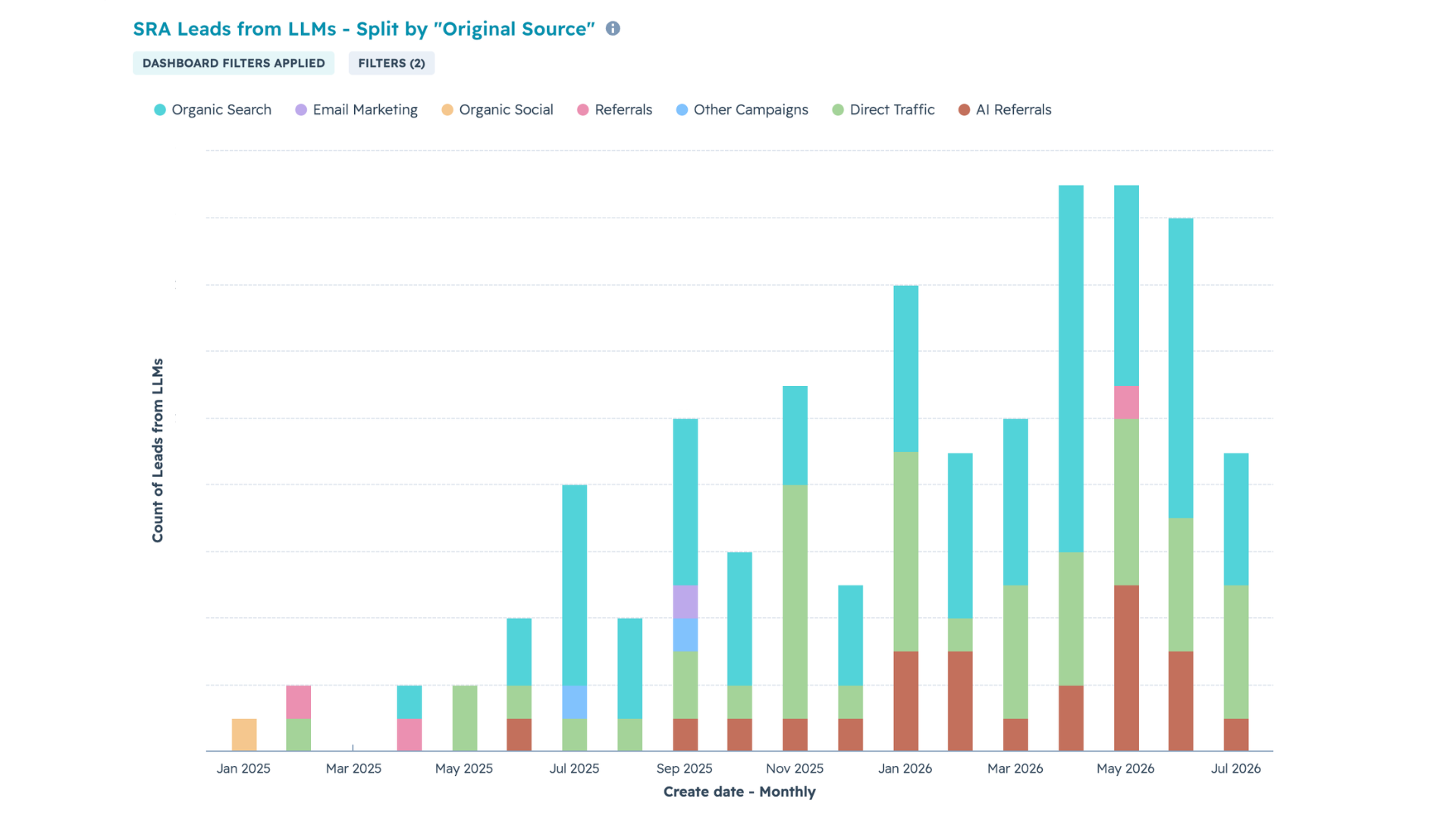
Below is a chart from our internal dashboard. These are the number of people who filled out our consultation form and stated that they found us through an LLM, split by the HubSpot-tagged source. Where possible, HubSpot automatically tags the source as “AI Referrals” (red).

We found that 80-90% of leads that came in via an AI platform were incorrectly tagged as “organic” or “direct.”

Image from author, July 2026

What To Monitor, But Not Set As KPIs

These metrics tend to be related but not the ultimate goal, and often not what you have control over.

Citations

This is the strategic piece that people mistakenly view as the success metric.

Off-page sources dominate citations at every funnel stage. Our research on citation sources found that, even for branded or bottom-funnel queries, 48% of sources were earned media, 30% were commercial content from other sites, and only 22% were from the brand’s own website.

So you should be measuring what percentage of attainable mentions you currently occupy across third-party surfaces. If it’s 1%, there’s massive headroom.

And remember that just because you’re cited, it doesn’t mean you’re recommended or presented in the LLM output.

This means that, yes, you should look at citations, but not simply to see if your website is cited, but whether your brand is mentioned on the most cited pages.

Sentiment

I get a lot of questions from marketers who say, “ChatGPT shows our brand in a less favorable light than it does our competitors. How do we improve that?”

Influencing market sentiment about a brand is a massive undertaking that no single person can control.

There are tactics you could use to influence the sentiment LLMs present, like engaging on relevant Reddit threads or producing content that paints your brand in a better light.

Ultimately, what LLMs present about your brand is not what the LLM thinks–it’s what the market is saying about your brand across hundreds of websites.

That has more to do with people’s experience with your product, your sales team, your customer support, and the overall customer experience your company provides. Marketing is just a small piece of that. No amount of marketing will overcome a negative experience with your brand.

So monitor sentiment, but treat it less as something to influence through marketing and more as feedback to improve the customer experience, which in turn improves sentiment.

LLM Referral Traffic

This is worth monitoring, but not a good KPI because you can’t control this.

OpenAI recently changed how ChatGPT presents sources and reduced the number of sources it showed. As a result, many websites lost ChatGPT referral traffic. However, they reversed that change a month later and showed more citations, leading to a large increase in ChatGPT referral traffic. That makes for a volatile KPI.

Beyond that, a lot of LLM traffic doesn’t get tagged as LLM referral traffic by tools like HubSpot or Google Analytics because the referral source is getting stripped. So traffic ends up being bucketed under direct.

How To Measure The Most Important Metrics

How Do You Track The Right Prompts?

The mistake many teams make is letting their AI visibility tool pick their prompts for them or trying to guess what prompts to track.

The problem is that those tools don’t know your customers. The good news: you do. That knowledge already exists as sales call recordings and transcripts, onboarding calls, and customer research calls. These are rich sources you can mine for voice of customer to understand:

  • What questions come up frequently?
  • What objections come up?
  • What language do they use to describe pain points or challenges?

If your prospects are asking these questions on a call, they – and people like them – are asking the same questions of ChatGPT or Claude.

The other source is self-reported attribution (see below). Once you’ve implemented self-reported attribution, your sales team can see whether a lead came through an LLM and simply ask them what prompt they used or even request a screenshot of the chat thread. In my experience, people are happy to share.

Between call transcripts and direct buyer input, you replace guesswork with the exact language customers use.

Your target prompts can and probably should change. We recommend reviewing prompts against voice-of-customer research quarterly, especially if you’re in a fast-moving industry.

How Do You Measure AI Visibility In ChatGPT, Claude, Gemini, Etc.?

Once you have your set of prompts, we recommend using Profound, Peec, or AirOps for tracking prompts.

Watch for the default channels that get tracked. For example, we don’t care much for Perplexity, and Claude is often not included as a default LLM. So we prioritize Claude, ChatGPT, Gemini, and AI Mode.

Put in your prompts, track your competitors, and track your visibility over time.

How Do You Set Up And Report On Self-Reported Attribution?

I mentioned above that platforms like Google Analytics and HubSpot don’t give the full picture of a lead source.

We recommend having a method to capture self-reported attribution so that a person can explicitly tell you how they found you. This won’t be perfect (attribution never is), but it will give you another informative data point.

This will also allow you to track sales opportunities, pipeline, and ultimately revenue that came in via LLMs.

I’ve seen this done in three ways:

  1. Add a question for “How did you hear about us?” in your lead or product signup forms. You can keep it open-ended or offer a dropdown with pre-defined options and have “AI Assistant (ChatGPT, Claude, Gemini, etc.)” as an option. Some clients are averse to this because they don’t want to negatively impact conversion rates. I’d recommend running an A/B test to see if that’s actually the case.
  2. Add the “How did you find out about us?” question to your product onboarding flow. This addresses the concern about conversion rates, but doesn’t account for pure sales-led motions.
  3. Have your sales team ask on their discovery calls. This requires a behavior change from your sales team, and the downside is it doesn’t account for self-service products.

Focus On What Pays The Bills

When we talk about paid marketing, we usually don’t measure success by the number of impressions because impressions don’t pay the bills. Instead, we talk about return on ad spend. For every dollar we put in, how many dollars do we get out?

It isn’t quite apples-to-apples, but the same logic applies. Instead of measuring visibility or citations (which don’t pay the bills), we should ask whether we’re reaching the right people through LLMs, and whether that visibility translates into business outcomes.

That means focusing on leads, pipeline, and revenue.

More Resources:


Featured Image: RobinRmD/Shutterstock

https://www.searchenginejournal.com/ai-visibility-measurement-what-to-track-what-to-ignore/582009/


Reddit Wants To Be The Destination, Not Just The Source Behind Search & AI via @sejournal, @brentcsutoras

Three months ago, I wrote about the Reddit earnings story most marketers missed.

That first-quarter call wasn’t the financial story I expected, but looking back, it was Reddit putting the pieces of its future on the record: participation had become too difficult, community creation needed work, human conversation was becoming more valuable, and Reddit Answers could bring more of the search journey inside Reddit.

The second-quarter call made the larger strategy much easier to see: Reddit doesn’t want to remain only the site people reach after searching Google or the source an LLM summarizes before answering somewhere else. It wants to become the place people intentionally open, search, participate in, and return to every day.

Steve Huffman said it directly:

“We’re not building for drive-by traffic. We’re building a daily destination.”

The strategy is clear, but it creates a contradiction Reddit will have to solve: The company wants the world to come to Reddit, while moderators, community rules, automated detection, and platform-level enforcement are all designed to keep low-quality behavior out.

Those protections are necessary, but they can also remove content, ban people from individual communities, or suspend accounts before legitimate new people understand what they did wrong. As Reddit moves closer to becoming a daily destination, helping more people participate without lowering the quality of its conversations may become the most important factor in its long-term success.

Reddit Wants Search Visitors To Become Daily Users

Reddit reported revenue of $805 million, up 61% year over year, with 130.3 million global daily active uniques and 514.6 million weekly active uniques.

For marketers, the more useful number is 197.2 million U.S. weekly active uniques because Reddit already has enormous U.S. reach, and its challenge is getting more of those people to use Reddit directly and return more frequently.

That is why the app came up so often: Huffman said direct and app users are worth multiples more than search-referral traffic, and during a CNBC interview, he described direct app usage as where Reddit’s business lives.

Reddit also said new app-user retention improved 50% year over year on a relative basis, though it came from a small base and Huffman acknowledged absolute retention still has room to improve. Search has already given Reddit massive reach, so the next step is getting more of those people to open Reddit directly and come back.

What Marketers Need To Know

Reddit is working to turn discovery into direct, repeat use, so marketers need to move beyond driving visits and build a consistent, valuable presence that helps them understand people’s challenges, participate in their validation journey, and create a connection that lasts.

The Home Feed As Reddit’s Recommendation Engine

Huffman called the home feed Reddit’s primary app surface and one of the primary drivers of subreddit discovery. The important point isn’t simply that people can find new subreddits there. It’s that the feed now recommends conversations from communities a logged-in user never chose to follow.

For years, logged-out users could see popular content from across Reddit, while a logged-in user’s home feed mainly reflected the communities they had subscribed to. That has changed. Reddit is now using what it knows about someone’s interests and activity to recommend content from outside those subscriptions.

That broader reach is central to the work we do at OGS Media, where we look at how useful conversations reach people through Reddit’s home feed, Reddit Answers, search results, and LLM outputs.

Huffman also explained how much room the recommendation system has to improve. Its models currently incorporate 10% of user activity, update in days rather than hours or minutes, and select from posts published during the previous week.

That seven-day limit may be the more important signal. Reddit has 26 billion posts and comments, including advice, reviews, and conversations that remain valuable long after they were originally posted.

If Reddit expands that window, older conversations could return to the home feed whenever they become relevant to someone’s interests or current problem.

What Marketers Need To Know

Reddit’s home feed can now carry a useful conversation beyond the people who already follow that subreddit. But that doesn’t mean marketers should treat the feed like another distribution channel.

People go to Reddit because they want something different from blog content, search results, ads, or public reviews. Reposting the same marketing content misses the opportunity to become part of their validation journey.

Create conversations that fit the community, solve real problems, and earn engagement. Those are the conversations Reddit can recommend today and may be able to resurface for much longer in the future.

Reddit Answers Is Becoming One Of The Best Ways To Search Reddit

Reddit’s push to become a daily destination is especially clear in search, where the search bar is now universal in the app and both searchers and searches grew during the quarter.

Huffman said that, for a lot of the queries he runs, Reddit is now the best place to search Reddit. I agree with him based on how often I’ve been using Reddit Answers and how useful I find it for locating the conversations and perspectives I need. In a lot of cases, it gives me a better experience than searching Reddit through Google or asking an LLM.

That matters because, as Huffman told CNBC, “a summarization of Reddit isn’t Reddit.” People look for Reddit because they want different experiences, opinions, perspectives, and the conversation itself, not just a compressed answer taken from it.

Search results sent people into those conversations, while AI Overviews and LLMs can use Reddit content without sending people to Reddit or giving them the opportunity to participate, which is why Reddit wants more of that search experience to happen inside its own platform.

What Marketers Need To Know

If you’re figuring out how to improve content for search and LLMs, compare what Reddit Answers surfaces with Google search results and LLM answers for the queries that matter to you. I would make showing up there for the right questions a higher priority, which means creating conversations that directly solve what people are searching for.

Reddit Is Making Conversations Easier To Consume

Reddit is also expanding the ways people can consume its conversations, with video in comments already accounting for more than 10% of Reddit’s video posts and Reddit expecting to test spoken or background-listening experiences later in 2026.

People often tell me Reddit doesn’t like video, but that has never been true. Written conversation is still its foundation, but credit goes to Rasha K. and Reddit’s APAC team for showing through their AMAs how video could add authenticity by making it clear the person answering was actually involved.

These formats give more people a way to use the conversations already there, including people who may never read a long thread. That broader access matters if Reddit is serious about its ambition to eventually reach one billion daily users.

What Marketers Need To Know

Video and audio won’t fit every community. If you experiment with either format, start with what the community wants and keep it connected to the conversations that make Reddit valuable.

As video begins appearing in communities related to your industry, pay attention to how people respond and which formats perform best so you can understand how your own community wants video used and presented.

Reddit Has To Balance Growth With Community Quality

Reddit is trying to make participation easier through new posting tools, better community recommendations, and LLM-assisted moderation that could replace some of the blunt account-age restrictions keeping legitimate new people out. Huffman acknowledged the problem directly when he said the account-age approach “has not aged well.”

That tension also came through in Reddit’s post-earnings AMA, where Huffman said its proactive systems prevent up to 23 million spam views and revoke nearly 2 million inauthentic votes every day.

Reddit clearly needs those protections, but working through this problem with Reddit and companies trying to participate responsibly has shown me how often legitimate people get caught between its growth goals and the systems designed to protect community quality.

Reddit has invested in Mod World and other moderator programs, but growth only works if its tools help moderators reduce spam, abuse, workload, and false positives enough to loosen blunt account-age restrictions safely.

What Marketers Need To Know

Brands and new Reddit users face a lot of scrutiny over whether they’ll be a quality addition to the site. A removed post or comment, a subreddit ban, and a sitewide account suspension have different consequences, but none should be treated as a minor setback.

Reddit is trying to become more open, but that doesn’t lower the standard for participation. Follow the rules, respect each community, and build a clear history of useful participation.

If automated enforcement, a moderator decision, or a sitewide suspension catches you unfairly, a credible participation history and careful documentation give you more context for an appeal. They don’t guarantee a reversal, but they give you a clearer case to present.

The Destination Reddit Is Trying To Become

“Reddit has become the validation phase of the customer journey because people trust it.”

Bartosz Goralewicz, Co-Founder of OGS Media

Q1 showed that Reddit understood the barriers keeping people from participating. Q2 showed why removing them matters. Reddit doesn’t want to remain a source that Google and AI tools summarize before people move on. It wants to become the place people go to understand a problem, hear different perspectives, and decide what they trust.

Reddit isn’t a place to be summarized because its value isn’t a single answer. It’s the depth of the conversation, the disagreement, the lived experience, and the emotional validation people get from hearing others work through the same problem.

For marketers, the opportunity is to understand those conversations, help solve the problems inside them, and earn a place in the validation journey. That’s how a brand becomes part of the decision instead of another message people learn to ignore.

If Reddit can bring more people into that process without losing the quality of its human voices, it can move beyond being the source behind search and AI and become the destination people choose when they need to decide what to trust.

More Resources:


Featured Image: Brent Csutoras/Search Engine Journal

https://www.searchenginejournal.com/reddit-wants-to-be-the-destination-not-just-the-source-behind-search-ai/584586/


Reddit CEO Intends To Show More Reviews And Recommendations via @sejournal, @martinibuster

Reddit’s Q2 earnings call revealed that Reddit intends to surface more evergreen content to users. The company also explained that it intends to make its search bar more visually engaging by integrating advertising modules. It’s clear that Reddit aspires to compete with online content publishers and become a stronger competitor to social networks.

Reddit Targeting Recommendations And Reviews

The question was whether Huffman could visualize the Reddit feed integrating video and machine learning in the way other social platforms do, what the engagement trends were within Reddit’s app search, and where Reddit stood on launching advertising within the app search results.

Huffman responded that, with the search bar fully integrated within its app, Reddit is now seeing growth in the number of people who search and in the number of searches. He characterized its progress as “chipping away” at it.

He then pivoted to sharing his opinion that Reddit is the best place to surface recommendations and reviews.

Huffman explained his point:

“And I think for many queries – for many queries that I run at least – Reddit is now the best platform for searching Reddit. That hasn’t always been the case.

…But I think any query where you want to know something or want to see multiple perspectives, like what should I watch? What do people think about this? What should I buy? Reddit … provides the best answers on the internet. So I’m really encouraged with the progress there, and we’re starting to look towards ads on that surface which I’ll turn it over to Jen to address.”

Monetizing Reddit Search With Ads

Reddit’s advertising aspirations are dependent on getting the search part right. And part of getting that search part right is being able to surface recommendations and reviews.

Chief Operating Officer Jen Wong expressly tied search to the consumer’s shopping experience, explaining that there are two angles to it. The first angle was adding product images and rich media modules to search. The second part was adding advertising modules with multiple retailers and products.

Wong explained:

“So search is in a space where it’s very married to like a shopping experience. And so we — there’s a couple of different angles to this.

One is that we think that the search page can be enriched with more like rich media modules. So it can have product visuals from the catalogs that we have when people are searching or discussing or a specific product.

And we’ve started to do that. We had done a test earlier on electronics and consumer electronics and now we’ve expanded those categories. And so that enriches the core search experience and hopefully increases engagement so people get more out of that experience.

And I do agree with Steve, that I think especially the agentic ask function on Reddit search, I think, is now the best way to search Reddit.

The second is, what goes along with that engagement at the product level when you have a match is ads, right? So I talked about our Shopping Listing Ads where you can have a module that has multiple different retailers and product types and brands in one module. That’s a great sort for a search page.

And that’s ultimately how I think ads would be well represented on search. So that’s a space that we’re eyeing. We clearly have the capability to do it. We keep tracking as the page settles and as users adopt that, …we do see an advertising opportunity there. And the good news is we have the infrastructure, and I think a lot of that capability, already queued up.”

Reddit Wants To Surface Evergreen Content

Huffman expressed that they have a massive amount of evergreen content about parenting and reviews that they want to show within their feeds.

User feeds are recommendation engines. Google Discover and YouTube are examples of recommendation engines that show the latest articles and videos that users are likely to engage with.

Google Discover and YouTube prioritize fresh content; evergreen content is not a priority for Google. But it is a priority for Reddit because they have a massive amount of evergreen content that users can engage with.

Unfortunately for Reddit, their feed is bottlenecked because of “small models” that hinder Reddit from showing evergreen topics. This is a serious problem for Reddit because their technology constrains them to show only a week’s worth of content.

That’s good news for publishers that rely on evergreen content. However, once Reddit solves this problem, they will be on a path that leads toward keeping users on Reddit for longer periods, engaging with evergreen topics, including product reviews.

This is the question that was asked:

“And then on the feed models, I don’t know if you can maybe give us some type of purview into the drivers. Obviously, there’s a lot that goes into building these models between retrieval and ranking and serving and refresh and there’s million different parameters, and I probably don’t want to get too much detail, but just kind of any sense can you give us on maybe what are some of the specific areas you’re focusing within the feed improvement?”

Huffman replied:

“So …posts that are eligible for recommendation, Reddit right now is limited to a week. So Reddit is basically… our feed is almost like a real-time feed where we have this actual mass of corpus. Much of that content is timeless.

So think about things like parenting advice or book or movie reviews, things like that are relevant for a very long time. We don’t show this on the feed at all.

So we can dramatically improve candidate selection, model size, model speed, the signals that go in from users, pretty much every dimension. We have, sometimes order of magnitude improvement opportunity. So we’ll be doing that work over the next year, and I expect every improvement we make to work because we’re just starting from such a low base.”

Reddit Intends To Surface More Reviews And Evergreen Content

This is a compelling sign that Reddit intends to surface its vast amount of reviews, advice, and recommendations through its feed, as well as more aggressively monetize product searches with advertising. This may not be good news to publishers of evergreen content, like recipes and reviews, but there is still at least a year.

Featured Image by Shutterstock/Diego Thomazini

https://www.searchenginejournal.com/reddit-ceo-intends-to-show-more-reviews-and-recommendations/584731/


What Top Stories Inside AI Overviews Means For Publishers And Brands In 2026 And Beyond via @sejournal, @gregjarboe

John Shehata, CEO of NewzDash, found something in July that a lot of publishers threatening to block Google’s AI don’t realize is already happening underneath them. Google has started folding entire Top Stories carousels directly inside AI Overviews, and the robots.txt directive most publishers reach for first does nothing to stop it.

Shehata posted on LinkedIn that nearly one in six U.S. trending news queries now place Top Stories inside AI Overviews, and followed it with a full data breakdown on the NewzDash SEO for News blog.

Screenshot from LinkedIn, July 2026

Google Has Run This Play Before

The topic he is describing is not new in kind, but it is new in mechanism. In 2006, John and I spoke on a panel about “Vertical Creep Into Regular Search Results” at the Search Engine Strategies New York conference. We discussed how Google was quietly pulling what appeared in Google News into its main web results before Universal Search formally arrived. Danny Sullivan called that May 2007 rollout the most radical change Google had ever shipped to its results, blending video, images, books, and news into a single ranked list instead of 10 blue links. Google’s own announcement framed it the same way, describing a shift toward one integrated set of results rather than separate verticals users had to hunt through individually.

Nineteen years later, Google is doing it again. This time the destination isn’t a blended results page. It’s an AI-generated answer.

What NewzDash’s Data Shows

According to NewzDash’s tracking, among trending news queries where Google displays Top Stories at all, 15.5% in the U.S. and 17.46% in the UK now show that carousel embedded inside the AI Overview rather than as its own standalone module below it. Entertainment queries lead both countries, clearing 35% in the U.S. and 31.5% in the UK. World News hits nearly 32% in the U.S. Health and Science queries barely register. Shehata’s data also shows the two placements are mutually exclusive. When Top Stories lives inside the AI Overview, Google is not also running a separate carousel further down the page for the same query.

That distinction matters more than it sounds like it should, because it reframes the entire opt-out conversation publishers have been having since AI Overviews launched.

Google-Extended Is Not An AI Overviews Opt-Out

Most publishers who want out point their robots.txt at Google-Extended and consider the matter settled. It isn’t. Google’s own crawler documentation states plainly that Google-Extended governs specified AI training and grounding uses, things like feeding future Gemini models or grounding certain Vertex AI responses, and explicitly does not affect a site’s inclusion in Google Search or function as a ranking signal. Blocking it does not remove a publisher from AI Overviews, AI Mode, standard Top Stories, or Top Stories embedded inside an AI Overview. Shehata is right to keep hammering on this, because the confusion is not a fringe misunderstanding. It’s the default assumption across the industry.

The Control That Reaches AI Overviews Is A Different One Entirely

Google began testing a generative AI exclusion inside Search Console in June, currently limited to a subset of UK site owners. It lets an eligible publisher exclude their links and content from AI Overviews, AI Mode, and generative Discover features specifically, without touching their eligibility for traditional Search. Google’s support documentation says an excluded site’s content won’t appear in those features and won’t even be used as an input for generating a response. Choose that setting and, by Shehata’s reading, you almost certainly lose your spot in the embedded Top Stories carousel too, since it’s just a collection of publisher links riding inside one of the covered surfaces.

Google has not confirmed what happens next at the layout level. Would the AI Overview keep showing an embedded carousel built from the publishers who remained opted in? Would Google fall back to a standalone Top Stories module instead? Nobody outside Mountain View knows yet, and Shehata is careful to label this a high-confidence interpretation rather than a documented outcome. That kind of restraint is rarer than it should be in AI SEO commentary right now, and it’s a large part of why I trust his data over the louder takes circulating on the same topic.

The Bigger Story Is Trust

I think the bigger story here is not the mechanics of Google-Extended versus the Search Console control, even though publishers genuinely need to understand that difference before they touch a setting. The bigger story is that AI Overviews’ central problem has always been trust, not visibility. Users don’t yet have a reliable way to know whether an AI-generated answer is drawing on something a credible newsroom actually reported or synthesizing something thinner. Pulling Top Stories, with its named publishers, real bylines, and direct links, into the body of the AI Overview instead of stacking it below a wall of generated text is a genuine, if incomplete, answer to that problem. I’ve watched Google reshuffle where news lives in its results since the “vertical creep” days of 2006. This is the first move in the AI Overview era that looks aimed at rebuilding trust rather than just reducing clicks to the open web.

Although this is my considered opinion, it comes with a caveat. A step in the right direction is not the same as a finished solution, and Google’s refusal to document what happens to publishers who opt out is exactly the kind of ambiguity that erodes the trust this move is supposed to build.

3 Things To Do This Week

For SEO practitioners managing news clients or in-house newsroom sites, three things are worth doing this week rather than waiting for Google to clarify the layout question.

First, separate your controls before you touch either one. Audit whether your site currently blocks Google-Extended, uses the new Search Console generative AI exclusion, or neither, and document which surfaces each one actually governs. Treating them as interchangeable is how a site accidentally forfeits AI Overview visibility while believing it only opted out of training data.

Second, if you have access to the Search Console exclusion, test it on a URL-prefix property or a single section before applying it sitewide. Google’s control supports inheritance between parent and child properties, which means a news publisher can trial the exclusion on, say, an opinion vertical and watch what happens to that section’s Top Stories eligibility before deciding whether the tradeoff is worth it domain-wide.

Third, start pulling Google’s generative AI performance reports in Search Console now, and pair them with a tool like NewzDash that tracks how often your URLs surface inside Top Stories carousels versus embedded AI Overview placements. You cannot make an informed opt-out decision without a baseline for how much visibility is actually at stake, and that baseline needs to exist before you flip the setting, not after.

Twenty years ago, “vertical creep” meant publishers had to figure out how a blended results page would treat their headlines. Today, it means figuring out how a generated answer treats them instead. The mechanism changed, but the need for publishers to understand exactly what they’re opting into, and out of, did not. John Shehata is doing the unglamorous work of documenting that shift in real time, and until Google says otherwise, his data is the closest thing the industry has to ground truth.

More Resources:


Featured Image: PeopleImages/Shutterstock

https://www.searchenginejournal.com/what-top-stories-inside-ai-overviews-means-for-publishers-and-brands-in-2026-and-beyond/584175/


What Opting Out Of Google’s AI Search Features Means Now via @sejournal, @MattGSouthern

Google is rolling out a Search Console setting that lets you pull your content out of AI Overviews, AI Mode, and Discover’s AI features without leaving Search. That’s a choice we haven’t had before, and regulators in the UK now require Google to offer it.

Whether to use it is a harder question than it seems because the tradeoffs keep stacking up. Tracking data released this week by NewzDash, which sells news-visibility tracking to publishers, found Top Stories carousels rendering inside AI Overviews on U.S. trending news results. That means opting out of AI could mean opting out of Top Stories.

Here’s what the new Search Console setting does, how it got here, and what’s worth knowing before you touch it.

What The Control Covers

The Search generative AI control lives under Settings in Search Console. Google is rolling it out to a subset of website owners, so not every account has it yet. The default option to include your website lets content appear as links and helps ground AI responses in AI Overviews, AI Mode, and Discover’s generative AI features, with whatever impressions and traffic that brings. Excluding your site removes it from those features, links included.

Google said it would begin respecting these changes on June 17. Changes generally take a few days to process, then content should drop out within one to two days, though caching can delay it.

The setting isn’t a ranking or inclusion signal anywhere else in Search, so using it shouldn’t affect regular results. It doesn’t override separate choices in Merchant Center or Google Ads, so Shopping participation stays its own decision. And it doesn’t touch AI training, which runs through a different control.

The choice began appearing on accounts outside the UK in July. Jamie Indigo, Director of Technical SEO at Cox Automotive, flagged the setting on a U.S. account on LinkedIn: “Search generative AI controls in Google Search Console. I’m not even British and it’s not even my birthday!”

How The Opt-Out Choice Took Shape

Until this year, there was no way to keep a page out of Google’s AI features without keeping it out of Search.

Robots.txt, noindex, and snippet directives have been around long before AI Overviews. None of these tools specifically separate generative features from others.

For example, Nosnippet removes content from AI Overviews, but it also takes out traditional snippets at the same time. This all-or-nothing approach was something Google acknowledged in January, when it mentioned it was exploring ways to opt out of AI features.

Google-Extended has addressed some of this issue. The robots.txt token controls whether crawled content can be used for training future Gemini models that power Gemini Apps and the Vertex AI API for Gemini, and for grounding in Gemini Apps and Grounding with Google Search on Vertex AI. It didn’t control whether content could appear in AI Overviews or AI Mode. Google’s crawler docs say Google-Extended doesn’t affect a site’s inclusion in Search and isn’t a ranking signal.

The Search Console setting offers a different choice by removing a site from Google’s AI features and nothing else. It was born through a regulator and a product team working on the same problem at once.

Google made a statement in January that landed the same day the UK’s Competition and Markets Authority opened a consultation on requiring AI opt-outs. In June, the CMA imposed a conduct requirement requiring Google to give websites more control over how their content is used in generative AI, and Google began testing the toggle with UK properties the same week. In the UK, this requirement makes the control obligations mandatory, with deadlines extending into next year.

When Traditional Features Sit Inside AI Surfaces

Google’s setting treats AI features and regular results as separate things. The issue with that is Google’s results don’t always separate AI and organic results. When a Top Stories carousel from organic search renders inside an AI Overview, one toggle may control both.

John Shehata, CEO and founder of NewzDash and GDdash, put a number on it: “Nearly 1 in 6 U.S. trending news queries now place Top Stories inside AI Overviews.” The 15.5% rate applies to tracked results where Google displayed Top Stories, not to all queries NewzDash tracked. The UK figure is 17.46%.

Additionally, he found the embedded carousel and the standalone version didn’t appear together. NewzDash hasn’t published sample sizes or collection dates alongside the figures.

Kyle Sutton, Head of SEO and AI Discovery at The Washington Post, sees the same pattern anecdotally. He wrote in a comment on Shehata’s post: “Anecdotally, seems we’re all seeing it a lot more often.” His comment doesn’t confirm NewzDash’s rate or how it was measured.

Shehata connects it to the new control: “Using Google’s newer Search Console generative AI opt-out is different, and will likely remove publishers from Top Stories inside AI Overviews.”

That’s his interpretation, which Google hasn’t officially confirmed. According to Google’s help page, sites that are excluded won’t show up in AI features. As of now, Google’s help page doesn’t say how the control handles a traditional feature that’s shown within an AI feature.

If his understanding is correct, choosing to opt out could mean missing out on placements that were never advertised as AI features.

What To Check Before Opting Out

Before anyone touches the new Search Console settings, there are three things to check:

  1. How much visibility your site gets from AI features
  2. Which of Google’s controls governs what.
  3. How the tradeoffs could affect your business.

Start with where your site shows up in AI features today. The generative AI performance report, also rolling out to a subset of accounts, shows impressions from AI features by page, country, device, and date. It combines AI Overviews and AI Mode, and it carries no clicks and no queries.

Broader analytics can show Google organic referrals, time on site, and conversions, but they can’t assign visits to either AI feature. In practice, that means there’s no clean baseline for AI traffic or conversions to weigh the decision against.

The CMA’s requirement says more data should come. Its interpretive notes list impressions, click-throughs, and click-through rate as metrics Google should provide, delivered “through a commonly accessible platform.”

I wrote about that gap when the setting launched without the data to use it. The reports only cover impressions today.

Vahe Arabian, founder and editor-in-chief of State of Digital Publishing, described the working answer this month: “The job isn’t picking a favourite dashboard; it’s blending them into one scorecard.”

Next, sort out which lever controls what. Here’s what the differences are:

  • The Search generative AI control affects links and grounding inside Search and Discover AI features.
  • Google-Extended controls specified Gemini model training, including training for models used in Search generative AI responses, plus grounding in Gemini Apps and Grounding with Google Search on Vertex AI.

Notably, Google-Extended does not determine what content shows up in Search. Search visibility is governed by factors like crawling, indexing, and preview controls, from Googlebot rules to noindex tags and snippet directives. Robots.txt only manages crawling, not content removal from Search. Shehata’s post highlighted the same distinction regarding Google-Extended.

Finally, weigh the variables that matter for your business. For news publishers, Top Stories exposure is one of the things the toggle may control. For ecommerce sites, site content and Merchant Center or Ads participation are separate decisions, because the control doesn’t override either.

For any business, the question is what showing up in AI features is worth against the traffic it may replace, and the honest answer is that the numbers to settle it don’t exist yet.

One argument against opting out has been on record since before the control shipped. Writing earlier this year, while the CMA was still weighing the requirement, Rahul Jain, CEO and co-founder of Noble, argued on LinkedIn: “Opting out of Google’s AI Overviews will hurt most publishers more than it helps.”

His reasoning is that exclusion takes websites away from where the attention is, rather than safeguarding them. Noble sells services designed to help brands appear in AI-generated answers.

The Limits Of The Available Controls

The Search Console control works at the property level, and page-level controls for grounding in generative Search features aren’t due until March 2027 under the CMA’s timeline.

In a recent paper published in the Journal of European Competition Law and Practice this spring, University of Oxford researcher Spencer Cohen and UCL competition-law PhD candidate Todd Davies shared their thoughts that this type of remedy might not be enough.

“We argue that forcing Google to let websites opt-out of appearing in AI Overviews would be ineffective,” Davies, who the paper discloses worked at Google as a software engineer until 2022, wrote in a LinkedIn post summarizing the paper. Their case is that an opt-out doesn’t protect publisher business models or create meaningful choice over how content is used.

Whether the control gives businesses a real choice or a symbolic one depends on data that doesn’t exist yet and placements that are still moving.

Looking Ahead: Click Data & Page-Level Controls Are Coming

Here’s what you can expect in the coming year regarding the decision.

The CMA requires Google to share click data and click-through rates, along with tools for publishers to assess those clicks, with most of these measures starting in December.

By March 2027, Google is required to offer more detailed page-level controls for generative Search features, providing a more precise option than the current property-based settings. Additionally, Google will need to report on its compliance every six months during the first year, moving to annual reports if the regulator is generally satisfied.

The two main things to keep an eye on are whether Google broadens these controls and reports beyond the current group of website owners, and whether the embedded Top Stories pattern becomes more widespread in tracked data. NewzDash has said it plans to test the opt-out effect directly.

Currently, the choice is available, but it’s not clear what the cost of using it might be, and the schedule for measuring that cost is in place.

More Resources:


Featured Image: Golden Dayz/Shutterstock

https://www.searchenginejournal.com/what-opting-out-of-googles-ai-search-features-means-now/584321/