AI Video After Sora: 3 Updates You Should Make Before You Publish via @sejournal, @gregjarboe

OpenAI shut down the Sora app in a two-sentence social media post in late March, but the reason it collapsed had nothing to do with video quality. The company wrote that it was “saying goodbye to the Sora app,” according to the Associated Press, after months of pressure over deepfakes of Michael Jackson, Martin Luther King Jr., and Mister Rogers that forced OpenAI into reactive takedowns before family estates and an actors’ union intervened. Sora didn’t fail because the model couldn’t generate convincing video. It failed because nobody had built the trust infrastructure around it before letting the public loose on the prompt box.

The same week, YouTube’s enforcement data told a related story from the opposite direction. In January, the platform permanently deleted 16 channels under what it now calls its inauthentic content policy, a July 2025 rename of the old repetitious content rule. Those channels had a combined 35 million subscribers and 4.7 billion lifetime views, and they were producing mass-generated, templated video with no human editorial input behind it, according to reporting in The Hollywood Reporter.

Both stories are about the same failure. Neither is really about AI video getting better or worse. They’re about what happens when scale outruns the human judgment that’s supposed to sit on top of it, and that gap is exactly what I built my 5-Pillar Framework for AI content to close back in April. Four months later, it doesn’t need much of an update.

The Cost Of Scale Just Dropped Again, Which Raises The Stakes

Two days before Sora’s shutdown made headlines, Google published a blog post announcing Veo 3.1 Lite, its most cost-effective video generation model, priced at less than half of Veo 3.1 Fast for the same speed. Developers can now generate four-, six-, or eight-second clips in landscape or portrait at up to 1080p, built explicitly for high-volume applications.

That’s not a criticism of the tool. It’s a fact worth ground truthing. The cost of producing video at scale keeps falling, which means the pressure my framework’s Pillar 1 was built to manage – the temptation to treat AI as a shortcut instead of infrastructure – is only going to grow. Cheaper generation makes strategy-first discipline more necessary, not less.

The Human Face Became A Trust Signal, Not Just A Style Choice

Craig Billings runs a science channel called Doctor NOS with 1.7 million subscribers, and he told The Hollywood Reporter that faceless channels covering his same territory are getting hit hard by the crackdown. Most of them are getting demonetized, he said, while creators who never touched AI but also never showed their face are getting caught in the same net.

That’s a real cost of imperfect enforcement, and it’s worth naming honestly, but it also confirms something my framework already argued in Pillar 5. YouTube’s own policy page, “How Creators Use AI for Content Creation,” states plainly that the platform requires creators to disclose when AI was used to edit or generate realistic content, and that labels can appear on the video player for Shorts or below long-form videos. If a creator skips disclosure and YouTube’s systems detect AI anyway, the label gets applied automatically, and creators cannot remove it once there’s high confidence it was AI-made.

Four months ago, I wrote that hiding AI use reads as weakness to sophisticated audiences and that disclosure reads as competence. That’s no longer just a trust strategy. It’s now baked into the platform’s actual infrastructure, and treating it as optional PR polish is a strategic mistake, not just a missed opportunity.

What Working AI Video Actually Looks Like

Contrast the slop channels with what Think with Google’s new Creativity Edition guide documents. Google Creative Lab’s Matthew Carey described building the AI-assisted short film ANCESTRA by deliberately avoiding generic prompts, prompting shots of the cosmos using descriptions of specific microscopes and lights rather than the word cosmos itself, because the obvious prompt produces the visual average every model defaults to. Monks co-founder Wesley Haar, ter told the same publication that the brands succeeding with AI have done the unglamorous work of codifying exactly what their brand is before ever generating a frame.

Neither example treats AI as a volume machine. Both treat it as execution capacity sitting underneath a specific human decision about what belongs on screen and what doesn’t. That’s Pillar 1 and Pillar 5 working together, and it’s the difference between the channels YouTube terminated and the case studies Google is now showcasing as the industry standard.

The Trust Gap Is Wider In The USA Than In The UAE

There’s a market dimension to this that American marketers tend to underweight. In a 19-market YouGov survey I covered in July, the US had the lowest rate of AI-assisted search of any country tested, at 48%, compared to 89% in India, Indonesia, and the UAE, and only 28% of U.S. searchers said they trust an AI assistant’s answer at all.

I teach a module called “Engaging Audiences through Content in the AI Era” at the New Media Academy in the UAE, in a region where AI-assisted discovery is already the norm rather than the exception. The lesson isn’t that Americans are wrong to be skeptical. It’s that the disclosure and human-judgment requirements built into Pillar 5 aren’t regional nice-to-haves. They’re the baseline a skeptical American audience needs and a receptive Emirati audience will expect anyway once enforcement catches up to adoption.

3 Updates To Make Before Your Next AI Video Goes Live

First, audit whether your disclosure practices meet the platform’s actual policy language, not your internal comfort level. YouTube’s own guidance says labels apply to photorealistic or meaningfully altered content, and creators lose the ability to remove that label once the system flags it with high confidence.

Second, price your production plan against what tools like Veo 3.1 Lite now make possible at scale, then deliberately choose to produce less than the ceiling allows. The technical ability to generate a thousand variants doesn’t obligate you to publish a thousand variants.

Third, name the human decision-maker on every AI-assisted piece before it ships, the way Carey’s team did on Ancestra and ter Haar’s team does with Monks’ brand knowledge bases. If no one can answer who decided this was the right cut, the piece isn’t ready.

My Take

The AI slop conversation in this industry keeps getting framed as a content quality problem, and I think that framing is wrong. It’s a trust infrastructure problem, and Sora, YouTube’s purge, and the falling cost of Veo all point at the same gap from three different angles.

What I argued in April holds. The only thing that changed is the platforms stopped arguing back. Meaning cannot be automated, and the tools that scale fastest are the ones that make skipping the human checkpoint most tempting. My framework didn’t need a rewrite this fall. It just needed the industry to catch up to Pillar 5.

More Resources:


Featured Image: Gorodenkoff/Shutterstock

https://www.searchenginejournal.com/ai-video-after-sora-3-updates-you-should-make-before-you-publish/583123/


Google Ads’ Target-Based Bidding Update For Ecommerce via @sejournal, @tonyadam

If you run ecommerce campaigns on target CPA or target ROAS and any of them sit at “Limited by budget,” Google’s August 17 bidding change is going to move your numbers, and we’re likely not talking about the direction you want. Starting August 17, campaigns that are limited by budget and use a target-based bid strategy will deliver more consistently toward the target you set instead of overshooting it. For the many accounts that have quietly been beating their targets, that means a higher cost per conversion or a lower ROAS unless you act first.

This one is not opt-in; Google is applying it automatically to eligible campaigns, and it has said it will not adjust your targets or budgets for you. The runway is getting shorter by the day. The Bid Target Adjustment Tool went live on July 6, and account notifications are landing now, with the change itself starting to roll out on August 17. That leaves a few weeks to decide, campaign by campaign, whether your over-delivery was a deliberate strategy or just a target you never updated.

What The Target-Based Bidding Update Changes

Today, a campaign that is limited by budget and running target CPA or target ROAS often beats its target, and it can swing around when you change the budget. After August 17, Google optimizes so that actual performance tracks closer to the target you set, including when you adjust budgets, which it frames as more predictable performance as you scale. Take a campaign with a $100 target CPA that has been delivering conversions at $50. After the change, it will move toward $100. The update applies to target-based campaigns across Search, Shopping, Performance Max, Demand Gen, Travel, and Display, while App, Video reach, and Video view campaigns are excluded. For multi-channel campaigns like Performance Max and Demand Gen, Google has also said you may see traffic shift between channels as the system rebalances toward the target.

Why Budget-Limited Campaigns Overdeliver

A campaign that is limited by budget beating its target was usually not a bidding miracle. The budget cap was the real constraint, so the algorithm never spent all the way up to the target. It bought the cheapest conversions it could inside the cap and left the rest of the target headroom untouched. That gap between your $50 actual and your $100 ceiling was efficiency you were getting for free, because budget, not the target, was doing the limiting.

After August 17, the system treats that headroom as room to work with. It will pursue additional conversions that cost more, which pulls your average up toward the target you set. In plain terms, your target stops being a ceiling you rarely touched and becomes a destination the algorithm actively aims for. This doesn’t mean that Google will actively raise your budget; it means the system pulls your actual performance up toward the stated target you already entered.

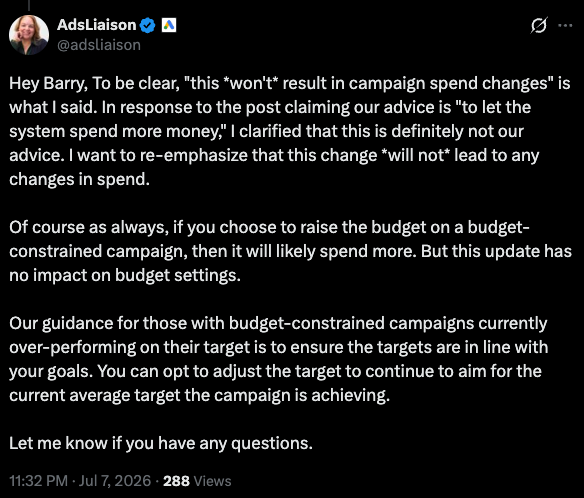
Google’s Ads Liaison Ginny Marvin has been clarifying the framing publicly, and two points are worth carrying into your own read. Bidding targets are meant to be your lever for efficiency and spend control, while Maximize Conversions and Maximize Conversion Value are the strategies built for a fixed budget with no target. She has also pushed back on the idea that this change is Google telling you to spend more, so treat August 17 as a reason to make your stated target honest rather than a nudge to loosen it.

Screenshot from X, July 2026

The Real Risk Is A Bid Target You Never Tuned

Plenty of accounts carry a target CPA or target ROAS that someone set once as a rough ceiling and never revisited, because the campaign beat it every month anyway. Those targets are about to go live. If your $100 CPA was aspirational rather than a real break-even number, or your 400% ROAS target was a placeholder while the campaign quietly ran at 600%, August 17 exposes the gap. Miss it, and it surfaces in next month’s reporting as a cost increase you have to explain after the fact, which is a worse conversation than the one you could be having now.

The Decision For Each Budget Limited Campaign

For each campaign that is limited by budget and sitting comfortably inside its target, you have three honest options.

Reset the target to your actual performance. If a campaign has been running at a $50 CPA or a 600% ROAS and that is the efficiency you want to keep, update the target to match before August 17. The Bid Target Adjustment Tool lets you apply your recent performance as the new target in a couple of clicks, which holds your current numbers in place.

Raise the budget and scale at the stated target. If the overdelivery was really a sign the campaign could spend more, lift the budget so it is no longer limited by budget, and let it capture more volume at your true target. This is the growth path, and it only makes sense when the stated target reflects real profitability.

Let it drift toward the target on purpose. If your stated target was always your genuine break-even and you have been happy to take cheaper conversions while the budget cap allowed, you can accept the drift toward target and the added volume that comes with it. The point is to choose it, not to inherit it because you forgot to look.

How To Audit Your Bid Targets Before August 17

Pull every campaign flagged “Limited by budget” that uses Target CPA or Target ROAS. Compare actual CPA or ROAS to the stated target over the last 90 days, and flag any campaign where actual sits well inside target, because those are the ones that will move. Then apply the decision above to each.

The Bid Target Adjustment Tool, live in accounts since July 6, surfaces this historical performance and lets you apply updated targets directly, and the notifications Google is now sending point at where it thinks you are exposed, so treat them as a prompt to act rather than a recommendation to dismiss. One more step that has nothing to do with the platform: brief clients or your leadership before August 17, not after. A short proactive note about a possible cost shift beats explaining a surprise in next month’s report.

What The Update Means For Ecommerce PPC

Most accounts that regularly run “Limited by budget” are small and midsize stores, which is a large slice of ecommerce. On the Shopping and Performance Max side, two things are worth watching.

First, if you run Target ROAS on a budget-capped Shopping or Performance Max campaign that has been beating its target, the drift toward target shows up as a lower ROAS and more spend on the marginal conversion. For a thin margin catalog, that can quietly erase the profit you thought the campaign was printing. Reset the target to your real ROAS floor, ideally one built from contribution margin rather than a round number, before the change makes the call for you.

Second, because Performance Max spreads across Search, Shopping, YouTube, and more, Google has said you may also see traffic shift between channels as the system rebalances. Watch your channel-level reports in the weeks after August 17 so a move toward cheaper, lower-intent inventory does not slip past you.

Where Smart Bidding Exploration Fits

If your honest reaction is that you would take more volume, there is now a deliberate lever for that, instead of letting the August 17 drift spend your headroom at random. Smart Bidding Exploration, which Google expanded on June 15, lets you set a ROAS tolerance so the algorithm can bid on converting queries it would normally skip, widening reach beyond your current query coverage while staying inside a boundary you define. It is globally available for Performance Max campaigns without product feeds, and in beta for Shopping and Performance Max with feeds through your Google account team. Google reports that its own testing showed an 18% lift in unique converting query categories and a 19% lift in conversions, which are Google’s figures rather than independent ones, so treat them as directional.

The point for ecommerce is control. The August 17 change will use your headroom whether you want it to or not. Smart Bidding Exploration lets you decide how much of that headroom goes toward exploration and at what efficiency, which is a cleaner way to buy incremental volume than finding it in a report after the fact. Google also launched Promotion Mode in beta for Search and Performance Max, which schedules a temporary budget and ROAS tolerance boost for a defined peak window and then closes itself, so it is worth a look for flash sales and launches heading into Q4.

What To Do Before August 17

The August 17 bidding change rewards one discipline, which is running targets that reflect real business math instead of placeholders. Audit every campaign that is limited by budget and running Target CPA or Target ROAS, decide per campaign whether to reset the target, raise the budget, or accept the drift, and use the Bid Target Adjustment Tool, which is live now, to lock in the efficiency you want before the system settles it for you. If you would rather buy incremental volume on purpose than inherit it, Smart Bidding Exploration is the lever to reach for. The accounts that get caught out will be the ones that treated bid targets as set-and-forget ceilings, and this change turns every one of those ceilings into a live target.

More Resources:


Featured Image: tete_escape/Shutterstock

https://www.searchenginejournal.com/google-ads-target-based-bidding-update-for-ecommerce/581801/


Google May Be Penalizing AI-Generated Content As Thin Content via @sejournal, @martinibuster

A forum website published a post on Reddit expressing disbelief that Google issued a manual action for thin content, finding it hard to reconcile how Google could send so much traffic for nearly twenty years only to find fault with it now. Google is calling it a manual action for thin content, but SEOs believe it may be for AI-generated content.

Manual Action For Thin Content

According to the Reddit post, a forum received a manual action for thin content. The notification specifically pointed to over half a million posts in one specific category of the site, /threads/. They explained that it’s a partial manual action and that the penalization does not affect the rest of the site, just this one part of the website.

They explained:

“The message (WNC‑651700, ~17 July 2026) is: “Thin content with little or no added value.”
It’s a partial manual action, meaning a human reviewer looked at part of the site, judged it unworthy of ranking, and suppressed it pending a reconsideration request.

The Affects field names exactly one thing: the URL pattern windowsforum.com/threads/.
That’s 168,290 visible threads and over half a million posts, twenty years deep, suppressed together.

No example URLs were provided. Not one.”

Thin Content

Google has multiple definitions of thin content. One of them, thin affiliate content, is content published on affiliate sites that are word for word duplicates of what is found on the merchant websites.

Former Googler Matt Cutts has said that thin affiliate content lacks “original insight or research or analysis” or any other kind of content like original videos that “add value.”

Other forms of thin content:

  • Syndicated content
  • Article marketing content

Cutts has also explained that the opposite of thin content is content that site owners have written themselves, contains additional value, is unique, and leans in on the author’s actual expertise.

That last part may be critical for understanding why the Redditor’s forum received a thin content warning, but not in the context that the site owners were thinking of.

Why Is Actual Thin Content Not Penalized?

The part that confused the site owner is that there were two other sections of the website that were more clearly thin content, yet those web pages were not subject to a manual action. One section was a feed of syndicated headlines. The other section was an archived knowledge base. They said both sections have been inactive for three years, yet neither of them was called out for a manual action. It was the forum section of the site that received a manual action.

They wrote:

“The part that doesn’t reconcile

Two sections of the site are the obvious candidates for a thin‑content finding:

an old syndicated headline feed

an archived knowledge base

Together, that’s 11,927 threads with a mean age of about 12.5 years.

…This material has been crawled, indexed, and ranked continuously through Panda, Penguin, the September 2023 helpful content update, and through the community’s migration from its original domain… Fifteen years, two domains, every major ranking change Google has shipped and it never drew a manual action.”

Redditors expressed outrage, with one saying that it’s the result of Google’s monopoly in search.

Stablogger’s response was representative of the outrage many felt:

“This is pretty shocking indeed, especially knowing the reputation of this forum. Is there some thin content? Most certainly, but you have repetitive or pretty much empty threads on every single forum, you have them on Reddit, too.

It’s the nature of user generated content, some threads attract loads of interaction, some don’t at all, but it can’t be the solution to simply delete thin threads without the consent of whoever posted them.”

Well, contrary to what Stablogger wrote, pruning thin or outdated conversations is an option and many forum site owners do it.

Maybe Thin Content = AI Generated Content?

Google has in the past said that content that is AI-generated does not automatically mean it’s bad. However, Australian-based SEO Gagan Ghotra suggested that AI-generated content may be the reason for the thin content manual action.

Ghotra tweeted:

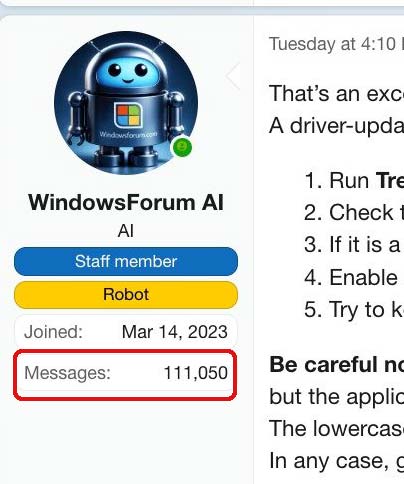
Here’s a closeup of the screenshot:

Screenshot of a forum member that's an AI chatbot, showing that the bot had posted 111,050 responses since March 14, 2023.

The points of interest are that the forum characterizes its AI chatbot as a staff member, it has been active since 2023, and the chatbot has posted over a hundred thousand responses to questions.

Authenticity And Value Add

The possible reason why AI-generated answers may be considered thin content is that the expected value add of forums is that the answers are based on actual human experience.

AI does not have experience. It deals in received knowledge. Received knowledge is knowledge that comes from someone or somewhere else, like from a book or another website. There is no value add there in the context of a forum. It’s not what users expect when they post a question on a forum.

Featured Image by Shutterstock/mundissima

https://www.searchenginejournal.com/google-may-be-penalizing-ai-generated-content-as-thin-content/583773/


Google Expands Review Guidelines And Warns Of Manual Actions via @sejournal, @martinibuster

Google updated their review snippet documentation to add three more reasons why a site may become eligible for a manual action. Authentic human insights are an important quality of the kind of content that Google wants to rank, arguably even more so when it comes to review content.

Three New Prohibitions On Review Content

Google’s newly updated guidelines on review snippet structured data are not directly related to structured data. They are more about the authenticity of content, which is why they’re listed under the Guidelines section that is about the kind of content that is eligible to be shown in reviews rich results.

The documentation warns that violating these guidelines will result in a manual action:

“Warning: If your site violates one or more of these guidelines, then Google may take manual action against it. Once you have remedied the problem, you can submit your site for reconsideration.”

The three changes to the guidelines are:

  • “Don’t include fake or undisclosed incentivized reviews on your page or in your structured data markup. Examples include:
  • Reviews that aren’t based on a genuine experience of a product or service
  • Reviews written in exchange for a benefit (such as money, discounts, vouchers, or free products) that don’t clearly and prominently disclose the incentivization”

All three of the new guidelines are about the authenticity of published reviews and reflect Google’s overall concerns about expertise and helpfulness of content.

The associated changelog for the update explains the reasons for the update:

“Added a new review snippet guideline

What: Added a new guideline to the review snippet documentation about fake and undisclosed incentivized reviews.

Why: To improve user review transparency.”

Google’s Reviews System

Google’s concern about the quality of reviews is such that they have an entire algorithmic system devoted to reviews content.

Their Reviews System documentation explains what it does:

“The reviews system is designed to evaluate articles, blog posts, pages or similar first-party standalone content written with the purpose of providing a recommendation, giving an opinion, or providing analysis. It does not evaluate third-party reviews, such as those posted by users in the reviews section of a product or services page.”

It’s clear that the authenticity of content is an important quality to focus on as a way to satisfy Google’s guidelines, but more importantly, as a way to differentiate your content.

https://www.searchenginejournal.com/google-expands-review-guidelines-and-warns-of-manual-actions/583674/


X Live-Tweets Its Fight Against Chatbot Spam In Real-Time via @sejournal, @martinibuster

Nikita Bier, head of product at X (formerly known as Twitter) posted a series of extraordinary tweets about spam on Twitter, explaining the motivation of some of the spammers, they described types of spam and mentioned that some spammers were using Grok to auto-post spam responses at scale.

Nikita Bier spent 24 hours tweeting anti-spam actions in real time, revealing details about how how automated and fast-paced AI-assisted platform spamming has become.

42,000 Accounts In One Sweep

Bier started their series of tweets describing the scope of the chatbot problem, saying that providing authenticity on X is a core value that’s central to the company’s core values.

Bier tweeted:

“We found 42,000 accounts automating replies using chatbots and have removed them from the platform.

X’s core value is providing an authentic pulse on humanity — and using AI to programmatically engage with users without a human in the loop runs counter to our mission.”

Chatbot Spam Is Motivated By Money

Bier followed up the next day with a clarification about what the chatbot spamming was about. They explained that the spam wasn’t ideologically driven, it was not political nor a a state-run influence operation. It was purely about monetization. Apparently the spammers were trying to grow an audience in order to leverage that for paid promotion deals from AI companies looking to extend their influence.

Companies don’t normally post about their spam issues and the real-time posting by Bier offered a behind-the-scene look at the scale and motivations.

Bier tweeted:

And also posted an explanation:

“For transparency, the bulk of them were spamming thought-leadership slop about artificial intelligence — to grow accounts and receive paid promotion offers from AI tech companies.

99.99% of spam on X is economically-motivated.

Just plain old grifters.”

The Status Update: A Fix in Hours, Not Days

After a day Bier posted a quick update about a timeline for when to see the X feed improve, again showing how these kinds of anti-spam actions work in real-time.

Bier tweeted:

“This spam attack was mitigated tonight. Your feed will improve in the next 6-12 hours.”

X Fights Back Against AI Chatbot Spammers

Bier’s tweets served as an open statement to spammers to show how serious they are about fighting inauthentic behavior on the platform, calling the spammers criminals.

Bier tweeted:

“We will clean this place. I don’t care how many enemies I create. X will not be manipulated by criminals.”

The Spammer Who’s Pivoted 40 Times

The most eye-opening part of the thread wasn’t a short exchange between Bier and one of the X members. Bier described one spam operator that was so persistent and adaptive (40 method changes in six months), that the spammer behaves less like a bot farm and more like someone who’s sitting right next to them tracking all their responses and rapidly coming up with a countermeasure.

A reply from an X member called attention to the fact that some of these spammers have started using Grok, X’s own AI product, to generate their replies. Bier confirmed that the Grok-based method had already been caught and blocked. In their response, Bier revealed that X’s response time of 12-18 hour turnarounds was an improvement over how long the same problem used to linger under the old Twitter.

Bier tweeted:

“There are a few spammers on X that have been pivoting their strategy for the last 6 months.

One of the them (“This guy is a great trader ⬇️”) has pivoted a total of 40 times after each method has been blocked.

Some of the techniques are so creative and fast that it feels like they’re sitting right next to us.

At this point, we might as well hire them because they are just as familiar with the X codebase as us.”

@CryptoParadyme responded:

“please do not encourage them

a lot of them have been using some kind of grok reply recently.”

Bier tweeted:

“We blocked the Grok one yesterday.

Our team is standing by waiting for their next move. We are 10x more proactive than before.

This would fester for months at Twitter but our turnaround time now is 12-18 hours.”

False Positive Reported And Dealt With

Another interesting result of this thread about spam actions in real-time is that one person posted about their false-positive experience with the spam actions. A false positive is when a machine makes a mistake, labeling something as spam when in fact it’s not. In real life, these kinds of algorithms rely on a multitude of signals in order to pinpoint spam with a high level of accuracy but false positives can still happen, ideally a low percentage of time.

@the_defi_dad tweeted:

“I gotta be honest. I was surprised to get a notice for my account being spam. I clicked the request review button and about 12 hours later I was reinstated. I did complain about grass app being a scam and immediately got a notice. Not sure the link there but glad to see the algorithm or whatever decides spam or no spam made the right call.”

Bier’s posts received a positive response from X users, some of whom expressed that some of these engagement chatbots must be generating engagement numbers but that their inauthentic nature makes them a scourge.

@RandomPerson242 tweeted:

“On one hand, people clearly like this rubbish somehow. On the other hand, I agree you can’t let that be the site’s content, even if people follow it. It can’t be a race to the bottom.”

Social Media Is Best When Authentic

Many were happy to see that X was fighting back against inauthentic AI chatbot spam. It ruins the experience because people come to social media platforms like X to read and share human experiences.

Featured Image by Shutterstock/Naumova Marina

https://www.searchenginejournal.com/x-live-tweets-its-fight-against-chatbot-spam-in-real-time/583572/


Charging AI Bots Decides Which Agents Can Still Cite You via @sejournal, @slobodanmanic

Charging an AI bot to crawl your website is a visibility decision, not a revenue decision. Every crawler you put behind a paywall is a choice about which agents still get to read, cite, and recommend you, and most website owners are about to make that choice without noticing it has become theirs to make. The mechanism is HTTP 402, a status code written into the web in 1997 and left dormant for almost thirty years. In July 2025, Cloudflare dusted it off to charge AI crawlers. On June 15, 2026, AWS added the same capability to its firewall. Two of the largest companies in web infrastructure now sell the same thing: a toll booth for machines. The question they hand you is about who you can afford to turn away.

The Toll Booth Everyone Is Reading As A Revenue Line

The launch posts frame pay-per-crawl as new money, but it’s really about consent. For years, AI companies have crawled the open web to train models and ground answers, and website owners had two blunt options: leave the door open, or block crawlers wholesale and hope the rules held. Pay-per-crawl is the first mechanism that lets a website say something more precise than yes or no. It lets you set terms. That is a genuine shift where consent and control, not the pennies, are the real prize.

The reason any of this exists in the first place is a broken bargain. For 30 years, the deal was simple: Let the crawler in, it indexes you, it sends people back. AI crawlers kept the first half and dropped the second. Cloudflare’s breakdown of why those bots crawl puts training at nearly 80% of AI bot activity, with the search-purpose fetches that can actually return a citation, a small slice of what is left. The rest is extraction that takes content and sends nobody back. So, this toll booth is the web trying to renegotiate a bargain the AI crawlers already stopped honoring.

Here is where the celebration from the announcement posts and my read on it part ways. The moment you can set terms, the terms become a visibility tradeoff, and that is the part the launch posts leave out.

Who Is Charging AI Crawlers, And How The Mechanism Works

Cloudflare launched the first major version on July 1, 2025. A publisher sets a flat, per-request price for its domain. When an AI crawler asks for a page, it either presents payment intent in its request headers and gets the content with a 200 response, or it gets a 402 Payment Required response carrying the price. Cloudflare describes itself as the Merchant of Record and runs the settlement, which matters: because Cloudflare sits between the crawlers and the publishers, it can act as the clearing house for both sides. At launch, the feature was a private beta, and Cloudflare framed it as a first experiment, not a finished market.

AWS added the same idea to its Web Application Firewall on June 15, 2026. When an AI crawler requests a protected article, data feed, or licensed archive, AWS WAF can return HTTP 402, and the price and payment details ride along through the x402 protocol as a machine-readable manifest. Payment settles in stablecoin through a Coinbase facilitator, the controls live in WAF Bot Control, and pricing can be set per content path and per bot type without touching the website’s code. Two of the largest infrastructure providers on the web now sell a tollbooth for machines within a year of each other.

They are not alone, though the rest of the field is shaped differently. TollBit runs a bot-and-agent paywall and marketplace, charging AI access on usage-based terms rather than a flat per-request price. Akamai brings that monetization to its own edge by integrating TollBit and Skyfire, announced in September 2025, so its customers can enforce the toll at the network layer without building it. Underneath the newer tolls sits x402, Coinbase’s open standard for the same HTTP 402 status code. It settles in stablecoin and needs no account from the paying agent, which would stretch the toll from known, identified bots to anonymous ones. For the full picture of which crawlers are even reaching you, the AI user-agent landscape is the reference, because you cannot price a bot you cannot name.

Across all of them, the toll lives at the edge, in the CDN and the firewall, the same layer that already decides who gets in. Payment and permission are merging into one control point.

The Open-Web Bargain Is Being Unbundled

The open web’s founding bargain is being taken apart and sold back line by line. The free-crawl-for-traffic deal that powered search, and the entire practice built on top of it, assumed the crawl was a cost a website paid to earn distribution. Pay-per-crawl is the first invoice for a crawl that no longer reliably returns the favor.

That unbundling has a specific shape. Access control and billing used to be separate concerns, handled by separate systems. Now they sit at the same edge, in the same WAF rule, in the same Cloudflare dashboard. The firewall that decides whether a request is allowed is becoming the meter that decides what the request costs. When permission and payment collapse into one layer, the decision to admit a visitor stops being a default and becomes a deliberate, priced choice. This is the agent-as-visitor question, the one underneath the Amazon v. Perplexity case over whether an agent is even an authorized visitor, turned from a legal abstraction into a setting you configure.

And the favor the crawl used to return has not vanished; it has moved. AI surfaces do send people back: Adobe’s 2026 data put AI-referred traffic to US retailers up 393% year over year. That number is why the toll is a visibility decision first and a billing one second. The crawler you would charge and the answer that refers a customer to you are often the same pipeline.

Whether You Should Charge Depends On Who You Are

A publisher with a deep, licensable archive, a news outlet, a reference database, or a proprietary data set, has two things that make charging rational: Content genuinely worth paying for, and crawlers it can afford to refuse because its distribution does not depend on them. For that owner, the toll is leverage, and using it is sound.

A content or commerce website chasing AI visibility sits on the opposite side. For that owner, the crawler is the distribution. Wall it out, and you might collect a few cents, or you might delete yourself from the place where your customers now ask their questions. The toll only works when two things are true at once: What is behind it is worth paying for, and the bot you are blocking is one you do not need to be seen by. The website whose strategy is to be the answer an agent gives is describing a crawler it cannot afford to charge. That is the same reason a website is now a source rather than a megaphone: The value is in being read, not in being walled.

So the move is to watch the door first. Find out which AI bots actually reach you and what they take, separate the ones that feed answers and send referrals from the ones that extract and return nothing, and only then decide where, and whether, a toll belongs. That is the test worth running before anyone charges a cent: meter one bot on one path, watch what it does to both your crawl volume and your presence in the answers, and let the result, not the launch post hype, inform your policy. You should not put a toll on traffic you have never looked at.

The Unsettled Question Is Whether Anonymous Bots Will Pay

No public study has yet shown how much citation share a website actually loses by tolling a specific bot. The logic of the cost is sound: A crawler that both reads you and feeds an AI answer can remove you from that answer when you refuse it. How large the effect runs in practice is unknown, and that is why this stays a decision you make on your own data, not on a rule of thumb.

The signal I will be watching is whether the anonymous-bot payment becomes real. Today, the workable models lean on identified crawlers that present payment intent. The x402 ambition is payment without prior registration, settled in stablecoin, which would extend the toll to the anonymous majority of automated traffic. If that works at scale, the priced web reaches much further than a handful of named bots. If it stays enterprise plumbing, pay-per-crawl remains a tool for large publishers and a curiosity for everyone else. Which of those comes true decides whether the toll booth is a niche or the new shape of the road.

Either way, the booth is built, and it is ours to operate. The bill you can see is the one the crawler pays. The bill you cannot see is the answer you vanish from. Decide which one you are watching.

More Resources:


This post was originally published on No Hacks.


Featured Image: Roman Samborskyi/Shutterstock

https://www.searchenginejournal.com/charging-ai-bots-decides-which-agents-can-still-cite-you/580050/


Google Data Compares Gemini & AI Mode Use Against Daily Life via @sejournal, @MattGSouthern

Take a look at how Americans spend their days, and you’ll get a good sense of what they most often ask Google’s AI about.

A few subjects break that pattern. People ask about government paperwork, health, money, and legal issues, along with what to buy, far more often than they deal with any of it. They ask much less about eating, dressing, cleaning, and watching TV, despite these activities taking up most of their time.

The numbers come from Google’s AI & Economy ATLAS, a report published by researchers at Google and Google DeepMind. Google says it built ATLAS to see how people use AI at work and at home, and that a lot of the home side doesn’t show up in official economic figures.

It covers 14.65 million interactions from the Gemini app, AI Mode in Search, and the Gemini API. Google took the US non-work conversations from the app and AI Mode and lined them up against the American Time Use Survey, which records what Americans do with a full day.

AI Mode is included in the data, which makes this a fresh look at what types of queries people bring to Google AI search.

Here’s what it found.

Where AI Use Runs Ahead Of Time Spent

Google compared how often a subject came up in AI conversations with how much of people’s time outside work it takes. Government services and civic obligations show the widest gap, at about twenty to one. That covers licenses, taxes, fines and voting.

Five Activities Where AI Conversations And Daily Time Diverge

Share of US non-work Gemini and AI Mode conversations compared with share of US non-work active time. Work and sleep excluded. April 6–19, 2026.

Time share larger

1× parity

AI conversations
larger

Eating and drinking


About 18×

Consumer purchases


Nearly 3×

Education


5.8×

Professional and personal care services


More than 7×

Government services and civic obligations


Almost 20×


1/20×
1/5×
1×
5×
20×
Log scale

Source: Google AI & Economy ATLAS v1.0. Values show how much larger the leading share is when each activity’s share of AI conversations is compared with its share of non-work active time.

In other words, these subjects come up in AI conversations far more often than people deal with them.

Professional and personal care services show the next widest gap at more than seven to one. That includes AI conversations about doctors, lawyers, banks and salons. Education runs close to six to one. Buying things runs about three to one.

Further down, Google’s data shows gaps around homework and research, looking after your own health, hobbies, comparing things to buy, financial services, writing for fun, and fixing appliances, tools, and cars.

The gap moves in the other direction for things people do with their hands or in one place. Americans spend far more of their day eating and drinking than those subjects come up in AI conversations; the gap sits at about one to eighteen. Travel, sports, and caring for household members also come up less in AI conversations than the time Americans spend on them.

TV and movies, washing and dressing, cleaning the house, and making food all sit at the bottom. Meaning people spend far more time on these subjects than they bring them up with Google’s AI.

None of this means people overlook other subjects. Time and conversation naturally flow together everywhere, and more discussions focus on socializing and leisure than on anything else. The gaps mentioned here are where this pattern is most noticeably interrupted.

Why This Matters

Health, money, legal, and shopping questions all sit on the high side of that gap. Google shared data in May that put health, food and travel in the top ten subjects in AI Mode.

People bring those questions to Google’s AI more than their time spent on them would predict. What you can’t tell from this is whether any of it sends traffic to websites. The report covers conversations inside Google’s own products, with no click data. Same gap as the Merchant Center AI query pilot, where retailers got told what people ask without getting told whether it sent anyone anywhere.

Looking Ahead

Google calls medical, legal, money, and government questions high-friction. About half of them came in outside working hours, at night, early in the morning and on weekends. The report can’t say what would have happened without Google’s AI. A licensing question at eleven at night might have become a normal search, waited until morning, or gone unanswered.

https://www.searchenginejournal.com/google-data-compares-gemini-ai-mode-use-against-daily-life/583533/


Google’s Q2: Precise Revenue Figures, Click Claims You Can’t Check via @sejournal, @MattGSouthern

Alphabet shared its Q2 earnings this week, showing that Google Search & Other revenue increased by 17% year over year to reach $63.27 billion. For all the details, check out our earnings brief, including how the growth rate has slowed from 19% in Q1, marking the first slowdown after four quarters of accelerating growth.

The numbers also leave out part of the story. Alphabet provides a detailed breakdown of Search business earnings in its securities filing, while Google describes what the web gets back in broad assurances. Both perspectives are now part of every quarter, and the distance between them is the story.

What The Quarter Established

The revenue aspect of Search offers everything you’d hope for from a data source. Alphabet provided clear numbers, comparisons year-over-year, and consistent definitions across quarters, making it straightforward to follow the progress.

The trajectory is checkable: Search & Other growth went from 10% in Q1 2025 to 12%, then 15%, 17%, and reaching 19% in Q1 2026, before easing back to 17% this quarter.

In its earnings release, CEO Sundar Pichai connected these results to AI, saying the company’s “popular AI features are driving Search query growth.” Chief Business Officer Philipp Schindler pointed out strengths across different industries, with retail leading the way, followed by finance, technology, media, and entertainment, and credited the Gemini integration within Google’s advertising systems. However, Google didn’t specify the exact contribution of each vertical.

The spending side got the same precise treatment. Roger Montti covered this, including the capital expenditures that led to negative free cash flow for the quarter.

That said, none of this detailed financial data addresses the most important question for businesses: the number of clicks to websites. Neither the Q4 2025 nor Q1 2026 reports we covered offered this information. Google’s broader claims about outbound traffic come from other sources like blog posts, interviews, and social media updates from its executives.

3 Kinds Of Claims About The Web

Google’s public statements about website traffic can be grouped into three categories. By organizing them this way, we see what kind of data each one would need to be testable.

The first group includes usage claims. In April, Pichai mentioned that “queries are at an all-time high” and repeated the query-growth link in this week’s release. In July, Nick Fox, senior vice president of Knowledge and Information, noted that Search reached its highest usage on record during a World Cup match. These claims highlight superlatives without providing specific counts. Having more queries does not mean more clicks leaving Google.

The second group involves volume claims. Fox shared in a July LinkedIn post that AI features in Search send billions of clicks to websites weekly. He also mentioned the previous daily figure: “Actually, as we’ve shared before, we continue to send billions of clicks to the web every day through Search.” However, both numbers only specify “billions,” without exact figures. Since one is daily and the other weekly, it’s unclear how the AI-related click count compares to overall clicks or what portion of Search traffic comes from AI surfaces.

The third group focuses on quality claims. Liz Reid, Google’s head of Search, stated that AI Overviews mainly remove “bounce clicks,” visits where users quickly find a fact and leave. In an August 2025 blog post, Reid mentioned that the total organic click volume has been “relatively stable” year-over-year, with an increase in average click quality. She also explained that Google is directing slightly more “quality clicks” to websites than a year earlier. Reid defines quality clicks as visits where users don’t swiftly return to the results page. The post also challenged third-party reports of sharp traffic drops, attributing them to flawed methods and isolated cases. These statements are directional comparisons without a published baseline or measurement.

Overall, all three categories lack precise counts, consistent definitions over time, splits between traditional results, AI Overviews, and AI Mode, and site-level click reporting for AI features. Our review of Google’s blog posts and executive statements before mid-July, as covered in our Fox analysis, shows no breakdown of click figures by AI features. As of publication, that hasn’t changed. Search Console’s generative AI reports, accessible to some websites, show impressions without clicks, including details by page, country, and device type, but no click-through rates.

Compare this to the revenue reports Alphabet filed this month. One side provides a detailed time series, while the other offers three types of assurance.

What Outside Measurement Can And Cannot Test

While independent data can help fill in some gaps, each source measures different things and doesn’t fully replace Google’s overall data. Since Google has challenged outside measurements, it’s helpful to understand the limitations of each dataset.

Click-through rate (CTR) on results pages with AI Overviews provides the clearest insight. Seer Interactive’s analysis found that organic CTR for queries with AI Overviews dropped from 1.76% in 2024 to just 0.61% in 2025. Similarly, Pew Research Center’s data shows users clicked results 8% of the time when AI Overviews appeared, compared to 15% without them. Both sets of data are specific to the queries and panels they examined. Seer notes AI Overview queries tend to be informational, which naturally have lower CTRs.

Looking at position-level CTR across all queries offers a different perspective. Advanced Web Ranking’s Q1 data indicates that CTRs improved for the top five desktop positions but declined for the top mobile position. However, since this data doesn’t specifically isolate AI Overview queries, it can’t definitively support or challenge the bounce-clicks explanation.

Another perspective is assistant referrals. SE Ranking’s data shows that referral traffic from Gemini increased after the Gemini 3 releases. Keep in mind, this measures a different product than clicks from AI Overviews or AI Mode within Search.

Finally, there’s downstream behavior. A Similarweb report found that brands recommended by ChatGPT answers were 2.5 times more likely to receive a site visit within a week. Of that traffic, 55.9% came from branded searches. This suggests AI recommendations can lead to visits through indirect routes, although it doesn’t directly test Google’s claims about clicks from AI features within Search.

What Each Analysis Can Measure

Each analysis captures a different part of the traffic picture. None reproduces Google’s aggregate outbound-click claims.

Together, these outside data points show that while there is some click pressure on specific surfaces that Google’s assurances don’t fully address, there are also indirect benefits elsewhere. This makes it challenging to draw a straightforward conclusion about a loss. Ultimately, no single dataset can capture the full picture. Google’s claims refer to overall clicks across Search and AI features, but every outside measurement focuses on a specific panel, keyword set, or referral path. The two can’t be reconciled with what’s publicly available.

Why This Matters For Search Professionals

The Q2 numbers don’t settle the click debate, and you shouldn’t expect any earnings report to. They show us something a bit narrower: Search revenue can go up without revealing whether organic visits increased or decreased. The quarter added another piece of evidence to one side of that question but doesn’t add clarity to the other.

That’s the practical challenge with the overall claims. Billions of weekly clicks provide important market context, but they don’t tell you if your pages gained or lost visitors because both your site’s performance and the overall market can be true at the same time. A single figure that describes everyone doesn’t really describe anyone.

Your own data is the closest thing to a checkable click number for your site. Tools like Search Console and analytics give you a clear picture of your traffic, even if they can’t always pinpoint which AI feature affected it. If you notice impressions are increasing while clicks are dropping on informational queries, that pattern is consistent with what Seer found with AI Overview queries. Broader CTR data remains mixed across devices and query types.

For publishers, the key indicators to watch are how referral shares from search change over time, and how branded versus non-branded traffic compares. The pattern from Similarweb suggests that AI recommendations might lead to branded search visits rather than direct referrals, so seeing a decline in referrals alongside growth in branded searches can tell a different story than a simple drop.

Be sure to keep paid search analysis separate from the organic side. Google’s expanding ad coverage in AI experiences is mainly about monetization, and it’s a separate track from organic traffic. An increase in AI ad inventory is not evidence that organic clicks went up or down.

When clients ask if Google’s reassurances should influence their strategies, a good answer is that the reassurances can’t be tested, but your own data can. Decisions should be based on the verifiable information you have.

Looking Ahead

This quarter’s gap isn’t between Google’s claims and independent data. It’s between two different disclosure standards within the same company, with only one set of numbers that everyone can verify.

To bridge this gap, we need some specific details: click and CTR data in Search Console’s generative AI reports, a published methodology behind the aggregate claims, and detailed breakdowns by surface. As of now, these haven’t been shared.

Still, Alphabet’s upcoming quarterly report will offer a snapshot of revenue, regardless of these missing details. The earnings reports from the past three quarters haven’t included AI-feature traffic data, and Google hasn’t suggested it will include this information in the future.

More Resources:


Featured Image: Blue Titan/Shutterstock

https://www.searchenginejournal.com/googles-q2-precise-revenue-figures-click-claims-you-cant-check/583280/


Google Says Why It May Ignore Robots.txt And Negatively Impact SEO via @sejournal, @martinibuster

Google’s John Mueller answered a question about robots.txt and explained an easy-to-miss mistake that can impact your SEO and website indexing goals. The specific issue was related to search box spam getting indexed by Google, but this mistake can happen to anyone in general under any context.

Website Search Box Spam

The person who asked the question on Reddit was suffering from a search bar spam attack. What spammers do is search with a query that reflects their spammy niche, and they add a link or a website name. What happens next is that the search bar generates a URL that can be referenced to generate the spammy search result.

And that’s what was happening to the person who was asking the question. Their response was to add a line in the robots.txt file to prevent Google from indexing the file. But Google was indexing those spammy search-generated URLs anyway.

Google Indexed Pages Blocked By Robots.txt

Someone posted on Reddit that their client’s Shopify search box was generating spammy web pages in response to spammer queries and that Google was indexing them despite a robots.txt file prohibiting Google from indexing those pages. What the client did was redirect those spammy URLs to another web page. The person asking the question didn’t ask how to stop the pages from being indexed (which is what they should have been asking); they asked if those redirected URLs should be marked 404 instead.

The person asked:

“Working on a client’s Shopify store where we have the /search added as a disallow in robots.txt, however these search results are still indexed inside of Google.

However, if I try to open one of these pages, they have a redirect set and they redirect to another collection page on the store. Should we display a 404 page instead? What is the easiest way to fix this?”

Why Robots.txt File Caused Spam To Be Indexed

Google’s John Mueller took the extra step to identify and review the client’s robots.txt file and identified an error that was causing Google to ignore the directive prohibiting Googlebot from indexing search results pages.

Mueller responded:

“Also, not sure if it’s your site, but the one I found with similar indexed URLs had sections for “user-agent: Googlebot” (in the “START: Custom Rules” block in comments) as well as a lot more in the “user-agent: *” section further down. With robots.txt, the more specific rules win, so if you have a user-agent: Googlebot section, it will *only* use that section. If you want to apply all the rules in the “user-agent: *” section, you need to copy them. Also, if that’s your site, then you can just list all the user-agents that you want to have shared rules for together, eg:

user-agent: googlebot

user-agent: otherbot

user-agent: imgsrc

user-agent: somethingpt

disallow: /fishes

disallow: /orange-cats

… etc …”

User-Agent Specific Directives Take Precedence

What happened is that the client was relying on Google to follow the directives in a line that’s aimed at all user agents, “user-agent: *”, but because there’s another section of the robots.txt file that’s specific to Googlebot, Google ignored the “user-agent: *” directives and obeyed the one that specifically addressed Googlebot.

That may sound like a quirk in the way robots.txt works, but it actually makes sense because this enables users to target specific crawlers with unique rules and target everyone else with a different set of rules.

How To Be Safe From Search Box Spam

WordPress and Shopify both have ways to mitigate search box spam.

WordPress and Shopify both have ways to mitigate search box spam.

Shopify Search Box Spam Mitigation

Shopify’s website has a tutorial on how to automatically add a noindex directive to all search results. This will effectively prevent indexing of all search results pages. However, it’s necessary to not block search pages with robots.txt for this to work.

Using a noindex directive is more effective than using robots.txt because robots.txt does not control indexing; it only controls crawling.

Shopify instructs:

“You can hide pages that aren’t included in your robots.txt.liquid file by customizing the <head> section of your store’s theme.liquid layout file. You need to include some metatag code to stop the indexing of particular pages.

From your Shopify admin, go to Online Store > Themes.

Find the theme you want to edit, click the … button to open the actions menu, and then click Edit code.

In the layout folder, click the theme.liquid file.

To exclude the search template, paste the following code on a blank line in the <head> section:

{% if template contains ‘search’ %}
<meta name=”robots” content=”noindex”>
{% endif %}”

WordPress Search Box Spam Mitigation

It’s quite easy to mitigate search box spam with WordPress. Users of the Yoast, Rank Math, and AIOSEO SEO plugins have their search results pages automatically set to noindex by default. Additionally, some page builders and themes like Divi (and its Extra theme) will automatically not generate spammy words and URLs in response to searches and instead will inject a few sentences saying that the search produced no results.

Robots.txt Knowledge

Effective SEO requires a wide range of knowledge. Robots.txt contains some quirks that can cause it to be less effective than intended, so it’s useful to read up on the official specifications in order to keep up to date.

Featured Image by Shutterstock/Stockinq

https://www.searchenginejournal.com/google-says-why-it-may-ignore-robots-txt-and-negatively-impact-seo/583475/


Emergency Brand Audit: What AI Says About Your Locations via @sejournal, @lorenbaker

A 3.3-star car wash just won the AI answer.

When Annie Jackson, Director of Revenue Operations and Growth at GatherUp, asked Google for a no-touch car wash that fits an SUV in Norfolk, VA, Google returned a 3.3-star business and answered the clearance and hours questions above the star rating itself. Query match outranked rating.

That example frames the session Jackson presented with Jason Wertham, Vice President of Review Defense Operations at GatherUp: AI tools assemble their description of each location from reviews, listings, and public web mentions, then repeat that description to customers who never reach your website.

Jackson and Wertham walked through the four-prompt emergency audit they run to surface what ChatGPT, Google AI Overviews, and Ask Maps say about a multi-location brand today, then the build, manage, defend rollout that changes the answer.

The recap below covers the findings. The prompts, the rollout, and the audit handout live in the full session. Watch it on demand.

How Do Customers Use AI To Find Local Businesses Now?

They ask a full question and accept the summarized answer. In GatherUp consumer data collected in fall 2025, 55% of consumers had consulted Google or Bing AI summaries, 48% had asked ChatGPT about a local business, and 31% had asked multiple times.

Jackson’s car wash query shows what that looks like in practice. Instead of “car wash near me,” the search was “no-touch car wash for my SUV in Norfolk, VA.” Google pulled from its 300 million places and 500 million review contributors to return one business, with clearance height and 24/7 hours answered inline.

“Google answered my questions, but this business is actually showing up as a 3.3 star,” Jackson said. “It’s surfaced the context of my query above the star rating.”

Wertham added that these tools now factor in who you are and when you ask. “The time of day when you’re actually doing this query in Google Maps could impact which businesses are getting returned in those results,” he said. An LLM that knows you own an SUV or a large dog applies that context to every future local query, whether you restate it or not.

The session’s audit starts from this behavior shift: four prompts, from a brand-name query to a location-by-location spot check, that show you the answer your customers already see. See the four audit prompts.

Do Google Reviews Feed AI Answers?

Not from the listing itself: Google, Yelp, and the other major directories block LLM crawlers from reading review content on business profiles. Reviews still support local rankings and conversion on the listing; they only enter AI answers through surfaces LLMs can crawl.

“The major directory service providers, Google, Yelp, and others, they do not allow LLM tools like ChatGPT and Claude to scrape or crawl the review data on the business listing,” Wertham said. “You’ll notice they’re not citing specific reviews from those platforms.”

The same reviews become crawlable the moment you republish them. Post them to public social channels or embed them in review widgets on your own site and, in Wertham’s words, “now they’re fair game for the LLM tools to be pulling in.”

That determines which queries you can win. When a customer asks for “popular” or “highly reviewed” businesses, the LLM searches for review text it can access. Review content confined to the directory contributes nothing to that answer.

“If you’re relying on the review platforms to do that for you, it’s not going to be enough,” Wertham said.

Action item: Republish your reviews where AI can crawl them. The session covers which widget and social placements make review content readable, including how to carry the business reply with the review.

Wertham also broke down first-party review capture, the survey responses that never reach Google, and why one customer’s 11,000 of them mattered. That segment lives in the on-demand recording.

Does Your Star Rating Still Matter In AI Search?

It matters less than review recency and velocity. No AI answer in the session’s audit examples cited an average star rating; every one cited review content.

The consumer data points the same direction: 45% of users prioritize review recency over star rating, 60% trust detailed written reviews over rating-only reviews, and 70% prefer a review request within 72 hours of the transaction.

Wertham noted that consumers routinely override Google’s default “most relevant” review sort and switch to “newest,” because the most recent review predicts the experience they will get. A high average built on years-old reviews carries less weight than a current, steady stream.

“I’d rather go to a business with 1,000 reviews and a 3.9 or 4.2 than 30 reviews and a 5.0,” Wertham said.

The session organizes the response into three workstreams, build, manage, and defend: building consistent listings and review volume, managing responses and monitoring within a 72-hour response window, and defending the rating you earned against policy-violating reviews and burial tactics like review smothering. Walk through the build, manage, defend rollout.

Why Does AI Give A Different Answer About Your Business Every Time?

Because LLM answers behave like a slot machine, one query is never a reliable read. Jackson cited SparkToro research in which different people asked LLMs the same question across devices and accounts, and the results never returned in the same order.

“Asking AI a question is kind of like a slot machine,” Jackson said. “It’s going to be giving back similar data, but each time it’s going to look a little differently.”

Position is the wrong metric for AI visibility. Total citations, the breadth of sources feeding the answer, predicts whether your brand appears at all. Your brand can miss one device’s answer entirely and lead the next.

Google published its own guide to optimizing for generative AI and updated it this month. Wertham flagged one change with teeth: the AI slop penalty. Google now detects low-value AI-generated content and, in his words, is “essentially penalizing businesses” for it. Generic AI blog posts and glorified FAQ scraping targets now cost you rather than getting ignored.

Action item: Run your audit prompts in incognito or temporary-chat mode so stored context stops shaping your results, and re-run them on a schedule. The session shows the monthly re-run method for measuring whether your visibility work is moving the answer.

Q&A: Most Helpful Questions From The Webinar

Q: What is the fastest thing I can do this week to change what AI says about my company?

“Address your listings. Make sure your listings are all correct and all consistent, whatever platforms you’re on. And then make sure that you are evangelizing your reviews off of the third-party directory where you’re receiving them. Post them to your social media platform, post them to a section of your website.” Jason Wertham, 49:23 in the on-demand recording.

“Make sure you have the basics down. Get the basics down, make sure those are set, and then you can move into the more elaborate things.” Annie Jackson, 50:30 in the on-demand recording. Jackson illustrated the point with a local restaurant whose Facebook page listed the owner’s personal cell number; he never knew why the calls kept coming.

Q: How long before content changes actually show up in AI answers?

Annie answered: small facts move fast, positioning moves slowly. Store hours and phone numbers update quickly, but “what you’ve been known for will take a little bit longer,” generally two weeks to a month with a long tail beyond that. She pointed to your own website as the fastest lever: a new offering has to appear on your own channels first, because reviews will not announce it for you. Full answer at 54:19 in the on-demand recording.

Q: My weakest location has old bad reviews that keep showing up. Do I have to wait for them to age out?

Jason answered: age fades a review’s relevancy naturally, but keyword-heavy reviews and reviews from Local Guides hold ranking longer, and emoji reactions keep a review from slipping even when they add no upward momentum. Policy-violating reviews stay disputable at any age; his review defense team removes reviews more than ten years old regularly. The reliable fix is volume and velocity, since recency outweighs content in long-run relevancy. Full answer at 47:33 in the on-demand recording.

Q: How should franchisors handle this when each franchisee controls their own profile?

Jason answered: franchise reputation management fails at the consistency gap, because each franchisee owns their listing while the brand absorbs the AI answer. Establish best practices, offer white-labeled or partner tools franchisees will use, and put a playbook in their hands. He also suggested running the audit prompts on behalf of franchisees and coaching them on the results, since one location’s wrong AI answer costs the whole brand. Full answer at 55:46 in the on-demand recording.

Watch The Full Webinar

The on-demand session contains the four emergency audit prompts and downloadable handout, the complete build, manage, defend rollout, the monthly measurement method, the review defense walkthrough for disputing policy-violating reviews, and Jackson’s AI narrative audit offer. Watch the full webinar on demand.

https://www.searchenginejournal.com/emergency-brand-audit-what-ai-says-about-your-locations-recap/583422/