Back in the days before practically every mobile game was a free-to-play, ad- and microtransaction-laden sinkhole, Rovio found years of viral success selling paid downloads of Angry Birds to tens of millions of smartphone users. Today, though, the company is delisting the last “pay upfront” version of the game from mobile app stores because of what it says is a “negative impact” on the more lucrative free-to-play titles in the franchise.
Years after its 2009 launch, the original Angry Birds was first pulled from mobile app stores in 2019, a move Rovio later blamed on “outdated game engines and design.” The remastered “Rovio Classics” version of the original game launched last year, asking 99 cents for over 390 ad-free levels, complete with updated graphics and a new, future-proofed engine “built from the ground up in Unity.”
In a tweeted statement earlier this week, though, Rovio announced that it is delisting Rovio Classics: Angry Birds from the Google Play Store and renaming the game Red’s First Flight on the iOS App Store (presumably to make it less findable in an “Angry Birds” search). That’s because of the game’s “impact on our wider games portfolio,” Rovio said, including “live” titles such as Angry Birds 2, Angry Birds Friends, and Angry Birds Journey.
Please read below for an important announcement regarding the availability of Rovio Classics: Angry Birds. pic.twitter.com/a4n4bU5gQJ
All of those other Angry Birds games are free-to-play titles in which players can earn extra lives or helpful items by purchasing in-game currency or watching short video ads. Those changes were roundly criticized when they were introduced into the Angry Birds universe, but that didn’t stop the free-to-play games from becoming highly lucrative for Rovio.
Pure economics
In a statement on the game’s Discord server (as captured by Video Games Chronicle), Angry Birds Community Manager Shawn Buckelew reiterated that sales of the 99-cent “classic” version of Angry Birds were “negatively impacting our other games, which is what we as a company have to focus on. If those other games do not improve and grow, then the outlook of the entire company changes. It’s harder to create new games or work on new projects. I’m sure that’s not something you would want.”
That’s a striking admission considering that Rovio Classics: Angry Birds is currently the No. 2 best-selling paid download among all games on the iOS App Store, well over a decade after its initial release (and nearly a year after its rerelease). But that chart-topping position translates to just $30,000 in estimated monthly revenue, according to Sensor Tower estimates.
The free-to-play Angry Birds 2, meanwhile, attracted 900,000 new free-to-play downloads last month and raked in over $9 million in revenue, according to those same Sensor Tower estimates. But that strong revenue number is only enough to make Angry Birds 2the 74th highest-grossing iOS game on the current iOS charts.
The difference shows how few mobile users are willing to pay upfront for their games these days and highlights the vast gulf in potential revenues between top-performing free-to-play and pay-to-own mobile titles.
If you don’t want your Angry Birds experience marred by ads or pushy microtransaction offers, there’s still hope. Apple Arcade subscribers can download Angry Birds Reloaded, which adds some new features over the original as well as Mac and Apple TV compatibility. Try doing that on Xbox Game Pass, we dare ya. https://arstechnica.com/?p=1919848
2023, the year of SEO: why brands are leaning in and how to prepare
30-second summary:
As marketing budgets inevitably tighten, the demand for cost-effective and dependable channels such as SEO continues to increase
Some of the critical updates and algorithm changes in 2022 give marketers a heads-up on where to focus in 2023
SEO and content marketers need to create better processes and work in tandem to achieve business goals
The days of set-and-forget SEO are over, organizations must utilize SEO in multiple ways
With marketing budgets under more scrutiny than ever, savvy organizations are looking towards SEO for sustained growth. Incorporating organic search into the digital strategy offers rich rewards – both in terms of cost efficiency and improved brand equity – that can contribute to an entire organization. As such, marketers have embraced this approach to maximize returns on marketing and technology expenditure.
In this article, I explain why SEO is so hot, what has changed in 2022, and what to capitalize on in 2023.
According to research from Gartner, CEOs are doubling down on digital investment strategies as they maximize their marketing ROI. However, Google recently reported that ad spending is down.
At the same time, in a recent survey of over 1000 enterprise marketers, over 90% of marketers are planning to place a greater emphasis on SEO in 2023.
Why organizations will lean into SEO in 2023
As marketing budgets inevitably tighten, the demand for cost-effective and dependable channels continues to increase — drawing much-deserved SEO attention from company leaders. In particular, they are finding that SEO insights give them a comprehensive view of consumer trends in times of volatility. It’s this invaluable knowledge that organizational and departmental heads know can help them drive their decisions today and tomorrow.
After two decades of sustained growth, search remains an essential channel despite marketplace volatility. It is a testament to the importance and effectiveness of search for connecting businesses with their target audiences.
Concerning enterprise organizations, some key benefit factors leading to the lean into SEO include:
SEO is a high-yield channel and is not impacted by market conditions
Organizations can benefit from long-term SEO incremental value
Only SEO can provide real-time insights into both market demand and customer intent
SEO insights drive sales, product, digital, and media initiatives across organizations
Organizations benefit from brand equity due to SEO presence on the SERPs
In tandem, SEO and PPC (together) give more control over the customer experience
SEO is rapidly becoming the key to unlocking a connection between businesses and customers. Organizations can get ahead of their prospects’ needs by understanding what they are looking for, why it matters to them, and how optimized content can best meet those requirements when needed most.
The focus on the (human) consumer and their experiences is something that Google focused heavily on in 2022. Some of the critical updates and algorithmic changes give marketers a heads-up on where to focus in 2023.
Learn from 2022 to prepare for 2023
2022 has been an eventful year for organic search, with several significant updates impacting how SEO and marketing teams should focus and operate.
Below are a few key areas where Google has indicated where SEO, content, technical and online marketers need to change – adapt and become agile – and where to prioritize their focus in 2023.
The Page Experience Update and Core Web Vitals was rolled out (mobile and desktop) to ensure users receive results that load quickly and render within a certain time threshold.
In 2023 all organizations must ensure their website’s technical performance creates an optimal user experience
This involves examining the page loading speed, browser response time, and content stability during loading for a seamless customer journey
Leveraging a tailored blend of data-led insights, content, and technical expertise in 2023 will help you create powerful user experiences. Google puts great emphasis on optimizing results and prioritizing accurate, reliable information – from page speed through to navigation capabilities Ensure you combine data-science techniques with best (white-hat) SEO best practices.
By focusing both on website functionality and providing engaging, relevant content – marketing teams can plan for success in the current – and any – economic climate
Google’s Product Algorithm Update was released to help users make informed decisions. This was in the form of a refreshed set of instructions and updates based on the annual performance of product reviews. It was designed to empower users with access to accurate information that will enable them to make sound product purchasing choices.
Future focus for 2023
In 2023 make it your goal to create a world-class experience for consumers, helping them find what they need quickly and easily. Aim to make the process of looking for items simpler than ever before – empowering people who search with an effortless journey directly from search results into their shopping carts!
If your selling products, demonstrate your professional abilities by providing well-founded advice and showcasing why you are the go-to expert on a subject
Back up any product recommendations with reliable data to provide assurance of authenticity
Multisearch was announced in April to enable searches using images and text. Powered by Google Lens, it allows people to use mobile cameras or photos to search relevant images and text to find the most relevant results they need. Connecting words & visuals to create an exciting array of possibilities for consumers.
Future focus for 2023
In 2023 expect more advancements in Google’s AI development and MUM
Balance the content you create, and find an image-to-text ratio to provide the accurate answers users now want and expect
Focus on mobile optimization of images and expect this type of functionality to become a new norm in 2023
Google’s Helpful Content Update was announced and recently rolled out to ensure users receive the most useful search results.
Future focus for 2023
In 2023, content creators and website owners must develop unique materials tailored specifically toward human end-users instead of robots or spiders
For instance, when collecting customer reviews on products sold online – be sure requests inquire about specific details so reviewers can demonstrate intimate knowledge in their feedback
Similarly, blog posts covering events or news should include fresh perspectives not found elsewhere by readers searching through Google’s services
Today’s algorithms are much more sophisticated, and they identify content that does not satisfy the reader – in some cases, content that has been “spun up” by automated tools.
At Google’s Search On event, they revealed some innovative developments that will revolutionize how we search online. For example, visual search results will provide an interactive and engaging experience with graphic cards of imagery directly integrated into every search result.
Additionally, users can also look forward to a new auto-complete feature for their searches as well as more tailored multi-search options designed for them to find meaningful answers quickly.
Googles Spam Update to help direct customers towards content with real purpose. As part of this effort, the search giant is improving the quality of results and expanding into new formats and mediums for delivering helpful information.
Consider how these updates may affect your SEO strategies moving forward
Ensure you are balancing keywords and not keyword stuffing
Avoid thin content and focus on quality over quantity
Use AI correctly for insights and optimization, not article content creation
Conclusion
SEO teams are becoming indispensable for organizations looking to uncover fresh opportunities and build a durable business. Cost-efficient tactics not only save funds but add value across departments too.
In 2023 focus on the following;
Utilizing SEO insights as a source of organization-wide business intelligence
Ensure technical SEO best practices are used to ensure websites provide experiences consumers expect and automate research and site fixes when and where possible
Focus on visual search and expect its importance to rise in 2023
Balance your optimization of content with key Google E-A-T and Helpful content guidelines, do not over-optimize
Leverage AI and automation to manage repetitive and time-consuming tasks and scale
Balance SEO and PPC and find synergies to adapt to changes in the market and with Google
SEO is no longer viewed as a stand-alone task; it is an integral part of your overall marketing plan. It enhances and bolsters other strategies in place while providing maximum reach for your business goals in 2023.
Be prepared for change and be flexible and agile. Slacking regarding optimization in terms of user experience, technical issue resolution, and speed can see you left behind competitors who are continuing their efforts without pause.
The days of set-and-forget SEO are over. Be prepared as organization look to utilize SEO in multiple ways
Change will be the main constant in the economy, with organizations and SEO next year!
Jim Yu is the founder and CEO of BrightEdge, the leading enterprise SEO and content performance platform. Find him on Twitter @jimyu.
Subscribe to the Search Engine Watch newsletter for insights on SEO, the search landscape, search marketing, digital marketing, leadership, podcasts, and more.
FanDuel Casino Encourages You to Take the Win However You Can Get It
In this world, you’ve got to take success where you can get it, and celebrating even the smallest victories can change your whole day for the better. What constitutes a win is in the eye of the beholder, but that doesn’t mean you can’t enjoy these little accomplishments as they come.
With the sense of triumph that can come from even the smallest wins at the forefront, FanDuel Casino has released its debut work with AOR Mischief @ No Fixed Address, “Winning Is Undefeated.”
Uber Wants to Be Your ‘Getaway’ Car for the Holiday Season
After a few years of disrupted holiday travel, many may have forgotten how much the season takes out of us. As families gather together under one roof again, Uber is reminding us it’s ready in case you need a break.
To celebrate its newly launched platform, Get Your Ride Right, Uber has a new campaign with agency Johannes Leonardo. “The Getaway” highlights the Uber Reserve option, which lets users schedule rides up to 30 days in advance.
The ride-hailing service released a 3-minute spot that comically approaches the delicate circumstances that make slipping away difficult. The short film mirrors a movie trailer complete with posters showing protagonists Sarah and her boyfriend Adam executing their getaway plan.
Dodging personal questions and angsty teens, they try to escape once they’ve had their fill of food and family time. The final scene ends with the couple making some elaborate moves, including losing some shoes, in order to make their getaway in their Uber Reserve.
The campaign also kicked off with an Excuse Generator takeover using the question sticker on Instagram to give people an excuse to make their own personal getaways.
“We know the best advertising doesn’t feel like advertising. We have to break through and entertain, or it’s not worth doing,” Nick Silver, mobility marketing head at Uber, told Adweek. “So we decided that we wanted to lean in and exaggerate those feelings through a more cinematic approach, referencing heist and getaway films like Ocean’s 11 and Drive.
“Our goal was to bring to life that feeling of pulling off a high-stakes heist … or escaping Thanksgiving after you’ve reached your limit. As planning is a key element in both, connecting those dots was seamless because Uber Reserve is all about planning and booking your ride ahead.”
Sweetest escape
The Get Your Ride Right platform is another way the ride-hailing app is continuing to adapt to the everyday needs of the consumers. Uber took a similar approach when unveiling its additional services in May as users can now order items through Google Assistant, pick up food at select sports stadiums and reserve a bus for group travel.
Despite a change in marketing leadership after the brand’s former CMO Thomas Ranese exited in January, Uber’s distinct, almost cinematic approach to branding has remained steadfast.
“As a marketer, I am always looking at every aspect of the campaign’s performance—how many impressions has it generated, are we targeting the right audience, is the message clear, are we increasing the awareness and adoption of the product, are we moving the needle?” Silver told Adweek.
You can view “The Getaway” on the brand’s YouTube channel and follow along on Instagram to see the results of the “Excuse Generator.”
Are the days of pure organic growth over for apps?
30-second summary:
Has it become nearly impossible to cut through the noise of six million apps in app stores?
For app marketing to be effective, it has to take into consideration the whole ecosystem that affects your app’s marketing performance
Whether it is app store optimization (ASO) or combining organic and paid user acquisition, marketers need to look at data holistically and ask the right questions when analyzing app performance
A successful app marketing strategy understands the correlation between ASO and paid user acquisition efforts
You need to understand how your paid funnel impacts organic growth and vice versa
Whether you like it or not, apps have become a day-to-day standard for businesses and consumers. There is an app for everything, whether it is shopping, banking, travel, or gaming. In fact, a recent survey has found that 88 percent of mobile time is spent within apps.
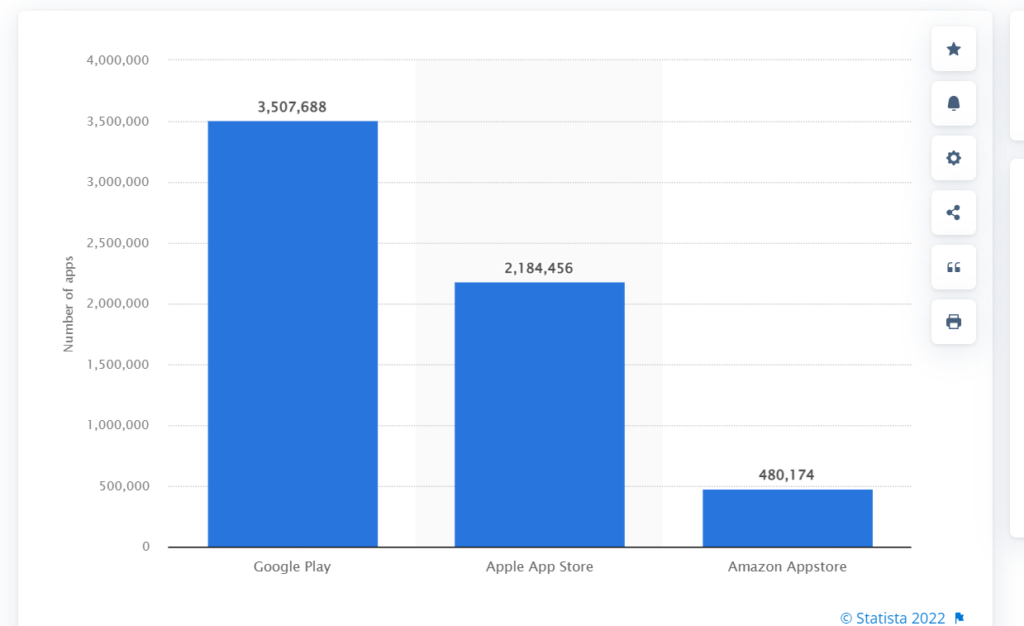
According to Statista’s data from Q2 of 2022, there are more than six million apps across Google Playstore, Apple app store, and Amazon store.
Source: Statista
That’s why marketing your app properly has never been more important and has become an integral part of a business’s marketing strategy. But for it to be effective, app marketing has to take into consideration the whole ecosystem that affects your app’s marketing performance. Whether it is app store optimization (ASO) or combining organic and paid user acquisition (for example, via Google App Campaigns and Apple Search Ads), marketers need to look at data holistically and ask the right questions when analyzing an app’s performance.
Here I will share some of the knowledge I have gained and tricks of the trade I have learned over the past 10 years in the marketing field.
Organic growth on its own won’t take you far
While a few years ago ASO may have been the most important part of your app marketing strategy, to stay competitive in the busy app marketing landscape, you need to power up your User Acquisition (UA) strategy. This does not mean that ASO is no longer important – it sure is – but it has to be combined with your paid user acquisition strategy for an app’s sustainable growth. Both organic and paid UA has the main goal to drive quality conversions while maintaining a low cost per conversion.
To start with, you need a solid ASO foundation to maintain a stream of high-quality users across channels. It is essential as the user will ultimately land in your app store listing. You are literally wasting your money if you haven’t invested time in ASO and optimizing your store listing.
Paid user acquisition can lead to more organic app installs. Ads will bring new attention to your app store listing. The more installs your app generates, the higher your app will be ranked in the app stores. As a result, it increases visibility across search results and browse sections. Due to increased visibility, more and more users will land in your organic store listing and download your app. Hence the growth loop continues!
A successful strategy is about understanding the correlation between ASO and paid user acquisition efforts. You need to understand how your paid funnel impacts organic growth and vice versa. At GAMEE, we have used App Radar’s all-in-one platform which has helped our team work together within one system and understand, as well as maximize, the impact of organic and paid user acquisition for both Google and Apple app stores.
Analyzing app performance
After putting a lot of effort into optimizing your UA, don’t just sit back and hope to see perfect results. Throughout the campaign, you should be analyzing your app’s performance and asking the right questions. You’d probably like to know how much growth your ASO efforts brought. Or was it your paid UA traffic that led to an increase or drop? It can be challenging to answer all these questions, especially considering many factors that can play a significant role. As an example, let’s look at a couple of scenarios.
Scenario one: A drop in app installs
Seeing a drop in installs? It might be concerning at first sight. However, the good news is that there is most probably an explanation for every decrease in installs. And for every problem, there is also a solution.
One crucial impact factor you need to consider is paid user acquisition efforts. When you notice a decrease in downloads, you should first check whether you had ads running during that specific time. Ads can bring a significant amount of traffic to your app, and once you stop or reduce them, this might have a substantial effect on your results. Check the correlation between organic and paid conversions, and then analyze how your paid conversions impact your total growth and understand whether an increase in installs might be due to reduced activity via paid channels.
What should you do now?
First, try to get a better picture of the situation by looking at the last 30 or 90 days timeframe and understanding how significant the impact was. If pausing, for example, your Google App Campaigns greatly decreased your installs, you should consider re-activating the ads.
Scenario two: An increase in app installs
This is the result we are all aiming for. Ideally, you’d want this to continue throughout and beyond your marketing campaign. But for that, you need to know what was impacting the increase. Transferring and attributing success from one place to another can be tricky if you do not know where the success is coming from.
Your best bet would be to look at the conversion breakdown to help you find the answer. Is it Google Ads, Apple Search Ads, another paid channel, or ASO? If you run a campaign via a paid channel at the same time as the installs increased then it is most likely that that was what influenced your overall app growth. It is worth also evaluating which ad platform is the most efficient. Do you get a better cost per conversion with a paid channel? To get an idea of whether your app is performing better or worse, you may want to compare the figures with previous campaigns – How did your impressions, conversions, and costs perform compared to the previous period? Taking all of this into account will help you determine whether you should change your focus or make tweaks to your campaign.
Three takeaways from GAMEE’s experience
At GAMEE we have learned that there are three elements every app marketer should never stop working on:
ASO
It is the end-point to all of your app activities. Every dollar and hour invested elsewhere can be multiplied by a good ASO strategy and approach. This is where our use of App Radar’s platform was extremely valuable in maximizing our campaigns.
Testing
Use custom app store listings (where possible), various combinations of paid ad networks, and app store A/B tests to get the best results.
Prioritizing
Pick the audience, markets, regions, and/or demographics you need to win and focus your ASO and paid channels on them.
While analyzing the impact of paid and organic user acquisition is no easy task, the one thing you don’t want to do is put all your eggs in one basket. You can’t rely on just organic UA or just paid UA. For a successful app marketing strategy, both areas have to work in tandem. Your campaign should also allow room for testing. This enables you to tweak and pivot strategy as you go, and tailor it for your target audience. Trust me, if properly managed your app will soon be reaping your strategy’s benefits.
Jan Gemrich is Chief Marketing Officer at GAMEE, a high-engagement play-to-earn gaming platform, that attracts over 30 million users. GAMEE is part of Animoca brands which is a leading blockchain gaming company. Jan previously worked for 9+ years at Google, based out of Prague, London, and Toronto, where he was responsible for user growth (Google Pay, Android, Search) and the launch of new products (Pixel, Stadia, etc).
Subscribe to the Search Engine Watch newsletter for insights on SEO, the search landscape, search marketing, digital marketing, leadership, podcasts, and more.
These Bolivian Skaters Linked With Samsung to Change the Culture’s Perception of Women
For many Hispanic and Latinx communities, embracing culture is not only a way to reconnect with their ethnicity, but a part of their identity. However, like in any culture, there are aspects that are still rooted in gender inequality, misogyny, and machismo.
Maximizing efficiency for ecommerce paid campaigns
30-second summary:
SEOs must improve the efficiency of ecommerce shopping ad campaigns to meet consumer expectations of a hassle-free online experience
Brands need to invest time, gather experience, and implement various new strategies to maximize their performance as the digital space is growing and evolving at a rapid pace
Setting up something like a Google Shopping Campaign may not be an uphill task; however, you need to implement smart strategies to make it more effective
The valuable tactics mentioned in this post will help you boost your ecommerce sales and get you started on the right track
We are witnessing a significant increase in digital ad spending across the globe. The pandemic has resulted in consumer behavior changes that have led to a new era of ecommerce. The majority of people around the world have increased their reliance on online shopping and brands have been investing more money and attention in direct-to-consumer activity.
According to a report by Oberlo, digital advertising spend in 2022 grew by 15.6 percent from 2021. The report further states that digital ad growth shows no signs of stopping and the growth is expected to continue for the next few years.
If you are running a business that sells products, you should absolutely embrace ecommerce to drive its growth. However, while neglecting ecommerce is not an option, there are numerous other brands online that could be fierce competition for your products, so it is important for you to enhance your strategy to remain both relevant and visible.
Important things to consider before starting a campaign
Ensure that your website is SEO-friendly (search engine optimized) and has a user-friendly design. A well-structured ecommerce website can help you achieve the kind of results you are looking for.
It is extremely crucial to create an ad that resonates with your potential customers. You should create a detailed customer persona with the following steps.
Decide who your target audience is. Are you targeting young men who like outdoor activities? Middle-aged mothers? Adults with aging parents?
Once you determine your target audience, you should understand what they are looking for. Analyze their requirements and try to find out their interests. What hobbies or goals might your target audience have? What interferes with their ability to do these things?
Turn these obstacles – these pain points – into your guidestones and try to address the problems that they pose.
How to maximize efficiency for your ecommerce paid campaigns
If you are looking to establish sustainable positive brand awareness online and improve your revenues from online sources, it’s critical to fine-tuning your online strategy.
Here is a list of key tactics that you must employ in order to achieve optimum results. While we will be specifically speaking about Google ads, many of these tactics are broadly applicable across any paid advertising service you use.
Optimize the product data feed
The data in your Google Product Feed determines your campaign performance, which seriously impacts your ROI. Therefore, optimization is key.
Make sure that the title is simple so that your audience can understand everything they need to know about your product just by reading it. Such titles can also help you gain maximum visibility on search engines like Google.
Instead of the Google Product Feed, if you prefer using a spreadsheet, make sure that you include all possible information about the product such as color, size, material, the age range of potential customers, and so on.
Select the right product categories and subcategories and align them with the appropriate product types. Failing to do this can seriously hurt your sales.
A quality Product Feed Management tool helps you track your performance, which is crucial, as you can make the necessary adjustments to your ad campaigns based on your performance.
Fine-tune your campaign by using negative keywords
Nothing is perfect in this world, and that includes the Google Shopping system as well. Even though Google Shopping listings are a boon for marketers, imperfect keyword targeting is a big issue as search results can sometimes display your products with irrelevant search keywords. For instance, if you sell running shoes, but not other running accessories, you don’t want your ads coming up for shoppers who won’t purchase.
If you’re showing up for these keywords that won’t generate buys, your ad campaigns could experience high spending but terrible conversion ratios, low click-through rates, and low ROIs and ROAS.
Implementing a negative keywords strategy in your Google Shopping ad campaigns can prevent your ads from showing up when certain search phrases are used. This in turn can boost the campaigns’ ROAS and ROI.
Using negative keywords in your ad campaigns can prevent unwanted clicks, thereby helping you save money by improving the click rate of your advertisement.
Highlight your sales, discounts, and special offers
Every customer loves a great offer as they are getting an opportunity to save while purchasing something.
If you want to move your products quickly, showcasing discounts and special offers is a great way to achieve that. While running special offers and deals, you need to specifically mention that, and if you really want to stand out in the field, you should run ads regarding these offers and deals.
Use Single Product Ad Groups
Single Product Ad Groups (SPAGs) enable marketers to set bids for each product individually. An SPAG allows you to pause individual products that aren’t giving you the expected results. SPAGs also give you the option to create negative keywords for specific products.
An SPAG allows you to identify your best-selling products and least-selling products, which will help you to group them into performing and non-performing categories accordingly.
An SPAG is a very useful tool, as it allows you to make modifications at the product level and create keywords for your product and control the bids at the market level.
Try Google Showcase Ads
Google Showcase Ads feature product images and prices directly on the results page. These ads expand when clicked and display a custom description of the product and a catalog of related products. These ads allow you to group together related products and present them together to introduce your brand or business.
Google Showcase Ads can improve your sales performance and efficiency of your paid campaigns as they allow you to highlight your products using high-quality digital images. You will be able to see them at the top of the SERP (search engine results page), above the paid search ads.
Create a good post-purchase experience
Considering the fierce competition from other brands and competitors online, it is very important to encourage repeat purchases, as they are often much less expensive than converting first-time shoppers.
A strong check-out experience and post-purchase considerations will help build strong customer loyalty which will make second and third purchases more likely.
Use customer data wisely once it is acquired. This will improve your customer retention rate. You can group your customers based on how much they have purchased and how many times they have purchased. You can then provide exclusive discounts and offers to your loyal customers accordingly.
Important points to remember while creating an ecommerce website
Here are a few key points that you must consider while creating an ecommerce website.
Ensure that your website is mobile-friendly. Many users use mobile devices for online searches, in fact, most online searches are executed on mobile devices. Making your site mobile user-friendly ensures that customers will be able to navigate your site on their mobile devices seamlessly.
Different users prefer different payment methods. Therefore, it is important to offer multiple payment options, as customers may cancel the purchase if they don’t find their preferred payment option on your ecommerce website. For instance, you could offer a normal credit card payment option, as well as PayPal or Google Pay.
Keep the sales process simple. Even customers who are not computer or mobile-savvy should be able to complete their purchase without trouble. A simple and straightforward experience can give your customers an effortless and seamless experience while purchasing.
Final thoughts
It is important for every brand to put the time in to ensure that they stand out and speak to their audience. Try to identify the ways in which you can keep your audience engaged as it can help in driving greater data capture and increase brand loyalty.
The strategies mentioned in this post can help you improve the efficiency of your ad campaigns, and implementing them correctly will pay off handsomely in the long run.
Andy Beohar is VP of SevenAtoms, a Google and HubSpot certified agency in San Francisco. Andy develops and manages ROI-positive inbound and paid marketing campaigns for B2B & Tech companies. Connect with Andy on LinkedIn or Twitter.
Subscribe to the Search Engine Watch newsletter for insights on SEO, the search landscape, search marketing, digital marketing, leadership, podcasts, and more.
Riot Games has thrived off a player-focused mentality with its flagship global sensation League of Legends. During its 10th anniversary in 2019, the developer announced several new game genres, including its first foray into the mobile gaming space.
Is your business optimized for Google Discover? This guide is for you!
30-second summary:
Would you turn down an opportunity to acquire new customers without breaking the bank?
Google Discover currently supports 800M users in exploration and is a great way to attract new audiences
Joe Dawson covers the “why” and “how” in this comprehensive Google Discover optimization guide
Even though spending on SEO plays such a major role in the online business sphere, most web admins spend their lives attempting to crack Google’s organic page ranking algorithms. As SEOs may or may not lose sleep over the latest updates, Google Discovery is surely a dreamy-eyed way to win more audiences.
What is Google Discover?
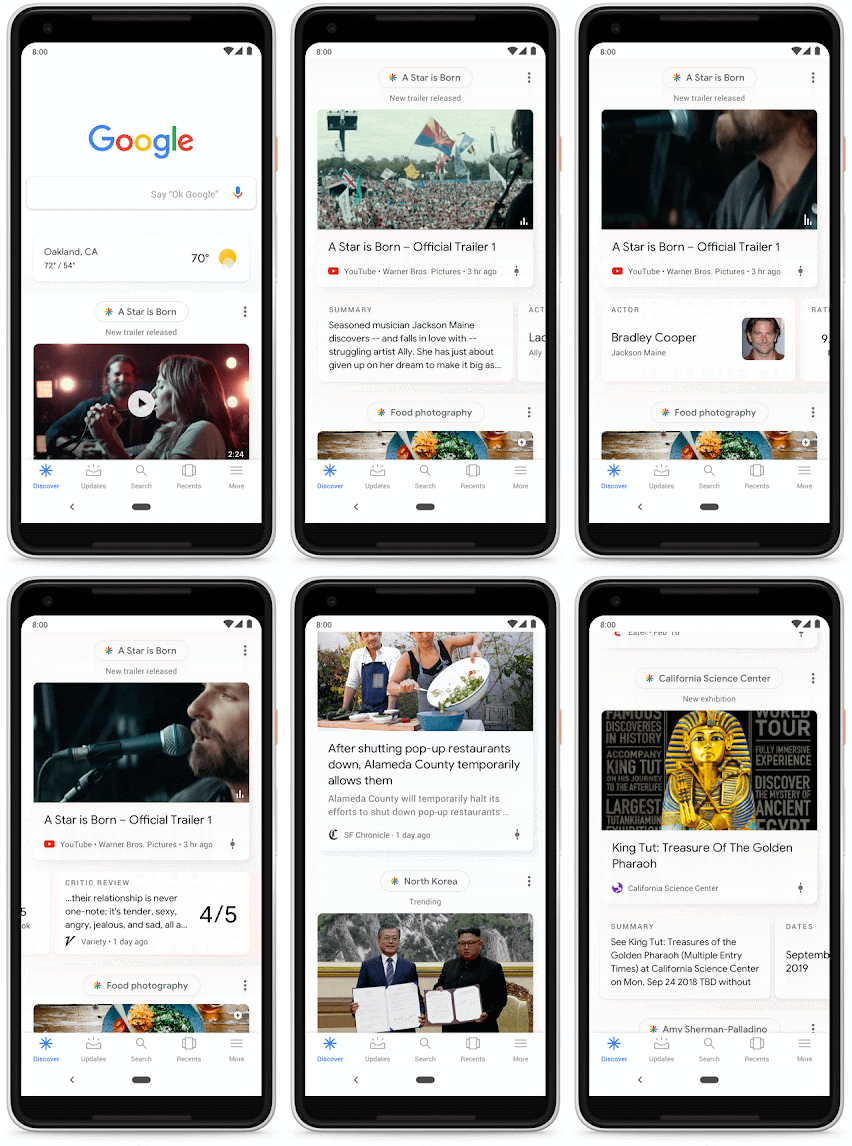
Discover is the brainchild that replaced Google Feed in 2018 and helps around 800M monthly active users with content exploration. Discover aims to push hand-selected news and articles directly to user feeds without the need for searching. Google builds a profile of users and supplies them with content considered relevant to individual interests.
Nothing is anonymous online, and we all leave digital trails of our fundamental interests. Just as your website offers opportunities to glean first-party data, so does Google. With the average person estimated to make at least three to four searches per day, that’s plenty of information to harvest.
Google plays their cards close to their chest about how they build consumer profiles. Experts believe that the following are factored into the creation of these blueprints:
Search history unique to Google
Browser history of websites visited
Activity on any installed apps
Location, assuming this information has not been barred in settings
That’s certainly enough material to understand what a user may be interested in. Much like social media targeted advertising, Google knows what your audience wants to see and will do all it can to meet such desires through Discovery. It’s your responsibility to optimize your Discovery presence and ensure that your content is chosen to be pushed.
Why optimize Google Discover?
Discover attracts a loyal, returning audience to your website. It allows users to follow a particular brand or business, ensuring their content will always appear on their smartphone. Naturally, you need to earn this loyalty. The usual caveats apply here. Work to attract your target audience by speaking their language, delivering content that shows your brand can be relied upon.
Perhaps more pertinently, Discover knows what users want to hear about – and delivers this in spades. Imagine that a user’s five most visited websites are for their local NFL team, a health food store in their town, a website specializing in tips for joggers, a website that sells running shoes, and a food blog packed with recipes. This suggests that the user in question enjoys sports and fitness. This individual’s Google Discovery feed will reflect this lifestyle.
Somebody with more sedentary hobbies may receive articles on the latest comings and goings on Netflix or technology and gadget news. If you optimize your content for Discover, it could be your website and articles that are pushed onto a smartphone. As Discover has an enviable CTR, this is not an opportunity to pass up.
How to optimize your website for Google Discover
Now that we’ve established that Discover fast-track site traffic, and by extension, conversions – how do you achieve this optimization? This fifteen-point checklist covers hints and tips to enhance your success rate.
1. Comply with Google’s policies
First thing’s first. Do not forget that Discover is a Google property, which means abiding by the search engine’s usual rules and regulations. In essence, that means continuing to follow organic SEO and page ranking practices.
As much as keeping on top of Google’s regular algorithm updates can sometimes feel like a full-time job, it remains necessary. To optimize the potential of Discover, your website must maintain standard white hat SEO protocols. If your dedication to improving page ranking and quality score slips, your content is less likely to be selected by Discover.
2. Create a Google My Business account
Here’s another quick and simple hack to help produce tangible results. Google always wants to provide users with the finest and most relevant connections. If you’re using Discover for ecommerce, the big G will consider a GMB account as a seal of quality. You’re likelier to be selected by Discover if you have an active profile – especially one that boasts organic, positive reviews.
3. Ensure mobile compatibility
When investigating different web design possibilities, highly prioritize mobile compatibility. This sounds like a no-brainer as Discovery is a mobile-centric tool, but you may be surprised at how many fall at this hurdle. Use Google’s Mobile Usability Report to check how your site is doing.
If you build your website through WordPress, consider taking advantage of the Web Stories plug-in. This is made for use on Google – after all, Web Stories even have their own segment on the search engine’s home page – and will often pique the curiosity of Discovery.
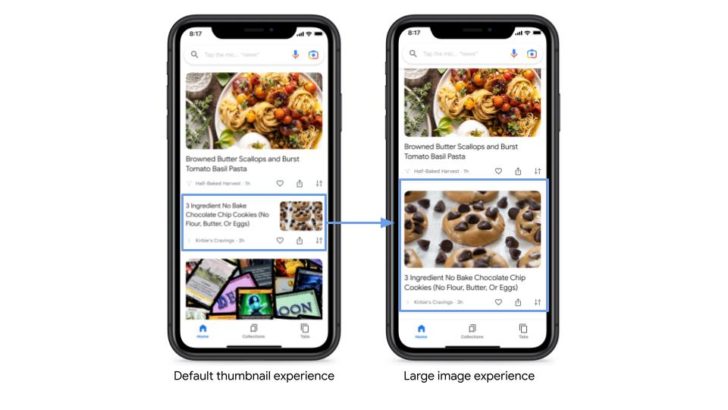
4. Feature larger images to create compelling UX and boost CTRs
You can even feature your card images in a large format by using the robots meta tag max-image-preview setting. This is a great way to gain more screen space and win audience attention that will drive CTR. According to Google, this increased a food blog’s CTR by 79 percent and drove a weekly magazine’s clicks by 332 percent across six months.
Google Discover optimization guide – use large images to drive CTR
5. Find a unique niche and demonstrate your knowledge
Like when bidding for a plum PPC spot, popular keywords can create an extremely competitive environment in Discovery. Unless you’re among the major players in your industry, you risk being muscled out by more prominent names. For example, if you’re writing about sports, ESPN is always likelier to be selected to discuss the playoffs and significant incidents in a game.
That doesn’t mean that Discover is pointless, you’ll just need to think outside the box. Come up with a topic that could be less commonplace within your niches, such as a particular player, team, or set of stats. Discuss these at length, appealing to the regulations of the E-A-T algorithm, and the results will come.
6. Consider your target audience
Discover is designed to match the ideal content with the perfect audience. That needs to be considered when creating blog posts and similar copy. Take the time to build a picture of your target audience and use analytics to ensure you are appealing to them.
Based on the results, you may need to adjust your approach. For example, emotive language may attract one type of reader but deter users likelier to convert. Equally, you may find that you need to use less prose and more images to draw users you really want.
7. Master your headlines carefully
Over 14 percent of all Google text searches include a question. Embrace this in your headlines. If you pose a question, you’re likelier to be selected by Discovery and attract an audience’s attention.
All the same, never lose sight of Google’s quest for relevance. That means not trying to pull a bait and switch. A blog headlined “how to hire an app developer” needs to discuss the trials and tribulations of this very process. An article that says, “don’t bother – here is a DIY mobile app design guide to save money,” will not be embraced by Discovery.
8. Ensure your content is of the highest quality
We’ve just established that Google Discover has limited patience for clickbait, but you may be able to slip some of this material through the net.
You’ll quickly lose their trust and struggle to attract followers. The same applies to content that has not gone through a quality check process and is littered with typos and errors. Quality matters, so do not try to pull the wool over anybody’s eyes. Another way to create compelling, relevant content for your audience is by checking your Google search traffic and keyword research. This will help you distinguish and craft top-of-the-funnel (TOFU) content for key segments of the search journey and align it with the sales funnel.
9. Keep your finger on the pulse
News and current events are the bread and butter of Google Discover. On paper, Google will always look to deliver the latest and greatest news articles to users. Criticism has been leveled at Discover, claiming that it has been top-of-the-funnel (TOFU), but it still pays to remain relevant when attempting to appeal to algorithms.
Anecdotal evidence claims that Discover ranks some search terms that SEO does not, opening new opportunities. That does not mean that you should throw together a hot take on the latest Twitter controversy and wait for the clicks to roll in. If that flies in the face of your brand values, you’ll suffer in the longer term. Just avoid shying away from existing talking points that would add value to your audiences. Also, don’t hop on this bandwagon unless you have something valuable to say as a brand.
10. Encourage users to ‘heart’ you
If you have a captive audience outside of Discover, encourage them to follow you on this platform. Discover offers a heart icon that matches the purpose of a Facebook like, which is a direct way to show appreciation for the material.
If somebody follows an article from your site in their areas of interest, it will be noted on their Google profile. They are then likely to receive more content on the same subject from your brand – as are other, unrelated users that Google considers to have similar interests.
11. Increase your brand awareness
As an extension of the point above, users are prone to discover – and follow – your Discover profile if they are aware of your brand. Use your marketing campaigns to raise your Google Discover profile, steering people toward following you on here.
12. Regularly create and post new content
Discover is often looking for the newest insights and articles to share with users. As a result, a freshly published blog is much likelier to be selected than something penned weeks, months, or years previously – assuming it meets the quality standards we previously mentioned. Evergreen contentoccasionally gets picked up, but not as often.
Just be aware that articles selected by Discover tend to have a shorter shelf life than something penned with organic SEO in mind. You can still look to appeal to both markets. Discover can be just as helpful for an inbound marketing strategy. Just do not expect your blog to remain on the platform longer than three or four days.
13. Include images and videos in your content
Regardless of whether a picture is truly worth a thousand words, there is no denying that Discover looks to curate variety in its content. Websites that included images and video in their blog posts saw a much greater uptake in selection by Discover than those that relied on pure prose.
Quality matters just as much as quantity here. A quick video shot on your smartphone and shoehorned into your content will not cut the mustard. Discover looks for crisp, high-definition image quality in moving and static pictures alike, so always opt for the greatest resolution you can that retains mobile friendliness.
14. Interact on social media
Discover loves social engagement. As with organic SEO, Discover is likely to select and push content that attracts comments and shares on social media. This creates a chicken and egg scenario. Will your content go viral on social media because it was picked up by Discover, or did Discover push the content because it was gaining social media traction?
In truth, the order of events matters little. Discover can sit neatly alongside the likes of Facebook, Twitter, Instagram, and YouTube to bolster awareness of your content and amass an army of new followers. As always, this creates a snowball effect – the more followers you gain, the more strangers will have your content pushed to their appliances.
15. Track your analytics – and improve where necessary
Finally, as with your SEO performance, you should always keep an eye on your Google Discover traffic analytics. You’ll find this in your Search Console. Do not be alarmed if your Discover traffic looks low. It takes a couple of days for these visits to hit the report so things may change in time.
Discover may not be essential if you are still attracting attention through other means. But no website should ever turn down an opportunity to boost website traffic! So if your numbers are tracking lower than anticipated, revisit points one through fourteen and implement what you can to improve performance.
Joe Dawson is Director of strategic growth agency Creative.onl, based in the UK. He can be found on Twitter @jdwn.
Subscribe to the Search Engine Watch newsletter for insights on SEO, the search landscape, search marketing, digital marketing, leadership, podcasts, and more.
Why Ryan Reynolds’ Mint Mobile Flipped an Old Ad Upside-Down for Super Bowl Sunday
Mint Mobile is making its return to Super Bowl Sunday this weekend, but you might need to tune in a bit early to catch the Ryan Reynolds-owned brand’s ad.