Why Ryan Reynolds’ Mint Mobile Flipped an Old Ad Upside-Down for Super Bowl Sunday

Mint Mobile is making its return to Super Bowl Sunday this weekend, but you might need to tune in a bit early to catch the Ryan Reynolds-owned brand’s ad.

https://www.adweek.com/creativity/why-ryan-reynolds-mint-mobile-flipped-an-old-ad-upside-down-for-super-bowl-sunday/


Winter Olympians Express Their Passions Beyond Sports in Samsung’s Sleek Ad

While Olympians regularly endorse everything from sneakers to credit cards, Rule 40 of the Olympic Charter places a blackout period immediately before and during the games when competing athletes can’t appear in ads. Samsung is getting around that restriction ahead of the Winter Olympics in Beijing with a spot from Leo Burnett that casts actors as athletes.

https://www.adweek.com/brand-marketing/winter-olympians-express-their-passions-beyond-sports-in-samsungs-sleek-ad/


A must-have web accessibility checklist for digital marketers

A must-have web accessibility checklist for digital marketers

30-second summary:

  • Accessibility underpins stellar user experience and positive brand perception, the key factors that appeal to value-driven consumers
  • According to WebAIM, 98 percent of US-based websites aren’t accessible
  • Though not a sparkly aspect of digital marketing strategies, there are multiple layers to “why?” and “how?” brands must be accessible across the internet

Marketers develop and execute numerous strategies to broaden their business reach. But one critical factor that most marketers neglect is web accessibility. And this neglect leads to their business being closed off for a large majority of potential customers.

What is web accessibility?

Web accessibility ensures that the internet is accessible, usable, and beneficial for everyone alike. It considers all possible disabilities to ensure marketing messages are delivered to every kind of audience and get the most value out of the website.

As important as it may seem right now, web accessibility is often the last thing marketers think of when building a website. And then, too, it is often brushed under the rug.

Despite the World Wide Web Consortium, commonly known as W3C developing dedicated web content accessibility guidelines to make the internet more accessible, digital inclusivity remains a rarity.

And this unfortunate reality acts not only as an accessibility barrier, but a growth barrier as well.

The value of web accessibility in modern marketing initiatives

Acknowledging and adopting web accessibility enhances the customer experience, opens new doors for your business, uplifts marketing outcomes, and boosts revenue in more ways than just one.

1. Extends your market reach

15 percent of the world’s population is disabled and belongs to a highly valuable market segment with strong spending powers.

With a digitally inclusive web presence, your business interacts with an increased volume of people who it would’ve missed otherwise. In this way, web accessibility brings a whole new community of prospects you can interact with, win as customers and boost your revenue.

2. SEO benefits

Search engines prefer to rank websites that are secure, accessible, and valuable to all kinds of users. Moreover, they perceive digitally inclusive websites as authentic sources of information and favor them in rankings.

As a result, enhancing web accessibility undeviatingly supplements your online marketing with an SEO boost, helping you get to the coveted top position in SERPs. It opens another channel for web traffic that connects you with your target audience.

3. Enhanced user experience

User experience is at the heart of your digital presence as it relates directly to conversions. The basic principle of UX optimization dictates that you research what your target audience wants and deliver it.

In the case of differently-abled audiences, it’s common sense that they would want you to deliver a website they can interact with and benefit from.

By optimizing your website’s accessibility, you boost its usability which is a core element of user experience.

If all other elements of UX are optimized, enhanced usability wins customer satisfaction and gives the prospect a final push towards conversion, contributing to your revenue.

4. Positive brand perception

Web accessibility enables your brand to appear as a strong advocate of digital inclusivity and works to build positive brand perception. Now isn’t that a critical outcome of modern marketing?

Today where people seek a business’s values before engaging with it, a concrete stance on digital inclusivity reflects your values of empathy, compassion, and equal opportunities for all. This builds your community of like-minded people who then contribute to your revenue.

Five-point checklist to get started with web accessibility

For maximum effect, web accessibility should be considered a priority rather than an afterthought and must be included in your digital and marketing strategy.

Following are a few ways through which you can uplift your digital inclusivity and leave a larger impact:

1. Multilingual SEO

Web accessibility not only aims at eliminating accessibility barriers for people with permanent, temporary, or situational disabilities. It also removes linguistic barriers, so people from all cultural and ethnic backgrounds can have equal access.

Given that English is spoken by a meager 4.83 percent of the world’s population, multilingual SEO eliminates linguistic barriers and helps searchers from all linguistic backgrounds to benefit from the internet.

Here’s a guide I created on multilingual SEO to get you started.

2. Voice search

The introduction of smart assistants such as Alexa has pioneered a new era of voice search ubiquity and the consequent web accessibility.

As an excellent avenue to pursue for businesses looking to be more digitally inclusive, voice search unlocks your website’s chances of interaction with people who cannot search the conventional way.

Here are some best practices to optimize voice search SEO:

  • Use long tail keywords that are specific, descriptive, and natural for users’ language
  • Serve up content that gives direct answers
  • Optimize your ‘Google My Business’ account
  • Create voice search FAQ pages
  • Implement schema which is a code that you can add to your website that improves search visibility

For more depth, check out this voice search SEO guide for trends and best practices.

Example of schema that improves web accessibility

3. Alternate (Alt) text

Alt text helps visually impaired visitors understand what a web image depicts. Hence image optimization allows web visitors to absorb the information your website offers in its totality and ties back to enhanced user experience.

Tips for using alt text:

  • Keep it descriptive and keyword specific, this will show up in case your page loads slow or if there was an audio description needed
  • For ecommerce sites, make good use of structured data to give the search engine more specific details about your products’ color, type, size, and a lot more

If you need more details, here’s an evergreen image optimization guide.

4. Hierarchical organization or content using H tags

Hierarchical layout shapes your web content in an easy-to-read structure. A critical part of web accessibility (and SEO), a hierarchical organization can make your website usable and understandable for users with certain cognitive disabilities and people with short attention spans, boosting their satisfaction and your websites’ overall UX.

Check out this guide on optimizing meta tags.

5. Color contrast

Color contrast involves adjusting the color of foreground web elements (for instance, fonts) against the color of the background elements to ensure that the foreground elements, which bear value, stand out and are easily readable for people with visual impairment.

The Bureau of Internet Accessibility has identified a color contrast ratio that ensures that your website is visible and readable for people with color-related visual impairments.

Conclusion

Web accessibility is a necessity, but unfortunately, it doesn’t get the same limelight as other digital marketing avenues that promise increased reach, better perception, and higher revenue.

This reality can work in your favor if you capitalize on the lack of web accessibility and gain a competitive edge by adopting digital inclusivity.

There are numerous marketing benefits of web accessibility, most significant of which may be the development of positive brand perception in an era of value-driven shoppers.

Inclusive marketing initiatives are commendable. But they are only valuable when backed by conscious efforts of enhancing your business’s digital accessibility. So, endeavoring to actualize web accessibility strategies can help you become the pioneer of an internet era where digital inclusivity is a priority.


Atul Jindal is a web design and marketing specialist, having interests in doing websites/apps optimized for SEO with a core focus on conversion optimization. He creates web experiences that bring conversations and transform web traffic into paying customers or leads.

Subscribe to the Search Engine Watch newsletter for insights on SEO, the search landscape, search marketing, digital marketing, leadership, podcasts, and more.

Join the conversation with us on LinkedIn and Twitter.

The post A must-have web accessibility checklist for digital marketers appeared first on Search Engine Watch.

https://www.searchenginewatch.com/2022/01/13/a-must-have-web-accessibility-checklist-for-digital-marketers/


Why is Zynga worth a whopping $12.7 billion? (Hint: It’s not FarmVille)

<img src="https://rassegna.lbit-solution.it/wp-content/uploads/2022/01/why-is-zynga-worth-a-whopping-12-7-billion-hint-its-not-farmville.png" alt="The company that publishes Grand Theft Auto now owns all of these goofballs, too…”>
Enlarge / The company that publishes Grand Theft Auto now owns all of these goofballs, too…

Major console game publisher Take-Two has acquired social and mobile gaming giant Zynga for a whopping $12.7 billion in cash and stock, making the deal the largest acquisition of a single gaming company in history.

That might seem like a ludicrous price if your familiarity with Zynga is limited to FarmVille, CityVille, and other Zynga games that came to dominate the “social gaming” fad of the early 2010s (and led to the creation of some excellent books, if I do say so myself). But while the original FarmVille merely limped along until 2010, Zynga has successfully transitioned into a casual mobile gaming powerhouse by spending billions of dollars on acquisitions like Gram Games (1010) and Small Giant Games (Empire & Puzzles) in 2018, as well as Peak Games (Toon Blast) and Rollic (Go Knots 3D) in 2020. Last year, the company even dipped into PC games with the acquisition of Torchlight studio Echtra Games.

With those companies gathered under the Zynga umbrella, the company now attracts over 168 million monthly users and made $706 million in revenue in the latest reporting quarter.

Still, Zynga’s mostly casual fare might seem like an odd match for a big-budget console game maker like Take-Two. But the acquisition gives Take-Two a simple way to get its massive and well-known console franchises—including Grand Theft Auto, Red Dead Redemption, Civilization, Borderlands, BioShock, Kerbal Space Program, and the 2K Sports games—in front of a huge audience of mobile players.

“Take-Two has an extensive catalog of commercially and critically successful console and PC titles with engaged and loyal communities of players, and there is a meaningful opportunity to create mobile games and new cross-platform experiences for many of these properties,” the company wrote in a statement announcing the acquisition. “Zynga’s nearly 3,000 employees include highly talented mobile developers, paving the way for Take-Two to accelerate this strategic initiative and introduce its iconic intellectual properties across the fastest-growing platform in the industry.”

<a href="https://rassegna.lbit-solution.it/wp-content/uploads/2022/01/why-is-zynga-worth-a-whopping-12-7-billion-hint-its-not-farmville-1.jpg" class="enlarge" data-height="675" data-width="1200" alt="A mobile version of the wildly popular Grand Theft Auto Online could quickly pay for the Zynga acquisition on its own…”><img alt="A mobile version of the wildly popular Grand Theft Auto Online could quickly pay for the Zynga acquisition on its own…” src=”https://rassegna.lbit-solution.it/wp-content/uploads/2022/01/why-is-zynga-worth-a-whopping-12-7-billion-hint-its-not-farmville.jpg” width=”640″ height=”360″ srcset=”https://rassegna.lbit-solution.it/wp-content/uploads/2022/01/why-is-zynga-worth-a-whopping-12-7-billion-hint-its-not-farmville-1.jpg 2x”>
Enlarge / A mobile version of the wildly popular Grand Theft Auto Online could quickly pay for the Zynga acquisition on its own…

Take-Two CEO Strauss Zelnick expanded on this synergy on a Monday morning conference call discussing the acquisition. “Perhaps most importantly, we have the ability together, from both a development and a publishing point of view, to optimize the creation of new titles based on Take-Two’s core intellectual property,” he said. “We believe we have the best collection of console and PC intellectual property in the interactive entertainment business, and it’s basically nearly entirely un-exploited from mobile and free-to-play around the world. Zynga’s best-in-class studios can help us develop that property.”

Get mobile or die trying

That helps explain why Take-Two thinks Zynga is a good fit. But it doesn’t necessarily mean the company is worth today’s record valuation.

The price Take-Two is paying today represents a significant 64 percent premium over Zynga’s closing stock price on Friday, showing just how eager the publisher is to get a chunk of the mobile gaming market. Today’s $12.7 billion valuation outpaces the $10 billion paid for Clash of Clans maker Supercell in 2016 and the $7.5 billion Microsoft paid for Bethesda Softworks in 2020.

Is Zynga’s collection of popular mobile titles really worth more than Doom, Fallout, The Elder Scrolls, and all of Bethesda’s other games combined? It could be—if it helps Take-Two seize even a small portion of the mobile game market, which was estimated to be worth $100 billion in 2020.

For players who grew up in an age when game consoles and especially PC games dominated the space, it can be hard to fathom just how quickly mobile games have taken over the worldwide market. A lot of that is due to blazing growth in Asia, where high-end gaming PCs have long been seen as unaffordable for a large part of the population and game consoles have historically been heavily restricted in many countries. As such, free-to-play games that run on billions of smartphones already in Asian consumers’ pockets now represent the vast majority of gaming revenue.

Given the size of that market, spending billions of dollars to get an instant foothold in the mobile games market seems perfectly natural. For evidence of just how important that foothold can be, look no further than Activision Blizzard. The major console and PC game publisher spent a then-unheard-of $5.9 billion for Candy Crush maker King Games back in 2015. That purchase looks prescient in retrospect, as King now represents a third of the company’s total revenues of over $2 billion a quarter.

<a href="https://rassegna.lbit-solution.it/wp-content/uploads/2022/01/why-is-zynga-worth-a-whopping-12-7-billion-hint-its-not-farmville-2.png" class="enlarge" data-height="675" data-width="1200" alt="Call of Duty: Mobile brought in an estimated $1 billion in revenue in 2021, showing how valuable the market can be for big-name console franchises.”><img alt="Call of Duty: Mobile brought in an estimated $1 billion in revenue in 2021, showing how valuable the market can be for big-name console franchises.” src=”https://rassegna.lbit-solution.it/wp-content/uploads/2022/01/why-is-zynga-worth-a-whopping-12-7-billion-hint-its-not-farmville-1.png” width=”640″ height=”360″ srcset=”https://rassegna.lbit-solution.it/wp-content/uploads/2022/01/why-is-zynga-worth-a-whopping-12-7-billion-hint-its-not-farmville-2.png 2x”>
Enlarge / Call of Duty: Mobile brought in an estimated $1 billion in revenue in 2021, showing how valuable the market can be for big-name console franchises.

Activision tried to leverage that acquisition with a King-made mobile version of Call of Duty, which began development in 2017. But the project fell apart, and Activision went to Tencent-owned TiMi Studios to develop Call of Duty: Mobile. That port is set to bring in over $1 billion in 2021, highlighting the potential value of bringing top-shelf console franchises to the massive worldwide mobile market.

In other words, today’s acquisition is only hard to understand if you still think of mobile games as the limited little cousin of PC and console gaming. In recent years, that relationship has flipped. Even giants of gaming’s old world are desperate for an easy way to leverage their franchises in the mobile market.

https://arstechnica.com/?p=1824871


The not-so-SEO checklist for 2022

30-second summary:

  • With several Google algorithm updates in 2021 its easy to fall into a dangerous trap of misconceptions
  • One factor that still remains constant is the value Google places on great content
  • Core Web Vitals aren’t the end-all of ranking factors but a tiebreaker
  • Read this before you create your SEO strategy for 2022!

The year 2021 was a relatively busy one for Google and SEOs across the world. The search engine behemoth is improving itself all the time, but in this past year, we saw a number of pretty significant updates that gave digital marketers cause for paying attention. From rewarding more detailed product reviews to nullifying link spam, Google keeps thinking of ways to improve the user experience on its platform.

Speaking of user experience: the biggest talking point of the year was June’s Page Experience update, which took place over a few months and notably included the Core Web Vitals.

After that happened, tens of thousands of words were published around the web instructing people on how to modify their websites to meet the new standards.

Mobile-friendliness became even more important than before. Some more inexperienced SEOs out there might have started looking to the Core Web Vitals as the new be-all ranking factor for web pages.

With all this new information on our hands since last year, it’s possible that some misconceptions have sprung up around what is good and bad for SEO in 2022.

In this post, I want to bring up and then dispel some of the myths surrounding Google’s bigger and more mainstream 2021 updates.

So, here it is – the not-so-SEO checklist for your 2022. Here are three of the things you shouldn’t do.

1. Don’t prioritize Core Web Vitals (CWV) above quality content

It’s no secret that Google’s Core Web Vitals are among the elements you’ll want to optimize your website for in 2022 if you haven’t done so already.

As a quick reminder, the Core Web Vitals are at the crossroads between SEO and web dev, and they are the measurements of your website’s largest contentful paint, first input display, and cumulative layout shift.

Those are the parts of your website that load first and allow users to start interacting with the site in the first few milliseconds. Logic tells us that the slower your load times are, the worse your site’s user experience will be.

The not so SEO checklist and Core Web Vitals - debunking myths

First of all, this isn’t exactly new information. We all know about page speed and how it affects SEO. We also know how vital it is that your Core Web Vitals perform well on mobile, which is where around 60 percent of Google searches come from.

Google takes its Core Web Vitals so seriously as ranking factors that you can now find a CWV report in Google Search Console and get CWV metrics in PageSpeed Insights results (mobile-only until February of 2022, when the metrics roll out for desktop).

Given that, why am I calling it a misconception that Core Web Vitals should be at the top of your SEO-optimization checklist for 2022?

It’s because Google itself has explicitly stated that having a top-shelf page experience does not trump publishing killer content. Content is still king in SEO. Being useful and answering user questions is one of the most crucial ranking factors.

So, it’s a misconception that Google will not rank you well unless your Core Web Vitals are all in solid, healthy places.

However, having it all is the ideal situation. If you have great web content and optimized Core Web Vitals, you’ll probably perform better in organic search than would a page without strong Core Web Vitals.

In 2022, therefore, work on your Core Web Vitals for sure, but develop a detailed content marketing plan first.

2. Don’t assume your affiliate product-review site is in trouble

Another misconception that might have followed from a 2021 Google update is that affiliate sites, specifically product-review sites, were in some hot water after the Product Reviews update from April.

Google meant for the update to prioritize in-depth and useful product reviews over reviews that are spammy and light on details. In other words, just as in organic search, higher-quality content is going to win here.

If there was ever a point when someone actually made money by running a shady, low-quality affiliate site that featured nonsense product reviews that were then essentially spammed out to thousands of people, Google’s April 2021 product reviews update started to kill that.

The search engine now prioritizes long-form, detailed reviews, the kind that generates trust from users. Those are the types of affiliate content that stand to benefit from Google’s update, while the spammy sites will continue to vanish from top rankings.

Therefore, we can forget about the misconception that good, honest, hard-working affiliate product reviewers would somehow be hurt by the update.

As long as you are presenting something relevant and legitimately useful to users, you may have even seen your rankings rise since the April of 2021.

3. Don’t assume Google will rewrite all your titles

The last misconception I want to address here is the idea that you don’t need to put effort into your pages’ title tags because Google is going to rewrite them all anyway following its August of 2021 title tag-rewrite initiative.

First, some explanation. Back in August, many of you know that SEOs across the industry started noticing their page titles being rewritten, as in, not as they had originally created them.

Google soon owned up to rewriting page titles, but only those it believed were truly sub-par for user experience. In Google’s view, those junky title tags included ones that were stuffed with keywords, overly long, boilerplate across a given website, or just plain missing.

But SEOs still noticed that seemingly SEO-optimized title tags were still being rewritten, and the new titles didn’t always come directly from the original title. Sometimes, as Google has been doing since 2012, the search engine would use semantics to rewrite a title to be more descriptive or just simply better.

In other cases, Google’s new titles came from H1 text, body text, or backlink anchor text.

Google saw these efforts and still does, as one great way to improve user experience during the search.

Many SEOs, however, did not see it that way, especially given that Google’s rewrites were sometimes responsible for drops in traffic.

To put it mildly, there was uproar in the SEO community over the change, so much so that Google explained itself a second time just a month later, in September 2021.

In that blog post, Google said that it uses marketers’ own title tags 87 percent of the time (up from just 80 percent in August). The other 13 percent would be rewrites done to improve:

  • too-short titles,
  • outdated titles,
  • boilerplate titles,
  • and inaccurate titles.

And now to bring things back to the crux of this: it is a misconception that you’re wasting your time writing title tags after August of 2021.

Google does not actually want to rewrite your title tags. It clearly stated this in its September blog post.

What Google wants is for you to write high-quality page titles on your own, ones that are descriptive, truthful, and useful. Give users what they need, and Google will leave your titles alone.

However, throw a bunch of keywords in there, or use boilerplate titles all over your site, and you can expect Google to do some cleaning up on your behalf. The trouble is, you may not personally like the results.

Title tags matter in SEO, big time. Don’t think that your efforts are futile just because of the 2021 change. Focus on creating title tags that matter for users, and you should be just fine.

Going forward

The three misconceptions I have covered here can be dangerous to fall into in 2022.

Now, are Core Web Vitals, quality affiliate links, and title tags important to Google? You can bet they are. But SEOs also just have to be smart when approaching these matters. Everything Google Search Central does has the user in mind.

Optimize for Core Web Vitals, but still, put quality content creation first.

Run your affiliate marketing site, but ensure the reviews are useful.

And write amazing SEO title tags so that Google won’t want to rewrite them.

Following these guidelines can only help you in the year to come.


Kris Jones is the founder and former CEO of digital marketing and affiliate network Pepperjam, which he sold to eBay Enterprises in 2009. Most recently Kris founded SEO services and software company LSEO.com and has previously invested in numerous successful technology companies. Kris is an experienced public speaker and is the author of one of the best-selling SEO books of all time called, ‘Search-Engine Optimization – Your Visual Blueprint to Effective Internet Marketing’, which has sold nearly 100,000 copies.

Subscribe to the Search Engine Watch newsletter for insights on SEO, the search landscape, search marketing, digital marketing, leadership, podcasts, and more.

Join the conversation with us on LinkedIn and Twitter.

https://www.searchenginewatch.com/2022/01/04/the-not-so-seo-checklist-for-2022/


Four Google SERP features for ecommerce SEO

30-second summary:

  • Holiday season shopping is on and your ecommerce store whether a local shop or an international ecommerce brand needs visibility for sales
  • How do you jump right in front of your potential customers and drive sales in a highly competitive space?
  • SEO pioneer, former Pepperjam founder, and serial entrepreneur, Kris Jones shares a practical ecommerce SEO guide

There is perhaps no type of business that is more primed for SEO than ecommerce companies. Think about it: where a local law firm can put up a billboard or buy ad space in a regional newspaper in addition to doing SEO, ecommerce businesses essentially have one resource available to them, the internet.

That’s where they do 100 percent of their business, and it’s where they’re going to reach the customers they want. So, ecommerce companies should spend a lot of time getting their SEO just right. One crucial way of doing that is to optimize your site to appear in Google’s various SERP features.

There are so many ways you can tell users about your business just from the SERP even before they get onto your website. And the information you present could mean all the difference between capturing your ideal traffic and losing it to competition.

Therefore, to market yourself in the best light to all potential customers searching for your products, you have to optimize your website specifically for the SERP features that drive conversions.

How do you do it? Here are four of the most vital Google SERP features for which you should be optimizing your ecommerce business’ SEO.

1. Rich cards

Back in 2016, Google introduced a new mobile SERP feature called rich cards. By using structured data, SEOs could make a business’s results “richer,” that is, more visually appealing, clickable, and therefore more likely to generate an organic click.

If you search for a certain type of product, results marked up with the proper language tell Google to show the product along with an image that can help users know if they want to explore more. Users simply swipe to see more items.

Now, why am I recommending a SERP feature from 2016?

It’s because in the first quarter of 2021, mobile traffic accounted for almost 55 percent of online traffic worldwide, and that number is only going to increase. Basically, mobile search results are even more relevant today than they were in 2016.

With that in mind, how can you optimize your ecommerce products for rich cards?

You need to use the JSON-LD method of marking up your products. You can then test your work with the various free rich results tools on offer from Google.

2. Google Images results

Somewhat related to rich cards is the need for ecommerce businesses to optimize their content for Google Images results. Relevant images will appear at the top of a SERP, before any organic results.

A good product description does indeed go a long way, but don’t forget to think simply, as well: if customers can see clear, high-quality images of your products, that will help your credibility along, and hence drive conversions.

How do optimize for Google Images results? Well, Google doesn’t read images like it reads text, so it’s all going to come down to how you prepare your images on the back end.

First of all, ensure your images are originally yours. You don’t stand much of a chance trying to rank for stock photos.

Next, give your photos descriptive file names that tie into the pages where they will be placed. In the case of ecommerce, since you’ll probably have a series of photos for each product, give the image files titles that reflect the product, with words separated by hyphens.

Here’s an example: unisex-sneakers-blue-brandname-yoursitename

And don’t forget to provide descriptive alt text to each image in case it can’t load and be seen.

Finally, be sure you’re not uploading huge image files that will weigh down a website. Compress them down as small as you can to give your site enough breathing room while still ensuring the images show what you need them to show. Check out this comprehensive guide on image optimization.

3. Rich snippets

Wait a minute, you might say, why are you talking about both rich cards and rich snippets?

With ecommerce products, rich cards will stop you at the images. You can choose to go a step further for appropriate products by optimizing for rich snippets.

Rich snippets add in extra details about your products. These get placed inside your search results, under the meta title, and above the meta description.

To get rich snippets on your product results, you’ll use structured data just like you did for rich cards. You can choose which information to enter based on what specifically can grab your potential customer’s attention and satisfy their search query.

For ecommerce companies, it makes the most sense to optimize your rich-snippet products for prices, in-stock status, sales, different brands, customer reviews, and star ratings.

Think about each of these features. Doesn’t it make sense that a customer searching for this type of product would want to see this information from your online store?

Rich snippets are one great way of reaching users with extra information without the need for the users actually to click on your result. You’re taking the most concentrated bits of data about your product offerings and jumping right out onto the SERPs at the user.

Sure, you can choose not to do this for your products. But if your competitors are, who do you think stands the better chance of getting a click and making a sale?

Rich snippets are just good ecommerce SEO, plain and simple.

4. Sitelinks

Finally, you should attempt to optimize your site for SERP sitelinks.

I say “attempt” to optimize because this isn’t a SERP feature you can just click on and off, like alt text or structured data.

So we’re all on the same page here, sitelinks are the clickable buttons below your result’s metadata on a SERP. They typically offer opportunities for users to navigate directly to sections of your website.

In the case of ecommerce, the most logical sitelinks you would want to get listed in your result would be for your most popular product categories.

But again, I’m saying “would want” because sitelinks are chosen by Google’s algorithm. That doesn’t mean you can’t influence which sitelinks Google places there. Which pages Google links in your results is based primarily on your site’s navigation.

As SEOs, we always recommend having a direct and easy-to-navigate website structure. It helps the user experience, supports navigation, and prompts Google to crawl your pages.

Other things that help Google crawl your site include keyword-optimized content, smart internal linking, and simple, intuitive menus.

It is through these elements that you stand your best chance of defining what your SERP sitelinks will be. When you tell Google which pages are most important to you and your customers, the search engine will respond in kind by generating helpful sitelinks.

This is yet another example of having your SEO jump right to the SERP at users without them having to do anything.

And when you’re in the competitive ecommerce space, that really matters.

Go forth and optimize

Businesses always have it tough when going up against the competition. Whether you’re a local shop or an international ecommerce brand, there’s always someone else trying to beat you at your own game.

While SEO can never make anyone do anything, we put ourselves on the best possible footing when we take the above steps to optimize our websites for the SERP features.

If you’re not doing these things already, you’ll want to get started as soon as you can! And then sit back and watch what happens.


Kris Jones is the founder and former CEO of digital marketing and affiliate network Pepperjam, which he sold to eBay Enterprises in 2009. Most recently Kris founded SEO services and software company LSEO.com and has previously invested in numerous successful technology companies. Kris is an experienced public speaker and is the author of one of the best-selling SEO books of all time called, ‘Search-Engine Optimization – Your Visual Blueprint to Effective Internet Marketing’, which has sold nearly 100,000 copies.

Subscribe to the Search Engine Watch newsletter for insights on SEO, the search landscape, search marketing, digital marketing, leadership, podcasts, and more.

Join the conversation with us on LinkedIn and Twitter.

The post Four Google SERP features for ecommerce SEO appeared first on Search Engine Watch.

https://www.searchenginewatch.com/2021/11/18/four-google-serp-features-for-ecommerce-seo/


Firefox 94 for iOS and Android adds new features for bookmarks and tabs

Mozilla's current logo for Firefox.
Enlarge / Mozilla’s current logo for Firefox.

Today, Mozilla updated the mobile versions of its Firefox web browser on iOS and Android with an overhauled home page and a new tab management feature.

Mozilla wrote in a blog post today announcing the update that the mobile version of the browser is specifically designed for “on-the-go, short bursts of online interactions that are constantly interrupted by life.”

To that end, the new update seeks to make it easier to jump into previously abandoned or uninterrupted content. There’s a new “jump back in” feature that lets you go directly to your last opened tab.

The mobile Firefox home page now prominently lists recently saved bookmarks, as well as recently completed web searches. The idea with the former is that you no longer have to go to the bookmarks menu to access stuff that might still need your attention from recent visits that were “interrupted by life,” as the blog post wrote.

As for the recent web searches feature, Mozilla imagines that you won’t have to leave as many active tabs open with search engine queries. Instead, you can essentially have these automatically bookmarked on your home page for easy access. These saved searches will be preserved for 14 days.

And speaking of tabs, the update also seeks to reduce tab clutter by automatically archiving inactive tabs after 14 days. You can still get to them easily, but they won’t clutter up the main tab view. Again, this fits into the general theme of helping users get back into unfinished tasks, searches, or articles inside the browser without having to leave an unmanageable number of tabs open.

It should be noted that the tabs feature is only available on Android to start; Mozilla says it will reach iOS “in the coming months.” Similarly, Android is also getting a new way to customize users’ Pocket stories feeds within Firefox, with the feature planned for iOS sometime in the future.

https://arstechnica.com/?p=1809637


How to use PageRank for ecommerce websites

30-second summary:

  • The PageRank still exists and here’s a deeper look at how Google’s Reasonable Surfer Model plays a key role
  • A well thought linking strategy both internally and externally for your ecommerce site can amplify search visibility
  • Google expert, Susan Dolan and Founder of leading agency NOVOS, Samuel Hurley share an ecommerce SEO guide ahead of the holiday season

PageRank is a patent Google introduced, which used links to help determine websites rankings in the SERPs. The algorithm was named after Google founder Larry Page.

The original patent has not been renewed and has since been updated by other algorithms, which work to achieve the same goal. However, by understanding the fundamental principles, we can better understand how to position our eCom sites to drive traffic and revenue.

PageRank key concepts

PageRank is passed between websites through links and can be distributed through a single website with internal links.

Some pages have a higher PageRank than others and thus can pass on more PageRank to pages they link to. When a page links to another, a dampening factor is applied. The original patent set this as 0.85 – so a page with a PageRank of one, linking to another page would pass 0.85 PageRank.

Key update: the Reasonable Surfer Model

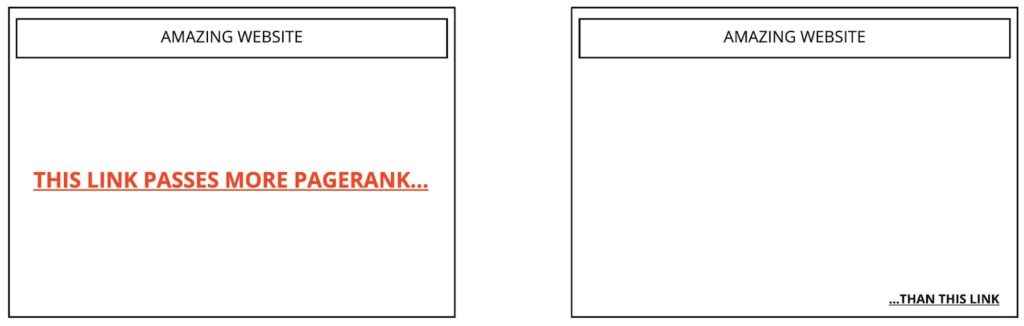
Google’s Reasonable Surfer Model indicates that a link that is more likely to be clicked on will pass more PageRank than a link that is less likely to be clicked on. This is determined by a whole host of factors, including font size, color, and anchor text. However, the position of a link on a page is also something that we often have control over as SEOs and that we can, therefore, leverage.

Here is a simple, rather crude representation of how certain links will pass more/less PageRank based on the prominence of a link and how likely it is to be clicked on.

How link prominence determines PageRank value

Build external links through to key pages

As linking pages pass PageRank, it stands to reason that we want to generate backlinks to key pages that we want to rank. For most ecommerce sites, the pages that rank for the highest volume and most revenue-driving keywords are category pages.

Wherever possible, we should therefore look to use tactics that support link building through to the pages that drive revenue, which for most sites looks something like:

  • Category pages
  • Product pages
  • Homepage
  • Blog posts

This is obviously easier said than done. Practicing these tactics with an overall aim to drive PageRank to your key pages. This reduces the dampening factors at play.

How to get past this

One common way to bypass this difficulty in building links to category pages is internally linking to key category pages we want to push from blog posts/Digital PR pieces that then get links themselves.

Although the PageRank passed to the page we ideally want to rank will undergo a dampening factor, this can still be more beneficial than failing to get any links at all to your target page.

It is worth considering how relevant the category page is to the blog/PR piece it is being included on, as well as where the links are placed on the page, being mindful of the impact the Reasonable Surfer dampening effect can have.

1. Build links from pages with high PageRank

As any Digital PR will know, high authority pages or pages that have lots of PageRank to pass onto your own site are some of the most sought-after links to attain.

Most of the time, this is actually viewed at a domain level, however as is demonstrated in this great review of how PageRank works by Majestic, a domain that should theoretically have a high PageRank can actually be significantly decreased at a page level by its own internal linking.

One caveat for Digital PR teams in this regard is not being too reliant on domain-level metrics as a proxy for links that pass a lot of PageRank and are thus good for ranking. Exactly which pages have high PageRank is nigh-on impossible to know, and although an over-reliance on third-party tools is never optimal, they may be the closest we can get to figuring out PageRank passed by a specific page, rather than a domain.

2. Build links from relevant sites

As part of the Reasonable Surfer Model, it suggests that a link is less likely to be followed if the links are unrelated to the document:

“This reasonable surfer model reflects the fact that not all of the links associated with a document are equally likely to be followed. Examples of unlikely followed links may include “Terms of Service” links, banner advertisements, and links unrelated to the document.”  (Source)

As a result, building links from sites that are of higher relevance to your own site, is likely to pass more PageRank.

3. Remember it is not just about the number of links

Due to how PageRank is calculated, the PageRank value passed by one site can be drastically higher than the PageRank passed by the culmination of 1000s of others combined.

This is why the reliance on the overall number of links can be misleading.

Use internal linking to spread PageRank

We need to consider a few different methods while identifying pages that will benefit the most from ranking and how you pass PageRank around an ecommerce site:

  1. Link to pages you want to rank from pages that have high PageRank themselves
  2. Link to pages you want to rank more frequently throughout the site
  3. Give links to pages you want more prominently ranked

1. Link to pages you want to rank from pages that have high PageRank themselves

Pages that have high PageRank, from which we can assume to be the pages most linked to from external sites, can be used to pass PageRank to – 

Homepage linking

The best example of how you can do this is through the homepage. The homepage for most websites tends to be one of the most, if not the most externally linked to page on a site.

This means that in terms of PageRank, the homepage has the most to pass on to other internal pages.

By carefully selecting which pages you link to from the homepage, and therefore pass the high levels of PageRank to the key pages you want to rank.

2. Link to pages you want to rank more frequently throughout the site

Another method to consider is how frequently you link to the most important pages you want to rank.

Considering that each page can pass PageRank on – this stands to reason that if a page is internally linked to more frequently, it is likely to pass on more as compared to a page less internally linked to (although obviously influenced by the PageRank of the linking pages).

Therefore, you should be considering where you can add internal links to ensure that important pages are linked to more frequently, including:

Global navigation

Due to being outside of the main body content of the page, we can reasonably assume there is a dampening factor applied to links in the menu. However, given its role in navigation, this is likely to be far less than in the footer. 

Therefore, since the global navigation is, as the name suggests, linked globally from every page on the site, the sheer number of links that will be passing PageRank is likely to funnel to those pages included in the navigation. These should therefore be the key pages you want to be ranking.

Breadcrumbs

As long-time fans of breadcrumbs at NOVOS, their benefit of passing PageRank to key pages should not be underestimated, due to the frequency with which different levels of pages are linked to.

The benefit of breadcrumbs on ecommerce sites (outside of usability benefits for the customers) is that they pass PageRank up to the core pages that generally rank for competitive keywords. They are typically helpful to rank the categories.

Most ecommerce websites have a pyramid structure with the homepage at the top, followed by some core categories, an increasing number of subcategories, and lots of product pages. By implementing breadcrumbs on the site, you use the pyramid structure to your advantage (both SEO and CX wise). Since every product page will link up to its relevant subcategories and category, and every subcategory will link through to its relevant category.

In this sense, you distribute internal links as an inverse pyramid, concentrating the highest number (if we disregard the homepage) on the core categories that are the pages generally targeted for high volume keywords. In this sense, your ecommerce site stands a great chance of receiving large amounts of PageRank from internal links.

Product pages also generally are easier to build links to and also naturally generate them. The higher PageRank product pages can distribute upwards, the greater is the relevance – which implies lesser chances of suffering significantly from dampening factors.

Hierarchy of ecommerce site structure and how PageRank can be transferred

Footer

Based on the Reasonable Surfer Model we can assume that the PageRank passed by footer links is significantly impacted by dampening factors. However, the fact that these links are site-wide may mean that there is some benefit to including important pages in the footer for the accumulation of PageRank.

3. Give links to pages you want more prominently ranked

As the Reasonable Surfer Model applied to the likelihood of a link being clicked on a page, it is therefore worth considering whereabouts on a page. This could also mean considering page templates in general links.

For example, in a content strategy, where multiple blogs are being written on a given relevant topic to support a category page, linking to the category page early in the article, with clearly related anchor text, is likely to drive more PageRank than right at the end of an article. On a case-by-case basis, this distinction may appear trivial, however, on an ecommerce site with hundreds and thousands of blogs, the PageRank passed in total may be significant.

Susan Dolan is a Search Engine Optimization Consultant first to crack the Google PageRank algorithm as confirmed by Eric Schmidt’s office in 2014. 

Samuel Hurley is the Founder of NOVOS, Global SEO Agency Of The Year 2020 and 2021.

Subscribe to the Search Engine Watch newsletter for insights on SEO, the search landscape, search marketing, digital marketing, leadership, podcasts, and more.

Join the conversation with us on LinkedIn and Twitter.

The post How to use PageRank for ecommerce websites appeared first on Search Engine Watch.

https://www.searchenginewatch.com/2021/10/22/how-to-use-pagerank-for-ecommerce-websites/


Fisher-Price Finally Makes a Chatter Telephone For Adults

Technology enthusiasts often eagerly await the release of the newest smartphones, with ads from Apple and Samsung touting all the latest features. But Fisher-Price is urging shoppers to buck the trends with a nostalgic—and now Bluetooth-enabled—Chatter Telephone.

https://www.adweek.com/brand-marketing/fisher-price-finally-makes-a-chatter-telephone-for-adults/


Why Virgin Mobile’s Newest Product Is a Breakfast Cereal

It’s not always easy to eliminate outside stressors in life, but reducing time spent managing your cell phone service and minimizing potential hazards such as hidden fees and complicated contracts might be a good start. Starting your day with good vibes could be another.

https://www.adweek.com/brand-marketing/why-virgin-mobiles-newest-product-is-a-breakfast-cereal/