Building Trust in AI Starts with Trustworthy Data

Enterprise AI is transitioning from the “does it work” phase to the “how can we adopt it safely” phase, creating an unprecedented and complex mix of opportunities and challenges for business leaders. Most AI pilots today fail due to misalignment between leaders, departments, individuals and one often-overlooked but critical piece: their data ecosystem. Without a defined strategy, clear accountability, clean data and explainable decisions, adding AI to a flawed process only amplifies existing risks. As AI quickly moves from pilot to production, unified data and AI trust are both strategic and infrastructure imperatives for enterprises.

As AI Investment Continues, So Does Cost of Failure

KPMG projects that in 2026, business leaders will invest an average of $124M in AI, with AI agents becoming more mainstream. Recent industry studies show that 54% of banks have adopted AI in production, 46% of proof of concept projects fielded by large providers in healthcare are progressing to production and 58% of retail and CPG organizations are actively deploying AI solutions in 2026. From risk identification and quality assurance in financial services to patient care management in healthcare and supply chain optimization in retail, AI is increasingly embedded in large sectors that impact billions of people worldwide. 

If the underpinning data infrastructure can’t support AI trust at scale, leaders risk expensive failed projects and operational, regulatory and reputational damage. Traditional backup and compliance approaches are no longer enough. As organizations increase their reliance on AI, the conversation is shifting from innovation alone to resilience and accountability. Now, leaders must question whether the data, systems and controls supporting AI can be trusted when decisions are challenged, systems fail or cyber incidents occur. The organizations that answer that question successfully will be the ones that scale AI with confidence.

What Failed AI Trust Looks Like

The rapid growth of AI, data volumes and autonomous AI agents operating at machine speed is bringing critical risks into sharper focus. The consequences vary by sector, but the pattern is consistent. When organizations can’t trust the data and records that AI depends on, they invite operational, financial or reputational risks. 

  • Financial services depend on auditability and operational continuity. An AI model making lending decisions needs a complete, auditable record of the data used to train it and the decisions it made. If that data can’t be recovered or verified after a system failure, compliance officers can’t defend it and regulators won’t accept it.
  • Healthcare depends on patient safety and system reliability. AI tools are increasingly used to flag high-risk patients, recommend treatments or prioritize emergency care. If the underlying data is compromised by ransomware, corruption or simple human error, the consequences can be life-threatening. Recovery isn’t just about restoring files. Organizations must be able to trust that the data guiding clinical decisions is accurate and complete.
  • Retail depends on resilient, always-on omnichannel operations. AI manages inventory, optimizes pricing and personalizes customer experiences across web, mobile and physical stores, all of rely on vast amounts of data. When data systems go down or become unreliable, inventory management breaks, dynamic pricing fails, customer recommendations stop and revenue disappears.

Growing Security Expectations Raise the Stakes for AI Trust

As AI adoption accelerates across financial services, healthcare and retail, trust is becoming a matter of operational resilience. Organizations are deploying AI into systems that support critical business functions and essential infrastructure. 

Recent U.S. federal policy initiatives emphasizing the importance of stronger cybersecurity and secure deployment of advanced AI systems without slowing innovation reflect how AI trust is a risk and resilience challenge.

Financial institutions must detect fraud and manage risk in real time while protecting sensitive customer data. Healthcare organizations must safeguard patient information while ensuring AI-enabled clinical systems remain reliable and available. Retailers increasingly rely on AI-driven operations spanning supply chains, ecommerce platforms and customer engagement systems that must remain resilient against disruption.

As organizations expand their use of AI, they need visibility into how data is accessed, governed, secured and recovered. AI trust is more than a governance concern. The ability to explain AI-driven outcomes, maintain operational continuity and recover trusted data after an incident will increasingly determine whether AI initiatives succeed at scale.

The Way Forward to an AI-Ready Future 

The single biggest mistake business leaders can make is dismissing risk and working in silos. As AI becomes increasingly embedded in business operations, IT, security, risk and compliance, business leaders must work together to establish shared visibility, stronger controls and greater resilience across the entire AI ecosystem.

Organizations should ask themselves several critical questions:

  • Can we identify and inventory the data assets that support our AI initiatives?
  • Do we understand where sensitive information is being used by AI systems?
  • Can we detect emerging risks before they affect operations?
  • Can we explain or audit all AI-driven decisions?
  • Can we recover trusted data quickly following a cyberattack or operational disruption?
  • Do we have visibility into autonomous AI systems and agent activity?

The answers to these questions provide a practical framework for building AI trust across the enterprise, ensuring organizations can support diverse workflows while maintaining visibility, accountability and operational confidence. AI trust is not created by technology alone. It’s created by leaders who understand the relationship between data, resilience, security and business outcomes. As AI becomes embedded in increasingly critical processes, the most important question may not be whether organizations are AI-ready, but whether leaders are prepared to build and sustain the trust that AI requires.

https://www.securitymagazine.com/articles/102463-building-trust-in-ai-starts-with-trustworthy-data




Bing tests new “Top Source” section in search results

Bing is testing a new section on its search results page called “Top Source.” Based on what we’re seeing, this section appears to group together multiple pieces of content whether individual pages or news articles from a single site.

Here is the screenshot of how it looks.

Image

Here is the X post.

We’ve noticed Bing testing additional source-focused sections on its results pages recently, suggesting Bing may be exploring different ways to highlight authoritative or dominant sources for certain searches.

Microsoft hasn’t confirmed this test, so it’s worth treating this as a limited experiment for now. Not all users are likely seeing this on Bing.

https://searchenginewatch.com/bing-tests-new-top-source-section-in-search-results/


How to check if your ste is eligible in Preferred Sources

Google recently rolled out a preferred sources feature on the search results page. When a user selects a website as a preferred source, that site’s content is more likely to show up in Top Stories and gets highlighted as a preferred source within AI Overviews and AI Mode.

Here is a screenshot of how it looks.

This feature is available for all languages. Google noted that preferred sources apply to AI Overviews and AI Mode, and that only domain-level and subdomain-level sites are eligible not subdirectories. So a site like:

  • https://www.example.com/
  • https://code.example.com/

would be eligible, but something like https://www.example.com/blog would not.

How To Check If Your Site Is Eligible

Before doing anything else, check whether your site actually shows up in the source preferences tool. If it does, you can guide users to select it as a preferred source.

How To Send Users Directly To The Source Preferences Tool

You can use this URL format to take users straight to the tool:

  • https://google.com/preferences/source?q=Your_Website’s_URL

For example, if your site is example.com, the link would be:

  • https://google.com/preferences/source?q=example.com

Sharing this link with your audience in a newsletter, on social, or on your site gives them a direct path to mark your domain as a preferred source, which could help increase your visibility in Top Stories and AI-generated results going forward.

Here is Google’s official documentation.

Have you checked whether your site is eligible for preferred sources yet?

https://searchenginewatch.com/how-to-help-users-find-your-site-through-preferred-sources-in-search-results/


Belarusian Ransom Cartel Mastermind Gets 16 Years in Prison

The Belarusian creator and administrator of the Ransom Cartel ransomware was sentenced to 16 years in prison in the US.

Maksim Silnikau, 40, built the ransomware operation and recruited other individuals through cybercrime forums, according to documents presented in court.

Silnikau provided Ransom Cartel conspirators with stolen credentials and other information on compromised computers, as well as with tools to encrypt those systems.

Additionally, the court documents show, he maintained a hidden website used to manage and monitor ransomware attacks, communicate with other conspirators and with victims, and manage the distribution of funds between participants.

Between 2021 and 2023, Ransom Cartel targeted at least 18 organizations in the US and abroad, stealing victims’ data and demanding monetary payments in exchange for decryption keys or the promise not to publish the stolen information.

According to the documents presented in court, the Ransom Cartel operation was disrupted when Silnikau was arrested in 2023.

Advertisement. Scroll to continue reading.

In a separate case, Silnikau was charged with participating in the distribution of Angler (a notorious exploit kit disrupted in 2016 that was widely used for the deployment of malware) and of other malware and online scams.

Together with Volodymyr Kadariya, a Belarusian and Ukrainian national, and Andrei Tarasov, a Russian national, Silnikau allegedly distributed malware and other threats through malvertising and other means between 2013 and 2022.

Silnikau was arrested in Spain and extradited to the US in 2024 from Poland. Tarasov was arrested in Germany, but was released after six months and returned to Russia. In 2024, the US posted a $2.5 million reward for information on Kadariya.

On August 5, Silnikau was sentenced to 16 years for conspiracy to commit offenses against the US, wire fraud conspiracy, and aggravated identity theft.

Related: Two Scattered Spider Hackers Sentenced to Jail in UK

Related: Alleged Scattered Spider Hacker Extradited to US

Related: Google, FBI Disrupt NetNut Residential Proxy Network Powered by Millions of Devices

Related: Microsoft and Allies Smash Shared Infrastructure of Amadey and StealC Malware

https://www.securityweek.com/belarusian-ransom-cartel-mastermind-gets-16-years-in-prison/


The State of National Security

A constantly shifting geopolitical landscape underscores the importance of protecting U.S. national security, especially as the private sector has been elevated and increasingly relied upon to combat threats to U.S. interests in partnership with government.

For more than 28 years, Paul Abbate worked at the Federal Bureau of Investigation in a variety of roles, most recently as Deputy Director where he oversaw domestic and international investigative and intelligence operations across the entire organization. He currently serves as Senior Managing Director at FTI Consulting.

In many ways, the mission remains the same: protecting national security, safeguarding the economy, and ensuring public safety.

Here, Abbate discusses the role of the private sector, present-day threat trends, and the state of cybersecurity.

During your time in the FBI, how did you see national security change, including the role that the private sector plays in protecting U.S. interests?

“The relationship between the government and private sector is now thoroughly integrated and built on the unified goal of protecting the country and keeping people safe.”

The U.S. approach to national security, and the role of the private sector within it, has changed significantly. The overall approach has shifted from a primary focus on physical threats and a reactive mindset to a highly proactive and preventative model that fully encompasses the digital world as well.  

This stance is underpinned by a focus on partnerships, information sharing, and action – a responsibility traditionally carried largely by the U.S. government. These duties have shifted in nearly equal measure to the private sector, significantly elevating its role on par with the government in protecting national security. As the majority owners of the nation’s critical infrastructure and the engines of our economy, the private sector is directly and inextricably linked to national security.

The relationship between the government and private sector is now thoroughly integrated and built on the unified goal of protecting the country and keeping people safe.

What are the biggest international trends impacting national security today?

The “great power competition” between the U.S. and other foreign powers is more relevant than ever. The current U.S. administration has taken a highly aggressive approach to protecting national security through offensive military action in and around Venezuela, Cuba, and Iran. The cascading geopolitical consequences affect the economy, trade, technology, and military partnerships with other countries. The environment is becoming more unpredictable and volatile, making it much more challenging for the private sector to develop strategies that effectively balance business and national security considerations.

Emerging technology, such as artificial intelligence, is advancing more rapidly than ever. The ability of the U.S. to lead and prevail in this arena is essential to our economic and national security and the very existence of our way of life. Nation-states are actively trying to undermine and steal American technology to leverage these capabilities. In response, the U.S. government is using a dual strategy: promoting domestic innovation while focusing on security and the defeat of adversaries.

How should international companies be thinking about national security?

International companies have to think deeply and broadly about what they own, the threats and vulnerabilities they face, and how to defend against them. This requires recognizing a widely expanded definition of national security, which today encompasses data, supply chains, technology, intellectual property, and cybersecurity, among other things. International companies should fully integrate national security considerations into their risk management frameworks and remain compliant with applicable laws and requirements.

It is essential that private sector companies build trusted relationships with the government and develop communication channels to constantly engage in information sharing, creating a proactive approach to protecting the organization, its people, assets, and data. International companies must be prepared for the fact that threats and attacks are more complex, faster moving, and more unpredictable than ever before.

What role does cybersecurity play in today’s national security landscape?

Every aspect of today’s national security landscape is intertwined with cybersecurity because of the critical role that data and technology play in underpinning the economy. Whoever innovates and evolves in advanced technologies will have the ultimate advantage. Adversaries face relatively low risk when launching remote, anonymous cyber attacks from safe havens, while the potential rewards – obtaining sensitive data or creating operational disruption – are significant. This imbalance reflects the importance of protecting critical infrastructure (energy, transportation, water, banking, etc.), which is essential to our survival. Cyber attacks against critical infrastructure have the potential to cause enormous harm to life, health, and safety, as well as dire economic consequences.

Nation-states can leverage digital means to attack instead of relying on physical options, obfuscating their involvement while creating immediate harm or positioning themselves in networks covertly in advance of conflicts. Strong cybersecurity requires a continuous focus on identifying vulnerabilities, closing gaps, and building enhanced and comprehensive defenses.

https://www.securitymagazine.com/articles/102424-the-state-of-national-security


Cisco Patches Critical SD-WAN, IOS XE, FMC Vulnerabilities

Cisco on Wednesday rolled out patches for two dozen vulnerabilities across its products, including critical-severity bugs in Catalyst SD-WAN, IOS XE, and Secure Firewall Management Center (FMC).

For Catalyst SD-WAN, the company released five fixes, noting that the CVEs were assigned to multiple weaknesses grouped by the underlying vulnerability class.

Three of the CVEs, namely CVE-2026-20303, CVE-2026-20304, and CVE-2026-20310, have a CVSS score of 9.9 and are described as improper input validation, improper access control, and improper link resolution before file access.

The remaining two, CVE-2026-20312 and CVE-2026-20313, are high-severity flaws described as cleartext storage of sensitive information and improper validation of specified quantity in input.

IOS XE received seven fixes, and the assigned CVEs group multiple issues by their underlying vulnerability class.

Two of them, CVE-2026-20272 (CVSS score of 9.8) and CVE-2026-20267 (CVSS score of 9.0), are critical-severity command injection and improper access control defects, while the rest are high-severity flaws.

Advertisement. Scroll to continue reading.

FMC received patches for CVE-2026-20079 (CVSS score of 10), a critical authentication bypass that allows remote, unauthenticated attackers to execute scripts and gain root privileges.

“An attacker could exploit this vulnerability by sending crafted HTTP requests to an affected device. A successful exploit could allow the attacker to execute a variety of scripts and commands that allow root access to the device,” Cisco notes.

The company also patched high-severity security defects in Integrated Management Controller (IMC), IOS XE, and IOS, and medium-severity bugs in IOS XE, Terminal Service (TS) Agent, Catalyst SD-WAN Manager, RoomOS, and IMC.

Of these, CVE-2026-20200 (CVSS score of 8.8) deserves special attention. It is a high-severity improper validation of user-supplied input issue in IMC that could be exploited remotely to execute arbitrary commands and gain root privileges.

While the flaw’s exploitation requires authentication, proof-of-concept (PoC) code targeting it exists, Cisco warns. The weakness affects UCS C-Series M7 and M8 Rack Servers in standalone mode.

Cisco says it is not aware of any of these vulnerabilities being exploited in the wild. Additional information can be found on the company’s security advisories page.

Related: Hackers Start Exploiting Recent JetBrains TeamCity Vulnerability

Related: Decades-Old BMC Vulnerability Exposes Thousands of Data Centers to Attacks

Related: N‑able Patches Vulnerability Exploited to Hack N-central Servers

Related: Ruby on Rails Patches Critical Vulnerability

https://www.securityweek.com/cisco-patches-critical-sd-wan-ios-xe-fmc-vulnerabilities/


Hackers Start Exploiting Recent JetBrains TeamCity Vulnerability

Threat actors have started exploiting a recently patched vulnerability in JetBrains TeamCity, the US cybersecurity agency CISA warns.

A continuous integration and continuous delivery (CI/CD) platform, TeamCity provides automated software building and deployment and is a central component of enterprise workflows, collaboration, and development practices.

Tracked as CVE-2026-63077 (CVSS score of 9.8), the critical security defect is related to deserialization of untrusted data and allows unauthenticated attackers to achieve remote code execution (RCE) via HTTP/S requests.

Impacting all TeamCity On-Premises versions, the flaw enables attackers to “bypass authentication checks and execute arbitrary operating system commands with the privileges of the TeamCity server process,” JetBrains warned last week.

Patches for the issue were included in TeamCity versions 2025.11.7 and 2026.1.3. A security patch plugin for version 2017.1+ was also released.

“An unauthenticated attacker could exploit the vulnerability via the TeamCity agent polling protocol,” JetBrains said, urging organizations to apply the patches to their TeamCity On-Premises deployments as soon as possible.

Advertisement. Scroll to continue reading.

In its advisory, JetBrains noted that the security defect was reported privately and that it was not aware of any active exploitation.

On Wednesday, roughly a week after public disclosure, CISA added CVE-2026-63077 to its Known Exploited Vulnerabilities (KEV) catalog, urging federal agencies to patch it within three days, as mandated by BOD 26-04.

There does not appear to be any public information on the attacks exploiting the vulnerability.

Related: How a $50,000 Exploit Chain Turned Bixby Against Samsung Phones

Related: New Attack Methods Enable Malware to Hijack Passkey-Protected Accounts

Related: CISA Warns of Exploited Langflow, N-central, and Tomcat Vulnerabilities

Related: Gemini Agent-to-Agent Attack Method Exposed Secrets, Enabled Pull Request Tampering

https://www.securityweek.com/hackers-start-exploiting-recent-jetbrains-teamcity-vulnerability/


Un dossier di attualità italiana si costruisce verificando scala fonti e interessi

Apri un foglio e separa subito dato, periodo, termine di confronto, fonte, interesse coinvolto e grado di certezza. Per preparare un dossier di attualità italiana utile a un tema o a un colloquio, ogni affermazione deve poter rispondere a queste domande prima di diventare una conclusione.

Come impostare un dossier di attualità italiana

Un dossier equilibrato serve a ricostruire una questione, non a raccogliere articoli che confermano un’opinione già formata. La cartella piena di ritagli, schermate e titoli può sembrare documentata, ma spesso nasconde confronti tra periodi diversi, percentuali prive del valore di partenza e commenti trattati come fatti.

Il metodo più semplice consiste nel partire da una notizia controversa e ridurla ai suoi elementi controllabili. Il mercato delle auto elettriche è un buon caso pratico perché riunisce industria, consumi, politiche ambientali e incentivi pubblici. Inoltre, lo stesso andamento cambia significato secondo la scala osservata: Italia, Europa, mese singolo o periodo più lungo.

Prima di scrivere, definisci anche la domanda. “Le auto elettriche stanno crescendo?” è troppo vaga. Può riferirsi alle nuove immatricolazioni, alle vetture già circolanti, alla quota sul totale oppure al confronto tra Paesi. Un dossier serio dichiara quale di queste domande sta affrontando.

Tre titoli compatibili che sembrano contraddirsi

In una simulazione di riunione di redazione arrivano tre proposte: “Il mercato italiano dell’auto arretra”, “La perdita rispetto al periodo precedente si amplia” e “In Europa l’elettrico conquista spazio”. Prese da sole sembrano raccontare vicende incompatibili. In realtà misurano oggetti, periodi e territori differenti.

Titolo possibile Dato e periodo Denominatore da controllare Fonte, interesse e certezza
Il mercato italiano arretra Ad agosto 2025 calo del 2,7% Intero mercato nazionale nel confronto mensile indicato UNRAE; interesse del settore da tenere distinto dal dato; certezza alta sul valore pubblicato
La distanza aumenta nel periodo lungo Nei primi otto mesi, 40.000 immatricolazioni in meno sul 2024, pari al 3,7%, e 285.000 in meno sul 2019, pari al 21,5% Totale delle immatricolazioni italiane nei periodi confrontati UNRAE; il titolo dipende dall’anno scelto come base; certezza alta sui conteggi, interpretazione da motivare
L’elettrico cresce nella scala europea Le BEV raggiungono il 19% del mercato 2025 Quota delle auto full electric, cioè solo elettriche, sul mercato europeo considerato Transport & Environment; missione della fonte da conoscere; certezza alta sul dato del report, confronto con l’Italia da costruire

La tabella impedisce l’errore più comune: usare un dato europeo per smentire un andamento italiano, oppure un mese debole per descrivere una tendenza pluriennale. Tutti e tre i titoli possono essere corretti. Diventano scorretti quando omettono il perimetro e suggeriscono una conclusione più ampia di ciò che il dato consente.

La scheda di verifica da compilare per ogni notizia

Ogni documento raccolto dovrebbe produrre una scheda sintetica. Il dato va trascritto senza modificarne il senso; il periodo deve avere un inizio e una fine riconoscibili; il denominatore indica rispetto a quale totale è calcolata una percentuale. Senza denominatore, una quota non spiega quasi nulla.

  • Dato: che cosa è stato misurato e con quale unità.
  • Periodo: mese, semestre, anno o serie storica.
  • Termine di confronto: periodo precedente, stesso periodo di un altro anno o altro territorio.
  • Fonte: soggetto che produce il dato, non soltanto il sito che lo ripubblica.
  • Interesse coinvolto: obiettivo istituzionale, commerciale, politico o associativo che può orientare il commento.
  • Grado di certezza: fatto documentato, stima, proposta, previsione oppure opinione.

La voce sull’interesse non serve a screditare una fonte. Serve a distinguere il numero dalla lettura proposta da chi lo pubblica. Anche un dato corretto può essere inserito in un titolo selettivo, mentre una fonte interessata può fornire informazioni solide e verificabili.

Gli incentivi cambiano il quadro ma non spiegano tutto

Nel mercato automobilistico, gli incentivi sono un fattore politico che può anticipare o rinviare gli acquisti. Se l’accesso dipende dall’ISEE, l’indicatore che descrive la situazione economica del nucleo familiare, il dossier deve controllare i documenti ufficiali validi nel periodo esaminato. Un articolo riassuntivo può aiutare a orientarsi, ma non stabilisce requisiti, scadenze o disponibilità delle risorse.

La procedura corretta è registrare la data del provvedimento, i beneficiari, le condizioni economiche e lo stato della misura: annunciata, approvata, aperta alle domande, sospesa oppure esaurita. Queste fasi non sono equivalenti. Scrivere che un incentivo “esiste” quando è soltanto proposto altera l’analisi e può far attribuire al mercato un effetto che ancora non si è prodotto.

Va evitato anche l’eccesso opposto. Un calo delle vendite non può essere assegnato automaticamente alla mancanza di incentivi, perché possono incidere prezzi, disponibilità dei modelli, tempi di consegna e condizioni generali della domanda. Se il materiale raccolto non misura questi fattori, il dossier deve presentarli come ipotesi da verificare.

Come adattare il metodo ai principali temi di cronaca

La procedura resta valida anche fuori dall’automobile, ma cambia il denominatore. Nella cronaca e sicurezza bisogna distinguere singolo episodio, andamento territoriale e serie temporale. Un fatto grave merita attenzione, ma non dimostra da solo un aumento generale del fenomeno.

Per politica italiana e istituzioni occorre separare dichiarazioni, proposte, atti approvati e misure effettivamente applicabili. Nei conflitti internazionali e nella geopolitica vanno precisati territorio, soggetto che diffonde l’informazione e possibilità di verifica indipendente. Nelle emergenze e nella salute pubblica bisogna distinguere casi rilevati, persone esposte, ricoveri, rischio individuale e disposizioni operative.

Il principio comune è semplice: una parola generica come “aumento”, “emergenza” o “successo” va sostituita con l’oggetto preciso che aumenta, entra in vigore o viene misurato.

Come trattare l’attualità della Costituzione italiana

L’attualità della Costituzione italiana emerge spesso nei temi scolastici e nei colloqui dedicati a diritti, istituzioni e partecipazione. Qui il rischio è usare un principio costituzionale come slogan oppure citarlo senza collegarlo alla questione concreta.

La scheda deve tenere distinti il testo del principio, il problema attuale e l’atto istituzionale che lo riguarda. Il dossier può quindi spiegare quale diritto o equilibrio tra poteri è coinvolto, quali soggetti pubblici hanno competenza e quali punti restano discussi. Non serve trasformarsi in giuristi: serve evitare di presentare una posizione politica come se fosse il contenuto automatico della Costituzione.

Per un tema, il riferimento costituzionale funziona quando chiarisce il criterio con cui leggere la notizia. Per un colloquio, dimostra invece la capacità di collegare un fatto alle regole istituzionali senza confondere diritto vigente, proposta di modifica e opinione personale.

Notizie false, territori e appuntamenti da controllare

La verifica delle notizie false comincia dalla ricerca dell’origine. Una fotografia può essere autentica ma riferita a un altro luogo; una percentuale può essere esatta ma provenire da un periodo diverso; una dichiarazione può essere stata tagliata. Prima di discutere il contenuto, bisogna quindi risalire al documento primario e controllarne data e contesto.

Le notizie regionali richiedono un’attenzione ulteriore. Un provvedimento locale, un’emergenza circoscritta o un dato produttivo di una regione non rappresentano automaticamente l’intero Paese. Nel dossier conviene indicare sempre territorio, competenza dell’ente e possibilità di confronto con aree simili.

Anche il calendario degli eventi imminenti va trattato con cautela. Un voto previsto, una scadenza amministrativa o la pubblicazione annunciata di un rapporto sono informazioni utili, ma future. Vanno segnate come appuntamenti da aggiornare, non come fatti già avvenuti. Prima di consegnare il tema o sostenere il colloquio, quelle righe devono essere ricontrollate.

La revisione prima del tema o del colloquio

Terminata la raccolta, riduci il materiale a una pagina di sintesi. Apri con la domanda, prosegui con i fatti confermati, inserisci le interpretazioni alternative e chiudi con ciò che resta incerto. L’opinione personale, se richiesta, arriva dopo e deve poggiare sui passaggi precedenti.

  • Controlla che ogni percentuale abbia un totale di riferimento.
  • Segna con chiarezza quali informazioni possono cambiare nel tempo.
  • Elimina i titoli che dicono più del documento citato.
  • Prepara una spiegazione semplice per ogni termine tecnico.
  • Tieni separati livello italiano, europeo, regionale e locale.

Durante un colloquio non occorre recitare tutte le cifre. È più convincente spiegare perché due dati apparentemente opposti possono essere entrambi corretti e quale informazione manca per scegliere tra le diverse interpretazioni.

Le domande più comuni

Quanto deve essere lungo un dossier per un colloquio?

La raccolta può essere ampia, ma la sintesi da usare durante il colloquio dovrebbe restare maneggevole. Prepara una pagina centrale con domanda, fatti, fonti e punti controversi; conserva dietro le schede di approfondimento. La misura giusta è quella che permette di ritrovare un dato senza interrompere il ragionamento.

È meglio preparare il dossier su carta o in formato digitale?

Il formato digitale facilita aggiornamenti, ricerca e archiviazione dei documenti. La carta aiuta a ripassare senza distrazioni e resta disponibile se durante il colloquio non è possibile consultare dispositivi. Una soluzione pratica è lavorare su un file ordinato e stampare soltanto la sintesi finale con le note essenziali.

Quante fonti servono per considerare affidabile una notizia?

Il numero da solo non garantisce nulla, perché molti articoli possono ripetere la stessa origine. Serve almeno il documento che produce il dato e una lettura indipendente capace di discuterne limiti e contesto. Quando manca la fonte primaria, il dossier deve dichiararlo e ridurre il grado di certezza attribuito alla notizia.

Come si citano le fonti durante un’esposizione orale?

Nomina la fonte quando presenti un numero, una regola o un’affermazione contestabile. Non occorre recitare il titolo completo del documento: basta indicare chi ha prodotto il dato, a quale periodo si riferisce e che cosa misura. Questa formula rende controllabile l’informazione senza appesantire l’esposizione.

Ogni quanto va aggiornato un dossier di attualità?

Va ricontrollato prima di ogni utilizzo e ogni volta che interviene un passaggio capace di cambiare la conclusione, come un nuovo dato, un atto approvato o una scadenza superata. Le parti storiche restano valide più a lungo; incentivi, calendari e misure operative richiedono invece verifiche ravvicinate sui documenti ufficiali.

Chi seleziona un candidato osserva soprattutto come gestisce un’informazione incompleta: distinguere fatti, ipotesi e opinioni vale più di una lunga sequenza di titoli memorizzati. Un dossier ordinato rende visibile proprio questa capacità.

https://www.ilkim.it/attualita-italiana-dossier-tema-colloquio/


How a $50,000 Exploit Chain Turned Bixby Against Samsung Phones 

BLACK HAT – Two security researchers found a way to exploit vulnerabilities in Samsung software, including the virtual assistant Bixby, to hack mobile devices.

The research was conducted by Dimitrios Valsamaras, senior security researcher at Microsoft, and Ken Gannon, head of mobile research at Mobile Hacking Lab. 

Gannon and Valsamaras demonstrated the vulnerabilities at the Pwn2Own Ireland hacking competition in October 2025, where they earned $50,000 after exploiting them to hack a Samsung Galaxy S25 device.

The researchers have now detailed their findings in a talk at the Black Hat conference, describing the vulnerabilities they discovered and how they were chained to achieve remote system-level compromise. 

The exploit developed by Gannon and Valsamaras starts with an attacker tricking the targeted user into clicking a link delivered via malicious ads or a messaging application. 

After the victim clicks on the link, a vulnerability tracked as CVE-2025-21079 is exploited to force Samsung Members to connect to a malicious website. Samsung Members is an official user community, diagnostics, and support app that is preloaded on many mid-range and flagship Galaxy smartphones. 

Advertisement. Scroll to continue reading.

The malicious site then forces Samsung Members to open the Samsung Account app, which is designed to connect users to Samsung services. 

Next, a different vulnerability, CVE-2025-58486, is used to force Samsung Account to connect to an attacker-controlled website. This site then exploits an XSS vulnerability tracked as CVE-2025-58487 to force Samsung Account to open Bixby, the virtual assistant that can handle voice commands, visual searches, and device automation routines.

The researchers told SecurityWeek that this is possible because the Samsung Account app has a special permission that is required to interact with a specific ‘entry point’ in Bixby. 

“Think of it as a ‘side entrance’ and Samsung Account happens to be a key holder for the ‘side entrance,’” explained Gannon.

The next stage of the attack involves a Capsule, a hidden background service inside an app that acts like a mini internal server. When users issue a voice command, Bixby translates the request and sends it to the app’s Capsule to perform the actual task. Because Capsules can directly control app functions, Samsung restricts access so that normally only Bixby is allowed to talk to them. 

However, the researchers reverse-engineered the Capsule infrastructure on Samsung phones and found a way to force Bixby to use various Capsules maliciously. 

This enabled an attacker to exfiltrate sensitive data and achieve system-level permissions on the Android device—the highest privilege level that can be achieved on a stock consumer device. 

The researchers showed that once an attacker has obtained ‘system’ permissions, they can achieve remote code execution and take control of the device.

The researchers said they successfully reproduced the exploit on Samsung Galaxy S25, S24, and Flip 7 smartphones. 

Vulnerabilities patched by Samsung

Samsung started patching the vulnerabilities a few weeks after the Pwn2Own competition. Specifically, the company rolled out patches for the Samsung Members application in November 2025, preventing the exploit chain from being triggered via a web browser or messaging app. Patches released in December fixed the Samsung Account flaws.

The researchers told SecurityWeek that the attack works on older Samsung devices, which may not have received the patches, but noted that the exploit requires all of the targeted apps to be installed. While flagship models come with the apps preinstalled, it’s unclear if that applies to budget models as well.

Samsung has not responded to SecurityWeek’s request for comment.

Related: Eight-Year-Old Samsung KNOX Flaw Exposed Millions of Galaxy Devices to Kernel Attacks

Related: What’s Hiding in Your Mobile Apps? Lookout MSEC Aims to Find Out

Related: New Exploit Bypasses Apple’s Boot Defenses, Affects Millions of iPhones

https://www.securityweek.com/how-a-50000-exploit-chain-turned-bixby-against-samsung-phones/


When AI Takes The Click, Click Worthiness Should Guide Your Strategy via @sejournal, @billhunt

In my previous Search Engine Journal article, I argued that organizations need to build Brand Sovereignty by becoming the most authoritative source of truth for AI. As AI increasingly serves as the intermediary between businesses and customers, the organizations most likely to be recommended will be those that provide the highest-confidence evidence about their products, services, and expertise.

The response to that article quickly converged on a practical executive question:

How do we justify continued investment in SEO, content, structured data, and knowledge management if AI is sending us less traffic?

For more than two decades, the answer to that investment question was relatively straightforward. Search volume represented opportunity. More searches led to more website visits, more visits created more opportunities to influence customer decisions, and traffic became the currency by which the SEO team demonstrated business value. Search demand therefore became the primary mechanism for prioritizing investment.

AI answers have weakened that relationship by increasingly satisfying informational intent before customers ever need to click through to the source.

Search demand still reveals customer interests, emerging problems, and consumer language. What it no longer guarantees is that customers will visit the organization that actually supplied the underlying knowledge. AI Overviews, conversational search, and zero-click experiences increasingly separate information consumption from business engagement on which many business plans were built.

Organizations therefore need a new planning layer that complements search volume by identifying where continued engagement still creates measurable business value.

I believe that planning layer is what I call Click Worthiness.

The name is intentionally provocative because it challenges one of SEO’s longest-held assumptions. Click Worthiness is not a framework for increasing click-through rates, nor is it another methodology for recovering traffic lost to AI. Instead, it asks a much more important strategic question:

If AI answers this query, is there still enough value left for customers to benefit from engaging directly with us?

Search volume measures demand for information. Click Worthiness measures the remaining business value of engagement after AI has already satisfied that demand. That distinction fundamentally changes how organizations should prioritize investment.

When The Answer Ends The Journey

Consider two different and specific questions about the same airline.

Does United Airlines fly to Buenos Aires?

Although the question sits close to a commercial transaction, it is fundamentally a request for a fact. Once AI provides a reliable yes-or-no answer, many customers have everything they need. United naturally prefers that they click to continue to schedules, fares, or booking, but the original question itself provides little incremental value beyond additional engagement.

Now consider a different question more illustrative of one done for AI.

Which United itinerary to Buenos Aires gives me the best connection from Boston while allowing me to use my miles?

The customer is no longer seeking a fact but is evaluating a set of conditions to make a decision. The answer depends upon schedules, connection quality, loyalty rules, pricing, award availability, and personal preferences. AI may narrow the choices, but it cannot confidently complete the decision without richer information and direct interaction.

This more complex and intent-aligned response no longer ends the journey but begins one. This distinction captures the essence of Click Worthiness.

Commercial proximity does not automatically create engagement value. The critical question is whether AI fully satisfies the customer’s need or presents a higher-value decision that warrants continued interaction, benefiting both the customer and the organization.

Why Search Volume No Longer Tells The Whole Story

For more than 20 years, search volume served as an excellent opportunity planning metric because the economics of search were remarkably simple. Websites created content for search engines to consume, and in return, there was the potential for traffic and sales. If organizations ranked well for high-volume queries, customers visited because there were few practical alternatives. Today, organizations must ask whether the potential for deeper interaction itself deserves investment.

AI has fundamentally changed the equation, not by reducing the demand for information, but by reducing the need for the searcher to visit its source. Many organizations have responded to this tectonic shift by trying to recover every lost click or by expanding content to capture new ones through competitive gap analysis. Those activities improve completeness, but they rarely create differentiation or increase the potential for clicks.

When every organization studies the same AI answers, fills the same topical gaps, and publishes increasingly similar content, they become more complete while simultaneously becoming more interchangeable.

Completeness is rapidly becoming the cost of participation rather than the source of competitive advantage.

Lessons We Learned Before AI

Competitive advantage will increasingly come from what happens after AI has answered the customer’s first question. Organizations that create meaningful reasons for customers to continue the journey will outperform those that simply publish more complete information.

Years before AI search became mainstream, I encountered a remarkably similar challenge while working with a global spirits company to drive traffic and brand awareness to their cocktail recipes website. Google rapidly introduced new and richer search experiences for cocktail-related queries through featured snippets, recipe formats, image carousels, and other enhancements that increasingly answered questions without requiring users to visit their website.

Our initial reaction mirrored what many organizations are experiencing today. We focused on recovering the traffic we were losing and debated how to create more content. Eventually, we realized we were solving the wrong problem. Similar to AI Overviews, the search experience had evolved, but our content strategy had not.

Rather than asking how to recover every lost visit due to these new engaging features, we asked how we could dominate them, how we could stand out, and what additional value we could provide to someone after they clicked.  That radical shift transformed our thinking.

Instead of publishing more recipes, we built richer experiences. One of the best examples involved the espresso martini. We learned that the image needed to clearly show a martini glass containing what unmistakably appeared to be an espresso martini, complete with the traditional three coffee beans on top.

For every cocktail category, we optimized for ingredient substitutions, bartender techniques, seasonal collections, visual inspiration, and related cocktails, all of which gave customers reasons to continue exploring after receiving the initial answer.

More importantly, we discovered a different audience altogether: the “drink curious.” These searchers were not looking for a single recipe but for ones that let them explore ingredients, colors, occasions, flavors, and entirely new experiences. We stopped optimizing for retrieval and focused on optimizing for inspiration and curiosity.

While AI platforms have changed the search results landscape, the underlying business principle has not: clicks are earned because continuing the journey creates additional value.

Click Worthiness As A Strategic Planning Framework

Being “Click-Worthy” fundamentally changes how organizations must prioritize their investments. Yes, search volume still matters as it informs us what customers want to know. However, it is their click-worthiness that tells us where continued engagement can create measurable and sustainable business value.

Rather than evaluating opportunities solely by search demand, organizations should assess whether continued interaction creates incremental value once AI has already answered the initial question.

We must accept that some interactions naturally conclude once reliable information has been provided, while others naturally flow into comparison, evaluation, reassurance, configuration, personalization, or purchase decisions, in which the organization’s expertise continues to influence the outcome. Those are the interactions where content and infrastructure investments create competitive advantage.

I must make it clear that Click Worthiness should never be evaluated in isolation. More than 20 years ago, Mike Moran and I argued in Search Engine Marketing, Inc. that successful optimization performance begins with a shared objective. Businesses seek profitable growth, customers seek confidence that they are making the right decision, and search engines, now joined by AI systems, seek sufficient evidence to recommend the most appropriate solution.

It is only when those individual objectives align that there will be a mutual benefit, with the value to each realized. That principle remains just as relevant today: customer intent provides the context for evaluating Click Worthiness. High Click Worthiness interactions reveal the customer decisions most deserving of investment. Those decisions identify the information customers need, the expertise organizations must demonstrate, and the structured knowledge AI requires to represent that expertise confidently.

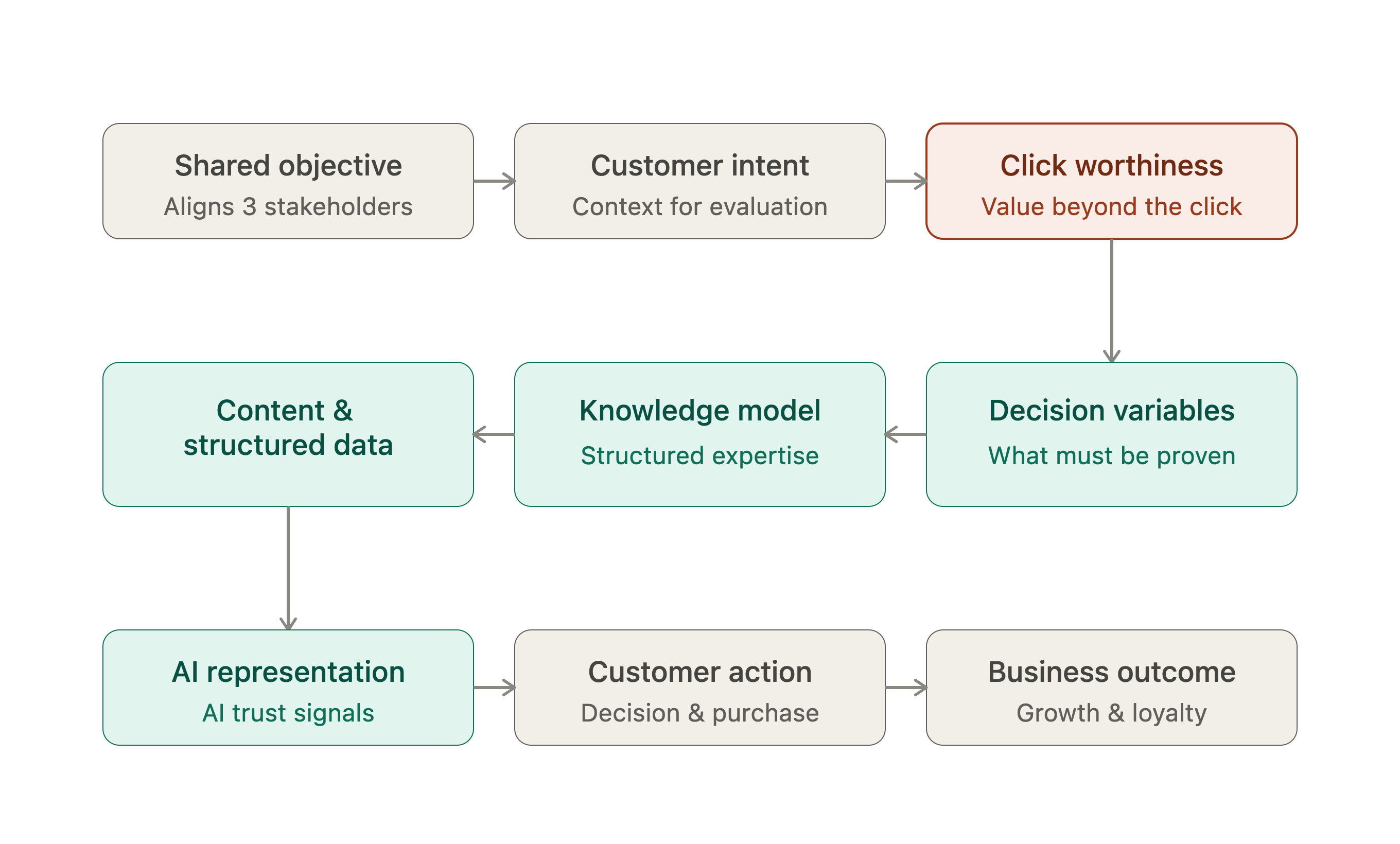
The practical implication of Click Worthiness is that it changes where planning begins. Rather than moving directly from keyword research into content creation and structured data implementation, organizations should first determine whether the customer’s intent creates sufficient value to justify continued engagement. Click Worthiness becomes the strategic decision point that determines whether additional investment in knowledge modeling, structured data, and AI optimization will produce measurable business outcomes.

The Click Worthiness Planning Model

Figure 1 illustrates how Click Worthiness shifts planning from keyword-first optimization toward decision-first optimization.

Image from author, July 2026

Notice where the process begins. The model intentionally starts with a shared objective and customer intent rather than keywords. Click Worthiness sits immediately after intent because it serves as the strategic gate that determines whether the remaining investment is justified. Only after an organization concludes that continued engagement creates measurable value should it invest in defining decision variables, building a knowledge model, implementing structured data, and optimizing AI representation.

Implementation becomes the consequence of strategy rather than the strategy itself.

Measuring Success Beyond Traffic

This planning model also requires organizations to rethink how success is measured.

Traditional SEO metrics such as rankings, impressions, clicks, and traffic remain valuable because they continue to measure visibility. Increasingly, however, they describe only part of the customer journey. Organizations should therefore evaluate success by asking a different set of questions.

  • Are we increasing AI’s confidence in our expertise?
  • Are we improving representation across AI-generated experiences?
  • Are we supporting higher-value customer decisions?
  • Are we creating sufficient incremental value that customers continue engaging after AI has answered the first question?

Brand Sovereignty remains the objective. Click Worthiness provides the planning model that determines where organizations should invest to achieve it. Together, they shift SEO away from maximizing traffic alone and toward maximizing the business value created by trusted knowledge.

In the next article, I’ll examine the knowledge behind those high-value interactions and explain why AI increasingly recommends organizations that model customer decision-making rather than simply publishing product information.

More Resources:


Featured Image: Accogliente Design/Shutterstock

https://www.searchenginejournal.com/when-ai-takes-the-click-click-worthiness-should-guide-your-strategy/582587/