Microsoft Advertising Adds AI Visibility Insights, PMax Testing, And Creative Preview Updates via @sejournal, @brookeosmundson

Microsoft Advertising introduced its first monthly product newsletter on LinkedIn this week. It brings together several features announced over the past few months while introducing new capabilities across AI reporting, Performance Max testing, and creative review.

Rather than focusing on entirely new products, the August update expands existing tools with additional reporting, experimentation, and workflow improvements.

Together, the updates provide a clearer picture of how Microsoft expects advertisers to measure AI visibility, evaluate Performance Max, and review creative before campaigns launch.

Read on to understand what this means for your Microsoft Ads campaigns.

Microsoft Clarity AI Visibility Now Includes Topic Insights

Microsoft is expanding its AI Visibility reporting in Clarity with Topic Insights.

The new reports group AI citations by subject, allowing advertisers to see which topics AI systems associate with their brand, how frequently those topics appear, and where they may have gaps in coverage.

The feature builds on the AI Visibility reporting Microsoft introduced earlier this year by adding another layer of analysis. Instead of reviewing individual citations, advertisers can identify the topics driving those citations and how AI systems understand their content.

The newsletter also defines several AI reporting metrics that advertisers will see inside the new reports, including:

  • Grounding queries: The retrieval searches AI systems generate before producing an answer.
  • Citation share: Measures how frequently a domain appears as a cited source.
  • Share of authority: Shows how often one domain is cited compared with competing sources.

Microsoft also outlined how advertisers can apply those insights to paid search.

They recommend comparing grounding queries with existing search terms, identifying opportunities for new keywords and negative keywords, and adjusting landing pages or ad creative based on competitive AI citation data.

Those recommendations suggest Microsoft views AI visibility reporting as useful beyond organic search by encouraging advertisers to use those insights when optimizing paid campaigns.

While Topic Insights focuses on understanding AI visibility, Microsoft’s next set of updates centers on measuring the impact of AI-powered campaign automation.

Expanding Performance Max Experimentation

Performance Max has become one of Microsoft’s primary AI-powered campaign types, but measuring its incremental impact remains one of the biggest questions for advertisers.

The August newsletter highlights two recently released experiment types designed to help answer that question.

  • Uplift experiments: Measure the impact of adding Performance Max alongside existing campaigns.
  • Upgrade experiments: Compare existing Search or Shopping campaigns against Performance Max after migration.

Together, the two experiment types give advertisers a structured way to evaluate whether Performance Max improves results before making broader campaign changes. The approach also aligns with Microsoft’s recent emphasis on experimentation and measurement across its AI-powered products. Microsoft continues to cite an average 8% increase in incremental conversions from Performance Max campaigns.

Microsoft’s newsletter also included practical guidance for setting up those test. Their recommendation to advertisers:

  • Have at least 30 conversions during the previous 30 days before running experiments.
  • Keep bidding targets, product groups, and campaign settings consistent between test and control groups.
  • Allow 4-12 weeks before evaluating results, depending on conversion volume and conversion lag times.

While these experiments focus on measuring campaign performance, Microsoft’s next update gives advertisers more visibility into how Performance Max creative will appear before launch.

Ad Preview Hub Adds Performance Max Support

Ad Preview Hub previously allowed advertisers to preview Audience ads before launch. The August update extends that functionality to Performance Max while adding Bing Search results page previews.

The expansion could simplify campaign approvals for agencies and in-house teams that rely on creative, legal, or brand reviews before launch.

Teams can generate shareable preview links showing how ads may appear before campaigns go live rather than relying on screenshots captured after ads begin serving. The addition of Bing SERP previews also gives reviewers visibility into Search placements alongside Audience inventory.

Because Performance Max automatically assembles and serves ads across multiple placements, previewing creative before launch can help advertisers identify formatting issues, messaging inconsistencies, or stakeholder concerns before campaigns begin serving.

Taken together with Topic Insights and the new Performance Max experiments, the Ad Preview Hub update reinforces Microsoft’s recent focus on expanding the tools that support AI-powered campaigns, not just the campaign types themselves.

What These Updates Suggest About Microsoft’s Priorities

Looking at these updates together, they point to a consistent pattern across Microsoft’s recent product releases. Rather than introducing entirely new campaign types, Microsoft continues adding reporting, experimentation, and review capabilities around products advertisers are already using.

Across the August updates, Microsoft focuses on helping advertisers answer three necessary questions:

  • How visible is my content in AI experiences?
  • Is Performance Max generating incremental business results?
  • What will my ads look like before they go live?

Each update pairs AI-powered automation with additional reporting, testing, or review capabilities. That gives advertisers more information before making campaign changes instead of relying solely on automated recommendations. During Microsoft Advertising Activate earlier this year, Ads Liaison Navah Hopkins described the company’s approach as “building with you, not just for you.”

Assuming that direction continues, future Microsoft Advertising releases may focus less on introducing entirely new AI products and more on expanding the measurement, experimentation, and workflow tools surrounding them. Those supporting capabilities may have as much day-to-day impact as brand new product releases.

https://www.searchenginejournal.com/microsoft-advertising-adds-ai-visibility-insights-pmax-testing-and-creative-preview-updates/584760/


Colpo di scena a Ormuz: l’Iran apre ai cacciamine europei. L’Italia finisce in prima linea?

Quancosa potrebbe cambiare per l’Europa nello stretto di Ormuz, con conseguenze particolari, soprattutto per l’Italia. Secondo quanto riporta Bloomberg, l’Iran sta valutando la possibilità di consentire ai paesi europei di rimuovere le mine dallo Stretto di Hormuz, una potenziale marcia indietro che potrebbe rientrare in un accordo volto a normalizzare il traffico marittimo in quella via navigabile e a facilitare i negoziati di pace con gli Stati Uniti.

In pubblico, l’Iran ha ripetutamente affermato che non permetterà a paesi stranieri di partecipare alle operazioni di sminamento in questo punto di transito cruciale per il petrolio e il gas naturale liquefatto. Tuttavia, secondo diplomatici informati sulla questione, che hanno parlato in forma anonima per discutere di informazioni sensibili, nelle riunioni private delle ultime settimane Teheran ha ammorbidito tale posizione.

Questa mossa fornirebbe ai settori della navigazione e delle assicurazioni una garanzia da parte di terzi, di cui c’è grande bisogno, circa la sicurezza dello stretto dopo oltre cinque mesi di conflitto militare, e potrebbe contribuire a dare slancio a più ampi sforzi diplomatici volti a porre fine alla guerra. Nello stesso tempo lo sminamento non è la scorta armata, quindi non implica un’azione militare diretta per una o l’altra parte, ma semplicemente una bonifica della rotta.

Sia il Qatar che il segretario al Tesoro statunitense Scott Bessent hanno affermato martedì che è imminente un accordo di qualche tipo, probabilmente relativo allo Stretto di Ormuz. La via navigabile è emersa come il punto di partenza effettivo per qualsiasi ulteriore negoziazione, con una disputa sulla sua gestione in fase di stallo da mesi.

Qualsiasi missione europea di sminamento dipenderebbe dalla fornitura, da parte dell’Iran, di garanzie di sicurezza per le navi coinvolte e dalla sostenibilità di un eventuale cessate il fuoco, hanno affermato le fonti, aggiungendo che non vi è alcuna garanzia che il piano vada in porto. Richiederebbe inoltre l’assenso del potente Corpo delle Guardie Rivoluzionarie Islamiche (IRGC) iraniano, il ramo delle forze armate che ha guidato gli attacchi contro il traffico marittimo attraverso lo stretto.

C’è ancora disaccordo tra i leader iraniani, ha affermato una delle fonti. Alcuni membri del Corpo delle Guardie Rivoluzionarie Islamiche insistono sul fatto che sia la Repubblica Islamica, piuttosto che altri paesi, a doversi occupare della bonifica delle mine marine, hanno spiegato.

Anche la questione della governance dello stretto nel dopoguerra rimarrebbe un punto critico. L’Iran chiede il controllo sulla via navigabile e la riscossione dei diritti per il suo utilizzo — cosa a cui gli Stati Uniti si oppongono fermamente.

Il presidente Donald Trump ha dichiarato lunedì che l’Iran ha un’«ultima possibilità» per raggiungere un accordo, minacciando di riprendere i raid aerei se non si giungesse a un’intesa. Un accordo dipende probabilmente dall’esito dei colloqui tra l’Iran e l’Oman, che controlla la costa meridionale dello stretto.

Un potenziale accordo per riavviare i colloqui tra Washington e Teheran è stato redatto e fatto circolare tra le parti, ha annunciato martedì il mediatore Qatar, in quella che potrebbe essere una soluzione a breve termine per allentare le tensioni. Bessent ha affermato che un accordo su Hormuz potrebbe arrivare già martedì.

I colloqui tra Iran e Oman si sono concentrati sulla creazione di un nuovo canale centrale attraverso lo stretto, ma secondo alcune fonti la rotta sarebbe minata, il che significa che il successo dell’iniziativa dipenderebbe dai successivi lavori di sminamento dell’area. Qui viene a subentrare l’attività dei paesi europei e, ricordiamo, in primis, dell’Italia, che opera la maggior flotta di cacciamine della NATO.

Cacciamine italiano classe Gaeta

La nostra flotta ha in servizio ben otto navi del genere, per cui sarebbe semplice, ed è stato già discusso, collocarne un paio al servizio della sicurezza dell’area.  Il problema è che in passato l’Iran si era opposto alla presenza di navi di paesi terzi anche europei. Sarebbe curioso che l’Italia, a sua volta ostile all’attività delle proprie navi nel Golfo, vi intervenisse su invito dell’Iran.

Il segretario alla Difesa Pete Hegseth ha sollecitato il Regno Unito e la Francia a ospitare una conferenza internazionale sulla navigazione nello Stretto di Hormuz, ma ora non si prevede che questa abbia luogo finché non sarà in vigore un altro cessate il fuoco e non si sarà dimostrato che può reggere, ha affermato un alto funzionario. Gli europei hanno respinto la richiesta per il timore di poter essere percepiti come sostenitori dell’azione offensiva statunitense, ha aggiunto il funzionario. Il sostegno degli Stati Uniti alla missione di sminamento rappresenta inoltre un cambiamento di rotta, poiché in precedenza Trump si era mostrato scettico nei confronti del sostegno europeo.

Google NewsGoogle News Rimani aggiornato seguendoci su Google News!

SEGUICI

https://scenarieconomici.it/colpo-di-scena-a-ormuz-liran-apre-ai-cacciamine-europei-litalia-finisce-in-prima-linea/


Black Hat USA 2026 – Summary of Vendor Announcements (Part 3)

Many companies are showcasing their cybersecurity products and services this week at the 2026 edition of the Black Hat conference in Las Vegas.

To help cut through the clutter, the SecurityWeek team is publishing a digest summarizing vendor announcements at Black Hat USA 2026, including new products and services, updates to existing offerings, reports, and other initiatives. 

This is the third part of the series. You can also read Part 1 and Part 2 if you haven’t already. 

Above Security’s strategic investment from CrowdStrike Falcon Fund

Above Security announced a strategic investment from the CrowdStrike Falcon Fund and integration with the CrowdStrike Falcon platform. Through the partnership, CrowdStrike customers will be able to extend their Falcon deployment, powering ready-made insider risk investigations with Falcon Next-Gen SIEM telemetry. Above correlates Next-Gen SIEM endpoint, identity, and third-party data into investigation-ready cases and streams completed investigations back into Falcon.  

ArmorCode launches vulnerability remediation agents

Advertisement. Scroll to continue reading.

ArmorCode announced four new Anya agents designed to help security teams analyze cloud risks, assess vulnerability exploitability, identify mitigation strategies, and coordinate patch orchestration. The company also added new Context Risk Graph capabilities for expanded attack path analysis, network reachability, and patch management. 

Commvault integrates Threat Scan with Google Threat Intelligence

Enterprise cyber resilience company Commvault announced a new integration that will incorporate Google Threat Intelligence into Commvault Threat Scan workflows. This capability can help organizations identify clean recovery points faster, as well as reduce downtime and speed up recovery following cyberattacks. This announcement adds to Commvault’s ongoing collaboration with Google Cloud, including expanded cyber resilience capabilities for Google Cloud environments via Clumio, and support for Google Cloud workloads.

CrowdStrike announces $100,000 international AI security challenge

CrowdStrike announced AI Unlocked: Agents of Chaos, a global AI red teaming competition created with AWS that challenges participants to exploit rogue AI agents using prompt injection and other techniques to better understand emerging agentic AI security risks. The virtual competition, which begins on August 31 and features a $100,000 prize pool, is designed to give defenders hands-on experience securing AI agents as they become a growing enterprise attack surface.

Dataminr threat landscape report

Dataminr has published its 2026 Mid-Year Threat Landscape Report, finding that the average patch window in H1 2026 got 11 days longer. Meanwhile, attackers can break out in less than 30 minutes, and Dataminr tracked a 69.2% jump in alerts from the second half of 2025.

DataBahn launches Federated Search and Orchestration

DataBahn launched Federated Search and Orchestration, an expansion of its agentic data control plane that moves companies from applying intelligence after data has moved through pipelines to orchestrating it as the data moves. Enterprises can ask one question across every store they own without needing to copy any of the data, and hand it off to an AI agent to complete the investigation.

FireMon integrates with Palo Alto Networks

FireMon announced it has completed its product integration with Palo Alto Networks Strata Cloud Manager to deliver intelligent and interoperable solutions that enable joint customers to innovate faster and solve their most complex cybersecurity challenges.

Intel 471 unveils new AI capabilities

Intel 471 announced two new AI capabilities in the Verity471 platform: MCP471 and Agent471. With the addition of MCP471 and Agent471, Verity471 makes its pre-attack and threat-hunt intelligence more accessible and operationalizes it to help organizations detect and respond rapidly.

Menlo Security extends platform to secure AI assistants and coding agents

Menlo Security expanded its cloud-based Menlo Agent Runtime Security platform to protect AI assistants and coding agents from prompt injection attacks and data exfiltration. The platform routes agent web traffic through a cloud environment to sanitize files and strip hidden instructions before an agent receives the content. Adaptive data loss prevention controls mask sensitive information, while token-based authentication assigns per-agent session identity to enforce specific web access policies. 

Mimecast unveils Agent Risk Center and Managed Threat Response

Mimecast announced a new expansion of its Incydr technology that discovers every AI agent and tool operating across an organization and ties each one back to the human who deployed it. The platform will also include a relaunched Managed Threat Response (MTR) service and expanded Google Workspace integrations.

Palo Alto Networks introduces evolution of PAN-OS and publishes research

Palo Alto Networks announced a new PAN-OS purpose-built for the Frontier AI era. PAN-OS 12.2 Ceres introduces Advanced Virtual Patching, automated blocking for direct-to-IP attacks, six AI security agents, and expanded hardware for securing AI data centers and critical infrastructure. Palo Alto Networks Unit 42 has also released new threat research detailing how an AI system built by its researchers uncovered more than 14,000 previously unknown vulnerabilities across nearly 4,000 widely used open source projects; and how analysis of more than 4 million reports found that 45.32% of malware with C&C activity communicates directly with IP addresses.

Prophet Security research on AI in Security Operations 

Prophet Security has released its second annual State of AI in Security Operations report. An independent survey of 250 IT and cybersecurity professionals finds that security operations teams are reaching a breaking point as alert overload, AI-powered attacks and staffing shortages force organizations to rethink how SOCs operate. According to the report, 96% of organizations are already using AI or actively evaluating AI for security operations, organizations leave an average of 28% of security alerts uninvestigated, and 56% report an increase in AI-driven attacks over the past year.

Proofpoint announces OEM Program

Proofpoint announced an OEM Program: a portfolio of OEM-ready threat intelligence and detection capabilities available for technology providers, cybersecurity vendors, managed service providers, and platform companies. The program cuts the time, cost, and operational lift of building threat intelligence capabilities from scratch, helping partners accelerate product roadmaps and bring differentiated offerings to market faster.

Rubrik adds agent identity controls to Agent Cloud

Rubrik expanded its Agent Cloud platform with Rubrik Agent Identity to manage autonomous AI agent access permissions at runtime. The solution eliminates standing credentials by generating short-lived, scoped tokens for individual tool calls and integrating with identity providers (including Okta and Microsoft Entra ID). Before execution, tool requests pass through a gateway that conducts semantic behavioral analysis, verifies infrastructure access policies, and authenticates session identities.

ServiceNow announces new security solutions and AI Center for Cyber Defense

ServiceNow launched six unified solutions that deliver prevention-first, AI-native cyber defense across unified exposure management, identity and access security, cyber-physical security, cyber risk and compliance, and agentic incident response. ServiceNow also unveiled its newly formed AI Center for Cyber Defense, a global hub for security innovation.

SOCRadar launches Human Identity Exposure

Threat intelligence company SOCRadar announced the launch of Human Identity Exposure, a new Identity & Access layer for its Extended Threat Intelligence (XTI) platform that gives analysts an instant, comprehensive snapshot of an individual’s identity risk. SOCRadar Human Identity Exposure unifies fragmented identity exposure data, including breach repositories, stealer infections, attacker telemetry, PII, data leaks, and CTI signals into a single, decision-ready record. 

Surf AI announces new integration and platform expansion 

Surf AI announced an integration with Claude’s Compliance API, alongside the general availability of Exposure Reduction Operations, extending the platform to govern AI model connectivity alongside identity, cloud, and SaaS exposures. The integration pulls activity logs from the Claude environment, maps the connection and access path to an accountable owner inside the Context Graph, and operationalizes remediation, including disabling unsanctioned MCP integrations and lingering Claude access after offboarding.

Tenable debuts open source AI agent exchange and expands AI risk coverage

Tenable launched CyberAgents Exchange, a free, open source AI agent exchange built for cybersecurity teams. It is a vendor-agnostic community where security professionals can discover, share and build trusted AI agents, skills, MCP servers and multi-agent playbooks, backed by code-level transparency into who built what and how it works. Founding members also include SentinelOne and Recorded Future. The company also unveiled new Tenable One AI Exposure capabilities that expand coverage across every major AI platform and key developer tools. 

Thales releases Luna 8

Thales released Luna 8, its first in-house designed hardware security module made to secure, store, protect, and manage cryptographic keys against quantum threats. The system features an upgradeable architecture to integrate future cryptographic algorithms while maintaining backward compatibility with existing interfaces and ancillaries. Delivered on a unified hardware platform, the appliance is undergoing independent evaluation for FIPS 140-3 Level 3 and EU Common Criteria standards.

Trustmi announces new AI investigation agent and new payment fraud threats

Trustmi unveiled an AI Investigation Agent that is purpose-built for B2B fraud detection. It introduces agentic workflows that investigate suspicious activity, reasons across business workflows, and connects evidence across systems. The company also announced the discovery of two emerging payment fraud threats: Ghost Executive, an attack in which fraudsters fabricate an executive’s approval so the payment looks like a decision has already been made; and Deadline Deception, which pairs fraudulent paperwork with a false deadline to pressure employees into releasing funds. 

VanishID adds AI exploitability management and external identity protection control

VanishID announced AI Exploitability Management and External Identity Protection. Operating externally without internal system credentials or installations, AI Exploitability Management breaks down over 40 attack scenarios to calculate individual risk scores based on public data availability. Complementing this tool, External Identity Protection deploys four categories of autonomous agents (detection, analyst, remediation, and residual risk) to scan data brokers, dark web repositories, and public records. Automated remediation agents submit and verify opt-out requests to erase public profiles.

https://www.securityweek.com/black-hat-usa-2026-summary-of-vendor-announcements-part-3/


AI Visibility Measurement: What To Track & What To Ignore

I have dozens of conversations per week with folks in growth and marketing, ranging from directors, VPs of marketing, and CMOs to SEOs in the nitty-gritty day-to-day.

Many of my conversations involve measurement. This is an increasingly challenging topic as traditional SEO metrics are breaking down with the advent of AI answers.

Much of the conversation is spent debunking misconceptions and misguided advice operators see on social media.

It’s not an easy conversation, but it’s important. This means telling people to avoid many of the things they see people promote on social media. It’s not an easy conversation, but it’s the right conversation.

My goal here is to clear up the confusion so you can tie your AI visibility efforts to business outcomes.

What To Track

These are a mix of leading and lagging indicators that you have varying degrees of control over. I’ll make the case for why each one matters, then we’ll cover how to influence them.

Prompts

This is the most obvious and most important decision, because what you measure influences behavior. From dozens of conversations, it’s also what many people get wrong.

It becomes the first domino in a chain of mismeasurement. None of the other metrics, like citation share, brand mentions, or visibility, matter if you’re tracking the wrong set of prompts.

Most AI visibility tools like Profound, Peec, and AirOps will automatically recommend prompts to track, but these are rarely what you should focus on. I haven’t confirmed this, but from what I can tell, they analyze your website and map existing pages back to prompts. They assume the pages already on your site are the ones that should be cited or visible in LLM outputs.

That might be true. But most companies we speak to say, “We aren’t appearing for the prompts we want to show up for,” which tells me they don’t have the right strategy and thus haven’t published the right pages.

AI Visibility

You can see how, if you’re tracking the wrong prompts, you’ll measure visibility for the wrong things.

From our perspective across dozens of clients, ChatGPT is the most commonly used LLM, but it’s worth tracking how often your brand shows up for your target prompts across ChatGPT, Gemini, Google AI Mode, Perplexity, Claude, and Copilot as well.

This is important because ChatGPT’s user base skews consumer, while Claude’s user base skews business and enterprise. If you’re a B2B business, Claude has fewer users, but those users are using Claude at work, which is the context that matters.

Google has also made AI mode more prominent, and with Chrome having dominant market share, many people will see AI mode outputs by default.

Tracking each model separately lets you see whether a change in visibility or traffic is isolated to one model or happening across all of them.

There are also significant differences in how each model searches for and presents information. For example, Claude’s use of Brave versus ChatGPT’s use of Bing; they have their different methodologies for selecting sources; and each model has preferred sources through media partnerships.

Self-Reported Attribution

For most of the last decade, marketers leaned on clickstream analytics and UTM parameters to tell them where leads came from.

That paradigm has been breaking down for a while, and it now shows an even smaller part of the picture.

LLMs are zero-click by design. When someone asks ChatGPT, Gemini, or Claude a question, the answer is provided in the chat. They don’t click through. They research in the conversation, then they might do a Google search for your brand directly or type your URL straight in. Your analytics and CRM platforms will log that traffic as “Organic” or “Direct,” but the reality is that an LLM is what led to the person going to your website.

Self-reported attribution is the simplest yet highest-signal way to get more of the story. We recommend simply asking people, “How did you hear about us?” There are well-known and documented flaws to self-reported attribution (mostly human memory and salience of touchpoints), so it won’t be perfect, but it’s the buyer telling you, in their own words, how they found you.

If you capture that information through a field on your lead form, you can then track those lead sources in your CRM to pipeline and closed revenue. That’s the ultimate success metric for a marketing channel.

One client that added it discovered ~5% of registrations were coming from ChatGPT despite doing zero work around AI visibility.

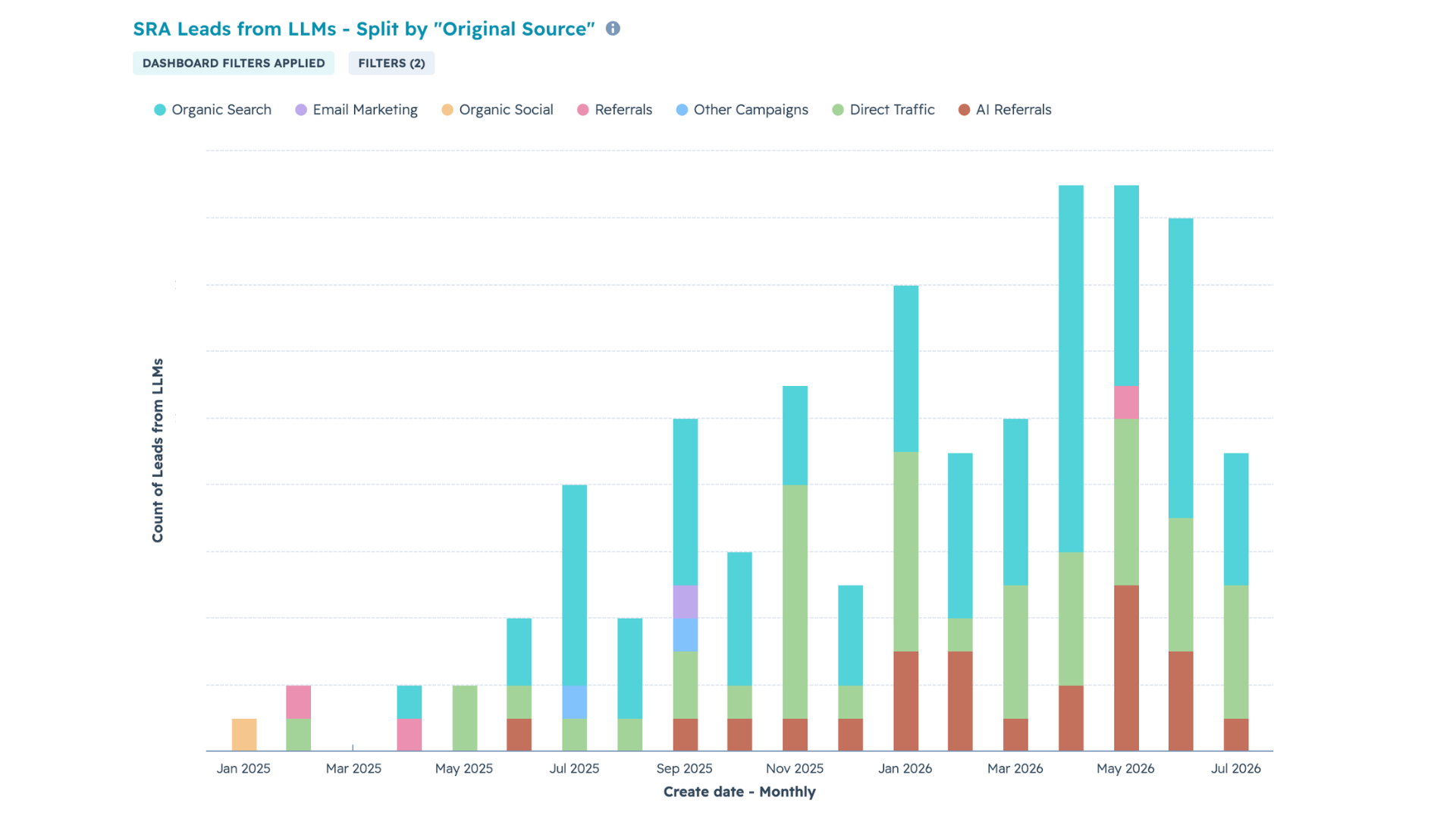
Below is a chart from our internal dashboard. These are the number of people who filled out our consultation form and stated that they found us through an LLM, split by the HubSpot-tagged source. Where possible, HubSpot automatically tags the source as “AI Referrals” (red).

We found that 80-90% of leads that came in via an AI platform were incorrectly tagged as “organic” or “direct.”

Image from author, July 2026

What To Monitor, But Not Set As KPIs

These metrics tend to be related but not the ultimate goal, and often not what you have control over.

Citations

This is the strategic piece that people mistakenly view as the success metric.

Off-page sources dominate citations at every funnel stage. Our research on citation sources found that, even for branded or bottom-funnel queries, 48% of sources were earned media, 30% were commercial content from other sites, and only 22% were from the brand’s own website.

So you should be measuring what percentage of attainable mentions you currently occupy across third-party surfaces. If it’s 1%, there’s massive headroom.

And remember that just because you’re cited, it doesn’t mean you’re recommended or presented in the LLM output.

This means that, yes, you should look at citations, but not simply to see if your website is cited, but whether your brand is mentioned on the most cited pages.

Sentiment

I get a lot of questions from marketers who say, “ChatGPT shows our brand in a less favorable light than it does our competitors. How do we improve that?”

Influencing market sentiment about a brand is a massive undertaking that no single person can control.

There are tactics you could use to influence the sentiment LLMs present, like engaging on relevant Reddit threads or producing content that paints your brand in a better light.

Ultimately, what LLMs present about your brand is not what the LLM thinks–it’s what the market is saying about your brand across hundreds of websites.

That has more to do with people’s experience with your product, your sales team, your customer support, and the overall customer experience your company provides. Marketing is just a small piece of that. No amount of marketing will overcome a negative experience with your brand.

So monitor sentiment, but treat it less as something to influence through marketing and more as feedback to improve the customer experience, which in turn improves sentiment.

LLM Referral Traffic

This is worth monitoring, but not a good KPI because you can’t control this.

OpenAI recently changed how ChatGPT presents sources and reduced the number of sources it showed. As a result, many websites lost ChatGPT referral traffic. However, they reversed that change a month later and showed more citations, leading to a large increase in ChatGPT referral traffic. That makes for a volatile KPI.

Beyond that, a lot of LLM traffic doesn’t get tagged as LLM referral traffic by tools like HubSpot or Google Analytics because the referral source is getting stripped. So traffic ends up being bucketed under direct.

How To Measure The Most Important Metrics

How Do You Track The Right Prompts?

The mistake many teams make is letting their AI visibility tool pick their prompts for them or trying to guess what prompts to track.

The problem is that those tools don’t know your customers. The good news: you do. That knowledge already exists as sales call recordings and transcripts, onboarding calls, and customer research calls. These are rich sources you can mine for voice of customer to understand:

  • What questions come up frequently?
  • What objections come up?
  • What language do they use to describe pain points or challenges?

If your prospects are asking these questions on a call, they – and people like them – are asking the same questions of ChatGPT or Claude.

The other source is self-reported attribution (see below). Once you’ve implemented self-reported attribution, your sales team can see whether a lead came through an LLM and simply ask them what prompt they used or even request a screenshot of the chat thread. In my experience, people are happy to share.

Between call transcripts and direct buyer input, you replace guesswork with the exact language customers use.

Your target prompts can and probably should change. We recommend reviewing prompts against voice-of-customer research quarterly, especially if you’re in a fast-moving industry.

How Do You Measure AI Visibility In ChatGPT, Claude, Gemini, Etc.?

Once you have your set of prompts, we recommend using Profound, Peec, or AirOps for tracking prompts.

Watch for the default channels that get tracked. For example, we don’t care much for Perplexity, and Claude is often not included as a default LLM. So we prioritize Claude, ChatGPT, Gemini, and AI Mode.

Put in your prompts, track your competitors, and track your visibility over time.

How Do You Set Up And Report On Self-Reported Attribution?

I mentioned above that platforms like Google Analytics and HubSpot don’t give the full picture of a lead source.

We recommend having a method to capture self-reported attribution so that a person can explicitly tell you how they found you. This won’t be perfect (attribution never is), but it will give you another informative data point.

This will also allow you to track sales opportunities, pipeline, and ultimately revenue that came in via LLMs.

I’ve seen this done in three ways:

  1. Add a question for “How did you hear about us?” in your lead or product signup forms. You can keep it open-ended or offer a dropdown with pre-defined options and have “AI Assistant (ChatGPT, Claude, Gemini, etc.)” as an option. Some clients are averse to this because they don’t want to negatively impact conversion rates. I’d recommend running an A/B test to see if that’s actually the case.
  2. Add the “How did you find out about us?” question to your product onboarding flow. This addresses the concern about conversion rates, but doesn’t account for pure sales-led motions.
  3. Have your sales team ask on their discovery calls. This requires a behavior change from your sales team, and the downside is it doesn’t account for self-service products.

Focus On What Pays The Bills

When we talk about paid marketing, we usually don’t measure success by the number of impressions because impressions don’t pay the bills. Instead, we talk about return on ad spend. For every dollar we put in, how many dollars do we get out?

It isn’t quite apples-to-apples, but the same logic applies. Instead of measuring visibility or citations (which don’t pay the bills), we should ask whether we’re reaching the right people through LLMs, and whether that visibility translates into business outcomes.

That means focusing on leads, pipeline, and revenue.

More Resources:


Featured Image: RobinRmD/Shutterstock

https://www.searchenginejournal.com/ai-visibility-measurement-what-to-track-what-to-ignore/582009/


The Fourth Battlefield: The Growing Role of Cyber Operations in Global Conflict

Cyberspace is now the fourth domain of military conflict.

Geopolitics can be summarized as the behavior of a country or region influenced by its location in time (history and current events), and space (geographical proximity to other countries or regions). Those geopolitical actions are also influenced by the state of the economy and the psychology of its leaders. 

Geopolitical disagreements between countries are usually settled by diplomacy but sometimes by physical force of arms. The latter is usually a kinetic war involving, as necessary and available, land (an Army), air (an Air Force) and the sea (a Navy).

Over the last few decades, cyberspace has been increasingly co-opted into these conflicts as a fourth force. This article is a discussion on the confluence and effect of using adversarial cyber activity to support kinetic force of arms in solving geopolitical conflict. It is, in short, a discussion on geopolitics and cyberspace.

Background

In the modern world there are three types of warfare: kinetic war (traditional ‘boots on the ground’ physical conflict involving armed forces and usually preceded by cyber operations); cyberwar (aggressive cyber operations); and cyber-kinetic (cyber operations that result in physical damage). All three are generally motivated by politics or geopolitical differences, which makes the intersection of geopolitics and cyberspace an important study.

The three primary geopolitical motivations for nation state cyber operations in support of geopolitical differences are espionage, a desire for regime change, and territorial disputes. In each case the cyber activity has become a common precursor to kinetic activity.

Advertisement. Scroll to continue reading.

In broad terms, nation state activity is ideologically East versus West. The East is primarily China, Russia, Iran and North Korea (CRINK for short). The West is primarily North America, UK, EU, and the remaining members of the 5Eyes (Australia and New Zealand).

Nation state geopolitical cyber operations differ in motivation and practice from simple criminal activity. Criminal activity is motivated by monetary gain. The desire is to achieve this with as much speed and as little cost as possible. Being noisy is not a problem if you can get in, grab what you want, and leave as quickly as possible.

Nation state activity is very different. It is low and slow. Stealth and continuous dwell time are important. “If you detect nation state actors on your network,” comments Dmitri Alperovitch, “chances are they have already been there for weeks or months.” 

Alperovitch was a co-founder of CrowdStrike, is a renowned expert on geopolitics and cyberspace, and is author of World on the Brink. He spoke to SecurityWeek about the intersection of geopolitics and cyberspace, and provided invaluable thoughts and insights.

Cyberspace and espionage

Nation state espionage alone is not generally considered to be war, although it is often a prelude to, or part of, war. It has been practiced for as long as civilization has existed. There are records from ancient Mesopotamia (perhaps 4,000 years ago). The Amarna Letters (14th century BCE) from Ancient Egypt provide diplomatic and intelligence correspondence inscribed on clay tablets. More recently, approximately 2,500 years ago, Sun Tsu’s The Art of War has a chapter titled ‘The use of spies’ treating espionage as the foundation of military activity.

Cyber, however, now raises espionage to a new level of scale and purpose. Its motivation is as often economic as it is military. Nation states use cyber espionage to monitor other nations’ military capabilities and where possible steal military secrets, but also now to steal intellectual property from foreign enterprises. The latter means that commerce as well as the military must protect against nation state low and slow incursions. 

Every nation with a cyber capability is engaged in cyber espionage. The West, with the Five Eyes (FVEY) alliance, is probably the better actor. 

“It’s an intelligence alliance (US, Canada, UK, Australia and New Zealand) that evolved from the work of Alan Turing and Bletchley Park during the Second World War,” comments Alperovitch. It started as a signals intelligence alliance collecting from airwaves and detecting radio signals, but its activities have broadened into cyber espionage. 

“NSA, GCHQ, and the other countries in the alliance are now using cyber to accomplish national security priorities – which is the collection of intelligence on our adversaries. So, yes, we’re doing that. And I think we’re the best in the world at it.”

What we don’t do, he continues, “We don’t steal intellectual property from private companies for the benefit of our own industries. That’s what China does.”

A hypothetical example could be drawn with AI. AI will be seriously important in the future, militarily, sociologically, and economically. It is to be expected that both sides are already surveilling the state of AI in the other. Five Eyes might wish to watch DeepSeek-like companies for intelligence purposes; but that’s all. Beyond intelligence, China, however, might wish to watch, and exfiltrate, Anthropic-like intellectual property – and pass that IP on to its own DeepSeek-like AI enterprises. Other CRINK nations would do similar.

There are additional behaviors that CRINK might engage in that Five Eyes does not. “We don’t engage in ransom operations or theft of currency and cryptocurrency as North Korea does. Our operations follow the rule of law, both domestic and international. The operations are designed generally to not be escalatory unless we’re in a military conflict, in which case, anything goes.”

The last comment is interesting and explains the difficulty in understanding the role of cyberspace in geopolitics. When, exactly, can two nations be defined as ‘at war’? It used to be the presence of opposing armies on a battlefield, or a formal declaration of war between nations. 

However, since 2011 in the US, and 2016 in the rest of NATO, cyber is officially a military domain, and cyberspace is therefore a potential battlefield. In the US, Cyber Command was ordered by Secretary of Defense Robert Gates in 2009 and became operational within Strategic Command in 2010 before becoming an independent unified combatant command in 2018.

The logical implication of this process is that the moment one nation engages in cyber espionage against another nation on the cyberspace battlefield, the two nations are effectively at least at military quasi-war with each other.

But “We’re not going to go [full kinetic] war over espionage, because everyone does it,” adds Alperovitch. If espionage led to war, the world would have been at continuous war since ancient Mesopotamia.

Nevertheless, his earlier qualification (‘unless we’re in a military conflict, in which case, anything goes’) marks a major change in the role of cyberspace that comes to a head when kinetic conflict has either started or is inevitable.

Cyberspace and kinetic conflict

There are two primary causes for kinetic war: regime change and territorial disputes. In both cases, any kinetic activity is generally preceded by or concurrent with aggressive cyber activity. Cyber activity is unlikely to ever win kinetic wars – its purpose is to prepare for, support, and hasten a kinetic victory. 

There are two recent examples of attempted regime change (Venezuela and Iran), and two examples of territorial disputes: Russia with Ukraine, and China with Taiwan. 

Venezuela. Nicolás Maduro, then president of Venezuela, was arrested and removed from Venezuela through a kinetic US operation on January 3, 2026. This operation was almost certainly, and is commonly believed, to have included a cyber element, if only pre-kinetic espionage intelligence gathering. Operational support (possibly in assisting the power blackout that was part of the extraction) is likely, but unproven. This is not surprising – US intelligence would avoid disclosing any cyber access to Venezuelan networks in case it is needed again in the future.

In a press conference following the operation, General Dan Caine (chairman of the joint chiefs of staff) specifically mentioned Cyber Command as part of the layering of ‘different effects’ leading up to the operation.

Maduro was arrested and extracted to face charges related to ‘narco-terrorism’ and is currently being held in New York. The primary purpose of the extraction was, however, to effect regime change, prevent future narco-terrorism, and give the US greater influence over Venezuelan oil. It succeeded only in oil, where the US now has considerable influence. 

It failed in preventing the flow of narcotics into the US since Venezuela was a transit route for narcotics produced elsewhere (primarily Colombia). And it failed to effect regime change. The current ‘acting’ president is Delcy Rodríguez, previously Venezuela’s Executive Vice President. Officially, her position is that Maduro is still the legal and rightful president.

Iran. Epic Fury and Roaring Lion were respectively the joint US and Israeli combat missions launched on February 28, 2026, against Iran. The primary purposes were to destroy Iran’s potential to develop nuclear weaponry and to effect regime change to prevent any continuing desire for nuclear weaponry. Cyber activity was an important component at the launch of kinetic action.

Cyber operations degraded Iran’s radar grids to allow the initial wave of US and Israeli airstrikes. These were remarkably successful, including killing supreme leader Ayatollah Ali Khamenei. Many of the top military leaders were also killed. It is believed that cyber espionage played a part in knowing precisely when and where they were located. 

The initial kinetic action amounted to regime decapitation that would hopefully lead to the rise of a new regime. Psychological cyber operations were used to deliver anti-regime messaging and normal state media, government communication lines, and public apps were all targeted, hoping that the Iranian people would rise up against the Iranian government. This didn’t happen. Despite the success of the ‘remote’ kinetic action against Iranian military capabilities, Iran continues.

Iran has retaliated with its own kinetic activity against US and Israeli regional allies, and with its own cyberattacks against the US. On July 22, 2026, CISA warned that Iranian actors were exploiting ‘programmable logic controllers across US critical infrastructure’. 

This war is ongoing. At the time of writing, it is four months and four weeks since the commencement of kinetic activity. It has involved action in the air, on the seas, and in cyberspace – but not specifically on the ground. Ground forces are not currently involved. The implication here is that cyber activity can assist in areas of kinetic activity, but cannot ultimately succeed without human boots, troops, on the ground in the battlefield.

Cyberspace and territorial disputes

We have two examples of major geopolitical territorial disputes. One involves an ongoing war – in Ukraine. The second dispute is over Taiwan. China insists it is part of China. Taiwan and much of the West disputes this. There is, again at the time of writing, no kinetic war in or for Taiwan. However, if we accept that the role of cyber in geopolitics is to prepare for and assist in kinetic warfare, there are worrying signs.

Ukraine. On February 24, 2022, Russia invaded Ukraine. This was fundamentally a territorial dispute. Putin, that is Russia, considered Ukraine to be part of the Russian empire. He wished to return Russia to the preeminence it had in the USSR prior to the collapse that ended the Cold War. Ukraine disagreed.

Other factors played into this dispute. Historically, Ukraine and Russia have always been linked. When Zelensky came to power, he spoke Russian more fluently than Ukrainian.

Ukraine is effectively a buffer between Russia and its adversary NATO and the EU. Ukraine, however, displayed distinct preferences toward NATO and indicated a wish to join the EU in the future. Putin felt he had no option but to force Ukraine back into the Russian fold. 

Physically attempting to do this started almost exactly eight years before the current ongoing war in mainland Ukraine when Russia took Crimea.

On both occasions he employed the now textbook style of first disrupting the enemy via cyberspace. For Crimea, a cyber espionage campaign dubbed Operation Armageddon and targeting government, law enforcement, and defense agencies was conducted from 2013. Ukraine attributed it to the FSB. 

Russian malware, including Snake and Uroburos (closely related malware) that was developed and distributed by the Turla APT group, was used against Ukrainian government systems. 

As the kinetic invasion began, Russian special forces and cyber units raided Crimean telecommunications centers and cut communication between Crimea and mainland Ukraine, disrupted government phones, and DDoSed government websites, news outlets and social media.

Three months prior to the later invasion of mainland Ukraine in 2022, in late 2021, Alperovitch had declared that kinetic war was inevitable. “What convinced me,” he told SecurityWeek, “was what I was seeing in the cyber domain. Not exclusively – there was a buildup of Russian forces and rhetoric from the Russian government – but I was also seeing cyber intrusions into Ukrainian systems unlike any that I had seen since Crimea in 2014. This was a clear indication that Russia was again preparing for a full scale invasion.” 

He believes that aggressive cyberactivity is effectively a ‘canary in the coalmine’ warning on imminent kinetic warfare.

In some ways, Russian activity never ceased after 2014, with long running Sandworm (GRU Unit 74455), APT28 / Fancy Bear (GRU Unit 26165), and Gamaredon (FSB‑linked) campaigns. 

However, cyber activity escalated dramatically immediately prior to the 2022 invasion. Ukrainian government websites were defaced using WhisperGate. HermeticWiper struck hundreds of systems across Ukrainian financial, defense, aviation, and IT sectors. A second wiper (IsaacWiper) targeted government networks. And as the invasion began, a cyberattack disrupted Viasat’s KA-SAT satellite network, disabling thousands of modems across Ukraine and Europe, but more specifically severely degrading Ukrainian military C2 capabilities.

Kinetically, Ukraine (supported by the US and the EU, has proven remarkably resilient. Four years into the war (again at the time of writing) Russia has not succeeded in its kinetic invasion. While the cyber activity did what it was designed to do, history again suggests that cyber can assist kinetic but cannot guarantee kinetic success.

Taiwan. A second territorial dispute exists today, with China insisting that Taiwan is part of mainland China. Like Ukraine with Russia, Taiwan disagrees, insisting it is an independent island nation. But just as an independent Ukraine inhibits Russian influence eastward, so an independent Taiwan off the eastern coast constrains China’s strategic freedom of action across military, economic, diplomatic, and informational domains in the Pacific region.

While there is currently no specific kinetic activity from China, there is massive cyber hostility targeting Taiwan that has been ongoing for years. There is also massive Chinese pre-positioning in western critical industries. This latter is not a precursor to a Chinese kinetic invasion of the US, but more likely a defensive position to disrupt the US in interfering in any kinetic action against Taiwan.

China’s Volt Typhoon is an example, combining pre-positioning with living-off-the-land for stealth. It has been operating for years, quietly embedding itself inside utility sectors, including communications, energy, transportation, and water systems. The belief is this is designed to give China the ability to disrupt critical services in the event of a future crisis. That crisis could be any US reaction to an invasion of Taiwan.

All of this is necessary because of the importance of Taiwan to western economy. Unlike Ukraine, which has little direct relevance to the US if lost to Russia, Taiwan is critically important to US technology companies. It supplies around 90% of the world’s most advanced chips. 

Without Taiwan’s fabrication capacity, it is unlikely that companies like Apple, AMD, Google or AMD would be able to manufacture the processors they use; and the progress of AI would be inhibited by difficulties in building the necessary data centers. It would take many years and many billions of dollars for the US to build its own industry to replace Taiwan’s current capacity.

For this reason, the US is more aggressive in its support for Taiwan than it is in support of Ukraine. We do not know if this support is preventing a Chinese kinetic invasion of Taiwan or merely delaying it. It’s certainly not stopping China’s desire to take Taiwan. China wants Taiwan, and the US doesn’t want it to have Taiwan.

Interpretation of what is really happening is all conjecture. Is China ramping up cyber activities to force the US to be less reliant on Taiwan? If that were to happen, US defense of Taiwan might relax, enabling China to absorb Taiwan with less difficulty. Or should we see this aggressive cyberactivity as an indication of Alperovitch’s ‘a canary in the coalmine’? Only time will tell. The longer it takes for China to invade Taiwan, the less dramatic it will be. But if China were to invade Taiwan tomorrow, all bets are off.

Summary

The four examples of Venezuela, Ukraine, Iran and Taiwan demonstrate that over the last 15 years, cyberspace has become deeply embedded in geopolitical military actions around the globe. Nowhere, at least so far, has cyber activity done more than assist kinetic military force. The only successfully completed kinetic action was the arrest of Maduro in Venezuela, which involved boots on the ground. Boots on the ground have so far been excluded from the Iran war, and nobody seems to know what will happen without them. But there have been boots on the ground in Ukraine for the last four years, and there is still no winner.

Neither successful cyber activity nor greater force on the ground guarantees a successful kinetic operation – but there is little doubt that cyberspace and ground force will continue hand in hand in the future. Taiwan is a big concern. The geopolitical peculiarities of this situation suggest that any future kinetic conflict will be, for the first time, between two major powers each with nuclear capabilities.

We must hope that for Taiwan, geopolitical hostilities between East and West remain in cyberspace.

Related: China Admitted to Volt Typhoon Cyberattacks on US Critical Infrastructure: Report

Related: The Impact of Geopolitics on CPS Security

Related: Geopolitics Will Drive Aggressive Cyber Activity Throughout 2020

Related: The Increasing Effect of Geopolitics on Cybersecurity

Related: Understanding Geopolitics Key to Analyzing Cyber Espionage: German Intelligence Service

https://www.securityweek.com/the-fourth-battlefield-the-growing-role-of-cyber-operations-in-global-conflict/




New Attack Methods Enable Malware to Hijack Passkey-Protected Accounts

Palo Alto Networks researchers have disclosed the details of new attack methods targeting passwordless authentication, showing how malware can hijack a passkey-protected account.

Passkeys are increasingly adopted by tech giants and are widely recommended because they are more secure against phishing.

The new attack methods, named ‘Pass-ta-key’ by Palo Alto Networks, focus on Google-synced passkeys. The security firm’s researchers showed how a threat actor could use the techniques to take over accounts without needing privilege escalation or user interaction.

In a Pass-ta-key attack, malware already present on a Windows machine running Chrome can examine the browser’s local synchronization database to identify which online accounts the user has protected with passkeys, along with associated usernames and encrypted credential material.

The malware recovers a device identity key that Chrome stores on disk or in memory. It then uses Windows cryptographic APIs to generate a signature over a challenge received from Google’s cloud authenticator service, without any biometric prompt, device unlock, or elevated privileges. 

The cloud service treats the signed request as coming from a legitimate trusted device. It returns a valid authentication assertion, which the attacker forwards to the target website to complete the login.

Advertisement. Scroll to continue reading.

In a more advanced variant, dubbed ‘Silver Pass-ta-key’, the malware forces Chrome into a device re-registration process. During a short window in that process, it registers its own user-verification key with the cloud authenticator. Once registered, the attacker can later authenticate from a completely different machine.

The most severe technique, ‘Golden Pass-ta-key’, extracts a master secret that briefly appears in Chrome’s process memory during re-enrollment. Possession of this secret allows the malware to decrypt every synchronized passkey private key belonging to the account, enabling the attacker to decrypt future passkeys as well.

Google has been notified and Palo Alto Networks’ blog post indicates that it has rolled out some mitigations. 

Related: Passkey Login Bypassed via WebAuthn Process Manipulation

Related: TP-Link Omada ZTP Vulnerabilities Chain Into Full Network Takeover

Related: Gemini Agent-to-Agent Attack Method Exposed Secrets, Enabled Pull Request Tampering

https://www.securityweek.com/new-attack-methods-enable-malware-to-hijack-passkey-protected-accounts/


Reddit Wants To Be The Destination, Not Just The Source Behind Search & AI via @sejournal, @brentcsutoras

Three months ago, I wrote about the Reddit earnings story most marketers missed.

That first-quarter call wasn’t the financial story I expected, but looking back, it was Reddit putting the pieces of its future on the record: participation had become too difficult, community creation needed work, human conversation was becoming more valuable, and Reddit Answers could bring more of the search journey inside Reddit.

The second-quarter call made the larger strategy much easier to see: Reddit doesn’t want to remain only the site people reach after searching Google or the source an LLM summarizes before answering somewhere else. It wants to become the place people intentionally open, search, participate in, and return to every day.

Steve Huffman said it directly:

“We’re not building for drive-by traffic. We’re building a daily destination.”

The strategy is clear, but it creates a contradiction Reddit will have to solve: The company wants the world to come to Reddit, while moderators, community rules, automated detection, and platform-level enforcement are all designed to keep low-quality behavior out.

Those protections are necessary, but they can also remove content, ban people from individual communities, or suspend accounts before legitimate new people understand what they did wrong. As Reddit moves closer to becoming a daily destination, helping more people participate without lowering the quality of its conversations may become the most important factor in its long-term success.

Reddit Wants Search Visitors To Become Daily Users

Reddit reported revenue of $805 million, up 61% year over year, with 130.3 million global daily active uniques and 514.6 million weekly active uniques.

For marketers, the more useful number is 197.2 million U.S. weekly active uniques because Reddit already has enormous U.S. reach, and its challenge is getting more of those people to use Reddit directly and return more frequently.

That is why the app came up so often: Huffman said direct and app users are worth multiples more than search-referral traffic, and during a CNBC interview, he described direct app usage as where Reddit’s business lives.

Reddit also said new app-user retention improved 50% year over year on a relative basis, though it came from a small base and Huffman acknowledged absolute retention still has room to improve. Search has already given Reddit massive reach, so the next step is getting more of those people to open Reddit directly and come back.

What Marketers Need To Know

Reddit is working to turn discovery into direct, repeat use, so marketers need to move beyond driving visits and build a consistent, valuable presence that helps them understand people’s challenges, participate in their validation journey, and create a connection that lasts.

The Home Feed As Reddit’s Recommendation Engine

Huffman called the home feed Reddit’s primary app surface and one of the primary drivers of subreddit discovery. The important point isn’t simply that people can find new subreddits there. It’s that the feed now recommends conversations from communities a logged-in user never chose to follow.

For years, logged-out users could see popular content from across Reddit, while a logged-in user’s home feed mainly reflected the communities they had subscribed to. That has changed. Reddit is now using what it knows about someone’s interests and activity to recommend content from outside those subscriptions.

That broader reach is central to the work we do at OGS Media, where we look at how useful conversations reach people through Reddit’s home feed, Reddit Answers, search results, and LLM outputs.

Huffman also explained how much room the recommendation system has to improve. Its models currently incorporate 10% of user activity, update in days rather than hours or minutes, and select from posts published during the previous week.

That seven-day limit may be the more important signal. Reddit has 26 billion posts and comments, including advice, reviews, and conversations that remain valuable long after they were originally posted.

If Reddit expands that window, older conversations could return to the home feed whenever they become relevant to someone’s interests or current problem.

What Marketers Need To Know

Reddit’s home feed can now carry a useful conversation beyond the people who already follow that subreddit. But that doesn’t mean marketers should treat the feed like another distribution channel.

People go to Reddit because they want something different from blog content, search results, ads, or public reviews. Reposting the same marketing content misses the opportunity to become part of their validation journey.

Create conversations that fit the community, solve real problems, and earn engagement. Those are the conversations Reddit can recommend today and may be able to resurface for much longer in the future.

Reddit Answers Is Becoming One Of The Best Ways To Search Reddit

Reddit’s push to become a daily destination is especially clear in search, where the search bar is now universal in the app and both searchers and searches grew during the quarter.

Huffman said that, for a lot of the queries he runs, Reddit is now the best place to search Reddit. I agree with him based on how often I’ve been using Reddit Answers and how useful I find it for locating the conversations and perspectives I need. In a lot of cases, it gives me a better experience than searching Reddit through Google or asking an LLM.

That matters because, as Huffman told CNBC, “a summarization of Reddit isn’t Reddit.” People look for Reddit because they want different experiences, opinions, perspectives, and the conversation itself, not just a compressed answer taken from it.

Search results sent people into those conversations, while AI Overviews and LLMs can use Reddit content without sending people to Reddit or giving them the opportunity to participate, which is why Reddit wants more of that search experience to happen inside its own platform.

What Marketers Need To Know

If you’re figuring out how to improve content for search and LLMs, compare what Reddit Answers surfaces with Google search results and LLM answers for the queries that matter to you. I would make showing up there for the right questions a higher priority, which means creating conversations that directly solve what people are searching for.

Reddit Is Making Conversations Easier To Consume

Reddit is also expanding the ways people can consume its conversations, with video in comments already accounting for more than 10% of Reddit’s video posts and Reddit expecting to test spoken or background-listening experiences later in 2026.

People often tell me Reddit doesn’t like video, but that has never been true. Written conversation is still its foundation, but credit goes to Rasha K. and Reddit’s APAC team for showing through their AMAs how video could add authenticity by making it clear the person answering was actually involved.

These formats give more people a way to use the conversations already there, including people who may never read a long thread. That broader access matters if Reddit is serious about its ambition to eventually reach one billion daily users.

What Marketers Need To Know

Video and audio won’t fit every community. If you experiment with either format, start with what the community wants and keep it connected to the conversations that make Reddit valuable.

As video begins appearing in communities related to your industry, pay attention to how people respond and which formats perform best so you can understand how your own community wants video used and presented.

Reddit Has To Balance Growth With Community Quality

Reddit is trying to make participation easier through new posting tools, better community recommendations, and LLM-assisted moderation that could replace some of the blunt account-age restrictions keeping legitimate new people out. Huffman acknowledged the problem directly when he said the account-age approach “has not aged well.”

That tension also came through in Reddit’s post-earnings AMA, where Huffman said its proactive systems prevent up to 23 million spam views and revoke nearly 2 million inauthentic votes every day.

Reddit clearly needs those protections, but working through this problem with Reddit and companies trying to participate responsibly has shown me how often legitimate people get caught between its growth goals and the systems designed to protect community quality.

Reddit has invested in Mod World and other moderator programs, but growth only works if its tools help moderators reduce spam, abuse, workload, and false positives enough to loosen blunt account-age restrictions safely.

What Marketers Need To Know

Brands and new Reddit users face a lot of scrutiny over whether they’ll be a quality addition to the site. A removed post or comment, a subreddit ban, and a sitewide account suspension have different consequences, but none should be treated as a minor setback.

Reddit is trying to become more open, but that doesn’t lower the standard for participation. Follow the rules, respect each community, and build a clear history of useful participation.

If automated enforcement, a moderator decision, or a sitewide suspension catches you unfairly, a credible participation history and careful documentation give you more context for an appeal. They don’t guarantee a reversal, but they give you a clearer case to present.

The Destination Reddit Is Trying To Become

“Reddit has become the validation phase of the customer journey because people trust it.”

Bartosz Goralewicz, Co-Founder of OGS Media

Q1 showed that Reddit understood the barriers keeping people from participating. Q2 showed why removing them matters. Reddit doesn’t want to remain a source that Google and AI tools summarize before people move on. It wants to become the place people go to understand a problem, hear different perspectives, and decide what they trust.

Reddit isn’t a place to be summarized because its value isn’t a single answer. It’s the depth of the conversation, the disagreement, the lived experience, and the emotional validation people get from hearing others work through the same problem.

For marketers, the opportunity is to understand those conversations, help solve the problems inside them, and earn a place in the validation journey. That’s how a brand becomes part of the decision instead of another message people learn to ignore.

If Reddit can bring more people into that process without losing the quality of its human voices, it can move beyond being the source behind search and AI and become the destination people choose when they need to decide what to trust.

More Resources:


Featured Image: Brent Csutoras/Search Engine Journal

https://www.searchenginejournal.com/reddit-wants-to-be-the-destination-not-just-the-source-behind-search-ai/584586/


Disney gives TikTok creators official access to Marvel, Star Wars, and Pixar characters

Disney is introducing fan-created TikTok content to its Disney Plus app in its latest attempt to break into short-form creator videos. The Walt Disney Company announced today that it’s partnering with TikTok to bring “an expansive collection of thoughtfully curated Disney-centric fan-created content” to the Verts video feed it launched on Disney Plus earlier this year, providing creators with access to assets from “hundreds” of movies and TV shows.

The partnership will be piloted in the US “in the coming months,” according to Disney, with plans to launch in other markets later. Videos from TikTok creators who opt-in to the program will be hosted on both the TikTok and Disney Plus platforms, and will feature a host of scenes and characters from Disney’s brands, including Pixar, Marvel, Star Wars, and more. Disney says the jointly-run creator program will also grant certain perks to participating TikTok creators, including increased visibility, exclusive event access, and career development pathways.

Disney was planning a similar partnership with OpenAI that would have allowed the AI provider’s now defunct Sora video generator to train on and replicate protected Disney IP, in exchange for hosting Sora-made videos on Disney Plus. There’s nothing in Disney’s new partnership with TikTok that specifically excludes AI tools, but we’ve reached out to clarify.

https://www.theverge.com/streaming/975520/disney-tiktok-partnership-verts-streaming


311,000 Impacted by Brown Health Medical Group-MA Data Breach

Lifespan Physician Group of Massachusetts, doing business as Brown Health Medical Group-MA, is notifying over 311,000 individuals that their personal, medical, and financial information was stolen in a data breach.

The incident occurred in December 2025 at its Hawthorn location. It involved a historic file server, the healthcare organization says in a sample notification letter filed with the Massachusetts Office of Consumer Affairs and Business Regulation.

While the practice’s electronic health record system was not affected, Brown Health Medical Group-MA determined on June 22, 2026, that the attackers accessed files containing personal information.

The potentially compromised information, it says, includes names, contact information, dates of birth, Social Security numbers, driver’s license numbers, government ID numbers, medical and disability-related records, financial account information, and credit/debit card numbers.

Personnel and human resources records, including payroll and compensation information, and licensure or credentialing information, were also compromised.

“Not all categories of information were impacted for all individuals,” Brown Health Medical Group-MA says.

Advertisement. Scroll to continue reading.

The healthcare organization says it isolated the affected server immediately after identifying the incident, has implemented additional safeguards, and is re-training its employees.

Brown Health Medical Group-MA notified the US Department of Health and Human Services (HHS) that 311,760 people were affected by the data breach. Of these, 290,357 are Massachusetts residents.

The organization is providing the impacted individuals with two years of free fraud detection and identity protection and restoration services.

Brown Health Medical Group-MA has not named the threat actor behind the attack, and SecurityWeek has not seen any known ransomware or extortion groups claiming responsibility for the incident.

Related: 150,000 Impacted by Madera Community Hospital Data Breach

Related: Cyberattack Hits Liechtenstein’s Register of People Behind Companies and Foundations

Related: River Bank Says Hackers Deleted Data Stolen in Ransomware Attack

Related: Brinks Home Discloses Data Breach as Hackers Leak Files

https://www.securityweek.com/311000-impacted-by-brown-health-medical-group-ma-data-breach/


Google Assistant will disappear from your phone next month

Google Assistant’s days have been numbered ever since Gemini arrived on the scene, and its time is now up. Google has announced that it will be removing access to Assistant on Android phones and tablets, along with paired devices like smartwatches or headphones, from September 4th.

The announcement came in an email apparently sent to some users, as reported by 9to5Google and shared in full on Reddit. The Verge has asked Google for confirmation that the email is accurate, and will update this story once we have it.

“We will begin removing access to Google Assistant starting on 4 September,” Google states in the email, “and expect that this process may take a few weeks to reach everyone. Once availability is removed, you will no longer be able to use or switch back to Google Assistant on your phone, tablet or paired devices.”

Google notes that if you’re in a region where Gemini is available, and your device meets minimum requirements, you’ll now only have access to the AI-enabled assistant. Paired devices including Wear OS smartwatches, headphones and earbuds, and cars running Android Auto will also lose access to Google Assistant, though cars running Google built-in will retain access to Assistant for now. Today’s announcement doesn’t seem to affect Google Home or Google TV devices, so Assistant will live on in a few places past September.

Google had previously planned to end access to Assistant for “most mobile devices” some time in 2025, but the shutdown was delayed to this year. It seems that the stay of execution has now been lifted, and Assistant is just a few weeks away from taking its place in the Google Graveyard.

https://www.theverge.com/tech/975516/google-assistant-android-phones-tablets-shutdown