Google DeepMind’s new AI model can control a robot’s entire body
Google DeepMind says the latest version of its Gemini Robotics AI model can “control entire humanoid robots.” While the previous model focused on controlling a humanoid robot’s upper body, Gemini Robotics 2 now supports “whole-body motions” ranging from its feet to fingertips, according to an announcement on Thursday.
The new model will allow humanoid robots to perform a wider range of actions, as it allows them to walk, crouch, stretch, and manipulate objects. Videos shared by Google show how Apptronik’s Apollo 2 robot can bend over to pick up a watering can, as well as find and take specific items off a shelf.
Though Google DeepMind notes that its robots “have more to advance in movement speed,” it adds that this update “is an important step towards the skills needed to complete more complex, real-world tasks that require whole-body coordination.”
Additionally, Gemini Robotics 2 supports better dexterity, as it can now control more complex, five-fingered hands. That enables robots to perform tasks like sealing a Ziploc, tying a trash bag, or unscrewing a lightbulb.
Google DeepMind is updating Gemini Robotics ER (embodied reasoning) as well, a vision-language model that helps robots to analyze their surroundings, process instructions, and perform multi-step tasks. Gemini Robotics ER 2 is better at completing tasks over an extended period of time and “now understands when tasks begin and end.”
Google DeepMind says this update also allows multiple robots of different types to work together and complete tasks, with one video showing how Apollo 2 instructs Google’s dual-arm robot to put tools inside a bin while cleaning the garage.
The company notes Gemini Robotics ER 2 is its “safest robotics model to date,” as it can “better detect when humans are nearby, trigger safety tool calls and bring the robot to a safe stop if someone approaches too closely.”
Meanwhile, Google DeepMind has brought improvements to its Gemini Robotics On-Device Model, which can run locally on a robot without an internet connection. This model can now adapt to new embodiments faster, including those with “drastically different shapes, sensors and degrees of freedom.”
ABC demands FCC drop its ‘punitive’ early license renewal of its stations
ABC filed its formal opposition to the Federal Communications Commission’s effort to force it to submit to an early renewal of its broadcast station licenses, calling it an effort to chill the speech of broadcasters across the country.
In a new filing with the FCC, ABC charges that the agency’s willingness to pursue the early renewal of eight of its licenses far before they expire is “extraordinary and unprecedented.” The company alleges the FCC “has spent the last 18 months searching for some pretext for revoking the Stations’ licenses,” but charges that the agency’s real motivations for pursuing these licenses are clear: “Each is owned by ABC, and the Administration has openly and repeatedly called for the revocation of ABC’s licenses, because it dislikes the content and viewpoints expressed on ABC network programs.” The FCC did not immediately respond to a request for comment.
“The retaliation against ABC is a signal to every media company in the country”
The station license fight has led to an outpouring of support for ABC, including from viewers it urged with on-air ads to file public comments. More than 153,000 comments have been left on the FCC docket, including from a bipartisan group of former FCC chairs and officials who slammed the agency’s action as part of a “broader pattern” in a “campaign to punish speech disfavored by the Trump administration.”
“The retaliation against ABC is a signal to every media company in the country: accommodate the Administration’s view of what news coverage should look like or pay the price,” ABC wrote in its latest filing. “The tools vary; the objective does not: a media industry too fearful of official reprisal to report the news freely.”
Doing More with Less: Practical Security Solutions for Resource Strapped Schools
With school buildings averaging nearly 50 years old nationwide, many districts may struggle with deteriorating facilities, outdated infrastructure, or insufficient technology. Budgets are stretched with varying priorities, yet safety threats continue to grow, challenging schools to strengthen their security posture using the resources they have on hand. By focusing on foundational, code-compliant practices and operational discipline, schools can significantly enhance safety in practical, cost-effective ways.
Facility Maintenance
A critical first step is ensuring all facilities are well maintained. Offering clean, orderly and visibly cared-for environments helps reduce the opportunity for vandalism and discourages unsafe and unauthorized activity on school grounds. Enhancements, such as additional windows or improved lighting in darker places inside the building and exterior areas, can increase visibility by eliminating blind spots and supporting natural surveillance, which are key components to a safer campus.
Clear Procedures
Operational consistency is especially important when keeping a school safe. Aging physical infrastructure and manual processes can introduce vulnerabilities if daily procedures are not followed rigorously. Schools manage a wide range of individuals throughout the year who each require different areas of access – including contractors, substitutes and volunteers. Without clear protocols for granting and monitoring access, the risk of unauthorized entry increases. Simple habits, such as ensuring classroom and office doors are secured at all times, are low-cost practices that help strengthen internal security of the school.
Having strong key control and access management practices in place provides another layer of protection for the school without requiring advanced technology. Establishing a well-defined key procedure for issuing, tracking and retrieving keys helps ensure only authorized individuals can access specific areas. By having strong key tracking practices in place, schools can hold an accountability system, allowing them to proactively identify gaps before they potentially become security incidents.
Visitor management is another essential area schools must pay close attention to, and often a very overlooked layer of security. Offering a single, secured point of entry for visitors helps control who is entering and leaving the building. Visitor identity verification and a clear pre-approved entry protocol help prevent unauthorized pickups or entry attempts. While having strong internal hardware limits access internally, strong visitor management helps control the external perimeter, a critical component of the overall safety of the campus.
Building a Culture of Safety
In addition to physical and operational improvements, a strong culture of safety can be equally impactful. Encouraging participation in regular training can help everyone understand their role in maintaining a secure environment. Regular training can range from recognizing unusual behavior and knowing how to respond during various emergency situations. Simple daily procedures like verifying doors are closed and locked, confirming visitor protocols are being followed, and identifying areas where student behavior may indicate risk reinforce strong safety habits. When consistent, these simple habits can become very effective. When students and staff understand safety protocols and expectations, districts can create a proactive environment where issues are spotted early and addressed quickly, helping strengthen overall safety.
As the most widely recognized national framework K-12 physical security, the Partner Alliance for Safer Schools (PASS) provides clear, tiered guidelines that help districts implement effective, code-compliant measures based on their current resources and facility needs. PASS guidelines emphasize the importance of classroom door locking from the inside only, so no individual must step into the hallway.
Beyond door security, PASS also highlights the importance of accessible communication tools. Staff should be able to easily reach a telephone, panic button, intercom call button or two-way radio to alert administrators or first responders when help is needed.
Lastly, a comprehensive Emergency Operations Plan (EOP) is an essential component and conducting safety drills throughout the year will strengthen preparedness. Schools that gather feedback from students and staff after drills take place can uncover pain points, make adjustments and strengthen procedures.
By implementing low-cost initiatives, districts can take important steps toward creating a safer, more resilient learning environment. This includes prioritizing facility upkeep, improving operational discipline, strengthening access control and enhancing classroom readiness. With thoughtful planning and consistent execution, schools can make meaningful progress toward strengthening their security posture, while building a strong foundation for future safety investments.
In 2009, a surgeon named Atul Gawande and a team backed by the World Health Organization showed that a 19-item surgical checklist could cut complications and deaths by dramatic margins across eight hospitals worldwide. Not a thousand-page protocol. Not a comprehensive framework. Nineteen items, printed on a single card. Aviation learned the same lesson decades earlier: the pre-flight checklist fits in a pilot’s hand, not in a binder. Nearly two decades later, I watch security teams send AI vendors questionnaires with 300 questions, half of which begin with “describe your approach to…” and almost none of which would catch a real failure. We have the frameworks. What we don’t have is the checklist.
The timing matters. The EU AI Act’s enforcement teeth for general-purpose AI arrive this August, high-risk obligations are phasing in behind them, and ISO/IEC 42001 is now showing up by name in third-party risk questionnaires. NIST’s AI Risk Management Framework has become the default answer for “show me you have an AI risk program” in North America. Add the OECD Principles, HITRUST’s AI assurance work, sector regulators like the FDA, and a growing patchwork of US state laws, and most enterprises are now operating under two or more frameworks simultaneously.
Here’s the part that surprises people: the frameworks themselves largely agree. Published crosswalks show substantial overlap between ISO 42001, NIST AI RMF, and the EU AI Act. An organization that builds its program thoughtfully can satisfy all three with a single set of processes and documentation. The problem isn’t the frameworks. The problem is what happens downstream, when those frameworks get translated into the questionnaires, audits, and attestations that land on real desks.
The Questionnaire Problem
If you’ve been on the receiving end of an AI security questionnaire lately, you know the artifact I’m describing. Hundreds of questions. Free-text answers. Prompts like “Describe how your AI system ensures fairness” or “Explain your approach to responsible AI.” These questions have three fatal flaws.
First, they can’t be answered with evidence, only with prose. And prose isn’t compliance; it’s creative writing. A vendor with a mature program and a vendor with a good technical writer produce indistinguishable answers. The exercise rewards confident fiction and punishes honest uncertainty. When I see a question that any vendor can answer without producing a single artifact, I know that question isn’t reducing anyone’s risk.
Second, they ignore the nature of the systems they’re assessing. As I wrote in the last column, LLMs are stochastic systems that are extremely difficult to replay and troubleshoot. A point-in-time attestation about model behavior is stale the moment a model version changes, a system prompt is updated, or a temperature setting moves. Asking “does your model produce biased outputs?” as a yes/no compliance question fundamentally misunderstands what these systems are. The right question is whether you can measure it, log it, and show me the trend.
Advertisement. Scroll to continue reading.
Third, they don’t scale with risk. I’ve seen the same 300-question addendum sent to a vendor running a marketing chatbot and a vendor deploying clinical decision support. When everything is high-risk, nothing is. The EU AI Act got at least this much right: its four-tier risk classification exists precisely so that obligations scale with consequences. Most homegrown questionnaires have no tiers at all.
What Usable Actually Looks Like
I want to propose a different bar for AI compliance, and it borrows directly from the checklist lesson: a framework is only as good as its worst question. Before any question makes it into your AI assessment, whether that’s a vendor questionnaire, an internal review gate, or an audit program, it should pass five tests:
1. Answerable with an artifact. Every question should map to evidence: a log, a config, an eval report, a data flow diagram, an architecture document. If the only possible answer is an essay, cut it or rewrite it. “Describe your approach to model security” becomes “Provide your logged inference parameters (model version, temperature, top P, token limits) for your production deployment.”
2. Scoped to risk tier. Classify the system first, then ask the questions that tier deserves. A limited-risk internal tool gets ten questions. A system touching patient data or financial decisions gets the full treatment. Don’t send Annex IV-depth documentation requests to a chatbot vendor.
3. Measurable or binary where possible. “Do you run evals? At what cadence? What was your last pass rate on your safety benchmark?” beats “describe your testing philosophy” every time. Reviewers can score it, trend it, and compare it across vendors.
4. Decision-relevant. For each question, ask: if the answer came back bad, would it change our decision? If removing the question wouldn’t change any outcome, remove the question. This single test eliminates half of most questionnaires I’ve seen.
5. Mapped once, reused everywhere. Build your control set once, then use the published crosswalks to answer NIST, ISO, and EU AI Act asks from the same evidence base. One process, multiple regulatory readings. If your teams are producing separate documentation for each framework, you’re paying a triple tax on the same work.
The Questions That Actually Matter
If I had to compress AI vendor assessment down to a single card, it would look something like this: Where is the model deployed, and who is the upstream provider? What data flows in, and what flows out, and where is that logged? Where are copies of that data stored, for how long, and who can access them? What inference parameters are logged per request, and can you replay an incident? What is your eval suite, what does it cover, and how often does it run against production? Where are the human oversight points, and what can the system do without one? What is your incident process when the model does something it shouldn’t? How do you swap or change models, what testing gates a switch, and do downstream customers get notified?
Notice these are largely the same questions I argued for in the red teaming column: before deploying, know where the model runs, what inputs it processes, what the outputs look like, and how business risk gets revisited over time. That’s not a coincidence. Good security questions and good compliance questions converge, because both are ultimately about whether you understand the system you’re operating.
Standardize the Model Card
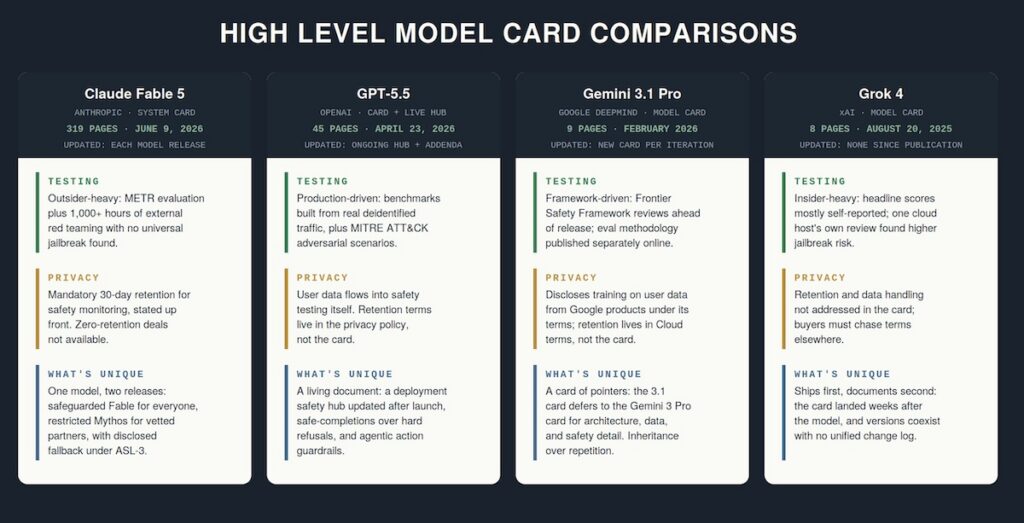
There’s one industry fix that would eliminate half of these questions before they’re ever asked: a standardized model card. I raised this in the last column, noting that model cards tend to offer some insights but measurements aren’t standardized across the industry, and it matters even more for compliance than it does for red teaming. Today, every model provider publishes something different: different eval benchmarks, different safety disclosures, different levels of detail on training data, different definitions of the same terms. That inconsistency is exactly what forces every downstream customer to run their own bespoke questionnaire, and forces every vendor to answer the same questions a hundred different ways.
Imagine instead a model card with a fixed schema: model version and lineage, training data provenance categories, where and how long data is retained, a common core of eval benchmarks with published scores, documented safety mitigations, default inference parameters, and a change log tied to every model swap or version update. SOC 2 didn’t succeed because it was clever. It succeeded because everyone agreed on what the report looks like, so one artifact could answer a thousand customers. The model card should be AI’s equivalent: produce it once, keep it current, and let it stand in for the first fifty questions of every assessment. Standards bodies are circling this idea, and both ISO 42001’s documentation requirements and the EU AI Act’s transparency obligations gesture at it. But until the schema is common, buyers can force the issue by asking for the same fields, in the same format, every time. Procurement pressure standardized SOC 2. It can standardize the model card too.
The key insight I want to share is this: compliance is an evidence problem, and for AI, evidence is an observability problem. The organizations that will sail through the enforcement wave now arriving aren’t the ones with the thickest binders. They’re the ones whose logging, evals, and documentation were designed so that any reasonable question can be answered in minutes with an artifact rather than in weeks with an essay. This is what I mean by timeless compliance. Frameworks will keep multiplying, regulators will keep diverging, and the models themselves will be unrecognizable in three years. But the principles underneath don’t move: know your system, log what matters, measure continuously, scale scrutiny to risk, and never ask a question you can’t act on. Those held true for surgical checklists and pre-flight cards, they held true for SOC 2 and ISO 27001, and they will hold true for whatever comes after the current generation of AI standards. Comprehensive coverage is a moving target. Simplicity, done honestly, is permanent.
This column is Part 3 of multi-part series on securing generative AI:
Stagwell’s Strong Q2 Anchored By Record New Business Haul
The numbers
$632 million – Net revenue growth for Q2, a 6% increase YoY.
$1.22 billion – Stagwell’s year-to-date net revenue, a 5% increase from 2025.
$171 million – Stagwell’s new business for Q2, a 45% increase YoY, according to chairman and CEO Mark Penn.
16% – Growth from Stagwell’s top 100 clients.
$109 million – This quarter’s adjusted EBITDA, which increased 15% YoY.
Watercooler talk
Stagwell notched a strong second quarter according to chairman and CEO, Mark Penn, with net revenue growing to $632 million—a 6% increase year-over-year.
During an earnings call with investors, Penn told investors he attributed the success to its aggressive strategy for new business.
UNLOCK FULL ACCESS
Subscribe and get full access to the news, insights, and expertise that keep industry professionals ahead of the curve.
AI Applications Contain Security Vulnerabilities, According to Report
A penetration testing report by BreachLock found that 100% of AI applications tested contained vulnerabilities aligned with the OWASP Top 10 for LLMs. Prompt injection (LLM01) was the most prevalent and impactful finding in the dataset, present in 28% of tested applications.
The report also identifies a sharp shift in how attackers are targeting web applications. Insecure Design and business logic flaws (OWASP A04) rose from 8% to 16% of findings year over year, a trend-defining increase in the 2026 web application dataset. Testers observed attackers exploiting race conditions in checkout flows, escalating privileges through parameter manipulation, and bypassing approval workflows outright. These issues do not appear on automated scanner reports. Finding them requires testers who understand how an application is supposed to behave and can reason through how that logic can be subverted.
Cloud environments produced the highest concentration of severe risk in the dataset. Cloud security audits carried a Critical finding rate of 1.34%, thirteen times higher than the rate found in web application testing, driven largely by exposed S3 buckets, leaking Lambda functions, and disabled GuardDuty monitoring.
Mobile applications showed a similarly narrow but severe risk profile. Hardcoded credentials in iOS applications accounted for 97% of all Critical mobile findings this year. These credentials can be extracted with free, publicly available tools in minutes, and credential-related vulnerabilities continue to be a top attack vector in headlines this year.
Majority of Organizations Unsure if They Could Detect AI Attack
A report by Onapsis analyzed the results from a study on artificial intelligence (AI) security and enterprise resource planning (ERP). The report found that nearly one in four organizations (22%) report experiencing a security incident in the last twelve months where bad actors used AI to exploit their critical business platforms.
The report also found that 70% of senior cybersecurity leaders have only some trust or no trust at all in AI to secure their organizations’ business critical data. However, more than half (58%) report that their organizations started using AI-based apps or agents that touch their ERP system within just the last six months, and 86% say they have already integrated, or will shortly integrate, AI directly into their ERP code.
Nearly 57% of respondents report that at least one business unit has objected to implementing AI within the ERP environment, with the security team topping the list of resistant groups (41.4%), followed by IT (20.7%) — the very function responsible for the ERP. The top reasons cited for resistance were lack of confidence in AI security (75%) and compliance risk (71.6%).
According to the report, 68.6% of respondents say they are only “somewhat” or “not very” confident that their current security defenses could even detect an AI-based attack. A similar share — 70.6% — report having only some, or no trust at all in AI applications and agents to secure their organization’s most business-critical data. When asked what it would take to build that trust, respondents pointed to robust access management controls (61.8%), strong personal data protections (45.8%) and sandboxing or digital twin environments (36.8%) as the top requirements over the next 12 months.
DataBahn Raises $40 Million for Agentic Data Pipeline Management
DataBahn today announced closing a $40 million Series B funding round that brings the total raised by the company to $59 million.
Founded in 2023, Texas-based DataBahn helps organizations automate data integration, management, and optimization, and reduce costs.
According to the company, its solution provides seamless data collection and integration, SIEM and data storage optimization, data ownership and governance, and real-time visibility and insights.
DataBahn’s agentic data control plane activates, governs, and orchestrates enterprise data across sources, destinations, and AI models, enriching and routing only the data required for real-time operations.
Its data fabric covers various types of data, including security, application, OT, IoT, and observability data.
DataBahn’s fresh investment round was led by Insight Partners, with additional support from previous investors Forgepoint, GTM Capital, and S3 Ventures.
Advertisement. Scroll to continue reading.
The company plans to use the funding to accelerate investments in R&D and product innovation, and to expand its agentic data control plane.
“The next generation of enterprise infrastructure won’t be built around moving more data—it will be built around intelligently orchestrating the right data at the right time. We believe every enterprise will need an agentic data control plane that continuously reduces, enriches, governs and activates enterprise data for both applications and AI,” said DataBahn co-founder and CEO Nanda Santhana.
Cantina Emerges From Stealth With $8 Million in Funding
Cybersecurity startup Cantina today emerged from stealth mode with $8 million in fresh funding for autonomous vulnerability management.
Bringing the total raised by the company to $16.5 million, the new investment round was led by Framework Ventures.
Based in New York, Cantina has built a community-powered agentic security platform that relies on autonomous security workers to identify, prioritize, and remediate vulnerabilities.
The platform allows organizations to use out-of-the-box, custom-built, and proven community-built agents shared by other customers to automate vulnerability management.
Cantina’s platform maps identities, servers, repositories, databases, and other assets across an organization’s environment, applies business context, and provides security teams with an overview of risks, flagging issues that require prioritization.
According to the startup, the platform learns with each investigation, becoming more precise with each alert and focusing on risks that matter.
Advertisement. Scroll to continue reading.
The solution maintains a dynamic digital twin of the organization’s environment, surfaces and ranks security issues, automates investigations and remediation, and verifies that fixes have been successfully implemented.
“Attackers can identify vulnerabilities, understand systems, and build exploits faster than ever before. Security teams cannot keep responding with workflows built for a pre-AI world. Defenders need AI that doesn’t just identify problems, but helps investigate them, coordinate remediation, validate fixes, and continuously gets smarter with every issue it resolves,” said Cantina co-founder and CEO Hari Mulackal.
Discern Security Raises $13 Million in Series A Funding
Discern Security today announced raising $13 million in a Series A funding round that brings the total raised by the company to $16 million.
The investment round was led by Forgepoint Capital, with additional support from First Rays Ventures, Growth Enjin Partners, Vela Ventures, and angel investors.
Founded in 2023, California-based Discern Security provides an agentic, proactive security platform for continuous security posture evaluation and security control improvement.
The Discern Security Loop platform unifies data from an organization’s environment and combines AI agents and human-approved workflows with business context to identify control gaps and prioritize remediation.
It allows security teams to assess controls, automate workflows, and prioritize remediation through proactive, agent-driven security operations that unify security data and vendor best practices.
Discern connects all findings to assets, controls, and compliance requirements to automate analysis and help organizations strengthen security posture while gaining measurable evidence of progress.
Advertisement. Scroll to continue reading.
The company will use the fresh funding to expand its engineering and product teams, accelerate platform development and adoption, and grow its AI Skills and autonomous capabilities library.
“AI can significantly improve security posture by closing control gaps with existing tools, but doing so requires a deep understanding of the organization’s environment, business context, and security stack,” said Forgepoint Capital partner Rey Kirton.
“Discern brings that understanding into an AI-powered workspace that helps users investigate, act, and continuously improve security,” Kirton added.