AI Video After Sora: 3 Updates You Should Make Before You Publish via @sejournal, @gregjarboe

OpenAI shut down the Sora app in a two-sentence social media post in late March, but the reason it collapsed had nothing to do with video quality. The company wrote that it was “saying goodbye to the Sora app,” according to the Associated Press, after months of pressure over deepfakes of Michael Jackson, Martin Luther King Jr., and Mister Rogers that forced OpenAI into reactive takedowns before family estates and an actors’ union intervened. Sora didn’t fail because the model couldn’t generate convincing video. It failed because nobody had built the trust infrastructure around it before letting the public loose on the prompt box.

The same week, YouTube’s enforcement data told a related story from the opposite direction. In January, the platform permanently deleted 16 channels under what it now calls its inauthentic content policy, a July 2025 rename of the old repetitious content rule. Those channels had a combined 35 million subscribers and 4.7 billion lifetime views, and they were producing mass-generated, templated video with no human editorial input behind it, according to reporting in The Hollywood Reporter.

Both stories are about the same failure. Neither is really about AI video getting better or worse. They’re about what happens when scale outruns the human judgment that’s supposed to sit on top of it, and that gap is exactly what I built my 5-Pillar Framework for AI content to close back in April. Four months later, it doesn’t need much of an update.

The Cost Of Scale Just Dropped Again, Which Raises The Stakes

Two days before Sora’s shutdown made headlines, Google published a blog post announcing Veo 3.1 Lite, its most cost-effective video generation model, priced at less than half of Veo 3.1 Fast for the same speed. Developers can now generate four-, six-, or eight-second clips in landscape or portrait at up to 1080p, built explicitly for high-volume applications.

That’s not a criticism of the tool. It’s a fact worth ground truthing. The cost of producing video at scale keeps falling, which means the pressure my framework’s Pillar 1 was built to manage – the temptation to treat AI as a shortcut instead of infrastructure – is only going to grow. Cheaper generation makes strategy-first discipline more necessary, not less.

The Human Face Became A Trust Signal, Not Just A Style Choice

Craig Billings runs a science channel called Doctor NOS with 1.7 million subscribers, and he told The Hollywood Reporter that faceless channels covering his same territory are getting hit hard by the crackdown. Most of them are getting demonetized, he said, while creators who never touched AI but also never showed their face are getting caught in the same net.

That’s a real cost of imperfect enforcement, and it’s worth naming honestly, but it also confirms something my framework already argued in Pillar 5. YouTube’s own policy page, “How Creators Use AI for Content Creation,” states plainly that the platform requires creators to disclose when AI was used to edit or generate realistic content, and that labels can appear on the video player for Shorts or below long-form videos. If a creator skips disclosure and YouTube’s systems detect AI anyway, the label gets applied automatically, and creators cannot remove it once there’s high confidence it was AI-made.

Four months ago, I wrote that hiding AI use reads as weakness to sophisticated audiences and that disclosure reads as competence. That’s no longer just a trust strategy. It’s now baked into the platform’s actual infrastructure, and treating it as optional PR polish is a strategic mistake, not just a missed opportunity.

What Working AI Video Actually Looks Like

Contrast the slop channels with what Think with Google’s new Creativity Edition guide documents. Google Creative Lab’s Matthew Carey described building the AI-assisted short film ANCESTRA by deliberately avoiding generic prompts, prompting shots of the cosmos using descriptions of specific microscopes and lights rather than the word cosmos itself, because the obvious prompt produces the visual average every model defaults to. Monks co-founder Wesley Haar, ter told the same publication that the brands succeeding with AI have done the unglamorous work of codifying exactly what their brand is before ever generating a frame.

Neither example treats AI as a volume machine. Both treat it as execution capacity sitting underneath a specific human decision about what belongs on screen and what doesn’t. That’s Pillar 1 and Pillar 5 working together, and it’s the difference between the channels YouTube terminated and the case studies Google is now showcasing as the industry standard.

The Trust Gap Is Wider In The USA Than In The UAE

There’s a market dimension to this that American marketers tend to underweight. In a 19-market YouGov survey I covered in July, the US had the lowest rate of AI-assisted search of any country tested, at 48%, compared to 89% in India, Indonesia, and the UAE, and only 28% of U.S. searchers said they trust an AI assistant’s answer at all.

I teach a module called “Engaging Audiences through Content in the AI Era” at the New Media Academy in the UAE, in a region where AI-assisted discovery is already the norm rather than the exception. The lesson isn’t that Americans are wrong to be skeptical. It’s that the disclosure and human-judgment requirements built into Pillar 5 aren’t regional nice-to-haves. They’re the baseline a skeptical American audience needs and a receptive Emirati audience will expect anyway once enforcement catches up to adoption.

3 Updates To Make Before Your Next AI Video Goes Live

First, audit whether your disclosure practices meet the platform’s actual policy language, not your internal comfort level. YouTube’s own guidance says labels apply to photorealistic or meaningfully altered content, and creators lose the ability to remove that label once the system flags it with high confidence.

Second, price your production plan against what tools like Veo 3.1 Lite now make possible at scale, then deliberately choose to produce less than the ceiling allows. The technical ability to generate a thousand variants doesn’t obligate you to publish a thousand variants.

Third, name the human decision-maker on every AI-assisted piece before it ships, the way Carey’s team did on Ancestra and ter Haar’s team does with Monks’ brand knowledge bases. If no one can answer who decided this was the right cut, the piece isn’t ready.

My Take

The AI slop conversation in this industry keeps getting framed as a content quality problem, and I think that framing is wrong. It’s a trust infrastructure problem, and Sora, YouTube’s purge, and the falling cost of Veo all point at the same gap from three different angles.

What I argued in April holds. The only thing that changed is the platforms stopped arguing back. Meaning cannot be automated, and the tools that scale fastest are the ones that make skipping the human checkpoint most tempting. My framework didn’t need a rewrite this fall. It just needed the industry to catch up to Pillar 5.

More Resources:


Featured Image: Gorodenkoff/Shutterstock

https://www.searchenginejournal.com/ai-video-after-sora-3-updates-you-should-make-before-you-publish/583123/




New GitHub, PyPI Policies Boost Supply Chain Security

GitHub and the Python Package Index (PyPI) have introduced new policies meant to boost supply chain security by preventing the fast propagation of poisoned package versions and the poisoning of old and long-stable releases.

To prevent the fast delivery of malicious code through the immediate fetching of brand-new releases, GitHub has introduced a Dependabot cooldown, where the automation tool waits for at least three days after a release has been published before opening a pull request.

“Waiting a few days before adopting a new release gives maintainers, security researchers, and automated scanners time to spot a malicious version and get it pulled before it ever reaches your pull requests,” GitHub explains.

The three-day cooldown only applies to non-security version bumps, and the behavior can be modified through the configuration option in the dependabot.yml.

“Three days as the default balances two goals: it pushes you past the window where most of these attacks live, and it doesn’t hold your dependencies back longer than necessary,” GitHub notes.

PyPI, on the other hand, is preventing the poisoning of releases older than 14 days by blocking the upload of new files to them.

Advertisement. Scroll to continue reading.

“This restriction was put in place to prevent old and long-stable releases from being poisoned in case publishing tokens or workflows of PyPI projects were compromised. As far as we are aware, this has not yet been abused, but there is no technical reason beyond that attackers weren’t aware it was possible,” PyPI says.

The behavior will be enforced once ‘Upload 2.0 API’ and ‘Staged Previews’ have been standardized by PEP 694 and will affect only a small fraction of projects that still publish new files to older releases.

Testing has shown that only 56 of the top 15,000 packages “had published a 3.14-compatible wheel more than 14 days after a release was available,” PyPI explains.

According to the platform, the change should not only protect users but also eliminate cleanup work in the event of an attack, as it would be much easier to distinguish between compromised and non-compromised releases.

Related: Multiple Jscrambler Packages Impacted by Supply Chain Attack

Related: Trump Orders Defense Contractors to Map Software, Suppliers Across Critical Supply Chains

Related: North Korean Hackers Target Open Source Developers in Supply Chain Attacks

Related: North Korean Hackers Blamed for Mastra NPM Supply Chain Attack

https://www.securityweek.com/new-github-pypi-policies-boost-supply-chain-security/


PTC Windchill Vulnerability Exploited in Ransomware Campaign

A Cl0p ransomware affiliate has been observed exploiting a critical-severity remote code execution (RCE) vulnerability in PTC’s product lifecycle management (PLM) platforms Windchill and FlexPLM.

Tracked as CVE-2026-12569 (CVSS score of 9.3), the security defect is described as a deserialization of untrusted data issue that can be exploited without authentication.

Patched on June 17, the bug was flagged as exploited in the wild the next day, when PTC published indicators of compromise (IoCs). It was added to CISA’s KEV catalog at the end of June.

Fresh warnings from ReliaQuest and Ransom-ISAC (in collaboration with eCrime.ch and Defused) show that the vulnerability is now exploited in the wild by a Cl0p affiliate.

“The actor behind these attacks remains unconfirmed. However, the observed tradecraft shares characteristics with previous Cl0p campaigns targeting enterprise applications and high-value data repositories,” ReliaQuest says.

A detailed Ransom-ISAC advisory shows that the attackers have been chaining a “pre-authentication information disclosure in the FlexPLM WSDL endpoint with a server-side flaw in the Windchill login servlet” to achieve RCE and deploy JSP webshells.

Advertisement. Scroll to continue reading.

Following initial access, the hackers have been observed enumerating filesystems, staging data, and exfiltrating data for extortion.

Starting July 20, the attackers have been targeting organizations across the aerospace, automotive, manufacturing, and retail/apparel sectors, Ransom-ISAC’s advisory reads.

As part of the observed campaign, the threat actor has been sending extortion emails with a subject line “Windchill PDMLink module serious data leak” to hundreds of users within the impacted organizations.

“As of 22 July, Cl0p ransomware has not begun listing victims of this latest campaign on their dark web data leak site or has publicly claimed credit for this latest campaign,” Ransom-ISAC says.

Organizations are advised to apply PTC’s patches and to use previously published and newly shared IoCs to conduct threat hunting. They should also follow PTC’s remediation steps.

Related: US Warns of Iranian Hackers Targeting Siemens, Schneider, and Rockwell ICS Devices

Related: Rockwell Patches Code Execution Flaws in Arena Simulation Software

Related: Is Patching Dead? Vulnerability Management in the Post-Mythos Era

Related: New Check Point Zero-Day Vulnerability Exploited in the Wild

https://www.securityweek.com/ptc-windchill-vulnerability-exploited-in-ransomware-campaign/


Medio Oriente al bivio: la Siria tratta la pace con Israele e punta al grande affare dei gasdotti

Una svolta clamorosa sta per cambiare il volto del Medio Oriente. Il presidente siriano Ahmed al-Sharaa ha dichiarato che Damasco sta lavorando a un accordo di sicurezza con Israele. L’obiettivo immediato è fermare gli scontri al confine. Quello a lungo termine è evitare che una nuova guerra regionale distrugga del tutto il paese.

Per decenni la Siria è stata il fulcro dell’ostilità contro lo Stato ebraico. Oggi la dura realtà economica e sociale impone una strada diversa. Il paese è devastato da anni di conflitto interno. Senza stabilità e senza risorse esterne, la ricostruzione è un miraggio.

In un’intervista concessa ad Al Jazeera, al-Sharaa ha spiegato che il patto vedrà la partecipazione di diverse potenze internazionali. Il presidente ha precisato che l’intesa non significa rinunciare ai diritti sul Golan, territorio occupato da Israele dal 1973. L’accordo serve invece a evitare incidenti militari e ad aprire la via verso una pace più ampia.

Il nodo del Libano e la paura della guerra totale

Il futuro della Siria dipende molto da ciò che accade ai suoi confini. Al-Sharaa ha smentito con decisione le voci di un possibile intervento militare in Libano. Damasco preferisce sostenere le autorità libanesi nel riprendere il pieno controllo del territorio e del monopolio delle armi.

Il vero incubo della regione resta l’allargamento dello scontro tra Stati Uniti, Israele e Iran. Un’escalation su larga scala avrebbe conseguenze immediate e rovinose per l’intera area. Per la Siria, la stabilità del Libano è una difesa fondamentale contro la diffusione del caos.

Sanzioni, forze curde e il dramma dei dispersi

Le difficoltà per il nuovo governo siriano non sono solo diplomatiche. Sul fronte economico, al-Sharaa ha aperto un tema decisivo per i mercati. La semplice revoca delle sanzioni occidentali non basta se la Siria rimane nella lista degli Stati sponsor del terrorismo. Senza la cancellazione da questo elenco, le banche internazionali continueranno a bloccare i flussi di denaro.

All’interno dei confini si gioca poi la partita con le Forze Democratiche Siriane (SDF), l’alleanza a guida curda. L’accordo per l’integrazione del nord-est sta subendo ritardi, ma il governo assicura di voler procedere.

[embedded content]

Sul piano dei diritti umani pesa il dramma dei dispersi. Si stima che tra le 100mila e le 300mila persone siano scomparse durante gli anni di guerra. Damasco ha creato una commissione speciale che lavorerà con esperti internazionali per dare risposte alle famiglie.

L’impatto economico: la Siria come snodo per le energie del Golfo

Dietro le mosse politiche si intravede un disegno economico di grande portata. La normalizzazione dei rapporti con Israele può sbloccare la posizione geografica della Siria. Il paese si trova in una posizione chiave per il trasporto delle risorse energetiche.

Se il quadro politico si stabilizza, la Siria può diventare il punto di arrivo di gasdotti e oleodotti provenienti dall’Iraq e dall’Arabia Saudita. Queste infrastrutture porterebbero le risorse del Golfo direttamente sulle coste del Mediterraneo.

Un progetto simile richiede enormi finanziamenti. Gli investimenti potrebbero arrivare da più parti: capitali occidentali in cerca di energia sicura, imprese turche focalizzate sulla logistica e perfino interessi iraniani. La trasformazione della Siria in un hub energetico cambierebbe l’economia della regione.

Lavoro, valuta e risorse per la ricostruzione

Per i cittadini siriani la costruzione di infrastrutture di transito rappresenterebbe la fine di un incubo. Le grandi opere portano lavoro immediato, ma soprattutto garantiscono entrate costanti. I diritti di transito pagati sulle materie prime porterebbero valuta pregiata nelle casse dello Stato.

Queste risorse servirebbero a finanziare la ricostruzione delle infrastrutture di base, come la rete elettrica, le strade e gli ospedali. Inoltre, la riapertura dei canali commerciali ridurrebbe la scarsità di beni di prima necessità, frenando l’inflazione che devasta i salari.

Naturalmente i rischi rimangono altissimi. I grandi gruppi energetici non investiranno mai in un’area a rischio bellico. Per trasformare le condotte energetiche da sogno a realtà, Damasco dovrà garantire pace duratura e certezza del diritto. Un percorso difficile, ma la sola speranza per evitare il collasso.

Google NewsGoogle News Rimani aggiornato seguendoci su Google News!

SEGUICI

https://scenarieconomici.it/medio-oriente-al-bivio-la-siria-tratta-la-pace-con-israele-e-punta-al-grande-affare-dei-gasdotti/


MedusaHVNC Malware Uses Hidden Windows Desktops to Evade Detection

Hidden desktops are a legitimate Windows capability, often used by specialized software, and occasionally used by malware.

MedusaHVNC is a remote access trojan (RAT) being sold as malware-as-a-service (MaaS). It is promoted through its own website and a Telegram channel. It was found and analyzed by BlackFog, with the analysis finding a hidden virtual network computing (HVNC) module that opens a legitimate browser on a separate hidden Windows desktop,

Since it operates from a hidden desktop, its operation is invisible to the user.

The malware uses a 5-stage infection chain. It starts when the legitimate wscript.exe executes a JScript launcher. The script waits for just over 7.5 seconds and then builds its embedded files under %TEMP%\Nx2981Okkr2\.

Several files are written to disc, including an encrypted payload and a .bat in the Startup folder to maintain persistence.

Windows AutoIT is used to decrypt the payload and start charmap.exe (the Windows character map utility. The loader, now inside charmap.exe, contains two further layers of encryption. “The first applies a 16-byte repeating XOR operation to 1,009,152 bytes from the .data section. The second uses ChaCha20 to decrypt 998,912 bytes of ciphertext with a 32-byte key, a 12-byte nonce, and an initial counter value of 1,” write the researchers.

Advertisement. Scroll to continue reading.

That installed final payload ‘is an unsigned PE32+ x86-64 console executable containing a .pay section and the family string MedusaHVNC.’ It communicates with the operator’s C2 at a hardcoded address: 51.89.204.28:4444.

The operator can create a browser of choice within the hidden desktop from Chrome, Edge, and Firefox. Legitimate Windows functions, including BitBlt, EnumWindows, and PrintWindow support screen and window capture, while SendInput and SetWindowsHookExW are associated with synthetic input and interaction. 

“Clipboard functions, including OpenClipboard, GetClipboardData, and SetClipboardData, provide another way to move information into or out of the session,” comment the researchers.

The hidden desktop allows the attacker to take full advantage of legitimate Windows tools without being observed by the user. The C2 is hardcoded into the malware but is relatively safe from observation. The result is a stealthy and persistent RAT.

The only obvious mitigation is detection of unexpected data exfiltration. Even if the RAT’s operation is out of view in the unknown and hidden desktop, the data must still be exfiltrated from the network. Detection of unexplained data leaving the network is always an indication that something is wrong somewhere.

Related: Google Antigravity in Crosshairs of Security Researchers, Cybercriminals

Related: Threat Actor Infests Hotels With New RAT

Related: New ‘Lobshot’ hVNC Malware Used by Russian Cybercriminals

Related: TrickBot Targets Outlook, Browser Data

https://www.securityweek.com/medusahvnc-malware-uses-hidden-windows-desktops-to-evade-detection/


Nvidia and Tech Giants Launch AI Security Alliance

Nvidia and a large group of technology, cybersecurity, and enterprise software companies announced on Monday the launch of the Open Secure AI Alliance, a new initiative aimed at developing and sharing open source tools, models, and techniques for securing AI systems and agents. 

The effort builds on existing work from the Linux Foundation’s recently launched Akrites initiative and the OpenSSF community.

Inaugural partners of the Open Secure AI Alliance also include Adobe, Cadence, Capital One, Cisco, Cloudera, Cloudflare, Cognition, CrowdStrike, Databricks, Dell, DoorDash, Elastic, HPE, Hugging Face, IBM, LangChain, Microsoft, Naver, NetApp, Nous Research, OpenClaw, Palantir, Palo Alto Networks, Red Hat, Reflection AI, Salesforce, SAP, SK Telecom, ServiceNow, Siemens, Snowflake, SpaceXAI, Synopsys, Thinking Machines Lab, and TrendAI.

Nvidia’s contribution to the project includes open models, weights, data, and agent harness research, including a newly released open source project called NOOA, designed to help harnesses make agent behavior easier to trace, test, and audit.

HPE is contributing to SPIFFE/SPIRE, a zero-trust identity framework for cryptographically verifying AI agents and services, while Hugging Face is donating its Safetensors model weight storage format to the PyTorch Foundation.

IBM and Red Hat are extending open source supply chain security through the Lightwell project, which is designed to deliver automated vulnerability remediation at scale.

Advertisement. Scroll to continue reading.

Microsoft is contributing MDASH, a multi-model agentic scanning harness that coordinates AI agents to find, debate, and validate exploitable software bugs.

SpaceXAI is open-sourcing its Grok Build terminal-based AI coding agent, with plans to eventually open-source the weights of the Grok model line.

The new alliance argues that open models, harnesses, and security tooling should be treated as defensive assets rather than liabilities, and warns policymakers and regulators that broad restrictions on open frontier AI could weaken collective cyber defense capacity.

Learn More at the AI Risk Summit | Ritz-Carlton, Half Moon Bay

Nvidia points to the recent security incident involving OpenAI and Hugging Face, noting that when closed AI tools could not differentiate between attackers and defenders and blocked forensic work, Hugging Face used the open-weight GLM 5.2 model on its own systems to review over 17,000 actions and contain the breach.

“The right response is not to deny defenders access to capable open systems. It is to pair openness with strong safeguards, clear rules against malicious misuse, rigorous evaluation and rapid remediation. In cybersecurity, the safer path is the one that gives more defenders the ability to test, verify and strengthen the systems on which society relies,” Nvidia said.

“Defenders need both frontier closed models and frontier open models, working together, so they can choose the right system for the job and ensure that transparency, adaptation and sovereign control are available wherever security demands them,” it added.

Related: Anthropic’s Opus 5 Nears Mythos 5 on Finding Bugs, but Falls Short on Exploits

Related: White House Launches AI-Driven ‘Gold Eagle’ Vulnerability Coordination Initiative

Related: OpenAI Fixes ChatGPT Agent Flaw That Could Let Attackers Forge an AI Insider

Related: Nuclear-Sabotage Malware Benchmark Trips Up Most Frontier AI Models

https://www.securityweek.com/nvidia-and-tech-giants-launch-ai-security-alliance/


Google Ads’ Target-Based Bidding Update For Ecommerce via @sejournal, @tonyadam

If you run ecommerce campaigns on target CPA or target ROAS and any of them sit at “Limited by budget,” Google’s August 17 bidding change is going to move your numbers, and we’re likely not talking about the direction you want. Starting August 17, campaigns that are limited by budget and use a target-based bid strategy will deliver more consistently toward the target you set instead of overshooting it. For the many accounts that have quietly been beating their targets, that means a higher cost per conversion or a lower ROAS unless you act first.

This one is not opt-in; Google is applying it automatically to eligible campaigns, and it has said it will not adjust your targets or budgets for you. The runway is getting shorter by the day. The Bid Target Adjustment Tool went live on July 6, and account notifications are landing now, with the change itself starting to roll out on August 17. That leaves a few weeks to decide, campaign by campaign, whether your over-delivery was a deliberate strategy or just a target you never updated.

What The Target-Based Bidding Update Changes

Today, a campaign that is limited by budget and running target CPA or target ROAS often beats its target, and it can swing around when you change the budget. After August 17, Google optimizes so that actual performance tracks closer to the target you set, including when you adjust budgets, which it frames as more predictable performance as you scale. Take a campaign with a $100 target CPA that has been delivering conversions at $50. After the change, it will move toward $100. The update applies to target-based campaigns across Search, Shopping, Performance Max, Demand Gen, Travel, and Display, while App, Video reach, and Video view campaigns are excluded. For multi-channel campaigns like Performance Max and Demand Gen, Google has also said you may see traffic shift between channels as the system rebalances toward the target.

Why Budget-Limited Campaigns Overdeliver

A campaign that is limited by budget beating its target was usually not a bidding miracle. The budget cap was the real constraint, so the algorithm never spent all the way up to the target. It bought the cheapest conversions it could inside the cap and left the rest of the target headroom untouched. That gap between your $50 actual and your $100 ceiling was efficiency you were getting for free, because budget, not the target, was doing the limiting.

After August 17, the system treats that headroom as room to work with. It will pursue additional conversions that cost more, which pulls your average up toward the target you set. In plain terms, your target stops being a ceiling you rarely touched and becomes a destination the algorithm actively aims for. This doesn’t mean that Google will actively raise your budget; it means the system pulls your actual performance up toward the stated target you already entered.

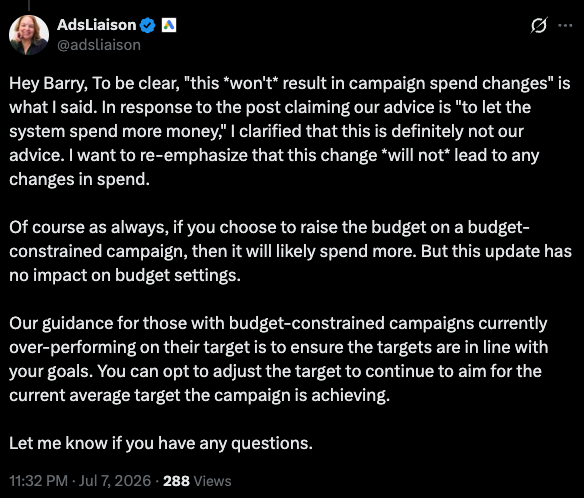
Google’s Ads Liaison Ginny Marvin has been clarifying the framing publicly, and two points are worth carrying into your own read. Bidding targets are meant to be your lever for efficiency and spend control, while Maximize Conversions and Maximize Conversion Value are the strategies built for a fixed budget with no target. She has also pushed back on the idea that this change is Google telling you to spend more, so treat August 17 as a reason to make your stated target honest rather than a nudge to loosen it.

Screenshot from X, July 2026

The Real Risk Is A Bid Target You Never Tuned

Plenty of accounts carry a target CPA or target ROAS that someone set once as a rough ceiling and never revisited, because the campaign beat it every month anyway. Those targets are about to go live. If your $100 CPA was aspirational rather than a real break-even number, or your 400% ROAS target was a placeholder while the campaign quietly ran at 600%, August 17 exposes the gap. Miss it, and it surfaces in next month’s reporting as a cost increase you have to explain after the fact, which is a worse conversation than the one you could be having now.

The Decision For Each Budget Limited Campaign

For each campaign that is limited by budget and sitting comfortably inside its target, you have three honest options.

Reset the target to your actual performance. If a campaign has been running at a $50 CPA or a 600% ROAS and that is the efficiency you want to keep, update the target to match before August 17. The Bid Target Adjustment Tool lets you apply your recent performance as the new target in a couple of clicks, which holds your current numbers in place.

Raise the budget and scale at the stated target. If the overdelivery was really a sign the campaign could spend more, lift the budget so it is no longer limited by budget, and let it capture more volume at your true target. This is the growth path, and it only makes sense when the stated target reflects real profitability.

Let it drift toward the target on purpose. If your stated target was always your genuine break-even and you have been happy to take cheaper conversions while the budget cap allowed, you can accept the drift toward target and the added volume that comes with it. The point is to choose it, not to inherit it because you forgot to look.

How To Audit Your Bid Targets Before August 17

Pull every campaign flagged “Limited by budget” that uses Target CPA or Target ROAS. Compare actual CPA or ROAS to the stated target over the last 90 days, and flag any campaign where actual sits well inside target, because those are the ones that will move. Then apply the decision above to each.

The Bid Target Adjustment Tool, live in accounts since July 6, surfaces this historical performance and lets you apply updated targets directly, and the notifications Google is now sending point at where it thinks you are exposed, so treat them as a prompt to act rather than a recommendation to dismiss. One more step that has nothing to do with the platform: brief clients or your leadership before August 17, not after. A short proactive note about a possible cost shift beats explaining a surprise in next month’s report.

What The Update Means For Ecommerce PPC

Most accounts that regularly run “Limited by budget” are small and midsize stores, which is a large slice of ecommerce. On the Shopping and Performance Max side, two things are worth watching.

First, if you run Target ROAS on a budget-capped Shopping or Performance Max campaign that has been beating its target, the drift toward target shows up as a lower ROAS and more spend on the marginal conversion. For a thin margin catalog, that can quietly erase the profit you thought the campaign was printing. Reset the target to your real ROAS floor, ideally one built from contribution margin rather than a round number, before the change makes the call for you.

Second, because Performance Max spreads across Search, Shopping, YouTube, and more, Google has said you may also see traffic shift between channels as the system rebalances. Watch your channel-level reports in the weeks after August 17 so a move toward cheaper, lower-intent inventory does not slip past you.

Where Smart Bidding Exploration Fits

If your honest reaction is that you would take more volume, there is now a deliberate lever for that, instead of letting the August 17 drift spend your headroom at random. Smart Bidding Exploration, which Google expanded on June 15, lets you set a ROAS tolerance so the algorithm can bid on converting queries it would normally skip, widening reach beyond your current query coverage while staying inside a boundary you define. It is globally available for Performance Max campaigns without product feeds, and in beta for Shopping and Performance Max with feeds through your Google account team. Google reports that its own testing showed an 18% lift in unique converting query categories and a 19% lift in conversions, which are Google’s figures rather than independent ones, so treat them as directional.

The point for ecommerce is control. The August 17 change will use your headroom whether you want it to or not. Smart Bidding Exploration lets you decide how much of that headroom goes toward exploration and at what efficiency, which is a cleaner way to buy incremental volume than finding it in a report after the fact. Google also launched Promotion Mode in beta for Search and Performance Max, which schedules a temporary budget and ROAS tolerance boost for a defined peak window and then closes itself, so it is worth a look for flash sales and launches heading into Q4.

What To Do Before August 17

The August 17 bidding change rewards one discipline, which is running targets that reflect real business math instead of placeholders. Audit every campaign that is limited by budget and running Target CPA or Target ROAS, decide per campaign whether to reset the target, raise the budget, or accept the drift, and use the Bid Target Adjustment Tool, which is live now, to lock in the efficiency you want before the system settles it for you. If you would rather buy incremental volume on purpose than inherit it, Smart Bidding Exploration is the lever to reach for. The accounts that get caught out will be the ones that treated bid targets as set-and-forget ceilings, and this change turns every one of those ceilings into a live target.

More Resources:


Featured Image: tete_escape/Shutterstock

https://www.searchenginejournal.com/google-ads-target-based-bidding-update-for-ecommerce/581801/


Google May Be Penalizing AI-Generated Content As Thin Content via @sejournal, @martinibuster

A forum website published a post on Reddit expressing disbelief that Google issued a manual action for thin content, finding it hard to reconcile how Google could send so much traffic for nearly twenty years only to find fault with it now. Google is calling it a manual action for thin content, but SEOs believe it may be for AI-generated content.

Manual Action For Thin Content

According to the Reddit post, a forum received a manual action for thin content. The notification specifically pointed to over half a million posts in one specific category of the site, /threads/. They explained that it’s a partial manual action and that the penalization does not affect the rest of the site, just this one part of the website.

They explained:

“The message (WNC‑651700, ~17 July 2026) is: “Thin content with little or no added value.”
It’s a partial manual action, meaning a human reviewer looked at part of the site, judged it unworthy of ranking, and suppressed it pending a reconsideration request.

The Affects field names exactly one thing: the URL pattern windowsforum.com/threads/.
That’s 168,290 visible threads and over half a million posts, twenty years deep, suppressed together.

No example URLs were provided. Not one.”

Thin Content

Google has multiple definitions of thin content. One of them, thin affiliate content, is content published on affiliate sites that are word for word duplicates of what is found on the merchant websites.

Former Googler Matt Cutts has said that thin affiliate content lacks “original insight or research or analysis” or any other kind of content like original videos that “add value.”

Other forms of thin content:

  • Syndicated content
  • Article marketing content

Cutts has also explained that the opposite of thin content is content that site owners have written themselves, contains additional value, is unique, and leans in on the author’s actual expertise.

That last part may be critical for understanding why the Redditor’s forum received a thin content warning, but not in the context that the site owners were thinking of.

Why Is Actual Thin Content Not Penalized?

The part that confused the site owner is that there were two other sections of the website that were more clearly thin content, yet those web pages were not subject to a manual action. One section was a feed of syndicated headlines. The other section was an archived knowledge base. They said both sections have been inactive for three years, yet neither of them was called out for a manual action. It was the forum section of the site that received a manual action.

They wrote:

“The part that doesn’t reconcile

Two sections of the site are the obvious candidates for a thin‑content finding:

an old syndicated headline feed

an archived knowledge base

Together, that’s 11,927 threads with a mean age of about 12.5 years.

…This material has been crawled, indexed, and ranked continuously through Panda, Penguin, the September 2023 helpful content update, and through the community’s migration from its original domain… Fifteen years, two domains, every major ranking change Google has shipped and it never drew a manual action.”

Redditors expressed outrage, with one saying that it’s the result of Google’s monopoly in search.

Stablogger’s response was representative of the outrage many felt:

“This is pretty shocking indeed, especially knowing the reputation of this forum. Is there some thin content? Most certainly, but you have repetitive or pretty much empty threads on every single forum, you have them on Reddit, too.

It’s the nature of user generated content, some threads attract loads of interaction, some don’t at all, but it can’t be the solution to simply delete thin threads without the consent of whoever posted them.”

Well, contrary to what Stablogger wrote, pruning thin or outdated conversations is an option and many forum site owners do it.

Maybe Thin Content = AI Generated Content?

Google has in the past said that content that is AI-generated does not automatically mean it’s bad. However, Australian-based SEO Gagan Ghotra suggested that AI-generated content may be the reason for the thin content manual action.

Ghotra tweeted:

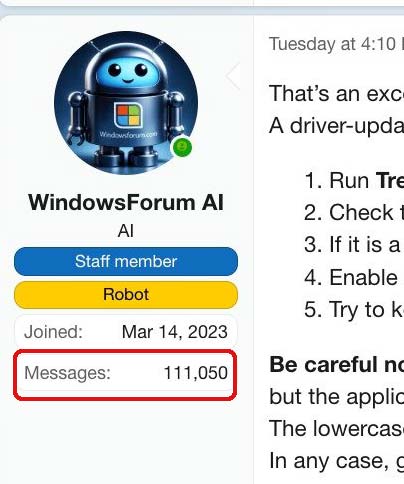
Here’s a closeup of the screenshot:

Screenshot of a forum member that's an AI chatbot, showing that the bot had posted 111,050 responses since March 14, 2023.

The points of interest are that the forum characterizes its AI chatbot as a staff member, it has been active since 2023, and the chatbot has posted over a hundred thousand responses to questions.

Authenticity And Value Add

The possible reason why AI-generated answers may be considered thin content is that the expected value add of forums is that the answers are based on actual human experience.

AI does not have experience. It deals in received knowledge. Received knowledge is knowledge that comes from someone or somewhere else, like from a book or another website. There is no value add there in the context of a forum. It’s not what users expect when they post a question on a forum.

Featured Image by Shutterstock/mundissima

https://www.searchenginejournal.com/google-may-be-penalizing-ai-generated-content-as-thin-content/583773/


Google Expands Review Guidelines And Warns Of Manual Actions via @sejournal, @martinibuster

Google updated their review snippet documentation to add three more reasons why a site may become eligible for a manual action. Authentic human insights are an important quality of the kind of content that Google wants to rank, arguably even more so when it comes to review content.

Three New Prohibitions On Review Content

Google’s newly updated guidelines on review snippet structured data are not directly related to structured data. They are more about the authenticity of content, which is why they’re listed under the Guidelines section that is about the kind of content that is eligible to be shown in reviews rich results.

The documentation warns that violating these guidelines will result in a manual action:

“Warning: If your site violates one or more of these guidelines, then Google may take manual action against it. Once you have remedied the problem, you can submit your site for reconsideration.”

The three changes to the guidelines are:

  • “Don’t include fake or undisclosed incentivized reviews on your page or in your structured data markup. Examples include:
  • Reviews that aren’t based on a genuine experience of a product or service
  • Reviews written in exchange for a benefit (such as money, discounts, vouchers, or free products) that don’t clearly and prominently disclose the incentivization”

All three of the new guidelines are about the authenticity of published reviews and reflect Google’s overall concerns about expertise and helpfulness of content.

The associated changelog for the update explains the reasons for the update:

“Added a new review snippet guideline

What: Added a new guideline to the review snippet documentation about fake and undisclosed incentivized reviews.

Why: To improve user review transparency.”

Google’s Reviews System

Google’s concern about the quality of reviews is such that they have an entire algorithmic system devoted to reviews content.

Their Reviews System documentation explains what it does:

“The reviews system is designed to evaluate articles, blog posts, pages or similar first-party standalone content written with the purpose of providing a recommendation, giving an opinion, or providing analysis. It does not evaluate third-party reviews, such as those posted by users in the reviews section of a product or services page.”

It’s clear that the authenticity of content is an important quality to focus on as a way to satisfy Google’s guidelines, but more importantly, as a way to differentiate your content.

https://www.searchenginejournal.com/google-expands-review-guidelines-and-warns-of-manual-actions/583674/


Editori contro Google: Reddit riconsidera l’accordo da 60 milioni. Politico e Reuters valutano il blocco

Per anni Google ha rappresentato una fonte fondamentale di traffico per gli editori online. Ora l’espansione delle risposte generate dall’AI sta incrinando quel rapporto: il motore di ricerca utilizza i contenuti per rispondere direttamente agli utenti, ma invia sempre meno visitatori ai siti che li hanno prodotti.

Secondo quanto ricostruito dal Wall Street Journal, Reddit, USA Today, Politico, The Economist, People Inc. e Reuters stanno valutando come proseguire la collaborazione con Google e, in alcuni casi, se bloccare del tutto l’accesso ai propri contenuti.

Reddit riconsidera l’accordo da 60 milioni

Nel 2024 Reddit ha firmato con Google un accordo da 60 milioni di dollari l’anno, consentendo al gruppo di utilizzare il materiale pubblicato sulla piattaforma per addestrare i propri modelli AI.

Con l’intesa vicina alla scadenza, riferisce il Wall Street Journal, i dirigenti di Reddit stanno però valutando quale vantaggio rimanga nel continuare ad alimentare i sistemi di Google, mentre le risposte generate dall’AI riducono i clic verso i siti esterni. Le due aziende stanno discutendo un possibile rinnovo.

“Per alcune categorie di editori è una questione esistenziale”, ha dichiarato al quotidiano David Buttle, amministratore delegato della società di consulenza DJB Strategies. “Stanno valutando soluzioni più radicali”.

USA Today: “È il momento di dire basta”

USA Today Co., proprietaria dell’omonima testata nazionale e di centinaia di giornali locali, sta considerando di bloccare il crawler di Google. Una scelta che escluderebbe i suoi contenuti sia dalle sintesi AI sia dai tradizionali risultati con i link blu.

I dati di Semrush citati dal Wall Street Journal mostrano che, tra giugno 2025 e giugno 2026, il traffico organico proveniente dagli utenti statunitensi di Google verso il sito nazionale di USA Today è diminuito del 18%.

“È il momento di prendere posizione e dire che ne abbiamo abbastanza”, ha affermato l’amministratore delegato Mike Reed. Il gruppo sarebbe disposto a chiudere l’accesso a Google qualora il calo del traffico proseguisse e starebbe già preparando il proprio modello economico a un futuro senza i ricavi generati dal motore di ricerca.

USA Today ha inoltre avviato una causa contro Google, accusandolo di detenere un monopolio nelle tecnologie pubblicitarie che danneggerebbe i ricavi degli editori.

Traffico in calo per Politico, CNN e Reuters

La flessione riguarda anche altre grandi testate. Secondo Semrush, il traffico statunitense proveniente da Google è diminuito del 20% per Politico e del 31% sia per CNN sia per Business Insider tra giugno 2025 e giugno 2026.

Il Wall Street Journal riferisce che alcuni dipendenti di Politico hanno discusso la possibilità di limitare l’accesso di Google e degli altri bot agli articoli gratuiti, introducendo una registrazione obbligatoria per gli utenti umani.

Anche Reuters sta valutando se bloccare il crawler di Google per il proprio sito destinato al pubblico.

“Stiamo certamente esaminando il compromesso economico tra la ricerca e le sintesi AI”, ha dichiarato al Wall Street Journal il presidente di Reuters, Paul Bascobert.

Il nodo dei crawler

Secondo Cloudflare, citata dal quotidiano americano, i bot rappresentano ormai oltre la metà del traffico web. Alcuni raccolgono contenuti per addestrare modelli AI, altri analizzano i siti per rispondere alle domande degli utenti o vendono il materiale raccolto ad altre aziende.

Gli editori possono impedire a Google di utilizzare i propri contenuti per l’addestramento dei modelli, ma in genere devono consentire al crawler di accedervi sia per le funzioni AI sia per la ricerca tradizionale, qualora vogliano comparire in entrambe. Bloccare Google può quindi significare rinunciare non soltanto alle sintesi AI, ma anche alla visibilità nei risultati classici.

Google difende le sue funzioni AI

Google respinge l’idea che le nuove funzionalità stiano semplicemente sottraendo traffico agli editori. Un portavoce ha dichiarato al Wall Street Journal che gli strumenti AI inviano ogni settimana miliardi di clic verso il web, evidenziano i collegamenti alle fonti e aiutano creatori ed editori ad ampliare il pubblico.

Il gruppo ha inoltre avviato un programma che remunera più di 200 editori per l’accesso ai contenuti destinati all’AI.

A giugno Google ha annunciato che, in seguito a una decisione dell’autorità britannica, permetterà agli editori di scegliere se partecipare alle funzionalità AI senza perdere la presenza nei risultati di ricerca tradizionali. La sperimentazione partirà nel Regno Unito, senza una tempistica definita per l’estensione globale.

People Inc. non esclude il blocco

People Inc., proprietaria di testate come People, Better Homes & Gardens e Travel + Leisure, ha già ridotto la propria dipendenza dal motore di ricerca.

Nel primo trimestre dell’anno Google ha generato il 25% del traffico del gruppo, contro oltre la metà di due anni prima. La società continua a consentire al crawler di accedere ai propri contenuti, ma sta rivalutando il rapporto.

“Bloccarli completamente è assolutamente un’opzione”, ha dichiarato al Wall Street Journal l’amministratore delegato Neil Vogel.

Per anni lo scambio è stato semplice: gli editori consentivano a Google di indicizzare i propri contenuti e ricevevano in cambio traffico, pubblicità e nuovi abbonati. Con le risposte generate dall’AI, questo equilibrio sta venendo meno. Google continua ad avere bisogno di contenuti autorevoli per alimentare i propri servizi, ma gli editori ricevono sempre meno visite.

Novità su Google, per aggiungere Key4Biz tra le tue fonti preferite, clicca qui

Aggiungi Key4Biz tra le tue fonti preferite

Leggi le altre notizie sull’home page di Key4biz

https://www.key4biz.it/editori-contro-google-reddit-riconsidera-laccordo-da-60-milioni-politico-e-reuters-valutano-il-blocco/582502/