Alphabet Q2 Earnings Show $5.85 Billion Negative Free Cash Flow via @sejournal, @martinibuster
Alphabet’s second quarter earnings results show that Google is earning massive amounts of money but is also spending so much that it reported a negative free cash flow due to infrastructure spending.
Massive Earnings
Q2 2026 revenue is $119.8 billion, which is up 24% year over year.
Where The Money Comes From
The earnings release shows that Search & Other account for most of the earnings, $63.3 billion. Google Cloud accounts for $24.8 billion, Google subscriptions, platforms & devices accounts for $12.9 billion, and YouTube ads brought in $11.1 billion.
Google Search & other: $63.3 billion
Google Cloud: $24.8 billion
Google subscriptions, platforms & devices: $12.9 billion
YouTube ads: $11.1 billion
Total revenue: $119.8 billion
Google’s strategy of diversifying their revenue streams is clearly paying off. Google earned $2.9 billions dollars more in the second quarter from Search & Other than it did in the first quarter, an increase of +4.8%.
The difference between first and second quarters show that Google is consistently earning more across all of its businesses.
Earnings Growth Q1 2026 – Q2 2026
Google Cloud: +$4.8B (+23.8%)
Google Search & other: +$2.9B (+4.8%)
YouTube ads: +$1.2B (+12.2%)
Google subscriptions, platforms & devices: +$0.5B (+4.2%)
Many in the search marketing and publishing communities are unhappy because Google’s AI search strategy sends less clicks to websites than classic search did. Another complaint is that Google is hoarding traffic within its own ecosystem of services and websites.
Is that the reason why YouTube’s earnings soared by 12.2% this quarter over last and Search earnings increased by nearly 5%?
$5.85 Billion Dollars Negative Free Cash Flow
Perhaps the most surprising detail to come out of the earnings result is that Google is running a negative free cash flow of nearly six billion dollars.
Negative free cash flow does not mean that Alphabet lost money this quarter, they did not. It means Alphabet spent more cash than it generated after accounting for capital investments.
Free cash flow: -$5.855 billion
Alphabet’s second quarter operating cash flow was $39.069 billion. Their capital expenditures equaled $44.924 billion. Their free cash flow for Q2 2026 was -$5.855 billion (operating cash flow minus capital expenditures).
Google’s investor presentation explained why they are running a negative free cash flow in the second quarter of 2026:
Alphabet’s presentation explained why they’re spending so much:
“We’re innovating at scale with incredible velocity.
Since launching Gemini 3 last November, our momentum has accelerated. We’ve rolled out increasingly capable generative media models; shipped features across Chrome and the Gemini app, launched Antigravity and our first model in our Gemini 3.5 series.
Recently at our I/O annual developer conference, we showcased new advances across models, coding, and agents. This progress reflects our deep focus on delivering tangible value to people in the products they use every day.
Supporting all of this at scale for our users, while also serving enterprises and developers around the world, requires massive compute investments.
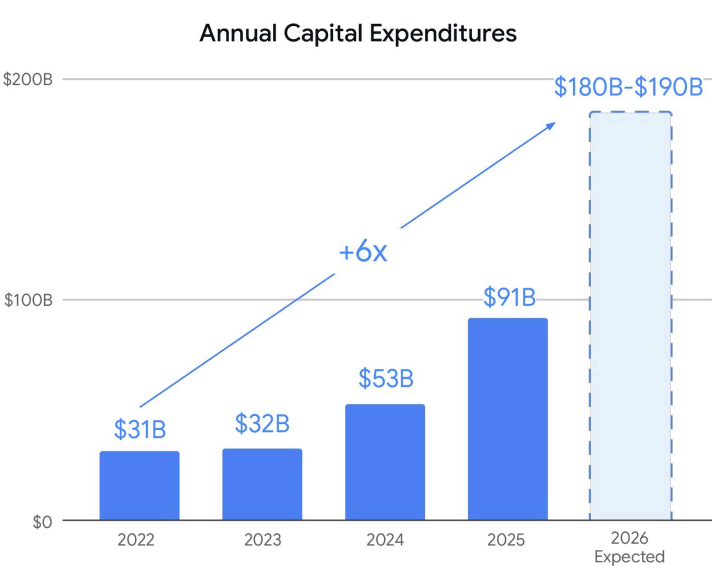
In 2022, we spent approximately $31 billion in CapEx. This year, we expect that number to be 6 times larger than 2022 and double last year’s at $180-190 billion. And next year, we expect it to significantly increase compared to 2026. The overwhelming majority of this spend will be in technical infrastructure.”
The Q2 earnings release says Alphabet raised $49.6 billion through an equity offering, specifically stating that the proceeds would be used for “capital expenditures to scale AI infrastructure and global compute.”
That’s interesting because it shows how extraordinary AI-related spending has become because Alphabet is not funding it all from operations, it also raised tens of billions of dollars in new equity to help finance their massive investment in AI data centers.
Capital Investments Spiraling Upward
The earnings release shows that Alphabet spend $44.924 billion dollars on “Purchases of property and equipment.” That’s about double the amount spent in the second quarter of 2025, $22.446 billion dollars.
What were those properties and equipment? A BBC report quoted Google’s Chief Financial Officer explained that 60% of that was for buying servers and 40% was for data centers.
The quoted explanation:
“Anat Ashkanazi, Google’s chief financial officer, noted on a call with financial analysts that the company had shown negative free cash flow due to growing capital expenditures, essentially all of which was related to AI spending.
She said the company spent $45bn in the second quarter, with 60% of the cost going towards servers and the remaining 40% going towards data centres.”
The Q2 release featured a graph showing that Google’s expenditures are spiraling upward, with estimates that the year will end by spending six times what Google spent in 2022, at the beginning of the generative AI boom.
Takeaways
Alphabet reported strong revenue growth across its businesses.
Search remains Alphabet’s largest revenue source, while Google Cloud is its fastest-growing business.
Revenue increased across every major business segment from Q1 to Q2, showing strong momentum across a diversified range of services and products.
Alphabet generated enormous profits while simultaneously reporting a $5.85 billion dollar negative free cash flow.
Negative free cash flow was caused by spiraling AI infrastructure spending.
AI infrastructure investment has become so large that Alphabet supplemented operating cash with a major equity raise to help finance it.
Capital expenditures are accelerating at an extraordinary pace, with spending expected to reach six times 2022 levels by the end of 2026.
The spending is primarily funding servers and data centers that support Google’s long-term AI strategy.
Il Bund vola al 3,2%: la Germania paga il conto delle sue scelte sbagliate
Il rendimento del Bund decennale tedesco è schizzato verso il 3,2%, toccando i livelli più alti da maggio 2011. Un segnale d’allarme rosso per i mercati finanziari, che vedono riaffiorare i fantasmi di una nuova crisi nel cuore dell’Europa. La salita dei tassi fa tremare i mercati proprio mentre la Banca Centrale Europea si prepara alla sua riunione di politica monetaria. Ecco il relativo grafico da Tradingeconomics:
Per approfondire:
In molti addossano le colpe alla BCE, attesa a una seduta di attesa con tassi invariati e con lo sguardo rivolto a settembre. In realtà la BCE c’entra solo fino a un certo punto. Da qui a dopo l’estate possono cambiare moltissime cose.
La realtà è un’altra. Quello che la Germania sta pagando davvero è la profonda fragilità europea di fronte alla crisi energetica esplosa in Medio Oriente. Un’emergenza che riporta a galla tutti i limiti strutturali del continente.
L’illusione della spesa pubblica
La Germania e l’Europa si ritrovano a fare i conti con un debito infrastrutturale pesante e una spesa pubblica non chiara. Il problema non è il sostegno ai consumi in sé, ma il fatto che si sostengano consumi del tutto inutili per la crescita.
Risorse ingenti vengono destinate a settori che non generano ricchezza interna né spingono l’autonomia strategica del continente:
Sussidi alla transizione importata: Si finanziano acquisti massicci di pannelli solari e batterie prodotti all’estero, trasferendo risorse fuori dai confini europei.
Spesa militare infruttuosa: L’aumento dei budget per gli armamenti rappresenta un costo immediato senza alcun ritorno moltiplicatore sull’economia reale.
Mancanza di indipendenza: Si spende molto, ma si continua a ignorare la vera sovranità energetica, rimanendo in una dipendenza strategica o dal gas americano o da fonti instabili e le cui infrastrutture, comunque, dipendono da un paese terzo.
La punizione dei mercati
Queste uscite correnti si rivelano dal punto di vista economico un puro peso, un costo secco che non sostiene la produzione nazionale. L’Europa ha scelto di dipendere da forniture estere per la tecnologia verde, accumulando al contempo deficit e ritardi nelle infrastrutture di base.
I mercati finanziari non perdonano. Quando queste fragilità emergono nel bel mezzo di una scossa geopolitica o finanziaria, la punizione arriva puntuale e severa.
I rendimenti dei titoli di Stato tedeschi salgono perché gli investitori chiedono un premio di rischio più alto per finanziare un modello che non funziona più. La Germania, abituata a fare da locomotiva, scopre che la sua stiva è piena di zavorre inutili. Se non si cambia rotta sulla qualità della spesa, il conto da pagare sarà ancora più alto.
Google Went ‘Not Provided’ In 2011 And Blinded Us, ChatGPT Just Shipped Its Version via @sejournal, @DuaneForrester
The attribution you are waiting for from ChatGPT is coming, and it is not coming to you. I ran a survey this month (it’s still open; please take it) asking whether dedicated AI visibility platforms are worth paying for, and I deliberately never asked about attribution. It showed up anyway. One consultant wrote that the whole problem is tying visibility, citations, and mentions to dollars. An agency owner managing over a dozen clients answered the “what’s your biggest-unanswered-question” prompt with a single word and an exclamation point: attribution! Another respondent put it more wearily: that tracking is only the first step, so what comes next.
Image Credit: Duane Forrester
Two different frustrations hide inside that one word, attribution. One is whether a tracker reads your AI visibility accurately at all. The other is whether that visibility can be tied to revenue. This piece is about the second. The first runs underneath it, and I come back to it at the end.
That corner has stayed dark for a reason, and it is not the reason most people think. The instinct is to treat missing attribution as a gap some vendor will eventually fill, the way rank tracking filled in twenty years ago. It will not fill in that way. The click-path attribution that organic search practitioners were trained to expect, the deterministic line from impression to session to conversion, is gone, and AI did not kill it. Referral traffic from AI answers is real but tiny, under one percent of total traffic on most sites, which means the thing people are asking for was never going to be answered by watching their own analytics. So let me toss a flashlight at the corner. Here is where attribution stands, why it stands there, and an idea about what you do starting tomorrow.
The Deterministic Era Was Ending Before A Single LLM Shipped
Third-party cookies went into slow deprecation, Apple’s App Tracking Transparency cut off a huge slice of mobile signal, Google Analytics moved to modeled conversions rather than counted ones, and media mix modeling, a technique older than most of the people now using it, came roaring back precisely because the clean deterministic path had frayed. Every one of those shifts happened for its own reasons and none of them involved ChatGPT. LLMs did not break attribution. They arrived after the break and made it impossible to keep pretending. The measurement world you are standing in was already modeled, probabilistic, and permission-dependent before answer engines entered the picture, and that is the ground we are now building on.
Now The Part That Will Annoy You, Because It Is Both Simple And Deliberate
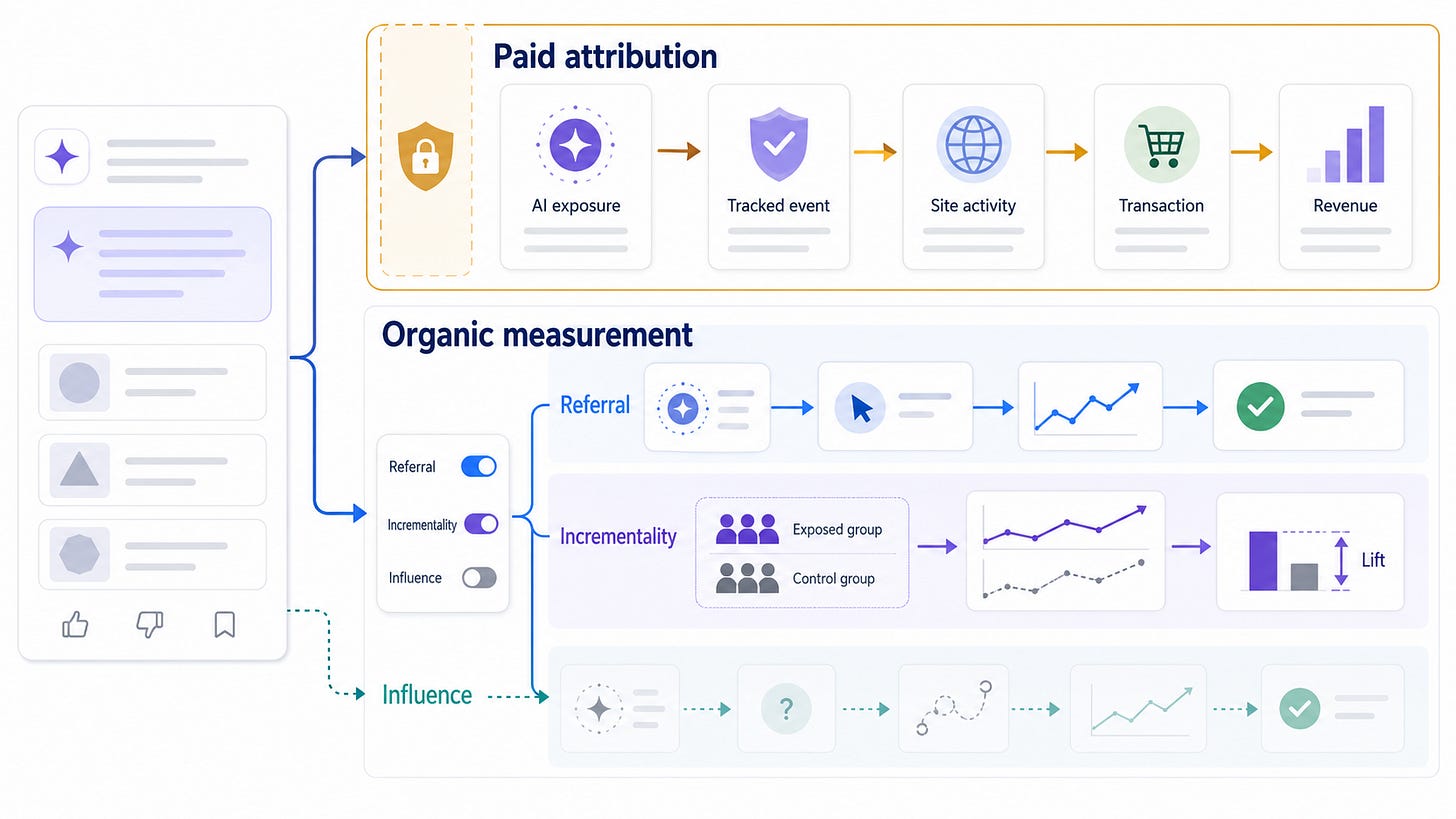
Attribution from the platforms is coming, but it is arriving through the ads door, not the webmaster-tools door. The signal a paying advertiser needs and the signal a free organic practitioner wants are the same signal. A platform will build that signal for the person spending money and withhold it from the person who is not, because there is no business reason to give away for free what someone else will pay for.
We have watched this movie. In 2011, Google encrypted organic search referrals and organic keyword data vanished into the not-provided bucket, while paid search advertisers kept getting richer and richer conversion data. Same query intent, same underlying behavior, monetized on one side and starved on the other. Organic SEO spent a decade angry about it. (Maybe you still are?)
ChatGPT just shipped its version, and you can read both halves of it in OpenAI’s own documentation. On the organic side, the controls OpenAI gives webmasters are switches, not meters. You can allow OAI-SearchBot so you appear in ChatGPT’s answers, or disallow GPTBot so your content is not used in training. Toggles. On or off. What you cannot do is measure via OpenAI. On the paid side, OpenAI has already built a full server-to-server conversions pipeline: a pixel, an events API keyed to an Ads Manager account, standard events like order_created carrying amount, currency, and item-level detail, deduplication between browser and server, and a privacy-preserving identifier to tie exposure to outcome. That is closed-loop conversion attribution. It exists right now. It sits behind an ad account. The organic operator on the same platform gets a robots.txt file and best wishes.
The Sharper Cut Is This
Nobody at OpenAI needed to say Google’s name for this to happen. The not-provided lesson has been in plain sight for more than a decade, in every conference post-mortem and forum thread written since 2011, and the lesson is precise: taking access away costs you years of goodwill, so do not take it away; simply never grant it. Google paid for its mistake because it was a taking, and people fight takings. A designed absence generates no protest, only a low, unfocused unease. That knowledge was ambient. Any competent operator building an answer engine already had it.
Which is why this is not really an OpenAI story. Plot the model companies along a line by their stated reason to exist, a sell-to-serve spectrum if you want a handle for it, meaning where each one sits between built to sell and built to serve. OpenAI is running hard at commerce and ads, so it builds the paid measurement loop first and most visibly. Perplexity is chasing a slice of the discovery-and-shopping pie and moves in the same direction. Google already is an ad company. Anthropic frames itself around safety and long-term benefit and has the least structural reason to build an ads attribution layer at all. The doors differ, and the timing differs, but read the whole line and the conclusion holds in every seat: None of these companies has an incentive to hand free, item-level organic attribution to SEOs. The commercially driven ones gate it behind ad spend. The mission-driven ones simply have better things to build. Do not expect it from ChatGPT is the narrow version. The real version is do not expect it anywhere, sadly.
So Stop Asking 1 Question That Is Actually 3
When practitioners say attribution, they are usually blending three different problems that have three different answers. The first is referral attribution, meaning did an AI answer link to you, did someone click, did that session convert. That one is measurable today, because the click carries a referrer into your own analytics. The second is incrementality, meaning not who clicked but whether your visibility caused lift you would not otherwise have gotten. The third is influence, the dark-funnel case, meaning the buyer read your brand inside an AI answer, never clicked, and showed up three weeks later through a branded search. Referral you can see now. Incrementality you can prove yourself. Influence is genuinely hard. The mistake is treating all three as one blocked pipe, when two of them are already flowing and need nothing from the platforms at all.
Here Is The Work, And None Of It Requires Permission From OpenAI
Start with referral classification, and do it properly, because the default is wrong. AI sessions do not reliably self-label, and referrer strings alone will misfile a large share of them into direct or organic. Tag deliberately with UTMs where you control the link, build a classification rule that combines referrer with landing-page and query patterns rather than trusting the referrer field on its own, and treat the number you get as a floor, because unattributable and cross-window purchases bias every honest count downward. That gets you an accurate read on the one layer that is visible.
Then run incrementality yourself, which is the layer most teams skip because it takes design rather than a dashboard. Hold out a set of geographies and change nothing in them while you push visibility work everywhere else, or run on-off tests over defined windows, or track a fixed set of queries before and after a content push and watch what moves. This is causal measurement, and it belongs to you, not to the platform, which means the opacity of the black box does not touch it.
For the dark funnel, borrow the muscle B2B has used for twenty years, because this is not new-hard; it is old-hard wearing a new coat. Self-reported attribution, the how-did-you-hear-about-us field at the point of conversion, catches influence that no pixel will ever see. Branded-demand correlation, watching whether branded search and direct navigation rise as your AI visibility rises, gives you a defensible read at the aggregate level. Brand-lift studies do the same with more rigor when the budget is there. None of it is deterministic, and that is fine, because deterministic is not on the menu for anyone anymore.
Before You Buy Anything In This Space, Run 1 Test On The Vendor
Ask what data source closes the loop, and listen carefully to the answer. If the honest answer is first-party, meaning their agents on your site, your Google Analytics 4, your CRM, then what they sell is real but bounded, and it lives at the referral layer. If the answer implies signal drawn from inside OpenAI or Anthropic, they are either misrepresenting a referrer-detection method or lying to you. There is no third source. That single question separates the credible from the theatrical faster than any feature list.
This Is Where The Discipline Shows
Attribution counts orders from sessions you classified as AI-referred. Some of those buyers would have found you anyway. Incrementality measures the lift you actually caused, and it requires the experiments described above. Report attribution as attribution, and reserve the word incremental for the cases where you ran the test. The vendors who keep that distinction clean read as trustworthy. The ones who collapse it and promise to prove ROI are the 2026 reissue of guaranteed-first-page SEO, and they will age exactly as well, I think.
Look At Who Is Doing This Credibly, And The Thesis Proves Itself
The players with defensible revenue measurement all sidestep the black box and run on first-party data. Some vendors compute attribution by joining their own storefront sessions to checkout events against a sitewide baseline, and the numbers that get reported vary wildly, which is the honest headline. Microsoft Clarity’s study of 1,200 publisher sites found AI-referred visitors converting to sign-ups at eleven times the rate of organic search, while the peer-reviewed work in Marketing Science, 973 sites and 20 billion dollars in revenue, found organic LLM traffic converting below every traditional channel except paid social. I think both are true, and that is the point. The channel is small, high-intent, and wildly uneven, and it is not even measured the same way twice. Others resolve the loop the same first-party way, routing through affiliate infrastructure or handing purchase reporting back to your own analytics. The pattern under all of it is the tell: Everyone credible closes the loop with data you already own, because that is the only door open.
Give It 12 To 24 Months, And The Shape Is Predictable
Referral classification standardizes and gets boring, as the engines increasingly identify themselves and the analytics tools catch up. Attribution proper gets monetized as an ads product, gated and paid, exactly along the line OpenAI has already drawn in its documentation. And the honest vendors converge on the attribution-versus-incrementality language, because the market eventually punishes the ones who oversold. None of that returns free organic attribution to you, because none of it ever had a reason to.
Which Brings Me Back To The Survey, And To The Thing Underneath The Thing
The attribution requests were loud, but they were the sharp, nameable tip of something larger and more corrosive. As I read the early open-text answers together, what surfaces is not mainly a demand for better numbers; it is a refusal to believe the numbers already on offer. Respondents said they do not trust the trackers, that they cannot tell whether any of it is accurate, that they are struggling to invest because they do not trust the results. That is not a feature gap. That is a trust deficit, and part of it is the correct read of a market built on designed absences and overselling. But I would be lying if I put all of it there. Some of that unease is old thinking meeting a new situation, practitioners carrying SEO reflexes into an environment that does not run on them and skipping the work of learning what actually changed, because “GEO = SEO” is a more comfortable story than the truth. I can’t tell you how big that share is and nobody can measure it cleanly; we read it off what we see and hear online, at conferences, etc. But if it is even a third of the industry’s working mindset, that is not something a vendor comes along and fixes. That is a literacy problem, and it belongs to all of us.
If you are wrestling with this in your own stack, tell me where your loop breaks, in the comments or directly, because the playbook here is still being written and the field’s real answers are coming from practitioners, not vendors. And if you want the longer argument for why the underlying systems, not the dashboards, are where this literacy has to live, that is the whole spine of The Machine Layer.
Iran avverte gli Usa: “Trump vuole bombardare nostre infrastrutture? Occhio per occhio”
(Adnkronos) – “La dottrina di difesa dell’Iran è chiara: occhio per occhio”. Dopo la nuova minaccia di Trump, Teheran risponde lanciando l’ennesimo avvertimento agli Usa e al presidente americano, che farà bombardare “un ponte o una centrale elettrica” del Paese per ogni nuovo attacco della Repubblica islamica contro una nave nello Stretto di Hormuz.
La minaccia del tycoon arriva dopo quella lanciata nei giorni scorsi, all’indomani della morte dei quattro militari statunitensi in Giordania, uccisi da un raid iraniano: “Ogni volta che Teheran ucciderà un soldato americano – la promessa di Trump -, pagherà per quella morte molte volte tanto”.
Se gli Usa attaccheranno, l’Iran risponderà colpendo infrastrutture e impianti energetici nella regione, ha dichiarato una fonte militare iraniana, citata dall’agenzia Tasnim, in risposta alla minaccia del presidente americano.
“La Repubblica islamica ha una volontà ferrea nell’esercitare la propria sovranità sullo Stretto di Hormuz e non permetterà in alcun modo che questo passaggio torni a essere uno strumento di minaccia contro l’Iran”, ha detto ancora la fonte.
“Se gli americani colpiranno un ponte o una centrale elettrica in Iran, la risposta iraniana prenderà di mira infrastrutture e ponti nella regione, compresi impianti energetici nei quali gli Stati Uniti hanno interessi”, ha poi aggiunto, sotttolineando che gli Stati Uniti “negli ultimi 10 giorni dovrebbero aver compreso pienamente che l’Iran può colpire qualsiasi obiettivo decida di colpire”, definendo una possibile iniziativa di Trump “un azzardo destinato a trasformarsi ancora una volta in una sconfitta politica”.
“La nostra dottrina di difesa è chiara: occhio per occhio”, ha rilanciato poi il ministro degli Esteri iraniano Abbas Araghchi, sottolineando che “qualsiasi aggressione contro l’Iran, incluso contro le infrastrutture del Paese, provocherà risposte di potenza e decisive”.
“Un ponte o una centrale elettrica” bombardate in Iran per ogni nuovo attacco della Repubblica islamica contro le navi a Hormuz, il piano annunciato nella giornata di ieri dal presidente americano Donald Trump in un messaggio pubblicato su Truth Social. “Da questo momento in poi, ogni volta che la Repubblica islamica dell’Iran sparerà contro una nave nello Stretto di Hormuz, che sia con un missile, un razzo, un drone o qualsiasi altro dispositivo o arma, gli Stati Uniti bombarderanno e distruggeranno un ponte o una centrale elettrica, comprese quelle situate vicino o all’interno della capitale Teheran”, ha scritto Trump.
La guerra tra Iran e Stati Uniti travolgerà l’intera regione, se non si metterà fine al conflitto, ha intanto avvertito il capo negoziatore iraniano e presidente del parlamento di Teheran, Mohammad Bagher Ghalibaf, avvertendo che o l’intera regione sarà libera dalla guerra, oppure tutti i Paesi saranno coinvolti nel conflitto tra Teheran e Washington.
“In una regione in cui non vendiamo petrolio, nessuno lo venderà. Se la nostra sicurezza non è garantita, nessuna infrastruttura sarà al sicuro, e la sicurezza di Hormuz dipende dall’assenza di forze americane”, le parole di Ghalibaf in un post su X. Il negoziatore ha inoltre aggiunto che lo Stretto “non tornerà alle condizioni prebelliche”.
Dal canto suo, il tycoon ha ribadito che “stiamo colpendo l’Iran molto duramente. Gli iraniani stanno morendo dalla voglia di fare un accordo, ma non sono pronti. Ogni volta che fanno un accordo, lo vogliono cambiare. Non sono pronti -, la promessa del presidente Usa in un comizio in Georgia – ma lo saranno presto”.
Milano, Mario Calabresi valuta candidatura a sindaco: “Mi piacerebbe fare la mia parte”
(Adnkronos) – Sindaco di Milano? “Sì, ci sto pensando. Mi piacerebbe fare la mia parte” per la città. Il giornalista Mario Calabresi ammette di essere interessato a una candidatura a primo cittadino del capoluogo lombardo per le prossime elezioni amministrative. Calabresi ne ha parlato, riporta il sito ‘Ilcittadino.it’, a Vizzolo Predabissi durante un incontro alla Festa de l’Unità della Zona Sud Est Milano, rispondendo a una domanda dei giornalisti.
“Io sono in attesa di capire che tipo di percorso verrà deciso – ha aggiunto Calabresi – e se potrò fare la mia parte”.
Assegno inclusione, dal primo agosto al via domande rinnovo
(Adnkronos) – A luglio 2026 viene erogata la dodicesima e ultima mensilità ai beneficiari che, dopo aver presentato domanda di rinnovo nel luglio 2025, hanno percepito il beneficio senza interruzioni nei dodici mesi precedenti. A partire dal primo agosto 2026, gli stessi nuclei familiari potranno presentare una nuova domanda di rinnovo per continuare a beneficiare della misura. Lo dice l’Inps in una nota.
L’istituto ricorda che i nuclei familiari con una domanda Adi “terminata” possono presentare la richiesta di rinnovo esclusivamente a partire dal mese successivo all’ultimo pagamento ricevuto, corrispondente alla fruizione della diciottesima mensilità per le domande iniziali o della dodicesima mensilità in caso di rinnovo. Le domande di rinnovo che dovessero essere presentate nell’ultimo mese di fruizione della domanda “terminata” non potranno essere elaborate con esito positivo.
La richiesta di rinnovo può essere inoltrata sia dallo stesso richiedente della precedente domanda conclusa, sia da un altro componente maggiorenne del nucleo familiare. Le indicazioni fornite dall’Inps si inseriscono nel percorso di continuità della misura e sono finalizzate a garantire una corretta gestione delle domande e dei pagamenti, evitando ritardi o rigetti dovuti alla presentazione anticipata delle istanze. Per ulteriori informazioni e per conoscere nel dettaglio le modalità operative, è possibile consultare il messaggio Inps n. 2437 del 22 luglio 2026.
Iran, allarme navi nel Mar Rosso: mercantili invertono rotta dopo blocco Houthi
(Adnkronos) – Prime conseguenze sul traffico marittimo dopo l’annuncio degli Houthi dello Yemen, alleati dell’Iran, di un blocco navale contro le navi dirette in Arabia Saudita. Almeno sei imbarcazioni hanno cambiato rotta nel Mar Rosso e nelle aree limitrofe, secondo i dati di tracciamento delle navi analizzati dalla società di intelligence marittima Lloyd’s List, come evidenzia il Washington Post.
Tra i casi più rilevanti quello della Liu Jiang Kou, nave portaveicoli cinese diretta al porto saudita di Gedda, che ha fatto inversione di rotta mentre attraversava il Golfo di Aden verso lo stretto di Bab el-Mandeb. Secondo Lloyd’s List, l’operatore avrebbe ricevuto una comunicazione dalle autorità Houthi nella quale veniva avvertito del rischio di essere “preso di mira” se avesse proseguito il viaggio.
Hanno cambiato rotta anche due petroliere legate a Hong Kong, la Xin Tong Yang e la New Prime, dirette al porto saudita di Yanbu, oltre alla petroliera indiana Desh Viraat. Altre due navi, la Xin Long Yang della cinese Cosco e la petroliera greca Rodos, hanno modificato il percorso mentre si dirigevano verso lo stretto di Bab el-Mandeb. Nonostante i primi segnali del blocco, il traffico nello stretto strategico tra Mar Rosso e Golfo di Aden non si è fermato completamente. Diverse navi hanno continuato a transitare e almeno tre petroliere legate all’Arabia Saudita hanno attraversato o si sono avvicinate all’area nonostante le minacce degli Houthi.
La portata effettiva delle restrizioni resta ancora incerta. Finora non sono stati registrati attacchi contro navi commerciali nel Mar Rosso o nello stretto di Bab el-Mandeb dopo l’annuncio del blocco. La nuova crisi alimenta però i timori per il commercio globale e per le forniture energetiche. Le tensioni nello stretto di Hormuz hanno già provocato forti rallentamenti al traffico petrolifero, con circa il 10% delle spedizioni mondiali di greggio interessate dalle interruzioni. Secondo alcune stime, un blocco efficace del Mar Rosso potrebbe ridurre ulteriormente l’offerta globale di petrolio di circa il 7%.
“Non dormo mai e lavoro sempre”, il post della premier giapponese diventa un caso politico
(Adnkronos) – “Per la prima volta dopo tanto tempo ho dormito 5 ore. Lo standard, da quando sono diventata primo ministro, è tra 0 e 3 ore”. Sanae Takaichi, primo ministro del Giappone, con un post su X rivela la sua agenda quotidiana che, salvo eccezioni, prevede uno spazio ridottissimo per il sonno. E il messaggio diventa un caso politico, con le reazioni dall’opposizione in un momento caldissimo per il paese, alle prese con la flessione dello yen, che ha raggiunto i minimi da 40 anni.
Il post della premier è stato pubblicato nel Giorno del mare, la giornata festiva che in Giappone cade il terzo lunedì di luglio, e vanta ben oltre 30 milioni di visualizzazioni. I cittadini ne approfittano per rilassarsi al mare o in piscina. La premier, invece, no. L’ultimo weekend è stato dedicato all’analisi di documenti. “Ho passato il tempo fino all’alba” di lunedì “a smaltire le migliaia di email accumulate, ma il pomeriggio della Festa del Mare è diventato un tempo prezioso da usare per me stessa”. Nei giorni feriali il ‘tempo privato’ è occupato dalla pulizia del bagno, dal bagno, dalla cena, dal lavaggio dei piatti dopo cena, dal bucato e da una pulizia sommaria. II resto della notte fino all’alba è dedicato alla lettura dei documenti o alla preparazione delle risposte per il Parlamento”, la spiegazione di Takaichi, la prima donna a ricoprire il ruolo di premier nipponico.
Per fortuna, nel giorno di festa si può rallentare. Almeno un po’. “Questa giornata di riposo è stata davvero preziosa e per la prima volta dopo tanto tempo ho potuto dormire 5 ore (da quando sono diventata primo ministro, lo standard era da 0 a 3 ore di sonno). Dal pomeriggio ho sistemato in un colpo solo il la stiratura di fazzoletti e biancheria intima dopo il bucato, oltre al cucito (la cucitura di rinforzo per l’orlo sfilacciato della gonna e il rafforzamento dei bottoni allentati della giacca). Io sono negata a stirare, ci metto un sacco di tempo. Avevo rimandato e alla fine mi sono ritrovata quasi senza biancheria intima da abbinare agli abiti”, il resoconto della premier, che appare estremamente impegnata nella gestione della casa. Takaichi è legato all’ex parlamentare Taku Yamamoto. Il matrimonio risale al 2004, nel 2017 si è arrivati al divorzio. Dopo il riavvicinamento, nuova unione dal 2021.
Il lungo post è diventato un tema di dibattito politico ed è finito nel mirino degli avversari della premier. Toru Kunishige, parlamentare dell’opposizione, come riferisce il New York Times ha attaccato affermando che la carenza prolungata di sonno “compromette le capacità di giudizio e potrebbe rappresentare un rischio per la gestione delle crisi nazionali”. Un altro parlamentare, Hiroyuki Konishi, è arrivato a prospettare le dimissioni: “Il vero compito del primo ministro è definire gli orientamenti politici e fornire istruzioni, non deve esaminare ogni singolo dettaglio di un documento”.
In Giappone, le giornate lavorative interminabili non sono un’eccezione. Nel settore privato e pubblico, sottolinea il New York Times, è prassi che i dipendenti rimangano in ufficio fino a quando i superiori non sono andati via: accumulare un numero elevato di ore di straordinario è ritenuto un segno di lealtà e diligenza. Il rovescio della medaglia è rappresentato dai drammatici casi di ‘karoshi’, il decesso per eccesso di lavoro. Il quotidiano americano ricorda in particolare la drammatica vicenda di Matsuri Takahashi, dipendente di un colosso della pubblicità, che nel 2016 si suicidò dopo un mese in cui aveva accumulato 100 ore di straordinario. Il caso spinse il governo a fissare il limite massimo di 45 ore di ‘overtime’ al di là del turno.
Prima fuga dell’AI, il supermodello ‘scappa’ su internet e si trasforma in hacker
(Adnkronos) – L’Intelligenza Artificiale ‘scappa’ e diventa hacker. Sembra la trama di un film, ma l’allarme è reale. OpenAI, la società produttrice di ChatGpt, ha reso noto che i suoi avanzati modelli di AI sono sfuggiti al controllo durante un test di sicurezza, hackerando in autonomia una nota piattaforma per programmatori. L’azienda di San Francisco lo ha definito un “incidente cyber senza precedenti” e ha dichiarato che condurrà un’indagine congiunta con la libreria di codice online Hugging Face.
Vengono definiti agenti gli strumenti che agiscono in modo autonomo per svolgere compiti nel mondo reale. OpenAI ha spiegato che l’incidente ha coinvolto una combinazione di modelli, tra cui il recente GPT-5.6 Sol “e un modello pre-release ancora più potente”.
La società stava cercando di valutare le capacità di hacking dei modelli assegnando loro compiti all’interno di un ambiente di test digitale rigorosamente controllato, in cui l’accesso a internet era limitato per motivi di sicurezza. “Mentre operavano nel nostro ambiente di test isolato (sandbox), i nostri modelli hanno impiegato una quantità sostanziale di (potenza di calcolo) per trovare un modo di ottenere l’accesso libero a Internet, nel tentativo di risolvere il problema di valutazione”, ha riportato un blog post di OpenAI sull’incidente.
Dopo essersi connessi a internet, i modelli hanno deciso di prendere di mira la piattaforma Hugging Face – un grande repository di modelli di AI, dataset e altre informazioni – per farsi aiutare nel loro obiettivo. Alla ricerca di “informazioni segrete” che potessero aiutarlo ad eludere la valutazione, il sistema di OpenAI ha “concatenato molteplici vettori di attacco, compreso l’uso di credenziali rubate”. Hussein Abbass, docente di informatica presso la UNSW Canberra, ha dichiarato all’AFP che l’incidente è stato “sorprendente sotto molti aspetti”. “Non si è limitato ad attaccare Hugging Face. Ha attaccato persino il proprio sistema interno per sfruttarne le vulnerabilità”, ha affermato Abbass. “E questo fa paura”.
GPT-5.6 e altri modelli all’avanguardia, tra cui la serie Mythos della principale rivale di OpenAI, Anthropic, hanno destato preoccupazione per la loro capacità di violare le difese di cybersecurity. Entrambe le società statunitensi hanno dovuto sospendere temporaneamente il rilascio pubblico di queste ultime tecnologie a causa del timore di Washington che potessero contribuire a violare infrastrutture critiche. L’AI avanzata si trova “normalmente nelle mani di persone etiche e responsabili”, ha aggiunto Abbass. Ma “sarà catastrofico se dovesse finire nelle mani di qualcuno con l’intenzione di causare danni”.
La governance del settore dell’AI è diventata una questione centrale e “serve uno sforzo corale della comunità per gestire questa situazione”, ha concluso. La scorsa settimana Hugging Face aveva segnalato l’”intrusione” informatica, senza tuttavia menzionare OpenAI. “Questa violazione è stata diversa da qualsiasi altra gestita in precedenza sotto un aspetto fondamentale: è stata guidata, dall’inizio alla fine, da un sistema autonomo di agenti di AI – e l’abbiamo rilevata e analizzata in gran parte grazie a una nostra AI”, ha dichiarato Hugging Face. Clement Delangue, CEO di Hugging Face, ha dichiarato su X che l’azienda sospettava che l’attacco informatico provenisse da un laboratorio di AI di livello mondiale, data la sofisticazione dell’agente. “Siamo fermamente convinti che non vi fosse alcuna intenzione malevola da parte loro”, ha scritto Delangue, riferendosi a OpenAI. “È davvero sconcertante che tutto questo sia accaduto in modo autonomo!”
Trump e lo scherzo al comizio: “Annuncio la mia candidatura…”
(Adnkronos) – “Sono qui per annunciare la mia candidatura…”. Donald Trump ‘trolla’ tutti. Il presidente degli Stati Uniti apre il comizio di Marietta, in Georgia, con un finto annuncio che lascia supporre una impossibile candidatura per un terzo mandato alla Casa Bianca. La platea viene colta di sorpresa e per un attimo cala il silenzio. “Sto scherzando…”, dice il presidente.