Ultimo modello di OpenAI, la Casa Bianca deciderà a chi può essere rilasciato

La Casa Bianca avrebbe chiesto a OpenAI di non rilasciare ancora al pubblico il suo nuovo modello. GPT Cyber 5.6 sarà distribuito inizialmente solo a un piccolo gruppo di aziende partner, mentre il governo americano approverà l’accesso cliente per cliente prima che ciascuna realtà possa utilizzarlo.

A comunicarlo allo staff sarebbe stato Sam Altman. Il CEO di OpenAI avrebbe spiegato che GPT 5.6 entrerà in una fase di preview con pochi partner e che, durante questo periodo, il governo approverà gli accessi uno per uno. Un rilascio più ampio potrebbe arrivare “un paio di settimane dopo”, se la fase iniziale andrà bene.

La decisione conferma il cambio di passo dell’amministrazione americana sui modelli AI più avanzati. Non più solo prodotti software da lanciare sul mercato, ma tecnologie considerate sensibili, da valutare prima della distribuzione pubblica.

Accesso ristretto e clienti approvati uno per uno

Il punto centrale è il controllo sull’accesso. Se il governo deve approvare ogni cliente, deve anche sapere chi è quel cliente. Questo apre il tema della verifica dell’identità di aziende e utenti autorizzati a usare i modelli più avanzati.

In una prima fase, il processo riguarderebbe le società ammesse alla preview. Ma il precedente può pesare anche sui futuri rilasci pubblici. Per concedere l’accesso, OpenAI potrebbe dover chiedere ai clienti procedure di identificazione più rigorose, con documenti o sistemi di verifica, e condividere queste informazioni con il governo prima dell’autorizzazione.

La motivazione? Una questione di sicurezza

La giustificazione indicata dal governo americano sarebbe legata alla cybersicurezza. La preoccupazione è che il nuovo modello possa aiutare attori malevoli a individuare vulnerabilità software.

È un argomento già visto negli ultimi mesi. I modelli AI più avanzati possono analizzare codice, suggerire correzioni, individuare punti deboli e accelerare attività che possono essere usate sia per la difesa sia per l’attacco. Per Washington, il rischio non è solo la singola capacità tecnica, ma la scala: un modello frontier può abbassare le barriere d’ingresso e rendere più rapide attività che prima richiedevano competenze specialistiche.

Resta però aperto il nodo della proporzione. Strumenti per cercare vulnerabilità software esistono da anni e molti sono liberamente disponibili. Un modello AI che segnala un punto debole può amplificare capacità già presenti sul mercato, ma non introduce necessariamente un rischio completamente nuovo.

Il controllo governativo, in ogni caso, produce anche un effetto comunicativo: se la Casa Bianca ritiene necessario valutare un modello prima del rilascio, quel modello appare automaticamente più potente, più sensibile e più strategico.

Da Anthropic a OpenAI, la nuova linea Usa

Il caso OpenAI indica che il controllo preventivo sui modelli frontier non riguarda più una sola azienda. Dopo Anthropic, anche OpenAI entra in una fase in cui la distribuzione dei modelli più avanzati passa da un filtro governativo.

La differenza è significativa: non si interviene solo dopo una controversia o un accesso ritenuto problematico. Si decide prima chi può usare il modello, con quali garanzie e sotto quale supervisione.

Questa logica rafforza il ruolo della Casa Bianca come arbitro dell’accesso all’AI americana più avanzata. Per le aziende, significa muoversi in un mercato sempre più legato alla sicurezza nazionale. Per i clienti, significa che l’accesso ai modelli migliori potrebbe dipendere non solo da un contratto commerciale, ma anche da identità, Paese, affidabilità e valutazione del rischio.

Il nodo geopolitico

Il caso si inserisce nella stessa cornice emersa con Anthropic. La decisione dell’amministrazione Trump di imporre restrizioni ai modelli più avanzati della società sarebbe stata influenzata dalle preoccupazioni nate dopo l’accesso concesso a SK Telecom, il maggiore operatore mobile della Corea del Sud, al modello Claude Mythos.

Secondo la ricostruzione di WIRED, alcuni funzionari statunitensi ritenevano che i rapporti storici e commerciali tra il gruppo SK e alcune realtà cinesi potessero rappresentare un rischio per la sicurezza nazionale. A questi timori si sarebbero aggiunte le segnalazioni di ricercatori di Amazon su possibili vulnerabilità in Fable 5, versione protetta di Mythos.

La combinazione tra accessi concessi a soggetti considerati sensibili, capacità cyber dei modelli e timori sui legami indiretti con la Cina avrebbe convinto la Casa Bianca a intervenire.

Ora la stessa logica sembra estendersi a OpenAI: quando un modello è considerato abbastanza potente da incidere su software, vulnerabilità e capacità cyber, la domanda non è più solo quando rilasciarlo. È a chi rilasciarlo.

Novità su Google, per aggiungere Key4Biz tra le tue fonti preferite, clicca qui

Aggiungi Key4Biz tra le tue fonti preferite

Leggi le altre notizie sull’home page di Key4biz

https://www.key4biz.it/ultimo-modello-di-openai-la-casa-bianca-decidera-a-chi-puo-essere-rilasciato/577484/





Banda 2 Ghz, Starlink attacca Bruxelles sulle regole anti-Usa per lo spettro satellitare

Starlink attacca pesantemente Bruxelles sulle regole di attribuzione della banda satellitare 2 Ghz per internet satellitare in scadenza nel 2027. L’operatore satellitare di Elon Musk denuncia grosse lacune nelle procedure di assegnazione decise dalla Commissione Ue, disegnate per estromettere gli attori americana dalla contesa.

E così SpaceX, casa madre di Starlink, alza la voce

Di fatto esclusa dalla Commissione Europea dalla futura assegnazione delle frequenze in banda 2 Ghz per servizi satellitari mobili (MSS), destinate a connettere direttamente gli smartphone ai satelliti, l’azienda di Elon Musk lancia il suo contrattacco.

La sua controllata Starlink, che ambisce a queste preziose risorse spettrali, attacca Bruxelles in un white paper inviato alla Commissione Europea la scorsa settimana e ottenuto da Le Figaro. Nel documento, denuncia “gravi carenze che compromettono gli obiettivi di connettività dell’Europa”, “un rischio significativo che gli europei si trovino privati ​​dei servizi satellitari erogati direttamente sui dispositivi” e che non sarebbero conformi alle norme dell’ITU, l’organizzazione dell’Onu che fissa le regole internazionali di utilizzo dello spettro radio.

Lo scorso 26 maggio la Commissione Europea ha spento le ambizioni degli operatori satellitari americani (tra cui oltre a Starlink anche Amazon Leo) riservando due terzi delle cosiddette bande a 2 GHz per i servizi satellitari mobili (MSS) agli operatori europei nella prossima gara d’appalto del 2027.

Questa banda di frequenza era stata utilizzata dal 2008 da due società americane, Viasat ed EchoStar. Ciò ha permesso loro di offrire servizi di chiamata e messaggistica collegando i dispositivi mobili ai satelliti, senza bisogno di ripetitori a terra.

2 Ghz più popolari grazie agli operatori LEO

Queste bande di frequenza hanno riguadagnato popolarità negli ultimi mesi con l’avvento delle costellazioni di satelliti in orbita terrestre bassa. Starlink, di gran lunga l’operatore satellitare più avanzato, sta implementando questo servizio diretto al dispositivo da oltre un anno e sostiene di poter offrire in futuro velocità simili a quelle del 4G e del 5G. L’azienda americana si affida attualmente ad accordi con gli operatori terrestri di ciascun paese per offrire il proprio servizio. Stima che 15 milioni di europei abbiano accesso a Starlink sui propri telefoni cellulari e che 6 milioni si connettano attualmente alla sua rete tramite i suoi partner. “Starlink ha contribuito più di qualsiasi altro operatore satellitare a connettere milioni di europei”, attacca l’azienda nel suo white paper. Avere accesso a uno spettro armonizzato le consentirebbe di offrire il servizio in tutto il continente.

“Regolamentazione politica”

La proposta di Bruxelles, che lascia solo un terzo della banda a 2 GHz agli operatori extraeuropei, sta inoltre destando preoccupazione per il gruppo americano. “Si tratta di una proposta normativa motivata politicamente che ignora la fattibilità tecnica. Persino quando ne parliamo con gli Stati membri e le loro autorità di regolamentazione, ci dicono che non funzionerà”, ha detto a Le Figaro una fonte vicina al gruppo. Nel suo white paper, l’azienda sostiene che la proposta di Bruxelles non sarebbe conforme agli impegni assunti da vari Paesi in tutto il mondo in ambito ITU. L’assegnazione attualmente in esame potrebbe causare conflitti per l’accesso a determinate frequenze e portare a problemi di interferenza ai confini europei, sostiene SpaceX.

Inoltre, l’azienda è preoccupata per la suddivisione di questa porzione della banda a 2 GHz in due bande da 5 MHz. “Si tratta di una larghezza di banda significativamente inferiore a quella raccomandata dagli esperti tecnici della Commissione per servizi a banda larga efficienti”, sostiene SpaceX nel suo white paper. “Con questa larghezza di banda, si possono inviare solo messaggi di testo su WhatsApp”, insiste una fonte vicina alla questione. Mentre la proposta di Bruxelles sarà soggetta a commenti prima del suo passaggio in Parlamento, l’azienda americana spera di poterla emendare.

L’azienda sta cercando di ottenere una banda di frequenza più ampia (2 x 15 MHz) per poter operare con questo servizio. “Speriamo di ottenerla per poter gestire il nostro sistema. Altrimenti, saremo costretti a spegnere i nostri satelliti quando sorvolano l’Europa”, sottolinea una fonte vicina a Starlink.

La Commissione difende la necessità di creare un’alternativa europea a Starlink

La Commissione, dal canto suo, difende la necessità di sviluppare alternative europee ai giganti americani, come Eutelsat e Iris 2. Questo sia per le opportunità economiche che il mercato rappresenta, sia per evitare di essere alla mercé del rischio di un’interruzione imprevista del servizio decisa a Washington, come accaduto la scorsa settimana con Anthropic. Ma SpaceX ritiene che, perseguendo questa strada in violazione delle norme ITU, gli operatori europei rischino di essere confinati al mercato locale, “dove la redditività dei servizi satellitari è compromessa”. “La copertura mobile è fornita al 99% da operatori terrestri, il che non lascia molto mercato agli operatori satellitari. Non so se il mercato sia abbastanza grande da supportare le quattro costellazioni che Bruxelles sta prendendo in considerazione”, aggiunge una fonte vicina a Starlink.

Il gruppo americano, dal canto suo, è in grado di gestire queste dimensioni di mercato grazie alla sua presenza in 160 paesi e alle economie di scala legate all’integrazione verticale, dalla costruzione dei satelliti al loro lancio sui razzi.

Novità su Google, per aggiungere Key4Biz tra le tue fonti preferite, clicca qui

Aggiungi Key4Biz tra le tue fonti preferite

Leggi le altre notizie sull’home page di Key4biz

https://www.key4biz.it/banda-2-ghz-starlink-attacca-bruxelles-sulle-regole-anti-usa-per-lo-spettro-satellitare/577575/


Google Gemini Can Now Control Your Computer. Hackers Are Already Targeting AI Agents via @sejournal, @martinibuster

Google has moved “computer use” from a specialized model into Google Gemini 3.5 Flash, making agent-style control of browsers, apps, and desktop workflows a built-in capability instead of a separate product. That means Gemini can now see and interact with user interfaces, reason about what’s on a computer screen, and take direct actions. A Google DeepMind senior scientist recently warned that scaled AI agents create incentives “for malicious people to do malicious things.”

Developers can now build agents that do a lot more than call APIs. They can automate GUI-only workflows such as testing software, filling forms, navigating dashboards, or using legacy apps with no API access. This reduces bottlenecks for automation and expands what AI agents can realistically do in production.

If software has a graphical user interface (GUI) but no API, an AI agent can still use it. Agents can be told to log into a dashboard, export yesterday’s SEO reports to a spreadsheet, compare them with last week’s data, and email the user a summary. The workflow is handled with natural language instead of relying on custom scripts to connect the dashboard, spreadsheet, and email.

What It Means For SEO

SEO tools may become far more agentic in the near future. Instead of just surfacing data, AI could log into Google Search Console, audit sites, crawl a site with Screaming Frog, extract specific data points for comparison, and execute repetitive optimization workflows.

For site owners, it also carries the implication that another set of AI agents may act as “visitors,” which could affect how site owners interpret site interactions and engagement signals for site and sales optimization.

AI Agents Will Be Attacked

Google’s announcement is pretty upbeat but the “safety best practices” document it links to bears paying attention to because failure to get this part right may result in theft and other poor user experiences.

The document explains:

“Computer Use presents unique security and operational risks, as a model acting on a user’s behalf might encounter untrusted content on screens or make errors in executing actions.”

That “untrusted content on screens” may be reference to the “traps” set for AI agents that the senior scientist at Google DeepMind warned against.

Google recommends seven best practices when this new AI agent:

1. Human-in-the-Loop (HITL):
Enforce user confirmation: When the safety response indicates require_confirmation (or legacy safety decision requires it), prompt the user for approval.
Provide custom safety instructions: Implement a custom system instruction to define and enforce your own safety boundaries.

2. Secure execution environment:
Run your agent in a secure, sandboxed environment to limit its potential impact. This can be a sandboxed virtual machine (VM), a container (e.g., Docker), or a dedicated browser profile with limited permissions

3. Input sanitization:
Sanitize all user-generated text in prompts to mitigate the risk of unintended instructions or prompt injection. This is a helpful layer of security, but not a replacement for a secure execution environment.

4. Content guardrails:
Use guardrails and content safety APIs to evaluate user inputs, tool inputs and outputs, and the agent’s responses for appropriateness, prompt injection, and jailbreak detection.

5. Allowlists and blocklists:
Implement filtering mechanisms to control where the model can navigate and what it can do. A blocklist of prohibited websites is a good starting point, while a more restrictive allowlist is even more secure.

6. Observability and logging:
Maintain detailed logs for debugging, auditing, and incident response. Your client should log prompts, screenshots, model-suggested actions (function_call), safety responses, and all actions ultimately executed by the client.

7. Environment management:
Ensure the GUI environment is consistent. Unexpected pop-ups, notifications, or changes in layout can confuse the model. Start from a known, clean state for each new task if possible.

Beware Of Trap-Filled Websites

As attack surfaces grow, the greater the likelihood that hackers will seek to exploit them. What that means is that as the number of AI agents on the web proliferates, hackers will turn their attention to exploiting them. Websites become the battlefield from which attackers launch attacks on AI agents.

A senior scientist at Google DeepMind recently said that malicious actors are already setting traps to steal money from humans by targeting their AI agents.

That’s not an exaggeration. Just this month, a cybersecurity expert in California experienced illicit charges made to his credit card due to Anthropic Claude’s AI agent. According to the article, he appears to have downloaded a Skills.md file that may have contained an AI agent trap.

The article reports:

“…he found a problematic add-on connected to Claude, referred to as a “skill,” similar to a plug-in. ‘That basically told Claude to attempt to purchase different types of gift accounts on my stored information. So it was using the digital wallet that was on my computer for Claude to start to make these purchases…’”

Site owners may need stronger bot controls and the ability to identify when hackers have hidden prompt-injection instructions on their sites. But that’s not something website owners are looking for, which compounds the problem for users who are utilizing AI agents like the one that Google just released.

Read more: Google DeepMind: Traps For AI Agents Are Already Stealing Money

Featured Image by Shutterstock/blocberry

https://www.searchenginejournal.com/google-gemini-can-now-control-your-computer-hackers-are-already-targeting-ai-agents/580578/


Your Brand Message Is Costing You Half Your Views – What 2 Reports Can Tell Us via @sejournal, @gregjarboe

Most of what gets written about AI and marketing this year reads like a warning label. Two new reports published this month make the opposite case: AI is unlocking inventory and content opportunities that were previously invisible or undervalued, and there’s now data to prove it. One comes from the video advertising side. The other comes from the creator content side. Together, they answer a question Search Engine Journal readers ask constantly: Why does some content take off organically while perfectly competent brand-led work gets scrolled past?

The Video Inventory Nobody Was Buying

IAB’s new Q2 2026 report on AI-powered video outcomes opens with a number that should bother anyone running video campaigns. When Integral Ad Science and Reuters tested how often keyword-based brand safety blocking excludes content unnecessarily, they found that 54% of URLs were blocked based on keywords alone, even though the underlying content would be considered appropriate once evaluated for full context, tone, and intent. More than half. For years, large portions of news video inventory have effectively been invisible to advertisers, not because the content was actually unsafe, but because a blunt keyword match flagged it.

Multimodal AI is changing the math. Rather than scanning a transcript or title for trigger words, these tools analyze video, audio, speech, and images together, building a holistic read of tone and intent that keyword lists were never built to capture. I asked Jamie Finstein, VP of Media Center at IAB, directly what that means practically for media buyers in 2026. Her answer was blunt: “Change always feels like a burden until you realize the cost of not evolving. Teams that don’t revisit their settings in the wake of multimodal AI are going to fall behind.” Her specific advice for next week: Pull up your exclusion lists and ask when they were last reviewed. “For most teams, the answer may be longer ago than they’d like to admit.”

The timing has a second layer SEJ readers should note. The 2026 midterms are exactly the kind of period when news inventory historically gets excluded the most, right as audience attention peaks. Finstein’s framing on this is worth sitting with: “The concern is understandable, but the math doesn’t support it. Election cycles are when news consumption peaks and audience attention is at its highest. Pulling back entirely means your brand is absent precisely when consumers are most engaged with media.” The fix isn’t abandoning caution; it’s precision: a report on voter turnout and partisan commentary are not the same risk profile, and content-level evaluation can now tell them apart.

Finstein was also direct about where this doesn’t replace human judgment. Asked how marketers should structure oversight given that AI can still misclassify content in fast-moving news cycles, she said the priority is transparency and accountability from verification partners, particularly around how edge cases get handled. The opportunity is real, but it’s not a “set it and forget it” upgrade. It’s a recalibration that still needs a human checking the model’s work, especially live.

For SEJ readers who are also publishers, Finstein’s answer on the content side is the most actionable line in the whole interview: “It means making video content easier for verification and evaluation systems to interpret. That starts with clear metadata and transcripts so each video can be assessed on its own, rather than relying on broad categories.” Publishers who clean up their own metadata and transcripts are doing the work that lets contextual AI correctly classify their content as monetizable, instead of leaving it lumped into a broad, blocked category by default.

The Content Gap Creators Have Already Solved

The second report comes from a completely different angle, but lands on a similar structural insight. Billion Dollar Boy, a creator marketing agency, partnered with DAIVID’s emotion-tracking technology to analyze 5,000 creator-led assets across Instagram and TikTok, mapping what actually drives view rate, engagement, brand favorability, and purchase intent against 39 distinct emotional signals. The resulting report, Creator Instinct: Unlocking the Social Code, identifies five specific, measurable behaviors that separate content that performs from content that gets ignored, and the gap is larger than most brand teams probably assume.

The first finding alone is worth rewriting a content brief over. Assets that led with product, benefit, or brand messaging in the opening seconds saw view rates drop by 44%, brand favorability drop by 12%, and consideration drop by 41%, compared to content that built a hook first and let the brand arrive as the payoff rather than the pitch. Creators have apparently known this instinctively for years. The data now quantifies exactly what it costs brands that haven’t caught up.

The second finding addresses something every content marketer has felt but rarely measured: proof beats claims. Content built around demonstration, showing the product in actual use, the before and after, the creator’s own authentic explanation, outperformed declarative “this is amazing” messaging by 33% in brand favorability and 15% in consideration. There’s a useful quote from creator Laura Adlington in the report that captures why. She explained that showing clothes on her own body builds trust because it lets people visualize the product in their real life, and that explaining the reasoning behind a styling choice builds more confidence than simply asserting that something looks good.

The third finding is the one most useful for content strategists working across multiple categories: there is no universal best emotion. The same emotional register that lifts performance in one vertical actively suppresses it in another. Anxiety lifts results in beauty and food content but stifles entertainment, retail, and fashion. Gratitude lifts retail and fashion but stifles beauty and food. This means a content calendar built around a single brand voice or emotional tone across every category is leaving performance on the table by design, not by accident.

The fourth and fifth findings reinforce each other. Polished, emotionally safe content underperforms. Assets that provoked a genuine, even awkward reaction saw a 25% lift in organic view rate over safer alternatives, and content that paired a raw emotional beat with a positive resolution saw consideration rise by 22% and recommendation rise by 17%. And the ending matters as much as the hook. Content that successfully built to a satisfying payoff saw organic view rates rise by 110% across platforms, and by 318% on TikTok specifically, with engagement on TikTok up 83%. The report’s framing, borrowed from Daniel Kahneman’s Peak-End Rule, is that audiences don’t remember an entire piece of content. They remember the emotional peak and how it ended. Brands that front-load their messaging and let the ending trail off are optimizing for the part viewers forget.

What This Means If You Don’t Run Paid Video Or Creator Budgets

Even SEJ readers who never touch a video buy or a creator contract should read both reports as evidence of the same underlying shift. AI tools are getting better at recognizing nuance, tone, and context rather than just pattern-matching on surface signals, whether that’s a keyword in a video transcript or a generic brand voice applied uniformly across content categories. That shift rewards specificity. Video content with clean metadata gets correctly classified instead of being blanket-excluded. Content built around category-specific emotional logic and an earned payoff outperforms content built around a one-size-fits-all brand template. The throughline across both reports is the same lesson SEO has been learning all year: The tools are getting better at telling the difference between genuinely good content and content that merely looks compliant on the surface. That is, for once, good news.

2 Steps Worth Taking This Week

First, if you run or influence video ad buys, pull your current exclusion lists and brand safety settings and check the date they were last reviewed, the way Finstein suggested. If multimodal contextual tools aren’t part of your verification stack yet, ask your partners what they currently offer and how content gets evaluated for tone, not just topic.

Second, if you brief content for social or creator partnerships, audit your last five briefs against the front-loading problem specifically. If the brand or product appears in the first three seconds of the asset, that single structural choice may be costing you close to half your potential view rate, regardless of how good the creative itself is. Move the brand to the payoff. The data says that’s where it does the most work.

More Resources:


Featured Image: Master1305/Shutterstock

https://www.searchenginejournal.com/your-brand-message-is-costing-you-half-your-views-what-2-reports-can-tell-us/580029/


Identifying Government Leaders Who Will Succeed in Corporate Security

The demand for executive and senior security leadership in the corporate sector has never been more competitive or more consequential. Organizations across a wide range of industries are increasingly turning to candidates with backgrounds in government, military, and law enforcement to fill their most critical security leadership roles. These candidates bring real-world experience in threat assessment, crisis response, and high-stakes decision-making that no graduate program replicates. Yet background and career level by themselves do not forecast results.

The transition from government service to corporate security leadership is one of the most psychologically demanding career changes in professional life. The factors that predict success are distinct from the factors that drove excellence in the originating organization.

The market for government-background corporate security leadership is full of talent but also full of preventable failures. The problem is not the capabilities of the individuals. Every agency we have examined contains exceptional security professionals with real-world experience that you will not find solely in commercial markets.

The failure lies in placing a candidate whose mindset was shaped by one institutional environment into a role governed by a completely different logic. Success does not happen by expecting that transition to occur on its own.

The goal is not to find a candidate who merely fits a commercial psychometric profile. It is to identify one whose government-based strengths align with the company’s real security risks. You are looking for someone with potential derailers that can be managed through structured onboarding and who has already begun shifting from institutional operator to commercial executive. Assessments such as the Hogan HDI, HDS, and MVPI, tools that SMR regularly offers its clients, reveal this data.

An interview structure based on assessment feedback helps reveal how far along the candidate is in adapting their professional identity. Specifically, moving from a government or military mindset that is rule-bound, hierarchical, and mission-driven, to a commercial one that is influenced by business strategy, stakeholder management, and risk-return balance.

This assessment framework backs up what we see in an individual’s behavior. The hiring manager can then use all this information to make a well-reasoned, evidence-based hiring decision. Two findings from this analysis process deserve particular emphasis for security practitioners and HR professionals.

First, the field-to-executive transition moment when a high-performing government professional is first hired into enterprise-level corporate leadership is the single highest-risk point in their career, and the least well-assessed moment in most corporate hiring processes.

The Army’s Battalion Commander Assessment Program, which produced a 34% change in selection outcomes versus traditional file review, is the most empirically rigorous model for what this transition assessment should look like. No civilian federal law enforcement agency, and no private sector corporation, has implemented anything close to this level of rigor at the senior leadership transition point. That gap is where the specialist practitioner adds the most value.

Second, the candidates who are going to succeed in corporate security leadership are already demonstrating it before they arrive at the assessment. They have been building a commercial understanding, voluntary cross-institutional relationships, and a new professional identity for months or years before the formal transition. The assessment process does not create these candidates; it identifies them. And that identification, done precisely with a well-run, highly informed, security executive search process, yields success.

Candidates from government backgrounds who thrive in corporate security leadership are not always the ones with the most impressive operational records. They are the individuals who, even before making the formal transition, have begun building a new professional identity rooted in commercial understanding, coalition-based influence, and genuine curiosity about the business they are entrusted to protect.

The candidates who thrive talk about what they are going to build. The candidates who struggle talk about what they are going to bring.

https://www.securitymagazine.com/articles/102383-identifying-government-leaders-who-will-succeed-in-corporate-security


Lighting Made Simple Using Continuous Lights with Scott Kelby

If lighting has ever felt intimidating, you’re definitely not alone.

For many photographers, lighting is where things get complicated. Flash triggers, power settings, test shots, and technical jargon can make it feel harder than it needs to be.

That’s why Scott Kelby’s latest class takes a different approach.

Using continuous lights, Scott demonstrates a simple “what you see is what you get” workflow that makes it easier to understand exactly how light affects your subject. You’ll see how to build a setup in just a few minutes, work through a live portrait session, and create a variety of popular lighting styles, including split lighting, Rembrandt lighting, rim lighting, and more.

The class also covers shooting tethered directly into Lightroom, making it easy to evaluate your images and make adjustments as you work.

Whether you’re brand new to lighting or simply looking for a more straightforward approach, this class offers a practical path to better portraits. Watch Scott tell you more about it below.

[embedded content]

Not a member yet? Now’s a great time to check out this class (and tons more) with our limited-time membership offer.

https://layersmagazine.com/continuous-lights-photography-scott-kelby.html


AI Is Outpacing Cyber Defense: Security Must Shift from Reaction to Readiness

Cybersecurity is entering a phase in which the pace of artificial intelligence advancement is outpacing traditional defense models. Anthropic’s recent Mythos announcement underscored a truth cybersecurity leaders can’t ignore: security models cannot keep pace with the speed of AI acceleration. 

The message, echoed across the industry, is stark — AI-enabled vulnerability may soon outpace defenders’ ability to respond in real time. In this environment, AI’s impact on cybersecurity is inevitable, and organizational resilience will depend on how quickly companies can adapt.

This turning point exposes a deeper issue: most enterprises still operate under outdated understandings of how security, AI, and workforce capabilities intersect. As AI systems become more capable and more autonomous, the critical gap between technological advancement and organizational readiness is also widening.

The Emerging Challenges of Speed, Complexity, and Misalignment

Modern AI systems are rapidly improving in their ability to generate code, identify vulnerabilities and simulate adversarial behavior. And AI-driven attack capabilities are evolving faster than traditional defensive controls and benchmark frameworks can accurately measure.

Furthermore, security teams often still rely on models built for earlier generations of technology that assume predictable systems and human-paced threat detection, and AI now undermines those assumptions. Compounding this disconnect, the broader conversation around AI often misrepresents its true impact within an organization. This includes narratives that jump between narrow use cases and speculation, ignoring the fact that individuals are already adopting AI in fast-moving, often poorly governed settings.

The speed of AI adoption is also exposing and amplifying a persistent communication gap between technologists and business leaders. As new functionalities are introduced across an organization, security teams often frame risks in technical terms — firewalls, models, configurations — while executives make decisions based on continuity and risk exposure. The result is a security program that may be technically sound but insufficiently integrated into a broader business strategy.

Addressing these challenges requires a shift in posture across three domains: governance, literacy and integration. Together, these three domains form the foundation of cyber resilience, enabling organizations to move beyond reactive defense and toward sustained readiness in an AI-driven environment.

Building Cyber Resilience in the Age of Rapid AI Deployment 

An organization’s readiness to implement AI extends beyond technical capability, requiring clear operational processes, governance structures, and workforce skills necessary to evaluate, deploy, and oversee AI systems across the enterprise.

However, AI systems are already being deployed across enterprises in exploratory and semi-structured ways, often without consistent oversight. It’s critical to incorporate governance into system designs rather than attempting to retrofit it after deployment. Frameworks such as ISO/IEC 42001 provide a structured approach for operationalizing AI management systems, embedding security, ethics, and accountability at the core of AI governance.

Organizations also need to prioritize AI literacy at every level of the enterprise. The goal is to ensure that practitioners and their leaders understand AI’s current capabilities, limitations, and risks without necessarily requiring every employee to become a machine learning engineer. A grounded understanding of “where we are in the AI lifecycle” is essential for making informed decisions regarding AI’s role in the organization’s daily operations. 

In addition to establishing these pillars of AI readiness, cybersecurity teams should reframe how they communicate their roles by connecting security initiatives to the organization’s long-term strategy. This alignment between security strategy and enterprise objectives will be critical as novel enterprise AI tools find new ways to compress the executive decision-making process across the board. Instead of focusing solely on vulnerabilities or controls, teams must articulate how security initiatives impact business resilience, regulatory compliance, and operational continuity.

Leaders must also invest in human capability as a core security control. As AI accelerates both offense and defense, the ability of teams to reason critically, adapt quickly, and collaborate effectively with AI systems becomes a primary determinant of security maturation. Organizations that cultivate these capabilities will be better positioned to navigate continuous cycles of experimentation, deployment and refinement that define the current AI landscape.

A New Security Mandate

Across industries, we are transitioning from AI experimentation to continuous adaptation. AI is now an active force reshaping the economics and speed of cybersecurity itself. Similar to the early days of the internet, where availability was prioritized over security, today’s AI systems are evolving faster than the governance structures designed to contain them.

As a result, the mandate for security leaders is clear: resilience must be built into dynamic AI systems through effective governance, elevated organizational AI literacy, and security strategies aligned with business outcomes.

In this era of rapid AI acceleration, competitive advantage will come from organizations that can combine human judgment, AI capabilities, and disciplined governance into a coordinated, resilient security strategy.

https://www.securitymagazine.com/articles/102388-ai-is-outpacing-cyber-defense-security-must-shift-from-reaction-to-readiness


Cal Water Confirms User Credentials Exploited in Hacking

After Iranian-linked threat actor Handala claimed to have hacked California Water Service (Cal Water), an organization spokesperson stated the company was investigating the claims. Recently, the Cal Water spokesperson reached out to Security magazine with an update on its investigation. 

The spokesperson stated, “As a critical infrastructure company, California Water Service takes cybersecurity and the security of our data and systems very seriously. Following the cybersecurity incident allegations made on June 11, 2026, we activated our cybersecurity response plan and worked around the clock to conduct a robust investigation, supported by leading cybersecurity experts, including Mandiant. 

“Based on its investigation, Mandiant has confirmed that the threat actor activity was limited to unauthorized access to a small number of specific user accounts within two third-party service provider platforms. Mandiant did not identify evidence of threat actor activity in Cal Water’s internal information technology or operational technology environments.

“The investigation determined that the threat actor accessed one active customer’s online Cal Water account using stolen user credentials. The customer account did not provide access to the billing system, and no payment information was compromised. The threat actor also accessed an external, third-party web site related to a GPS location correction tool; however, the website does not contain any confidential or sensitive information.  

“We appreciate the collaboration and support our state and federal government partners provided throughout the investigation, and we will continue to work to maintain the security of our systems and data from malicious actors.”

This attack falls in line with official warnings earlier this year that Iranian actors may target critical infrastructure, including water and wastewater systems (WWS).

https://www.securitymagazine.com/articles/102392-cal-water-confirms-user-credentials-exploited-in-hacking


61% of Healthcare Organizations Predict a ‘Fatal’ Cyberattack Within 5 Years

A recent report by Omega Systems analyzed cybersecurity incidents within healthcare organizations. The report found that 85% of healthcare practices experienced at least one operational disruption caused by a third-party or “vendor-of-a-vendor” failure in the past 12 months. Despite this, 70% of leaders say they are confident in their vendors’ cybersecurity posture.

The report also found that 63% of practices do not continuously monitor their digital supply chains. That gap shows up most clearly when something goes wrong. If a healthcare practice’s EMR goes down due to a cyberattack, the most likely outcomes are billing and scheduling stopping instantly and freezing cash flow (53%), loss of access to patient histories and medication lists creating malpractice liabilities (47%), and temporary or permanent practice closure (25%).

According to the report, 61% of healthcare organizations expect a fatal cyberattack within five years. However, 62% still treat cybersecurity and compliance as a technical line item rather than a patient-safety priority. The report also found that more than eight in 10 practices have gaps in their recovery plans. Nearly a third (31%) are still running on legacy systems that can’t contain a breach quickly once it starts.

Ninety-three percent of practices are already using AI in patient-facing and administrative workflows, according to the report. Additionally, six in 10 leaders have self-attested to HIPAA compliance despite known, unpatched vulnerabilities. With the proposed 2026 HIPAA Security Rule, 76% of practices say they aren’t ready.  

Fifty-two percent of practices have no managed security service provider (MSSP), and 39% manage cybersecurity entirely in-house. Thirty-five percent say this leaves their teams understaffed, and 23% describe their technology as antiquated. Practices that do partner with an MSSP report better access to capabilities such as managed threat detection and response (42%) and next-gen firewalls (35%).

Download the report

https://www.securitymagazine.com/articles/102393-61-of-healthcare-organizations-predict-a-fatal-cyberattack-within-5-years


Buffer Has a Home Page Now: Here’s Why and What it Means

The Buffer app has never really had a home page. You sign up, you go through onboarding, and you land in Publish — a queue, probably an empty one, with a calendar and a lot of buttons.

For an experienced user, that’s great! The calendar is the product for a lot of people. But for someone who signed up four minutes ago, it’s a strange place to start. We were dropping new users into the “existing user” experience and hoping they’d figure out the rest.

We just launched Buffer Home to change that. This is the first major change to Buffer’s user experience since our visual redesign in March. I want to share a bit about it, as well as the strategy underneath it — why we built a home page in 2026, and where Buffer’s UX is heading from here.

The activation problem

For a couple of years, the biggest growth opportunity within our product was retention: getting people to come back. We invested heavily there (streaks, goals, lifecycle emails, a generally more polished product), and that work paid off to a degree, but we still had a significant activation challenge.

Activation is about helping more of the people who sign up reach an “a-ha!” moment from using Buffer as a social media toolkit, and while we’ve worked hard to offer more features and a better workflow to facilitate that “a-ha”, users need to find all those features first.

Our main tool for this, for over two years, was a welcome checklist. It worked, statistically, to increase activation a bit. But it was also more frequently dismissed than acted on, covered a small slice of what Buffer can do, and treated everyone identically — a solo creator, an agency, and a developer exploring our API all got the same four first steps.

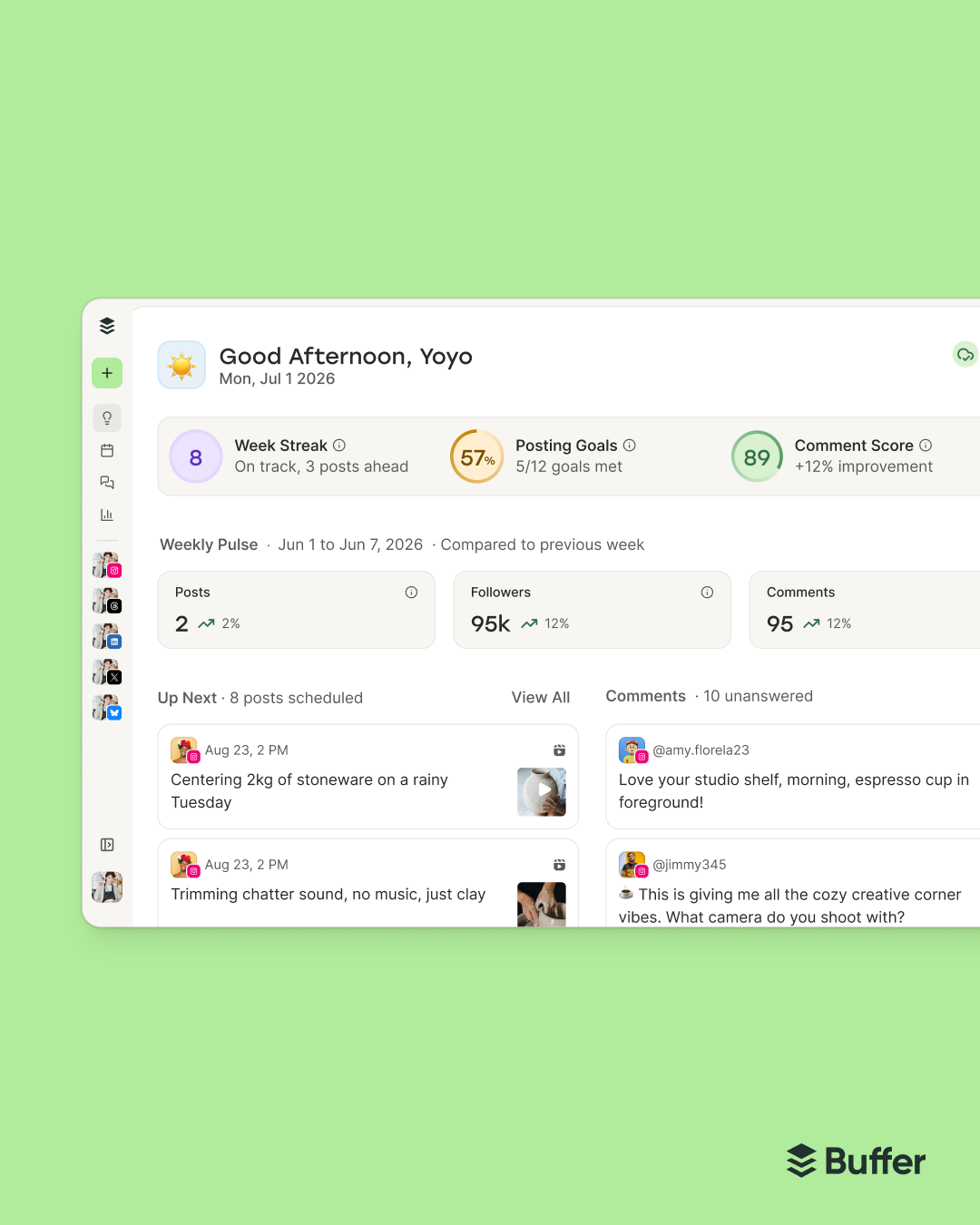
So the first job of Buffer Home is to replace that checklist with a page that folks can engage with and meet them where they’re at. New users now land on Home after onboarding and see a small set of setup cards that reflect what they told us about themselves. (We’re running this as an A/B test with new signups, because we’d rather know than assume it helps.)

What it does for everyone else

If you’ve used Buffer for years, you don’t need help connecting a channel. For existing users, Home is a place to see the state of things before you go do the thing: your upcoming posts, comments you haven’t answered, and a summary of your posting habits. Everything is clickable, so it works as a launching point rather than a dashboard you admire and then leave.

The existing-user version is intentionally minimal in version 1. There’s a long list of things Home could surface — deeper insights, team activity, suggested content — and we left most of it out on purpose. We’d rather ship something we believe could still be valuable and learn from real usage than guess at the perfect page.

Where it could go from here

We have an ambitious vision and roadmap for Buffer over the next year: we’re overhauling our analytics and insights features, continuing to develop Community, and making Buffer more powerful for teams handling social. (And that’s not all!)

Home plays a key role in ensuring each of those developments, and ultimately, your most important social marketing tasks, are easy to find and use.

Let’s say you’re a contributor in a marketing agency, and you are responsible for drafting posts for review by an editor — there isn’t an easy way to simply act on review feedback. It takes 3 to 4 clicks to see the feedback today. I believe Home can and should surface those important review comments so you can act on them in one click.

A page that unlocks, rather than adds

The part I find most interesting strategically: Buffer Home introduces almost no new capability (yet!). Everything on it (posts, comments, templates, goals) existed before. What changed is how you encounter those things.

Buffer has grown a lot of surface area over the years, and when every feature lives behind its own tab, it’s only discovered by people who go looking. A home page flips that: it can progressively reveal the product based on where you are in your journey, instead of presenting fifteen doors and wishing you luck.

If you’re new to Buffer, you may already be seeing Home. If you’ve been around a while, it’s coming soon! I’d love to hear what you’d want from it. Check out our public roadmap for this feature or reach out to me on LinkedIn.

https://buffer.com/resources/buffer-home/