Google Tests ‘Strongest Match’ Labels On Search Ads via @sejournal, @brookeosmundson
Google is testing a new Search ads label that could give certain advertisers a visible endorsement directly within search results.
In a LinkedIn post, Google Ads Liaison Ginny Marvin announced a limited U.S. experiment that adds a “Strongest match” or “Strong match” label to select Search ads.
According to Marvin, the labels are intended to help users quickly identify the most relevant information for their query while helping advertisers connect with high-intent audiences.
The experiment is currently rolling out to a small percentage of users in the United States.
Marvin said the designation relies on existing ad quality and relevance signals that Google already uses to evaluate Search ads.
While the announcement itself was relatively brief, it immediately sparked questions from advertisers about how the label is determined, whether it could influence click behavior, and what it might signal about the future direction of Search.
Google Hasn’t Explained What Qualifies As A “Strongest Match”
Google’s announcement answered what the label is intended to do, but not how advertisers qualify for it.
According to Marvin, the designation is based on existing quality and relevance signals. Beyond that, Google has not shared any details about how the label is determined.
As a result, advertisers still don’t know:
Which signals are used to determine the label
How those signals are weighted
Whether the designation is based on the query, keyword, ad, landing page, or a combination of factors
Whether multiple advertisers can receive the label in the same auction
Whether the label is tied to ad position
The lack of detail quickly became one of the main discussion points following the announcement.
Several advertisers questioned whether the designation reflects the same systems Google already uses to evaluate ad relevance or whether the experiment introduces an additional layer of evaluation.
Others questioned whether bid strength plays any role.
Google’s description suggests the label is intended to reflect relevance rather than spend. However, the company has not explained how those determinations are made.
Until Google shares more information, advertisers are left with a label that appears meaningful but lacks a clear definition.
Advertisers Are Asking For More Transparency
Advertisers quickly focused on a different question: how Google determines which ads receive the label.
Several commenters asked whether “Strongest match” reflects the same relevance systems Google already uses or whether additional factors are involved.
Terry Hogan questioned whether the designation is truly based on relevance or whether bid strength contributes to the decision.
Kristen Kelleher asked a popular question, based on the amount of likes she got:
What components make up the scoring underneath the match label? Is this based on the keyword based quality score, ad relevance, landing page exp or is it only based on the ad itself?
So far, Google has not provided additional detail.
Other comments asked measurement questions around the label testing.
Craig Graham asked: “Are there plans for any kind of advertiser-side reporting for this if the experiment rolls out more broadly?”
That visibility could become important if the designation influences click behavior. Advertisers will likely want to know when their ads receive the label and whether it impacts performance.
Questions also accumulated in Marvin’s LinkedIn post about how the label will appear within search results.
Bernt Muurling asked whether the strongest match will always be the first result shown.
If the label only appears on the top-ranked ad, it reinforces Google’s existing ranking decisions. If it can appear elsewhere on the page, it introduces a new signal that users may evaluate alongside ad position.
Justin Windschitl pointed to what may be the biggest challenge for the experiment:
Interested what the criteria are for labeling “match types” and if there can be flaws with the labeling, hurting businesses. On the flip side, if it’s buttoned up, it could be very beneficial for filtering best matches and more effective ad spend!
If the designation is occasionally inaccurate, advertisers may question whether Google is effectively endorsing one business over another.
Could This Become A Public Relevance Signal?
The experiment stands out because it could make Google’s assessment of relevance visible to users.
Advertisers have always known that Google evaluates factors such as ad relevance, landing page experience, expected click-through rate, and other quality signals when determining which ads appear and where they rank. Those evaluations largely happen behind the scenes.
A “Strongest match” label would move part of Google’s relevance evaluation from Google Ads into the user experience itself.
That may seem like a small change, but it introduces a new dynamic into the search experience.
Users already see ad position. A visible label gives them another signal to evaluate.
That is one reason several advertisers immediately questioned how the designation is determined and whether it could influence click behavior.
It also raises questions about whether the label becomes a competitive advantage of its own.
If users begin viewing the designation as a recommendation from Google, advertisers who receive the label could benefit beyond the visibility that comes with ranking well in the auction.
Whether that happens will likely depend on how often the label appears and whether users respond to it.
For now, Google has positioned the experiment as a way to help users identify relevant information more quickly. The broader question is whether advertisers and users eventually view the designation as a relevance signal, a recommendation, or something in between.
Why Google May Be Testing This Now
While Google hasn’t shared the reasoning behind the experiment, the test arrives as Search continues to evolve beyond a traditional list of links.
Google already makes relevance decisions every time an auction takes place. The difference is that those decisions typically remain behind the scenes.
This experiment tests what happens when part of that evaluation becomes visible to users.
Google already makes relevance decisions every time an auction takes place. This experiment tests whether those assessments should be visible to users.
Like many Search tests, the feature may never move beyond experimentation. If it does, it could mark another step toward Google making more of its relevance decisions visible within the Search experience itself.
What This Means For Advertisers
At this point, advertisers should view the label as an experiment rather than a new optimization opportunity.
Google hasn’t introduced any controls, reporting, or guidance around how advertisers qualify for the designation.
For now, the announcement is getting a lot of attention because it introduces a new user-facing signal in Search ads. Whether that signal influences click behavior or campaign performance is unclear until Google provides more information.
We’ll continue watching the rollout and update this story if Google shares additional details about qualification criteria, reporting, or broader availability.
Featured image: Kues / Shutterstock, Phone image courtesy of Google
Microsoft and Allies Smash Shared Infrastructure of Amadey and StealC Malware
Microsoft, law enforcement, and several cybersecurity companies have collaborated to take down infrastructure shared by two widely used malware families: Amadey and StealC.
The action, part of the long-running Operation Endgame, involved the use of AI, legal action, and the exploitation of a vulnerability in a malware control panel, and resulted in hundreds of domains and servers being targeted for takedown.
While many cybercrime operations have been disrupted in recent years as part of Operation Endgame, this one stands out because law enforcement and companies targeted what they described as the “cybercrime assembly line”.
Making the rounds since 2018, Amadey is a malware-as-a-service loader that gives threat actors access to systems, enabling them to deliver secondary payloads. StealC is an infostealer that has been around since 2023, helping cybercriminals obtain credentials, cryptocurrency wallets, cookies, and other valuable data.
Amadey and StealC have often been used together — the former has enabled hackers to gain access to systems, while the latter has been used to steal information from the breached systems.
AI-powered analysis of the two malware families revealed that they use the same command-and-control (C&C) infrastructure, making it easier for Microsoft and its partners to conduct takedown activities.
Advertisement. Scroll to continue reading.
“This operation marked a shift in strategy: instead of focusing solely on individual threats, Europol, law enforcement and judicial authorities, as well as private industry partners disrupted the entire chain that allows cyberattacks to scale,” said Europol.
More than 25 million unique credentials stolen from over 385,000 systems were seized, and 18,000 compromised computers were identified and secured. Europol said crypto assets valued at more than $47 million were identified and flagged to restrict their use.
Researchers also discovered a vulnerability in the StealC C&C panel that enabled uploading a web shell to the server. While this flaw was exploited to collect data in support of the takedown operation, there is evidence that a StealC affiliate also used it to steal other affiliates’ data.
The Accessibility Tree Is How AI Agents Read Your Site & It’s Breaking via @sejournal, @slobodanmanic
AI agents do not read your website the way you do. They do not see your layout, your hero image, or your brand color. They prefer reading the accessibility tree: a stripped-down structural model of the page, the same one that has powered screen readers for two decades.
Today, that matters more because the audience reading that way is now the majority.
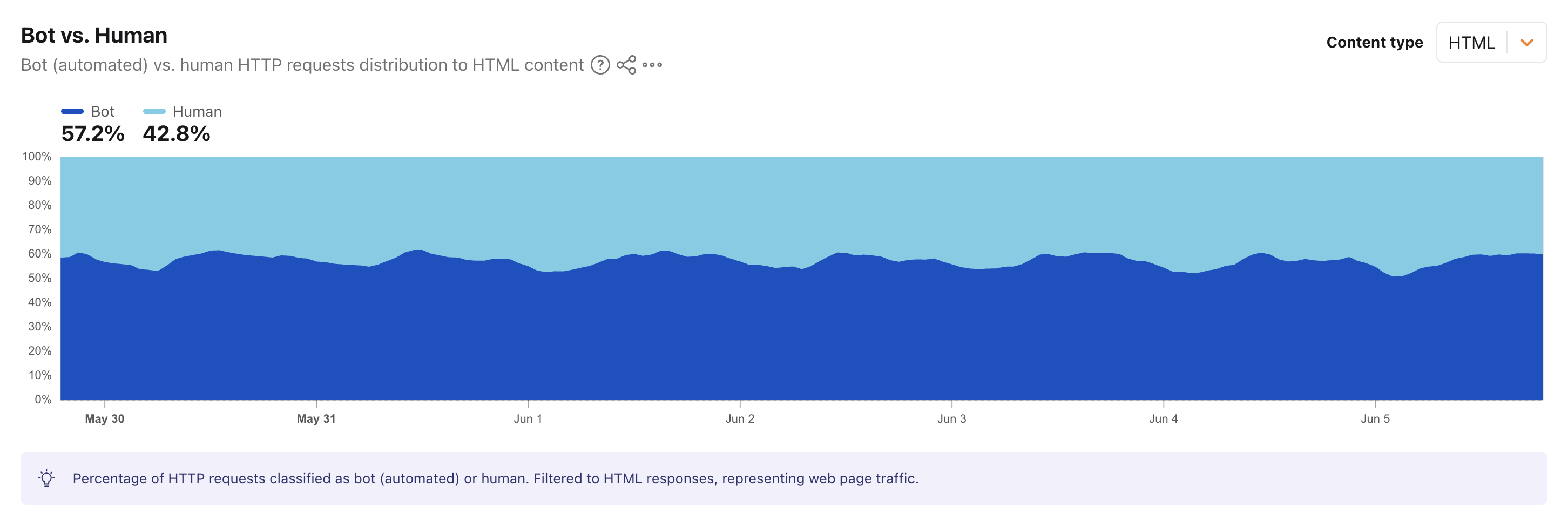
For the week of May 30 to June 5, 2026, Cloudflare Radar measured 57.2% of HTTP requests to HTML content, the requests that represent web-page traffic, as automated bots, against 42.8% human. Cloudflare CEO Matthew Prince, who shared the data on June 3, had forecast that crossover for 2027. He got it wrong because it arrived over a year early.
Cloudflare Radar, Bot vs. Human distribution filtered to HTML content (web-page traffic), May 30 to June 5, 2026 (Image from Cloudflare Radar by author, June 2026)
Some of that automated traffic is scrapers you probably want gone. A large and rising share is AI agents reading pages for real people. And according to the accessibility data published this year, the structure those AI agents depend on is getting worse, for the first time in six years.
The Accessibility Tree Is A Structural Model The Browser Builds From Your DOM
The accessibility tree is a semantic version of your page that the browser computes from the DOM so non-visual software can understand it. The pipeline is short: HTML to DOM to accessibility tree to consumers (assistive technology, and now AI agents).
The W3C’s WAI-ARIA 1.2 defines it as a “tree of accessible objects that represents the structure of the user interface,” where each node “represents an element in the UI as exposed through the accessibility API.” The browser builds it from the DOM (the mapping is specified in Core-AAM 1.2) and exposes it through the operating system’s accessibility API, which, per the W3C, “can be used by any assistive technologies, such as screen readers.” MDN explains the pipeline this way: Browsers “create an accessibility tree based on the DOM tree.”
The accessibility tree discards most of the DOM. A page with several thousand nodes collapses to the meaningful, interactive set: headings, links, buttons, form fields, landmarks, images with their text alternatives. For software working inside a limited context window, it is that reduction that makes the tree usable at all.
Every node in the accessibility tree carries four properties:
Property
What it captures
Example
Role
What kind of element it is
Button, navigation region, list item
Name
How it is referred to
A link reading “Read more” is named “Read more.” An icon-only button with no label has no accessible name.
State
Its current condition
Checked, expanded, disabled, selected
Description
Any extra context beyond the name
A longer explanation, like a tooltip, that a screen reader can read aloud
The tree also records what can be done with a node: a link can be followed, a text input can be typed into. That is exactly the information an agent needs in order to act.
AI Agents Read The Accessibility Tree Because It Costs Less And Misleads Less Than Pixels
An agent driving a browser can understand a page three ways: read the raw HTML, look at a screenshot with a vision model, or read the accessibility tree. There is a real split in how today’s agents do it.
Purely relying on the accessibility tree. Microsoft’s Playwright MCP, a widely used tool for letting a model operate a browser, “uses Playwright’s accessibility tree, not pixel-based input,” with “no vision models needed, operates purely on structured data.” Its tool description tells the model an accessibility snapshot “is better than screenshot.”
Vision-first. OpenAI’s Computer-Using Agent, the model behind Operator, works primarily from screenshots. It is not reading your accessibility tree to decide what to click.
Hybrid. A third approach combines both: the structured accessibility tree for the bulk of the page, plus vision for the parts the tree cannot capture, like canvas-rendered apps and dense visual layouts.
Two forces push agents toward the accessibility tree:
Cost. A screenshot spends a large number of tokens encoding a picture the model then has to interpret. The accessibility tree is compact text.
Reliability. A vision model has to guess which pixels form a clickable control. The tree states this outright, with a role and a name for each.
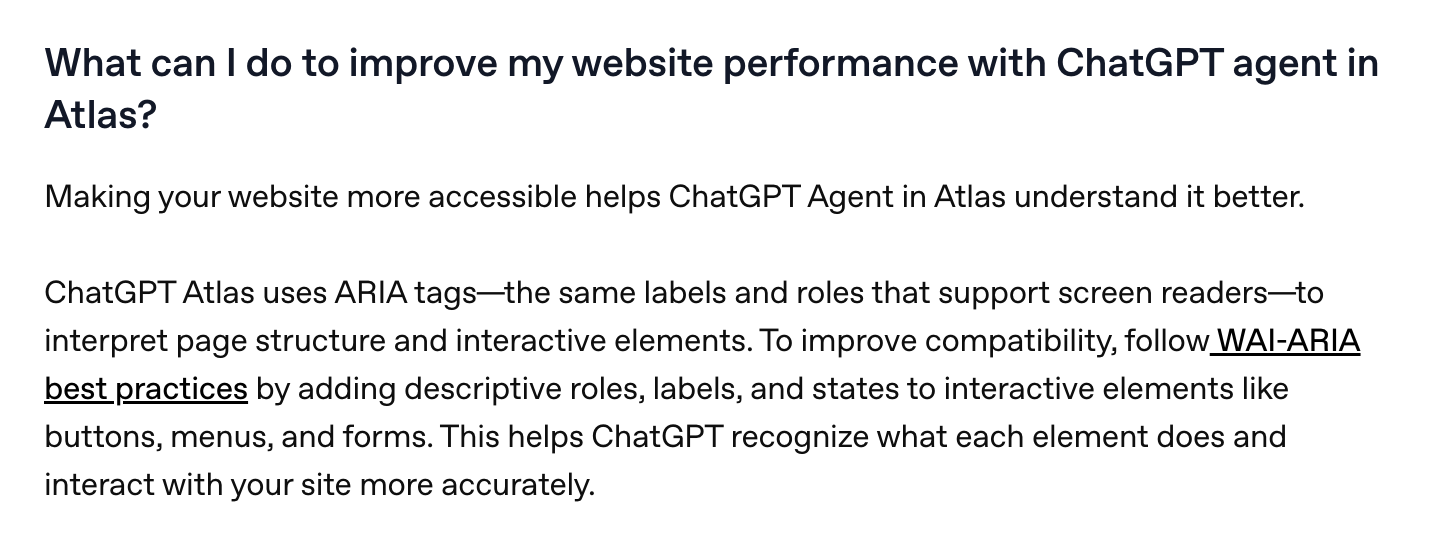
The clearest signal of where this goes is the vendors’ own guidance. OpenAI’s Publishers and Developers FAQ says ChatGPT Atlas “uses ARIA tags, the same labels and roles that support screen readers, to interpret page structure and interactive elements,” and advises that making a website more accessible helps the agent understand it.
OpenAI’s Publishers and Developers FAQ (Image by author, June 2026)
OpenAI is the company behind Computer-Using Agent, the one that works by analyzing screenshots. They still recommend making websites more accessible. For the machine, accessibility and readability are the same problem. The full agent-by-agent breakdown is in a companion article on how AI agents see your website.
A Markdown Copy Is Not An Agent-Ready Page
A clean markdown version of a page is a good way to feed an agent your content, and providers like Cloudflare now generate one at the edge. For reading, extracting, and citing, markdown is fine, and often better than raw HTML.
But a markdown copy carries only the words. It cannot tell an agent that a control is a button, whether that button is disabled, or hand it something to click. It lets an agent read the page, not operate it.
It is also a separate copy of the page, and a separate copy can tell an agent one thing while the rendered page shows humans something else. A hand-maintained one also drifts from the real markup over time. The accessibility tree has neither problem. The browser builds it from the same page it renders to people, so there is nothing extra to maintain and nothing to cloak, and it carries the roles, states, and element references an agent needs to act. Which is why, for an agent that has to do something, one of the two is close to pointless, and the other is the whole point.
You Can See Your Own Accessibility Tree In About 2 Minutes
Every major browser shows you the exact tree an agent reads.
Open DevTools, select an element in the Elements panel, and open the Accessibility tab to see that element’s computed role, name, and state.
To view the whole page the way the tree does, turn on the “Show accessibility tree” toggle, which “replaces the DOM tree in the Elements panel with a full-page accessibility tree.”
For the same thing in code, Playwright’s ARIA snapshots produce “a YAML representation of the accessibility tree of a page,” capturing roles, accessible names, states, and nesting. Running an ARIA snapshot against your own URL returns almost exactly the structured text an agent like Playwright MCP receives.
Here’s an easy test you can run: For every important action on the page, does the tree show a node with the right role and a clear name? A “buy” button that appears in the tree as a generic element with no accessible name is a button your customers’ agents can see but cannot confidently use.
Run this on a few of your own pages, and the gaps will show up fast.
The 2026 Data Says The Web Is Getting Harder, Not Easier, For Machines To Read
The accessibility tree is only as good as the markup it is built from. In 2026, that markup got worse. Web accessibility regressed for the first time in six years, at the same moment agents became the majority of HTML traffic.
The WebAIM Million, the annual automated analysis of the top 1 million home pages, reported in its February 2026 edition:
95.9% of home pages had detectable WCAG failures, up from 94.8% the year before, which WebAIM describes as “reversing a trend of small improvements each of the previous 6 years.”
56.1 detected errors per home page, a 10.1% increase over the 51 found in 2025.
1,437 elements per home page, which WebAIM flags as “a 22.5% increase in only one year.”
A 22.5% jump in page complexity in a single year is not normal. More elements mean more places for structure to break, and the report shows exactly where it breaks.
The Most Common Failures Are The Ones That Blank Out The Accessibility Tree
The accessibility failures WebAIM finds most often are exactly the defects that strip meaning out of the tree an agent reads.
Failure
Home pages affected
What it does to the agent
Low-contrast text
83.9%
A visual failure for low-vision users and vision-based agents
Missing alt text
53.1%
The image contributes nothing to the agent’s understanding
Missing form labels
51%
An input the agent cannot map to a purpose, so it cannot fill it
Empty links
46.3%
A node with a role but no name: a door with no sign
Empty buttons
30.6%
A control the agent sees but cannot identify
Missing document language
13.5%
The wrong language model applied to the page
Nearly half of the top million home pages come with empty links. Almost a third have empty buttons. For the visitor class that now outnumbers humans, those are dead ends. To quote the report:
“Addressing just these few types of issues would significantly improve accessibility across the web.”
What WebAIM has measured every year for screen-reader users is the same thing that decides whether an AI agent can read and act on your page. They’re different audiences with identical broken structure.
WebAIM Ties The Rising Complexity To Frameworks And “Vibe Coding”
WebAIM attributes the rising complexity to “increased reliance on 3rd party frameworks and libraries and automated or AI-assisted coding practices (‘vibe coding’).”
This is the first WebAIM Million published well into the era of generating production websites by prompting a model. We have more code, shipped by more people, more pages deployed faster, more complexity stacked on complexity, with fewer humans in the loop asking whether an element needs to exist or whether a control exposes its name and role.
There is no way to prove a single cause for a one-year reversal across a million websites, and claiming one with certainty would be dishonest. But the timing is impossible to ignore, and the contradiction is the point: Humans are using AI to build a web that AI itself cannot reliably consume. Bloated DOMs, broken semantics, unnamed controls. The same defects that hurt humans and screen readers hurt the crawlers and the agents.
It’s tempting to think you should not worry, because the next model will be good enough to sort out the mess. That is a marketing line, not a strategy. The same products promising the model will handle anything also tell you, in fine print, that the assistant can make mistakes.
Independent measurements like the WebAIM Million are among the only objective signals we have about what is really happening to the web underneath that promise. Right now, the signal is that the web is getting harder to parse at the exact moment more of its traffic depends on parsing it cleanly.
The ARIA Paradox: Bolting On Attributes Makes It Worse
More ARIA correlates with more errors, not fewer. WebAIM found that home pages with ARIA present averaged 59.1 errors, against 42 on pages without it.
ARIA, short for Accessible Rich Internet Applications, is a set of attributes you add to HTML to hand the accessibility tree the roles, names, and states the native markup did not supply on its own.
The reason is simple. An empty or wrong attribute does not leave the accessibility tree blank. It fills the tree with confident, possibly incorrect information, which is worse for an agent than an honest gap, because the agent has no way to know it is being misled.
This is where the vendors and the standards body disagree:
OpenAI tells developers to add ARIA roles, labels, and states so agents understand a page.
The W3C’sFirst Rule of ARIA (first!) puts native HTML first: “If you can use a native HTML element … with the semantics and behavior you require already built in, instead of re-purposing an element and adding an ARIA role, state or property to make it accessible, then do so.”
Accessibility specialists have pushed back on the vendor framing directly. W3C contributor Adrian Roselli, responding to OpenAI’s guidance, argued it inverts the discipline, pointing teams toward bolt-on attributes when the durable fix is correct native markup.
The WebAIM data sides with the specialists: The pages reaching hardest for ARIA carry the most errors. You do not fix the accessibility tree by adding attributes. You fix it by … fixing it. By making the underlying markup mean what it says, and reserving ARIA for the genuine gaps native HTML cannot express.
Make The Markup Mean What It Says
The fixes are unglamorous and well understood, and they pay off twice: once for the humans using assistive technology, once for the agents that are now the majority of your traffic.
Use native HTML for native behavior. A <button> is a button in the tree with no extra work. A <div> with a click handler is an unnamed, roleless node an agent cannot trust. The same holds for <a href> and <select>.
Name every control. Use a real <label> on every form input. Accessible text on every link and button, including the icon-only ones. Empty links and empty buttons are the failures an agent hits first.
Server-render the content that matters. A price, a spec, or a primary action that only appears after client-side JavaScript runs may never reach the tree an agent reads.
Use ARIA for genuine gaps, not as a patch. Correct semantics first, attributes second, and only where native HTML cannot express the state. Remember the First Rule of ARIA?
Inspect the result. Run your key pages through the DevTools accessibility tree or a Playwright ARIA snapshot, and confirm every important action shows up with a clear role and name.
It is not too late to start, and none of this requires a redesign. The accessibility debt on most websites is real and years deep, and the 2026 numbers show it growing rather than shrinking. But the fixes are still small: markup-level changes you can make page by page, not a full rebuild that would take months. Start with your highest-traffic pages, check the accessibility tree, and fix the empty controls and unlabeled inputs first. Every one of these fixes serves a human visitor and a machine visitor in the same change.
Accessibility used to be a compliance checkbox; the thing reached after the redesign was launched. It is now the interface the majority of your visitors use to read your website. Teams that build their markup to mean what it says will be legible to the agents deciding what to recommend and what to buy. Teams betting that a future model will clean up the mess are wagering on someone else’s questionable roadmap. The web has now handed us a year of data on how that bet is going.
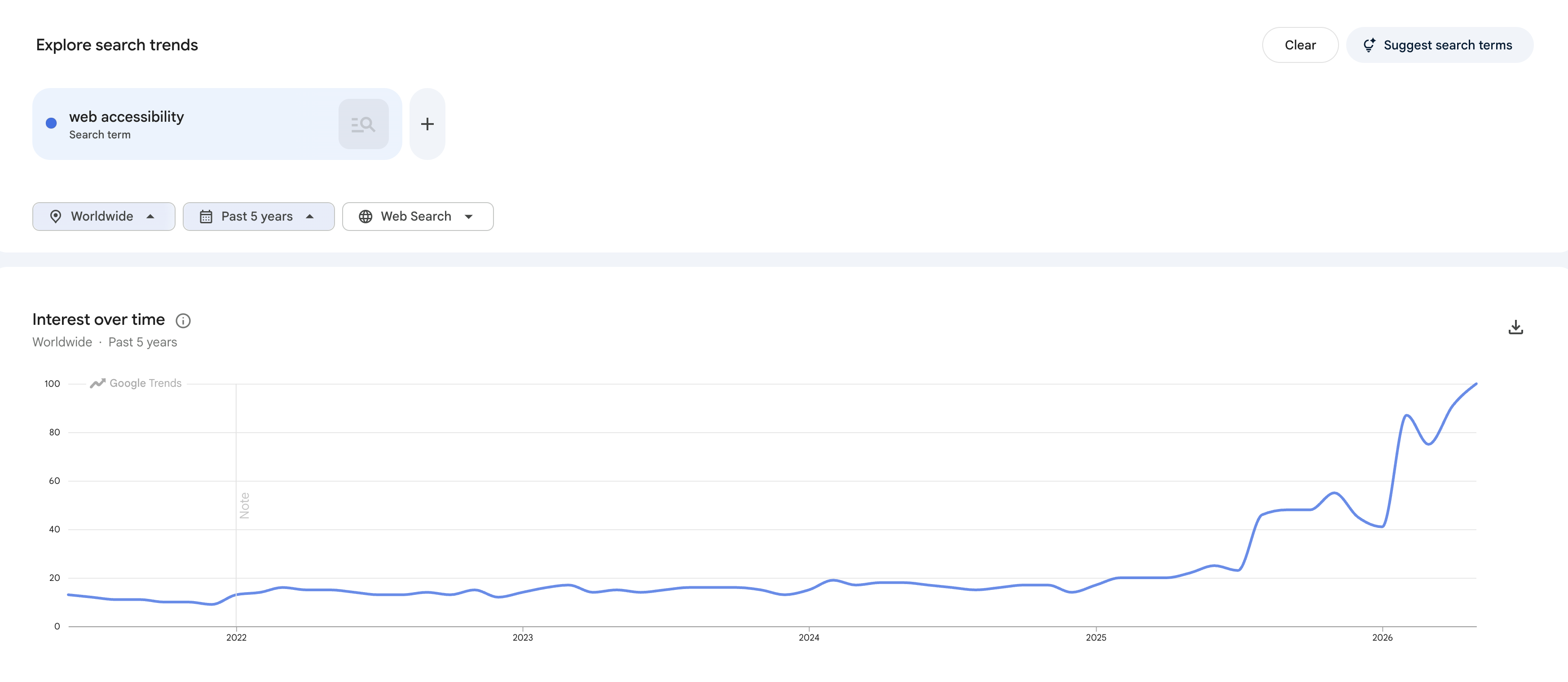
At the same time, the interest in web accessibility is at a five-year high.
Google Trends: worldwide search interest in “web accessibility,” past five years (Image by author, June 2026)
The interest was flat for years, then climbed through 2025 and spiked in 2026. The drivers are mixed, and worth being honest about: compliance deadlines like the ADA Title II web rule and the European Accessibility Act, a rising wave of accessibility lawsuits, and broader attention as AI changes how the web is built and read. No single one explains the whole curve, and claiming it does would be a guess.
But the direction is the whole point. The attention is arriving, the fixes are manageable, and the audience that depends on them is now the majority. The moment to fix the web is now.
Exclusive: Meet AIVEX, a New Triage Model Built to Reduce Supply Chain Threat and Risk
Remediation priority (vulnerability triaging) traditionally focuses on Software Bill of Materials (SBOMs) and Vulnerability Exploitability eXchange (VEX) statements provided with the software and supplemented by CVSS scores. That is not enough in today’s environment.
SBOMs list the components within the software. They emanated from Executive Order 14028 designed to reduce supply chain attacks. VEX statements emerged soon afterward to indicate whether any known vulnerabilities are exploitable. The separate CVSS score is used as a severity indicator for vulnerability remediation priority. It’s not working – supply chain attacks continue.
A major cause is a growing lack of context around exploitation. In the AI Age, the effect of exploitation may differ depending on which stage of an AI lifecycle in which it occurs. Lack of context reduces the effectiveness of remediation priority, while the expansion of AI software will magnify the problem. Supply chain attacks will continue to grow.
(Understanding ‘context’ is essential for understanding anything and everything in life. We perceive things – in this case data – but those things are meaningless in isolation. It is the surrounding, often invisible, context in which we see things that gives them any meaning. For another and different example of the importance of context, again involving AI, see the effect of bad AI context on AI decision-making.)
Devashri Datta is an independent researcher and security architect (specializing in DevSecOps automation, software supply chain security, and governance of large-scale vulnerability and compliance systems) has a solution. This solution comprises two new elements in the triage process: a safety relevance interpretation layer (SRIL) to provide context, and an extension (known as AIVEX) to the CycloneDX VEX to make the context machine readable.
SRIL provides context, and AIVEX transforms the context into a CycloneDX‑compatible schema suitable for use within the organization’s existing tooling.
Advertisement. Scroll to continue reading.
Datta’s article explaining SRIL (Moving Beyond Severity Scores: A VEX-Driven Interpretation Layer for Software Supply Chain Governance) will be published by ISACA on July 1. Today, she sat down with SecurityWeek to discuss the failure of existing SBOM/VEX/CVSS, and the manner in which AIVEX/SRIL can change things.
A growing concern
AI can transform a data threat against systems into a physical threat against people – it is increasingly and autonomously driving physical robots.
If a firm has two CVSS scores — a CVSS 9.8 critical remote code execution flaw in a back-office analytics dashboard and a moderate CVSS 5.2 input-validation bug in the sensor-fusion module of an autonomous delivery robot operating in a public warehouse — current logic dictates patching the former first. But the latter could possibly harm or even kill innocent members of the public. The existing triage logic of using SBOMs, VEX and CVSS scores does not provide this context.
As software-driven autonomous robots increasingly pervade our physical world, context becomes ever more important. “But VEX stops short of safety context,” explained Datta. “It can tell you a vulnerability is not exploitable; but it cannot tell you that if it were exploitable, the consequence would be a vehicle losing steering control at highway speed.”
The commercial consequence of an autonomous robot causing death because of a software vulnerability that could have been fixed but wasn’t fixed would probably be bankruptcy.
This is the anomalous consequence of relying on CVSS scores: AI turns low threat into very high risk.
The AI Attack Surface
The inability of CVSS to indicate context is a growing concern and has reduced the CVSS value for DevSecOps engineers. Today, with the rise of AI and autonomous robots, a new solution is urgent. But context within AI software is complicated because AI’s attack surface is not the same as a traditional software attack surface.
“An AI system, particularly an agentic one capable of taking actions in the real world, has attack surfaces distributed across training data, model weights, inference pipeline, tool integrations, and deployment infrastructure,” explained Datta. “A compromise at any stage can alter behavior in ways that are difficult to detect and harder to attribute.”
She tackles this problem through the combination of SRIL and AIVEX.
SRIL
SRIL is not just a vague idea. “Flexera has adopted this and is shipping the version to customers next week; similarly, Anchore is working on it and will ship it in the next version,” she explained.
So, what is it? “SRIL is a structured annotation layer designed to sit above existing vulnerability data, enriching CVSS scores and VEX statements with four dimensions of context that safety-critical environments need but current standards do not provide,” she continued.
The four dimensions are:
Safety domain classification (does the vulnerable component operate within a safety-critical function such as a sensor in an autonomous vehicle);
Lifecycle stage mapping (the attack surface differs between different stages of an AI – training data integrity has a different level of risk than inference-time input validation);
Consequence severity modifier (independent of the CVSS score, what is the real-world consequence if this vulnerability is exploited?)
Exploitability in context (does the deployment environment, threat actor model, and asset exposure change the exploitability calculation in ways the base VEX statement does not capture?).
In combination, said Datta, “These dimensions allow security teams to generate a safety-adjusted priority – a triage score that reflects not just how severe a vulnerability is in isolation, but how much it matters in the specific operational context where affected software is deployed.”
This is a manual effort required from the DevSecOps team, but one that is fully justified by the potential blast radius of an unpatched low-severity AI vulnerability causing robotic third party harm.
AIVEX
The SRIL data is consumed and processed by the AIVEX. It generates context-rich decisions (such as ‘remediate now’, ‘defer’, or ‘monitor’ in machine readable format.
“The AI Vulnerability Exploitability eXchange is a proposed extension to the CycloneDX VEX schema. It makes SRIL machine-readable in structured fields for model provenance, inference-time attack surface classification, safety domain annotation, and AI lifecycle stage. It is designed to integrate with existing SBOM tooling rather than replace it,” explained Datta. “The CycloneDX working group has it under active consideration.”
VEX tells you whether a CVE is exploitable in a given product configuration. “AIVEX asks the question that comes afterward,” she continued. “If the vulnerable component is an AI model acting as an agent in the real world, what does exploitation actually mean? That’s a different problem class, and the industry doesn’t have a standard for it yet.”
AI compliance benefits
More realistic triaging is not the only benefit provided by SRIL/AIVEX. It also benefits increasingly arduous AI regulatory compliance. “A life cycle-based interpretation model improves traceability and auditability without introducing new compliance burdens. The US National Institute of Standards and Technology (NIST) Secure Software Development Framework promotes risk-informed decisions,” she explains in the paper being published on July 1.
“This model operationalizes that guidance by clarifying how SBOM and VEX data feed into real-world governance decisions. Importantly, the model does not redefine these standards; it helps organizations apply them consistently.”
She goes further, anticipating future international regulation convergence. The EU AI Act is in force, but full enforcement of its most demanding aspects for AI embedded in regulated products (conformity assessment, risk management, logging, human oversight) will only begin in August of this year.
Meanwhile, she explained, “NIST’s AI Risk Management Framework similarly emphasizes governance processes that account for operational context and real-world impact of AI system failures, not merely technical severity. Sector-specific guidance from FDA (medical devices), CISA (critical infrastructure), and the Department of Transportation (autonomous vehicles) is independently converging on the same need: a structured mechanism to connect vulnerability data to safety consequence.”
Such increasingly arduous regulations make demands without telling DevSecOps how to comply with those demands. “SBOMs tell you what components you have. VEX tells you whether they’re exploitable. But SRIL asks the question that regulators actually care about: if exploited, does it matter to a patient, a power grid or a passenger?”
macOS Weaknesses Chained to Silently Disable Endpoint Security Agents
Cybersecurity firm XM Cyber has demonstrated a macOS attack technique that allows a standard, non-administrative user account to silently disable enterprise endpoint security tools, including EDR and MDM agents, without triggering alerts or requiring kernel exploits.
Some of the underlying primitives, including the abuse of weakly-validated XPC connections and the injection of malicious payloads into application Interface Builder (NIB) files, have been publicly documented by security researchers for years and partially addressed by Apple.
However, the research introduces a novel chain that exploits the persistence of the kernel’s code-signing trust cache after a legitimately signed application executes, allowing an attacker to inject a malicious payload that impersonates a trusted app component and silently invokes privileged XPC methods.
The cybersecurity company noted that the attack technique abuses legitimate macOS behavior rather than software vulnerabilities.
The technique was successfully demonstrated against CrowdStrike Falcon Sensor, which was fully unloaded from a standard user account, and against Kandji MDM, which was permanently deactivated via a two-stage chain. The Kandji exploit cleared the EDR guards and terminated the Endpoint Security Framework extension, XM Cyber said.
According to the security firm, CrowdStrike has paid a bug bounty and added detection, while Kandji has patched the issue and assigned CVE-2026-39118 to the flaw. A third, unnamed enterprise EDR vendor was also successfully targeted and is working on a patch.
Advertisement. Scroll to continue reading.
XM Cyber researcher Hillel Pinto will be releasing an open source discovery tool called XPC Hunter, which automates the identification of exploitable XPC privilege escalation surfaces across all installed macOS applications, with a full presentation planned for Black Hat US in August 2026.
SecurityWeek has reached out to Apple, CrowdStrike, and Kandji for comment and will update this article if they provide any clarifications.
Third DraftKings Hacker Sentenced to 18 Months in Prison
A third man charged for his role in a 2022 hacking attack on the sports and betting website DraftKings has been sentenced to prison, the Justice Department announced on Tuesday.
The DOJ has not named the targeted site, describing it as a fantasy sports and betting website, but its description of the attack matches the 2022 credential-stuffing attack targeting DraftKings. In that attack, hackers accessed more than 60,000 accounts using usernames and passwords obtained from other breaches.
Once they gained access to a DraftKings account, the cybercriminals either withdrew the available funds or sold access to the account on online marketplaces.
The third suspect charged in this case is Nathan Austad, aka Snoopy, who pleaded guilty in December 2025. He has now been sentenced to 18 months in prison and three years of supervised release. He has also been ordered to pay roughly $1.8 million in restitution and forfeiture.
According to the DOJ, Austad and his accomplices stole approximately $600,000 from 1,600 DraftKings accounts.
Austad also set up a website to sell compromised accounts, and investigators identified his cryptocurrency accounts, which had roughly $465,000, including funds from his criminal activities.
Advertisement. Scroll to continue reading.
The other individuals charged for the DraftKings attack are Kamerin Stokes, sentenced to 30 months in prison in April 2026, and Joseph Garrison, sentenced to 18 months in prison in early 2024.
Authorities made public some of the messages exchanged by the three men, indicating they clearly knew they were committing a crime.
“The defendants acknowledged the federal investigation into their conduct while they were committing their crimes, even having the hubris to say the FBI could not do anything about it. They were wrong,” said Jay Clayton, US Attorney for the Southern District of New York. “Austad’s prison sentence today demonstrates the commitment of the DOJ, the FBI, and all our federal partners to protecting our on-line markets.”
Critical Ubiquiti Vulnerabilities in Attackers’ Crosshairs
Threat actors have been targeting three critical-severity vulnerabilities in Ubiquiti devices, the US cybersecurity agency CISA warns.
The exploited flaws, tracked as CVE-2026-34908, CVE-2026-34909, and CVE-2026-34910, with a CVSS score of 10/10, were patched last month.
CVE-2026-34908 is described as an improper access control issue that could allow remote attackers to make unauthorized changes to vulnerable UniFi OS devices.
CVE-2026-34909 is a path traversal defect that could be exploited to access files on the underlying operating system and manipulate them to access underlying accounts.
CVE-2026-34910 is described as an improper input validation weakness that allows attackers to execute command injection attacks over the network. A variant of the flaw, tracked as CVE-2026-33000 (CVSS score of 9.1), requires authentication.
On May 21, Ubiquiti announced that UniFi OS Server version 5.0.8 was released with patches for these vulnerabilities.
Advertisement. Scroll to continue reading.
The company made no mention of their in-the-wild exploitation, yet multiple users reported on the company’s forums and on Reddit that the bugs were exploited in the wild, likely as zero-days, to create rogue administrator accounts under the username ‘John Sim’, in what appear to have been automated reconnaissance attacks.
A BishopFox analysis of the patches shows that CVE-2026-34908 and CVE-2026-34909 are an authentication gateway bypass rooted in how NGINX processes crafted requests. In raw form, the requests begin with the auth-exempt prefix, while in normalized form they resolve to an authenticated internal route.
“We confirmed the bypass against a live [UniFi OS version] 5.0.6 virtual machine. Requests built this way reached internal backends that are supposed to require authentication,” BishopFox said.
The gateway bypass then leads to CVE-2026-34910, the lack of validation of package names in a function that handles updates. It allows an attacker to supply a crafted package name containing shell metacharacters, as well as an option that forces the command code path, leading to command injection.
“We validated the unauthenticated path against our live 5.0.6 test target using a benign, time-based oracle: a request whose injected portion simply causes the server to pause for a fixed interval before responding,” the company says.
As the Centre for Cybersecurity Belgium points out, UniFi OS devices are designed for managing infrastructure and are centrally integrated into networks. Their successful compromise could allow attackers to move laterally into enterprise environments.
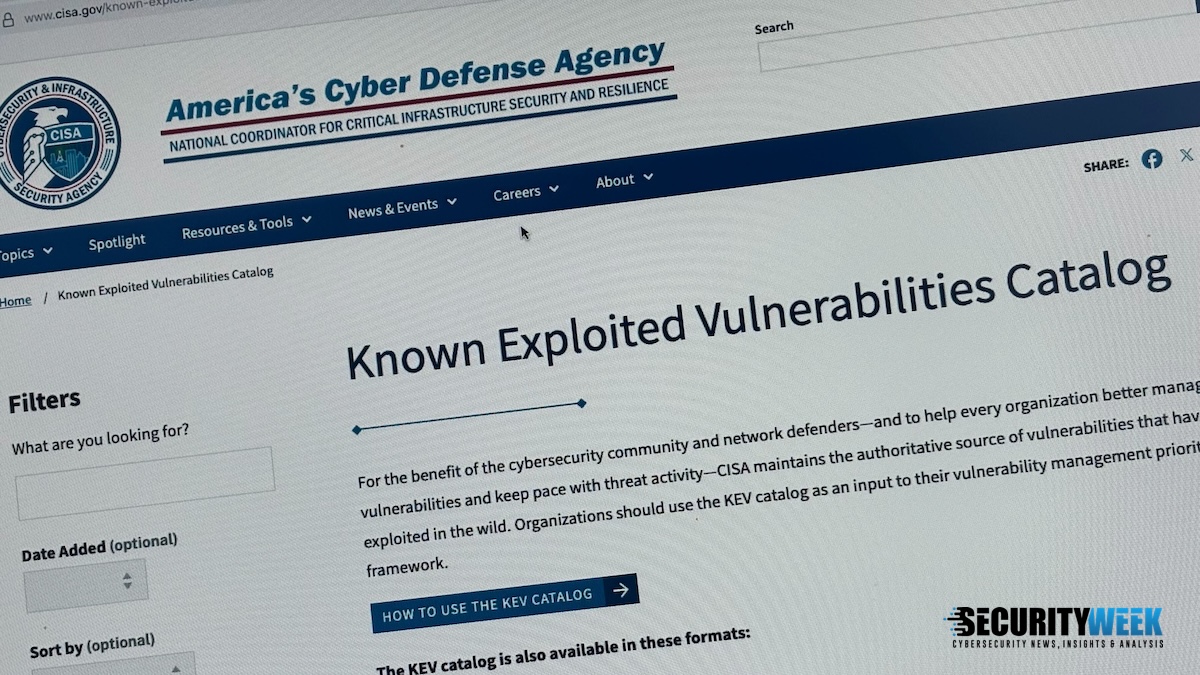
On Tuesday, CISA added CVE-2026-34908, CVE-2026-34909, and CVE-2026-34910 to its Known Exploited Vulnerabilities (KEV) catalog, urging federal agencies to patch them within three days, in line with BOD 26-04 requirements.
The same applies to CVE-2025-67038 (CVSS score of 9.8), an unauthenticated OS command injection defect in Lantronix EDS5000 that could lead to code execution with root privileges. The issue was disclosed in April along with 21 other Lantronix and Silex vulnerabilities, collectively tracked as BRIDGE:BREAK.
Agentic AI Security: Wrong Context, Wrong Decisions at Machine Speed
Context is the central plank of AI in general, and agentic AI in particular. If an AI system doesn’t have the correct context, it cannot make the correct decisions.
Security is moving toward reliance on the autonomous and automatic action of agentic AI. It has little choice. The increasing speed, volume and efficiency of attacks automated by adversarial use of both generative and agentic AI will only be matched by defensive AI with as little slow human intervention (the proverbial man-in-the-loop) as possible.
But defensive agentic AI can get it wrong and make bad decisions through lack of context. We’re not yet ready for fully autonomous AI.
Emanuel Salmona, CEO at Nagomi Security
“The problem that keeps me up at night is simple: an agent is only as good as the context it operates on,” explains Emanuel Salmona, CEO and co-founder at Nagomi Security. “Give it an accurate, correlated view of your environment – your assets, your controls, your exposures, your threat landscape – and it can make decisions that genuinely reduce risk. Give it incomplete data and it will still act. Confidently. Quickly. Incorrectly. Automation without verified context is just a faster way to be wrong at scale.”
Confidence is provided by the LLM used by the agentic system (it’s what LLMs are designed and trained to do). Speed comes from the machine-speed performance of artificial intelligence. Potential inaccuracy is determined by the accuracy of the context it uses. Context is king. Inadequate context can lead to bad decisions confidently, quickly, and implemented automatically.
This reliance on context applies to all agentic AI used in business, including customer service automation, software development, financial operations, sales operations, and personal assistants – and autonomous SOC applications. Give them the wrong context and they will give you bad decisions.
Context
Context is of little relevance to LLMs. Context here is fundamentally the user’s prompt – to which the LLM responds in accordance with its training. The LLM’s context is this prompt window, comprising both query and response; and it is stateless.
Advertisement. Scroll to continue reading.
Agentic AI has a goal. Its context is stateful and includes anything and everything it is allowed to see and use to achieve its goal. If the context it is given does not include the relevance of a specific device to business continuity, the response it provides will not take that into consideration – it could make immediate shutdown its conclusion, unaware of the catastrophic business effect of shutting down that device at this moment.
Agentic AI does not stop until it achieves its goal. Put simply, based on the context it is given, it presents a possible response to a received alert to an LLM in the form of a prompt. If the LLM does not agree with the validity of the prompt it receives, its own response is added to the agent’s context – and a new proposal/prompt is issued based on the new context.
Eventually, the prompt and prompt response will agree, and the agent will, if so designed, enact the proposal automatically and, where allowed, autonomously. Since the end could in theory allow device isolation or shutdown, autonomous automatic shutdown could be the result (the end) governed by the context (the means). In agentic AI, the end must not justify the means; the means must justify the end. If the context is lacking, the decision of the AI will almost certainly also be lacking.
If the agent designer and developer gets the context right, agentic AI can be a massive boon to the security of the user. If the context is wrong or inadequate, any autonomous action could be catastrophic. The precise context must be defined by the agent’s goal. But getting it right is very difficult.
Too much context for an agent is similar to sensory overload for a human: slower reasoning and degraded performance, goal drift and loss of focus, oscillation between incompatible actions (the agent may get stuck in a never-ending loop), and potential hallucinations as it attempts to connect loosely related bits of data.
Too little context is even more problematic. Just as humans might guess the answer to a problem by assuming bits of data that seem logical, so an agent that is instructed to achieve a goal might invent data to bridge the gap in its contextual knowledge. Operational accuracy and reliability may be lost through more hallucination. That hallucination could be a very bad decision delivered confidently.
The real world is constantly changing, so an agent’s context must continually be updated. Here, its ability to learn and adapt its own context can help. For example, a professional assistant in the US could be instructed to initiate a video meeting with an engineer in Europe. If it does so using its US timezone, it could be out of sync with Europe. The engineer’s personal assistant might reject this and reply, ‘I can only accept calls within this (UTC) timeframe’. The US assistant receives this, and the knowledge could become part of its context for future reference.
The ease with which context can be improved and expanded offers hope that the use of agentic AI will improve. It will make bad decisions to begin with but will get better with usage – but the ability to do so must be built into the system.
The problem for agentic security
Using AI to automate the work of the SOC provides an example of potential agentic issues.
The primary purpose of the original SOC is to manually triage alerts and find and respond to those that are most urgent and dangerous to the business and its IT infrastructure. This is costly and time-consuming while the time-to-disaster is collapsing. The appeal of using AI to increase the speed of triaging and reduce its cost is obvious.
SOC analysts already receive an abundance of alerts from multiple sources: EDR, NDR and XDR, SIEM and SOAR, IAM and threat information platforms. And we should include the SBOMs that should be provided with all new software and should provide vulnerability details. Getting data is not the problem. Interpreting and using data is the problem.
The difficulty for agentic AI in security is twofold. Firstly, it can only operate within the data it is given (which is its context). The conclusion it reaches while analyzing an alert within the confines of its context is entirely dependent on the adequacy of that context. To make it more difficult, adequate context is continually changing since business and infrastructure is continually changing.
Secondly, even if the context is good, the recommendation from the agent is usually poor – its reasoning is not competently explained to the user. Even with a human in the loop, the information provided by the AI may simply be, ‘this alert means there is a critical issue with this device, act now’, or perhaps ‘critical’ or ‘mild’, or ‘8 out of 10’ or ‘3 out of 10’.
The attraction of feeding alerts into an agentic system to perform machine-speed autonomous triaging is obvious. But the process comes with a major flaw. “No board would accept a set of numbers without an audit trail, yet many accept intelligence that shapes approvals and decisions with no method of visibility,” says Adam Irwin, managing partner at Heligan Strategic Advisory.
Agentic automation feeds raw alerts to the agent without the benefit of SOC expert triaging and then makes a decision on those alerts that is accepted by management without the benefit of visible reasoning. We question what we see on paper but automatically assume that our AI is correct. We are likely to assume that an autonomous SOC is accurate, but we have no proof that it is.
One alternative approach
Obbe Knoop, founder and CEO at Lanxit, has a different approach – his Security Decision Intelligence Layer uses artificial intelligence, but is not an agentic AI system. He believes that agentic AI is not sufficiently mature to be trusted with autonomous action; decisions and actions should currently be left in the hands of human experts. But those experts are being hamstrung by receiving too much data, too little reasoning, and little or no context.
“I take an alert and I pull in all the context that I need to make a decision,” he explains. “I go to the VPN gateway, I go to the identity solution, for example Okta, I go to Active Directory, I go to CrowdStrike, I pull in threat intel, I look at the target’s CMDB, and I look at the business structure, purpose and employees.”
Obbe Knoop, founder and CEO at Lanxit
Knoop gathers the context, fresh every time at the time of use. His product analyzes alerts in that current context and makes a recommendation within minutes. But it doesn’t simply say, this is critical or this is not critical; it explains why it has made its conclusion, and what the user should do about the situation. It will even say, “I don’t have enough context to make a clear decision on this alert” rather than hallucinate a recommended but ultimately guessed action.
What it will not do is take any autonomous automated action on behalf of the user. The final decision on what action to take in response to a detected issue is left to the user, but with more understanding of what is happening, why it is an issue, and a recommendation on how it could be solved – all delivered in plain English.
Does he believe AI will eventually have the maturity to be allowed autonomous action? “Probably,” he says. “But we’re not there yet.” He offers autonomous vehicles as an example. They are largely but not completely trusted. In some regions, users are still required by law to keep hands on the steering wheel, just in case. His solution is to give as much accurate and current information as possible on a potential vulnerability with recommendations on how to solve it, but to allow the user to keep hands on the wheel.
This context-based decision-making is good in many ways, but still has one potential drawback. While CMDBs are often and mostly accurate, this is not guaranteed to be always true. Without constant and possibly fallible human oversight and manual maintenance wherever and whenever necessary, they can drift. An automatically interrogated CMDB may not always provide ground truth for the system’s current context.
Context to AI is like batter to a cake. If you don’t have the right ingredients mixed in the right amounts, you almost certainly won’t like the outcome.
Current state of AI decision-making
Our descriptions here are simplified, while AI and its use is evolving rapidly. LLMs are being given short-term memories, so they can have their own (limited) context, if only for the current session. Agentic AI concepts are also advancing in better context gathering, better decisions and usage with fewer hallucinations. Furthermore, the general acceptance that accurate interpretation of data is more important than sheer volume of data has become more widely recognized. Nevertheless, accurate and relevant context is the axis upon which all else revolves.
AI has been around for many years; but the current state of accessible AI is only a few years old. We should not expect it to behave as a mature technology, and yet we do. We don’t know how it will evolve, in either design or use, over the next few years. What is already clear, however, is the current state of agentic AI can offer huge benefits or surprising failures depending on how we develop and manage it. Getting the context within which it operates is essential for beneficial performance. This is possible, but as we have seen, it is very difficult to achieve because of all the pitfalls discussed above.
What is needed going forward is more efficient and reliable methods for gathering and aligning relevant context to each agentic goal, and better descriptions delivered by the AI on how and why decisions are made – with detailed explanations on the users’ options for next steps. There are signs that this is happening. We have security intelligence systems. We have autonomous agentic AI. If we combine the two in a single product and monitor its performance for a few years, we will be in a better position to understand how much and where we can allow autonomous decision making to become autonomous action taking.
New ‘Mistic’ RAT Opens Door to Several Ransomware Families
An initial access broker (IAB) linked to multiple ransomware families has been using a new remote access trojan (RAT) in recent attacks, Broadcom’s Symantec and Carbon Black threat hunter team reports.
The threat actor, tracked as Woodgnat and KongTuke, and active since at least May 2024, is known to have ties to ransomware groups such as Qilin, Interlock, Rhysida, Akira, 8Base, and Black Basta.
Starting in April 2026, Woodgnat has been deploying the new Backdoor.Mistic RAT against the networks of organizations across multiple industries, including education, insurance, IT, and professional services.
Previously, the threat actor was observed deploying the ModeloRAT in attacks targeting other entities.
“The targeting appears to be opportunistic, with the attackers casting a wide net and then assessing which organizations they could sell access to rather than focusing on a single sector,” Broadcom’s researchers say.
Also tracked as MLTBackdoor, Mistic provides attackers with typical capabilities, including file download and upload, file manipulation, folder creation, and code execution. The attackers can also modify the frequency at which the malware checks for new commands and can instruct it to terminate itself.
Advertisement. Scroll to continue reading.
Woodgnat has been deploying the backdoor as a DLL, executing it via sideloading. In a recent attack, the threat actor also deployed a credential stealer alongside Mistic.
Additional tools observed in the intrusion include Curl, Reg.exe, Net (net.exe), PowerShell, Certutil, and WMIC (Windows Management Instrumentation), for data exfiltration, registry manipulation, network resource management, command execution, reconnaissance, lateral movement, file download, and browser certificate installation.
The IAB is known for distributing malware via compromised WordPress sites and for relying on social engineering to entice users into executing attacker-supplied commands, including the ClickFix, FileFix, and CrashFix techniques.
“In each case the victim is ultimately tricked into running an attacker-supplied PowerShell command. While the initial compromise may be opportunistic, the attackers profile the machines for potential interest to determine their value and if they can sell access to them,” Broadcom’s threat hunter team says.
Since April 2026, the threat actor has also been using helpdesk and IT-support lures delivered via Microsoft Teams to convince victims into executing malicious code.