Kaspersky: la GenAI mette alla prova il riconoscimento facciale


Un volto reale può essere modificato dall’intelligenza artificiale invecchiandolo, ringiovanendolo o alterandolo talmente tanto da perdere la somiglianza con l’originale. A un osservatore umano sembrerà quello di un’altra persona ma, per alcuni sistemi di riconoscimento facciale, quel volto può continuare a corrispondere alla stessa identità.

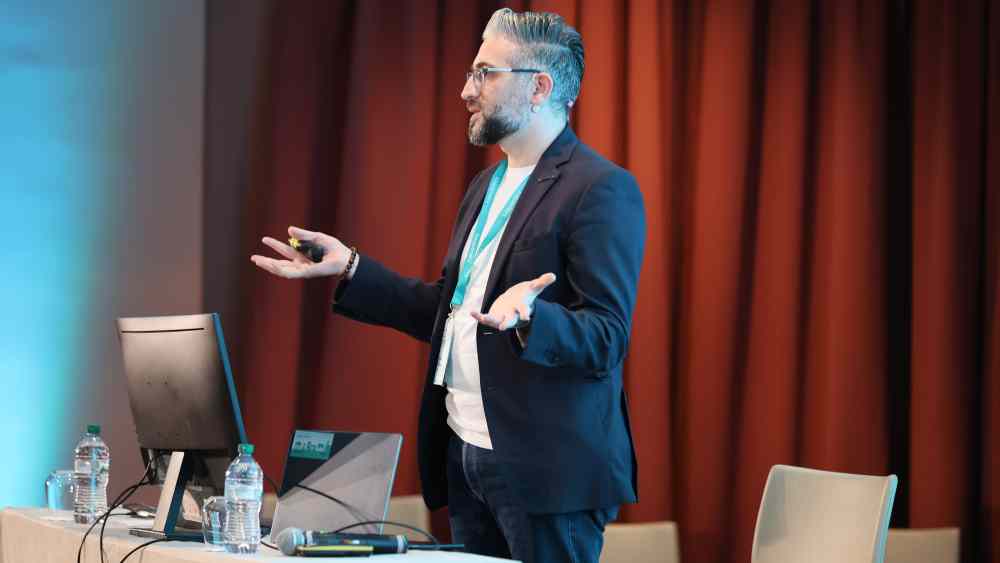
È il risultato mostrato da Kaspersky durante HORIZONS, la principale conferenza europea dell’azienda, in una dimostrazione condotta dal Global Research and Analysis Team, il GReAT.

I ricercatori hanno elaborato fotografie di volti reali con strumenti di intelligenza artificiale generativa, simulando scenari di invecchiamento e ringiovanimento. In molti casi le immagini prodotte sono apparse ai giornalisti presenti come ritratti di persone diverse, ma il sistema di riconoscimento facciale ha continuato ad associarle alle identità originali in dieci casi di test indipendenti.

Il punto, per Kaspersky, è duplice. Da una parte l’esperimento conferma che alcuni sistemi biometrici non si basano sulla semplice somiglianza visiva, ma su caratteristiche geometriche e strutturali del volto.

Dall’altra, proprio queste caratteristiche possono essere conservate anche in immagini sintetiche generate a partire da fotografie reali, creando un rischio per i sistemi automatici di verifica dell’identità.

Maher Yamout è Lead Security Researcher del Global Research and Analysis Team di Kaspersky.

Maher Yamout, Lead Security Researcher del Global Research and Analysis Team di Kaspersky, lo ha definito “una prova di fattibilità di un potenziale attacco basato sull’intelligenza artificiale”, precisando che l’esperimento non costituisce uno studio su larga scala.

La conseguenza pratica, ha spiegato, è che “le trasformazioni facciali generate dall’IA possono preservare l’identità biometrica anche quando la percezione umana interpreta le immagini come individui completamente diversi”.

Perché la macchina non vede quello che vediamo noi

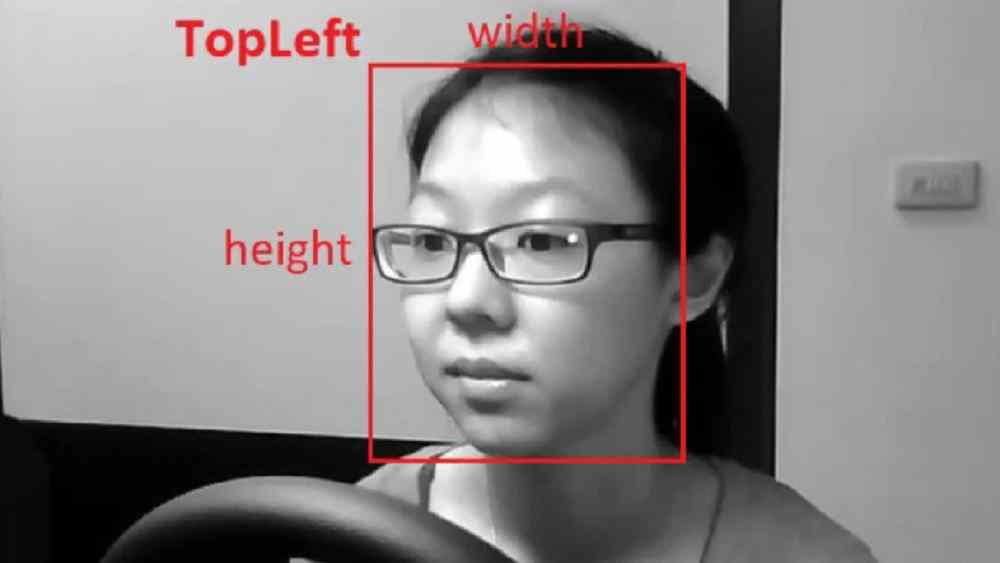
Per capire il problema bisogna distinguere due passaggi che spesso vengono confusi. Il primo è il rilevamento facciale: il sistema analizza un’immagine e stabilisce se al suo interno è presente un volto.

Il secondo è la verifica facciale: una volta individuato il volto, il sistema lo confronta con un’immagine di riferimento e valuta se appartiene alla stessa persona.

Nel suo intervento, Yamout ha spiegato che la macchina non “capisce” un volto nel modo in cui lo fa un essere umano. Non interpreta la pelle, l’espressione, l’impressione complessiva o la somiglianza visiva.

Il sistema individua l’area del volto, ne estrae caratteristiche e le converte in matrici matematiche. A quel punto confronta numeri, distanze e soglie di similarità.

Questo spiega perché un’immagine modificata dall’IA può apparire molto diversa a una persona, ma risultare ancora abbastanza vicina all’originale per un modello di riconoscimento.

L’intelligenza artificiale può cambiare l’età apparente, la texture della pelle, gli occhiali, alcuni dettagli estetici o lo stile dell’immagine, ma conservare elementi geometrici e strutturali sufficienti per superare il confronto biometrico.

Nella nostra intervista, avvenuta successivamente alla presentazione, Yamout ha riassunto il punto in modo molto diretto: “Le macchine non capiscono la pelle, non capiscono le fotografie”.

Secondo Yamout, sette modelli su otto hanno si sono fatti ingannare da immagini rifatte in stile Studio Ghibli. Che questa immagine sia sufficiente per fingersi Sam Altman?

I modelli, ha spiegato, cercano elementi come occhi, naso e bocca, individuano l’area del volto e la trasformano in numeri. “Quello che siamo riusciti a fare è stato cambiare l’aspetto visibile del volto ma mantenere intatta la struttura sottostante”.

Uno degli esempi più efficaci mostrati durante la presentazione riguardava un’immagine trasformata in uno stile illustrato simile a quello dello Studio Ghibli. A un osservatore umano non verrebbe naturale accettarla come prova di identità in un sistema di sicurezza.

Eppure, secondo Yamout, sette modelli su otto l’hanno comunque riconosciuta come riferibile alla stessa persona.

È un dettaglio aneddotico, che però rende bene la distanza tra la percezione umana e il calcolo biometrico.

KYC, onboarding e verifica dell’identità

Il tema diventa particolarmente rilevante nei processi di verifica dell’identità. Tra questi rientra il KYC, acronimo di “Know Your Customer”, cioè l’insieme delle procedure con cui banche, fintech, piattaforme finanziarie e altri soggetti verificano l’identità di un cliente prima di attivare un servizio o autorizzare determinate operazioni.

In molti casi l’utente carica un documento, scatta una foto o registra un breve video; il sistema confronta poi quei dati con un’immagine di riferimento.

Yamout ha indicato le università e le istituzioni finanziarie tra gli ambiti in cui possono essere ancora usate forme di verifica facciale bidimensionale.

È difficile misurarne la diffusione precisa, ha osservato, perché si tratta di una tecnologia comune, integrata in molti ambienti con motori, modelli e configurazioni differenti.

Il rischio più concreto riguarda gli scenari in cui un attaccante non genera un volto casuale ma parte da una fotografia reale.

Nella conferenza stampa Yamout ha parlato di immagini “seeded”: il modello riceve un’immagine iniziale e produce una variante sintetica, modificata secondo le istruzioni dell’operatore.

Questo rende l’attacco più mirato, perché l’immagine artificiale conserva una relazione matematica con il volto originale.

Yamout ha indicato le università e le istituzioni finanziarie tra i contesti in cui possono essere ancora usate forme di verifica facciale bidimensionale.

La conseguenza è che la verifica umana e quella algoritmica possono differire. Un operatore potrebbe considerare sospetta o non corrispondente un’immagine che il sistema giudica invece compatibile.

Oppure, in uno scenario automatizzato, una piattaforma potrebbe accettare un’immagine sintetica perché la distanza matematica rispetto al volto di riferimento rimane entro la soglia prevista dal modello.

Secondo Yamout, gli attaccanti partono sempre dallo studio dell’ambiente che vogliono colpire. Cercano di capire quali sistemi vengono usati, quali utenti sono coinvolti, quali software sono presenti e quali abitudini operative esistono all’interno dell’organizzazione.

Se scoprono che una procedura di verifica facciale usa un modello vulnerabile a immagini sintetiche o deepfake, quella procedura può diventare un punto d’ingresso.

La biometria resta utile, ma non basta da sola

Il messaggio di Yamout, però, non è che il riconoscimento facciale debba essere abbandonato.

Nell’intervista ha usato un paragone molto chiaro: le password continuano a essere usate anche se possono essere violate; i token di autenticazione a due fattori continuano a essere usati anche se possono essere sottratti con tecniche di phishing; gli antivirus continuano a essere distribuiti anche se esistono malware capaci di aggirarli.

La logica è la stessa per il riconoscimento facciale. Il riconoscimento facciale può ancora servire ma da solo non basta più a confermare un’identità. Deve essere affiancato da altri controlli, soprattutto nei processi più sensibili.

“Dobbiamo smettere di usarlo? No. È una buona misura di sicurezza”, ha spiegato Yamout. Il punto è affiancarla ad altri controlli compensativi: password, token, codici, verifica del dispositivo, analisi del comportamento, controlli documentali e procedure di escalation quando emergono anomalie.

Il riconoscimento facciale può ancora servire ma da solo non basta più a confermare un’identità. Deve essere affiancato da altri controlli, soprattutto nei processi più sensibili.

Questa logica vale soprattutto per i sistemi 2D. Yamout ha distinto questi scenari dal riconoscimento facciale usato ad esempio dagli smartphone, che si basa su scansioni 3D e quindi su una tecnologia più difficile da aggirare.

Anche in quel caso, ha ricordato, sono stati discussi tentativi di attacco tramite modelli tridimensionali del volto, ma il costo operativo è molto più alto. E nella sicurezza informatica, l’aumento del costo dell’attacco è già una forma di protezione.

È qui che torna il concetto di difesa in profondità. Se un sistema richiede password, token e verifica facciale, diventa più difficile aggirare tutto insieme. L’attaccante può riuscire a compromettere un fattore ma deve investire più tempo e più risorse per superarli tutti.

E spesso, ha detto Yamout, si sposta su un bersaglio più facile: “Gli attaccanti, alla fine, sono pigri”.

Le vecchie serrature vanno aggiornate

L’esperimento di Kaspersky non dice che ogni sistema di riconoscimento facciale sia facilmente aggirabile, né che la biometria abbia perso utilità.

Mostra però che immagini, audio e video generati dall’intelligenza artificiale stanno cambiando le regole della verifica dell’identità, costringendo aziende, sviluppatori e responsabili della sicurezza a ripensare molti processi oggi dati per affidabili.

Per anni il volto è stato trattato come un elemento forte dell’identità, perché difficile da replicare e immediato da verificare.

L’IA ha cambiato i termini del problema: può produrre immagini che confondono l’essere umano, preservano elementi biometrici rilevanti per la macchina e aprono nuovi scenari per frodi, identità sintetiche e manipolazioni nei processi di onboarding.

La risposta più solida passa da sistemi capaci di combinare più segnali. La verifica facciale deve essere accompagnata da controlli sulla provenienza dell’immagine, analisi del rischio, verifica del dispositivo, controlli antifrode e procedure manuali nei casi dubbi.

Dove la posta in gioco è alta, affidarsi a un singolo fattore espone a un rischio crescente.

Condividi l’articolo


Articoli correlati

Altro in questa categoria


https://www.securityinfo.it/2026/05/25/kaspersky-la-genai-mette-alla-prova-il-riconoscimento-facciale/?utm_source=rss&utm_medium=rss&utm_campaign=kaspersky-la-genai-mette-alla-prova-il-riconoscimento-facciale


Il robot domestico che ti pulisce casa per 150 dollari: una rivoluzione per il mercato del lavoro che taglierà fuori molti umani

Non è un mistero che le aziende tecnologiche stiano addestrando da anni i robot umanoidi. Fino a ieri, l’obiettivo era inserirli nelle catene di montaggio o nei grandi magazzini della logistica. Oggi, però, le macchine si preparano a varcare la soglia delle nostre case.

Il primo segnale concreto arriva da San Francisco. Una nuova azienda chiamata “Gatsby” ha appena lanciato un servizio di pulizia domestica che utilizza robot umanoidi, apparentemente modelli prodotti da Unitree. Queste macchine sono state addestrate per pulire ogni superficie: dai pavimenti ai piani di lavoro in cucina, fino agli specchi.

Il caso Gatsby: pulizie a tariffa fissa

L’offerta commerciale di Gatsby è chiara e molto aggressiva: 150 dollari per un intervento completo, indipendentemente dalle ore. Si tratta di un prezzo che rischia di cambiare le regole del gioco. L’azienda ha recentemente annunciato di aver portato a termine con successo la prima pulizia domestica per consumatori gestita interamente da un robot negli Stati Uniti.

“Abbiamo scelto un cliente a caso dalla nostra lista d’attesa,” ha comunicato l’azienda. “Abbiamo consegnato il robot e la macchina ha pulito l’intero appartamento da sola. Nessun umano all’interno“.

L’impatto economico: una spinta al ribasso sui prezzi

Per capire la portata economica di questa novità, basta confrontare i costi. Negli Stati Uniti, una pulizia profonda eseguita da un professionista costa in media tra i 200 e i 400 dollari, arrivando anche a 500 dollari per le case più grandi, oltre al problema di avere un estraneo in casa.

Servizio di Pulizia Costo Medio Stimato Affidabilità e Limiti
Lavoratore Umano 200$ – 400$ Soggetto a orari, ferie e stanchezza fisica, problemi di sicurezza  sui beni contenuti in casa
Robot Umanoide (Gatsby) 150$ (Fisso) Operatività continua, nessuno sforzo umano richiesto

Da un punto di vista puramente economico, l’ingresso dei robot nei servizi domestici ridurrà drasticamente i costi per le famiglie. Il minor costo potrebbe aprire un mercato completamente nuovo, con questo servizio non più riservato solo alle classi agiate, ma anche alle classi medie. Il mercato si può moltiplicare di molte volte

Gatsby robot che pulisce casa

La questione sociale: chi pagherà il conto?

Se il servizio si espanderà, minaccerà di spazzare via le agenzie di pulizia tradizionali e i lavoratori autonomi. Storicamente, le pulizie, la cucina e i servizi di cura della casa assorbono una grandissima quantità di manodopera a bassa qualifica, molto spesso coperta da lavoratori migranti.

Come prevede la banca d’affari UBS, se i robot diventeranno sempre più diffusi entro la fine del decennio, la domanda per la manodopera umana crollerà. A livello sociale, l’impatto sarà dirompente:

  • Crollo dell’occupazione di fascia bassa: Milioni di persone, spesso sprovviste di un’istruzione avanzata, si troveranno senza una fonte primaria di reddito. L’idea che costoro possano semplicemente reinventarsi come tecnici o programmatori è un’illusione.
  • Aumento delle tensioni sociali: La mancanza di lavoro per i nuovi arrivati, come i migranti, potrebbe innescare forti tensioni nelle aree urbane, alimentando il disagio nelle periferie.
  • Pressione sui bilanci pubblici: Gli Stati dovranno intervenire. Meno lavoratori significano meno tasse raccolte, ma la necessità di sostenere chi ha perso il lavoro richiederà un aumento massiccio della spesa pubblica per i sussidi. Bisognerà cambiare il soggetto dal reddito dei lavoratori a quello delel aziend e generato dai capitali, un cambiamento che non sarà politicamente semplice.
  • Sarà necessario un reddito universale e ripendare completamente i flussi migratori? A questo punto bisognerà pensare a un reddito universale per far fronte alla disoccupazione, e bisognerà anche rivedere la funzione dei flussi migratori.

La tecnologia promette di liberarci per sempre dalle faccende domestiche. Ma mentre i robot lucidano i nostri pavimenti a basso costo, i governi dovranno trovare in fretta delle soluzioni per evitare che l’efficienza tecnologica si trasformi in un disastro sociale. Non stiamo parlando solo di elettrodomestici più intelligenti, ma di una rivoluzione che modificherà le fondamenta della nostra struttura sociale.

L’articolo Il robot domestico che ti pulisce casa per 150 dollari: una rivoluzione per il mercato del lavoro che taglierà fuori molti umani proviene da Scenari Economici.

https://scenarieconomici.it/il-robot-domestico-che-ti-pulisce-casa-per-150-dollari-una-rivoluzione-per-il-mercato-del-lavoro-che-tagliera-fuori-molti-umani/


Il “motore” del cuore ricreato in provetta: dalla Cina il pacemaker biologico che cambierà la medicina

Il cuore è, in fin dei conti, una straordinaria e instancabile pompa elettromeccanica e biologica. E come ogni motore che si rispetti, possiede una sua centralina di accensione: il nodo seno-atriale. Nascosto nel profondo dell’atrio destro, questo minuscolo gruppo di cellule agisce come un vero e proprio pacemaker naturale, dettando il ritmo vitale attraverso impulsi elettrici. Quando questa centralina si guasta, la medicina tradizionale interviene con fili, batterie e circuiti elettronici, cioè il pace-maker. Una soluzione salvavita, certo, ma pur sempre una toppa metallica su un tessuto vivo.

Ora, però, la prospettiva sta cambiando radicalmente. A Shanghai i ricercatori dell‘Accademia Cinese delle Scienze e dell’Università Fudan hanno cercato una soluzione, ma in una direzione diversa rispetto a quella elettronica. Hanno creato in laboratorio il primo “pacemaker biologico” al mondo, un organoide tridimensionale del nodo seno-atriale capace di generare e regolare autonomamente il battito cardiaco.

Oltre i limiti della sperimentazione animale

Fino ad oggi, la ricerca sulle aritmie si è scontrata con un limite strutturale. Il nodo seno-atriale umano è microscopico e inaccessibile, e i modelli animali, come i classici topi da laboratorio, non replicano fedelmente la complessità del sistema elettrico dell’uomo.

Per superare l’ostacolo, i ricercatori cinesi sono partiti dalle cellule staminali pluripotenti umane. Guidando i segnali tipici dello sviluppo embrionale, hanno “coltivato” in una piastra di Petri questo minuscolo centro di controllo. Ma non si sono fermati qui: per rendere il sistema realistico, hanno collegato l’organoide a una rete nervosa artificiale (il plesso gangliare cardiaco), dimostrando che le fibre nervose possono penetrare nel tessuto, regolarne la frequenza e condurre i segnali elettrici. Un cuore in provetta, insomma, che batte e risponde agli stimoli proprio come farebbe nel nostro petto.

La fine dell’era elettronica?

Le prospettive di questa scoperta sono affascinanti. Il futuro della cardiologia, secondo questi sviluppi, non è l’innesto di macchine sempre più miniaturizzate, ma la medicina rigenerativa. I vantaggi sono innumerevoli: ad esempio non ci sono più problemi di compatibilità fra tessuti umani e componenti esterni, elettronici. L’impianto, se di questo si può parlare, è costituito da tessuto vivente, quindi non ci sono problemi di rigetto, di ricarica, etc. Si tratta di tessuto vivente dello stesso donatore.

Quando i ricercatori hanno introdotto nell’organoide mutazioni genetiche legate a disfunzioni del ritmo cardiaco, il “pacemaker” ha iniziato a battere più lentamente, replicando la malattia umana. Somministrando i farmaci corretti, il ritmo è tornato normale. Questo significa avere a disposizione una piattaforma perfetta per testare nuove cure senza rischi per i pazienti.

In un futuro non troppo lontano, i pazienti affetti da gravi aritmie potrebbero non aver più bisogno di dispositivi elettronici nel petto. Il futuro è rigenerare il cuore dall’interno, offrendo una cura meno invasiva, più naturale e, in definitiva, infinitamente più elegante.

Google NewsGoogle News Rimani aggiornato seguendoci su Google News!

SEGUICI

https://scenarieconomici.it/il-motore-del-cuore-ricreato-in-provetta-dalla-cina-il-pacemaker-biologico-che-cambiera-la-medicina/


L’Egitto fa centro nel Deserto Occidentale: 70 milioni di barili che cambiano le carte in tavola (e aggirano Suez)

Il mondo ha sete di energia. I mercati globali, scossi dalla guerra in Iran, tremano di fronte ai forti rincari e alle rotte di rifornimento sempre più incerte. In questa situazione critica, l’Egitto tira fuori dal cilindro — o meglio, dalle sabbie del Deserto Occidentale — una scoperta che non è solo una boccata d’ossigeno per le proprie casse, ma una mossa strategica fondamentale per l’economia dell’area.

Parliamo del più grande giacimento scoperto negli ultimi 15 anni in quella specifica zona. È un vero tesoro nascosto che promette di cambiare gli equilibri di un Paese che ha sempre bisogno di energia, strizzando l’occhio a un’Europa attualmente in piena crisi del gas.

I Numeri della Scoperta Bustan South-1X

Il Ministero del Petrolio egiziano ha annunciato con grande soddisfazione i risultati del pozzo esplorativo Bustan South-1X. I lavori, condotti dall’impianto EDC 9 per conto di Agiba Petroleum (una società mista tra la compagnia petrolifera di stato egiziana ed Eni), hanno nettamente superato le attese.

Le stime iniziali sono di tutto rispetto:

Tipo di Risorsa Quantità Stimata
Gas Naturale 330 miliardi di piedi cubi
Condensati e Greggio 10 milioni di barili
Totale Equivalente 70 milioni di barili (BOE)

Questa non è l’unica buona notizia dell’anno per l’Egitto e i suoi partner internazionali. Solo ad aprile, a circa 70 chilometri dalla costa, era stato annunciato il ritrovamento di altri 2000 miliardi di piedi cubi di gas. Negli ultimi due anni, queste operazioni esplorative hanno permesso ad Agiba di portare la produzione nel Deserto Occidentale a 32.000 barili al giorno, il livello massimo da tre anni a questa parte.

Il Triangolo d’Oro: posizione, costi e geopolitica

I numeri sono grandi, ma il vero punto di forza di questa scoperta è la sua posizione. Il nuovo pozzo si trova ad appena 10 chilometri dai tubi e dagli impianti già esistenti. Per chi investe questo significa una cosa molto chiara: si spende molto meno per avviare la produzione. L’allacciamento rapido alla rete energetica permetterà di incassare subito i frutti dell’investimento, senza i lunghi anni di attesa tipici dei nuovi enormi cantieri isolati.

La vera marcia in più, però, è la geopolitica. Lo sfruttamento del giacimento offre un’alternativa sicura alle crisi globali in corso. Il gas e il petrolio potranno infatti arrivare direttamente nel bacino del Mediterraneo, muovendosi verso l’Europa senza dover per forza passare per il difficile e congestionato Canale di Suez e senza sfiorare le acque sempre più pericolose del Mar Nero.

Oppure, scenario altrettanto probabile, queste nuove risorse andranno a saziare la fame cronica di gas dell’Egitto. In questo modo si sosterrà in maniera vitale la domanda dell’economia interna e si eviteranno i pesantissimi danni causati dai continui blackout alle industrie locali.

Google NewsGoogle News Rimani aggiornato seguendoci su Google News!

SEGUICI

https://scenarieconomici.it/legitto-fa-centro-nel-deserto-occidentale-70-milioni-di-barili-che-cambiano-le-carte-in-tavola-e-aggirano-suez/


Kaspersky: gli agenti IA cambiano la fiducia aziendale


Gli agenti di intelligenza artificiale sono ormai entrati nel radar dei criminali informatici. Dall’inizio dell’anno, infatti, Kaspersky ha rilevato a livello mondiale oltre 92.000 attacchi malware camuffati da servizi e agenti IA.

Il dato è stato presentato a Roma durante Kaspersky HORIZONS, e racconta bene quanto rapidamente l’hype sull’intelligenza artificiale sia stato metabolizzato anche dal cybercrime. Tant’è che le false applicazioni di ChatGPT rappresentano il 49% degli attacchi rilevati, mentre Claude e Gemini incidono ciascuno per il 18%.

Accanto ai nomi più noti, i ricercatori hanno individuato oltre 15.000 file malevoli distinti mascherati da software di IA autonoma, comprese versioni contraffatte di strumenti emergenti come OpenClaw.

Il punto, però, non è soltanto che i criminali usino l’IA come nuova esca. Nel suo intervento, Dmitry Galov, Head of Kaspersky’s Global Research & Analysis Team per Russia e CIS, ha spiegato che dietro molti di questi falsi strumenti si nascondono malware già noti.Ci riferiamo a banking trojan, spyware, infostealer, exploit e downloader in grado di installare ulteriori payload dannosi.

La novità sta nella confezione: gli attaccanti sfruttano la fiducia nei brand dell’IA e la curiosità verso strumenti percepiti come indispensabili per restare al passo.

cover Galov Kaspersky

Dmitry Galov, Head of Kaspersky’s Global Research & Analysis Team per Russia e CIS.

La supply chain dell’IA diventa un bersaglio

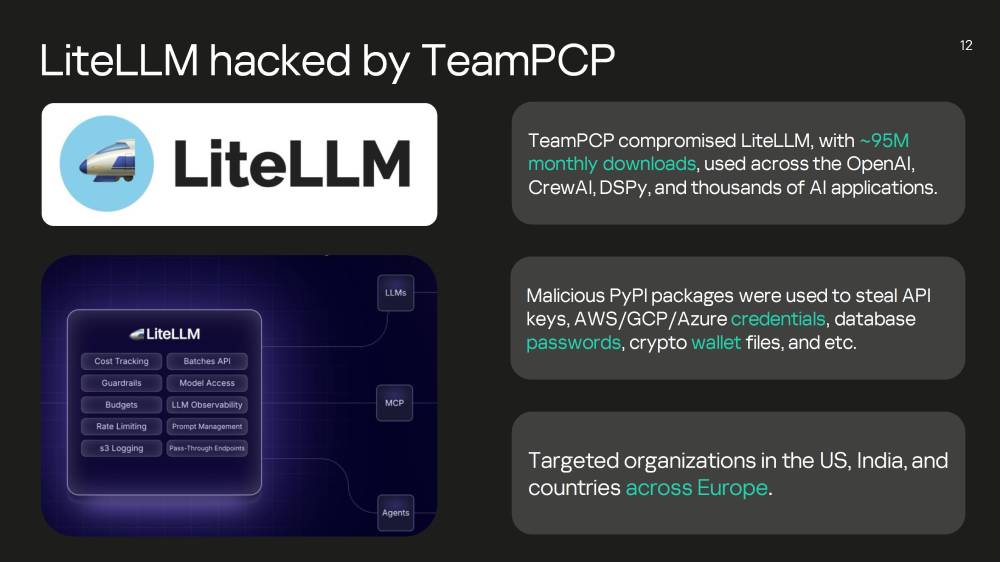
Un’altra area di rischio riguarda la supply chain del software. Galov ha citato il caso di LiteLLM, una libreria Python ampiamente usata per accedere a modelli di intelligenza artificiale, con circa 97 milioni di download mensili.

La compromissione della libreria ha permesso di inserire codice dannoso capace di sottrarre credenziali di database, file di wallet di criptovalute e altre informazioni sensibili. È un esempio concreto di come un singolo componente esterno, se compromesso, possa trasformarsi in un punto d’ingresso verso molte organizzazioni contemporaneamente.

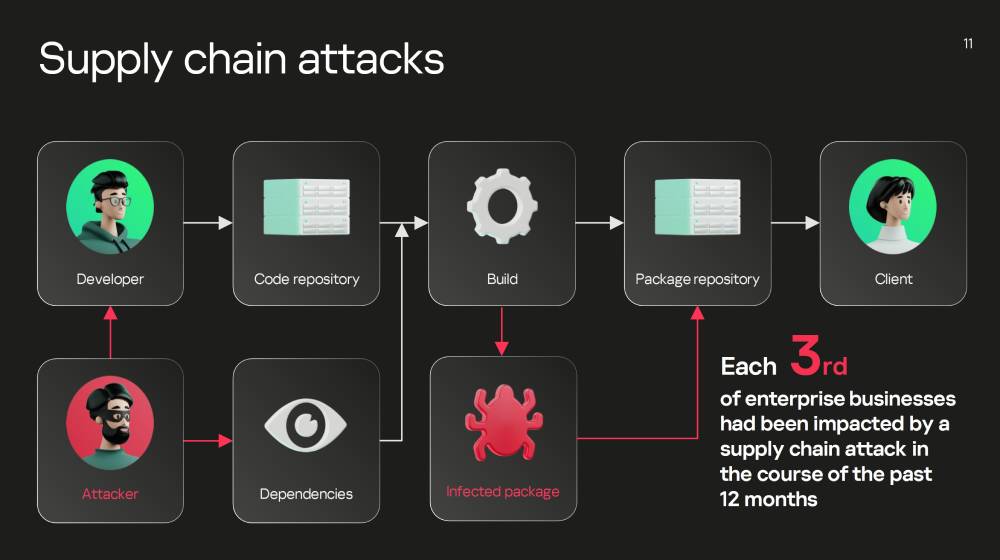
Galov ha chiarito nell’intervista che il problema non riguarda solo l’IA. Qualsiasi software moderno può dipendere da librerie, pacchetti open source o componenti di terze parti. Nel caso dell’intelligenza artificiale, però, l’ecosistema si sta sviluppando a grande velocità, in modo aperto e collaborativo, e questo rende più appetibili le dipendenze esterne.

Per ridurre il rischio, secondo Galov, serve integrare la sicurezza in tutto il ciclo di sviluppo del software: ogni pacchetto esterno introdotto in un prodotto o in un’infrastruttura deve essere controllato da motori di rilevamento e gestito con policy chiare.

Per gli aggiornamenti non legati alla sicurezza, ha suggerito anche una finestra di “cool down”, evitando di adottare automaticamente l’ultima versione appena pubblicata. Molti attacchi alla supply chain, ha spiegato, restano attivi per finestre molto brevi, da pochi minuti a qualche giorno, prima di essere individuati dalla comunità open source o dai vendor di sicurezza.

Compromettendo LiteLLM (95 milioni di download mensili), il gruppo TeamPCP ha aperto una breccia in migliaia di applicazioni contemporaneamente, sottraendo credenziali cloud e chiavi di accesso ai modelli.

ClickFix e la vecchia debolezza umana

La corsa agli strumenti di IA ha riattivato anche tecniche di ingegneria sociale più classiche. Galov ha citato il caso degli attacchi ClickFix, in cui falsi tutorial o documentazioni apparentemente legittime convincono l’utente a copiare e incollare un comando nel terminale.

L’utente pensa di installare un componente, configurare un ambiente o migliorare le prestazioni di uno strumento, in realtà esegue una stringa malevola. Il meccanismo è particolarmente efficace perché colpisce sviluppatori, tecnici e persone che stanno cercando guide pratiche per entrare nel mondo degli agenti IA.

Nella nostra intervista, successiva alla presentazione, Galov ha ricondotto questi attacchi a una dinamica nota: le esche cambiano ma la natura umana resta la stessa. Gli utenti tendono a fidarsi di ciò che percepiscono come utile, urgente o di valore.

Sul primo gesto, cioè copiare, incollare e premere Invio, la tecnologia può fare ben poco. La difesa può però intervenire negli stadi successivi, con soluzioni di rilevamento e risposta sugli endpoint (EDR) e altri livelli di protezione capaci di bloccare l’esecuzione o riconoscere comportamenti malevoli prima che l’attacco raggiunga il suo obiettivo finale.

Negli attacchi alla supply chain, il bersaglio non è mai quello finale. Un’azienda su tre ne è rimasta vittima nell’ultimo anno.

Skill, plugin e falsi strumenti legittimi

Il rischio non si esaurisce nei malware travestiti da app IA. Kaspersky segnala anche la crescita delle “malicious skills”, cioè funzionalità dannose nascoste all’interno dei flussi di lavoro basati sull’intelligenza artificiale.

Possono presentarsi come plugin, prompt o estensioni apparentemente innocue, in realtà sono progettate per esfiltrare dati, fare ricognizione o manipolare risultati.

È un passaggio importante perché sposta il tema dalla protezione del singolo endpoint alla sicurezza dell’intero ecosistema agentico. OpenClaw, citato sia nel comunicato sia durante l’intervento, diventa in questo senso un esempio del nuovo perimetro da controllare.

Gli agenti IA possono essere estesi con skill e plugin, e queste estensioni possono a loro volta scaricare dipendenze, interagire con strumenti locali o collegarsi a servizi esterni.

La domanda di sicurezza non riguarda quindi solo il modello ma tutto ciò che gli viene connesso: codice, permessi, API, dipendenze e automazioni.

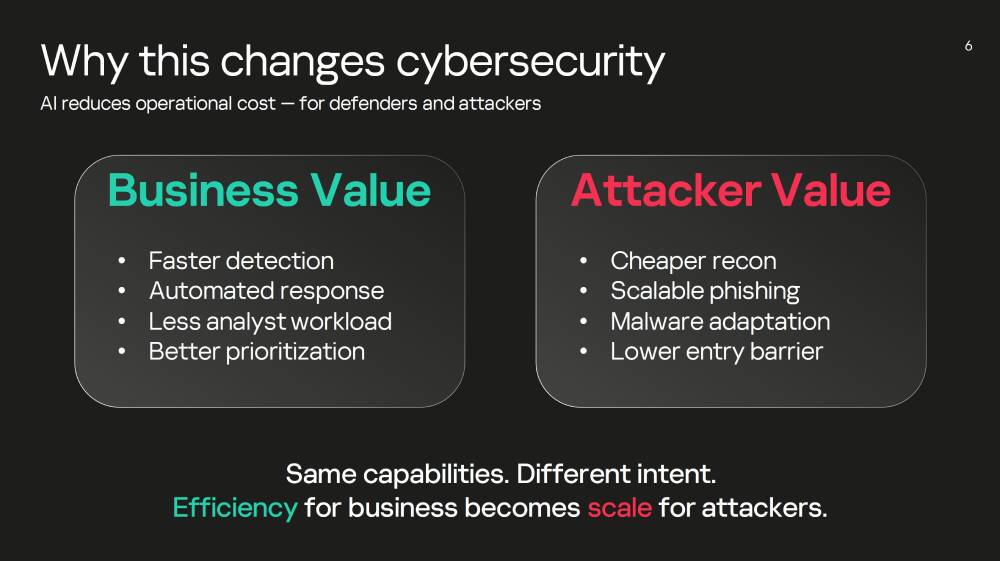
L’IA in ottica cybersecurity: stessi strumenti, intenzioni opposte. Quello che per le aziende è efficienza, per gli attaccanti diventa scala.

Gli agenti aumentano l’efficienza, ma anche l’esposizione

Nel corso della nostra intervista, Galov non ha proposto una lettura allarmistica. Anzi, ha definito gli agenti IA un grande vantaggio per l’efficienza, anche nella cybersecurity e nei SOC, soprattutto quando aiutano ad automatizzare attività ripetitive. Il problema nasce quando vengono adottati senza una postura di sicurezza adeguata.

La sua analogia è semplice: passare da carta e penna a un laptop aumenta senz’altro l’efficienza, ma anche il rischio di vulnerabilità. La scelta non è tra innovazione e sicurezza, ma tra automazione governata e automazione lasciata senza controllo.

Una posizione, questa, che troviamo anche nei comunicati di Kasperky: “L’introduzione di agenti di intelligenza artificiale negli ambienti aziendali cambia la natura stessa della fiducia. Ogni azione automatizzata diventa parte di una catena più ampia di sistemi e scambi di dati”.

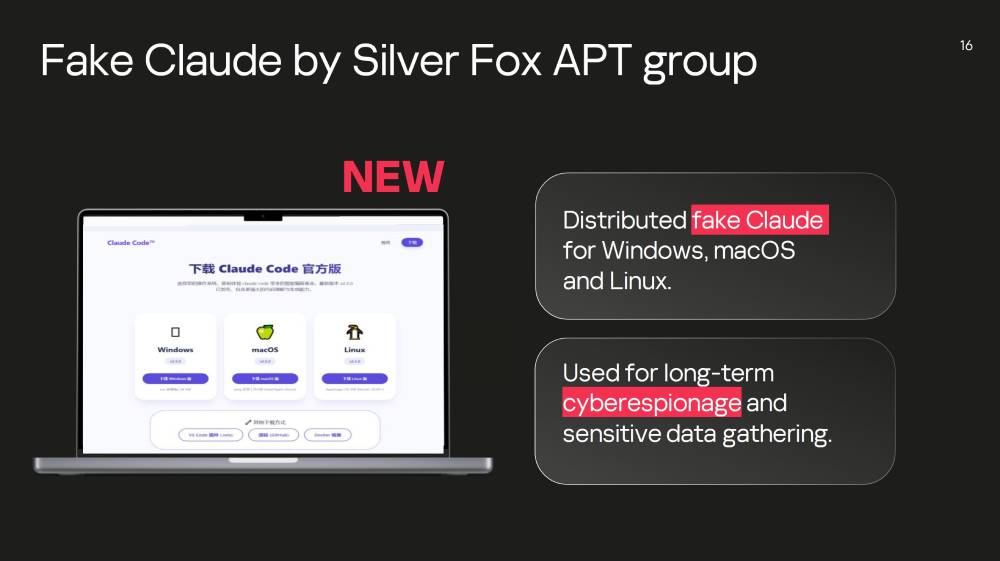
Il gruppo Silver Fox ha usato versioni false di Claude Code. Un caso che mostra come la diffusione degli strumenti IA apra nuove superfici d’attacco basate sull’ingegneria sociale.

Il nuovo controllo passa da dati, decisioni e log

Non corso dell’intervista, non ci è  restato che chiedere a Galov delle possibili contromisure. Per Galov le aziende devono concentrarsi su due piani: data management e decision management.

Il primo riguarda i dati a cui l’agente può accedere: bisogna verificare che siano davvero necessari per il compito assegnato e che non venga concesso più di quanto serva.

Il secondo riguarda le azioni che l’agente può compiere: per le decisioni più sensibili deve restare una validazione umana, una sorta di secondo fattore in cui il controllo finale torna a una persona.

A questo si aggiunge la visibilità sull’infrastruttura intorno agli agenti, che comunicano con modelli esterni, tool di terze parti e API.

Per questo, secondo Galov, le aziende devono raccogliere log ed eventi, integrarli in sistemi SIEM e metterli a disposizione dei SOC analyst. Il rischio peggiore è che qualcosa accada senza sapere chi lo ha fatto, quale componente lo ha eseguito e quali dati o sistemi siano stati coinvolti.

È lo stesso principio che Kaspersky riassume nelle sue raccomandazioni: standardizzare interfacce e protocolli, applicare il principio del minimo scambio necessario di dati, identificare chiaramente utenti, agenti e servizi IA, mantenere la supervisione umana nei processi critici e procedere con implementazioni graduali, includendo eventuali rollback.

Condividi l’articolo


Articoli correlati

Altro in questa categoria


https://www.securityinfo.it/2026/05/22/kaspersky-agenti-ia-cambiano-fiducia-aziendale/?utm_source=rss&utm_medium=rss&utm_campaign=kaspersky-agenti-ia-cambiano-fiducia-aziendale


Siamo noi il valore

Nel nostro canale Youtube “Moneta Positiva”, abbiamo pubblicato un video musicale di cui ho scritto parole e musica, poi arrangiata con l’AI.
Questa è la versione Rock da stadio:

[embedded content]

Mentre questa è la versione Jazz da piano bar, per i palati più raffinati…

[embedded content]

Per chi vuole valutare meglio il testo, queste sono le parole della canzone “Siamo noi il valore”:

Virus, pandemie, fame, malattie
ci distraggono, ci dividono
segui i soldi, fino in fondo
per scoprire, chi guadagna, dal dolore

Armi, eserciti, banche, debiti
demoliscono, arricchiscono
segui i soldi, fino in cima,
per trovare, chi specula, sul dolore

Noi crediamo che, il debito c’è, senza un perché
ma paghiamo sempre noi, senza chiederci mai poi,
se ci sia un’alternativa, al sistema che ci rende, tutti schiavi del presente
Non possiamo fare niente, se l’informazione mente
non vediamo mai, che cosa accade in noi

Se distratti, da paura, accettiamo di tutto, anche se…
Siamo noi, il valore, meritiamo amore, salute e libertà

Si può crescere, nel benessere
Ci vuole poco, è quasi un gioco
Cambia i soldi, cambia il mondo
Per provare, che possiamo, stare meglio

Noi vogliamo che, il denaro c’è, non solo per me
ma per tutti quanti noi, senza diventare eroi
una vera alternativa, una società che tende, a favore della gente
Senza limitare niente, col potere della mente
capiremo poi, che cosa abbiamo in noi

È una forza, dirompente, inventiamo già tutto, sai perché?
Siamo noi, il valore, perché siamo amore, salute e libertà

Fabio Conditi
Presidente dell’associazione Moneta Positiva
fondatore del Movimento culturale Un Mondo Positivo
https://unmondopositivo.it/

Google NewsGoogle News Rimani aggiornato seguendoci su Google News!

SEGUICI

https://scenarieconomici.it/siamo-noi-il-valore/


HackerOne taglia drasticamente le ricompense dei bug bounty


L’epoca d’oro dei bug bounty potrebbe stare entrando in una nuova fase molto più complessa. HackerOne, una delle piattaforme più importanti al mondo per la segnalazione responsabile di vulnerabilità, ha drasticamente ridotto le ricompense economiche del proprio programma Internet Bug Bounty (IBB), provocando forti reazioni nella comunità dei ricercatori di sicurezza.

Secondo quanto riportato da The Register, i compensi per le vulnerabilità critiche sono stati ridotti di oltre il 75%. Un bug critico che in precedenza poteva valere circa 9.250 dollari viene ora premiato con appena 2.257 dollari. Anche le altre categorie hanno subito ridimensionamenti drastici: le vulnerabilità high severity passano da circa 4.429 a 1.009 dollari, mentre le medium severity scendono da 1.843 a 297 dollari.

Il taglio rappresenta uno dei segnali più evidenti della crisi che sta attraversando il settore del vulnerability research crowdsourced, sempre più travolto da una crescita esplosiva di report generati con l’AI, falsi positivi e attività automatizzate a basso valore.

La rivoluzione AI sta travolgendo i bug bounty

Negli ultimi mesi il mondo dei bug bounty è stato investito da un’ondata senza precedenti di segnalazioni generate o assistite da AI. Secondo diversi operatori del settore, i moderni LLM consentono ormai anche a utenti con competenze offensive limitate di produrre grandi quantità di report apparentemente plausibili, saturando i team di triage e aumentando enormemente il rumore operativo.

Il problema non riguarda solo HackerOne. Secondo Financial Times, alcune piattaforme hanno registrato un aumento quadruplo delle submission nel giro di poche settimane, mentre la percentuale di report realmente validi sarebbe crollata in molti casi sotto il 5%.

Il problema è talmente grave che persino Linus Torvalds ha recentemente definito la mailing list sicurezza del kernel Linux “quasi completamente ingestibile” a causa dell’aumento di report AI-generated.

HackerOne cerca di ridurre il rumore operativo

Il drastico ridimensionamento delle ricompense sembra quindi essere parte di una strategia più ampia. Già ad aprile 2026 HackerOne aveva annunciato la sospensione temporanea delle nuove submission per il programma Internet Bug Bounty, spiegando che il rapporto tra velocità di discovery e capacità di remediation era diventato insostenibile.

Secondo la piattaforma, l’intelligenza artificiale ha “industrializzato” la scoperta delle vulnerabilità molto più rapidamente rispetto alla capacità dei maintainer open source di validare, correggere e distribuire patch. In pratica, l’intero ecosistema dei bug bounty starebbe soffrendo un problema strutturale: trovare vulnerabilità sta diventando sempre più facile, ma gestirle continua a richiedere tempo umano altamente specializzato.

Questo crea un paradosso operativo. Da un lato le piattaforme ricevono volumi enormi di report; dall’altro il valore medio reale delle submission tende a diminuire.

Il rischio di una crisi economica per i ricercatori indipendenti

La riduzione dei payout rischia però di avere conseguenze importanti anche sulla sostenibilità economica del bug hunting indipendente. Negli ultimi dieci anni piattaforme come HackerOne e Bugcrowd hanno contribuito a trasformare il vulnerability research in una vera professione, creando un mercato globale basato sulla disclosure responsabile.

Molti ricercatori hanno costruito carriere interamente basate sui bug bounty, mentre alcune aziende hanno iniziato a utilizzare il crowdsourced testing come alternativa o complemento ai penetration test tradizionali. Secondo vari report di settore, i payout per vulnerabilità critiche nei programmi enterprise possono ancora raggiungere cifre a sei zeri, soprattutto in ambito cloud, crypto e infrastrutture strategiche. Tuttavia il drastico taglio del programma IBB mostra che il modello economico tradizionale potrebbe non essere più sostenibile per alcuni ecosistemi open source.

Il rischio, secondo diversi esperti, è che i ricercatori più qualificati inizino progressivamente ad abbandonare i bounty pubblici meno remunerativi, spostandosi verso altri ambiti.

L’effetto collaterale: meno vulnerabilità divulgate?

Storicamente i bug bounty sono stati considerati uno strumento fondamentale per incentivare la disclosure responsabile. L’idea alla base del modello è relativamente semplice: pagare i ricercatori affinché segnalino vulnerabilità ai vendor invece di venderle a broker, spyware company o gruppi criminali.

Ma il mercato delle vulnerabilità è cambiato enormemente negli ultimi anni. Diversi studi mostrano che il valore economico dei mercati grigi e dei broker zero-day può essere enormemente superiore rispetto ai payout tradizionali dei bug bounty. In alcuni casi vulnerabilità particolarmente critiche possono raggiungere cifre superiori al milione di dollari sui mercati offensivi.

Se i payout pubblici diminuiscono troppo, il rischio teorico è che una parte dei ricercatori inizi a considerare meno conveniente la disclosure responsabile tradizionale. Naturalmente il panorama resta molto più complesso di così. Per molti ricercatori contano anche reputazione, visibilità, riconoscimento professionale e opportunità lavorative future. Tuttavia il fattore economico continua a rappresentare uno dei principali motori dell’intero ecosistema.

Condividi l’articolo


Articoli correlati

Altro in questa categoria


https://www.securityinfo.it/2026/05/21/hackerone-taglia-drasticamente-le-ricompense-dei-bug-bounty/?utm_source=rss&utm_medium=rss&utm_campaign=hackerone-taglia-drasticamente-le-ricompense-dei-bug-bounty


Best AI search analytics tools for marketing teams

I’ve spent the last year watching marketing teams scramble to understand why their organic traffic reports tell one story while their pipeline tells another. The missing link is almost always a need for AI search analytics tools. Get Started with HubSpot's AEO Tool

When a prospect asks ChatGPT, “What’s the best CRM for a mid-sized SaaS company?” and your brand doesn’t appear in the answer, no SERP rank tracker in the world will tell you — at least not yet. That gap is exactly what AI search analytics tools are built to close and why every growth-focused team needs at least one in their tech stack right now.

This guide covers what these tools do, which features actually matter, and recommended platforms based on team size, budget, and use case.

I’ll also walk through how to set a credible baseline and use your data to drive real content and distribution decisions.

Table of Contents

What are AI search analytics tools?

AI search analytics tools are software platforms that track how and where a brand appears in responses generated by AI-powered answer engines and chatbots, including ChatGPT, Google AI Overviews, Perplexity, Gemini, and Claude.

Unlike traditional SEO analytics tools, which measure SERP rankings, clicks, and website traffic from Google’s organic blue-link results, AI search analytics tools measure the following from AI-powered answer engines:

  • prompts
  • citations
  • brand mentions
  • sentiment
  • AI referral traffic
  • Share of voice

The distinction matters because the consumer behavior behind the two is genuinely different.

When someone searches Google for “best yoga mats for home workouts,” they likely expect to see a ranked list and choose where to click.
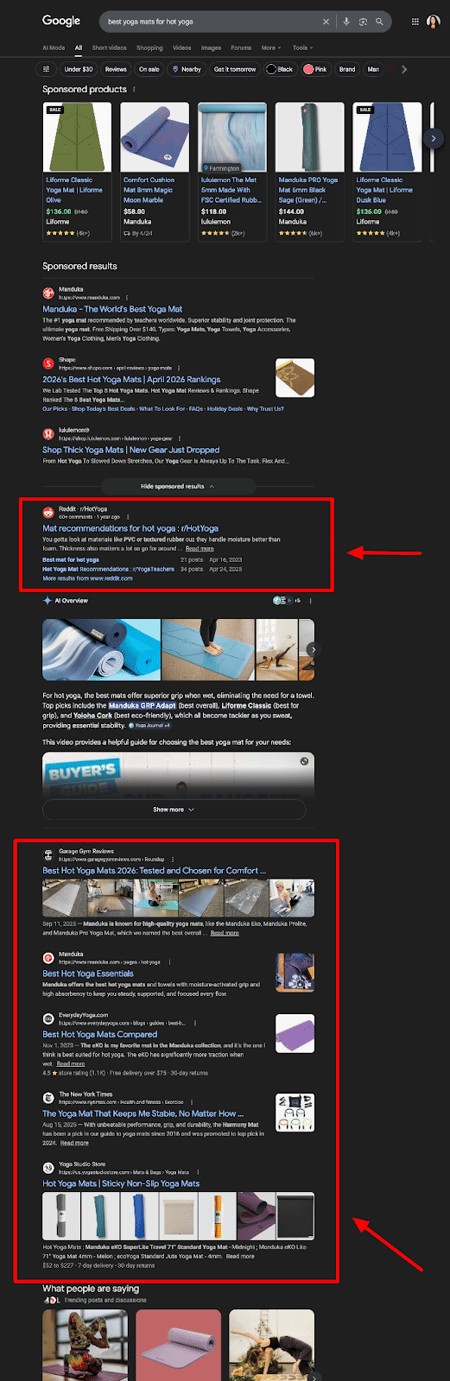
google search results page showing regular, blue link list results to the query best yoga mat for hot yoga

When someone asks ChatGPT the same question, the model synthesizes a direct recommendation, and businesses either appear in those recommendations or they don’t.
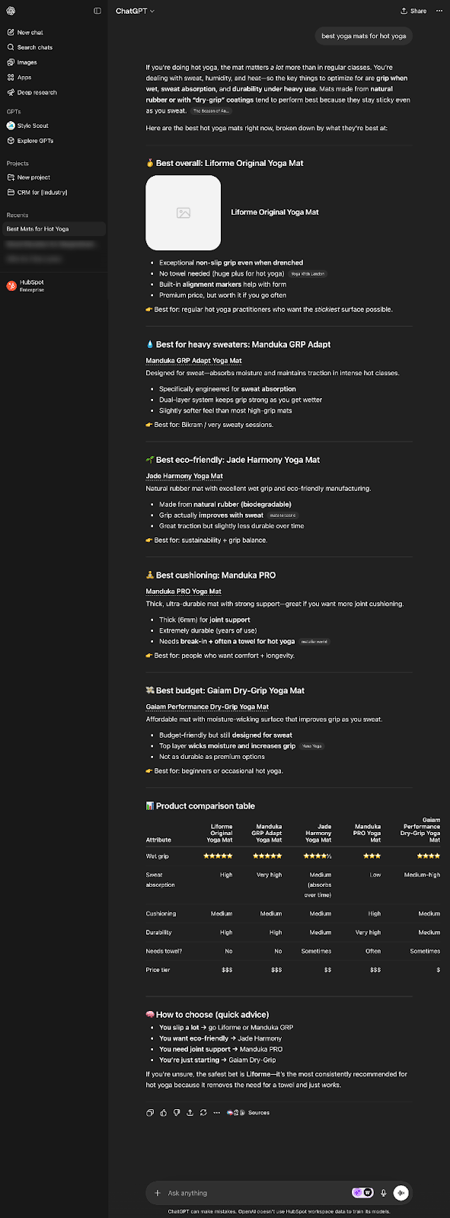
chatgpt results page showing anser engine recommendations to the query best yoga mat for hot yoga

Read: ChatGPT Product Recommendations: How to Make Sure You Are One in 2026

Why do they matter?

Experts suggest AI search traffic could overtake traditional organic search traffic within the next two to four years, and AI-referred visitors already convert at 4.4 times the rate of organic visitors from traditional search.

The impact of AI search results is already significant.

Google AI Overviews now appear in approximately 25% of searches, based on Semrush’s analysis — up from 13% in March 2025. ChatGPT has surpassed 800 million weekly active users. And 73% of B2B buyers now use AI tools in their purchase research process, according to a March 2026 synthesis of 680 million AI citations.

Despite this, however, only 22% of marketers currently track AI visibility, meaning the competitive window for early movers is still open.

How marketing teams use AI search analytics tools

AI search analytics tools support four core marketing workflows, each addressing a blind spot that traditional analytics platforms can’t cover.

  • Content planning: Understanding which prompts trigger AI responses in your category reveals gaps your existing content doesn’t address.
  • Brand monitoring: Tracking when, how, and in what context AI systems mention your brand catches reputation risks that traditional media monitoring misses entirely.
  • Competitive intelligence: Seeing which competitors appear alongside your brand — or instead of it — for high-intent prompts gives a new category of market signal.
  • Attribution: Linking AI citations to referral traffic and conversion rates finally gives brands a feedback loop to prove ROI on AEO and GEO investments.

For a deeper strategic context on how AI is reshaping the marketing stack, the free HubSpot AI Web Analytics guide is a useful companion read.

Features to look for in AI search analytics tools

The AI visibility platform category emerged quickly, and tooling maturity varies significantly across vendors. My experience evaluating these platforms has taught me that features fall into two buckets: core visibility capabilities and operational needs.

Both are needed before committing to any paid subscription.

Core Visibility Features

Platform Coverage

A brand can appear in 90% of prompts on one platform and be completely absent from another, so multi-platform tracking is not optional.

At minimum, your a should track ChatGPT, Gemini, and Perplexity as these are the three largest platforms by user base and have the strongest impact on purchase research. Google AI Overviews, Microsoft Copilot, and Claude coverage broadens brand signal, but only matters if your audience actively uses those platforms.

HubSpot AEO tracks ChatGPT at all levels, including Free, while paid accounts add Perplexity and Gemini. More platforms are in the works.

Prompt Tracking

The ability to define and monitor specific conversational prompts (aka the actual questions buyers type into AI systems) is the core unit of measurement in this category.

Look for tools that let teams enter their own prompts and suggest others based on industry and competitors. The quality and relevance of the prompt library directly determine how useful the visibility data will be.

In HubSpot AEO, the Prompts tab is where marketers manage which questions they’re tracking and see how their brand performs on each one.
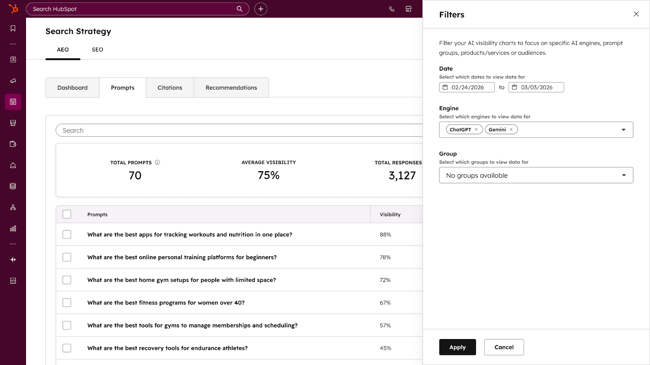
ai search analytics tools, HubSpot AEO search strategy dashboard for prompt management

Teams can also view recommendations and organize prompts into groups by product line or customer segment, which makes it easier to analyze performance for specific parts of the business.
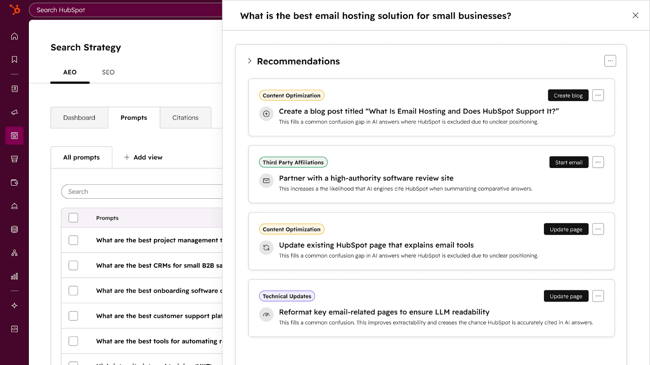
ai search analytics tools, hubspot aeo prompt recommendations dashboard with suggestions tailored to a specific business case

Citation and Mention Analysis

Beyond knowing whether the brand appears, marketers need to know which URLs AI systems are citing, how often, and in what position. Having the specific URLs helps teams understand what pages are working and what needs to get done to accomplish set goals.

Unlinked mentions matter too. AI systems frequently reference brands without hyperlinking, and those mentions still shape perception. Tools that separate linked citations from brand mentions give a more complete picture.

The Citations tab in HubSpot AEO breaks down exactly which sources AI is pulling from.
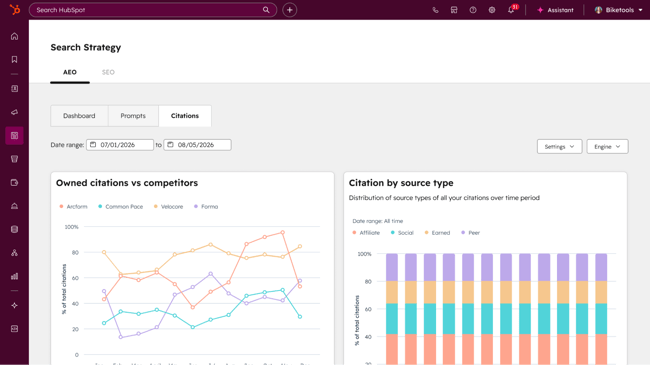
ai search analytics tools, hubspot aeo citations dashboard showing which types of content are cited.

You can see which content types are most commonly cited (listicles, blog posts, product pages, news articles, etc.), which channels those citations come from (your own website, earned media, review sites, user-generated content like Reddit, and so on), and which specific domains are getting cited most often.

There’s also a competitive view that shows how often AI cites a website compared to competitors, and how often a brand is mentioned across citations overall.

Sentiment Analysis

Are AI systems describing your brand positively, negatively, or neutrally? Sentiment scoring at the mention or citation level reveals whether the brand’s AI presence is helping or hurting. It also flags reputational issues before they appear in conversion data.

Alongside Brand Visibility in HubSpot AEO, there is a Sentiment Analysis tab. This measures how positively or negatively a brand is described in AI-generated responses, on a scale from -100% to +100%.

Competitor Benchmarking

Share of voice, or the percentage of AI responses in a given category that include a brand versus its competitors, is the key performance indicator in this space. Knowing competitor traffic in general can also help give marketers context.

Look for tools like HubSpot AEO that let teams track a defined competitor set and show where the brand is winning or losing.

Operational Needs

The core visibility features are only half the equation. How a tool handles data history, alerting, and integrations determines whether it fits into a real team’s workflow.

Historical Data

AI visibility shifts with model updates, changes in training data, and seasonal demand patterns. Without historical trending, marketers can’t distinguish a real improvement from model volatility. Look for at least 90 days of historical data, ideally more.

Alerting

Visibility can change overnight when a major publication covers a competitor or when a model update reweights its training data. Alerts for significant mention gains, citation losses, or competitor overtakes let teams react in near real-time rather than catching changes in a monthly report.

HubSpot AEO, for example, offers weekly score tracking and trend alerts.

Exports and Integrations

AI visibility data becomes far more accurate and actionable when it connects to the tools a team already uses (i.e. Google Analytics, Search Console, Slack, Looker Studio, CMS)

Native exports to CSV or direct integrations let teams fold AI visibility into existing reporting cadences. HubSpot AEO fully integrates with existing HubSpot workflows and tools (like Content Hub and Marketing Hub) as well as third-party tools like Reddit and TikTok.

Governance and Access Control

Enterprise teams managing multiple brands or regional markets need workspace separation, role-based permissions, and ideally compliance certifications like SOC 2 Type II. These aren’t nice-to-haves for large organizations; they’re requirements that keep a company’s activities secure and organized.

Tools like HubSpot have robust user permission settings to help with this.
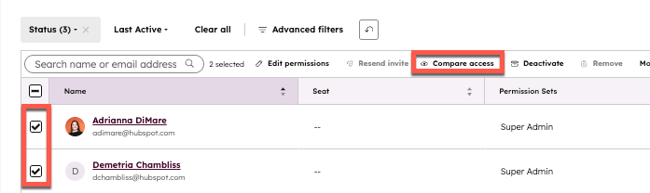
ai search analytics tools: hubspot access control dashboard

Quick Vendor Demo Checklist

Before any sales call or trial, I recommend running through this list to stress-test the tool against your actual use case:

  • Can I add my own custom prompts, or am I limited to what the platform suggests?
  • Which AI platforms are covered on my plan, and which require an upgrade?
  • How far back does historical data go, and how often does it update?
  • Can I export data to CSV and connect to Google Looker Studio or a BI tool?
  • Does the tool distinguish between linked citations and unlinked brand mentions?
  • What alerting options exist for significant visibility changes?

Below is a breakdown of the platforms I’d put on any marketing team’s tech stack shortlist, organized from free to enterprise.

I’ve included a coverage comparison table to help you see the platform tradeoffs at a glance. An asterisk (*) indicates that a feature is available only on higher-tier plans.

AI Search Analytics Tool Coverage Comparison

*Claude monitoring is available on Profound Enterprise plans only. Pricing current as of April 2026.
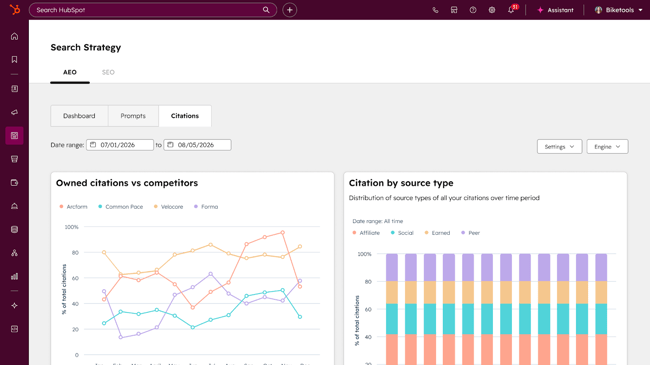
1. HubSpot AEO

hubspot aeo owned citations vs competitors dashboard allows users to track answer engine citations by source over a period of time

Best for: Marketing teams that want ongoing AI visibility tracking, competitive benchmarking, and prioritized recommendations across ChatGPT, Perplexity, and Gemini in one platform.

HubSpot AEO tracks how a brand appears in AI-generated answers across ChatGPT, Perplexity, and Gemini on a daily basis. It analyzes brand mentions, competitor share of voice, and citations — and crucially, tells teams what to do about what it finds.

The Prompts tab is where marketers manage which questions they’re tracking and see how the brand performs on each one. Marketers can organize prompts into Groups by product line or customer segment, making it easier to analyze performance for specific parts of the business. Prompts are suggested based on business context, and for Marketing Hub customers, CRM data makes those suggestions more relevant from day one.

The Citations tab breaks down exactly which sources AI is pulling from — which content types are most commonly cited, which channels those citations come from, and which specific domains are getting cited most often. There’s also a competitive view showing how often AI cites your website versus competitors.

Alongside Brand Visibility, a Sentiment Analysis tab measures how positively or negatively a brand is described in AI-generated responses over time.

What sets HubSpot AEO apart from monitoring-only tools is the recommendations layer. Rather than just surfacing where a brand appears or doesn’t, it delivers prioritized actions — from creating new content to building presence on third-party platforms that answer engines trust. For Marketing Hub Pro and Enterprise customers, those recommendations connect directly to HubSpot’s content tools.

Not ready to commit to a paid plan? Start with HubSpot’s free AEO Grader, which gives teams a one-time snapshot of their brand’s visibility across ChatGPT, Perplexity, and Gemini. This option includes sentiment analysis, share of voice, and a competitor comparison — with no setup required. It’s a strong starting point before moving to ongoing tracking.

Pro tip: Run the AEO Grader on the brand’s top two competitors before the first strategy session. The side-by-side score comparison gives immediate context for where the brand is over- or under-indexed relative to the market, and it’s a compelling slide in a stakeholder deck.

What we like: Daily tracking across three platforms, citation and sentiment analysis, prioritized recommendations, CRM-connected prompt suggestions, and a free Grader for teams not yet ready for a paid subscription.

Pricing: Free 28-day trial available. Paid plan starts at $50/month, or included in Marketing Hub Pro and Enterprise at no additional cost.
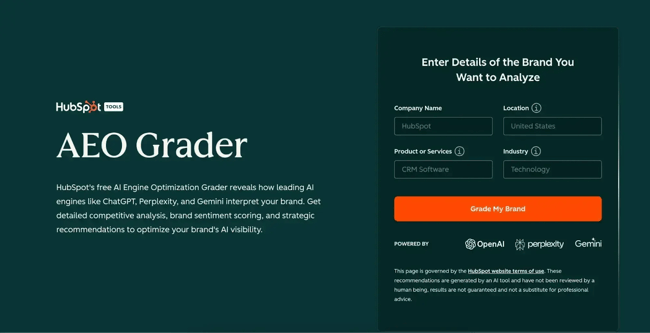
2. HubSpot AEO Grader

hubspot aeo grader let’s users track their brand’s current visibility in answer engines like chatgpt, perplexity, and gemini

Best for: Teams new to AI visibility who want a free, no-setup audit across ChatGPT, Perplexity, and Gemini.

I’d start any AI visibility conversation with HubSpot’s free AEO Grader, because it immediately shows brands where they stand before spending a dollar on paid tooling.

AEO Grader evaluates your brand across five scored dimensions:

  • Sentiment Analysis
  • Presence Quality
  • Brand Recognition
  • Share of Voice
  • Market Competition.

It also cross-validates results across GPT-5.2, Perplexity, and Gemini simultaneously to produce a composite score out of 100, plus a written interpretation and an exportable report.

What makes it genuinely useful for getting started is that it goes beyond a single score. Marketers get narrative theme analysis (the recurring stories AI consistently associates with your brand), source quality assessment (identifying which publications and domains are shaping how AI perceives you), and competitor comparison.

For competitive intelligence, the tool accepts any brand name, so teams can run the same analysis on top competitors.

HubSpot also offers deeper AEO Strategy features, including content scoring, optimization recommendations, and AI referral traffic reporting, directly in the platform — creating a loop from brand audit through content action to traffic measurement.
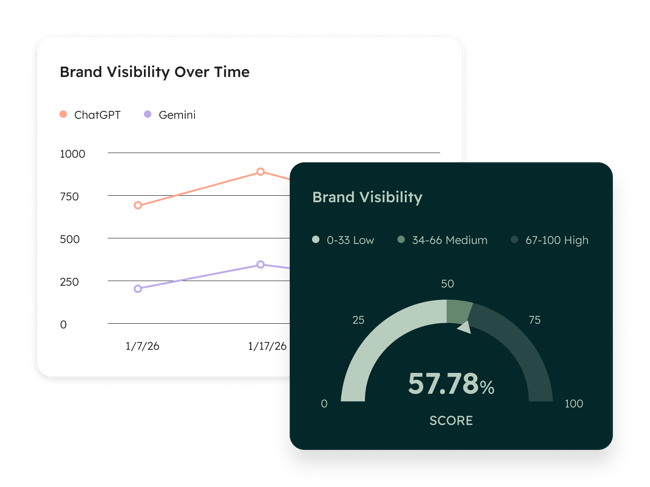
ai search analytics, aeo tool

Pro tip: Run the AEO Grader on your top two competitors before your first strategy session. The side-by-side score comparison gives you immediate context for where you’re over- or under-indexed relative to the market, and it’s a compelling slide in a stakeholder deck.

What we like: Free, no setup, cross-validates across three AI platforms simultaneously, produces an exportable report with source-level analysis. Strong starting point before committing to a paid tool.

Pricing: AEO Grader is free for all, and you can get started with HubSpot AEO for free as well. Paid add-on is available for $50/month.
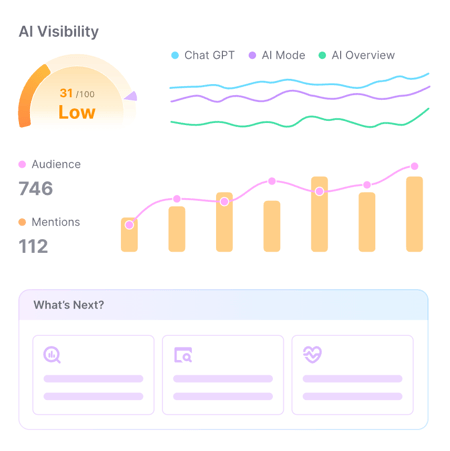
3. Semrush AI Visibility Toolkit

ai search analytics tools, semrush ai visibility dashboard with visibility score

Source

Best for: Teams already using Semrush who want SEO and AI visibility in one platform, or agencies needing scalable prompt tracking with competitive benchmarking.

If your team already lives inside Semrush for keyword research and rank tracking, the AI Visibility Toolkit is the natural upgrade path. It tracks brand mentions and visibility across ChatGPT, Google AI Overviews, AI Mode, Perplexity, and Gemini.

The greatest selling point, however, is the integration: teams can see their traditional SEO rankings and your AI visibility on the same platform, in the same reporting cadence, without context-switching.

The toolkit is now bundled into Semrush One, launched in October 2025, which combines the full SEO toolkit with AI visibility tracking.

I’ve found the AI Visibility Score to be a useful executive-level metric. It gives you a single number to track over time and benchmark against competitors. The Brand Performance reports are the most actionable feature, showing sentiment shifts, source attribution, and competitive positioning week over week.

What we like: All-in-one SEO + AI visibility, strong prompt-tracking infrastructure, Brand Performance reports with source attribution, familiar interface for existing Semrush users.

Pricing: Semrush One Starter begins at $199/month and includes both toolkits. The standalone AI Visibility Toolkit is $99/month per domain, though the base plan limits users to 25 custom prompts — and scaling up for additional domains or prompt volume adds cost quickly.
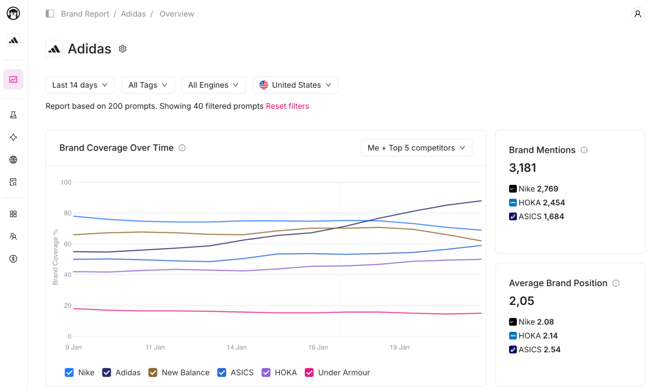
4. Otterly.AI

ai search analytics tools otterly brand coverage over time dashboard example using adidas

Source

Best for: Marketing teams and agencies that need fast, affordable brand monitoring across six AI platforms with a clean interface and strong GEO audit capabilities.

Otterly.AI has built a strong reputation as the most accessible pure-play AI search monitoring tool on the market. Used by over 20,000 marketing professionals and recognized as a Gartner Cool Vendor in 2025, it covers ChatGPT, Google AI Overviews, Google AI Mode, Perplexity, Gemini, and Microsoft Copilot, making it the broadest platform coverage at its price tier.

The core workflow is prompt-based: users define a library of conversational queries that mirror what their buyers actually type into AI systems, and Otterly automatically runs those prompts across its covered platforms, logging brand mentions, citation URLs, share of voice, and sentiment over time.

On top of that, the Brand Visibility Index and weekly citation change alerts are particularly useful for catching competitive shifts before they surface in the pipeline.

One honest limitation: Otterly is a monitoring-first approach. It provides clear insight into what’s happening, but it doesn’t include built-in content creation or optimization capabilities. Marketers will need separate tools to act on what they discover.

What we like: Six-platform coverage, clean GEO audit tool, Google Looker Studio connector, weekly citation alerts, agency workspace support. Strong value for monitoring-focused teams.

Pricing: Lite at $29/month (15 prompts), Standard at $189/month (100 prompts), Pro at $989/month (1,000 prompts). Free trial available. The pricing jump is steep for teams that outgrow the entry tier.
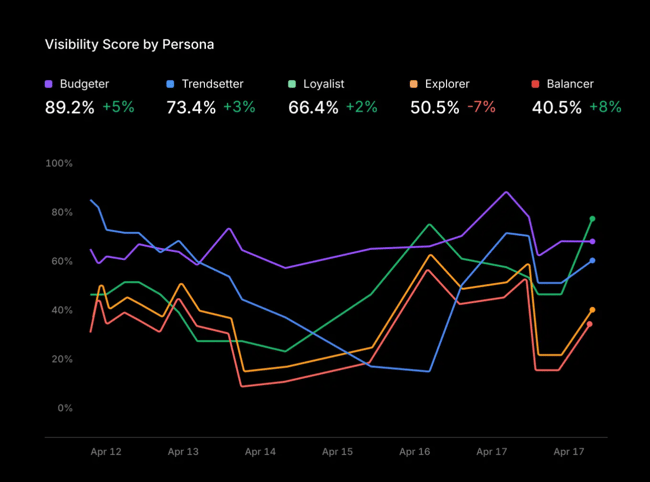
5. Profound

ai search analytics tools, profound’s visibility by persona dashboard

Source

Best for: Enterprise marketing teams with compliance requirements, Fortune 500 brands needing multi-model coverage, including Claude and Grok, and teams that want both monitoring and AI-optimized content creation in one platform.

Profound is the most funded dedicated AI visibility platform in the market, having raised $58.5 million across seed, Series A, and Series B rounds.

It’s built for organizations with enterprise-scale needs like SOC 2 Type II and HIPAA compliance and multi-workspace management. It also covers 10+ AI models, including Claude, Grok, and DeepSeek on enterprise tiers.

Profound’s standout feature, in my opinion, is its Conversation Explorer, a real-time window into what millions of users are actually asking across AI platforms, with search volume data that was previously invisible to marketers.

Combined with the AI Visibility Dashboard and Prompt Volumes analytics, it gives content, PR, and brand teams a market intelligence layer that goes well beyond citation tracking. The platform also includes Agents for creating AI-optimized content, making it one of the few tools that closes the loop between insight and execution.

What we like: Enterprise security, Conversation Explorer for market research, AI Agents for content creation, and the deepest AI model coverage at enterprise tiers. Best for large organizations serious about AI search as a strategic priority.

Pricing: Starter from $99/month (ChatGPT only), Growth at $399/month, Enterprise custom. No free trial.
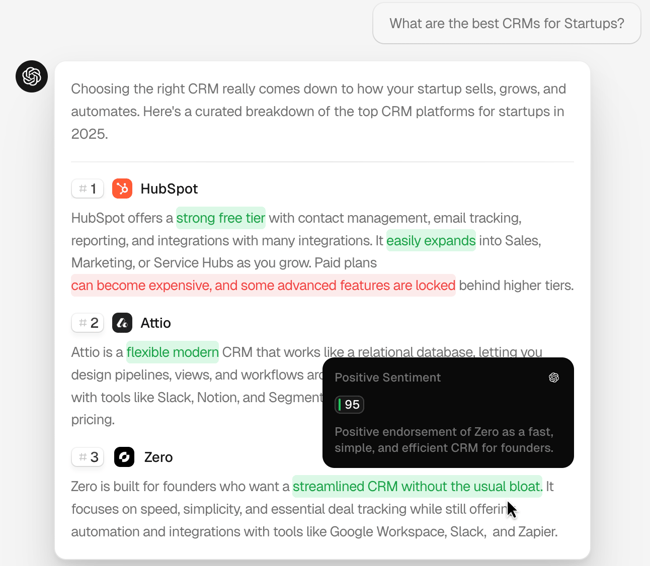
6. Peec AI

ai search analytics tools, peec ai’s sentiment analysis tool showing hubspot with a 95% positive sentiment for the keyword “what are the best startups”

Source

Best for: Content-led SaaS and B2B teams that want granular visibility, segmentation by model, region, and audience persona — with fast setup and daily refresh.

Peec AI runs prompts across ChatGPT, Perplexity, and DeepSeek once every 24 hours, with filtering by country IP, AI model, and prompt tags (such as audience persona or funnel stage).

That segmentation capability is more granular than most tools at its price point, and it’s particularly useful for B2B teams running multi-market or multi-persona strategies.

What we like: Granular segmentation by model, region, and persona. Daily refresh cadence. Fast onboarding. Strong fit for SaaS teams running structured AEO programs.

Pricing: Starting at €89/month. Free trial available.
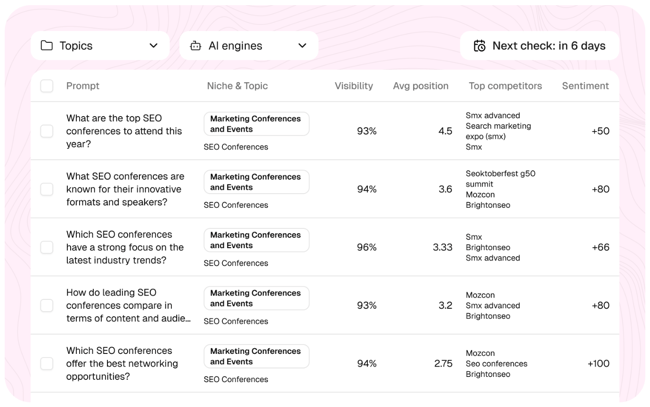
7. SE Visible by SE Ranking

ai search analytics tools, se visible let’s users view prompts and brand mentions

Source

Best for: Teams that want an affordable, beginner-friendly AI visibility add-on with clean dashboards and strong net sentiment tracking — especially if they already use SE Ranking for traditional SEO.

SE Visible is SE Ranking’s dedicated AI visibility platform. It tracks brand visibility across ChatGPT, Perplexity, Google AI Mode, and Gemini, with dashboard filters for date, region, topic, competitor, sentiment, and AI engine.

The four top-line metrics (visibility score, rank, average position, and net sentiment) are surfaced immediately at the dashboard level, making it one of the most accessible tools for teams new to the category.

SE Visible is also particularly strong on sentiment tracking. It scores weekly sentiment shifts with a clear net score and breaks down how mentions are framed positively, negatively, or neutrally across platforms.

What we like: Intuitive dashboard, strong net sentiment scoring, source analysis for citation strategy, solid fit for agencies adding AI visibility to their service offering without a steep learning curve.

Pricing: Starting at $49/month. Free trial available.

How to Baseline and Benchmark With AI Search Analytics Tools

One of the most common mistakes I’ve seen teams make is purchasing an AI visibility platform and immediately trying to optimize without first establishing where they actually stand. Baselining is not optional. Without a baseline, marketers can’t distinguish a real improvement from model volatility, and can’t prove ROI to stakeholders who need to justify the subscription spend.

Start by running HubSpot’s free AI Search Grader on the brand and its top three competitors. This gives a composite score across five dimensions cross-validated across ChatGPT, Perplexity, and Gemini. Export the report. This becomes the team’s T0 benchmark. Use it to initiate the team’s AI search analysis workflow.

Fast-start Baseline Workflow

Use this workflow to move from zero visibility data to an active monitoring and optimization system in two weeks.

Week 1: Establish your prompt library.

  • List the 10–20 questions buyers most commonly ask when researching your category. Start with awareness-stage prompts (“What is the best [category] for [use case]?”) and work toward decision-stage prompts (“Compare [your brand] vs. [competitor].”). Review your sales conversations and conduct customer research to uncover these.

    Read: Top 15 Tools For Finding Long-Tail Keywords

  • Add these to your chosen monitoring platform. If your tool suggests prompts, use those as a secondary layer. AI can make mistakes, so you don’t want to shape your strategy on its suggestions alone.
  • Set a competitive benchmark by running the same prompt library against your top three competitors and logging their baseline scores.

Week 2: Conduct a Citation Gap Analysis (Document your citation sources.)

  • Which domains is AI citing when it references your brand? Which domains is it citing when it references competitors?
  • This list becomes your citation gap analysis. These are the publications, review sites, forums, and third-party sources you need to build or strengthen your presence on.
  • Log your Share of Voice percentage for each AI platform separately. A brand that dominates Perplexity citations and has zero Google AI Overview presence has a very different action plan than one with the reverse pattern.

Ongoing: Review and update worksheet weekly.

Each week, take time to review and update all crucial metrics including:

  • Share of Voice this week vs. last week, by platform
  • New citations gained or lost, with the source domain
  • Sentiment score change, with any notable positive or negative prompt surfacing
  • Competitor movement: who gained or lost citations in your category
  • Priority action item for the week: one content, PR, or technical fix based on the data

The goal of a weekly cadence is not to react to every fluctuation — AI models update constantly, and model volatility is real. The goal is to identify directional trends over four-to-eight week windows and build your optimization backlog around those patterns, not week-to-week noise.

How to Improve AI Visibility With Insights From These Tools

Analytics without action is just pointless. The power of AI search analytics tools comes from translating citation gaps, sentiment signals, and competitive benchmarks into a prioritized content and distribution plan.

Here’s how I’d structure the AI SEO side of this workflow.

Content Updates based on Citation Gap Analysis

If your monitoring tool shows that a competitor is being cited for a prompt where you’re absent, the first question is: do you have content that directly addresses that prompt?

If not, create it. If you do, audit whether it’s structured for AI retrievability. This includes:

  • Short, extractable answer blocks
  • Clear headings
  • FAQ schema
  • Original data (that gives AI systems and others a reason to cite you as a primary source.)

New Content Assets Targeting High-value Prompts

According to recent AirOps research, there are certain structured content formats that significantly lift AI citation rates. For instance:

  • Comparison pages with three or more tables earn 25.7% more citations
  • Shortlist-style pages averaging fewer than 10 words per sentence earn up to 18.8% more citations.

Use your prompt data to identify the highest-volume, highest-intent queries in your category, then build content specifically structured to answer those questions clearly and completely.

Authoritative Citation Building

AI systems develop their understanding of brands from the web sources in their training data. The domains AI cites most frequently are high-authority publications, Reddit threads, review platforms, and “Best X” listicles.

Your citation gap analysis will tell you which of those surfaces you’re missing from. Targeted media outreach, guest contributions, and review site presence on the sources that AI trusts are your highest-leverage external actions.

Structured Data and Technical AI Readiness

Schema markup, particularly FAQPage, HowTo, Article, and Organization schema, improves the probability that AI systems can extract and attribute your content correctly.

Check your monitoring tool’s technical audit recommendations, and ensure that AI crawlers (GPTBot, ClaudeBot, PerplexityBot) have access to your key pages. Blocked crawlers are one of the most common and easiest-to-fix sources of low AI visibility for established brands.

Cross-channel Distribution to Expand the AI Training Signal

Single-source content rarely builds AI trust at scale.

As HubSpot’s AEO guide explains, consistent brand messaging across multiple trusted platforms — industry publications, forums, YouTube, LinkedIn, review sites — signals to AI systems that there is a reliable, multi-source consensus around your brand.

AI visibility data can tell marketers which channels are contributing to brand citations and which aren’t, so teams can focus distribution effort where it drives the most citation lift.

FAQs About AI Search Analytics Tools

Which AI platforms should marketing teams monitor first?

Prioritize the platforms buyers actually use. For most B2B marketing teams, that means starting with ChatGPT and Google AI Overviews, which together represent the largest share of AI-driven referral traffic. ChatGPT now drives 87.4% of all AI referral traffic to websites, while Google AI Overviews appear in approximately 25% of all Google searches and dramatically compress CTR for the organic results below them.

Add Perplexity if the audience skews toward technical or research-oriented buyers, whose citation behavior tends to favor high-authority, primary-source content. Gemini is worth adding for consumer-facing brands and any team already investing in Google’s ecosystem.

When should you invest in an AI visibility platform versus building in-house?

The build-vs-buy decision comes down to speed, coverage, and ongoing maintenance cost. Building a basic prompt-tracking system is technically feasible, but engineering and maintenance costs typically exceed a year’s subscription to a purpose-built platform — and a homegrown system will still exclude Google AI Overviews natively.

The recommendation: buy before you build, at least for the first 6–12 months. Start with HubSpot’s free AEO Grader for quarterly brand audits, then add a paid monitoring tool like HubSpot AEO once a baseline is established and the highest-priority platforms and prompts are clear.

How do I prove ROI from AI visibility improvements?

Start by segmenting AI referral traffic in Google Analytics 4. HubSpot’s platform groups AI referrals separately in Traffic Analytics, making it possible to build reports specifically for AI-sourced visitors. Track conversion rate, time on site, and pipeline attribution for that segment separately from organic and direct channels.

The benchmark worth holding in mind: AI search visitors convert at 4.4 times the rate of traditional organic visitors, and SE Ranking’s data found AI visitors spend 68% more time on websites than traditional organic visitors. Even small improvements in AI share of voice can translate to outsized revenue impact relative to the effort invested.

What’s the best way to keep up with model updates and volatility?

AI model updates are the single biggest source of short-term volatility in AI visibility data. The most practical approach is maintaining a change log that records significant model updates alongside visibility metrics, so shifts in Share of Voice can be correlated with external causes rather than assumed to reflect something the team did or didn’t do.

Set up alerting in the monitoring platform for sudden changes in brand mention volume, sentiment score, or competitive positioning. Most platforms notify within 24–48 hours of significant shifts, giving teams time to investigate before a stakeholder asks.

AI search visibility is full of opportunity

The shift to AI-mediated search is already reshaping how buyers discover, evaluate, and choose brands. The teams that invest in measurement now will have months of baseline data, a tested prompt library, and an optimization playbook by the time their competitors begin asking the right questions.

Regardless of budget or team size, the underlying principle is the same. Visibility can’t be improved without first being measured. Start with the free AEO Grader, run it on top competitors, and build from there.

Source



AI citation tracking tools to monitor and increase visibility

The brand tracking dashboard says awareness is up. Social listening tools show steady mention volume. The PR platform logged a dozen media hits last quarter. But, none of those tools show how a brand shows up when a buyer asks ChatGPT, Perplexity, or Gemini for a recommendation. Get Started with HubSpot's AEO Tool

AI citation tracking monitors when AI-generated answers cite a brand as a source. That requires a fundamentally different toolkit than traditional SEO or media monitoring. Think purpose-built platforms that query across multiple answer engines, run prompt variations, and surface competitive share of voice. Most tool stacks can’t do this, even with AI market research tools in the mix.

This guide covers what AI citation tracking means, which features to prioritize, and how eight leading tools compare on pricing and capabilities. It also walks through a four-dimensional framework to score each option. Looking to track AI citations? Get started with HubSpot AEO today.

Table of Contents

What is a citation in AEO?

a hubspot-branded image defining and explaining, in plain english, ai citation tracking-1

A citation in AEO (answer engine optimization) is when an AI-generated answer references a brand, content, or domain as a source. It’s the AI equivalent of being quoted in a news article, except the “journalist” is ChatGPT, Perplexity, or Gemini, and the “article” is the answer a buyer reads before they ever visit a website.

In practical terms, when someone asks an answer engine, “What’s the best CRM for small businesses?” and the response says “According to HubSpot’s 2026 Marketing Report…” or links directly to a page on a business’s domain, that’s a citation. The AI selected a specific brand’s content from everything it indexed and presented it as a credible source in its answer.

That selection is what makes citations in AEO fundamentally different from traditional mentions. The LLM didn’t just reference a brand; it recommended the brand as the answer.

That said, citations in AI answers typically take three forms:

  • Direct source citations: The AI links directly to a specific page as a source. It’s also the most visible, trackable, and the data point most AEO tools are built around.
  • Brand entity mentions: The AI names a company, product, or expert without linking to a source. A phrase like ‘HubSpot recommends using a content calendar…‘ signals authority even without a URL.
  • Indirect references: The AI paraphrases a brand’s content without naming it. These are the hardest citations to catch, but some advanced AEO tools detect them by running semantic similarity checks against a brand’s published content library.

Most teams only track the first type. That’s a problem, because all three shape how visible a brand is in AI-generated answers. If a team only tracks direct URL citations, they’re undercounting their AI presence. They also miss signals about where their brand has authority but isn’t getting explicit credit.

HubSpot AEO captures all three citation types — direct links, brand mentions, and indirect references — so teams don’t undercount their true visibility in AI-generated answers. Its citation analysis shows how often each citation type appears across prompts and engines.

Why do AEO citations matter for marketers?

Citations in AI answers carry more weight than traditional search rankings or social mentions because they influence buyer behavior. When an answer engine cites a brand’s content, it’s doing three things simultaneously:

  • Positioning the brand as a trusted source. The LLM evaluated the brand’s content against every other indexed source on that topic and chose that one. That’s an algorithmic endorsement, and buyers treat it as one.
  • Influencing decisions before the click. Unlike organic search results, where a user scans 10 blue links, an AI answer delivers a synthesized recommendation. If a brand is cited in that recommendation, it has shaped the buyer’s perception before they visit any website. If a brand is absent, a competitor steps in.
  • Creating a new attribution channel. AEO citations drive measurable referral traffic visits from ChatGPT, Perplexity, and other AI domains that appear in marketing analytics. But they also drive unmeasurable influence: buyers who see a brand cited in an AI answer, then search for it directly or mention it in an internal Slack thread.

In short, AEO citation tracking focuses on citations and source references shown in AI-generated answers. But the downstream impact extends well beyond what any tool can fully attribute. This is why tracking for AEO has become a priority for marketing leaders, SEO strategists, and PR teams alike.

Pro tip: Unsure whether a brand is being cited in AI answers at all? Start with a free baseline before investing in paid tools. HubSpot’s AEO Grader benchmarks brand visibility in answer engines across ChatGPT, Perplexity, and Gemini, and scores brands on recognition, sentiment, share of voice, market positioning, and presence quality.

How are AEO citations different from traditional citations?

An AEO citation is a source reference inside an AI-generated answer. It means the LLM selected a brand’s content as relevant, credible, and useful enough to include in its response.

This definition should not be confused with other uses of the word “citation” in academia, SEO, and PR. In traditional SEO, a citation often refers to a NAP listing (name, address, phone number) in a local business directory. In academic research, it’s a footnote referencing a source. In PR, it’s a media mention.

Here are the key distinctions between traditional and AEO citations:

Understanding this distinction is the first step toward choosing the right AEO citation tracking tools. The tools, metrics, and optimization strategies are entirely different from traditional citation management.

HubSpot AEO and AEO features in Marketing Hub Pro and Enterprise show where content is being selected or passed over in AI answers. Built-in competitor comparisons turn citation tracking into a true share-of-voice analysis, not just a visibility check.

What is AI citation tracking in AEO?

a hubspot-branded image defining and explaining, in plain english, ai citation tracking

AI citation tracking monitors when and where AI-generated answers reference a brand, content, or domain as a source. When a user asks ChatGPT, Perplexity, or Google’s AI Overview a question, the AI pulls from indexed web content such as articles, reports, product pages, and documentation. Then, it often cites those sources directly in the response, which are the “citations” in LLM answers that marketers need to track.

AI citations differ from traditional brand monitoring. Traditional brand monitoring tells marketers that someone mentioned their company on X or in a news article. Citation tracking for AEO tells them that ChatGPT named their blog post as a source when answering a user’s question about their industry. It’s a fundamentally different kind of visibility with different implications for traffic, authority, and pipeline.

AI-generated answers are now a primary way decision-makers consume information. That makes AEO citation tracking essential. If a brand’s content is cited in an AI answer, it’s influencing the buyer before they ever visit the site. If it’s not, the brand is invisible in a growing share of how decisions actually get made.

Traditional monitoring and AI citation tracking don’t just measure different things; they look in completely different places.

For teams trying to track citations to their site in AI results, this means existing PR dashboards and social listening tools won’t surface the data they need. They need purpose-built AEO tools that query LLMs directly and log when their domain appears as a source.

Top tools for tracking citation data address this by automating multi-model, multi-prompt verification at scale. HubSpot AEO automates prompt tracking across ChatGPT, Perplexity, and Gemini, running queries daily and logging when a brand or its competitors are cited. Results roll up into a single answer engine visibility score so teams can quickly see where they stand.

Pro tip: Want to learn more about AEO in under 30 minutes? Check out this video from HubSpot’s Marketing YouTube channel:

Who needs AI citation tracking, and for what?

a hubspot-branded image defining and explaining, in plain english, what marketers measure with ai citation tracking tools

Marketers use AI citation tracking tools to measure:

  • Share of voice
  • PR impact
  • Content performance
  • Pipeline influence

But the specific use cases vary by function. Let’s see below.

SEO and Content Strategists

SEO and content strategy professionals use AEO citation tracking tools to assess:

  • Share of voice in AI answers: Track how often a brand’s content is cited versus competitors for priority keywords and topics. This is the AEO equivalent of ranking, and the best citation analysis tools for answer engine optimization make this data accessible at the keyword level.
  • Content performance signals: Identify which pages, formats, and content structures earn the most citations. Good AEO content uses clear definitions, consistent entity names, concise fact statements, and structured headings; the citation data tells content strategists whether their content meets that bar.
  • Optimization prioritization: Use citation data to decide which existing content to restructure to meet AI answer eligibility criteria, versus which gaps to fill with new production.

HubSpot AEO helps content teams identify which prompts trigger citations and which pages influence those outcomes. Then, it generates prioritized recommendations for what to create or optimize next.

PR and Communications Teams

PR and communications teams use AI citation tracking tools to quantify:

  • Earned media in AI channels: AI citations are a new form of earned placement. When an LLM cites a company’s executive’s byline or a business’s research report, that’s influence at scale, and citation tracking quantifies it.
  • Crisis and narrative monitoring: Track whether AI answers reference outdated, inaccurate, or competitor-favoring narratives about their brand, then create content that corrects the record.
  • Visibility of spokespeople and thought leaders: Measure how frequently named individuals from the organization appear as cited experts in AI-generated answers across their vertical.

HubSpot’s AEO tool includes sentiment analysis alongside citation tracking. So PR teams can see not just where they’re mentioned in AI answers, but how their brand is being portrayed.

Marketing Ops and Leadership

Here’s how marketing ops and leadership use an AEO citation tracking tool to measure:

  • Pipeline attribution: Connect AI citation data to downstream metrics. To measure citation-to-pipeline influence, ask these questions: Did prospects who entered through AI-cited content convert at different rates? What’s the citation-to-pipeline path?
  • Cross-channel reporting: AI citation tracking fills a gap in the modern marketing dashboard. Without it, marketing leaders have visibility into paid, organic, social, and email, but a blind spot in the fastest-growing information channel.
  • Tool consolidation opportunities: Many teams currently cobble together manual LLM queries, spreadsheets, and disconnected monitoring tools. An AI citation tracking definition that’s shared across marketing, PR, and SEO teams creates alignment on what each team is measuring and why.

AEO features in Marketing Hub Pro and Enterprise connect citation data directly to CRM records. This lets teams trace answer engine visibility from prompt to site visit to lead and pipeline, without cobbling data together manually.

Thought Leadership Programs

Finally, here’s how to use an AI citation tracking tool to run a thought leadership program.

  • Track expert recognition: Monitor whether LLMs associate their brand’s subject matter experts with specific topics. See whether that association strengthens over time as they publish more authoritative content.
  • Content format ROI. Determine whether original research, how-to guides, or data studies earn more AI citations in their niche. Allocate production resources accordingly.

The key takeaway: AI citation tracking closes the gap between publishing great content and being recognized as an authority by AI systems.

In the next section, let’s break down the must-have features to look for when choosing an AI citation tracking tool.

Must-have Features in AI Citation Tracking Tools for Marketers

Not every tool that claims to monitor answer engine visibility actually does the job. Marketing teams need a tool that tracks citations across multiple LLMs, captures brand mentions, measures share of voice, and delivers actionable insights.

Tracking Across Multiple LLMs

Start with LLM coverage: does the tool track citations across the models customers actually use, or just one?

ChatGPT, Perplexity, and Gemini each pull from different indexes, weigh content signals differently, and surface different citations for the same query. A tool that monitors only one gives teams a fragment of the picture.

The best tools track citation data across all major answer engines simultaneously, and present the results in a consistent format so teams can compare performance across models.

When evaluating LLM coverage, look for:

  • Model breadth: Does the tool query ChatGPT, Perplexity, Google AI Overviews, Claude, and Gemini at a minimum? These five account for the majority of AI-assisted search behavior among B2B buyers.
  • Prompt variation: LLM outputs are non-deterministic, meaning the same question can produce different citations each time. The best tools run the same query multiple times and in different ways, so citation data reflects a real pattern rather than a one-time result.
  • Update frequency: AI models update constantly. A tool that only checks weekly can miss changes that happened days ago. Look for daily monitoring at minimum.

Pro tip: If a vendor can’t say exactly which models they query, how many prompt variations they run per keyword, and how often they refresh results, that’s a red flag. AEO citation tracking is only as reliable as the methodology used to query it.

HubSpot AEO tracks visibility across multiple engines in one dashboard. It shows which prompts cite a brand, which cite its competitors, and where a brand is completely absent.

Brand Mention Captures Beyond Direct Citations

There’s a very important distinction between a direct citation and a brand mention. Both matter, and the best citation analysis options for AEO capture both. If a tool only tracks linked citations, it undercounts a brand’s actual presence in AI answers.

That said, look for tools that distinguish between:

  • Direct source citations: The LLM explicitly links to or names a specific URL from a brand’s domain as a reference.
  • Brand entity mentions: The LLM references a company, product, or named expert without a direct link (which still signals authority and recognition).
  • Indirect references: The LLM paraphrases or reflects a brand’s content without attribution. Some advanced tools detect this by matching semantic similarities against the brand’s published content library.

This granularity is what distinguishes a monitoring tool from an actual AI citation-tracking platform. Without it, marketers can’t answer the basic question: “How visible is our brand in AI-generated answers?”

HubSpot AEO breaks down citations by type and source, including which domains and content formats answer engines rely on most. This helps teams understand not just if they’re visible, but why.

Measure Share of Voice and Competitive Position

Knowing a brand’s own citation count is useful. Knowing it relative to their competitors is actionable. Any good tool should answer: For the queries that matter to our business, how often are we cited versus the competition?

The share of voice for AI answers differs from traditional SERP results. In organic search, a web page either ranks or it doesn’t. In AEO, multiple sources can appear in a single response, meaning a brand might show up alongside two competitors, or not at all.

Strong AI citation tracking tools provide competitive analysis that includes:

  • Head-to-head citation frequency: For a brand’s target query set, how often does each competitor appear as a cited source across models?
  • Co-citation patterns: Which brands frequently appear in the same AI answer? This reveals who LLMs view as a brand’s true competitive set, which may differ from its traditional competitor list.
  • Topic-level authority mapping: For which subjects does each competitor earn the most citations? This shows where a brand is winning, where it’s losing, and where there’s space to claim.

HubSpot AEO and Marketing Hub include competitor analysis that shows share of voice across tracked prompts. This reveals where competitors consistently earn citations and where gaps exist.

Provide Actionable Insights, Not Just Dashboards

Most tools stop at dashboards. They show the data but don’t tell teams what to do with it. Raw citation counts and mention logs are data. What marketers need are insights that drive decisions: Which content should we restructure? Which entities need reinforcement? Where are we losing citations we previously held?

When tracking citations to a site in AI results, the data should connect to action. Specifically, look for:

  • Content-level attribution: Which specific pages on a site are earning citations, and for which queries? This tells marketing leaders what’s working and what to replicate.
  • Citation trend analysis: Are a brand’s citations increasing or decreasing over time? Did a content update or competitor move shift its visibility? Trend data turns static snapshots into a narrative that teams can act on.
  • Optimization recommendations: The strongest tools go beyond reporting and suggest what to change. Good AEO content uses clear definitions, consistent entity names, concise fact statements, and structured headings. The best tools flag when cited content falls short of these standards.
  • CRM and pipeline integration: For marketing ops teams, the question isn’t just “are we cited?” It’s “do citations correlate with pipeline?” Tools that integrate with a company’s CRM let marketers trace the journey from citation to site visit to lead to opportunity, closing the attribution loop.

Pro tip: Before evaluating paid tools, establish the baseline. HubSpot’s AEO Grader benchmarks brand visibility in answer engines for free. This shows marketers where they currently appear, where they don’t, and what to prioritize.

HubSpot AEO pairs citation data with clear, prioritized recommendations. In Marketing Hub Pro and Enterprise, those recommendations connect directly to content tools so teams can go from insight to published updates in one workflow.

A Quick Evaluation Scorecard for AI Citation Tracking Tools

When comparing AI citation tracking tools side by side, score each option against these five criteria,

  • LLM coverage breadth: Does it monitor citations across five or more major models, running each query multiple ways to ensure consistent results?
  • Mention type granularity: Does it capture direct citations, brand mentions, and indirect references separately?
  • Competitive intelligence: Does it show share of voice, which competitor brands appear alongside the brand, and where the brand has the most authority by topic?
  • Actionable output: Does it connect citation data to content recommendations and business outcomes?
  • Integration depth: Does it connect to the tools the team already uses, such as CRM, analytics, and content management, so citation data shows up where decisions actually get made?

Best AI Citation Tracking Tools

1. HubSpot AEO

a screenshot of hubspot aeo dashboard

HubSpot AEO is designed to help marketers understand how their brand appears in AI-generated answers and act on that visibility. Unlike tools that only monitor visibility, HubSpot AEO combines citation tracking, content insights, and optimization workflows in one platform. This allows teams to move from insight to action.

Core Features

  • Answer engine visibility and sentiment analysis: HubSpot AEO monitors how brands appear across ChatGPT, Gemini, and Perplexity, and whether mentions are positive, negative, or neutral. This helps teams track citations, mentions, and overall presence in AI-generated responses.
  • Prompt tracking and suggestions: HubSpot also suggests prompts based on a company’s competitors and industry.
  • Content optimization insights: The AEO tool identifies which pages and topics are most likely to earn citations and provides recommendations to improve structure, clarity, and authority.
  • Actionable recommendations: HubSpot turns visibility data into clear, prioritized recommendations to improve a brand’s AI presence.
  • Competitive visibility analysis: Marketing teams can benchmark the brand’s presence against competitors to understand share of voice and identify gaps in coverage.

Limitations

  • Not natively connected to other tools like CRM or content and marketing tools.

Best for: Marketing teams that want an all-in-one platform to monitor, optimize, and improve brand visibility across AI search and answer engines.

Pricing: $50/month (or $45/month billed annually). No HubSpot platform subscription needed.

2. Marketing Hub Pro and Enterprise

a screenshot of hubspot marketing hub aeo features

HubSpot Marketing Hub (Pro and Enterprise tiers) includes built-in AEO features that allow teams to optimize content for AI-generated answers without adding a separate tool. These capabilities extend HubSpot’s existing SEO, content, and analytics tools to support answer engine optimization. Teams can adapt their current workflows to AI-driven discovery without starting from scratch.

Another advantage of HubSpot Marketing Hub’s AEO capabilities is how tightly they connect with a company’s CRM and customer data. Because everything lives within the same platform, teams can tie content performance directly to real business outcomes like leads, pipeline, and revenue. This closed-loop reporting makes it easier to understand which content is being surfaced in AI-generated answers. More importantly, it shows which pieces are actually driving customer engagement and conversions.

By combining AEO insights with rich customer data, marketers can create more targeted, personalized content. They can also continuously refine their strategy based on what’s proven to work across the entire customer journey.

Core Features

  • Competitor monitoring: For every prompt, see how often a competitor shows up in the answer and where a brand is absent. See which sources are driving their citations so marketers know where to focus.
  • AI-powered content optimization: HubSpot Marketing Hub provides recommendations to improve content structure, clarity, and relevance so it aligns with how answer engines extract and cite information.
  • SEO and AEO alignment: The platform connects traditional SEO insights with AEO best practices. This helps teams create content that performs in both search rankings and AI-generated answers.
  • Content performance tracking: Teams can analyze how pages perform across channels, including traffic, engagement, and conversions.
  • Integrated reporting and attribution: Built-in analytics and CRM integration allow marketers to connect content performance to leads, opportunities, and revenue without additional tooling.
  • Scalable content workflows: With built-in tools for content creation, publishing, and optimization, teams can act on AEO insights immediately.

Limitations

  • Teams not already using HubSpot may need to migrate data or adjust existing processes to get full value.

Best for: Growing and enterprise marketing teams that want to embed AEO directly into their existing content, SEO, and campaign workflows.

Pricing:

  • Included in Marketing Hub Pro and Enterprise plans.

3. HubSpot’s AEO Grader

a screenshot of hubspot’s aeo grader

HubSpot’s AEO Grader benchmarks brand visibility across ChatGPT, Perplexity, and Gemini. It scores brands across brand recognition, market positioning, presence quality, sentiment analysis, and share of voice. Users enter their brand name, and the tool handles the rest automatically.

Core Features

  • Five-dimensional scoring: HubSpot’s AEO Grader provides an overview of brand recognition strength, competitive market positioning, contextual relevance, sentiment analysis, and share of voice. Each contributes to a score out of 100.
  • Narrative theme analysis: HubSpot’s AEO Grader identifies the specific themes and contexts answer engines associate with a brand. Marketers can see whether their brand is showing up for the right use cases.
  • Source quality assessment: HubSpot’s AEO citation tracking tool shows which external sources (publications, review sites, forums) influence how AI represents a brand.
  • Multi-language support: Available in English, Spanish, French, German, Portuguese, and Japanese for global teams.

Best for: Marketing leaders, brand managers, and SEO professionals who need an immediate answer engine visibility baseline before committing to paid monitoring tools.

Pricing: Free (no credit card, no usage limits, no features locked behind a paid plan).

4. Otterly.ai

a screenshot of otterly.ai’s ai visibility dashboard

Source

Otterly.ai is a subscription-based AI citation tracking platform that monitors brand mentions and website citations across ChatGPT, Google AI Overviews, Perplexity, and Microsoft Copilot. Gemini and Google AI Mode are available as paid add-ons.

Users define tracked prompts (conversational questions that mirror real user queries), and Otterly automatically runs them across answer engines on a daily or weekly cadence, logging which brands get cited, how often, and in what context.

Core Features

  • Automated prompt monitoring: Otterly.ai can track citations across six answer engines and it updates results daily or weekly.
  • Link citation analysis: Otterly.ai’s citation dashboard shows which URLs are referenced most frequently and by which answer engines.
  • Brand Visibility Index: Otterly.ai’s AEO citation tracking tool gives teams a single metric to track overall AI presence.
  • AEO audit tool: Otterly.ai’s built-in AEO tool includes competitive benchmarking and shows where a brand’s strategy is falling behind.
  • CSV export for stakeholder reporting and custom dashboards: With Otterly.ai, data is downloadable across all plan tiers.

Limitations

  • The prompt-based pricing model means costs scale quickly, so tracking 100+ prompts across five engines can quickly use up credits.
  • Gemini and Google AI Mode require paid add-ons beyond the base subscription.

Best for: Small to mid-size marketing teams and agencies that want continuous, automated monitoring of citations at an accessible price point.

Pricing:

  • Lite: $29/month (15 prompts)
  • Standard: $189/month (100 prompts)
  • Premium: $489/month (400 prompts)
  • Free trial available

5. AirOps

a screenshot of airops’ ai visibility dashboard

Source

AirOps is fundamentally different from the other tools on this list. Most tools focus on monitoring visibility. AirOps is built as an end-to-end content operations platform with answer engine visibility tracking as one layer within a broader production system.

The platform tracks brand presence across ChatGPT, Perplexity, Gemini, and Google AI Mode, identifies citation gaps. From there, it provides the workflow infrastructure (i.e., Power Agents, Grids, and CMS integrations) to create and publish content that closes them.

Core Features

  • Answer engine visibility dashboard: The AEO tracking tool tracks brand citations, share of voice, and competitor positioning across multiple answer engines.
  • Power Agents: AirOps runs custom multi-step AI workflows that move from research to drafting and optimization automatically.
  • Grids: AirOps includes a spreadsheet-style content management interface for planning, assigning, tracking, and publishing at scale.
  • Opportunities module: It surfaces citation gaps, declining mentions, and prompt-level content priorities with weekly (Pro) or monthly (Solo) reports.
  • Direct CMS publishing to WordPress, Webflow, and Shopify: AirOps also features integrations with Semrush and Google Search Console.
  • Page360 analytics: AirOps’ LLM tracking features combine citation data, rank position, AI-generated traffic, and content freshness into a single page-level view.

Limitations

  • The Solo plan only tracks ChatGPT; multi-engine insights (Perplexity, Gemini, Google AI Mode) require the Pro plan.
  • Answer engine coverage is narrower, and the platform has a notable learning curve. Teams without an established content strategy may struggle to get value quickly.

Best for: Established content teams and agencies with a proven strategy that need to combine AI citation tracking with scalable content production workflows.

Pricing: Start with a 14-day free trial for any plan. Solo plans start at $199 per month.

6. Profound

a screenshot of profound ai visibility dashboard

Source

Profound positions itself as a “read/write” marketing platform for AI, meaning it both monitors visibility and generates optimized content. The platform processes millions of citations daily and tracks brand mentions across ChatGPT, Perplexity, Google AI Overviews, Google AI Mode, Gemini, Copilot, Claude, and Grok.

Core Features

  • Prompt volume analytics: The Conversation Explorer shows an estimated AI demand score for topics in a brand’s category.
  • Citation share tracking: Profound offers domain-level ranking against a brand’s full competitive set.
  • Sentiment and theme analysis: The platform goes beyond mention counts to assess how AI portrays a brand.
  • Automated content workflows: Profound has built-in tools to generate AI-optimized content briefs and drafts.
  • SOC 2 Type II compliance, SSO, and enterprise reporting for regulated industries: All are included across plan tiers.

Limitations:

  • The $99 Starter plan covers only ChatGPT with 50 prompts, compared to HubSpot AEO at $50/month for multi-engine visibility across ChatGPT, Perplexity, and Gemini.
  • The learning curve is steep, and platform users would benefit from having a dedicated analyst.

Best for: Enterprise brands and large agencies that need deep competitive intelligence, compliance-grade security (SOC 2 Type II), and cross-engine citation data at scale.

Pricing:

7. Peec.ai

a screenshot of peec.ai’s ai visibility dashboard

Source

Peec.ai is a pure-play AEO analytics platform. It tracks visibility across ChatGPT, Perplexity, Google AI Overviews, Copilot, Gemini, and Google AI Mode, but doesn’t bundle content creation or optimization tools.

This focus keeps the interface simple and the data clean, which teams that already have separate content workflows prefer.

Core Features

  • Prompt-level visibility tracking: Peec.ai offers position data across six AI models.
  • Sentiment analysis: Peec.ai’s AEO tracking tool breaks down positive, neutral, and negative brand characterizations.
  • Competitor benchmarking: AEO citation tracking tools provide regional visibility breakdowns for multi-market brands.
  • Looker Studio integration: Peec.ai integrates with Looker Studio for custom reporting dashboards.
  • Multi-language and multi-region support. This feature is available in multiple countries with Peec.ai.

Limitations

  • Full multi-engine coverage gets expensive; adding Claude, Gemini, DeepSeek, and Grok to the Starter plan can push the total monthly cost to $170–200+/month.
  • The platform focuses purely on monitoring, with no content optimization or generation tools.

Best for: Marketing teams and agencies that want clean, focused answer engine visibility analytics with a strong UX and Looker Studio integration for custom reporting.

Pricing:

  • Starter: $95/month
  • Pro: $245/month
  • Advanced: $495/month
  • Enterprise: Custom pricing
  • Free trial available

8. Scrunch

a screenshot of scrunch ai’s ai visibility dashboard

Source

Scrunch AI monitors brand visibility across seven answer engines: ChatGPT, Claude, Perplexity, Gemini, Google AI Overviews, Google AI Mode, and Meta AI. The platform’s GA4 integration is a differentiator. It tracks AI crawler bot traffic to a site and provides traffic attribution from AI platforms. This helps teams connect citation data to actual site visits and conversions.

Core Features

  • Seven answer engines covered: Scrunch delivers the broadest platform coverage in comparison to most AEO tracking tools.
  • GA4 integration for AI referral traffic attribution and bot traffic monitoring: This is Scrunch’s strongest differentiator compared to other AEO citation tracking tools.
  • Misinformation detection: Scrunch flags inaccurate brand representations in AI answers.
  • Site audit tool: This feature of Scrunch’s AEO tracking capabilities assesses the readiness of each page for AI citation.
  • Sentiment analysis and competitive share of voice tracking are included across all tiers.
  • SOC 2 compliance and enterprise-grade security are included for enterprise buyers.

Limitations

  • The $250/month starting price is one of the highest in the category, and the prompt credit system can be confusing. Tracking prompts across multiple engines depletes credits faster than the headline numbers suggest.
  • Insights and optimization recommendations are still in beta and less developed than the monitoring capabilities.

Best for: Mid-market to enterprise organizations and agencies that need the broadest answer engine coverage, GA4 integration for traffic attribution, and SOC 2 compliance.

Pricing:

  • Core: $250/month
  • Enterprise: Custom pricing
  • Free trial available for the Explorer plan

Now that we’ve walked through the top tools on the market, let’s talk about how to evaluate which one actually fits a team’s stack.

How to Evaluate AEO Citation Tracking Tools for Your Stack

Choosing between AI citation tracking tools isn’t a feature-checklist exercise — it’s a stack decision. The right tool depends on:

  • Which answer engines a company’s buyers use.
  • What systems a company already runs.
  • How much a company can spend relative to the gap they’re closing.
  • Whether the team can actually operationalize the data.

The scorecard framework below provides a structured, repeatable way to evaluate any AI citation tracking platform against four dimensions:

  • Coverage.
  • Integrations.
  • Cost.
  • Team fit.

Score each tool on a 1–5 scale per dimension, then weigh the dimensions based on company priorities.

Dimension 1: Coverage (Which answer engines and data types does it track?)

Coverage is the foundation. If a tool doesn’t monitor the answer engines where a business’s audience searches, nothing else matters. AI citation tracking tools differ from traditional brand monitoring by tracking citations within LLMs and AI-generated answers. But each tool covers a different set of engines.

Score 1–5 based on these criteria:

  • Engine breadth: How many major AI platforms does the tool monitor? The baseline in 2026 is ChatGPT, Perplexity, and Gemini.
  • Mention type granularity: Does it distinguish between direct URL citations, brand name mentions, and indirect references? A tool that only reports “you were cited” without specifying how leaves teams guessing about the nature of their visibility.
  • Prompt variation and sampling. LLM outputs are non-deterministic. A tool that queries each prompt once per cycle gives teams a snapshot. One that runs three to five variations gives them a statistically meaningful signal. Ask vendors: How many prompt runs per query per engine per cycle?
  • Geographic and language coverage. If the audience spans multiple markets, the tool needs to track AI answers by region and language. In this case, U.S. English defaults are limiting.

Dimension 2: Integrations (Does it connect to your existing workflow?)

Most AEO citation tools live in their own dashboard, separate from the CRM, analytics platform, and content workflows a team already uses. The most common trap isn’t bad data; it’s data nobody acts on because it never shows up where decisions get made

Score 1–5 based on these criteria:

  • CRM connectivity: Does it connect citation data to HubSpot, Salesforce, or your CRM of choice? Without it, teams are stuck manually correlating spreadsheets.
  • Analytics platform integration: Does the AI citation tracker connect to Google Analytics 4, Looker Studio, or a BI tool? Teams that track citations to a site in AI results need to see that data alongside organic traffic, paid performance, and conversion metrics.
  • CMS and SEO tool connections: If the tool surfaces content optimization opportunities, can teams act on them within their existing workflow? Integrations with WordPress, Webflow, Semrush, or Ahrefs mean teams can go straight from spotting the gap to shipping the update.
  • Export and API access: Any tool worth considering should export data as a CSV at minimum. For teams building custom dashboards or automating reporting, API access is essential. Check whether API access is included in a plan tier or locked behind enterprise pricing.
  • Alerting and notification channels: Can the tool push alerts to Slack, email, or Teams when the citation status changes? Real-time notifications mean teams catch visibility shifts the day they happen.

Pro tip: Before evaluating paid tool integrations, establish the brand’s baseline for free. HubSpot’s AEO Grader benchmarks brand visibility across ChatGPT, Perplexity, and Gemini. It produces a report marketers can share with their team immediately and reference as they evaluate paid platforms.

Dimension 3: Cost (What’s the real price for the coverage you need?)

Pricing across AEO citation tracking tools is designed to obscure actual costs. The base plan looks reasonable, until marketers add the engines needed, account for how quickly prompt credits deplete, and hit the tier jump that doubles the bill.

To compare costs fairly, measure every tool by the same metric.

Score 1–5 based on these criteria:

  • Cost per tracked query per engine per month: This is the single most useful comparison metric. Divide total monthly cost by (number of tracked queries × number of engines monitored). The best tools keep the per-query-per-engine cost low with no surprise add-ons.
  • Add-on transparency: Does the base price include all engines a business needs, or do critical platforms (Gemini, Claude, Google AI Mode) require paid upgrades? Calculate the total cost for the required engine set. The base tier won’t accurately reflect what you’ll actually spend each month
  • Credit consumption clarity: Some tools count each query × each engine as a separate credit. Tracking 50 queries across five engines consumes 250 credits, not 50. Confirm the math before signing.
  • Tier jump feasibility: Some entry plans cover ChatGPT only, with multi-engine tracking locked behind a 5–10x price jump and no mid-tier option. Factor in whether the budget can sustain that jump — because broader coverage is usually inevitable.
  • Stack displacement value: Does the tool replace any existing tools in the current stack? A $400/month platform that eliminates $150 in social listening costs and $100 in manual audit labor has a net effective cost of $150.

Dimension 4: Team Fit (Can your team actually use it?)

The AI citation tracking definition a team adopts matters less than whether they can act on the data a tool provides. A platform with deep analytics that requires a dedicated analyst to interpret is a poor fit for a three-person marketing team.

A simple dashboard with no optimization guidance is a poor fit for an enterprise content operation with 20 writers.

Score 1–5 based on these criteria:

  • Time to first insight: How quickly can a new user go from sign-up to actionable data? Tools requiring multi-day onboarding, sales calls, or prompt library configuration slow teams down before they’ve even started.
  • Learning curve and UX: Can a team navigate the interface without training? Ask for a trial or demo and have the person who’ll actually use it evaluate usability.
  • Actionability of output: Does the tool tell marketers what to do with the data, or just present it? Platforms that surface specific content recommendations, priority rankings, and optimization guidance are built for teams without a dedicated AEO analyst. Tools that just present data are ideal for teams that have someone to interpret it.
  • Reporting and stakeholder communication: Can users generate exportable reports for leadership, clients, or cross-functional partners? If proving AEO impact to the VP or CMO is a goal, the tool needs to produce shareable artifacts.
  • Seat model and collaboration: Does pricing scale per user, or are seats unlimited? For teams where marketing, PR, SEO, and ops all need access, per-seat pricing can double or triple the effective cost.

Putting the Scorecard to Work

Once marketers have evaluated each platform against these criteria, score each tool across all four dimensions, then weight the scores based on the team’s primary need.

HubSpot AEO is a quick starting point for teams new to AEO. It delivers a visibility score, competitor benchmarking, and actionable recommendations without requiring a broader platform commitment.

For teams already using HubSpot Marketing Hub, the built-in AEO features extend those capabilities by connecting insights directly to execution. Teams can go from identifying a citation gap to publishing the fix all in the HubSpot platform.

Frequently Asked Questions About AI Citation Tracking Tools

How often should you audit LLM and AI answer citations?

Marketing teams should audit AI citations weekly for high-priority queries and monthly for broader keyword sets. Because LLM outputs are non-deterministic, a single snapshot can’t reliably represent citation visibility. A weekly cadence helps teams detect shifts early, before competitors gain sustained visibility through new or updated content.

HubSpot’s AEO Grader benchmarks brand visibility in answer engines for free. Marketers should run it monthly on both their brand and their top three competitors to catch positioning shifts between their automated monitoring cycles. Then use those monthly snapshots to verify that the reports from paid tools align with what the answer engines actually show.

How can you verify citations and handle AI hallucinations?

AI systems can produce hallucinated citations by referencing nonexistent sources or misattributing claims to brands. Marketing teams should implement a verification workflow that includes checking URLs for accuracy, validating claims on cited pages, and testing multiple prompt variations to assess citation consistency across runs.

How do you fairly compare costs across tools?

Organizations should normalize pricing by calculating cost per tracked query per engine per month, as vendors use different billing models that can obscure true costs. Evaluating this standardized metric allows teams to make accurate comparisons across tools with varying prompt limits and engine coverage.

What are the basics of improving AEO metrics?

Content teams should structure pages to align with how AI systems extract and cite information. This includes leading with clear definitions, using consistent entity names, and organizing content with question-based headings that match common user queries.

You can’t survive the AEO era without an AEO tracking tool

Marketers can’t compete in the AEO era without a system to measure and improve how their brands appear in AI-generated answers — and that starts with the right tooling.

Platforms like ChatGPT, Perplexity, and Google AI Overviews now determine which sources get cited. This shifts visibility from traditional rankings to whether content is selected, trusted, and reinforced across responses.

HubSpot offers AEO capabilities through two routes: its dedicated AEO product and built-in features within Marketing Hub Pro and Enterprise. Both help teams track AI citations, analyze performance in generative search, and translate those insights into action.

Source


Sanzioni alla Russia e bagno di realtà: Starmer riapre ai carburanti di Mosca per salvare l’economia

Il governo britannico, guidato da Keir Starmer, ha appena fatto una decisa marcia indietro sulle sanzioni alla Russia. Il motivo è semplice: l’economia del Regno Unito non può reggere il peso di un blocco energetico e di un’inflazione fuori controllo.

La pressione politica e la grave crisi energetica in corso stanno obbligando Londra al pragmatismo. Non potendo cancellare del tutto le sanzioni per ovvi motivi di immagine internazionale, il governo ha scelto la via delle eccezioni mirate.

I nuovi permessi per il carburante russo

Mercoledì è stata emessa una nuova licenza che permette l’ingresso nel Regno Unito, a tempo indeterminato, di gasolio e carburante per aerei (jet fuel) ricavati da petrolio russo. L’unica condizione è che la raffinazione sia avvenuta in paesi terzi. L’oro nero di Mosca va bene se lavorato altrove.….

Inoltre, il Dipartimento per le Imprese e il Commercio ha autorizzato il trasporto marittimo di gas naturale liquefatto (GNL) proveniente da due grandi terminali russi: Sakhalin-2 e Yamal.

Si tratta di un cambio di rotta notevole. Solo quattro anni fa, dopo l’invasione dell’Ucraina, Londra aveva annunciato il blocco totale anche per i prodotti russi lavorati all’estero, proprio per colpire a fondo le finanze del Cremlino. All’epoca, il governo britannico criticò persino gli Stati Uniti per aver concesso deroghe simili. Oggi, la necessità economica ha preso il sopravvento.

I numeri della crisi nel Golfo

Dietro questa decisione c’è una grave emergenza logistica e militare. Il blocco dello Stretto di Hormuz – causato dal conflitto tra Stati Uniti, Israele e Iran – ha tagliato fuori una via di transito vitale. Prima di questa crisi, i paesi del Golfo fornivano il 65% del carburante per aerei del Regno Unito.

Il risultato sui mercati energetici è stato immediato e brutale:

  • Carburante per aerei (Jet fuel): aumento del 103% da fine febbraio, sfiorando i 150 dollari al barile.
  • Gasolio: aumento di 43,5 penny al litro alla pompa (circa 50 centesimi di Euro), un duro colpo per famiglie e trasportatori.
  • Petrolio greggio: i prezzi globali sono saliti di oltre il 55% dall’inizio del conflitto in Iran.

Il rischio di una carenza materiale di carburante è reale. La compagnia aerea Ryanair ha avvertito che si sta preparando a una situazione da “Armageddon” per le forniture globali di carburante in vista dei voli estivi. Le linee aeree britanniche rischiano enormi perdite e i cittadini sono esasperati.

Nel frattempo nella UE la Commissione si oppone ancora alla revisione delle sanzioni sul gas russo, in un momento in cui il riempimento dei depositi di gas rischia di diventare incredibilmente costoso.

Il paradosso politico e i controlli sui prezzi

La mossa di Keir Starmer si presta a feroci critiche per la sua palese incoerenza. Kemi Badenoch, leader dei Conservatori, ha attaccato duramente la scelta, definendola “folle”. L’ironia, infatti, è evidente: da un lato, i parlamentari laburisti hanno votato contro le nuove licenze per estrarre gas e petrolio nel Mare del Nord per motivi ambientali; dall’altro, il governo si trova costretto a comprare carburante russo per evitare il collasso del paese. Una situazione che farebbe sorridere se non fosse tremendamente seria.

Inoltre, controllare in modo rigoroso l’origine esatta del petrolio raffinato in paesi come l’India o la Cina stava diventando un problema impossibile da gestire dal punto di vista burocratico.

Nel frattempo, per cercare di contenere il malcontento, il Cancelliere dello Scacchiere Rachel Reeves sta cercando soluzioni quasi disperate. Sta facendo pressione sui supermercati affinché blocchino i prezzi dei beni alimentari di base, come pane, latte e uova, offrendo in cambio una riduzione della burocrazia.

Questa mossa ha scatenato le proteste del settore commerciale. Cercare di fermare un’inflazione causata dalla mancanza di materie prime imponendo tetti ai prezzi ricorda le peggiori politiche economiche degli anni ’70. La storia insegna che bloccare i prezzi senza risolvere i problemi di fornitura porta solo a scaffali vuoti e mercato nero, ma questo sembra essere completamente dimenticato nel Regno Unito. Il controllo dei prezzi ha una conseguenza secondaria spiacevole, come insegna bene la storia, cioè la sparizione dei prodotti dai negozi. Vedremo accadere questo anche sotto il governo Starmer ?

Google NewsGoogle News Rimani aggiornato seguendoci su Google News!

SEGUICI

https://scenarieconomici.it/sanzioni-alla-russia-e-bagno-di-realta-starmer-riapre-ai-carburanti-di-mosca-per-salvare-leconomia/