Google launches Gemini 4 Carbon with a ‘significant leap’ in cybersecurity


An image showing the Gemini logo on a dark blue background

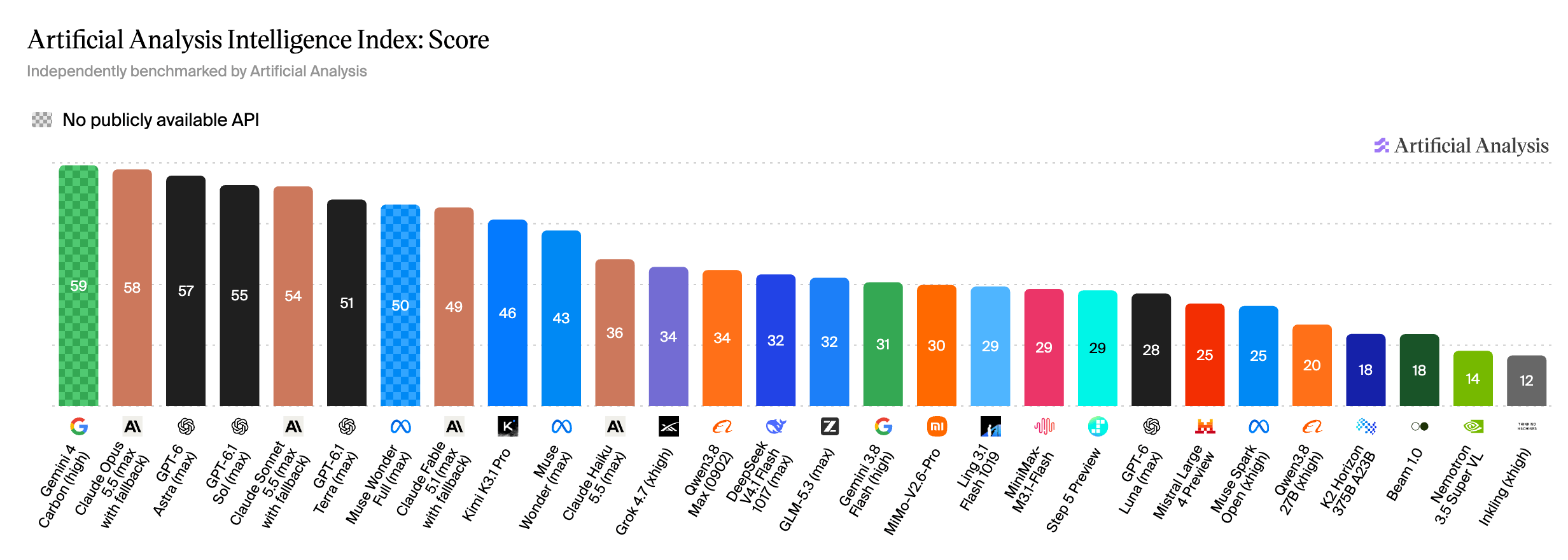
Google has released its latest frontier model, Gemini 4 Carbon, offering “significant gains” in coding, agentic tasks, and cybersecurity. In an announcement on Wednesday, Google highlights Carbon’s top spot on the Artificial Analysis Intelligence Index (v5.0) benchmark, with Claude Opus 5.5 and GPT-6 Astra trailing behind.

The new Gemini 4 Carbon model offers improvements over Argon, which Google released earlier this month. It’s currently only available to a select group of cybersecurity defense companies, but it will eventually expand to other partners in its Fairwind Program.

The company says Carbon reflects the “pace at which we’re pus …

Read the full story at The Verge.

https://www.theverge.com/tech/1021339/google-gemini-4-carbon-cybersecurity-frontier


Foreign gadget bans: all the news about the FCC’s clampdown on Chinese tech


A gavel prior to an open commission meeting at the FCC. | Photo: Al Drago/Bloomberg via Getty Images

What do drones, routers, and Roombas have in common? The US government wants to keep Chinese ones from entering the country. They’re the first consumer gadgets that are facing de facto import bans because of the US government’s xenophobic stance — and they might not be the last.

Originally, the US government was just worried about US networks. It’s been distrustful of Chinese telecom equipment providers Huawei and ZTE for well over a decade, eventually requiring telecom providers to “rip and replace” their gear. (Many telecoms have still failed to do so.) It established an “Entity List” for companies whose gear should be banned from import, marketing, and sale.

But under the second Trump administration, that list has been weaponized against entire home consumer gadget categories too — starting in December 2025 when Trump and Brendan Carr’s FCC banned all future foreign drones unless their companies obtained a waiver.

Next was a ban on all future foreign routers, all future foreign robots and power inverters, and within the robot ban, all future foreign robovacs. In each case, the government claims it’s because those gadgets fundamentally pose an unacceptable threat to US national security. But in each case, the US has provided zero public evidence of a threat, has done nothing about existing drones and routers and robots that might pose such a threat, and hasn’t given us any reason to trust that its waivers have anything to do with security.

Besides, there are rarely any US companies to fill the gaps left by foreign ones. Consumer gadgets are largely made overseas, including practically all routers and practically all drones — just like how your Apple, Dell, and HP laptops are not made in the US.

In this StoryStream, we’re following the latest on the foreign gadget bans.

https://www.theverge.com/policy/1019851/fcc-foreign-gadget-ban-drone-robot-roomba-storystream


Bitly’s New Data Says SEOs Are Half Right About Short Links via @sejournal, @gregjarboe

SEOs have spent the better part of 15 years telling clients to keep bit.ly links out of anything that matters. The case against them goes like this. A generic short link hides the brand and the keywords that a reader would otherwise see in the URL, it makes people suspicious, and it hands control of your links to somebody else.

A new Bitly survey of 1,507 Americans says that case is half right. But the half SEOs have been ignoring is costing more clicks than the half we keep arguing about.

Jenny Coppola, Bitly’s senior director of brand and content, published “The Click Expectation Report” on the Bitly blog on Sept. 29. It draws on 1,006 U.S. consumers and 501 U.S. marketers and creators surveyed between July 27 and Aug. 5, 2026.

Yes, a link management company ran a study that concludes you need link management. I’ll come back to that. But the consumer data inside the report is more useful to SEO, paid media, and social teams than the sales pitch wrapped around it, and it’s worth reading before your next planning meeting.

What SEOs Got Right, And What The Data Adds

Start with the part of the old argument that holds up. When Bitly asked consumers what makes them hesitate before clicking a link, 23% named generic shorteners that hide the brand’s name.

That’s a real cost. It also sits near the bottom of the list. Safety or security concerns about the URL topped it at 57%, followed by links that feel like clickbait (52%), vague descriptions of where the link goes (44%), and a mismatch between a creator’s usual content and the destination (42%).

Long URLs packed with tracking characters bothered 28% of consumers. That’s five points more than generic shorteners, which is inside the survey’s margin of error, so call it a tie. The UTM-heavy URLs many of us paste into social posts to protect attribution look no better to consumers than the bit.ly links we tell clients to avoid.

On the other side of the ledger, 48% of consumers said a custom branded short link builds the recognition that makes them comfortable clicking. That was the top factor in the survey, ahead of personal trust in the brand or creator sharing the link (44%) and clear copy explaining where the link leads (43%).

The link equity objection was answered a long time ago. In 2011, Google’s Matt Cutts said in a Webmaster Help video that shorteners using 301 redirects pass PageRank to the destination like any other 301, as Search Engine Journal reported at the time.

The ownership objection still has teeth. Google announced in 2024 that its own goo.gl short links would stop working on Aug. 25, 2025, and then reversed course weeks before the deadline for links that still saw activity. If Google came that close to breaking its own short links, any vendor can break yours. To me, that argues for a branded short domain your company owns, rather than a vendor’s domain hard-coded into every post you’ve ever published.

See also: When Direct Means We Don’t Know: CMOs Need To Rethink Attribution In AI Search

The Bigger Leak Is The Homepage

Now the half SEOs have been missing.

79% of consumers said they had abandoned an action because a social link sent them to a generic homepage instead of the product featured in the post. Only 8% of consumers expect a social video link to land on a homepage, while 61% expect a product page.

And yet 39% of marketers and 30% of creators named the generic homepage as a top destination for their social video links. Across both groups, 34% admitted their own social video links usually route there.

The rest of the abandonment list reads like a technical SEO audit. Excessive redirects or browser security warnings drove away 76% of consumers. Another 76% walked when the promo code promised in the post wasn’t on the page. Forced app installs or app store redirects cost 69%, pages that weren’t built for mobile cost 51%, and the wrong region, language, or currency cost 49%.

The mobile number splits sharply by age. Only 41% of Baby Boomers said a non-mobile page made them abandon, compared with 61% to 62% of Millennials and Gen Z. iOS users were more likely than Android users to bail on a page that wasn’t built for mobile (57% vs. 47%).

My view is that anyone who has argued about search intent should recognize this immediately. A homepage at the end of a product link is an intent mismatch, with a thumb tap standing in for the query. We would never accept it in paid search, where Google rates landing page experience on how relevant the page is to the people who click the ad. We accept it on social media every day because nobody on the SEO team owns those links.

The redirect finding deserves a second look too, because a short link adds a hop. If that hop leads to a tracking redirect, which leads to a regional redirect, which leads to an app store prompt, you’ve built exactly the chain that 76% of consumers say makes them leave.

See also: How To Design URL Structures For AI Retrieval, Not Just Rankings

93% Are Withholding Clicks On Purpose

This is the number I keep coming back to.

93% of consumers said they had avoided clicking a link on purpose, just to keep their algorithm from serving them more of that content. 43% said they do it always or often, and among Gen Z and Millennials that figure rises to 45%.

Click-through rate has always stood in for interest. This survey suggests a large share of interested people decline to click precisely because they know the click will be counted and used to shape what they see next.

That fits what SEOs already see in zero-click search and AI answers, where people get what they need without visiting a site. Clicks were never a clean measure of interest, and people are now deciding how they want to be profiled one tap at a time. Low click-through can sit alongside high attention. If CTR is the only signal in your report, you’re missing some of the people you actually reached.

Trust Depends On Who Shares The Link, And Where

LinkedIn was the platform consumers trusted most when deciding whether to click a link, at 19%. YouTube, Instagram, and Reddit tied at 17% each. With a margin of error of plus or minus 3.1 points on the consumer sample, that’s a four-way statistical tie, and the overall ranking matters far less than the splits underneath it.

Instagram was Gen Z’s top pick at 33%, nearly double the 18% of Millennials who said the same. LinkedIn climbed with age, becoming the top choice for Gen X (22%) and Baby Boomers (24%). TikTok fell at every generational step, from 12% among Gen Z to 2% among Boomers. Reddit belonged to Millennials, at 21%.

That Reddit number should catch the eye of anyone tracking where AI answers pull their citations. The platform that a large slice of 30- and 40-somethings trusts for links is also one whose visibility in AI answers SEOs already track closely, and that overlap is worth watching.

Who shares the link matters as much as where. Consumers trusted corporate brands more than independent creators for six of the seven link types in the survey. The widest gap was app or software downloads, where brands drew 88% of trust and creators 12%. Curated resource lists were the one exception, splitting evenly at 50/50.

The practical read is simple. People trust a brand to handle a transaction and trust a creator to point them toward something worth their time. If your creator program sends followers straight to an app download, you’re asking creators to spend trust they don’t have.

Attribution Is Broken From Both Ends

Marketers and creators told Bitly they expect links in social profiles and content to drive an average of 39% of their revenue over the next 12 months. That’s a lot of revenue to forecast from a channel most of them can’t fully measure.

Difficulty tracking traffic across channels and formats was the top challenge overall, cited by 36% of marketers and creators (41% of marketers, 30% of creators). Connecting platform analytics to website or campaign data tripped up 29% of marketers but only 17% of creators. In-app browsers stripping tracking parameters or cookies hit creators harder, 27% vs. 18% for marketers.

The two groups also measure differently. Marketers lean most on native link tracking inside social media management platforms (39%). Creators lean most on post-purchase or post-signup surveys that simply ask customers how they found the product (33%). Marketers use manual UTM parameters nearly three times as often as creators, 23% vs. 8%, and 10% of creators and 3% of marketers aren’t measuring their links at all.

For SEOs, the lost social clicks don’t vanish. When an in-app browser drops the referrer or the parameters, those visits tend to show up in analytics as direct or unattributed traffic, which muddies every channel report that sits next to organic.

Read The Methodology Before You Quote The Numbers

The survey was fielded through an opt-in online research panel, and the results are unweighted. Bitly gives margins of error “assuming a simple random sample,” which an opt-in panel isn’t. An AAPOR task force on online panels advised back in 2010 that “claims of ‘representativeness’ should be avoided” for this kind of sample.

A few other details are worth knowing before you put a slide in front of a client. The claim that custom domain links see a 2.3x lift in clicks comes from Bitly’s sales copy, not from the survey, and the report doesn’t say how it was measured. The FAQ cites figures, such as 34% of marketers relying on link management tools and 29% using link-in-bio pages, that don’t appear in the body of the report. And the infographic describes the 79% as abandoning “a purchase,” while the text says “an action.” Use the text.

None of that makes the findings useless. It makes them directional. Quote them as “Bitly’s survey found,” not “consumers say,” and you’ll be on solid ground.

How To Apply This To Your Strategy

You don’t need to buy anything to act on this report. Here’s where I’d start.

1. Audit where your social links actually land. Pull every link in your bios, pinned posts, video descriptions, and recent paid social ads into one sheet, with the destination URL next to each. Then check your analytics landing page report for social sessions. Any link that promises a product and delivers the homepage gets repointed to the product or category page, and any mobile app link gets a deep link with a web fallback instead of an app store detour.

2. Put your short links on a domain you own. If your team uses short links at all, move them to a branded short domain or subdomain your company controls, whichever vendor you pick. Keep the chain to a single 301 hop, tuck the UTM parameters behind the short link so the visible URL stays clean, and ask the vendor in writing how you’d export and repoint your links if you ever leave.

3. Tag brand traffic and creator traffic differently. Write a UTM convention that separates links your brand posts from links creators share, with the creator’s handle in a consistent field. Then open those links inside the Instagram, TikTok, and LinkedIn in-app browsers and confirm the parameters survive the trip, because the survey says they often don’t.

4. Borrow the creators’ attribution survey. Add a “How did you hear about us?” question to checkout or signup. It’s the measurement method creators trust most, and it catches the visits that analytics files under direct. Report it next to branded search volume and direct traffic, so a low CTR doesn’t hide the 93% who saw your post and chose not to click.

The Net-Net

I’ve been skeptical of vendor research for as long as I’ve covered this industry, and this report earns some of that skepticism. Every recommendation in it leads to a Bitly feature.

But the consumer data underneath points somewhere SEOs should already feel at home. Send people to the page they were promised, from a source they recognize, and be honest about what your analytics can’t see. That’s search intent and trust, applied to the link in a TikTok bio instead of a blue link on page one.

We were right to distrust the generic short link. We were wrong to stop caring where it went.

More Resources:


Featured Image: Viktoriia_M/Shutterstock

https://www.searchenginejournal.com/bitlys-new-data-says-seos-are-half-right-about-short-links/593983/



Montse Alvarado dal 1° novembre a capo del Dicastero per la Comunicazione del Vaticano

Domenica 1° novembre Maria Montserrat Alvarado entrerà in carica come prefetta del Dicastero per la Comunicazione della Santa Sede. La giornalista e dirigente messicana succede a Paolo Ruffini, che lascia l’incarico per raggiunti limiti di età. La nomina era stata annunciata da papa Leone XIV lo scorso 2 giugno. Alvarado diventa la prima donna laica a guidare un dicastero vaticano.

Il suo nuovo ruolo è insieme gestionale e strategico. Il Dicastero coordina il sistema dei media della Santa Sede, con l’obiettivo di renderne più coerente l’attività e di adattarla a un panorama in cui stampa, radio, televisione e piattaforme digitali sono sempre più intrecciate.
Ne fanno parte, tra gli altri, Vatican News, Radio Vaticana, L’Osservatore Romano, Vatican Media e la Sala Stampa della Santa Sede, oltre alla Libreria Editrice Vaticana, alla Tipografia e alla Filmoteca Vaticana. Il mandato comprende anche la riflessione teologica e pastorale sulla comunicazione e la formazione degli operatori.

Non si tratta, quindi, di dirigere una singola testata o di occuparsi soltanto della comunicazione del Papa. Alla prefetta spetta guidare un’organizzazione che riunisce strutture con linguaggi, pubblici e funzioni differenti: dall’informazione quotidiana sulle attività pontificie alla produzione audiovisiva, dalla distribuzione digitale alla comunicazione istituzionale. La sfida è far lavorare queste realtà in modo coordinato, preservandone le specificità e rendendo la presenza della Santa Sede accessibile a un pubblico internazionale.

Alvarado arriva a Roma con una carriera maturata tra comunicazione, advocacy e informazione cattolica. Nata a Città del Messico, ha studiato alla Florida International University e alla George Washington University. Dal 2009 al 2023 ha ricoperto incarichi di responsabilità al Becket Fund for Religious Liberty, organizzazione statunitense che si occupa di libertà religiosa.
Nel 2021 è entrata in EWTN News come conduttrice del programma settimanale EWTN News In Depth; dal 2023 ne è presidente e direttrice operativa, con la supervisione di piattaforme che producono contenuti in sette lingue per televisione, stampa, radio, digitale e social media.

Nell’intervista a EWTN News In Depth con cui si è preparata al passaggio di consegne, Alvarado ha descritto la nomina come una responsabilità di servizio.

La sua nomina ha anche un significato istituzionale. Paolo Ruffini, nominato nel 2018 da papa Francesco, era stato il primo laico a guidare un dicastero della Curia romana. Alvarado segna un ulteriore passaggio: una donna non consacrata assume la responsabilità di uno dei dicasteri centrali della Santa Sede.
La presenza femminile ai vertici vaticani è cresciuta negli ultimi anni, ma la guida di un dicastero resta un incarico di particolare rilievo. Il suo ingresso non cambia la natura del mandato, affidato dal Papa, ma porta al vertice una dirigente laica con esperienza diretta nell’informazione audiovisiva e digitale.

La Segreteria per la Comunicazione fu istituita da papa Francesco nel 2015 per integrare le diverse strutture mediatiche vaticane. Nel 2018 assunse il nome di Dicastero per la Comunicazione. A quasi undici anni dalla riforma, Alvarado eredita dunque un sistema già accorpato, ma chiamato a misurarsi con trasformazioni continue: convergenza dei media, innovazione tecnologica, nuovi modelli di fruizione e rapidità della comunicazione online.

The post Montse Alvarado dal 1° novembre a capo del Dicastero per la Comunicazione del Vaticano appeared first on Key4biz.

https://www.key4biz.it/montse-alvarado-dal-1-novembre-a-capo-del-dicastero-per-la-comunicazione-del-vaticano/592087/


The Hreflang Magic Trick – It Routes, It Doesn’t Rank via @sejournal, @billhunt

In 2018, Glenn Gabe published one of the more puzzling SEO case studies of the decade. A client was canonicalizing UK and Indian hreflang URLs to a U.S. version, technically wrong, and against Google’s own guidance. Yet, the “wrong” URLs kept surfacing correctly in country-specific search results, even though Search Console showed them as not indexed. When Gabe asked John Mueller about it during a webmaster hangout, Mueller confirmed the behavior was real: Google could swap in the correct country/language URL at the SERP level, even when only one page in the hreflang cluster was actually indexed. It was treated as a curiosity, a “magic trick,” as Gabe called it, because Google never fully explained the mechanism behind it.

Eight years later, it got a name. In August 2026, Google’s Gary Illyes responded to a LinkedIn question about this scenario and described these URLs as alternate names. His explanation gives us a useful mental model for something international SEOs have been reverse-engineering for years: discovery, canonicalization, indexing, scoring, and serving are separate parts of the process, and a URL doesn’t necessarily have to pass through all of them independently to appear in search.

That distinction helps explain where hreflang actually fits in the process. More importantly, as search moves toward semantic retrieval and AI-generated answers, it raises a larger question for international websites: if multiple market pages contain essentially the same information, what makes any one of them uniquely valuable?

First, Google Has To Discover The Alternatives

Before there’s a cluster to canonicalize, a canonical to score, or an alternate URL to serve, Google has to discover the URLs. This is why XML sitemaps, internal links, and hreflang annotations become particularly important during migrations, replatforms, and international rollouts. Google needs to discover the U.S., UK, Australian, Italian, and other versions before it can understand how those resources relate to one another. Once discovered and crawled, those URLs don’t automatically become independently indexed documents. Google still has to determine whether they represent genuinely different resources or duplicate and near-duplicate versions of essentially the same content. Some may warrant independent indexing and scoring, while others may be clustered with another URL.

This is an important distinction because we often treat “discovered,” “crawled,” and “indexed” as stages a URL simply progresses through. The alternate-names explanation demonstrates that Google can retain knowledge about a URL and its relationship to other URLs even when that URL isn’t independently represented in the index.

Hreflang Is A Cross-Reference, Not A Ranking Signal

One of the most persistent misconceptions about hreflang is that it somehow creates ranking value. I have always found it more useful to think of hreflang as a cross-reference table that tells Google that this URL is the Italian equivalent of another URL; this one is intended for English speakers in Australia, and another is intended for English speakers in the UK.

Google can use those relationships when determining which URL to present to a particular searcher, but that doesn’t mean hreflang created the ranking in the first place. Across tens of thousands of hreflang implementations, I’ve never seen a case where adding hreflang suddenly caused a page to rank higher because of the annotation itself.

If a U.S. English page is ranking in the UK before hreflang is implemented, adding the correct UK alternate doesn’t magically give the UK page a new ranking score. What can change is which URL Google presents for the ranking it has already determined.

This is what I find particularly useful about Illyes’ explanation of “alternate names.” Indexing and scoring can happen on one member of a duplicate cluster while the serving layer selects an appropriate alternate URL for the user. Hreflang helps Google understand that relationship and select the appropriate representation. In that sense, hreflang routes rather than ranks.

The 38-Market Problem

A global shoe brand I’ve worked with illustrates the problem at scale. It had roughly 98 market websites, about 38 of which were in English and nearly identical to one another. 22 even shared the same dollar-sign currency symbol. That meant dozens of URLs effectively carried the same product information, the same language, and often the same pricing presentation, differentiated primarily by domain, directory, or a handful of localized details.

From the organization’s perspective, these were 38 different market websites. From a machine’s perspective, however, many of them represented essentially the same resource. There is little reason for Google to independently store, process, and score 38 copies if they contribute almost no additional information.

Instead, it can cluster near-duplicates, choose a canonical representation, and retain enough information about the alternatives to present the appropriate URL when the user’s country or language calls for it. This helps explain the “magic trick” Gabe documented. The alternate URL didn’t necessarily need its own independent ranking score to appear because Google already understood its relationship to the URL that had been indexed and scored.

The serving layer could handle the rest.

Canonical Tokenization And The Cost Of Duplication

This becomes easier to understand if we think about canonicalization as an efficiency problem. Search engines operate at enormous scale, and there is little benefit in repeatedly storing and processing substantially identical information when those resources can be confidently clustered together.

One member of a duplicate or near-duplicate cluster can become the primary representation while Google retains relationships to the alternatives. In traditional search, those relationships can then be used at serving time to present the most appropriate URL.

AI makes this more interesting because an AI system isn’t limited to returning one document as a blue link. It can retrieve information, extract evidence from different sources, and assemble an answer. As a result, the unit we need to focus on shifts from the URL itself to the information it contains.

Instead of only asking which URL should rank, we increasingly need to consider which information is useful for answering the user’s question, where the best evidence for that information can be found, and whether that evidence is actually relevant to the user’s market.

Motoko Hunt explored this distinction recently, to say hreflang can help identify the intended language or market relationship, but that doesn’t mean an AI system will consider the content itself the best evidence for a user in that market.

That distinction becomes especially important for international websites with large numbers of highly similar market pages. If the underlying information is substantially the same, the presence of separate URLs and correct hreflang annotations doesn’t necessarily give an AI system a reason to retrieve one market version over another. That reason increasingly has to come from the content itself.

AI Systems Are Getting Better At Recognizing Equivalence

Microsoft provided an interesting look at this problem in its description of Web IQ, the retrieval and grounding infrastructure supporting its AI experiences. Its multilingual models are designed to represent semantically equivalent information as close together as possible, even when that information appears in different languages.

That matters because hreflang represents an explicitly declared relationship. We tell the search engine that two resources are equivalents intended for different audiences. Semantic retrieval systems are increasingly capable of identifying that equivalence from the content itself. Two passages can be recognized as saying essentially the same thing even if the web admin never explicitly declares the relationship between them.

Microsoft also describes retrieval as focused on passage-level evidence rather than treating the entire URL as the only meaningful unit. That is an important change in how we should think about international content. If an AI system can recognize equivalent information across pages and languages and retrieve the specific evidence it needs, creating additional URLs containing substantially identical information doesn’t necessarily create additional useful knowledge. It may simply create more copies of knowledge the system already has.

This is where what initially looks like a technical hreflang discussion becomes a much larger international content issue.

Hreflang Can’t Make Content Local

Hreflang can tell Google that one page is intended for the UK and another for Australia, but it cannot make either page more relevant to those markets. If 20 market pages contain essentially the same product descriptions, claims, specifications, FAQs, and supporting information, adding perfect hreflang annotations doesn’t suddenly make those pages meaningfully different.

The organization may have created 20 URLs, but from a retrieval perspective it may have created one piece of knowledge with 20 different addresses.

This is why I think localization needs to move beyond the traditional definition of translating content and swapping currencies, phone numbers, spelling, or a few market references. The more useful question is what someone in a particular market needs to know that someone in another market does not.

Products may differ by market. Regulations, certifications, availability, warranties, delivery options, and pricing models may be different. Customers may use different terminology, have different use cases, evaluate different competitors, require different integrations, or make purchase decisions based on completely different criteria. Local teams may also have evidence, customer examples, regulatory expertise, and market knowledge that never makes it onto the website.

Those differences give a market page a reason to exist and give search and AI systems something unique to retrieve.

Give Every Market Page A Reason To Exist

None of this makes hreflang less important. If anything, Google’s explanation of alternate names makes its role clearer. Hreflang establishes the relationship between alternate language and market URLs and helps Google understand which version is intended for which audience. What it cannot do is create the market differentiation itself.

The content has to do that.

This becomes increasingly important as retrieval systems get better at understanding semantic equivalence across URLs and languages. If the U.S., UK, Australian, Singaporean, and South African pages all say essentially the same thing, machines are becoming increasingly capable of recognizing that regardless of how many URLs, folders, domains, or hreflang annotations surround the content.

The objective shouldn’t be to make those systems believe pages are different when they aren’t. International teams should instead look for the places where markets really differ and ensure those differences are reflected in the content.

That requires more than an SEO or localization team working independently. International SEO, localization, content, product, legal, regional marketing, and local market teams may all hold different pieces of the information needed to make a market experience genuinely useful.

The technical implementation establishes the relationship; the local knowledge establishes the difference.

That is ultimately what Google’s “alternate names” explanation helps clarify. The mystery Gabe documented wasn’t a bug or loophole. It exposed the differences among indexing, scoring, and serving long before Google gave us the terminology for them.

As search moves further toward semantic retrieval and AI-generated answers, the bigger lesson isn’t simply how Google can serve an alternate URL that wasn’t independently indexed. It’s why we should give that alternate page enough unique local value that both machines and customers have a reason to care about it in the first place.

More Resources:


Featured Image: Roman Samborskyi/Shutterstock

https://www.searchenginejournal.com/the-hreflang-magic-trick-it-routes-it-doesnt-rank/591979/


Decodo Launches Web Data API To Give AI Agents Web Access

Decodo, a leading provider of web data infrastructure, has introduced the Web Data API, which puts scraping, mapping, crawling, and search behind a single API key. Designed for AI startups building agents or retrieval pipelines, its single interface delivers fresh, structured web data.

“AI startups don’t have time to build their own scraping infrastructure,” noted Decodo CEO Vaidotas Juknys. “The Web Data API gives them one key for scraping, searching, mapping, and crawling. That’s less time on infrastructure and more time on the product.”

Data Challenge Facing Most AI Agents

Language models train on a fixed information snapshot. Agents tracking a company, a news feed, or a price list need up-to-date data. Retrieval-augmented generation (RAG) likewise relies on how fresh the retrieved documents are.

Pulling live pages means running scrapers behind rotating IPs, getting past CAPTCHAs and bot detection, followed by cleaning up incomplete pages and stripping navigation, ads, and boilerplate from whatever comes back. Building this infrastructure or assembling individual tools takes engineering time away from products.

Meet The Web Data API

Decodo developed the Web Data API to eliminate that additional work, bringing four endpoints on one account and one API key. Separate scraping, search, mapping, and crawling contracts are no longer necessary. Each endpoint addresses a distinct stage in the web data collection process.

  • Scrape retrieves a single page’s clean content, even through anti-bot protection.
  • Search delivers live web results, replacing the previously offered Fast Search API.
  • Map reveals a site’s structure; each call can return up to 147,000 URLs.
  • Crawl automatically follows a site’s links, collecting up to 10K pages within a single job.

One Vendor For All 4 Endpoints

Because the four run on one key, a team gets one invoice, one dashboard, and one place to read usage. Each is supported by Decodo’s proxy network of over 125 million IPs spanning 195+ locations.

It also shortens procurement: one vendor to vet, one support queue for billing and technical questions, one integration for new hires to learn.

How Teams Are Already Using The 4 Endpoints

The four endpoints are already available for practical workflows tailored to each user’s needs:

  • RAG teams convert a documentation site to clean Markdown for embedding through a single crawl job.
  • Developers creating coding tools use search to bring live results into an IDE or an agent.
  • Legal and research teams locate documents by mapping a regulator’s site before crawling those documents.
  • Competitive intelligence teams regularly repeat map and crawl jobs to monitor a rival’s catalog over time.

The best part is that all these workflows run without needing a separate scraping stack.

Start Here

Decodo provides up to 10,000 free requests per month, with one quota shared by all four endpoints, without requiring a credit card. This quota resets each month, so a team can run a real pilot before deciding on a paid tier.

For AI startups comparing the time and budget needed for in-house scraping infrastructure with licensing it, Web Data API brings page extraction together with search, discovery, and crawling in one integration. The free tier lets teams evaluate how it fits within their existing stack.


Featured Image: Paulo Bobita/Search Engine Journal

https://www.searchenginejournal.com/decodo-launches-web-data-api-to-give-ai-agents-web-access-spn/594415/


AI, l’adozione corre ma i ritorni no: solo il 37% delle aziende vede un impatto sui conti

L’AI nelle aziende? L’adozione è in crescita, ma i ritorni economici restano limitati. È questo in sintesi quanto emerge dal nuovo report McKinsey “The State of AI in 2026: On the road to ROI”, basato su un’indagine condotta tra maggio e giugno su 1.719 partecipanti in 97 Paesi.

Quasi nove intervistati su dieci dichiarano che la propria organizzazione utilizza regolarmente l’AI in almeno una funzione aziendale. Ma il dato più significativo riguarda il passaggio dalla sperimentazione all’adozione vera e propria: il 44% afferma che l’AI è già in fase di scaling all’interno dell’organizzazione, contro il 38% dello scorso anno. Anche il numero di funzioni coinvolte aumenta: il 56% utilizza l’AI in almeno tre aree aziendali.

La distanza tra grandi e piccole imprese resta però significativa.

Tra le organizzazioni con almeno un miliardo di dollari di ricavi annuali, il 54% dichiara di avere già portato l’AI su scala aziendale, contro circa un terzo delle imprese più piccole. La differenza diventa ancora più evidente quando si guarda agli agenti AI: nelle grandi aziende la quota di chi li sta già scalando è salita dal 27% al 40% in un anno, mentre nelle organizzazioni più piccole è rimasta sostanzialmente ferma al 22%.

I chatbot restano gli strumenti più diffusi, ma crescono rapidamente anche gli agenti software e quelli dedicati alla programmazione. Circa due aziende su dieci dichiarano di avere già portato su scala organizzativa gli agenti AI, mentre nelle grandi imprese il 31% sta scalando quelli dedicati al coding.

L’80% vede aumentare la propria produttività

Il 32% degli intervistati afferma che la propria organizzazione ha rinunciato ad acquistare almeno un prodotto o una funzionalità software perché è riuscita a costruirla internamente utilizzando agenti AI per il coding. Il fenomeno è particolarmente evidente nel settore tecnologico, dove la percentuale sale al 41%, ma è già significativa anche nella sanità, nei servizi professionali, nell’energia e nella finanza.

Per il report è un primo segnale di come l’AI possa iniziare a modificare anche la distribuzione dei budget IT: non soltanto acquistare software da fornitori esterni, ma decidere sempre più spesso cosa comprare e cosa costruire internamente.

L’80% degli intervistati afferma che gli strumenti AI hanno migliorato la propria produttività. Più della metà dichiara di aver sviluppato nuove competenze e circa uno su due sostiene di prendere decisioni migliori grazie all’intelligenza artificiale.

Il quadro cambia però quando si passa dal singolo lavoratore ai conti dell’intera azienda. Solo il 37% degli intervistati afferma che l’AI abbia già prodotto un contributo positivo all’EBIT della propria organizzazione, una percentuale sostanzialmente invariata rispetto al 2025.

I benefici economici sono però più evidenti se si osservano singole funzioni aziendali. Le riduzioni dei costi vengono segnalate soprattutto nella gestione della supply chain, nelle service operations e nella produzione. Seguono marketing e vendite, risorse umane e software engineering.

Sul fronte dei ricavi, invece, gli aumenti vengono attribuiti più frequentemente all’utilizzo dell’AI nel marketing e nelle vendite, nello sviluppo di prodotti e servizi e nell’ingegneria del software.

I costi dell’AI iniziano però a pesare

Un’organizzazione su cinque afferma di avere già limitato l’utilizzo dell’AI a causa dei costi operativi, compresi quelli legati ai token. Nel settore tecnologico la quota raggiunge il 25%, mentre nelle istituzioni finanziarie si attesta al 24%.

Il problema non sembra comunque frenare gli investimenti.

Il 28% degli intervistati dichiara che la propria organizzazione destina già oltre il 10% del budget ICT complessivo alle tecnologie AI. E il 60% prevede di aumentare ulteriormente gli investimenti nel prossimo anno. Il report parla ormai di “tokenomics”: anche se il costo per singolo token diminuisce, il numero di token utilizzati cresce ancora più velocemente, soprattutto nelle applicazioni agentiche e nei sistemi di reasoning più complessi.

AI e lavoro: per il report i tagli previsti sono stati sovrastimati. Ma intanto si continua a licenziare

Nel 2025 il 32% degli intervistati prevedeva una riduzione degli organici causata dall’AI nell’arco dei dodici mesi successivi. A consuntivo, soltanto il 14% afferma che l’intelligenza artificiale abbia effettivamente contribuito a ridurre il numero complessivo dei dipendenti.

Due terzi delle organizzazioni non hanno invece registrato variazioni significative nell’occupazione legate all’AI. Le aspettative restano però elevate: per il prossimo anno il 39% degli intervistati prevede una riduzione della forza lavoro dovuta all’intelligenza artificiale, mentre il 43% si aspetta pochi cambiamenti o nessuna variazione. Intanto però le grandi aziende continuano a licenziare. Oggi Microsoft ha annunciato 60mila uscite volontarie.

The post AI, l’adozione corre ma i ritorni no: solo il 37% delle aziende vede un impatto sui conti appeared first on Key4biz.

https://www.key4biz.it/ai-ladozione-corre-ma-i-ritorni-no-solo-il-37-delle-aziende-vede-un-impatto-sui-conti/592058/


GA4 Missed 66% Of One Retailer’s Holiday Orders: Check Yours Before Peak Season

Few things waste a boardroom meeting like defending Google Analytics 4 figures that don’t align with the store-reported numbers. It erodes trust and leaves everyone with an incomplete, misleading picture, and over the past 12 months I’ve found it harder to get GA4 to do the job it’s set up for. It’s challenged me and my team to keep a much closer check, with alerts on the tracking we rely on to judge success.

So, ahead of this year’s holiday season, I audited GA4 at eight U.K. ecommerce brands, putting its Q4 numbers for 2024 and 2025 next to store orders. I expected gaps, but not ones this big, or this well hidden.

Between Christmas Day 2025 and Jan. 4, 2026, GA4 told a U.K. retailer its revenue was down 68% a day on the year before. The retailer’s own order records showed a fall of 13%.

GA4 recorded 81% of the store’s web orders in Q4 2024, 41% in Q4 2025 and just 32% over the Christmas period.

Six of the eight stores let me match GA4 to their own order records. At three, GA4 told a very different story. At two, the cookie banner had been switching itself off for days or weeks at a time, and GA4 gave no sign anything was missing. At the third, GA4 recorded no purchases for five weeks, then loaded them in late and counted hundreds twice. A fourth store’s GA4 was flooded with bots this September.

Most are setup problems that could happen at any store, including yours.

AI Shopping: Get Your Products Found in Google & ChatGPT, October 28, 2026

What I Compared

For six brands, I compared GA4 orders with web orders, week by week where I could. At two stores, the counts include some phone or finance orders the platform couldn’t separate out. I checked every figure against its source. Retailers A to D are the four stores with the biggest problems, and Retailer A is the one from the opening. (Disclosure: I work for a digital agency that has worked directly with all eight brands.)

See also: Why Your Search Data Doesn’t Agree (And What To Do About It)

5 Pitfalls To Look Out For In GA4

A Steady Gap

One brand’s GA4 recorded 76% of its web orders in both Q4 2024 and Q4 2025, and another’s between 72% and 84% every week of Q4 2025. That’s the shape cookie consent produces, with a similar share of shoppers declining tracking each week.

What to look for: A capture rate (GA4 orders as a share of store orders) that stays in the same band each week. Allow for it, and use GA4 for trends, not totals.

A Cookie Banner That Switched Itself Off

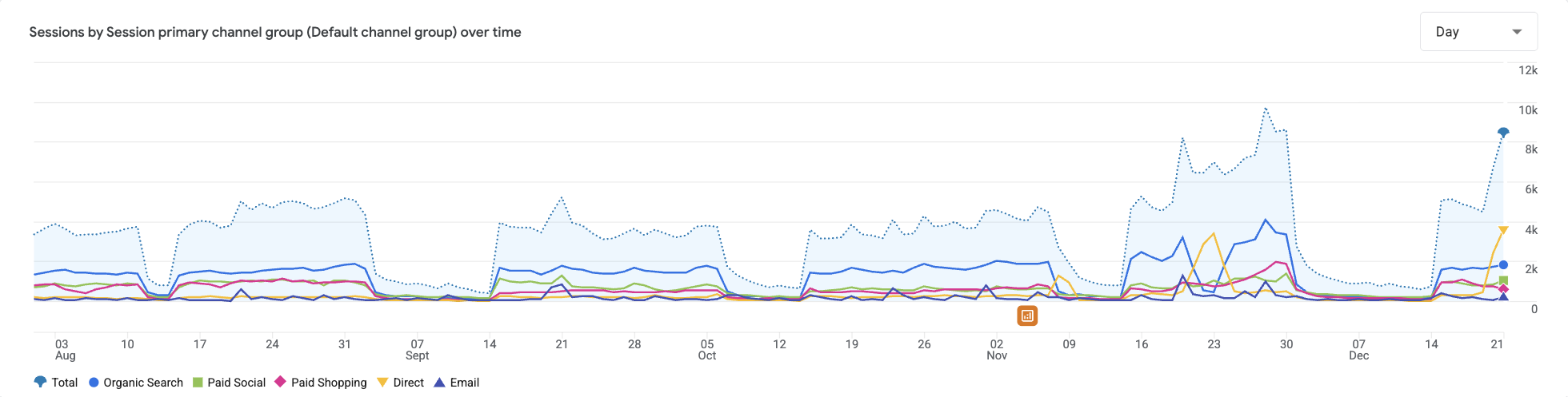
Retailer A’s GA4 sessions dropped out in blocks of days, and every block ended on the 14th of the month.

GA4 sessions by channel for Retailer A, August to December 2025, dropping out in blocks each month
Retailer A’s GA4 sessions, August 1 to December 21, 2025: every dropout ended on the 14th. Screenshot from Google Analytics 4, October 2026.
GA4 showed Q4 web orders falling while the store recorded them rising
GA4 recorded 81% of Retailer A’s web orders in Q4 2024 and 41% in Q4 2025. Image from author, October 2026.

Retailer B’s blocks ended on the 20th. Its GA4 recorded 94% of the store’s orders in Q4 2024 and 36% in Q4 2025, and showed revenue down 69% while the store’s net sales rose 18.5%.

GA4 sessions by channel for Retailer B, September to December 2025, dropping out in blocks that end on the 20th of each month
Retailer B’s GA4 sessions, September 1 to December 31, 2025: every dropout ended on the 20th. Screenshot from Google Analytics 4, October 2026.

The cause was the cookie banner, twice over. Both stores moved to a new consent setup in 2025, so a share of shoppers stopped being tracked: the steady kind of gap. Each consent plan also covered a set number of page views a month, and once they ran out, the banner stopped showing until the next billing date. At Retailer B, GA4 recorded up to 68% of orders in weeks the banner stayed up and between 10% and 22% in weeks it switched off. GA4 kept receiving some data, so nothing looked broken, and the missing days read like a slump in sales.

In the Black Friday billing cycle, Retailer A’s allowance ran out on December 1, and GA4 didn’t recover until December 15.

What to look for: Sessions dropping out in blocks that start or end on the same date each month while store orders carry on. Size your consent plan for peak traffic and make sure its limit warnings reach marketing, not just developers.

A Blackout And A Late Backfill

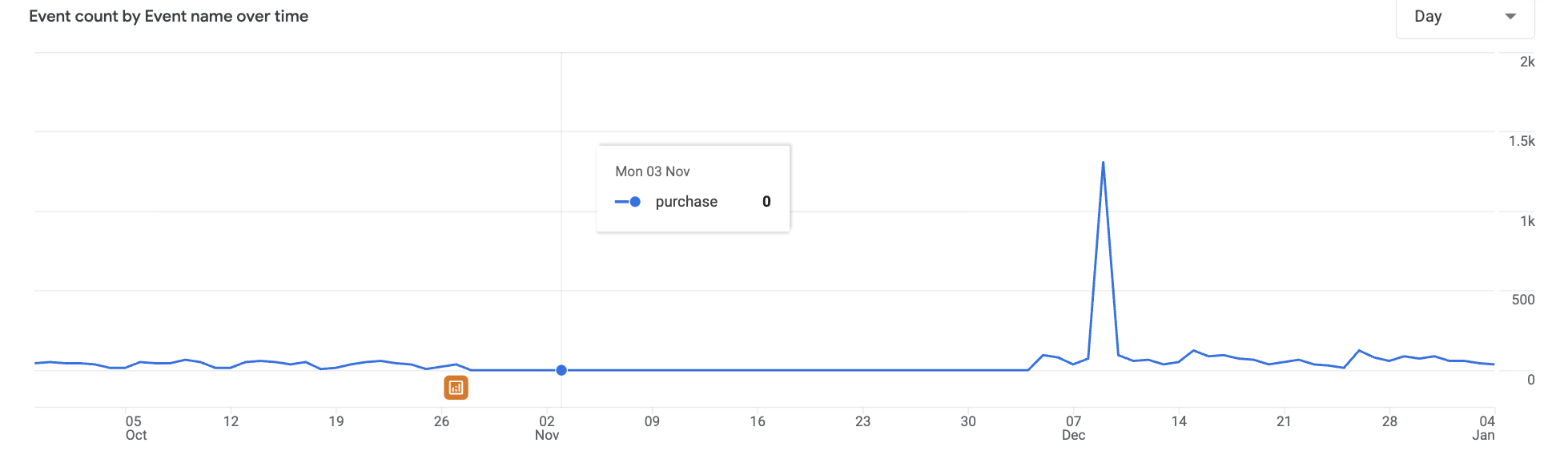
From Oct. 28 to Dec. 4, 2025, Retailer C’s store recorded 2,215 orders, and GA4 recorded no purchases at all.

On Dec. 9, GA4 recorded 1,261 orders in one day, 1,000 of them with order numbers from inside the gap. Blackout orders were being loaded in late, and all but five went to Unassigned.

GA4 purchase events by day for Retailer C, September 2025 to January 2026, flat at zero from late October to early December, then a single-day spike
Retailer C’s purchase events in GA4, September 29, 2025, to January 4, 2026: none from October 28 to December 4, then a spike on December 9. Screenshot from Google Analytics 4, October 2026.
Weekly orders recorded by the store and by GA4 for Retailer C
Between October 28 and December 4, 2025, Retailer C’s store recorded 2,215 orders, and GA4 recorded none. Image from author, October 2026.

What to look for: Days with sessions but no purchases, and sudden runs of purchases in Unassigned.

The Same Order Counted Twice

Google’s guidance on transaction IDs says GA4 “deduplicates purchase events with the same transaction ID,” though only from the same user. At Retailer C, 657 of the 3,365 order numbers GA4 recorded in Q4 2025 had more than one purchase event, adding 735 purchases to its total. Across the quarter, the errors almost canceled out: GA4 recorded 4,100 purchases against 4,501 store orders. Check only the quarterly total, and it looks fine.

What to look for: In a GA4 exploration, list the purchase event count for each transaction ID. Anything above one is double counting.

Visitors Who Weren’t Shoppers

Its known bot-traffic exclusion filters out “known bots and spiders,” but other bots that run a site’s code like a browser count as visitors.

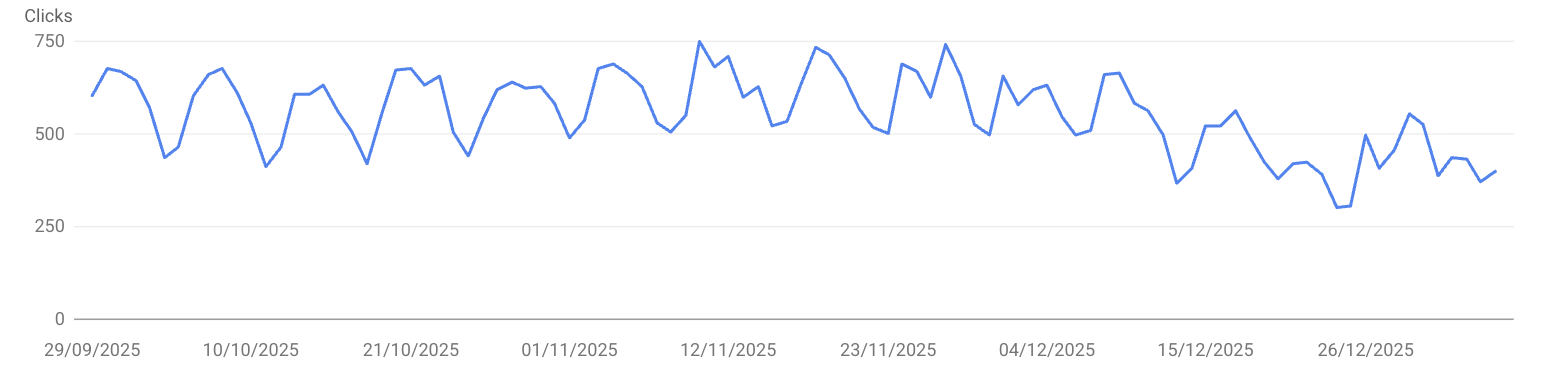
Retailer D’s GA4 recorded 23,187 sessions on September 27, 2026, and 25,622 the next day, against 300 to 900 a day in mid-September. Almost all were direct, desktop Chrome visits averaging about a second of engagement. Search Console clicks didn’t move.

GA4 sessions by channel for Retailer D, September 1 to October 5, 2026, with a spike in Direct sessions
Retailer D’s sessions in GA4, September 2026: the spike is almost all Direct. Screenshot from Google Analytics 4, October 2026.
Search Console clicks for Retailer D over the same dates, with no spike
Retailer D’s Search Console clicks over the same dates: no spike. Screenshot from Google Search Console, October 2026.

What to look for: Session spikes that orders don’t follow. Exclude them from reports and block them at your firewall, sparing verified crawlers like Googlebot.

AI Shopping: Get Your Products Found in Google & ChatGPT, October 28, 2026

Use Search Console As An Early Warning

Search Console counts a click whenever a result sends someone to a page outside Google, whatever the site’s tags are doing. Divide GA4’s Google organic sessions by Search Console clicks each week, and a tracking failure shows up as a sudden drop.

In Retailer C’s blackout, Google sent 4,244 clicks in the week of November 3, and GA4 recorded 57 Google organic sessions.

GA4 sessions from google / organic for Retailer C, September 2025 to January 2026, close to zero from late October to late November
Retailer C’s Google organic sessions in GA4, September 29, 2025, to January 4, 2026: almost none from October 28 to November 24. Screenshot from Google Analytics 4, October 2026.
Search Console clicks for Retailer C over the same dates, steady through November
Retailer C’s Search Console clicks over the same dates held steady through the blackout. Screenshot from Google Search Console, October 2026.

See also: Why Is Organic Traffic Down? Here’s How To Segment The Data

What It Does To Budget Decisions

Retailer A’s Q4 web orders rose from 5,874 to 7,686 while GA4 showed them falling by a third. GA4 also had Google Ads’ return on spend falling from 8.07 to 4.79 and organic search revenue nearly halving. Matched to store orders in a premium multi-touch attribution tool, Google Ads’ return rose from 4.42 to 7.93 on 20% less spend, and revenue attributed to organic and direct visits rose 58%. The attribution models differ, but they shouldn’t point in opposite directions. Cutting either channel on GA4’s numbers would have pulled budget from channels that were working, which is why I judge them together against store orders.

Retailer C’s GA4 put revenue from Google, paid and organic, down 86% while the store’s net sales rose 4.8%.

See also: Google Ads Budget Misallocation Is More Common Than You Think – And Harder To Spot

A Check To Run Before The Holidays

  1. Export weekly web orders for Q4 2024 and Q4 2025, without marketplace, subscription, and manual orders.
  2. Pull GA4 purchases for the same weeks as distinct transaction IDs on purchase events. Avoid the transactions metric, which counts refunds as well as purchases.
  3. Divide GA4 purchases by store orders. A step change, a near-zero week, or a week above 100% is a tracking problem.

AI Shopping: Get Your Products Found in Google & ChatGPT, October 28, 2026

How To Explain GA4’s Pitfalls To Stakeholders

Agree on the source of truth before the holidays. Orders and revenue come from the store; GA4 explains behavior and trends; ad platforms report what they claim.

Lead with the capture rate. “GA4 recorded 41% of our web orders this quarter, down from 81% last year” is a sentence any finance director understands.

Explain the consent gap in plain terms. In the U.K., the ICO’s guidance on consent expects a consent mechanism to make it “as easy to refuse consent as it is to accept,” so some shoppers will always decline, and GA4 will always undercount. In the U.S., opt-out signals such as California’s Global Privacy Control Act mainly affect advertising tags, while browser privacy features and ad blockers chip away at analytics.

Give marketing sight of anything that moves its figures. Consent limits, checkout updates, and tag changes often sit with developers. Put store and GA4 revenue side-by-side and date every change, so a fall in GA4 isn’t read as a fall in sales.

Move Purchase Tracking Server-Side

Most GA4 setups record a purchase in the shopper’s browser, where a checkout update, a script error, an ad blocker, or a refresh can lose it or count it twice.

Instead, send the purchase from the store’s own system when the order is created, through the Measurement Protocol or a server-side tagging container fed by the store, keyed on the order number. It no longer depends on the confirmation page; a refresh can’t duplicate it, and every event matches a store order. Moving browser tags to a server container doesn’t do this on its own, because the purchase still starts in the browser. Pass the shopper’s GA4 client ID and session ID with it, captured at checkout, so GA4 can join the order to the visit. Keep the browser tag for behavior: Google says the Measurement Protocol is meant “to augment automatic collection,” not replace it.

Server-side tracking doesn’t change your consent obligations, so the steady gap stays. If you’re starting now, I’d send it to a separate GA4 property through Q4, so nothing is counted twice, rather than switching over in November.

Count Orders Where They Happen

GA4 is still the best free tool most ecommerce teams have for understanding behavior, but it isn’t a record of sales. Before you cut or push spend this holiday season, count your orders where they happen: in the store.

AI Shopping: Get Your Products Found in Google & ChatGPT, October 28, 2026

More Resources:


Featured Image: PeopleImages/Shutterstock

https://www.searchenginejournal.com/ga4-missed-two-thirds-retailers-holiday-orders-check-yours-before-peak-saeson/593007/


Agenda 2030. Giovannini (ASviS): “Rischiamo una regressione insostenibile”

Rapporto ASviS 2030: “L’Italia e gli Obiettivi di sviluppo sostenibile. Agenda per la prossima legislatura. E non solo”

A quattro anni dalla scadenza dell’Agenda 2030, oggi a Roma, presso l’Aula dei gruppi parlamentari della Camera dei Deputati, è stato presentato il Rapporto ASviS 2026, documento annuale sullo stato di avanzamento dell’Italia rispetto all’Agenda, redatto dall’Alleanza grazie al contributo della rete di esperte ed esperti delle organizzazioni aderenti.

Attraverso dati, scenari e proposte, il Rapporto dal titolo “L’Italia e gli Obiettivi di sviluppo sostenibile. Agenda per la prossima legislatura. E non solo”, giunto alla sua 11esima edizione e l’ultimo prima delle prossime elezioni politiche nazionali, misura la distanza del mondo, dell’Unione europea e in particolare dell’Italia dagli Obiettivi di sviluppo sostenibile (Sdg) e individua le politiche trasformative possibili, in campo economico, sociale, ambientale e istituzionale, sia per l’Unione sia per il nostro Paese.

Un documento quindi di grande importanza politica e di analisi profonda delle cause strutturali che sono alla base di rallentamenti, se non arretramenti conclamati, nella lunga, faticosa e quanto mai necessaria marcia verso lo sviluppo sostenibile in tutto il mondo.

Come ha sottolineato Anna Ascani, Vicepresidente della Camera dei Deputati, nei saluti istituzionali, il percorso si fa sempre più difficile, anche visto il momento storico e le tensioni geopolitiche crescenti, tragicamente sfociate in vere e proprie guerre regionali sempre più simili a quella “Terza guerra mondiale a pezzi” evocata più volte da Papa Francesco.

“L’ONU ha alzato al 35% la quota di target dell’Agenda 2030 non raggiunti”, ha ricordato Ascani, mentre secondo l’Ocse, “i due terzi delle persone, l’80% in Italia, ritengono che i governi non agiscono per migliorare le condizioni dei popoli in ottica di lungo periodo”. E questo è un grave problema, appunto di portata storica, con evidenti ricadute negative a livello sociale e politico, proprio quando le nuove generazioni “denunciano a gran voce un furto di futuro a loro danno”, chiedendo “di essere ascoltate sulle grandi decisioni da prendere sui temi chiave dell’Agenda 2030”, ha precisato Ascani rilanciando il messaggio del Presidente della Repubblica, Sergio Mattarella, dal tempo dell’emergenza Covid: “Questo è tempo di costruttori”.

  “Il mondo di oggi è molto diverso da quello che ci eravamo impegnati a costruire con l’Agenda 2030 – ha affermato Marcella Mallen, presidente dell’ASviS – ogni ulteriore rinvio aumenta i costi sociali, economici e ambientali, soprattutto per i più deboli“.

“Le proposte dell’Alleanza guardano anche oltre il 2030 e si fondano sui principi della nostra Costituzione e sui valori europei. Vogliamo contribuire a dare risposte concrete alla domanda di futuro che arriva dalle giovani generazioni“, ha sostenuto Pierluigi Stefanini, Presidente dell’ASviS 

Giovannini (ASviS): “A livello mondiale solo il 15% degli obiettivi di sviluppo sostenibile sarà raggiunto”

“C’è ancora una partita da giocare e la politica e gli impegni dei politici hanno un peso rilevante sul possibile risultato”, ha dichiarato Enrico Giovannini, Direttore Scientifico dell’ASviS, illustrando i risultato del Rapporto.

“Le decisioni su ciò che verrà dopo il 2030 sono importanti e l’Unione europea deve prepararsi ad affrontarle. L’Italia guiderà, nel primo semestre del 2028, proprio questo tipo di analisi e di confronto. Per questo il rapporto, diversamente dai precedenti, vuole offrire a tutte le forze politiche spunti di riflessione su ciò che vogliamo per la prossima legislatura.
Il primo capitolo, come di consueto, si concentra sul contesto internazionale. Alcuni dati sono già stati richiamati: secondo l’ONU, solo il 15% degli obiettivi sarà raggiunto, mentre per un altro 15% il mondo si sta addirittura allontanando dai traguardi fissati
”, ha precisato Giovannini.

“La distribuzione sembra quasi quella di un Parlamento, con una ripartizione pressoché equa tra centro, centrosinistra e centrodestra. Ma il problema vero è al centro: riguarda una parte consistente degli obiettivi. Se guardiamo a quelli su cui si sono registrati maggiori progressi, vediamo che, contrariamente a quanto spesso si sostiene nel dibattito sull’energia, il Goal 13, cioè ‘Adottare misure urgenti per combattere i cambiamenti climatici e le loro conseguenze’, dedicato alla lotta al cambiamento climatico, è tra le aree in cui sono stati compiuti alcuni passi avanti. Lo indica anche un rapporto sull’Azerbaigian pubblicato ieri.
Naturalmente non basta, perché i problemi restano enormi. La buona notizia è che potremmo affrontarli: la tecnologia consentirebbe di nutrire tutti, portare elettricità sostenibile a gran parte del mondo, ridurre drasticamente la mortalità estrema e contrastare la povertà.
Dobbiamo però ricordare che tutto è connesso, come diceva Papa Francesco
– ha proseguito il Direttore Scientifico dell’ASviS – guerre, energia, migrazioni e cambiamento climatico sono fattori interdipendenti, sui quali la politica può incidere in positivo o in negativo. Il drastico taglio degli aiuti allo sviluppo da parte degli Stati Uniti rischia di esporre milioni di persone, soprattutto bambini, a malattie, povertà e morte prematura”.

“Italia posizionata male, su 5 obiettivi situazione peggiore rispetto al 2010”

Rispetto agli Obiettivi di sviluppo sostenibile dell’Agenda 2030, l’Italia non è posizionata bene, ha ricordato Giovannini: “Su 17 Obiettivi ne abbiamo 5 in cui siamo in una situazione peggiore oggi rispetto a quella del 2010. E guardando anche agli obiettivi in prospettiva, gran parte dei target che ci siamo impegnati a raggiungere a livello europeo o con le programmazioni nazionali non verranno raggiunti. Quindi dobbiamo accelerare in tutti i modi, ma non per essere bravi in una classifica, ma per migliorare la condizione economica, sociale e ambientale del nostro Paese, che è quello tra l’altro che chiedono i nostri giovani“.

Per mettere l’Italia sulla buona strada verso gli Obiettivi di Sviluppo Sostenibile, ha detto Giovannini “il rapporto presenta un ampio spettro di interventi sulle varie tematiche, frutto del lavoro dei nostri mille esperti. Ma nel breve termine si possono fare tre cose che possono cambiare il modo di fare le politiche. Primo: adottare la Strategia Nazionale di Sviluppo Sostenibile entro fine anno e farla diventare la guida di tutte le politiche settoriali, superando la frammentazione che invece ha caratterizzato purtroppo anche questa legislatura. Secondo: introdurre una governance anticipante, come ci raccomanda l’Onu e la Commissione europea, cioè istituzioni capaci di anticipare il futuro e non di reagire solo alle emergenze. Terzo, ancora più importante: attuare subito la riforma dell’anno scorso che impone al governo e al Parlamento di valutare l’impatto delle nuove leggi in termini ambientali e sociali sui giovani e sulle future generazioni. Anche questa sarebbe una bella risposta alle giuste rivendicazioni dei giovani che chiedono futuro. È un anno che aspettiamo il decreto di attuazione, è veramente il caso di procedere“.

UE vede peggiorare risultati in sette obiettivi dell’Agenda

Nell’Unione europea la quota dei traguardi quantitativi raggiungibili entro il 2030 scende dal 53% al 47% e sette Obiettivi registrano un peggioramento nell’ultimo anno, come povertà, salute, istruzione, disuguaglianze, vita sott’acqua, giustizia e istituzioni solide e partnership, secondo il Rapporto ASviS.

Solamente in un caso, nella lotta contro la fame, si registra un miglioramento in Europa. Un po’ poco per il mercato più ricco del mondo.

A proposito di mondo, come detto, soltanto il 15% dei Target dell’Agenda 2030 è sulla buona strada per essere conseguito, mentre il 21% registra progressi moderati, il 32% avanzamenti marginali, il 17% praticamente è in stagnazione e, grave, il 15% in regressione.

Secondo l’analisi, “conflitti, crisi climatica e ambientale, tensioni geopolitiche e indebolimento di cooperazione e diplomazia ostacolano il cammino verso lo sviluppo sostenibile“: nel 2025 gli aiuti allo sviluppo sono diminuiti del 23,1%, mentre la spesa militare mondiale ha raggiunto la cifra record di 2.900 miliardi di dollari, ben il 2,5% del Pil globale. L’impatto economico della violenza nel mondo è stato quantificato in circa 21.800 miliardi di dollari nel 2025, una cifra pari a circa cinque volte il fabbisogno annuale di finanziamento per gli obiettivi di sviluppo sostenibile nei Paesi in via di sviluppo.

The post Agenda 2030. Giovannini (ASviS): “Rischiamo una regressione insostenibile” appeared first on Key4biz.

https://www.key4biz.it/agenda-2030-giovannini-asvis-rischiamo-una-regressione-insostenibile/592063/


Google Signals A Wider Crackdown On SEO Spam via @sejournal, @martinibuster

Google takes aim at a new source of SEO spam, signaling that platforms, tools, and services may face consequences for content published by their users. It’s also a warning to SEOs and website owners who leverage these kinds of sites for links and AI search influence.

The three changes are:

  1. Adds sharing platforms as a type of site that can be penalized for UGC spam.
  2. Provides steps that platforms can take to prevent UGC Spam
  3. Advises on how to become aware of harmful activities and manual actions

All three advisories are specific to platforms which means that Google may take actions against these kinds of sites. SEOs who are promoting sites with these kinds of sites should become aware of these policies and the platform owners should also be aware of these new guidelines.

Change 1: Spam Advisory Addresses Sharing Services

The first change is the addition of a few words that add these sharing platforms as the kinds of sites that the guidelines apply to.

These are the new words added to the page:

  • “…and tools that let users publish shared pages, generated content, or web apps…”
  • “pages or”

This is the full context, with the newly added words in italics:

“Spammers often take advantage of open comment forms and other user generated content inputs and generate spammy content on an unsuspecting victim site. Hosting platforms and tools that let users publish shared pages, generated content, or web apps may be similarly open to abuse; spammers may create a large number of pages or sites that violate our spam policies and add little or no value to the web.”

Takeaway for SEOs and Platform Owners

Google may be planning to target tool and app platforms that enable users to generate content. SEOs should add this to their site audits to check if clients are using these kinds of sites in manipulative ways. Platform owners should take notice and make necessary changes as outlined in the next sections.

Google may in the near future crack down on tool and app platforms that enable users to generate content on the web pages of those platforms.

Change 2: Defending Against UGC Spam

The second change to the spam support page explains what platform owners should do in order to prevent harmful behavior on their platforms that could result in a manual action by Google (removal from the search results).

Google added an entirely new section that is targeted at platforms or websites that allow user generated content. The new guidelines outline steps the platforms should take to avoid receiving a manual action.

These steps are specific to platforms that enable users to generate web pages. This also includes services that are meant for content sharing or collaboration.

Typical platforms:

  • Services
  • Tools
  • Sites
  • Apps

The new section advises users of these kinds of sites and platforms to use the no-index directive on pages that are not meant to be indexed by search engines. For example, use a no-index rule in either the robots.txt or with a meta no-index tag if the function of a service is to generate shareable pages or tools but are not meant to be indexed.

The new guidelines advise:

“Only index content meant for Search
If your service lets users create shareable pages, generated outputs, or interactive tools, consider whether that content is meant to be found through search engines or only accessed directly by people with a link.

When pages are created for direct sharing, collaboration, or utility rather than public search discovery, apply the noindex rule (using a robots meta tag or X-Robots-Tag HTTP response header) or block crawling in robots.txt by default.”

Change 3: Preparation For Manual Action

The third and last change to Google’s spam page is an explanation of how to track and recognize the signs that users are causing potentially negative changes to a a website and how to know when a site has reached a point where Google has taken action against it.

This is the new section added to the website:

“Verify your site or subdomain in Search Console so you receive email alerts if Google issues a manual action against your site or detects security issues. Also check the Page Indexing report and Search performance report regularly for unexpected spikes in indexed pages, impressions, or queries that don’t match your platform’s purpose.

Track platform-level creation and indexing metrics, and set up alerts for anomalies such as spikes in newly published public pages or a small number of users generating a large share of indexable URLs.”

Takeaways

  • Google Expands Its UGC Spam Guidelines
    Google’s updated policies now explicitly address platforms that enable users to publish shared pages, AI-generated content, and web apps, extending the guidance beyond traditional user-generated content.
  • Platforms Face Greater Responsibility For User-Generated Spam
    Google’s changes put platform owners on notice that allowing users to publish spam can expose the entire platform to search penalties.
  • Google Draws A Distinction Between Shareable Content And Indexable Content
    Not everything users create is intended for search engines. Google advises platforms to prevent indexing of content intended primarily for sharing, collaboration, or utility.
  • Spam Prevention Becomes A Platform-Level Responsibility
    Google’s updated guidance emphasizes proactive prevention, monitoring, and early detection of abusive publishing activity rather than waiting for a manual action.
  • Implications For SEO Audits
    SEOs should consider whether clients use third-party publishing platforms in ways that violate Google’s spam policies and whether the platforms themselves are vulnerable to abuse.
  • Potential For Expanded Enforcement
    The changes suggest Google may be paying closer attention to spam originating from platforms that enable users to publish generated content, although the updated guidance does not establish that a crackdown is imminent.

Google updated its user-generated spam guidelines to explicitly address platforms that enable users to publish shared pages, generated content, and web apps, putting platform owners on notice that they may face search penalties for spam published by their users. The changes suggest Google is taking a closer look at how these platforms are being abused and may be preparing for greater enforcement.

Featured Image by Shutterstock/ra2 studio

https://www.searchenginejournal.com/google-signals-a-wider-crackdown-on-ugc-seo-spam/594679/