Dear Media and Amanda Hirsch Want Brands To Ditch the Script
For podcast host Amanda Hirsch, the best brand partnerships start before a deal is ever signed.
Hirsch, who hosts Not Skinny But Not Fat, will even accept a lower fee from a brand she already uses, she told ADWEEK chief content officer Zoe Ruderman at ADWEEK’s Advertising HQ event.
Hirsch runs every potential partner through a few filters: whether she’s an organic fan, whether she has tried the product herself, and whether her audience would find it genuinely useful. Turning down a deal is not painful, she added, because she believes another opportunity will follow.
“I’m thinking about my audience, like, ‘Wait, they would love this,’” Hirsch said. “‘This would be so helpful for them.’”
That approach fits the model at Dear Media, which has a roster of about 100 shows and a sales team of roughly 40 people. The company rarely runs programmatic advertising, relying instead on host-read ads that talent can shape directly with the brand, according to Mark Mullett, Dear Media’s president of global entertainment.
In fact, the biggest mistake brands still make is handing talent a script and expecting them to read it, according to Mullett. Another misconception is that creators will take any offer for the money, he added.
“Let creators create,” he said. “If they said yes to working with a brand, let them cook, let them do their thing. It’s going to be better for you.”
The strategy appears to be working. Last year, Dear Media was on track to generate between $50 million and $100 million in revenue, after having raised around $12 million in investment, according to The New York Times.
Video has widened what those partnerships look like, from product placement on set to IRL events and footage spliced into episodes. For instance, Dear Media recently worked with Weight Watchers, a partnership that included a show hosted by a company employee about her own GLP-1 journey. The show focuses less on the science than on the psychological and personal side of the experience.
While the phrase “brand entertainment” can be a little “snoozy,” the concept behind it is sound, per Mullett.
“It’s really just great entertainment—brought to you by Weight Watchers,” he said.
Hirsch, for her part, mostly avoids the numbers, checking performance only when quarterly reports arrive. She considers an episode a success when listeners walk away loving a guest they had never heard of before.
Her dream partner, after years of organically talking about the brand: Ugg.
Vicksburg, Mississippi, experienced a ransomware incident that caused the city’s computer systems to be shut down temporarily on Oct 1.
Mayor Willis Thompson stated that utility services, 911, and the Police and Fire Departments were not impacted and remained operational. However, individuals attempting to make in-person payments for utilities may experience delays.
The city continues to work on restoring systems.
Michael Centrella, Head of Public Policy at SecurityScorecard, comments, “Protecting emergency services is only one part of a city’s ransomware response. Vicksburg says 911, police, fire and utility services remain operational, but the shutdown of city computer systems may delay in-person utility payments. The city has said it will suspend late-payment penalties and service shutoffs while systems are offline, helping protect residents from consequences caused by the outage.
“The next question is what it will take to restore those systems safely. Investigators need to establish how the attackers gained access, which systems and accounts they reached, and whether any access remains. Bringing a payment system back online before those questions are answered could leave the city vulnerable to renewed disruption. Local governments also need to test whether essential functions can continue when the systems they normally depend on have to be disconnected.
“The potential data exposure creates a separate concern. Vicksburg is still determining whether information relating to customers, employees, contractors or business partners was accessed or stolen. Restoring services will not resolve that question. If information was taken, the consequences could continue after the visible disruption ends. If data exposure is confirmed, the city should clearly communicate what information was involved and who was affected so those individuals can understand their own risk.”
At this time, external cybersecurity experts are conducting an investigation.
“One of the top priorities of our investigation is determining whether there was any compromise of personal or confidential information relating to current and/or former customers, contractors, vendors, employees, or affiliated business partners of the city,” says Thompson. “At this time, the investigation is ongoing, and the city has not reached a final determination regarding what information, if any, may have been accessed or acquired without authorization.”
While approaching the coast of Texas, an oil supertanker was hacked. According to the FBI and the U.S. Coast Guard, the hackers were able to access the propulsion system, emphasizing how cyberattacks can cause physical ramifications.
At this time, the breach is still being investigated. It is unknown who conducted it.
Security Leaders Weigh In
Jacob Krell, Senior Director: Secure AI Solutions & Cybersecurity, Suzu Labs:
Access and control are separate findings, and the public evidence on VL Prosperity stops before engine control. If investigators can show that an intruder reached a write-capable propulsion controller and issued a valid command, this would be the first publicly documented, independently confirmed cyberattack against a commercial vessel’s propulsion controls. That is a much bigger claim than temporary access to a digital system.
Bloomberg reports that investigators found temporary access to the tanker’s digital propulsion system. The public joint statement from the Federal Bureau of Investigation and U.S. Coast Guard says the agencies boarded the vessel to examine its information technology (IT) and operational technology (OT) systems after indications that its networks were compromised. It reports no operational disruption, vessel instability, physical danger to the crew, or environmental impact.
That distinction matters because a propulsion-related bridge console, engineering workstation, machinery automation gateway, and engine controller are materially different findings. The U.S. Coast Guard’s 2019 response to a malware incident aboard a deep-draft vessel is the useful comparison. The malware seriously degraded the ship’s onboard computer network, but investigators found that essential vessel control systems were unaffected. Maersk made a similar distinction during the 2017 NotPetya attack, when its shore and terminal systems were disrupted while its vessels remained maneuverable.
The closest publicly documented physical-control event was the 2013 University of Texas test that moved a yacht off course by spoofing the Global Positioning System (GPS) and inducing navigation corrections. The researchers did not control the engine. In 2025, French authorities investigated Remote Access Trojan (RAT) malware found on the Fantastic ferry, but the operator said the intrusion was neutralized without operational consequences.
VL Prosperity could change that record. The decisive evidence is a forensic trail showing a write-capable session sent a valid command to the engine controller and that the controller accepted it. Until authorities produce that, call this a propulsion-access incident. The public record does not yet support a confirmed propulsion takeover.
Damon Small, Board of Directors, Xcape, Inc.:
The rapid escalation from a single novel maritime intrusion to federal tracking of nearly 20 compromised vessels globally directly threatens an already precarious global oil market, creating upward pressure on crude prices and downstream refined products. These supertankers operate as self-sufficient floating cities governed by complex operational technology (OT) systems that manage crew life support, navigation, and critical cargo onboarding and offboarding. Although threat actor attribution remains unconfirmed, the scale and sophistication strongly suggest coordinated state-sponsored activity targeting maritime OT.
A widespread compromise across vessel networks could ground entire fleets or trigger catastrophic physical disruption at sea. To mitigate these systemic risks, asset owners must enforce rigorous physical and digital network segmentation between vessel bridge controls, satellite communications, and IT networks, while implementing unidirectional security gateways and mandatory anomaly monitoring across onboard industrial control systems.
Critical Takeaways:
Escalating Market Impact: Global tracking of nearly 20 compromised vessels shifts maritime cyber risk from an isolated novelty to a material supply chain threat capable of driving up global oil prices.
Complex OT Vulnerabilities: Supertankers rely on interconnected OT for life support, propulsion, and cargo operations, making unauthorized access to onboard control networks potentially devastating to fleet operations.
Essential Defensive Controls: Security teams must enforce strict network segmentation between bridge IT, satellite communications, and OT systems, backed by unidirectional gateways and continuous industrial network monitoring.
Air-gapping vessel networks only works if you do not run an ethernet cable straight from the satellite dish to the propulsion engine.
Ferrero Will Have Two Ads in Super Bowl 2027, Part of a $50 Million Bet on Sports
Ferrero will advertise two of its products, Nutella and Kinder Bueno, during Super Bowl 2027, the company said Tuesday.
The Italian confectioner made its Super Bowl debut earlier this year with an outer space-themed ad for Kinder Bueno, which drove a 140% lift in volume sales year-over-year, per the brand.
The ads in next year’s Big Game are part of a strategic shift at the European confectioner, which plans to invest $50 million in sports marketing in 2027.
“Ferrero is continuing to bet big on sports and doubling its Super Bowl investments in a shift that signals a fundamental change in how the Italian conglomerate is positioning itself in the U.S. market,” Ferrero told ADWEEK.
Paid media aside, Nutella got an organic viral moment in April when a jar of the hazelnut spread was filmed floating inside the Artemis II spaceship on its historic flight around the moon. The “Nutella in Space” video drove a 20% lift in unit sales on Amazon, Ferrero said.
In the same month, Ferrero also launched a new product, Nutella Peanut. Made with roasted nuts and cocoa, the spread is the brand’s first flavor innovation in 60 years.
“We’ve invested billions of dollars in our North American growth plans, and last year’s ad debut proved it’s working,” said Michael Lindsey, Ferrero North America president and chief business officer, in a statement.
“Building on the genuine momentum from Kinder Bueno and the success of Nutella Peanut, we’re in a position to double down on our investment to accelerate portfolio awareness and market share in the U.S.”
Frontline Education Data Breach Highlights Third-Party Risks
Education technology organization Frontline Education experienced a data breach due to a third-party software vulnerability. The third party in question has not been revealed.
According to reports, an unauthorized user gained access to the organization’s systems and exfiltrated employee information. This includes Social Security numbers.
Michael Centrella, Head of Public Policy at SecurityScorecard, comments, “School districts entrust vendors with sensitive employee information, but the risk also extends to the software those vendors rely on. Frontline says attackers gained access through a vulnerability in third-party software it used. That creates a chain of exposure from the software provider, through Frontline, to the districts whose employee records it held. A district can assess its direct vendor and still have limited visibility into another product that provides a path to its data.
“The important security question is what that vulnerable application could reach. Frontline says it remediated the vulnerability, but affected districts also need to understand which records were accessible through it and what controls limited that access. Fixing the entry point addresses one part of the incident. Districts need to understand why access through that application exposed sensitive employee records and whether similar access paths remain elsewhere in the environment.”
Until 2026, the answer to “can you schedule Substack Notes?” was a flat “nope.” But now, folks looking to schedule their Notes on Substack are spoilt for choice.
Substack has its own built-in scheduler, and a handful of third-party tools can do it, too.
Why would you want to schedule anywhere other than Substack, though? Good question! If you’re a Substack- only creator, that option probably does make the most sense for you.
But plenty of Substack writers don’t post exclusively on Substack. A Note that lands well is often just as good on Threads, LinkedIn, or Bluesky — and manually copy-pasting it can become a bit of a nuisance.
That’s where third-party tools (particularly feature-rich social media schedulers) earn their keep. Most of them let you line up a week or two of Notes and social posts in one sitting instead of scheduling them one by one. Bonus: Several tools will even show you detailed analytics on how each Note performed — and which brought in new subscribers.
Sounds great, but with so many options, how do you know which Substack scheduler is the best fit for you? I explored six of the most popular options, including Substack’s own, to see how they compare.
Key takeaways
Substack now schedules Notes natively and for free, up to about three months ahead. The catch is that you schedule one Note at a time, with no queue, calendar, or bulk scheduling.
The biggest difference between third-party schedulers is how they publish. Some post from your open browser, some from a stored copy of your Substack login, some hand Notes to Substack’s own scheduler, and some use a direct integration.
If you post a few Notes a week and nowhere else, you probably don’t need a paid tool.
If Notes is one channel among several, a multi-platform scheduler (Buffer, Typefully) saves the most time. If Substack is your whole world, a Substack-only tool like WriteStack goes deeper.
Jump to a section:
The best Substack Notes schedulers at a glance
Tool
Best for
How it publishes
Crossposts?
Free plan?
Paid from
Buffer
Crossposting Notes to other platforms
Direct connection via Substack’s API
Yes, 10+ platforms
Yes, for up to three channels
$6 per channel per month
Substack (native)
A few Notes a week
Substack’s own servers
No
Yes
—
WriteStack
Substack-only research and analytics
Chromium-based browser extension
Via Buffer add-on
No, seven-day trial
$23.99 per month
Typefully
X-first writers
Direct connection via Substack’s API
Yes
Yes, limited
$99 per year
Narrareach
Turning articles into Notes with AI
Hands off to Substack’s scheduler
Yes, incl. Medium
Yes, five Notes per month (Substack only)
$19 per month
StackSweller
Simple flat-price cloud queue
Stored session
No
No
$25 per month
Can you schedule Substack Notes natively?
Yes, you can schedule Substack Notes. Substack rolled out native Notes scheduling in spring 2026, on both web and mobile.
Here’s how to do schedule on Substack:
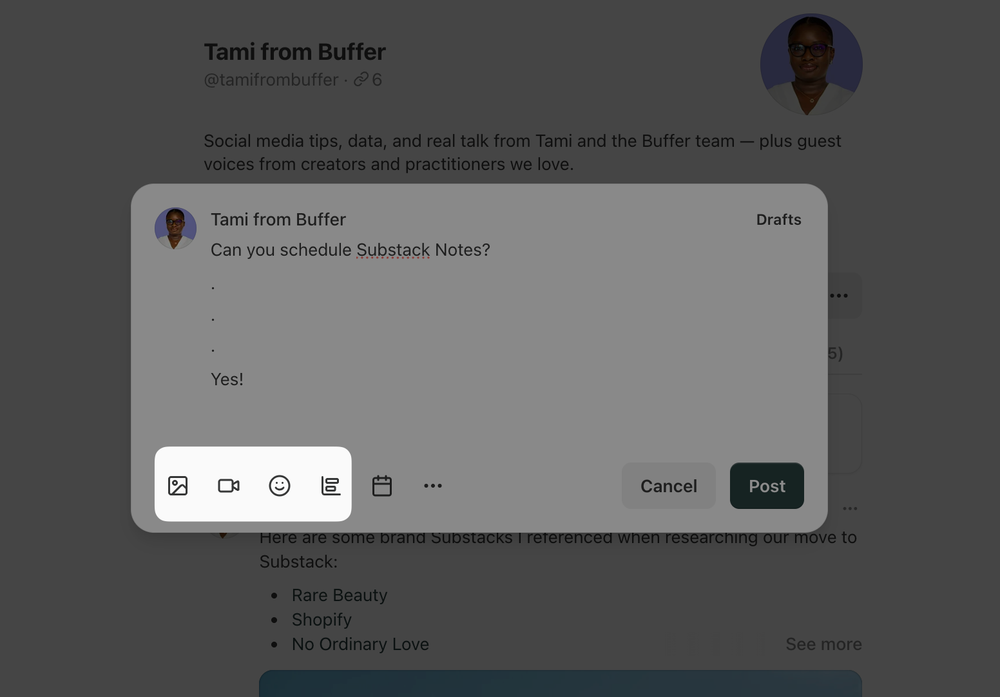
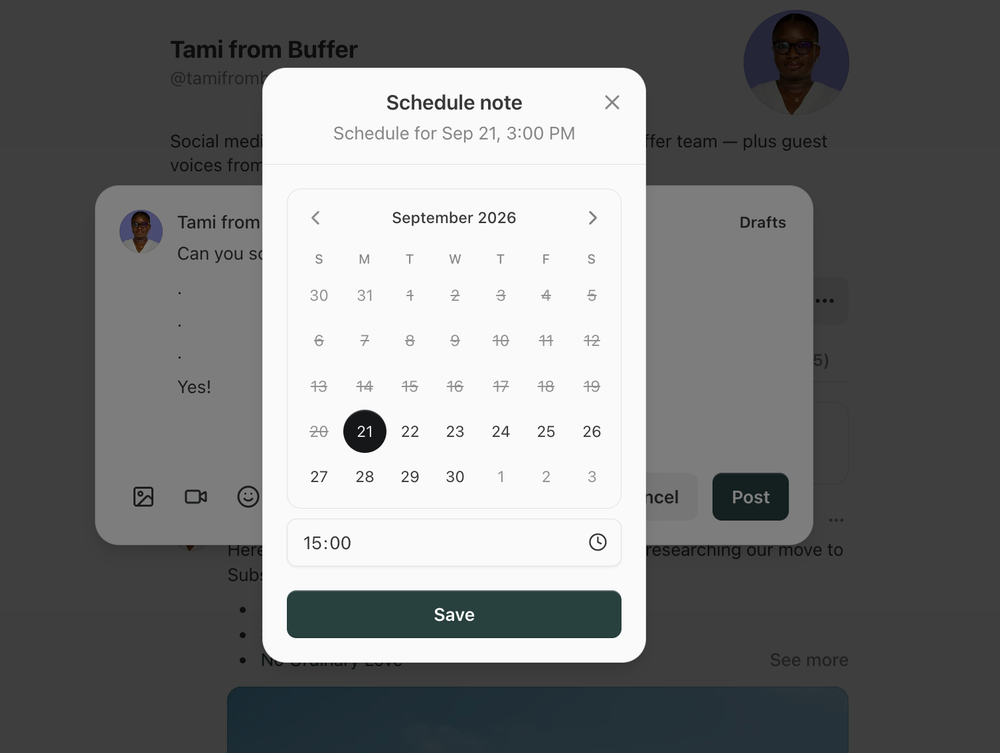
On web: open the Notes composer, click the calendar icon, choose a date and time, hit Save, then Schedule.
On mobile: tap the three-dot menu in the composer, choose Schedule, and pick your slot.
You can schedule up to about three months out. Scheduled Notes sit in your drafts until they go live, so you can still edit them. (If you’re newer to the platform, our guide to how Substack works covers Notes versus posts.)
The catch is that you schedule one Note at a time. There’s no queue, no bulk scheduling, and no way to crosspost your content elsewhere (say, Threads, X, or LinkedIn, which are all natural fits for Notes-type content.)
Those are the gaps all the third-party tools are trying to fill.
How a scheduler publishes might matter more than its features
Before we dig in, a quick note on something that tripped me up a little in testing. Not every scheduler publishes the same way, and the method might affect whether your Note goes out at all. Here are the most common ways:
Browser extension. The tool posts from your own browser at the scheduled time. WriteStack works like this, and it’s only available in Chromium-based browsers (basically, not Safari or Firefox).
Stored session. The tool keeps a copy of your logged-in Substack session on its servers and posts from there. This works with your laptop closed. The trade-offs: sessions expire, so you’ll reconnect every so often, and you’re trusting a third party with access to your account.
Handoff to Substack’s scheduler. The tool pushes your Notes into Substack’s native scheduler ahead of time, and Substack publishes them. Nothing on your end needs to stay switched on.
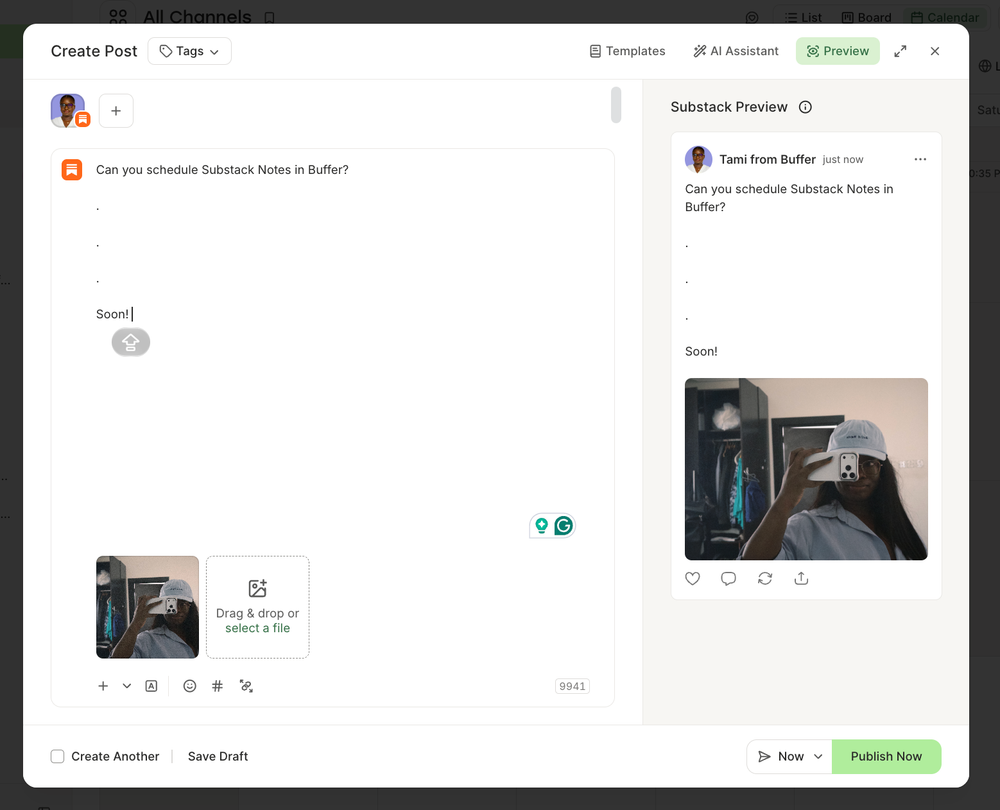
Direct integration. You connect your Substack account the same way you’d connect Instagram or LinkedIn: sign in to Substack, approve access, and you’re done! The scheduler then posts through Substack’s own API. Nothing needs to stay open on your end, and the tool doesn’t store a copy of your login. Buffer and Typefully both work this way.
That doesn’t necessarily mean any of the above is a ‘bad’ choice. But it’s still worth knowing how these things work before you sign up (and pay!) for them.
The 6 best Substack Notes schedulers
1. Buffer — best Substack Notes scheduler for crossposting to other platforms
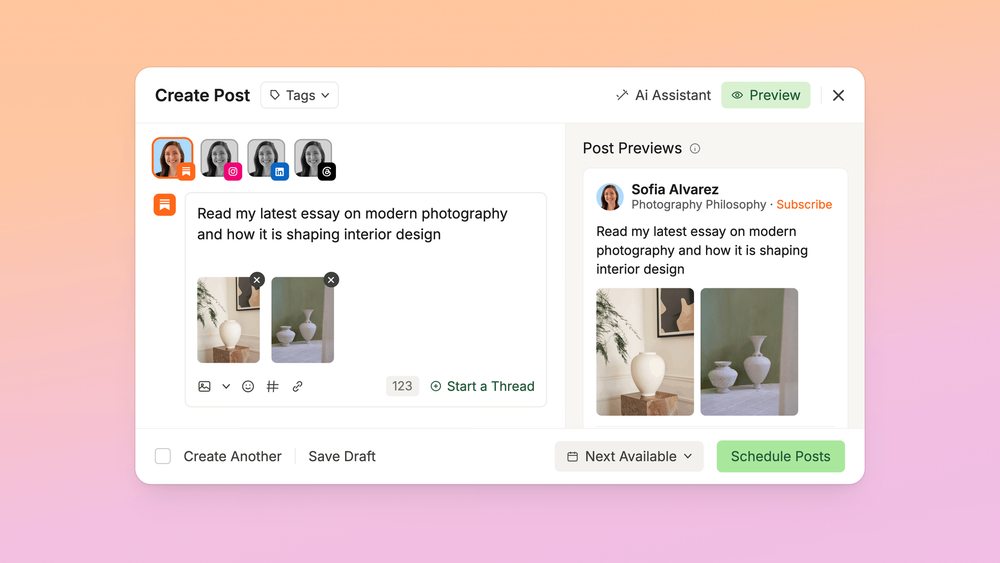
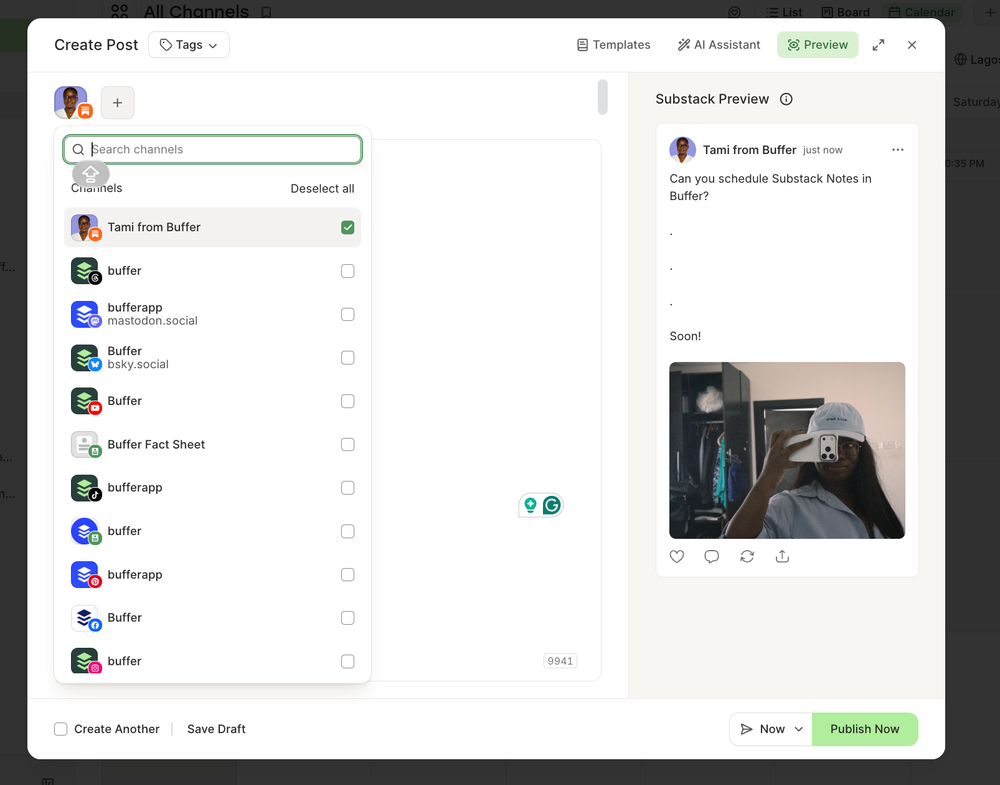
Buffer added Substack Notes in September 2026, after the integration request passed 1,100 upvotes. You connect Substack alongside X, LinkedIn, Threads, Bluesky, Instagram, and more, and schedule Notes from the same calendar. You can schedule Substack Notes on Buffer’s forever-free plan (which includes up to three channels), too!
Quick disclosure: I work at Buffer, so my view here is certainly not biased. But, as a long-time creator, social media manager, and newsletter writer who used Buffer for many years before I was hired, I genuinely find the tool tough to beat for ease-of-use and flexibility. Plus (this really matters to me as a serial tool tester) the app is just beautiful. It’s a pleasant, smooth place to work — which takes so much of the friction out of staying consistent.
What stands out:
Write once, adapt per channel. You can tweak the LinkedIn or Threads version of a Note without copy-pasting between tabs.
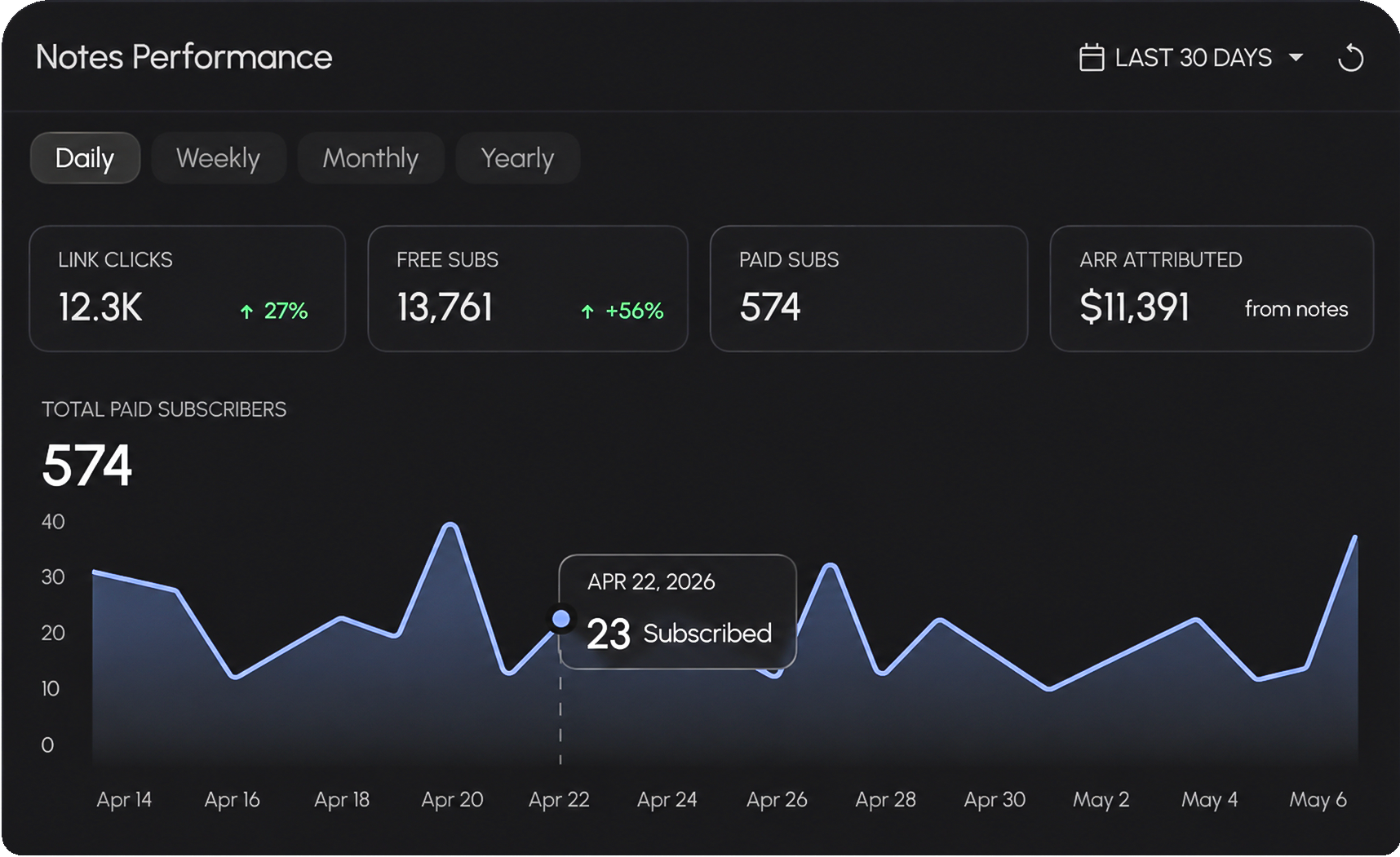
Subscriber analytics. Buffer shows which Notes bring in free and paid subscribers, plus impressions and engagement.
Resharing old posts. You can connect your Substack as a feed so your published posts are ready to share on your other channels.
Teams and multiple publications. You can collaborate on drafts and schedule across more than one Substack account.
Pricing: Substack Notes scheduling is available on the Free plan (you can have up to three channels). Paid plans start at $6 per channel per month, or $5 per channel when billed annually.
2. Substack’s native scheduler — best free option for a few Notes a week
If you post two or three Notes a week, and aren’t creating on any other social platforms, I’d recommend you start with this option.
What stands out:
Free and built in. There’s no extra login, extension, or account connection.
Substack publishes it, so it goes out whether your laptop is open or not.
Three months of runway. That’s enough for a quarter’s worth of launch Notes, if you’re that organized (I am not).
Pricing: Free.
3. WriteStack — best for Substack-only writers who want research and analytics
A queue built around your followers, with default posting times set by when your followers are most active.
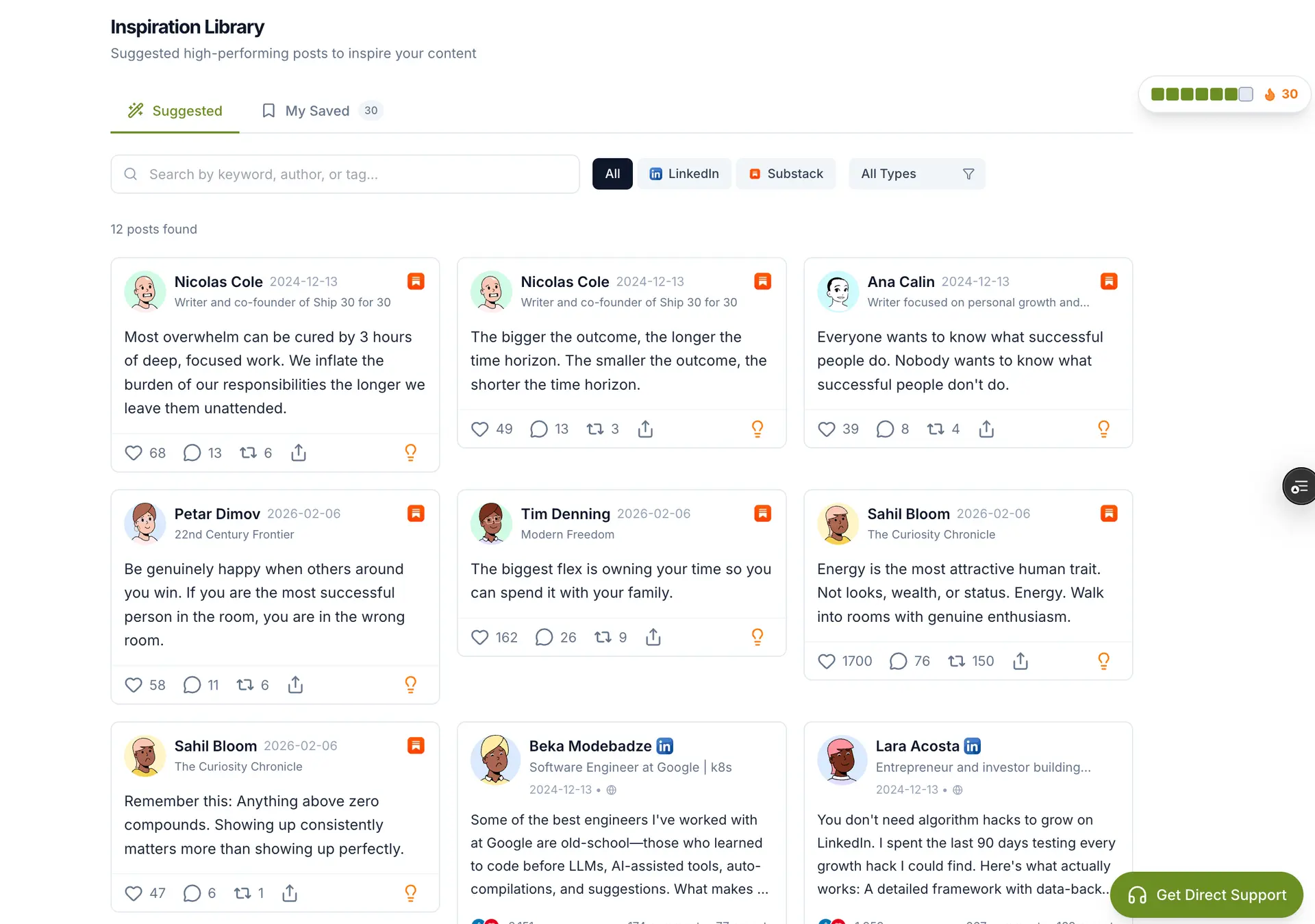
Research: a searchable feed of top-performing Notes across Substack.
Subscriber analytics: every Note in one sortable view, including which ones converted to free and paid subscribers.
AI Notes in your voice, trained on your past posts, plus an MCP connection for Claude.
Worth knowing: WriteStack only works in Chromium browsers (not Safari or Firefox).
Pricing: No free plan (7-day trial). $23.99, $32.99, or $99.99 a month
4. Typefully — best Substack Notes scheduler for writers whose main platform is X
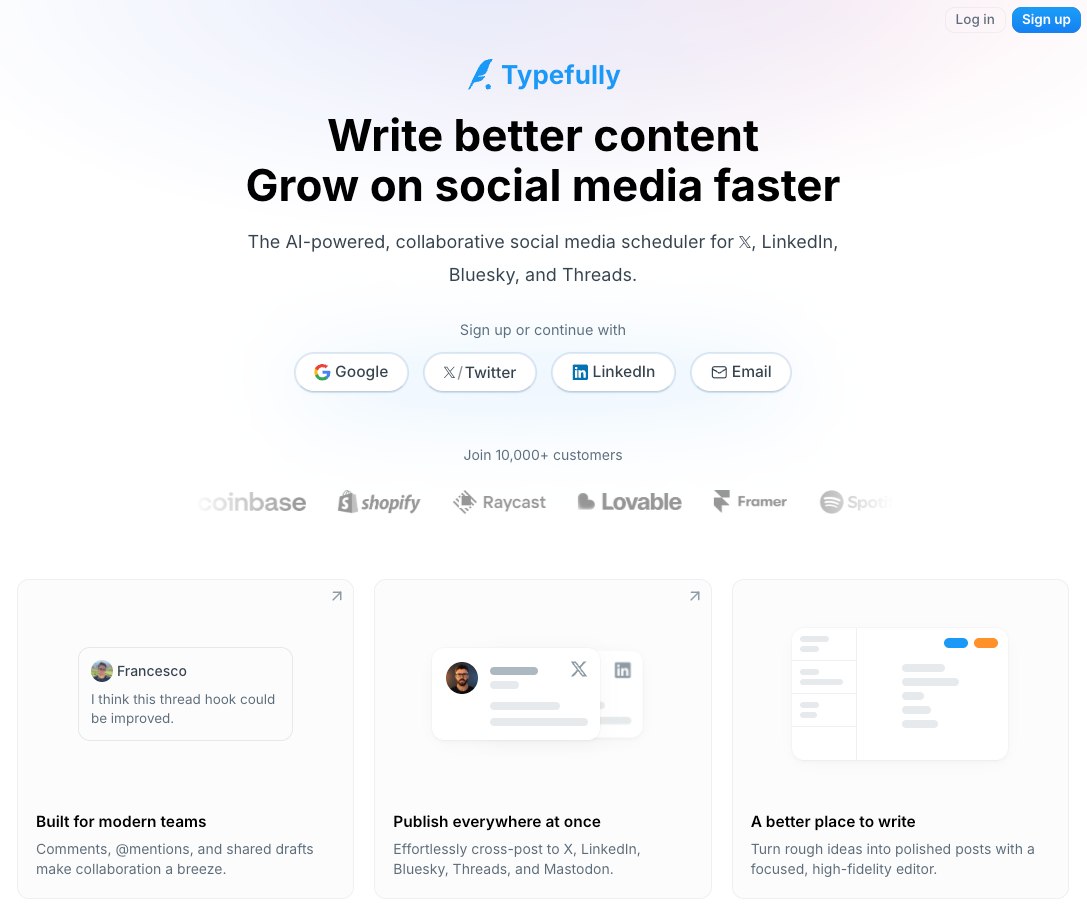
Typefully added Substack Notes in July 2026, on every plan including free. Notes sit next to X, LinkedIn, Threads, Bluesky, and Mastodon in a writing-first composer.
What stands out:
Notes on the free plan. This is one of the cheapest ways to schedule Notes alongside other platforms (Buffer also offers this).
A composer built for writers. Typefully has a really clean, focused composer, with an AI writing assistant built in.
Images and GIFs are supported in Notes.
It’s worth noting that Typefully doesn’t support video in Notes yet, so now that Substack Notes supports video (woohoo!), you might want to look elsewhere, like Buffer, if you plan to post video.
Pricing: Free plan includes Notes; paid from $99 per year.
5. Narrareach — best for turning articles into Notes with AI
Narrareach’s pitch: paste in an article, and its AI cuts it into Notes and short posts, then batch-schedules them.
What stands out:
Article-to-Notes repurposing. A helpful way to go from zero to one in converting long-form content into posts.
CSV import and batch scheduling, for planning several weeks at once.
Crossposting to LinkedIn, X, Bluesky, Threads, and Medium. It’s the only tool on this list that covers Medium.
Setup runs through a Chrome extension, and Narrareach hands your Notes to Substack’s own scheduler to publish. It only does this for “eligible” Notes, and doesn’t say which ones qualify, so double-check before relying on it for anything with media.
Pricing: Free plan (5 Notes a month, Substack only). Paid plans: $19, $39, or $89 a month.
6. StackSweller — best simple Notes queue at a flat price
StackSweller does one thing: a Substack Notes queue that publishes from the cloud, so your laptop can be closed when your Note goes out. There’s no crossposting and no research feed — it’s a scheduler and nothing else, which is exactly what some writers want.
What stands out:
Unlimited Notes: As many Notes as you can post for one monthly or annual fee.
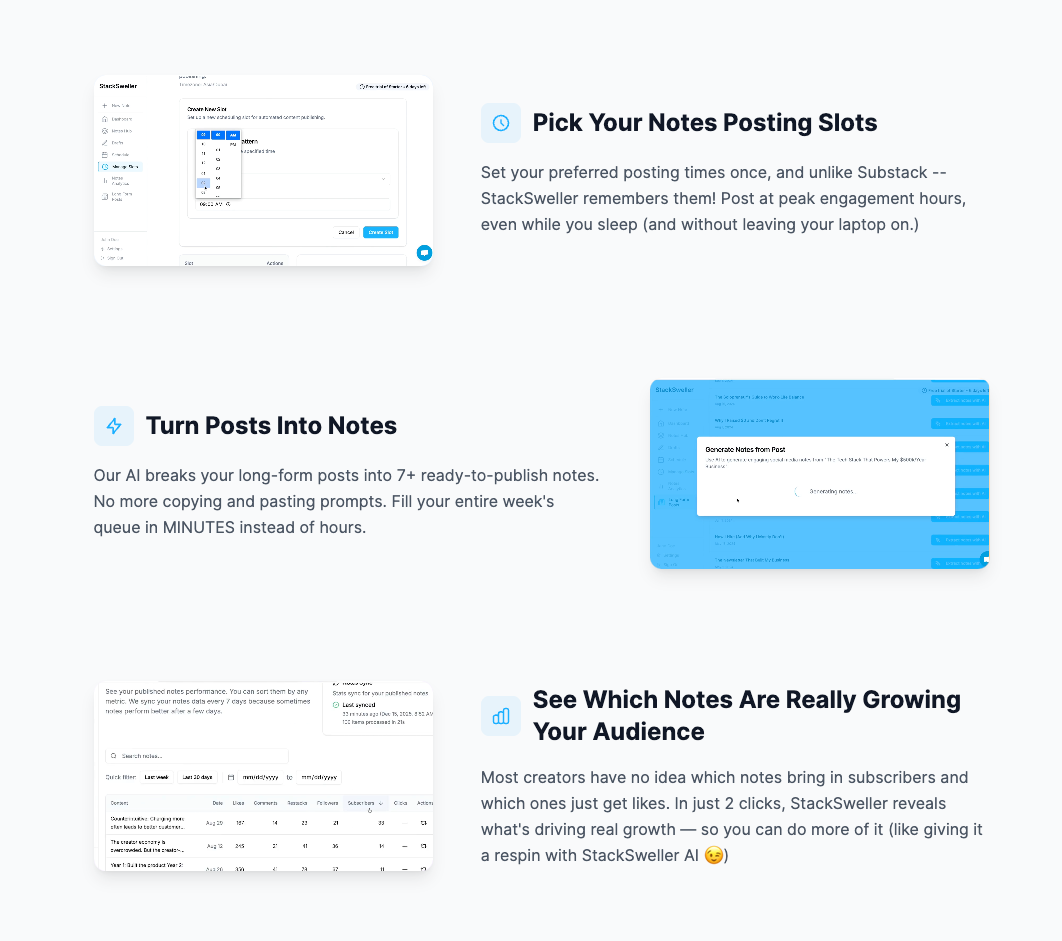
Slot-based scheduling: set your posting times once, then fill them.
Paste-in bulk scheduling, plus AI that turns a post into a stack of Notes.
However, StackSweller is still in beta, so you may encounter a few bugs here and there. Also, it stores your Substack session on its servers. Setup has involved pasting a session cookie by hand, which isn’t for everyone, and sessions can expire, so you may need to reconnect from time to time.
Pricing: $25 per month or $250 per year.
How to choose a Substack Notes scheduler
Start with two questions: where else do you post, and how many Notes a week?
A few Notes a week, Substack only: the native scheduler.
Daily Notes, Substack only: WriteStack if you want research and your computer is reliably on. Try StackSweller if you just want a queue.
Notes plus X, LinkedIn, Threads, or Bluesky: You can’t beat Buffer for cross-platform planning, scheduling, and analytics.
Long posts you want chopped into Notes: Narrareach.
A scheduler’s job is to keep you posting consistently, which does most of the work when you’re trying to grow a newsletter. Posting four times a day doesn’t help if you can’t write four good Notes a day, so it’s absolutely fine to start with one.
If you’re not sure where to start, try Substack’s native scheduler for a couple of weeks. You’ll find out quickly whether scheduling one Note at a time works for you, or whether you’d rather have a proper queue — and by then, you’ll have a better sense of which Notes are worth sharing beyond Substack, too.
Happy scheduling (and happy Noting)!
Frequently asked questions
Can you schedule Substack Notes?
Yes. Since spring 2026, Substack schedules Notes natively on web (calendar icon in the composer) and mobile (three-dot menu, then Schedule), up to about three months ahead. Third-party tools add queues, bulk scheduling, and crossposting.
What’s the best free Substack Notes scheduler?
Substack’s own scheduler is free and doesn’t require your computer to be running in order for your posts to be published. For free scheduling alongside other platforms, Buffer is an excellent choice — the forever-free plan gives you access to planning, scheduling, analytics, and a bunch of other powerful features for up to three channels (including Substack Notes).
Is it safe to give a scheduler access to my Substack account?
It depends on how the tool publishes:
Browser-extension tools post from your own logged-in browser.
Stored-session tools keep a copy of your login on their servers.
Handoff and direct-integration tools avoid both.
I always recommend you check a tool’s help docs and user reviews before connecting.
Can I crosspost Substack Notes to X, LinkedIn, and Threads?
Yes. Buffer, Typefully, and Narrareach all do it from one composer. WriteStack does it through its Buffer add-on.
7 Billion Impressions Without Paid Media: Fanta’s Halloween Strategy
Halloween is no longer just a seasonal celebration. For brands, it can become a powerful cultural platform for building relevance, generating engagement, and creating long-term brand assets.
In this episode of Adspeak by ADWEEK, Rebecca Stewart sits down with Ibrahim Khan, global vice president of marketing at Fanta, to explore how Fanta turned Halloween into a global brand moment and generated more than 7 billion impressions through fan-generated content without paid media spend.
The conversation explores how Fanta identified an opportunity to build ownership around Halloween, harnessed TikTok and community creativity, and partnered with Universal Pictures and Blumhouse to create collectible horror-themed cans.
Ibrahim also explains how product design can become a storytelling platform, how to balance brand authenticity with licensed IP, and why giving audiences creative freedom can drive deeper engagement.
He shares the long-term thinking behind turning a successful seasonal campaign into a recurring global franchise that builds anticipation and cultural relevance year after year.
[embedded content]
What you’ll learn:
How to identify a “white space” holiday moment competitors have left unclaimed and build ownership around it
Why letting fans create content can generate more impressions than any paid campaign
The “constructive tension” principle for balancing a licensor’s IP integrity with your own brand’s authenticity
How to select characters or creative assets that flex across generations and 50+ global markets without losing relevance
Why product design itself (not just advertising) can become the most scalable storytelling platform a brand has
The long-game playbook for turning a single viral moment into a recurring, expectation-building annual tradition
About the guest:
Ibrahim Khan leads global strategy and marketing for Fanta, bringing more than a decade of experience at Coca-Cola across diverse markets. Previously, he served as senior marketing director for sparkling flavors in greater China and Mongolia, overseeing Fanta, Sprite, and Schweppes. His career also includes leading marketing for Sprite in its largest global market, managing sparkling portfolios across ASEAN, and driving brand strategy for Coca-Cola and Fanta across Thailand, Pakistan, and Afghanistan. Ibrahim specializes in global brand management, digital transformation, and creating consumer experiences that resonate across cultures.