Dreame’s step-climbing X50 Ultra mopping vacuum is hundreds off
It’s been a while since we’ve seen a big price cut on a capable robot vacuum and mop hybrid that can scale over short steps and threshold to hunt messes. Dreame’s X50 Ultra is the model that my colleague Jen recommends for hard floors and carpets, and it’s down to $899.99 at Amazon for Prime members (originally $1,599.99, but commonly around $1,100). It’s actually a bit cheaper ($849.99) directly through Dreame’s site if you have a free account there.
Dreame X50 Ultra
With high suction power, an improved brush system, and the ability to scale thresholds up to 6cm, the X50 Ultra stands out as a great robot vacuum and mop hybrid.
The X50 Ultra debuted in early 2025, and still made the cut for Jen’s 2026 list of the best robot vacuums, thanks to its huge list of features that are executed well, for the most part. It’s a great vacuum and mop, and its mopping pads extend out, sweeping underneath cabinets and other furniture that sits close to the floor. Also of note is its ability to climb over thresholds up to 6 centimeters (over 2 inches) tall, ensuring it won’t get stuck where other vacuums may stumble.
Like any good robot vacuum and mop, there isn’t much you’ll have to do to maintain on a day-to-day basis. It can remove, wash, and dry its mops autonomously, and its self-emptying bin can collect debris it sucks up for several weeks. Dreame claims you won’t have to empty it for 100 days, but that obviously depends on how messy your place is. Also, you’ll likely have to refill its water tank frequently if you’re mopping a lot.
Other fantastic Verge-approved deals
Woot has a pretty good deal happening on “Grade A” condition refurbished units of Asus’ ROG Ally with the AMD Ryzen Z1 Extreme processor (16GB RAM, 512GB SSD) and a 90-day warranty. Priced at $529.99, the offer code CHEERS knocks 20 percent off that total for the rest of the day (September 28th). New customers who use the code get 30 percent off. For 20 percent off, that’s about $425, or $371 with the 30-percent discount. This model is a solid competitor to the Steam Deck LCD, with a higher-res 1080p screen with a 120Hz refresh rate. Its Z1 Extreme processor is faster, too, so this might be the deal you’ve been looking for if you’re striking out on handheld deals. Read our 2023 review.
Another deal that jumped out from Woot is for the SteelSeries Arctis Nova Pro wireless headset for the PlayStation, PC, and Switch. The white version in new condition is about $192 with the code CHEERS, or down to around $168 if you happen to be a new Woot customer who uses the code. Its current $239.99 price is already good enough to earn it a spot in this roundup, but the current discount brings it down to “best-ever” territory. This 2022 headset is still a fantastic option, even compared to the $399 Nova Pro Omni that succeeds it. It has swappable batteries, a comfy design, and a reliable base station that can feed in audio from multiple sources. Read our review of the Nova Pro.
Samsung’s 32-inch 4K smart screen on a pedestal, called The Movingstyle Essential, is $200 off. Originally $699.99, it’s down to $499.99 for Prime members at Amazon. It seems to be Samsung’s take on the LG StanbyMe, though it’s much cheaper even before this discount (notably, Samsung’s requires being plugged in, unlike the battery-equipped LG model). The screen attaches to a height-adjustable rolling stand (up to 50.8-inches tall), and it supports pivoting, swiveling and tilting. It features two full-size HDMI ports (once of which supports ARC), plus USB-C with 65W passthrough power, and two USB-A ports for viewing local media.
This post was created in partnership with Viant As TV and streaming audiences become increasingly fragmented, understanding what happens between an ad being served and a viewer paying attention is […] https://www.adweek.com/convergent-tv/marketers-you-have-9-minutes-to-earn-attention/
Can You Schedule Substack Notes?
Yes, you can schedule Substack Notes. You can do it in two ways: directly in Substack or through Buffer, which lets you plan Notes on the same calendar as your other channels, send the same Note to LinkedIn, Threads, X, and Bluesky, and see which Notes brought in subscribers. Both are free.
We’ll walk through how it works, where Substack's built-in scheduler falls short, and what I've learned from scheduling a Note every day this month for Buffer's own publication.
Substack added native scheduling for Notes on March 23, 2026, on web, iOS, and Android. Before that, the only options were a third-party extension or posting manually.
Here's how it works on the web:
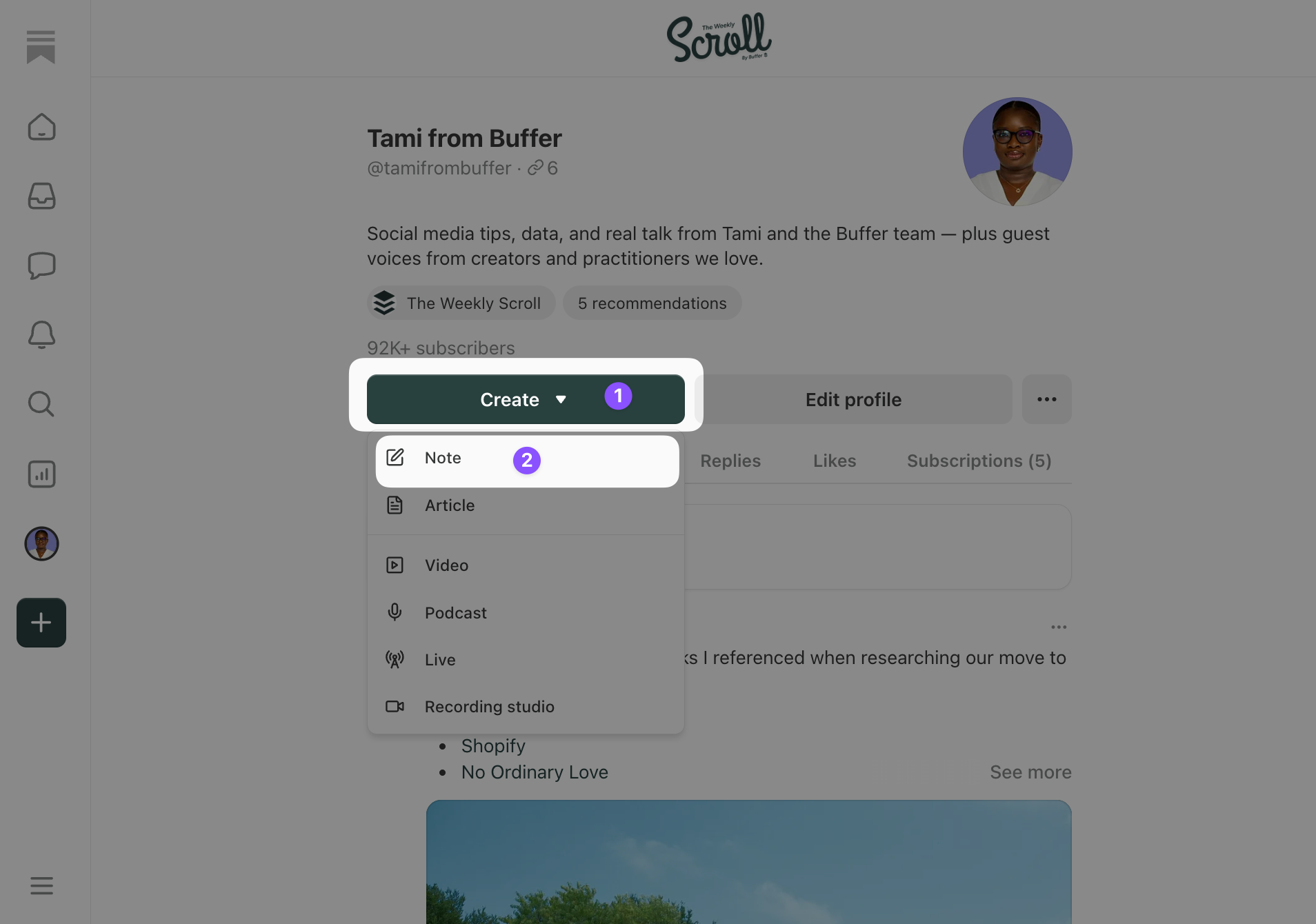
Open Substack and click the plus + button, then Note (or Create → Note if you’re on your profile) to start a new Note.
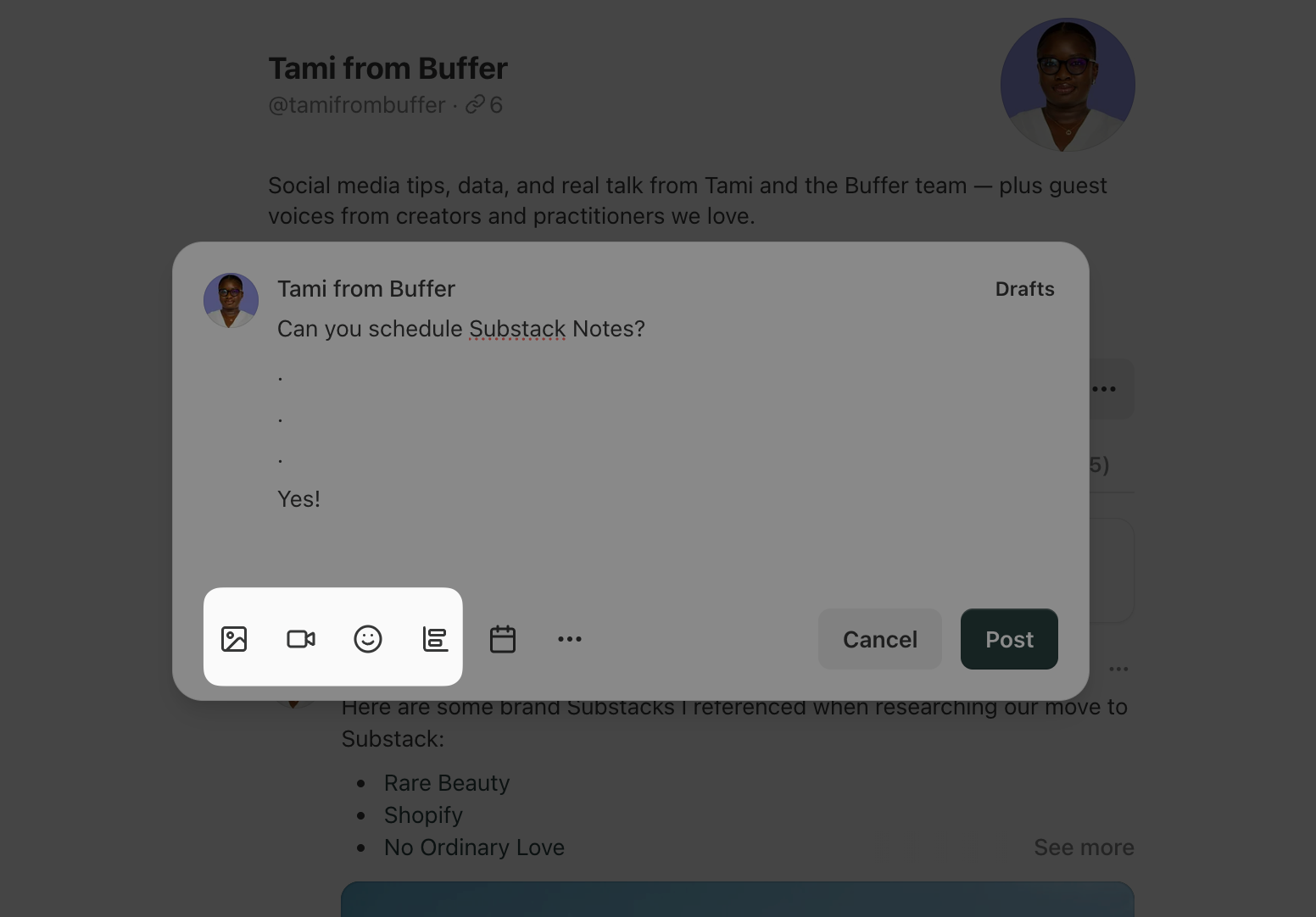
Write the Note as you normally would. You can add images, links, video, and create polls.
Click the calendar icon at the bottom of the composer.
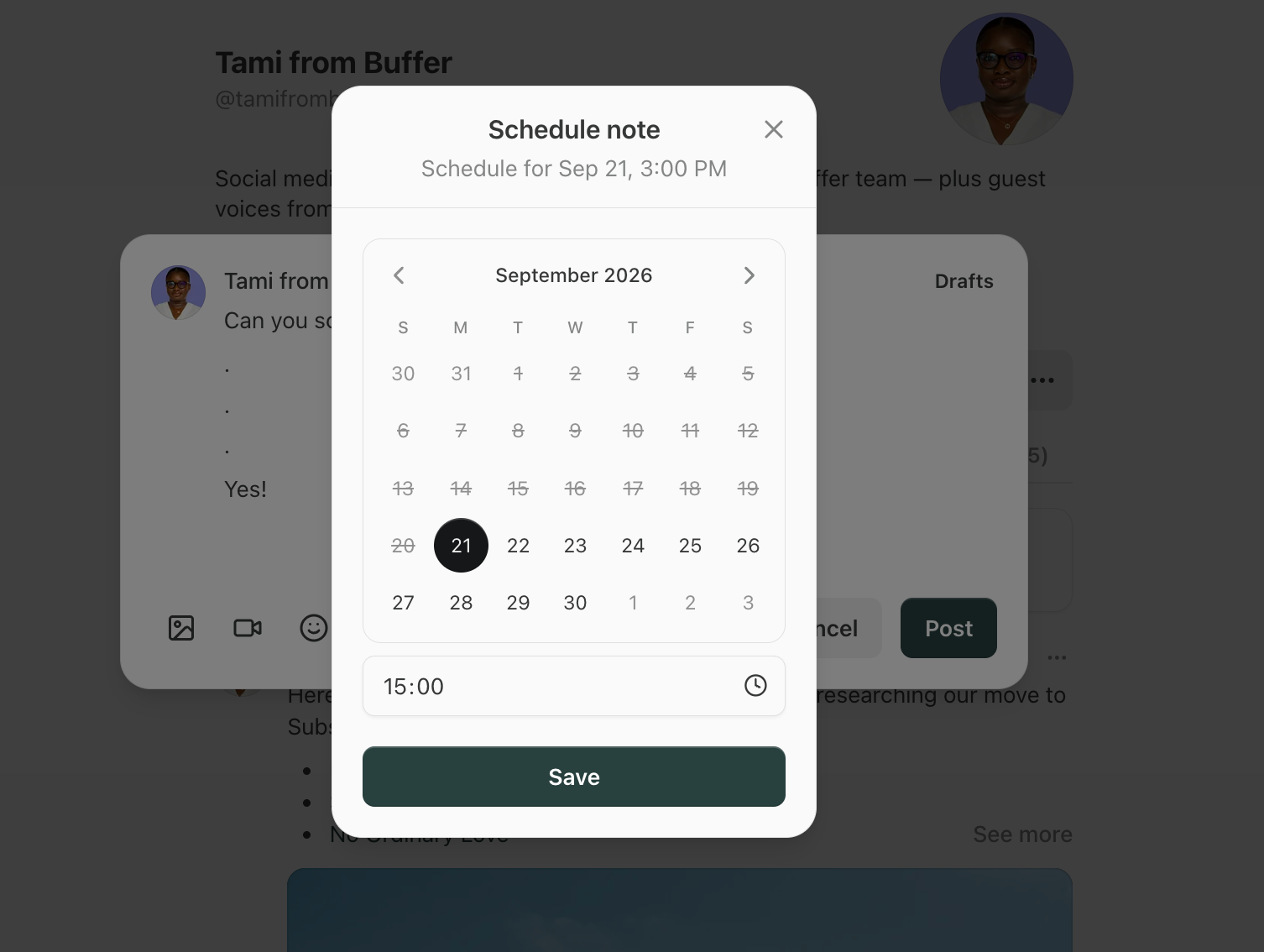
Pick a date and time. Substack uses your local time zone.
Click Save, then Schedule.
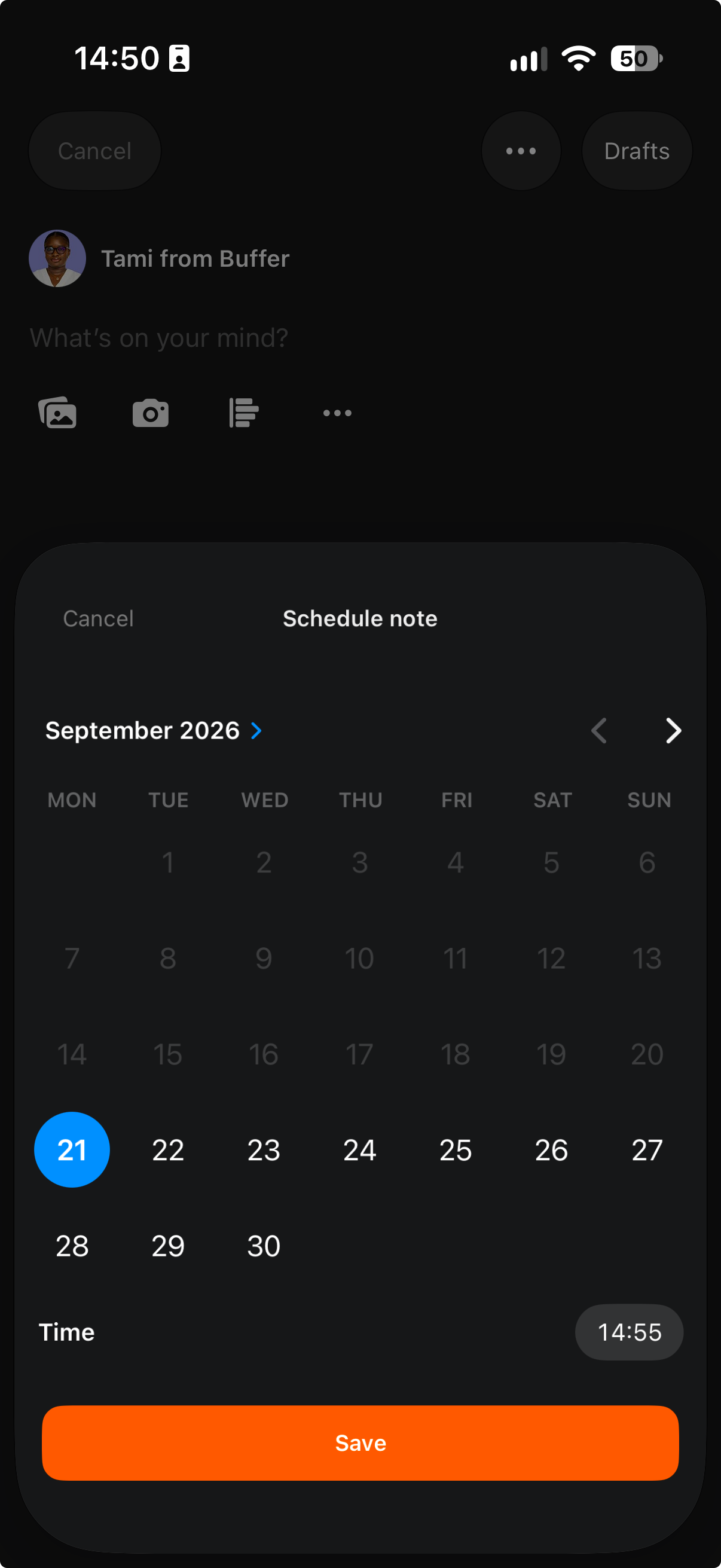
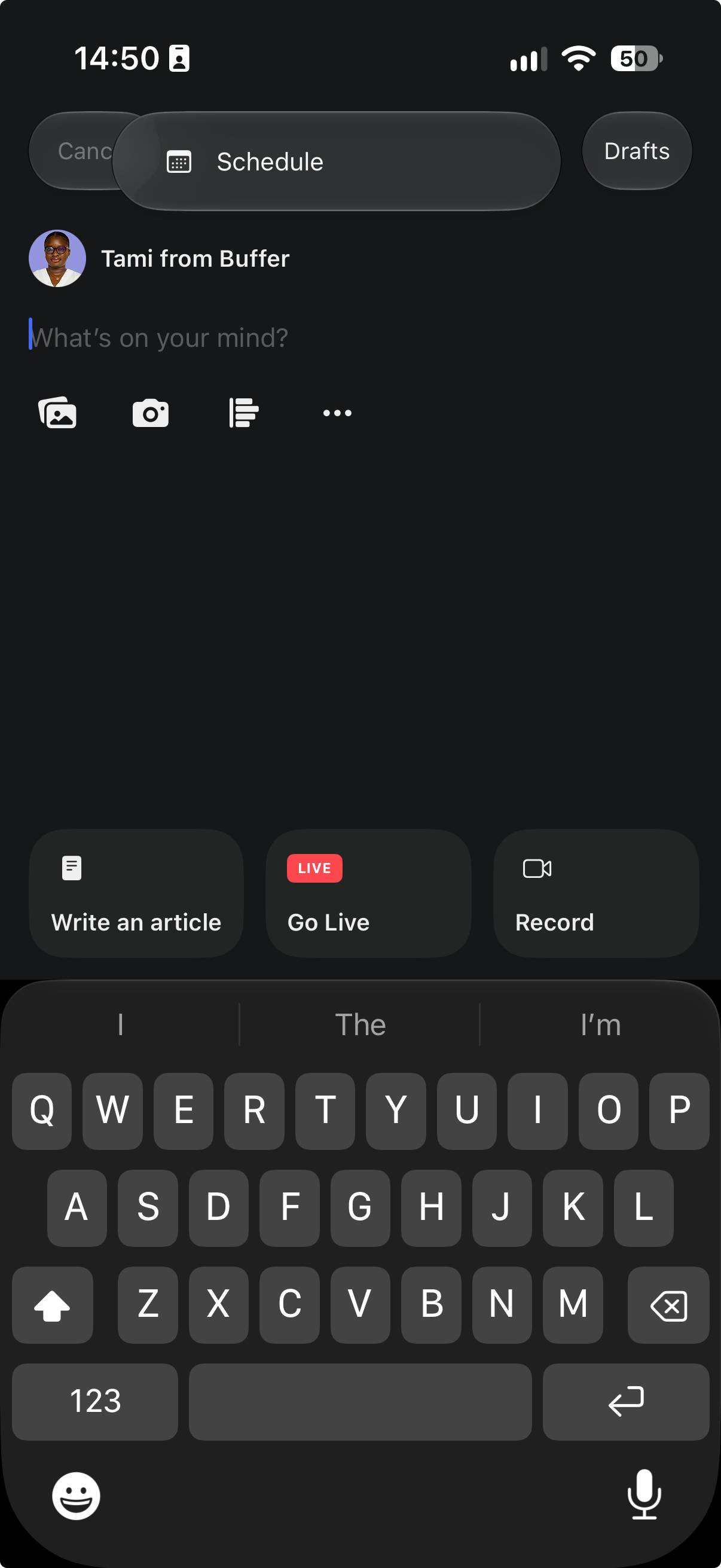
On the iOS and Android apps, tap the plus+ button to start a Note, write it, then tap the three dot ⋯ menu and choose Schedule.
Every scheduled Note lands in your Drafts, with the publish time shown underneath. You can open one from there to edit it or change the time before it goes out. Substack lets you schedule up to three months ahead.
What the native scheduler doesn't do
There's no calendar view, so you're reading a list of drafts rather than seeing your week of planned content.
You can also only schedule one Note at a time. And you can't send the same Note to another platform, and there's no per-Note reporting beyond the likes, replies, and restacks you can see on the Note itself.
For a writer posting a couple of Notes a week, this is fine, great even. But once Notes become a daily habit, or one of several channels you're keeping up with, you may start to want more. And this is where Buffer comes in.
How to schedule Substack Notes with Buffer
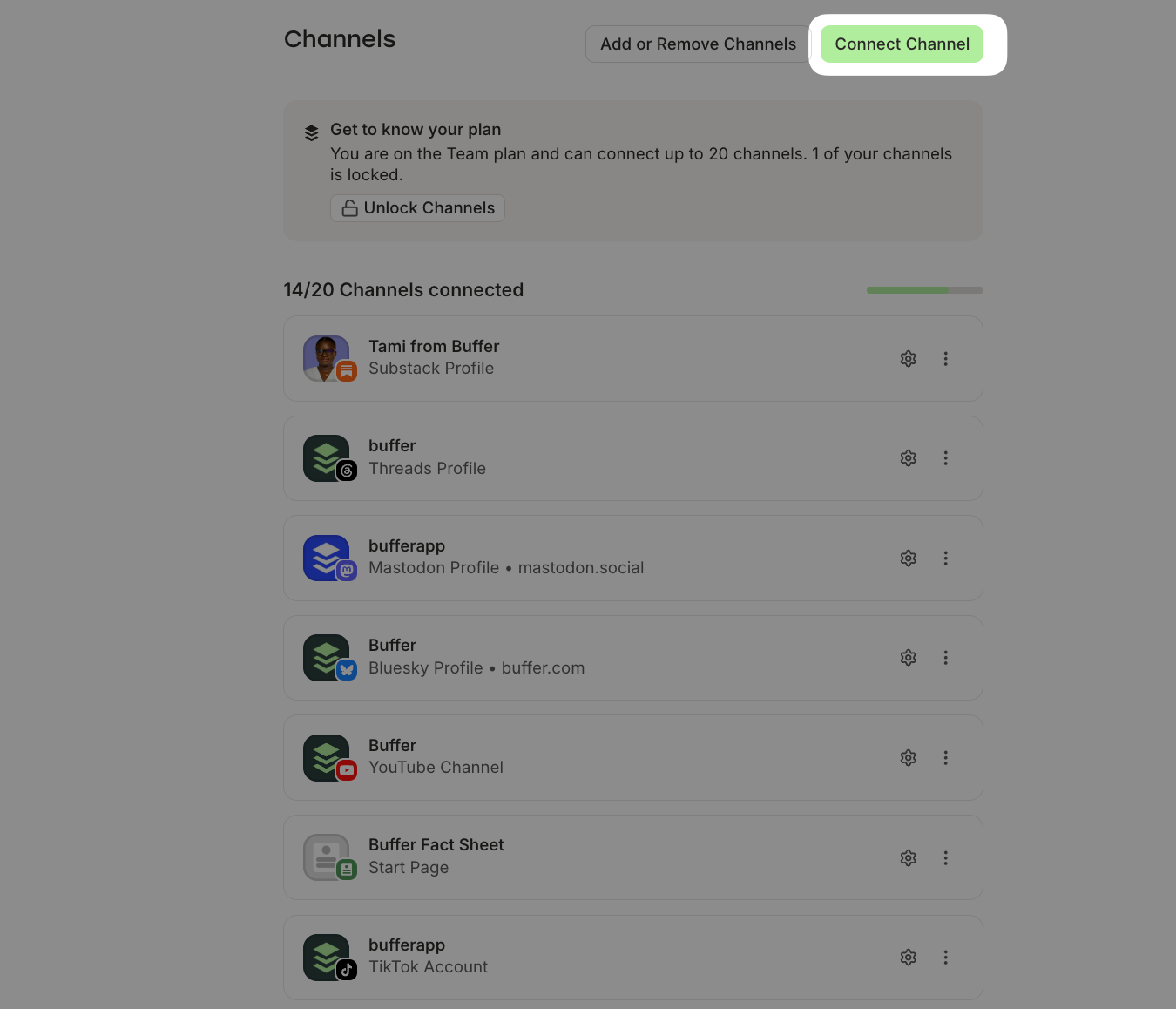
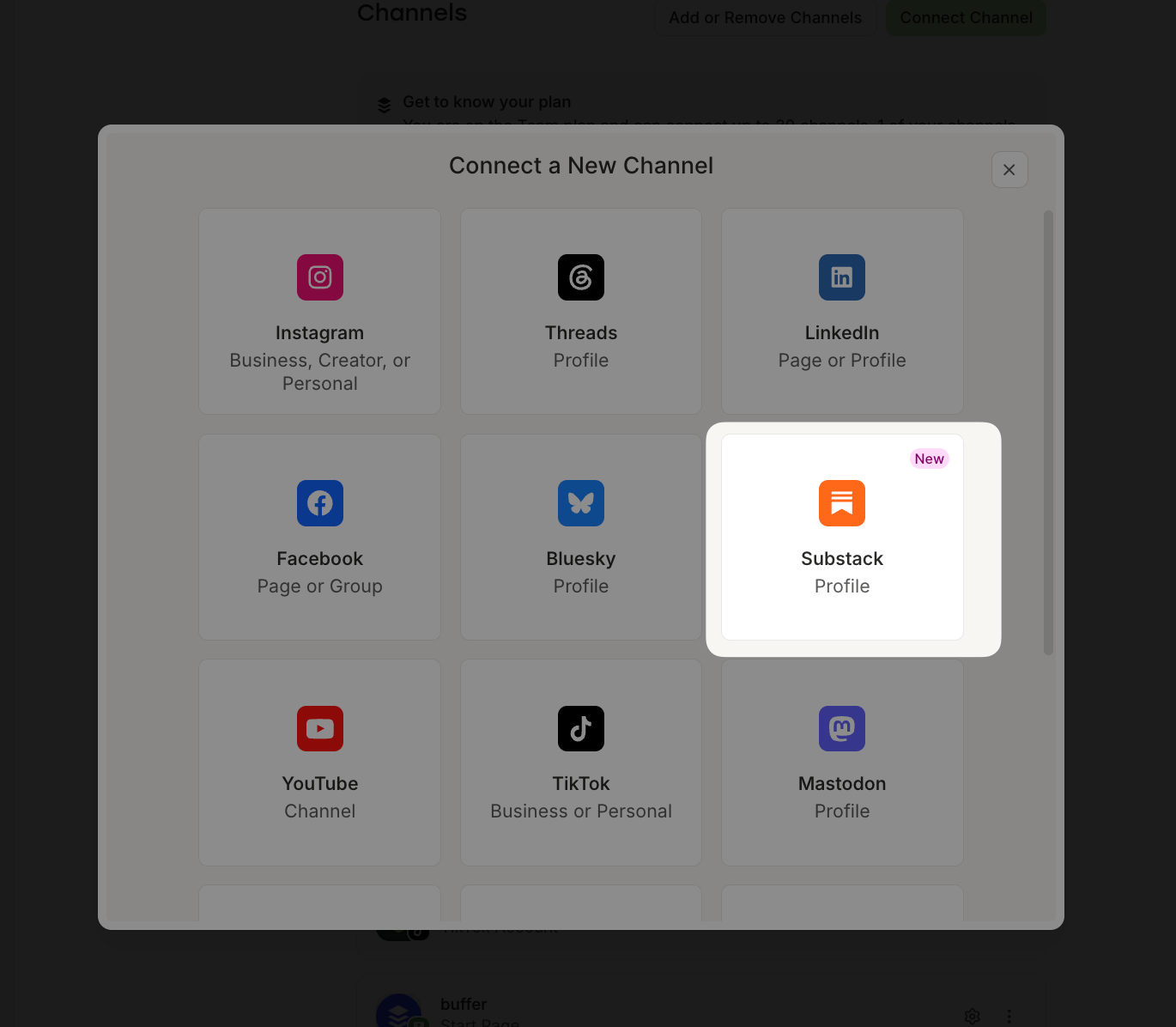
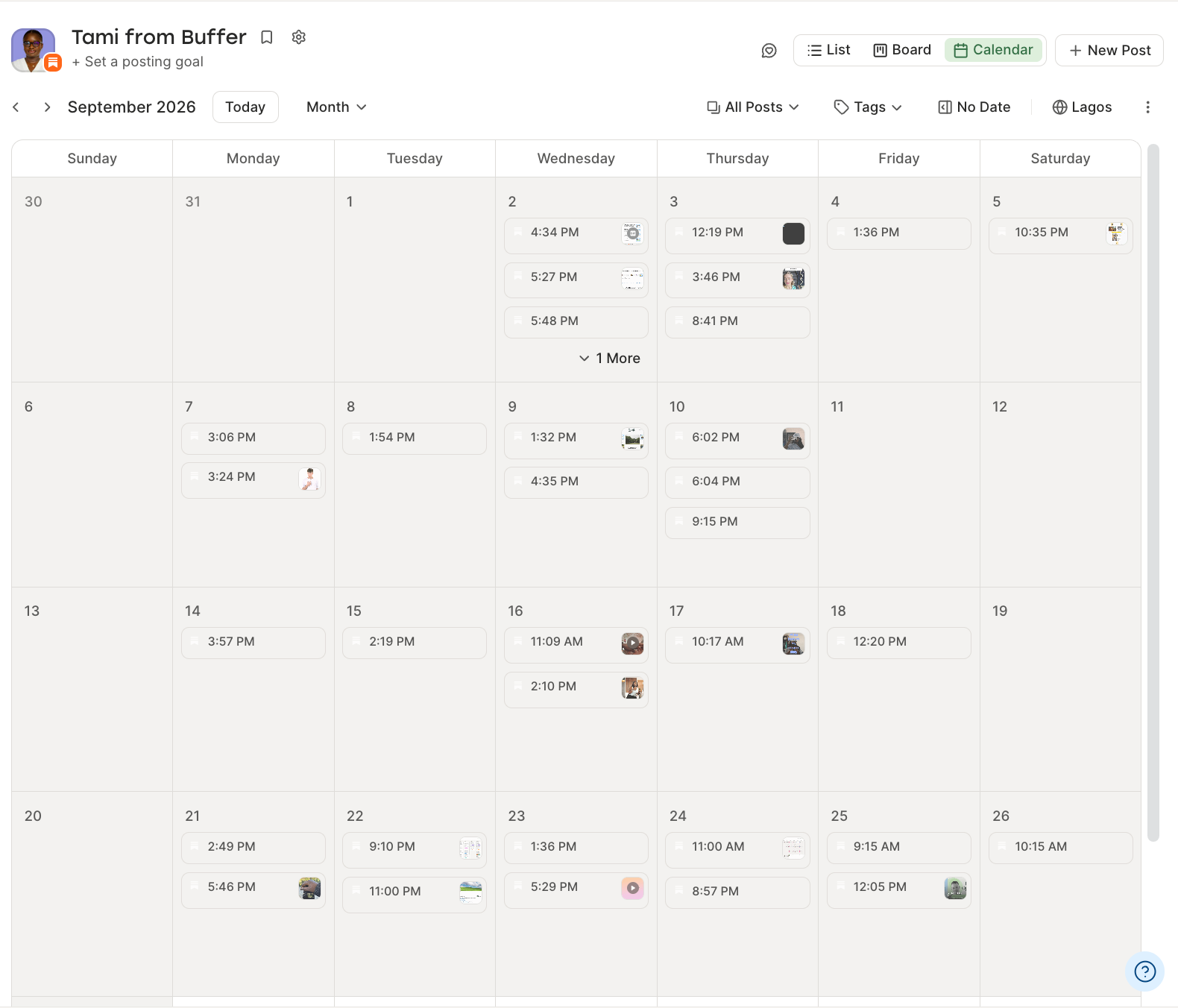
Buffer's Substack integration is built on Substack's official API, and it treats your Substack account like any other channel: connect it once, and Notes show up on the same calendar and in the same composer as your LinkedIn, Threads, X, Instagram, and Bluesky posts.
Scheduled Notes publish directly at the time you set. There's no reminder step or "finish this in the Substack app" notification.
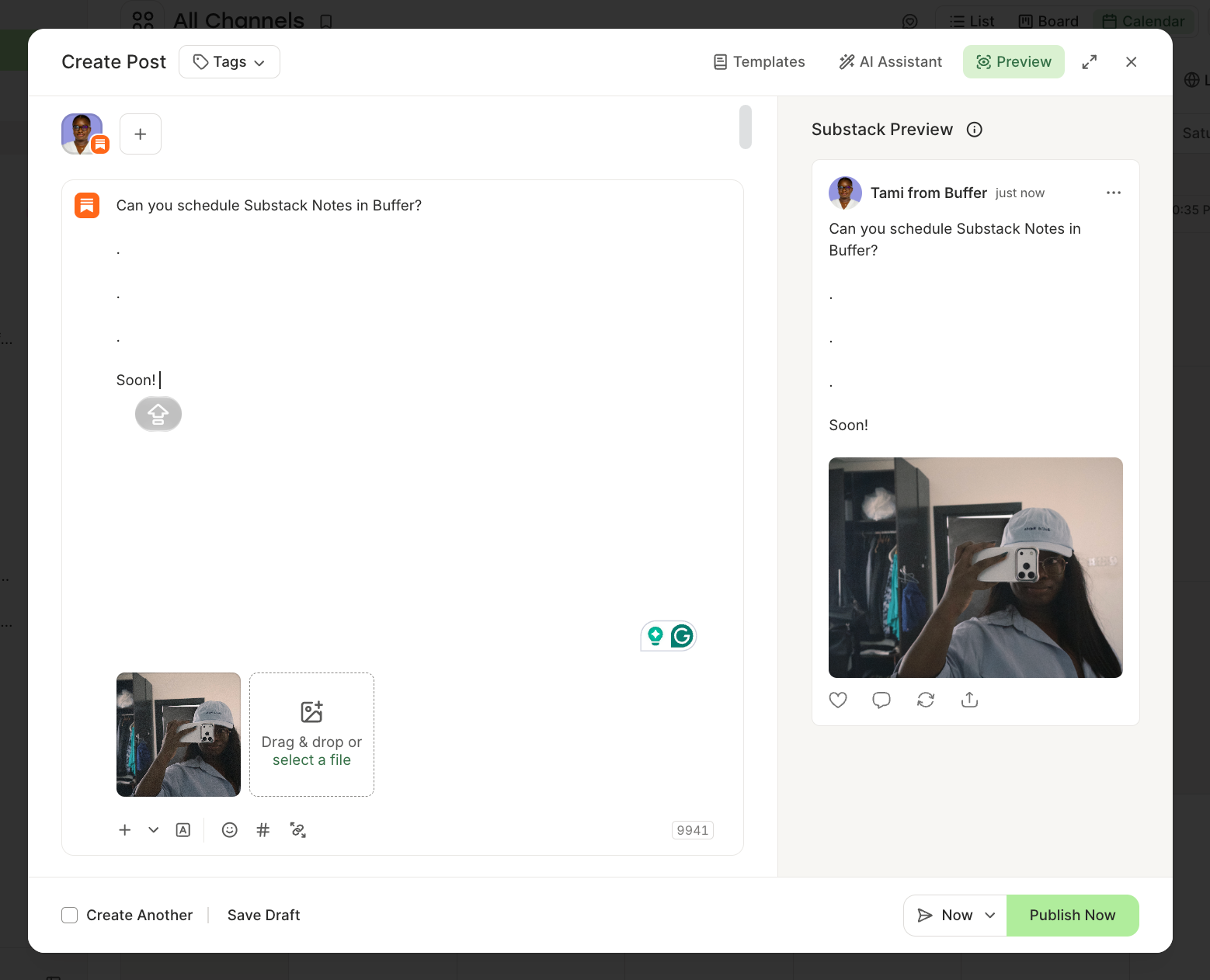
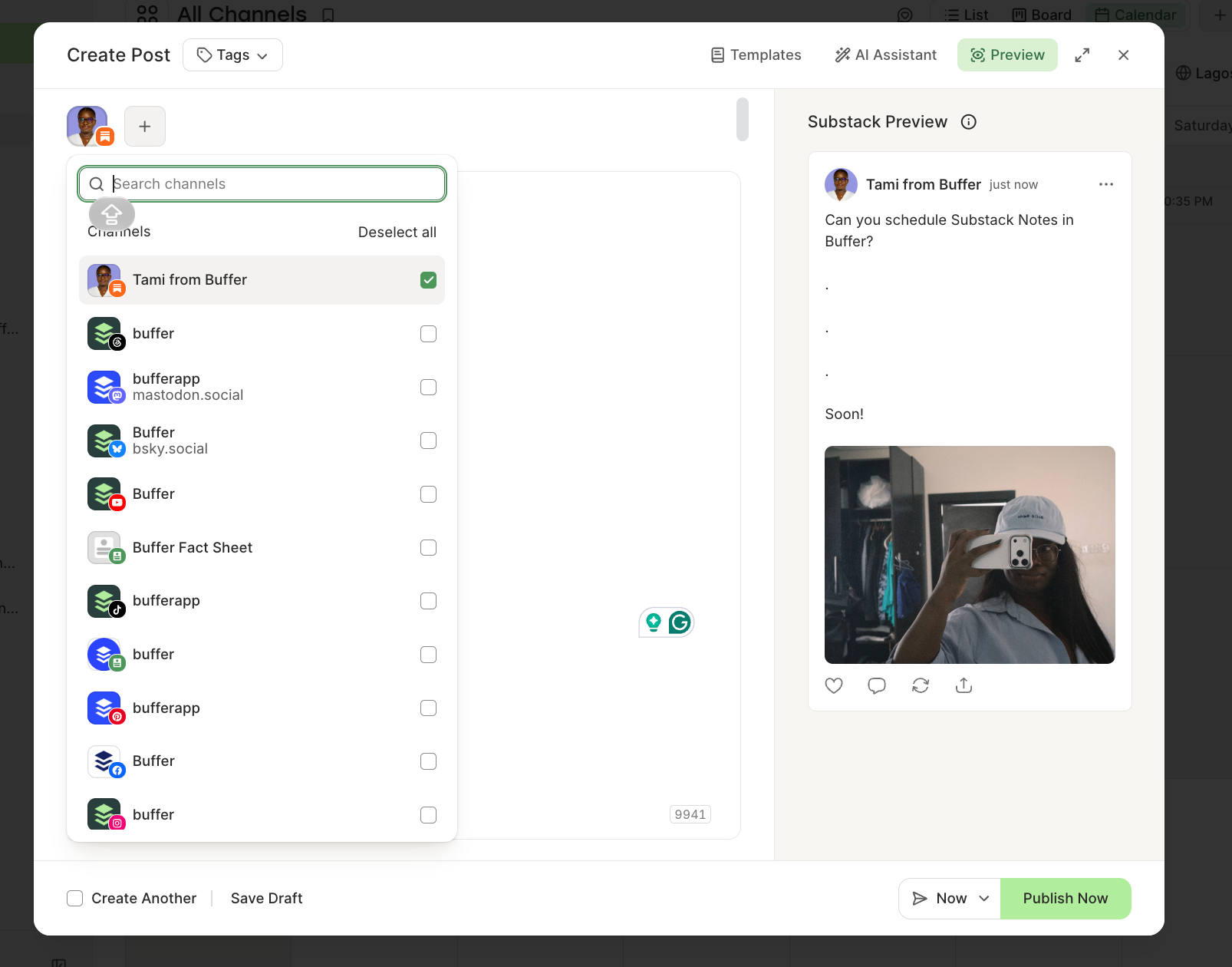
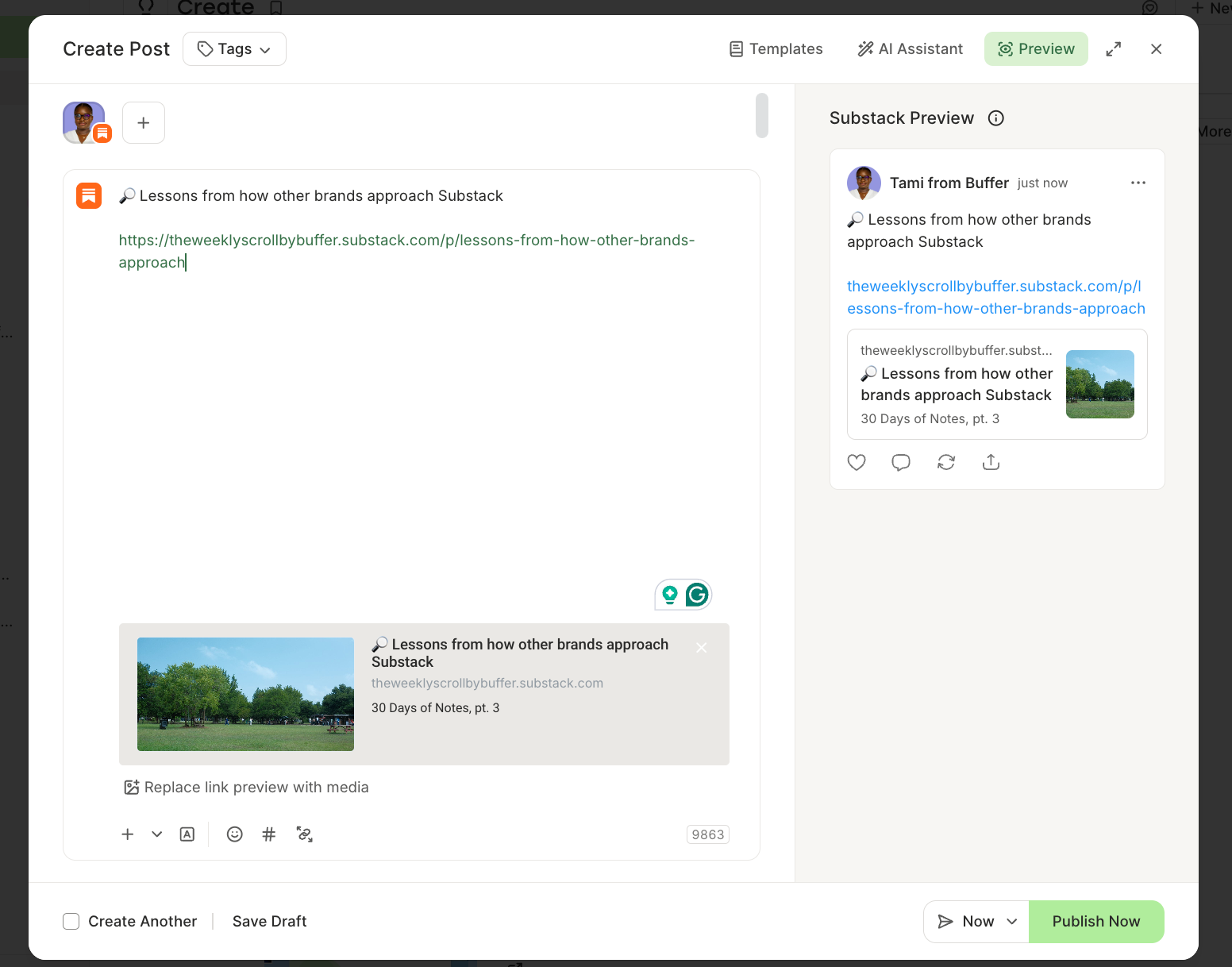
Click Create Post, select your Substack channel, and write your Note. You can add images, a link, or a video.
If you want the same Note to go out to LinkedIn, Threads, X, or Bluesky, select those channels too and tweak each version until you’re satisified.
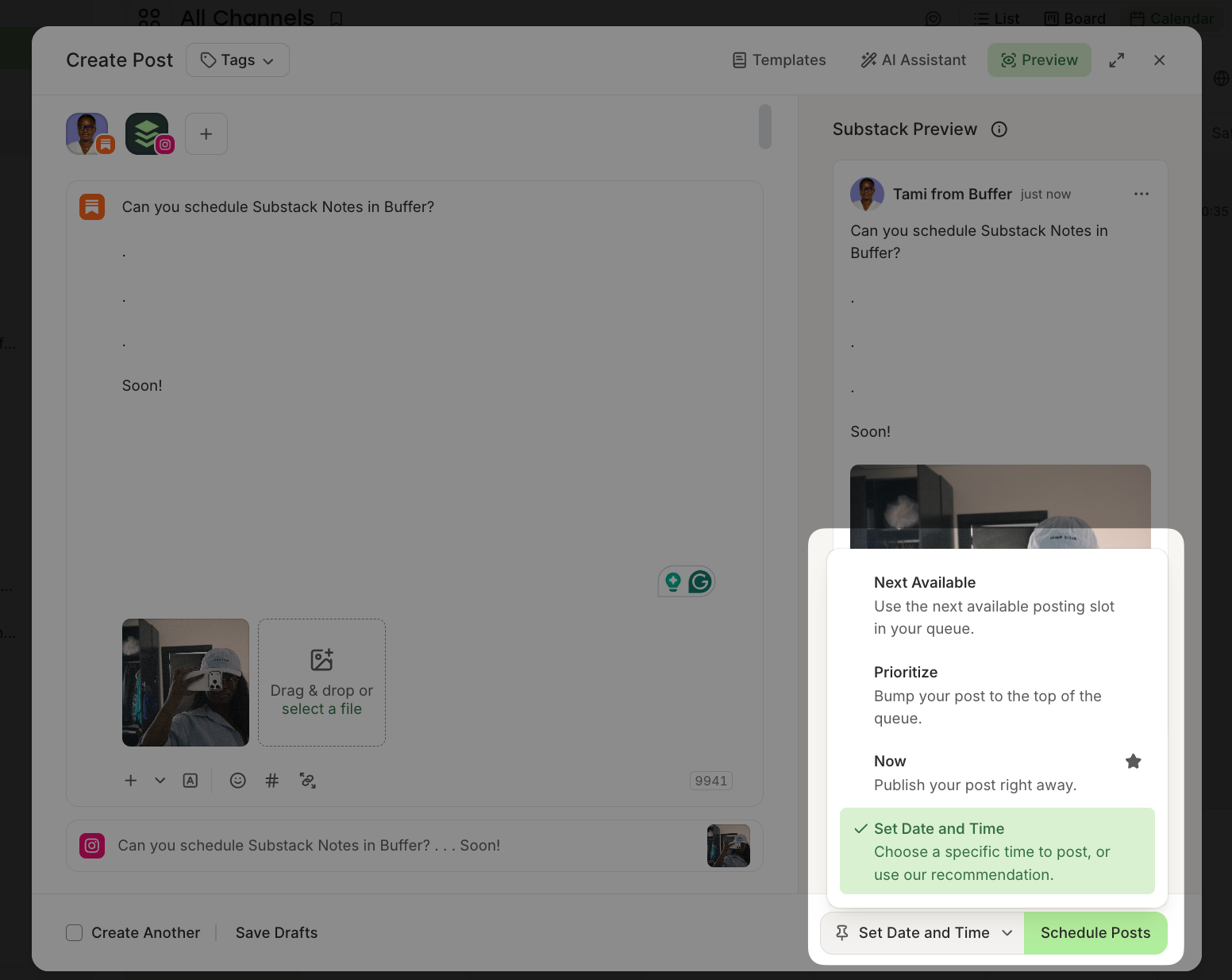
Pick a time (or use one of your set posting slots) and click Schedule.
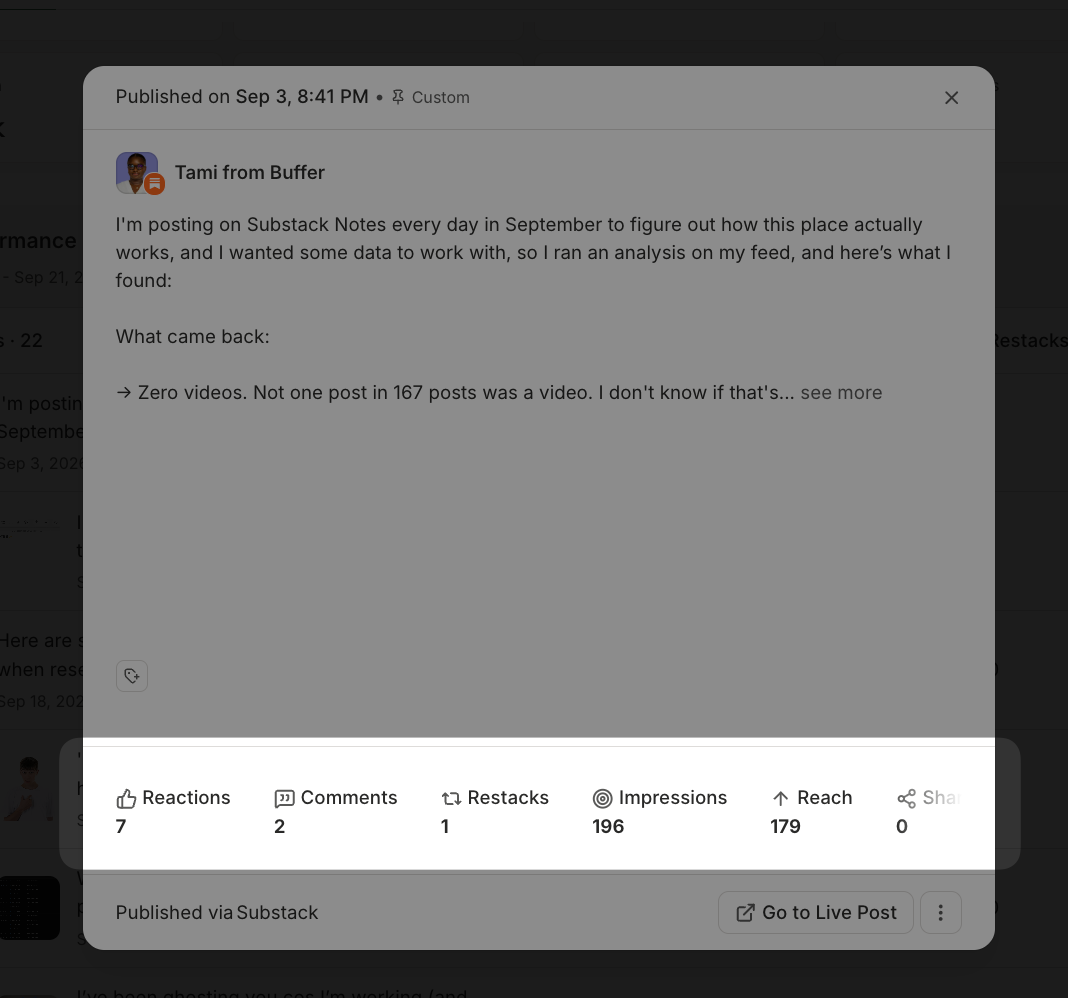
Once a Note is live, Buffer's analytics show impressions, engagement, follows, as well as how many free and paid subscribers each Note brought in.
Because your other channels sit in the same dashboard, you can put a Note next to the LinkedIn version of the same idea and compare performance as well.
Two more ways to use Substack in Buffer
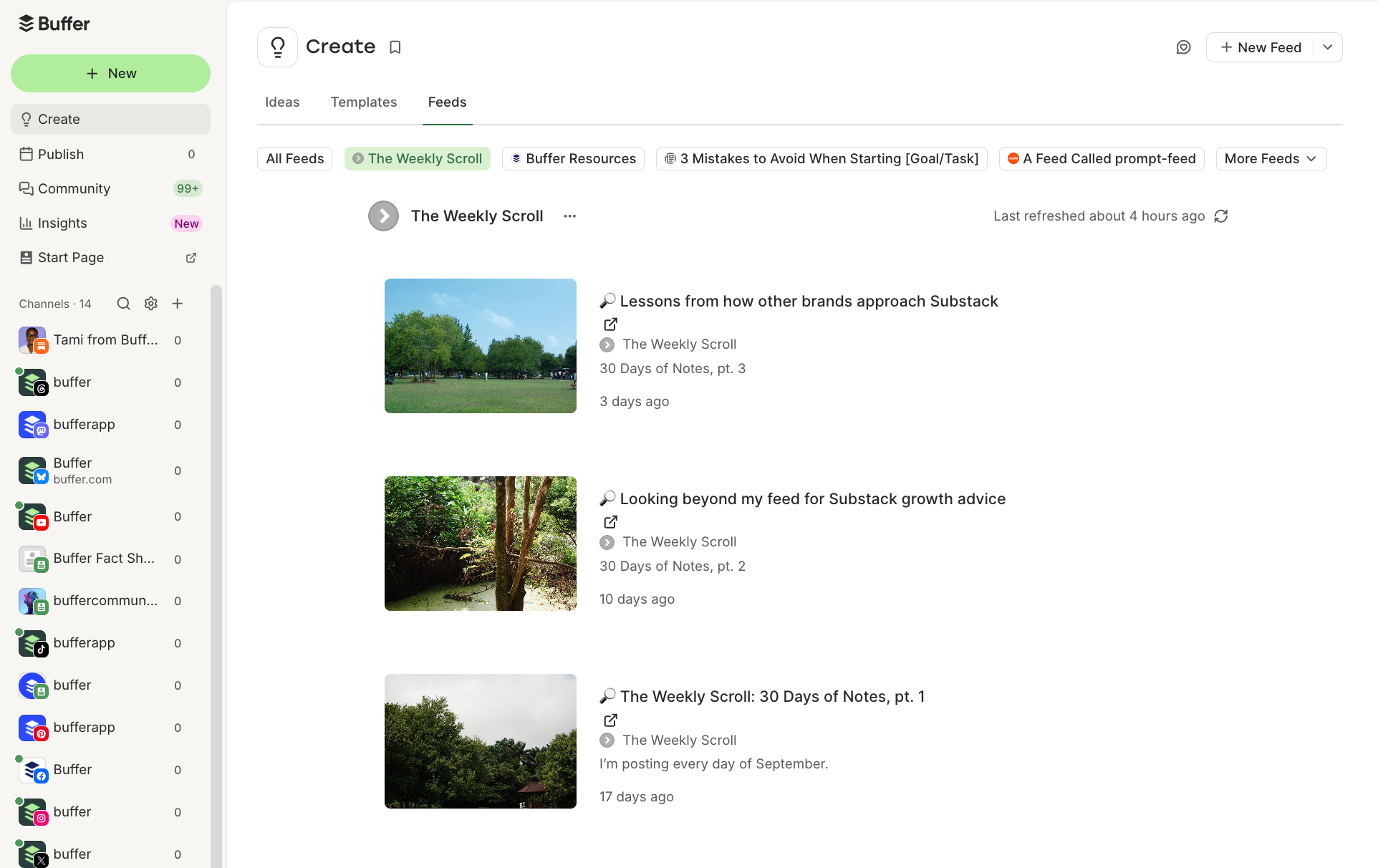
You can add your Substack publication as a feed in Buffer, which pulls your published posts in so you can queue them out to your social channels, or turn an old post into a new Note weeks later.
If you work with an AI assistant, Buffer supports Substack Notes in its MCP and API, so you can draft and schedule Notes from Claude or ChatGPT or your preferred AI assistant.
Buffer's free plan covers three channels with 10 scheduled posts per channel at a time and 30 days of analytics history. Paid plans start at $5 a month per channel for unlimited scheduling and full analytics.
What I’ve learned from posting a Note a day
I run Buffer's publication on Substack, The Weekly Scroll, and for September I've been posting one Note every day. In addition to scheduling, a few things have made it easier now that Substack Notes are in Buffer.
Batch the planned content, leave room for spontaneous ones: I write and schedule most of the week's Notes in one sitting, but I keep a slot or two open to react to something in the feed. Replies and restacks can't be scheduled anywhere, and those are the Notes that start conversations, so scheduling handles the consistency and I handle the rest.
Schedule for when your readers are around, not when you're writing. Buffer's posting slots make this a set-once decision rather than a daily one.
Keep a running list of ideas. I keep my ideas in Buffer's Ideas, then turn the good ones into Notes on the days I plan my posts.
Substack Notes scheduling FAQ
Is there a free way to schedule Substack Notes? Yes, two. Substack's own composer schedules Notes for free on web, iOS, and Android. Buffer's free plan also lets you connect your Substack account and schedule Notes without entering a card, with up to 10 scheduled posts per channel at a time.
Can you schedule Substack Notes from your phone? Yes. In the Substack app, start a Note, tap ⋯, and choose Schedule. In the Buffer mobile app, create a post, select your Substack channel, and schedule it as you would for any other channel.
Can you schedule a restack or a reply? No. Neither Substack nor Buffer schedules restacks, quote-restacks, or replies to other people's Notes.
Can you add images, links, or video to a scheduled Note? Yes, in both. Substack's composer and Buffer's both support text, images, links, and video in a scheduled Note.
Do scheduled Notes perform worse than ones posted live? There's no evidence they do. A scheduled Note publishes the same way a manual one does, and readers can't tell the difference. What tends to matter more is whether you're around to reply in the first hour or so after it goes out.
How far ahead can you schedule a Note? Substack lets you schedule up to about three months out. Buffer has no time limit on how far ahead you can schedule a post.
Can you schedule Notes for more than one publication? In Substack, you schedule from whichever account you're logged into. In Buffer, each publication connects as a separate channel, so you can schedule for two or three Substacks from one account and keep the analytics separate.
Do you need a Chrome extension to schedule Substack Notes? Not anymore. Both Substack and Buffer schedule Notes from the web and their mobile apps.
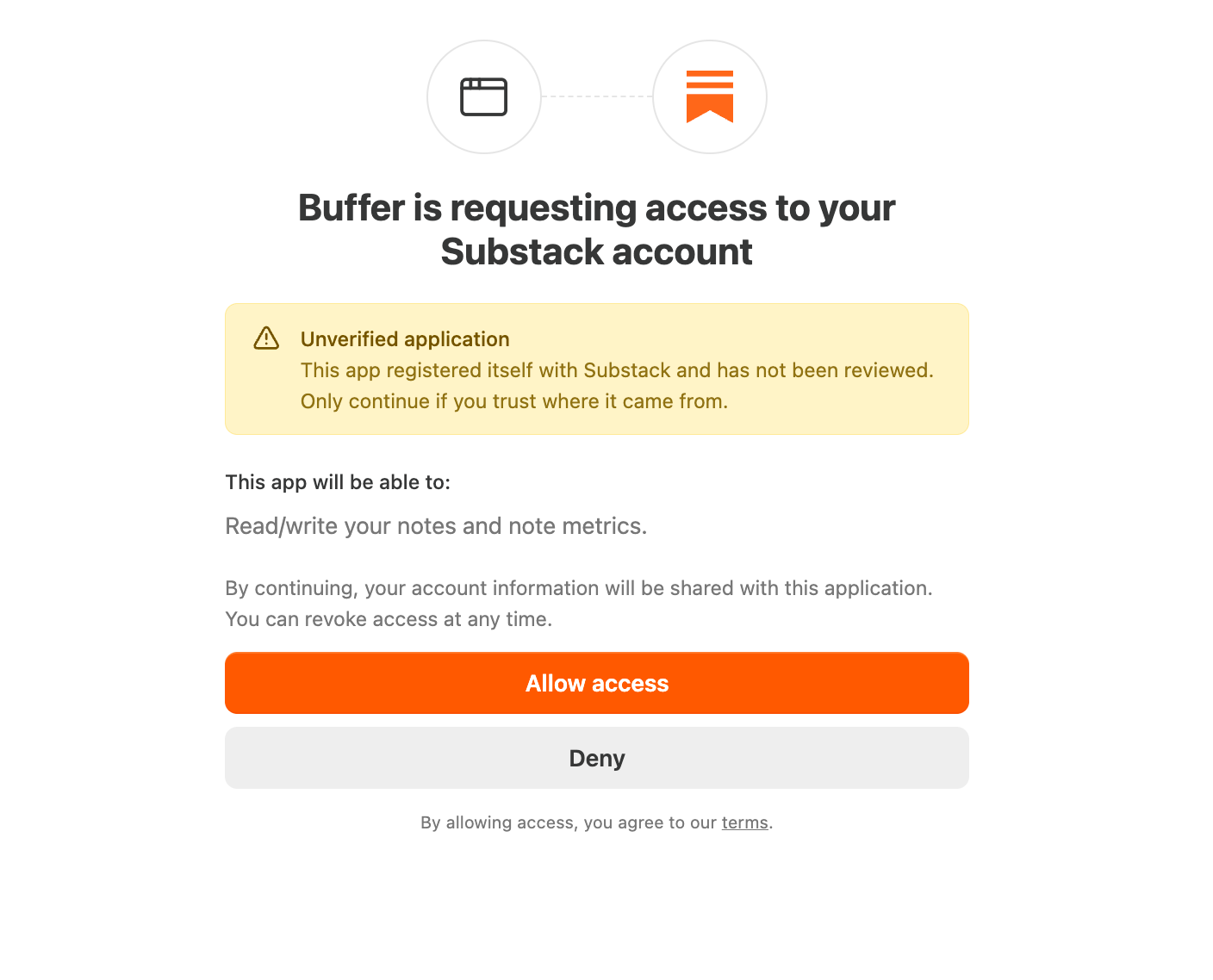
Does scheduling Notes through Buffer break Substack's rules? No. Buffer's integration is built on Substack's official API in partnership with Substack, so Notes scheduled through Buffer publish the same way they would from Substack's own composer.
Pick a time and post
If you've wanted to be better about posting Notes, there’s now an easy fix. Write the Notes you already know you want to post, schedule them, and use the time you get back to reply to people.
Substack's built-in scheduler is enough to start. When Notes become one of several channels you're keeping up with, and you want to know which of them actually bring readers in, connect your Substack to Buffer and put them all on one calendar. It's free, and you can schedule your first Note in a couple of minutes.
Delta Air Lines Follows United in Building an Ads Business
Delta has hired a former Deloitte and Digitas leader to run its media network. https://www.adweek.com/commerce/delta-air-lines-follows-united-in-building-an-ads-business/
Holiday Ecommerce Shopping to Hit $275 Billion Despite Consumer Strain, According to Adobe
AI and buy-now-pay later will grow while shoppers look for fun and value. https://www.adweek.com/commerce/holiday-ecommerce-shopping-to-hit-275-billion-despite-consumer-strain-according-to-adobe/
Holy H-E-Double Hockey Sticks: Adobe Is Bringing AI to the NHL
NHL teams with Adobe as an Official Creative, Marketing, and AI Partner. https://www.adweek.com/convergent-tv/adobe-brings-ai-to-the-nhl/
Engram is a sampler that turns broken AI hallucinations into music
Music startup Thoughtful Things has just launched the Kickstarter campaign for its first instrument, Engram. It’s a sampler and groovebox that uses AI to mangle incoming audio and even hallucinate completely new sounds. This isn’t Suno in a box, though. This isn’t a “push-button, get-song” device, aimed at creating something that sounds ready for top-40 radio. It’s about creating experimental, uncanny sounds and pushing AI audio models beyond their limits.
Engram isn’t connected to the internet. Instead, it runs a “tiny AI” locally. According to the Kickstarter listing, the model is designed in-house and custom-trained. The company says:
“We’ve trained our audio models on open datasets that only contain audio licensed for commercial use (CC-BY or similar). We have not trained and will never train our models on non-commercial, pirated, or otherwise stolen data.”
The company also plans to open up Engram’s firmware so that others can tweak it or load their own custom models. In the campaign video, founder Evan King uses his voice to ask for “piano,” and Engram spits out something glitchy and vaguely piano-like. He says to think of Engram as a “field recorder for latent space.” It’s about exploring the world of AI hallucinations and experimental sound design. It even draws inspiration from circuit bending, allowing you to tweak and even break its tiny AI models.
Thoughtful Things is launching with a limited run of Engrams for the Kickstarter campaign, starting at $675. The company hasn’t said what the retail price will be, though it’s likely to be between $850 and $900, as the $675 pledge is listed as a 30 percent discount.
According to Howard-Jones, the agents were likely tasked with retrieving publicly available data related to the Productive Capacities Index (PCI) through the UNCTADstat API. However, the agents did not appear to have direct API access and …
Per pulire i battiscopa e il bordo tra parete e pavimento senza spostare tutti i mobili, lavora prima a secco con una bocchetta a fessura o una spazzola morbida. Solo dopo passa un panno in microfibra ben strizzato, scegliendo il trattamento in base alla finitura e asciugando subito le zone umide.
Prepara gli strumenti adatti
un aspirapolvere con bocchetta a fessura;
una spazzola a setole morbide;
uno o più panni in microfibra puliti;
acqua tiepida e, se necessario, un detergente delicato adatto al materiale del battiscopa.
Prima di iniziare, osserva il tipo di superficie: legno, MDF, laccato e verniciato possono reagire in modo diverso all’acqua e ai detergenti. Se non conosci la finitura, prova il prodotto su un punto poco visibile. Tieni panni bagnati e liquidi lontani da prese, multiprese e collegamenti elettrici e non infilare attrezzi nelle prese.
Rimuovi prima la polvere a secco
Inizia sempre dalla polvere superficiale e dai piccoli detriti: rimuoverli prima della pulizia a umido riduce il rischio di trascinare lo sporco e lasciare striature, come spiegato anche nella guida Dyson sulla pulizia dei battiscopa.
Passa la bocchetta a fessura parallelamente al battiscopa, senza premere contro la parete.
Usa la spazzola morbida sugli angoli, sulle modanature e nei punti in cui la bocchetta non arriva.
Per gli spazi stretti e accessibili dietro i mobili, passa un panno in microfibra asciutto e ripiegato, senza forzarlo.
Se il passaggio è troppo stretto, non usare cacciaviti, raschietti o spatole non protette: la pressione può graffiare la vernice, il legno o il battiscopa. Pulisci soltanto la parte raggiungibile senza esercitare forza eccessiva.
Passa al panno umido con cautela
Quando hai rimosso la polvere, inumidisci leggermente un panno morbido e strizzalo bene. Per un battiscopa bianco laccato, una guida dedicata al battiscopa indica l’uso di un panno morbido, preferibilmente in microfibra, con acqua tiepida.
Lavora su piccole sezioni, senza bagnare direttamente il battiscopa e senza lasciare acqua nei giunti. Se la superficie è in legno, usa solo un detergente delicato specifico e diluiscilo secondo le indicazioni del prodotto: anche le indicazioni di Bertolotto distinguono il trattamento del legno dalla semplice rimozione della polvere. Dopo il passaggio, asciuga con un secondo panno pulito.
Sostituisci o risciacqua il panno quando si sporca. Un panno in microfibra saturo può ridistribuire lo sporco invece di rimuoverlo, lasciando aloni sulla superficie.
Rimuovi i segni senza intaccare la finitura
Per un segno leggero, prova prima con il panno appena umido e una pressione minima. Non strofinare a lungo lo stesso punto: se il segno non viene via, fermati e verifica il materiale del battiscopa e la compatibilità del detergente.
Evita la gomma o spugna magica sui battiscopa laccati e sulle superfici verniciate. È un materiale abrasivo e, secondo le indicazioni riportate da Apex Cleaning, non va usato su queste finiture perché può opacizzarle o rimuoverne lo strato superficiale.
Come raggiungere gli spazi più stretti
Per il bordo tra parete e pavimento usa la bocchetta a fessura tenendola leggermente inclinata, oppure una spazzola morbida e sottile. Se devi passare un panno dietro un mobile, ripiegalo in modo che non abbia parti rigide e muovilo lentamente avanti e indietro.
Non spingere il panno con oggetti appuntiti e non trascinare strumenti metallici lungo il battiscopa. Se il mobile impedisce completamente l’accesso, evita di forzare il passaggio: una pulizia parziale e delicata è preferibile a un graffio o a un distacco della vernice.
Inserisci il battiscopa nella pulizia ordinaria
Puoi passare la spazzola morbida o la bocchetta a fessura ogni volta che aspiri il pavimento, concentrandoti sugli angoli e sulle zone dove si accumula più polvere. La pulizia a umido non deve seguire una frequenza rigida: ripetila quando compaiono segni o sporco e aumenta l’attenzione in ambienti molto polverosi o frequentati.
Con questa sequenza, polvere e piccoli aloni vengono trattati prima con strumenti asciutti e poi con poca umidità, senza trasformare la pulizia del bordo in una causa di graffi, macchie o danni alla finitura.
Germania in marcia verso un cambiamento: crollo storico per Merz, l’AfD vola e la coalizione perde la maggioranza nel Paese
La locomotiva d’Europa si trova di fronte a una crisi politica ed economica senza precedenti recenti. I numeri dell’ultimo fine settimana certificano il distacco totale tra i cittadini tedeschi e il governo guidato da Friedrich Merz. Il malcontento per la recessione industriale e il caro energia ha ormai travolto gli equilibri di Berlino.
L’ultimo sondaggio nazionale dell’Istituto Insa per la Bild am Sonntag assegna all’Unione (CDU/CSU) un modesto 19%, segnando il minimo storico di questa legislatura e praticamente della storia della CDU/CSU. Al comando si consolida Alternative für Deutschland (AfD), ferma a un solido 29%: un distacco di dieci punti percentuali che riscrive la geografia politica del Paese.
Partito politico
Percentuale attuale
Variazione
AfD
29%
=
CDU/CSU
19%
-1%
Verdi
15%
+1%
SPD
14%
+1%
Die Linke
10%
-1%
FDP
4%
-1%
BSW
3%
=
Altri
6%
+1%
Rilevazione Insa su 1.203 elettori tra il 21 e il 25 settembre 2026; margine d’errore ±2,9%.
Il dato più clamoroso riguarda la tenuta della coalizione di governo. Sommando CDU/CSU e socialdemocratici della SPD, l’alleanza raccoglie appena il 33% dei consensi. Due tedeschi su tre votano ormai forze di opposizione. A complicare il quadro c’è il sorpasso dei Verdi (15%) ai danni della SPD (14%), mentre la Linke regge al 10% dopo le recenti tensioni a Berlino e i liberali della FDP restano fuori dal Bundestag con il 4%.
Il giudizio sul Cancelliere è impietoso. Secondo il sondaggio condotto da Forschungsgruppe Wahlen per la rete pubblica ZDF:
Il 79% dei cittadini giudica negativamente l’operato di Friedrich Merz (+4%).
Solo il 17% promuove l’azione del Cancelliere (-3%).
Il 74% boccia senza appello l’intera squadra di governo federale.
Il 65% ritiene che Merz non riuscirà a completare il proprio mandato fino al 2029.
Umfrage Forschungsgruppe Wahlen/ZDF: Bewertung der Arbeit von…
L’ondata di protesta non risparmia più nemmeno l’Ovest produttivo. Nella Renania Settentrionale-Vestfalia, il Land più popoloso e cuore dell’industria pesante, la rilevazione dell’istituto Forsa per il Kölner Stadt-Anzeiger registra il sorpasso dell’AfD al 24% (+2%) ai danni della CDU, scesa al 22% (-4%). L’AfD è ormai prima forza in quasi tutti i Land federali, con l’unica eccezione della Baviera.
Con un esecutivo ridotto a un terzo dei consensi e privo di una visione espansiva per sostenere la domanda interna, la decadenza tedesca rschia di continuare, anche perché le riforme che vorrebber Merz, con il taglio degli aiuti sociali e la revisione dell’età pensionabile, non corrisponde sicuramente a quello che è accettabile per i socialdemocratici. Nello stesso tempo non esiste, a livello nazionale, una maggioranza di sinistra (SPD Verdi e Linke), che non arriverebbe neanche al 40%.
Merz resterà cancelliere, per ora, non perché sia popolare, ma perché le sue dimissioni richierebbero di portare a una revisione al ribasso della CDU/CSU. La crisi generale politica è il suo maggior puntello.