Navigating Data Security in Financial Services: Lessons from the TeleMessage Breach
The breach at TeleMessage highlighted significant vulnerabilities within the financial industry’s communications infrastructure. As financial institutions increasingly rely on off-channel messaging platforms for customer engagement, operational efficiency and compliance, this incident underscores the importance of effective security measures.
The Breach and Its Broader Implications
The breach revealed vulnerabilities related to off-channel communications, a vital component of our industry. While such channels offer flexibility and speed, they also present unique security challenges — particularly when human error and third-party vulnerabilities are possible.
This incident serves as a reminder that cyber threats continue to evolve rapidly, and no system can be considered fully safe from risk. Financial organizations must adopt layered security strategies that encompass strong authentication protocols, continuous monitoring, and rapid response capabilities to mitigate potential damage. The messaging platforms they use must employ state-of-the-art encryption, strict adherence to compliance standards with clear information barriers, and a dependable, secure infrastructure.
Global Security Infrastructure Challenges
Given the global footprint of financial markets, data sovereignty has become a critical concern to many. Certain countries’ regulations impose complex compliance requirements around cross-border data flows.
Achieving this delicate balance demands flexible, well-designed security frameworks that can adapt to shifting regulatory landscapes without compromising operational efficiency.
Mitigating Risks from Human Error and Third Party Vulnerabilities
While technological safeguards are essential, human factors often represent the weakest link. Insufficient training, ambiguous policies, or complex user interfaces can inadvertently lead to security lapses. This breach served as a reminder that if authorized solutions aren’t only secure and trustworthy, but also convenient, users are likely to turn to unauthorized alternatives.
Reliance on third-party vendors introduces additional risks. Ensuring that all suppliers and communication tools meet high-security standards – and are undergoing continuous upkeep — is vital. This involves rigorous due diligence and regular audits.
Financial institutions are expected to demonstrate control over all off-channel interactions, with transparent audit capabilities and integrated compliance features becoming essential.
Regulators are scrutinizing these communication platforms more closely, making it imperative for institutions to incorporate rigorous oversight and to demonstrate compliance and mitigate regulatory risks.
Moving Toward a More Secure Future, Globally
The TeleMessage breach represents an opportunity for ongoing efforts to strengthen security infrastructure across the financial industry. As technology advances, so must our approach to cybersecurity, data governance, and operational resilience, particularly as the advent of AI has the potential to accelerate risks significantly as well as the emergence of quantum.
Building a trustworthy ecosystem requires a comprehensive security posture — one that strikes a balance between innovation, risk mitigation, and regulatory adherence. Only through continual assessment and adaptation can the industry hope to stay ahead of emerging threats and maintain integrity in business communications.
As cyber attacks evolve, many K-12 education institutions are falling behind. With a new school year beginning, it’s time for schools to think about the cyber risks students, staff and faculty face, and how the school can defend against these threats.
Below, cyber experts share three major threats to school cybersecurity and provide advice for managing these risks.
1. Scams
Alex Quilici, CEO at YouMail:
The biggest cyber risk to schools is our kids. Everyone talks about protecting grandma, but the reality is younger generations are the ones getting scammed the most. Gen Z in particular is impatient, naive, and easy to trick. Scam texts and calls bombard them every day, and they have not yet learned to pause and question what they are seeing.
I always tell parents to protect their kids and educate them about these risks. One effective step is to have a family safe word that only your kids and you know. This can stop someone pretending to be your child from manipulating your family. Teaching kids to slow down and think before responding to messages is just as important.
Scams are no longer just emails. They come in texts, calls, and even through AI-driven voice messages. Families need to stay alert, and schools can play a role by educating students about online safety. The more kids understand how scammers operate, the less likely they are to fall victim.
2. Ransomware
Heath Renfrow, Chief Information Security Officer at Fenix24:
Threat actors prefer to target organizations that are relied upon heavily by the public because this dependence ratchets up the pressure to pay the ransom. K-12 schools or districts cannot afford to be down for weeks, and in most cases, they do not have the right IT infrastructure to be able to recover on their own without paying the ransom. In addition, they rarely have robust security defenses, making them both attractive and easy targets.
Today, most ransomware actors are also exfiltrating and threatening to publish sensitive data; considering the data taken from schools is highly sensitive information about students and faculty, you then have the perfect storm of pressure for extracting a ransom payment. Financially motivated ransomware actors are particularly interested in attacking K-12 because they are easy targets, typically have no recoverable backups, cannot afford to see schools shut down or private data on students and faculty released, and thus are likely to pay the ransom.
3. Compromised Passwords
Anne Cutler, Cybersecurity Evangelist at Keeper Security:
Schools face the same evolving cyber threats as large enterprises, but often without the same resources. Ransomware demands now average more than half a million dollars, while AI-generated phishing and deepfakes make it harder than ever to separate fact from fraud. At the same time, research shows that while 74% of parents believe schools are prepared for cyber threats, only 21% receive guidance on secure password management. That gap between perception and reality is exactly what cybercriminals exploit.
The cost of a cyberattack is measured not only in dollars, but in lost classroom time and compromised records, from sensitive student information to staff and faculty data. To close these gaps, schools don’t need endless new tools — they need the right ones. Strong password policies, multi-factor authentication and privileged access management are critical for mitigating the most common cyber threats, and limiting who can access sensitive systems and when. Combined with consistent training for staff and students, these measures create meaningful resilience for the vulnerable education sector.
Cybersecurity doesn’t have to be overwhelming. With practical safeguards, the right tools and consistent awareness training, schools can build the resilience they need to keep their focus where it belongs — on educating students.
BCP Business Continuity Plan: Test Real Simulations e gestione RTO
Questo contenuto rappresenta l’ultimo estratto dal white paper “Business Continuity: mito o realtà?” elaborato da Chiara Cavicchioli, focalizzandosi sui test di Business Continuity, la mappatura dei fornitori critici e la redazione del Business Continuity Plan (BCP).
Una volta identificate le soluzioni è indispensabile testarle al fine di verificare se, attivandole, vengano rispettati gli RTO, nonché di identificare la Recovery Time Capability (RTC).
La RTC indica la durata di tempo effettiva, testata e comprovata entro la quale i processi, l’infrastruttura tecnologica di supporto e i servizi aziendali critici, supportati da un fornitore, vengono ripristinati dopo un evento non pianificato. Viene misurata in avanti nel tempo, dal verificarsi iniziale di un evento non pianificato al ripristino dei servizi.
Ovvero, l’RTO identifica la soglia di tempo entro il quale i servizi erogati, la produzione, i servizi di supporto e le funzionalità operative devono essere ripristinati dopo l’incidente che ha generato la discontinuità (i desiderata oltre i quali l’impatto economico risulta insostenibile); mentre l’RTC identifica le capacità di ripristino in concreto.
Se a seguito dei test di Business Continuity si riscontra una discrepanza tra questi due valori, sarà necessario rivedere le soluzioni adottate. In tal caso, potrebbe quindi rendersi necessario lo stanziamento di fondi per l’implementazione di nuovi strumenti di continuità (es. l’acquisto di un generatore elettrico per i siti in cui non è presente e dove i soli UPS non riescono a garantire sufficiente energia).
Tra le varie tipologie di test di Top Management da utilizzare al fine di testare le soluzioni, troviamo:
Table-Top Exercises
Walkthrough
Real Simulations.
Le Real Simulations sono un ottimo strumento, che consente di verificare in effettivo se le soluzioni identificate garantiscano la ripartenza del processo entro l’RTO identificato.
I Table-Top Exercises e i Walkthroughs possono essere utili sia come veri e propri test, sia per preparare e formare le risorse a svolgere le Real Simulations.
Un esempio di test “Real Simulations” potrebbe essere:
INDISPONIBILITÀ DEL SITO
Le risorse di emergenza operanti per il processo pagamenti alle ore 9.00 di lunedì 20/05 riscontrano che la rete elettrica non è funzionante presso lo stabile sito a Milano, via Mario Rossi 1.
Tale situazione emergenziale viene notificata al responsabile d’ufficio o al suo sostituto/deputy, che attiva la soluzione di Business Continuity del lavoro da remoto, avvisando tutte le risorse di recarsi a lavorare presso le filiali più vicine e/o da casa.
Una volta ripristinata l’attività da remoto, l’emergenza rientra ed è possibile calcolare l’effettiva tempistica che è stata necessaria allo spostamento dei dipendenti e al ripristino del processo.
Nel caso in cui questa tempistica sfori l’RTO, si dovrà tenere in considerazione la possibilità di ingaggiare le risorse di backup finché le risorse ordinarie non saranno arrivate presso altra destinazione e abbiano ripreso l’operatività.
Un esempio di test “Walkthrough” potrebbe essere:
INDISPONIBILITÀ DEL FORNITORE CRITICO
I relatori (di solito il Business Continuity Managero chi per lui) preparano la trama di uno scenario in cui si ipotizza l’indisponibilità di un fornitore a supporto del processo.
Di norma tale trama non viene condivisa con il process owner e le funzioni coinvolte nel processo, proprio perché, durante il test, dovranno essere loro a pensare a come gestire l’evento e a come ripartire nel rispetto degli RTO indicati.
Il Business Continuity Manager (o suo sostituto), una volta radunati in presenza o da remoto tutti gli utenti tester, inizierà a condividere lo scenario, eventuali aggravamenti del rischio ed input, su cui i partecipanti dovranno fare delle valutazioni e considerazioni e definire come gestire l’evento.
Questo scenario, per esempio, può mettere in luce eventuali lacune da parte del process owner (e/o chi per lui), in merito al tipo di contrattualizzazione del fornitore critico (è sempre buona norma che ne sia a conoscenza) e relative alla gestione del processo stesso.
Maggiore è il coinvolgimento delle risorse nei test, maggiore sarà il livello di conoscenza della materia e consapevolezza in ambito continuità operativa.
La cosiddetta “awareness”, infatti, è di sostanziale importanza per l’ottimale riuscita di un programma di Business Continuity: tutte le risorse, ad ogni livello, dovranno comprendere perché è importante partecipare ai test, avere la possibilità di proporre idee e spunti di miglioramento e, quindi, essere coinvolte come parti attive. Ciò permetterà di aumentare la reattività, in termini sia di identificazione di eventuali lacune che potrebbero trasformarsi in incidenti, sia di migliore gestione di tali incidenti, a seguito delle sessioni formative e di training.
Il tutto, ovviamente, si traduce in minori costi e impatti, in termini economici e di tempo.
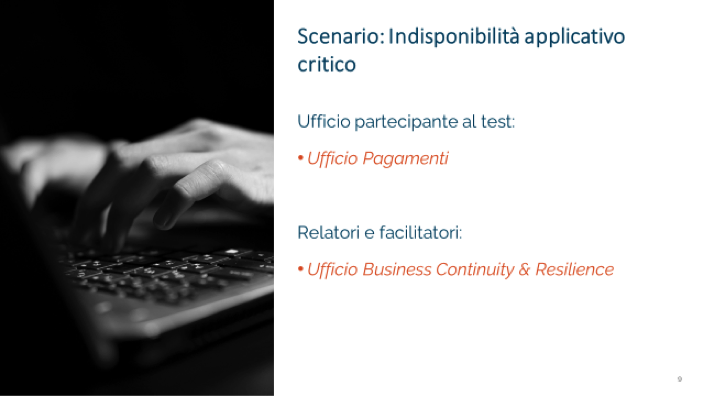
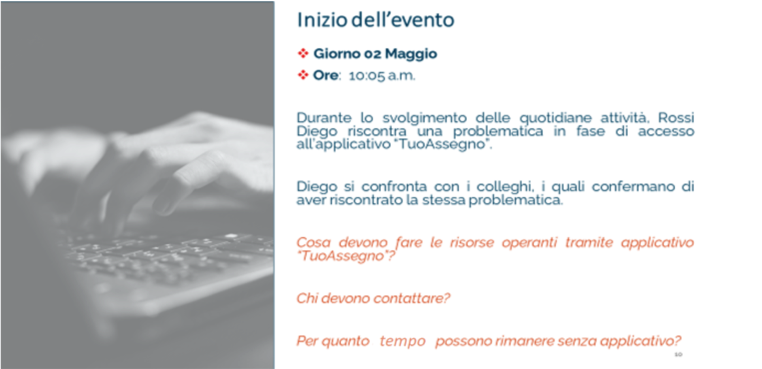
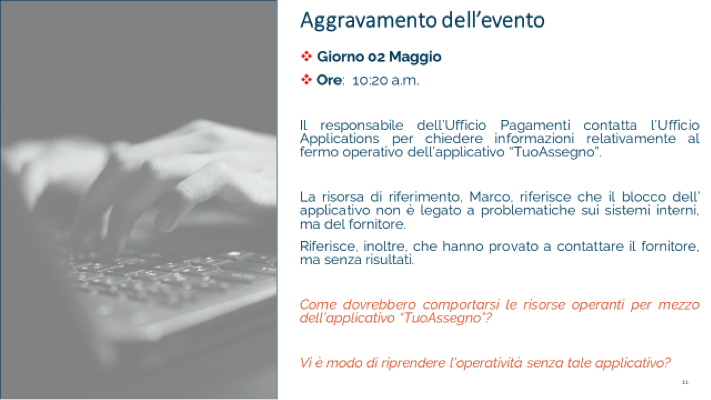
Di seguito, un esempio di come impostare una presentazione per un test in modalità “Walkthrough”: nell’esempio riportato è stato coinvolto un solo ufficio e si è ipotizzato che il processo riesca ad essere portato avanti tramite lavoro manuale in caso di mancanza di applicativo (è ovviamente possibile arricchire gli scenari, il numero dei partecipanti e il modo in cui sono impostate le slides).
Figura 9. Slide 1 creata da Chiara CavicchioliFigura 10. Slide 2 creata da Chiara CavicchioliFigura 11. Slide 3 creata da Chiara Cavicchioli
Tutte le risultanze, la tipologia di test, gli attori coinvolti e gli spunti di miglioramento emersi devono essere formalizzati in appositi documenti/registri che possono essere messi a disposizione delle funzioni di Audit.
Ogni anno, specialmente all’inizio della campagna di rinnovo del programma di Business Continuity, dovranno essere formalizzati il numero e la tipologia di test che l’entità intende svolgere durante l’anno.
Tale elenco dovrà essere sottoposto e approvato dal Top Management, che sarà incaricato di stanziare fondi aggiuntivi – se necessari – allo svolgimento dei test e potrà chiedere una revisione della tipologia di processi e di test oggetto delle sessioni di training.
Si consiglia di testare su base annuale almeno i processi più critici, considerando scenari differenti.
Fornitori e interdipendenze
In concomitanza con lo svolgimento dei test, è di fondamentale importanza mappare i fornitori identificati come critici o a supporto di processi critici, nonché quelli che forniscono un applicativo ritenuto critico.
È opportuno richiedere a tali fornitori di consegnare i loro piani di Business Continuity e/o Disaster Recovery, i verbali di conduzione dei loro test di BC e, in aggiunta, una copia delle eventuali certificazioni in vigore in tali ambiti.
Inoltre – quando possibile – è consigliabile che l’invio di tali documenti avvenga prima della stipula del contratto, poiché, se ciò avvenisse in un secondo momento e i Piani del fornitore non fossero idonei, l’organizzazione correrebbe il rischio di non poter svolgere i processi supportati da tale fornitore in caso di evento avverso.
La consegna della sola certificazione o di piani di Business Continuity e/o Disaster Recovery poco esaustivi, o con sezioni addirittura nascoste, non dovrebbe essere ritenuta valida.
La sola certificazione, infatti, non è una prova sufficiente che l’organizzazione sia in grado di ripartire nel minor tempo possibile a seguito di eventi avversi. Inoltre, rendere inaccessibile la totalità del documento potrebbe portare a non avere visione di informazioni importanti.
In questi casi, o nel caso in cui i documenti non siano ritenuti idonei, l’organizzazione stessa potrebbe valutare di dare supporto al fornitore nella stesura di un piano di BC “condivisibile”, in cui siano riportate e lasciate in chiaro le informazioni di maggiore interesse.
Inoltre, è consigliabile, con il supporto delle funzioni che si occupano di gestire la parte di supply chain, definire le clausole contrattuali da sottoporre al fornitore in termini di Business Continuity, gli RTO e RPO che sarà chiamato a rispettare ed eventuali SLA da attivare in caso di mancata osservanza di questi ultimi.
Oltre agli RTO e agli RPO, è consigliabile inserire clausole circa la documentazione e le attività che l’istituto si aspetta di ricevere dal fornitore, quali ad esempio la consegna annuale del piano di BC rinnovato, la consegna delle certificazioni, la possibilità di far partecipare il fornitore ai test svolti dall’organizzazione, il numero e tipologia dei test che si desidera il fornitore svolga e la ricezione dei relativi verbali.
Ove sia possibile, è consigliabile prendere parte ai loro test come ospiti, al fine di constatare concretamente il grado di maturità dell’azienda in relazione a queste tematiche. Inoltre, sulla base del livello di preparazione dell’entità finanziaria stessa e del fornitore, è possibile svolgere test congiunti con uno o più fornitori: ciò permetterà di avere dettagli sulle effettive soluzioni da attivare in caso di indisponibilità di uno o più fornitori, comprendere come possano garantire supporto all’istituto finanziario e conoscere le azioni da mettere in campo in modo congiunto al fine di ripartire.
Inoltre è sempre opportuno, ove possibile, prevedere nei contratti delle clausole relative alle strategia d’uscita, che facilitino il recesso dal contratto da ambo le parti nel caso vengano a mancare le garanzie in termini di sicurezza di erogazione dei servizi da parte del fornitore, unitamente alle clausole che garantiscano all’organizzazione il pieno supporto da parte del fornitore, nel caso in cui quest’ultimo eroghi lo stesso servizio a più organizzazioni colpite da un medesimo evento e nello stesso frangente temporale.
Nel caso in cui un fornitore già contrattualizzato non rispetti i requisiti richiesti nel contratto (ad esempio non consegni i verbali dei test svolti durante l’anno, non conceda la partecipazione ai test quando è invece stata contrattualizzata, non fornisca più sufficienti garanzie di Business Continuity o non rispetti gli RTO e gli RPO dichiarati in caso di incidente), ciò verrà portato all’attenzione del Top Management, che valuterà se accettare il rischio e continuare a mantenere rapporti con tale fornitore o se sostituirlo con altri.
Per ogni fornitore – e specialmente per le grosse aziende – è consigliabile identificare un referente del fornitore, che si occuperà di tenere i contatti e fungerà da “collante” tra l’ufficio che si occupa di gestire il programma di Business Continuity, l’ufficio acquisti e il fornitore stesso.
Per le aziende più strutturate, è addirittura possibile implementare una funzione che si occupi in prima persona della gestione delle terze parti dal punto di vista della Business Continuity e che tenga quindi i rapporti diretti con ogni fornitore.
Inoltre, al fine ultimo di avere un quadro sempre aggiornato e chiaro rispetto alla documentazione prodotta e consegnata dal fornitore, è possibile creare una mappa con dei rating per ognuno, da aggiornare con una cadenza almeno annuale.
I punteggi potranno essere personalizzati e variati in base a diversi driver tra cui, per esempio:
Consegna del piano di business continuity (+ 1 punto)
Consegna di un piano aggiornato (+1 punto)
Se consegna di un piano non aggiornato all’anno in corso (- 0,5 punto)
Piano di continuità esaustivo che contenga almeno: ruoli e responsabilità, scenari coperti dal piano, soluzioni di continuità operativa, driver di analisi dei processi esaustivi, numero dei processi critici, siti dove vengono erogati i processi, numero e tipologia dei test svolti durante l’anno (+1 punto)
Se piano di Business Continuity non esaustivo o con parti nascoste (- 1 punto)
Consegna elenco verbali dei test svolti (+1 punto) (qui andrebbe definito dall’organizzazione il numero minimo dei test che si aspettano che i fornitori svolgano tutti gli anni)
Esito positivo almeno di tutti i test richiesti (+1 punto)
Esito test positivo ma numero test insufficiente (- 0,5 punto)
Esito test negativo ma successivamente ripetuti con esito positivo e documentazione riportante le azioni mitigative implementate per far fronte alla problematica che ha portato all’esito negativo; numero di test effettuati sufficiente (+1 punto)
Esito test negativo ma successivamente ripetuti con esito positivo/negativo e documentazione riportante le azioni mitigative implementate per far fronte alla problematica che ha portato all’esito negativo; numero di test effettuati insufficiente (- 1 punto)
Possibilità di partecipazione ai test di Business Continuity (+1 punto)
Possibilità di coinvolgere il fornitore ai test interni (+1 punto)
Consegna delle certificazioni (+ 1 punto)
Figura 12. Tabella esemplificativa per rating fornitore creata da Chiara Cavicchioli
Nel caso specifico, è assegnata una penalizzazione di 0,5 punti se:
viene consegnato un piano non aggiornato all’anno in corso;
l’esito dei test svolti è positivo ma il numero test insufficiente;
in quanto il fornitore non è stato in grado di fornire la documentazione più aggiornata ed esaustiva possibile ma dimostra, comunque, di avere un programma di Business Continuity e di svolgere dei test durante l’anno.
È stata invece assegnata una penalizzazione maggiore (pari ad 1 punto) se, a seguito di esito test negativo, i test vengono successivamente ripetuti con esito positivo/negativo e la successiva documentazione prodotta riporta le azioni mitigative implementate per far fronte alla problematica che ha portato all’esito negativo ma i test effettuati risultano insufficienti o inesistenti; dato che, in una casistica simile, il fornitore dimostrerebbe di non essere in grado di ripartire nella maniera più adeguata e veloce possibile e di non riuscire a implementare e documentare le azioni mitigative.
Una tabella analoga potrebbe essere implementata e manutenuta anche in relazione agli incidenti (può essere arricchita a piacere).
Comunicazione non tempestiva dell’incidente (- 0,5 punti)
Comunicazione continua circa lo stato dell’incidente (+ 1 punto)
Comunicazione non continua circa lo stato dell’incidente e spesso sollecitata (- 0,5 punti)
Rispetto dell’RTO e RPO (+ 1 punto)
Mancato rispetto dell’RTO e RPO (-1 punto)
Ricadute sull’istituto a seguito di incidente (- 1 punto)
Impatto mediatico con possibili ricadute sull’istituto (- 1 punto)
Mancato rispetti degli SLA contrattuali (+ 1 punto)
Rispetto degli SLA contrattuali (+ 1 punto)
Implementazione e test delle soluzioni di mitigazione post evento (+1 punto).
In aggiunta ai fornitori, è indispensabile mappare e analizzare con maggiore dettaglio gli applicativi, i sistemi e la documentazione ritenuta critica ai fini della BIA.
È infatti importante effettuare una mappatura che consideri l’applicativo critico, il fornitore che fornisce tale applicativo, dove sia conservata la documentazione ritenuta critica e cosa supporti.
In relazione agli applicativi e ai sistemi, è opportuno mapparne e verificarne le interconnessioni con il supporto delle funzioni interne che si occupano di gestire e manutenere i software, i sistemi e gli applicativi, al fine di individuare se, in caso di interruzione di un sistema e/o applicativo, vi sia un effetto a catena tale da poter causare l’indisponibilità di terzi applicativi e dei processi da essi supportati.
Un esempio potrebbe essere:
Sistema “Pagoyou”, i.e. la piattaforma di vendita digitale home banking. Tale sistema è connesso e quindi può compromettere la funzionalità dei seguenti applicativi:
“TuoConto”, applicativo per la gestione e visualizzazione del portafoglio cliente;
“TuoNuovoProdotto”, applicativo per la vendita di nuovi prodotti bancari;
“TuoAssegno”, applicativo per la gestione degli assegni bancari per destinatari residenti in Italia.
Maggiori sono la granularità e profondità con cui si analizza tutta l’infrastruttura a supporto di un processo e maggiori sono le probabilità che, in caso di evento, questo possa essere gestito in modo ottimale e tempestivo.
Un’analisi approfondita consente, inoltre, di individuare in anticipo possibili lacune da colmare.
Nel caso in cui gli applicativi “TuoConto”, “TuoNuovoProdotto” e “TuoAssegno” siano stati ritenuti critici all’interno di una BIA relativa a un processo critico, sarà necessario identificare soluzioni di Business Continuity che garantiscano la loro operatività anche in caso di indisponibilità di “Pagoyou”.
Tale mappatura consente di anticipare potenziali effetti “a catena” in caso di incidenti o malfunzionamenti di un applicativo, sistema e/o fornitore.
Piano di continuità operativa (BCP – Business Continuity Plan)
Al termine delle BIA, dei test e della mappatura dei fornitori, degli applicativi, dei sistemi e della documentazione critica, è possibile iniziare la stesura del BCP.
Un BCP ben strutturato deve contenere almeno i seguenti elementi.
Data della stesura e/o revisione e nominativi/ruoli degli approvatori
Normativa di riferimento (nel caso non sia già stata esplicitata nella policy di continuità operativa)
Finalità del piano e programma di continuità operativa
Ruoli e responsabilità suddivisi per legal entities (quando presenti)
Scenari coperti dal BCP che, nel caso specifico, sono:
indisponibilità dei siti;
indisponibilità dei sistemi informativi critici;
indisponibilità dei fornitori;
indisponibilità degli applicativi, dati e documentazione critica;
indisponibilità dell’infrastruttura critica,
indisponibilità delle risorse;
calamità naturali;
non è quindi compreso lo scenario di un attacco informatico. Nel caso in cui si voglia far rientrare anche tale scenario tra quelli coperti dal piano, sarà necessario predisporre e testare soluzioni di BC ad hoc, oltre a impostare le BIA al fine di quantificare anche tale rischio.
Criteri di esecuzione delle BIA. Nel nostro caso specifico le BIA si basano sui seguenti driver:
mancati ricavi;
costi aggiuntivi;
sanzioni normative;
danno reputazionale;
fermo operativo di altri processi.
Andranno inoltre considerati ulteriori aspetti, quali:
razionali di impatto;
siti di erogazione;
processi in Input;
descrizione Input;
processi in Output;
descrizione Input;
periodi di lavoro di picco;
scadenze giornaliere (cut-off);
eventuali Legal Entities servite;
che, nel nostro caso specifico, non concorrono alla definizione dell’RTO. Nel caso in cui vogliano essere integrate, sarà sufficiente attribuire un algoritmo alla tabella in modo che nel calcolo finale anche a queste voci venga attribuito un peso (che va definito con la funzione rischi).
L’elenco delle soluzioni di Business Continuity identificate, che potrebbe configurarsi come allegato del Piano in cui vengono riportate le soluzioni identificate per ogni processo considerato critico
Criteri in base ai quali il piano deve essere attivato, ad esempio:
IMPATTO
CONSEGUENZE
AZIONI
LIVELLO 1 – BASSO
Compromissione di alcune funzionalità di un numero limitato e circoscritto di processi critici e/o non critici.
La situazione di emergenza viene presidiata e gestita in modo ordinario senza necessità di attivazione delle soluzioni di continuità operativa
LIVELLO 2 – MEDIO
Compromissione e indisponibilità di un numero significativo di processi critici e/o seri danni al personale, alle infrastrutture tecnologiche, fornitori critici e applicativi.
La situazione di emergenza viene presidiata e gestita per mezzo dell’attivazione del piano e soluzioni di continuità operativa.
LIVELLO 3 – ALTO
Compromissione e indisponibilità totale di un numero significativo di processi critici, del sistema informativo, di fornitori critici e applicativi.
La situazione di emergenza richiede l’adozione di misure di contenimento straordinarie.
Può essere attivato il comitato di crisi e dichiarato lo stato di crisi.
Figura 13. Criteri di attivazione del piano di continuità operativa creati da Chiara Cavicchioli
Gli strumenti a supporto del piano (ad esempio, il Piano delle Emergenze realizzato dalle funzioni incaricate della gestione della sicurezza, il piano di Disaster Recovery)
Le tempistiche di ripristino e obiettivi dei punti di ripristino dei processi critici (è possibile creare un elenco che andrà a far parte degli allegati del piano, contenente i processi critici e non critici con i relativi RTO, RTC e RPO)
Le procedure di escalation da eventi classificati come “Livello 1 – Basso” al livello “Livello 2 – Medio” e/o al “Livello 3 – ALTO” e i ruoli coinvolti
La procedura di comunicazione interna ed esterna durante l’emergenza (quali sono gli utenti interessati e chi si occupa di darne comunicazione e con quali modalità)
I relativi allegati, che comprenderanno:
Catena di comando e di controllo: contiene i nominativi delle funzioni incaricate della gestione del programma di continuità operativa, le funzioni di emergenza e backup relative alla continuità operativa, le modalità di ingaggio ed escalation di una situazione emergenziale che può diventare una crisi, dove sono situate le war room (o sale di crisi, cioè ambienti fisici o virtuali in cui si ritrovano le funzioni e ruoli incaricati di gestire un evento) e un elenco di altre funzioni che potrebbero essere coinvolte a gestire un evento con i rispettivi recapiti (es. il CISO della capogruppo, il responsabile della funzione immobili, il responsabile della Sicurezza, il responsabile della funzione degli incidenti di sicurezza fisica e/o virtuale, il responsabile dell’ufficio procurement che gestirà i fornitori, il responsabile del personale, etc.)
Allegato elenco dei siti: indica tutti i siti in cui vengono erogati i processi e la loro criticità. Tale informazione può essere fornita dall’ufficio che si occupa della quantificazione e gestione dei rischi.
Allegato elenco dei processi: riporta tutti i processi che sono stati oggetto di analisi BIA durante l’anno, il relativo ufficio di riferimento e responsabile, il sito dal quale vengono erogati, l’ufficio sotto il quale sono collocati, gli applicativi e fornitori a supporto.
Allegato elenco degli applicativi:riporta gli applicativi mappati durante le analisi BIA (specialmente per quelli con criticità alta) e i relativi processi di riferimento. È inoltre consigliabile inserire le varie interconnessioni con altri applicativi/sistemi.
Allegato elenco dei fornitori: riporta i fornitori a supporto dei processi oggetto di analisi BIA, suddividendoli (quando necessario e presenti) tra fornitori normali, esternalizzazioni ed esternalizzazioni FEI (Funzioni Essenziali e Importanti). Per ognuna di queste voci è necessario riportare la criticità dei fornitori e dei processi da essi supportati, oltre al nominativo di un referente interno che si occupa di tenere i rapporti con tale fornitore. È consigliabile indicare anche numero del contratto e tipologia del servizio erogato, al fine di facilitarne l’individuazione in caso di emergenza.
Allegato elenco delle risorse umane coinvolte: riporta tutte le risorse identificate come di emergenza e di backup ai fini delle analisi BIA, i relativi recapiti e l’ufficio di appartenenza, oltre al sito nel quale lavorano (riprendendo l’esempio della tabella BIA, Rossi Diego – matricola 0001 è una risorsa di emergenza per l’ufficio sito a Milano, ma può essere risorsa di backup per il sito di Verona) e i loro recapiti.
Allegato elenco dei test svolti: riporta i test svolti durante l’anno ed i relativi esiti. Tale elenco dovrebbe contenere un numero di test almeno pari a quello redatto ad inizio anno e approvato dal Top Management, includendo l’elenco dei test svolti dai fornitori.
Allegato elenco dei rischi residui: riporta tutti i rischi residui identificati durante tutta la gestione del programma di Business Continuity, quali ad esempio i processi per i quali le soluzioni di BC identificate non sono sufficienti a garantire l’RTO desiderato, i fornitori che non hanno rispettato i requisiti richiesti, eventuali processi per i quali non siano presenti siti e/o risorse di backup e tutti gli ulteriori “colli di bottiglia” (ossia rischi per i quali non ci siano soluzioni secondarie attivabili) identificati e che devono essere portati all’attenzione del Top Management.
Tale piano – contenente almeno tutte le informazioni precedentemente elencate – dovrà essere redatto per tutte le società del gruppo; oppure, nel caso si decida di mantenere la gestione del programma accentrata presso la capogruppo, le informazioni e gli allegati dovranno fare riferimento anche alle legal entities.
Miglioramento continuo
Le Business Impact Analysis, i test e le mappature devono essere nuovamente svolte e/o aggiornate – assegnando un numero progressivo alla relativa documentazione – con cadenza annuale, o a fronte di cambiamenti significativi all’interno dell’organizzazione.
Nell’anno successivo e all’avvio del nuovo programma, dovranno essere indicati e recepiti tutti gli spunti di miglioramento emersi l’anno precedente: ciò al fine di promuovere un’ottica di miglioramento continuo del BCP e, ove possibile, colmare i gap di eventuali rischi residui emersi.
_*]:min-w-0 !gap-3.5″>
Per approfondire tutti gli aspetti della Business Continuity e accedere a una guida completa e strutturata, si consiglia la lettura del white paper “Business Continuity: mito o realtà? La continuità nella discontinuità” elaborato da Chiara Cavicchioli e Federica Maria Rita Livelli, che offre un approccio metodologico completo per l’implementazione di programmi di continuità operativa nelle organizzazioni moderne.
Profilo Autore
Digital and Operational Resilience and Crisis Management Specialist. Certificata FERMA Rimap & AMBCI.
Ha maturato esperienza nell’ambito della Continuità Operativa, Crisis Management e Resilienza Digitale in ambito finanziario, anche grazie alle esperienze lavorative svolte presso primari istituti bancari.
Autrice di alcuni articoli pubblicati dal Business Continuity Institute (BCI).
Condividi sui Social Network:
https://www.ictsecuritymagazine.com/articoli/bcp/
Critical Steps to Strengthening Satellite Network Security
Satellite networks are integral to myriad aspects of modern society, providing essential services that support both civilian and military operations. As our dependency on satellite networks has increased, so has the risk of cyber threats targeting these critical infrastructures. Any disruption of satellite services can negatively impact everything from emergency response systems to financial transactions to navigation. That makes ensuring the cybersecurity of satellite networks essential to maintaining global stability and security.
Confronting Satellite Cyber Vulnerabilities
Satellites can be vulnerable to a range of cyber threats like jamming, spoofing and even hacking. Successful attacks prove the risks are not theoretical. For instance, in 2019, a British oil tanker was led into Iranian waters by global positioning system (GPS) spoofing and then captured; in 2022, signal jamming that led to loss of accurate positioning data resulted in the crash of an Azerbaijan Airlines flight.
In 2008, Chinese state-linked actors hacked Norway’s Svalbard Satellite Station; in late 2023, a Russian cyberattack in Ukraine damaged thousands of computers and servers and the pro-Russian Killnet group hit SpaceX’s Starlink with a denial-of-service attack. Emerging artificial intelligence and machine learning technologies are being used by adversaries to find new vulnerabilities and launch more sophisticated cyberattacks.
The consequences are not only disruptive but potentially catastrophic. Even so, securing satellite networks presents unique challenges due to their complex and distributed nature. Legacy satellite systems were not designed with modern cybersecurity measures, and updating them is difficult and costly. Thousands of satellite components are sourced from multiple suppliers, increasing risks from supply chain attacks. Human error or bad intent — the leading cause of successful cyberattacks for any information technology environment — is always a risk. And there are the obvious challenges of protecting assets far away in space from physical tampering or destruction.
Specific cybersecurity measures should be implemented to address these unique challenges. A top priority is encrypting sensitive data transmitted between satellites and ground stations to protect it from interception and tampering. Using advanced standards like NSA-grade encryption will ensure the highest level of security. Equally important is segregating satellite network command and control from other corporate or public networks; isolating critical systems will prevent lateral movement of cyber threats from potential attack vectors. Also, implementing strict role-based access and multi-factor authentication control measures will curb insider threats as well as external attacks. And as with ground-based networks, deploying intrusion detection and prevention systems (IDPS) to monitor network traffic for suspicious activity can help identify and mitigate cyber threats in real-time.
It’s also important to address supply chain risks. Carefully vetting suppliers and adopting secure procurement processes will help ensure the integrity of sourced satellite components. Conducting regular audits and compliance checks supports a continuous improvement process that strengthens a satellite network’s overall security posture.
True Security is a Shared Effort
Given the global stakes, securing satellite networks also requires international cooperation and collaboration. Sharing threat intelligence and best practices among governments and industry helps protect satellite networks from adversarial cyber threats. Organizations like the Space Information Sharing and Analysis Center (Space ISAC) and the US Space Force Commercial Integration Cell are valuable information sources that also advance cyber threat mitigation strategies.
Adherence to frameworks tailored to satellite systems will also increase resilience. For instance, the U.S. National Institute of Standards and Technology (NIST) offers a Cybersecurity Framework Profile for Hybrid Satellite Networks (HSN) that provides guidelines for assessing the security posture of satellite systems and their components. The European Union Agency for Cybersecurity’s (ENISA) Space Threat Landscape report also outlines a cyber control framework for commercial satellite operators. Buyers of satellite solutions should always evaluate the frameworks and certifications of the provider’s network.
The Satellite Cyber Future
Next-generation low Earth orbit (LEO) constellations present both opportunities and challenges. While offering improved performance and resilience, the thousands of existing and planned LEO satellites also introduce many more attack surfaces. That requires innovative security approaches.
An important criterion is for LEO satellite providers to design their systems to one or more of the leading standards from the beginning, since retrofitting security is difficult and risky. For the most rigorous defense, satellites should be built to requirements of the U.S. Space Force Infrastructure Asset Pre-Assessment (IA-PRE) program for commercial satellite communications systems, and incorporate NSA-level hardware-based encryption. Because resilience of ground infrastructure is also critical, having multiple inter-connected satellites and ground nodes eliminates single points of failure and ensures networks stay connected.
Many threats that now exist were not a concern with earlier generation satellites, but with our growing dependence on the next generation, stringent cybersecurity is no longer optional. Satellite-based networks must be treated with the same rigor as terrestrial critical infrastructure. Both commercial and defense entities in the satellite ecosystem need to consider advanced, layered cybersecurity strategies and collaborate internationally to stay ahead of ever-evolving threats.
2B Weekly Downloads at Risk: Supply Chain Attack Targets Popular npm Packages, Security Leaders Discuss
Packages containing malicious code were recently pushed to npm. There were 18 affected packages in total, all of which are widely used. Listed alongside their downloads per week, these packages include:
ansi-regex (243.64 million)
supports-color (287.1 million)
strip-ansi (261.17 million)
color-string (27.48 million)
error-ex (47.17 million)
color-name (191.71 million)
is-arrayish (73.8 million)
slice-ansi (59.8 million)
color-convert (193.5 million)
chalk (299.99 million)
debug (357.6 million)
ansi-styles (371.41 million)
has-ansi (12.1 million)
simple-swizzle (26.26 million)
backslash (0.26 million)
chalk-template (3.9 million)
supports-hyperlinks (19.2 million)
wrap-ansi (197.99 million)
In total, these packages have more than 2 billion downloads each week.
According to a Bluesky post, a maintainer was compromised by a convincing phishing email that prompted him to update his two-factor authentication credentials.
Below, security leaders discuss this attack and its implications.
Security Leaders Weigh In
Jonathan Gill, CEO of Panaseer:
As a central hub for modern software, nearly every company with an online presence will depend on npm, often without realizing. Any compromise’s impact will spread far and wide, making a breach like this seem especially alarming.
To avoid feeling overwhelmed by attacks which expose not just one company but entire ecosystems, security teams need to focus on what they can and can’t control. They can’t control the outer circle: the attackers, the security posture of your suppliers, or the unknown flaws in third-party code.
But they can control the inner circle: their own assets and security controls, and their effectiveness. Maximizing visibility into what’s knowable — e.g. infrastructure, privileged access points, security configurations, and patching status — helps to better manage the unknowable threats outside the perimeter.
Real resilience comes from proof, meaning verifiable data, not checkboxes. Organizations that master their inner circle gain the clarity, agility, and confidence to respond effectively to the next supply chain attack.
Ensar Seker, CISO at SOCRadar:
This incident represents a watershed moment in software supply chain security. The compromise of npm packages with over 2.6 billion weekly downloads highlights just how devastating upstream attacks can be when they exploit the foundational trust built into open-source ecosystems. Attackers didn’t need to break into servers or bypass technical defenses; they simply hijacked a legitimate maintainer’s account through a targeted phishing campaign. That alone granted them the keys to a vast software kingdom.
What’s particularly dangerous here is how the attackers used a domain that convincingly mimicked a legitimate one, npmjs.help, to socially engineer the maintainer. This wasn’t a spray-and-pray phishing attempt. It was calculated, timed, and executed with a deep understanding of developer psychology. The fear-based tactic of threatening to lock accounts by a specific deadline added urgency, increasing the chance of a successful compromise.
Once inside, the attackers tampered with highly popular libraries like chalk and debug, which are ubiquitous in front-end and back-end stacks across the world. These libraries are not surface-level tools; they sit deep in dependency trees, often pulled into projects silently via transitive dependencies. That’s what makes this breach so insidious. Developers and CI/CD pipelines rarely question dependencies that come pre-vetted from trusted registries. Malicious code embedded in these packages can bypass traditional static security checks and propagate downstream at incredible scale.
The software industry is facing a reality where dependency hygiene is no longer optional. When a single compromised maintainer account can poison a global software supply chain, organizations must rethink what software trust means. This starts with strong identity protection for maintainers, including mandatory hardware-based two-factor authentication, anomaly detection, and continuous monitoring of commit behaviors.
Organizations must also start treating their dependency trees as living assets that require governance, not just during development but throughout the entire software lifecycle. A software bill of materials (SBOM) is now essential. It’s no longer enough to know what code you wrote, you need to know what you inherited. Continuous validation of the packages that flow into build pipelines, coupled with deterministic dependency resolution and runtime behavior monitoring, is critical for defense.
This event also underscores a broader issue. We often assume open-source software is secure because it’s open, but that openness means nothing if identity controls are weak, if changes go unreviewed, and if package provenance isn’t verified. Security must now follow the code from origin to runtime, not just within corporate networks, but across global ecosystems.
I believe we will see more targeted phishing attacks against popular open-source maintainers in the future. This won’t be the last time. The question is how fast our tooling, our governance, and our development practices can adapt to match the evolving threat landscape.
Roger Grimes, Data-Driven Defense Evangelist at KnowBe4:
Is this the thousandth time npm packages have been compromised this decade? What’s the over/under on that number? Can’t be that much. The idea that maintainers are still not using phishing-resistant multi-factor authentication (MFA) to protect their maintainer accounts is so, so not understandable. Cybercriminals want to compromise npms and do so all the time. And yet, maintainer after maintainer don’t get and use phishing-resistant MFA! It’s like almost asking to be hacked.
I’m going to put most of the blame on the majority of the cybersecurity industry that tells people they must use MFA and doesn’t tell them that 85% to 95% of the MFA being used is as phish-able as the extremely hackable login name and password they replaced with their weak MFA. And to every cybersecurity expert and guide that says, “You should be using MFA” and not “You must be using phishing-resistant MFA,” you’re doing a huge disservice to your congregation. You are contributing to the problem. Both need to change their ways.
Google dovrà pagare una multa salata da 425 milioni per informazioni vaghe e fuorvianti sulle proprie politiche di privacy: lo ha deciso la Corte distrettuale del distretto settentrionale della California, come riporta Malware Bytes.
Il caso è iniziato nel 2020 quando Anibal Rodriguez, un utente della compagnia, aveva intentato una causa contro il gigante tech accusandolo di aver confuso volontariamente gli utenti con le impostazioni “Attività web e app”. L’azione legale è diventata in seguito una class action.
Idealmente modificando queste impostazioni Google permetteva agli utenti di preservare la propria privacy disabilitando la raccolta di informazioni; in realtà, la compagnia non smetteva di raccogliere i dati, ma si limitava ad anonimizzarli.
Nel dettaglio, queste informazioni venivano raccolte tramite Firebase, un database per il monitoraggio delle attività che opera in maniera indipendente da “Attività web e app”. I dati venivano raccolti da applicazioni quali Uber, Shazam, Duolingo, Instagram e molte altre, con 98 milioni di utenti ignari di questa operazione.
I legali di Google si sono opposti all’accusa chiarendo che, modificando le impostazioni di privacy, viene mostrato all’utente un popup di conferma dal quale è possibile navigare su un dettaglio dei dati raccolti, e che quindi l’operato dell’azienda è trasparente.
I giudici, però, non hanno condiviso questa visione e hanno sottolineato che la compagnia dovrebbe essere più chiara nelle comunicazioni, soprattutto considerando che gli utenti spesso sono “superficiali” non dei lettori attenti; un dettaglio che, per quanto possa far sorridere, evidentemente ha avuto un certo peso nella decisione finale.
“Questa decisione fraintende il modo in cui funzionano i nostri prodotti” ha affermato Jose Castaneda, Policy Communication Manager presso Google. “I nostri tool per la privacy danno alle persone il controllo sui loro dati, e quando disabilitano la personalizzazione, noi rispettiamo quella scelta“.
In merito al caso, il giudice Richard Seeborg ha affermato che “Le comunicazioni interne di Google indicano che la compagnia sapeva di essere ‘intenzionalmente vaga’ sulla distinzione tecnica tra i dati raccolti da un account Google e quelli ottenuti al di fuori di esso perché la verità ‘sarebbe potuta sembrare allarmante per gli utenti’“.
Google ha comunicato l’intenzione di fare ricorso.
Best Practices for Security in the Hospitality Industry
The hospitality industry is complex with its array of evolving services, amenities, and security measures that are integral to creating positive, memorable guest experiences. How comfortable and protected guests feel in their accommodations is particularly critical. That’s why it’s essential to prioritize safety without compromising the overall guest experience.
Security in the hospitality space encompasses everything from environmental features and video surveillance to access control technology for hotel rooms, workout facilities, and other guest amenities. While security solutions must be robust, they also should be able to blend in with their welcoming surroundings. An example of this is how electronic door locks can now balance protection and convenience with aesthetic touches to complement the style of a hotel.
Let’s explore best practices for security in this space and how to implement them.
Environmental Features
Security in the hospitality industry starts before guests even enter the front door. Environmental design features should promote security without impacting ambiance and brand aesthetics.
For example, lighting is a crucial security feature. Heavily trafficked areas like parking garages, staff entrances, lobbies, workspaces and guest hallways should be well-lit for both safety and accessibility. Hospitality businesses can also enhance environmental security by implementing features like perimeter fences, light posts along pedestrian walkways and parking gates that blend in with the overall design of an establishment.
Mobile Solutions
Today’s on-the-go world demands fast-paced solutions that can keep up. That’s why modern hotels and restaurants have gone keyless, opting instead for keycards, RFID-enabled fobs, mobile apps, and even biometric identification for staff and guests alike.
Mobile access solutions are easy to use, but still provide the same high standards of comprehensive security that guests expect. Mobile credentials simplify security and provide hotel personnel with greater flexibility and control. Administrators can update schedules and manage employee access directly through a mobile app or web browser — eliminating the need for in-person key handoffs. Some apps also allow business owners to view access histories, which allows for a detailed log of employee comings and goings within the establishment. The advantages of mobile-based credentials are only growing with the technology continuing to evolve, as pointed out by Vingcard’s Vice President of Sales, George Winker:
“Whether at home or traveling, modern consumers overwhelmingly prefer to interact with mobile-driven services that are more seamless and that bypass any unnecessary steps. For mobile-based keys, this expectation is behind the rising adoption rates of newer digital wallet-compatible platforms where users can easily store and use their room key without first having to download a separate mobile app. This translates into a more intuitive and user-friendly experience and also symbolizes a growing desire for enhanced control and personalization during the hotel stay journey.”
Biometrics, such as facial identification technology, offer another opportunity to make access control more seamless by providing a hands-free solution instead of physical credentials — a big plus, especially for housekeeping and repair personnel who already have their hands full moving carts and other equipment. Facial identification can also serve as part of a multi-level authentication solution.
Cybersecurity Measures
Trust is the currency of the hospitality industry. Every guest who visits an establishment trusts that they will receive excellent service and remain safe for their entire stay, whether for a meal with friends or a week-long vacation.
Trust is even more relevant as the industry continues to move into the digital space. All online, customer-facing actions like add-on purchases, bookings, and other transactions should be insulated from cybersecurity risks. To help prevent scams or customer data breaches, hospitality businesses should implement digital security safeguards like two-factor authentication, data encryption, and password management for all employees.
Still, simply installing digital technologies isn’t enough. Staff should be regularly and thoroughly trained on both cybersecurity risks and how to mitigate them. This will not only help keep guests’ data safe but also proprietary company or transactional information that might be stored online.
Integrating Design
Security and safety should always be the priority regarding access controls in hospitality. That said, some high-tech hardware can be visually intimidating for guests.
In the hospitality space, access controls should be aesthetically pleasing without compromising on efficacy. Incorporating decorative features like levers, card readers, peepholes, and hinges can maintain security without disrupting the overall guest experience. It’s all in the details — eye-catching colors, unique shapes, and other branded hardware are examples of custom finishes that assist in the marriage of form and function in access control with desired aesthetics for a great customer experience.
Emergency Planning
No one wants to plan for the worst, but it’s essential to have systems that enable effective emergency management. Opt for security solutions that integrate with alarm systems, access control and guest messaging services in an emergency or lockdown situation.
Comprehensive emergency management may also include the use of AI-enabled cameras. Video Management Systems (VMS) can be used to analyze footage and recognize patterns and faces. Security cameras should monitor entrances, exits, and other heavily trafficked areas, but discretion is also relevant — guests should feel secure, not surveilled.
Getting the Team on Board
Even state-of-the-art security tools are only as effective as the staff administering them. Best practices start at the top. Management should conduct regular security audits and risk management assessments to identify any weak links in the chain of security.
The best way to ensure security and guest safety within the hospitality industry is to regularly and thoroughly train staff on general security best practices and how to use the technology you’re investing in most effectively.
Securing Experiences and Building Trust
Robust security is not just a protective measure — it’s a vital part of delivering exceptional experiences that earn lasting trust. Hospitality venues benefit from blending smart technology, thoughtful design, and well-trained staff to keep people safe without compromising comfort or convenience. By investing in integrated security solutions and fostering a culture of awareness and preparedness, hospitality businesses can protect what matters most: their people, their reputation, and the memorable experiences that keep guests coming back.
Georgia Hospital Notifies 160K Individuals of Breach 1 Year After Incident
Wayne Memorial Hospital in Jesup, Georgia, experienced a data breach on May 30, 2024, but notified affected consumers on August 27, 2025, according to a filing with the Maine Attorney General’s office. 163,440 individuals were affected by this breach. Reporting from Comparitech states that only 2,500 individuals were notified of the breach in August 2024.
Rebecca Moody, Head of Data Research at Comparitech, comments, “This is another worrying case where there has been a significant delay in notifying the majority of people involved in a data breach. Despite having initially notified 2,500 people of a breach in August 2024, it’s taken another year to confirm that over 163,000 people may have been impacted. Furthermore, even though Wayne Memorial Hospital added a data breach alert to its website in August 2024, according to Wayback Machine internet archive data, this had been removed by January 2025. So, unless patients were one of the first 2,500 people to receive a data breach notification letter or happened to view the alert on the hospital’s website from August to December 2024, it’s highly likely they were completely unaware of this breach until now.”
Information compromised includes:
Social Security numbers
Names
Birth dates
State-issued ID numbers (such as a driver’s license)
User IDs and passwords
Financial account numbers, credit and debit card numbers, expiration dates, and CVV codes
Medical history, diagnoses, and treatments/prescriptions
Lab results and images
Healthcare provider numbers
Health insurance, Medicare and Medicaid numbers
Erich Kron, Security Awareness Advocate at KnowBe4, adds, “A delay of over a year to notify people who have had their information stolen is unfortunate. Every day the information is in the hands of bad actors puts the victims at risk of not only identity theft, but also of scams and other social engineering tactics.
“Information such as procedures, dates and insurance information, all stolen along with other data, allow bad actors to contrive stories that can be used to scam victims again, such as convincing the victim that they have outstanding debts related to the procedure, or similar ruses. Having a lot of detailed information can allow attackers to create detailed stories, and unless the victim is aware that the information is available to bad actors, can easily convince the victims of the validity of the scam.
“Organizations that handle sensitive data need to ensure they are making every effort to secure it. Since human error is the top way that ransomware and other malware infect organizations, especially through email phishing, these organizations need to have a well-designed human risk management (HRM) program in place.”
According to the cybersecurity incident notice sent out by the institution, the hospital discovered the ransomware incident after some data was encrypted an a ransom note was left on the network. The ransomware group Monti has claimed responsibility for the attack, although at this time, the hospital has not confirmed the validity of this claim.
Moody remarks, “While Wayne Memorial Hospital hasn’t confirmed whether or not a ransom was paid, the fact that the hospital was posted on Monti’s website suggests it wasn’t (for the data theft, at least). This means patients’ highly sensitive data has been posted on the dark web since the end of June 2024, leaving them exposed to identity theft and fraud.”
Most enterprise security platforms operate in reactive mode. A door is breached, a badge is misused, or an asset goes missing, and then the system responds. But in environments where speed, volume and complexity are growing, reaction is no longer enough. Next-generation physical identity and access management (PIAM) uses AI to shift organizations from hindsight to foresight. PIAM+ leads this transformation by pulling data from access points, visitor records and incident logs to reveal patterns before problems surface.
For today’s security leaders, the conversation is no longer just about access control. The real question is: Are we using our security data to stay ahead of threats? PIAM+ brings artificial intelligence into the access control equation, offering real-time analytics, behavioral insights and predictive alerts. This results in a smarter and more resilient approach to physical security that supports operational goals.
PIAM+: From Static Access to Dynamic Identity Intelligence
Managing who enters and exits a facility used to be a matter of issuing badges and assigning clearance levels. But in flexible, hybrid work environments, static access models introduce blind spots. They create unnecessary friction and fail to provide visibility when behavior changes.
PIAM+ replaces static access with dynamic identity management. Permissions are updated automatically based on real-time behavior, role changes and context. This reduces the need for manual oversight and cuts the risk of outdated or excessive access.
Every interaction becomes part of a behavioral pattern. If access attempts fall outside established norms, like repeated entries at unusual hours, the system can flag these as anomalies, trigger alerts, or escalate for review. Over time, this data shapes more accurate threat detection models that help organizations get ahead of incidents before they escalate.
Teams are no longer just reacting to events but are working from a continuously updated picture of risk and behavior.
Visitor Identity Management: From Gaps to Predictive Intelligence
Many organizations still treat visitor management as an administrative function. Manual check-ins, standard badges and limited tracking create major gaps in visibility. For facilities with high foot traffic or sensitive access points, this can lead to serious vulnerabilities.
PIAM+ brings clarity and control to the visitor experience. It enables centralized tracking of who is entering, why they’re there, and what permissions they’ve been granted. This includes contractors, vendors and temporary workers, with each treated as a monitored identity.
What makes this meaningful is how PIAM+ uses visitor data in context. By combining it with employee access and asset use patterns, the system can flag inconsistencies or unusual behavior across the board. A contractor repeatedly visiting a secure area outside scheduled hours, for example, would trigger an alert based on historical norms.
Tying It Together: Incident Response and Asset Awareness
Security incidents are rarely isolated. They typically involve a chain of events that spans people, places and equipment. The ability to connect these dots quickly is essential, and PIAM+ makes it possible.
AI within PIAM+ monitors activity across systems, detecting deviations from established baselines. When an incident begins to take shape, it can automatically generate alerts, log the event, and recommend next steps based on past outcomes. This shortens response time and gives teams better context when making decisions.
Asset tracking is part of that equation. Using RFID and other smart tools, PIAM+ can monitor the use, location, and condition of critical infrastructure. It flags maintenance needs before failures occur, identifies when equipment is accessed outside designated parameters, and supports compliance with audit trails and usage reports.
Together, these functions transform access control into a source of strategic intelligence. Teams are no longer just reacting to events but are working from a continuously updated picture of risk and behavior.
Predictive Security Starts with Smarter Integration
For years, physical security has lagged behind its digital counterparts in turning data into actionable intelligence. But that gap is closing. With PIAM+ systems, organizations gain more than a collection of access control tools — they also gain a connected framework that uses AI to learn, adapt and guide decision-making.
By unifying identity management, visitor oversight, incident response, and asset tracking into a single intelligent platform, PIAM+ enables security teams to act earlier, respond faster, and make better use of their data. The result is not just improved protection, but a shift in how security contributes to operational resilience and business value.
PIAM+ isn’t just another access control upgrade. It’s an intelligence layer that helps you connect the dots between people, spaces, and systems. It gives you visibility into what’s happening today and the foresight to prevent what could happen tomorrow.
Why It’s Time to Move on From Legacy Access Control Systems
The modern workplace or campus looks very different from even a decade ago — and older access control systems struggle to keep up. They weren’t built to handle the fast pace of change we see today. Employees no longer work from the same building every day. Flexible working hours, telecommuting, and increased reliance on contractors introduce more complexity in scheduling and cardholder management.
The threat landscape has also evolved. Many legacy systems lack modern security protocols, leaving them vulnerable to attack. Access control hardware, IP network security, and encryption standards have all advanced significantly. Outdated devices and technology are more prone to attack. For example, 125kHz prox cards can be cloned easily and older door controllers may not have had firmware updates in years, leaving them vulnerable to evolving cybersecurity and physical security risks.
It’s time to upgrade. Modern systems help protect against cyber threats, gather data on how spaces are used, and integrate with other systems. They can support staff to keep up with increasingly demanding regulatory compliance requirements around privacy, security, and industry-specific demands.
Switching to an open, flexible access control isn’t just about upgrading hardware and software. It sets the stage for smarter, safer security infrastructure that will evolve and grow to meet changing needs.
Ability to streamline
A modern access control system does more than lock and unlock doors. They can make day-to-day operations easier and more efficient.
A modern, unified access control system makes it easier to grant the right level of access to the right people and reduce the administration involved in managing cardholders. Access rules speed up onboarding and offboarding and empower managers to adjust levels of access to reflect changing job functions or user requirements. Features like global cardholder management, allow operators to enroll visitors and employees in a few clicks, assign credentials, and manage cardholders without having to switch systems.
For example, on a college campus, students who are registered in certain science programs could automatically gain access to labs. However, they would lose access when they complete those courses or drop those classes.
In addition to managing access, feature-rich modern systems can leverage data from other systems. Centralizing data streamlines investigations, shortens audit times, and makes it easier to connect the dots when incidents occur. For example, if an operator receives a “door forced open” alert, a modern system that supports unification, will attach relevant video footage to the alert. Operators quickly have the information they need to determine if it’s a false alarm or the alert needs attention.
You can also use automation to schedule reports, send event-based notifications, or set predefined rules. For example, a ‘Game Day’ mode that locks or unlocks specific doors and alerts cleaning crews and security teams to ensure consistent procedures.
And last but not least, intuitive user interfaces and custom dashboards are a key benefit when migrating to a modern access control system. Features like map-based monitoring make it easier to visualize where events are happening and increase an operator’s situational awareness. They’re able to see secured access points on a map rather than unintuitive lists or logical trees. Custom dashboards can allow operators to build personalized views for their access control monitoring to fit their unique needs and challenges.
Unique opportunities courtesy of modern access control systems
An open architecture system creates a strong foundation for newer credentials, such as mobile IDs or biometrics, and unique use case deployments.
Some popular examples of access control system integrations include:
Elevator dispatch to ensure employees only have access to the floors they need to reach, or to limit access only to authorized people outside of business hours.
Mobile credentials at post-secondary campuses that unlock access to dorms, gyms, or other spaces and can also be used to pay for food or parking.
Human resource (HR) system integrations to allow role-based access rules, so access permissions change automatically when employees leave or move to other departments or positions.
Payroll systems integrations using time and attendance reports from access control systems to automate time sheet tracking and payroll.
IoT sensors linked to building management, such as smoke or vape detectors that trigger automated notifications or other responses guided by the organization’s standard operating procedures.
Video surveillance, people counting, or motion sensor integrations that help rule out false alarms when doors are held open or left ajar.
License plate recognition to identify VIP guests at stadiums, casinos, or other venues, so that staff are notified when high-value clients enter the parking lot and can get ready to greet them at the door.
It’s an investment, not an expense
Access control systems are a big investment, so it’s natural that budget concerns are often the primary reason companies hesitate to upgrade when they know their old solution has reached the end of its useful life. Yet it’s important to remember that delaying necessary upgrades also comes at a cost.
Older systems may cost more than you realize. Systems that rely on proprietary hardware make upgrades expensive and challenging. When a system is reaching end of life, there’s limited support and no new features or innovation. A recent report noted that outdated systems can lead to a 15% budget increase annually for maintenance.
One of the advantages of today’s software-forward approach is that it offers much greater flexibility of deployment. Not only can you decide whether an on-premises, cloud-based, or hybrid solution is best for your needs, but you can also choose to upgrade in phases to reduce the up-front costs. You may even be able to re-use some existing hardware, wiring, or components.
A reputable partner can help you explore ways to reduce costs. You can also get expert advice on how to reduce migration risks, preserve existing data, keep downtime to a minimum, and ensure all crucial functionality remains available during the transition.
Think about what’s next
Upgrading to a modern, unified access control system isn’t just about keeping pace with technology — it’s about building a security foundation that can adapt as your organization grows and changes.
By moving away from outdated systems, you not only strengthen protection against evolving threats but also unlock efficiencies, integrations, and insights that support better decision-making across the business. The sooner you take steps to modernize, the sooner you can turn access control from a reactive necessity into a strategic advantage.