Browser extensions turn nearly 1 million browsers into website-scraping bots

MellowTel is also problematic because the sites it opens are unknown to end users. That means they must trust MellowTel to vet the security and trustworthiness of each site being accessed. And, of course, that security and trustworthiness can change with a single compromise of a site. MellowTel also poses a risk to enterprise networks that closely restrict the types of code users are permitted to run and the sites they visit.

Attempts to reach MellowTel representatives were unsuccessful.

Tuckner’s discovery is reminiscent of a 2019 analysis that found browser extensions installed on 4 million browsers collected users’ every movement on the web and shared them with customers of Nacho Analytics, which went defunct shortly after Ars exposed the operation.

Some of the data swept up in the collection free-for-all included surveillance videos hosted on Nest, tax returns, billing invoices, business documents, and presentation slides posted to, or hosted on, Microsoft OneDrive and Intuit.com, vehicle identification numbers of recently bought automobiles along with the names and addresses of the buyers, patient names and the doctors they saw, travel itineraries hosted on Priceline, Booking.com, and airline websites, Facebook Messenger attachments and Facebook photos, even when the photos were set to be private. The dragnet also collected proprietary information belonging to Tesla, Blue Origin, Amgen, Merck, Pfizer, Roche, and dozens of other companies.

Tuckner said in an email Wednesday that the most recent status of the affected extensions is:

  • Of 45 known Chrome extensions, 12 are now inactive. Some of the extensions were removed for malware explicitly. Others have removed the library.
  • Of 129 Edge extensions incorporating the library, eight are now inactive.
  • Of 71 affected Firefox extensions, two are now inactive.

Some of the inactive extensions were removed for malware explicitly. Others have removed the library in more recent updates. A complete list of extensions found by Tuckner is here.

https://arstechnica.com/security/2025/07/browser-extensions-turn-nearly-1-million-browsers-into-website-scraping-bots/


Threat Actor Targeting Indian Defense Sector

A threat actor based in Pakistan (APT36) has engaged in a sophisticated cyber-espionage campaign, according to intelligence from CYFIRMA. 

The threat actor is targeting individuals and organizations in the defense sector of India. The research has identified a shift in methodology from APT36, as the group is focusing on Linux-based environments, particularly on systems running BOSS Linux. Boss Linux is widely deployed by Indian government agencies. 

Shane Barney, Chief Information Security Officer at Keeper Security, states, “APT36’s focus on Linux-specific systems, particularly those used in government infrastructure, reinforces that no operating system is off-limits to nation-state attackers. This kind of multi-layered phishing attack highlights how threat actors are constantly evolving their tactics to quietly bypass defenses and exploit user trust.”

The research encourages organizations (especially those in the Indian defense sector) to take the following threat mitigation strategies: 

  1. Enhance email security
  2. Enact user security awareness and training
  3. Secure systems
  4. Monitor networks and endpoints
  5. Integrate threat intelligence 
  6. Patch systems and applications 
  7. Utilize behavior-based detection rules

“To defend against these threats, organizations need a proactive, layered security approach that begins with locking down identity and access, ensuring that credentials are protected and privilege is tightly controlled. Endpoint visibility and behavioral monitoring are just as important, especially as attackers increasingly exploit legitimate tools like desktop shortcuts to mask their activity. Equally essential is equipping organizational team members to recognize the signs of phishing and unusual file behavior, as well as giving security teams the visibility and tools to act quickly when something doesn’t look right,” Barney explains. “These evolving campaigns are a reminder that the fundamentals still matter: strong authentication, least-privilege access, behavioral detection and threat-informed defense planning. Organizations that stay ahead of the curve in these areas are far better positioned to detect, contain and respond to attacks like this before damage is done.” 

What Is the Attack Vector? 

According to the findings, APT36 sends mass phishing emails that contain ZIP file attachments with a malicious .desktop file, working as a Linux shortcut. When executed by the target, the file will download and open a legitimate PowerPoint file as a diversion while downloading a malicious ELF (Executable and Linkable Format) binary. This ELF behaves as the primary payload and grants the threat actor unauthorized access. 

Jason Soroko, Senior Fellow at Sectigo, remarks, “Even a PowerPoint presentation has the power to help automate, but it should only do so when you know it’s legitimate. Prevention improves when BOSS Linux images disable auto execution of desktop shortcuts and enforce application allow lists that limit what runs outside signed repositories. PowerPoint viewers should open in read only mode and downloads from untrusted networks should land in a no execute mount. Zero-trust segmentation keeps a compromised workstation isolated from classified enclaves.” 

The multi-staged attack works by evading user detection and bypassing traditional security measures. This allows the threat actor to obtain persistent access to targeted environments. 

“This APT36 campaign shows exactly what happens when attackers recycle old tricks against less prepared targets,” states J Stephen Kowski, Field CTO at SlashNext Email Security+. “Most mature defense organizations already have solid file transfer policies that would block these ZIP attachments from even reaching users, but this attack specifically targets environments that haven’t caught up with modern security practices yet. The real solution here is implementing automated email security that can detect these multi-stage attacks before they hit inboxes — technology that analyzes not just the initial ZIP file but also predicts what happens when users click on suspicious links or attachments. Organizations need systems that can spot when legitimate-looking PowerPoint files are being used as decoys while malicious code runs in the background, because that’s exactly the kind of sneaky behavior that fools people every time.”

https://www.securitymagazine.com/articles/101752-threat-actor-targeting-indian-defense-sector


Un dipendente ha venduto le proprie credenziali per un colpo da 120 milioni di euro


Un gruppo di cybercriminali ha rubato circa 140 milioni di dollari (circa 120 milioni di euro) da sei istituti bancari brasiliani grazie a un dipendente che gli ha venduto le proprie credenziali. 

João Nazareno Roque, 48 anni, è stato arrestato giovedì dalle forze dell’ordine di City Jaraguà per aver collaborato col gruppo. Come riportato dal giornale brasiliano Globo, il dipendente avrebbe ricevuto 15.000 rais brasiliani (quasi 3.000 euro) per fornire agli hacker le credenziali d’accesso ai sistemi C&M, l’azienda dove lavora.

dipendente credenziali

C&M è una compagnia software che si occupa di collegare le istituzioni finanziarie del Brasile alla Banca Centrale per eseguire transazioni PIX. Stando a quanto riportato dalla testata brasiliana, Roque ha comunicato con i cybercriminali solo tramite cellulare e non ne conosce l’identità. L’uomo ha dichiarato alla polizia di essere stato contattato dal gruppo lo scorso marzo, avvicinato da un membro del team o un complice mentre usciva da un bar a San Paolo.

Roque non si è solo limitato a vendere le proprie credenziali: il dipendente di C&M, dietro indicazione del gruppo, ha anche eseguito comandi sui sistemi aziendali per facilitare le operazioni. Roque sarebbe stato guidato tramite Notion, una nota applicazione di produttività e organizzazione per team.

La dirigenza di C&M ha specificato che sta collaborando con le forze dell’ordine per individuare le persone responsabili dell’attacco e che attualmente sta “mantenendo i sistemi aziendali sotto stretto monitoraggio e controllo“. Gli indizi raccolti finora indicherebbero che non ci sono stati problemi o vulnerabilità nella tecnologia della compagnia e che l’attacco sia stato portato avanti solo tramite tecniche di ingegneria sociale. 

Attualmente non sono state rese note informazioni sulla possibile identità degli hacker.

Condividi l’articolo


Articoli correlati

Altro in questa categoria


https://www.securityinfo.it/2025/07/09/un-dipendente-ha-venduto-le-proprie-credenziali-per-un-colpo-da-120-milioni-di-euro/?utm_source=rss&utm_medium=rss&utm_campaign=un-dipendente-ha-venduto-le-proprie-credenziali-per-un-colpo-da-120-milioni-di-euro


OT Security Responsibility Is Elevating to Executive Leadership

Research from Fortinet delves into the state of operational technology (OT) cybersecurity, finding that OT security responsibility is continuously rising within executive ranks. Among responding organizations, 52% report the CSO or CISO is responsible for OT security. This is shows an increase from 2022, in which only 16% of CSOs or CISOs were in charge of OT security. 

Proper OT security is essential, as attacks against OT systems can affect critical infrastructure. The report found that implementing effective cybersecurity practices (including cyber hygiene and security awareness training) has positive impacts, such as a notable decrease in business email compromise (BEC) attacks. 

OT security appears to be maturing, which has mitigated the affects of intrusions. At the basic level, Level 1, 26% of organizations have established visibility and segmentation. Level 2, the access and profiling phase, is where a majority of responding organizations are. Organizations above Level 4 maturity report greater ease in handling low-level cyber threats, such as phishing. As a result, operational outages impacting revenue decreased from 52% to 42% in 2025.

Below, security leaders discuss the shift in OT security responsibility, the importance of defending critical infrastructure, and more. 

Security Leaders Weigh In

Tim Mackey, Head of Software Supply Chain Risk Strategy at Black Duck:

One of the biggest challenges with cybersecurity in critical infrastructure is the long lifespan of the devices. Something that was designed and tested to the best practices available when it was released can easily become vulnerable to attacks using more sophisticated attacks later in its lifecycle. In effect, legacy best practices may not be up to the task of mitigating current threats, or worse those that might be deployed in the coming years. Since attackers know that critical infrastructure providers are measured in their up-time or service availability, once a device is compromised, attackers know that they have the luxury of mapping out and planning a very targeted attack rather than just being opportunistic. 

James Maude, Field CTO at BeyondTrust:

Securing remote access remains one of the top priorities for many organizations especially in high risk, OT and ICS environments which need to be kept well away from the public internet. Organizations need to think about how to securely manage privileged access into their critical environments. Ensuring that employees, vendors and third parties have just the access and permissions needed to do their job without additional risk exposure. This can be combined with real time monitoring and controls to audit and terminate access in the event of identity compromise. Relying on VPNs or Remote Desktop alone is not enough and risks introducing additional attack vectors.

Beyond remote access an important defense is to reduce standing privileges in the environment so that in the event an identity is compromised the ‘blast radius’ is limited. This is especially important in the age of identity attacks and hybrid environments where one compromised identity can open up paths to privileged access on dozens of systems on-prem and in the cloud that organizations weren’t aware of.

The C-Suite, CISOs and CSOs need to look beyond siloed views of obviously privileged identities in individual systems and take a holistic view of the combinations of privileges, entitlements and roles that could be exploited by an attacker to elevation privilege, move laterally and inflict damage. The identity security debt accumulated by many organizations represents a far great risk than any other area as it only takes the attacker to login using the right identity and all is lost because of the paths to privilege that abound in their environment.

Understanding and reducing your identity attack surface should be at to forefront of every organization thinking when it comes to cyber defense moving forward.

Trey Ford, Chief Information Security Officer at Bugcrowd:

OT is particularly scary because it is known as vulnerable and has immediate public impact when compromised. Failures can destabilize countries (loss of power, water, etc.).

OT owners and operators need to require vulnerability disclosure programs or public bug bounty programs, in an effort to drive increasingly resilient OT ecosystem. Continuing the posture of “protect the vulnerable environment” will see these trends persist. The long-term answer to the ICS/SCADA/OT soft-target pattern is the buyers forcing technology providers to build increasingly resilient, self-defending technologies. Every OT vendor should have test networks with their devices connected to the internet for continual testing — and to demonstrate that they can be operated safely when exposed to any interested adversary.

Network isolation, known as an air-gap, is the principal protection relied upon by these OT networks, and one mistake or protective deficiency is all it takes to allow miscreants access to vulnerable attack surface. So many critical infrastructure sectors operate relatively soft targets powering ICS/SCADA and OT networks that rely heavily on network isolation for protection. While ICS/SCADA and OT solution providers need to deliver more heavily tested and self-defending products, vendors offering that critical network segmentation and remote access protection face extremely high accountability for failure. The findings of this report underscore the importance of carefully testing and validating your critical suppliers and technologies — and prioritizing partnership in vulnerability disclosures.

Jeff Macre, Industrial Security Solutions Architect at Darktrace:

Maintaining accurate, real-time visibility is one of the core challenges organizations face when trying to secure legacy OT systems. Many existing tactics, such as traditional rule-based methods, create a host of false positives and fail to detect subtle changes in OT environments such as unusual device behavior or network traffic, which can help identify early indications of an attack. The good news is that AI is already making a positive security impact across OT systems.

OT device communications are often highly predictable and routine, with devices following consistent schedules and fixed command sets. Unlike in IT environments, where behavior can vary widely, OT systems tend to repeat the same operations in the same order, day after day. This makes it easy for AI to understand their normal behavior and be able to detect deviations that may indicate cyber threats or operational anomalies. AI can revolutionize cybersecurity across legacy OT systems with minimal disruption. AI can learn the network communication patterns of legacy OT environments, helping to detect threats or anomalies in real-time. OT device communications are often highly predictable and routine, with devices following consistent schedules and fixed command sets. Unlike in IT environments, where behavior can vary widely, OT systems tend to repeat the same operations in the same order, day after day. This makes it easy for AI to understand their normal behavior and be able to detect deviations that may indicate cyber threats or operational anomalies. This approach makes monitoring more accurate and reduces the volume of false positives.

OT security is strongest when supported by robust IT security. This requires extensive coordination and collaboration between IT and OT teams to defend entire ecosystems.

Additionally, OT security teams must embrace machine-driven response. Organizations with legacy OT devices have historically been hesitant to adopt machine-driven response due to concerns around possible critical failures and/or significant safety issues. However, AI can be used to execute highly targeted and precise incident response mechanisms. Organizations should assess their environments and perform risk calculations to see where it is appropriate to integrate machine-driven response to accelerate security team response and protect against attacks. AI will provide a more efficient and effective approach to both OT threat detection and incident response. These techniques can drastically improve the understanding and patterning of ICS device communications, helping to establish a pattern of normal activity. This deep understanding allows for highly accurate anomaly detection, enabling organizations to take proactive measures to stop anomalous network traffic. 

The greatest impact AI will have in the next five years for OT security, is in threat response and remediation. AI can take precise, targeted response actions to stop threats in real time, preventing escalation. Historically, targeted response actions were challenging to implement safely in OT networks, however, with advancements in AI, critical infrastructure organizations can now quickly identify threats and respond confidently. These innovations are crucial for the operational processes of industrial environments. Historically, industrial systems have been equipped with emergency shut-off valves and various physical safety controls. With AI, we now have similar safety capabilities from a cybersecurity perspective, ensuring robust protection for ICS. 

For organizations to stay ahead of rising threats to OT, breaking down silos, integrating AI-powered response, and shifting to proactive strategies is the key to creating modern, resilient OT environments. Many organizations today use a siloed approach, where IT and OT networks use separate monitoring tools. A method that has proved ineffective time and time again. By adopting a unified platform that supports both IT and OT, organizations will streamline their detection and response processes, leading to more organized and efficient handling of cyber threats within OT environments. This unified approach for IT and OT networks must also be coupled with the adoption of AI-powered tools to detect and respond to threats more quickly and accurately within OT environments. AI can be used to conduct surgical and precise response actions, stopping only anomalous activity without disrupting operations. This approach must become common practice as opposed to traditional quarantine and assess approaches to build a resilient OT security strategy.  

https://www.securitymagazine.com/articles/101751-ot-security-responsibility-is-elevating-to-executive-leadership


L’evoluzione dell’ecosistema Ransomware: la democratizzazione delle minacce informatiche

Il panorama delle minacce informatiche sta subendo una profonda trasformazione, come illustrato dall’analisi esposta da Matteo Carli (CTO di una società di cyber intelligence ed esperto di sicurezza informatica) durante la 13ª Cyber Crime Conference, l’ecosistema ransomware è in continua evoluzione.

La presentazione ha rivelato come l’ecosistema dei ransomware stia attraversando un processo di democratizzazione allarmante, che rende questa minaccia sempre più accessibile anche a soggetti con competenze tecniche limitate.

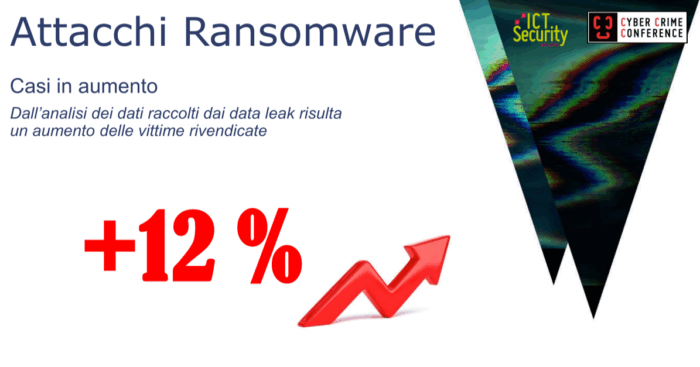
«Nel 2024 gli attacchi a livello globale sono saliti del 12%» ha esordito Carli. La sua disamina si è poi focalizzata principalmente sui gruppi che adottano la strategia del “data leak site”, ossia la tattica attraverso cui i dati sottratti alle vittime che rifiutano di pagare vengono pubblicati online.
attacchi ransomware - L'evoluzione dell'ecosistema Ransomware: la democratizzazione delle minacce informatiche. Matteo Carli, cybercrime conference

Questo approccio consente di misurare con una certa precisione la portata del fenomeno, sebbene l’esperto abbia sottolineato come, a causa della complessità dell’ecosistema criminale, i numeri possano variare tra i diversi report di settore.

Un cambiamento significativo rilevato nell’ultimo anno riguarda la natura dei bersagli: gli attacchi ransomware, tradizionalmente orientati verso organizzazioni di grandi dimensioni con maggiori capacità economiche, stanno ora ridefinendo il proprio raggio d’azione.

«Gli attacchi si stanno spostando su aziende di dimensioni più piccole rispetto al passato» ha spiegato l’esperto, evidenziando come questa tendenza sia emersa negli ultimi mesi del 2024 e stia proseguendo nel 2025, delineando una nuova strategia da parte dei gruppi criminali.

Gruppi Ransomware e ridefinizione economica del riscatto

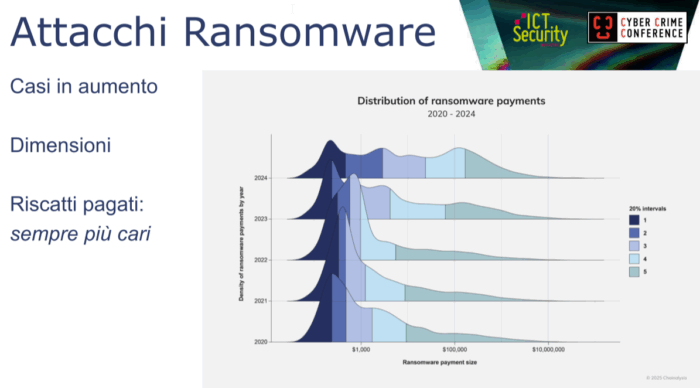
Parallelamente al mutamento dei bersagli, Carli ha evidenziato un’evoluzione nella distribuzione degli importi richiesti a titolo di riscatto.

I dati presentati dall’esperto rivelano un cambiamento sostanziale: «In precedenza a prevalere erano importi bassi, mentre ora sono quasi uniformi fino ai 100.000 euro (e comunque ci sono attacchi che vanno ben oltre i 100.000 euro)». Una trasformazione che indica l’atteggiamento adattivo dei gruppi criminali, i quali calibrano le richieste economiche in base alla capacità delle vittime, massimizzando il potenziale guadagno senza compromettere le probabilità di pagamento.
attacchi ransomware - L'evoluzione dell'ecosistema Ransomware: la democratizzazione delle minacce informatiche. Matteo Carli, cybercrime conference

Il panorama italiano presenta caratteristiche peculiari rispetto al contesto globale. Sebbene Carli abbia riportato che «gli attacchi sono calati in maniera considerevole rispetto al 2023», ha immediatamente messo in guardia contro interpretazioni eccessivamente ottimistiche di questo dato: «attenzione a non confondere questo dato come una vittoria» ha avvertito, ricordando che «il 2023 è stato l’anno peggiore per l’Italia» e che «i numeri del 2024 ci dicono che ancora siamo più alti rispetto al 2022».

La posizione dell’Italia nel contesto internazionale rimane preoccupante: «In questo momento siamo la quinta nazione al mondo nella classifica – purtroppo non positiva – dei paesi più attaccati e la terza a livello europeo» ha precisato il relatore, delineando un quadro che richiede attenzione continua e strategie di mitigazione efficaci.

La vulnerabilità del tessuto industriale italiano

Una delle rivelazioni più significative dell’analisi di Carli riguarda la peculiare vulnerabilità del settore manifatturiero italiano, che emerge come anomalia nel panorama globale.

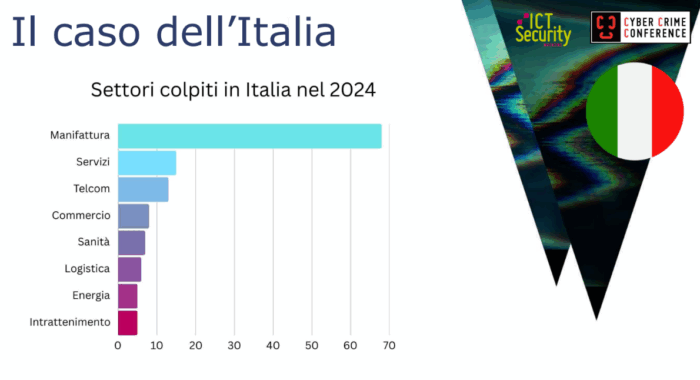
«In Italia la manifattura è il settore più colpito, differentemente da tutto il resto del mondo» ha sottolineato l’esperto, analizzando poi le ragioni di questa specificità.
ransomware in Italia - L'evoluzione dell'ecosistema Ransomware: la democratizzazione delle minacce informatiche. Matteo Carli, cybercrime conference

Tale vulnerabilità appare, infatti, attribuibile a due fattori principali: da un lato «una presenza molto importante delle PMI all’interno del tessuto economico italiano», con le piccole e medie imprese che rappresentano la spina dorsale dell’economia nazionale; dall’altro una carenza strutturale a livello di protezioni informatiche, poiché «all’interno di quel settore non c’è tutto ciò che dovrebbe esserci in termini di cybersecurity».

Questa combinazione di fattori rende il settore manifatturiero italiano un bersaglio particolarmente appetibile per i gruppi ransomware, che possono sfruttare le vulnerabilità sistemiche per massimizzare l’efficacia dei loro attacchi.

Perturbazioni nel regno del crimine digitale

Il 2024 ha segnato quello che Carli ha definito «un periodo difficile per i gruppi ransomware», a causa di una serie di eventi che hanno destabilizzato l’ecosistema criminale, contribuendo a ridisegnare la geografia del crimine informatico e costringendo i gruppi a riorganizzarsi per adattare le proprie strategie.

Il primo evento significativo è stato «il data leak delle chat del gruppo Conti, probabilmente uno dei più famosi», avvenuto in un momento particolarmente delicato poiché, «Nel momento in cui è iniziato il conflitto tra Ucraina e Russia, Conti aveva apertamente espresso il proprio sostegno alla Russia».

Questa dichiarazione politica, probabilmente a causa della presenza di membri ucraini all’interno dell’organizzazione, ha avuto ripercussioni interne, portando «a uno “sgretolamento” del gruppo stesso». La fuoriuscita delle conversazioni interne ha fornito a investigatori e ricercatori preziose informazioni sulle dinamiche operative e organizzative del gruppo, rivelandosi quindi molto positiva sul fronte dell’intelligence.

Un secondo episodio rilevante è stato «il data leak delle chat del gruppo Black Basta, molto noto perché ha condotto attacchi abbastanza importanti anche sulle aziende italiane»: anche in questo caso, le conversazioni trapelate hanno offerto uno sguardo privilegiato sulle metodologie operative e sulle relazioni interne alla gang.

Il terzo evento – verificatosi a marzo 2025 – è stato «il leak del database dei pannelli di controllo di MediaLand, probabilmente il più famoso e duraturo bullet-proof hosting» (servizi che forniscono infrastrutture protette per attività malevole come malware, phishing e ransomware).

Il leak ha esposto le informazioni tecniche relative all’infrastruttura utilizzata da numerosi gruppi criminali, includendo dettagli sugli indirizzi IP e sulle macchine coinvolte nelle operazioni malevole.

L’offensiva delle Forze dell’Ordine e le nuove frontiere legislative

Parallelamente ai data leak che hanno destabilizzato l’ecosistema criminale dall’interno, Carli ha sottolineato l’importanza delle operazioni di polizia internazionali che hanno contribuito ad annientare diverse organizzazioni criminali.

Queste operazioni, infatti, hanno portato non solo «all’arresto di affiliati o gestori di servizi ma anche allo smantellamento di intere infrastrutture tecniche» fondamentali per le attività criminali, infliggendo colpi significativi alla capacità operativa dei gruppi ransomware.

Sul fronte normativo, l’esperto ha evidenziato importanti sviluppi in corso: «è in corso un lavoro a livello legislativo, in USA e in UK, che mira a rendere illegale il fatto di pagare un riscatto per recuperare i propri dati o evitare che vengano pubblicati».

Tali iniziative rappresentano un cambiamento di paradigma nella lotta contro i ransomware, poiché mirano a interrompere il flusso finanziario che sostiene l’ecosistema criminale.

Un’iniziativa analoga, «che va nella direzione di rendere illegale il pagamento del riscatto per le aziende rientranti nel Perimetro Nazionale [di sicurezza cibernetica]», sta emergendo anche in Italia. Al riguardo, Carli ha evidenziato come questa proposta sembri ricevere un ampio consenso politico; questo approccio potrebbe rappresentare un ulteriore strumento nella lotta contro la proliferazione dei ransomware, sebbene sollevi interrogativi pratici sulla gestione delle emergenze informatiche da parte delle aziende colpite.

La frammentazione dell’Ecosistema Criminale

Le pressioni congiunte esercitate dai leak interni, dalle operazioni di polizia e dalle evoluzioni legislative hanno provocato una profonda trasformazione nell’ecosistema ransomware.

Il relatore ha osservato che «stiamo andando verso un’atomizzazione del fenomeno», con gruppi che puntano a target meno visibili o che scompaiono per poi ripresentarsi sotto nuove identità, nonché persino gang che si fondono con altre, condividendo infrastrutture per ottimizzare le risorse e minimizzare i rischi.

Questa frammentazione è tuttavia accompagnata da un fenomeno allarmante: «l’incremento di annunci di ransomware-as-a-service (RaaS)», ovvero di programmi già pronti per condurre attacchi, dove basta affiliarsi perché il gestore del servizio fornisca le risorse tecniche e di negoziazione.

Carli ha evidenziato «un 40% abbondante di aumento nel proporre nuovi RaaS», il che rende l’attività accessibile anche a individui con competenze tecniche limitate: «questo vuol dire anche meno skill e meno struttura, quindi un singolo può affiliarsi a una ransomware gang e iniziare a condurre attacchi» ha spiegato l’esperto, sottolineando come le organizzazioni siano diventate «più snelle, più semplici e capaci di variare molto velocemente nel tempo».

L’evoluzione verso strutture più agili e decentralizzate rappresenta una sfida significativa per le forze dell’ordine e per le strategie di difesa tradizionali, che si trovano a dover contrastare un avversario sempre più mutevole e sfuggente.

Gli Intermediari dell’Accesso: i facilitatori nell’ombra

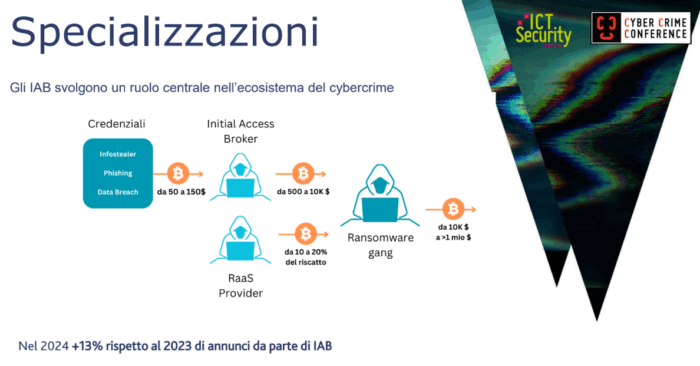
Un altro trend significativo identificato nel 2024 è l’ascesa degli “Initial Access Broker” (IAB), descritti dal relatore come «soggetti o gruppi che di fatto sono facilitatori per gli affiliati ransomware». Questi attori specializzati «forniscono credenziali di accesso o accessi già pronti a VPN, dispositivi o firewall» delle aziende bersaglio, creando un ponte tra la fase di compromissione e l’implementazione finale dell’attacco.
cybercrime - L'evoluzione dell'ecosistema Ransomware: la democratizzazione delle minacce informatiche. Matteo Carli, cybercrime conference

«Abbiamo visto un 13% di aumento degli annunci di Initial Access Broker che mettevano a disposizione e vendevano accessi alle aziende di tutto il mondo» ha rivelato l’esperto, evidenziando la crescente professionalizzazione di questo segmento dell’ecosistema criminale.

Particolarmente preoccupante è la diretta correlazione osservata «tra l’aumento dei dati reperibili online – intesi come credenziali o altre informazioni che possono essere utilizzate per condurre un attacco – e l’aumento degli attacchi ransomware». Tale correlazione suggerisce un ecosistema criminale altamente interconnesso, dove i dati sottratti da malware specializzati nella raccolta di credenziali (infostealer) alimentano direttamente la catena di fornitura degli attacchi ransomware.

Ingegneria Sociale: l’antica arte della manipolazione in veste moderna

Dai leak delle chat, in particolare quelle di Black Basta, è emerso un ulteriore dato: «l’ingegneria sociale è ancora un tema».

Con questa osservazione il relatore ha sottolineato che, nonostante i progressi nelle difese informatiche, la manipolazione psicologica resta uno strumento primario e sorprendentemente efficace per gli attaccanti.

In merito Carli ha citato il caso emblematico di Hellcat, un ransomware-as-a-service che ha dichiarato come, «per condurre due noti attacchi contro aziende molto grandi, avesse usato credenziali sottratte alle vittime con del malware infostealer: credenziali che per quanto si sa erano lì da anni e nessuno – soprattutto le aziende – se n’era accorto, quindi erano ancora valide».

Le conversazioni interne di Black Basta hanno altresì rivelato come il gruppo si confrontasse «su metodologie di ingegneria sociale complesse» per aggirare le difese aziendali. Note come “Hands on Keyboard”, queste tecniche «inducevano le vittime ad aprire, installare o utilizzare applicazioni desktop remote», creando così un vettore di accesso che bypassava le protezioni tecnologiche attraverso la manipolazione dell’elemento umano.

La persistente efficacia di simili tecniche evidenzia una vulnerabilità strutturale nelle strategie di difesa cibernetica, che spesso privilegiano le soluzioni tecnologiche a discapito della formazione e della sensibilizzazione del personale.

L’Intelligenza Artificiale al servizio del crimine: un nuovo capitolo nella Minaccia Digitale

Un elemento emergente nel panorama delle minacce è l’integrazione dell’AI generativa negli arsenali dei gruppi criminali.

Carli ha fatto riferimento ai “MALLA”, intelligenze artificiali utilizzate in ambito offensivo, riferendo come si registri «sempre più interesse e offerta sui forum, canali Telegram e in generale nell’underground criminale» per questi strumenti sofisticati.

Sebbene questi strumenti non abbiano ancora portato «novità dirompenti o distruttive», secondo l’esperto si tratta di «tool che agevolano, migliorano o aumentano la produttività» delle risorse in mano agli attaccanti. Un esempio concreto è la capacità di creare «phishing kit veramente credibili, ben fatti sia nel design che nella parte di testo», aumentando significativamente la verosimiglianza delle esche utilizzate negli attacchi di ingegneria sociale.

L’esperto ha definito questo settore «interessantissimo da seguire, poiché questa velocità di sviluppo non si era mai vista nell’IT», così implicitamente suggerendo che l’integrazione dell’intelligenza artificiale nelle strategie offensive potrebbe rappresentare il prossimo salto evolutivo nella sofisticazione degli attacchi informatici.

La consapevolezza come fondamento della sicurezza: un richiamo all’azione

In conclusione della sua analisi, Carli ha offerto una riflessione che trascende la mera anticipazione delle tendenze future per concentrarsi sulle vulnerabilità attuali.

«È interessante pensare al domani; ma probabilmente, visto anche il problema dell’ingegneria sociale e le tecniche utilizzate dalle ransomware gang, dobbiamo guardare più all’oggi e capire effettivamente cosa abbiamo sbagliato finora».

Un invito accompagnato da un richiamo all’importanza della consapevolezza e della formazione: «Le tecnologie ci sono e l’awareness va promossa tra le persone, i dipendenti, i collaboratori… probabilmente dobbiamo ripartire da lì, prima di parlare di cosa succederà domani».

Il messaggio suona come un richiamo all’essenza stessa della sicurezza informatica, che non può essere delegata esclusivamente alle soluzioni tecniche ma deve sempre includere la dimensione umana. Se infatti l’ingegneria sociale continua a rappresentare un vettore di attacco privilegiato, la formazione e la sensibilizzazione del personale emergono come componenti indispensabili di qualsiasi strategia di difesa coerente ed efficace.

Oltre a offrire uno spaccato allarmante di un ecosistema criminale in rapida evoluzione – dove la democratizzazione degli strumenti d’attacco abbassa costantemente le barriera all’ingresso per potenziali attaccanti – l’intervento di Carli ha quindi rappresentato un promemoria della necessità di approcci alla sicurezza che integrino tecnologia e consapevolezza. A fronte della crescente accessibilità degli strumenti offensivi, la conoscenza e la preparazione rappresentano il più efficace baluardo contro la marea montante delle minacce informatiche.

Condividi sui Social Network:

https://www.ictsecuritymagazine.com/articoli/ransomware-minacce-informatiche/



Britney Fortner: Relationships Are Key in Security

@import url(‘https://fonts.googleapis.com/css2?family=Architects+Daughter&family=Roboto:ital,wght@0,100;0,300;0,400;0,500;0,700;0,900;1,100;1,300;1,400;1,500;1,700;1,900&display=swap’); h3 { font-weight: bold; font-size: 18px; color: #C72026; } .pqFull { display: block; border-width: 2px 0; border-style: solid; border-color: #404144; padding: 1.5em 0 0.5em; margin: 1.5em 0; position: relative; Architects Daughter’, Arial, sans-serif; font-size: 21px; text-align: center; color: #0067A6; } .pqFull:before { content: ‘\201C’; position: absolute; top: 0em; left: 50%; transform: translate(-50%, -50%); background: #fff; width: 3rem; height: 2rem; color: #666; text-align: center; } .pqFull:after { content:; display: block; text-align: center; font-size: 18px; color: #404144; } .w3-black { color: #fff!important; background-color: #000!important } .w3-button { width: 100%; text-align: center; padding: 8px 16px } .w3-bar { width: 100%; overflow: hidden; display: inline-block; width: auto } .w3-bar .w3-bar-item { padding: 8px 16px; float: left; width: auto; border: none; display: block; outline: 0 } .w3-bar .w3-button { white-space: normal } .w3-bar-item { width: 100%; display: block; padding: 4px 8px; text-align: center; border: none; white-space: normal; float: none; outline: 0 } .w3-bar-item { text-align: center } .w3-bar:before,.w3-bar:after { content: “”; display: table; clear: both } .w3-button { border: none; display: inline-block; padding: 4px 8px; vertical-align: middle; overflow: hidden; text-decoration: none; color: inherit; background-color: inherit; text-align: center; cursor: pointer; white-space: nowrap } .w3-button { -webkit-touch-callout: none; -webkit-user-select: none; -khtml-user-select: none; -moz-user-select: none; -ms-user-select: none; user-select: none } .w3-button:hover { color: #fff!important; background-color: #C72026!important } .w3-text { Nunito Sans’,Arial,sans-serif; font-size: 14px; }

Britney Fortner was a Program Coordinator over the Austin Police Department’s Threat Liaison and School Safety Outreach programs during two tragic school shootings. The first was the shooting at Marjory Stoneman Douglas High School on February 14, 2018 (also known as the Parkland school shooting). The second was the Santa Fe High School shooting on May 18, 2018.

Fortner recalls, “When both of those events took place, we as an intelligence center started asking ourselves: what could we do to mitigate these risks and these threats?”

Fortner took this question with her as she changed positions, becoming a Behavioral Threat Assessment Grant Specialist at Texas State University, where she provided training on legislative mandates for behavioral threat assessment procedures to safety personnel and administrators at K-12 institutions and colleges in Texas. Later, she joined YES Prep Public Schools as a Manager of Safety and Security, eventually rising to Director of Safety and Security.

“I learned a lot in that role because I was doing a lot more related to physical security,” Fortner reflects. “I did a lot of work related to mitigating risk when it came to school safety and really got my feet under me.”

With this experience behind her, Fortner eventually applied for and received her current position as Director of Safety, Security and Threat Management.

“It truly is my dream job,” she declares.

School Safety

Proactive school safety doesn’t begin on campus — it starts in the community.

To secure campuses, Fortner emphasizes the importance of taking a look at the surrounding community. Mitigating threats to schools requires security professionals to be attuned to trends and unrest within the community in order to identify the early signs of an individual grievance that could turn into violence.

Our families have an expectation that they’re going to drop their student off and that their student is going to not only be safe, but feel safe and learn.

“We’re trying to catch individuals that have a grievance early, so that we can put interventions in place to help that person and take them off the pathway of violence,” Fortner explains. “But if that person is not in our community and we don’t know of their grievance or what they’re planning — and they’ve already decided they’re going to act — at that point, it is almost impossible to stop something from happening.”

In the event that a person outside of the community plans to harm the school, preparation is key.

“You must have the appropriate measures and layers in place to be able to respond as quickly as possible,” Fortner states.

Securing school campuses is essential; yet, it’s not the only part of the job. Students must also feel comfortable coming into class each day.

“Our families have an expectation that they’re going to drop their student off and that their student is going to not only be safe, but feel safe and learn.” Fortner asserts, “While security is my top priority because that’s my job, our top priority in the school district is always going to be educating students.”

In order to ensure that students feel safe and comfortable, Fortner says she strives to ensure that “school still feels like school.” A huge component of achieving that is engaging in community relationships.

Security Is Relational

While Fortner has established herself in the realm of school security, she didn’t always start there. Instead, she graduated college with a Bachelor of Science in Public Relations with a Business Concentration, then later graduated with a Master of Education, focusing on higher education and higher education administration. Before she joined the Austin Police Department, she held roles such as an Event Manger for The Allan House and an Administrative Assistant for the National Institute for Staff and Organizational Development (NISOD).

Fortner’s educational and professional background provides her an essential skill for building and maintaining community relations: communication.

“Communication is so important for safety and security. Communicating expectations, communicating policies and procedures, communicating when something has gone wrong or not as intended — all of it is essential,” Fortner remarks. “It’s important to be able to communicate enough so that you’re providing transparency to what is going on, but not divulging all of your safety processes, because that creates vulnerabilities.”

The question that Fortner asked herself after two school shootings in quick succession — how to mitigate school risks — was found through community connections. While proper technology, training, and preparedness are also essential, when it comes down to it, school security professionals will achieve very little without strong community relationships.

“The most important part of this job is the relational piece,” Fortner declares.


Women in Security 2025 [Main Article]

https://www.securitymagazine.com/articles/101741-britney-fortner-relationships-are-key-in-security


Avril Eklund: Building Trust, Teams, and a Better Path Forward

@import url(‘https://fonts.googleapis.com/css2?family=Architects+Daughter&family=Roboto:ital,wght@0,100;0,300;0,400;0,500;0,700;0,900;1,100;1,300;1,400;1,500;1,700;1,900&display=swap’); h3 { font-weight: bold; font-size: 18px; color: #C72026; } .pqFull { display: block; border-width: 2px 0; border-style: solid; border-color: #404144; padding: 1.5em 0 0.5em; margin: 1.5em 0; position: relative; Architects Daughter’, Arial, sans-serif; font-size: 21px; text-align: center; color: #0067A6; } .pqFull:before { content: ‘\201C’; position: absolute; top: 0em; left: 50%; transform: translate(-50%, -50%); background: #fff; width: 3rem; height: 2rem; color: #666; text-align: center; } .pqFull:after { content: ; display: block; text-align: center; font-size: 18px; color: #404144; }
.w3-black{color:#fff!important;background-color:#000!important}
.w3-button{width:100%;text-align:center;padding:8px 16px}
.w3-bar{width:100%;overflow:hidden;display:inline-block;width:auto}
.w3-bar .w3-bar-item{padding:8px 16px;float:left;width:auto;border:none;display:block;outline:0}
.w3-bar .w3-button{white-space:normal}
.w3-bar-item{width:100%;display:block;padding:4px 8px;text-align:center;border:none;white-space:normal;float:none;outline:0}
.w3-bar-item{text-align:center}
.w3-bar:before,.w3-bar:after{content:””;display:table;clear:both}
.w3-button{border:none;display:inline-block;padding:4px 8px;vertical-align:middle;overflow:hidden;text-decoration:none;color:inherit;background-color:inherit;text-align:center;cursor:pointer;white-space:nowrap}
.w3-button{-webkit-touch-callout:none;-webkit-user-select:none;-khtml-user-select:none;-moz-user-select:none;-ms-user-select:none;user-select:none}
.w3-button:hover{color:#fff!important;background-color:#C72026!important}
.w3-text{Nunito Sans’,Arial,sans-serif;font-size:14px;}

Avril Eklund’s career path has led her through multiple facets of the security industry ranging from state law enforcement, global tech firms, and team-building. Eklund got her start in security in the public sector as a Police Officer at Bristol Township Police Department in Pennsylvania.

While there, her work included policing and eventually undercover narcotics investigations for the Pennsylvania Attorney General’s Office — a role she excelled at due to her ability to blend in and think strategically.

“I got really good at buying drugs,” she says with a laugh. “So I was recruited by the Pennsylvania Attorney General’s Office, Bureau of Narcotics and spent the last 10 years of my law enforcement career there.”

While it might have initially been a detriment to entering the world of law enforcement, Eklund says her unassuming appearance brought a unique value to the role.

“It came in handy when they needed somebody to buy drugs, because I don’t look like a cop, and I don’t act like a cop, and nobody ever thought I was one so I was really successful at undercover work,” she says.

During her time with the Attorney General’s Office, Eklund prepared for what would come next, earning a master’s degree in intelligence analysis while balancing the demands of her job and a growing family.

“The hours of narcotics work are kind of crazy and I wanted something more stable,” she says and the private sector beckoned.

Eklund took her first leap from government to the private sector with WeWork — a global workplace provider — as Director of Global Security Operations, Investigations, and Threat Management, where she helped build the company’s global security team.

From there, she was recruited by GitHub (which was acquired by Microsoft but operated independently), where she became the company’s first-ever physical security hire. Since then, she’s built a comprehensive program from the ground up — one that now includes event security, crisis management, travel risk support, and more.

If there’s one professional achievement Eklund is most proud of, it’s the team she’s built at GitHub.

It’s so important to have somebody that’s there to be your true cheerleader and kind of keep pushing you along, so I try to be that for other women.

“I’ve got much better at hiring, and hiring quality people that have really good hearts and are just really invested and love what they do,” she says. “They’re just really good people that are interested in the customer service part, and can explain to people why security matters and win people over. So we’re out there winning hearts and minds, rather than just out there being the bad guy. They’re here because they want to help people and they want to help keep people safe.”

GitHub’s remote-first model presents unique challenges for physical security, Eklund says. With remote employees spanning the globe — the security team included — Eklund had to think differently.

“Some were a little skeptical about whether remote would work for a security team, but we found that most of the incidents we were handling were at other locations, such as we were in San Francisco handling a situation in Amsterdam,” she says. “It certainly required some creativity when building out our team.”

Building a strong and effective security program included implementing mass communication systems, travel monitoring tools, and guard staff in each location Eklund says.

“It has been interesting from a security standpoint, and it’s been neat to see how we haven’t needed to be on site and have been very successful as a security team,” she says.

Paying it Forward

Looking back on her career, Eklund attributes much of her success to a mentor she met during her time at the Attorney General’s Office who introduced her to intelligence work and encouraged her to step outside familiar territory.

“I think that I wouldn’t be where I am now if I didn’t have a really good mentor,” Eklund says. “It was the first time I’d really had somebody like that build my confidence up and keep encouraging me and pushing me to do things that were outside of my comfort zone.”

She credits the mentorship as giving her the courage to transition from the public sector to private sector.

“I think I would have been too risk averse and too scared to do it if I hadn’t had that sort of mentor in my life to support me and keep pushing me forward,” she adds.

Now, she’s dedicated to paying it forward by mentoring women in security offering advice, support and encouragement however she can.

“It’s so important to have somebody that’s there to be your true cheerleader and kind of keep pushing you along, so I try to be that for other women,” Eklund says. “I always offer to help however I can. I hope I can be that for someone else, because I know how important it was for me to have that in my career.”

For those looking to break into the security field, Eklund emphasizes the importance of soft skills, curiosity and a willingness to take risks — even when those risks can be scary or you don’t know all the answers.

“You can be afraid but you just have to do it anyway,” she says. “The risk is worth the reward. If somebody asked me if I knew how to do something, or know about something, my answer was ‘no, but I’m happy to learn.’ I’ve been able to show myself again and again that I can learn new skill sets, learn new things, and become an expert.”


Women in Security 2025 [Main Article]

https://www.securitymagazine.com/articles/101740-avril-eklund-building-trust-teams-and-a-better-path-forward


Next-Generation Security: Video Analytics Transforms On-Premises and Hybrid Video Solutions

Rapid advancements in artificial intelligence (AI) based on machine learning (ML) are revolutionizing traditional on-premises video security systems. These technologies aren’t simply enhancing existing capabilities; they’re fundamentally transforming how organizations approach security, operational efficiency, and information analysis.

Evolution and Infrastructure Advantages

The integration of deep learning into security technology has marked a critical inflection point for the industry. What began as basic motion detection and object tracking has evolved into sophisticated systems capable of pose estimation, behavioral analysis and anomaly detection. Today’s AI-powered platforms can differentiate between hostile and benign interactions, identify unusual events signaling potential hazards, and predict breaches before they occur by processing huge volumes of data that would overwhelm human operators.

Organizations applying AI/ML-enhanced on-premises systems gain several competitive advantages. These solutions deliver real-time processing capabilities, allowing immediate response to threats. They maintain data privacy by keeping sensitive information on-site, which is critical in many sectors for meeting strict regulatory requirements. The on-premises approach also significantly reduces latency in mission-critical applications while ensuring privacy holds also for the customization of AI models, both the training data and the specialized models themselves.

Open platform video management software (VMS) serves as the foundation for these advanced systems. A flexible VMS can integrate thousands of cameras and sensors, enabling centralized management and analysis of vast amounts of data. This architecture allows security teams to quickly adapt to emerging threats as well as deploy new solutions without extensive system overhauls.

The key to maximizing on-premises use of analytics lies in the strategic planning of hardware. As these technologies continue to evolve, processing requirements will naturally increase. Organizations should evaluate their current infrastructure with an eye toward future expansion, ensuring adequate computational power to handle increasingly sophisticated algorithms. This forward-thinking approach prevents costly system overhauls while maintaining optimal performance as capabilities advance.

To maximize on-premises advantages while addressing scalability challenges, many organizations are adopting on-prem/cloud hybrid models. These approaches maintain critical real-time data on local servers for control and low latency while selectively leveraging cloud services for long-term storage and advanced analytics — allowing organizations to scale processing power without compromising core security principles.

Practical Applications and Implementation

The integration of smart analytics into on-premises video security is transforming practices across many sectors. In retail environments, AI-powered analytics optimize product placement, track customer behavior patterns, and enhance loss prevention efforts. Educational institutions employ advanced video analysis to address challenges like vaping detection, bullying prevention, and traffic monitoring while ensuring adherence to safety protocols.

Manufacturing facilities leverage AI to streamline quality control, detect safety violations and maximize production efficiency. Healthcare organizations monitor patient safety, manage access control and document compliance with established procedures. Transportation systems benefit from improved traffic management, enhanced protection in transit hubs, and more effective incident response.

Despite their transformative potential, smart analytic systems present deployment challenges. The considerable upfront investment may deter smaller organizations or those with limited budgets. However, when viewed as a long-term strategic investment, the returns in enhanced security and operational efficiency often justify the initial costs.

Ethical considerations surrounding privacy, consent and potential algorithmic bias demand careful attention. Organizations must strike a balance between enhancing surveillance and safeguarding individual privacy rights to maintain public trust in these technologies. This balance becomes increasingly critical as AI capabilities expand, requiring transparent policies about data usage and algorithmic decision-making processes.

Emerging Trends and Strategic Directions

The future of analytics in on-premises video monitoring holds significant promise. Edge computing will enable sophisticated processing directly on cameras, reducing server demands. Predictive analytics will shift security postures from reactive to proactive, with systems capable of anticipating incidents before they occur.

Integration between security systems and business operations will deepen, with analytics delivering insights beyond traditional applications. Automation will also allow operators to focus on complex situations and strategic decisions, fundamentally shifting professional roles from monitoring to analysis.

For security professionals, embracing these technologies is necessary to remain competitive. By leveraging open platform VMS and strategic planning, organizations can build powerful surveillance solutions that protect people, privacy, and assets while driving business value.

https://www.securitymagazine.com/articles/101735-next-generation-security-video-analytics-transforms-on-premises-and-hybrid-video-solutions


Phishing Scams Can Deceive Large Language Models

Netcraft researchers have discovered that large language models (LLMs), when asked to identify how to log into various platforms, would provide concerning results one-third of the time. 

Two-thirds of the time, the LLM would provide the correct login URL. The concerning one-third can be broken down as follows: 

  • 30% sent users to domains that were unregistered, parked or inactive (which could leave them at risk of takeover). 
  • 5% directed users to unrelated organizations.

Essentially, more than one in three individuals were sent to a site unassociated with the brand in question. 

The research asserts that the tests run were not edge-case prompts; rather, researchers used simple, casual phrases to simulate how an average user might realistically submit a prompt to an LLM. 

In one observed instance, the live AI-powered search engine Perplexity directed researchers to a phishing link. According to the researchers, the phishing link was not associated with a subtle scam, and Perplexity ignored signals such as domain authority or reputation.

Below, security leaders discuss these findings and their implications. 

Security Leaders Weigh In

Gal Moyal, CTO Office at Noma Security:

If AI suggests unregistered or inactive domains, threat actors can register those domains and set up phishing sites. As long as users trust AI-provided links, attackers gain a powerful vector to harvest credentials or distribute malware at scale.

Without guardrails enforcing URL correctness, AI responses can mislead users. Guardrails should validate domain ownership before recommending login, Any request/response containing a URL can be vetted using common practices, or use common practices such as domain reputation, known malicious URL websites, etc. 

AI can easily become a phishing delivery mechanism, highlighting the urgency of runtime protection to be put in place.

Nicole Carignan, Senior Vice President, Security & AI Strategy, and Field CISO at Darktrace:

LLMs provide semantic probabilistic answers with intentional variability to avoid repetitive outputs. Unfortunately, this mitigation strategy can also introduce hallucinations or inaccuracies. 

The research shows that approximately one-third of domains provided by the LLM were unregistered, parked, or unavailable — highlighting an emerging risk that can be easily weaponized by threat actors. When AI suggests one of these domains, it opens the door to malicious redirection, phishing, and credential harvesting. This, however, is not a new tactic. Threat actors have been leveraging typo-squatting — registering intentionally misspelled or lookalike domains to deceive users — for more than two decades.

The research also revealed a more dangerous threat; the intentional data poisoning or bias interjected into promoted GitHub repositories. The compromise of data corpuses used in the AI training pipeline underscores a growing AI supply chain risk. Data integrity, data sourcing, cleansing, and verification are critical to ensuring the safety and accuracy of LLM-generated outputs.

LLMs can and should have guardrails in place to mitigate this risk. One basic mitigation is to have LLMs ground or source any URL that is cited, essentially removing “generated” hostnames and replacing them with grounded, accurate hostnames.  

More broadly, this research points to a deeper issue: users are relying on generated, synthetic content from the outputs of LLMs as if it is fact-based data retrieval. LLMs don’t “retrieve” information — they generate it based on learned semantic probabilities from training data that users typically have no visibility into. Without proper sourcing, these systems become ripe for both inaccuracy and exploitation.

J Stephen Kowski, Field CTO at SlashNext Email Security+:

AI sending users to unregistered, parked or unavailable URLs creates a perfect storm for cybercriminals. When AI models hallucinate URLs pointing to unregistered domains, attackers can simply register those exact domains and wait for victims to arrive. It’s like having a roadmap of where confused users will end up — attackers just need to set up shop at those addresses and collect whatever sensitive information people try to enter.

This LMM behavior definitely needs immediate attention through input and output filtering systems. Traditional security measures struggle with AI-generated content because it looks legitimate and bypasses normal detection patterns. Real-time URL validation and domain verification before presenting results to users would catch these hallucinated links before they cause damage.

The one instance when AI actually provided a link to a phishing site is the most concerning finding because it shows AI can directly serve up active threats, not just create opportunities for future ones. This demonstrates how AI systems can become unwitting accomplices in phishing campaigns, essentially doing the attacker’s work by delivering malicious links with the authority and trust that comes with an AI recommendation. When users trust AI responses as authoritative, a single malicious link recommendation can compromise thousands of people who would normally be more cautious about clicking suspicious URLs. 

https://www.securitymagazine.com/articles/101738-phishing-scams-can-deceive-large-language-models


Liste di dati sul dark web: una fonte inaffidabile per le analisi di sicurezza. L’approfondimento di Group-IB


In una recente analisi, Group-IB ha approfondito il ruolo dei dati sensibili distribuiti nel dark web per dimostrare che, a dispetto di quanto molti credano, non sono un’indicazione affidabile di un’avvenuta compromissione e della sua portata. 

L’analisi prende in esame in particolare le cosidette “combolist“, ovvero liste di username con relativi indirizzi email e password, e dei file Url-Login-Password (ULP), liste di triplette contenenti l’url di un sito e le credenziali degli utenti per accedervi. Queste liste sono molto utili per i cybercriminali perché gli consentono di eseguire attacchi su larga scala, automatizzandoli.

Group IB

Spesso gli utenti che pubblicano questi file sostengono che contengono miliardi di credenziali valide e pronte da essere usate; un’affermazione che mette ovviamente in allarme aziende e ricercatori di sicurezza, i quali analizzano spesso queste liste per comprendere l’impatto di un leak.

Come riportato da Group-IB, però, queste liste sono diventate ormai obsolete e non sono degli indicatori affidabili di nuove compromissioni. “Pur continuando a far parte dell’ecosistema della criminalità informatica, la maggior parte dei dati contenuti in queste raccolte è riciclata, obsoleta o poco verificata. Per i ricercatori, il loro vero valore risiede più nell’analisi storica e nel monitoraggio dell’esposizione delle credenziali che nell’identificazione di nuove minacce” specifica la compagnia sul suo blog.

Uno dei motivi per cui non si possono considerare affidabili è che queste liste spesso vengono copiate e ridistribuite da numerosi attaccanti, i quali non si preoccupano di controllarne il contenuto. Nel corso del tempo le combolist e i file ULP vengono “riciclati” e non più aggiornati, col risultato che in molti casi le credenziali sono diventate obsolete.

Inoltre, in molti casi gli attaccanti rimaneggiano queste liste, rendendole di fatto non utilizzabili. Si arriva quindi a una diffusione incontrollata delle informazioni che nella maggior parte dei casi sono sempre le stesse credenziali, probabilmente non più funzionanti. “Dopo che l’attaccante prende le informazioni da una fonte, potrebbe rinominare il file, creando l’illusione di un nuovo file o di un nuovo leak” aggiunge Group-IB. Non essendoci un vero e proprio standard per il renaming dei file, l’operazione diventa caotica, soprattutto considerando quanto è diffusa.

Ci sono anche sempre più situazioni in cui le liste contengono delle combinazioni false, generate da tool di IA; in questo caso non è semplice verificarne l’autenticità per i ricercatori di sicurezza, i quali si trovano a perdere tempo dietro a dati non di valore.

Tutte queste problematiche complicano l’analisi e soprattutto distolgono l’attenzione da incidenti di sicurezza reali e dal loro impatto. Avendo a che fare con dati compromessi e non più autentici, se ne perde il contesto reale e non è più così immediato risalire alla vera origine del breach. Le organizzazioni potrebbero pensare erroneamente di essere state vittime di un breach o, al contrario, gli utenti potrebbero abbassare la guardia dopo l’ennesimo alert di un incidente che si rivela poi un falso allarme.

“Può sembrare ovvio, ma spesso viene trascurato: le informazioni trovate in un dump di password o in un archivio di login provengono da un breach specifico. Non si materializzano dal nulla. Per questo motivo, gli analisti di Group-IB sottolineano l’importanza di dare priorità all’identificazione e al monitoraggio delle fonti di violazione originali, non solo degli ecosistemi che fanno circolare artefatti di dati secondari” sottolinea Group-IB.

Queste liste trovate sul dark web o su canali Telegram di cybercriminali non sono da ignorare completamente, ma nemmeno da prendere come oro colato. Trovandosi di fronte a file di questo tipo, un ricercatore di sicurezza dovrebbe innanzitutto cercare di capire a cosa si riferisce la lista, se i dati sono aggiornati e se sono effettivamente funzionanti. 

È necessario, evidenzia la compagnia, che i ricercatori non si limitino ad aggregare i dati delle combolist e delle ULP e usarli come fonte primaria di analisi, ma che si occupino di analizzarle per comprendere l’origine del breach e il reale impatto che ha avuto.

Condividi l’articolo


Articoli correlati

Altro in questa categoria


https://www.securityinfo.it/2025/07/08/liste-di-dati-sul-dark-web-una-fonte-inaffidabile-per-le-analisi-di-sicurezza-lapprofondimento-di-group-ib/?utm_source=rss&utm_medium=rss&utm_campaign=liste-di-dati-sul-dark-web-una-fonte-inaffidabile-per-le-analisi-di-sicurezza-lapprofondimento-di-group-ib