Le campagne russe di disinformazione si evolvono sfruttando tattiche sempre più sofisticate. Social Design Agency (SDA), azienda con sede a Mosca sanzionata dagli Stati Uniti all’inizio di quest’anno, è stata collegata a nuove operazioni segrete. L’obiettivo sarebbe quello di destabilizzare il sostegno globale all’Ucraina e di creare divisioni tra le alleanze occidentali. Grazie a contenuti generati ad hoc dall’Intelligenza artificiale, siti fasulli e manipolazione dei social media, le nuove tecnologie e gli strumenti di comunicazione digitale diventano un complesso veicolo di propaganda e disinformazione.
Campagne russe di disinformazione: sempre più evolute
L’ultima campagna dell’agenzia incriminata, denominata Operazione Undercut dal gruppo Insikt di Recorded Future, dimostra la perseveranza della Russia nell’intento di minare il sostegno all’Ucraina e influenzare la narrativa sul conflitto in corso. Attraverso video potenziati dall’IA e siti di fake news che imitano fonti affidabili, l’operazione prende di mira un pubblico molto ampio. A essere colpite sono le popolazioni di Ucraina, Europa e Stati Uniti.
“Questa campagna non solo mette in dubbio la leadership dell’Ucraina e l’efficacia degli aiuti occidentali, ma alimenta anche le tensioni socio-politiche, diffondendo notizie false sulle elezioni presidenziali statunitensi del 2024 e sul conflitto tra Israele e Gaza” hanno sottolineato i ricercatori di Recorded Future.
Le tattiche sfruttate da SDA richiamano quelle di Doppelganger, un’altra operazione di disinformazione progettata per diffondere notizie false e fuorvianti attraverso siti web e profili sui social media. Entrambe le campagne sono collegate a strategie ben più ampie, come l’Operazione Overload. Quest’ultima ha preso di mira eventi di ampio respiro come le elezioni francesi del 2024 e le Olimpiadi di Parigi.
Come la Russia sfrutta IA e media falsi
Una caratteristica chiave dell’Operazione Undercut è l’uso di video e immagini, generati dall’Intelligenza Artificiale, che imitano marchi noti e affidabili, conferendo credibilità alle false narrazioni. Grazie ad oltre 500 account distribuiti su diverse piattaforme social, tra cui figurano 9gag e America’s Best Pics and Videos, i cyber criminali riescono ad amplificare la portata dell’operazione di disinformazione.
Tra gli strumenti sfruttati ci sono anche hashtag di tendenza nelle lingue locali. E attraverso piattaforme come CopyCop, un network che usa l’ingegnerizzazione dei prompt e i grandi modelli di linguaggio (LLM) per produrre contenuti in grado di influenzare le scelte politiche delle masse, l’efficacia dell’operazione cresce ulteriormente. “Questi sforzi mirano a rappresentare la leadership ucraina come corrotta e inefficace” hanno osservato gli esperti di Recorded Future.
Parallelamente, i gruppi hacker continuano a usare tecniche di attacco avanzate (come la nearest neighbor) per rubare dati e informazioni sensibili a organizzazioni occidentali che rivestono ruoli chiave.
Implicazioni per la sicurezza e la stabilità globale
L’uso coordinato di propaganda generata dall’IA e cyber attacchi da parte della Russia sottolinea la crescente complessità dei conflitti moderni. Campagne come l’Operazione Undercut mirano a destabilizzare le alleanze politiche e a erodere la fiducia pubblica, mentre le intrusioni informatiche compromettono dati e infrastrutture critiche.
Una convergenza molto pericolosa
La convergenza tra disinformazione e attacchi informatici nelle campagne russe rappresenta una seria minaccia per la stabilità globale. Le organizzazioni sono chiamate a rafforzare le difese contro la propaganda basata sull’intelligenza artificiale e le intrusioni cyber. Parallelamente, governi e piattaforme tecnologiche rivestono un ruolo cruciale nel mitigare l’influenza di realtà come SDA.
I codici QR, onnipresenti nella nostra vita quotidiana, rappresentano un terreno fertile per i cybercriminali. Secondo Cisco Talos, circa il 60% delle email contenenti codici QR è spam, spesso mirato al phishing o al furto di credenziali usate per l’autenticazione a più fattori (MFA). Pur essendo nati per semplificare l’accesso alle informazioni, traghettando velocemente gli utenti a siti promozionali, codici sconto o pagine informative, tali codici possono essere usati come vettori di attacchi molto insidiosi.
I QR non sono altro che una tipologia di codice a barre bidimensionale, in grado di codificare fino a 4.300 caratterialfanumerici. Possono veicolare diversi tipi di dati, ma in genere sono usati per codificare gli indirizzi web.
Il lato oscuro dei codici QR
Sfruttando i dispositivi mobili, spesso meno protetti rispetto ai PC e non connessi alla rete aziendale (generalmente più controllata), i criminali informatici indirizzano le vittime verso siti dannosi, sondaggi o altri strumenti per rubare dati sensibili.
Un fenomeno emergente riguarda, inoltre, la creazione di codici QR “artistici”. I dati che veicolano la minaccia vengono nascosti all’interno di immagini visivamente accattivanti. Questa tecnica non solo rende più difficile identificare i codici malevoli, ma aumenta anche la probabilità di ingannare le vittime. Queste immagini hanno, infatti, maggiori possibilità di sfuggire ai tradizionali sistemi di sicurezza.
Immagine artistica che nasconde un codice QR fraudolento
Esempi concreti di attacchi che usano i codici QR
Un caso riportato di recente dalla BBC evidenzia come adesivi con codici QR fraudolenti siano stati posizionati sui parchimetri. Il sistema serviva a traghettare i pagamenti degli ignari automobilisti nelle tasche dei criminali. Si tratta di QR molto ben realizzati, che sembrano emessi dall’ente di gestione ufficiale dei parcheggi.
Nell’immagine qui sotto, invece, si vede una falsa email di Microsoft che invita a immettere nuovamente le credenziali per l’autenticazione a due fattori. Il QR porta, come è facile immaginare, a un sito fasullo creato dagli hacker di turno.
Una mail fraudolenta che si spaccia per Microsoft invitando l’utente a inserire le proprie credenziali
Come proteggersi dai QR code fraudolenti
Proteggersi, fortunatamente, è più facile di quello che si potrebbe pensare. Bisogna però avere la pazienza di controllare ogni QR, utilizzando una delle tante piattaforme gratuite di decodifica disponibili online. Le aziende, invece, possono affidarsi a soluzioni avanzate, in grado di bloccare le email contenenti codici QR sospetti prima che raggiungano le caselle di posta destinatarie.
600,000 sensitive files exposed by data broker SL Data Services
A non-password protected database belonging to data broker SL Data Services has exposed more than 600,000 sensitive files. The exposed records include:
Full names (including first, middle and last)
Family members
Home addresses
Phone numbers
Email addresses
Employment details
Social media accounts
Court records
Criminal history records
Vehicle records (such as license plate and VIN)
“It is exceptionally frustrating to see events such as this in modern times where encryption of files is a trivial process yet has been ignored by an organization whose primary purpose is the collection of sensitive information,” says Erich Kron, Security Awareness Advocate at KnowBe4. “In addition, allowing an unprotected folder to be available directly from the internet is a major lapse in security. The icing on the cake is the failure to take a report of this exposed data seriously when the researcher attempted to disclose it. The information found in these files can be especially useful to social engineers who want to create email, text or voice phishing campaigns. The more information the social engineer has about an individual, including significant events in their life, past addresses and phone numbers, etc., the more authentic they can make their attacks seem, the more likely a target is to become a victim.”
At this time, it is unknown how long the database was exposed or if anyone other than Cybersecurity Researcher Jeremiah Fowler gained access to it. Nonetheless, individuals should be aware that their personal information may be held by various data brokers and take the necessary steps to protect their privacy.
Chris Hauk, Consumer Privacy Champion at Pixel Privacy, comments, “Incidents like these are the reason I strongly suggest requesting to have your personal information removed from as many data brokers as you possibly can. Data brokerage databases are a popular target among bad actors, simply because of all of the data available in the databases, and that many times, data brokers do not properly secure their data pots, either from ignorance or neglect. While it can be quite time consuming to request that your data be removed from the thousands of data brokers files, there are services that will make the removal requests for you, track to ensure the removal has been performed, and inform you of the progress being made in removing the data.”
Organizations should also be proactive about protecting stored data. Kron states, “Organizations that handle large amounts of potentially sensitive information for individuals should take extreme care in the storage and collection of the information. Data encryption is not an option and processes and controls to verify permissions on folders, especially those in the cloud, are absolutely a necessity. Having a program in place that allows someone to report a potential leak or security concern should be an easily found and accessed part of every organization that handles sensitive data. Whether it’s a form on the website to make a report, or a process in which customer service individuals can gather information and forward the report to a security team, the ability to handle responsible reporting should be a priority.
“Although it’s not known if bad actors accessed the database and pilfered the information, individuals that are potentially affected should be notified and should be very cautious with unsolicited emails, text messages, or phone calls in the foreseeable future.”
Intelligenza Artificiale Generativa nel Ciclo di Intelligence OSINT
L’intelligenza artificiale generativa ha assunto un ruolo cruciale nel ciclo dell’Open Source Intelligence (OSINT), rendendo fondamentali le scelte relative ai modelli da impiegare e alle loro modalità di utilizzo.
In quest’ottica Dario Beniamini – SANS Institute OSINT Instructor, Senior Solutions Consultant presso NUIX, nonché CEO e Co-Fondatore di Intellexia Srls – ha presentato al 22° Forum ICT Security l’intervento intitolato “NO PAIN NO GAIN – L’Intelligenza Artificiale nel Ciclo dell’Intelligence OSINT”.
Partendo da alcune definizioni utili a chiarire i concetti di intelligence e open source intelligence, Beniamini ha definito il ciclo dell’OSINT come un processo strutturato volto alla raccolta e analisi di informazioni da fonti aperte, illustrando come l’intelligenza artificiale possa migliorarne significativamente l’efficienza.
Il relatore ha esposto il contributo che può dare l’AI nelle diverse fasi di questo ciclo, condividendo alcune considerazioni legali ed etiche relative all’uso dell’AI, tra cui il rispetto delle normative vigenti e la gestione dei bias nei modelli più diffusi come ChatGPT. Ha quindi sintetizzato le maggiori difficoltà (“The Pain”) associate alla scelta del modello di intelligenza artificiale da utilizzare, per arrivare ad illustrarne i potenziali benefici (“No Pain, No Gain”).
Categorie di Intelligence
Beniamini ha esordito ricordando che l’intelligence rappresenta, essenzialmente, un processo volto a trasformare dati grezzi in informazioni operative.
In campo di intelligence esistono molteplici categorie rilevanti, tra le quali si includono:
Human Intelligence (HUMINT)
Communication Intelligence (COMINT)
Signal Intelligence (SIGINT)
Measurement and Signature Intelligence (MASINT)
Technical Intelligence (TECHINT)
Financial Intelligence (FININT)
Geospatial Intelligence (GEOINT)
Open Source Intelligence (OSINT)
Nel contesto dell’OSINT i dati vengono raccolti da fonti aperte e pubblicamente disponibili, per poi essere analizzati e validati.
Attraverso questo processo, i dati si trasformano in open source information.
Dopo essere stati sottoposti a ulteriori analisi e verifiche, possono diventare open source intelligence; oppure (qualora validati attraverso altre categorie di intelligence) evolversi in validated open source intelligence.
Open Source Intelligence (OSINT)
Il relatore ha chiarito come l’espressione “open source” non si riferisca, nel contesto dell’OSINT, all’uso di software open source; bensì a informazioni accessibili pubblicamente, a prescindere dalla difficoltà o dalle tecnologie necessarie per ottenerle.
Il processo OSINT, quindi, implica la raccolta e la valutazione di informazioni da fonti aperte.
Non sempre tali fonti sono immediatamente accessibili. Ad esempio, per accedere ad alcuni dati presenti sui social media è richiesta l’autenticazione tramite un account; inoltre alcune informazioni possono essere pubblicamente disponibili ma accessibili solo a pagamento, come ad esempio le visure camerali in Italia.
L’Open Source Intelligence comprende un ampio spettro di informazioni: dai media quali audio, video e immagini, ai testi provenienti da documenti o articoli di giornale, fino ai dati di geolocalizzazione inclusi nei post pubblicati sulle piattaforme social.
Nel tempo le categorie di intelligence si sono moltiplicate includendo termini specifici per i vari settori in cui si svolgono, come SOCMINT per le attività svolte all’interno dei social media.
Applicazioni dell’OSINT
L’OSINT è ormai parte della nostra quotidianità: a titolo di esempio, Beniamini ha citato le comuni ricerche che siamo abituati a svolgere sul web per valutare l’acquisto di un immobile o per prenotare una vacanza.
Viene altresì utilizzato da organizzazioni, risorse umane, giornalisti investigativi, governi e forze di polizia; ma anche in contesti meno leciti, come possono essere le attività di stalking, terrorismo e cybercriminalità. In questo ultimo caso l’OSINT è spesso usato per raccogliere informazioni preliminari su un obiettivo prima di un attacco di social engineering, costruendo una falsa identità o “sockpuppet”.
In ambito aziendale l’OSINT può essere utile a selezionare il personale nonché ad analizzare i livelli di soddisfazione dei dipendenti, monitorando commenti e reazioni sui social media per comprendere lo “stato di salute” dell’azienda. Trova inoltre applicazione a fini di due diligence, nel marketing, nella competitive intelligence e spesso anche nel data enrichment, dove permette di aggregare più informazioni da varie fonti aperte (a pagamento o gratuite).
Il ciclo OSINT
Nell’intervento è stato ricordato che, sebbene ne esista più di una variante, il ciclo OSINT può essere suddiviso in quattro fasi principali:
Planning e Direction – definizione degli obiettivi, delle fonti e delle regole di ingaggio. Spesso sottovalutata, questa fase è invece cruciale per evitare discrepanze tra le aspettative del committente e i risultati finali.
Collection – acquisizione delle informazioni utilizzando metodi di data crawling.
Analysis e Correlation – trasformazione dei dati grezzi in informazioni utilizzabili, attraverso tecniche di link analysis e altre metodologie.
Dissemination – presentazione al committente del report finale.
Naturalmente, il ciclo OSINT può includere anche ulteriori fasi: tra queste la validazione delle informazioni raccolte attraverso altre forme di intelligence, come la human intelligence (HUMINT), per garantire la maggiore accuratezza possibile.
Regolamentazione dell’Intelligenza Artificiale
Passando al quadro che regolamenta l’uso dell’intelligenza artificiale nel campo dell’intelligence, Beniamini ha ricordato come esistano numerose fonti normative: tra questi ha citato l’Artificial Intelligence Act in ambito di Unione Europea, l’AI Risk Management Framework del NIST negli Stati Uniti e l’Australian Artificial Intelligence Ethics Framework.
La conoscenza di questi regolamenti è fondamentale per stabilire le regole di ingaggio ed evitare che, laddove raccolte in violazione della legge, le informazioni risultino inutilizzabili.
Intelligenza Artificiale Generativa
Sebbene oggi l’intelligenza artificiale sia erroneamente associata ai soli modelli generativi (come quelli diffusi da OpenAI), in realtà è stata utilizzata per anni in molte altre forme: ad esempio gli smartphone utilizzano da tempo algoritmi di machine learning per organizzare le foto personali e creare video ricordo.
L’IA generativa, andando oltre tale modello “deterministico”, ha invece una natura “stocastica”. Il relatore ha evidenziato come ciò la renda estremamente utile per generare nuovi contenuti ma al tempo stesso imponga alcune cautele, considerando come gli output possano variare nel tempo in base a vari fattori.
Scelta del Modello di Intelligenza Artificiale
L’intervento si è quindi concentrato sul complesso tema relativo alla scelta del modello di intelligenza artificiale da adottare, ricordando come esistano numerose opzioni – ognuna con diverse implicazioni in termini di privacy e controllo sui dati – che spaziano dai modelli open source alle soluzioni commerciali.
Inoltre, a livello di software, si può optare per l’utilizzo del modello tramite API o attraverso un’interfaccia grafica, o ancora implementarlo on-premises o in cloud: il relatore ha evidenziato che, laddove si scelga una soluzione on-premises, è necessario valutare se si dispone di hardware sufficiente (come GPU di tipo NVIDIA).
Secondo Beniamini le organizzazioni dovrebbero valutare attentamente costi e risorse hardware necessarie per l’implementazione di ciascun modello, consapevoli che investire nell’IA generativa può comportare interessanti vantaggi per il loro business.
Benefici dell’Intelligenza Artificiale Generativa nel Ciclo OSINT
Richiamando il ciclo OSINT esposto in precedenza, Beniamini ha evidenziato come l’uso dell’IA generativa offra significativi benefici in ogni fase del processo.
Planning: l’IA può suggerire ulteriori fonti e termini di ricerca.
Collection: l’IA può aiutare nella creazione di script per il data gathering.
Analysis e Correlation: l’IA può velocizzare la traduzione, la trascrizione, il parsing e la sentiment analysis sui contenuti raccolti.
Dissemination: l’IA può contribuire a migliorare la presentazione del report finale, fornendo supporto nella scrittura e nella sintesi dei risultati.
Un esempio concreto: creazione di un Sock Puppet
A titolo di esempio circa l’impiego dell’IA generativa nelle attività di OSINT, Beniamini ha esposto la creazione di un “sock puppet”, ossia una falsa identità successivamente utilizzabile in operazioni di raccolta d’informazioni.
Nel caso esposto, a partire dal prompt ricevuto, ChatGPT ha generato in brevissimo tempo nome, username e dettagli relativi al profilo social di un uomo di 30 anni: sebbene alcuni aspetti richiedano ancora una verifica manuale, è evidente come l’automazione di parte del lavoro rappresenti un notevole vantaggio.
Creazione di immagini con Reti GAN
Un altro possibile impiego dell’intelligenza artificiale generativa riguarda la creazione di immagini attraverso reti GAN; nel campo dell’OSINT queste immagini sono utili per creare falsi profili che appaiano credibili e non siano riconoscibili come fake.
Il relatore ha esemplificato tale tecnica mostrando al pubblico un volto generato dall’IA combinando le caratteristiche di due volti noti (George Clooney e Brad Pitt), così creando un’immagine completamente nuova e non riconducibile ad alcuna persona reale.
Conclusione
Beniamini ha chiuso il suo intervento ribadendo che – se utilizzata con le dovute precauzioni – l’intelligenza artificiale può rappresentare uno strumento prezioso nelle attività di OSINT.
Alla luce dei notevoli benefici, i potenziali rischi connessi alla violazione della privacy e all’abuso delle informazioni possono essere limitati da un approccio consapevole e rispettoso delle normative, che massimizzi l’impatto positivo dell’IA su tutte le diverse fasi del ciclo di intelligence.
SANS Institute OSINT Instructor, Senior Solutions Consultant at NUIX, CEO and Co-Founder of Intellexia Srls
Dario Beniamini is a Senior Solutions Consultant at NUIX, CEO and Co-Founder of Intellexia Srls, and an instructor of SEC497 Practical Open-Source Intelligence. He has experience conducting OSINT and Digital Forensics investigations in both the private and public sectors. Dario is also a certified trainer for the European Judicial Training Network (EJTN), the European Union Agency for Law Enforcement Training (CEPOL), and the Italian Ministry of Interior. Dario holds a Master’s in Fraud and Operational Risk from Luiss Business School and has earned a number of professional certifications over the years, including: GCFA, GCFE, and GOSI certifications.
The 2024 Annual Guarding Report: Navigating the Changing Weather
@import url(‘https://fonts.googleapis.com/css2?family=Nunito+Sans:ital,opsz,wght@0,6..12,400;0,6..12,500;0,6..12,600;0,6..12,700;1,6..12,400;1,6..12,500;1,6..12,600;1,6..12,700&family=Nunito:ital,wght@0,400;0,500;0,600;0,700;1,400;1,500;1,600;1,700&display=swap’); @import url(‘https://fonts.googleapis.com/css2?family=Architects+Daughter&family=Roboto:ital,wght@0,100;0,300;0,400;0,500;0,700;0,900;1,100;1,300;1,400;1,500;1,700;1,900&display=swap’); h3 { font-weight: bold; font-size: 18px; color: #C72026; } figure { padding: 4px; margin: auto; } figcaption { background-color: #f8f8f8; color: #404144; Nunito Sans’, Arial, sans-serif; font-size: 16px; padding: 2px; text-align: center; } .sidebarFullWidth { position: relative; left: -60px; margin-right: -120px; color: #000; padding: 20px 40px; width: auto; box-shadow: none; Nunito Sans”, “Open Sans”, sans-serif; background-color: #fff;
} .pqFull { display: block; border-width: 2px 0; border-style: solid; border-color: #404144; padding: 1.5em 0 0.5em; margin: 1.5em 0; position: relative; Architects Daughter’, Arial, sans-serif; font-size: 21px; text-align: center; color: #0067A6; } .pqFull:before { content: ‘\201C’; position: absolute; top: 0em; left: 50%; transform: translate(-50%, -50%); background: #fff; width: 3rem; height: 2rem; color: #666; text-align: center; } .pqFull:after { content: “\2013 \2003” attr(cite); display: block; text-align: center; font-size: 18px; color: #404144; } /* These contain the individual column contents. */
.columnContainer{ display: inline-block; margin: 0px; width: 48%; vertical-align: top; text-align: center;
} /* This media query block makes the column widths 45% at a screen width of 720px, allowing for two columns. */
@media screen and (max-width: 720px){ .columnContainer{ width: 45%; }
} /* This media query block sets the column widths to auto, which fills the screen but allows for margins, at a screen width of 450px, allowing for one column.
This is really the only media query block you will need.*/
@media screen and (max-width: 450px){ .columnContainer{ width: auto; }
}
Workplace violence, civil and political unrest, property crimes, and weather-related challenges are all on the plate of guarding companies and their clients, who must respond with the right training, equipment and technology, and hiring and retention initiatives to ensure they keep people and assets safe and secure.
The Archers-Daniels-Midland Company (ADM), which mostly uses GardaWorld Security in North America but a variety of other companies around the world, has experienced an increased need for guards to handle hostile incidents and has deployed greater training in certain hot spots, such as Ukraine and Israel, says Brian Howell, vice president and global head of security.
“We’ve also seen an uptick in the burden that’s put on guards for emergency management—evacuations of sites, that type of thing,” he says. “We’ve slowly aligned and gotten that verbiage into the post orders. They’ve adapted very well.”
Keeping officers safe is top of mind for Eric Golebiewski, vice president of corporate security at Caesars Entertainment, which uses a blend of in-house and third-party vendors. “Our goal is to make sure those employees go home every day uninjured and stay safe while on the job,” he says.
Workplace violence is the main concern for Ken Harr, Assistant Vice President and Chief Security Officer at Tennessee-based Ballad Health, which has 21 hospitals, practices in 298 office buildings, and has 150 armed, in-house officers (with no third-party contracts).
“Patients and visitors sometimes get upset due to wait times or not getting the medication they are wanting,” he says. “It goes along with weapons being brought into the facility, whether it be guns or knives. We have added more officers in the [emergency department], 24/7. We’re purchasing two K9 units for our level one trauma center that hopefully will provide deterrence.”
Allied Universal and its clients continue to see ramifications of property crimes such as smash-and-grab retail attempts, says Rachelle Loyear, Vice President of Integrated Security Solutions, while concerns about potential civil unrest led Allied to publish an election-related security guide. “No matter what happens in the United States in November, some segment is going to be unhappy about it,” she says. “Where are people going to be celebrating? Where are people going to be expressing themselves in a different way?”
Clients of GardaWorld Security have been intensely concerned about election preparedness as well, says Prentice Robertson, President and Chief Operating Officer. “There are lots of concerns about what could happen with either candidate winning,” he says. “There’s obviously concerns about what crime is, in the country. We are seeing more requests for arming of our officers. … We’re seeing an uptick in technological capabilities for weapons detection.”
Looking for a reprint of this article? From high-res PDFs to custom plaques, order your copy today!
BEST Crowd Management, a company of GardaWorld specialized in large-scale event security and crowd management, remains vigilant in protecting their clients from terrorist targeting, says Jeff Spoerndle, Chief Operating Officer. “The threats are real and prevalent,” he says.
In addition to civil unrest, ECAMSECURE, a GardaWorld company providing surveillance, monitoring and AI-enabled threat detection, is focused on weather threats, says Jordan Lippel, Vice President, Strategic Sales and Alliances. “Those threats are new to our clients,” he says. “How can you help us protect our assets, when you potentially can’t deploy people there?”
Protos Security, which works through third-party vendors to deliver its services region by region, has seen escalating risks on client properties and greater need to protect officers, says Dan Arnold, Senior Vice President of National Operations. When it comes to shoplifting, for example, “Many retailers still observe and report, and they’re hands-off,” he says. “But there’s an increased presence of law enforcement officers with a uniform and a badge, and the ability to respond to crimes in progress. That’s a big shift we’ve viewed in the market.”
Security officer on patrol. Image courtesy of Protos Security
Off-duty law enforcement placing a call over his radio. Image courtesy of Protos Security
Training updates
Guarding companies and end users have rolled out a variety of different training modules to handle these shifting challenges. To address the more dangerous situations in certain hot spots around the world, ADM has put forth training designed by Howell’s internal team, which sometimes requires translation into local languages and to conform with local laws. “We’ve deployed more hostile incident training. That’s the biggest initiative,” he says.
Caesars Entertainment has been deploying a virtual reality-based training system to closely mimic the types of stressors an officer may encounter, Golebiewski says. “And then, we’re able to review that with the employee to expedite their learning curve,” he says. “Virtual reality-based training is going to help employees focus on de-escalation as well as know when it’s necessary to use force, and what force is reasonable and necessary.”
New hires at Caesars undertake a two- to three-week training with a field officer at the outset, then later another seven-day security academy, which Golebiewski says makes new officers feel more confident in their abilities and connected to the supervisors and managers. “They feel more comfortable on their post reaching out to them when they have a question, rather than taking matters into their own hands and potentially making a bad decision,” he says.
Officers at Ballad Health receive de-escalation, process intervention and trauma-informed-approach training to help combat workplace violence, Harr says. The medical center also has encouraged team members to pursue criminal charges against those who become violent, which officers help with in terms of writing an affidavit of complaint and bringing that to the courthouse, in hopes of obtaining a warrant, he says.
To provide resources to its third-party companies, Protos Security has forged a strategic partnership with a company called Defensify that has offered customized site-level training over the past 18 months. Arnold says this aims to be “entertaining and engaging, to keep [trainees] in the mix.” More generally, he says, “We look at enhancements and figure out the right ways to provide training through our tech platform.”
GardaWorld Security always has paid a lot of attention to preparing uniformed officers for nonviolent crisis intervention, Robertson says. “It’s verbal judo, teaching security officers how best to deescalate when matters seem to be escalating,” he says. “People seem to be angrier, a bit shorter and more aggravated. … We’re continually expanding the procedural training, the customer service training, and the specific component of nonviolent crisis intervention.”
GardaWorld Security works to train its employees to be true security professionals, Robertson adds, because clients “want to do business with a security company whose frontline workers know how to identify risks, not just react in a transactional moment.”
Allied Universal trains all employees on de-escalation techniques, says Brent O’Bryan, Senior Vice President, Global Training & Talent Development. “If employees recognize the need for vigilance and are trained in the skills needed to be vigilant, they will effectively recognize customer needs while also identifying security concerns,” he says. “A natural part of this training must include the development of de-escalation skills to address scenarios across a variety of different locations and vertical markets.”
Equipment and technology
Equipment and technology continue to play a key role in keeping companies’ human and other assets safe. Howell says ADM has been working to homogenize its access controls, cameras and other systems, moving down an escalating list of sites. “It’s very hard to have a global standard,” he says. “Not everything is everywhere.”
If employees recognize the need for vigilance and are trained in the skills needed to be vigilant, they will effectively recognize customer needs while also identifying security concerns,” he says. “A natural part of this training must include the development of de-escalation skills to address scenarios across a variety of different locations and vertical markets.”
Technology integration and wearable technology play key roles, Howell says. For example, in some high-risk footprints in southeast Asia, officers were often targets of bribes — and then threats if those bribes weren’t delivered. Bodycams were deployed, and “they told us, overwhelmingly, it helps,” he says. “Someone approaches them, they see conversations being recorded,” and threats are less likely to come.
ADM also has ramped up the use of AI and drone technology in remote regions, Howell says. “It gives guards not only safer working environments, but you can set up all kinds of data analytics,” he says. “We will lean more into technology,” including the pending creation a new security technology lead position who will be responsible for “aggressive innovation.”
Caesars Entertainment has started to notice the use of body cameras by its third-party providers, Golebiewski says. “They feel that it changes the behavior of the employee, knowing that they’re on camera,” he says. “But it’s also, notifying the individual that you’re having the contact with changes their behavior, as well. … It keeps everybody honest, so to speak.”
Gaming industry security colleagues have told Golebiewski they’ve either deployed or are at least in trial phase for body cameras, and he plans to explore potential uses for an AI software product called Axon Draft 1, which takes audio and video captured by body cameras and drafts a security report. “I personally find this new technology fascinating,” he says.
To increase the safety of team members, Caesars also has implemented a wearable panic alarm product from Titan HST that immediately alerts security dispatchers and has reduced response time to duress situations like medical emergencies, Golebiewski says. In addition, the company has adopted the mass communication platform from Titan HST, which “allows the Caesars Security Intelligence Center to quickly disseminate information about a situation at a resort to key stakeholders.”
Ballad Health has added body cameras for officers to help combat workplace violence and potentially to gather evidence for prosecution, Harr says. “It’s also deterrence sometimes,” he says. “When somebody sees a camera, they quiet down a little bit and don’t cause any more problems. They don’t want to be videotaped being belligerent.” Ballad also has added wearable panic buttons inside some emergency rooms and some doctor’s offices, rather than placing them under a desk that might or might not be reachable in a given situation, he adds.
Allied uses a range of technology from access control, cameras and surveillance, on up to artificial intelligence and data analytics, Loyear says. “Technology isn’t changing as rapidly as much as what people are doing with the data points collected, what they’re able to see with the analytics and understanding traffic patterns,” she says. “If you see a pattern, you can deploy a security officer differently, or maybe you need a gate over here.”
Wearable technology is about more than body cameras, Loyear adds, noting that guards can now carry around a large portion of the security platform remotely, in their pockets. “They’re getting alerts and being dispatched to do something, along with the instructions for how to do it,” she says. “The power of how [people and technology] work together in a mesh is where it comes home.”
Artificial intelligence helps to blend the manned and virtual sides of guarding to offer the most holistic solution, says Robertson of GardaWorld. “From the client’s perspective, it’s a force multiplier, which potentially can lead to cost savings,” she says. “Blending humanity with the best of technology becomes an important driver.”
Clients of BEST Crowd Management are using facial recognition and other screening technology to tighten access, Spoerndle says. “Our staff have to adapt to new processes,” he says. “We focus on that through training and working hand-in-hand with clients.”
ECAMSECURE deploys mobile AI-enabled surveillance units for early detection of people and vehicles in restricted areas, and that AI has gotten faster, cheaper and more pinpoint, Lippel says. ECAMSECURE also uses virtual gate guards for autonomous entry, assuming the gate is electrified, which helps augment security at night and on the weekends, he adds.
Hiring and retention
While the “Great Resignation” has eased somewhat as the pandemic fades into the rearview mirror, guarding companies and end users still face challenges in hiring and retaining personnel.
ADM works with third parties to try to bump up pay depending on how it compares to hourly wages in a given community, Howell says. “I won’t say it’s a lot, but we want to incentivize,” he says. “We’ve also gone to great lengths for my team to work with Garda in getting the right management at the site level.” Those supervisors are incentivized to provide little extras like buying lunch for employees, or designating top performers deserving of a little higher raise than everyone else, to try to ensure they’re retained, Howell adds.
Ballad Health sometimes loses officers to competitor organizations, depending on the location, Harr says. “Law enforcement has taken many of our security officers, after they’ve been here for a year or so, and trained,” he says. “I’m happy for them and wish them the best. … I’ve asked our human resources to look at a market study for pay, to make sure that we are comparable and competitive with anyone else.” He hopes that will lead to initiatives that slow the outflow.
The applicant flow at Allied Universal remains strong, but funneling that down to finding the best candidates will differentiate one organization’s talent from another, O’Bryan says. Allied works with its partners to look for the best fits in terms of skill sets, backgrounds and experiences, using technology to help narrow the funnel and holding monthly classes for hiring managers on how to select the best talent.
Remote guards reviewing live video surveillance footage. Image courtesy of Protos Security
To help with retention, Allied starts by “trying to hire personnel who are qualified for the position we’re hiring them for, while also looking for those who may have [an] upward movement or two in them,” he says. “We have C-suite individuals who started in this organization wearing a uniform; one, because of their grit; and two, because of the opportunity this organization provides our employees to develop and grow.”
Allied works to avoid employee burnout by monitoring individuals’ hours and providing team leaders a clear view on who seems to be working more than 40 hours a week on a regular basis, meeting regularly to go over those numbers, O’Bryan says. “We also know that they’re not going to be the most effective employee when they’re working 16 hours a day,” he says. And keeping the funnel filled is key to ensuring that doesn’t happen. “This is why we make sure the funnel is full and that we’re hiring enough qualified individuals so we are not burning out the ones we have.”
Recruiting and retention have always been challenges in the guarding industry, but GardaWorld Security has minimized these challenges by focusing on the entire lifecycle of the employee, starting with the new candidate experience, Robertson says. This starts with a focus on preventing the “regrettable loss” that can occur within the first 90 days of an employee’s hiring, which is greatly reduced by “making sure they have lots of touch points,” he says. “We have an employee experience manager in each branch whose sole job is to have frequent touch points so they can navigate post orders, make sure the uniform fits, and they get the proper equipment and support to be successful.”
Then, GardaWorld Security makes sure to provide rewards and recognition so people feel appreciated, and the company works to develop “the right leaders” so they are seen as bosses that line employees want to stay with, Robertson says. “Employees don’t typically leave companies, they typically leave leaders,” he says.
BEST Crowd Management invests significant time and money in talent acquisition because “if we don’t provide qualified employees who can staff positions and comprehend training, we don’t have an effective solution,” Spoerndle says. The company works to retain employees by walking in their shoes, based on the philosophy that “if we take care of our employees, they’re going to go out and take care of business,” he says. “People look at the event business as a transient space with a lot of seasonal employees. We’re very fortunate that every year, 70%-plus of our employees come back.”
ECAMSECURE is always looking to increase its talent pool on both the business development and operations sides, Lippel says. The company’s U.S. based, UL listed, Five Diamond Certified command center runs 24-7 with three shifts, and “we’re always looking to have a higher retention rate and make careers out of these jobs,” he says. “How do we bring someone in, train them and have them become managers?”
Protos Security focuses on worker dignity, Arnold says, adding that hiring challenges have eased but retention remains a factor. “How do you make the job engaging, stimulating, active and push additional tasks that can provide clients with continued value?” he says. “We work with partners to provide ways to keep their people moving. … We try to highlight individuals on their teams as they do some pretty heroic things in the field, in pretty tough situations. It’s a tough profession, and it’s not always looked at as an important or high-value role.”
State of the security market
How has the market for security companies fared in 2024, and how will it continue into next year? Keith Oringer, principal at security industry brokerage, advisory and consulting firm Security ProAdvisors, feels very bullish about the state of play at the moment, with inflation down, interest rates ½-point lower and probably more cuts to come from the Federal Reserve, private equity money pouring into the business, and company valuations increasing and staying strong.
“Private equity money and new investments are coming in, including foreign investments,” he says. “They like four things: the cash flow, the fragmentation of the market, the recurring revenue, and the resiliency,” meaning that it’s recession-resistant. “Also, police are so stretched thin that end users are increasingly relying on private security.”
Oringer sees private equity money in particular flowing to the fire and life safety space, evidenced notably by the multiple acquisitions made by Pye Barker over the past year, along with a focus on major electronic acquisitions, security integration, and remote video monitoring. “Guarding companies are branching out toward that as another service,” he says of the latter. “They’re adopting this technology to supplement their core offerings. It’s a cost savings, sometimes, to their clients, if they want to go that route.”
Companies are facing a challenging insurance environment and experiencing higher general liability and worker’s compensation costs based on both individual unfavorable loss records that are often due to exposure to unfavorable verticals, as well as rising litigation and settlement costs to insurers, Oringer says.
The most significant deals over the past year, he believes, have been:
The ICTS Europe acquisition of First Coast Security, establishing FCS as the North American corporate security business unit of the billion-dollar French company;
The Titan Security Group-Marksman Security Corporation merger that created a boutique national company, backed by private equity;
Sunstates Security’s partnership with private equity group Trilantic North America to expand its financial wherewithal;
The pending buyout of former GardaWorld majority equity partner BC Partners by CEO Stephan Crétier and select members of the company’s management, who will own 70% of the company while BC keeps a minority stake;
GardaWorld’s acquisitions of both North American commercial mobile and fixed video monitoring provider Stealth Monitoring, and event management services, travel risk and mass communications provider OnSolve; and,
Continued select acquisitions by other global companies like Allied Universal, Prosegur and Securitas, the latter mostly in technology.
Regional and smaller companies continue to succeed because of the personal touch they provide, Oringer says. “There are global contracts, but other contracts where a large company might use two or three vendors to cover the whole country, vs. putting all their eggs in one basket,” he says.
US recommends encrypted messaging as Chinese hackers linger in telecom networks
An unnamed FBI official was quoted in the same report as saying that phone users “would benefit from considering using a cellphone that automatically receives timely operating system updates, responsibly managed encryption, and phishing-resistant” multifactor authentication for email accounts, social media, and collaboration tools.
The FBI official reportedly said the hackers obtained metadata showing the numbers that phones called and when, the live phone calls of some specific targets, and information from systems that telcos use for court-ordered surveillance.
Despite recognizing the security benefits of encryption, US officials have for many years sought backdoors that would give the government access to encrypted communications. Supporters of end-to-end encryption have pointed out that backdoors can also be used by criminal hackers and other nation-states.
“For years, the security community has pushed back against these backdoors, pointing out that the technical capability cannot differentiate between good guys and bad guys,” cryptographer Bruce Schneier wrote after the Chinese hacking of telecom networks was reported in October.
Noting the apparent hacking of systems for court-ordered wiretap requests, Schneier called it “one more example of a backdoor access mechanism being targeted by the ‘wrong’ eavesdroppers.”
1994 surveillance law in focus
CISA issued a statement on the Chinese hacking campaign in mid-November. It said:
The US government’s continued investigation into the People’s Republic of China (PRC) targeting of commercial telecommunications infrastructure has revealed a broad and significant cyber espionage campaign.
Specifically, we have identified that PRC-affiliated actors have compromised networks at multiple telecommunications companies to enable the theft of customer call records data, the compromise of private communications of a limited number of individuals who are primarily involved in government or political activity, and the copying of certain information that was subject to US law enforcement requests pursuant to court orders.
The hacks raise concerns about surveillance capabilities required by a 1994 law, the Communications Assistance for Law Enforcement Act (CALEA), which requires “telecommunications carriers and manufacturers of telecommunications equipment design their equipment, facilities, and services to ensure that they have the necessary surveillance capabilities to comply with legal requests for information.”
European Cybersecurity Competence Center (ECCC): la risposta dell’UE alle minacce informatiche globali
Durante l’intervento “Sinergia e cooperazione – la risposta dell’UE alle minacce informatiche globali” di Luca Tagliaretti, Executive Director, European Cybersecurity Competence Center (ECCC) al 22° Forum ICT Security vengono presentate le attività del Centro Europeo per la Competenza sulla Cyber Security, illustrando le opportunità di finanziamento disponibili e il principale obiettivo del Centro nel prossimo futuro: ossia la creazione di una comunità di stakeholder italiana ed europea per il settore della sicurezza informatica.
L’European Cybersecurity Competence Center (ECCC)
L’European Cybersecurity Competence Center – istituito dal Regolamento (UE) n. 887 del 2021 – è un volano per l’implementazione delle politiche europee sulla cybersecurity nonché per la ricerca, l’innovazione e le politiche industriali.
È nato con l’idea di sostenere la società comunitaria nell’implementazione dei regolamenti in materia, molti dei quali sono stati approvati negli anni passati ed entreranno in funzione gradualmente: alcuni sono già attivi mentre altri lo saranno nei prossimi mesi, con un impatto significativo su tutte le imprese. Pertanto è essenziale che, oltre a definire i regolamenti, sia anche possibile sostenere la loro implementazione.
L’European Cybersecurity Competence Center è stato concepito come Centro europeo e non come un semplice ufficio della Commissione (da cui, solo da poche settimane, è anche finanziariamente indipendente), perché è molto importante trattare il tema dei finanziamenti e della cybersecurity a livello europeo come una comunità e in uno spirito di squadra.
Il Centro opera all’interno dell’Università di Bucarest, al fine di creare una sinergia tra il mondo del lavoro e quello accademico.
Tre obiettivi principali
Il regolamento istitutivo dell’European Cybersecurity Competence Center prevede numerose linee d’azione, finalizzate a tre obiettivi principali.
Rafforzare la leadership e l’autonomia strategica dell’Unione Europea nel campo della sicurezza informatica: ciò significa ad esempio attuare le direttive NIS e NIS2, il Cyber Solidarity Act e il Cyber Resilience Act, quindi tutta una serie di normative che aumentano la resilienza dello spazio digitale europeo.
Sostenere la capacità tecnologica dell’Unione: questo richiede di agevolare lo sviluppo di nuove risorse tecnologiche nonché di lavorare per innalzare la generale competenza delle società, principalmente tramite attività di ricerca (programma Horizon) e implementazione (programma DEP).
Proiezione internazionale: l’ultimo obiettivo tende ad aumentare la competitività dell’industria europea nel mercato globale, dando sostegno a start-up e piccole e medie imprese (PMI), al fine di promuovere lo sviluppo tecnologico in Europa.
Azioni dell’European Cybersecurity Competence Center
Il Centro fa parte di un gruppo di agenzie europee denominate “joint undertaking” (JTs), create più o meno nello stesso periodo e focalizzate su altri aspetti relativi alle tecnologie emergenti, come supercomputer e reti 5G/6G.
L’obiettivo di tali agenzie – da perseguire in cooperazione con l’industria – è permettere la crescita organica di tutti i settori tecnologici essenziali nel contesto dell’Unione.
Tre leve d’azione principali
Per raggiungere questi obiettivi, il regolamento indica tre leve d’azione.
Leva strategica: insieme agli altri JTs e ai 27 Paesi membri, l’European Cybersecurity Competence Center ha la possibilità di stabilire l’agenda degli investimenti e delle priorità fino al 2027 per l’ambito della cybersecurity.
Leva finanziaria: per sostenere questi investimenti, il Centro è coinvolto nella gestione e nell’utilizzo dei fondi messi a disposizione dal bilancio europeo.
Comunità: al Centro è affidato anche il compito di rafforzare il coinvolgimento della società e dei potenziali beneficiari degli investimenti, ricevendo input e suggerimenti da imprese, start-up ed enti di ricerca.
Piano di Lavoro e finanziamenti
Il nostro lavoro – e quello che l’ACN fa a livello nazionale – è quindi raccogliere stimoli dalle imprese e dai centri di ricerca per contribuire alla definizione della strategia comune europea in ambito di sicurezza informatica.
L’Agenda strategica è un documento pubblico, disponibile sul nostro sito e soggetto a revisione ogni due anni (nel 2025 valuteremo eventuali modifiche), che comprende 27 azioni e 8 priorità. Le azioni coprono vari settori, dalla creazione di competenze cyber alle reti 5G, fino alle tecnologie duali e agli usi dell’intelligenza artificiale.
A partire dall’Agenda, l’European Cybersecurity Competence Center e i Paesi membri creano i piani di lavoro annuali: attualmente siamo nella fase di definizione del piano per i prossimi tre anni, che identificherà le aree di investimento, i progetti da finanziare e i fondi da utilizzare.
Per quanto riguarda gli strumenti finanziari, siamo responsabili del titolo 3 del DEP (Digital Europe Program), focalizzato sul sostegno agli investimenti in tecnologie esistenti.
Nell’ambito di questo nuovo programma, l’Agenzia copre dal 50 al 75% dei costi per tecnologie che devono essere sviluppate e messe in circolazione nel mercato europeo; il programma Horizon, invece, copre il 100% dei costi per la ricerca pura.
Dalla sua creazione nel 2021 il Centro ha pubblicato sei bandi per progetti DEP, con un investimento totale di 485 milioni di euro e circa 136 progetti finanziati. Abbiamo inoltre bandi per il programma Horizon per quasi 60 milioni di euro.
Nei prossimi mesi e fino al 2025 prevediamo investimenti per altri 220 milioni di euro, per un totale di quasi 700 milioni stanziati nell’arco di cinque anni di attività.
Partecipazione dell’Italia
Per quanto riguarda la partecipazione dell’Italia ci sono 44 beneficiari, 34 partner e 10 progetti.
L’Italia si posiziona quindi tra i primi paesi per quantità di investimenti; anche se il numero di progetti risulta minore, evidenziando come nel nostro paese arrivino soprattutto fondi relativi a bandi di grandi dimensioni.
Circa il 50% degli investimenti è destinato alle piccole e medie imprese e il 20% alle università o centri di ricerca, mentre il restante 20-25% è riferito agli enti governativi.
Bandi attuali e Progetti futuri dell’European Cybersecurity Competence Center
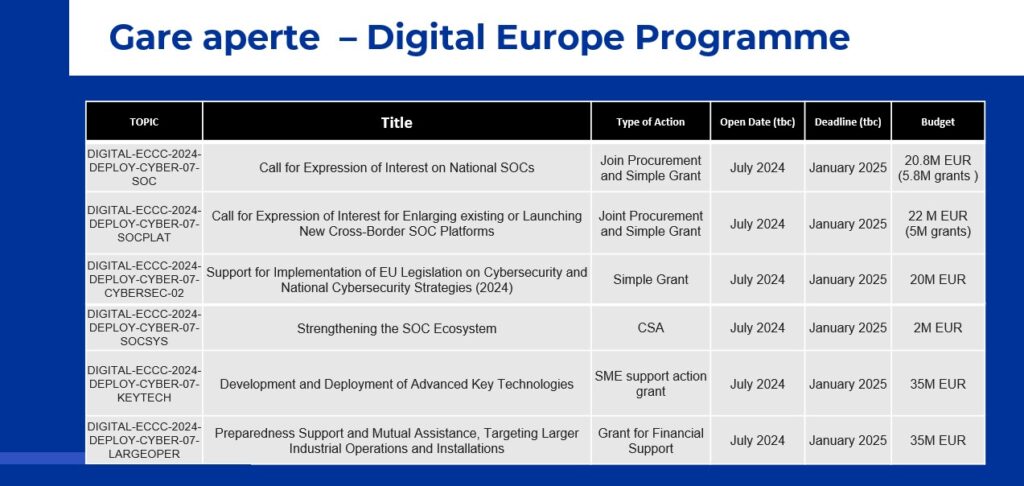
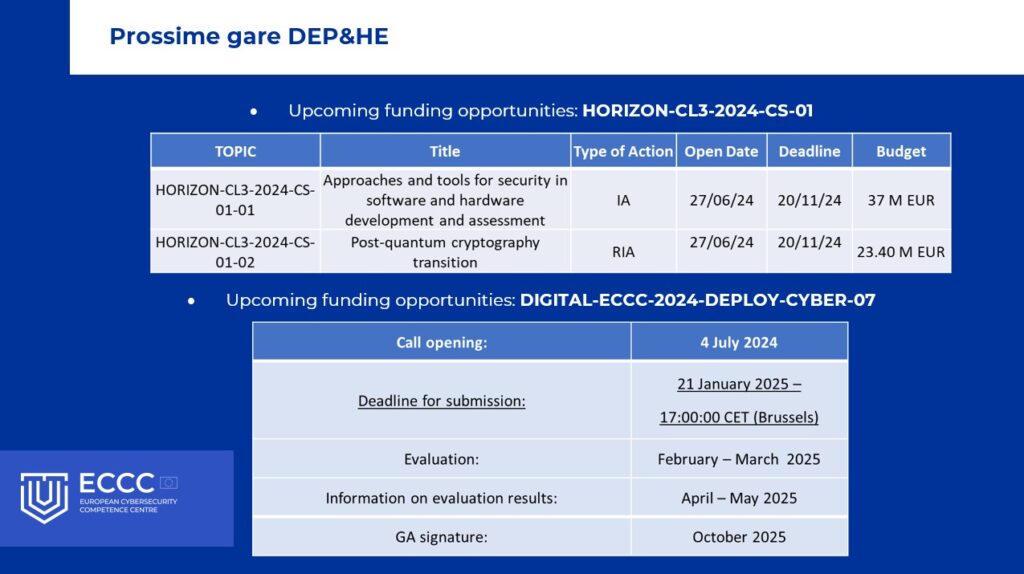
Attualmente sono aperti diversi bandi che scadranno a gennaio 2025: uno dei più importanti destina 20 milioni di euro alla creazione di SOC (Security Operations Center) e allo sviluppo di tecnologie da utilizzare negli stessi.
L’implementazione del Cyber Solidarity Act prevede la creazione di hub di coordinamento transnazionali per l’identificazione di attacchi cyber e la condivisione di informazioni in caso di attacco”. L’Italia insieme ad altri paesi europei parteciperà al primo di questi hub, al momento in fase di preparazione.
L’obiettivo è creare una rete di hub interconnessi, con un sistema di alert condiviso tra SOC nazionali ed europei, per facilitare lo scambio di informazioni in caso di attacchi informatici su larga scala: una parte significativa degli investimenti sarà, pertanto, destinata alla creazione dei centri di coordinamento nazionali e transnazionali.
Tra le priorità dell’UE per l’ecosistema cyber spiccano poi l’adozione di nuove tecnologie (come l’intelligenza artificiale, la crittografia post-quantistica o le tecnologie duali) nonché il miglioramento dell’economia e della resilienza informatica dell’Unione, con particolare attenzione al sistema sanitario e alle PMI.
Infine, come European Cybersecurity Competence Center stiamo lavorando per costruire una comunità allargata che includa – oltre ai 27 Centri di Coordinamento nazionali – tutti i vari stakeholder del settore.
Abbiamo sviluppato una piattaforma che raccoglierà tutte le entità che hanno un ruolo di responsabilità nei loro ecosistemi nazionali e che permetterà sia di raccogliere feedback, sia di promuovere opportunità di finanziamento e collaborazione. Una ventina di queste entità verranno poi selezionate per costituire un gruppo di consulenza che aiuterà il Board e l’Agenzia a stabilire le strategie future.
Il sostegno dei Paesi membri sarà essenziale nel rendere note le opportunità esistenti, creando forme di collaborazione transnazionale necessarie ad affrontare le sfide tecnologiche dei prossimi anni: il lavoro sulla comunità è fondamentale per costruire ecosistemi dove la sicurezza sia un valore condiviso.
Profilo Autore
Luca has more than 20 years of experience working with European Institutions and International Organisations, specialising in the domains of digital transformation, cybersecurity, and research and development.
Before joining the ECCC as Executive Director in 2024, he held the roles of Deputy Executive Director and Interim Executive Director of eu-LISA, the European Union Agency for the management of large-scale IT systems. Prior to that he served as head of the Global Technical Centre of the Central Bank Counterfeit Deterrence Group at the European Central Bank.
Luca’s academic achievements include an Engineering Degree from the Polytechnic University of Milan, a Master’s Degree from the School of Management of the Polytechnic of Milan (MIP), and an MBA from Oxford Brookes University. He has completed the Advanced Leadership and Management Programme (OALMP) at Saïd Business School, Oxford University, as well as the Program on Negotiation (PON) at Harvard University.
Mid-market organizations say AI can replace workers, expert disagrees
A recent report from Avanade shows five out of six mid-market decision makers believe AI can replace human workers. The report reveals that many mid-market organizations see AI as an investment with a fourfold return within just 12 months.
With only one-third of respondents feeling very confident their leaders could distinguish between AI-generated work and human work, 78% of respondents express concern that AI may overshadow human contributions. This devaluation of human input could potentially lower morale among workers and create a rift between employees and leaders.
Florin Rotar, Chief AI Officer at Avanade, offers another perspective to mid-market organizations.
“AI presents incredible opportunities for organizations but it’s more than a tech upgrade; it’s a transformative shift in workplace dynamics and raises vital questions about the future of work and the role of the workforce,” states Rotar. “Our data shows that the mid-market must confront these questions directly or risk alienating the very employees who drive their success. AI should enhance, not replace, human potential — employees should be seen as collaborators with AI, not mere tool users. Integrating AI thoughtfully, with people at the center, will be crucial for sustainable business value and will set the standard for success in the AI era.”
Key findings from the report include:
Only 40% of respondents express confidence in their leaders’ abilities to address the social impacts of AI.
84% view AI as a cost-saving tool.
85% are concerned about whether or not employees are sufficiently informed and involved with AI-driven decisions.
SmokeLoader attack targets organizations in Taiwan
Fortinet’s FortiGuard Labs released research detailing an observed attack deploying the SmokeLoader malware to target organizations in Tawian, particularly in sectors like manufacturing, healthcare and information technology. Casey Ellis, Founder and Advisor at Bugcrowd, remarks, “Given the geo-political environment, Taiwan is no stranger to thinking about Advanced Persistent Threats (APTs). The use of SmokeLoader does seem to follow suit with the general trend of pre-positioning that we have seen in other parts of the world.”
SmokeLoader is an adaptable, modular malware that can be utilized for a variety of needs. While SmokeLoader is typically used as a downloader to deliver malware, the research shows that in this case, it is used to download plugins from its C2 server to carry out the attack itself. Microsoft Windows platforms are primarily affected by this attack campaign, in which information can be stolen and leveraged in a later attack.
John Bambenek, President at Bambenek Consulting, comments, “This particular campaign uses exploits in native Office from 2017 (as opposed to Office 365) and is a reminder that even though tools may be end-or-life’d by the software manufacturer, they may still remain in use and be exploited by attackers. Not everywhere in the world is it possible to have a three year technology refresh cycle. For organizations that have to use dated software, it becomes more important to have strong endpoint detection tools that can detect malware like SmokeLoader, or detects the exploitation behavior that leads the malware to be delivered in the first place.”
Callie Guenther, Senior Manager, Cyber Threat Research at Critical Start, adds, “The SmokeLoader campaign targeting Taiwanese industries reflects a strategic focus on sectors critical to national infrastructure and economic stability. The use of modular malware like SmokeLoader, coupled with phishing vectors and exploitation of legacy Office vulnerabilities, highlights a calculated attempt to infiltrate supply chains and exfiltrate sensitive data for long-term strategic gains, potentially enabling follow-on attacks. This campaign underscores a trend of leveraging versatile malware for reconnaissance and persistence in high-value environments.”
Guenther offers the following recommendations for security teams:
“Threat hunting: Actively search for IOCs related to SmokeLoader in network logs and endpoints, focusing on unusual C2 communications and known hash values.
“Supply chain risk assessment: Ensure supply chain partners and vendors are adhering to robust cybersecurity practices to mitigate risks of lateral compromise.
“Incident readiness: Enhance response playbooks for modular malware incidents, including containment, forensic analysis, and communication protocols with impacted stakeholders.”
Guida Completa al Registro delle Attività di Trattamento: Elementi Minimi per Titolari e Responsabili
Il contenuto che segue fa parte di una serie di articoli dedicati al Registro dei trattamenti. In questo focus, approfondiamo gli elementi minimi richiesti nel Registro delle Attività di Trattamento, evidenziando le informazioni essenziali che ogni Titolare e Responsabile del trattamento devono includere.
Informazioni presenti nel Registro delle Attività di Trattamento
Ogni Titolare del trattamento e, ove applicabile, il suo rappresentante tengono un registro delle attività di trattamento svolte sotto la propria responsabilità. Tale registro contiene tutte le seguenti informazioni:
Il nome e i dati di contatto del titolare del trattamento e, ove applicabile, del contitolare del trattamento, del rappresentante del titolare del trattamento e del responsabile della protezione dei dati.
Le finalità del trattamento.
Una descrizione delle categorie di interessati e delle categorie di dati personali.
Le categorie di destinatari a cui i dati personali sono stati o saranno comunicati, compresi i destinatari di paesi terzi od organizzazioni internazionali.
Ove applicabile, i trasferimenti di dati personali verso un paese terzo o un’organizzazione internazionale, compresa l’identificazione del paese terzo o dell’organizzazione internazionale e, per i trasferimenti di cui al secondo comma dell’articolo 49, la documentazione delle garanzie adeguate.
Ove possibile, i termini ultimi previsti per la cancellazione delle diverse categorie di dati.
Ove possibile, una descrizione generale delle misure di sicurezza tecniche e organizzative di cui all’articolo 32, paragrafo 1.
Il contenuto del Registro rappresenta una sintesi delle attività di trattamento attivate dal Titolare o dal Responsabile anche mediante i loro rappresentanti e, quindi, da qui la necessità di predisporre una più specifica policy privacy interna da cui estrarre le informazioni utili sia per la compilazione del Registro che dell’informativa ex artt. 13 e 14 del GDPR.
Il Ruolo dei Soggetti Autorizzati al Trattamento
In tale contesto è, quindi, utile richiamare sin da ora l’attenzione circa l’importanza che rivestono i soggetti autorizzati al trattamento. Essi rappresentano coloro che, durante l’esecuzione di un trattamento dei dati, per primi conoscono la qualità del dato trattato (comune, particolare e giudiziario unitamente alle loro sottocategorie) oltre ad ogni informazione utile così da poter supportare il Titolare nel costante aggiornamento della policy privacy interna e di conseguenza del Registro.
Ai fini della compilazione del Registro dei trattamenti ed a titolo esemplificativo corre precisare che l’operazione di anonimizzazione oltre che misura di sicurezza è essa stessa un trattamento e come tale deve essere censita nel Registro dei trattamenti nonché indicato tra le informazioni presenti nell’informativa resa all’interessato.
Elementi Minimi del Registro del Responsabile
Prima di illustrare gli elementi minimi del Registro del Responsabile è utile evidenziare come tra gli obblighi del titolare all’atto della nomina di un responsabile del trattamento ex art. 28 del GDPR riscontriamo la verifica dei requisiti di cui al par. 1 dello stesso, e più in particolare essi rilevano, ai fini del principio di accountability, e anche in questo caso, per quanto attiene l’obbligo di collaborazione con l’Autorità.
Il Titolare, quindi, sarà tenuto a verificare sia la corretta applicazione del GDPR da parte del Responsabile che la corretta tenuta del Registro, anche al fine di non incorrere nelle sanzioni previste dal GDPR per la mancata o incompleta tenuta del Registro stesso.
Ciò premesso, ogni responsabile del trattamento e, ove applicabile, il suo rappresentante tengono un registro di tutte le categorie di attività relative al trattamento svolte per conto di un titolare del trattamento, contenente:
Il nome e i dati di contatto del responsabile o dei responsabili del trattamento, di ogni titolare del trattamento per conto del quale agisce il responsabile del trattamento, del rappresentante del titolare del trattamento o del responsabile del trattamento e, ove applicabile, del responsabile della protezione dei dati.
Le categorie dei trattamenti effettuati per conto di ogni titolare del trattamento.
Ove applicabile, i trasferimenti di dati personali verso un paese terzo o un’organizzazione internazionale, compresa l’identificazione del paese terzo o dell’organizzazione internazionale e, per i trasferimenti di cui al secondo comma dell’articolo 49, la documentazione delle garanzie adeguate.
Ove possibile, una descrizione generale delle misure di sicurezza tecniche e organizzative di cui all’articolo 32, paragrafo 1.
Importanza della Documentazione nel GDPR
La figura del responsabile del trattamento è contenuta nell’art. 28 GDPR che al paragrafo 1 enunciati i presupposti e le garanzie che il titolare deve verificare mentre al paragrafo 2 enunciata la procedura di nomina.
Qualora un trattamento debba essere effettuato per conto del titolare del trattamento, quest’ultimo ricorre unicamente a responsabili del trattamento che presentino garanzie sufficienti per mettere in atto misure tecniche e organizzative adeguate in modo tale che il trattamento soddisfi i requisiti del presente regolamento e garantisca la tutela dei diritti dell’interessato.
Il responsabile del trattamento non ricorre a un altro responsabile senza previa autorizzazione scritta, specifica o generale, del titolare del trattamento. Nel caso di autorizzazione scritta generale, il responsabile del trattamento informa il titolare del trattamento di eventuali modifiche previste riguardanti l’aggiunta o la sostituzione di altri responsabili del trattamento, dando così al titolare del trattamento l’opportunità di opporsi a tali modifiche.
In un rapporto tra un titolare e un responsabile, il titolare è sempre tenuto a comprovare l’adozione delle misure adeguate al caso di specie. In particolare, la mera nomina di un responsabile non è sufficiente a tenerlo indenne da eventuali responsabilità derivanti da violazioni del GDPR. Il titolare è dunque tenuto anche ad adottare tutte le misure adeguate necessarie e ivi inclusa la scelta del responsabile al fine di soddisfare i requisiti del GDPR e garantire la tutela dei diritti dell’interessato così da non incorrere nella culpa in eligendo e nella culpa in vigilando.
L’articolo si è focalizzato sull’analisi degli elementi minimi del Registro delle Attività di Trattamento, sottolineando l’importanza della documentazione e della corretta tenuta dei registri per garantire la conformità al GDPR. Nel prossimo articolo, affronteremo la compilazione del registro del Titolare e del Responsabile, fornendo linee guida utili per una corretta applicazione del regolamento. Invitiamo i lettori a scaricare il white paper dal titolo “La compilazione del Registro dei trattamenti nel nuovo quadro normativo del Reg. UE 679/2016“ per approfondire ulteriormente questi temi.
Profilo Autore
Tecnologo presso l’UAIG del CNR. Abilitato all’esercizio della professione forense.


 @import url(‘https://fonts.googleapis.com/css2?family=Nunito+Sans:ital,opsz,wght@0,6..12,400;0,6..12,500;0,6..12,600;0,6..12,700;1,6..12,400;1,6..12,500;1,6..12,600;1,6..12,700&family=Nunito:ital,wght@0,400;0,500;0,600;0,700;1,400;1,500;1,600;1,700&display=swap’); @import url(‘https://fonts.googleapis.com/css2?family=Architects+Daughter&family=Roboto:ital,wght@0,100;0,300;0,400;0,500;0,700;0,900;1,100;1,300;1,400;1,500;1,700;1,900&display=swap’); h3 { font-weight: bold; font-size: 18px; color: #C72026; } figure { padding: 4px; margin: auto; } figcaption { background-color: #f8f8f8; color: #404144; Nunito Sans’, Arial, sans-serif; font-size: 16px; padding: 2px; text-align: center; } .sidebarFullWidth { position: relative; left: -60px; margin-right: -120px; color: #000; padding: 20px 40px; width: auto; box-shadow: none; Nunito Sans”, “Open Sans”, sans-serif; background-color: #fff;