Microsoft individua un aumento di campagne BEC che sfruttano servizi cloud


Negli ultimi anni il numero di campagne di business email compromise (BEC) è cresciuto notevolmente, anche grazie a un aumento dell’abuso di servizi cloud ampiamente usati come Dropbox, SharePoint e OneDrive.

A lanciare l’allarme è Microsoft: in un recente post sul suo blog, la compagnia ha evidenziato che la diffusione di questi servizi collaborativi e di file sharing nelle organizzazioni rende gli utenti aziendali un obiettivo molto interessante per gli attaccanti. Abusando della fiducia che gli utenti ripongono in questi servizi e della facilità di utilizzo, i cybercriminali riescono a condividere file e link malevoli, eludendo i tradizionali controlli di sicurezza.

BEC cloud

Microsoft spiega che l’abuso di questi servizi cloud per condurre campagne BEC è diventato un trend soprattutto per la relativa facilità di svolgimento degli attacchi. Da metà aprile 2024, la compagnia ha individuato in particolare due tattiche più usate dagli attaccanti per superare i meccanismi di difesa: una consiste nel condividere via e-mail file con restrizioni di accesso che possono essere aperti solo dal destinatario specificato; questo implica che l’utente debba essere loggato al servizio o eventualmente autenticarsi di nuovo inserendo email e OTP.

La seconda tattica sfrutta i file con permessi di sola lettura per eludere i sistemi di detonation nelle e-mail: i file condivisi dagli attaccanti sono impostati in modalità “Sola lettura” per impedirne il download e di conseguenza l’individuazione di URL malevoli nel file.

Solitamente gli attaccanti ottengono l’accesso iniziale compromettendo l’utente di un vendor dell’azienda e inviando dei file all’organizzazione target da questo account. “Questo abuso di servizi di file hosting legittimi è particolarmente efficace perché i destinatari sono più propensi a fidarsi delle e-mail provenienti da fornitori noti, consentendo agli attaccanti di aggirare le misure di sicurezza e compromettere le identità” spiegano i ricercatori di Microsoft.

I file condivisi, per essere più credibili, di solito fanno riferimento ad argomenti già oggetto di discussione tra le due aziende o a temi legati al business, e in generale si basano su un senso di urgenza per portare gli utenti ad aprire immediatamente i documenti ricevuti.

Quando la vittima accede al file condiviso, gli viene chiesto di verificare la sua identità inserendo l’email e l’OTP. L’utente apre quindi il documento dove è presente una finta preview di un messaggio e un pulsante per visualizzarlo interamente. Il link rimanda la vittima a una pagina di phishing controllata dall’attaccante; qui gli viene richiesto di inserire la sua password e completare l’autenticazione multifattore. Il token, ora in possesso degli attaccanti, può essere usato per prendere il controllo dell’account utente e proseguire con la campagna.

Difendersi dagli attacchi BEC che abusano del cloud

Per proteggersi da questi attacchi sempre più frequenti, Microsoft consiglia innanzitutto di rendere obbligatoria l’autenticazione multifattore per tutti gli utenti aziendali e, se possibile, eliminare le password.

Nel caso si utilizzi Microsoft Entra, è utile abilitare le policy di accesso condizionale e implementare la continuous access evaluation per verificare continuamente la sicurezza degli accessi. È inoltre fondamentale adottare soluzioni di sicurezza in grado di identificare e bloccare siti potenzialmente malevoli e di scartare le email sospette o anomale prima che raggiungano le vittime.

Condividi l’articolo


Articoli correlati

Altro in questa categoria


https://www.securityinfo.it/2024/10/10/microsoft-individua-un-aumento-di-campagne-bec-che-sfruttano-servizi-cloud/?utm_source=rss&utm_medium=rss&utm_campaign=microsoft-individua-un-aumento-di-campagne-bec-che-sfruttano-servizi-cloud



Researchers discover 14 new DrayTek vulnerabilities

14 additional vulnerabilities in DrayTek routers were discovered in a recent Forescout Technologies report. If left unaddressed, attackers could gain full control over these devices, opening the door to ransomware, denials of service and other attacks. With routers being increasingly targeted, this research spotlights the need for immediate action including patching and disabling unnecessary remote access to protect network devices against rising cyber threats.

DrayTek routers are widely used across many industries and this broad usage has made them prime targets for cybercriminals. In addition to this research, DrayTek routers were flagged in a recent FBI action and CISA added DrayTek vulnerabilities to the Known Exploited Vulnerabilities (KEV) list.

  • 14 vulnerabilities identified across DrayTek routers: The highest severity finding received a CVSS score of 10; another scored a 9.1. These high-risk vulnerabilities can allow attackers to conduct remote code execution and OS command injection attacks. Further technical details are included in the full report.
  • Global widespread exposure: Over 704,000 DrayTek routers are currently exposed to the internet. More than 425,000 are in the UK and EU, and over 190,000 are in Asia, a complete regional breakdown of exposure is detailed in the report. The majority of the routers are intended for business use — with 75% used commercially. Nearly 40% of DrayTek routers are still vulnerable to similar issues identified two years ago and added to the CISA KEV catalog.
  • End-of-Life devices at risk: The vulnerabilities found impact 24 DrayTek router models, 11 of which are end-of-life (EoL). Over two-thirds (63%) of the exposed devices are either End-of-sale (EoS) or EoL, making them more difficult to patch and protect.

DrayTek vulnerabilities create many potential router attack paths, especially for those with the web management interface exposed to the internet. Attackers can deploy a persistent rootkit to intercept and analyze network traffic, stealing sensitive data such as credentials or confidential information. Once inside, they could move laterally across the network, compromising other devices and potentially leading to ransomware, denial-of-service (DoS) attacks, or the creation of botnets for distributed attacks. High-performance routers, such as the Vigor3910, could even be repurposed as command-and-control (C2) servers, enabling attackers to launch further attacks on other victims.

As part of the responsible disclosure process, DrayTek has patched all the firmware vulnerabilities Vedere Labs uncovered. However, organizations still need to take mitigation steps to protect these products on their networks.

Read the report

https://www.securitymagazine.com/articles/101089-researchers-discover-14-new-draytek-vulnerabilities


62% of observed finance domains involved in phishing attacks

Research from BforeAI reveals recent trends in phishing and spoofing in the financial industry. Between January and June 2024, 62,074 registered domains with financial keywords were observed. Among observed domains, 38,737 (62%) were determined to be connected to phishing attacks that target legitimate institutions through spoofing websites.

The report suggests that the rise in phishing and spoofing attacks is due to the accessibility and ease of use for phishing kits. Deepfake technology also increases the ease of spoofing for many malicious actors. 

Well-known financial entities were common targets, suggesting that malicious actors tend to target high profile brands. Meanwhile, smaller firms tend to be harder to spoof. This is often because spoofing attacks on smaller firms are easier to spot and address. Moreover, the reach of such an attack would be limited compared to a larger firm. 

The research warns of the following potential ramifications for businesses impacted by a phishing or spoofing incident: 

  • Financial loss
  • Strain on security posture
  • Damage to brand reputation or customer trust 

https://www.securitymagazine.com/articles/101124-62-of-observed-finance-domains-involved-in-phishing-attacks


CYBEROO: Strategie Avanzate di Detection e Remediation per una Protezione Always-On

La consapevolezza dei pericoli in tema di sicurezza informatica continua a essere fondamentale. Oggi, essere consapevoli significa sviluppare una filiera “always on” di identificazione e mitigazione delle minacce.

Tuttavia, costruirla non è semplice: è necessario dotarsi di una serie di tecnologie e servizi da integrare in modo fluido ed efficace con l’esistente ecosistema IT, partendo da una potente detection, per arrivare a una efficiente remediation.

La fase di detection, su cui oggi il mercato della cyber security è particolarmente focalizzato, deve essere un’attività svolta sull’intero perimetro logico aziendale, senza trascurare le minacce più insidiose, in grado di sfuggire ai sistemi di controllo tradizionali. La fase di remediation, spesso sottovalutata nella scelta di servizi di cyber security, deve essere altrettanto completa e agnostica, per mitigare il rischio di compromissione.

È inoltre necessario costruire una concatenazione di attività che coinvolga diversi attori, partendo dai responsabili della cybersecurity, per garantire determinati SLA sui sistemi di ogni utente. Le cosiddette “catene del soccorso” possono essere infatti includere più partner, in un ecosistema in cui ciascuno si assume la responsabilità di una parte dell’infrastruttura del cliente.

Per minimizzare i rischi, dato il numero di partner coinvolti, è fondamentale scegliere solo quelli che presentano alcune caratteristiche essenziali. Per prima cosa, la presenza di un NOC real h24, totalmente autonomo con competenze in cybersecurity e sempre aggiornato sulle tattiche, tecniche e procedure degli attaccanti. In caso contrario, il rischio di una identificazione inefficace delle minacce aumenta. La fase di remediation, infine, richiede una organizzazione puntuale: non attuarla correttamente è un errore che può costare caro.

SCOPRI CYBEROO

Condividi sui Social Network:

https://www.ictsecuritymagazine.com/notizie/cyberoo-strategie-avanzate-di-detection-e-remediation-per-una-protezione-always-on/


Active shooter preparedness: Past, present and future

@import url(‘https://fonts.googleapis.com/css2?family=Nunito+Sans:ital,opsz,wght@0,6..12,400;0,6..12,500;0,6..12,600;0,6..12,700;1,6..12,400;1,6..12,500;1,6..12,600;1,6..12,700&family=Nunito:ital,wght@0,400;0,500;0,600;0,700;1,400;1,500;1,600;1,700&display=swap’);
@import url(‘https://fonts.googleapis.com/css2?family=Architects+Daughter&family=Roboto:ital,wght@0,100;0,300;0,400;0,500;0,700;0,900;1,100;1,300;1,400;1,500;1,700;1,900&display=swap’); h3 { font-weight: bold; font-size: 18px; color: #C72026; } figure { padding: 4px; margin: auto; } figcaption { background-color: #f8f8f8; color: #404144; Nunito Sans’, Arial, sans-serif; font-size: 16px; padding: 2px; text-align: center; } .pqFull { display: block; border-width: 2px 0; border-style: solid; border-color: #404144; padding: 1.5em 0 0.5em; margin: 1.5em 0; position: relative; Architects Daughter’, Arial, sans-serif; font-size: 21px; text-align: center; color:#0067A6;
}
.pqFull:before { content: ‘\201C’; position: absolute; top: 0em; left: 50%; transform: translate(-50%, -50%); background: #fff; width: 3rem; height: 2rem; color: #666; text-align: center;
}
.pqFull:after { content: ; display: block; text-align: center; font-size: 18px; color: #404144;
}

There was a time, not too long ago, the term “active shooter” did not exist in the mainstream. These days, sadly, it is now deeply embedded in our everyday lives. It has taken on many meanings, created industries, and has produced generations of Americans unaware of a world without the risk of targeted gun violence.

How did we get here? The data is undeniable. Over the past few decades, the proliferation of targeted public mass shootings has been staggering. This unabated and uniquely American risk is producing two groups in our society; those who have been directly impacted by a specific event and those who have yet to. And those numbers are only moving in one direction. Even more incomprehensible, is a growing segment of our population impacted by multiple active shooter incidents.

History has shown active shooter attacks, notably occurring in and around buildings and campuses, culminated from an offender successfully overcoming and circumventing security postures. In other words, everything that institution implemented — in both action and integration — failed to prevent and mitigate that specific tragedy. Some recent highly-publicized incidents even included large pre-deployed security and police presence to no avail.

Past preparedness

Mitigating gun violence is very complex. Preventing and preparing for an active shooter attack is no easy task. It never will be. In my experience, it is filled with institutional challenges and factors dictated by subjective “best practices”, individual fears, institutional culture, and optics, to name a few. And frankly, many decisions are based on assumptions, calculated risk, and unintended bias. Moreover, we’ve all been part of conversations where clairvoyance was inserted; “Well, if it happens here, it will happen like this,” that consequently shaped preparedness via hubris omnipotence rather than the reality of the vast risk vectors beyond anyone’s control. When applied to active shooter mitigation, the concept of control — especially for a threat dictated by an offender cohort who has all the practical and tactical advantages over his unsuspecting population — is an illusion.

Like all sectors and industries, institutions and those charged with active shooter readiness vary greatly. While many have a dedicated security professional, there are equally as many institutions that are managed collaterally by staff from human resources, facilities, risk management, legal, compliance, etc. Could this be a contributing factor to how cut and paste policies and preparedness — many of which are just to check-the-box — are standing currently in countless institutions? I know I have seen my share. We all have.

Current correction

With relatively 25-plus years of conscious hindsight, we are still struggling with understanding what active shooter preparedness is and its long-term impact. This is evident in our current course corrections and actions occurring in industry, legislation, and judication. In the past few decades, we may have overshot what effective preparedness is in both theory and application. Remember, the prior generation didn’t hand over a manual or playbook to us. In 2024, we are still the founders, architects and keepers of active shooter preparedness. This is happening on our watch.

Were we short-sighted? Current state legislation to entirely eliminate school active shooter training drills to remediate the decades of trauma-inflicted on students is a clear indication of corrective action. Legislating schools to administer a mandatory “grace period” during a fire alarm activation to validate a genuine evacuation emergency, rather than to be intentionally drawn out of secured rooms, is upon us. Again, history has shown how fire alarm activations complicate our preparedness.

Mitigating gun violence is very complex. Preventing and preparing for an active shooter attack is no easy task. It never will be.

Newly established school safety state agencies, workplace violence prevention state mandates, the weekly roll-out of the newest training acronym, and backed-up docket calendars ready to test post-incident litigation, are all evident of our past and future.

Future in failure?

What do you think of when you hear the term “active shooter”? Many recall a specific tragic event by name or town often summarized in a single word; Columbine, Parkland, Las Vegas, Uvalde. Some think of victim names. Others think of firearms or the 2nd Amendment. I think of catastrophic failure. In other words, how can we understand our limitations and underperformance in all our violence mitigation disciplines — in both technology and human response — and integrate dimensional fore-sight rather than hind-sight.

In my experience, very few institutions, if any at all, prepare for an active shooter attack with this failure lens. It’s unlikely any security professional responsible for this risk landscape would freely admit their respective prevention strategies could fail. Having a realistic understanding of how every preparedness strategy can not only succeed, but also can fail, is a mark of a comprehensive and holistic approach. As much as we think people and things “rise to the occasion” during violent events, we all know they’re always marred with underperformance at every level.

We have made progress. The advances in gunshot detection, training and behavioral threat assessment are on the right track. Moving forward, however, I believe our future lies in the progress we have yet to make. Today there is an incredible amount of focus on prevention, which is laudable; however, history has proven our current preventative strategies, in both the public and private sectors, are still collectively ineffective in curtailing the active shooter threat. This may be the reason why there are so many government agencies, at every level, entering the active shooter space.

I freely admit, I don’t have the answer. What I do know is we all have the distinction of being security professionals operating in The Age of Active Shooter. I’m sure we can all agree this is a distinction none of us wanted. Nevertheless, our everyday collective efforts and grind, regardless of industry or discipline, is required to reach that future sooner than later. The next “(fill in the blank) Strong” locations are depending on it.

https://www.securitymagazine.com/articles/101107-active-shooter-preparedness-past-present-and-future


DDoS attacks surge in H2 2023

A recent Gcore report reveals an increase of 46% in the number of distributed denial of service (DDoS) attacks compared to the same period in 2023.  UDP floods made up 61% of DDoS attacks, while TCP floods and SYN floods constituted 18% and 11% of the total respectively.

The most-attacked business sectors were gaming (49%), technology (15%), financial services (12%) and telecommunications (10%). The e-commerce (7%) and media and entertainment (5%) industries emerged from the ‘Other’ category in H1 2024, indicating that they were being targeted more often than in the past.

Attacks on the gaming industry in H1 2024 continued to dominate and rose by 3% over H2 2023. The report saw DDoS attacks being used by gamers and gaming groups as a tactic against opponents to derive competitive advantage in tournaments and matches. However, the biggest change over the previous two quarters was in the number of attacks on the technology industry, which more than doubled to 15%. The sector has become increasingly attractive for bad actors seeking to disrupt businesses that host critical infrastructure.

In terms of the industries most impacted by network-layer attacks in H1 2024, gaming was first at 47%, technology came in second with 31% of the attacks, and the telecommunications sector was third most-affected wit1 industries affected by application-layer attacks, financial services were highly targeted with 41% of all attacks. E-commerce was the second most-affected sector with 28% of application-layer attacks, with media and entertainment third with 13% of the total application-layer attacks.

The vast majority of attacks lasted under ten minutes, while the maximum attack duration recorded during H1 2024 lasted for 16 hours. The potency of even the shortest attacks, however, was strong, which would often have led users to abandon the services they were trying to access with a significant impact on the brand reputation of the provider.

Read the report

https://www.securitymagazine.com/articles/101109-ddos-attacks-surge-in-h2-2023


Archive.org, a repository storing the entire history of the Internet, has a data breach

Archive.org, possibly one of the only entities to preserve the entire history of the Internet, was recently compromised in a hack that revealed data of roughly 31 million users.

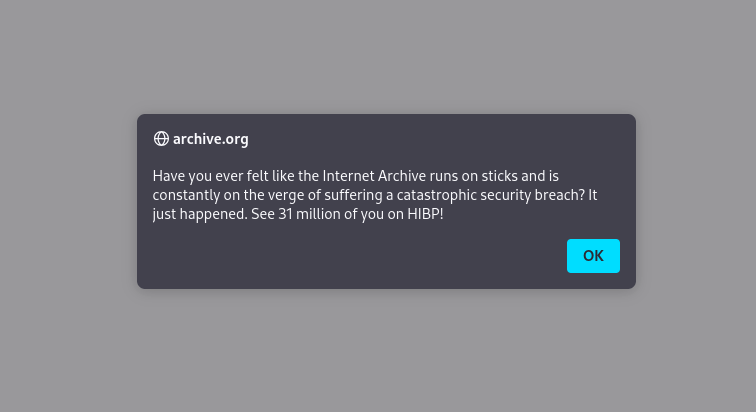
A little after 2 PM California time, social media blew up with screenshots showing what the archive.org homepage displayed.

It read:

archive.org

Have you ever felt like the Internet Archive runs on sticks and is constantly on the verge of suffering a catastrophic security breach? It just happened. See 31 million of you on HIBP!

HIBP is short for Have I been Pwned, the authoritative site for breach notifications that help people protect their accounts after they’ve been compromised.

The message didn’t last long. Soon after it appeared, archive.org, when it loaded at all, displayed a message saying the site was temporarily down. Later, the site returned. Archive.org’s Brewster Kahle said on a social media site that the archive had come under a DDoS attack.

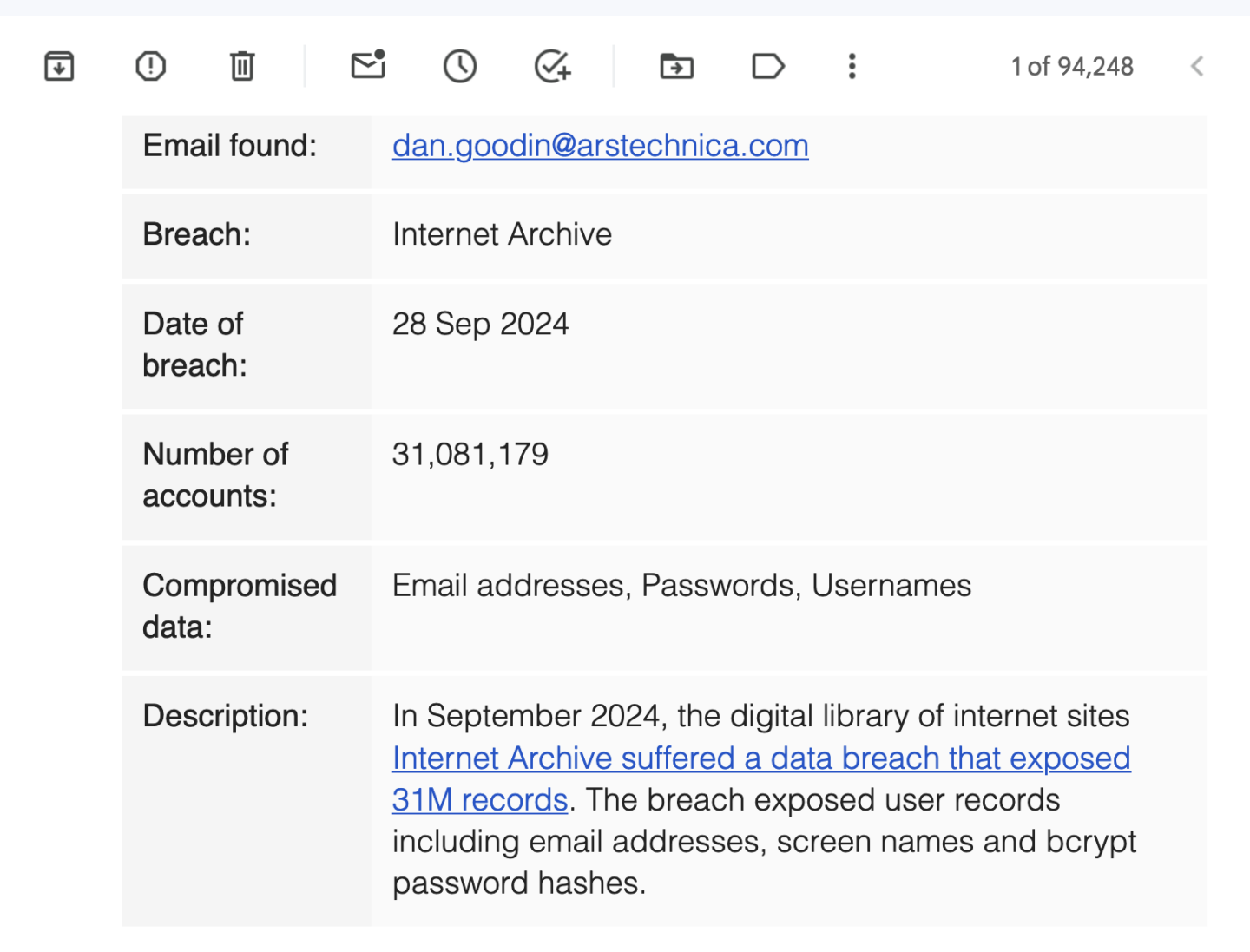
Now, Have I Been Pwnd is reporting that archive.org was hacked. HIBP said the compromise occurred last month and exposed 31 million records containing email addresses, screen names, and bcrypt-hashed passwords.

More soon,

https://arstechnica.com/information-technology/2024/10/archive-org-a-repository-storing-the-entire-history-of-the-internet-has-been-hacked/


Security experts discuss the American Water cyberattack

American Water Works Company, Inc., experienced a cyberattack and was forced to pause customer billing. The organization provides services for more than 14 million individuals across 14 states, including 1,700 communities. While finer details of the attack are not currently available, American Water released a statement that unauthorized activity was discovered on its systems, prompting the shut down. 

Tim Erlin, Security Strategist at Wallarm, discusses what may have caused the incident. “Critical infrastructure isn’t immune from the digital transformation that other organizations are undergoing, including the reliance on APIs and applications,” Erlin states. “We saw a real world proof that cybersecurity can impact water safety with the 2021 incident in Oldsmar, Florida, and just last month a water treatment plant in Kansas implemented manual controls because of a cyber incident. There’s no doubt that we’ll learn more as the incident investigation progresses, but the fact that they’d disconnected online systems could point to an API or web application attack. Just as other industries have adopted APIs, critical infrastructure has moved forward in how they connect to customers and other facilities. Water and wastewater treatment facilities are often underfunded when it comes to cybersecurity, but they face the same threats as other organizations. CISA, the federal agency tasked with securing critical infrastructure, has focused on the water and wastewater treatment sector, but these changes take time and budget. Of course, the attack surface continues to shift with new technologies, new ways of connecting and new threats.”

Securing critical infrastructure is essential not just for maintaining organizational integrity, but for ensuring the safety of those who rely on said infrastructure.

Akhil Mittal, Senior Manager of Cybersecurity Strategy and Solutions at Black Duck, comments, “We often overlook how vulnerable our everyday essentials are to digital threats. We’re not just talking about data breaches — this is about the safety of millions of people who rely on clean water every day. A cyber incident like this could disrupt water services, delay safety checks and potentially risk public health. The focus now should be on quick action: containing the attack, getting the system back online and being transparent with the public. As more essential services go digital, cybersecurity needs to be built into the infrastructure from the start, not bolted on later. Instead of just reacting to these threats, we need to focus on preventing them. Protecting these systems is no longer optional now, it’s critical to keep things running smoothly and safely.”

https://www.securitymagazine.com/articles/101117-security-experts-discuss-the-american-water-cyberattack


Cyberinsurance: misurare il rischio umano può rivoluzionare le polizze


Negli ultimi anni sempre più aziende stanno sottoscrivendo polizze assicurative per proteggersi dalle perdite derivanti dagli attacchi informatici. Le compagnie assicurative, da parte loro, chiedono un certo livello di protezione ai propri clienti, traducibile in soluzioni robuste, monitoraggi continui e piani di risposta agli attacchi ben definiti. In tutto questo c’è però una componente che è difficile da prendere in considerazione e misurare: il rischio umano.

Tony Anscombe di Welivesecurity ricorda che dipendenti e manager rimangono l’anello debole nel mondo della cybersecurity: possono fare errori, agire con superficialità, essere vittime di campagne di social engineering e anche danneggiare l’azienda in maniera deliberata.

rischio umano

Le assicurazioni devono quindi trovare un modo per contemplare il livello di rischio umano durante le loro valutazioni sulla polizza; per Anscombe, si tratta di una sfida del tutto simile a quella del mondo finanziario, dove gli istituti devono calcolare il livello di rischio di ogni cliente per valutare i termini e le condizioni dei prestiti.

Con la diffusione dell’intelligenza artificiale, la possibilità di valutare il rischio umano nella cybersecurity potrebbe diventare realtà. Ogni utente, spiega Anscombe, potrebbe avere un rating di “responsabilità” basato sui suoi modelli di comportamento e sulle sue interazioni online. “Con sufficienti informazioni, una previsione basata sui dati potrebbe dire se una persona cliccherà su un link di phishing, allegherà dati non cifrati a un’email o avrà delle abitudini di ricerca dubbie“.

Usando il rating è più semplice anche per le aziende misurare la propria postura di sicurezza e investire in iniziative per migliorarla, per esempio formando i dipendenti sugli aspetti su cui sono più carenti.

Anscombe evidenzia un aspetto molto importante di questa modalità di valutazione: i rating devono essere protetti adeguatamente e mai resi pubblici in quanto i cyberattaccanti potrebbero usarli per identificare le persone più suscettibili agli attacchi, affinando le proprie campagne. A quel punto la definizione di un rating avrebbe l’effetto contrario a quello desiderato, rendendo l’azienda ancora più vulnerabile.

La possibilità di misurare con più precisione il rischio umano potrebbe portare a una svolta significativa nel mondo della cybersecurity e rendere le aziende più resilienti.

Condividi l’articolo


Articoli correlati

Altro in questa categoria


https://www.securityinfo.it/2024/10/09/cyberinsurance-misurare-il-rischio-umano-puo-rivoluzionare-le-polizze/?utm_source=rss&utm_medium=rss&utm_campaign=cyberinsurance-misurare-il-rischio-umano-puo-rivoluzionare-le-polizze


35% of UK security leaders cite competition as cause of skills shortage

Issues faced by IT leaders in the U.K. were analyzed in a recent Hyve Managed Hosting report. The report found that four out of five U.K. businesses are currently struggling to source the talent they need to address today’s IT challenges. 

According to research, the majority of decision makers surveyed cited the skills gap as one of the biggest challenges to the success of their business, together with ongoing economic uncertainty and keeping pace with competition and technological advances. The latter is what 42% of U.K. business and IT leaders attribute the skills shortage to. Right now, technological evolution is outpacing the current speed of training and development of new talent, which leaves businesses vulnerable and exposed:

  • 31% of respondents feel academic institutions are not keeping up with industry progress, resulting in a shortage of qualified candidates coming out of school or university and into the workforce.
  • 30% claimed a lack of training in schools is not adequately preparing individuals for entry-level roles, calling into question current curriculum.
  • Over a third of the respondents (35%) believe the competition created by larger companies exacerbates the skills shortage, as tech giants draw many skilled professionals from the market.
  • 27% believe the high cost of hiring talent is widening the chasm.
  • When it comes to the most sought-after skills, cybersecurity (43%) and cloud computing (34%) top the list, followed by:
    • Machine learning (ML) and artificial intelligence (AI): 33%.
    • Developers: 26%.
    • Data (e.g. analysis/visualisation): 25%.
  • 52% said they often settle for less qualified professionals due to a lack of suitable candidates.

Read the report

https://www.securitymagazine.com/articles/101088-35-of-uk-security-leaders-cite-competition-as-cause-of-skills-shortage