The bad actor’s best friend: Dormant service accounts


Dormant accounts, also known as inactive accounts, are accounts that haven’t been used or updated in at least 90 days. This extended period of inactivity gives them their “dormant” classification. 

Since these accounts are not being actively used, it’s common for application owners not to know they exist. The lack of knowledge can be attributed to the fact that these accounts aren’t being accessed or updated, meaning they don’t appear in system logs or trigger any security alerts. They go unnoticed and essentially become invisible within the system, slipping under the radar. Inactive accounts are a hotbed of opportunity for attackers, even more so if accounts remain dormant for long periods of time. 

An attacker can leverage the inactivity to their advantage, as the account’s lack of use means that any unauthorized activities are less likely to be noticed immediately. This provides a window of opportunity for nefarious activities to go undetected, making dormant accounts a significant security risk an attacker can easily take advantage of.

Risks involved with dormant accounts

A dormant account’s biggest weakness is the age of its password, and because credential reuse (specifically passwords) is a widespread issue, cybercriminals look for these signs to attack. Password reuse is the number one enabler of breaches. This essential security issue can be found across all companies, from the smallest organizations to multi-billion dollar corporations employing some of the brightest minds in the world. 

Let’s consider the tech giant, Microsoft. In January of 2024, Microsoft detected a significant breach within its internal systems. The perpetrators of this breach zeroed in on a non-production administrator account, which was specifically used for testing. By deploying a password spray attack, they were able to crack the account’s weak password. The absence of multi-factor authentication (MFA) on this account provided an unobstructed path for the attacker to log in. 

Once the attacker had infiltrated the system, they had access to a wealth of sensitive information. Emails and valuable data pertaining to high-ranking Microsoft leadership and their cybersecurity and legal teams were now at the attacker’s disposal. 

One month later, in February of 2024, Tangerine, the Australian telecom company, announced that they had suffered a cyberattack, which resulted in the loss of 232,000 customers’ personal data. This data encompassed a wide range of sensitive information, such as names, email addresses, birth dates and account numbers. 

According to Tangerine, the root cause of this devastating breach was a “legacy customer base” accessed by “login credentials of a single user engaged by Tangerine on a contract basis.”

In both of these massive companies, the underlying cause of the breach was the same: dormant accounts with weak passwords.

What can organizations do? 

The first step in protecting dormant accounts is being able to discover them in the organization’s environment. Leveraging a dynamic identity vulnerability solution that discovers and monitors all accounts and their access chains can help reveal dormant accounts in systems that are being improperly managed or used. 

Once they are revealed, organizations should deactivate or delete accounts that do not serve a current business function. Then, they should take the time to establish a strong password policy.

While preventing users from reusing their passwords can be challenging, accounts can be configured to rotate passwords every 90 days or automatically “lock” if they go unused after a certain period of time. 

To further impede attacks like spraying, stuffing and brute force attacks, it is advisable to implement a password complexity requirement, which makes the password less susceptible to guessing. 

Finally, multi-factor authentication (MFA) should be enabled for every account. This will prevent attackers from accessing the account even if they guess (or know) the password. 

Robust security posture requires robust identity security tools 

Dormant accounts remain a significant risk to organizations of all sizes and are low-hanging fruit for attackers, providing an easy, often overlooked entry point. Couple their nature as prime targets with detrimental practices such as password reuse and the non-implementation of MFA, and these accounts become the epicenter of security risks. 

Fortunately, there are identity vulnerability solutions that help to discover all dormant accounts easily and monitor environments for them. These solutions can track password rotation to ensure all accounts are complying with password policies, protecting an organization from an easily avoidable attack.

https://www.securitymagazine.com/articles/100884-the-bad-actors-best-friend-dormant-service-accounts


97% of CrowdStrike systems are back online; Microsoft suggests Windows changes

A bad update to CrowdStrike's Falcon security software crashed millions of Windows PCs last week.
Enlarge / A bad update to CrowdStrike’s Falcon security software crashed millions of Windows PCs last week.
CrowdStrike

CrowdStrike CEO George Kurtz said Thursday that 97 percent of all Windows systems running its Falcon sensor software were back online, a week after an update-related outage to the corporate security software delayed flights and took down emergency response systems, among many other disruptions. The update, which caused Windows PCs to throw the dreaded Blue Screen of Death and reboot, affected about 8.5 million systems by Microsoft’s count, leaving roughly 250,000 that still need to be brought back online.

Microsoft VP John Cable said in a blog post that the company has “engaged over 5,000 support engineers working 24×7” to help clean up the mess created by CrowdStrike’s update and hinted at Windows changes that could help—if they don’t run afoul of regulators, anyway.

“This incident shows clearly that Windows must prioritize change and innovation in the area of end-to-end resilience,” wrote Cable. “These improvements must go hand in hand with ongoing improvements in security and be in close cooperation with our many partners, who also care deeply about the security of the Windows ecosystem.”

Cable pointed to VBS enclaves and Azure Attestation as examples of products that could keep Windows secure without requiring kernel-level access, as most Windows-based security products (including CrowdStrike’s Falcon sensor) do now. But he stopped short of outlining what specific changes might be made to Windows, saying only that Microsoft would continue to “harden our platform, and do even more to improve the resiliency of the Windows ecosystem, working openly and collaboratively with the broad security community.”

When running in kernel mode rather than user mode, security software has full access to a system’s hardware and software, which makes it more powerful and flexible; this also means that a bad update like CrowdStrike’s can cause a lot more problems.

Recent versions of macOS have deprecated third-party kernel extensions for exactly this reason, one explanation for why Macs weren’t taken down by the CrowdStrike update. But past efforts by Microsoft to lock third-party security companies out of the Windows kernel—most recently in the Windows Vista era—have been met with pushback from European Commission regulators. That level of skepticism is warranted, given Microsoft’s past (and continuing) record of using Windows’ market position to push its own products and services. Any present-day attempt to restrict third-party vendors’ access to the Windows kernel would be likely to draw similar scrutiny.

Microsoft has also had plenty of its own security problems to deal with recently, to the point that it has promised to restructure the company to make security more of a focus.

CrowdStrike’s aftermath

CrowdStrike has made its own promises in the wake of the outage, including more thorough testing of updates and a phased-rollout system that could prevent a bad update file from causing quite as much trouble as the one last week did. The company’s initial incident report pointed to a lapse in its testing procedures as the cause of the problem.

Meanwhile, recovery continues. Some systems could be fixed simply by rebooting, though they had to do it as many as 15 times—this could give systems a chance to grab a new update file before they could crash. For the rest, IT admins were left to either restore them from backups or delete the bad update file manually. Microsoft published a bootable tool that could help automate the process of deleting that file, but it still required laying hands on every single affected Windows install, whether on a virtual machine or a physical system.

And not all of CrowdStrike’s remediation solutions have been well-received. The company sent out $10 UberEats promo codes to cover some of its partners’ “next cup of coffee or late night snack,” which occasioned some eye-rolling on social media sites (the code was also briefly unusable because Uber flagged it as fraudulent, according to a CrowdStrike representative). For context, analytics company Parametrix Insurance estimated the cost of the outage to Fortune 500 companies somewhere in the realm of $5.4 billion.

https://arstechnica.com/?p=2039500


At the Olympics, AI is watching you

Police observe the Eiffel Tower from Trocadero ahead of the Paris 2024 Olympic Games.
Enlarge / Police observe the Eiffel Tower from Trocadero ahead of the Paris 2024 Olympic Games on July 22, 2024.

On the eve of the Olympics opening ceremony, Paris is a city swamped in security. Forty thousand barriers divide the French capital. Packs of police officers wearing stab vests patrol pretty, cobbled streets. The river Seine is out of bounds to anyone who has not already been vetted and issued a personal QR code. Khaki-clad soldiers, present since the 2015 terrorist attacks, linger near a canal-side boulangerie, wearing berets and clutching large guns to their chests.

French interior minister Gérald Darmanin has spent the past week justifying these measures as vigilance—not overkill. France is facing the “biggest security challenge any country has ever had to organize in a time of peace,” he told reporters on Tuesday. In an interview with weekly newspaper Le Journal du Dimanche, he explained that “potentially dangerous individuals” have been caught applying to work or volunteer at the Olympics, including 257 radical Islamists, 181 members of the far left, and 95 from the far right. Yesterday, he told French news broadcaster BFM that a Russian citizen had been arrested on suspicion of plotting “large scale” acts of “destabilization” during the Games.

Parisians are still grumbling about road closures and bike lanes that abruptly end without warning, while human rights groups are denouncing “unacceptable risks to fundamental rights.” For the Games, this is nothing new. Complaints about dystopian security are almost an Olympics tradition. Previous iterations have been characterized as Lockdown London, Fortress Tokyo, and the “arms race” in Rio. This time, it is the least-visible security measures that have emerged as some of the most controversial. Security measures in Paris have been turbocharged by a new type of AI, as the city enables controversial algorithms to crawl CCTV footage of transport stations looking for threats. The system was first tested in Paris back in March at two Depeche Mode concerts.

For critics and supporters alike, algorithmic oversight of CCTV footage offers a glimpse of the security systems of the future, where there is simply too much surveillance footage for human operators to physically watch. “The software is an extension of the police,” says Noémie Levain, a member of the activist group La Quadrature du Net, which opposes AI surveillance. “It’s the eyes of the police multiplied.”

Near the entrance of the Porte de Pantin metro station, surveillance cameras are bolted to the ceiling, encased in an easily overlooked gray metal box. A small sign is pinned to the wall above the bin, informing anyone willing to stop and read that they are part of a “video surveillance analysis experiment.” The company which runs the Paris metro RATP “is likely” to use “automated analysis in real time” of the CCTV images “in which you can appear,” the sign explains to the oblivious passengers rushing past. The experiment, it says, runs until March 2025.

Porte de Pantin is on the edge of the park La Villette, home to the Olympics’ Park of Nations, where fans can eat or drink in pavilions dedicated to 15 different countries. The Metro stop is also one of 46 train and metro stations where the CCTV algorithms will be deployed during the Olympics, according to an announcement by the Prefecture du Paris, a unit of the interior ministry. City representatives did not reply to WIRED’s questions on whether there are plans to use AI surveillance outside the transport network. Under a March 2023 law, algorithms are allowed to search CCTV footage in real-time for eight “events,” including crowd surges, abnormally large groups of people, abandoned objects, weapons, or a person falling to the ground.

“What we’re doing is transforming CCTV cameras into a powerful monitoring tool,” says Matthias Houllier, cofounder of Wintics, one of four French companies that won contracts to have their algorithms deployed at the Olympics. “With thousands of cameras, it’s impossible for police officers [to react to every camera].”

https://arstechnica.com/?p=2039514


Are deepfake fraud risks overhyped? Where enterprises are exposed

Deepfakes are the hot new enterprise risk. British engineering group Arup lost $25 million recently after scammers used AI deepfakes to falsely pose as the group’s CFO and request transfers from an employee to fraudulent bank accounts. 

But will deepfakes become the number one avenue for fraudsters to steal money? Likely not. There are far more common and pervasive cyber fraud attack methods, specifically business email compromise (BEC) schemes. Data shows that 83% of companies faced an increase in cyber fraud attempts from activity such as BEC attacks, hacking and highly sophisticated phishing schemes. In fact, fraudsters use BEC scams (31%) and hacking (31%) more often than deepfakes (11%) to dupe organizations.

Deepfakes are still a threat and it’s important for corporates to take steps to fight these types of attacks. But don’t get caught up in the hype and overlook BEC schemes as a critical point of entry. Actively bolster organizational defenses now. 

Today’s cyber fraud landscape

Cybersecurity and fraud prevention are now inextricably intertwined. The vast majority of cyberattacks are perpetrated to commit financial crimes such as payment fraud. Ninety-six percent of U.S. companies faced a payment fraud attempt in the past year, a 71% increase from the prior year. 

Once a cybercriminal breaches a company’s internal defenses, they go on the prowl to find weak links where they can steal money. The weak link is often human workers — especially those with access to financials and payments. A recent study found that 31% of employees made errors that could impact the security of their workplace. Falling victim to phishing scams and sharing passwords with colleagues were cited as top mistakes. Finance, treasury and procurement teams have become targets of fraudsters because they hold the purse strings. 

As AI advances, cybercriminals are scaling BEC attacks across thousands of companies simultaneously. AI is also making it significantly easier for fraudsters to write convincing phishing emails that are difficult for even the trained eye to spot as fraud. Social engineering-based BEC attacks have risen by 1,760% in the past year, mostly fueled by the advancements in generative AI. 

The main reason why BEC attacks are a far greater threat comes down to a general comfortability in certain channels of communication. Most professional workers would not share payment details or authorize a transaction on a video conference line. Sharing this sensitive information over email is much more common, making BEC attacks the one to watch for. 

Most organizations have robust firewalls, secure operating systems and intrusion detection systems but BEC attacks bypass these preventative measures through social engineering techniques where employees give up sensitive information over email and enable hackers to infiltrate their systems. These types of attacks can be much harder to spot, control and avoid.

For example, a fraudster may use a sophisticated phishing email to extract important information about a company’s payment process and target employees with access to that sensitive information. They will use an aggressive social engineering email scheme to trick that employee in charge of the payment information into wiring a seemingly real business payment to a fraudulent bank account. 

Most leaders believe their investments in cybersecurity measures are enough, but cybersecurity only goes so far if not backed by strong fraud prevention mechanisms. 

Where enterprises are exposed 

There are several main types of BEC scams where enterprises are exposed.

  • Invoice fraud: These appear to be emails from legitimate suppliers with real invoices, but the bank accounts belong to fraudsters. Thirty percent of U.S. companies faced this type of attack in 2023. 
  • CEO/CFO fraud: Emails from the CEO or senior executives’ accounts will request transfers of funds to fraudulent accounts. This type of attack is the third most common type of fraud. 
  • Hacked accounts: An employee’s email account will request invoice payments from suppliers. Payments are diverted to the scammer’s account.
  • Data theft: Employees in HR and accounts departments are targeted for personally identifiable information (PII) or tax information on employees. This can be used to divert payroll funds. 
  • Law firm information requests: Emails seemingly from a company’s law firm will request confidential information.

Sophisticated BEC attacks are varied and challenging to spot, meaning enterprises should prioritize the following defensive measures in the second half of 2024.

Three steps to protect against BEC attacks 

Companies have three clear steps they can take to fight back against BEC attacks. 

1. Implement two lines of defenses

Data breaches have surged to an all-time high, with over 17 billion records compromised in 2023. Despite significant investment in cyber defenses, it’s not working. Fraud prevention investment is lagging, with only 28% of companies reporting they have fraud prevention tech in place. 

Consider implementing fraud prevention software that will stop fraudsters in their tracks by using automation to confirm that each business payment is going to a legitimate bank account that matches the company they are supposed to be paying. Even if a criminal gets access to a vendor’s email account and requests a payment to a fraudulent bank account, technology can flag the illegitimacy of the bank account before the fraudster steals millions. 

2. Ensure payment data is accurate 

Companies often think that the risk of fraud comes from the payment itself. In fact, the risk comes from the payment data. Large companies work with thousands of vendors. Vendor data is not always accurate or up-to-date. It is estimated that 30% of existing vendor data in financial systems is outdated, whether because a vendor decides to work with a new bank, is acquired by another organization, or another reason. Those changes don’t always get captured in organizations’ vendor databases, which exposes them to fraud.

Preventing fraud requires regularly and actively screening and cleaning vendor data, making sure it’s up to date and then validating the account at the time of payment so organizations are confidently paying the right vendor every time.

3. Enable collaboration across internal teams associated with payments 

Finance, treasury and procurement professionals all share responsibility for fraud prevention. Each plays a different role. But today, most of these teams operate in silos, with little to no communication and visibility around payments. And often, each team thinks the other is primarily responsible for the fight against fraud. 

The moments in between process handoffs can easily be exploited by fraudsters using sophisticated BEC attacks. They could request a change to bank account information right after the finance team takes over, without procurement knowing or being able to confirm whether the change is fraudulent. It’s important to create a culture of collaboration with the teams associated with payments — and enable them with technology that can monitor the potential risks and enable teams to address them before fraud happens. 

Looking forward

Deepfakes are the shiny new toy for fraudsters. As deepfakes enter the cybersecurity and fraud prevention conversation, outsized hype has been placed on their risks. It’s important that leaders do not overlook BEC attacks, as they are a critically vulnerable entry point for fraudsters to swipe millions. 

https://www.securitymagazine.com/articles/100882-are-deepfake-fraud-risks-overhyped-where-enterprises-are-exposed


Il 25% dei Wi-Fi pubblici di Parigi non è sicuro


Parigi è al centro dell’attenzione mondiale per le Olimpiadi: la cerimonia d’apertura è attesa per questa sera alle 19:30, dopo la quale i Giochi Olimpici avranno ufficialmente inizio. Il governo francese ha investito notevolmente sul rafforzamento delle misure di sicurezza per atleti e pubblico, ma a quanto pare non abbastanza, almeno dal punto di vista cyber: secondo gli esperti di Kaspersky, il 25% delle reti Wi-Fi pubbliche di Parigi non è sicuro.

Nel dettaglio, le reti hanno una crittografia debole o del tutto assente; ciò espone gli utenti al rischio di furto di dati personali e bancari. Dal report emerge inoltre che solo il 6% delle reti adotta il più recente protocollo di sicurezza WPA3.

Analizzando 47.891  in luoghi molto frequentati e nelle sedi olimpiche, è emerso che quasi una rete su cinque è configurata con WPS, un algoritmo obsoleto facilmente compromettibile.

“Come gli sportivi che si allenano per l’estate all’insegna dello sport in Francia, anche i criminali informatici si sono preparati ad accogliere in modo sgradevole milioni di persone in direzione di hotel, fan zone ed eventi parigini, in cui potrebbero creare punti di accesso falsi o compromettere le reti legittime per intercettare e manipolare i trasferimenti di dati” ha spiegato Amin Hasbini, Head of META Research Group del GReAT (Global Research and Analysis Team) di Kaspersky. “Le reti Wi-Fi pubbliche e mal configurate sono particolarmente attraenti per i criminali, poiché consentono di rubare password, dati delle carte di credito e altri dati sensibili degli utenti“.

La situazione delle reti Wi-Fi di Parigi deve sensibilizzare gli utenti nell’usare in maniera sicura le reti pubbliche. Gli esperti di Kaspersky consigliano di usare una VPN per avere un ulteriore livello di sicurezza, sfruttando la cifrature delle connessioni e il mascheramento dell’indirizzo IP.

Occorre inoltre evitare le transazioni sensibili quando si è collegati al Wi-Fi pubblico, verificare la legittimità della rete, attivare il firewall e disattivare la condivisione dei file. In generale, si ricorda di usare password efficaci e robuste ed eseguire regolarmente gli aggiornamenti dei software in uso.

Condividi l’articolo


Articoli correlati

Altro in questa categoria


https://www.securityinfo.it/2024/07/26/il-25-dei-wi-fi-pubblici-di-parigi-non-e-sicuro/?utm_source=rss&utm_medium=rss&utm_campaign=il-25-dei-wi-fi-pubblici-di-parigi-non-e-sicuro


Starting a job in tech? Read this advice to maximize your experience

It’s that time of the year. New graduates have just begun to enter the workforce, re-fueling a cybersecurity industry that desperately needs talent around the world. Right now, the shortage sits at just under four million unfilled cybersecurity jobs globally, with the gap rising year-over-year, according to the nonprofit ISC2. 

It is imperative that the industry do all it can to retain new graduates who are entering the industry, but there are steps that grads can take to make the transition from school into a Security Operations Center as smooth as possible. Cybersecurity is a fast-paced environment in which the circumstances can change on a dime, or at least as fast as the adversary can execute, innovate and adapt. With constant change, I have found it incredibly beneficial to identify and internalize, a mission-driven approach to work.

Let me explain. As a new graduate, your responsibilities may afford you a bit of extra time, and your scope of work might be narrow until you gather the ‘lay of the land’ at your company. But taking ownership of those limited options by being curious and asking questions, building relationships by engaging with your colleagues, and getting a bit uncomfortable by taking on tasks that you may not be perfectly ready to say ‘yes’ to in your role will fuel your professional growth faster than anything else. 

As a junior employee, taking the initiative to understand how different teams and departments at your organization function alongside each other, offering insight where you can and over-communicating with your colleagues will show that you are ready to grow while immersing yourself in the company. It will help your colleagues and managers build trust in you that they might otherwise reserve for more senior employees and jumpstart your career right out of the gate. Do not underestimate the value of learning the company culture. Get involved in clubs or programs that you are passionate about.   

It is also important to remember that not everyone lands their perfect role in the perfect part of the organization immediately after graduation. Just because you may have accepted or are applying for roles because they are interesting, this does not equate to immediate long-term success. I was always interested in math, for example, but a professor encouraged me to pivot myself to computer science. It was considered a more practical field than mathematics when I realized teaching was not what I was interested in as a career. In my case, the first part of my CS internship did not enthuse me at all before I discovered network and security. Even when I did develop a passion for security, it took several separate roles to figure out what I wanted to specialize in, from compliance, incident management, to security operations center management.

The bottom line is that career trajectories are rarely ever linear, and many people learn more about what they don’t like before finding something they do like. While on this journey myself, I received great advice and mentorship from the people I met along the way: my first internship role, colleagues over the years, at conferences, networking events and meetups; connecting both in-person and online to share stories and best practices in the cybersecurity world through to career advancement. The first few months of a new role are the best time you will ever have to soak up the wisdom of your colleagues, and to take it all in. This is the best time to build relationships, get involved with the company culture, learn to interact with new teammates, find passion in the industry, and meet interesting people who are willing to impart their knowledge with eager, tenacious new graduates. There is only one time in your life that you will be a new grad entering the workforce. Plunge into the experience and enjoy the journey. 

https://www.securitymagazine.com/blogs/14-security-blog/post/100881-starting-a-job-in-tech-read-this-advice-to-maximize-your-experience


Il Ruolo dei Big Data nell’Evoluzione del Commercio Elettronico

I Big Data stanno cambiando le regole del commercio online. Finalmente le aziende possono comprendere davvero i propri clienti, grazie a insight ottenuti dall’analisi di terabyte di informazioni.

In questo articolo mostreremo come i leader di mercato stiano sfruttando appieno il loro potenziale, per vendere di più sì, ma anche per proporre nuove esperienze. Scopriremo come la segmentazione permetta promozioni su misura, capaci di intercettare con precisione i reali bisogni dei consumatori. Non soltanto marketing, anche logistica e supply chain guadagnano in efficienza grazie alle previsioni abilitate dall’AI.

Uno sguardo al presente e al futuro di un settore in evoluzione, guidato dalla rivoluzione data-driven ancora in corso.

La rilevanza dei Big Data nel commercio elettronico

L’adozione dei Big Data nel commercio elettronico ha trasformato il modo in cui le aziende comprendono e interagiscono con i loro clienti. I dati provengono da una varietà di fonti, tra cui transazioni online, interazioni sui social media, recensioni dei clienti e dati di navigazione web. Analizzandoli, le aziende possono identificare tendenze e modelli di comportamento, così da anticipare le esigenze dei consumatori e personalizzare le offerte in modo più accurato.

L’analisi dei Big Data dà modo di segmentare il mercato in maniera molto dettagliata, e identificare di conseguenza gruppi specifici di consumatori con caratteristiche e comportamenti simili. Tale segmentazione rende possibile alle aziende creare campagne di marketing altamente personalizzate. Il risultato? L’aumento dell’efficacia delle strategie di vendita e una migliore esperienza complessiva del cliente.

Come i Big Data migliorano la comprensione dei comportamenti dei consumatori

Uno dei principali vantaggi dei Big Data è la loro capacità di fornire una visione dettagliata e in tempo reale dei comportamenti dei consumatori. Le aziende possono monitorare le attività dei clienti sui loro siti web, analizzare le preferenze di acquisto e identificare i prodotti più popolari. Una conoscenza talmente approfondita da permettere di prevedere le tendenze future e adattare rapidamente le strategie di vendita alle mutevoli esigenze del mercato.

I Big Data danno anche la possibilità di comprendere meglio le dinamiche di acquisto dei consumatori, come ad esempio il processo decisionale che porta all’acquisto di un prodotto. Analizzando i dati sulle interazioni dei clienti con il sito web, si possono identificare i punti di forza e di debolezza del percorso di acquisto e apportare miglioramenti per rendere l’esperienza di acquisto più fluida e intuitiva.

L’Intelligenza Artificiale e la trasformazione dei Big Data in insight

Quando si parla di trasformazione dei Big Data in insight utili per il business, non si può prescindere dal menzionare l’intelligenza artificiale (AI). I servizi di intelligenza artificiale sono infatti in grado di analizzare enormi volumi di dati in modo rapido e preciso, identificando modelli complessi e fornendo raccomandazioni basate su dati concreti. Un simile processo consente alle aziende di prendere decisioni ponderate e sviluppare strategie di vendita più efficaci.

Ad esempio, l’AI può essere utilizzata per identificare i prodotti che potrebbero essere di interesse per specifici segmenti di mercato e ottimizzare le campagne di marketing. Oppure, può aiutare a migliorare la gestione dell’inventario, prevedendo la domanda futura e ottimizzando i livelli di stock per evitare sia eccessi che carenze di prodotti.

Per sfruttare appieno il potenziale dell’AI serve una strategia a prova di futuro. Il processo di adozione inizia con l’esplorazione delle tecnologie disponibili e la loro applicazione specifica nel contesto aziendale, seguito dall’evoluzione dei processi in ottica AI, fino alla misurazione dei risultati e dell’impatto dell’iniziativa. Per realizzare tutto ciò, le organizzazioni devono adottare soluzioni AI per aziende come quelle proposte da NTT DATA, per rimanere competitive e cogliere appieno le opportunità offerte dall’intelligenza artificiale.

Ottimizzazione delle strategie di vendita attraverso i Big Data

L’ottimizzazione delle strategie di vendita è uno degli obiettivi principali dell’utilizzo dei Big Data nel commercio elettronico. Le aziende possono utilizzare i dati per personalizzare le offerte, migliorare la customer experience e incrementare le vendite. Ad esempio, l’analisi dei dati di acquisto può rivelare quali prodotti sono più popolari tra determinati gruppi di consumatori, e sviluppare di conseguenza promozioni mirate.

I Big Data vengono utilizzati anche per migliorare le campagne di marketing, identificare i canali più efficaci per raggiungere i clienti e ottimizzare i messaggi pubblicitari: l’analisi dei dati sulle interazioni dei clienti con le campagne di marketing consente di valutare l’efficacia delle diverse strategie e di apportare modifiche in tempo reale per massimizzare i risultati.

L’uso dei Big Data e dell’intelligenza artificiale nel commercio elettronico può trasformare il modo in cui le aziende operano, viste le nuove opportunità per comprendere meglio i consumatori e ottimizzare le strategie di vendita.

Condividi sui Social Network:

https://www.ictsecuritymagazine.com/notizie/il-ruolo-dei-big-data-nellevoluzione-del-commercio-elettronico/


EvolvedAim: infostealer nascosto nel cheat per Escape From Tarkov


Tanti videogiocatori si affidano ai cheat per avere più possibilità di vincere nei videogiochi, trucchi che gli consentono di ottenere benefici che il titolo normalmente non offre. Utilizzare i cheat non è soltanto scorretto nei confronti degli altri videogiocatori, ma può essere anche pericoloso: è il caso del popolare EvolvedAim, un cheat per Escape From Tarkov che conteneva un infostealer. 

Il videogioco è un noto simulatore militare realistico che conta 14,76 milioni di giocatori e centinaia di cheat in vendita. Tra questi, EvolvedAim ha guadagnato popolarità perché offre numerose funzionalità, come il trading automatico nella casa d’aste del gioco e l’addestramento automatico per sviluppare abilità specifiche.

EvolvedAim

Pixabay

David El, malware researcher di CyberArk Labs, spiega che il malware nei cheat non è raro, ma in questo caso l’impatto potenziale è elevato: Escape From Tarkov è molto popolare tra i giovani adulti (dai 25 anni in su), così come il trucco che prevede un modello in abbonamento, studiato per colpire utenti adulti. Le informazioni sottratte possono essere usate per far leva e ottenere accesso ai dati personali degli utenti.

Più di un anno fa Mythical, il principale sviluppatore di EvolvedAim, ha contattato EDP, proprietario di uno dei più grandi forum di cheat e bot per il videogioco, per proporgli di mettere in vendita il suo strumento, condividendo una parte dei profitti. Nel corso dell’ultimo anno entrambe le parti hanno generato un buon flusso di entrate e il cheat è diventato famoso anche al di fuori del forum, tanto che Mythical ha iniziato a metterlo in vendita sul proprio sito.

È a questo punto che sono iniziati i problemi: Mythical, raggiunta la notorietà col suo cheat, voleva ridurre la quota di profitti di EDP pur continuando a rivendere EvolvedAim sul suo forum; nel frattempo, il proprietario del forum ha iniziato a notare diversi tentativi di accesso ai suoi account e la comparsa di screenshot del suo desktop.

Come agisce EvolvedAim

El spiega che il cheat è scritto in Python 3.10 e viene convertito in eseguibile usando la libreria PyInstaller. Quando si esegue EvolvedAim, viene mostrata una casella di input che richiede di inserire una chiave di licenza. Il danno ormai è fatto: l’infostealer ha già raccolto le informazioni, in quanto il codice malevolo viene eseguito in un thread separato da quello principale del cheat.

Nel dettaglio, il software esegue quattro thread: due sono benigni, usati per l’effettiva funzionalità del cheat, mentre gli altri sono dannosi e vengono eseguiti con nomi non sospetti come discord_to_bot e run_antivm.

I quattro thread vengono eseguiti simultaneamente: run_antivm appare come un  rilevamento anti-virtual machine ma, in realtà, esegue la logica dannosa. Questo thread controlla inizialmente il nome del PC e, se corrisponde a uno dei due nomi inseriti nella black list, non procede con il furto di informazioni. I nomi inseriti nella black list sono quelli dei due sviluppatori del cheat.

A seguire viene eseguita la logica per la raccolta e l’esfiltrazione delle informazioni, le quali comprendono le password e i valori dei cookie dai principali browser, compresi Chrome, Firefox e Opera, ma anche Tor, Torch e Vivaldi. Vengono inoltre raccolti e caricati tutti i file memorizzati dall’estensione del popolare portafoglio di criptovalute MetaMask, oltre ai file sensibili di Discord e Steam, l’elenco di file dalle cartelle Documenti e Download, e viene scattato uno screenshot al desktop.

furto di informazioni

Pixabay

I dati raccolti vengono archiviati temporaneamente in una cartella e compressi in un archivio .zip col nome del PC colpito; l’archivio viene in seguito caricato su Mega.nz. A questo punto, l’infostealer usa un webhook di Discord per notificare l’attaccante sul server.

Il thread discord_to_bot si occupa invece di gestire i comandi inviati dall’attaccante. Il cybercriminale può decidere di interrompere l’esecuzione dell’infostealer, cancellare un file o una cartella dal PC colpito, raccogliere un file o una cartella dalla vittima o eliminare il comando dal database utilizzato per verificare se il client è ancora attivo.

Le conseguenze della scoperta

Dopo aver scoperto la vera identità del cheat, EDP e altri proprietari dei forum hanno avvisato i propri utenti e hanno bandito Mythical dai propri server. CyberArk Labs ipotizza più di un migliaio di utenti colpiti, con una quantità di informazioni sottratte significativa.

“Il malware nei cheat e nei software craccati non è raro, ma questo è il primo caso in cui ci siamo imbattuti in uno sviluppatore di cheat a pagamento che si è arricchito attaccando i suoi stessi clienti” afferma El. Il ricercatore spiega inoltre che il danno non è limitato alla vittima, perché gli utenti possono accedere ai propri account lavorativi dai loro PC personali ed esporre la propria azienda a potenziali pericoli.

EvolvedAim ora non è più attivo e il server Discord è stato chiuso, così come il negozio online.

Condividi l’articolo


Articoli correlati

Altro in questa categoria


https://www.securityinfo.it/2024/07/26/evolvedaim-infostealer-nascosto-nel-cheat-per-escape-from-tarkov/?utm_source=rss&utm_medium=rss&utm_campaign=evolvedaim-infostealer-nascosto-nel-cheat-per-escape-from-tarkov


One year after SEC cyber disclosure ruling, security leaders weigh in

July 26, 2024, marks the one year anniversary since the SEC cyber disclosure ruling. With a year in the rearview mirror, many security professionals are reflecting on whether or not their predictions for this ruling were accurate. Furthermore, they assess the impacts of the cyber disclosure ruling.

Security leaders weigh in 

George Gerchow, Faculty at IANS Research and Head of Trust at MongoDB: 

“We are approaching the anniversary of the SEC’s cybersecurity disclosure rules, and still, not much has changed. While organizations are trying to be more transparent, the lack of significant fines or penalties allows the same bad habits to persist. Many large corporations have experienced major incidents and failed to disclose them within the required four days of determining materiality without facing additional penalties.

“Having personally experienced two cybersecurity incidents last year, I can attest that the new rules are a priority, especially regarding disclosure timing. However, these rules also create problems, such as announcing an ongoing attack before having time to mitigate the issue. This adds complexity and increases malicious activity against an already vulnerable organization.

“So far, the only significant fine imposed has been around $10 million. To address these issues, we need greater accountability and larger sanctions on timing to enable customers to protect themselves, as well as clearer guidance on what constitutes material information. Additionally, we must find ways to better protect companies that are undergoing an incident after disclosure and are under attack.

“Regarding last week’s news of most of the SEC’s charges against SolarWinds being dismissed, let me start by saying this is a good and sensible step forward. I feel like the current ‘disclose while you are still under attack’ puts you in an even more vulnerable position. So, I am glad to see the judge’s response to risk warnings being too detailed.

“I see the overall dismissals as potentially damaging depending on what they are. We need more accountability for the organization instead of focusing on the security leaders of these companies who, in many instances, have their hands tied by execs and the board. We are becoming scapegoats. If this trend continues, you will see an even larger gap in security talent willing to put their credibility on the line, as well as facing charges by the SEC and DOJ.”

Steve Martano, Faculty at IANS Research and Partner at Artico Search: 

“While the dismissal of most of the SEC charges against SolarWinds will be viewed as a win within the CISO community, it is premature to think regulatory pressure and litigation against companies and individuals will desist in the future.

“Each cyber incident and consequent response is unique, and while the SEC may be hesitant to proceed with litigation due to this precedent in the immediate future, it’s become clear in recent months and years that regulators are indeed willing to test the bounds of such litigation. We are far from a clear understanding of what is expected of companies and security leaders in terms of breach response, but U.S. District Judge Paul Engelmayer’s ruling that company risk warnings do not require “maximum specificity” does mitigate the risk for CISOs, if only slightly.

“As we approach the anniversary of the SEC’s cyber disclosure rules, we reflect on both the initial disclosure requirements and the required filing follow-ups codified by the SEC.

“Regulators such as the SEC are continuing to add requirements beyond financial disclosure, and cyber is just one piece of additional information that holistically makes up the health and business risk of any company. Due to these adjusted regulations, companies are reevaluating materiality and documentation around cyber incidents.

“Although many CISOs clamored that the SEC did not do enough in their 2023 ruling, they begrudgingly agree that any move leading to an increase in transparency and disclosure is a positive step. Most of the discontent last summer was around the SEC striking their cyber board member requirement, the optics of which was regulators viewing cyber as an operational challenge to be managed by executives rather than in the boardroom.

“Many companies over the last year developed a cross-functional plan for cyber incidents, redesigning incident response strategies that include an assessment of materiality. This positive development enhances the muscle memory of an organization in the event they need to respond to a security incident while also elevating the security function and security leader. While we are far from an equilibrium on cyber disclosure and regulatory requirements, we are trending in the right direction.”

Scott Kannry, CEO and Co-Founder at Axio: 

“As we approach the 1-year anniversary of the SEC cyber disclosure rules, there is a lot of uncertainty, especially in light of the recent Chevron ruling. This pivotal decision emphasizes the courts’ role in interpreting ambiguous regulations, leaving many to question the future impact on existing frameworks.

“Furthermore, last week’s dismissal of most of the SEC’s charges against SolarWinds is significant. While this decision may ease some immediate pressures on companies, it also underscores the ongoing complexity and unpredictability of the regulatory landscape. Even though the judge ruled that risk warnings don’t need maximum specificity, the risk isn’t entirely removed, although it offers some relief for CISOs.

“For companies and CISOs, this raises critical questions: Do these rules still matter, and how should strategies evolve to align with shifting regulations? While clear answers remain elusive, one thing is certain — the regulatory and litigation landscape will continue to transform. We can anticipate more regulations, increased litigation and potentially conflicting court decisions.

“In this dynamic environment, management teams must gain the insights necessary to make informed and defensible decisions about their cybersecurity programs. Key considerations include:

  • “Ensuring cybersecurity programs align with the organization’s highest risk areas.
  • Assessing the potential financial impact of cybersecurity events.
  • Evaluating how well losses are contained within risk tolerance levels if an event occurs.
  • Identifying the most cost-effective strategies to achieve these goals.

“CISOs, in particular, must build a shield of defensibility. They need to demonstrate that they have exercised appropriate care, were well-informed and used proper business judgment. By doing so, they can better navigate the complex and evolving regulatory landscape, safeguarding their organizations.”

https://www.securitymagazine.com/articles/100879-one-year-after-sec-cyber-disclosure-ruling-security-leaders-weigh-in


Chrome will now prompt some users to send passwords for suspicious files

Chrome will now prompt some users to send passwords for suspicious files

Google is redesigning Chrome malware detections to include password-protected executable files that users can upload for deep scanning, a change the browser maker says will allow it to detect more malicious threats.

Google has long allowed users to switch on the Enhanced Mode of its Safe Browsing, a Chrome feature that warns users when they’re downloading a file that’s believed to be unsafe, either because of suspicious characteristics or because it’s in a list of known malware. With Enhanced Mode turned on, Google will prompt users to upload suspicious files that aren’t allowed or blocked by its detection engine. Under the new changes, Google will prompt these users to provide any password needed to open the file.

Beware of password-protected archives

In a post published Wednesday, Jasika Bawa, Lily Chen, and Daniel Rubery of the Chrome Security team wrote:

Not all deep scans can be conducted automatically. A current trend in cookie theft malware distribution is packaging malicious software in an encrypted archive—a .zip, .7z, or .rar file, protected by a password—which hides file contents from Safe Browsing and other antivirus detection scans. In order to combat this evasion technique, we have introduced two protection mechanisms depending on the mode of Safe Browsing selected by the user in Chrome.

Attackers often make the passwords to encrypted archives available in places like the page from which the file was downloaded, or in the download file name. For Enhanced Protection users, downloads of suspicious encrypted archives will now prompt the user to enter the file’s password and send it along with the file to Safe Browsing so that the file can be opened and a deep scan may be performed. Uploaded files and file passwords are deleted a short time after they’re scanned, and all collected data is only used by Safe Browsing to provide better download protections.

Enter a file password to send an encrypted file for a malware scan
Enlarge / Enter a file password to send an encrypted file for a malware scan

For those who use Standard Protection mode which is the default in Chrome, we still wanted to be able to provide some level of protection. In Standard Protection mode, downloading a suspicious encrypted archive will also trigger a prompt to enter the file’s password, but in this case, both the file and the password stay on the local device and only the metadata of the archive contents are checked with Safe Browsing. As such, in this mode, users are still protected as long as Safe Browsing had previously seen and categorized the malware.

Sending Google an executable casually downloaded from a site advertising a screensaver or media player is likely to generate little if any hesitancy. For more sensitive files such as a password-protected work archive, however, there is likely to be more pushback. Despite the assurances the file and password will be deleted promptly, things sometimes go wrong and aren’t discovered for months or years, if at all. People using Chrome with Enhanced Mode turned on should exercise caution.

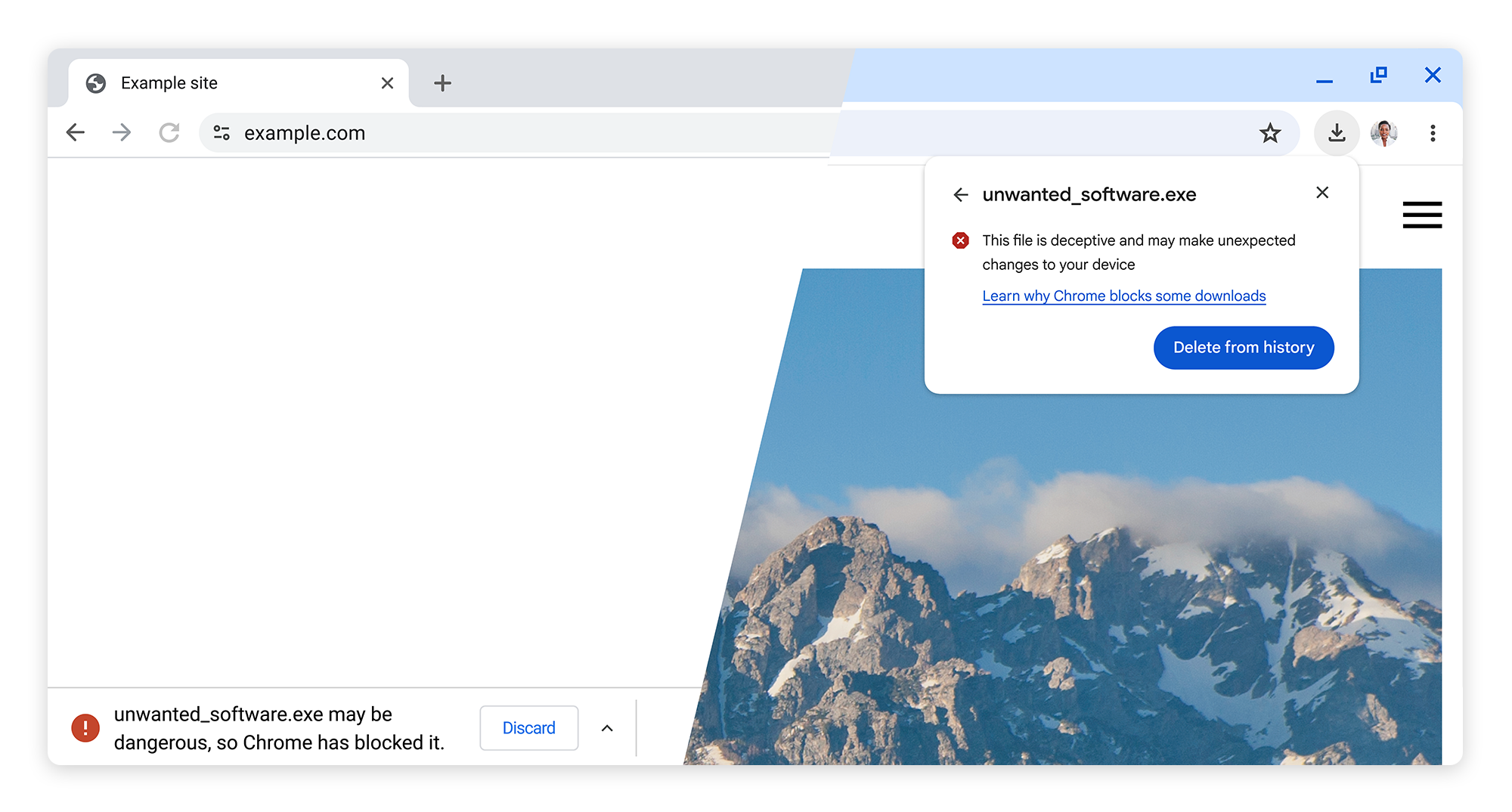
A second change Google is making to Safe Browsing is a two-tiered notification system when users are downloading files. They are:

  1. Suspicious files, meaning those Google’s file-vetting engine have given a lower-confidence verdict, with unknown risk of user harm
  2. Dangerous files, or those with a high confidence verdict that they pose a high risk of user harm

The new tiers are highlighted by iconography, color, and text in an attempt to make it easier for users to easily distinguish between the differing levels of risk. “Overall, these improvements in clarity and consistency have resulted in significant changes in user behavior, including fewer warnings bypassed, warnings heeded more quickly, and all in all, better protection from malicious downloads,” the Google authors wrote.

Previously, Safe Browsing notifications looked like this:

Differentiation between suspicious and dangerous warnings.
Enlarge / Differentiation between suspicious and dangerous warnings.

Over the past year, Chrome hasn’t budged on its continued support of third-party cookies, a decision that allows companies large and small to track users of that browser as they navigate from website to website to website. Google’s alternative to tracking cookies, known as the Privacy Sandbox, has also received low marks from privacy advocates because it tracks user interests based on their browser usage.

That said, Chrome has long been a leader in introducing protections, such as a security sandbox that cordons off risky code so it can’t mingle with sensitive data and operating system functions. Those who stick with Chrome should at a minimum keep Standard Mode Safe Browsing on. Users with the experience required to judiciously choose which files to send to Google should consider turning on Enhanced Mode.

https://arstechnica.com/?p=2039375