95% of organizations adjusted cybersecurity strategies this past year

A report from LogRhythm takes a closer look at the evolving digital landscape, revealing that within the last 12 months, 95% percent of organizations reported altering cybersecurity strategies in place. The research included a global survey, in which 1,176 security leaders and professionals across five continents responded. Key explorations of the report include budget allocation, available resources, preparedness and accountability for breaches, reporting abilities and the effectiveness of security communication. 

Considering there was a notable percentage of organizations adjusting cybersecurity strategies, the report took a closer look at what factors may have been driving those decisions. The report noted three top factors: 

  1. Maintaining pace with the evolving regulatory landscape (98%). 
  2. Meeting customer expectations for data privacy and protection (89%). 
  3. Keeping up with the rise of AI threats and solutions (65%). 

While organizations are adjusting their cybersecurity strategies, there is a gap in efficient communication between security teams and non-security leaders. 44% of non-security leaders do not understand the regulations that the organization must comply with, and 59% have difficulty explaining the importance of specific security systems to non-security stakeholders. 

https://www.securitymagazine.com/articles/100624-95-of-organizations-adjusted-cybersecurity-strategies-this-past-year


Microsoft “rompe” la VPN con l’ultimo update per Windows


L’ultimo aggiornamento di sicurezza per Windows 11 sta creando un po’ di problemi: la versione 23H2 rilasciata ad aprile sta bloccando il corretto funzionamento delle VPN, e non solo.

“I dispositivi Windows potrebbero imbattersi in problemi di connessione della VPN dopo aver installato l’aggiornamento di sicurezza di aprile 2024 o la preview dell’aggiornamento di non-sicurezza” si legge sul blog di Microsoft.

Le piattaforme colpite dal bug comprendono anche le versioni 22H2 e 21H2 di Windows 11 e le versioni 22H2 e 21H2 di Windows 10, oltre a Windows Server 2022, Windows Server 2019, Windows Server 2016, Windows Server 2012 R2, Windows Server 2012, Windows Server 2008 R2 e Windows Server 2008.

La compagnia non ha specificato qual è la causa di questo problema, né quanto ci vorrà per risolverlo.

Pixabay

I problemi dell’aggiornamento non hanno colpito solo la VPN, ma anche BitLocker, alcuni driver Smart Sound Technology di Intel e Copilot. I primi due bug sono stati già gestiti, mentre per l’ultimo il fix è ancora in lavorazione; nel dettaglio, l’update di Edge installa un nuovo pacchetto non richiesto che mostra Microsoft Copilot tra le applicazioni installate.

L’aggiornamento di Edge scarica infatti il pacchetto “Microsoft chat provider for Copilot in Windows” senza il permesso dell’utente, facendo sì che Copilot compaia tra le applicazioni installate sul dispositivo. Il pacchetto, spiega Microsoft, serve a preparare alcuni dispositivi Windows a una compatibilità futura con Copilot, ma non installa né abilita l’effettiva esecuzione della feature. La compagnia sottolinea inoltre che il provider non esegue alcun codice o processo e non raccoglie alcun dato sul dispositivo.

Microsoft ha temporaneamente mitigato il problema con un nuovo aggiornamento di Edge che però non è ancora disponibile per tutti i dispositivi. Si attende un nuovo update definitivo nelle prossime settimane.

La compagnia sta lavorando a dei fix per i due problemi e per il primo al momento non esistono workaround per mitigarlo; l’unica soluzione è disinstallare l’aggiornamento e attendere nuove comunicazioni, consapevoli però che in questo modo anche tutte le nuove funzionalità di sicurezza verranno disinstallate.

Condividi l’articolo


Articoli correlati

Altro in questa categoria


https://www.securityinfo.it/2024/05/02/microsoft-rompe-la-vpn-con-lultimo-update-per-windows/?utm_source=rss&utm_medium=rss&utm_campaign=microsoft-rompe-la-vpn-con-lultimo-update-per-windows


The power of partnerships

h3 { font-weight: bold; font-size: 18px; color: #C72026; } .w3-panel:after,.w3-panel:before{content:””;display:table;clear:both}
.w3-panel{padding:16px;margin-top:16px;margin-bottom:16px}
.w3-leftbar{border-left:6px solid #58526F!important}
.w3-color,.w3-hover-color:hover{color:#58526F!important;background-color:#f1f0f4!important}
.w3-large{font-size:20px!important}
.w3-sans-serif{Nunito Sans’,Arial,sans-serif}
.w3-opacity,.w3-hover-opacity:hover{opacity:0.60}

Throughout the day to day operations of a business or organization, it can be easy for different departments to work independently; however, when it comes to developing an effective security strategy, working cooperatively is indispensable. Whether it is collaborating with other departments or with outside organizations, building and maintaining partnerships is mission critical.

“It’s impossible to do everything yourself,” says Jay Gruber, Associate Vice-President for Public Safety and Chief Public Safety Officer at Georgetown University.

Gruber remembers a bit of advice from a supervisor during his time at the FBI, who said “the command post is no place to exchange business cards.” Gruber expands upon that by saying being able to reach out to someone you have an established relationships with can be a big help for security professionals in times of crisis.

“Already having these established relationships are huge,” Gruber continues. “If you don’t have established partnerships, then in times when there’s not a crisis, you’re not getting the information that you need, and in times of crisis you’re not able to seek support in areas where you don’t have expertise.”

Strong partnerships between security and business operations plays a critical role in mitigating risks and ensuring a secure environment.

“In every business, what we are securing and why we are securing it needs to be a commonly understood theme across the organization,” says Matthew Horace, Chief Security Officer at Pretium & Progress Residential. “This is essential for two key reasons: First, this allows us to ensure the safety of our organizations’ own people, which is always going to be a priority. Secondly, aligning on the ‘why’ of our collective risk mitigation efforts informs our organization’s overall risk mitigation strategy, which is what all of our security decisions ladder up to on a day-to-day basis, and allows for quick decision-making in time-sensitive situations.”

Jay Gruber - Matthew Horace

Curating collaboration

No matter the industry, a responsibility of enterprise security leaders is fostering communication and collaboration between security teams and various units within an organization. This relationship building could be key to a strong and effective security strategy.

Horace says it falls on security leaders to be proactive in setting up the foundations for success.

“This means integrating staff, resources, projects, cadence and tempo at every level, and for every eventuality,” Horace says. “For me, it all starts with one-on-one bidirectional feedback. I meet with people across the business on a regular basis to share ideas, listen, and to learn what is expected from security. At Progress Residential a regular cadence of 1:1’s is germane to our business principals and culture, in my current I have a regular cadence of 1:1’s with stakeholders at all levels to achieve this goal.”

Gruber says leaders should be proactive and don’t wait until somebody reaches out to them.

“You can’t wait until there’s a crisis,” Gruber says. “You need to have already reached out to these people ahead of time — do that handshaking tour, set up appointments. If they’re outside of your organization then invite them to lunch. If they’re inside of your organization, meet for coffee, send an email every once in a while. It’s important that that you take the initiative to keep those relationships fresh, you can’t count on others to do that. It’s more work on your part, but in the end, it pays huge dividends.”

Shared vision

Measuring the effectiveness of partnerships between security and business operations is paramount in achieving shared objectives. Such collaborations are vital for maintaining a robust and resilient organization. Assessing the impact of these partnerships allows a security leader to gauge their organization’s ability to mitigate risks, protect assets and ensure continuity of operations.

“Security can’t succeed if the business fails and vice versa,” says Horace. “That’s why an integration mindset is essential, treating security as an extension of the business. Security leaders must work to gain that level of buy-in from their colleagues and business leaders.

Horace continues saying that practically, consistent, bi-directional, multi-level feedback between security and business operations is essential. At Progress Residential I have a straight line relationship with our Senior Vice President of Operations which I use every day to ensure alignment regarding strategy and tactics.

“What gets measured gets accomplished, and what gets measured gets improved; you must find ways to quantify and keep track of your progress, whether via dashboards, scorecards or surveys,” he adds. “These are effective accountability tools that also provide good feedback as to what is working broadly, and what needs to change.”

Maintaining effective partnerships applies to more than just business organizations. Gruber says universities are extraordinarily collaborative consensus building environments, where relationships really mean a lot.

❝

It’s important that that you take the initiative to keep those relationships fresh, you can’t count on others to do that. It’s more work on your part, but in the end, it pays huge dividends.”
— Jay Gruber, Associate Vice-President for Public Safety
and Chief Public Safety Officer at Georgetown University

“You measure the effectiveness based on what you were able to do to increase security in any way, whether it was cutting branches down to get the camera a better view on things, or getting additional security into a building, or getting a new technology to support existing projects,” Gruber says. “I measure the effectiveness by the relationships that I have, and how that relationship supports both of us. It’s a win-win. So if I find that the relationship is working well, and other person finds the relationship is working well, then we both get to our shared objectives.”

Buy-in from the top down

Having buy-in from the top down in an organization is also a key part of cultivating an effective security strategy.

“Without buy-in, you’re not going to get the money to do what you need to do, security does not make money,” Gruber says.

Gruber says keeping the decision makers regularly appraised of the work the security teams are doing, and not just when buy-in is needed, lays a foundation of respect.

“Then when you do need that buy-in, you’ve already set this really good foundation that you’re a strong leader, you have a good organization, you get things done, and they’ll take you seriously,” Gruber says.

Horace agrees saying security practitioners would always prefer to be strategically proactive rather than reactive in their security strategies.

“Most of us have been in situations where we were told ‘no’ to a strategy that involved upfront costs, only to be called into immediate action as a reaction to a condition,” he says.

Horace says, one strategy he’s utilized to successfully influence up is to gain the buy-in from a diverse group of stakeholders who understand and support the vision and apply gentle consistent and respectful pressure until the needed buy-in is achieved. One person making recommendation is one thing, 10 stakeholders asking for the same thing is much more impactful.

“Security executives understand how important ‘influencing up’ becomes as we move from hire to evaluation to recommendations to asking for funding for our visions. As we foster integration with business operations stakeholders and gain buy-in for our vision and recommendations, the reality is that someone has to pay for that vision and those recommendations.”

Collaborative partnerships between security teams and other units within an organization are the pillars for overall organizational success. By fostering effective communication and working together, these relationships can fortify resilience in an ever-evolving threat landscape.

https://www.securitymagazine.com/articles/100623-the-power-of-partnerships


Hacker free-for-all fights for control of home and office routers everywhere

Rows of 1950s-style robots operate computer workstations.

Cybercriminals and spies working for nation-states are surreptitiously coexisting inside compromised name-brand routers as they use the devices to disguise attacks motivated both by financial gain and strategic espionage, researchers said.

In some cases, the coexistence is peaceful, as financially motivated hackers provide spies with access to already compromised routers in exchange for a fee, researchers from security firm Trend Micro reported Wednesday. In other cases, hackers working in nation-state-backed advanced persistent threat groups take control of devices previously hacked by the cybercrime groups. Sometimes the devices are independently compromised multiple times by different groups. The result is a free-for-all inside routers and, to a lesser extent, VPN devices and virtual private servers provided by hosting companies.

“Cybercriminals and Advanced Persistent Threat (APT) actors share a common interest in proxy anonymization layers and Virtual Private Network (VPN) nodes to hide traces of their presence and make detection of malicious activities more difficult,” Trend Micro researchers Feike Hacquebord and Fernando Merces wrote. “This shared interest results in malicious internet traffic blending financial and espionage motives.”

Pawn Storm, a spammer, and a proxy service

A good example is a network made up primarily of EdgeRouter devices sold by manufacturer Ubiquiti. After the FBI discovered it had been infected by a Kremlin-backed group and used as a botnet to camouflage ongoing attacks targeting governments, militaries, and other organizations worldwide, it commenced an operation in January to temporarily disinfect them.

The Russian hackers gained control after the devices were already infected with Moobot, which is botnet malware used by financially motivated threat actors not affiliated with the Russian government. These threat actors installed Moobot after first exploiting publicly known default administrator credentials that hadn’t been removed from the devices by the people who owned them. The Russian hackers—known by a variety of names including Pawn Storm, APT28, Forest Blizzard, Sofacy, and Sednit—then exploited a vulnerability in the Moobot malware and used it to install custom scripts and malware that turned the botnet into a global cyber espionage platform.

The Trend Micro researchers said that Pawn Storm was using the hijacked botnet to proxy (1) logins that used stolen account credentials and (2) attacks that exploited a critical zero-day vulnerability in Microsoft Exchange that went unfixed until March 2023. The zero-day exploits allowed Pawn Storm to obtain the cryptographic hash of users’ Outlook passwords simply by sending them a specially formatted email. Once in possession of the hash, Pawn Storm performed a so-called NTLMv2 hash relay attack that funneled logins to the user accounts through one of the botnet devices. Microsoft provided a diagram of the attack pictured below:

Trend Micro observed the same botnet being used to send spam with pharmaceutical themes that have the hallmarks of what’s known as the Canadian Pharmacy gang. Yet another group installed malware known as Ngioweb on botnet devices. Ngioweb was first found in 2019 running on routers from DLink, Netgear, and other manufacturers, as well as other devices running Linux on top of x86, ARM, and MIPS hardware. The purpose of Ngioweb is to provide proxies individuals can use to route their online activities through a series of regularly changing IP addresses, particularly those located in the US with reputations for trustworthiness. It’s not clear precisely who uses the Ngioweb-powered service.

The Trend Micro researchers wrote:

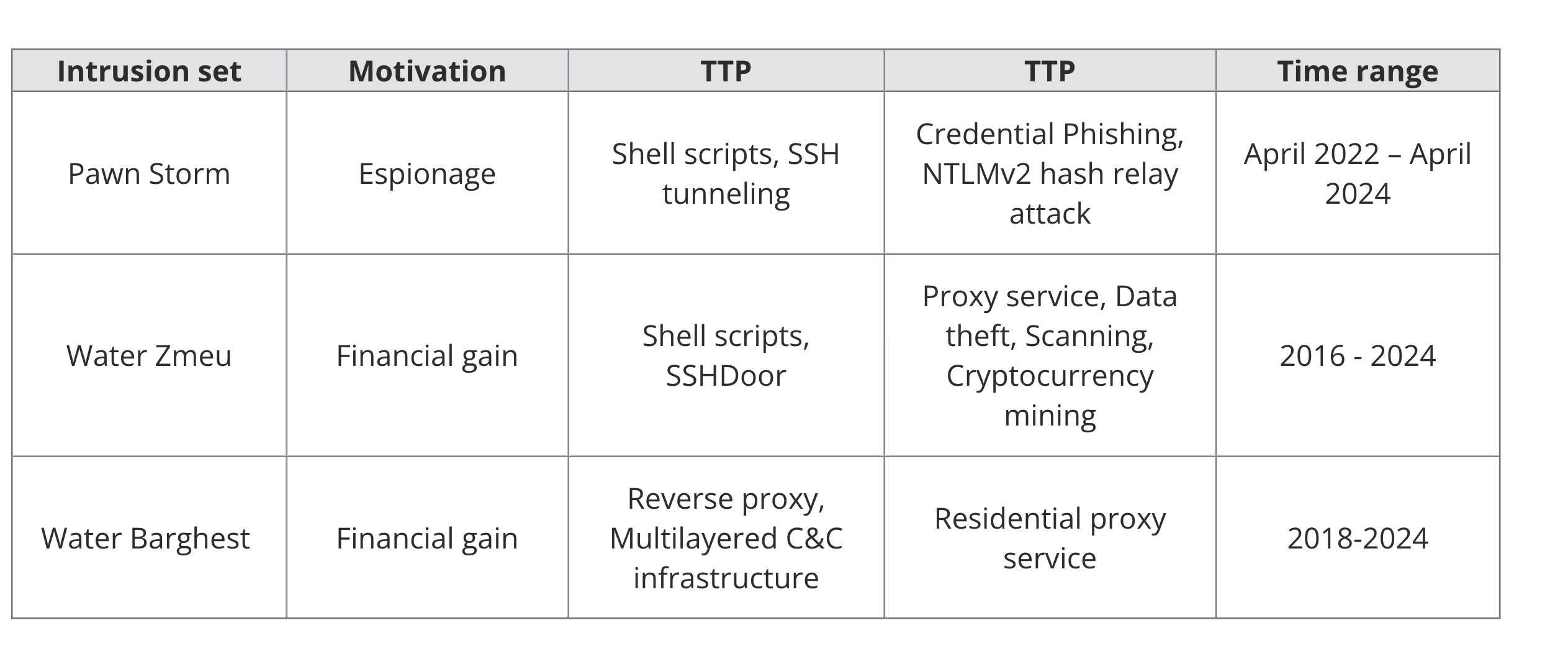
In the specific case of the compromised Ubiquiti EdgeRouters, we observed that a botnet operator has been installing backdoored SSH servers and a suite of scripts on the compromised devices for years without much attention from the security industry, allowing persistent access. Another threat actor installed the Ngioweb malware that runs only in memory to add the bots to a commercially available residential proxy botnet. Pawn Storm most likely easily brute forced the credentials of the backdoored SSH servers and thus gained access to a pool of EdgeRouter devices they could abuse for various purposes.

The researchers provided the following table, summarizing the botnet-sharing arrangement among Pawn Storm and the two other groups, tracked as Water Zmeu and Water Barghest:

Trend Micro

It’s unclear if either of the groups was responsible for installing the previously mentioned Moobot malware that the FBI reported finding on the devices. If not, that would mean routers were independently infected by three financially motivated groups in addition to Pawn Storm, further underscoring the ongoing rush by multiple threat groups to establish secret listening posts inside routers. Trend Micro researchers weren’t available to clarify.

The post went on to report that while the January operation by the FBI put a dent in the infrastructure Pawn Storm depended on, legal constraints prevented the operation from preventing reinfection. What’s more, the botnet also comprised virtual public servers and Raspberry Pi devices that weren’t affected by the FBI action.

“This means that despite the efforts of law enforcement, Pawn Storm still has access to many other compromised assets, including EdgeServers,” the Trend Micro report said. “For example, IP address 32[.]143[.]50[.]222 was used as an SMB reflector around February 8, 2024. The same IP address was used as a proxy in a credential phishing attack on February 6 2024 against various government officials around the world.”

https://arstechnica.com/?p=2021233


Ransomware gang RAGroup activities increased by more than 300%

NCC Group’s Threat Intelligence team has released new data analyzing ransomware group activities. A notable finding from the research is that activity from the ransomware gang RAGroup increased by more than 300% since the group’s last known attacks in December 2023. The rise in activity has ranked the group among the top three threat actors for the first time. 

Security leaders weigh in 

Venky Raju, Field CTO at ColorTokens:

“I can’t speculate on why RAGroup escalated their attacks in the last 12 months; however, one of their primary attack vectors is compromised domain controllers followed by lateral movement. The ability for attackers to freely move around the network is a critical issue, and most businesses have underinvested in protecting against such lateral movement.

“Organizations continue to allocate a majority of their cybersecurity spend on edge solutions like firewalls, EDRs, SIEMs, etc. However, we continue to see breaches rise, with attackers leveraging stolen credentials and software vulnerabilities for the initial access. It is time to recognize that no cyber defense technology can address 100% of all incursions, and a zero-trust approach is needed.  

“Businesses should start with implementing microsegmentation with the goal of making it pervasive within their networks. Microsegmentation can disrupt lateral movement within the network, thereby limiting the reach of attackers once they have gained initial access. Microsegmentation is also effective at disrupting command-and-control connections established from compromised systems back to the attacker’s servers. This is often used by attackers such as RAGroup while executing multi-stage attacks.”

Piyush Pandey, CEO at Pathlock:

“In the recent surge of ransomware attacks targeting technology and financial sectors, it’s possible the group exploited a vulnerability in a system or application widely used across these industries. Given the high value of data managed within these sectors, they are particularly vulnerable and attractive targets for cybercriminals. To defend against such threats, organizations in these sectors must implement robust data security measures. Strong access policies are essential to control who can access sensitive systems and data. Additionally, dynamic data access controls should be enforced, including techniques like data masking and attribute-based access control (ABAC). These measures help ensure that sensitive information is only accessible under strict conditions and is obscured when not in use, thereby reducing the potential impact of a data breach.”

Xen Madden, Cybersecurity Expert at Menlo Security:

“The reported 300% surge in RAGroup’s operations since December 2023 might not fully represent real-time activities. A strategy that is commonly used among threat actors is that they delay publicizing victim data to amass a significant number of targets, a tactic that appears to be gaining popularity among cybercriminals. This strategy not only inflates perceived threat levels but also manipulates the cybersecurity landscape by introducing sudden perceived increases in threat actor capabilities.

“The 67% rise in attacks by the cyber gang Play underscores the importance of user training and a multi-layered defense strategy. These measures are crucial not just for mitigating risks but also for adapting quickly to the evolving tactics of well-established cyber adversaries. As well as more awareness across a range of business sizes, the increased rates mean more SME businesses could be affected, and these could still be in security denial. So, we recommend all businesses create a contingency plan and take appropriate measures to protect themselves.

“With a 41% rise in attacks on technology firms and a 64% increase on financial services, it’s critical to utilize sector-specific threat intelligence to identify and mitigate unique vulnerabilities. While generic security solutions can address common threats, a tailored approach that reflects the unique aspects of each organization’s threat landscape is essential for effective and efficient cybersecurity. It is debatable whether the rise in these sectors is a deliberate choice or a consequence of companies using technologies that are vulnerable to attacks, including those involving social engineering.

“The ransomware landscape has always been a dynamic and interesting world where groups come and go. The emergence of new groups is typical in the cybercriminal ecosystem, where longevity can vary dramatically; this is a routine aspect to monitor rather than a novel threat. However, when a new group emerges and makes a noticeable impact on the community by affecting either a significant number of businesses or a large business, it becomes clear.

“As far as LockBit goes, the community notes that many of LockBit’s recent victim disclosures may include outdated or duplicate data, suggesting possible operational difficulties, which has led to affiliate distrust. And what is a ransomware group without its affiliates?”

Callie Guenther, Senior Manager, Cyber Threat Research at Critical Start:

“Cybercriminal activities can often show seasonal spikes due to various factors including economic cycles, geopolitical events, or targeting specific business cycles. The surge in RAGroup’s activity could be due to normal seasonality, acquisition of more sophisticated attack tools, or financial gains from previous attacks prompting further activity. Lapses in cybersecurity measures during vulnerable periods such as the end of the year when IT staff might be on vacation could have provided initial vectors for increased compromise.

“To combat the escalation in attacks by Play, organizations should implement advanced detection systems focusing on behavioral analytics, conduct regular security training, ensure robust data backup practices and enforce network segmentation. These measures can limit the damage and spread of ransomware attacks.

“In the technology sector, enhancing API security and securing development environments are critical. In financial services, monitoring transaction activities closely and bolstering endpoint security can mitigate risks. Both sectors should focus on educating employees about spear-phishing and other social engineering attacks.

“The continued prominence of LockBit 3.0 and the emergence of new actors like Play and RAGroup underscore the need for dynamic cybersecurity strategies. Organizations must integrate these threats into their risk assessments and improve defenses continually. Increased collaboration and intelligence sharing within the cybersecurity community are essential to address these evolving threats efficiently.”

Darren Guccione, CEO and Co-Founder at Keeper Security:

“Threat actors are increasingly leveraging existing malware with modified Tactics, Techniques and Procedures (TTPs), making it crucial to recognize broader and emerging attack vectors. Organizations should pivot strategy from focusing on identifying specific ransomware variants to mitigating the underlying TTPs employed by attackers. The ever-growing number of connections to network resources — including remote workforce, contractors, service providers, partners and customers — has made potential attack surfaces balloon. Continuous monitoring of network and endpoint activities is essential for real-time detection and response, allowing organizations to contain and mitigate the impact of ransomware incidents promptly.  

“To defend against the rapid escalation in ransomware threats posed by established threat actors like RAGroup and Play, it’s crucial for organizations to implement a zero-trust security model to enhance their cybersecurity posture. When it comes to ransomware, or any other cyber threat vector, the best offense is a good defense. A cybersecurity strategy and prudent investment are essential to prevent these types of cyberattacks, because no organization is immune. A zero-trust security model with least privileged access and strong data back-ups will limit the blast radius if a cyberattack occurs. Strong identity and access management at the front end will help prevent the most common cyberattacks that can lead to a disastrous data breach.”

https://www.securitymagazine.com/articles/100619-ransomware-gang-ragroup-activities-increased-by-more-than-300


Navigate the new European AI Act and possible global standardization

No doubt, the European Union’s (EU) recently approved, comprehensive regulation act on artificial intelligence (AI) is an important milestone in the global effort to establish responsible AI governance. This landmark legislation establishes a robust legal structure, setting stringent standards for AI development and usage within the EU, with the aim of nurturing a climate where businesses and investors can innovate with confidence, knowing their AI systems must adhere to principles of safety, transparency, equity and non-discrimination. Most importantly, it prioritizes the protection of users and respect for human rights, ensuring that technological progress serves the greater good of society.

The essential balance: Regulation and innovation

Governments and lawmakers need to strike a delicate balance to minimize the negative impact over-regulations may have on innovation. The EU AI Act, while comprehensive, presents significant challenges in its implementation due to the diverse complexity of AI systems. Its rigorous demands risk curbing creativity and deterring companies, particularly startups and small and medium-sized enterprises (SMEs), from investing in AI.

In addition, the impact of those new regulatory regimes on business transactions cannot be underestimated. By introducing additional layers of compliance, AI-related regulations like the EU AI Act could inadvertently become a form of “tax” on innovation, potentially slowing down the pace at which companies can bring new and valuable AI-powered solutions to market. Not only will this affect the pace of business value creation, but it could also put companies at a competitive disadvantage on the global stage.

Adapting to the evolving regulatory landscape

In the rapidly changing realm of global technology regulation, businesses are tasked with the dual challenge of fostering innovation while navigating an increasingly intricate regulatory environment. The “regulatory tax” — the burden of compliance with these new regulations — is a reality that is unlikely to diminish. However, organizations can adopt strategic measures to not only cope with these changes but also leverage them as a catalyst for strengthening their operations and market positioning. 

  • Invest in cybersecurity and GRC: By bolstering critical areas like cybersecurity and Governance, Risk Management and Compliance (GRC), organizations can ensure that assets and customer data are protected in the first place. The investment includes allocating resources to build teams of compliance and security professionals, or partnering with third parties or vendors to strengthen the security barriers. This is particularly important as most emerging regulations place a strong emphasis on data protection and privacy. Establishing robust cybersecurity measures and a comprehensive GRC framework is the foundation for responding confidently to the regulatory environment.
  • Incorporate security into strategy: Regulatory readiness should extend beyond legal or compliance teams and become part of broader strategic discussions at the highest organizational levels. This integration ensures that regulatory compliance is embedded in the company’s strategic planning, product development and market expansion initiatives.
  • Master data management: Regulations often center on how data is collected, stored, accessed, shared, transferred and transformed. Companies must have a clear grasp of the types of data they handle, identifying what is critical for delivering value while ensuring stringent security measures are in place. This entails not just technical safeguards but also policies and training to ensure all staff understand their role in maintaining data integrity and privacy.
  • Proactive monitoring and flexibility: Organizations must remain vigilant and proactively monitor developments in domestic and international AI regulations. Keeping abreast of new laws, regulations, guidelines and industry standards related to AI is critical to ensuring compliance and mitigating potential risks. By closely tracking regulatory updates, organizations can adjust their strategies and operations to align with the emerging legal framework, thereby guarding against potential legal challenges and reputational damage.

The implications for U.S. companies 

Unlike the EU and some other countries and regions, the United States has yet to develop and introduce national-level regulations on AI, but a growing number of organizations have successively expressed concerns about the development and application of AI. The EU AI Act shows that there will be a dominant trend towards the possible introduction of AI regulatory approaches tailored to national circumstances and needs.

As it stands now, U.S. companies may be under pressure to meet or exceed EU regulatory standards to remain competitive in the global marketplace. This may change the plans of U.S. companies to broaden the European as well as global markets and even the development plans of related technologies and products. In addition, as countries are likely to follow the lead of the EU in introducing regulatory measures, differences in regulation and implementation could also lead to international tensions and cybersecurity issues at the international level.

To address and navigate the complexities of the EU’s AI Act, U.S. companies should take a strategic and proactive approach. This requires not only aligning their AI development and deployment practices with EU standards but also engaging in an ongoing dialog with regulators and industry partners to anticipate and influence future regulatory trends. By investing in ethical AI development and demonstrating a commitment to user protection and transparency, U.S. companies can comply with current regulations and position themselves as leaders in the field of ethical AI. 

In summary, while the EU AI Act and forthcoming regulations from other nations aim to secure a safe and equitable digital future, the inherent complexities of AI and its intersection with business necessitate a more flexible regulatory approach. Governments and legislators must seek a harmonious balance between regulation, innovation and market dynamics, ensuring that technological advancements and market needs are in sync.

https://www.securitymagazine.com/articles/100620-navigate-the-new-european-ai-act-and-possible-global-standardization


Security’s Top 5 – March 2024

@import url(‘https://fonts.googleapis.com/css2?family=Nunito+Sans:ital,opsz,wght@0,6..12,400;0,6..12,500;0,6..12,600;0,6..12,700;1,6..12,400;1,6..12,500;1,6..12,600;1,6..12,700&family=Nunito:ital,wght@0,400;0,500;0,600;0,700;1,400;1,500;1,600;1,700&display=swap’); h3 { font-weight: bold; font-size: 18px; color: #C72026; } .w3-panel:after,.w3-panel:before { content: “”; display: table; clear: both } .w3-panel { padding: 16px; margin-top: 16px; margin-bottom: 16px } .w3-card { box-shadow: 0 2px 5px 0 rgba(0,0,0,0.16),0 2px 10px 0 rgba(0,0,0,0.12) } .w3-pale-red,.w3-hover-pale-red:hover { color: #000!important; background-color: #f1f0f4!important; font-weight: 500; }

In this edition of Security’s Top 5 from Security magazine, we showcase the top stories and new developments from across the security industry throughout March. This month, we take a look at the Top Cybersecurity Leaders, American Express data breach, Changing global influence in a year of elections, and more.

Top Cybersecurity Leaders 2024
Security magazine presents the honorees of our fourth annual Top Cybersecurity Leaders program, which recognizes enterprise information security executives and professionals and their industry accomplishments. This year’s nominees represent the wide range of cybersecurity professionals making a difference across the field and in their organizations. Our 2024 awardees lead by example and improve security through innovative approaches to risk and technology.

The goal of the Top Cybersecurity Leaders program is to spotlight cybersecurity professionals who are making a difference in their organization and/or in the industry as a whole, and this year’s nominees didn’t disappoint. Our editorial staff was blown away by the caliber of this year’s nominations. We received an overwhelming number of nominees with years of experience, industry impact and cybersecurity leadership.

Top Cybersecurity Conferences in 2024
Cybersecurity conferences provide security leaders around the world of all levels of experience with an opportunity to connect with one another. Security magazine highlights some of the upcoming cybersecurity conferences in 2024.

American Express Announces Data Breach
American Express announced that card members’ data may have been affected by a data breach involving third party partners. American Express owned or controlled systems were not compromised by this incident.

Current or previously issued American Express Card account number, names and other card information such as the expiration date, may have been compromised.

The Cybersecurity and Geopolitical Discussion — Changing global influence in a year of elections
In Episode 21 of the Cybersecurity & Geopolitical Discussion, hosts Ian Thornton-Trump CD, CISO for Cyjax, Lisa Forte, Partner at Red Goat Security and Philip Ingram MBE, CEO of Grey Hare Media discuss how modern forces manifest, how much power is truly being wielded, and what effect it is likely to have on a year when some of world’s biggest and most influential powers are holding elections.

Prioritizing Duty of Care in the Workplace
By definition, duty of care refers to the moral and legal obligations of employers to their employees, contractors, volunteers and related family members in maintaining their well-being, security and safety when in the workplace, wherever that might be, or traveling on behalf of the company. According to International SOS’ 2024 Risk Outlook Report, created to identify top concerns that organizations are expected to face in the coming year, 75% of surveyed organizations expect an increase in duty of care expectations from their employees this year. With these increased expectations and the dynamic work environments seen today, prioritizing duty of care should be at the core of an organization’s priorities and policies.

https://www.securitymagazine.com/articles/100622-securitys-top-5-march-2024


Health care giant comes clean about recent hack and paid ransom

Health care giant comes clean about recent hack and paid ransom
Getty Images

Change Healthcare, the health care services provider that recently experienced a ransomware attack that hamstrung the US prescription market for two weeks, was hacked through a compromised account that failed to use multifactor authentication, the company CEO told members of Congress.

The February 21 attack by a ransomware group using the names ALPHV or BlackCat took down a nationwide network Change Healthcare administers to allow healthcare providers to manage customer payments and insurance claims. With no easy way for pharmacies to calculate what costs were covered by insurance companies, payment processors, providers, and patients experienced long delays in filling prescriptions for medicines, many of which were lifesaving. Change Healthcare has also reported that hackers behind the attacks obtained personal health information for a “substantial portion” of the US population.

Standard defense not in place

Andrew Witty, CEO of Change Healthcare parent company UnitedHealth Group, said the breach started on February 12 when hackers somehow obtained an account password for a portal allowing remote access to employee desktop devices. The account, Witty admitted, failed to use multifactor authentication (MFA), a standard defense against password compromises that requires additional authentication in the form of a one-time password or physical security key.

“The portal did not have multi-factor authentication,” Witty wrote in comments submitted before his scheduled testimony on Wednesday to the House Energy and Commerce Committee’s Subcommittee on Oversight and Investigations. “Once the threat actor gained access, they moved laterally within the systems in more sophisticated ways and exfiltrated data.” Witty is also scheduled to appear at a separate Wednesday hearing before the Senate Committee on Finance.

Witty didn’t explain why the account, on a portal platform provided by software maker Citrix, wasn’t configured to use MFA. The failure is likely to be a major focus during Wednesday’s hearing.

After burrowing into the Change Healthcare network undetected for nine days, the attackers deployed ransomware that prevented the company from accessing its IT environment. In response, the company severed its connection to its data centers. The company spent the next two weeks rebuilding its entire IT infrastructure “from the ground up.” In the process, it replaced thousands of laptops, rotated credentials, and added new server capacity. By March 7, 99 percent of pre-incident pharmacies were once again able to process claims.

Witty also publicly confirmed that Change Healthcare paid a ransom, a practice that critics say incentivizes ransomware groups who often fail to make good on promises to destroy stolen data. According to communications uncovered by Dmitry Smilyanets, product management director at security firm Recorded Future, Change Healthcare paid $22 million to ALPHV. Principal members of the group then pocketed the funds rather than sharing it with an affiliate group that did the actual hacking, as spelled out in a pre-existing agreement. The affiliate group published some of the stolen data, largely validating a chief criticism of ransomware payments.

“As chief executive officer, the decision to pay a ransom was mine,” Witty wrote. “This was one of the hardest
decisions I’ve ever had to make. And I wouldn’t wish it on anyone.”

Bleeping Computer reported that Change Healthcare may have paid both ALPHV and the affiliate through a group calling itself RansomHub.

Two weeks ago, UnitedHealth Group reported the ransomware attack resulted in a $872 million cost in its first quarter. That amount included $593 million in direct response costs and $279 million in disruptions. Witty’s written testimony added that as of last Friday, his company had advanced more than $6.5 billion in accelerated payments and no-interest, no-fee loans to thousands of providers that were left financially struggling during the prolonged outage. UnitedHealth Care reported $99.8 billion in sales for the quarter. The company had an annual revenue of $371.6 billion in 2023.

Payment processing by Change Healthcare is currently about 86 percent of its pre-incident levels and will increase as the company further restores its systems, Witty said. The number of pharmacies it serves remains a “fraction of a percent” below pre-incident levels.

https://arstechnica.com/?p=2020827


There was an 81% year-over-year increase in ransomware attacks

Research from Black Kite analyzed nearly 4,900 ransomware attacks to understand malicious actors and their new techniques, their evolving operations and their global impact. Some key findings from the report include: 

  • Between April 2023 and March 2024, there were 4,893 ransomware attacks reported.
  • The United States was the most targeted country, with approximately 2300 attacks. 
  • Out of the 15 most active ransomware groups, nine are newcomers. 

The report finds that attacks are not only escalating but accelerating, suggesting ransomware groups are becoming more aggressive. The succession of attacks is increasing, sometimes within the span of a few days. This suggests that ransomware groups are monitoring each other’s activities in order to leverage an organization’s weakness after a preceding attack. Furthermore, ransomware groups are more frequently targeting smaller businesses (companies with a revenue that is less than $20 million) rather than the resource-rich organizations frequently targeted in the past. 

https://www.securitymagazine.com/articles/100618-there-was-an-81-year-over-year-increase-in-ransomware-attacks


Poor cyber hygiene and budgets leave organizations ill-prepared

A report by ExtraHop suggests that cyber leaders may be feeling a misplaced sense of confidence in their organization’s cybersecurity posture. According to the report, 88% of cyber leaders express confidence in their organization’s risk management abilities, yet findings indicate that many organizations are unprepared to mitigate risk. The lack of preparedness is attributed to poor cyber hygiene and inadequate budgets. 

Poor cyber hygiene is a notable source of cyber risk in the agricultural, educational and government sectors particularly. 51% of respondents report that more than half of their organization’s cyber events are related to poor cyber hygiene, and one out of two organizations are deploying one or more insecure network protocols that malicious actors have been known to leverage. 

Furthermore, many organizations report having an insufficient security budget. The report found that 31% of respondents believe that a 50% budget increase is needed in order to properly manage and mitigate risk. 

https://www.securitymagazine.com/articles/100617-poor-cyber-hygiene-and-budgets-leave-organizations-ill-prepared