Message-scraping, user-tracking service Spy Pet shut down by Discord

Image of various message topics locked away in a wireframe box, with a Discord logo and lock icon nearby.

Spy Pet, a service that sold access to a rich database of allegedly more than 3 billion Discord messages and details on more than 600 million users, has seemingly been shut down.

404 Media, which broke the story of Spy Pet’s offerings, reports that Spy Pet seems mostly shut down. Spy Pet’s website was unavailable as of this writing. A Discord spokesperson told Ars that the company’s safety team had been “diligently investigating” Spy Pet and that it had banned accounts affiliated with it.

“Scraping our services and self-botting are violations of our Terms of Service and Community Guidelines,” the spokesperson wrote. “In addition to banning the affiliated accounts, we are considering appropriate legal action.” The spokesperson noted that Discord server administrators can adjust server permissions to prevent future such monitoring on otherwise public servers.

Kiwi Farms ties, GDPR violations

The number of servers monitored by Spy Pet had been fluctuating in recent days. The site’s administrator told 404 Media’s Joseph Cox that they were rewriting part of the service while admitting that Discord had banned a number of bots. The administrator had also told 404 Media that he did not “intend for my tool to be used for harassment,” despite a likely related user offering Spy Pet data on Kiwi Farms, a notorious hub for doxxing and online harassment campaigns that frequently targets trans and non-binary people, members of the LGBTQ community, and women.

Even if Spy Pet can somehow work past Discord’s bans or survive legal action, the site’s very nature runs against a number of other Internet regulations across the globe. It’s almost certainly in violation of the European Union’s General Data Protection Regulation (GDPR). As pointed out by StackDiary, Spy Pet and services like it seem to violate at least three articles of the GDPR, including the “right to be forgotten” in Article 17.

In Article 8 of the GDPR and likely in the eyes of the FTC, gathering data from what could be children’s accounts and profiting from them is almost certainly to draw scrutiny, if not legal action.

Ars was unsuccessful in reaching the administrator of Spy Pet by email and Telegram message. Their last message on Telegram stated that their domain had been suspended and a backup domain was being set up. “TL;DR: Never trust the Germans,” they wrote.

https://arstechnica.com/?p=2020247


93% of security leaders anticipate daily AI attacks by 2025

A recent report from Netacea surveyed security leaders in the United States and the United Kingdom to understand their experiences and perspectives on artificial intelligence (AI). The survey found that AI has improved both offensive and defensive capabilities, and 100% of security leaders considered their organizations’ security stack to be improved since the adoption of AI tools. 

At the same time, a majority of those surveyed expect that AI will become a more prevalent tool in the tool kit of cybercriminals as well. 65% anticipate that AI will be used in a majority of cyberattacks, and 93% predict that AI cyberattacks will become a daily occurrence by 2025. In addition, security leaders anticipate the following AI-powered attacks: 

  • AI-driven ransomware attacks are a concern among 48% of CISOs. 
  • 38% expect that phishing attacks will be driven by AI. 
  • 16% believe bot attacks will be AI-powered. 

https://www.securitymagazine.com/articles/100613-93-of-security-leaders-anticipate-daily-ai-attacks-by-2025


GuptiMiner intercetta gli update dell’antivirus per distribuire backdoor e cryptominer


I ricercatori di Avast hanno scoperto una nuova campagna malware che effettua l’hijacking degli aggiornamenti dell’antivirus eScan per distribuire backdoor e miner di criptovalute.

Il malware, chiamato GuptiMiner, segue una catena di infezione piuttosto complessa nella quale gli attaccanti, tramite attacchi Man in the Middle, intercettano la richiesta di aggiornamento dell’antivirus al server e scambiamo il pacchetto di update con uno malevolo. Una volta estratto il pacchetto, viene caricata una libreria DLL che dà il via al resto del processo, durante il quale viene installato XMRig per il mining di criptovalute e una backdoor.

Avast ha individuato due varianti di backdoor: la prima è una versione migliorata di PuTTY Link che esegue la scansione della rete colpita per individuare sistemi Windows 7 e Windows Server 2008 e spostarsi lateralmente; la seconda è multi-modulare e accetta comandi dagli attaccanti per installare nuovi moduli, oltre a essere in grado di scansionare il sistema per ottenere chiavi private e portafogli di criptovalute.

Pixabay

“Gli attaccanti hanno implementato numerosi stage e funzionalità, tra cui l’esecuzione di richieste ai server DNS dell’aggressore, il sideloading, l’estrazione di payload da immagini, la firma dei payload con un’autorità di certificazione di root anchor personalizzata e molte altre” afferma il team di Avast. GuptiMiner colpisce principalmente grandi organizzazioni di tutto il mondo.

Non ci sono ancora indizi certi sull’identità degli attaccanti, ma secondo i ricercatori il gruppo sarebbe legato a Kimsuky, un gruppo APT Nord Coreano che utilizza tecniche molto simili nelle sue campagne.

Avast ha condiviso con eScan i dettagli sulla vulnerabilità del processo di aggiornamento e il vendor ha risolto il problema nell’ultima versione dell’antivirus. “La nostra ultima versione sfrutta download https sicuri che assicurano comunicazioni criptate quando i client interagiscono con i nostri server cloud per scaricare gli aggiornamenti” ha spiegato la compagnia. Il consiglio è ovviamente di aggiornare il prima possibile eScan. 

Condividi l’articolo


Articoli correlati

Altro in questa categoria


https://www.securityinfo.it/2024/04/26/guptiminer-intercetta-gli-update-dellantivirus-per-distribuire-backdoor-e-cryptominer/?utm_source=rss&utm_medium=rss&utm_campaign=guptiminer-intercetta-gli-update-dellantivirus-per-distribuire-backdoor-e-cryptominer


Why banning TikTok will not solve data security challenges

TikTok, the social media platform owned by the Beijing-based company ByteDance, has come under fire from Washington, D.C. lawmakers. Legislation signed into effect on April 24 includes a provision that requires ByteDance to sell the social media app in the next nine to twelve months or be banned in the United States. According to the Associated Press, the ban would not go into effect for at least a year and will likely take longer due to legal challenges. 

Those arguing for TikTok to be banned cite multiple reasons with national security at the top of the list. Another reason they want TikTok banned: data security.

The fact that the platform is owned by a Chinese company and that it could be exploited by the Chinese government is a valid national security concern. But the idea that TikTok is a data security threat simply doesn’t hold water when there are so many other apps with just as much — if not more — access to user data.

How much data does TikTok have?

TikTok currently has approximately 170 million U.S. users. When someone opens an account, TikTok collects personally identifiable information such as the user’s name, age, language, email, phone number, social media account information and profile image — very similar to other popular social media apps like Facebook and Instagram. 

Also, like other social media apps, TikTok is saving user activity data and collects information on purchases that happen on the app, contact lists and messages sent via the platform. On its privacy policy page, TikTok confirms it automatically collects usage and device information, location data, image and audio information, metadata and cookies.

TikTok: A drop in the bucket when it comes to data collection

Yes, TikTok may be capturing a lot of data, but if you’re comparing TikTok’s data policies to Meta’s policies for Facebook and Instagram, it all sounds strikingly similar. What’s not similar are the user numbers. According to Meta’s Q4 2023 earnings report, Facebook had 205 million daily active users in the U.S. and Canada at the end of last year. Add to that the more than 150 million U.S. users on Instagram — not to mention Threads and WhatsApp — and one immediately realizes just how much more data Meta has.

And that’s just one company. Google, Apple, Amazon and the thousands of consumer apps that Americans use for entertainment, shopping and wellness — not to mention the collaborative work apps so many of us have on our phones — all of these platforms are collecting user data. TikTok accounts for barely even a drop in this ocean of data collection. In fact, when grading the largest tech companies on their data policies, Security.org gave Google an F: “Out of all the companies on this list, Google collects and stores most of your information by far.” (Worth noting that Facebook earned a C and Apple received an A+). 

As Representative Sara Jacobs from California made clear after briefings on the bill, “Not a single thing that we heard in today’s classified briefing was unique to TikTok.”

What the data security and tech experts have to say

The primary issue when it comes to the amount of data that TikTok has compared to these other leading tech platforms and social media giants is that TikTok is owned by China. But the reality is that China can just as easily access Americans’ data without the app.

In a recent report from Scientific American, Kate Ruane, an attorney for the Center for Democracy and Technology, emphasized just how ineffective a TikTok ban would be in terms of data security: “Banning access to one application does not create safety or security for Americans’ data from China or from any other country,” said Ruane. “So many applications and social media services collect our data and sell it or leak it all over the world, all the time.”

In the same article, Callie Schroeder, senior counsel for the nonprofit organization Epic.org (Electronic Privacy Information Center), called the ban a form of security theater and said that legislators are smart enough to know banning TikTok doesn’t address the real problem. “You could get rid of TikTok today, and China would not lose any significant [amount] of personal information on Americans,” said Schroeder.

If banning TikTok isn’t the answer, what is? 

There may be valid arguments for U.S. lawmakers to ban or force the sale of the social media app — national interests and regulatory issues being among them — but banning TikTok for data privacy protections against China won’t work.

So, what’s the answer? There is an argument to be made for stricter consumer privacy laws that apply to all social media sites and tech platforms. Transparency is a must for any platforms that collect user data — informing the user on exactly what data is being collected and how it is used. For businesses, it’s crucial IT or security teams have complete visibility into what data is being uploaded, saved and shared across the company’s cloud-based app environment. 

Ultimately, the digital ecosystem is so massive and contains so much personally identifiable information that banning a single social media app over data security concerns would have zero impact. It may even cause further harm, opening the door to more bans without any efforts going toward policies and tactics that could actually create positive change. 

https://www.securitymagazine.com/articles/100612-why-banning-tiktok-will-not-solve-data-security-challenges





Millions of IPs remain infected by USB worm years after its creators left it for dead

Millions of IPs remain infected by USB worm years after its creators left it for dead
Getty Images

A now-abandoned USB worm that backdoors connected devices has continued to self-replicate for years since its creators lost control of it and remains active on thousands, possibly millions, of machines, researchers said Thursday.

The worm—which first came to light in a 2023 post published by security firm Sophos—became active in 2019 when a variant of malware known as PlugX added functionality that allowed it to infect USB drives automatically. In turn, those drives would infect any new machine they connected to, a capability that allowed the malware to spread without requiring any end-user interaction. Researchers who have tracked PlugX since at least 2008 have said that the malware has origins in China and has been used by various groups tied to the country’s Ministry of State Security.

Still active after all these years

For reasons that aren’t clear, the worm creator abandoned the one and only IP address that was designated as its command-and-control channel. With no one controlling the infected machines anymore, the PlugX worm was effectively dead, or at least one might have presumed so. The worm, it turns out, has continued to live on in an undetermined number of machines that possibly reaches into the millions, researchers from security firm Sekoia reported.

The researchers purchased the IP address and connected their own server infrastructure to “sinkhole” traffic connecting to it, meaning intercepting the traffic to prevent it from being used maliciously. Since then, their server continues to receive PlugX traffic from 90,000 to 100,000 unique IP addresses every day. Over the span of six months, the researchers counted requests from nearly 2.5 million unique IPs. These sorts of requests are standard for virtually all forms of malware and typically happen at regular intervals that span from minutes to days. While the number of affected IPs doesn’t directly indicate the number of infected machines, the volume nonetheless suggests the worm remains active on thousands, possibly millions, of devices.

“We initially thought that we will have a few thousand victims connected to it, as what we can have on our regular sinkholes,” Sekoia researchers Felix Aimé and Charles M wrote. “However, by setting up a simple web server we saw a continuous flow of HTTP requests varying through the time of the day.”

They went on to say that other variants of the worm remain active through at least three other command-and-control channels known in security circles. There are indications that one of them may also have been sinkholed, however.

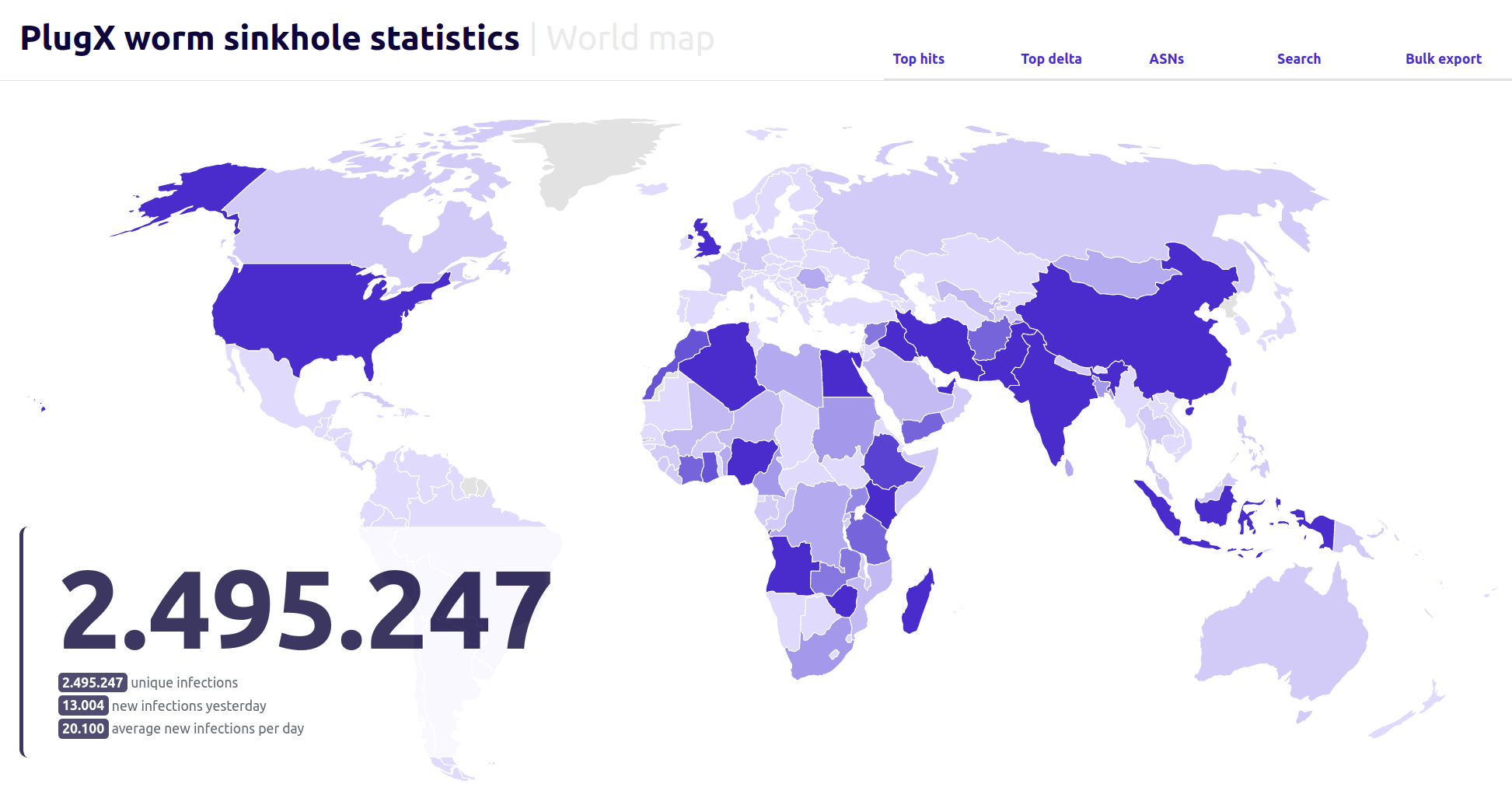
As the image below shows, the machines reporting to the sinkhole have broad geographic disbursement:

A world map showing country IPs reporting to the sinkhole.
Enlarge / A world map showing country IPs reporting to the sinkhole.

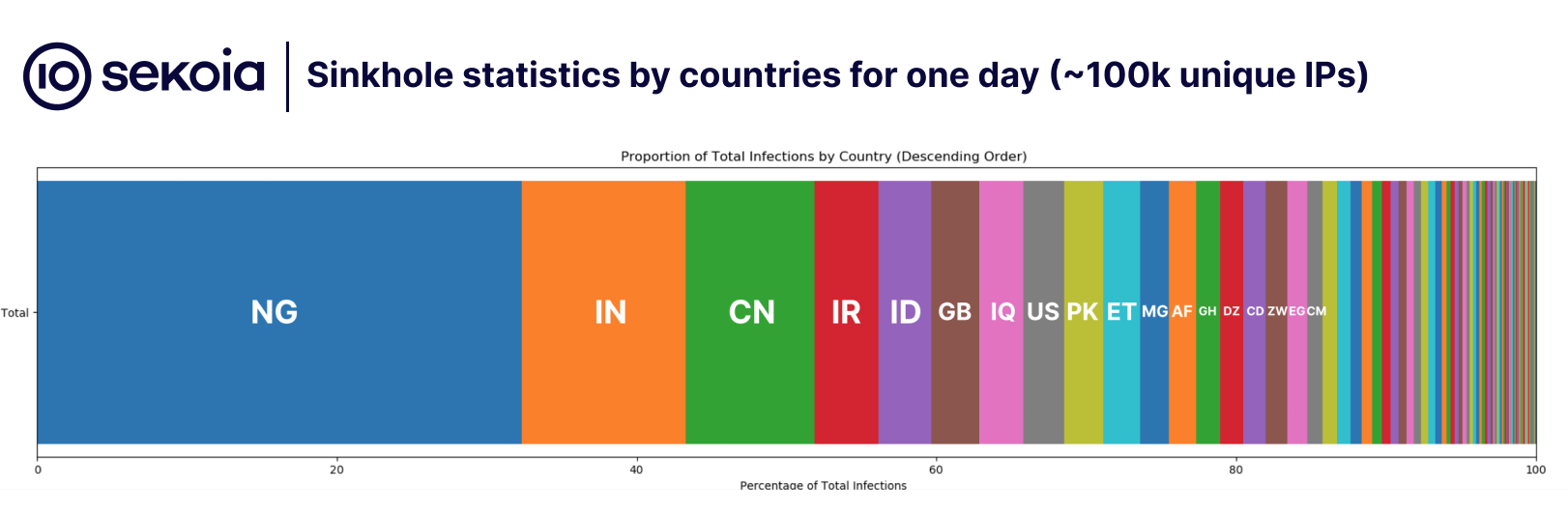
A sample of incoming traffic over a single day appeared to show that Nigeria hosted the largest concentration of infected machines, followed by India, Indonesia, and the UK.

Graph showing the countries with the most affected IPs.
Enlarge / Graph showing the countries with the most affected IPs.

The researchers wrote:

Based on that data, it’s notable that around 15 countries account for over 80% of the total infections. It’s also intriguing to note that the leading infected countries don’t share many similarities, a pattern observed with previous USB worms such as RETADUP which has the highest infection rates in Spanish spelling countries. This suggests the possibility that this worm might have originated from multiple patient zeros in different countries.

One explanation is that most of the biggest concentrations are in countries that have coastlines where China’s government has significant investments in infrastructure. Additionally many of the most affected countries have strategic importance to Chinese military objectives. The researchers speculated that the purpose of the campaign was to collect intelligence the Chinese government could use to achieve those objectives.

The researchers noted that the zombie worm has remained susceptible to takeover by any threat actor who gains control of the IP address or manages to insert itself into the pathway between the server at that address and an infected device. That threat poses interesting dilemmas for the governments of affected countries. They could choose to preserve the status quo by taking no action, or they could activate a self-delete command built into the worm that would disinfect infected machines. Additionally, if they choose the latter option, they could elect to disinfect only the infected machine or add new functionality to disinfect any infected USB drives that happen to be connected.

Because of how the worm infects drives, disinfecting them risks deleting the legitimate data stored on them. On the other hand, allowing drives to remain infected makes it possible for the worm to start its proliferation all over again. Further complicating the decision-making process, the researchers noted that even if someone issues commands that disinfect any infected drives that happen to be plugged in, it’s inevitable that the worm will live on in drives that aren’t connected when a remote disinfect command is issued.

“Given the potential legal challenges that could arise from conducting a widespread disinfection campaign, which involves sending an arbitrary command to workstations we do not own, we have resolved to defer the decision on whether to disinfect workstations in their respective countries to the discretion of national Computer Emergency Response Teams (CERTs), Law Enforcement Agencies (LEAs), and cybersecurity authorities,” the researchers wrote. “Once in possession of the disinfection list, we can provide them an access to start the disinfection for a period of three months. During this time, any PlugX request from an Autonomous System marked for disinfection will be responded to with a removal command or a removal payload.”

https://arstechnica.com/?p=2020055


The real space race: Inside geopolitics and security of a $1.8T industry

.pod { width: 100%; border: solid 3px #C72026; padding: 7px; margin: 20px 0; justify-content: center; background-color: #fbe9ea; } h3 { font-weight: bold; font-size: 18px; color: #C72026; }

Whether many of us realize it or not, space — the infinite phenomenon outside the Earth’s atmosphere within which our planet sits — has become part of our everyday lives. Not in the sense of being able to jump onto a rocket to go to work on Mars, as space travel remains a considerable challenge, but rather in terms of satellite communications, and also the number of innovations we take for granted that have come about through research and development by space organizations like NASA.

With satellite communications today powering everything from entertainment channels to mobile phones to navigation and tracking systems, in this episode our panel debates the geopolitical and security dimensions of the current global space industry. A sector that the World Economic Forum values at a staggering $1.8 trillion. We may not be living on Mars any time soon — something else our panel discusses — but it’s arguably never been more important for nation states to join the space race, while also presenting an increasingly attractive target for cybercriminals.

Space hacking

We blast off by asking whether the regulatory protocols in place match the sector’s growing value and status. How could they be improved to avoid the development of a Wild West scenario where chaos rules — a situation likely to fuel cyberattacks? More importantly, just how big is the cyber threat in space and exactly what mayhem could hackers cause whether motivated by greed or political beliefs? Could satellites come tumbling from the sky and missile systems tampered with, or is data the main focus? The practice of GPS spoofing certainly throws up some pretty frightening scenarios.

Pressing on with the subject of vulnerability, our panel turn to the space supply chain. This is not only arguably the most extensive in the world, but also extremely complex, with specialisms so developed that a single company could manufacture just one of the many millions of items that need sourcing, such as the humble bolt. The effects of any disruption could therefore be huge creating a pretty broad attack surface.

Trash or treasure?

Our panel also look at how the space industry could be affected by satellite clutter and its environmental impact, as debris increasingly accumulates around our planet. When you realize that some space technologies use nuclear power, the dangers become more apparent. So just how much space junk is there and how can it be dealt with?

Emerging technologies like deep space networks provide the final focus for our experts. Where is the industry going? What does the future hold? Could the next world war be fought in space? And just how close are we to inhabiting one of our planetary neighbors? Don’t just sit there, pull on your space suit and watch or listen to our latest episode to find out.

https://www.securitymagazine.com/articles/100594-the-real-space-race-inside-geopolitics-and-security-of-a-18t-industry


FTC issues refunds to Ring customers following privacy settlement

The Federal Trade Commission (FTC) announced that they’re issuing refunds totaling more than $5.6 million to consumers as the result of a settlement with Ring over charges the company allowed employees and contractors to access consumers’ private videos and failed to implement security protections, enabling hackers to take control of consumers’ accounts, cameras and videos.

In a complaint first announced in May 2023, the FTC says that Ring deceived its customers by failing to restrict employees’ and contractors’ access to its customers’ videos, using its customer videos to train algorithms without consent and failing to implement security safeguards. 

The FTC is sending 117,044 PayPal payments to consumers who had certain types of Ring devices, such as indoor cameras, during periods when the FTC alleges unauthorized users may have had access to customer videos.

https://www.securitymagazine.com/articles/100607-ftc-issues-refunds-to-ring-customers-following-privacy-settlement


Bridging the widening cybersecurity skills gap

In today’s cyber landscape, the challenges loom large. Evolving threats and technologies have reshaped the battleground, making traditional on-premises infrastructure defenses obsolete. Despite advancements in security tools, a pressing issue remains: a significant shortage of skilled professionals.

In addition to the compromise of mission-critical systems and networks, enterprises grapple with reputational damage, financial losses, compliance hurdles and legal ramifications from a cyberattack. Organizations must not only address current risks but also anticipate future threats, safeguard sensitive data, comply with regulations, meet industry expectations and prioritize customer satisfaction. These imperatives underscore the critical need for businesses to bridge the cybersecurity skills gap, ensuring the continuity of digital transformation that drives competitiveness and resilience in the face of these evolving threats.

Where the industry is at with the issue

In its annual Cybersecurity Workforce Study released last October, ISC2 found that the gap between the number of cybersecurity professionals available and needed increased by 12.6% over the previous year even though the cybersecurity workforce as a whole grew by 8.7%. ISC2’s findings show that a large percentage of respondents believe they do not have enough cybersecurity professionals in their organization to prevent and troubleshoot cybersecurity issues. Across industries, 67% of cybersecurity professionals reported that their team is understaffed.

Technical expertise is essential, but other skills are equally vital

As our understanding of security has matured, the demands associated with cybersecurity positions have grown. Although technical proficiency remains crucially important, it is no longer sufficient on its own. Yes, some employees may understandably gravitate to a particular aspect of security such as threat analysis or incident response. And supporting a niche role is entirely possible and valued in many organizations. However, to be effective in a general practitioner or leadership role requires today’s cybersecurity professionals to possess a multi-faceted skill set. Beyond technical skills, professionals in these roles must also grasp intricate industry regulations, risk management, organizational processes, security prioritization and customer expectations as well as adapt to continuous learning and thrive in high-stress environments. 

Bridging the gap — how do organizations develop, attract and retain such professionals?

Fortunately, there are many proven strategies enterprises can embrace, and steps they can take, to address the cybersecurity skills gap — a gap that will only widen as organizations realize that the demand for professionals who possess such competencies will continue to outpace their availability for years to come.

Executive, IT and cybersecurity leaders can and must take action to address this reality. Fundamental, required actions include:

  • Revisit the organization’s environment and culture: It is crucial for both leaders and the entire enterprise to acknowledge that cybersecurity, though closely tied to IT, is a complex discipline. This field demands not just dedicated resources but also a unique reward system and organizational structure. These elements should be in alignment with the crucial role cybersecurity plays in protecting an organization’s assets, reputation and its ability to conduct business. Just as importantly, this necessitates not only the recruitment of individuals who possess the aforementioned multifaceted skill set, but also the proactive development of such talent.
  • Prioritize the work-life balance and job satisfaction of employees in cybersecurity roles: Unfortunately, in many companies, cybersecurity roles are only valued when a breach occurs. Leaders must take steps to support the mental and physical health of cybersecurity professionals who often feel they are “on call” at all times. This includes recognizing the demanding nature of their roles and the importance of maintaining resilience and job satisfaction. 
  • Invest in comprehensive professional development: Continuous training is critical to maintaining relevance in the field of cybersecurity. Organizations should provide opportunities for their cybersecurity employees to enhance their skills and stay abreast of emerging threats and technologies. This includes employer funded technical training and additional opportunities for development in areas such as compliance, risk management and leadership — not to mention evolving areas like AI. It is also critical to support participation in industry conferences and professional associations. These perks demonstrate a commitment to ongoing learning and help retain top talent.
  • Create partnerships with local educational institutions: Local community colleges and universities that offer cybersecurity programs serve as excellent sources for new talent. Additionally, these institutions provide opportunities to enhance the skill sets of current employees. Cybersecurity apprenticeships, cyber range simulation training, blue-teaming competitions and various other proactive educational initiatives can help uplevel the workforce. 
  • Foster relationships with cybersecurity consultants to bridge the skills gap: Retention is challenging, so establishing collaborative relationships with reputable cybersecurity firms provides organizations with access to specialized expertise and resources, helping to address the shortage of cybersecurity professionals. And if designed appropriately, these relationships offer the benefit of independent perspectives and impartial assessments, allowing executives to make informed decisions and navigate complex cybersecurity challenges with confidence. This also alleviates pressure on security teams, allowing them to focus on core responsibilities with greater confidence.
  • Invest in new technologies: New innovations make cybersecurity professionals’ lives easier and enable them to focus more on high-value activities like the cybersecurity training of business users. For example, investments in AI-powered solutions can automate the monitoring of security logs. They can also generate alerts when devices connected to the network behave suspiciously. Such technologies augment any organization’s security stance and free cybersecurity employees from tasks that, while important, can be tedious.

The greatest vulnerability in many organizations today is the inability of leaders to communicate and collaborate on their cybersecurity needs and investments. In years to come, those who develop strong personal relationships in the cybersecurity community will possess an asset that will only grow more valuable with time — an experienced, proven, satisfied and dedicated cybersecurity team — teams of professionals that will increasingly be required not only to secure cybersecurity insurance, but to successfully complete the digital transformations required for business success.

https://www.securitymagazine.com/articles/100608-bridging-the-widening-cybersecurity-skills-gap


Nation-state hackers exploit Cisco firewall 0-days to backdoor government networks

A stylized skull and crossbones made out of ones and zeroes.

Hackers backed by a powerful nation-state have been exploiting two zero-day vulnerabilities in Cisco firewalls in a five-month-long campaign that breaks into government networks around the world, researchers reported Wednesday.

The attacks against Cisco’s Adaptive Security Appliances firewalls are the latest in a rash of network compromises that target firewalls, VPNs, and network-perimeter devices, which are designed to provide a moated gate of sorts that keeps remote hackers out. Over the past 18 months, threat actors—mainly backed by the Chinese government—have turned this security paradigm on its head in attacks that exploit previously unknown vulnerabilities in security appliances from the likes of Ivanti, Atlassian, Citrix, and Progress. These devices are ideal targets because they sit at the edge of a network, provide a direct pipeline to its most sensitive resources, and interact with virtually all incoming communications.

Cisco ASA likely one of several targets

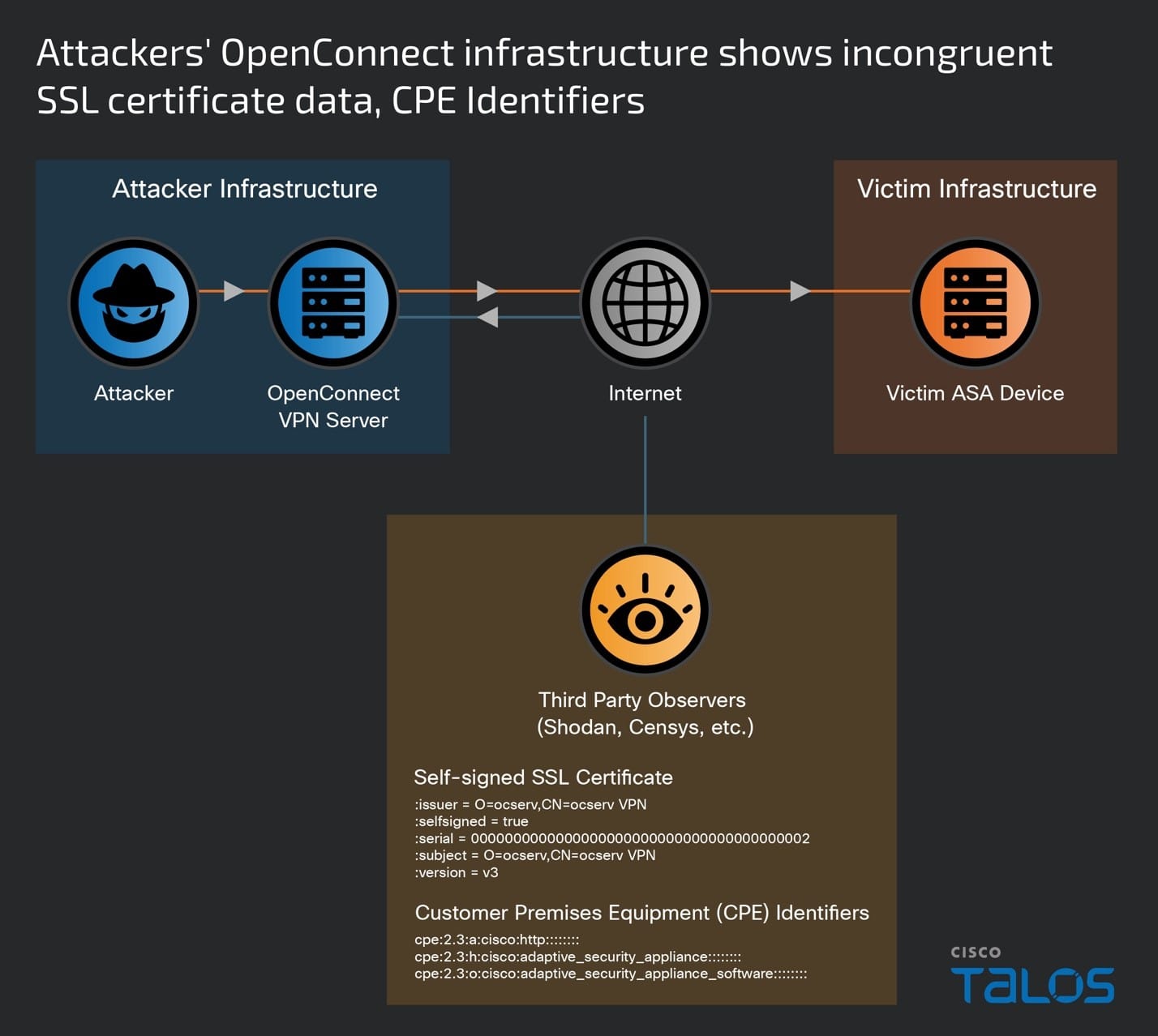
On Wednesday, it was Cisco’s turn to warn that its ASA products have received such treatment. Since November, a previously unknown actor tracked as UAT4356 by Cisco and STORM-1849 by Microsoft has been exploiting two zero-days in attacks that go on to install two pieces of never-before-seen malware, researchers with Cisco’s Talos security team said. Notable traits in the attacks include:

  • An advanced exploit chain that targeted multiple vulnerabilities, at least two of which were zero-days
  • Two mature, full-feature backdoors that have never been seen before, one of which resided solely in memory to prevent detection
  • Meticulous attention to hiding footprints by wiping any artifacts the backdoors may leave behind. In many cases, the wiping was customized based on characteristics of a specific target.

Those characteristics, combined with a small cast of selected targets all in government, have led Talos to assess that the attacks are the work of government-backed hackers motivated by espionage objectives.

“Our attribution assessment is based on the victimology, the significant level of tradecraft employed in terms of capability development and anti-forensic measures, and the identification and subsequent chaining together of 0-day vulnerabilities,” Talos researchers wrote. “For these reasons, we assess with high confidence that these actions were performed by a state-sponsored actor.”

The researchers also warned that the hacking campaign is likely targeting other devices besides the ASA. Notably, the researchers said they still don’t know how UAT4356 gained initial access, meaning the ASA vulnerabilities could be exploited only after one or more other currently unknown vulnerabilities—likely in network wares from Microsoft and others—were exploited.

“Regardless of your network equipment provider, now is the time to ensure that the devices are properly patched, logging to a central, secure location, and configured to have strong, multi-factor authentication (MFA),” the researchers wrote. Cisco has released security updates that patch the vulnerabilities and is urging all ASA users to install them promptly.

UAT4356 started work on the campaign no later than last July when it was developing and testing the exploits. By November, the threat group first set up the dedicated server infrastructure for the attacks, which began in earnest in January. The following image details the timeline:

One of the vulnerabilities, tracked as CVE-2024-20359, resides in a now-retired capability allowing for the preloading of VPN clients and plug-ins in ASA. It stems from improper validation of files when they’re read from the flash memory of a vulnerable device and allows for remote code execution with root system privileges when exploited. UAT4356 is exploiting it to backdoors Cisco tracks under the names Line Dancer and Line Runner. In at least one case, the threat actor is installing the backdoors by exploiting CVE-2024-20353, a separate ASA vulnerability with a severity rating of 8.6 out of a possible 10.

https://arstechnica.com/?p=2019790


73% of security professionals failed to act upon security alerts

A new report by Coro sheds light on the challenges that cybersecurity professionals are facing in regard to their workload. The report surveyed 500 cybersecurity decision-makers in the United States, all of whom worked for companies with 200 to 2000 employees. The survey focused on small and medium-sized enterprises (SMEs), finding that many lacked the resources and abilities to properly handle the large volume security alerts received. 

In fact, 73% of security professionals in SMEs reported that they either missed, ignored or failed to act upon high priority security alerts. Two main reasons given for this were a lack of staff and time constraints. In terms of time constrains, 52% of those surveyed reported the task consuming most of their time was monitoring security platforms. This task is followed by vulnerability patching. 

Key findings from the report include: 

  • Professionals surveyed report that managing the organization’s cybersecurity tools takes an average of 4 hours 43 minutes each day. These organizations average 11.55 tools to be used in “security toolboxes.” 
  • It takes an estimated 4.223 months for new cybersecurity tools to become fully operational. This is because it requires installation, configuration, integration, staff training and more to become operational. 
  • Within the next 12 months, 85% of professionals surveyed say they are seeking to consolidate their tools.

https://www.securitymagazine.com/articles/100610-73-of-security-professionals-failed-to-act-upon-security-alerts