Microsoft Copilot for Security è ora disponibile per le aziende italiane


“In un contesto di crescente fragilità, gli sforzi di Microsoft vanno nella direzione di fornire alle aziende e ai propri partner soluzioni integrate che possano incrementare la loro postura di sicurezza, per far fronte in maniera più efficace alle minacce e aumentare la resilienza aziendale in seguito a eventuali attacchi”.

Ha esordito così Tamara Zancan, Direttrice Cybersecurity, Compliance e Identity di Microsoft Italia, all’evento tenutosi ieri a Milano per lanciare Copilot for Security. Una soluzione che a suo dire è “l’unione di tre vantaggi critici di Microsoft perché è in grado di combinare dati e intelligence sulle minacce su larga scala, una protezione end-to-end completa e un’intelligenza artificiale responsabile”.

Microsoft Copilot for Security integra il modello GPT-4 di OpenAI con le infrastrutture di sicurezza di Microsoft, sfruttando la vasta conoscenza di Microsoft Security sul panorama delle minacce globali. È uno strumento che si basa su una sconfinata mole di dati, non a caso Microsoft ha ricordato in due circostanze gli oltre 78 trilioni di allarmi di sicurezza processati quotidianamente. A novembre erano 67 trilioni, a conferma della crescente capacità dell’azienda in materia di cybersecurity.

Attraverso l’uso dell’intelligenza artificiale generativa, in grado peraltro di semplificare strumenti tecnici solitamente complessi, Copilot for Security vuole proporsi come un supporto cruciale alle aziende nella gestione delle minacce e nell’intercettazione di possibili attacchi. Una soluzione che assiste gli analisti della sicurezza e i professionisti IT nell’espandere le loro competenze, migliorare la collaborazione e ottenere una visibilità più profonda sulle minacce, accelerando di conseguenza le risposte agli incidenti.

Microsoft dispone di un team di 10.000 esperti che si occupano esclusivamente di cybersecurity, su un totale di 200.000 dipendenti.

C’è poi un altro punto importante da sottolineare. Nel mondo mancano competenze nell’ambito della cybersecurity, tant’è che si stimano 3,5 milioni di posti di lavoro vacanti. Copilot for Security si propone quindi come un alleato per tutte quelle aziende che navigano in un contesto di sicurezza complesso e che incontrano difficoltà nel reperire sul mercato risorse qualificate con competenze specializzate in sicurezza informatica.

Minacce crescenti

È per descrivere meglio lo scenario attuale che è poi salito sul palco Csaba Deme, Global Security Sales di Microsoft nel corso della presentazione di Copilot for Security: “I cybercrimini si stanno intensificando, con l’obiettivo di infiltrarsi nelle aziende, sottrarre dati e informazioni. Sia che si tratti di agenti governativi o di singoli criminali informatici, nel corso degli ultimi 12 mesi, abbiamo assistito a un triplicarsi delle operazioni su scala globale. Non si pensi che queste siano state rivolte alle grandi corporazioni: il 70% degli attacchi ransomware hanno preso di mira imprese con meno di 500 dipendenti.

Dame ha poi proseguito: “Quest’anno, gli attacchi informatici hanno generato danni economici stimati in circa 8 trilioni di dollari e si prevede che questa somma aumenterà a 24 trilioni entro il 2027. Per capire meglio l’entità del problema, 24 trilioni corrispondono all’incirca al PIL attuale degli Stati Uniti. E non si pensi che l’impatto di questi attacchi sia solo economico, perché vi è anche un significativo risvolto umano”.

A queste dichiarazioni hanno fatto eco quelle di Igor Salvoni, Specialists Team Unit Lead di Microsoft Italia: “Quando osserviamo il cybercrime come fenomeno globale, vediamo che dispone di ingenti risorse finanziarie, ben superiori a quelle di quasi ogni organizzazione privata e quasi tutti i governi del mondo, e cresce a un ritmo più che doppio rispetto alle economie europee. Questo contesto ci aiuta a comprendere la sfida che abbiamo davanti”.

“Come ecosistema di fornitori, partner e clienti, dobbiamo collaborare per mantenere il più sicuro possibile il nostro ambiente, i nostri dati e le nostre proprietà. Per farlo, abbiamo bisogno di molti dati e siamo consapevoli del privilegio che abbiamo nel poter accedere a un volume così significativo di informazioni. A novembre, il numero di segnali che Microsoft è stata in grado di intercettare e analizzare era di 65 trilioni di segnali giornalieri“.

Copilot for Security vuole essere un valido aiuto per tutte le aziende. Per quelle particolarmente strutturate, così come per quelle che faticano a reperire sul mercato risorse qualificate in sicurezza informatica.

“Da allora”, prosegue Armoni, “siamo arrivati a 78 trilioni, dimostrando quanto rapidamente aumentino le informazioni che tentiamo di intercettare e l’impegno che mettiamo nel migliorare continuamente, senza accontentarci di ciò che sappiamo oggi. Perché domani potrebbe non essere più sufficiente. Abbiamo un team di 10.000 esperti che si occupano esclusivamente di cybersecurity, su un totale di 200.000 dipendenti. Un milione di clienti oggi utilizza le nostre soluzioni di sicurezza, con i quali cerchiamo di condividere e fornire il miglior servizio possibile, imparando ciò che è necessario per migliorarci”.

L’IA di Copilot for Security in soccorso della cybersecurity

La sicurezza informatica si conferma come uno dei settori più fertili per l’adozione dell’intelligenza artificiale, con quasi la metà (47%) dei progetti di AI in Europa focalizzati proprio su questo ambito. In Italia la tendenza è simile, con la cybersecurity e il rilevamento delle minacce posizionati tra i primi tre utilizzi aziendali dell’AI per migliorare l’efficienza operativa.

Lo stesso Csaba Deme ieri ha ricordato che l’obiettivo primario della cybersecurity è evitare che accadano incidenti. “Se non succede nulla, significa che le misure preventive hanno funzionato. Se si rendono necessari interventi, significa che qualcosa è già andato storto“.

Ricerche recenti tra i responsabili di cybersecurity evidenziano che il 73% ritiene che la capacità di identificare minacce in modo precoce attraverso sistemi di detection sia cruciale per aumentare la resilienza cibernetica delle aziende. Ciò sottolinea l’importanza di avere un sistema di risposta rapido che possa attivarsi non appena si presentano i primi segnali di un attacco.

Le aziende che hanno testato Copilot for Security di Microsoft segnalano benefici significativi come il risparmio di tempo e l’incremento dell’accuratezza nelle analisi, con un beneficio per l’efficienza delle operazioni del 22% e un aumento della precisione del 7% nelle attività svolte. Inoltre, il 93% dei professionisti che ha utilizzato Copilot for Security conferma miglioramenti nella qualità del loro lavoro, mentre il 97% si dice propenso a utilizzare questo strumento in futuro per le stesse attività.

La disponibilità italiana di Copilot for Security è stata annunciata ieri nel corso dell’evento “Microsoft Secure: la nuova era della Cybersecurity potenziata dall’AI”.

Ulteriori ricerche di Microsoft evidenziano che uno dei vantaggi principali di Copilot for Security è la riduzione di oltre il 60% del tempo speso dagli analisti in compiti routinari, liberando risorse per attività di maggiore valore. Inoltre, l’uso di Copilot, che utilizza il linguaggio naturale per elaborare le richieste, permette anche agli analisti meno esperti di acquisire competenze critiche, contribuendo a un ciclo virtuoso di formazione e crescita professionale e aziendale.

Copilot for Security è offerto sia come soluzione indipendente sia come componente integrata in Azure, con un costo di 4 dollari l’ora. Questo, nelle intenzioni di Microsoft, per permettere di adattarne l’utilizzo alle necessità aziendali, con la flessibilità di attivarlo soltanto nei momenti più opportuni, per poche ore o per periodi più estesi.

Condividi l’articolo


Articoli correlati

Altro in questa categoria


https://www.securityinfo.it/2024/04/17/microsoft-copilot-for-security-disponibile-italia/?utm_source=rss&utm_medium=rss&utm_campaign=microsoft-copilot-for-security-disponibile-italia




Pentesting accounts for an average of 13% of total IT security budgets

A report by Pentera has revealed that enterprises continue to emphasize pentesting as a tool for security validation strategies. Among surveyed respondents, pentesting takes up an average of 13% of the security team’s budget, or an average of $164,400. The report surveyed 450 CIOs, CISOs and IT security leaders to gather this data, shedding light on how enterprises are approaching security validation. 

As breach efforts from malicious actors continue to evolve, the subsequent losses from an attack become more prevalent. Among enterprises that admitted experiencing a breach, 93% reported unexpected downtime, financial loss or data exposure. Therefore, pentesting efforts are often utilized to validate the efficacy of security systems, observe the potential impact of an attack and structure an effective security budget. 

Other notable findings from the report include: 

  • Security testing is not keeping pace with organizational IT changes. While 73% report IT environment changes at least quarterly, only 40% report pentesting at the same pace.
  • Security teams are increasingly lacking internal resources for pentesting. In 2023, 21% of respondents indicated a lack of resources for remediation as an obstacle. However, that percentage has since risen to 36%. 
  • Organizations are adopting more security technology. On average, enterprises utilize 53 security solutions across the entire organization; yet, 51% reported at least one breach in the past 24 months. 

https://www.securitymagazine.com/articles/100588-pentesting-accounts-for-an-average-of-13-of-total-it-security-budgets


Una vulnerabilità di PuTTY permette di ottenere la chiave privata dell’utente


I mantainer di PuTTY, il client open-source di SSH e Telnet, hanno reso noto che il tool soffre di una vulnerabilità critica che consente a un attaccante di ottenere la chiave segreta dell’utente.

Il bug, tracciato come CVE-2024-31497, è causato da un’implementazione errata del protocollo ECSDA (NIST P-521) di crittografia ellittica. “Un aggressore in possesso di qualche decina di messaggi firmati e della chiave pubblica dispone di informazioni sufficienti per recuperare la chiave privata e falsificare le firme come se provenissero dall’utente, consentendogli (ad esempio) di accedere a qualsiasi server per il quale si utilizza la chiave” spiegano gli sviluppatori.

Per ottenere le firme a un attaccante basta compromettere qualsiasi server nel quale si usa la chiave per autenticazione o accedere a una copia di Pageant, ovvero l’agent di autenticazione di PuTTY, che contiene la chiave.

Pixabay

Gli sviluppatori spiegano che, dal momento che PuTTY è stato sviluppato su Windows prima che ci fosse un qualsiasi generatore di numeri randomici, il tool ha sempre generato le chiavi in modo deterministico. Nel dettaglio, tutti gli schemi di firma crittografica richiedono l’uso di un valore casuale chiamato “nonce” e usato solo una volta, in molti casi indicato con la lettera k. Se un attaccante riesce a indovinare il valore di k o trovare due firme generate con lo stesso k, allora può facilmente derivare la chiave privata; poiché PuTTY genera in modo deterministico k, gli utenti sono esposti all’attacco.

I mantainer del tool invitano gli utenti a revocare immediatamente qualsiasi chiave generata, rimuovere la vecchia chiave pubblica da tutti i file autorhized_keys e generare una nuova coppia di chiavi.

La buona notizia è che l’unico tipo di chiave che soffre di questa vulnerabilità è l’ECDSA a 521 bit; chiavi di altre dimensioni o generate con altri algoritmi non sembrano essere affette dal problema.

A fronte del bug, gli sviluppatori di PuTTY hanno abbandonato il vecchio sistema di generazione di k e attualmente stanno usando la tecnica RFC 6979.

Le versioni di PuTTY colpite dalla vulnerabilità sono tutte quelle dalla 0.68 alla 0.80. Il fix è già disponibile nella versione 0.81 rilasciata pochi giorni fa.

Condividi l’articolo


Articoli correlati

Altro in questa categoria


https://www.securityinfo.it/2024/04/17/una-vulnerabilita-di-putty-permette-di-ottenere-la-chiave-privata-dellutente/?utm_source=rss&utm_medium=rss&utm_campaign=una-vulnerabilita-di-putty-permette-di-ottenere-la-chiave-privata-dellutente


AI security for CISOs: A dynamic and practical framework

Few technologies have infiltrated the business world as rapidly — and with so much enthusiasm from leaders — as artificial intelligence (AI) and machine learning (ML). By some reports, two-thirds of enterprises are already using generative AI, citing benefits like productivity gains and improved customer relationship management. 

But with the excitement for AI and ML comes security and privacy concerns. Leaders consistently point to security as a top concern when adopting generative AI. Even CISOs, who are accustomed to the ins and outs of technological change within their organizations, are nervous: they need to understand the ins and outs of AI, balance innovation with security and ensure any changes have a net positive impact on their business in the long run. Without the proper foundation or understanding of how to secure their AI systems and address key security concerns, innovation slows or gets stuck. 

To address this need, my team compiled input from 100+ CISOs from a traveling workshop program on the topic and 15 industry AI experts to develop a framework (the Databricks AI Security Framework) to guide CISOs through bringing the power of generative AI to their organizations securely and at scale — and to combat the pattern of security teams slowing down AI due to their lack of confidence in successfully securing the system. We’ve gleaned some interesting insights in speaking with global CISOs about this problem. Here’s what we’ve learned.

Why CISOs are “slowing down” AI 

The concerns among CISOs boil down to two key problems: there’s a lack of specific guidance around AI, and consequently, CISOs are forced to operate without enough knowledge in this important area. The lion’s share of guidance, including frameworks from NIST, international organizations and leading technology companies, do an excellent job of organizing risks in AI and ML systems at the highest level. But many of them lack the execution-oriented specificity technical leaders need right now. 

Throughout our series of CISO workshops, it’s become clear that AI is still too new for most CISOs to have had the time or space to get a clear understanding of what the system entails or where to start with security — and the business side of their organizations may not have as much patience when it comes to getting started with AI. It’s like CISOs being told to “secure the building” without any details about the building or what they’re securing. The necessary context — how many floors does it have? What are the doors like? What is the surrounding area like? — is essential. I’ve also witnessed CISOs debate whether securing AI is actually different from securing traditional deterministic systems applications ad nauseam. While the controls of securing AI look similar to those of other systems in regard to how and what to secure, this knowledge gap leaves CISOs in the dark about where they ought to secure it. 

Without understanding the difference between testing data and validation data or a feature catalog and a model catalog, only having high-level guidance available, coupled with a daunting new paradigm, we are seeing a pattern of some CISOs burying their heads in the sand. This is expected — humans are wired to fear the unknown — but it doesn’t have to be this way. 

Needed: A holistic technical framework for AI security 

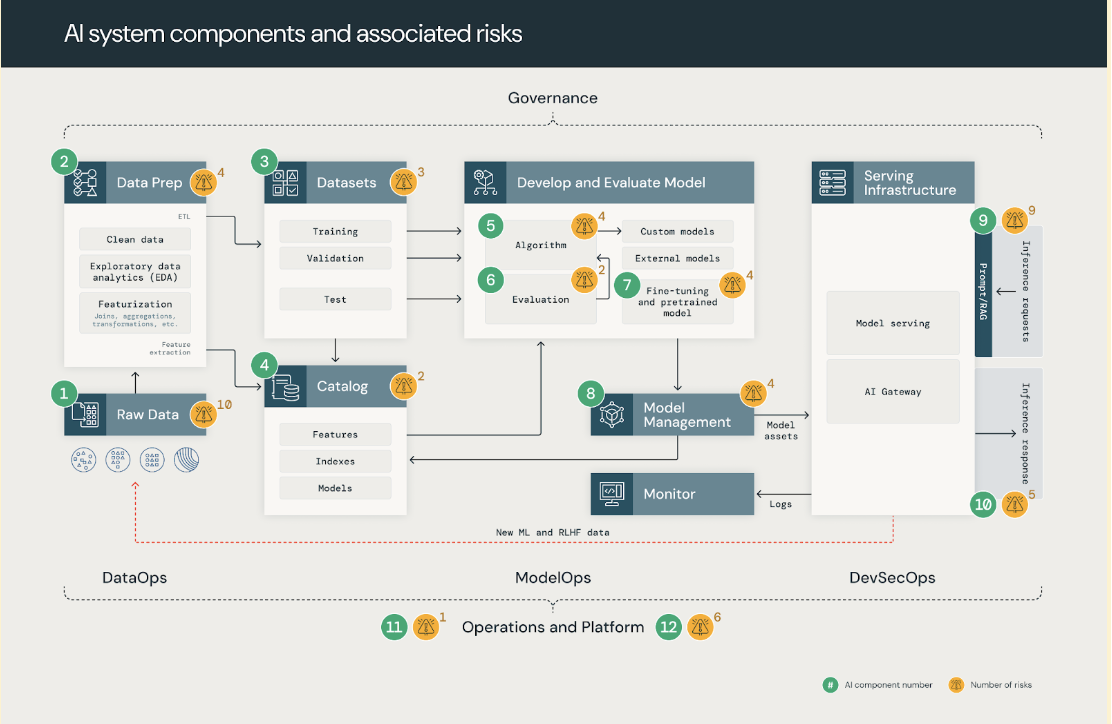
The AI Security Framework seeks to provide the necessary guidance to understand those core questions that inform CISOs’ teams’ security work. It outlines the 12 foundational components of a data-centric AI and ML system and maps out a total of 55 technical security risks across those components. 

Framework FlowchartImage courtesy of Khawaja

For any given situation, only a few risks actually apply. The above diagram shows what those risks are in context — and by focusing on a subset of risks, the universe of controls required to secure an AI system becomes more feasible. 

The four foundational subsystems of AI, per the framework, are: 

  1. Data operations, which include ingesting and transforming data and ensuring data security and governance. 
  2. Model operations, which include building custom models, acquiring models from a model marketplace, or using SaaS LLMs (like OpenAI). 
  3. Model deployment and serving, which consist of securely building model images, isolating and securely serving models, automated scaling, rate limiting, and monitoring deployed models.
  4. Operations and platform, which include platform vulnerability management and patching, model isolation and controls to the system. 

From there, one can visualize and understand the corresponding risks to each foundational component. For example, model operations encompass 13 potential risks, including model theft, model inversion and model asset leak. 

This approach helps tackle companies’ varying needs when it comes to securing AI. Just like preparing a building for natural disasters as part of the process of securing it — are you in a region that gets earthquakes, or are you more concerned about hurricanes? — CISOs must prioritize some components of their AI system over others. To go back to the example about model operations, a company that has invested heavily in building a proprietary model will be more concerned with model theft and protecting the model itself; one that has a plethora of valuable training data might be most concerned with safeguarding their raw training data. 

Guardrails to adapt to a changing landscape 

Importantly, when adopting any framework, ensuring it is dynamic and can change alongside the landscape is paramount; as regulations crystallize around how enterprises use or build AI, threats and vulnerabilities will, too. Frameworks like ours, those of our peers, and those from governing organizations can help CISOs and other leaders pinpoint specific focus areas as the regulatory environment shifts. There may be a time when “doing generative AI” looks differently in California than New York, or in the US versus Europe. CISOs need to be adequately equipped to respond to changing regulations on a dime, and by breaking down the system and looking at risks on a holistic level, CISOs can better understand what system components and risks. 

There’s a reason why there are so many uncertainties around security in AI: it’s hard, whether that’s due to moving parts, systems that feel unfamiliar or the many gray areas in regulations and compliance today. Through a thorough understanding of which components make up AI, how those components work together and what distinct risks AI introduces, CISOs can better understand which components, threats and risks are the highest priority to their organization and ensure those controls are in place. CISOs deserve to say “yes” to innovation — and by using robust and dynamic frameworks to illuminate a path forward, CISOs can securely shepherd their organizations’ data and AI journeys — even as the landscape evolves. 

https://www.securitymagazine.com/blogs/14-security-blog/post/100589-ai-security-for-cisos-a-dynamic-and-practical-framework


Attackers are pummeling networks around the world with millions of login attempts

Attackers are pummeling networks around the world with millions of login attempts
Matejmo | Getty Images

Cisco’s Talos security team is warning of a large-scale credential compromise campaign that’s indiscriminately assailing networks with login attempts aimed at gaining unauthorized access to VPN, SSH, and web application accounts.

The login attempts use both generic usernames and valid usernames targeted at specific organizations. Cisco included a list of more than 2,000 usernames and almost 100 passwords used in the attacks, along with nearly 4,000 IP addresses sending the login traffic. The IP addresses appear to originate from TOR exit nodes and other anonymizing tunnels and proxies. The attacks appear to be indiscriminate and opportunistic rather than aimed at a particular region or industry.

“Depending on the target environment, successful attacks of this type may lead to unauthorized network access, account lockouts, or denial-of-service conditions,” Talos researchers wrote Tuesday. “The traffic related to these attacks has increased with time and is likely to continue to rise.”

The attacks began no later than March 18.

Tuesday’s advisory comes three weeks after Cisco warned of a similar attack campaign. Cisco described that one as a password spray directed at remote access VPNs from Cisco and third-party providers connected to Cisco firewalls. This campaign appeared to be related to reconnaissance efforts, the company said.

The attacks included hundreds of thousands or millions of rejected authentication attempts. Cisco went on to say that users can intermittently receive an error message that states, “Unable to complete connection. Cisco Secure Desktop not installed on the client.” Login attempts resulting in the error fail to complete the VPN connection process. The report also reported “symptoms of hostscan token allocation failures.”

A Cisco representative said company researchers currently don’t have evidence to conclusively link the activity in both instances to the same threat actor but that there are technical overlaps in the way the attacks were carried out, as well as the infrastructure that was used.

Talos said Tuesday that services targeted in the campaign include, but aren’t limited to:

  • Cisco Secure Firewall VPN
  • Checkpoint VPN
  • Fortinet VPN
  • SonicWall VPN
  • RD Web Services
  • Mikrotik
  • Draytek
  • Ubiquiti.

Anonymization IPs appeared to belong to services, including:

  • TOR
  • VPN Gate
  • IPIDEA Proxy
  • BigMama Proxy
  • Space Proxies
  • Nexus Proxy
  • Proxy Rack.

Cisco has already added the list of IP addresses mentioned earlier to a block list for its VPN offerings. Organizations can add the addresses to block lists for any third-party VPNs they’re using. A full list of indications of compromise is here.

Cisco has also provided a list of recommendations for preventing the attacks from succeeding. The guidance includes:

  • Enabling detailed logging, ideally to a remote syslog server so that admins can recognize and correlate attacks across various network endpoints
  • Securing default remote access accounts by sinkholing them unless they use the DefaultRAGroup and DefaultWEBVPNGroup profiles
  • Blocking connection attempts from known malicious sources
  • Implement interface-level and control plane access control lists to filter out unauthorized public IP addresses and prevent them from initiating remote VPN sessions.
  • Use the shun command.

Additionally, remote access VPNs should use certificate-based authentication. Cisco lists further steps for hardening VPNs here.

https://arstechnica.com/?p=2017646


Nevada loses the most money to cybercrime

The financial burden of cybercrime was analyzed by NoDepositRewards using data from the FBI crime report. According to the data, Nevada is losing the most money to cybercrime. Nevada faced a total loss of $6,286,710.72 per 100,000 residents. In Nevada, 7,198 citizens fell victim to cybercrime, with the average loss for each victim being a staggering $27,897.83.  

The following states were ranked as follows: 

  • California had a total loss of $5,535,081.99 per 100,000 people. There were 51,319 victims of cybercrime in California, with the average loss for each person being $42,026.45.  
  • New Jersey had a total loss of $4,744,902.86 per 100,000 citizens. In New Jersey, 9,978 citizens fell victim to cybercrime with an average loss of $44,181.34. 
  • Arizona had a total loss of $4,360,097.73 per 100,000 residents. Overall, there were 13,186 victims of cybercrime in Arizona with an average loss for each person being $24,572.57.  
  • Alaska had a total loss of $4,329,852.50 per 100,000 people. With 1,267 victims, the average loss for each person was $25,063.46. 
  • Montana experienced a total loss of $4,021,115.77 per 100,000 citizens; as well as this, there were 1,316 victims in Montana, where each person experienced an average loss of $34,613.74.  
  • South Dakota had a total loss of $3,899,509.20 per 100,000 residents. The state witnessed 784 people fall victim to cybercrime, with the average loss for each person being $45,725.63. 
  • Utah had a total loss of $3,867,064.11 per 100,000 people. There were 4,163 victims of cybercrime in Utah – the average loss per person was $31,747.77. 
  • Following closely behind is Florida in ninth place, with a total loss of $3,864,683.83 per 100,000 citizens. In Florida, 32,638 citizens fell victim to cybercrime, with the average loss per person being $26,773.49.  
  • Last on the list is New York, with a total loss of $3,824,820.44 per 100,000 residents. There were 21,313 victims of cybercrime in the state, with an average loss of $35,122.41 for each person. 

Find out more here.

https://www.securitymagazine.com/articles/100587-nevada-loses-the-most-money-to-cybercrime


LockBit: scoperta una nuova variante in grado di auto-propagarsi


LockBit continua a colpire le organizzazioni di tutto il mondo, evolvendosi rapidamente. In seguito a un recente incidente, il team Kaspersky Global Emergency Response ha individuato una variante del ransomware che ha dimostrato funzionalità di auto-propagazione. 

La variante ha utilizzato feature finora inedite che, in caso di successo, possono creare un “effetto valanga” incontrollato capace di diffondere il malware nella rete aziendale. La nuova versione del ransomware riesce a diffondersi autonomamente attraverso la rete usando credenziali con privilegi elevati ed è in grado di disabilitare Windows Defender, la crittografia delle condivisioni di rete e cancellare Windows Event Logs per nascondere la propria attività.

Il nuovo LockBit ha inoltre presentato alcune funzionalità adattive che gli permettono di adattarsi alle configurazioni specifiche dell’architettura aziendale della vittima, per esempio infettando solo determinati tipi di file o un certo gruppo di sistemi. Kaspersky ha anche scoperto che gli attaccanti hanno usato lo script SessionGopher per individuare e rubare le password salvate per le connessioni remote nei sistemi compromessi.

“Il builder LockBit 3.0 è apparso nel 2022, ma gli aggressori lo utilizzano ancora attivamente per creare versioni personalizzate e non richiede competenze di programmazione avanzate. Questa flessibilità consente agli avversari di migliorare l’efficacia dei propri attacchi, come dimostra il recente caso. Inoltre, rende questo tipo di attacchi ancora più pericolosi, considerando l’aumento della frequenza delle fughe di credenziali aziendali” ha dichiarato Cristian Souza, Incident Response Specialist, Kaspersky Global Emergency Response Team.

L’attacco in questione ha colpito un’organizzazione dell’Africa occidentale, in Guinea-Bissau, ma gli incidenti di sicurezza che coinvolgono LockBit, anche senza le ultime funzionalità, si verificano regolarmente in vari settori e aree geografiche.

Per proteggersi dagli attacchi ransomware e mitigare le conseguenze Kaspersky consiglia di implementare un programma di backup regolari e implementare soluzioni di sicurezza efficaci per la protezione degli endpoint e la ricerca proattiva delle minacce. Le organizzazioni dovrebbero inoltre disabilitare servizi e porte inutilizzati e mantenere i software sempre aggiornati.

Condividi l’articolo


Articoli correlati

Altro in questa categoria


https://www.securityinfo.it/2024/04/16/scoperta-una-nuova-variante-di-lockbit-in-grado-di-auto-propagarsi/?utm_source=rss&utm_medium=rss&utm_campaign=scoperta-una-nuova-variante-di-lockbit-in-grado-di-auto-propagarsi


Navigating cybersecurity in telecommunications: The FCC’s 7-day rule

The telecommunications industry underpins global communication and powers our digital world. Cybercriminals, however, have also become increasingly sophisticated in the threats they pose against such critical infrastructure. Recent developments, like the Federal Communications Commission’s (FCC) 7-day rule mandating that telecom providers report data breaches within seven days after initial discovery, underscore the growing urgency to fortify cybersecurity measures across this vital sector.

Research from Sysdig’s Threat Research Team revealed the telecom industry was the most heavily targeted vertical by cyberattackers in 2023, receiving a staggering 38% of all tracked attacks. This alarming trend is projected to continue rising in 2024, so why are telecoms being disproportionately targeted? Cybercriminals are exploiting the inherent complexity of telecommunication networks, and the cloud services they interconnect with, to obscure their malicious activities and bypass traditional security controls. 

The FCC’s new rule requiring prompt seven-day notification of data breaches aims to mitigate the fallout of these incidents by enabling swift response and protective actions for affected parties. While a positive step, this rule introduces operational challenges for major telecom providers. They must now implement robust breach detection and disclosure processes across their vast infrastructure handling immense volumes of sensitive data.

Due to the sheer scale of data transiting their networks, telecoms are prime targets for cybercriminals seeking financial gain or state-sponsored threat actors engaged in sabotage. The globally interconnected nature of telecommunications creates a web of potential entry points that increases breach risk. As telecoms rapidly adopt 5G, edge computing and cloud-native technologies to accelerate innovation and reduce customer churn, security is sometimes deprioritized in favor of faster time-to-market. The Sysdig 2024 Cloud-Native Security and Usage Report documented a striking 91% failure rate in runtime security scans, indicating inadequate security testing earlier in the development lifecycle.

While faster development fuels innovation and enhances customer experiences, it also often leads to insufficiently secured adoption of container technology and cloud-native designs. Moreover, it introduces new attack vectors. Network, workload, identity (i.e., access controls) configurations, container images and APIs can expose telecom infrastructure to cyberattacks when they’re not adequately hardened and continuously monitored for threats. Securing these dynamic environments requires real-time threat detection, efficient gathering of environmental context, correlation of potentially malicious signals, and automated initiation of incident response.

As telecoms increasingly leverage edge computing to deliver low-latency services and enable the Internet of Things (IoT) — including autonomous vehicles, smart home devices and more — the distributed edge infrastructure inadvertently increases the attack surface. Telecom networks are also used to integrate industrial control systems (ICS) and operational technology (OT) that have major public safety implications if disrupted. Securing telecom infrastructure is no longer just about preventing service outages — compromise of these critical systems could potentially impact national security and public welfare.

Safeguarding telecom networks is both an operational imperative for providers and a national security priority for governments. Cyber resilience has become the flavor of the day, but for good reason. Telecom disruptions or breaches could destabilize economies, jeopardize public services, compromise business operations across sectors and cripple military defense capabilities. In addition to the FCC rule, telecom providers are faced with a wave of other regulations that mandate disclosure. The Cyber Incident Reporting for Critical Infrastructure Act (CIRCIA) requires that telecom incidents also be reported to the US Cybersecurity and Infrastructure Security Agency (CISA). Additionally, material incidents must be disclosed in SEC filings under the Securities and Exchange Commission’s (SEC) cybersecurity disclosure rules enacted in 2023. Internationally, legislation like the EU’s Network and Information Security (NIS) 2 Directive also raises the cybersecurity bar for telecom operators.

While striving to accelerate innovation, major telecoms find themselves navigating a delicate balance between rapidly deploying cutting-edge technologies and comprehensively securing it all. Prioritizing a holistic security mindset through diligent risk management, adoption of defense-in-depth security controls, secure-by-design principles, and real-time threat detection are crucial. Cross-sector collaboration and public-private partnerships fostering improved threat intelligence and incident response capacity are also essential. Under heightened national and economic security scrutiny, telecom operators must rise to the challenge as stewards in protecting the integrity of the many critical systems intertwined with their infrastructure. 

https://www.securitymagazine.com/articles/100586-navigating-cybersecurity-in-telecommunications-the-fccs-7-day-rule


Rethinking network and security monitoring in the age of TLS 1.3

The adoption of the Transport Layer Security (TLS) 1.3 creates a watershed moment for cybersecurity, revolutionizing encryption and data protection standards. TLS has been widely used to secure data end-to-end for many decades. Though this latest version significantly enhances the security of the TLS protocol, it also severely limits the decryption of those data streams for cybersecurity and network monitoring purposes. This results in our current forms of network and security monitoring used with previous TLS versions to lose their effectiveness. The new TLS encrypted traffic actually can increase security risks by obscuring malware and traffic by threat actors as well, and therefore requires a fundamental rethinking of today’s monitoring approach.

A U.S. response to a global challenge

These changes are considered enough of a cybersecurity challenge that the U.S. National Cybersecurity Center of Excellence (NCCoE), a part of the National Institute of Standards and Technology (NIST), has started a project to “provide system and application administrators with practical tools and approaches to help them gain visibility into the traffic flowing across their networks, and to fully adopt TLS 1.3.” 

Collaborating with experts from various industries, NCCoE recently released draft publications describing the challenges of TLS 1.3 to cybersecurity and suggesting various solutions and their benefits to tackle this visibility challenge in the latest “NIST SPECIAL PUBLICATION 1800-37B: Addressing Visibility Challenges with TLS 1.3 within the Enterprise.” 

TLS 1.3 — Innovation in encryption that negatively impacts visibility 

Security, network and application operations have always relied on visibility into the traffic traversing the network, whether to determine the most efficient routing based on the data content, to measure network and application performance or to determine legitimate versus illegitimate resource usage. While ever more complex encryption and cypher technologies are employed to protect privacy and information confidentiality, it decreases visibility and increases complexity for these monitoring applications. 

The Internet Engineering Task Force (IETF) released the TLS 1.3 specification in RFC 8446 in August of 2018 and is now the most common version in use. It significantly enhanced previous TLS and SSL encryption protocols but impacts visibility and monitoring capabilities:

  • TLS 1.3 has fewer handshake messages to initiate the connection between devices, which are also encrypted. This accelerates the setup process but also limits the information visible to security devices that do not carry out decryption.
  • TLS 1.3 reduces the number of options and cipher suites to those that have been proven to be unbreakable so far, creating more secure communication.
  • TLS 1.3 requires only cipher suites that provide Perfect Forward Secrecy (PFS) which applies cryptographic keys only to a single communication session, not all traffic sent from a device. This addresses the issue of threat actors potentially obtaining the private encryption keys to read all communication to a device, past and future. 

How is this impacting the approach today? 

Previous versions of TLS allowed for passive monitoring of the initial encryption handshake, providing vital insight. Furthermore, traffic could be decrypted if the monitoring application had a copy of each device’s static cryptographic key which then would allow for the monitoring of all traffic from these devices, whether recorded or real-time. 

TLS 1.3 on the other hand requires that any application monitoring the traffic now needs to be inline and actively involved during each TLS connection establishment. Given the number of monitoring applications utilizing network traffic, this creates a significant number of decryption points that increase risk but also can impact the performance of the traffic. An alternative approach is the distribution of each session’s cryptographic keys to each monitoring application, a process that would create millions of keys that would need to be safely managed and applied. 

NIST addressing the challenge in the enterprise

NIST assembled experts including cryptographers, network security technology providers and user organizations to identify solutions to address those issues. They focused on solutions for enterprise data centers either hosted by the enterprise (on-prem or virtual) or hosted by a third-party, public cloud provider. They did not address communication over the public Internet or for newly emerging encrypted Domain Name System (DNS) protocols. 

Each solution had to ensure that it “does not change or replace the IETF RFC 8446 standard, provides secure management of servers’ cryptographic keys, securely manages recorded traffic, and manages expectations of privacy.” The experts identified two fundamentally different approaches:

  1. Passive network traffic analysis, requiring the safe storage and distribution of encryption keys to the monitoring applications.
  2. Inline traffic analysis, using “middle boxes” that are inline with the traffic flow and actively participate in the encryption. This is sometimes also referred to as “break and inspect”.

Alternative approaches such as analyzing only the encrypted network traffic or using security protocols without forward secrecy are not discussed. Those approaches do not deliver on the goal of TLS 1.3 visibility and do not address the vulnerabilities to which previous TLS versions are susceptible. 

Visibility into TLS 1.3 encryption — Passive traffic analysis

The first approach is for passive traffic inspection, meaning analyzing copies of the traffic passing through the network, either in real-time or for later analysis. This requires key-management solutions that store those keys and defer deletion until the traffic inspection can be concluded. However, during this time, Perfect Forwarding Secrecy (PFS) could be compromised if threat actors would get access to those keys. This key management can be achieved in two ways:

  1. A key management system provides known, fixed keys for encryption to each endpoint that is valid for a limited time and then refreshed. 
  2. The organization collects encryption keys directly from the end-devices and retains those.

In this approach, key management solutions need to securely store and reliably delete those keys by policy or when they are no longer required. Furthermore, applications monitoring the traffic need to be authorized and require safe — i.e., encrypted communication mechanisms — to obtain the keys for the key management system. 

Visibility into TLS 1.3 encryption — Break and inspect via middle boxes

A middle box, whether virtual or physical, actively engages in the communication between two endpoints. It connects inline and actively participates in the communication between devices. In this context, its role is to decrypt traffic for numerous monitoring applications, thereby eliminating the need for each application to individually intercept the traffic.  Applying this approach for each monitoring application individually would create a large number of concatenated monitoring points which could degrade transfer performance and generate additional potential security vulnerabilities. Therefore, this approach should be applied at strategic points in the network and one monitoring point utilized for as many monitoring applications as possible.  

As organizations plan to enable TLS 1.3, they need to augment their traffic monitoring approach for security and all the other applications benefiting from traffic analysis.  Without this change, they will enhance data privacy while losing vital visibility into existing and emerging threats, increasing their security risks. 

https://www.securitymagazine.com/articles/100585-rethinking-network-and-security-monitoring-in-the-age-of-tls-13


Alleged cryptojacking scheme consumed $3.5M of stolen computing to make just $1M

Alleged cryptojacking scheme consumed $3.5M of stolen computing to make just $1M
Getty Images

Federal prosecutors indicted a Nebraska man on charges he perpetrated a cryptojacking scheme that defrauded two cloud providers—one based in Seattle and the other in Redmond, Washington—out of $3.5 million.

The indictment, filed in US District Court for the Eastern District of New York and unsealed on Monday, charges Charles O. Parks III—45 of Omaha, Nebraska—with wire fraud, money laundering, and engaging in unlawful monetary transactions in connection with the scheme. Parks has yet to enter a plea and is scheduled to make an initial appearance in federal court in Omaha on Tuesday. Parks was arrested last Friday.

Prosecutors allege that Parks defrauded “two well-known providers of cloud computing services” of more than $3.5 million in computing resources to mine cryptocurrency. The indictment says the activity was in furtherance of a cryptojacking scheme, a term for crimes that generate digital coin through the acquisition of computing resources and electricity of others through fraud, hacking, or other illegal means.

Details laid out in the indictment underscore the failed economics involved in the mining of most cryptocurrencies. The $3.5 million of computing resources yielded roughly $1 million worth of cryptocurrency. In the process, massive amounts of energy were consumed.

Parks’ scheme allegedly used a variety of personal and business identities to register “numerous accounts” with the two cloud providers and in the process acquiring vast amounts of computing processing power and storage that he never paid for. Prosecutors said he tricked the providers into allotting him elevated levels of services and deferred billing accommodations and deflected the providers’ inquiries regarding questionable data usage in unpaid bills. He allegedly then used those resources to mine Ether, Litecoin, and Monero digital currencies.

The defendant then allegedly laundered the proceeds through cryptocurrency exchanges, an NFT marketplace, an online payment provider, and traditional bank accounts in an attempt to disguise the illegal scheme. Once proceeds had been converted to dollars, Parks allegedly bought a Mercedes-Benz, jewelry, first-class hotel and travel accommodations, and other luxury goods and services.

From January to August 2021, prosecutors allege, Parks created five accounts with the Seattle-based “on-demand cloud computing platform” using different names, email addresses, and corporate affiliations. He then allegedly “tricked and defrauded” employees of the platform into providing elevated levels of service, deferring billing payments, and failing to discover the activity.

During this time, Parks repeatedly requested that the provider “provide him access to powerful and expensive instances that included graphics processing units used for cryptocurrency mining and launched tens of thousands of these instances to mine cryptocurrency, employing mining software applications to facilitate the mining of tokens including ETH, LTC and XMR in various mining pools, and employing tools that allowed him to maximize cloud computing power and monitor which instances were actively mining on each mining pool,” prosecutors wrote in the indictment.

Within a day of having one account suspended for nonpayment and fraudulent activity, Parks allegedly used a new account with the provider. In all, Parks allegedly consumed more than $2.5 million of the Seattle-based provider’s services.

The prosecutors went on to allege that Parks used similar tactics to defraud the Redmond provider of more than $969,000 in cloud computing and related services.

Prosecutors didn’t say precisely how Parks was able to trick the providers into giving him elevated services, deferring unpaid payments, or failing to discover the allegedly fraudulent behavior. They also didn’t identify either of the cloud providers by name. Based on the details, however, they are almost certainly Amazon Web Services and Microsoft Azure. Representatives from both providers didn’t immediately return emails seeking confirmation.

If convicted on all charges, Parks faces as much as 30 years in prison.

https://arstechnica.com/?p=2017285