Fostering a Resilient and Supportive Workplace


As the workplace threat landscape continually evolves, effective communication is keys to fostering a resilient environment to keep teams safe. In order to cultivate a culture of well-being and resilience, it is important for organizations of all sizes to recognize and prioritize employee safety and security. 

One way to accomplish this is utilizing modern communication tools and strategies, such as Next Generation 911 (NG911) which aims to enhance emergency services by leveraging communication methods improving speed, accuracy, and efficiency of emergency responses. Many state and local governments across the U.S. have already or are planning to transition from analog 911 infrastructure to digital, IP-based NG911 systems for emergency call handling.

To maintain a resilient workforce, security leaders may consider embracing communication tools that integrate with emergency services. This would not only ensure faster response times, but also timely information provided to employees when it counts during an emergency. 

The Cybersecurity and Infrastructure Security Agency (CISA) points out that as state offices work toward implementing NG911 networks, assessing progress can pose challenges. CISA previously released a self-assessment tool, as well as other resources, available to 911 authorities and emergency communication centers (ECC) and public safety answering points (PSAP) administrators and oversight personnel to help evaluate a system’s NG911 maturity state and understand the next steps necessary to continue deployment.   

Emergency communications play a critical role in keeping connected during a disaster, especially for first responders. During an emergency, wireless and wireline communications can become degraded or overwhelmed, however frontline workers still need to have timely and effective response.

To that end, each year CISA honors National Emergency Communications month and encourages emergency communications partners to enroll in free priority telecommunications services (PTS) such as Government Emergency Telecommunications Service (GETS) and Wireless Priority Service (WPS) to maintain communications during a crises. These services are critically important as they allow for communication with priority capability when networks are degraded or congested and allow for the exchange of information when needed most.

Employee Viewpoints on Safety

In order to build and maintain a resilient workforce and promote a culture of workplace safety, it is important for security leaders listen to the concerns and ideas of team members and employees. It is critical to understand things from their perspective. According to a recent survey, 49% of today’s workforce believes the world is more dangerous today than it was a few years ago, which is understandable with the seeming increase of severe weather incidents and other emergencies.

A recent study released by AlertMedia, reveals the importance employees place on workplace safety as well as what they think of their companies’ approach to ensuring it. According to the survey, employees feel more secure and engaged when they are informed about safety protocols and emergency procedures. The State of Employee Safety Report discovered that 71% of employees don’t think their employers are following through on safety promises, and 65% believe their employers are not making an active effort to improve safety training.

The report also showed that 84% of employees believe their organization has the means to help them feel more prepared for any emergency; however, the majority of employees surveyed (75%) say current safety efforts have not been very effective. 

An employer’s ability to demonstrate a genuine care about worker safety plays an integral part in worker retention with 46% of employees saying they take it into consideration it when assessing whether to stay with an organization long-term.

Building a supportive workforce requires a proactive approach to safety communication. By leveraging modern communication tools and strategies, security leaders can stay ahead of the curve to enhance employee safety communications and build a work environment that prioritizes the safety and security of its people.

https://www.securitymagazine.com/articles/100478-fostering-a-resilient-and-supportive-workplace


Researchers create AI worms that can spread from one system to another

Researchers create AI worms that can spread from one system to another
Jacqui VanLiew; Getty Images

As generative AI systems like OpenAI’s ChatGPT and Google’s Gemini become more advanced, they are increasingly being put to work. Startups and tech companies are building AI agents and ecosystems on top of the systems that can complete boring chores for you: think automatically making calendar bookings and potentially buying products. But as the tools are given more freedom, it also increases the potential ways they can be attacked.

Now, in a demonstration of the risks of connected, autonomous AI ecosystems, a group of researchers has created one of what they claim are the first generative AI worms—which can spread from one system to another, potentially stealing data or deploying malware in the process. “It basically means that now you have the ability to conduct or to perform a new kind of cyberattack that hasn’t been seen before,” says Ben Nassi, a Cornell Tech researcher behind the research.

Nassi, along with fellow researchers Stav Cohen and Ron Bitton, created the worm, dubbed Morris II, as a nod to the original Morris computer worm that caused chaos across the Internet in 1988. In a research paper and website shared exclusively with WIRED, the researchers show how the AI worm can attack a generative AI email assistant to steal data from emails and send spam messages—breaking some security protections in ChatGPT and Gemini in the process.

The research, which was undertaken in test environments and not against a publicly available email assistant, comes as large language models (LLMs) are increasingly becoming multimodal, being able to generate images and video as well as text. While generative AI worms haven’t been spotted in the wild yet, multiple researchers say they are a security risk that startups, developers, and tech companies should be concerned about.

Most generative AI systems work by being fed prompts—text instructions that tell the tools to answer a question or create an image. However, these prompts can also be weaponized against the system. Jailbreaks can make a system disregard its safety rules and spew out toxic or hateful content, while prompt injection attacks can give a chatbot secret instructions. For example, an attacker may hide text on a webpage telling an LLM to act as a scammer and ask for your bank details.

To create the generative AI worm, the researchers turned to a so-called “adversarial self-replicating prompt.” This is a prompt that triggers the generative AI model to output, in its response, another prompt, the researchers say. In short, the AI system is told to produce a set of further instructions in its replies. This is broadly similar to traditional SQL injection and buffer overflow attacks, the researchers say.

To show how the worm can work, the researchers created an email system that could send and receive messages using generative AI, plugging into ChatGPT, Gemini, and open source LLM, LLaVA. They then found two ways to exploit the system—by using a text-based self-replicating prompt and by embedding a self-replicating prompt within an image file.

[embedded content]

In one instance, the researchers, acting as attackers, wrote an email including the adversarial text prompt, which “poisons” the database of an email assistant using retrieval-augmented generation (RAG), a way for LLMs to pull in extra data from outside its system. When the email is retrieved by the RAG, in response to a user query, and is sent to GPT-4 or Gemini Pro to create an answer, it “jailbreaks the GenAI service” and ultimately steals data from the emails, Nassi says. “The generated response containing the sensitive user data later infects new hosts when it is used to reply to an email sent to a new client and then stored in the database of the new client,” Nassi says.

In the second method, the researchers say, an image with a malicious prompt embedded makes the email assistant forward the message on to others. “By encoding the self-replicating prompt into the image, any kind of image containing spam, abuse material, or even propaganda can be forwarded further to new clients after the initial email has been sent,” Nassi says.

In a video demonstrating the research, the email system can be seen forwarding a message multiple times. The researchers also say they could extract data from emails. “It can be names, it can be telephone numbers, credit card numbers, SSN, anything that is considered confidential,” Nassi says.

Although the research breaks some of the safety measures of ChatGPT and Gemini, the researchers say the work is a warning about “bad architecture design” within the wider AI ecosystem. Nevertheless, they reported their findings to Google and OpenAI. “They appear to have found a way to exploit prompt-injection type vulnerabilities by relying on user input that hasn’t been checked or filtered,” a spokesperson for OpenAI says, adding that the company is working to make its systems “more resilient” and saying developers should “use methods that ensure they are not working with harmful input.” Google declined to comment on the research. Messages Nassi shared with WIRED show the company’s researchers requested a meeting to talk about the subject.

While the demonstration of the worm takes place in a largely controlled environment, multiple security experts who reviewed the research say that the future risk of generative AI worms is one that developers should take seriously. This particularly applies when AI applications are given permission to take actions on someone’s behalf—such as sending emails or booking appointments—and when they may be linked up to other AI agents to complete these tasks. In other recent research, security researchers from Singapore and China have shown how they could jailbreak 1 million LLM agents in under five minutes.

Sahar Abdelnabi, a researcher at the CISPA Helmholtz Center for Information Security in Germany, who worked on some of the first demonstrations of prompt injections against LLMs in May 2023 and highlighted that worms may be possible, says that when AI models take in data from external sources or the AI agents can work autonomously, there is the chance of worms spreading. “I think the idea of spreading injections is very plausible,” Abdelnabi says. “It all depends on what kind of applications these models are used in.” Abdelnabi says that while this kind of attack is simulated at the moment, it may not be theoretical for long.

In a paper covering their findings, Nassi and the other researchers say they anticipate seeing generative AI worms in the wild in the next two to three years. “GenAI ecosystems are under massive development by many companies in the industry that integrate GenAI capabilities into their cars, smartphones, and operating systems,” the research paper says.

Despite this, there are ways people creating generative AI systems can defend against potential worms, including using traditional security approaches. “With a lot of these issues, this is something that proper secure application design and monitoring could address parts of,” says Adam Swanda, a threat researcher at AI enterprise security firm Robust Intelligence. “You typically don’t want to be trusting LLM output anywhere in your application.”

Swanda also says that keeping humans in the loop—ensuring AI agents aren’t allowed to take actions without approval—is a crucial mitigation that can be put in place. “You don’t want an LLM that is reading your email to be able to turn around and send an email. There should be a boundary there.” For Google and OpenAI, Swanda says that if a prompt is being repeated within its systems thousands of times, that will create a lot of “noise” and may be easy to detect.

Nassi and the research reiterate many of the same approaches to mitigations. Ultimately, Nassi says, people creating AI assistants need to be aware of the risks. “This is something that you need to understand and see whether the development of the ecosystem, of the applications, that you have in your company basically follows one of these approaches,” he says. “Because if they do, this needs to be taken into account.”

This story originally appeared on wired.com.

https://arstechnica.com/?p=2007366


US prescription market hamstrung for 9 days (so far) by ransomware attack

US prescription market hamstrung for 9 days (so far) by ransomware attack
Getty Images

Nine days after a Russian-speaking ransomware syndicate took down the biggest US health care payment processor, pharmacies, health care providers, and patients were still scrambling to fill prescriptions for medicines, many of which are lifesaving.

On Thursday, UnitedHealth Group accused a notorious ransomware gang known both as AlphV and Black Cat of hacking its subsidiary Optum. Optum provides a nationwide network called Change Healthcare, which allows health care providers to manage customer payments and insurance claims. With no easy way for pharmacies to calculate what costs were covered by insurance companies, many had to turn to alternative services or offline methods.

The most serious incident of its kind

Optum first disclosed on February 21 that its services were down as a result of a “cyber security issue.” Its service has been hamstrung ever since. Shortly before this post went live on Ars, Optum said it had restored Change Healthcare services.

“Working with technology and business partners, we have successfully completed testing with vendors and multiple retail pharmacy partners for the impacted transaction types,” an update said. “As a result, we have enabled this service for all customers effective 1 pm CT, Friday, March 1, 2024.”

AlphV is one of many syndicates that operates under a ransomware-as-a-service model, meaning affiliates do the actual hacking of victims and then use the AlphV ransomware and infrastructure to encrypt files and negotiate a ransom. The parties then share the proceeds.

In December, the FBI and its equivalent in partner countries announced they had seized much of the AlphV infrastructure in a move that was intended to disrupt the group. AlphV promptly asserted it had unseized its site, leading to a tug-of-war between law enforcement and the group. The crippling of Change Healthcare is a clear sign that AlphV continues to pose a threat to critical parts of the US infrastructure.

“The cyberattack against Change Healthcare that began on Feb. 21 is the most serious incident of its kind leveled against a US health care organization,” said Rick Pollack, president and CEO of the American Hospital Association. Citing Change Healthcare data, Pollack said that the service processes 15 billion transactions involving eligibility verifications, pharmacy operations, and claims transmittals and payments. “All of these have been disrupted to varying degrees over the past several days and the full impact is still not known.”

Optum estimated that as of Monday, more than 90 percent of roughly 70,000 pharmacies in the US had changed how they processed electronic claims as a result of the outage. The company went on to say that only a small number of patients have been unable to get their prescriptions filled.

The scale and length of the Change Healthcare outage underscore the devastating effects ransomware has on critical infrastructure. Three years ago, members affiliated with a different ransomware group known as Darkside caused a five-day outage of Colonial Pipeline, which delivered roughly 45 percent of the East Coast’s petroleum products, including gasoline, diesel fuel, and jet fuel. The interruption caused fuel shortages that sent airlines, consumers, and filling stations scrambling.

Numerous ransomware groups have also taken down entire hospital networks in outages that in some cases have threatened patient care.

AlphV has been a key contributor to the ransomware menace. The FBI said in December the group had collected more than $300 million in ransoms. One of the better-known victims of AlphV ransomware was Caesars Entertainment and casinos owned by MGM, which brought operations in many Las Vegas casinos to a halt. A group of mostly teenagers is suspected of orchestrating that breach.

https://arstechnica.com/?p=2007373


Security leaders discuss ONCD’s call for memory-safe software

The White House Office of the National Cyber Director (ONCD) put out a report stating that in order to address the cause of many cyberattacks, future software should be developed with a memory-safe design. The release goes on to encourage the technical community to be proactive in the minimization of the cyberspace attack surface. By enforcing memory-safe programming languages, technology manufacturers can block off threats from encroaching the digital landscape.

Security leaders weigh in

Quazi Nafiul Islam, Developer Advocate at Sonar:

“The report from the White House Office of the National Cyber Director (ONCD) underscores the need for companies across industries to prioritize the adoption of memory-safe programming languages as a means to mitigate costly cybersecurity attacks. From a developer standpoint, this carries some major implications. It means that we need to tackle the challenge that can be adopting memory safe programming languages, and we can expect languages like Rust to gain more traction. This is certainly a tall order as it’s not just about making sure a program is memory safe, but changing the default programming paradigm to memory safe.

“The technical community is critical to this process. Ensuring memory safety, even with Rust and similar languages, is not an easy task. Following this policy will be a tough nut to crack, requiring collaboration between software quality vendors. But the delayed prioritization of memory safe software has already led to major security vulnerabilities. OCDN wants to drive a future of more secure software, and this isn’t a change that can happen overnight, which the title “Future Software Should Be Memory Safe,” acknowledges. We can’t turn all current software into memory safe software. This report is an opportunity to drive a conversation surrounding software quality and security — it’s an exciting spot to be in.”

Chris Wood, Principal Application Security SME at Immersive Labs:

“While proactively reducing the attack surface serves as an important reminder of the need for memory-safe programming languages for future software development, it is equally important that we acknowledge that organizations will still need to support legacy applications that may be memory unsafe. Developers play a critical role in protecting digital environments, so it’s important that they are aware of a wide range of potential threats that could eventually lead to exploitation.

“The White House has taken a step in the right direction with this report by incorporating the technical community’s expertise into the Federal Government’s approach to these issues. However, just because memory safe as a CWE category could be phased out, does not mean there are not other categories developers should be concerned about. We may not be able to always mitigate every risk, but it’s critical to upskill developers so that they can defend against known exploits and adopt an always-on approach to building security capabilities. When organizations rapidly address exploited vulnerabilities, they greatly reduce the impact of risks and potential damage.”

https://www.securitymagazine.com/articles/100467-security-leaders-discuss-oncds-call-for-memory-safe-software


Su GitHub ci sono più di 100.000 repository malevoli


I ricercatori di Apiiro, fornitore di soluzioni unificate di sicurezza, hanno individuato l’espansione di una campagna di repository confusion che finora ha impattato migliaia di repo GitHub. La campagna, cominciata a metà dello scorso anno, ha avuto un picco negli ultimi mesi.

Negli attacchi di repository confusion gli attaccanti mirano a far scaricare alle vittime il proprio codice infetto invece di quello reale. Generalmente gli attaccanti clonano il repo target, lo infettano con payload di malware e lo caricano su GitHub con lo stesso nome. Per aumentare le possibilità di download, effettuano centinaia di fork e poi promuovono il repository sul web, usando forum e chat di sviluppatori.

Dopo che i developer hanno scaricato il repository, il payload nascosto installa il malware che raccoglie credenziali di login da diverse applicazioni, password e cookie del browser, oltre ad altri dati sensibili, e li invia al server C2 degli attaccanti.

Molti dei repository malevoli sono stati rimossi da GitHub per via delle centinaia di fork, ma molti altri sono riusciti a eludere i controlli della piattaforma.  I ricercatori spiegano che la campagna avviene su larga scala, quindi il numero di repository ancora online si aggira intorno alle centinaia di migliaia; considerando anche i repo rimossi, si parla di milioni di applicazioni malevole. Non solo: vista l’ampia portata degli attacchi, essi generano una sorta di rete di “ingegneria sociale di secondo ordine” nel momento in cui gli sviluppatori condividono i repo dannosi senza sapere che contengono malware.

GitHub repository

Pixabay

La tecnica di repository confusion su GitHub ha diversi vantaggi: in primis, la piattaforma ospita talmente tanti repo che, nonostante le istanze malevole siano molte, queste rappresentano comunque una porzione insignificante del totale ed è quindi difficile individuarle; inoltre, in questa campagna non vengono sfruttati i package manager, e ciò rende più complesso riconoscere i repo malevoli; infine, poiché i repository colpiti sono poco conosciuti e utilizzati solo da una nicchia di sviluppatori, è più semplice trarre in inganno gli utenti.

“GitHub è stata avvisata del problema e la maggior parte dei repository malevoli sono stati eliminati” scrivono i ricercatori, “ma la campagna continua e gli attacchi che tentano di iniettare codice malevolo nella supply chain stanno diventando sempre più diffusi“.

Oltre a chiedere agli sviluppatori di controllare attentamente i repository che stanno scaricando, Apiiro consiglia alle organizzazioni di implementare soluzioni per il monitoraggio del codice, sfruttando tecniche di analisi basate su IA per individuare porzioni di codice sospette.

Condividi l’articolo


Articoli correlati

Altro in questa categoria


https://www.securityinfo.it/2024/03/01/su-github-ci-sono-piu-di-100-000-repository-malevoli/?utm_source=rss&utm_medium=rss&utm_campaign=su-github-ci-sono-piu-di-100-000-repository-malevoli


Scoperta una nuova versione di Bifrost che colpisce Linux


I ricercatori di Unit42 di Palo Alto Networks hanno individuato una nuova variante del trojan Bifrost che colpisce i sistemi Linux. La nuova versione, chiamata Brifose, sfrutta il dominio download.vmfare.com per fingersi un’installazione legittima di VMware.

Bifrost è uno dei remote access trojan (RAT) più longevi, identificato per la prima volta 20 anni fa, nel 2004. Oggi il malware conta più di 10 varianti e le sue capacità sono in continua espansione. Il trojan consente gli attaccanti di raccogliere informazioni sensibili sulla vittima, dati come l’hostname e l’indirizzo IP e di eseguire codice sul dispositivo colpito. Generalmente il malware viene distribuito tramite allegati email o file scaricati da siti web malevoli.

La nuova versione si collega al dominio del server C2 con nome volutamente fuorviante, situato a Taiwan, riuscendo a evadere i controlli di sicurezza e scaricare il payload centrale del trojan.

Kaspersky

Pixabay

Sul server i ricercatori hanno trovato sia la versione x86 già conosciuta che una versione ARM del malware. “La presenza di questa versione indica che gli attaccanti stanno cercando di espandere la propria superficie di attacco” spiega il team di Unit42. L’intenzione del gruppo è di prepararsi alla diffusione dei dispositivi ARM e riuscire a colpire più target possibili.

Proprio per questo motivo, anche se il trojan non è tra i più complessi in circolazione, Bifrost è una minaccia da non sottovalutare, ora anche per i sistemi Linux. Il recente aumento degli attacchi registrato da Unit42 indica che gli attaccanti stanno cercando di colpire nuove vittime.

Condividi l’articolo


Articoli correlati

Altro in questa categoria


https://www.securityinfo.it/2024/03/01/scoperta-una-nuova-versione-di-bifrost-che-colpisce-linux/?utm_source=rss&utm_medium=rss&utm_campaign=scoperta-una-nuova-versione-di-bifrost-che-colpisce-linux


Research finds that cybersecurity leaders are taking on multiple roles

IANS Research and Artico Search collaborated on a research study that offers first-hand information into employment data such as work expectations, compensation and retention. The study collected responses from more than 560 cybersecurity staff members, all belonging to various industries in the United States and Canada.

The survey found that 42% of respondents perform roles that cross several cybersecurity domains. Observed role combinations include architecture and engineering, product security and application security.  

  • 74% of application security staff are involved with product security, while 67% contribute to identity and access management (IAM).
  • 63% of product security members are included in IAM work.
  • 37% of governance, risk and compliance workers take on architecture and engineering responsibilities. 25% are involved in application security.

The report also details key insights regarding security staff compensation and how it is influenced by experience and gender.

  • Workers with a minimum of 12 years of experience may earn up to 22% more than the baseline.
  • Security staff with less than three years of experience may earn up to 40% less than the baseline.
  • A 7% gendered pay gap exists, increasing with experience. Women with 12 or more years of work experience may have a pay gap in the double digits. 

Another key insight from the report involves retention rates. The survey found that the opportunity for career advancement and a culture of support and appreciation were most strongly linked to higher retention rates.  

https://www.securitymagazine.com/articles/100468-research-finds-that-cybersecurity-leaders-are-taking-on-multiple-roles


Security’s Top Cybersecurity Leaders 2024

@import url(‘https://fonts.googleapis.com/css2?family=Nunito+Sans:ital,opsz,wght@0,6..12,400;0,6..12,500;0,6..12,600;0,6..12,700;1,6..12,400;1,6..12,500;1,6..12,600;1,6..12,700&family=Nunito:ital,wght@0,400;0,500;0,600;0,700;1,400;1,500;1,600;1,700&display=swap’); .profilesAll { text-align: center; max-width: 98%; } .selectProfile { margin: 20px auto; text-align: center; font-size: 24px; Nunito Sans’, sans-serif; color: #666666; } .profileContainer { width: 45%; height: 250px; display: inline-block; margin: 0px auto 10px auto; padding: 10px; vertical-align: top; text-align: center; vertical-align: top; position: relative; cursor: pointer; color: #666666; font-size: 18px; Nunito Sans’, sans-serif; } .profileContainer:hover {} .profileContainer:hover img { opacity: 0.7; } .profileContainer img { max-width: 95%; height: 250px; border-bottom: none; } .profilesAll a:link, .profilesAll a:visited { text-decoration: none; color: #666666; border-bottom: none; } .profileName { display: block; text-align: center; min-height: 42px; margin-top: 10px; } .profileContainer:hover .profileName { color: #666666; } .w3-button{border:none;display:inline-block;padding:8px 16px;vertical-align:middle;overflow:hidden;text-decoration:none;color:inherit;background-color:inherit;text-align:center;cursor:pointer;white-space:nowrap} .w3-button{-webkit-touch-callout:none;-webkit-user-select:none;-khtml-user-select:none;-moz-user-select:none;-ms-user-select:none;user-select:none} .w3-button:hover{color:#000!important;background-color:#ccc!important} .w3-block{display:block;width:100%} .w3-red,.w3-hover-red:hover{color:#fff!important;background-color:#C72026!important}

Security magazine presents the honorees of our fourth annual Top Cybersecurity Leaders program, which recognizes enterprise information security executives and professionals and their industry accomplishments. This year’s nominees represent the wide range of cybersecurity professionals making a difference across the field and in their organizations. Our 2024 awardees lead by example and improve security through innovative approaches to risk and technology.

The goal of the Top Cybersecurity Leaders program is to spotlight cybersecurity professionals who are making a difference in their organization and/or in the industry as a whole, and this year’s nominees didn’t disappoint. Our editorial staff was blown away by the caliber of this year’s nominations. We received an overwhelming number of nominees with years of experience, industry impact and cybersecurity leadership.

It’s been our honor to profile just a few of the cybersecurity leaders who mitigate risk within their own organizations and further the profession of cybersecurity with their industry involvement and contributions on a daily basis.

We’d like to thank our industry partners, ISACA, ISC2 and Minorities in Cybersecurity (MiC), for their help in making these awards a success. Nominations for the 2025 Top Cybersecurity Leaders program will open in August of this year. Nominees do not need to be a member of our industry partner organizations to apply.

Read on to learn about the 2024 Top Cybersecurity Leaders!

Select a profile to learn more

← VIEW THE ARCHIVES OF SECURITY MAGAZINE’S TOP CYBERSECURITY LEADERS →https://www.securitymagazine.com/articles/100439-securitys-top-cybersecurity-leaders-2024


How military-civilian cooperation is transforming space cybersecurity

Over the past decade, there has been a proliferation of space-based technology. Increased affordability and accessibility of satellite and other space technology have led many countries and enterprises to get involved. Space technology is playing an increasing role in the day-to-day operations of businesses, militaries and the lives of individual civilians.

With greater affordability and accessibility of space has come greater cooperation between public and private entities and military and civilian organizations. For example, SpaceX is a private company that regularly delivers humans and equipment to space for NASA. The Pentagon has also contracted with SpaceX for use of its Starshield satellite network for military purposes. The overall increase in scale, scope and interdependency of space technologies across public and private sectors also drives a need for more cybersecurity capabilities tailored to rapidly evolving space infrastructure — and the ground-based technology that supports it.

This combination of rapid growth and technology proliferation with increased public-private collaboration is driving several major cybersecurity trends in space. First, there is an increased demand for distributed cybersecurity technology that can work across organizations and widely distributed assets, such as ground stations and satellites. Second is the adoption of zero trust technology to enable secure connections and data sharing across different organizations, classification levels and more. And finally, the increased public awareness of potential cyberattacks in space, which is driving discussion around whether space should be considered a critical infrastructure sector.

Increased cross-sector collaboration in space

Historically, satellite technology, both hardware and software, was custom-built and only available to government agencies. Only a small number of countries had the ability to launch satellites into space. This provided a degree of “security by obscurity” against cyberattacks that are rapidly evaporating. Over the past several decades, private companies have accelerated innovation in space technology and have outpaced government space agency launches. In Q1 2023, SpaceX launched over 700 spacecraft into orbit, the majority of which were communications satellites. As private companies move rapidly to both build and launch satellites, governments are looking to collaborate, to tap into the value and pace of innovation enabled by private companies.

This raises urgent cybersecurity challenges. Governments hoping to use commercial communications satellite networks to rapidly relay data across the globe must be assured that the sensitive data they are transmitting is secure. If a government purchases satellites manufactured by a private company, they need to know that the technology has been built with the highest cybersecurity standards in mind. Private companies may use commercial, off-the-shelf technology in building their satellites, as confirmed in a talk at BlackHat 2023 in which a researcher found basic security flaws in several models of commercial and government-used satellites.

Governments know they need to rely on private companies’ innovation to create new technologies to achieve cybersecurity goals in space, as much as they have come to rely on private companies to build and launch satellites. As more and more critical government functions, and the livelihoods of civilians, rely on an interconnected web of public- and privately owned space and ground infrastructure, cybersecurity across these assets grows more important than ever. There has been ongoing discussion as to whether space should be designated a critical infrastructure sector by the U.S. government. This would potentially increase regulatory guidance and funding for the cybersecurity of space resources. Currently, space forms one component of several existing critical infrastructure sectors, but is not, in itself, designated as such.

The establishment of the Space Force represents a substantial stride in fostering collaboration and underscores the evolving nature of warfare. It also kicked off a much-needed educational campaign about space safety. Now, all are beginning to understand that funding, next-generation research, and securing all types of space infrastructure is paramount. This requires striking a delicate balance between international collaboration and the protection of sensitive military intelligence, as well as the intellectual property of government contractors and the defense industrial base.

Growing adoption of distributed cyber

The highly distributed nature of space assets creates tough cybersecurity challenges. Many satellites are already in orbit, and updating their built-in cybersecurity measures is difficult or impossible. Ground stations that send and receive signals to and from many different satellites could be targeted by attackers hoping to either steal valuable remote sensing data, intercept classified military data, or even sabotage satellites in orbit. Securing all of these assets, while still allowing them to do their job of gathering and distributing data at a speed that enables worldwide private and public business and military activity, is a nontrivial challenge.

One of the core challenges is that of sending and receiving sensitive data among these assets while being sure that the data is not tampered with, corrupted or accessed by unauthorized individuals along the way. Remote sensing data, for example, high-resolution cameras, and other sensors mounted on satellites, is valuable but must be transmitted rapidly to retain that value for mission assurance. How do users capture images on a satellite, transmit them across a network of other private and public satellites, and ultimately to a ground station, to someone who needs to make a life-or-death decision, while ensuring that data’s integrity along the way?

Secure data sharing across various space systems introduces a large challenge in distributed cybersecurity, particularly concerning redundancy and trust. The ramifications of data tampering can be substantial. Even a minor deviation from specifications during a space launch, caused by tampering, can have real-world consequences, potentially resulting in the loss of human life.

A holistic perspective should be maintained regarding all participants in the cyber landscape. To illustrate this, consider the example of Putin’s invasion of Ukraine, where a satellite internet provider widely utilized throughout Europe and by the Ukrainian military faced an unprecedented cyberattack. This is a stark reminder that as space systems continue to become more interconnected and intricate, cyberattacks are rising — and electronic warfare has arrived.

Acceleration of zero trust adoption

The realization is dawning upon nations that the same zero-trust principles that have proven essential for securing systems on Earth must now extend to those operating in space. This shift is underscored by the Defense Department’s Zero Trust Roadmap, highlighting that both the defense industrial base and military organizations have already identified zero trust as a top priority. However, the current challenge lies in the practical implementation of zero trust within the unique context of space.

Many areas must be secured rapidly with zero trust tech, such as ground communications and satellites. For ground station operations, securing legacy access while also bridging to modern assets is a critical need. Protecting launch facilities is also important, as they are massive facilities with complex, potentially vulnerable industrial control systems. The U.S. Space Force is leading the way in adopting innovative, privately developed security solutions and, more generally, in fostering productive collaboration between commercial entities and defense agencies to secure the space domain.

Uptick in public awareness of cyber threats in space

In a proactive move to expand visibility around space vulnerabilities, the U.S. government launched a satellite into space in August of 2023 with the explicit purpose of serving as a target for hacking exercises. This strategic initiative aimed to assess the cybersecurity landscape of space technology while simultaneously elevating public awareness regarding potential threats in the cosmos. This mission not only shed light on the ease of hacking into space assets but also caught the broader public’s attention, increasing global support for space cyber-hardening.

Despite the evident risks and growing awareness of space vulnerabilities, space being officially designated as a critical infrastructure sector is still an ongoing discussion. The designation would acknowledge the intrinsic importance of secure space technology and establish a framework for implementing regulations and oversight. It is a necessary step to protecting not only our nations but the future of space exploration — and having support from the broader public may just be key.

Space as the new cybersecurity frontier

As space enters its new era and is reprioritized, technology — and those that create it — continue to sit at the forefront of all space-related initiatives. With attacks rising, there’s no question that deep collaboration and cybersecurity for space needs to evolve rapidly to protect the growing and changing space landscape. Zero trust innovation and strong collaboration between public and commercial entities must be our guiding star to ensure a future where space is secure.

https://www.securitymagazine.com/articles/100329-how-military-civilian-cooperation-is-transforming-space-cybersecurity


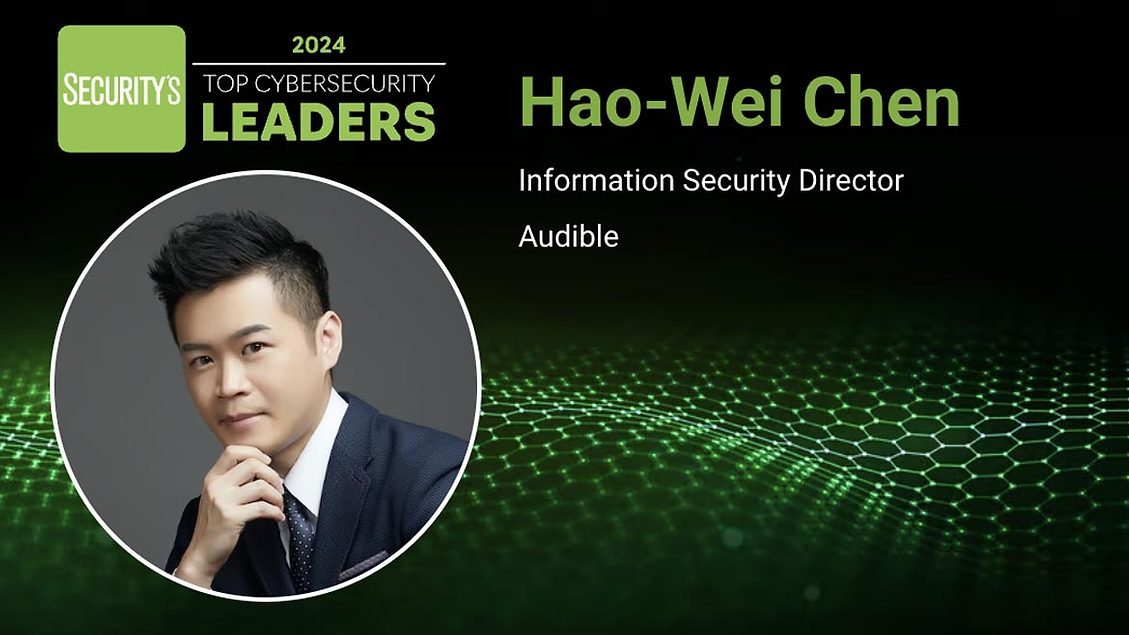
Hao-Wei Chen | Top Cybersecurity Leaders 2024

h3 { font-weight: bold; font-size: 18px; color: #C72026; } .w3-button{border:none;display:inline-block;padding:8px 16px;vertical-align:middle;overflow:hidden;text-decoration:none;color:inherit;background-color:inherit;text-align:center;cursor:pointer;white-space:nowrap} .w3-button{-webkit-touch-callout:none;-webkit-user-select:none;-khtml-user-select:none;-moz-user-select:none;-ms-user-select:none;user-select:none} .w3-button:hover{color:#000!important;background-color:#ccc!important} .w3-block{display:block;width:100%} .w3-red,.w3-hover-red:hover{color:#fff!important;background-color:#C72026!important}

With frequent childhood moves, Hao-Wei Chen had to learn how to adapt from an early age. He frequently experienced culture shock while attending different schools to accommodate his father’s career shifts, having to learn new languages alongside his regular studies.

Chen’s introduction to the security field came when he was 17. Chen’s introduction to the security field came when he was 17. Working as a developer and security tester, he launched the educational website Hacker.org.tw in Taiwan. Chen would ethically inform organizations of bugs located on their websites.

“There was one nonprofit organization that didn’t know how to fix the bug I reported. I consulted with them through phone calls, emails for a couple of weeks,” Chen says. The consultation landed Chen in a bit of trouble, as the organization doubted his original intentions of looking into the website. Once it was proven that Chen was attempting to do a good deed, the scrutiny went away and paved the path for him to pursue cybersecurity as a career.

BUILDING A SECURITY TEAM FROM THE GROUND UP

Chen moved to the U.S. to study cybersecurity at Carnegie Mellon University (CMU). Following graduation, Chen joined Amazon in 2014 as an Incident Response Engineer. Chen’s role included working within the “blue team” to protect the company from threats. Chen then switched to attack and research, and then moved to product security and investigations.

While working at Amazon, Chen advocated for creating a bug bounty program. Based on his own struggles from ethical hacking, Chen wanted to create a safe space for people to report security issues without fear of persecution. It was a challenge especially during the inception stage as Chen lacked resources. Chen conducted in-depth research and created data-driven justification to promote his idea. He relayed his pitch across leadership positions, eventually gaining access to funding to begin building out a team.

“When we eventually got the green light from a retail CEO, I built out a team from one to 10 people and then to launch Amazon’s first public bug bounty program. I didn’t give up because that was something I really wanted to do. It was not only for the company, or company’s customers, but the global security community,” Chen says.

Chen currently serves as the Director of Information Security at Audible, a position he took in August of 2023. Chen found that his previous Amazon positions provided him with the necessary skills to thrive. His role involves protecting company and consumer data. This includes building security best practices as well as incorporating security into the products themselves. In addition to prevention, Chen’s role involves responding to incidents and creating plans to avoid them in the future.

“Our job is to safeguard customer data, and ensure the trust customers put in us. We wanted to ensure that customers could use our products securely, and they’re confident in our websites and our products,” Chen says. This management includes dozens of devices, including those owned by subsidiaries. Chen emphasizes the importance of understanding the scope of his work and the threats he needs to be aware of.

THE IMPORTANCE OF MULTINATIONAL SECURITY PARTNERSHIPS

Chen holds a lot of pride for his home of Taiwan, using his knowledge and skills to collaborate with public and government.

“I learned security because of the geopolitical cyberattacks I was witnessing. I was actively participating on the advisory roles for public sectors in Taiwan. I was their cyber advisor for the Ministry of National Defense from 2021 to 2023, which is the ministry equivalent to the DOD. I also contributed to the National Security Council. There, I gathered experts from overseas to help consult on security-related issues, research, policy analysis and even technical reviews for the top decision-maker of the Taiwan government,” Chen says.

In addition to government partnerships, Chen also works closely with nonprofits. One organization he works with is the NEX Foundation, a nonprofit established in Seattle and Taipei. Chen worked to secure funding, build online products to provide mentorship and education opportunities. The organization provides career advice for students, including cybersecurity study groups for prospective security leaders.

One organization Chen is incredibly proud of is the Taiwan International Foundation based in D.C. The organization is focused on sharing Taiwanese culture and history with the public.

“I feel that there are a lot of gaps in terms of global understanding of Taiwan. Eventually, the Foundation’s goal is to establish the first ever physical museum in D.C., with Taiwan as the focus. I wanted to take on some security issues through different angles, such as education, and cultural attempts,” Chen says.

Looking to the future, Chen advises security leaders to continue to make threat actors’ lives harder. Cyberattacks aren’t 100% avoidable, but security leaders can work to continue to reduce the chances of an attack.

“I would say one difficult part of being in this industry is that we need to advance ourselves as well. We need to understand the latest threats, the attack surface, what tactics and procedures are leveraged by actors. We need to understand their motivations and the latest kind of technologies that they may be using. We need to be able to innovate or enact countermeasures in order to raise the bar,” Chen says.

← VIEW MORE 2024 TOP CYBERSECURITY LEADERS →https://www.securitymagazine.com/articles/100441-hao-wei-chen-top-cybersecurity-leaders-2024