Cyber security threats are predominantly as-a-service attacks

A recent report by Darktrace reveals the key threats businesses have faced in the past sixmonths. The report emphasizes the prevalence of as-a-service attacks, as a majority of malicious actors use Malware-as-a-Service (MaaS) and Ransomware-as-a-Service (Raas) to carry out attacks. These tools provide resources to attackers, such as pre-made malware or phishing templates. The report noted that following the dismantling of ransomware group Hive, new threats such as ScamClub and AsyncRAT emerged. 

The most widespread tools used by such attackers were malware loaders, which made up 77% of investigated threats. This was followed by cryptominers at 52%, botnets at 39%, information-stealing malware at 36% and proxy botnets at 15%. 

The report also discusses a rise in sophisticated phishing tactics. The report showed 10.4 million phishing emails between September and December of 2023. One such tactic includes Microsoft Teams phishing attempts, in which attackers pose as a victim’s co-worker and lure them in to clicking a malicious link. 

Another noted trend is the increase in multi-functioning malware, allowing attackers to cast a wide net and inflict maximum damage. As attackers shift toward the latest methods to bypass modern security measures, security teams must continue to adapt and innovate. 

Read the full report here. 

https://www.securitymagazine.com/articles/100390-cyber-security-threats-are-predominantly-as-a-service-attacks


Ransomware threats increased by twofold in 2023

According to a report by Cyble, ransomware threats increased in 2023, as incidents rose from 2,200 in 2022 to 4,200 in 2023. While 117 counties suffered attacks, the majority targeted the United States, the UK, Canada, Germany and Italy. These countries experienced 65% of the attacks in 2023, with the U.S. enduring the greatest number of incidents. 

All industry sectors were targets of ransomware attacks in 2023, but the sectors of professional services, manufacturing and construction suffered the most attacks. Meanwhile, the healthcare, transportation & logistics and energy & utilities sectors faced the most intense incidents. 

Prominent ransomware groups were responsible for 42% of the attacks, however, as many as 32 new groups emerged. Many groups enacted aggressive extortion tactics by weaponizing cybersecurity regulations to tarnish an organization’s reputation and pressure them into paying a ransom. 

Although ransomware attacks were on the rise, law enforcement agencies were able to seize operations of groups such as Hive and RagnarLocker. Many ransomware groups struggled to maintain brand sustainability in the face of reduced ransom payments and increased law enforcement pressure, this pushing them from encryption to extortion. 

To learn more, read Cyble’s research report here. 

https://www.securitymagazine.com/articles/100389-ransomware-threats-increased-by-twofold-in-2023


Fort Lee employs ALPR tech for vehicle-centric investigations

The Fort Lee Police Department recently upgraded their automatic license plate recognition (ALPR) technology with Genetec’s AutoVu Cloudrunner vehicle-centric investigative system. Due to Fort Lee’s proximity to Manhattan, the Fort Lee Police Department struggled to manually sort through the expansive list of license plates that passed through their area. The adoption of the new technology has allowed them to minimize their investigative time and close cases faster. 

Fort Lee Police Department Lieutenant Thomas Porto shared one such case that was benefited by the technology. After being alerted of suspicious individuals in a vehicle on housing facility property, they were able to access the nearest camera to pinpoint the location, time frame and vehicle description to match it to a stolen vehicle. The suspects were apprehended soon after. 

To reduce the use of investigative time and resources, the technology’s audit features only require officers to enter a case number once. Any additional searches in that query will be matched to the case number so users don’t have to reenter the case number for every search. 

https://www.securitymagazine.com/articles/100388-fort-lee-employs-alpr-tech-for-vehicle-centric-investigations


SPF, DKIM, DMARC: la triade dei protocolli per la sicurezza email


Il Simple Mail Transfer Protocol, comunemente noto con l’acronimo SMTP, rappresenta il fondamento della comunicazione email su Internet.
Creato negli anni ’80, questo protocollo è essenziale per la trasmissione “affidabile” e efficiente dei messaggi elettronici da un mittente a un destinatario.
SMTP costituisce il linguaggio universale che consente ai server di posta elettronica di scambiarsi informazioni e garantire la consegna rapida e sicura delle email senza tuttavia prevedere una verifica del mittente.

Per questo motivo, in tempi più recenti, sono stati sviluppati diversi protocolli di sicurezza, tra cui SPF, DKIM e DMARC, che lavorano insieme per garantire una maggiore autenticità e protezione contro le minacce online

SPF (Sender Policy Framework)

Il Sender Policy Framework (SPF) è un protocollo progettato per prevenire la falsificazione degli indirizzi email. Funziona attraverso la creazione di record DNS che specificano quali server sono autorizzati a inviare messaggi a nome di un dominio specifico.
Quando un messaggio viene ricevuto, il server di destinazione verifica il record SPF del dominio mittente per assicurarsi che l’invio provenga da un server autorizzato. Se il server non è incluso nell’elenco, il messaggio potrebbe essere considerato sospetto e respinto.

DKIM (DomainKeys Identified Mail)

Il DomainKeys Identified Mail (DKIM) è un altro protocollo di autenticazione che mira a prevenire la falsificazione degli indirizzi email, ma si concentra sulla validità del contenuto del messaggio.
Con DKIM, il mittente appone una firma digitale al messaggio utilizzando una chiave privata, mentre il server di destinazione verifica la firma utilizzando la chiave pubblica presente nel record DKIM del dominio mittente. Se la firma è valida, il messaggio è autenticato e considerato più affidabile.

DMARC (Domain-based Message Authentication, Reporting, and Conformance)

DMARC è un protocollo che unisce SPF e DKIM, fornendo un livello aggiuntivo di sicurezza. DMARC consente ai proprietari di dominio di dichiarare le politiche di autenticazione e specificare come gestire i messaggi che non superano le verifiche di SPF e DKIM.
Con DMARC, è possibile impostare regole per indicare se un messaggio sospetto deve essere consegnato, contrassegnato come sospetto o respinto del tutto. Inoltre, DMARC fornisce rapporti dettagliati sull’attività di autenticazione, consentendo ai proprietari di dominio di monitorare e migliorare continuamente la sicurezza delle proprie comunicazioni via email.

Implicazioni e Vantaggi

L’implementazione combinata di SPF, DKIM e DMARC offre diversi vantaggi in termini di sicurezza della posta elettronica. Innanzitutto, riduce significativamente il rischio di phishing e spoofing, in quanto i messaggi fraudolenti sono più facilmente identificabili e respinti.
Contribuisce a migliorare la reputazione del dominio, poiché dimostra agli altri server di posta elettronica che si sta prendendo sul serio la sicurezza e l’autenticità delle proprie comunicazioni.

In conclusione, l’implementazione congiunta di SPF, DKIM e DMARC è cruciale per garantire un ambiente di posta elettronica sicuro e affidabile.
Le aziende dovrebbero considerare l’adozione di questi protocolli come parte integrante delle loro strategie di sicurezza informatica per proteggere la propria reputazione online e prevenire potenziali minacce alla sicurezza.

Articolo a cura di Francesco Guiducci | LinkedIn | YouTube

Condividi l’articolo


Articoli correlati

Altro in questa categoria


https://www.securityinfo.it/2024/02/09/spf-dkim-dmarc-la-triade-dei-protocolli-per-la-sicurezza-email/?utm_source=rss&utm_medium=rss&utm_campaign=spf-dkim-dmarc-la-triade-dei-protocolli-per-la-sicurezza-email


G7 ed elezioni in Italia, i rischi maggiori sulla sicurezza informatica in Italia nel 2024

Anche quest’anno il contesto geopolitico e sociale sarà fortemente condizionato da eventi di grande rilevanza, come il G7 in Italia, le elezioni europee e regionali nel nostro Paese e i conflitti internazionali. L’Intelligenza Artificiale (AI) sarà essenziale per il progresso digitale, ma rappresenterà anche una nuova fonte di possibili attacchi. Inoltre, si prevede un aumento degli attacchi alla Supply Chain a causa della maggiore digitalizzazione della catena di approvvigionamenti.

Questo emerge dal report “Prospettive 2024: scenari politici, geopolitici e sicurezza informatica in Italia – Analisi dei rischi e tendenze”, realizzato dall’azienda BeDisruptive, dove vengono analizzati i principali Use Cases di eventi avvenuti nell’anno passato (2023), con l’obiettivo di fornire a tutti i responsabili della cybersecurity una panoramica chiara, concisa e accurata del 2024 in Italia.

Dal report emergono come significativi quattro eventi: le elezioni del Parlamento Europeo, il summit del G7 in Puglia le elezioni Regionali e amministrative e il collocamento dell’Italia all’interno dei principali scenari bellici mondiali (in particolar modo la Guerra tra Russia e Ucraina e il conflitto tra Israele ed Hamas). Questi eventi contribuiranno ad aumentare l’interesse dei gruppi hacker e concorreranno ad ampliare l’impatto della criminalità informatica nel nostro Paese.

Il 2024 segna una fase cruciale nell’evoluzione tecnologica con la diffusione su vasta scala dell’Intelligenza Artificiale (IA) che ci traghetta verso l’inizio della quinta rivoluzione industriale. Se da una parte questa evoluzione è ottimale per aumentare la digitalizzazione, dall’altra l’IA espone inevitabilmente l’Italia a minacce sempre più sofisticate ed efficaci. L’utilizzo di strumenti AI generativi da parte dei malintenzionati rende le loro “esche” più convincenti perciò si stima che la diffusione di malware attraverso campagne di phishing è destinata a perdurare ed il margine di successo ad aumentare.

Italia protagonista di un’agenda politica intensa

Le elezioni politiche Europee e le elezioni in alcune delle regioni italiane prevedono un aumento della destabilizzazione sociale e politica a causa di possibili campagne di disinformazione orchestrate da threat actor durante il periodo elettorale. Il terreno è fertile anche grazie ai numeri: il 62% degli italiani è propenso a recarsi alle urne, e molti di loro sono incerti su quale partito votare.

Il G7 in Italia vedrà i principali Capi di Stato nel nostro Paese in diverse date da aprile a giugno; all’interno dell’agenda spiccano i temi riferiti ai principali conflitti e dai gruppi terroristici che li sostengono. L’obiettivo ultimo della Premier italiana Giorgia Meloni è quello di conferire al nostro Paese il ruolo geo-strategico di ponte naturale tra continente africano e Occidente. Questo comporterà una serie di rischi per il nostro Paese: uno di essi, come analizzato nel rapporto, è rappresentato dalla minaccia di spionaggio perpetrato da paesi stranieri tramite le APT (Advanced Persistent Threat).

Per Carolina Andrade, CTI Analyst di BeDisruptive, “Nel primo semestre del 2023, secondo il rapporto Clusit, si è osservato un notevole aumento del 40% negli attacchi informatici in Italia rispetto al 2022. È rilevante sottolineare che la percentuale di crescita degli attacchi mirati a obiettivi italiani supera quella osservata a livello globale, la quale è stata dell’11% nello stesso periodo di riferimento. Il contesto si complica ulteriormente quest’anno, considerando l’avvicinarsi di rilevanti eventi nazionali e mondiali come il G7, le elezioni europee e regionali e le Olimpiadi in corso.

Questi imminenti eventi di portata internazionale aumentano significativamente la vulnerabilità dell’Italia a rischi informatici, quali attacchi di hacktivism, che, già nel primo semestre del 2023, hanno evidenziato un incremento del 5% rispetto al 2022. La crescente attenzione mediatica e l’ampia partecipazione digitale legate a tali avvenimenti rendono il nostro Paese suscettibile ad un incremento di attività malintenzionate, richiedendo un rafforzamento delle misure di sicurezza informatica.”

Supply Chain un terreno profittevole per gli hacker

Si prevede che, in linea con il trend degli ultimi anni, gli attacchi alla supply chain aumenteranno ulteriormente nel corso del 2024. Difatti, grazie alla progressiva digitalizzazione delle catene di approvvigionamento, i criminali informatici si stanno focalizzando sempre di più su di esse. L’appetibilità di questi attacchi risiede nel fatto che, sfruttando le vulnerabilità di una rete interconnessa di fornitori e clienti, gli hacker possono infiltrarsi in più aziende attraverso un unico punto di compromissione. Durante il 2023, l’attacco del gruppo ransomware LockBit ai danni del fornitore della PA italiana Westpole si è configurato come un attacco alla supply chain particolarmente importante nell’ambito del contesto italiano, nel report (link) viene analizzato e approfondito.

Per scaricare il report completo: https://www.bedisruptive.com/wp-content/uploads/2024/02/BeDisruptive-Prospettive-2024-Analisi-dei-rischi-e-tendenze.pdf

Condividi sui Social Network:

https://www.ictsecuritymagazine.com/notizie/g7-ed-elezioni-in-italia-i-rischi-maggiori-sulla-sicurezza-informatica-in-italia-nel-2024/


The voices of security

@import url(‘https://fonts.googleapis.com/css2?family=Nunito+Sans:ital,opsz,wght@0,6..12,400;0,6..12,500;0,6..12,600;0,6..12,700;1,6..12,400;1,6..12,500;1,6..12,600;1,6..12,700&family=Nunito:ital,wght@0,400;0,500;0,600;0,700;1,400;1,500;1,600;1,700&display=swap’); h3 { font-weight: bold; font-size: 18px; color: #C72026; } .pod { width: 100%; border: solid 2px #99c2ff; padding: 7px; margin: 20px 0; Nunito Sans’, sans-serif; justify-content: center; background-color: #cce0ff; }

As one of the preeminent security executive publications, the editorial team at Security magazine works to center the voices of security leaders via as many routes as possible. One of these avenues is via our podcast channel, The Security Podcasts.

In addition to our monthly eMagazine and constant web coverage, Security magazine releases bite-sized podcast episodes featuring cybersecurity and physical security leaders from across the industry. From team leadership advice to explorations of emerging security threats, our podcast guests share stories from their careers for the betterment of the industry at large.

The episodes below represent a selection of dynamic conversations Security editors have had with security professionals about current trends, predictions for the future of the industry, and more.

“If your image of a hacker is still the disaffected 20-something living in his mother’s basement, that’s not the adversaries that we’re talking about.”
— Michael Daniel, President & CEO at Cyber Threat Alliance

Strong Security Posture Means Building Effective Partnerships

Michael Daniel, President & CEO at Cyber Threat Alliance, discusses sharing threat intelligence with other organizations, as well as the challenges faced when establishing effective partnerships in the security industry.

“Interdepartmental collaboration is a vital piece of having a successful security department in healthcare. Our officers really touch every facet of the organization.”
— Holly Rasche, Director of Security Management Services at Northwest Community Healthcare

AMA: Healthcare Security Leader Edition — Holly Rasche

What are the unique challenges of securing a healthcare environment? How do you keep security team morale up? What are the most rewarding parts of a career in hospital security? This AMA episode features Holly Rasche, Director of Security Management Services at Northwest Community Healthcare. Rasche shares the lessons she’s learned from her 26-year career in hospital security, covering topics from how COVID-19 changed the security landscape to the benefits/challenges of contract vs. proprietary security guards in healthcare.

“Cybersecurity leaders in general have this image in their head of what they want. ‘I need a CISSP. I need someone that’s been in the industry from 10 to 15 years… In reality, sometimes your best [cybersecurity team] members don’t have that kind of experience.”
— George Gerchow, Chief Security Officer at Sumo Logic

How to Build Future Security Leaders

What challenges do aspiring cybersecurity leaders face while trying to join the field? What can current security leaders do to help them? Answer these questions and more with George Gerchow, Chief Security Officer at Sumo Logic.

“For the first time in history, criminal gangs can launder hundreds of millions instantly with absolutely no concern.”
— Lisa Forte, Partner at Red Goat Security

The Cybersecurity and Geopolitical Discussion — Inside Cryptocurrency — Episode 18

Welcome to the enigmatic and frequently problematic world of cryptocurrency. In Episode 18 of The Cybersecurity & Geopolitical Discussion, Lisa Forte, Partner at Red Goat Security, Phil Ingram, MBE, of Grey Hare Media and Ian Thornton-Trump CD, Chief Information Security Officer (CISO) at Cyjax discuss the wide-ranging impact crypto has on geopolitical and economic conflict.

Take a listen and subscribe to our podcast channel for high-level, strategic security content directly from experts in the field. New episodes are released on Wednesdays directly to the Security magazine website, Spotify and Apple Podcasts. Don’t forget to rate and review The Security Podcasts on Spotify and Apple Podcasts to support future episodes.

https://www.securitymagazine.com/articles/100366-the-voices-of-security


Learning to say “no” in your security career

.w3-panel:after,.w3-panel:before { content: “”; display: table; clear: both } .w3-panel { padding: 16px } .w3-panel { margin-top: 16px; margin-bottom: 16px } .w3-leftbar { border-left: 6px solid #58526F!important } .w3-sand,.w3-hover-sand:hover { color: #58526f!important; background-color: #e3e2e9!important } .w3-xlarge { font-size: 24px!important } .w3-xxlarge { font-size: 36px!important } .w3-sans-serif { Nunito Sans’,Arial,sans-serif } .w3-opacity,.w3-hover-opacity:hover { opacity: 0.60 }

Security has the reputation of being the “Department of ‘No.’” No, that risk is too great. No, we can’t take the chance. No, the likelihood of failure is too high. Most of us in the profession believe that the role of the security executive is not to say “no,” but to lay out the risks, costs, relevant factors and let the business or asset owner make an informed decision whether to go forward.

On a personal level, however, it’s imperative to sometimes offer a firm “no.” Not on whether to take a risk, but whether to take on a new role or responsibility, volunteer at an association, earn a credential present at a conference, help with a job search, write an article, or take on a mentee.

During the COVID-19 pandemic, security departments found themselves with new duties, some of which naturally aligned with their mission — such as business continuity — and some that appeared to be one-offs, such as enforcing masking rules and making decisions on air filtration. In the aftermath, some security departments gained lasting health and safety duties without a concomitant increase in resources. In an emergency, saying no can kill your career and cripple your employer.

But most of the requests we receive don’t involve emergencies.

We all want to prove our value, pull our weight, support the team. Most of us are inherent helpers, protectors, and all-around doers. It’s in our DNA. But saying no appropriately and strategically goes to the heart of leadership.

I should know. I’ve never mastered it. And I’m not alone.

I asked a couple of colleagues to weigh in on this issue — a C suite advisor/consultant and a corporate security executive.


Saying yes to yourself is critical, and you only have time to say that if you give yourself permission to say no to others.”
— Angela Scalpello

“I have to admit, I also struggle with saying no,” says Angela Scalpello, a Corporate Advisor who often works with security professionals. She has developed a system for evaluating requests for her time and assistance. “I ask for more time. Then I sit with the feeling of ‘how will I feel if I say yes?’” she explains. “If it’s overwhelmed, or stressed, or slightly resentful, I know I need to say no.” The process doesn’t end there. “Then I sit again, and if I feel I need to make time [for the request], I feel more guided.”

What about the feeling of guilt or sense you’ve let someone down?

“Sometimes I think, ‘Why is everyone else allowed to say no except me?’” Scalpello says. “The ability to choose wisely makes us more effective in the things we say yes to.”

As a security leader, Farhad Tajali, Director, Global Security Systems and Data Analytics at Creative Artists Agency, must team with various internal stakeholders as well as executive leadership. He notes that saying “yes” Is often seen as a facilitator of business and positive collaboration. But saying no is critical for being an effective leader. Saying no may be a way to uphold standards and protocols, prevent overextension of resources, and “protect against security threats that may arise from taking on too many projects and commitments,” Tajali says. “Additionally, saying no can help maintain strategic focus, ensuring that the organization’s security posture aligns with its overall goals and risk tolerance.”

Saying yes to everyone and everything also takes a personal toll. “Self-care, especially in [the security] profession, is really important,” Scalpello says. “Saying yes to yourself is critical, and you only have time to say that if you give yourself permission to say no to others.”

Letting someone down is easier if you don’t make it personal. If your boss asks you to do something that is voluntary or tangential to your job, an effective response might be that you fear that you may not be able to accomplish the task at your traditional level of excellence given constraints such as time and resources. In that case, saying no benefits the department and the organization.

For requests that don’t come from a direct superior, such as to co-present at a conference or actively help them search for a job, Scalpello sums it up nicely: “The question to ask yourself is, do I really believe in the person and the purpose, and do I really have the bandwidth to do this?”

https://www.securitymagazine.com/articles/100369-learning-to-say-no-in-your-security-career


A password manager LastPass calls “fraudulent” booted from App Store

A password manager LastPass calls “fraudulent” booted from App Store
Getty Images

As Apple has stepped up its promotion of its App Store as a safer and more trustworthy source of apps, its operators scrambled Thursday to correct a major threat to that narrative: a listing that password manager-maker LastPass said was a “fraudulent app impersonating” its brand.

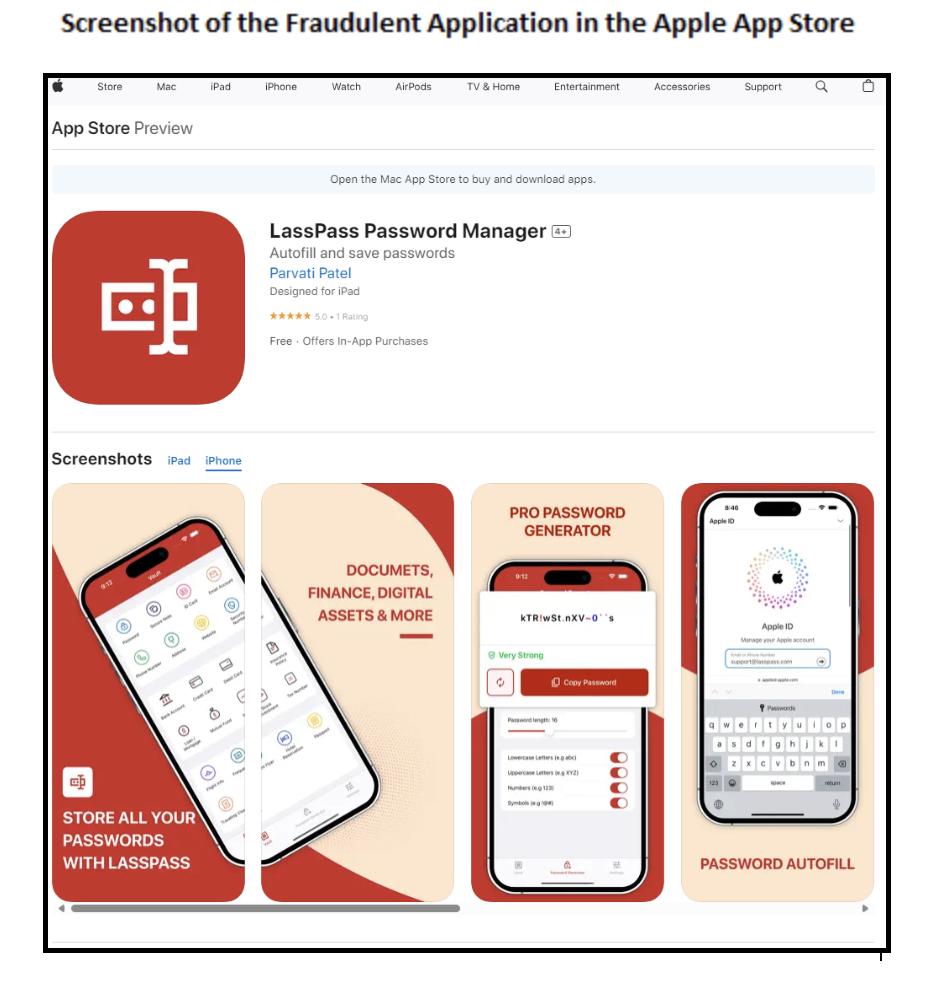
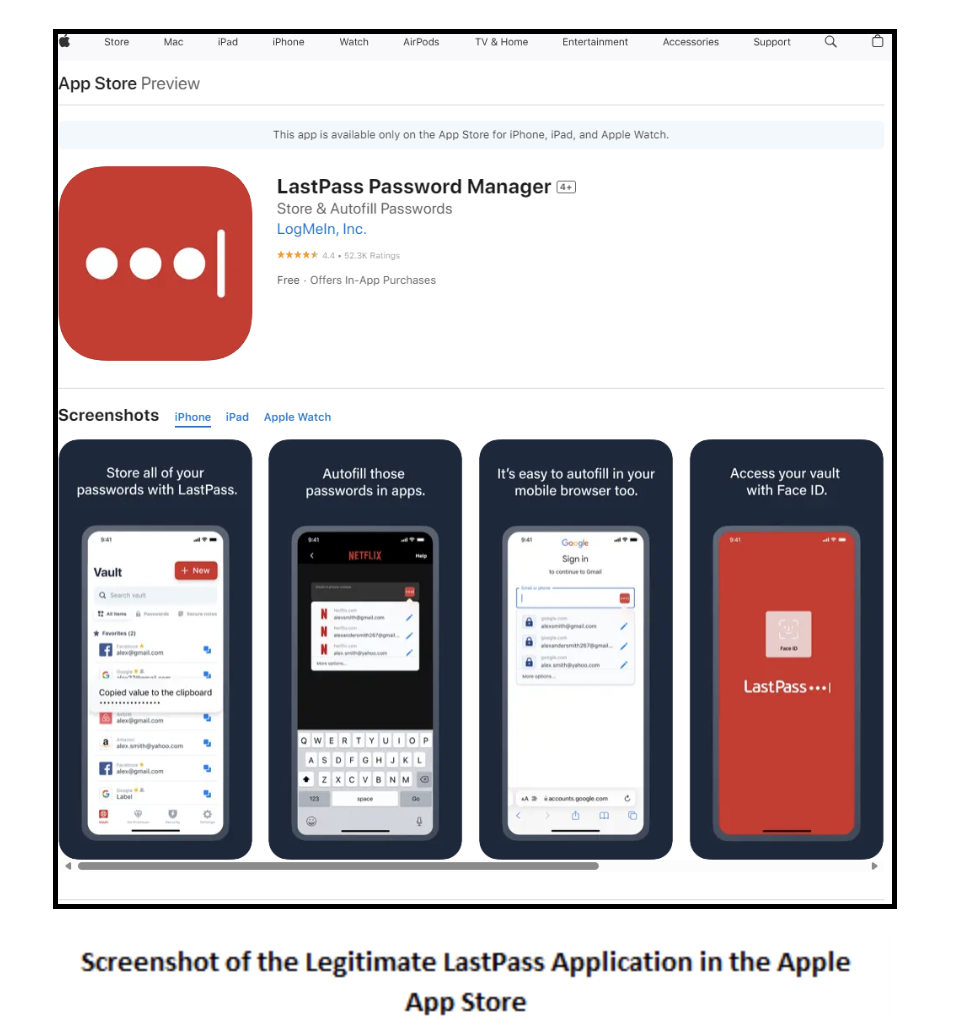
At the time this article on Ars went live, Apple had removed the app—titled LassPass and bearing a logo strikingly similar to the one used by LastPass—from its App Store. At the same time, Apple allowed a separate app submitted by the same developer to remain. Apple provided no explanation for the reason for removing the former app or for allowing the latter one to remain.

Apple warns of “new risks” from competition

The move comes as Apple has beefed up its efforts to promote the App Store as a safer alternative to competing sources of iOS apps mandated recently by the European Union. In an interview with App Store head Phil Schiller published this month by FastCompany, Schiller said the new app stores will “bring new risks”—including pornography, hate speech, and other forms of objectionable content—that Apple has long kept at bay.

“I have no qualms in saying that our goal is going to always be to make the App Store the safest, best place for users to get apps,” he told writer Michael Grothaus. “I think users—and the whole developer ecosystem—have benefited from that work that we’ve done together with them. And we’re going to keep doing that.”

Somehow, Apple’s app-vetting process—long vaunted even though Apple has provided few specifics—failed to spot the LastPass lookalike. Apple removed LassPass Thursday morning, two days, LastPass said, after it flagged the app to Apple and one day after warning its users the app was fraudulent.

“We are raising this to our customers’ attention to avoid potential confusion and/or loss of personal data,” LastPass Senior Principal Intelligence Analyst Mike Kosak wrote.

There’s no denying that the logo and name were strikingly similar to the official ones. Below is a screenshot of how LassPass appeared, followed by the official LastPass listing:

The LassPass entry as it appeared in the App Store.
Enlarge / The LassPass entry as it appeared in the App Store.
The official LastPass entry.
Enlarge / The official LastPass entry.

Here yesterday, gone today

Thomas Reed, director of Mac offerings at security firm Malwarebytes, noted that the LassPass entry in the App Store said the app’s privacy policy was available on bluneel[.]com, but that the page was gone by Thursday, and the main page shows a generic landing page. Whois records indicated the domain was registered five months ago.

There’s no indication that LassPass collected users’ LastPass credentials or copied any of the data it stored. The app did, however, provide fields for users to enter a wealth of sensitive personal information, including passwords, email and physical addresses, and bank, credit, and debit card data. The app had an option for paid subscriptions.

A LastPass representative said the company learned of the app on Tuesday and focused its efforts on getting it removed rather than analyzing its behavior. Company officials don’t have information about precisely what LassPass did when it was installed or when it first appeared in the App Store.

The App Store continues to host a separate app from the same developer who is listed simply as Parvati Patel. (A quick Internet search reveals many individuals with the same name. At the moment, it wasn’t possible to identify the specific one.) The separate app is named PRAJAPATI SAMAJ 42 Gor ABD-GNR, and a corresponding privacy policy (at psag42[.]in/policy.html) is dated December 2023. It’s described as an “application for Ahmedabad-Gandhinager Prajapati Samaj app” and further as a “platform for community.” The app was also recently listed on Google Play but was no longer available for download at the time of publication. Attempts to contact the developer were unsuccessful.

There’s no indication the separate app violates any App Store policy. Apple representatives didn’t respond to an email asking questions about the incident or its vetting process or policies.

https://arstechnica.com/?p=2002178


Report: Blocked IP addresses increased by 116.42%

A new report recently released by Qrator Labs reveals an increase in blocked IP addresses associated with malicious activity. The United States is within the top 10 countries originating these cyber attacks, with 5.66 million blacklisted IP addresses. It was followed by China (4.97 million), Germany (1.39 million), Indonesia (1.32 million) and Singapore (1.03 million). Notable newcomers include Israel (483,000), Poland (377,000) and Bangladesh (340,000). 

This geographical distribution confirms a trend observed in Q2: malicious actors are increasingly using local traffic sources to bypass geo-blocking.  

The report also investigated the locations of the largest botnets. The report showed that India was at the top with 10,671 devices, though it was closely followed by Indonesia, Russia and the U.S. 

Attackers are focusing on efficiency rather than brute force, opening the door for new attacks to emerge. 

Read the full report here.

https://www.securitymagazine.com/articles/100387-report-blocked-ip-addresses-increased-by-11642


L’intelligenza artificiale sempre più al servizio del cybercrimine


L’intelligenza artificiale ha potenziato gli attacchi di phishing e provocato un’impennata degli attacchi via e-mail: a dirlo è l’ultimo report di Acronis, “Incessante aumento degli attacchi informatici: PMI e MSP nel mirino”. L’indagine ha coinvolto più di un milione di endpoint dislocati in 15 paesi e ha evidenziato che il phishing potenziato dall’intelligenza artificiale ha colpito più del 90% delle organizzazioni, contribuendo a un aumento del 222% degli attacchi tramite e-mail nel secondo semestre del 2023 rispetto allo stesso periodo del 2022.

“La tendenza in atto a livello globale è preoccupante: i criminali continuano a sfruttare ChatGPT e sistemi di AI generativa simili per creare codice dannoso e sferrare attacchi più efficaci e automatizzati” afferma Candid Wüest, Vicepresidente di Acronis Product Management. “Mai come ora, è prioritario che le aziende utilizzino soluzioni di Cyber Protection complete per garantire la propria continuità operativa”.

Le principali minacce del periodo luglio-dicembre 2023

Anche se il numero di varianti e nuovi gruppi è diminuito, il ransomware si è riconfermata una delle principali minacce per medie e grandi imprese. I gruppi ransomware hanno colpito settori strategici come la pubblica amministrazione e la sanità, continuando a causare perdite di dati e denaro in tutto il mondo.

Tra i gruppi più attivi figurano LockBit, Cl0p, BlackCat, Play e 8Base. L’attacco a Westpole, provider italiano di servizi cloud, è solo un esempio della pericolosità dei ransomware: l’incidente ha messo in crisi i servizi di 1.300 amministrazioni pubbliche e ha avuto ripercussioni piuttosto pesanti sui pagamenti degli stipendi.

ransomware

Pixabay

Il furto di dati è la seconda minaccia più diffusa e la causa della maggior parte delle violazioni di dati. È aumentato inoltre l’uso di sistemi di intelligenza artificiale generativa, in particolare ChatGPT, per sviluppare codice dannoso e avviare gli attacchi. I cybercriminali usano anche strumenti più specializzati, come WormGPT, FraudGPT, DarkEERT, DarkBART e ChaosGPT per abusare delle capacità dell’IA.

Tra le realtà più colpite ci sono gli MSP, come dimostra una delle ultime violazioni che ha colpito numerose agenzie governative degli Stati Uniti. I cybercriminali hanno sfruttato le vulnerabilità degli account di posta elettronica di Microsoft violando 60.000 e-mail legate a 10 account del Dipartimento di Stato degli U.S.A.

Per quanto riguarda gli attacchi malware, i Paesi più colpiti sono stati Singapore, Spagna e Brasile. Nello stesso periodo Acronis ha bloccato quasi 28 milioni di URL sugli endpoint, un calo del 36% rispetto al quarto trimestre del 2022.

L’intelligenza artificiale nel futuro del cybercrimine

Acronis anticipa un’intensificazione degli attacchi con tattiche avanzate, in particolare quelli basati su IA, quelli alla supply chain e il cyberspionaggio di gruppi legati ai governi.

Il report mette in guardia in particolare gli MSP, i quali si troveranno a far fronte a minacce specifiche contro la loro attività; tra queste spiccano l’island hopping, un attacco che sfrutta l’infrastruttura di un MSP per attaccare i suoi clienti, e lo stuffing di credenziali che sfrutta l’ampio accesso ai sistemi che hanno queste realtà.

Pixabay

Secondo l’indagine, le imprese sono ancora molto carenti in termini di soluzioni di sicurezza capaci di intercettare lo sfruttamento delle vulnerabilità zero day; inoltre, un problema molto diffuso è il ritardo nell’applicare le patch di sicurezza che consente ai cybercriminali di infiltrarsi nei sistemi e sottrarre dati sensibili.

Acronis ricorda che le tecnologie di rilevamento comportamentale e di rilevazione degli exploit possono evitare gran parte di questi attacchi e sono quindi indispensabili per avere delle difese all’avanguardia.

Condividi l’articolo


Articoli correlati

Altro in questa categoria


https://www.securityinfo.it/2024/02/08/l-intelligenza-artificiale-sempre-piu-al-servizio-del-cybercrimine/?utm_source=rss&utm_medium=rss&utm_campaign=l-intelligenza-artificiale-sempre-piu-al-servizio-del-cybercrimine