SAP Patches Critical ICM2SHELL, ProxyGate Vulnerabilities

Enterprise software maker SAP on Tuesday announced the release of 42 new and updated security notes, including nine that resolve critical-severity vulnerabilities.

Four of SAP’s new security notes address maximum-severity flaws in NetWeaver (Internet Communication Manager (ICM) and SAML2 Service Provider), Web Dispatcher, and Gateway.

The ICM and Web Dispatcher flaws, tracked as CVE-2026-76964 and CVE-2026-89126, are a single weakness in the SAP kernel component that receives HTTP, HTTPS, and WebSocket traffic.

According to Onapsis, which calls the security defect ICM2SHELL, the issue is related to reassembling large WebSocket messages, which may be split into fragments during a server-browser exchange and then put together by the receiver.

“A specially crafted sequence of WebSocket messages makes the ICM or the WD write attacker-controlled data past the end of the memory it reserved for the connection. Depending on how that data is shaped, the result is either an immediate crash of the process or controlled corruption of its memory,” Onapsis explains.

ICM2SHELL, the enterprise application security firm says, could allow an attacker to execute operating system commands with <sid>adm privileges.

Advertisement. Scroll to continue reading.

“This is not a theoretical outcome. The Onapsis Research Labs provided SAP a working exploit that achieves full, unauthenticated remote code execution end to end, running arbitrary commands as <sid>adm on the target system. The denial-of-service condition, in turn, reproduced on every SAP Kernel release tested,” Onapsis says.

The max-severity SAP Gateway flaw, tracked as CVE-2026-89103 and referred to as ProxyGate, could be exploited by unauthenticated attackers to achieve remote code execution (RCE) without user interaction.

It is related to the prxyinfo access-control list, which should restrict requests to trusted networks only. However, if left open, it allows an attacker to send a series of requests that appear to be originating from an internal network, tricking the gateway into accepting them.

This allows an attacker to execute OS commands with the <sid>adm privileges and gain full control over the SAP system, without providing a username, password, or certificate.

“Because the flaw is in the SAP kernel, it affects a broad range of releases, including kernel versions that are already out of maintenance. Further, the gateway runs not only on ABAP but also on AS Java, dual-stack, and standalone-gateway systems,” Onapsis explains.

SAP also resolved a max-severity missing authentication bug in NetWeaver (CVE-2026-120017) that, in certain configurations, could allow unauthenticated attackers to submit specially crafted data and impersonate arbitrary users, which could lead to full system compromise.

The remaining five critical notes in SAP’s November 2026 bulletin address vulnerabilities in NetWeaver (CVE-2026-109803 and CVE-2026-76965), S4CRM (CVE-2026-109795), Web Dispatcher (CVE-2026-89119), and BusinessObjects (CVE-2026-109798).

Additionally, SAP published 17 high-severity fixes, including for multiple memory corruption, denial-of-service (DoS), and information disclosure bugs.

Since the scheduled October 2026 security patches, SAP released new notes dealing with the recently disclosed PHP2Shell and Node2Shell vulnerabilities in its Business AI Platform and updated several other notes and advisories. This brings the total to 43 new and updated notes released this month, Onapsis notes in its analysis of the patches.

Related: Anthropic Rolls Out Mythos 5.2 With Improved Bug Hunting, Fewer Sandbox Escapes

Related: N-able Takes N-central Offline as Researcher Drops Over 30 Zero-Days

Related: IBM Aspera Faspex, SignalWire FreeSwitch Vulnerabilities Exploited in Attacks

Related: Chrome Update Patches Exploited XML Zero-Day, Eighth This Year

https://www.securityweek.com/sap-patches-critical-icm2shell-proxygate-vulnerabilities/



Over a Dozen Organizations Hit in Qubole Supply Chain Attack

A threat actor used the compromised IAM credentials for an AWS account associated with big-data platform Qubole to steal data from over a dozen organizations, cybersecurity researchers discovered.

The credentials allowed the attackers to assume IAM roles organizations had set up for Qubole’s AWS account and access their AWS environments.

Cross-account IAM roles are normal for SaaS platforms that operate within customers’ AWS environments. During onboarding, customers create a role for Qubole, and the vendor’s AWS account can assume the role when needed, typically via an External ID.

The leaked Qubole credentials allowed the threat actor to assume this role and pull data from the AWS environments of over a dozen companies.

“The doors the attacker used were old ones. Qubole roles were still in place long after companies had stopped using Qubole, and those roles could read nearly all of the data the attacker went after,” cybersecurity firm Sentra notes.

The roles stayed dormant until the campaign kicked off on October 14. They were used until October 26 to enumerate resources, collect secrets and configurations, and access data.

Advertisement. Scroll to continue reading.

The attacks came from a rented OVH server and the Mullvad VPN, and none of the observed activity originated from Qubole’s network, Sentra says.

“The threat actor used role session names that followed a consistent format of the prefix quiam-, followed by a suffix describing the actions taken. This includes session names such as quiam-enum and quiam-scope-full,” Wiz, which analyzed the campaign alongside Sentra, says.

Following enumeration, the attackers harvested secrets from common AWS storage locations, then used TruffleHog to test the credentials. Next, the threat actor exfiltrated data from the victims’ S3 buckets.

“The threat actor appears to have been opportunistic. Rather than looking for specific data, it read from whatever buckets each role could reach, in some cases downloading entire buckets in a single session,” Wiz says.

The cybersecurity firm also identified an ISO file designed to be remotely booted on victim machines to harvest data, but has no evidence of its deployment.

“Wiz has not identified any ties between this campaign and other publicly reported activity. The targeting and data theft appear opportunistic and do not match typical state-backed priorities; however, we don’t have any direct insight into the motivation of the threat actor or how they may use the stolen data,” the company says.

Wiz also discovered a separate campaign involving Qubole integrations, active between October 8 and October 11, in which customer-owned AWS access keys were tested against victim environments, and in some cases used for compromise.

Related: Malicious cPGuard Updates Served in OpsShield Supply Chain Attack

Related: Malicious Claude Code Extension Served in Cursor Supply Chain Attack

Related: LiteLLM Compromised in Fresh Supply Chain Attack

Related: AOMEI Backupper Compromised in Short-Burst Supply Chain Campaign

https://www.securityweek.com/over-a-dozen-organizations-hit-in-qubole-supply-chain-attack/


Anthropic Rolls Out Mythos 5.2 With Improved Bug Hunting, Fewer Sandbox Escapes

Anthropic says Mythos 5.2 improves vulnerability discovery while showing a lower tendency to escape sandboxes in controlled tests.

The post Anthropic Rolls Out Mythos 5.2 With Improved Bug Hunting, Fewer Sandbox Escapes appeared first on SecurityWeek.

https://www.securityweek.com/anthropic-rolls-out-mythos-5-2-with-improved-bug-hunting-fewer-sandbox-escapes/


N-able Takes N-central Offline as Researcher Drops Over 30 Zero-Days

Attackers could exploit the flaws for remote code execution, credential theft, and administrator account creation.

The post N-able Takes N-central Offline as Researcher Drops Over 30 Zero-Days appeared first on SecurityWeek.

https://www.securityweek.com/n-able-takes-n-central-offline-as-researcher-drops-over-30-zero-days/


Security Through Obscurity Is Dead. Long Live the King.

If your security program still relies on the assumption that your vulnerabilities are too complex or too hidden for attackers to find, you are operating on borrowed time.

https://www.securitymagazine.com/articles/102677-security-through-obscurity-is-dead-long-live-the-king


What the Midterm Results Could Mean for US Cybersecurity Policy

There are three shifts in cybersecurity policy the country may see following the most recent midterm election. 

https://www.securitymagazine.com/articles/102723-what-the-midterm-results-could-mean-for-us-cybersecurity-policy


Claude Code is accidentally exposing secrets all over GitHub

Claude Code is leaking sensitive information on public GitHub instances thanks to a partial oversight in the way its settings files are handled. That’s the finding of AI security researchers at Apiiro, who discovered thousands of secrets, including database passwords, API tokens, and root logins, amid Claude Code settings files embedded in GitHub repositories.

The leak stems from the way Claude Code handles user approval for automated shell commands. When a user chooses the “Yes, and don’t ask again” option to approve running a command, that choice gets stored as part of a rule in the local “.claude/settings.local.json” file on the user’s computer. That rule is sometimes coded as a pattern, but the command itself is often written to that settings file as is, including any sensitive information that may be embedded within it.

This isn’t really a significant security issue if the settings file stays on the user’s local machine (assuming that machine doesn’t become compromised itself, of course). And Anthropic notes in its Claude Code documentation that this particular settings file gets added to the developer’s global .gitignore list, which usually prevents it from being shared publicly.

But that .gitignore setting isn’t reflected at the repo level, meaning the sensitive file can be uploaded accidentally if a repo is cloned to another machine or a folder becomes a repo later, for instance. In many cases, Claude Code itself will commit changes to the settings file without the user’s input, Apiiro writes.

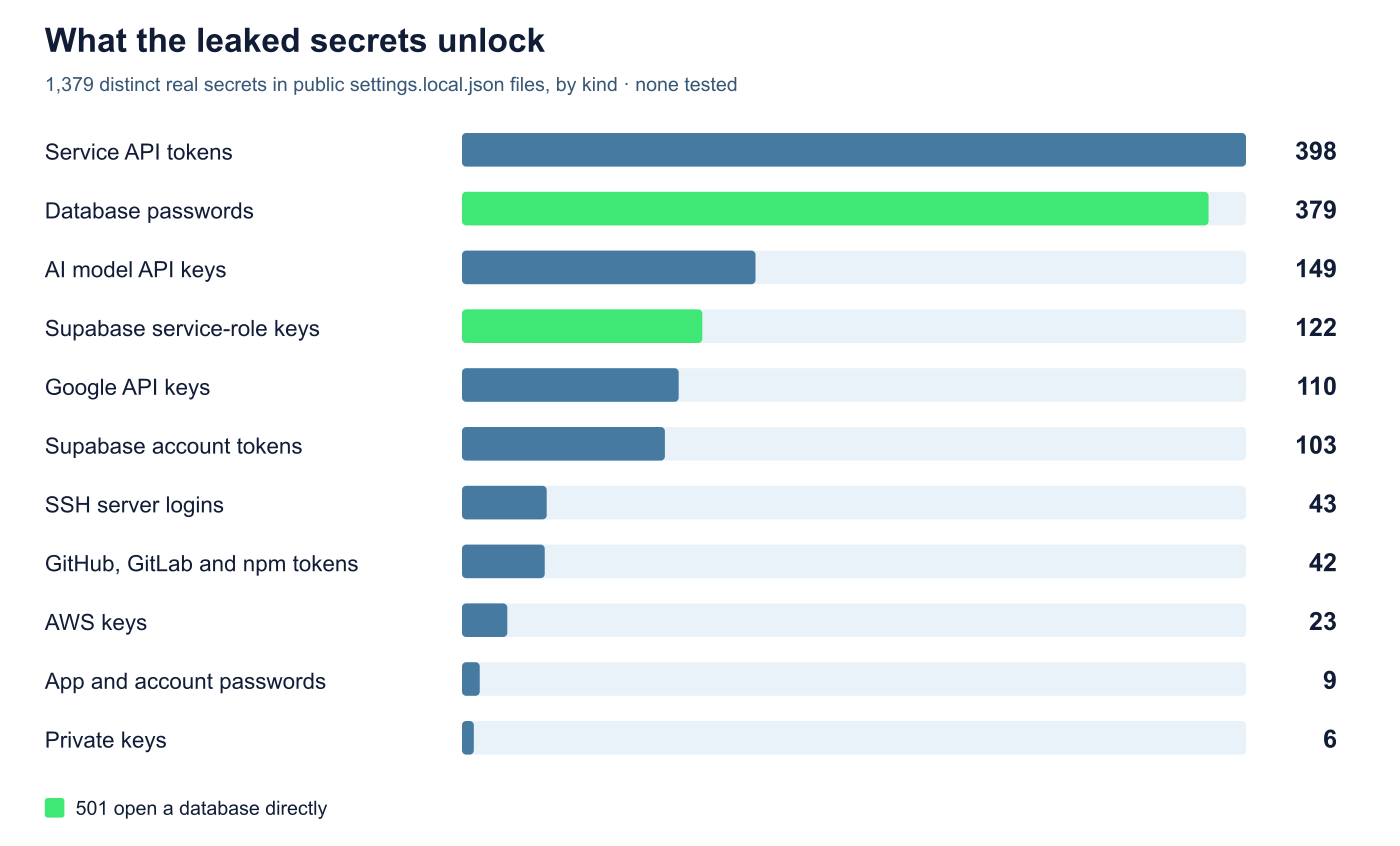
A breakdown of the kinds of secrets Apiiro found in publicly shared Claude Code settings files.

A breakdown of the kinds of secrets Apiiro found in publicly shared Claude Code settings files. Credit: Apiiro

Apiiro’s researchers found over 100,000 cases where Claude Code’s local settings file had been uploaded to a public GitHub repository. Of these, only about 1,100 from 63 different organizations contained secrets such as public API tokens, database passwords, or private keys. Even after these files are discovered and removed from a repository, the secrets can persist in forks of the original project if a GitHub user isn’t careful.

https://arstechnica.com/ai/2026/11/claude-code-settings-files-expose-thousands-of-secrets-on-github/


Revolve Puts Data Breach Victim Count at 1.5 Million

Online fashion retailer Revolve has informed the Indiana Attorney General’s Office that 1,515,073 individuals were impacted by the data breach it disclosed in October.

The company revealed the incident on October 29 in a filing with the US Securities and Exchange Commission (SEC). It started sending notification letters to impacted customers around the same time.

Revolve had not publicly shared a total. Its notices to regulators in Iowa, Massachusetts, South Carolina, Texas, and Vermont covered roughly 197,000 people combined.

The retailer says an unauthorized party broke into some of its systems, including its e-commerce platform, on September 11. Per the Indiana Attorney General’s records, Revolve became aware of the intrusion on September 29.

According to the company, the intruder may have relied on “automated means” to collect customers’ names and contact information, including mailing addresses, along with their card numbers and expiration dates.

The exposure is limited to shoppers who chose to store a payment method in their online accounts.

Advertisement. Scroll to continue reading.

Revolve reported the attack to federal law enforcement and enlisted external cybersecurity experts to help with its response. 

The company has yet to explain how the hackers got into its systems. So far, the attack has not been publicly claimed by any hacker group.

Related: Iris Plaza Breach May Have Exposed Data of 7.7 Million Customers

Related: Amplifon Americas Data Breach Impacts 1.3 Million

Related: Over 3 Million People Hit by Frontline Education Data Breach

https://www.securityweek.com/revolve-puts-data-breach-victim-count-at-1-5-million/


Plex2Shell Exploited Against QNAP NAS Users

Threat actors are exploiting Plex2Shell to hack into Plex Media Server applications on QNAP NAS devices, Taiwanese storage and networking solutions provider QNAP warns.

Plex2Shell is a chain of four vulnerabilities (CVE-2026-96652, CVE-2026-96654, CVE-2026-96655 and CVE-2026-96656) in Plex Media Server that was patched this summer.

Widespread exploitation of the four-flaw chain started in mid-October, after technical details and proof-of-concept (PoC) code were published.

Successful exploitation of Plex2Shell does not require valid credentials and could allow attackers to execute arbitrary code on exposed servers, with the privileges of the Plex service.

Plex Media Server is available as a third-party application to QNAP NAS users, through the official App Center.

“QNAP has received reports from some users that Plex Media Server on their NAS appears to have been compromised through these vulnerabilities,” the Taiwanese firm warned on Friday.

Advertisement. Scroll to continue reading.

“The QNAP Technical Support team is assisting affected users and has confirmed that no data loss has occurred. The QNAP Product Security Incident Response Team (QNAP PSIRT) has confirmed that the vulnerabilities exist only in Plex Media Server; QTS, QuTS hero, and other QNAP operating systems are not themselves affected,” it added.

QNAP NAS users are advised to update to Plex Media Server version 1.43.3 or later as soon as possible.

Devices accessible from the internet should be considered potentially compromised and Plex should be reinstalled, QNAP says, adding that the passwords for both Plex and the NAS should be immediately rotated.

“If you do not need remote access to Plex, disable Plex Remote Access and do not forward port 32400. If you do need remote access, use a VPN instead. Also make sure QTS or QuTS hero and all installed apps are up to date,” QNAP says.

The company has published a step-by-step remediation guide to help users identify and respond to potential compromises.

Related: Hackers Exploiting ‘SSHole’ Authentication Bypass in OpenSSH

Related: Chrome 157 Rolls Out With 213 Security Fixes, Seven Rated Critical

Related: Critical Node-RED Flaw Exploited in Attacks

Related: Ivanti Patches Two More Zero-Days Exploited in Connect Secure Attack Chain

https://www.securityweek.com/plex2shell-exploited-against-qnap-nas-users/


Brava Security Emerges From Stealth With $15 Million in Funding

Its multi-agent AI platform generates the telemetry an attack would produce to fix gaps in enterprise defenses.

The post Brava Security Emerges From Stealth With $15 Million in Funding appeared first on SecurityWeek.

https://www.securityweek.com/brava-security-emerges-from-stealth-with-15-million-in-funding/