Critical vulnerability affecting most Linux distros allows for bootkits

Critical vulnerability affecting most Linux distros allows for bootkits

Linux developers are in the process of patching a high-severity vulnerability that, in certain cases, allows the installation of malware that runs at the firmware level, giving infections access to the deepest parts of a device where they’re hard to detect or remove.

The vulnerability resides in shim, which in the context of Linux is a small component that runs in the firmware early in the boot process before the operating system has started. More specifically, the shim accompanying virtually all Linux distributions plays a crucial role in secure boot, a protection built into most modern computing devices to ensure every link in the boot process comes from a verified, trusted supplier. Successful exploitation of the vulnerability allows attackers to neutralize this mechanism by executing malicious firmware at the earliest stages of the boot process before the Unified Extensible Firmware Interface firmware has loaded and handed off control to the operating system.

The vulnerability, tracked as CVE-2023-40547, is what’s known as a buffer overflow, a coding bug that allows attackers to execute code of their choice. It resides in a part of the shim that processes booting up from a central server on a network using the same HTTP that the Internet is based on. Attackers can exploit the code-execution vulnerability in various scenarios, virtually all following some form of successful compromise of either the targeted device or the server or network the device boots from.

“An attacker would need to be able to coerce a system into booting from HTTP if it’s not already doing so, and either be in a position to run the HTTP server in question or MITM traffic to it,” Matthew Garrett, a security developer and one of the original shim authors, wrote in an online interview. “An attacker (physically present or who has already compromised root on the system) could use this to subvert secure boot (add a new boot entry to a server they control, compromise shim, execute arbitrary code).”

Stated differently, these scenarios include:

  • Acquiring the ability to compromise a server or perform an adversary-in-the-middle impersonation of it to target a device that’s already configured to boot using HTTP
  • Already having physical access to a device or gaining administrative control by exploiting a separate vulnerability.

While these hurdles are steep, they’re by no means impossible, particularly the ability to compromise or impersonate a server that communicates with devices over HTTP, which is unencrypted and requires no authentication. These particular scenarios could prove useful if an attacker has already gained some level of access inside a network and is looking to take control of connected end-user devices. These scenarios, however, are largely remedied if servers use HTTPS, the variant of HTTP that requires a server to authenticate itself. In that case, the attacker would first have to forge the digital certificate the server uses to prove it’s authorized to provide boot firmware to devices.

The ability to gain physical access to a device is also difficult and is widely regarded as grounds for considering it to be already compromised. And, of course, already obtaining administrative control through exploiting a separate vulnerability in the operating system is hard and allows attackers to achieve all kinds of malicious objectives.

https://arstechnica.com/?p=2001542


Cloudflare conferma l’attacco ai propri sistemi dopo il breach di Okta


Cloudflare ha confermato che il proprio server Atlassian è stato violato dopo l’attacco a Okta del 18 ottobre scorso. Il breach aveva coinvolto tutti gli utenti del servizio, e non solo l’1% come la compagnia aveva annunciato inizialmente.

Cloudflare ha individuato l’attacco il 23 novembre, ma gli attaccanti era all’opera già dal 14 novembre. La compagnia riporta che dal 14 al 17 novembre gli attaccanti sono riusciti ad accedere alla wiki interna, la quale usa Atlassian Confluence, e al database dei bug (Jira); inoltre, il 20 e il 21 novembre Cloudflare ha registrato nuovi accessi da parte del gruppo, probabilmente per verificare la connettività ai sistemi.

È stato il 22 novembre che gli attaccanti sono riusciti a ottenere accesso persistente al server Atlassian sfruttando una vulnerabilità ScriptRunner for Jira; in seguito, il gruppo è riuscito ad accedere al sistema di gestione del codice sorgente e ha tentato di accedere, senza successo, al data center di San Paolo, in Brasile, non ancora in produzione.

Pixabay

Il 24 novembre la compagnia ha bloccato tutte le connessioni sospette e ha eliminato definitivamente la presenza del gruppo nei propri sistemi. 

Gli attaccanti sono riusciti ad accedere ai sistemi Cloudflare grazie ai token e alle credenziali sottratte durante la compromissione di Okta. In totale il gruppo è riuscito ad accedere a 36 ticket Jira (su un totale di più di 2 milioni), a 202 pagine di documentazione (su circa 194.000) e a 120 repository (su 11.904).

L’identità del gruppo è ancora sconosciuta. Secondo Cloudflare si tratta di un gruppo legato a qualche governo e dai metodi di attacco piuttosto avanzati.

La compagnia ha sottolineato che i dati e i sistemi dei clienti sono al sicuro e non sono stati coinvolti nell’attacco. “Grazie al nostro controllo degli accessi, alle regole di firewall e all’uso di chiavi di sicurezza fisiche in combinazione con i nostri tool Zero Trust, la capacità degli attaccanti di spostarsi lateralmente è stata limitata” scrive il team di Cloudflare.

Condividi l’articolo


Articoli correlati

Altro in questa categoria


https://www.securityinfo.it/2024/02/06/cloudflare-conferma-lattacco-ai-sistemi-atlassian-dopo-breach-di-okta/?utm_source=rss&utm_medium=rss&utm_campaign=cloudflare-conferma-lattacco-ai-sistemi-atlassian-dopo-breach-di-okta


Save The Date: il 17 e 18 aprile si terrà a Roma la Cyber Crime Conference 2024

Iscriviti all’evento e salva in agenda questa imperdibile 12a Edizione della Cyber Crime Conference, che i prossimi 17 e 18 aprile riunirà a Roma esperti e aziende leader nel mondo della sicurezza informatica.

Complici le attuali innovazioni tecnologiche – AI in primis – il panorama delle minacce informatiche appare oggi in profonda trasformazione.

Per questo è imprescindibile che gli addetti ai lavori continuino a formarsi e confrontarsi su rischi emergenti e buone pratiche consolidate, al fine di definire un adeguato aggiornamento delle policies e strutturare una governance strategica in ambito di cyber security, così da garantire alle organizzazioni sia pubbliche sia private adeguati livelli di resilienza digitale.

Da sempre la Cyber Crime Conference mira proprio a tale obiettivo e l’edizione 2024 non sarà da meno, prevedendo una fitta agenda che entrerà nel dettaglio dei cambiamenti determinati dalla “Disruptive innovation” in atto a livello tecnologico e normativo, nonché di policy e modelli di business.

Le due giornate vedranno l’alternarsi di Tavole Rotonde e keynote di approfondimento dedicate ai temi di maggiore attualità entro il dominio cyber globale.

Organizzato da ICT Security Magazine, in continuità con l’anno passato, anche questa nuova edizione vede la collaborazione con due importanti associazioni: Cyber 4.0 e SOCINT (Società Italiana di Intelligence).

Per tutta la durata della Cyber Crime Conference gli ospiti potranno inoltre scoprire e testare le ultime soluzioni di sicurezza sul mercato, presentate dalle aziende sponsor nell’ampia area espositiva.

L’evento si rivolge a:
Security Manager (CSO, CISO), IT Manager (CIO), Network Security Managers, CFOs, CXOs, Risk Managers, Datacenter and Infrastructure Managers, Forze dell’Ordine, Autorità Giudiziarie, Professionisti della Cyber Diplomazia, Business Manager (LoB, GM, CEO), Progettisti, Legali, Buyer, Auditor e Sviluppatori Software IT, Professionisti Information Security e Investigazioni Digitali, Università e Centri di Ricerca, a tutti i decision maker nel campo della sicurezza informatica.

La partecipazione è gratuita previa registrazione online: potrà prendere parte alla manifestazione soltanto chi avrà ricevuto il biglietto di ingresso.

Vista la molteplicità e la qualità dei servizi offerti, al fine di garantire un’esperienza ottimale a tutti i nostri ospiti i posti sono limitati; affrettati a riservare il tuo spazio e seguici su Linkedin per tutti gli aggiornamenti in tempo reale sull’evento.

Condividi sui Social Network:

https://www.ictsecuritymagazine.com/notizie/save-the-date-il-17-e-18-aprile-si-terra-a-roma-la-cyber-crime-conference-2024/


Una compagnia di Hong-Kong ha perso 25 milioni di dollari a causa di un deepfake


Una multinazionale di Hong Kong ha perso 200 milioni di dollari hongkonghesi (circa 25 milioni di  dollari americani) a causa di un deepfake: un dipendente della compagnia ha partecipato a una videoconferenza credendo di essere con il CFO e altri dipendenti, tutti ovviamente falsi, e ha inviato il denaro della compagnia a diversi conti correnti.

A riportare per primo la notizia è stato The South China Morning Post. Le autorità locali hanno specificato che si tratta del primo caso di truffa tramite deepfake ai danni di una compagnia di Hong Kong, ma non hanno rivelato il nome dell’azienda né il dipendente coinvolto.

I cybercriminali hanno utilizzato dei video pubblici della compagnia per ricreare i partecipanti della call. Il gruppo ha contattato la vittima fingendosi il CFO della compagnia e chiedendo una somma in denaro. Per rendere il tutto più veritiero, i cybercriminali hanno organizzato una videoconferenza in cui avrebbero partecipato il CFO e altri dipendenti.

Durante l’incontro, la vittima ha ricevuto precise istruzioni per inviare il denaro agli attaccanti. Le transazioni sono state in totale 15, dirette a 5 conti correnti diversi.

Pixabay

The Star riporta che il dipendente si è reso conto di essere stato ingannato una settimana dopo aver ricevuto il primo messaggio, dopo aver chiesto spiegazioni ai manager aziendali. All’inizio la vittima era sospettosa della richiesta di denaro, ma quando ha partecipato all’incontro ha creduto davvero di essere in presenza dei suoi colleghi. Non ci sono ancora notizie sui cybercriminali che hanno sferrato l’attacco.

Si tratterà anche del primo caso di scam con deepfake a Hong Kong, ma di certo l’abuso di questa tecnologia non è un problema nuovo. Negli ultimi anni sono circolati diversi video e immagini creati con l’IA che sono riusciti a ingannare milioni di persone.

Nel caso specifico di Hong Kong, il deepfake è stato decisivo per concludere l’attacco con successo. La proliferazione dei video generati da IA è un problema che sta diventando sempre più pressante e per questo bisogna fare molta attenzione, mettendo in dubbio qualsiasi richiesta di denaro o di condivisione di dati sensibili.

Condividi l’articolo


Articoli correlati

Altro in questa categoria


https://www.securityinfo.it/2024/02/06/una-multinazionale-di-hong-kong-ha-perso-25-milioni-di-dollari-a-causa-di-un-deepfake/?utm_source=rss&utm_medium=rss&utm_campaign=una-multinazionale-di-hong-kong-ha-perso-25-milioni-di-dollari-a-causa-di-un-deepfake


A Spotlight on Video Surveillance Solutions

Taelor Daugherty is the Assistant Editor at Security magazine. Daugherty covers news affecting enterprise security leaders, from industry events to physical & cybersecurity threats and mitigation tactics. She is also responsible for coordinating and publishing web exclusives, multimedia content, social media posts, and a number of eMagazine departments. Daugherty graduated in 2022 with a BA in English Literature from Agnes Scott College.

https://www.securitymagazine.com/articles/100355-a-spotlight-on-video-surveillance-solutions


The Warning Shot: Two Years Later, Ukraine Is Just the Beginning

.w3-panel:after,.w3-panel:before{content:"";display:table;clear:both} .w3-panel{padding:16px}.w3-panel{margin-top:16px;margin-bottom:16px} .w3-leftbar{border-left:6px solid #58526F!important}.w3-rightbar{border-right:6px solid #ccc!important} .w3-sand,.w3-hover-sand:hover{color:#000!important;background-color:#d5d3de!important} .w3-xlarge{font-size:20px!important} .w3-xxlarge{font-size:36px!important} .w3-sans-serif{color:#464158} .w3-opacity,.w3-hover-opacity:hover{opacity:0.60}

The world has changed. Two years ago, when Russia invaded Ukraine, that change became front-page news. The war on Europe’s Eastern flank is simply one symptom of a larger geopolitical reality. Other symptoms — additional wars and conflicts — have already erupted and will continue to emerge as a result of the changing world order. A look back at the last two years of war in Ukraine serves as a stark reminder of the urgent need for business leaders to plan ahead in an increasingly unstable world.

America has grown less interested in using its resources to enforce the world order that it helped establish. For instance, as the American presence in Iraq and Afghanistan extended over two decades, many Americans grew fatigued and distanced from the reasons we entered the region. Consequently, support for intervention in this and other overseas conflicts began to wane. America’s withdrawal from Afghanistan in 2021 clearly sent this message to foreign leaders — and those who would seek to disrupt our world order saw an opportunity surface.

Meanwhile, a pervasive complacency lulled Western business leaders into a false sense of security, and it is here that they remain to this day. Executives ignored escalating rhetoric and warning signs, including major military drills along the border of Ukraine. Rather than recognizing and adjusting to changing geopolitical realities, many took peace for granted as a constant state.


Companies must prepare now for the next major geopolitical crisis. Business leaders have a responsibility to their shareholders to anticipate major disruptions to their business models, supply chains and access to markets.”

This peace was violently disturbed in February 2022, when Russian President Vladimir Putin capitalized on this confluence of geopolitical circumstances and invaded Ukraine. Two years later, he is still staking his victory on Americans’ apathy and aversion to U.S. military involvement abroad.

If America continues in its reluctance to use force to deter future aggression by enemies, businesses shouldn’t be surprised to see more of the same results. Russia is not the only nation to recognize the opportunity presented by America’s fading presence on the world stage. The Oct. 7 massacre in Israel is another symptom of the evolving world order. After decades of unrest and sporadic conflict in the region, our adversaries were not deterred from instigating conflict without facing immediate, severe repercussions from America. Our timidity has created a vacuum for others to test their strength, and businesses are paying the price.

In the face of this shifting global order, corporate leaders must confront their role in safeguarding business operations against geopolitical risks. Specifically, after Russia invaded Ukraine, the clock on Taiwan started to tick. Similar to Ukraine prior to Russia’s invasion, Taiwan has experienced threats from China for generations. In recent years, China’s behavior in the region has grown increasingly aggressive. It has embarked on the fastest military modernization and nuclear buildup in history and conducted military drills to demonstrate its ability to blockade the island. Now, CIA Director Burns has said that Xi Jinping ordered his military to prepare for an invasion of Taiwan by 2027.

If China follows in the footsteps of Russia, Iran and Azerbaijan by seizing on American complacency to invade Taiwan, the global implications will have an outsized impact on American life outside of the foreign policy and geopolitical circles. A sudden decoupling of the two largest economies in the world could throw global markets into a depression. Additionally, the geographical nature of Taiwan would make emergency evacuations all but impossible. If the invasion of Ukraine was disruptive to American businesses, the invasion of Taiwan would be catastrophic.

Companies must prepare now for the next major geopolitical crisis. Business leaders have a responsibility to their shareholders to anticipate major disruptions to their business models, supply chains and access to markets. Even more fundamentally, they have a duty of care obligation to protect their employees from international instability and the fallout that may result. Hiring firms to scenario plan and monitor the signs of an impending conflict can save countless lives and assets — as can building decision trees and response infrastructure and being prepared to bring in outside help to manage the extraction of personnel from conflict regions if necessary.

In many ways, Ukraine was only a warning shot, an early symptom of deeper changes. American businesses were surprised by Russia two years ago, but the risks to people’s lives and our economy are too high for corporate America to be caught unprepared again. Planning isn’t about going the extra mile — it’s about protecting the lives and livelihoods of countless individuals. Any company left reacting to a crisis is already behind.

https://www.securitymagazine.com/articles/100360-the-warning-shot-two-years-later-ukraine-is-just-the-beginning


As if 2 Ivanti vulnerabilities under exploit weren’t bad enough, now there are 3

As if 2 Ivanti vulnerabilities under exploit weren’t bad enough, now there are 3

Mass exploitation began over the weekend for yet another critical vulnerability in widely used VPN software sold by Ivanti, as hackers already targeting two previous vulnerabilities diversified, researchers said Monday.

The new vulnerability, tracked as CVE-2024-21893, is what’s known as a server-side request forgery. Ivanti disclosed it on January 22, along with a separate vulnerability that so far has shown no signs of being exploited. Last Wednesday, nine days later, Ivanti said CVE-2024-21893 was under active exploitation, aggravating an already chaotic few weeks. All of the vulnerabilities affect Ivanti’s Connect Secure and Policy Secure VPN products.

A tarnished reputation and battered security professionals

The new vulnerability came to light as two other vulnerabilities were already under mass exploitation, mostly by a hacking group researchers have said is backed by the Chinese government. Ivanti provided mitigation guidance for the two vulnerabilities on January 11 and released a proper patch last week. The Cybersecurity and Infrastructure Security Agency, meanwhile, mandated all federal agencies under its authority disconnect Ivanti VPN products from the Internet until they are rebuilt from scratch and running the latest software version.

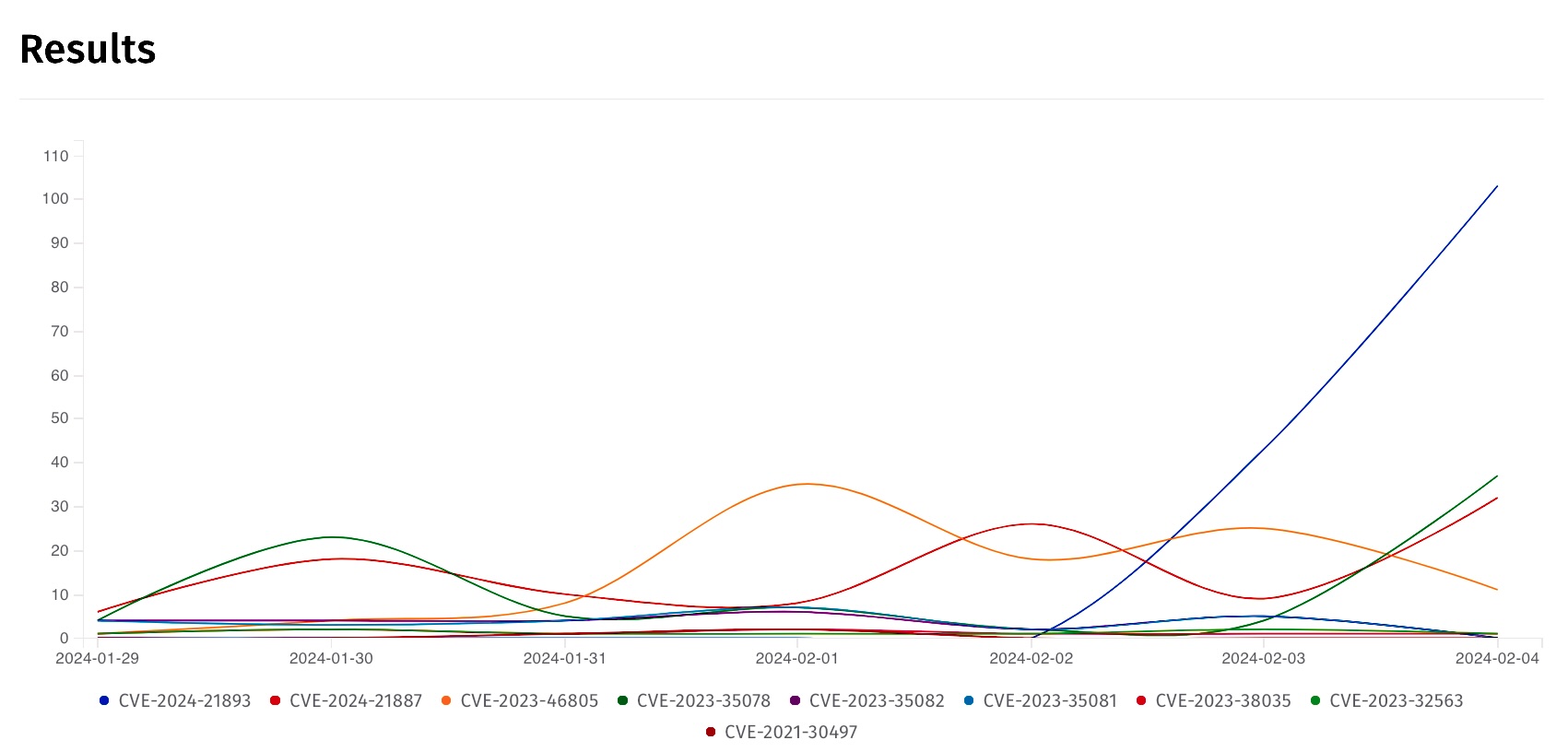
By Sunday, attacks targeting CVE-2024-21893 had mushroomed, from hitting what Ivanti said was a “small number of customers” to a mass base of users, research from security organization Shadowserver showed. The steep line in the right-most part of the following graph tracks the vulnerability’s meteoric rise starting on Friday. At the time this Ars post went live, the exploitation volume of the vulnerability exceeded that of CVE-2023-46805 and CVE-2024-21887, the previous Ivanti vulnerabilities under active targeting.

Shadowserver

Systems that had been inoculated against the two older vulnerabilities by following Ivanti’s mitigation process remained wide open to the newest vulnerability, a status that likely made it attractive to hackers. There’s something else that makes CVE-2024-21893 attractive to threat actors: because it resides in Ivanti’s implementation of the open source Security Assertion Markup Language—which handles authentication and authorization between parties—people who exploit the bug can bypass normal authentication measures and gain access directly to the administrative controls of the underlying server.

Exploitation likely got a boost from proof-of-concept code released by security firm Rapid7 on Friday, but the exploit wasn’t the sole contributor. Shadowserver said it began seeing working exploits a few hours before the Rapid7 release. All of the different exploits work roughly the same way. Authentication in Ivanti VPNs occurs through the doAuthCheck function in an HTTP web server binary located at /root/home/bin/web. The endpoint /dana-ws/saml20.ws doesn’t require authentication. As this Ars post was going live, Shadowserver counted a little more than 22,000 instances of Connect Secure and Policy Secure.

Shadowserver

VPNs are an ideal target for hackers seeking access deep inside a network. The devices, which allow employees to log in to work portals using an encrypted connection, sit at the very edge of the network, where they respond to requests from any device that knows the correct port configuration. Once attackers establish a beachhead on a VPN, they can often pivot to more sensitive parts of a network.

The three-week spree of non-stop exploitation has tarnished Ivanti’s reputation for security and battered security professionals as they have scrambled—often in vain—to stanch the flow of compromises. Compounding the problem was a slow patch time that missed Ivanti’s own January 24 deadline by a week. Making matters worse still: hackers figured out how to bypass the mitigation advice Ivanti provided for the first pair of vulnerabilities.

Given the false starts and high stakes, CISA’s Friday mandate of rebuilding all servers from scratch once they have installed the latest patch is prudent. The requirement doesn’t apply to non-government agencies, but given the chaos and difficulty securing the Ivanti VPNs in recent weeks, it’s a common-sense move that all users should have taken by now.

https://arstechnica.com/?p=2001230


FTC requires Blackbaud to delete personal data following charges

Following Federal Trade Commission (FTC) charges, Blackbaud will be required to delete any unnecessary personal data. The settlement comes after the company was charged claiming that “lax security” allowed a hacker to breach the company’s network and access the personal data of millions of consumers including Social Security and bank account numbers.

In its complaint, the FTC says that Blackbaud, which provides data services and financial, fundraising and administrative software services to companies, nonprofits, healthcare organizations and others, failed to implement appropriate safeguards to secure and protect the vast amounts of personal data it maintains as part of the services it provides to its clients.

As a result of these failures, a hacker in early 2020 accessed a customer’s Blackbaud-hosted database, according to the complaint. Once logged in, the attacker was able to freely move across multiple Blackbaud-hosted environments by leveraging existing vulnerabilities and local administrator accounts and creating new administrator accounts, according to the complaint. The breach went undetected for three months, allowing the hacker to remove massive amounts of unencrypted sensitive consumer data belonging to Blackbaud’s customers.

In addition to requiring Blackbaud to delete data that it no longer needs to provide products or services to its customers, the proposed order will prohibit the company from misrepresenting its data security and data retention policies. The proposed order also will require Blackbaud to develop a comprehensive information security program that would address the issues highlighted by the FTC’s complaint. In addition, the company will also be required to put in place a data retention schedule that would detail why it maintains personal data and when it will delete such information. The proposed order also requires that Blackbaud notify the FTC if it experiences a future data breach that it is required to report to any other local, state, or federal agency.

https://www.securitymagazine.com/articles/100381-ftc-requires-blackbaud-to-delete-personal-data-following-charges


3 steps to a comprehensive security threat assessment

@import url('https://fonts.googleapis.com/css2?family=Nunito+Sans:ital,opsz,wght@0,6..12,400;0,6..12,500;0,6..12,600;0,6..12,700;1,6..12,400;1,6..12,500;1,6..12,600;1,6..12,700&family=Nunito:ital,wght@0,400;0,500;0,600;0,700;1,400;1,500;1,600;1,700&display=swap'); h3 { font-weight: bold; font-size: 18px; color: #C72026; } .highlight { padding-left: 16px; border-left: 6px solid #58526F; width: 100%; font-size: 20px; color: #58526F; }

When there’s an internal or external event on the horizon, physical security is crucial. The best strategy is to conduct a comprehensive physical security threat assessment well before the event to evaluate the threats that face the enterprise and develop contingency plans to secure the organization before, during and after events.

“It’s better to have a plan in place that has been created in a non-stressful situation,” says Jack Leskovar, Director of Security and Risk Management at Edgewood College in Madison, Wisconsin. “We try to come up with every complication that we can think of prior to an incident actually happening because the worst thing would be for something bad to happen and you’re trying to devise the plan as you go along.”

A comprehensive physical security threat assessment is a complex project, but “it’s worth its weight in gold,” says Anthony Brown, Director of Risk and Emergency Management at Gonzaga University in Spokane, Washington, and Owner of S5 Risk Management LLC. “Risk is a result of thousands of small factors. The trick is to identify as many factors as possible to accurately reflect risk, as well as all the opportunities to manage that risk. A threat assessment is an effective tool for providing that context in an efficient manner.”

1. Identify threats and hazards

 In every threat assessment, Brown says a skillful assessor will consider factors such as insider threats, external threats, natural disasters, cyber threats, active shooter threat, criminal behavior in the region, and legislation that impacts the ability to prevent and respond to threats or that increases the likelihood of events.

One standard threat assessment process to consider is the Threat and Hazard Identification and Risk Assessment (THIRA), which divides threats and hazards into three categories: natural, technological and human-caused. THIRA uses “objective analysis to build a comprehensive view of threats the organization faces, and the impacts should those threats occur,” says Brown.

Stay relevant
The security team may already have a baseline list of security threats thanks to regular general risk assessments or yearly events. However, this will need to be updated for each event to keep up with current events, points out Harris D. Schwartz, a strategic security advisor in Las Vegas.

Gather as much data as possible. “As trivial as that information may seem, it’s going to be important to put that full picture together of what you’re dealing with,” Leskovar says.

Include other departments
A threat assessment should involve every department that either contributes to or is impacted by any risk factors. “Every department has value to add to a comprehensive threat assessment and can inform it with concerns, incidents and ongoing issues,” says Brown.

At Edgewood College, the threat assessment team involves people from Residence Life, Student Development, the Wellness Center, and Student Inclusion and Involvement.

“We meet weekly to address the students that may have some issues or stressors so we can prevent incidents and help them be successful,” Leskovar says. “It’s almost like a mentorship process, and it has been phenomenal.”

Gather threat intelligence
Schwartz says it’s a good idea to collect threat intelligence prior to and during the event, and in some cases after the event too. “If people are talking about it, especially special interest groups and other threat actors, it’s important to have a full picture, especially because you’re most likely going to be holding that event again,” he says.

Anthony Brown, Jack Leskovar, Harris Schwartz

“Every department has value to add to a comprehensive threat assessment.”
— Anthony Brown, Director of Risk and Emergency Management at Gonzaga University

2. Assess vulnerabilites

A comprehensive threat assessment should include a vulnerability assessment “because it will identify the factors that are contributing to risk and therefore identify opportunities for improvement,” says Brown. This includes identifying at-risk assets and the financial losses should the specific threat occur, as well as evaluating the target’s appeal while also considering the current security countermeasures that are in place.

Review access control
Schwartz stresses the importance of evaluating access control. Onsite events give you better control over physical access, but in an external venue, it’s essential to review all the potential ways that someone could access the event. “There could be access points that you’re not even aware of, so ensure that you’ve done a full review,” Schwartz says.

“We look at the buildings and event sites here and what would be the most reasonable way that an attacker could access a building or an event undetected,” says Leskovar. “We’re in a college environment and the doors are all open in public spaces, so we have to find other solutions to mitigate threats.”

Inspect systems
A threat assessment should identify existing physical security components, along with how effective they are in decreasing the likelihood of or the impact of a threat against your organization, Brown says. This allows you to pinpoint vulnerabilities and decide which mitigation projects are a high priority.

Perform an advance survey
If the event is external, Schwartz believes an advance assessment of the location is essential, though he acknowledges that not all organizations do this. “You’re assessing where the event is actually going to take place and building your understanding of the surroundings in the area, including knowing where hospitals are and meeting with local law enforcement,” says Schwartz. Security teams can also check lighting, maintenance and other environmental factors.

Include behavior
Innocent situations can quickly be spun into major issues via gossip and rumors, especially in educational environments. Because of this, Leskovar believes that an effective, complete threat assessment should involve a focus on behavior. “If we skip the behavioral side of it, we’re missing a lot,” he says. This is why changes in behavioral patterns are critical to the prediction and mitigation of incidents.

Survey the security climate
“The largest weakness in most security systems is people. Conversely, people are the most important asset organizations employ to reach their goals,” Brown says. In other words, any threat assessment should include the people in your enterprise.

Brown believes understanding the security culture is vital to finding strengths and weaknesses in an organization and that it can give valuable insight into risk factors, especially when it comes to the vulnerability assessment. Survey questions should be deliberately worded so that security is able to discern between relevant factors such as security awareness, compliance and weaknesses, Brown says.

3. Make a plan

 Once threats and vulnerabilities have been assessed, you need to have a well-documented plan in place regarding areas such as crisis communication and incident response, Schwartz says.

This plan should be as simple and clear as possible. “I can give you a telephone book full of rules and regulations and then an incident occurs and no one’s looking at that book,” Leskovar says. “If an incident occurs, (the team) is going to be under a tremendous amount of stress and they’re going to be relying on very basic information in steps that they can follow.”

Brown says generating a risk analysis from the data security has collected can give the function an opportunity to educate stakeholders on risk factors. “By including the vulnerability rankings of each threat into a single chart, a threat assessment can also provide a by-default prioritization list of threats,” he says.

A comprehensive security assessment is not only an opportunity to engage stakeholders, Brown says it’s also an opportunity to educate security officers in the organization. In another role, “I had an expectation that every officer of a certain rank and above should be able to clearly articulate the why behind their tasks,” he says. “Performance improved dramatically from a connection to this higher perspective, as did job satisfaction and employee retention.”

https://www.securitymagazine.com/articles/100353-3-steps-to-a-comprehensive-security-threat-assessment



Behind the scenes of emergency management


h3 { font-weight: bold; font-size: 18px; color: #C72026; } .w3-panel:after,.w3-panel:before { content: “”; display: table; clear: both } .w3-panel { padding: 16px; margin-top: 16px; margin-bottom: 16px } .w3-light-grey,.w3-hover-light-grey:hover,.w3-light-gray,.w3-hover-light-gray:hover { color: #000!important; background-color: #f3eef7!important } .w3-xlarge { font-size: 22px!important; Nunito Sans’, sans-serif; }

When it comes to emergency management, preparation can vary greatly. Each sector faces its own threats, and even those can differ depending on factors such as region or time of year.

Schools, for example, have to protect their students, faculty and staff. They face the threat of active shooters and violence, but also must be prepared for severe weather emergencies. In the United States, fire season runs from late spring through fall, often when students are entering and leaving school. Hurricanes, tornados and snowstorms also pose risks to schools.

Some of these risks are exacerbated in college settings, as the students are more likely to be unfamiliar with an area’s weather threats. Southern California natives attending college in the Northeast are likely to be prepared for a wildfire, not a blizzard, and may not know what to do in an emergency. Campus security leaders should work alongside local leaders to prepare their students for severe weather emergencies.

A security leader working to prepare students is Joe Hernon, Associate Vice President for Emergency Management, Campus Safety and Environmental Health at Colgate University. In the state of New York, Hernon’s role involves preparing students and staff for the emergencies most likely to affect them.

“I oversee a variety of different departments, one of those being our fire safety department, our campus safety department, and our environmental health and safety department,” Hernon says.

“One of our biggest threats is weather’s impact to our operations. Obviously, there’s always the worst case — that one percent chance of an active shooter, or act of violence scenarios. Our primary planning and focus is around natural disasters and their impact to our community. The probability of that kind of event is so much higher. We built out our ability to shelter, so spaces designed for flooding, ice or a snowstorm can also be flipped over to an operation like an act of violence or hazmat incident,” Hernon says.

Security isn’t a one-person job

Collaboration between schools and other organizations can help boost emergency preparedness. Hernon discusses how “as a partner with the National Weather Service, we are constantly receiving daily updates. We also have our own weather system that we utilize for athletic events and major outdoor events. We’ll talk about what we have going on. What have we heard from other universities? Has the university 40 minutes away from us already closed? What are we seeing in the K-12 system?”

❝ Joe Hernon

Our primary planning and focus is around the natural disasters and their impact to our community. The probability of that kind of event is so much higher.”

— Joe Hernon, Associate Vice President for Emergency Management, Campus Safety and Environmental Health at Colgate University. Headshot image courtesy of Hernon

A critical aspect of emergency management is collaborating with government organizations. Police officers, firefighters and emergency medical technicians (EMTs) are essential in an emergency setting. These partnerships can help security leaders determine how to build trust within their community. Students want to feel safe on campus, and trusting campus safety is an important first step. The phrase “if you see something, say something” is used a lot among security leaders, but is meaningless if students do not feel safe reporting the issues they see.

“Our campus security is New York State Security Guard certified, so our officers here don’t carry weapons. Not carrying weapons creates opportunities to connect with students where a weapon on the side of their hip could have been a barrier. At the same time, we do have a number of our employees and members of our campus safety team that are firefighter/EMTs, so they have an opportunity to engage students in medical crises as well,” Hernon says.

Building a community of trust

Part of helping students feel safe is ensuring they’re taken care of. While students should be educated around potential threats, it’s important to ensure they aren’t constantly afraid of worst-case scenarios. Stress and mental health concerns can affect overall campus safety in a number of ways. A mental health crisis can turn into an active violence scenario, and security leaders need to be prepared.

“We’ve seen a number of mental health crises, so we’ve been trying to branch out and get our folks more trained in that, utilizing some programs with crisis intervention teams. We’re utilizing our own Counseling Center and subject matter experts to help build up our folks’ skill sets. That way at 2:30 in the morning, when most of the campus administrators and the Counseling Center is gone, our campus safety officers that are going to be responding to this mental health crisis have the right tools to address the situation.”

Hernon says that he’s proud of his campus security team’s ability to bond with students. “We found that students love to come out for food. It provided an opportunity for students to come have some tacos with us and our staff. They get to see our team outside of potentially that scenario where we’re writing you up for something on campus or we’re enforcing a university policy.”

A key component of emergency management is prevention and preparation. Small steps, such as tracking the weather and building community trust, can save invaluable time in the event of an emergency.

https://www.securitymagazine.com/articles/100352-behind-the-scenes-of-emergency-management