Google Answers Question About SEO For AI Agents via @sejournal, @martinibuster
Google’s John Mueller responded to a question about whether Google’s search quality principles will change as AI agents increasingly browse websites on behalf of users. The answer may matter more to site owners than it first appears.
Question About Agentic Browsers And Search Quality Principles
An SEO asked Mueller on Bluesky whether Google’s guidance around satisfying user experiences, including principles around things like images and page design, would evolve as agentic AI tools gain the ability to navigate and retrieve information from websites autonomously. The question reflects a concern that has been growing in the SEO community as tools like Google Gemini become capable of browsing websites, completing tasks, and returning answers to users without the user ever directly visiting a page.
“Hi John – Given Computer use is now a built-in tool for Gemini 3.5 Flash, and as agentic becomes more of a “thing”, would you expect principles like “Images provide a satisfying experience” to evolve since the satisfying experience is an information agent? Curios on your thoughts.”
Websites Useful For Humans Will Generally Also Work For Agentic Browsers
Mueller explained that most of Google’s existing quality principles will remain in place. A website that is useful for human users will generally also be useful for agentic browsers.
He responded:
“I expect most principles will remain the same. A website that’s useful for users, will generally also be useful for agentic browsers.”
Mueller’s response means that it’s a good idea to keep making content useful for site visitors, which also means the site layout, navigation, and internal linking. AI agents do not change the fundamentals that Google’s algorithms are still picking up on external user signals for ranking purposes, especially signals that indicate site popularity with users.
Blindly Blocking Agentic Browsers Could Become An SEO Problem
Mueller’s answer also contained the observation that some details will evolve, and that site owners should avoid blindly blocking agentic browsers.
He said:
“Some details will undoubtedly evolve (and new basics – such as … not blindly blocking agentic browsers … will come into play), but in the end, it’s still users.”
Mueller’s response draws a line between content quality and technical accessibility. A site can meet Google’s quality standards and still create problems for itself if AI agents are blocked from accessing or interacting with its content.
In some ways this is similar to how nofollow links became an issue for some sites when it was introduced many years ago. Some site owners blocked off important sections of their websites in order to drive more PageRank to the pages they thought were important, giving zero priority to actually important parts of a website like the About Us pages.
The agentic browser situation may follow a similar pattern, where technical decisions made for one reason end up having unintended SEO consequences.
One way to think about it is that Google’s definition of a quality website is not being rewritten for the agentic era. The standards already in place were written for human users, and if AI agents are serving human users, then satisfying those agents is arguably the same job. What changes is the technical considerations of accommodating AI agents, not the underlying expectation of what a good website is.
Google Gemini Can Now Control Your Computer. Hackers Are Already Targeting AI Agents via @sejournal, @martinibuster
Google has moved “computer use” from a specialized model into Google Gemini 3.5 Flash, making agent-style control of browsers, apps, and desktop workflows a built-in capability instead of a separate product. That means Gemini can now see and interact with user interfaces, reason about what’s on a computer screen, and take direct actions. A Google DeepMind senior scientist recently warned that scaled AI agents create incentives “for malicious people to do malicious things.”
Developers can now build agents that do a lot more than call APIs. They can automate GUI-only workflows such as testing software, filling forms, navigating dashboards, or using legacy apps with no API access. This reduces bottlenecks for automation and expands what AI agents can realistically do in production.
If software has a graphical user interface (GUI) but no API, an AI agent can still use it. Agents can be told to log into a dashboard, export yesterday’s SEO reports to a spreadsheet, compare them with last week’s data, and email the user a summary. The workflow is handled with natural language instead of relying on custom scripts to connect the dashboard, spreadsheet, and email.
What It Means For SEO
SEO tools may become far more agentic in the near future. Instead of just surfacing data, AI could log into Google Search Console, audit sites, crawl a site with Screaming Frog, extract specific data points for comparison, and execute repetitive optimization workflows.
For site owners, it also carries the implication that another set of AI agents may act as “visitors,” which could affect how site owners interpret site interactions and engagement signals for site and sales optimization.
AI Agents Will Be Attacked
Google’s announcement is pretty upbeat but the “safety best practices” document it links to bears paying attention to because failure to get this part right may result in theft and other poor user experiences.
“Computer Use presents unique security and operational risks, as a model acting on a user’s behalf might encounter untrusted content on screens or make errors in executing actions.”
That “untrusted content on screens” may be reference to the “traps” set for AI agents that the senior scientist at Google DeepMind warned against.
Google recommends seven best practices when this new AI agent:
1. Human-in-the-Loop (HITL): Enforce user confirmation: When the safety response indicates require_confirmation (or legacy safety decision requires it), prompt the user for approval. Provide custom safety instructions: Implement a custom system instruction to define and enforce your own safety boundaries.
2. Secure execution environment: Run your agent in a secure, sandboxed environment to limit its potential impact. This can be a sandboxed virtual machine (VM), a container (e.g., Docker), or a dedicated browser profile with limited permissions
3. Input sanitization: Sanitize all user-generated text in prompts to mitigate the risk of unintended instructions or prompt injection. This is a helpful layer of security, but not a replacement for a secure execution environment.
4. Content guardrails: Use guardrails and content safety APIs to evaluate user inputs, tool inputs and outputs, and the agent’s responses for appropriateness, prompt injection, and jailbreak detection.
5. Allowlists and blocklists: Implement filtering mechanisms to control where the model can navigate and what it can do. A blocklist of prohibited websites is a good starting point, while a more restrictive allowlist is even more secure.
6. Observability and logging: Maintain detailed logs for debugging, auditing, and incident response. Your client should log prompts, screenshots, model-suggested actions (function_call), safety responses, and all actions ultimately executed by the client.
7. Environment management: Ensure the GUI environment is consistent. Unexpected pop-ups, notifications, or changes in layout can confuse the model. Start from a known, clean state for each new task if possible.
Beware Of Trap-Filled Websites
As attack surfaces grow, the greater the likelihood that hackers will seek to exploit them. What that means is that as the number of AI agents on the web proliferates, hackers will turn their attention to exploiting them. Websites become the battlefield from which attackers launch attacks on AI agents.
That’s not an exaggeration. Just this month, a cybersecurity expert in California experienced illicit charges made to his credit card due to Anthropic Claude’s AI agent. According to the article, he appears to have downloaded a Skills.md file that may have contained an AI agent trap.
“…he found a problematic add-on connected to Claude, referred to as a “skill,” similar to a plug-in. ‘That basically told Claude to attempt to purchase different types of gift accounts on my stored information. So it was using the digital wallet that was on my computer for Claude to start to make these purchases…’”
Site owners may need stronger bot controls and the ability to identify when hackers have hidden prompt-injection instructions on their sites. But that’s not something website owners are looking for, which compounds the problem for users who are utilizing AI agents like the one that Google just released.
Your Brand Message Is Costing You Half Your Views – What 2 Reports Can Tell Us via @sejournal, @gregjarboe
Most of what gets written about AI and marketing this year reads like a warning label. Two new reports published this month make the opposite case: AI is unlocking inventory and content opportunities that were previously invisible or undervalued, and there’s now data to prove it. One comes from the video advertising side. The other comes from the creator content side. Together, they answer a question Search Engine Journal readers ask constantly: Why does some content take off organically while perfectly competent brand-led work gets scrolled past?
The Video Inventory Nobody Was Buying
IAB’s new Q2 2026 report on AI-powered video outcomes opens with a number that should bother anyone running video campaigns. When Integral Ad Science and Reuters tested how often keyword-based brand safety blocking excludes content unnecessarily, they found that 54% of URLs were blocked based on keywords alone, even though the underlying content would be considered appropriate once evaluated for full context, tone, and intent. More than half. For years, large portions of news video inventory have effectively been invisible to advertisers, not because the content was actually unsafe, but because a blunt keyword match flagged it.
Multimodal AI is changing the math. Rather than scanning a transcript or title for trigger words, these tools analyze video, audio, speech, and images together, building a holistic read of tone and intent that keyword lists were never built to capture. I asked Jamie Finstein, VP of Media Center at IAB, directly what that means practically for media buyers in 2026. Her answer was blunt: “Change always feels like a burden until you realize the cost of not evolving. Teams that don’t revisit their settings in the wake of multimodal AI are going to fall behind.” Her specific advice for next week: Pull up your exclusion lists and ask when they were last reviewed. “For most teams, the answer may be longer ago than they’d like to admit.”
The timing has a second layer SEJ readers should note. The 2026 midterms are exactly the kind of period when news inventory historically gets excluded the most, right as audience attention peaks. Finstein’s framing on this is worth sitting with: “The concern is understandable, but the math doesn’t support it. Election cycles are when news consumption peaks and audience attention is at its highest. Pulling back entirely means your brand is absent precisely when consumers are most engaged with media.” The fix isn’t abandoning caution; it’s precision: a report on voter turnout and partisan commentary are not the same risk profile, and content-level evaluation can now tell them apart.
Finstein was also direct about where this doesn’t replace human judgment. Asked how marketers should structure oversight given that AI can still misclassify content in fast-moving news cycles, she said the priority is transparency and accountability from verification partners, particularly around how edge cases get handled. The opportunity is real, but it’s not a “set it and forget it” upgrade. It’s a recalibration that still needs a human checking the model’s work, especially live.
For SEJ readers who are also publishers, Finstein’s answer on the content side is the most actionable line in the whole interview: “It means making video content easier for verification and evaluation systems to interpret. That starts with clear metadata and transcripts so each video can be assessed on its own, rather than relying on broad categories.” Publishers who clean up their own metadata and transcripts are doing the work that lets contextual AI correctly classify their content as monetizable, instead of leaving it lumped into a broad, blocked category by default.
The Content Gap Creators Have Already Solved
The second report comes from a completely different angle, but lands on a similar structural insight. Billion Dollar Boy, a creator marketing agency, partnered with DAIVID’s emotion-tracking technology to analyze 5,000 creator-led assets across Instagram and TikTok, mapping what actually drives view rate, engagement, brand favorability, and purchase intent against 39 distinct emotional signals. The resulting report, Creator Instinct: Unlocking the Social Code, identifies five specific, measurable behaviors that separate content that performs from content that gets ignored, and the gap is larger than most brand teams probably assume.
The first finding alone is worth rewriting a content brief over. Assets that led with product, benefit, or brand messaging in the opening seconds saw view rates drop by 44%, brand favorability drop by 12%, and consideration drop by 41%, compared to content that built a hook first and let the brand arrive as the payoff rather than the pitch. Creators have apparently known this instinctively for years. The data now quantifies exactly what it costs brands that haven’t caught up.
The second finding addresses something every content marketer has felt but rarely measured: proof beats claims. Content built around demonstration, showing the product in actual use, the before and after, the creator’s own authentic explanation, outperformed declarative “this is amazing” messaging by 33% in brand favorability and 15% in consideration. There’s a useful quote from creator Laura Adlington in the report that captures why. She explained that showing clothes on her own body builds trust because it lets people visualize the product in their real life, and that explaining the reasoning behind a styling choice builds more confidence than simply asserting that something looks good.
The third finding is the one most useful for content strategists working across multiple categories: there is no universal best emotion. The same emotional register that lifts performance in one vertical actively suppresses it in another. Anxiety lifts results in beauty and food content but stifles entertainment, retail, and fashion. Gratitude lifts retail and fashion but stifles beauty and food. This means a content calendar built around a single brand voice or emotional tone across every category is leaving performance on the table by design, not by accident.
The fourth and fifth findings reinforce each other. Polished, emotionally safe content underperforms. Assets that provoked a genuine, even awkward reaction saw a 25% lift in organic view rate over safer alternatives, and content that paired a raw emotional beat with a positive resolution saw consideration rise by 22% and recommendation rise by 17%. And the ending matters as much as the hook. Content that successfully built to a satisfying payoff saw organic view rates rise by 110% across platforms, and by 318% on TikTok specifically, with engagement on TikTok up 83%. The report’s framing, borrowed from Daniel Kahneman’s Peak-End Rule, is that audiences don’t remember an entire piece of content. They remember the emotional peak and how it ended. Brands that front-load their messaging and let the ending trail off are optimizing for the part viewers forget.
What This Means If You Don’t Run Paid Video Or Creator Budgets
Even SEJ readers who never touch a video buy or a creator contract should read both reports as evidence of the same underlying shift. AI tools are getting better at recognizing nuance, tone, and context rather than just pattern-matching on surface signals, whether that’s a keyword in a video transcript or a generic brand voice applied uniformly across content categories. That shift rewards specificity. Video content with clean metadata gets correctly classified instead of being blanket-excluded. Content built around category-specific emotional logic and an earned payoff outperforms content built around a one-size-fits-all brand template. The throughline across both reports is the same lesson SEO has been learning all year: The tools are getting better at telling the difference between genuinely good content and content that merely looks compliant on the surface. That is, for once, good news.
2 Steps Worth Taking This Week
First, if you run or influence video ad buys, pull your current exclusion lists and brand safety settings and check the date they were last reviewed, the way Finstein suggested. If multimodal contextual tools aren’t part of your verification stack yet, ask your partners what they currently offer and how content gets evaluated for tone, not just topic.
Second, if you brief content for social or creator partnerships, audit your last five briefs against the front-loading problem specifically. If the brand or product appears in the first three seconds of the asset, that single structural choice may be costing you close to half your potential view rate, regardless of how good the creative itself is. Move the brand to the payoff. The data says that’s where it does the most work.
Google Tests ‘Strongest Match’ Labels On Search Ads via @sejournal, @brookeosmundson
Google is testing a new Search ads label that could give certain advertisers a visible endorsement directly within search results.
In a LinkedIn post, Google Ads Liaison Ginny Marvin announced a limited U.S. experiment that adds a “Strongest match” or “Strong match” label to select Search ads.
According to Marvin, the labels are intended to help users quickly identify the most relevant information for their query while helping advertisers connect with high-intent audiences.
The experiment is currently rolling out to a small percentage of users in the United States.
Marvin said the designation relies on existing ad quality and relevance signals that Google already uses to evaluate Search ads.
While the announcement itself was relatively brief, it immediately sparked questions from advertisers about how the label is determined, whether it could influence click behavior, and what it might signal about the future direction of Search.
Google Hasn’t Explained What Qualifies As A “Strongest Match”
Google’s announcement answered what the label is intended to do, but not how advertisers qualify for it.
According to Marvin, the designation is based on existing quality and relevance signals. Beyond that, Google has not shared any details about how the label is determined.
As a result, advertisers still don’t know:
Which signals are used to determine the label
How those signals are weighted
Whether the designation is based on the query, keyword, ad, landing page, or a combination of factors
Whether multiple advertisers can receive the label in the same auction
Whether the label is tied to ad position
The lack of detail quickly became one of the main discussion points following the announcement.
Several advertisers questioned whether the designation reflects the same systems Google already uses to evaluate ad relevance or whether the experiment introduces an additional layer of evaluation.
Others questioned whether bid strength plays any role.
Google’s description suggests the label is intended to reflect relevance rather than spend. However, the company has not explained how those determinations are made.
Until Google shares more information, advertisers are left with a label that appears meaningful but lacks a clear definition.
Advertisers Are Asking For More Transparency
Advertisers quickly focused on a different question: how Google determines which ads receive the label.
Several commenters asked whether “Strongest match” reflects the same relevance systems Google already uses or whether additional factors are involved.
Terry Hogan questioned whether the designation is truly based on relevance or whether bid strength contributes to the decision.
Kristen Kelleher asked a popular question, based on the amount of likes she got:
What components make up the scoring underneath the match label? Is this based on the keyword based quality score, ad relevance, landing page exp or is it only based on the ad itself?
So far, Google has not provided additional detail.
Other comments asked measurement questions around the label testing.
Craig Graham asked: “Are there plans for any kind of advertiser-side reporting for this if the experiment rolls out more broadly?”
That visibility could become important if the designation influences click behavior. Advertisers will likely want to know when their ads receive the label and whether it impacts performance.
Questions also accumulated in Marvin’s LinkedIn post about how the label will appear within search results.
Bernt Muurling asked whether the strongest match will always be the first result shown.
If the label only appears on the top-ranked ad, it reinforces Google’s existing ranking decisions. If it can appear elsewhere on the page, it introduces a new signal that users may evaluate alongside ad position.
Justin Windschitl pointed to what may be the biggest challenge for the experiment:
Interested what the criteria are for labeling “match types” and if there can be flaws with the labeling, hurting businesses. On the flip side, if it’s buttoned up, it could be very beneficial for filtering best matches and more effective ad spend!
If the designation is occasionally inaccurate, advertisers may question whether Google is effectively endorsing one business over another.
Could This Become A Public Relevance Signal?
The experiment stands out because it could make Google’s assessment of relevance visible to users.
Advertisers have always known that Google evaluates factors such as ad relevance, landing page experience, expected click-through rate, and other quality signals when determining which ads appear and where they rank. Those evaluations largely happen behind the scenes.
A “Strongest match” label would move part of Google’s relevance evaluation from Google Ads into the user experience itself.
That may seem like a small change, but it introduces a new dynamic into the search experience.
Users already see ad position. A visible label gives them another signal to evaluate.
That is one reason several advertisers immediately questioned how the designation is determined and whether it could influence click behavior.
It also raises questions about whether the label becomes a competitive advantage of its own.
If users begin viewing the designation as a recommendation from Google, advertisers who receive the label could benefit beyond the visibility that comes with ranking well in the auction.
Whether that happens will likely depend on how often the label appears and whether users respond to it.
For now, Google has positioned the experiment as a way to help users identify relevant information more quickly. The broader question is whether advertisers and users eventually view the designation as a relevance signal, a recommendation, or something in between.
Why Google May Be Testing This Now
While Google hasn’t shared the reasoning behind the experiment, the test arrives as Search continues to evolve beyond a traditional list of links.
Google already makes relevance decisions every time an auction takes place. The difference is that those decisions typically remain behind the scenes.
This experiment tests what happens when part of that evaluation becomes visible to users.
Google already makes relevance decisions every time an auction takes place. This experiment tests whether those assessments should be visible to users.
Like many Search tests, the feature may never move beyond experimentation. If it does, it could mark another step toward Google making more of its relevance decisions visible within the Search experience itself.
What This Means For Advertisers
At this point, advertisers should view the label as an experiment rather than a new optimization opportunity.
Google hasn’t introduced any controls, reporting, or guidance around how advertisers qualify for the designation.
For now, the announcement is getting a lot of attention because it introduces a new user-facing signal in Search ads. Whether that signal influences click behavior or campaign performance is unclear until Google provides more information.
We’ll continue watching the rollout and update this story if Google shares additional details about qualification criteria, reporting, or broader availability.
Featured image: Kues / Shutterstock, Phone image courtesy of Google
The Accessibility Tree Is How AI Agents Read Your Site & It’s Breaking via @sejournal, @slobodanmanic
AI agents do not read your website the way you do. They do not see your layout, your hero image, or your brand color. They prefer reading the accessibility tree: a stripped-down structural model of the page, the same one that has powered screen readers for two decades.
Today, that matters more because the audience reading that way is now the majority.
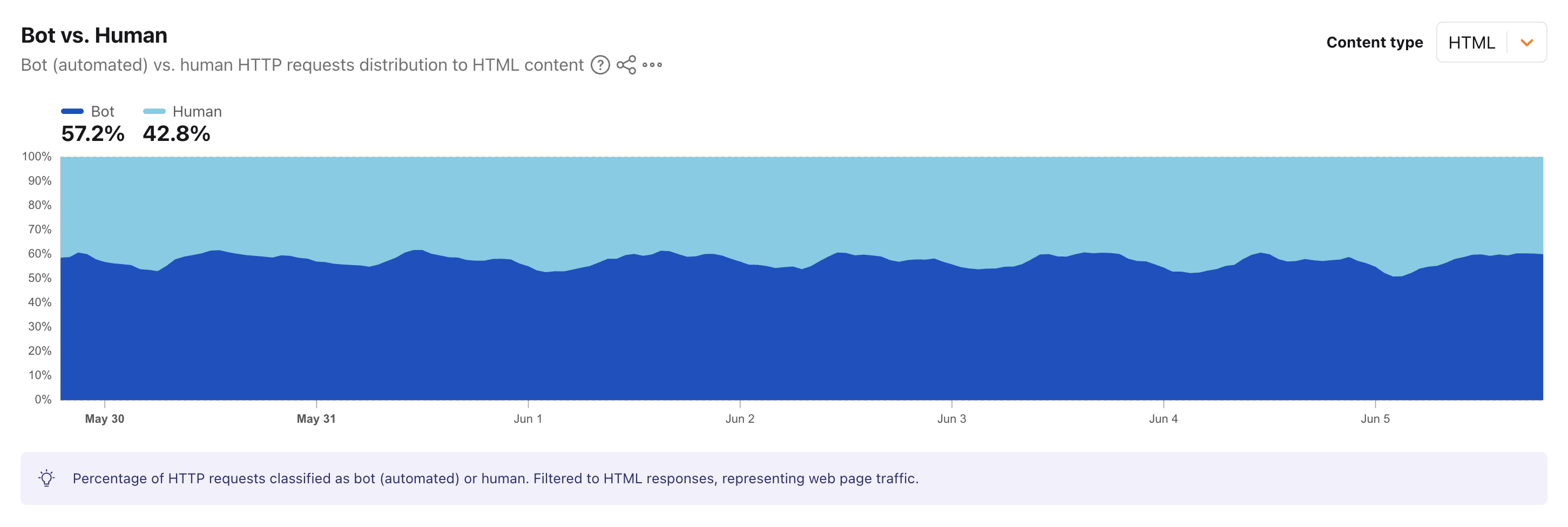
For the week of May 30 to June 5, 2026, Cloudflare Radar measured 57.2% of HTTP requests to HTML content, the requests that represent web-page traffic, as automated bots, against 42.8% human. Cloudflare CEO Matthew Prince, who shared the data on June 3, had forecast that crossover for 2027. He got it wrong because it arrived over a year early.
Cloudflare Radar, Bot vs. Human distribution filtered to HTML content (web-page traffic), May 30 to June 5, 2026 (Image from Cloudflare Radar by author, June 2026)
Some of that automated traffic is scrapers you probably want gone. A large and rising share is AI agents reading pages for real people. And according to the accessibility data published this year, the structure those AI agents depend on is getting worse, for the first time in six years.
The Accessibility Tree Is A Structural Model The Browser Builds From Your DOM
The accessibility tree is a semantic version of your page that the browser computes from the DOM so non-visual software can understand it. The pipeline is short: HTML to DOM to accessibility tree to consumers (assistive technology, and now AI agents).
The W3C’s WAI-ARIA 1.2 defines it as a “tree of accessible objects that represents the structure of the user interface,” where each node “represents an element in the UI as exposed through the accessibility API.” The browser builds it from the DOM (the mapping is specified in Core-AAM 1.2) and exposes it through the operating system’s accessibility API, which, per the W3C, “can be used by any assistive technologies, such as screen readers.” MDN explains the pipeline this way: Browsers “create an accessibility tree based on the DOM tree.”
The accessibility tree discards most of the DOM. A page with several thousand nodes collapses to the meaningful, interactive set: headings, links, buttons, form fields, landmarks, images with their text alternatives. For software working inside a limited context window, it is that reduction that makes the tree usable at all.
Every node in the accessibility tree carries four properties:
Property
What it captures
Example
Role
What kind of element it is
Button, navigation region, list item
Name
How it is referred to
A link reading “Read more” is named “Read more.” An icon-only button with no label has no accessible name.
State
Its current condition
Checked, expanded, disabled, selected
Description
Any extra context beyond the name
A longer explanation, like a tooltip, that a screen reader can read aloud
The tree also records what can be done with a node: a link can be followed, a text input can be typed into. That is exactly the information an agent needs in order to act.
AI Agents Read The Accessibility Tree Because It Costs Less And Misleads Less Than Pixels
An agent driving a browser can understand a page three ways: read the raw HTML, look at a screenshot with a vision model, or read the accessibility tree. There is a real split in how today’s agents do it.
Purely relying on the accessibility tree. Microsoft’s Playwright MCP, a widely used tool for letting a model operate a browser, “uses Playwright’s accessibility tree, not pixel-based input,” with “no vision models needed, operates purely on structured data.” Its tool description tells the model an accessibility snapshot “is better than screenshot.”
Vision-first. OpenAI’s Computer-Using Agent, the model behind Operator, works primarily from screenshots. It is not reading your accessibility tree to decide what to click.
Hybrid. A third approach combines both: the structured accessibility tree for the bulk of the page, plus vision for the parts the tree cannot capture, like canvas-rendered apps and dense visual layouts.
Two forces push agents toward the accessibility tree:
Cost. A screenshot spends a large number of tokens encoding a picture the model then has to interpret. The accessibility tree is compact text.
Reliability. A vision model has to guess which pixels form a clickable control. The tree states this outright, with a role and a name for each.
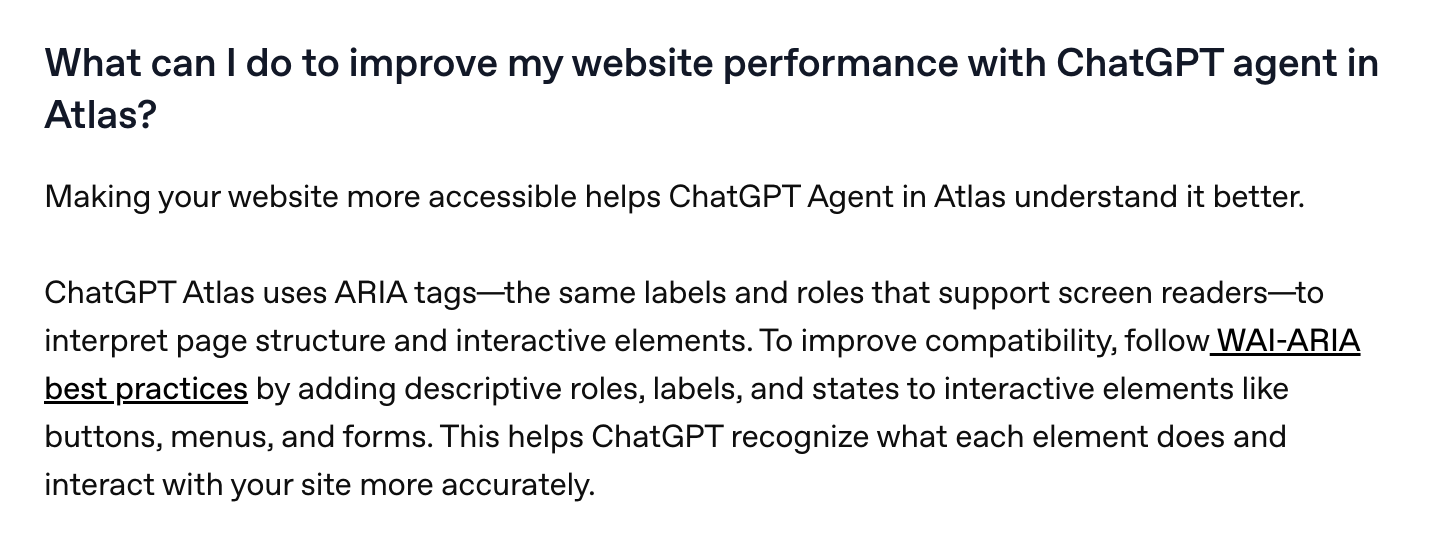
The clearest signal of where this goes is the vendors’ own guidance. OpenAI’s Publishers and Developers FAQ says ChatGPT Atlas “uses ARIA tags, the same labels and roles that support screen readers, to interpret page structure and interactive elements,” and advises that making a website more accessible helps the agent understand it.
OpenAI’s Publishers and Developers FAQ (Image by author, June 2026)
OpenAI is the company behind Computer-Using Agent, the one that works by analyzing screenshots. They still recommend making websites more accessible. For the machine, accessibility and readability are the same problem. The full agent-by-agent breakdown is in a companion article on how AI agents see your website.
A Markdown Copy Is Not An Agent-Ready Page
A clean markdown version of a page is a good way to feed an agent your content, and providers like Cloudflare now generate one at the edge. For reading, extracting, and citing, markdown is fine, and often better than raw HTML.
But a markdown copy carries only the words. It cannot tell an agent that a control is a button, whether that button is disabled, or hand it something to click. It lets an agent read the page, not operate it.
It is also a separate copy of the page, and a separate copy can tell an agent one thing while the rendered page shows humans something else. A hand-maintained one also drifts from the real markup over time. The accessibility tree has neither problem. The browser builds it from the same page it renders to people, so there is nothing extra to maintain and nothing to cloak, and it carries the roles, states, and element references an agent needs to act. Which is why, for an agent that has to do something, one of the two is close to pointless, and the other is the whole point.
You Can See Your Own Accessibility Tree In About 2 Minutes
Every major browser shows you the exact tree an agent reads.
Open DevTools, select an element in the Elements panel, and open the Accessibility tab to see that element’s computed role, name, and state.
To view the whole page the way the tree does, turn on the “Show accessibility tree” toggle, which “replaces the DOM tree in the Elements panel with a full-page accessibility tree.”
For the same thing in code, Playwright’s ARIA snapshots produce “a YAML representation of the accessibility tree of a page,” capturing roles, accessible names, states, and nesting. Running an ARIA snapshot against your own URL returns almost exactly the structured text an agent like Playwright MCP receives.
Here’s an easy test you can run: For every important action on the page, does the tree show a node with the right role and a clear name? A “buy” button that appears in the tree as a generic element with no accessible name is a button your customers’ agents can see but cannot confidently use.
Run this on a few of your own pages, and the gaps will show up fast.
The 2026 Data Says The Web Is Getting Harder, Not Easier, For Machines To Read
The accessibility tree is only as good as the markup it is built from. In 2026, that markup got worse. Web accessibility regressed for the first time in six years, at the same moment agents became the majority of HTML traffic.
The WebAIM Million, the annual automated analysis of the top 1 million home pages, reported in its February 2026 edition:
95.9% of home pages had detectable WCAG failures, up from 94.8% the year before, which WebAIM describes as “reversing a trend of small improvements each of the previous 6 years.”
56.1 detected errors per home page, a 10.1% increase over the 51 found in 2025.
1,437 elements per home page, which WebAIM flags as “a 22.5% increase in only one year.”
A 22.5% jump in page complexity in a single year is not normal. More elements mean more places for structure to break, and the report shows exactly where it breaks.
The Most Common Failures Are The Ones That Blank Out The Accessibility Tree
The accessibility failures WebAIM finds most often are exactly the defects that strip meaning out of the tree an agent reads.
Failure
Home pages affected
What it does to the agent
Low-contrast text
83.9%
A visual failure for low-vision users and vision-based agents
Missing alt text
53.1%
The image contributes nothing to the agent’s understanding
Missing form labels
51%
An input the agent cannot map to a purpose, so it cannot fill it
Empty links
46.3%
A node with a role but no name: a door with no sign
Empty buttons
30.6%
A control the agent sees but cannot identify
Missing document language
13.5%
The wrong language model applied to the page
Nearly half of the top million home pages come with empty links. Almost a third have empty buttons. For the visitor class that now outnumbers humans, those are dead ends. To quote the report:
“Addressing just these few types of issues would significantly improve accessibility across the web.”
What WebAIM has measured every year for screen-reader users is the same thing that decides whether an AI agent can read and act on your page. They’re different audiences with identical broken structure.
WebAIM Ties The Rising Complexity To Frameworks And “Vibe Coding”
WebAIM attributes the rising complexity to “increased reliance on 3rd party frameworks and libraries and automated or AI-assisted coding practices (‘vibe coding’).”
This is the first WebAIM Million published well into the era of generating production websites by prompting a model. We have more code, shipped by more people, more pages deployed faster, more complexity stacked on complexity, with fewer humans in the loop asking whether an element needs to exist or whether a control exposes its name and role.
There is no way to prove a single cause for a one-year reversal across a million websites, and claiming one with certainty would be dishonest. But the timing is impossible to ignore, and the contradiction is the point: Humans are using AI to build a web that AI itself cannot reliably consume. Bloated DOMs, broken semantics, unnamed controls. The same defects that hurt humans and screen readers hurt the crawlers and the agents.
It’s tempting to think you should not worry, because the next model will be good enough to sort out the mess. That is a marketing line, not a strategy. The same products promising the model will handle anything also tell you, in fine print, that the assistant can make mistakes.
Independent measurements like the WebAIM Million are among the only objective signals we have about what is really happening to the web underneath that promise. Right now, the signal is that the web is getting harder to parse at the exact moment more of its traffic depends on parsing it cleanly.
The ARIA Paradox: Bolting On Attributes Makes It Worse
More ARIA correlates with more errors, not fewer. WebAIM found that home pages with ARIA present averaged 59.1 errors, against 42 on pages without it.
ARIA, short for Accessible Rich Internet Applications, is a set of attributes you add to HTML to hand the accessibility tree the roles, names, and states the native markup did not supply on its own.
The reason is simple. An empty or wrong attribute does not leave the accessibility tree blank. It fills the tree with confident, possibly incorrect information, which is worse for an agent than an honest gap, because the agent has no way to know it is being misled.
This is where the vendors and the standards body disagree:
OpenAI tells developers to add ARIA roles, labels, and states so agents understand a page.
The W3C’sFirst Rule of ARIA (first!) puts native HTML first: “If you can use a native HTML element … with the semantics and behavior you require already built in, instead of re-purposing an element and adding an ARIA role, state or property to make it accessible, then do so.”
Accessibility specialists have pushed back on the vendor framing directly. W3C contributor Adrian Roselli, responding to OpenAI’s guidance, argued it inverts the discipline, pointing teams toward bolt-on attributes when the durable fix is correct native markup.
The WebAIM data sides with the specialists: The pages reaching hardest for ARIA carry the most errors. You do not fix the accessibility tree by adding attributes. You fix it by … fixing it. By making the underlying markup mean what it says, and reserving ARIA for the genuine gaps native HTML cannot express.
Make The Markup Mean What It Says
The fixes are unglamorous and well understood, and they pay off twice: once for the humans using assistive technology, once for the agents that are now the majority of your traffic.
Use native HTML for native behavior. A <button> is a button in the tree with no extra work. A <div> with a click handler is an unnamed, roleless node an agent cannot trust. The same holds for <a href> and <select>.
Name every control. Use a real <label> on every form input. Accessible text on every link and button, including the icon-only ones. Empty links and empty buttons are the failures an agent hits first.
Server-render the content that matters. A price, a spec, or a primary action that only appears after client-side JavaScript runs may never reach the tree an agent reads.
Use ARIA for genuine gaps, not as a patch. Correct semantics first, attributes second, and only where native HTML cannot express the state. Remember the First Rule of ARIA?
Inspect the result. Run your key pages through the DevTools accessibility tree or a Playwright ARIA snapshot, and confirm every important action shows up with a clear role and name.
It is not too late to start, and none of this requires a redesign. The accessibility debt on most websites is real and years deep, and the 2026 numbers show it growing rather than shrinking. But the fixes are still small: markup-level changes you can make page by page, not a full rebuild that would take months. Start with your highest-traffic pages, check the accessibility tree, and fix the empty controls and unlabeled inputs first. Every one of these fixes serves a human visitor and a machine visitor in the same change.
Accessibility used to be a compliance checkbox; the thing reached after the redesign was launched. It is now the interface the majority of your visitors use to read your website. Teams that build their markup to mean what it says will be legible to the agents deciding what to recommend and what to buy. Teams betting that a future model will clean up the mess are wagering on someone else’s questionable roadmap. The web has now handed us a year of data on how that bet is going.
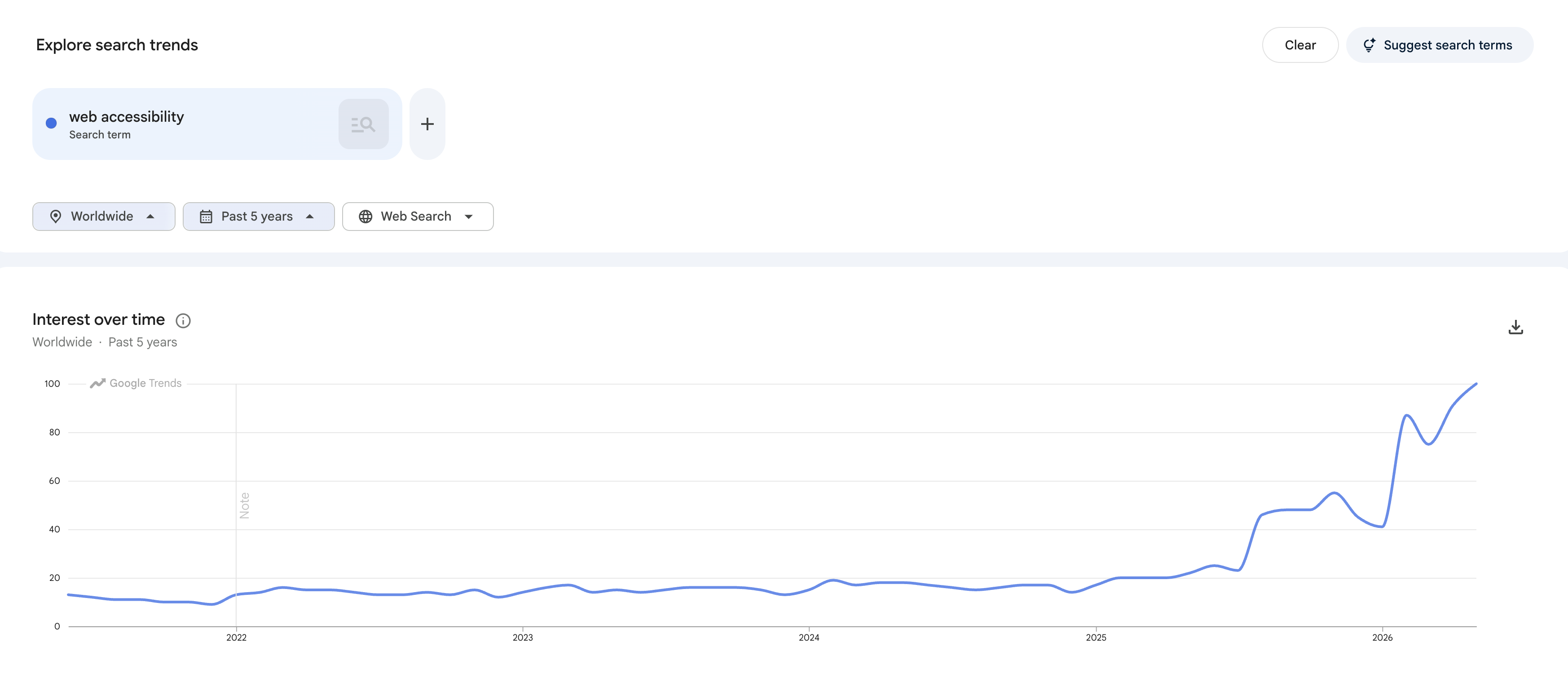
At the same time, the interest in web accessibility is at a five-year high.
Google Trends: worldwide search interest in “web accessibility,” past five years (Image by author, June 2026)
The interest was flat for years, then climbed through 2025 and spiked in 2026. The drivers are mixed, and worth being honest about: compliance deadlines like the ADA Title II web rule and the European Accessibility Act, a rising wave of accessibility lawsuits, and broader attention as AI changes how the web is built and read. No single one explains the whole curve, and claiming it does would be a guess.
But the direction is the whole point. The attention is arriving, the fixes are manageable, and the audience that depends on them is now the majority. The moment to fix the web is now.
Google Must Let Websites Opt Out Of AI Search Features In UK via @sejournal, @MattGSouthern
The UK’s Competition and Markets Authority has imposed a new conduct requirement on Google Search that will let publishers opt out of having their content used in AI search features.
The requirement follows the CMA’s decision to designate Google with strategic market status in general search. It sits under the UK’s digital markets competition regime, the framework created by the Digital Markets, Competition and Consumers Act.
For clarity, designating Google with that status is not a finding that the company broke competition law.
What Google Has To Do
The requirement places three obligations on Google.
Google must provide a way for websites to opt out of AI search features like AI Overviews and AI Mode. The CMA says greater control can strengthen publishers’ bargaining power with Google.
Additionally, Google needs to give websites a way to opt out of having their content used to train AI models. According to the CMA, this publisher opt-out is a world first.
Google must also attribute publisher content with clear links in AI-generated results.
Cardell said:
“With features like AI Overviews rapidly reshaping online search, it is crucial that content publishers, including news organizations, have appropriate bargaining power over how their content is used. At the same time, these measures will help tens of millions of UK search users better understand and trust the information presented to them.”
Timeline And Oversight
Most of the requirements come into effect six months after publication. Google has nine months to introduce page-level controls for AI search features.
Google will also have to submit compliance reports to the CMA every six months for the first year. The CMA expects Google to publish a summary or a non-confidential version so we can learn more about the impact of these changes.
Google hasn’t said how the opt-out will work, including whether publishers will manage it via a robots.txt directive, Search Console, or another method.
Why This Matters
The main way to keep content out of AI Overviews has been the nosnippet directive, which also strips standard search snippets. A control that separates AI-feature use from normal indexing, if it works as the CMA describes, would remove that tradeoff for publishers whose content reaches UK users.
Looking Ahead
The CMA said it will announce further action on Google’s search business in the coming weeks. The regime took effect in 2025, and the agency has since opened four strategic market status investigations into Google, Apple, and Microsoft.
You Can Finally Measure Content Alignment. That’s The Dangerous Part via @sejournal, @DuaneForrester
We have always been approximating relevance. Every keyword list, every TF-IDF score, every editorial judgment about whether a page “covers the topic” has been an attempt to answer a single question: is this content about the thing the user is looking for? The tools changed. The question did not. What changed, meaningfully, is the resolution of the instrument. Keyword research approximated relevance through lexical overlap: If the words match, the topics probably align. Vector-based semantic analysis approximates it through meaning overlap: If the concepts are close in embedding space, the content is probably relevant regardless of whether the exact terms appear. That is a genuine, material upgrade, but it is not a move from guessing to knowing.
The reason that distinction matters is that a significant portion of the SEO and content strategy community is right now treating it as if it were. They are looking at alignment scores, cosine similarity outputs, and semantic proximity metrics and reading them as ground truth. A high score means aligned. A low score means not aligned. Optimize until the number goes up. And the number, because it is a number, feels like it has settled the question that keyword research always left open. It hasn’t. It has given you a higher-resolution version of the same approximation, and the higher resolution is exactly what makes it dangerous, because it removes the humility that low resolution used to enforce.
Precision Is Not Accuracy
Gerard Salton’s SMART system at Cornell introduced the vector space model for document retrieval in the 1960s. The core insight then was the same insight powering today’s embedding models: represent both the query and the document as vectors, measure the angle between them, and use that angle as a proxy for relevance. What has changed across 60 years is the sophistication of how those vectors are constructed. Salton used term frequency. Modern embedding models use transformer-derived representations that encode semantic relationships, contextual meaning, and conceptual proximity across hundreds or thousands of dimensions. The measurement got dramatically better. But the thing being measured, the angular distance between two vector representations, is still a proxy for a relationship that exists outside the math.
This is where the Netflix research team landed in their 2024 study on cosine similarity in embedding models. Steck, Ekanadham, and Kallus demonstrated that cosine similarity applied to learned embeddings can produce results that are, in their framing, arbitrary. The way an embedding model is trained, the regularization applied, the data it saw, all shape the geometry of the space in ways that make a raw cosine score unreliable as an absolute measure of semantic similarity. A high score in one embedding space is not equivalent to a high score in another. The score is real. The similarity it claims to represent may not be.
For practitioners optimizing content, the implication is direct. When you score your content’s alignment to a query using an embedding model, you are measuring semantic proximity inside that specific model’s representation of language. You are not measuring how Google’s retrieval infrastructure or OpenAI’s RAG pipeline or Perplexity’s index would evaluate the same relationship. Those systems use their own embedding models, their own retrieval architectures, and their own reranking layers. A score of 0.92 in your measurement space might correspond to strong retrieval in one system, weak retrieval in another, and irrelevance in a third.
What Kind Of Wrong Are You?
This is the axis that matters, and it is not the one most practitioners are thinking about. The question is not whether keyword research or vector alignment is the better method. The question is what kind of error each method produces, because the error type determines whether you can correct for it.
Keyword research, for all its limitations, produces a known unknown. You know you are approximating. You know that matching terms to a page does not guarantee topical coverage, does not guarantee user satisfaction, and does not guarantee that a search engine will judge the page as relevant. The imprecision is visible, and because it is visible, it keeps you honest. Practitioners who grew up in keyword-driven optimization learned to over-cover, to build supporting content, to triangulate intent from multiple angles, precisely because they understood the instrument was blunt. The bluntness was a feature. It forced humility.
Vector alignment scoring, by contrast, can produce an unknown unknown. The number is precise. It has decimal places. It can be tracked over time, graphed, compared across content assets, and optimized against. And that precision creates a psychological trap: it feels like the question has been answered. The content is 0.89 aligned to the query. That must mean something definitive. But what it actually means is that in one specific embedding space, using one specific model’s learned representation, the angular distance between two vectors falls within a certain range. The score says nothing about whether the production retrieval system that will actually serve your content uses a compatible embedding space, applies the same tokenization, or weights semantic similarity the same way during reranking.
The MTEB benchmark leaderboard illustrates this concretely. The performance spread across current embedding models is not small. A content asset that scores well against one model’s embedding space may score materially differently against another, not because the content changed but because the geometry of the space changed. And the embedding model your scoring tool uses is almost certainly not the one any given AI platform uses in production. There is no public registry of which model powers which system’s retrieval layer. You are measuring in a space that is representative of the general problem but not identical to the specific system where your content will be evaluated.
That is not an argument against measuring. It is an argument against reading the measurement as settled fact. The distinction between a directional signal and a definitive answer is the entire discipline.
The Instrument Got Better. The Old One Is Not Enough
None of this rescues keyword-only optimization as a sufficient strategy. It is not sufficient, and the reasons are structural, not sentimental.
LLMs and AI retrieval systems operate in semantic space, not lexical space. They process meaning, not strings. A page can score perfectly against a keyword target list while being semantically adrift from the actual intent the query represents, because keyword presence and semantic coverage are different things. Conversely, a page can use none of the target keywords and still be strongly aligned semantically, because it covers the same conceptual territory through different vocabulary. The paraphrase and synonym space that LLMs operate in is structurally invisible to a keyword-based evaluation. You cannot see what you cannot measure, and keyword tools cannot measure semantic proximity.
Consider a practical case. Keyword research correctly identifies “customer churn prevention strategies” as a high-value target. The content team builds a thorough, intent-appropriate piece around it. It covers the topic, uses the target terms naturally, and would pass any keyword audit without issue. But an alignment score reveals that the content’s semantic center of gravity sits closer to “measuring churn” than to “preventing churn,” because the piece leans heavy on diagnostic framing, identifying at-risk accounts, calculating churn rates, segmenting by behavior, and lighter on intervention framing, what to actually do once you have identified the problem. Both treatments are on-topic. Both satisfy the keyword target. But the semantic distance between the content and the query as a retrieval system represents it is larger than the keyword coverage suggests, and keyword research has no instrument to surface that drift. The alignment score does. Not because the keyword research failed, but because it was never built to see at that resolution.
This is not a criticism of people who focus on keyword research. Those practitioners are not wrong. They are working at the resolution the available instruments allow. Intuiting alignment between content and query intent is a real skill, and the best keyword strategists are doing something genuinely sophisticated: they are approximating semantic relevance through lexical indicators, using editorial judgment to bridge the gap the tools could not cross. The tools can now cross a version of that gap. The editorial judgment still matters, but the gap it has to bridge is different.
The danger is the practitioner who decides that because keyword research is no longer sufficient, vector alignment scoring is the complete replacement. That practitioner has traded one approximation for a better one while losing the awareness that it is still an approximation. They have upgraded the instrument and downgraded the literacy, which is a net loss.
The Discipline Is Knowing What The Number Is Not Telling You
Goodhart’s Law, the observation that when a measure becomes a target, it ceases to be a good measure, is not just an aphorism for economists. It is the exact failure waiting for any team that treats an alignment score as a target to optimize against rather than a signal to interpret. The moment the score becomes the goal, the content starts drifting toward the score’s geometry and away from the actual relevance it was supposed to approximate. You start writing for the embedding model instead of the reader and the retrieval system, and the embedding model you are writing for is not the one any production system uses.
The real discipline, the one that did not exist when practitioners were navigating by keyword intuition alone, is understanding what an alignment measurement is and is not telling you. It is telling you that in a given embedding space, your content’s vector representation is geometrically close to a query’s vector representation. That is useful. That is more information than keyword presence gives you. It is telling you something about semantic coverage that lexical analysis cannot. But it is not telling you whether the production system’s embedding space has the same geometry. It is not telling you how reranking will treat the result. It is not telling you whether the LLM’s generation layer will interpret your content as authoritative, complete, or worth citing. Alignment is a retrieval-adjacent signal. It says nothing about interpretation.
The practitioner who can hold those two realities, the signal is real and the signal is incomplete, is the one operating with genuine literacy about the systems they are trying to influence. The one who collapses them, who reads a high alignment score as confirmation that the content is “optimized,” is operating with a more sophisticated version of the same overconfidence that made people think a keyword density of 3% meant their page was relevant. The number got better. The mistake is the same.
Representative, Not Identical
The honest framing is not “right space versus wrong space.” That binary invites paralysis: If no measurement space is the production space, why measure at all? The best framing, in my opinion, is a spectrum of representativeness. Some measurement spaces are closer to what production systems use than others. Some embedding models share more architectural DNA with the models powering major AI platforms than others. Some scoring methodologies account for the gap between measurement and production better than others. The question is not whether your measurement is perfect. It never will be. The question is how representative your measurement space is of the systems you actually care about, and whether you are treating the score with appropriate directional respect rather than absolute faith.
This is the actual work. Not chasing a number. Not abandoning measurement because it is imperfect. Building enough literacy about how these systems work to know which signals to take seriously, which to discount, and which to combine with other indicators before making a content decision. That literacy was optional when the only instrument was keyword research, because the instrument was so obviously blunt that nobody mistook it for truth. It is not optional now. The instruments are precise enough to fool you, and the cost of being fooled is optimizing content for a geometry that does not represent the system where your brand needs to be visible.
I wrote about a related dimension of this problem in the vector index hygiene piece last year, focusing on how the quality and maintenance of the index itself shape retrieval outcomes. This article is the other side of that coin: not the index, but the measurement you use to evaluate whether your content belongs in it. And both connect to a larger question I will return to in future work, which is a gap most people aren’t talking about yet.
Start With What You Can See
If you are still running keyword research as your primary content alignment method, you are working with a blunt instrument in an environment that now demands more resolution. If you are running vector alignment scoring and reading the output as settled truth, you have the resolution but not the literacy to use it safely. Both are correctable. The path forward is not choosing one over the other. It is layering them, understanding what each can and cannot tell you, and building the organizational capacity to treat precise measurements as what they are: directional signals produced inside a specific space that may or may not represent the systems where your content competes.
The gut feeling was never the enemy. The illusion that you have moved past the need for judgment is.
For a broader look at how AI search visibility is reshaping the work of being found, “The Machine Layer” covers the structural shifts that make this kind of measurement literacy essential.
For the past couple of years, AI has been moving search through a structural shift. Every software tool is embedding generative AI as a new product feature for default interface, and there seems to be a new AI measuring or optimization tool every couple of days.
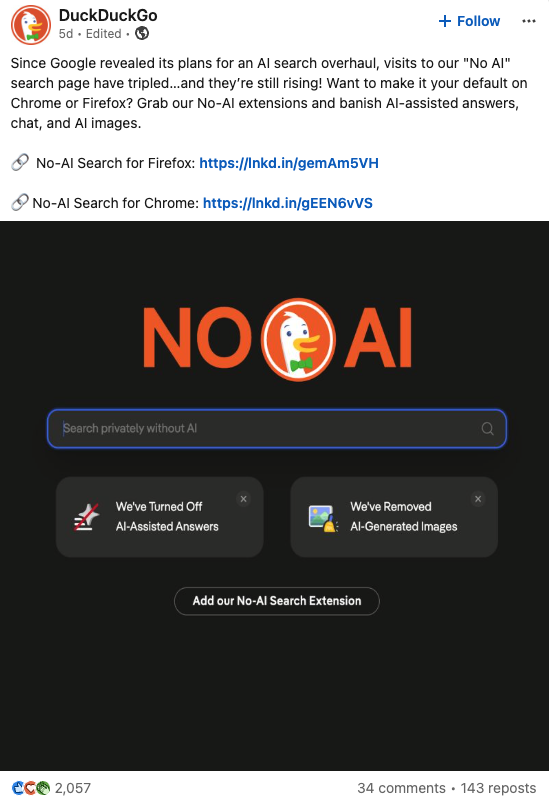
But we’re seeing users react both positively and negatively to AI being seemingly thrust upon them. DuckDuckGo is reporting that visits to its No AI Search have tripled since Google announced Intelligent Search.
Screenshot from LinkedIn, June 2026
How Everyday Users Interact With AI
As an industry, we’re focused on this narrative of total disruption, and we are seeing disruption and movement away from what has been our norm, but research shows a fragmented adoption of AI, rather than blanket adoption.
For easy, low-risk tasks like finding a local plumber or brainstorming dinner ideas, people are happy to use AI.
The tripling of traffic to DuckDuckGo’s “No AI” search page is a direct reaction to users not having a choice.
When software forces AI on users without letting them turn it off, users feel trapped, especially if they’re not yet trusting of AI.
Instead of accepting it, they are actively switching to alternative search engines and browser extensions that offer the clean, link-based experience they prefer.
To understand this pushback, we have to look at how the human mind reacts to new technology (and a big thank you to Giulia Panozzo, who helped me source and research these studies).
The 5 Barriers To Trust
In a study published in Nature Human Behaviour, researchers De Freitas et al. (2023) looked at the psychological barriers that stop people from trusting AI.
There are two main reasons that stand out for search engines and AI.
First is “opacity,” which simply means the AI is a “black box.”
When a search engine gives a synthesized answer without showing its sources clearly, we cannot see how it got its information. Human minds naturally want transparency, especially when making important decisions.
Second is the threat to our “agency,” or our sense of control. When search engines force an AI chat onto users, it feels like our choice is being taken away. To regain control, users flee to alternative search engines that respect their independence.
Safety-First Thinking And Tech Anxiety
Research by Sapru (2026) in Technology in Society looks at why some people feel intense anxiety about AI.
The study divides users into two groups:
Promotion-focused people, who love trying new and exciting tools.
Prevention-focused people, who prioritize safety, accuracy, and keeping things simple.
For safety-first users, a search engine is just a basic tool to get things done, not a toy to play with. Forcing an AI layer onto these users makes them feel anxious.
They worry about being misled or having to learn a complicated new system, which drives them to look for “No-AI” options.
Recognition Doesn’t Equal Utilization
A study by Yin (2025) in Frontiers in Education shows that recognizing an AI tool is useful does not mean a person will actually use it.
The researchers mapped out a step-by-step path of how users actively avoid AI:
If they see a way to avoid the AI, they will take it. The sudden spike in DuckDuckGo’s traffic can be seen as people taking an available exit route to avoid the threat.
Outside Our Bubble, AI Adoption Is Happening, But We Shouldn’t Panic
It’s easy for SEOs and other tech-savvy professionals to assume the rest of the world is adopting AI at the same pace we are.
Microsoft’s Global AI Diffusion Report shows that despite billions of dollars spent on AI, the vast majority of the world has not adopted it.
Regular active use of generative AI sits at 17.8% of the global working-age population (15-64). That means more than four in five working-age adults worldwide are not regularly using generative AI tools.
This also means that a lot of our clients who are worried about audiences (with buying power) moving away from traditional search to AI alternatives, are in the majority not adopting AI on a regular basis.
A large number of users are still relying on the “traditional web” and methods of fulfilling their purpose of going online.
As an industry, we’re going through a lot of changes at a rapid rate, and users are going through the same changes and barrage of AI solutions to their problems. We need to be adaptive and forward-thinking with our approaches, but we’re not quite in panic mode yet.
Google CEO Sundar Pichai Is OK With AI Mode Replacing Classic Search via @sejournal, @martinibuster
In a recent interview, Google’s CEO Sundar Pichai confirmed that sources and links will always be a part of the AI answers and when asked how he feels about a decline in the use of Classic Search in favor of AI Search, he mentioned that Google will survive on a blend of subscriptions and advertising.
Google On The Future Of Links And Sources
Google’s CEO acknowledged that people still want to connect with what’s on the web. He also shared that Google is creating a seamless transition from classic search to AI Mode and that according to their internal metrics, people are satisfied with it.
In response to an interviewer question as to whether Google is at some point going to transition away from the ten blue links and classic search, he said that the process is a “continuum,” which means a gradual transition, not a “rip the band-aid” type change.
The question the interviewer asked:
“I think a lot of people expect that at some point, the kind of normal Google sort of classic search interface goes away. The 10 blue links maybe go away and you just kind of have this AI mode as the default.
…Do you think that goes away at any point that you sort of rip the band-aid off and just go full AI mode?”
Sundar Pichai confirmed that sources and links won’t always be a part of Search:
“You know, I think it’s important to bring users along the journey as well as making sure the product is working for their expectations.
So, you know, I try not to get ahead of that.
I think it is very clear as we evolve through these changes, people are responding positively. We can see it in the long-term metrics of the product in such a clear way. And so I think we understand that. But people want search to be fast.
I do think through search, people are looking to connect with what’s out there on the web, so that’s important to us. It’s all of that.
So I think you’re seeing us evolve the product.
And I think you’ll continue to see it be methodical, but we didn’t have AI Mode a year ago. But now a lot of people are experiencing it. I think we have made it more seamless to go there than before.
And so it’s a continuum.
But I don’t see…
Sources and links will always be there as part of it.”
Pichai says people want to connect with what is on the web and that sources and links remain part of the experience. But he also says AI Mode is becoming more seamless and widely used, which actually impacts referrals.
Visibility Is Not The Same As Referrals
The idea of evolving classic search so that it’s seamlessly transitioning to AI Mode is not going to be popular with publishers and SEOs. The reality of “links” and “sources” in AI Mode is that visibility is not the same thing as referral traffic. So when Pichai’s AI Mode offers visibility with one hand, it’s also diminishing referrals with the other.
This ties directly with the concept of Google Zero. Google Zero is the big brand calculation that referral traffic is dwindling to zero. So in order to survive, businesses must promote and monetize as if Google referrals will one day be zero, Google Zero.
The reality of AI Mode is that Google is preserving the appearance of attribution while diminishing the economic value of clicks.
Google Says Users Are Responding Positively
The other important point in his answer is that Pichai says Google can see positive user response to AI Mode in their long-term metrics. But people are increasingly concerned about data center use, the record amounts of water that they use, and the harm that does to the environment as well as to the cost of energy, which affects the cost of everything from the clothes you wear to the dinner on the table.
The interviewer even mentioned how college graduates across the United States booed at the very mention of AI. So with all of the negative public sentiment against AI, Pichai still insists that people are happy with it.
Google Is Okay With Replacing The Search Advertising Model
One of the two interviewers gestured to his co-interviewer and commented that he had told him that he hadn’t done a traditional Google Search in a year and asked Pichai if he’s okay with people abandoning search in favor of pure AI queries.
He asked Pichai if he’s okay with users who don’t use classic search :
“When you hear that, are you cool? Like, this is the kind of user that I want right now, or does it send you a little chill because the traditional search ad business is a pretty good one for you.”
Pichai’s answer seemed to suggest that there may in the future be a blending of subscription and advertising revenues.
He responded:
“Well, I think we will, if anything, in the AI mode, in an agentic… these things are going to do a lot more for you than what we were able to do for users 10 years ago.
I think the economic value is always a function of the total value you’re giving users. All of us would say over time, the value we are providing users increases, there’s more competition, there are more choices.
So I feel comfortable between a combination of subscription and ads that the right models will continue to be there.”
That’s maybe the first time someone at Google has mentioned a blend of subscriptions and advertising as a way of monetizing the AI web. Where does that leave publishers?
When asked about the negative economic future that many feel AI is bringing, he compared AI to the introduction of the spreadsheet and how that revolutionized financial analysis, to how it will make coding easier, and how it will enable doctors to spend more time with patients.
All of those analogies and comparisons sidestep the damage to the web ecosystem that non-referring visibility brings.
His answer:
“I think people are going to be more productive. They will have more time for leisure. All of that will simultaneously be true.”
Pichai is confident that the web ecosystem can subsist on visibility, and that Google will be fine if people stop using classic search. But where does that leave the web ecosystem? Pichai all but recommended eating cake.