LLM Traffic Is Shrinking via @sejournal, @Kevin_Indig

LLM referral traffic has been growing +65% year-to-date. But we should assume 0 in the future.

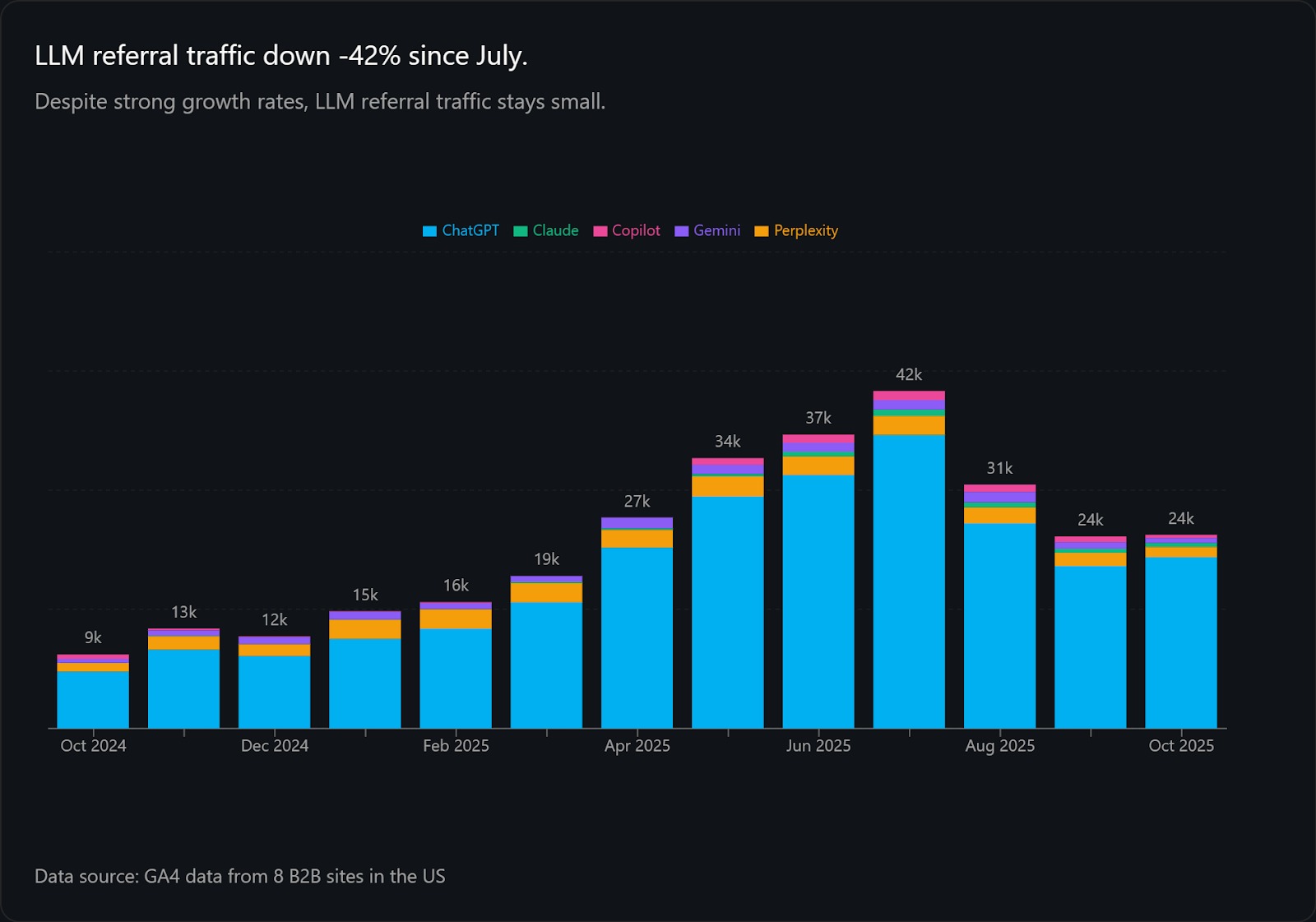
LLM Referral Traffic Is Shrinking

LLM referral traffic in B2B grew +65.1% since January – but dropped -42.6% since July.

Image Credit: Kevin Indig

My December prediction of 50% organic by 2027 is dead:

  • In December 2024, I analyzed six B2B sites and found LLM referral traffic was growing at such a fast rate it would make up 50% of organic traffic in three years.
  • Today, I’m finding the monthly growth rate of LLM traffic dropped from 25.1% in 2024 to 10.4% in November 2025.
  • Even from January to July 2025, the average growth rate was lower (19.2%) than my projection. That’s fast, but not enough to reach 50% organic traffic in three years.

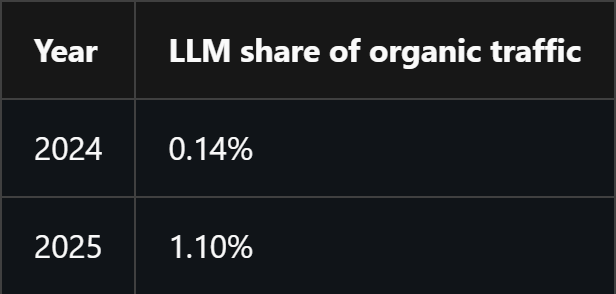
LLM contribution to organic traffic grew from 0.14% in 2024 to 1.10% in 2025, which is more than I projected (0.79%).

Image Credit: Kevin Indig

But with organic traffic falling due to AI Overviews, this growth becomes meaningless.

Fewer Citations Despite Growing Usage

In August, several factors influenced LLM referral traffic:

  1. Seasonality: Siege Media documented that B2B sites lost LLM traffic in August due to vacation season.
  2. Router: ChatGPT 5, which launched on August 7, has a router that picks the model. The router favors non-reasoning models, which show fewer citations and send less traffic out.
  3. Concentration: Josh from Profound found a higher concentration of referrals to Reddit and Wikipedia starting late July.

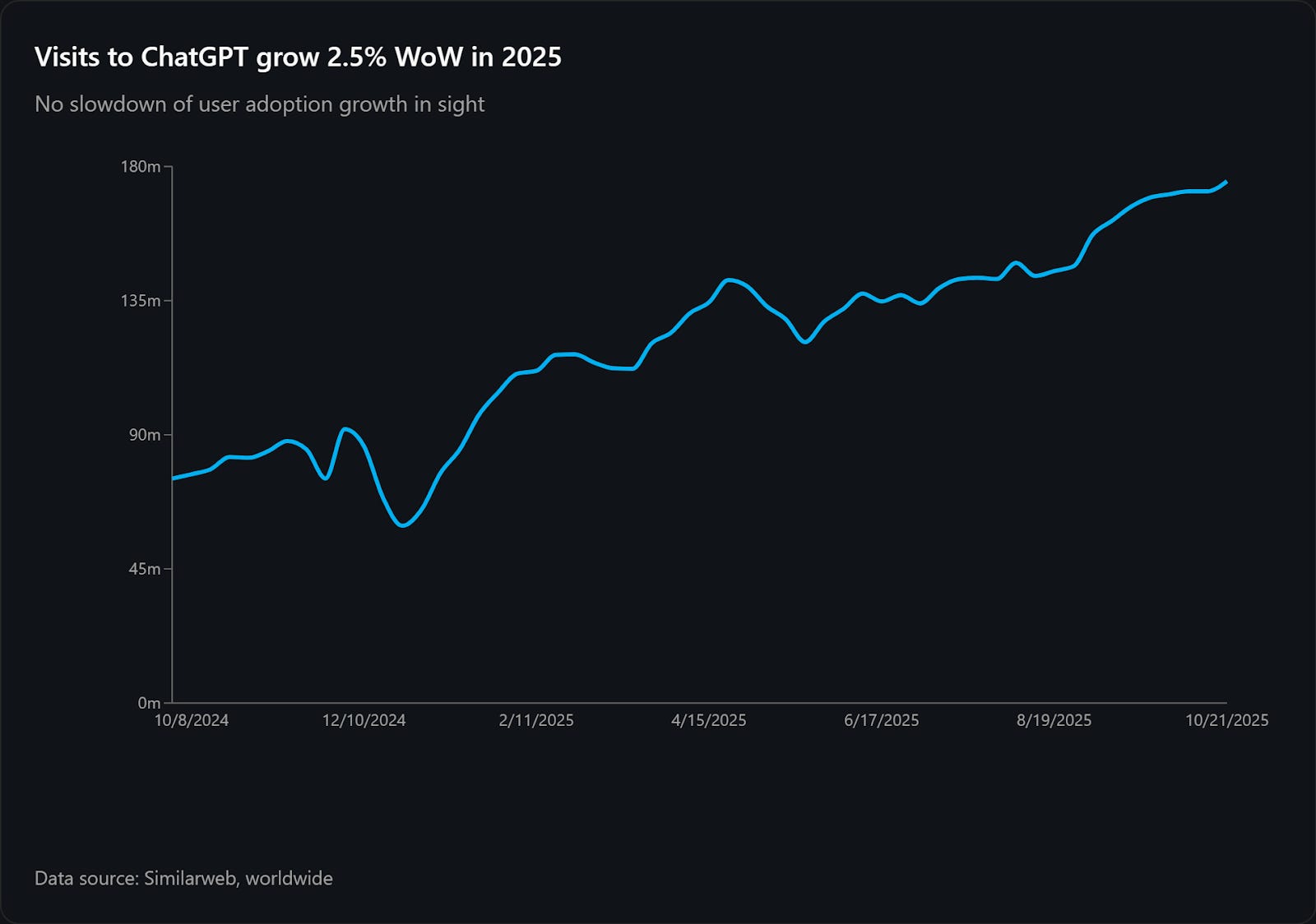
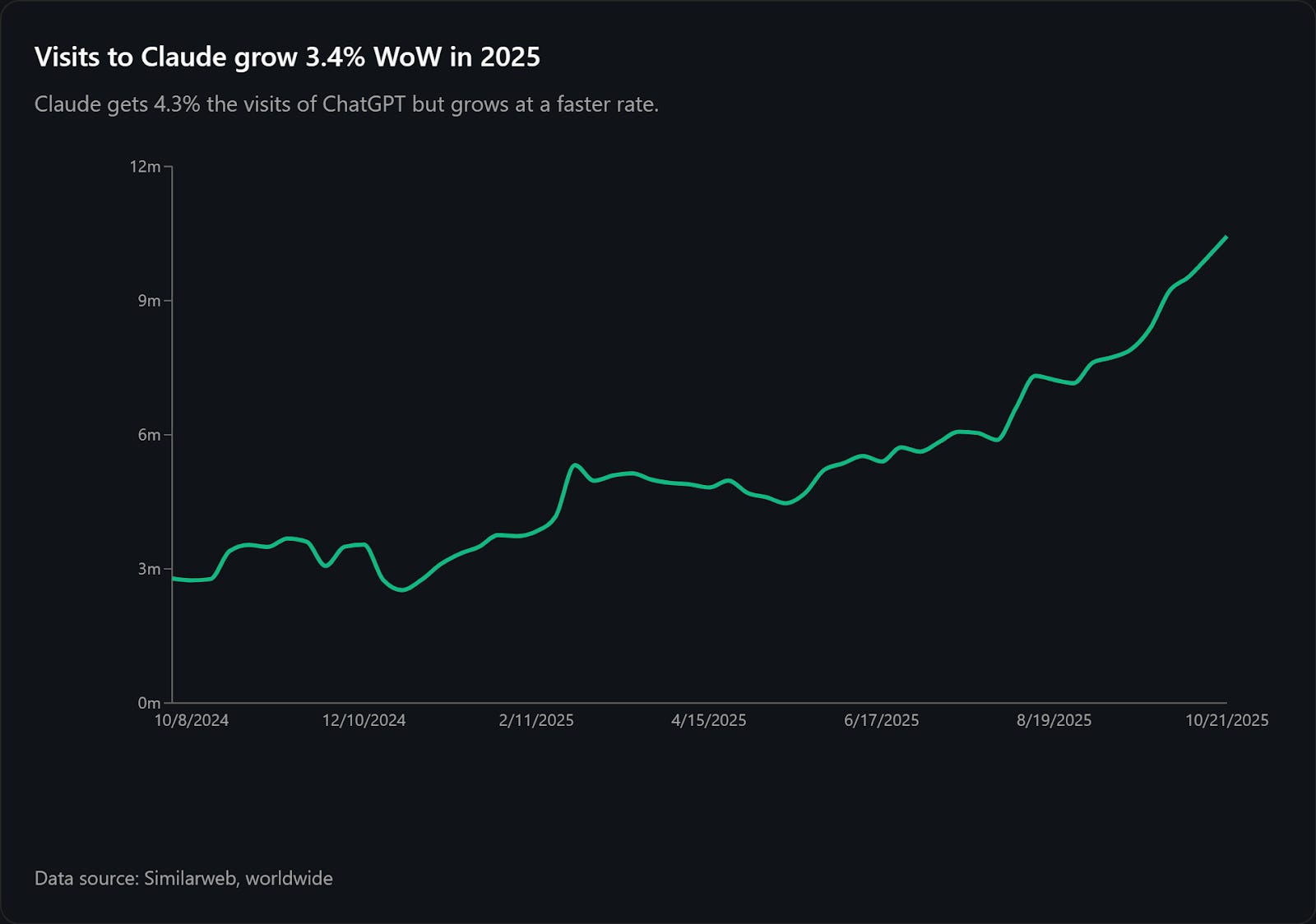
Business seasonality has a lower impact because neither ChatGPT (consumer focus) nor Claude (business focus) sees a decrease in site visits.

Image Credit: Kevin Indig

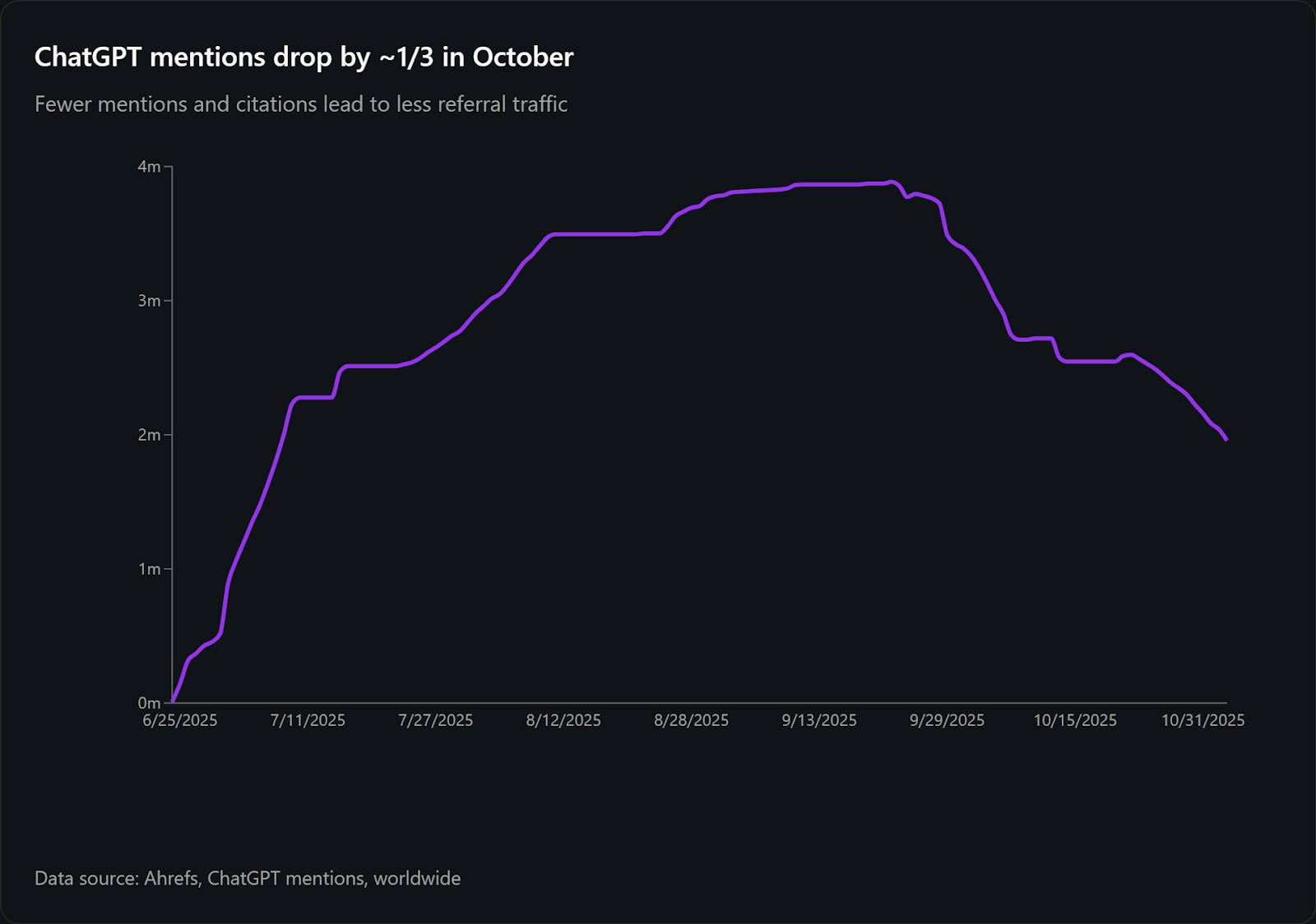
ChatGPT mentions, however, dropped by one-third in October and continue dropping in November.

Image Credit: Kevin Indig

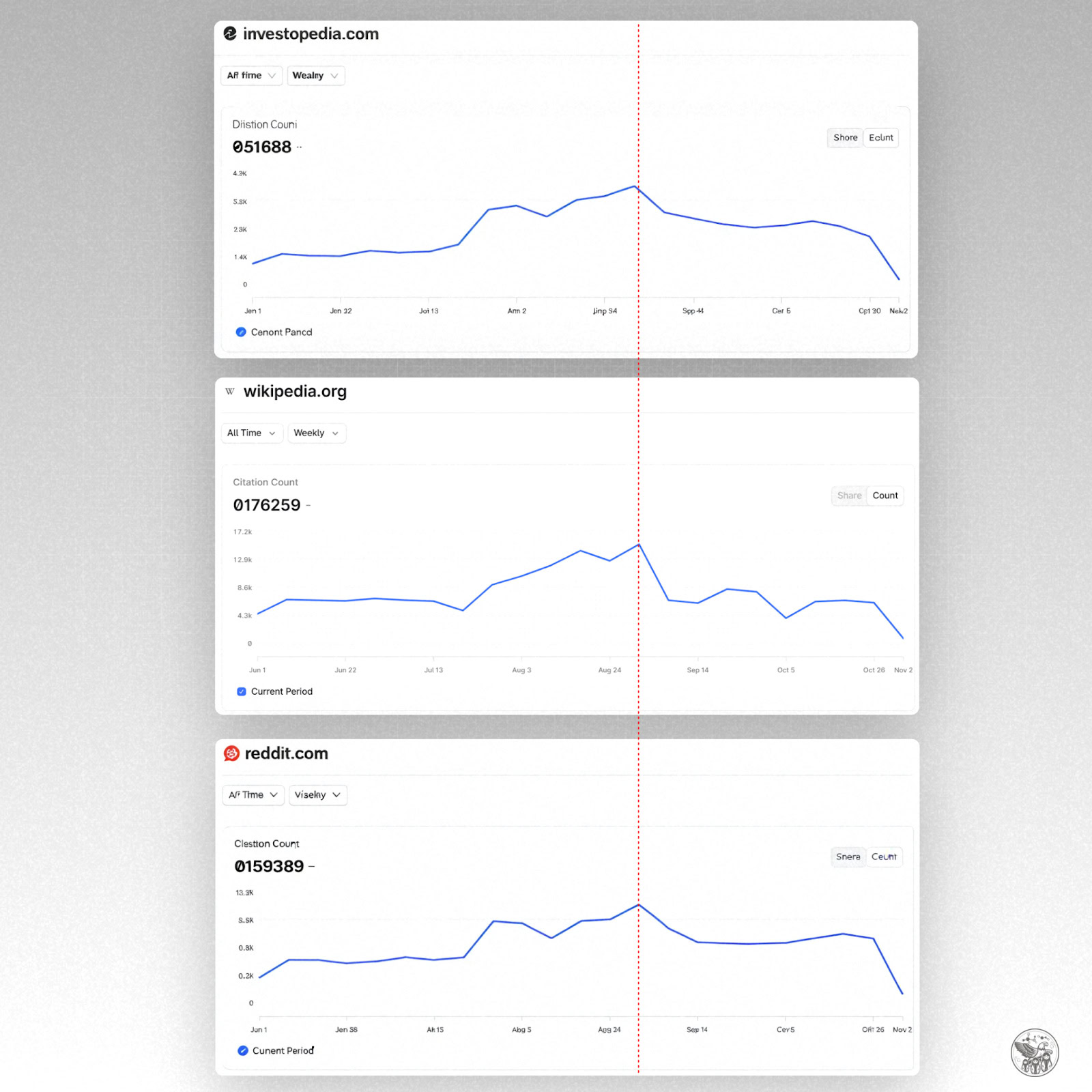
Citations for large domains like Reddit or Wikipedia follow suit (based on Profound data).

Major sites see citation declines in September (Image Credit: Kevin Indig)

Conclusion: LLM visits are up, which removes seasonality as dominant cause. The driver of lower referral traffic is ChatGPT, showing fewer citations due to the model router.

Visibility Is The Real Price

Traffic was never the right way to value LLMs because LLMs make clicks redundant:

  • The AI Mode study I published last month validates that clicks only occurred for shopping-related tasks (zero-click share = ~100%).
  • Pew Research has found that only 1% of users click links in AI Overviews.

Focusing on traffic leads to disappointing results. ChatGPT is more like TikTok than Google Search. The currency of the AI world is visibility.

The good news: LLMs grow the pie. Semrush found people don’t use Google less often because they also use ChatGPT. If LLMs are additive to Google Search, the visibility surface grows even though clicks per source shrink. You have more places to be seen, fewer clicks per place.

But our success metrics need to change. Referral traffic neither works for ChatGPT nor Google, as AI Overviews and AI mode swallow more clicks. Instead, we need to adopt visibility-first.

Default To Zero LLM Traffic

  1. Track LLM and organic search seasonality for your vertical to measure the total pie of citations and make sense of drops/spikes.
  2. Monitor total citation and mention count to answer the question, “Are we growing because the market grows?” Lower citations/mentions means fewer chances to influence purchase decisions.
  3. Prioritize brand mentions over citations in LLMs. Mentions without links drive familiarity and influence purchase decisions.
  4. Stop expecting (meaningful) LLM referral traffic. Budget for visibility.
  5. Invest resources where LLMs go to train: UGC and third-party reviews like Reddit, YouTube, review sites, community forums.

Boost your skills with Growth Memo’s weekly expert insights. Subscribe for free!


Featured Image: Paulo Bobita/Search Engine Journal

https://www.searchenginejournal.com/llm-traffic-is-shrinking/559940/


Holiday PPC Guide 2025: Advanced Strategies For Smarter Bidding, Budgets & Audiences via @sejournal, @siliconvallaeys

The holiday this year brings more competition than ever, but the shopper journey is also shifting. Consumers begin research weeks earlier, often starting in October, and rely on conversational AI or chatbot-style searches to compare products. Microsoft’s holiday insights show that shopping behavior kicks off in October, with many November and December conversions originating from clicks made weeks earlier.

The funnel is changing shape: wider at the top as more shoppers browse early, but shorter at the bottom as they move quickly once urgency kicks in. The key lesson is that PPC strategy must nurture intent early and be ready for compressed buying cycles when urgency arrives.

Holiday shoppers are beginning earlier, researching longer, and converting later. The funnel is wider than ever, but also shorter once the urgency hits.

Bidding: Winning The Ad Auction

Don’t Fear Expensive Clicks, Fear Unprofitable Ones

Holiday auctions bring higher cost-per-click (CPCs), a natural result of more advertisers competing for limited inventory. Success is not about avoiding CPC increases but maintaining strong return on ad spend (ROAS) and protecting profit margins. Teika Metrics’ Black Friday and Cyber Monday (BFCM) data confirms that CPCs climb seasonally, especially on Black Friday and Cyber Monday.

Smart Bidding goals should be tied to profitability, not just revenue, and portfolio bidding can help balance volatility across campaigns. Microsoft and Google also recommend applying seasonality bid adjustments before major holidays so automation anticipates conversion spikes.

Pro Tip: Set seasonality adjustments 24-48 hours before and after Black Friday and Cyber Monday to help Smart Bidding avoid over- or under-reacting.

Smart Bidding With Guardrails: Train The Machine

Automation is powerful, but it is not infallible. It needs monitoring and guardrails. Trust tROAS or tCPA when conditions are stable, but ensure you have bid limits (through portfolio bidding) and guardrails to alert you about unusual performance during peak periods when volatility spikes.

Real-World Example: Last BFCM, a large retailer client of ours using offline conversion import (OCI) saw conversions suddenly vanish. Optmyzr automation flagged the anomaly right away, revealing a Google-side glitch in OCI reporting. Without that safeguard, Smart Bidding would have assumed conversions had dried up and slashed bids during the most important shopping week of the year. Guardrails prevented disaster.

Key Take: Automation doesn’t eliminate risk; it changes the type of risk. Without guardrails, a data glitch can quietly sabotage your bids. With guardrails, you catch it before it becomes a disaster.

Inventory And Feed-Aware Bidding: Don’t Burn Budget On Out-Of-Stock

Holiday shoppers expect items to be in stock, priced competitively, and available with fast delivery. Automating feed hygiene to pause out-of-stock products is essential. Structuring campaigns by margin allows for different tROAS bids that achieve your target profitability.

Pro Tip: If your price is not competitive, shift spend toward SKUs where you can compete on both offer and margin.

And before you worry about bids, ensure the feed can win the impression. Tighten mobile-friendly titles and human-readable attributes (e.g., use “light brown,” not obscure color names), add seasonal terms like “Black Friday deals,” and fix disapprovals early so you don’t lose visibility when auctions heat up.

Create label taxonomies that align with your profit strategy, like “hero products,” “doorbusters,” “low-margin,” “last-chance,” so you can direct bids and budgets to what actually drives profits.

Case Study Insight: When Amazon briefly exited the Google Ads auction, Optmyzr’s analysis showed other advertisers gained clicks at lower CPCs, but ROAS did not improve. Shoppers were expecting Amazon, and when they did not find it, they often failed to convert with alternatives. Winning an auction is meaningless if the offer and expectations do not align.

Budgeting: Flexibility Wins

Turn On Campaigns Now And Control Delivery With Budgets

I normally recommend pausing campaigns that are not needed, rather than reducing their budgets to a very low amount to keep them active. Advertisers sometimes use budget rather than status to “pause” a campaign because they fear the dreaded learning period that may kick in when a campaign is enabled after an extensive period of inactivity.

Pausing does not erase Google’s memory, since “learning” reflects new auction contexts rather than forgotten history. Longer pauses, however, risk drift as consumer behavior shifts. The bigger issue is that paused campaigns with new ads will not undergo review until they are re-enabled, which can delay serving during crucial moments.

So during BFCM, there are good reasons to use budget rather than status because it keeps campaigns actively learning about shifts in consumer behavior, and it ensures new creatives go into the approval process.

Holiday Pitfall Alert: Do not pause campaigns with unapproved creatives close to Black Friday. Get ads reviewed in advance.

Intraday Pacing: Don’t Get Fooled By Conversion Lag

Static daily budgets can be damaging in volatile holiday conditions. Dynamic pacing using scripts or APIs is a better approach, especially when aligned with key milestones like Black Friday, Cyber Monday, shipping cutoffs, and last-minute windows.

On Black Friday and Cyber Monday, pacing must be monitored throughout the day. Hourly reporting in Google Ads makes this possible, but advertisers must also account for conversion lag.

Looking at last year’s data, conversions appear smooth by the hour because lag has already resolved. On the day, however, conversions will often appear behind pace even when clicks and impressions are aligned. Saving hourly reports as the day unfolds will provide a baseline for analyzing lag in future years.

Pro Tip: Do not confuse lag with poor performance. Cutting budgets midday can mean missing the evening conversion surge.

Lock in your total Q4 budget and earmark a supplemental pool for Black Friday, Cyber Monday, and the biggest shopping weekends. Expect higher CPCs and raise day caps accordingly so campaigns don’t exhaust at noon. Finally, audit your automations – safety scripts that pause or cap spend are helpful, but if they fire at the wrong time during BFCM, they can suppress profitable traffic.

Targeting

Audience Signals Are Your Multiplier

First-party data goes beyond CRM lists. It includes your business’s unit economics, such as pricing and profit margins, which can guide automation toward profitability rather than vanity ROAS.

Key Take: First-party data is not only about who your customers are, but also includes all your business data, including how you price. Leverage this to guide when you run ads and how much you bid.

Microsoft has a unique feature that Google doesn’t have: impression-based remarketing, which allows advertisers to retarget users who saw their ads but did not click. This expands reach to pre-qualified audiences and often reduces costs. Combining CRM imports, impression-based remarketing, and profit-based bidding provides automation with richer signals.

Keywords And Keywordless Targeting

With match types getting broader every year, and the growth in keywordless campaign types like Performance Max, advertiser control over queries is eroding. This trend will continue as users shift from keyword searches to prompting, and Google eventually replaces synthetic keywords with a more precise targeting system.

Performance Max is performing well, and we shared details about what trends are working best in our PMax study. AI Max, on the other hand, doesn’t feel quite as ready for primetime, though there is unverified speculation that a September 2025 algorithm update improved performance significantly. Test AI Max using Experiments before setting it loose on your BFCM traffic this year.

Creative: Stand Out In Crowded Auctions

Ads That Win Auctions: CTR Beats Clever Copy

Auctions for bottom-of-the-funnel search ads reward click-through rate (CTR) and predicted CTR, not witty copy. Coverage and clarity matter most. Ad headlines, descriptions, and assets (formerly ad extensions) should be updated with current promotions, shipping cutoffs, and urgency messaging.

However, with 15 potential headlines that Google can choose from for your ad, controlling what is most important to include in messaging requires pinning during BFCM.

Optmyzr’s soon-to-be-published 2025 Responsive Search Ads (RSA) study shows that advertisers who pin multiple variations to the same position achieve better ROAS. Pinning one element restricts the machine too much, while no pinning gives it too much freedom. Multi-asset pinning balances human guidance with algorithmic optimization. Google’s RSA guidance confirms that variation improves performance.

Pro Tip: Plan RSAs in waves and use multi-asset pinning to balance brand strategy with system optimization.

Keep It Fresh: Creative Burnout Happens Faster In Q4

Shoppers tire quickly of repetitive ads, especially in Demand Gen campaigns. But even search ads should be kept fresh, and ads should be staged in waves to appeal to Black Friday and Cyber Monday shoppers, and reflect shipping cutoffs, last-minute gifts, and post-holiday clearance as the holidays approach.

Pre-loading assets ensures they are reviewed and ready to serve. Countdown customizers and promotion extensions can reinforce urgency, but messaging must stay consistent with site offers to maintain trust.

Pro Tip: Schedule creative waves in advance. Do not wait until Cyber Monday morning to swap assets.

Competitive Insights

Competitor Surge Alerts: Auction Insights As A Warning

Auction Insights is a powerful diagnostic tool. Google’s Auction Insights report reveals shifts in competitor behavior, such as impression share surges. Monitoring these trends in November helps advertisers react quickly, whether by increasing brand defense or positioning directly against rivals.

Auction Insights is your battlefield radar for Q4. Ignore it, and you could be blindsided.

Post-Holiday: Turn December Buyers Into January Fans

January Is Your PPC Lab: Retain, Don’t Just Acquire

Holiday buyers are the most expensive to acquire but can become the most profitable if nurtured in Q1. Segment holiday-only versus year-round buyers using customer relationship management (CRM) and ad data, then run loyalty and cross-sell campaigns. Feeding learnings back into bidding and audience systems ensures automation improves over time.

Holiday buyers are the most expensive you will ever acquire. Retarget them in January to make them more profitable.

Final Thoughts

Holiday PPC is the ultimate stress test. CPC inflation, automation, budgets, audiences, creative, competition, and fraud all converge at once. Winning requires guiding automation with better inputs, protecting profitability with strong signals, and owning your message at a time when keyword precision is fading. Prepare early, pace carefully, and place guardrails everywhere they matter most.

Checklist Summary

  • Expect CPC inflation in Q4. Optimize for profit and ROAS, not cheap clicks.
  • Set seasonality bid adjustments and add guardrails so Smart Bidding doesn’t misfire on BFCM.
  • Treat budgets as fluid with intraday pacing. Don’t confuse conversion lag with underperformance.
  • Use first-party data beyond CRM lists. Profit margins and pricing strategy are key signals.
  • Microsoft’s impression-based remarketing lets you retarget high-intent searchers who never clicked.
  • Make creative your control lever in a PMax and broad-match world. Use multi-asset RSA pinning.
  • Monitor Auction Insights, watch for fraud/MFA, and turn expensive Q4 buyers into Q1 loyalists.

More Resources:


Featured Image: Roman Samborskyi/Shutterstock

https://www.searchenginejournal.com/holiday-ppc-guide-advanced-strategies/557692/


Ahrefs Data Shows Brand Mentions Boost AI Search Rankings via @sejournal, @martinibuster

The latest Ahrefs podcast shares data showing that brand mentions on third-party websites help improve visibility across AI search surfaces. What they found is that brand mentions correlate strongly with ranking better in AI search, indicating that we are firmly in a new era of off-page SEO.

Training Data Gets Cited

Tim Soulo, CMO of Ahrefs, said that off-page activity that increases being mentioned on other sites improves visibility in AI search results, both those based on training data and those drawing from live search results. The benefits of conducting off-page SEO apply to both. The only difference is that training data doesn’t get into LLMs right away.

Tim recommends identifying where your industry gets mentioned:

“You just need to see like where your competitors are mentioned, where you are mentioned, where your industry is mentioned.

And you have to get mentions there because then if the AI chatbot would do a search and find those pages and create their answer based on what they see on those pages, this is one thing.

But if some of the AI providers will decide to retrain their entire model on a more recent snapshot of the web, they will use essentially the same pages.”

Tim cautioned that AI companies don’t ingest new web data for training and that there’s a lag in months between how often large language models receive fresh training data from the web.

Appear On Authoritative Websites

Although Tim did not mention specific tactics for obtaining brand mentions, in my opinion, off-page link-building strategies don’t have to change much to build brand mentions.

Tim underlined the importance of appearing on authoritative websites:

“So yeah, …essentially it’s not that you have to use different tactics for those things. You do the same thing, you appear like on credible websites, but yeah, let’s continue.”

The only thing that I would add is that authoritativeness in this situation is if a site gets mentioned by AI search. But the other thing to think about is if a site is simply the go-to for a particular kind of information, relevance

Related: Why You Should Be Focusing On Brand Marketing Right Now

Topicality Of Brand Mentions

The other thing that was discussed is the topicality of the brand mentions, meaning the context in which the brand is discussed. Ryan Law, Ahrefs’ Director of Content Marketing, said that the context of the brand mention is important, and I agree. You can’t always control the narrative, but that’s where old-fashioned PR outreach comes in, where you can include quotes and so on to build the right context.

Law explained:

“Well, that segues very nicely to what I think is probably the most useful discrete tactic you can do, and that is building off-site mentions.

A big part of how LLMs understand what your brand is about and when it should recommend it and the context it should talk about you is based on where you appear in its training data and where you appear on the web.

  • What topics are you commonly mentioned alongside?
  • What other brands are you mentioned alongside?

I think Patrick Stox has been referring to this as the era of off-page SEO. In some ways, the content on your own site is not as valuable as the content about you on other pages on the web.”

Law mentioned that these off-page mentions don’t have to be in the form of links in order to be useful for ranking in AI search.

Testing Shows Brand Mentions Are Important

Law went on to say that their data shows that brand mentions are important for ranking. He mentions a correlation coefficient of 0.67, which is a measure of how strongly two variables are related.

Here are the correlation coefficient scales:

  • 1.0 = perfect positive correlation (two things are related).
  • 0.0 = no correlation.
  • –1.0 = perfect negative correlation (for example, for every minute you drive the distance gets smaller, a negative correlation).

So, a correlation coefficient of 0.67 means that there’s a strong relationship in what’s observed.

Law explained:

“And we did indeed test this with a bit of research.

So we looked at these factors that correlate with the amount of times a brand appears in AI overviews, tested tons of different things, and by far the strongest correlation, very, very strong correlation, almost 0.67, was branded web mentions.

So if your brand is mentioned in a ton of different places on the web, that correlates very highly with your brand being mentioned in lots of AI conversations as well.”

He goes on to recommend identifying industry domains that tend to get cited in AI search for your topics and try to get mentioned on those websites.

Law also recommended getting mentions on user-generated content sites like Reddit and Quora. Next he recommended getting mentioned on review sites and on YouTube video in the transcripts because YouTube videos are highly cited by AI search.

Related: How To Get Brand Mentions In Generative AI

Ahrefs Brand Radar Tool

Lastly, they discussed their Ahrefs tool called Brand Radar that’s useful for identifying domains that are frequently mentioned in AI search surfaces.

Law explained:

“And obviously, we have a tool that does exactly that. It actually helps you find the most commonly cited domains.  …if you put in whatever niche you’re interested in, you can see not only the top domains that get mentioned most often across all of the thousands, hundreds of thousands, millions of conversations we have indexed. You can also see the individual pages that get most commonly mentioned.

Obviously, if you can get your brand on those pages, yeah, immediately your AI visibility is going to shoot up in a pretty dramatic way.”

Citations Are The New Backlinks

Tim Soulo called citations the new backlinks for the AI search era and recommended their Brand Radar tool for identifying where to get mentions. In my opinion, getting a brand mentioned anywhere that’s relevant to your users or customers could also be helpful for ranking in the regular search  as well as AI (Read: Google’s Branded Search Patent)

See also: Data Finds Brand Mentions Improve Visibility

Watch the Ahrefs podcast starting at about the 6:30 minute mark:

How to Win in AI Search (Real Data, No Hype)

[embedded content]

https://www.searchenginejournal.com/ahrefs-data-shows-brand-mentions-boost-ai-search-rankings/559938/


Kinsta Managed WordPress Host Won’t Charge For Bot Traffic via @sejournal, @martinibuster

WordPress managed web hosting company Kinsta announced that it is changing how it bills its customers by not charging users for bandwidth related to unwanted bot and scraper traffic.

Daniel Pataki, CTO at Kinsta explained:

“In the past 12 months we’ve seen bot traffic rise due to the prevalence of both good and bad uses of AI. These bots can not be filtered as effectively, modifying our typical visits-to-bandwidth ratio. We’re working internally and with Cloudflare to improve bot filtering, but our top priority remains our customers’ success. Reducing bot-related costs as quickly as possible will have the greatest impact.”

Bot And Scraper Traffic Out Of Control

Anyone who’s watched their live traffic statistics can confirm that scraper and hacker bots make up a significant amount of traffic to a website, accounting for as much as half of the bandwidth costs for a website. I still remember the time I added a forum to a content site a few years ago and purposely left it without bot protection to see how long it would take to get spammed. I didn’t have to wait long; a spam bot registered itself and started posting spam within minutes.

Kinsta is providing bandwidth-based options that don’t charge for wasted bandwidth while also providing options such as caching and CDNs that help mitigate the impact of bad bot visits.

Kinsta’s announcement explains:

“Now with bandwidth-based options, Kinsta is giving customers more choice, transparency and control in how they pay for hosting: by visits or bandwidth. Customers are not locked into a single pricing model. This is consistent with Kinsta’s long-term approach of delivering quality and building trust. The new pricing option is setting the standard for hosting by giving customers the freedom to choose how they pay, in a way that reflects how the modern web actually works.”

The new feature is available to every visitor-based tier, enables the flexibility to switch between visits and bandwidth-based, and with improved usage notifications plus no charges for scrapers and bad bots the risk of unexpectedly running out of bandwidth is lower.

Read Kinsta’s announcement:

Kinsta Launches Bandwidth-Based Pricing to Give Website Owners and Developers More Hosting Control

Featured Image by Shutterstock/Paul shuang

https://www.searchenginejournal.com/kinsta-managed-wordpress-host-wont-charge-for-bot-traffic/559918/


Report: Apple To Lean On Google Gemini For Siri Overhaul via @sejournal, @MattGSouthern

Apple is reportedly paying Google to build a custom Gemini AI model that will power a major Siri upgrade targeted for spring 2026, according to Bloomberg’s Mark Gurman.

The custom Gemini model is expected to run on Apple’s Private Cloud Compute infrastructure. Neither Apple nor Google has officially announced the partnership.

What’s Being Reported

Bloomberg reports Apple conducted an internal evaluation comparing AI models from Google and Anthropic for the next-generation Siri.

Google’s Gemini won based largely on financial terms. Bloomberg says Anthropic’s Claude would have cost Apple more than $1.5 billion annually.

According to the report, Google’s models will provide the query planner and summarizer components of Siri’s new architecture. Apple’s own Foundation Models would continue handling on-device personal data processing, with the Google-supplied models running on Apple’s servers.

The project carries the internal codename “Glenwood.”

Apple Won’t Acknowledge Google’s Role

Bloomberg reports Apple plans to market the updated Siri as Apple technology running on Apple servers through an Apple interface, without promoting Google’s involvement.

In practice, Gemini would operate behind the scenes while Apple positions the capabilities as its own work.

Launch Timeline

Bloomberg reports Apple is targeting spring 2026 for the Siri overhaul as part of iOS 26.4.

Earlier Bloomberg reporting also pointed to a smart home display device on a similar timeline that could showcase the assistant’s expanded capabilities.

What We Don’t Know Yet

Financial terms beyond the broad “paying Google” characterization are undisclosed.

Neither company has confirmed the partnership, and the legal and technical data-handling arrangements are not public. It’s also unclear whether the deal is finalized or still being negotiated.

Why This Matters

A Gemini-powered backend could change how Siri answers questions, and who gets credit in AI responses, even if the branding remains Apple-only.

If Bloomberg’s report holds, more answers will start and finish inside Siri and Spotlight on iPhone, which can reduce early web discovery.

The open questions are how sources will appear and whether traffic will be traceable.

Looking Ahead

Apple has already enabled ChatGPT access within Siri and Writing Tools as part of Apple Intelligence, and Anthropic says Claude is available in Xcode 26 for developers.

The potential Gemini partnership would be Apple’s most consequential AI arrangement to date because it would underpin core Siri functionality rather than optional features.

Watch for official details closer to the iOS 26.4 window.


Featured Image: Thrive Studios ID/Shutterstock

https://www.searchenginejournal.com/report-apple-to-lean-on-google-gemini-for-siri-overhaul/559910/


GEO Platform Shutdown Sparks Industry Debate Over AI Search via @sejournal, @MattGSouthern

Benjamin Houy shut down Lorelight, a generative engine optimization (GEO) platform designed to track brand visibility in ChatGPT, Claude, and Perplexity, after concluding most brands don’t need a specialized tool for AI search visibility.

Houy writes that, after reviewing hundreds of AI answers, the brands mentioned most often share familiar traits: quality content, mentions in authoritative publications, strong reputation, and genuine expertise.

He claims:

“There’s no such thing as ‘GEO strategy’ or ‘AI optimization’ separate from brand building… The AI models are trained on the same content that builds your brand everywhere else.”

Houy explains in a blog post that customers liked Lorelight’s insights but often churned because the data didn’t change their tactics. In his view, users pursued the same fundamentals with or without GEO dashboards.

He argues GEO tracking makes more sense as one signal inside broader SEO suites rather than as a standalone product. He points to examples of traditional SEO platforms incorporating AI-style visibility signals into existing toolsets rather than creating a separate category.

Debate Snapshot: Voices On Both Sides

Reactions show a genuine split in how marketers see “AI search.”

Some SEO professionals applauded the back-to-basics message. Others countered with cases where assistant referrals appear meaningful.

Here are some of the responses published so far:

  • Lily Ray: “Thank you for being honest and for sharing this publicly. The industry needs to hear this loud and clear.”
  • Randall Choh: “I beg to differ. It’s a growing metric… LLM searches usually have better search intents that lead to higher conversions.”
  • Karl McCarthy: “You’re right that quality content + authoritative mentions + reputation is what works… That’s not a tool. It’s a network.”
  • Nikki Pilkington raised consumer-fairness questions about shuttering a product and whether prior GEO-promotional content should be updated or removed.

These perspectives capture the industry tension. Some see AI search as a new performance channel worth measuring. Others see the same brand signals driving outcomes across SEO, PR, and now AI assistants.

How “AI Search Visibility” Is Being Measured

Because assistants work differently from web search, measurement is still uneven.

Assistants surface brands in two main ways: by citing and linking sources directly in answers, and by guiding people into familiar web results.

Referral tracking can come through direct links, copy-and-paste, or branded search follow-ups.

Attribution is messy because not all assistants pass clear referrers. Teams often combine UTM tagging on shared links with branded-search lift, direct-traffic spikes, and assisted-conversion reports to triangulate “LLM influence.”

That patchwork makes case studies persuasive but hard to generalize.

Why This Matters

The main question is whether AI search needs its own optimization framework or if it primarily benefits from the same brand signals.

If Houy is correct, standalone GEO tools might only produce engaging dashboards that seldom influence strategy.

On the other hand, if the advocates are correct, overlooking assistant visibility could mean missing out on profitable opportunities between traditional search and LLM-referred traffic.

What’s Next

It’s likely that SEO platforms will continue to fold “AI visibility” into existing analytics rather than creating a separate category.

The safest path for businesses is to continue doing the brand-building work that assistants already reward, while testing assistant-specific measurements where they are most likely to pay off.


Featured Image: Roman Samborskyi/Shutterstock

https://www.searchenginejournal.com/geo-platform-shutdown-sparks-industry-debate-over-ai-search/559896/


Can You Use AI To Write For YMYL Sites? (Read The Evidence Before You Do) via @sejournal, @MattGSouthern

Your Money or Your Life (YMYL) covers topics that affect people’s health, financial stability, safety, or general welfare, and rightly so Google applies measurably stricter algorithmic standards to these topics.

AI writing tools might promise to scale content production, but as writing for YMYL requires more consideration and author credibility than other content, can an LLM write content that is acceptable for this niche?

The bottom line is that AI systems fail at YMYL content, offering bland sameness where unique expertise and authority matter the most. AI produces unsupported medical claims 50% of the time, and hallucinates court holdings 75% of the time.

This article examines how Google enforces YMYL standards, shows evidence where AI fails, and why publishers relying on genuine expertise are positioning themselves for long-term success.

Google Treats YMYL Content With Algorithmic Scrutiny

Google’s Search Quality Rater Guidelines state that “for pages about clear YMYL topics, we have very high Page Quality rating standards” and these pages “require the most scrutiny.” The guidelines define YMYL as topics that “could significantly impact the health, financial stability, or safety of people.”

The algorithmic weight difference is documented. Google’s guidance states that for YMYL queries, the search engine gives “more weight in our ranking systems to factors like our understanding of the authoritativeness, expertise, or trustworthiness of the pages.”

The March 2024 core update demonstrated this differential treatment. Google announced expectations for a 40% reduction in low-quality content. YMYL websites in finance and healthcare were among the hardest hit.

The Quality Rater Guidelines create a two-tier system. Regular content can achieve “medium quality” with everyday expertise. YMYL content requires “extremely high” E-E-A-T levels. Content with inadequate E-E-A-T receives the “Lowest” designation, Google’s most severe quality judgment.

Given these heightened standards, AI-generated content faces a challenge in meeting them.

It might be an industry joke that the early hallucinations from ChatGPT advised people to eat stones, but it does highlight a very serious issue. Users depend on the quality of the results they read online, and not everyone is capable of deciphering fact from fiction.

AI Error Rates Make It Unsuitable For YMYL Topics

A Stanford HAI study from February 2024 tested GPT-4 with Retrieval-Augmented Generation (RAG).

Results: 30% of individual statements were unsupported. Nearly 50% of responses contained at least one unsupported statement. Google’s Gemini Pro achieved 10% fully supported responses.

These aren’t minor discrepancies. GPT-4 RAG gave treatment instructions for the wrong type of medical equipment. That kind of error could harm patients during emergencies.

Money.com tested ChatGPT Search on 100 financial questions in November 2024. Only 65% correct, 29% incomplete or misleading, and 6% wrong.

The system sourced answers from less-reliable personal blogs, failed to mention rule changes, and didn’t discourage “timing the market.”

Stanford’s RegLab study testing over 200,000 legal queries found hallucination rates ranging from 69% to 88% for state-of-the-art models.

Models hallucinate at least 75% of the time on court holdings. The AI Hallucination Cases Database tracks 439 legal decisions where AI produced hallucinated content in court filings.

Men’s Journal published its first AI-generated health article in February 2023. Dr. Bradley Anawalt of University of Washington Medical Center identified 18 specific errors.

He described “persistent factual mistakes and mischaracterizations of medical science,” including equating different medical terms, claiming unsupported links between diet and symptoms, and providing unfounded health warnings.

The article was “flagrantly wrong about basic medical topics” while having “enough proximity to scientific evidence to have the ring of truth.” That combination is dangerous. People can’t spot the errors because they sound plausible.

But even when AI gets the facts right, it fails in a different way.

Google Prioritizes What AI Can’t Provide

In December 2022, Google added “Experience” as the first pillar of its evaluation framework, expanding E-A-T to E-E-A-T.

Google’s guidance now asks whether content “clearly demonstrate first-hand expertise and a depth of knowledge (for example, expertise that comes from having used a product or service, or visiting a place).”

This question directly targets AI’s limitations. AI can produce technically accurate content that reads like a medical textbook or legal reference. What it can’t produce is practitioner insight. The kind that comes from treating patients daily or representing defendants in court.

The difference shows in the content. AI might be able to give you a definition of temporomandibular joint disorder (TMJ). A specialist who treats TMJ patients can demonstrate expertise by answering real questions people ask.

What does recovery look like? What mistakes do patients commonly make? When should you see a specialist versus your general dentist? That’s the “Experience” in E-E-A-T, a demonstrated understanding of real-world scenarios and patient needs.

Google’s content quality questions explicitly reward this. The company encourages you to ask “Does the content provide original information, reporting, research, or analysis?” and “Does the content provide insightful analysis or interesting information that is beyond the obvious?”

The search company warns against “mainly summarizing what others have to say without adding much value.” That’s precisely how large language models function.

This lack of originality creates another problem. When everyone uses the same tools, content becomes indistinguishable.

AI’s Design Guarantees Content Homogenization

UCLA research documents what researchers term a “death spiral of homogenization.” AI systems default toward population-scale mean preferences because LLMs predict the most statistically probable next word.

Oxford and Cambridge researchers demonstrated this in nature. When they trained an AI model on different dog breeds, the system increasingly produced only common breeds, eventually resulting in “Model Collapse.”

A Science Advances study found that “generative AI enhances individual creativity but reduces the collective diversity of novel content.” Writers are individually better off, but collectively produce a narrower scope of content.

For YMYL topics where differentiation and unique expertise provide competitive advantage, this convergence is damaging. If three financial advisors use ChatGPT to generate investment guidance on the same topic, their content will be remarkably similar. That offers no reason for Google or users to prefer one over another.

Google’s March 2024 update focused on “scaled content abuse” and “generic/undifferentiated content” that repeats widely available information without new insights.

So, how does Google determine whether content truly comes from the expert whose name appears on it?

How Google Verifies Author Expertise

Google doesn’t just look at content in isolation. The search engine builds connections in its knowledge graph to verify that authors have the expertise they claim.

For established experts, this verification is robust. Medical professionals with publications on Google Scholar, attorneys with bar registrations, financial advisors with FINRA records all have verifiable digital footprints. Google can connect an author’s name to their credentials, publications, speaking engagements, and professional affiliations.

This creates patterns Google can recognize. Your writing style, terminology choices, sentence structure, and topic focus form a signature. When content published under your name deviates from that pattern, it raises questions about authenticity.

Building genuine authority requires consistency, so it helps to reference past work and demonstrate ongoing engagement with your field. Link author bylines to detailed bio pages. Include credentials, jurisdictions, areas of specialization, and links to verifiable professional profiles (state medical boards, bar associations, academic institutions).

Most importantly, have experts write or thoroughly review content published under their names. Not just fact-checking, but ensuring the voice, perspective, and insights reflect their expertise.

The reason these verification systems matter goes beyond rankings.

The Real-World Stakes Of YMYL Misinformation

A 2019 University of Baltimore study calculated that misinformation costs the global economy $78 billion annually. Deepfake financial fraud affected 50% of businesses in 2024, with an average loss of $450,000 per incident.

The stakes differ from other content types. Non-YMYL errors cause user inconvenience. YMYL errors cause injury, financial mistakes, and erosion of institutional trust.

U.S. federal law prescribes up to 5 years in prison for spreading false information that causes harm, 20 years if someone suffers severe bodily injury, and life imprisonment if someone dies as a result. Between 2011 and 2022, 78 countries passed misinformation laws.

Validation matters more for YMYL because consequences cascade and compound.

Medical decisions delayed by misinformation can worsen conditions beyond recovery. Poor investment choices create lasting economic hardship. Wrong legal advice can result in loss of rights. These outcomes are irreversible.

Understanding these stakes helps explain what readers are looking for when they search YMYL topics.

What Readers Want From YMYL Content

People don’t open YMYL content to read textbook definitions they could find on Wikipedia. They want to connect with practitioners who understand their situation.

They want to know what questions other patients ask. What typically works. What to expect during treatment. What red flags to watch for. These insights come from years of practice, not from training data.

Readers can tell when content comes from genuine experience versus when it’s been assembled from other articles. When a doctor says “the most common mistake I see patients make is…” that carries weight AI-generated advice can’t match.

The authenticity matters for trust. In YMYL topics where people make decisions affecting their health, finances, or legal standing, they need confidence that guidance comes from someone who has navigated these situations before.

This understanding of what readers want should inform your strategy.

The Strategic Choice

Organizations producing YMYL content face a decision. Invest in genuine expertise and unique perspectives, or risk algorithmic penalties and reputational damage.

The addition of “Experience” to E-A-T in 2022 targeted AI’s inability to have first-hand experience. The Helpful Content Update penalized “summarizing what others have to say without adding much value,” an exact description of LLM functionality.

When Google enforces stricter YMYL standards and AI error rates are 18-88%, the risks outweigh the benefits.

Experts don’t need AI to write their content. They need help organizing their knowledge, structuring their insights, and making their expertise accessible. That’s a different role than generating content itself.

Looking Ahead

The value in YMYL content comes from knowledge that can’t be scraped from existing sources.

It comes from the surgeon who knows what questions patients ask before every procedure. The financial advisor who has guided clients through recessions. The attorney who has seen which arguments work in front of which judges.

The publishers who treat YMYL content as a volume game, whether through AI or human content farms, are facing a difficult path. The ones who treat it as a credibility signal have a sustainable model.

You can use AI as a tool in your process. You can’t use it as a replacement for human expertise.

More Resources:


Featured Image: Roman Samborskyi/Shutterstock

https://www.searchenginejournal.com/can-you-use-ai-to-write-for-ymyl/558945/


Don’t Let Your Founder Burn Out: 4 Systems To Operationalize Thought Leadership via @sejournal, @purnavirji

In my last article, we covered strategies that turn a founder’s voice into a pipeline driver. The most common follow-up question I get then is about how to do it consistently without burning out.

Every minute a founder spends on LinkedIn is a minute they aren’t building, hiring, or selling. This is the number one reason most founder-led content strategies fail: They start strong, then disappear. Many fail to make it past 90 days.

The data from our LinkedIn (my employer) playbook confirms the stakes: startup director+ who post at least 9x a year see 3x more engagement and 4x more new followers than those who post only once. But trust isn’t built on viral moments. It’s built over time.

That means you’ll need more than inspiration or willpower to go the distance. The solution is to build systems to operationalize your founder’s creativity.

Now, it might sound counterintuitive. Creativity is a nebulous, free-flowing concept. And operationalizing it can sound … restrictive. I promise you it’s not. Think of it as building the foundation and scaffolding to strengthen and support creativity, allowing your founders (or you!) to stay consistent without burning out. And actually enjoy the process along the way.

Here are four systems you can build to maintain consistency.

1. Build A Central Content Bank

Stop hunting for ideas every week and start building a repository.

This shared document – a simple Google Doc or Notion page works fine – becomes your single source of truth that you and your founder can both contribute to.

Your content bank should include:

  • ICP Profiles: Quick reference of customer pain points, objections, and goals.
  • Post Ingredients: Running list of “scar stories,” customer insights, contrarian takes, and company stats.
  • Hook Library: Collection of proven opening lines ready to deploy.
  • “What’s Worked” File: Log of top-performing posts to repurpose formats.

Most importantly, include a “Creative Block” list. When your founder gets stuck, whip out one of these prompts for instant inspiration:

  • “What’s something I wish I knew six months ago?”
  • “What’s a mistake I made this week?”
  • “What’s a customer question I keep hearing?”
  • “What’s a belief I’ve changed my mind about?”
  • “What’s an intelligent risk I took that paid off?”
  • “What most energized me this week?”

This bank is a sanity saver. Rather than stare at blank screens waiting for inspiration to strike, your founder now has a library of proven material ready to deploy.

2. Establish A Repeatable Content Rhythm

Inspiration is fickle. A schedule is reliable.

Help your founder build a repeatable rhythm for content creation by batch creating their content during set content creation time blocks. Gal Aga, CEO of Aligned, blocks off time on Sundays to create his three posts for the upcoming week.

He follows a simple formula:

  • 1 Scar Story (e.g., “We lost $500,000 because…”)
  • 1 Contrarian Take (e.g., “Why [industry belief] is wrong”)
  • 1 Customer Insight (e.g., “What 17 buyers told me about…”)

Another approach comes from Peep Laja, CEO of Wynter, who runs original survey-based research one to two times per month. This system gives him a week’s worth of unique, proprietary content that no competitor has.

The specific rhythm matters less than having one. Pick a day, pick a format, and stick with it long enough to build momentum.

3. Create A “Capture” System

Your founder is already creating content. It’s just trapped in their daily conversations. Your job is to build a system to capture it.

The simplest method? Voice memos.

As humans, we talk faster than we can type. Encourage your founder to record a one- to two-minute voice memo on their phone right after a customer call or whenever an idea strikes. You can then transcribe these notes and turn them into the first draft of a post ready for them to edit. This can save as much as 80% of the writing time and gives you loads more raw material for posts.

A more hands-on approach is to “interview” your founder. As Kacie Jenkins, former SVP of Marketing at Sendoso, explains: “It’s important to work with your exec team to identify how they best think and reflect, and then build on that.”

Book 30 minutes on their calendar, hit record, and ask them questions from your “creative block” list. This gives you authentic, first-person soundbites that can be turned into a week’s worth of text posts and video clips.

The key is reducing friction between having an idea and capturing it. Make it as easy as talking into their phone.

4. Use AI As A System Multiplier

When things get busy, AI can help you maintain consistency. Instead of using it to write posts, use it to operationalize your founder’s insights.

  • Turn voice notes into drafts: Feed an AI tool the transcript from a voice memo and ask: “Summarize this into two to three post ideas” or “What’s the most compelling insight here?”
  • Build your content bank faster: Feed the AI a batch of past posts and ask: “What themes do I keep coming back to?” or “Which ideas could become a series?”
  • Capture their authentic voice: Arvind Jain, founder of Glean, shared how his team took this approach further. They built an AI agent trained on transcripts from his past speaking engagements. Now, every draft runs through the agent for tone and polish before it’s shared, ensuring it sounds authentically like him.

AI doesn’t replace your founder’s thinking or creativity. It removes the friction between their ideas and published content.

Systems Create Stamina

A high-impact founder brand takes months to grow. The initial discomfort of building these systems is the barrier to entry that keeps most competitors out.

Your competitors are waiting for inspiration. By building systems, you create stamina. You reduce friction, align content creation with your founder’s existing work, and build the consistency required to turn their expertise into trust, pipeline, and authority.

The founders who win at this aren’t the most creative or the best writers. They’re the ones who built systems that let them show up consistently, even when inspiration doesn’t.

All data, quotes, and examples cited above without a source link are taken from the “Founder-Led Sales and Marketing Never Ends” playbook.

More Resources: 


Featured Image: Master1305/Shutterstock

https://www.searchenginejournal.com/dont-let-your-founder-burn-out-4-systems-to-operationalize-thought-leadership/559066/


Google Discusses Digital PR Impact On AI Recommendations via @sejournal, @martinibuster

Google’s VP of Product for Google Search confirmed that PR activities may be helpful for ranking better in certain contexts and offered an explanation of how AI search works and what content creators should focus on to stay relevant to users.

PR Helps Sites Get Recommended By AI

Something interesting that was said in the podcast was that it could be beneficial to be mentioned by other sites if you want your site to be recommended by AI. Robby Stein didn’t say that this is a ranking factor. He said this in the context of showing how AI search works, saying that the behavior of AI is similar to how a human might research a question.

The context of Robby Stein’s answer was about what businesses should focus on to rank better in AI chat.

Stein’s answer implies the context of the query fan-out technique, where, to answer a question, it performs Google searches (“questions it issues“).

Here’s his answer:

“Yeah, interestingly, the AI thinks a lot like a person would in terms of the kinds of questions it issues. And so if you’re a business and you’re mentioned in top business lists or from a public article that lots of people end up finding, those kinds of things become useful for the AI to find.”

The podcast host, Marina Mogilko, interrupted his answer to remark that this is about investing in PR. And Robby Stein agreed.

He continued:

“So it’s not really different from what you would do in that regard. I think ultimately, how else are you going to decide what business to go to? Well, you’d want to understand that.”

So the point he’s making is that in order to understand if a business should be recommended, the AI, like a human, would search on Google to see what businesses are recommended by other sites. The podcast host connected that statement to PR and Stein agreed. This aligns with anecdotal experiences where not just Google’s AI but also ChatGPT will provide answers to recommendation type queries with links to sites that recommend businesses. As the podcast host suggested and Stein seems to agree, this raises the importance of PR work, getting sites to mention your business.

Mogilko then noted that her friends might not have seen the articles that were published as a result of PR activities but that she notices that the AI does see those mentions and that the AI uses them in answers.

Robby agreed with her, affirming her observation, saying:

“That’s actually a good way of thinking about it because the way I mentioned before how our AI models work, they’re issuing these Google searches as a tool.”

Content Best Practices Are Key To Ranking In AI

Stein continued his answer, shifting the topic over to what kind of content ranks well in an AI model. He said that the same best practices for making helpful and clear content also applies for ranking in AI.

Stein continued his answer:

“And so in the same way that you would optimize your website and think about how I make helpful, clear information for people? People search for a certain topic, my website’s really helpful for that. Think of an AI doing that search now. And then knowing for that query, here are the best websites given that question.

That’s now… will come into the context window of the model. And so when it renders a response and provides all of these links for you to go deeper, that website’s more likely to show up.

And so it’s a lot of that standard best practices around building great content really do apply in the AI age for sure.”

The takeaway here is that helpful and clear content is important for standard search, AI answers, and people.

The podcast host next asked Robby about reviews, candidly remarking that some people pay for reviews and asking how that would “affect the system.” Stein didn’t address the question about how paid reviews would affect AI answers, but he did circle back to affirming that AI behaves like a human might, implying that if you’re going to think about how the AI system approaches answering a question, think of it in terms of how a human could go about it.

Stein answered:

“It’s hard. I mean, the reviews, I think, again, it’s kind of like a person where like imagine something is scanning for information and trying to find things that are helpful. So it’s possible that if you have reviews that are helpful, it could come up.

But I think it’s tricky to say to pinpoint any one thing like that. I think ultimately it’s about these general best practices where you want is reliable. Kind of like if you were to Google something, what pages would show up at the top of that query? It’s still a good way of thinking about it.”

AI Visibility Overlaps With SEO

At this point, the host responded to Stein’s answer by asking if optimizing for AI is “basically the same as SEO?”

Stein answered that there’s an overlap with SEO, but that the questions are different between regular organic search and AI. The implication is that organic search tends to have keyword-based queries, and AI is conversational.

Here’s Stein’s answer:

“I think there’s a lot of overlap. I think maybe one added nuance is that the kinds of questions that people ask AI are increasingly complicated and they tend to be in different spaces.

…And so if you think about what people use AI for, a lot of it is how to for complicated things or for purchase decisions or for advice about life things.

So people who are creating content in those areas, like if I were them, I would be a student of understanding the use cases of AI and what are growing in those use cases.

And there’s been some studies that have done around how people use these products in AI.

Those are really interesting to understand.”

Stein advised content creators to study how people are using AI to find answers to specific questions. He seemed to put some emphasis on this, so it appears to be something important to pay attention to.

Understand How People Use AI

This next part changes direction to emphasize that search is transforming beyond just simple text search, saying that it is going multimodal. A modality is a computer science word that refers to a type of information such as text, images, speech, or video. This circles back to studying how users are interacting with AI, in this case expanding to include the modality of information.

The podcast host asked the natural follow-up question to what Stein previously said about the overlap with SEO, asking how business owners can understand what people are looking for and whether Google Trends is useful for this.

Stein affirmed that Google Trends is useful for this purpose.

He responded:

“Google Trends is a really useful thing. I actually think people really underutilize that. Like we have real-time information around exactly what’s trending. You can see keyword values.

I think also, you know, the ads has a really fantastic estimation too. Like as you’re booking ads, you can see kind of traffic estimates for various things. So there’s Google has a lot of tools across ads, across the search console and search trends to get information about what people are searching for.

And I think that’s going to increasingly be more interesting as, a lot more of people’s time and attention goes towards not just the way people use search too, but in these areas that are growing quickly, particularly these long specific questions people ask and multimodal, where they’re asking with images or they’re using voice to have live conversation.”

Stein’s response reflects that SEOs and businesses may want to go beyond keyword-based research toward also understanding intent across multiple ways in which users interact with AI. We’re in a moment of volatility where it’s becoming important to recognize the context and purpose in how people search.

The two takeaways that I think are important are:

  1. Long and specific questions
  2. Multimodal contexts

What makes that important is that Stein confirmed that these kinds of searches are growing quickly. Businesses and SEOs should, therefore, be thinking, will my business or client show up if a person searches with voice using a lot of specific details? Will they show up if people use images to search? Image SEO may be becoming increasingly important as more people transition to finding things using AI.

Google Wants To Provide More Information

The host followed up by asking if Google would be providing more information about how users are searching, and Stein confirmed that in the future that’s something they want to do, not just for advertisers but for everyone who is impacted by AI search.

He answered:

“I think down the road we want to get, provide a glimpse into what people are searching for broadly. Yeah. Not just advertisers too. Yeah, it could be forever for anyone.

But ultimately, I think more and more people are searching in these new ways and so the systems need to better reflect those over time.”

Watch the interview at about the 13:30 minute mark:

[embedded content]

Featured Image by Shutterstock/Krot_Studio

https://www.searchenginejournal.com/google-discusses-digital-pr-impact-on-ai-recommendations/559864/


8 LinkedIn Alternatives For Professional Networking via @sejournal, @donutcaramel13

When it comes to thought leadership and great opportunities, professionals are missing out if they’re not on LinkedIn. It’s the world’s largest professional network with over 1.2 billion members in 200 countries and regions worldwide.

LinkedIn’s popularity rose following a significant turn away from X (formerly Twitter), and users looked for continuation with their established audience and exiting network, but news feeds are now full of AI-generated posts and very noisy with self-promotional shouting.

Also, there have been changes to the platform’s algorithm that prioritize ad revenue and sponsored content, and it can be impossible to find posts from the people you do want to reach and interact with.

Luckily, LinkedIn isn’t the only platform where you can network and continue to interact with people in your community and network in your industry.

Here are eight professional networking alternatives to LinkedIn to help you connect to opportunities:

Event & In-Person Networking

1. Meetup

MeetupScreenshot from Meetup, October 2025

With over 52 million members, Meetup is a social media platform that connects you to like-minded enthusiasts in your own local community, wherever you may be located. It is a platform that encourages face-to-face meetings to form lasting, high-quality connections.

Whether you sign up as an organizer or a member, the platform provides tools that help you create and communicate scheduled Meetup events.

From hosting virtual events about AI tools as a company to meeting fellow entrepreneurs and practicing public speaking skills, you can enjoy a wide range of social activities.

If you don’t find one that interests you or one that works with your schedule, you can set one up, and Meetup will notify anyone who has identified your topic as something of interest to them.

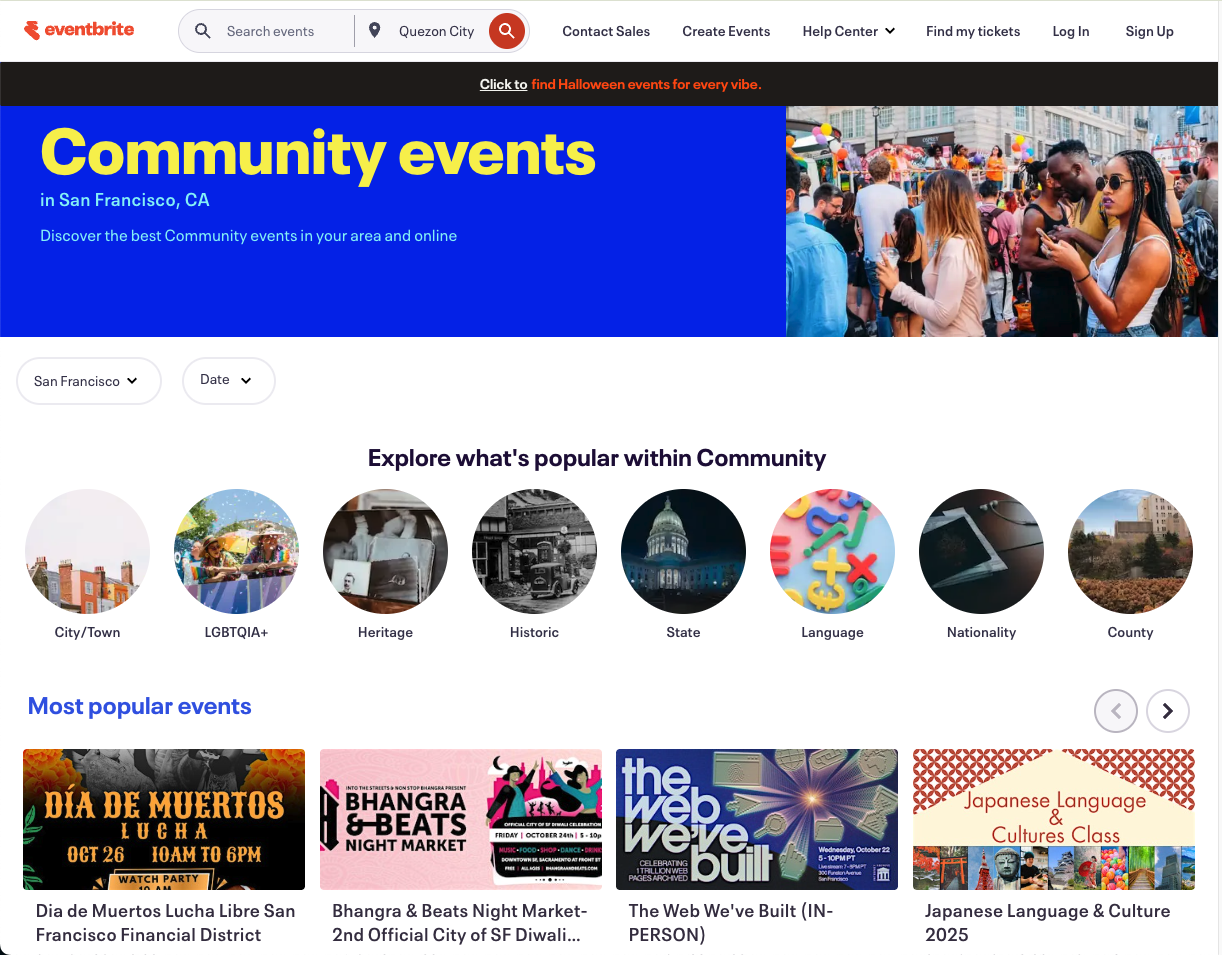
2. Eventbrite Communities

EventbriteScreenshot from Eventbrite, October 2025

Similar to Meetup, Eventbrite is a huge networking platform, hosting 4.7 million total events in 180 countries in 2024, focused on larger-scale professional gatherings and festivals alike.

You can attend and enjoy immersive or virtual live experiences. It’s a seamless registration and sign-up process, and much like attending a concert, you buy tickets to an event so you can meet fellow peers, talk shop, and expand your professional circle.

Community & Group-Based Networking

3. Discord

DiscordScreenshot from Discord, October 2025

While most people think Discord is limited to being a screen-sharing gaming communication platform (about 90% of users play games), it is also a great networking option.

It’s not unusual to consider using Discord as an alternative to LinkedIn. After all, it’s a free voice, video, and text communication platform with over 200 million monthly active users (MAU).

Job boards on DiscordScreenshot from Discord, October 2025

Although it seems more lucrative for developers and gaming-related professionals to network on the platform, what sets Discord apart is the real-time connections you can make, thanks to dedicated spaces, namely Discord servers.

The platform makes collaboration a no-brainer. Members can join multiple channels, voice rooms, and live co-working sessions that are centered on their niche, which is far more personable than a plain DM.

The casual environment also helps professionals relax and interact better than on formal job sites. Non-curated, authentic posts within tight-knit communities on Discord can boost your professional networking better than polished LinkedIn posts that get little to no attention.

4. Slack Communities

Slack Screenshot from Slack, October 2025

While Slack is best known as a company’s internal messaging tool, it has been adopted as a networking platform that can be considered as a LinkedIn alternative. There are great communities for whatever your niche may be, from startup founders to UX designers. For example, data experts can join Measure, a digital analytics community Slack group, or LocallyOptimistic, another data community that shares their challenges working with data.

Read the rules carefully, as some Slack Chapters do not allow mentions of your own brand/product, nor do they permit contacting for job opportunities.

The caveat is that you’re likely already using Slack for work, so notifications on your mobile phone and work device can be distracting. If you find yourself easily distracted by instant messaging (IM) and mobile/desktop notifications, Slack might not be the best option (though you can always adjust notifications in your settings).

To find your relevant Slack community, simply search for “[Your Topic] + Slack Community” in Google; this usually turns up several options. If it doesn’t exist yet, you can create your own Slack workspace and invite people to join for free.

5. Facebook Groups

Screenshot from Facebook, October 2025

There are 3 billion monthly active users on Facebook, which means that while it’s often viewed as a personal social media platform, you’re more than likely to find your professional network on it.

Facebook can serve as a great, less formal alternative to LinkedIn, particularly Facebook groups, which remain popular for professional networking. You can plug in related keywords for your interest or industry within Facebook, then click on Groups and filter the results according to your location.

There are several groups that share expert advice, hold conferences, or serve as a network for hiring freelancers. These groups cater to various aspects of digital marketing, from tactical knowledge to running a digital agency.

Open & Social Networking Platforms

6. Reddit

Search for [digital marketing] on RedditScreenshot from Reddit, October 2025

Reddit is becoming more popular and can be used for networking. With over 100,000 active communities, Reddit boasts hundreds of useful marketing subreddits, including r/PPC for paid search and r/SEO. These communities are completely free to join and open to the public.

You can reply to those seeking professional opinion and build up your karma and profile to earn interest in your brand/services.

Each of these has its own purpose, with a set of rules and mods in place to enforce them, ensuring they’re not scams. So, if you’re job hunting, it’s best to search for classified boards such as r/RemoteJobs and r/forhire. You can reply to existing posts or create your own; simply sign up for a free Reddit account to participate in the conversation.

7. X (formerly Twitter) Threads

#ppcchat on X/TwitterScreenshot from X (formerly Twitter), October 2025

Like Reddit, X (formerly Twitter) isn’t a direct LinkedIn alternative, but it’s public, free, active, and is still going strong with over 586 million estimated MAU. You can connect with a broad audience on it to exchange work-related ideas and ask for feedback. It’s ideal for digital marketers because it’s a top social media platform that easily draws people within the tech industry.

The communities on the platform are public, free, active, and can be really supportive. You can also ask Grok, the free AI assistant built into the platform, to analyze real-time data and current trends, to summarize conversations or discover relevant data.

SEOs and digital marketers can find hashtag-driven communities, such as @SEOChat, #PPCchat, #FBadsChat, #SEOchat, #SEOtalk, #socialROI, and #contentwritingchat. Simply showing up for relevant conversations can lead to conference invitations, podcast appearances, or potentially job opportunities.

Startup & Career Focused Platform

8. AngelList

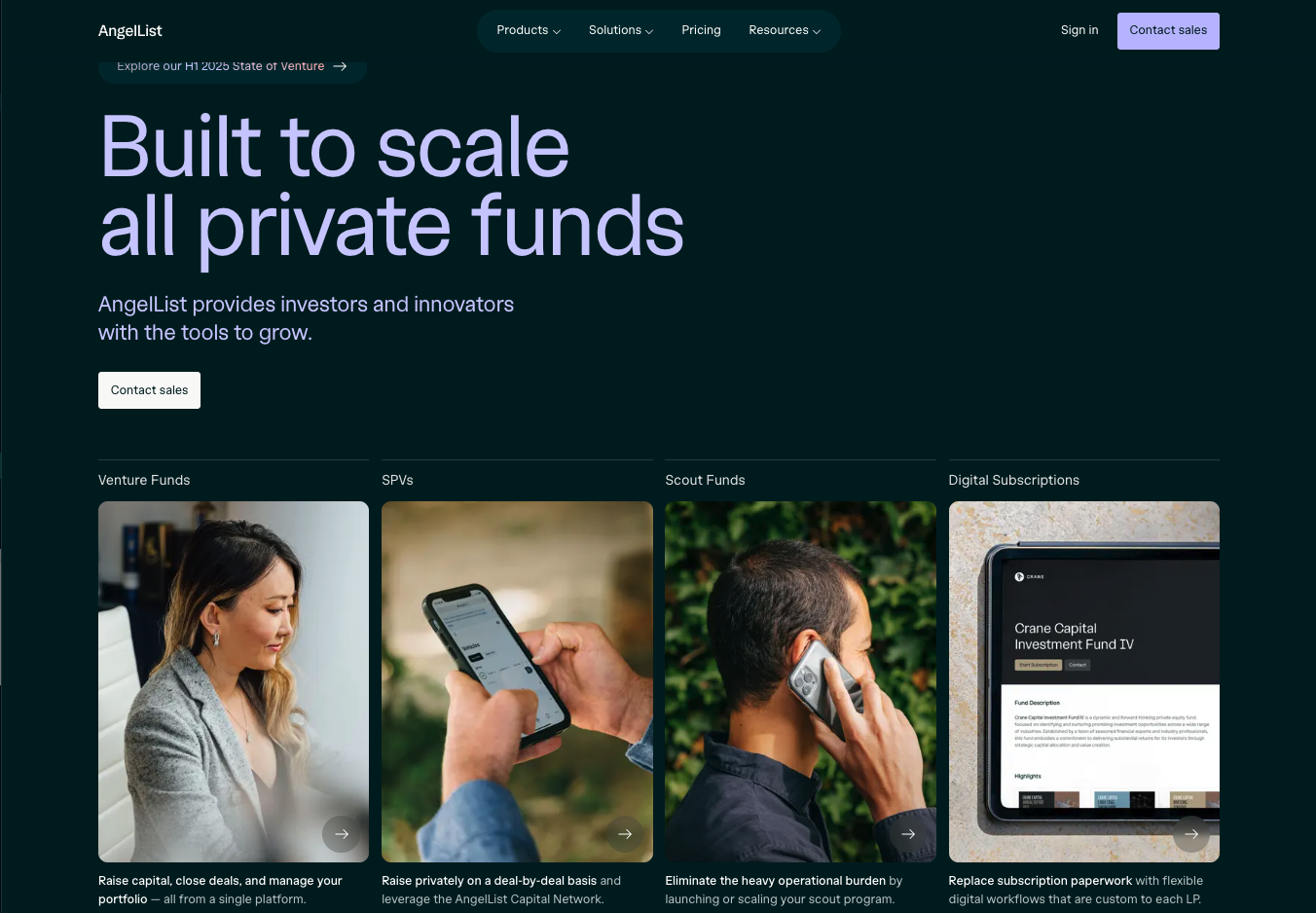
AngelListScreenshot from AngelList, October 2025

For a more startup-focused networking experience, AngelList is a strong alternative to LinkedIn. With over 13,000 active startups on the platform, it was originally created for startup founders to raise funding, but has evolved into a networking platform useful to tech, marketing, and entrepreneurial professionals.

Members can create specialized profiles to highlight their skills, apply for job listings, follow companies, participate in discussions with professionals in their field, and connect with founders to share knowledge and expertise.

AngelList is like LinkedIn, but custom-fit to startup enthusiasts and founders, so it’s more likely to help you gain startup-stage connections and opportunities faster than if you were to browse on LinkedIn.

Wrapping Up

While LinkedIn is still the largest professional networking site in the world, it’s not the only one you need. There are so many alternatives to build meaningful connections.

Many of these alternatives listed may be more helpful than LinkedIn because they focus on creating more professional connections based on community or niche interests, or offer location-based networking in a much more relaxed setting.

Professionals are branching out to other channels like Slack, where they can foster genuine connections and or explore career opportunities through multiple job boards on Reddit. The key is to meet your peers where they are, pitch your best work, and connect around a shared goal.

Whether you prefer a casual forum-style job posting or a high-energy live event, these LinkedIn alternatives can help you grow your network and take the next step in your career.

More Resources:


Featured Image: Master1305/Shutterstock

FAQ

Is online networking on social platforms like X (Twitter) as effective as formal networking sites?

Social platforms like X (Twitter) can be remarkably effective for professional networking because these communities are often more casual and approachable in nature. Here are some of the benefits:

  • They are public and free, allowing unfettered access to industry discussions.
  • Communities such as X (Twitter) provide supportive environments where new members are welcomed and encouraged to contribute.
  • Professionals can use hashtags to engage in industry-specific conversations, share expertise, or seek advice.
  • Many professionals have leveraged X (Twitter) for career opportunities, including speaking events or client referrals.

X (Twitter) and similar platforms offer a dynamic and interactive avenue for building professional relationships and staying current with industry trends.

What are some considerations when choosing a professional networking platform?

Choosing a networking platform suitable for your professional needs involves evaluating several factors:

  • Purpose: Determine if you need a platform for job searching, industry networking, client outreach, or professional development.
  • Geographical Focus: Some platforms are better for local networking (like Meetup), while others have a broader, often global reach.
  • Industry Relevance: Look for platforms hosting communities or forums that cater to your specific industry or niche.
  • Format and Features: Consider if you prefer casual social media interactions, structured networking sites, or industry forums for knowledge exchange.
  • User Base: The size and activity level of the community can greatly impact networking opportunities and resource availability.
  • Cost: There might be membership fees involved, so assess if the potential benefits justify the expenses.

Analyzing these aspects can help pinpoint the best networking platforms for achieving your professional goals.

https://www.searchenginejournal.com/linkedin-alternatives-for-professional-networking/557642/