How To Do A Complete Local SEO Audit: 11-Point Checklist via @sejournal, @JRiddall

Local SEO includes several specific tasks geared to establishing the relevance and authority of a business within a targeted geographic area.

Search engines and large language models (LLMs) like Google Gemini and ChatGPT reference many different data points to determine who will be surfaced in their respective result sets, which include AI Overviews and AI Mode in Google, featured snippets, local map packs, image or video carousels, and other emerging search formats.

So, how can you identify and prioritize optimizations with the greatest potential to deliver converting traffic to your website or your business door from traditional organic local SEO or AI search?

Below, we’ll walk through an evaluation of each key facet of your local search presence and uncover your best opportunities to improve your visibility in traditional organic and AI search.

These tasks are listed in typical order of completion during a full audit, but some can be accomplished concurrently.

1. Keyword Topic/AI Prompt Audit

Although the introduction of AI in search has changed the keyword-first strategy, the natural place to start a local SEO audit is in organic and AI search results. Start with the topical keywords, phrases, and AI prompts you are hoping your business will be found for, in order to identify where you are positioned relative to your competitors and other websites/content.

This research can help you quickly identify where you have established some level of authority/momentum to build on, as well as topics upon which you should not waste your time and effort.

SEO is a long-term strategy, so no keyword or prompt should be summarily dismissed. Even so, it’s generally best to focus on keyword topics you realistically have a chance to gain visibility and drive traffic for. Pay close attention to the intent behind the keywords you choose and ideally focus on those with commercial or transactional intent, as informational content search results are largely being dominated by AI summaries.

You will also need to consider optimizing for conversational search queries or prompts and voice search, as AI Mode will increasingly rely on natural language processing.

Further, some younger users have developed different searching behaviors altogether and are using social media platforms like Instagram and TikTok for local searches. Search optimization for these platforms is a different conversation, but having an eye on how your business and its products/services are found when searching here can provide insight into how searches are conducted in more traditional and emerging AI formats.

Different people search in different ways, and it’s important not to limit your research to single keywords, but rather account for the various ways and phrases your audience may use to try to find you or your offerings; hence, taking a topical approach. This only becomes amplified in AI search, where every prompt is the beginning of a potentially long, drawn-out chat.

2. Website Audit

You can now conduct full content and technical website audits to ensure your site is optimized for maximum crawlability, indexability, and visibility by search engine and LLM crawlers. A typical audit is designed to analyze the underlying structure, content, and overall site experience.

Here again, there are many site auditing tools to crawl a website and then identify issues and prioritize actions to be taken based on SEO best practices.

A website audit and optimization can be broken down into a few buckets:

Page Optimization

Webpage optimization is all about ensuring pages are well structured, focused around targeted topical keywords, and provide a positive user experience.

As a search engine crawls a webpage, it looks for signals to determine what the page is about and what questions it can answer. These crawlers analyze the entire page to determine its focus, but specifically focus on page titles and headings as primary descriptors. A well-structured page with a hierarchical heading structure is key to helping site visitors, search engine and LLM bots easily scan and consume your content.

Ideally, each webpage is keyword topic-focused and unique. As such, keyword variations should be used consistently in titles, URLs, headings, and body content.

Another important potential issue raised in an audit, depending on the nature of your local business, is image optimization. As a best practice, all images should include relevant descriptive filenames and alt text, which may include pertinent keywords. This becomes particularly important when images (e.g., product or service photos) are central to your business, as image carousels can and will show up in web search results. In every case, attention should be paid to the images appearing on your primary ranking pages.

Lastly, an over-reliance on JavaScript can be particularly detrimental for LLM visibility, as some LLMs currently do not execute JavaScript. If your site is powered by JavaScript, you’ll want to address this with your developer to see how the most important content can be presented in raw HTML or via server-side scripting to enable crawling and indexing.

Internal Link Audit

A link audit will help you quickly identify any potential misdirected or broken links, which can create a less-than-optimal experience for your site visitors and may confuse search engine and LLM bots.

Links are likewise signals the search engines use to determine the structure of a website and its ability to direct searchers to appropriate, authoritative answers to their questions.

Part of this audit should include the identification of opportunities to crosslink prominent pages. If a page within your site has keywords (anchor text) referencing relevant content on another page, a link should be created, provided the link logically guides users to more relevant content or an appropriate conversion point.

External links should also be considered, especially when there is an opportunity to link to an authoritative source of information. From a local business perspective, this may include linking to relevant local organizations, partners, or events.

Schema Review

Schema or structured data can help search engines and LLMs better understand your business and its offerings and offer enhanced visibility. An effective local SEO audit should include the identification of content within a website to which schema can be applied.

Local businesses have an opportunity to have their content highlighted if they:

  • Publish highly authoritative and relevant content.
  • Use structured schema markup to tag content.

Relevant local business schema markup includes LocalBusiness, Product, Service, Review, and FAQPage, among others. All schema markup code should be validated via Google’s Rich Results Test and/or the Schema.org validator.

Mobile Audit

As most consumers search via their mobile devices – especially for local services – it’s essential for local businesses to provide a positive mobile web experience. Websites need to load quickly, be easily navigated, and enable seamless user interaction.

Google offers a range of free mobile testing and mobile-specific monitoring tools, such as Page Experience and Core Web Vitals, in Google Search Console.

More in-depth user experience and SEO analysis can be done via Google Lighthouse, though a local business owner will likely want to enlist the help of a web developer to action any of the recommendations this tool provides.

Duplicate Content

High-quality, authoritative content is, by definition, original content.

As such, it’s important to let Google know if your website contains any content/pages you did not create by adding a canonical tag to the HTML header of the page. Most pages, which are unique unto themselves, will have a self-referencing canonical.

Not doing so can have a detrimental effect on your authority and, by extension, your ability to rank. Most site auditing tools will flag content missing or having malformed canonical tags.

3. Google Business Profile Audit

A Google Business Profile (GBP) effectively represents a “secondary” website and highly visible point of presence for most local businesses. Increasingly, this “secondary” website is becoming the consumers’ first point of contact.

An accurate, comprehensive GBP is critical to establishing visibility in organic and now AI search results.

A recent behavioral study of travel booking in AI Mode conducted by Propellic found GBP to be among the most highly displayed and engaged content for searchers booking local accommodations and experiences.

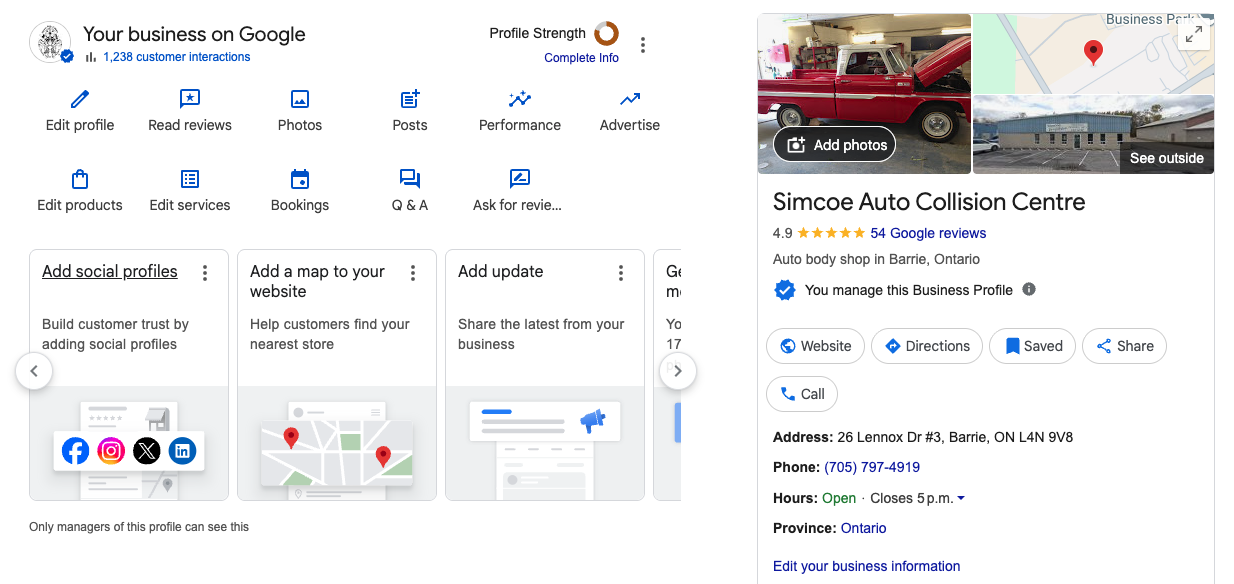
A Google Business Profile audit should focus on the accuracy and completeness of the various components within the profile, including:

  • Business information and location details.
  • Correct primary business category.
  • Hours of operation.
  • Correct pin location in Google Maps.
  • Proper categorization as a physical location or service area business.
  • Products.
  • Services.
  • Appointment link(s), if applicable.
  • Photos or Videos.
  • Social Profiles.
  • Offers.
  • Regular updates.
  • Events.
  • Informational content.
Google Business Profile screenshotScreenshot from Google Business Profile, September 2025

The more complete the profile is, the more likely it will be viewed as a reliable local resource and be given appropriate billing in the search results.

Assuming you have claimed and are authorized to manage your GBP, you can access and edit your info directly within the search results.

4. Review Monitoring And Management

Another very important aspect of a GBP is reviews.

Local business customers have an opportunity to write reviews, which appear on the GBP for other customers to reference and play a significant role in determining visibility in the local map pack. They are most certainly a determining factor with regard to appearing in Google AI Overviews.

Google will notify business owners as soon as reviews are submitted, and they should be responded to as soon as possible. This goes for negative reviews just as much as positive ones. Include an analysis of your reviews to ensure none have fallen through the cracks. This will also help determine whether there are recurring customer service and satisfaction issues or themes to be addressed. A detailed analysis of reviews can be a great source of content ideas aimed at answering customers’ most pressing questions or concerns.

Of course, there are also several other places for consumers to submit reviews, including Facebook, local review sites like Yelp, and industry-specific sites such as TripAdvisor and Houzz. A full audit should take inventory of reviews left on any of these services, as they can show up in search results.

Pro tip: Request positive reviews from all customers and politely suggest they reference the product or service they are reviewing, as keywords contained in reviews can have a positive effect from ranking perspective.

5. Local Business Listing/Citation Audit

Local business listings and citations provide search engines and LLM bots with a way of confirming a business is both local and reputable within a specific geographic region. Recent studies have revealed unlinked brand mentions and citations play a significant role in AI Visibility.

It is important to have a presence in reputable local directories, review sites, business directories (e.g., Chambers of Commerce), or local partner sites to prove your “localness.”

Depending on the size and scope of your local business, an audit of your listings and citations can be done in an automated or manual fashion.

Business listings and citation management tools can be used to find, monitor, and update all primary citations with your proper Name, Address, Phone Number (aka NAP), and other pertinent business details found in broader listings (e.g., website address, business description).

If you manage a limited number of locations and have the time, one quick method of identifying where your current listings can be found is to simply conduct a search on your business name. The first three to four pages of search results should reveal the same.

It’s also important to find and resolve any duplicate listings to prevent confusing customers and search engines alike with outdated, inaccurate information.

Local business owners and managers should also monitor Reddit for their brand and local product/service offerings to gauge activity and sentiment. Reddit is a unique platform where “karma” and trust are tantamount, but there is an opportunity for brands and local businesses to engage with their customers if they do it in a transparent, authentic, and non-promotional way.

6. Backlink Audit

Backlinks or inbound links are similar to citations, but are effectively any links to your website pages from other third-party websites.

Links remain an important factor in determining the authority of a website, as they lend validity if they come from relevant, reputable sources.

As with other components of an audit, there are several good free and paid backlink tools available, including a link monitoring service in Google Search Console, which is a great place to start.

An effective backlink audit has the dual purpose of identifying and building links via potentially valuable backlink sources, which can positively affect your ranking and visibility.

For local businesses, reputable local sources of links are naturally beneficial in validating location, as noted with citations above.

Potential backlink sources can be researched in a variety of locations:

  • Free and paid backlink research tools, such as Ahrefs or Semrush identify any domains where your primary competition has acquired backlinks, but you have not.
  • Any non-competitive sites appearing in the organic search results for your primary keywords are, by definition, good potential backlink sources. Look for directories you can be listed in, blogs or articles you can comment on, or publications you can submit articles to.
  • Referral sources in Google Analytics may reveal relevant external websites where you already have links and may be able to acquire more.

7. Local Content Audit

People search differently and require different types of information depending on where they are in their buying journey. A well-structured local web presence will include content tailored and distributed for consumption during each stage of this journey, to bolster visibility and awareness.

You want to be found throughout your customer’s search experience. A content audit can be used to make sure you have helpful content for each of the journey buckets your audience members may find themselves in.

Informational content may be distributed via social or other external channels or published on your website to help educate your consumers on the products, services, and differentiators you offer at the beginning of their path to purchase.

As AI is consuming and repurposing much of this informational content, it’s important to ensure your informational content includes your unique perspective based on your experience and expertise. This content ideally answers your prospects’ why, how, and what types of questions.

Transactional content is designed to address those consumers who already know what they want, but are in the process of deciding where or who to purchase from. This type of content may include reviews, testimonials, or competitive comparisons.

Navigational content ensures when people click through from Google after having searched your brand name or a variation thereof, they land on a page or information validating your position as a leader in your space. This page should also include a clear call-to-action with the assumption they have arrived with a specific goal in mind.

Commercial content addresses those consumers who have signaled a strong intent to buy. Effective local business sites and social pages must include offers, coupons, discounts, and clear paths to purchase.

Optimizing Content For AI

From an AI search and visibility perspective, keep in mind the vast majority of AI results are responses to long-form questions/prompts from consumers. As such, it is crucial for some of your content to be in a direct question/answer format.

One quick and effective tactic is the creation of an FAQ section within product or service pages. However, avoid overseeding FAQs by including generic questions and answers. FAQs should be specific to the pages they reside on.

We’ve previously touched upon the importance of structured content for improved crawling, scanning, and comprehension. When reviewing your content, look for opportunities to incorporate defined heading structures, tables of contents for long-form content, and ordered lists.

Content Variety And Distribution

Quality content is content your audience wants to consume, like, and share. For many businesses, this means considering and experimenting with content beyond simple text and images.

Video content shared via platforms like YouTube, Instagram, Facebook, TikTok, and others is easier to consume and generally more engaging.

8. Google Search Console Review

Google Search Console is an invaluable free resource for data related to keyword and content performance, indexing, schema/rich results validation, mobile/desktop experience monitoring, and security/manual actions.

A complete local SEO audit must include a review and analysis of this data to identify and react to strengths, weaknesses, opportunities, and threats outlined in each section.
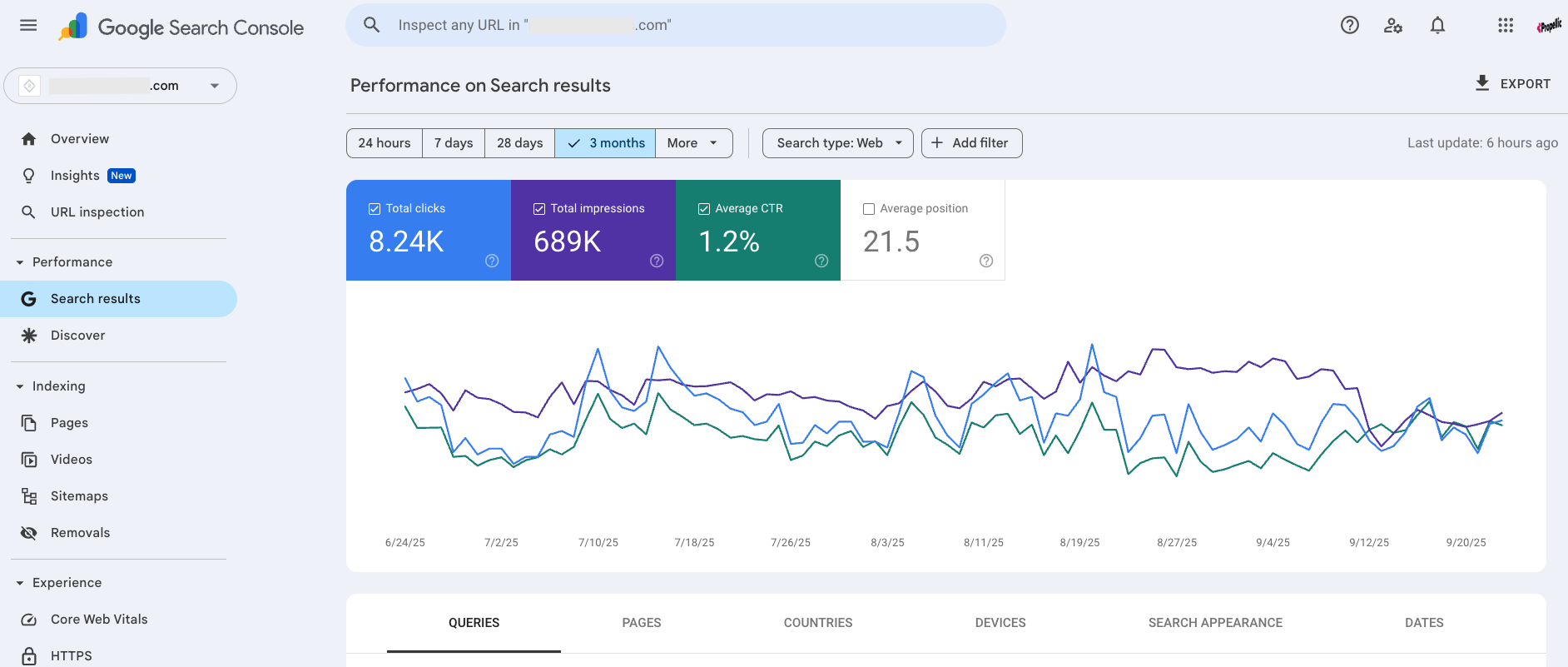
Google Search Console screenshotGoogle Search Console screenshot, September 2025

Website owners and managers will want to pay particular attention to any issues related to pages not being crawled/indexed or manual actions having been taken based on questionable practices, as both can have a detrimental effect on search engine visibility.

Google Search Console does send notifications for these types of issues as well as regular performance updates, but an audit will ensure nothing has been overlooked.

9. Analytics Review

Whether you are using Google Analytics or another site/visitor tracking solution, the data available here is useful during an audit to validate top and lesser-performing content, traffic sources, audience profiles, and paths to purchase.

Findings in analytics will be key to your content audit.

As you review your site analytics, you may ask the following questions:

  • Are my top-visited pages also my top-ranking pages in search engines?
  • Which are my top entry pages from organic and AI search?
  • Which LLMs are sending traffic to my site?
  • Which pages/content are not receiving the level of traffic or engagement desired?
  • What is the typical path to purchase on my site, and can it be condensed or otherwise optimized?
  • Which domains are my top referrers, and are there opportunities to further leverage these sites for backlinks? (see Backlink Audit above).

Use Google Analytics (or another tool of your choice) to find the answers to these questions, so you can focus and prioritize your content and keyword optimization efforts.

10. Competitor Analysis

A comprehensive local SEO audit should identify and review the strengths and weaknesses of your competition.

You may already have a good sense of who your competition is, but to begin, it’s always a good idea to confirm who specifically shows up in the organic search and AI results when you enter your target keywords. You may find different competitors in these two formats, which represent both a threat and an opportunity.

These businesses/domains are your true online competitors and the sites you can learn the most from. If any of your online competitors’ sites and/or pages are ranking ahead of yours, you’ll want to review what they may be doing to gain this advantage.

You can follow the same checklist of steps you would conduct for your own audit to identify how they may be optimizing their keywords, content, Google Business Profile, reviews, local business listings, or backlinks.

In general, the best way to outperform your competition is to provide a better overall experience online and off, which includes generating more relevant, unique, high-quality content to more fully address the questions your mutual customers have.

11. AI Search For Local Businesses

AI Overviews and AI Mode are increasingly superseding traditional organic search results in Google, as the search engine aims to provide the answers to questions directly within its SERPs. Further, Google has signalled its commitment to AI Mode by recently integrating it into the Chrome address bar.

While AI search optimization has some new considerations, a strong foundation in traditional SEO will go a long way to building visibility in AI search results; chief among these at a local level is a fully optimized Google Business Profile, which appears prominently for local searches with commercial intent as outlined above.
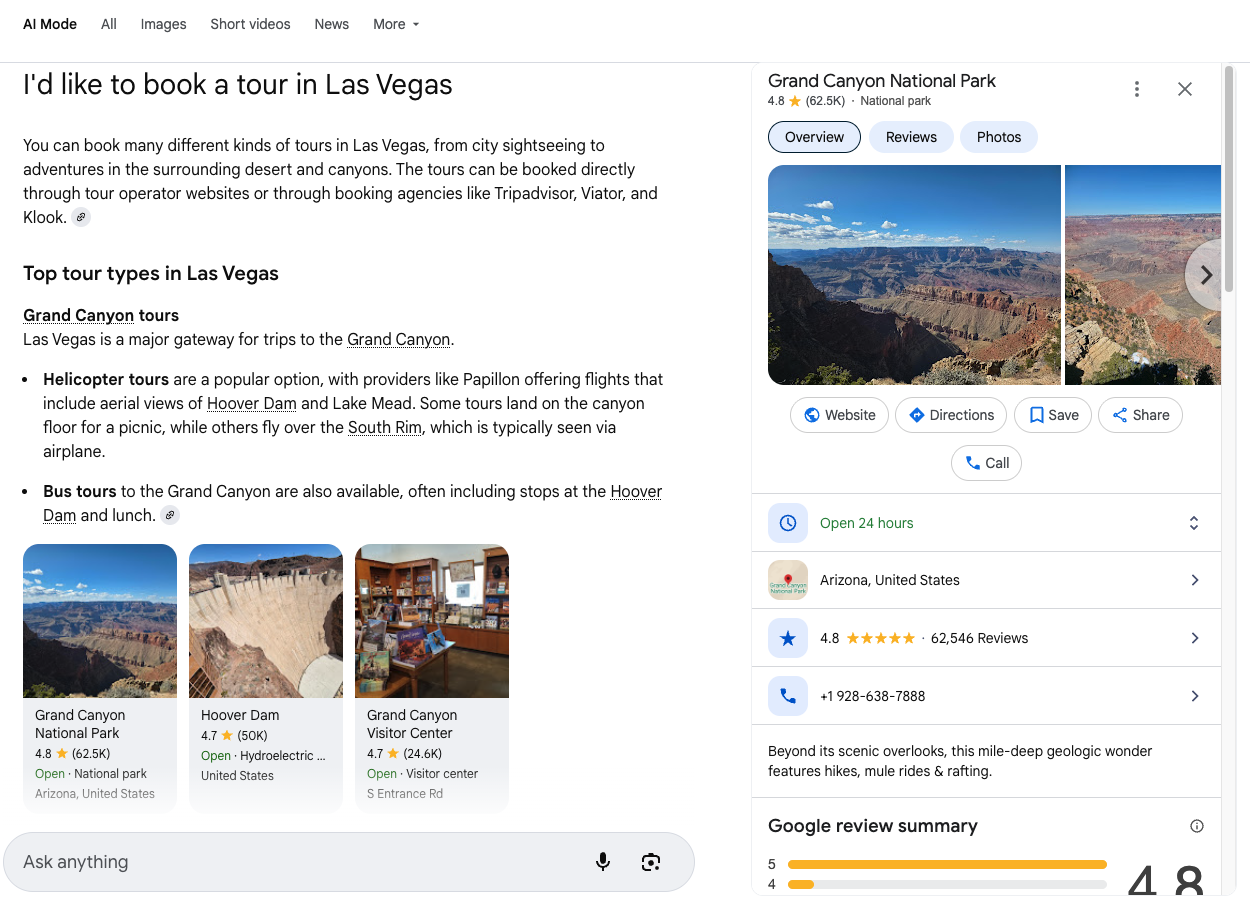
Google Business Profile Cards accessible within AI ModeScreenshot of Google AI Mode displaying Google Business Profile Cards, September 2025

AI Mode Strategy Checklist Should Consider:

  • Enhanced GBP Features: Stay updated on new features within Google Business Profile, allowing for direct interactions or transactions, as these will be favored by AI Mode.
  • Focus on User Intent: Understand the transactional and informational intent behind local searches. AI Mode aims to provide immediate solutions, so businesses facilitating this will gain an advantage.
  • Voice Search Optimization: As AI Mode becomes more conversational, optimizing for natural language queries and voice search will be crucial. Ensure your content answers questions directly and uses conversational language.
  • Direct Action Integrations: This may still be a ways away, but review and explore opportunities to integrate with Google’s booking or reservation features, if applicable to your business. This could become a direct pathway to conversions within AI Mode.

Prioritizing Your Action Items

A complete local SEO audit is going to produce a fairly significant list of action items.

Many of the keyword, site, content, and backlink auditing tools do a good job of prioritizing tasks; however, the list can still be daunting.

One of the best places to start with an audit action plan is around the keywords, AI prompts, and content you have already established some, but not enough, authority for.

Determine how to best address deficiencies or opportunities to optimize this content first before moving on to more competitive keywords or those you have less or no visibility for. Establishing authority and trust is a long-term game.

These audit items should be reviewed every six to 12 months, depending on the size and scale of your web presence, to enable the best chance of being found by your local target audience.

More Resources:


Featured Image: BestForBest/Shutterstock

https://www.searchenginejournal.com/how-to-do-a-complete-local-seo-audit-11-point-checklist/556641/



How to Turn Every Campaign Into Lasting SEO Authority [Webinar] via @sejournal, @hethr_campbell

Capture Links, Mentions, and Citations That Make a Difference

Backlinks alone no longer move the authority needle. Brand mentions are just as critical for visibility, recognition, and long-term SEO success. Are your campaigns capturing both?

Join Michael Johnson, CEO of Resolve, for a webinar where he shares a replicable campaign framework that aligns media outreach, SEO impact, and brand visibility, helping your campaigns become long-term assets.

What You’ll Learn

  • The Resolve Campaign Framework: Step-by-step approach to ideating, creating, and pitching SEO-focused digital PR campaigns.
  • The Dual Outcome Strategy: How to design campaigns that earn both high-quality backlinks and brand mentions from top-tier media.
  • Real Campaign Case Studies: Examples of campaigns that created a compounding effect of links, mentions, and brand recognition.
  • Techniques for Measuring Success: How to evaluate the SEO and branding impact of your campaigns.

Why You Can’t Miss This Webinar

Successful SEO campaigns today capture authority on multiple fronts. This session provides actionable strategies for engineering campaigns that work hand in hand with SEO, GEO, and AEO to grow your brand.

📌 Register now to learn how to design campaigns that earn visibility, links, and citations.

🛑 Can’t attend live? Register anyway, and we’ll send you the recording so you don’t miss out.

https://www.searchenginejournal.com/turn-campaign-into-lasting-seo-authority/558685/


The AI Search Visibility Audit: 15 Questions Every CMO Should Ask

This post was sponsored by IQRush. The opinions expressed in this article are the sponsor’s own.

Your traditional SEO is winning. Your AI visibility is failing. Here’s how to fix it.

Your brand dominates page one of Google. Domain authority crushes competitors. Organic traffic trends upward quarter after quarter. Yet when customers ask ChatGPT, Perplexity, or others about your industry, your brand is nowhere to be found.

This is the AI visibility gap, which causes missed opportunities in awareness and sales.

“SEO ranking on page one doesn’t guarantee visibility in AI search.  The rules of ranking have shifted from optimization to verification.”

Raj Sapru, Netrush, Chief Strategy Officer

Recent analysis of AI-powered search patterns reveals a troubling reality: commercial brands with excellent traditional SEO performance often achieve minimal visibility in AI-generated responses. Meanwhile, educational institutions, industry publications, and comparison platforms consistently capture citations for product-related queries.

The problem isn’t your content quality. It’s that AI engines prioritize entirely different ranking factors than traditional search: semantic query matching over keyword density, verifiable authority markers over marketing claims, and machine-readable structure over persuasive copy.

This audit exposes 15 questions that separate AI-invisible brands from citation leaders.

We’re sharing the first 7 critical questions below, covering visibility assessment, authority verification, and measurement fundamentals. These questions will reveal your most urgent gaps and provide immediate action steps.

Question 1: Are We Visible in AI-Powered Search Results?

Why This Matters: Commercial brands with strong traditional SEO often achieve minimal AI citation visibility in their categories. A recent IQRush field audit found fewer than one in ten AI-generated answers included in the brand, showing how limited visibility remains, even for strong SEO performers. Educational institutions, industry publications, and comparison sites dominate AI responses for product queries—even when commercial sites have superior content depth. In regulated industries, this gap widens further as compliance constraints limit commercial messaging while educational content flows freely into AI training data.

How to Audit:

  • Test core product or service queries through multiple AI platforms (ChatGPT, Perplexity, Claude)
  • Document which sources AI engines cite: educational sites, industry publications, comparison platforms, or adjacent content providers
  • Calculate your visibility rate: queries where your brand appears vs. total queries tested

Action: If educational/institutional sources dominate, implement their citation-driving elements:

  • Add research references and authoritative citations to product content
  • Create FAQ-formatted content with an explicit question-answer structure
  • Deploy structured data markup (Product, FAQ, Organization schemas)
  • Make commercial content as machine-readable as educational sources

IQRush tracks citation frequency across AI platforms. Competitive analysis shows which schema implementations, content formats, and authority signals your competitors use to capture citations you’re losing.

Question 2: Are Our Expertise Claims Actually Verifiable?

Why This Matters: Machine-readable validation drives AI citation decisions: research references, technical standards, certifications, and regulatory documentation. Marketing claims like “industry-leading” or “trusted by thousands” carry zero weight. In one IQRush client analysis, more than four out of five brand mentions were supported by citations—evidence that structured, verifiable content is far more likely to earn visibility. Companies frequently score high on human appeal—compelling copy, strong brand messaging—but lack the structured authority signals AI engines require. This mismatch explains why brands with excellent traditional marketing achieve limited citation visibility.

How to Audit:

  • Review your priority pages and identify every factual claim made (performance stats, quality standards, methodology descriptions)
  • For each claim, check whether it links to or cites an authoritative source (research, standards body, certification authority)
  • Calculate verification ratio: claims with authoritative backing vs. total factual claims made

Action: For each unverified claim, either add authoritative backing or remove the statement:

  • Add specific citations to key claims (research databases, technical standards, industry reports)
  • Link technical specifications to recognized standards bodies
  • Include certification or compliance verification details where applicable
  • Remove marketing claims that can’t be substantiated with machine-verifiable sources

IQRush’s authority analysis identifies which claims need verification and recommends appropriate authoritative sources for your industry, eliminating research time while ensuring proper citation implementation.

Question 3: Does Our Content Match How People Query AI Engines?

Why This Matters: Semantic alignment matters more than keyword density. Pages optimized for traditional keyword targeting often fail in AI responses because they don’t match conversational query patterns. A page targeting “best project management software” may rank well in Google but miss AI citations if it doesn’t address how users actually ask: “What project management tool should I use for a remote team of 10?” In recent IQRush client audits, AI visibility clustered differently across verticals—consumer brands surfaced more frequently for transactional queries, while financial clients appeared mainly for informational intent. Intent mapping—informational, consideration, or transactional—determines whether AI engines surface your content or skip it.

How to Audit:

  • Test sample queries customers would use in AI engines for your product category
  • Evaluate whether your content is structured for the intent type (informational vs. transactional)
  • Assess if content uses conversational language patterns vs. traditional keyword optimization

Action: Align content with natural question patterns and semantic intent:

  • Restructure content to directly address how customers phrase questions
  • Create content for each intent stage: informational (education), consideration (comparison), transactional (specifications)
  • Use conversational language patterns that match AI engine interactions
  • Ensure semantic relevance beyond just keyword matching

IQRush maps your content against natural query patterns customers use in AI platforms, showing where keyword-optimized pages miss conversational intent.

Question 4: Is Our Product Information Structured for AI Recommendations?

Why This Matters: Product recommendations require structured data. AI engines extract and compare specifications, pricing, availability, and features from schema markup—not from marketing copy. Products with a comprehensive Product schema capture more AI citations in comparison queries than products buried in unstructured text. Bottom-funnel transactional queries (“best X for Y,” product comparisons) depend almost entirely on machine-readable product data.

How to Audit:

  • Check whether product pages include Product schema markup with complete specifications
  • Review if technical details (dimensions, materials, certifications, compatibility) are machine-readable
  • Test transactional queries (product comparisons, “best X for Y”) to see if your products appear
  • Assess whether pricing, availability, and purchase information is structured

Action: Implement comprehensive product data structure:

  • Deploy Product schema with complete technical specifications
  • Structure comparison information (tables, lists) that AI can easily parse
  • Include precise measurements, certifications, and compatibility details
  • Add FAQ schema addressing common product selection questions
  • Ensure pricing and availability data is machine-readable

IQRush’s ecommerce audit scans product pages for missing schema fields—price, availability, specifications, reviews—and prioritizes implementations based on query volume in your category.

Question 5: Is Our “Fresh” Content Actually Fresh to AI Engines?

Why This Matters: Recency signals matter, but timestamp manipulation doesn’t work. Pages with recent publication dates, but outdated information underperforms older pages with substantive updates: new research citations, current industry data, or refreshed technical specifications. Genuine content updates outweigh simple republishing with changed dates.

How to Audit:

  • Review when your priority pages were last substantively updated (not just timestamp changes)
  • Check whether content references recent research, current industry data, or updated standards
  • Assess if “evergreen” content has been refreshed with current examples and information
  • Compare your content recency to competitors appearing in AI responses

Action: Establish genuine content freshness practices:

  • Update high-priority pages with current research, data, and examples
  • Add recent case studies, industry developments, or regulatory changes
  • Refresh citations to include latest research or technical standards
  • Implement clear “last updated” dates that reflect substantive changes
  • Create update schedules for key content categories

IQRush compares your content recency against competitors capturing citations in your category, flagging pages that need substantive updates (new research, current data) versus pages where timestamp optimization alone would help.

Question 6: How Do We Measure What’s Actually Working?

Why This Matters: Traditional SEO metrics—rankings, traffic, CTR—miss the consideration impact of AI citations. Brand mentions in AI responses influence purchase decisions without generating click-through attribution, functioning more like brand awareness channels than direct response. CMOs operating without AI visibility measurement can’t quantify ROI, allocate budgets effectively, or report business impact to executives.

How to Audit:

  • Review your executive dashboards: Are AI visibility metrics present alongside SEO metrics?
  • Examine your analytics capabilities: Can you track how citation frequency changes month-over-month?
  • Assess competitive intelligence: Do you know your citation share relative to competitors?
  • Evaluate coverage: Which query categories are you blind to?

Action: Establish AI citation measurement:

  • Track citation frequency for core queries across AI platforms
  • Monitor competitive citation share and positioning changes
  • Measure sentiment and accuracy of brand mentions
  • Add AI visibility metrics to executive dashboards
  • Correlate AI visibility with consideration and conversion metrics

IQRush tracks citation frequency, competitive share, and month-over-month trends across across AI platforms. No manual testing or custom analytics development is required.

Question 7: Where Are Our Biggest Visibility Gaps?

Why This Matters: Brands typically achieve citation visibility for a small percentage of relevant queries, with dramatic variation by funnel stage and product category. IQRush analysis showed the same imbalance: consumer brands often surfaced in purchase-intent queries, while service firms appeared mostly in educational prompts. Most discovery moments generate zero brand visibility. Closing these gaps expands reach at stages where competitors currently dominate.

How to Audit:

  • List queries customers would ask about your products/services across different funnel stages
  • Group them by funnel stage (informational, consideration, transactional)
  • Test each query in AI platforms and document: Does your brand appear?
  • Calculate what percentage of queries produce brand mentions in each funnel stage
  • Identify patterns in the queries where you’re absent

Action: Target the funnel stages with lowest visibility first:

  • If weak at informational stage: Build educational content that answers “what is” and “how does” queries
  • If weak at consideration stage: Create comparison content structured as tables or side-by-side frameworks
  • If weak at transactional stage: Add comprehensive product specs with schema markup
  • Focus resources on stages where small improvements yield largest reach gains

IQRush’s funnel analysis quantifies gap size by stage and estimates impact, showing which content investments will close the most visibility gaps fastest.

The Compounding Advantage of Early Action

The first seven questions and actions highlight the differences between traditional SEO performance and AI search visibility. Together, they explain why brands with strong organic rankings often have zero citations in AI answers.

The remaining 8 questions in the comprehensive audit help you take your marketing further. They focus on technical aspects: the structure of your content, the backbone of your technical infrastructure, and the semantic strategies that signal true authority to AI. 

“Visibility in AI search compounds, making it harder for your competition to break through. The brands that make themselves machine-readable today will own the conversation tomorrow.”
Raj Sapru, Netrush, Chief Strategy Officer

IQRush data shows the same thing across industries: early brands that adopt a new AI answer engine optimization strategy quickly start to lock in positions of trust that competitors can’t easily replace. Once your brand becomes the reliable answer source, AI engines will start to default to you for related queries, and the advantage snowballs.

The window to be an early adopter and take AI visibility for your brand will not stay open forever.  As more brands invest in AI visibility, the visibility race is heating up.

Download the Complete AI Search Visibility Audit with detailed assessment frameworks, implementation checklists, and the 8 strategic questions covering content architecture, technical infrastructure, and linguistic optimization. Each question includes specific audit steps and immediate action items to close your visibility gaps and establish authoritative positioning before your market becomes saturated with AI-optimized competitors.

Image Credits

Featured Image: Image by IQRush. Used with permission.

In-Post Images: Image by IQRush. Used with permission.

https://www.searchenginejournal.com/ai-visibility-audit-questions-iqrush-spa/558015/


Trust In AI Shopping Is Limited As Shoppers Verify On Websites via @sejournal, @MattGSouthern

A new IAB and Talk Shoppe study finds AI is accelerating discovery and comparisons, but it’s not the last stop.

Here are the key points before we get into the details:

  • AI pushes people to verify details on retailer sites, search, reviews, and forums rather than replacing those steps.
  • Only about half fully trust AI recommendations, which creates predictable detours when links are broken or specs and pricing don’t match.
  • Retailer traffic rises after AI, with one in three shoppers clicking through directly from an assistant.

About The Report

This report combines more than 450 screen-recorded AI shopping sessions with a U.S. survey of 600 consumers, giving you observed behavior and stated attitudes in one place.

It tracks where AI helps, where trust breaks, and what people do next.

Key Findings

AI speeds up research and makes it more focused, especially for comparing options, but it increases the number of steps as shoppers validate details elsewhere.

In the sessions, people averaged 1.6 steps before AI and 3.8 afterward, and 95% took extra steps to feel confident before ending a session.

Retailer and marketplace sites are the primary destination for validation. Seventy-eight percent of shoppers visited a retailer or marketplace during the journey, and 32% clicked directly from an AI tool.

The share that visited retailer sites rose from 20% before AI to 50% after AI. On those pages, people most often checked prices and deals, variants, reviews, and availability.

Low Trust In AI Recommendations

Trust is a constraint. Only 46% fully trusted AI shopping recommendations.

Common friction points where people lost trust were:

  • Missing links or sources
  • Mismatched specs or pricing
  • Outdated availability
  • Recommendations that didn’t fit budget or compatibility needs

These friction points sent people back to search, retailers, reviews, and forums.

Why This Matters

AI chatbots now shape mid-journey research.

If your product data, comparison content, and reviews are inconsistent with retailer listings, shoppers will notice when they verify elsewhere.

This reinforces the need to align details across channels to retain customer trust.

What To Do With This Info

Here are concrete steps you can take based on the report’s information:

  • Keep specs, pricing, availability, and variants in sync with retailer feeds.
  • Build comparison and “alternatives” pages around the attributes people prompt for.
  • Expand structured data for specs, variants, availability, and reviews.
  • Create content to answer common objections surfaced in forums and comment threads.
  • Monitor the queries and communities where shoppers validate information to close recurring gaps.

Looking Ahead

Respondents said AI made research feel easier, but confidence still depends on clear sources and verified reviews.

Expect assistants to keep influencing discovery while retailer and brand pages confirm the details that matter.

For more insight into how AI influences the shopping journey, see the full report.


Featured Image: Andrey_Popov/Shutterstock

https://www.searchenginejournal.com/trust-in-ai-shopping-is-limited-as-shoppers-verify-on-websites/559497/


Microsoft Locks In OpenAI Partnership Through 2032 via @sejournal, @MattGSouthern

Microsoft and OpenAI signed a deal extending Microsoft’s rights to OpenAI models through 2032, confirming a 27% stake worth $135B

  • The OpenAI and Microsoft relationship is now locked in long term.
  • Microsoft keeps priority access to OpenAI’s newest models for its search and marketing products,
  • OpenAI gets more flexibility to work with other partners.

https://www.searchenginejournal.com/microsoft-locks-in-openai-partnership-through-2032/559492/


AI Is Breaking The Economics Of Content via @sejournal, @Kevin_Indig

What does it say about the economics of content when the most visible site on the web loses significant traffic?

A status report by Wikipedia shows a significant decline in human page views over the last few months as a result of generative AI, “especially with search engines providing answers directly to searchers” [1].

Image Credit: Kevin Indig

Boost your skills with Growth Memo’s weekly expert insights. Subscribe for free!

  • Evergreen content = Educational content covering established, timeless topics.
  • Additive content = Content that provides net-new takes, insights, and conversations.

Wikipedia is an evergreen site. Even though it’s a user-generated content (UGC) platform like Reddit or YouTube, its primary purpose is to serve comprehensive definitions on established topics. Reddit, YouTube, and LinkedIn & Co. are about additive topics and insights.

AI destroys the value of one while raising it for the other.

Wikipedia’s human traffic has dipped -5% YoY, while scrapers grew by 10.5% and bots by 162.4% [2]. The fact that scrapers and bots together make up almost as much traffic as humans is symbolic of the eroding value of answering questions.

Even though Wikipedia’s direct traffic is up ~23% and Chat GPT referrals are up 3.5x YoY, Google referrals are down -35% because AI Overviews make it redundant for users to click through.

Image Credit: Kevin Indig

Over the same time that Wikipedia lost ~90 million visits, Google started showing a lot more AI Overviews that answer user questions directly – often based on Wikipedia’s content.

Image Credit: Kevin Indig

Almost 50% of Wikipedia’s queries display a large AIO at the top of the search results. That’s no outlier: Reddit is at 46% and YouTube at 38%.

Google and ChatGPT reward additive content.

YouTube’s citation rate jumped from 37% to 54% (up 17 percentage points) at the same time as Wikipedia dropped from 58% to 42% (down 16 percentage points). Video is replacing text as Google’s primary source for answers.

Image Credit: Kevin Indig

ChatGPT cites Wikipedia 3x more often than it mentions the site, while Reddit is at one-to-one and YouTube at ~250%! Since users don’t click citations, mentions are much more valuable. [3]

Pre-AI, the economics of evergreen content were net-positive because it attracted clicks from Google, some of which converted into customers. LLMs like ChatGPT, AI Overviews, or AI Mode are not incentivized to send out traffic but to give the best answer, which makes the experience more similar to TikTok than Search.

LLMs use web content like Wikipedia for training, but offer invisible citations instead of mentions. The net return is negative. Wikipedia has to convince donors that it’s still worth giving money, while its content is used as a utility for LLMs.

Over the last 12 months, sites offering additive UGC have gained LLM visibility [4]:

  • Reddit.
  • LinkedIn.
  • Youtube.
  • Quora.
  • Yelp.
  • Tripadvisor.
  • Etc.

At the same time, content sites offering evergreen content lost significant amounts of organic traffic (and value):

  • Stackoverflow.
  • Chegg.
  • Britannica.
  • Wiktionary.
  • History.com.
  • eHow.
  • Etc.

With fewer and eventually maybe zero clicks arriving [5], the value of creating evergreen content is questionable – not just for Wikipedia.

The fix is to shift focus from evergreen topics to net-new insights:

  1. Invest more in additive content: data stories, research, customer success stories, thought leadership, etc. Oura, Ramp, Okta, and others are already making the shift and hiring economists, journalists, and researchers. [6, 7, 8]
  2. Lower your investment in evergreen content in favor of additive content. We don’t know the right mix, but 50/50 or even 70/30 seems better than 80/20.
  3. When to keep evergreen content: For user experience (critical to understand a topic), Topical Authority, or when you can automate + enrich with unique data.
  4. When creating evergreen content, focus on hyperlong-tail topics aligned with your audience personas and positioning that no one else is visible for.

Evaluate additive content against influenced pipeline, LLM citations/mentions/Share of Voice, and publisher links/coverage.


Featured Image: Paulo Bobita/Search Engine Journal

https://www.searchenginejournal.com/ai-is-breaking-the-economics-of-content/559407/


Ask An SEO: Is It Better To Refresh Content Or Create New Pages? via @sejournal, @rollerblader

This week’s Ask An SEO asks a classic content conundrum:

“Are content refreshes still an effective tactic, or is it better to create new pages altogether?”

Yes, content refreshes are still an effective tactic in cases such as:

  • Product releases where you only continue to sell the new product (new colors or sizes and other variants, but the same product).
  • Data is released and should be updated for the content to be helpful or accurate.
  • New customer or reader questions that are something readers are considering and thinking about.
  • New brands enter the space and others close down, making shopping lists non-helpful if there’s nowhere to shop.
  • New ways to present the content, such as adding bullet lists or tables, or a new video.

With that said, not every page needs to be refreshed. If there is a similar topic that will help the reader but isn’t directly related to an existing header or sub-header, refreshing the page to include the new content could take your page off-topic. This can make it somewhat irrelevant or less helpful for users, which makes it bad for SEO, too. In this case, you’ll want to create a new page.

Once you have the new page created, look for where it can tie into the page you initially wanted to refresh and add an internal link to the new page. This gives the visitor on the page the opportunity to learn more or find the alternative, and then click back to finish reading or shopping. It also helps search engines and crawlers find their way to the new content.

New pages could be a good solution for:

  • Articles and guides where you want to define a topic, strategy, or theory in more detail.
  • Ecommerce experience to bring users to a sub-collection or sub-category, or a product alternative for things that are better for specific needs like size, fit, make, or model, etc.
  • Lead gen pages where you have a few service options and want the person to find the more relevant funnel for their specific needs.

For example, a recipe site that offers a regular, gluten-free, and vegetarian option doesn’t need to stuff all three recipe versions into the main recipe page. They can use an internal link at the top of the main recipe that says, “Click here for the gluten free version,” which helps the user and lets the search engines know they have this solution, too. Clothing brands can talk about tighter or looser fits and recommend a complementary brand if a customer complains about the same thing for a specific product or brand; this can go on product or category and collection pages.

If a client asks if they should refresh or create a new page, we:

  • Recommend refreshing pages when the content begins to slip, does not recover, and we realize that the content is no longer as helpful as it could be. If refreshing the content can keep it on topic and provide a more accurate solution, or a better way for visitors to absorb it.
  • Add new pages when the solution a visitor needs is relevant to the page that we thought about refreshing, but is unique enough from the main topic to justify having its own page. SEO pages aren’t about the keywords; they are about the solution the page provides and how you can uncomplicate it.

Complicated pages are ones with:

  • Tons of jargon that regular consumers won’t understand without doing another search.
  • Multiple sections where the content is hard to scan through and has solutions that are difficult to find.
  • Large bulky paragraphs and no visual breaks, or short choppy paragraphs that don’t have actual solutions, just general statements.
  • Sentences that should instead be lists, headers, tables, and formatted in easier-to-absorb formats.

But knowing what you could do or try doing doesn’t mean anything if you aren’t measuring the results.

How To Measure The Effectiveness

Depending on which one you choose, you’ll have different ways to measure the effectiveness. Here are a few tests we do with clients in these same situations:

The first option is to have a control group with a couple of pages or topics, and we leave them alone as a control group. We then either expand with an equal amount of new content or refresh the same amount. The control group should be about as competitive to rank as the test groups, and from there, we watch over a few months to see if the test group begins climbing or gaining traffic while the control group remains the same.

The second test you can run, assuming you have a reasonably reliable rank tracking tool, is to monitor how many new keywords the content group has in the top 100 positions, top 20 positions, and top 10 positions after a couple of months. If the keywords and phrases have the same user intent as the topic (i.e., shopping vs. how to do something vs. informative and educational), then it looks like you made a good decision. On top of this, look for rich results like increases in People Also Ask and AI overview appearances. This is a sign the new content may be high quality and that you made the right decision.

Summary

I hope this helps answer your question. Refresh when the content is outdated, could be formatted better, or because it is fluffy and doesn’t provide value. Add new pages when there is a solution for a problem or an answer for a question, and it is unique enough from an existing page to justify the page’s existence. SEO keywords and search volumes do not justify this; an actual unique solution does.

More Resources:


Featured Image: Paulo Bobita/Search Engine Journal

https://www.searchenginejournal.com/ask-an-seo-is-it-better-to-refresh-content-or-create-new-pages/553877/


Google’s Advice On Canonicals: They’re Case Sensitive via @sejournal, @martinibuster

Google’s John Mueller answered a question about canonicals, expressing his opinion that “hope” shouldn’t be a part of your SEO strategy with regard to canonicals. The implication is that hoping Google will figure it out on its own misses the point of what SEO is about.

Canonicals And Case Sensitivity

Rel=canonical is an HTML tag that enables a publisher or SEO to tell Google what their preferred URL is. For example, it’s useful for suggesting the best URL when there are multiple URLs with the same or similar content. Google isn’t obligated to obey the rel=canonical declaration, it’s treated as a strong hint.

Someone on Reddit was in the situation where a website has category names that they begin with a capitalized letter but the canonical tag contains a lowercase version. There is currently a redirect from the lowercase version to the uppercase.

They’re currently not seeing any negative impact from this state of the website and were asking if it’s okay to leave it as-is because it hasn’t affected search visibility.

The person asking the question wrote:

“…I’m running into something annoying on our blog and could use a sanity check before I push dev too hard to fix it. It’s been an issue for a month, after a redesign was launched.

All of our URLs resolve in this format: /site/Topic/topic-title/

…but the canonical tag uses a lowercase topic, like: /site/topic/topic-title/

So the canonical doesn’t exactly match the actual URL’s case. Lowercase topic 301 redirects to the correct, uppercase version.

I know that mismatched canonicals can send mixed signals to Google.

Dev is asking, “Are you seeing any real impact from this?” and technically, the answer is no — but I still think it’s worth fixing to follow best practices.”

If It Works Don’t Fix It?

This is an interesting case because in many things related to SEO if something’s working there’s little point trying to fix a small detail for fear of triggering a negative response. Relying on Google to figure things out is another fallback.

Google’s John Mueller has a different opinion. He responded:

“URL path, filename, and query parameters are case-sensitive, the hostname / domain name aren’t. Case-sensitivity matters for canonicalization, so it’s a good idea to be consistent there. If it serves the same content, it’ll probably be seen as a duplicate and folded together, but “hope” should not be a part of an SEO strategy.

Case-sensitivity in URLs also matters for robots.txt.”

Takeaway

I know that in highly competitive niches the SEO is on a generally flawless level. If there’s something to improve it gets improved. And there’s a good reason for that. Someone at one of the search engines once told me that anything you can do to make it easier for the crawlers is a win. They advised me to make sites easy to crawl and content easy to understand. That advice is still useful, it follows with Mueller’s advice to not “hope” that Google figures things out, implying that it’s best to make sure they do work out.

Featured Image by Shutterstock/MyronovDesign

https://www.searchenginejournal.com/googles-advice-on-canonicals-theyre-case-sensitive/559440/


AI Search Blueprint: Entity Maps, Structured Data, IndexNow & The Basics

Let’s reminisce for a moment. Do you remember how, back in 2020, we all obsessed over “link juice” and PageRank flow as far as internal links are concerned?

In 2025, what matters more is how your internal links define the entities and relationships on your site.

Internal linking is no longer just about distributing authority. It’s about:

  • Building your own semantic map that Google can trust.
  • Reinforcing your topical authority.
  • Earning a place in an AI-search-forward landscape.

The last full guide I wrote on internal linking strategies was in 2020, and – well – much has happened since then (to say the least).

And most internal linking guides treat links as simple “traffic routers,” ignoring their role in building entity context.

So today, yes, I’m revisiting some of the basic building blocks of SEO, but we’re going to expand how we think about internal linking.

If you’re already deep into entity-first SEO and apply it to your internal linking tactics, skip ahead to the action items to ensure you’re implementing it well.

For everyone else, I’ll explain why tightening up your internal linking structure isn’t just table stakes. It’s one of the simplest core levers to influence organic visibility.

Image Credit: Kevin Indig

Boost your skills with Growth Memo’s weekly expert insights. Subscribe for free!

Internal linking is the age-old SEO practice of connecting one page on your site to another page, all on the same domain.

These links act like the roads or highways that guide users through your content. But they also help search engines understand how your pages relate.

In the past, we thought about internal links as “pipes” for PageRank.

Add enough links from your homepage or other strong, well-ranking pages, and you’d push authority toward the URLs you wanted to rank.

That view isn’t wrong; it’s just incomplete.

Today, internal links aren’t just distributing authority. They’re defining the semantic structure of your site.

Internal linking isn’t simply a practice that routes people (and bots/crawlers) to the pages you want them to go to.

In fact, when we think about internal linking this way is exactly when we start to half-ass the practice or let it sit on the back burner.

The words you use in anchor text and the way you connect hubs of related content all signal to search engines: These are the entities your brand wants to be known for.

Strategic internal linking can do three critical things for your site:

  1. Reinforce entity authority. You’re signaling to Google, and everyone else, which concepts you want associated with your brand.
  2. Improve index stability. Pages that are well-linked internally are more likely to be crawled often – and that means they stay indexed and are likely to show up in AI-generated results. (This is especially for Bing optimization, which seems to struggle more with indexing than Google. Bing is often forgotten when it comes to AEO/GEO because everyone assumes ChatGPT only uses Google, but it doesn’t.)
  3. Drive user engagement. Smart placement and descriptive anchors help users explore more of your related content, increasing engagement signals.

Put simply: Internal links aren’t just SEO plumbing. They’re how you build a discoverable, authoritative entity graph inside your own site.

Generative AI being infused into all modalities of search means Google and LLMs aren’t just hiking all over the web searching for crawlable/indexable pages — search engines and LLMs are mapping relationships between entities and judging your brand’s authority accordingly.

But currently, there’s some disagreement on whether or not LLMs can navigate your site through internal links.

My hypothesis? LLMs do form entity relationships via your strategic use of internal links. But probably not through traditionally “crawling” them like search engines do, and more purely based on text signals on the page.

And if that turns out to be true – keeping in mind that LLMs often use search engine results to ground themselves – internal linking also benefits LLM optimization/AEO/GEO mostly by improving Google/Bing ranks, which LLMs heavily rely on.

I dropped the question over on LinkedIn, you can check out the discussion there. But a few responses stood out. (Take a look at the full thread, but I also highly recommend following these pros to learn more from each of them.)

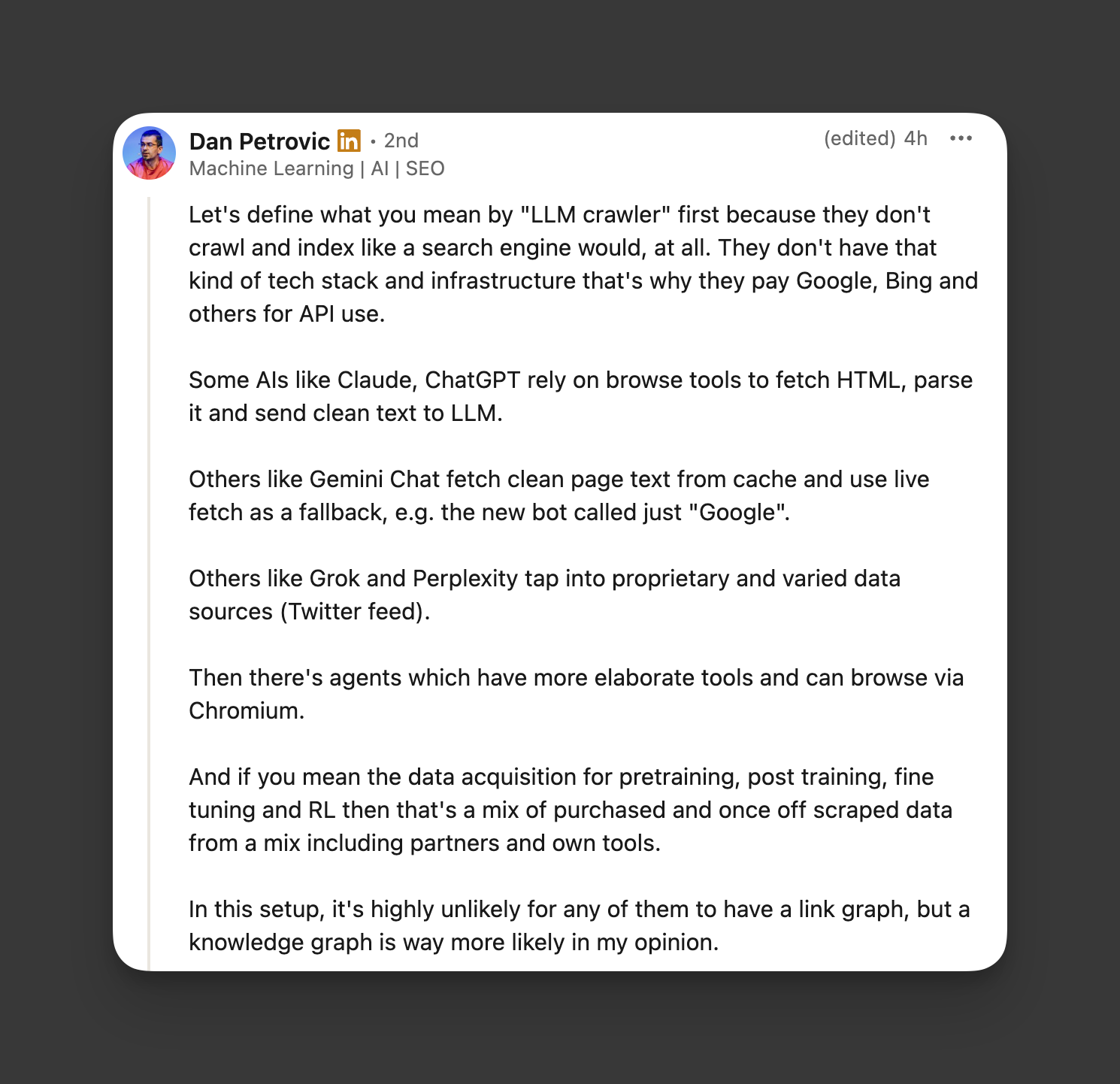
Dan Petrovic, founder and CEO of Dejan SEO, gave a detailed answer about the differences between a) the types of LLM crawlers and b) the different LLMs and how they behave.

Image Credit: Kevin Indig

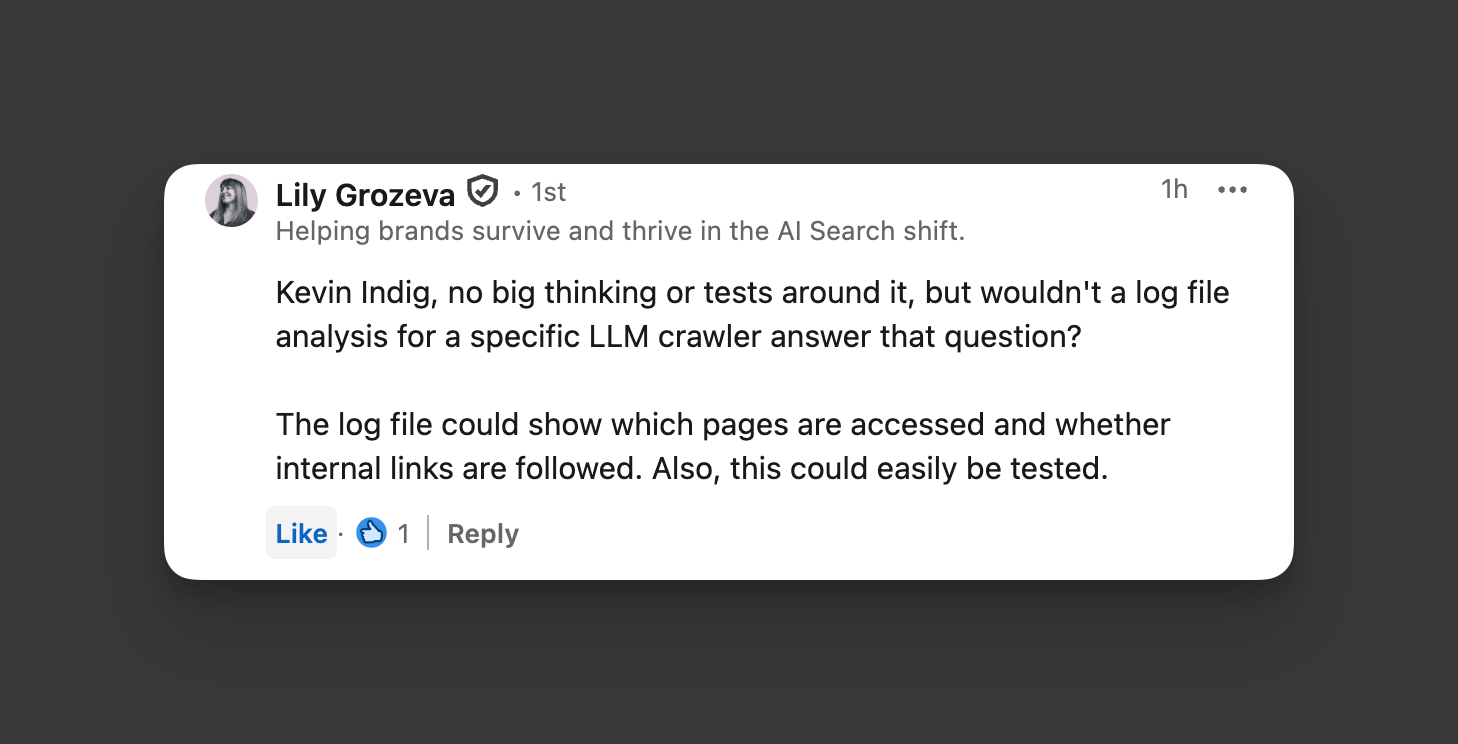
Lily Grozeva, head of SEO at Verto Digital, rightfully called out that we can all get the answer in our own logfiles.

Image Credit: Kevin Indig

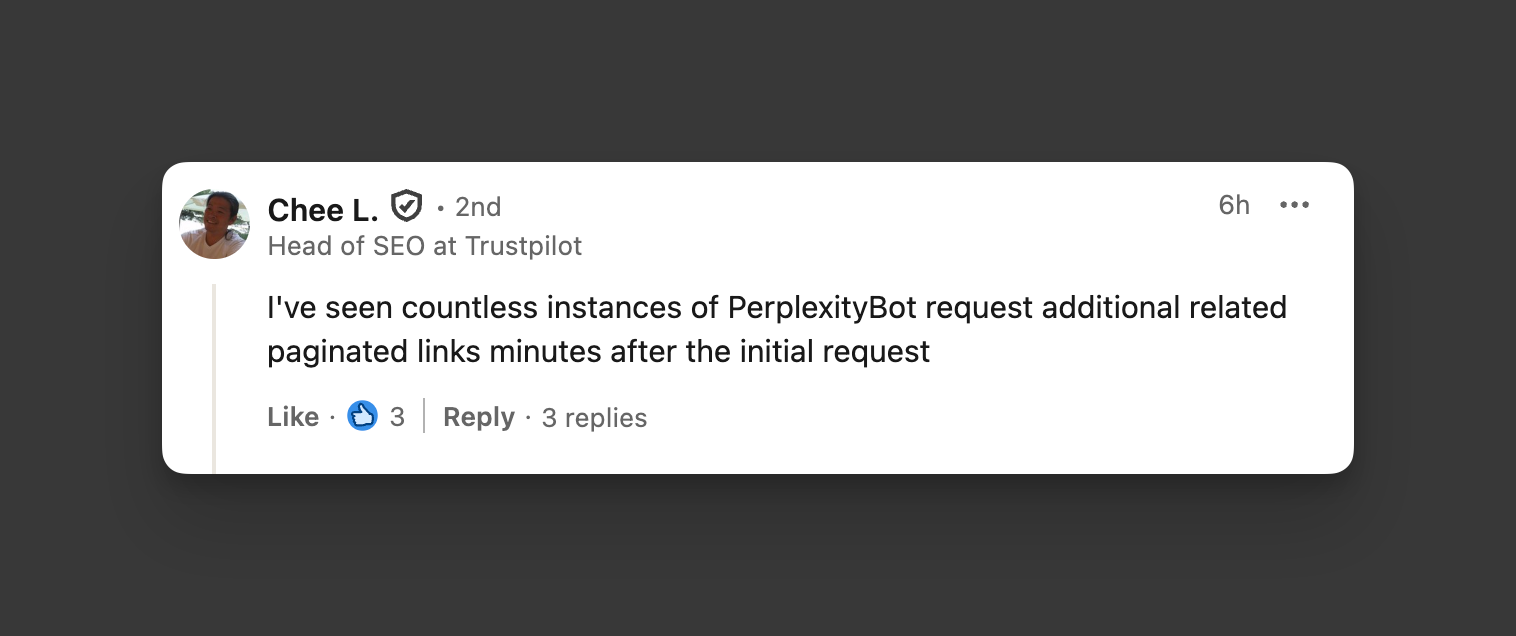
Chee Lo, head of SEO at Trustpilot, shared his experience with Perplexity, which seems to be a bit more aggressive than other bots.

Image Credit: Kevin Indig

Sites with clear internal linking patterns that mirror how humans connect concepts are (in theory, more data will tell over time) better positioned to be included in AI-generated answers and entity-rich snippets.

Way back in 2019, I explained the following in Semantic content optimization with entities:

Entities are semantic, interconnected objects that help machines to understand explicit and implicit language. In simpler terms, they are words (nouns) that represent any type of object, concept, or subject … According to Cindy Krum and her fantastic entity series, Google seems to restructure its whole approach to indexing based on entities (while you’re at it, read AJ Kohn’s article about embeddings). Understanding entities and how Google uses them in search sharpens our standards for content creation, optimization, and the use of schema markup.

Entities are nouns like events, ideas, people, places, etc. They’re the building blocks of ideas and how those ideas relate to each other. (They’re not just “keywords.”)

Search engines and LLMS use semantic relationships between entities to (1) reduce ambiguity, (2) reinforce authority/canonical sources on your site, and (3) map out relationships between topics, features, services, and audiences across your site.

When you internally link pages together with strategically descriptive anchors, you’re telling search engines how your site fits together … and you’re training them on how entities across your site connect.

Therefore, by practicing internal linking through an entity-based lens, you’re creating stronger, clearer relationships and patterns for Google/search engines/LLMs to understand.

Entity-first SEO starts with defining the people, products, concepts, and places your brand “owns.”

If you’re a B2B SaaS company offering a CRM, those entities might include your:

  • Core product (CRM platform).
  • Features (pipeline management, email automation, reporting dashboards).
  • Use cases (sales enablement, customer support, marketing teams).
  • Personas/target ICPs (heads of sales at mid-market companies, startup founders scaling revenue teams, or enterprise IT buyers).

Taking this example, you’re going to think in terms of topic-first SEO:

  • Hub or pillar pages = parent entities. These are your central nodes – the definitive resource on a core concept. For a B2B SaaS CRM, it might be the CRM platform overview page.
  • Cluster pages = sub-entities. These are the supporting nodes that expand on the hub. For a CRM, the CRM hub branches into feature pages like pipeline management, email automation, and reporting dashboards.
  • Cross-link clusters to show relatedness. Don’t just point everything back to the hub – connect the clusters to each other to model real-world relationships. In the instance of the CRM, pipeline management integrates with email automation to shorten deal cycles.
  • Navigation and breadcrumbs reinforce hierarchy. The visible structure tells both users and Google how entities fit together. Example: Home → Products → CRM → Pipeline Management.
  • Include personas in the implementation. This reinforces the relationship: This persona → has this pain point → solved by this feature → within this product topic.

For example, look at this topic cluster map created with Screaming Frog:

Image Credit: Kevin Indig

It shows two clusters with nodes very close together (red and orange) and three other clusters that are spread apart (green, blue, and purple). Guess which clusters outperform the others in organic search? Red and orange!

Here’s how you connect those entities into a meaningful structure in the copy on the page:

1. Anchor text = entity disambiguation.

Instead of linking with vague text, use descriptive anchors that clarify which entity the link refers to. For example, if your CRM has a feature page about pipeline management, link to it with “sales pipeline management CRM feature” language.

2. Consistency matters.

If you always link to that pipeline management page with variations like “pipeline automation tool,” “deal tracking software,” and “CRM feature,” you dilute the entity connection. (But variations like “pipeline management tool,” “sales pipeline management CRM feature,” and “pipeline management features” are derivatives.)

By sticking to clear, consistent anchors, you signal to Google that this is the page that defines “pipeline management” for your brand.

3. Context strengthens meaning.

The sentence or paragraph around the link can add semantic weight. For example:

“Our CRM includes pipeline management, so your sales team can track every deal from prospecting to close.”

That tells Google (and users) that pipeline management isn’t just a phrase; it’s a core feature within the CRM product.

4. Include personas.

Making personas a criterion for internal linking is a no-brainer, because from a psychological perspective, a link automatically signals “there’s more for you here.”

If your internal link is placed on the right word that triggers a response in your target ICPs (and the right areas of the page), it increases the chance of people staying on the site. It’s also just a better experience – and good customer service – to help site visitors find the right offering specifically for themselves, all with the goal to increase trust and the chances they take an action or convert.

If one of your ICPs is head of Sales at mid-market SaaS companies, you might internally link from a blog article like “10 Ways SaaS Sales Leaders Can Shorten Their Sales Cycle” directly to your pipeline management feature page, while using copy surrounding that link that explains how your offering solves this problem. That link makes the relationship explicit: This is the feature that solves this persona’s pain point.

Ultimately, think of every internal link as a connector in your brand’s knowledge graph.

Together, these links show how entities and topics (like CRM platform → pipeline management → sales enablement → head of sales persona) relate to each other, and why your site is authoritative on them.

Amanda Johnson jumping in here to add: Basically, show + tell people (and search engines/LLMs) what you want them to know via literal semantics. It really is that simple. No need to overthink this. Use clear, descriptive, accurate anchor text for the internally linked page, use it consistently, and give context as to how/why the page is linked there with surrounding copy.

Ultimately, if you practice internal linking thoughtfully and methodically, you end up with a better user experience and more thorough reinforcement of internal entity relationships (which can improve topical authority signals).

Worried that your most important pages aren’t getting enough visibility because you haven’t set up a clear linking structure? Following the guidance above will help you resolve this and set up a clear internal linking system.

And using tools that have internal link auditing (like Semrush, Ahrefs, Clearscope, Surfer, etc.) will help you implement your system. Some SEO tools also give page-level internal linking recommendations and copy suggestions to anchor the text to.

Internal linking hasn’t just been about crawlability for some time now.

By structuring links around topics, entities, (and even user journeys of your target personas), you communicate your site’s semantic map to Google and LLMs.


Featured Image: Paulo Bobita/Search Engine Journal

https://www.searchenginejournal.com/rundowns/ai-search-blueprint-entity-maps-structured-data-indexnow-the-basics/


YouTube Introduces ‘Ask Studio’ AI For Channel Analytics via @sejournal, @MattGSouthern

YouTube launched Ask Studio, an AI assistant built into YouTube Studio that analyzes channel data to provide insights and content suggestions.

The tool appears as a chat interface accessed through a sparkle icon in YouTube Studio. You can ask for comment summaries, video performance analysis, and content ideas based on your channel’s data.

What’s New

Ask Studio analyzes three primary types of channel data: comments, analytics, and past content performance.

For comments, Ask Studio can summarize key themes and sentiment across videos. You can ask for summaries on a specific video or get an overall view of what viewers are talking about.

For analytics, Ask Studio pulls from the same performance metrics already in YouTube Studio. It identifies patterns and suggests areas for improvement based on the channel’s data.

For content planning, Ask Studio can generate ideas tailored to what viewers already respond to. You can prompt it for new angles on an ongoing series, ask what topics are resonating with your audience, or get title and outline suggestions.

See a full walkthrough in the video below:

[embedded content]

How It Differs From Inspiration Tab

Ask Studio and the Inspiration Tab are both designed to help with content ideas, but they work differently.

Inspiration Tab is a visual surface. It shows idea cards, images, and thumbnail suggestions for creators who like to browse concepts.

Ask Studio is conversational. You type a prompt and get an answer in plain language. It’s meant for creators who already have a direction and want help sharpening the angle, planning the next video, or understanding what viewers are saying.

Both use your channel data, but Ask Studio responds in real time. Inspiration Tab curates pre-generated suggestions.

Availability

Ask Studio is currently available in English to a limited group of creators in the United States.

YouTube says it’s continuing to expand access to more U.S. creators, experimenting with additional languages, and working on international rollout.

Some prompts may return a generic response or “I can’t help with that.” YouTube says that happens when Ask Studio doesn’t have enough context or doesn’t support that request yet.

Why This Matters

Ask Studio can surface patterns in your comments and analytics without manually digging through dashboards or scrolling hundreds of viewer messages. That reduces the time spent on reporting and lets you focus on packaging the next video.

The current limitation is reach. Right now it’s U.S.-only, English-only, and only some channels are in the test group, which restricts access for international creators and teams that work across multiple languages.

Looking Ahead

YouTube says it plans to roll out Ask Studio to more creators in the United States before expanding internationally. The company is also testing additional language support but hasn’t announced specific languages or dates.

The launch continues YouTube’s push toward AI-assisted creator tools inside YouTube Studio, alongside features like the Inspiration Tab for idea generation.


Featured Image: vrlibsstudio/Shutterstock

https://www.searchenginejournal.com/youtube-introduces-ask-studio-ai-for-channel-analytics/559399/