OpenAI Flags Emotional Reliance On ChatGPT As A Safety Risk via @sejournal, @MattGSouthern

OpenAI is telling companies that “relationship building” with AI has limits. Emotional dependence on ChatGPT is considered a safety risk, with new guardrails in place.

  • OpenAI says it has added “emotional reliance on AI” as a safety risk.
  • The new system is trained to discourage exclusive attachment to ChatGPT.
  • Clinicians helped define what “unhealthy attachment” looks like and how ChatGPT should respond.

https://www.searchenginejournal.com/openai-flags-emotional-reliance-on-chatgpt-as-a-safety-risk/559394/


Google Uses AI To Group Queries In Search Console Data via @sejournal, @MattGSouthern

Google announced Query groups in Search Console Insights. The AI feature clusters similar search queries, surfaces trends, and shows which topics drive clicks.

  • Query groups uses AI to cluster similar search queries.
  • The new card shows total clicks per group and highlights groups trending up or down.
  • Query groups will roll out over the coming weeks to high volume accounts.

https://www.searchenginejournal.com/google-uses-ai-to-group-queries-in-search-console-data/559360/


AI in SEO: 5 Essential Tactics To Be Seen & Trusted On New SERPs via @sejournal, @duchessjenm

Search is literally evolving faster than ever. Is your SEO strategy keeping up?

Are you struggling to stay visible in AI-powered search results? 

Does your visibility seem to vanish with each algorithm update or SERP overhaul? 

Worried that AI Overviews are cutting into your traffic, but unsure how to adapt?

Discover 5 proven tactics to protect your SERP visibility.

The rise of AI-driven search engines like ChatGPT, Google’s SGE, and Bing Copilot is changing how users discover and trust brands online.

What Worked Last Year May Not Work Tomorrow

Join Craig Smith, Chief Strategy Officer at OuterBox, and learn exactly how to adapt your strategy for a world run by answer engines and generative SERPs.

What You’ll Learn:

  • How to structure your content and technical SEO practices for AI-generated answers.
  • Which trust signals matter most when AI chooses which brand to cite.
  • Where search is headed, plus how to stay ahead.

Watch on-demand and get the SEO playbook your competitors wish they had.

View the slides below or check out the full webinar for all the details.

Join Us For Our Next Webinar!

AI Search Playbook: The Strategy Leaders Want — and Teams Can Act On

Need to confidently answer“what’s our strategy?” This session gives you a clear, data-backed measurement framework to solidify your AI Search strategy for the new year.

https://www.searchenginejournal.com/5-seo-tactics-on-ai-search/557107/


The Brands & Campaigns That Won Black Friday 2024 via @sejournal, @gregjarboe

When it comes to Black Friday and Cyber Monday, the winners aren’t just the brands that rack up sales; they’re the ones that capture attention, drive conversation, and leave a lasting impression.

In 2024, Pixability’s YouTube Insights revealed how shoppers used video to plan and validate purchases throughout the season. Meanwhile, YouGov’s BrandIndex tracked which brands earned the highest “Buzz scores,” asking consumers whether they had heard something positive or negative about a brand in the past two weeks. And DAIVID’s creative testing platform analyzed how Amazon and Walmart’s humor-driven campaigns performed.

Together, these data sources provide a 360-degree view of who won last year – and what lessons marketers should take into 2025.

What Pixability’s Insights Tell Us About Black Friday 2024

Pixability’s YouTube Insights provide a valuable lens on what drove consumer behavior last season – and what will matter in 2025.

In a direct email, Matt Duffy, the CMO of Pixability, told me on Sept. 18, 2025, “YouTube searches that spike the most on Black Friday are tech-related products, but in terms of consumption patterns, the real winners are home-related channels – where people are likely watching reviews of bigger-ticket items like couches or even how to put a deck on your house.”

Duffy also shared original research directly with me that showed on Black Friday itself (Nov. 29, 2024), searches for popular products spiked compared to the seasonal average:

  • Dyson Airwrap: up 132%.
  • AirPods Pro: up 100%.
  • Nespresso Vertuo: up 92%.
  • Smart TVs: up 73%.
  • Madden NFL 25: up 42%.

But the bigger story was how far in advance shoppers began preparing. In November, views of product-related content like gift guides, reviews, and hauls were nearly 19% higher than the rest of 2024. By October, those same videos were already up 26% compared to the first nine months of the year.

Duffy added, “The uptick in product interest accelerates as early as October, with views on videos that inform purchase decisions up 26.3% compared to the first nine months of the year.”

Category-specific growth was also revealing:

  • Home content: up 91% in October, 62% in November.
  • Tech content: up 26% in October, 8% in November.
  • Fashion content: up 17% in October, 8% in November.

The surge in home-related content suggests shoppers are increasingly using Black Friday to make bigger lifestyle investments, not just splurge on gadgets.

Retailers benefited as well. For example, Best Buy-related content saw an 18% jump in November, reflecting how brand-specific searches converged with shopping intent.

The takeaway? Winning Black Friday begins long before Black Friday. Brands that resonate are the ones that show up early, align with categories people are actively researching, and create the kind of content – reviews, guides, tutorials – that helps consumers feel confident about their choices.

Duffy concluded, “Views on videos that inform purchase decisions – gift guides, reviews, hauls – were 18.7% higher in November than the rest of 2024, with home-related content up 62% year-over-year.”

Which Brands Generated The Most Buzz During Black Friday And Cyber Monday 2024?

During a webinar on Sept. 24, 2025, Ashley Brown of YouGov said, “Ahead of 2025, we looked back at the brands that drove the highest Buzz during November last year to understand which categories are winning consumer attention during Black Friday and Cyber Monday.”

Brown added, “YouGov BrandIndex tracked more than 2,000 U.S. consumers between Nov. 1 and Dec. 3, 2024. The net Buzz score showed which fashion, retail, tech, beauty, and gaming brands were most positively talked about during Black Friday and Cyber Monday.”

As the dust settled after Black Friday and Cyber Monday 2024, one thing became clear: Not all brands captured consumer attention equally. Some emerged as big winners in the battle for share of mind, sparking conversations online, in the news, and at the dinner table.

The results highlight which fashion, retail, tech, beauty, and gaming brands broke through the noise. Let’s take a closer look.

Fashion Retail: Nike Runs Ahead Of The Pack

In fashion, Nike led with a Buzz score of 26.2, proving once again that its mix of cultural relevance, athlete endorsements, and smart digital campaigns keeps it top of mind.

The rest of the top 10 shows a mix of performance wear, heritage names, and mass-market favorites:

  1. Nike (26.2).
  2. Adidas (22.5).
  3. Rolex (19.9).
  4. Skechers (18.8).
  5. Old Navy (18.5).
  6. Victoria’s Secret (17.1).
  7. New Balance (16.2).
  8. Puma (16.2).
  9. Levi’s (15.2).
  10. Crocs (14.7).

From high fashion watches (Rolex) to comfort footwear (Crocs), fashion buzz during Black Friday/Cyber Monday 2024 reflected both status and accessibility.

Retail Stores: Walmart, Home Depot, And Target Dominate

Among retailers, Walmart took the top spot with a Buzz score of 23.9, but Home Depot was a close second (23.8). Target and Lowe’s tied at 22.0, while Costco rounded out the top five at 21.3.

The full ranking underscores how large-format retailers continue to dominate awareness:

  1. Walmart (23.9).
  2. Home Depot (23.8).
  3. Target (22.0).
  4. Lowe’s (22.0).
  5. Costco (21.3).
  6. IKEA (17.7).
  7. Best Buy (16.6).
  8. Ace Hardware (15.2).
  9. Home Goods (14.9).
  10. Kohl’s (13.9).

These brands won by blending convenience, deep discounts, and multichannel experiences that amplified their visibility.

Tech & Electronics: iPhone Tops The Charts

It wouldn’t be Cyber Monday without tech. In 2024, the iPhone led the pack with a Buzz score of 33.5 – the highest single score across any category. Samsung (29.4) and Apple as a brand (29.0) followed, reflecting the enduring ecosystem war.

Here are the top 10:

  1. iPhone (33.5).
  2. Samsung (29.4).
  3. Apple (29.0).
  4. LG (21.4).
  5. Android (21.3).
  6. Apple Watch (21.1).
  7. Sony (15.8).
  8. iPad (15.8).
  9. HP (15.5).
  10. Google Pixel (14.8).

Big launches, steep markdowns, and loyal communities made tech brands the most talked-about of Black Friday/Cyber Monday 2024.

Skincare, Hair & Cosmetics: Dove Leads In Double Categories

In beauty, Dove pulled off a rare double, ranking No. 1 in both skincare (28.6) and haircare (26.0). Legacy personal care brands dominated, while retailers like Sephora and Bath & Body Works also broke into the top 10.

The rankings:

  1. Dove (Skincare) (28.6).
  2. Dove (Haircare) (26.0).
  3. Vaseline (22.0).
  4. Olay (18.8).
  5. Nivea (18.1).
  6. CeraVe (17.2).
  7. Head & Shoulders (14.5).
  8. Neutrogena (14.3).
  9. Sephora (13.5).
  10. Bath & Body Works (13.3).

The buzz highlights how trusted household brands continue to thrive, even in a social-driven beauty market.

Video Games: Call Of Duty Fires The Winning Shot

Gaming saw heated competition, but Call of Duty secured the top spot with a Buzz score of 16.8, followed closely by Candy Crush Saga (16.5) and Super Mario Bros. (14.8).

The top 10 video game brands during Black Friday/Cyber Monday 2024 were:

  1. Call of Duty (16.8).
  2. Candy Crush Saga (16.5).
  3. Super Mario Bros. (14.8).
  4. Call of Duty: Warzone (14.2).
  5. MONOPOLY GO! (11.9).
  6. Minecraft (11.4).
  7. Mortal Kombat (10.9).
  8. Grand Theft Auto (9.7).
  9. EA Sports FC (9.6).
  10. Fortnite (9.3).

From AAA franchises to mobile hits, gaming buzz was fueled by new releases, bundles, and the power of community-driven hype.

Brown concluded, “The lesson for marketers is clear: measuring net Buzz doesn’t just reveal who won last year – it provides a roadmap for which categories and campaigns are most likely to generate positive word-of-mouth this holiday season.”

Amazon And Walmart Prove Humor Can Win Black Friday

While buzz rankings and search spikes show marketers and their agencies which brands topped the conversation, creative execution explains why.

In 2024, Amazon and Walmart both leaned into humor – and it paid off, according to original research shared directly with me on Sept. 26, 2025, from DAIVID’s AI-powered testing platform.

Amazon’s “Five Star Theater” campaign featured actor Adam Driver performing dramatic monologues based on actual customer reviews. By turning quirky product reviews into performance art, Amazon transformed shopping commentary into entertainment.

Walmart countered with “Deals of Desire,” a 10-part parody series riffing on popular TV tropes, distributed across TV, YouTube, TikTok, and out-of-home. The series even brought back Vampire Diaries star Ian Somerhalder, who read reviews in character.

According to DAIVID’s creative data, both brands outperformed the industry average for humor. Amazon’s ads were 22% funnier than typical campaigns, while Walmart’s were 19% funnier. Walmart’s “Stable Boy of the Season” was the single funniest ad, boosting purchase intent nearly 9% above the norm.

In an email sent directly to me, a spokesperson for DAIVID said, “The problem with brands trying to be funny is that most fail. For advertisers, it’s even harder as you also have to squeeze in some suitable brand messaging at the same time, while also not offending any of your target demographics. Easier said than done. Well, despite the risks, both Walmart and Amazon managed to tickle people’s funny bones with their campaigns.”
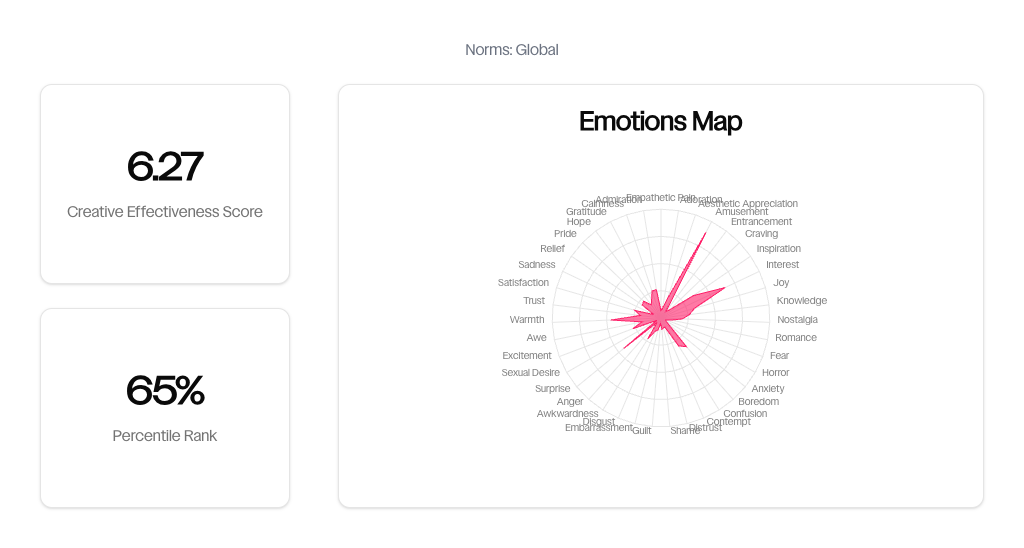
Image courtesy of DAIVID, shared to author, October 2025

Attention patterns told a different story. Both campaigns struggled to hook viewers in the first few seconds, but Amazon steadily won people over by the end of its longer-form spots, such as the “Salad Bowl” video. Walmart’s performance varied, though “Stable Boy” again stood out as the exception.

The spokesperson added, “Losing attention in the first few seconds can really hurt an ad’s performance. It’s hard to win it back. So, it’s interesting that in Amazon’s case overall attention levels in ‘Five Star Theater’ by the final few seconds actually exceeded the industry average. As people listened to the content, they started to understand the premise more and were more inclined to stick around.”
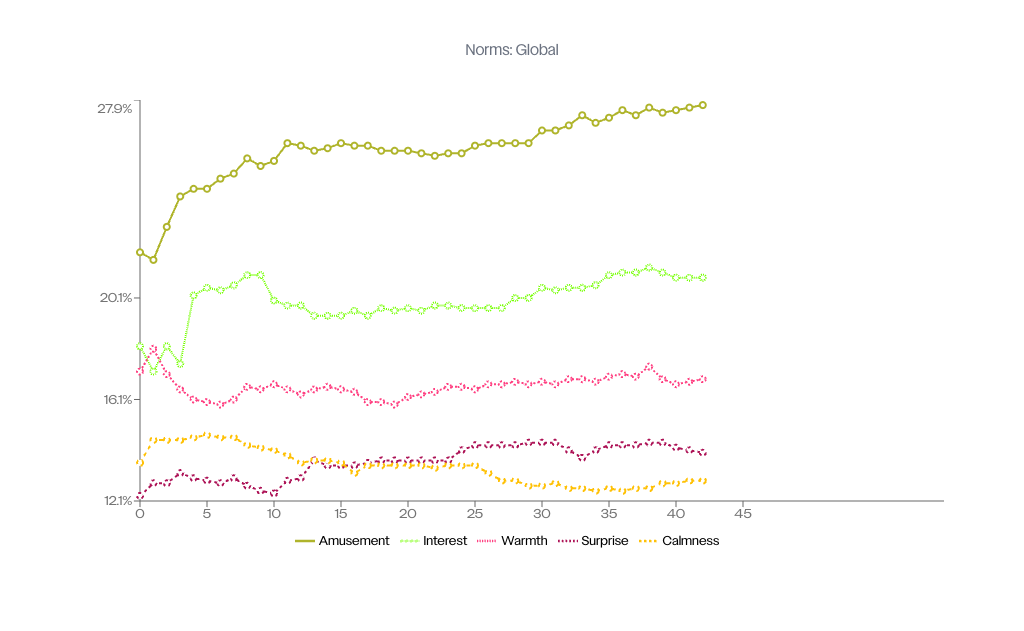
Image courtesy of DAIVID, shared to author, October 2025

Brand recall was strong across the board, with Walmart benefiting from explicit mentions of its loyalty program. Purchase intent lifted for both brands – +6.4% for Amazon, +5.8% for Walmart – putting them well ahead of the average ad.

Using DAIVID’s Creative Effectiveness Score (CES), both campaigns ranked well above industry norms. Walmart posted a CES of 6.21, while Amazon edged ahead at 6.39, with its “Adam Driver, Dutch Oven” spot scoring highest at 6.47.

The lesson? Black Friday campaigns don’t have to be just about deals. Humor, when executed well, not only entertains but also boosts recall, strengthens brand affinity, and drives intent. Amazon and Walmart proved that a wink can sometimes work better than a shout.

The spokesperson concluded, “Viewers of the Amazon ads were on average 6.4% more likely to splash the cash after watching than the industry norm. In fact, all of the top five ads that scored the highest for purchase intent came from Amazon. Meanwhile, Walmart’s ads were 5.8% more likely to inspire people to reach for their wallets than the average ad.”

Looking Forward: What 2024’s Winners Tell Us About 2025

Looking back at 2024, three different data sources tell a powerful, complementary story:

  • Pixability’s YouTube Insights demonstrate that planning and discovery start weeks before the sales, with shoppers relying heavily on video to guide decisions.
  • YouGov’s Buzz scores show which brands were most talked about across categories – from Nike and Walmart to iPhone and Dove.
  • DAIVID’s creative testing reveals why campaigns work, with Amazon and Walmart proving that humor can drive both engagement and purchase intent.

For marketers preparing for Black Friday and Cyber Monday 2025, the lesson is clear: Success won’t come from deals alone. The campaigns most likely to win will be the ones that:

  • Enter the conversation early.
  • Align content strategies with the way consumers actually research and shop.
  • Use creative storytelling to stand out.

In other words, Black Friday isn’t just a day; it’s a season. And the brands that treat it that way will be the ones topping the buzz charts, driving intent, and winning hearts in 2025.

More Resources:


Featured Image: Roman Samborskyi/Shutterstock

https://www.searchenginejournal.com/the-brands-and-campaigns-that-won-black-friday-2024/557070/



Automattic’s Legal Claims About SEO… Is This Real? via @sejournal, @martinibuster

SEO plays a role in Automattic’s counterclaim against WP Engine. The legal document mentions search engine optimization six times and SEO once as part of counterclaims asserting that WP Engine excessively used words like “WordPress” to rank in search engines as part of an “infringement” campaign that uses WordPress trademarks in commerce. A close look at those claims shows that some of the evidence may be biased and that claims about SEO rely on outdated information.

Automattic’s Claims About SEO

Automattic’s counterclaim asserts that WP Engine used SEO to rank for WordPress-related keywords and that this is causing confusion.

The counterclaim explains:

“WP Engine also has sown confusion in recent years by dramatically increasing the number of times Counterclaimants’ Marks appear on its websites. Starting in or around 2021, WP Engine began to sharply increase its use of the WordPress Marks, and starting in or around 2022, began to sharply increase its use of the WooCommerce Marks.”

Automattic next argues that the repetition of keywords on a web page is WP Engine’s SEO strategy. Here’s where their claims become controversial to those who know how search engines rank websites.

The counterclaim asserts:

“The increased number of appearances of the WordPress Marks on WP Engine’s website is particularly likely to cause confusion in the internet context.

On information and belief, internet search engines factor in the number of times a term appears in a website’s text in assessing the “relevance” of a website to the terms a user enters into the search engine when looking for websites.

WP Engine’s decision to increase the number of times the WordPress Marks appear on WP Engine’s website appears to be a conscious “search engine optimization” strategy to ensure that when internet users look for companies that offer services related to WordPress, they will be exposed to confusingly written and formatted links that take them to WP Engine’s sites rather than WordPress.org or WordPress.com.”

They call WP Engine’s strategy aggressive:

“WP Engine’s strategy included aggressive utilization of search engine optimization to use the WordPress and WooCommerce Marks extremely frequently and confuse consumers searching for authorized providers of WordPress and WooCommerce software;”

Is The Number Of Keywords Used A Ranking Factor?

I have twenty-five years of experience in search engine optimization and have a concomitantly deep understanding of how search engines rank content. The fact is that Automattic’s claim that search engines “factor in the number of times” a keyword is used in a website’s content is outdated and incorrect.

Modern search engines don’t factor in the number of times a keyword appears on a web page as a ranking factor. Google’s algorithms use models like BERT to gain a semantic understanding of the meaning and intent of the keyword phrases used in search queries and content, resulting in the ability to rank content that doesn’t even contain the user’s keywords.

Those aren’t just my opinions; Google’s web page about how search works explicitly says that content is ranked according to the user’s intent, regardless of keywords, which directly contradicts Automattic’s claim about WPE’s SEO:

“To return relevant results, we first need to establish what you’re looking for – the intent behind your query. To do this, we build language models to try to decipher how the relatively few words you enter into the search box match up to the most useful content available.

This involves steps as seemingly simple as recognizing and correcting spelling mistakes, and extends to our sophisticated synonym system that allows us to find relevant documents even if they don’t contain the exact words you used.”

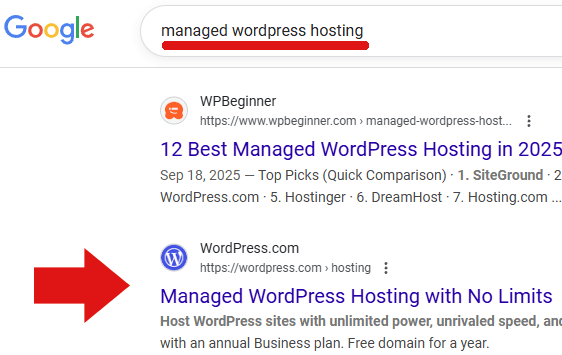
If Google’s documentation is not convincing enough, take a look at the search results for the phrase “Managed WordPress Hosting.” WordPress.com ranks #2, despite the phrase being completely absent from its web page.

Screenshot Of WordPress.com In Search Results

What Is The Proof?

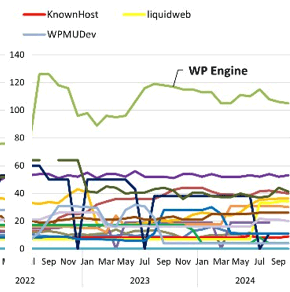
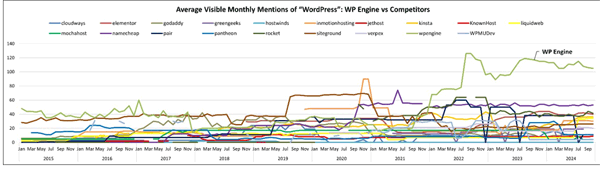
Automattic provides a graph comparing WP Engine’s average monthly mentions of the word “WordPress” with mentions published by 18 other web hosts. The comparison of 19 total web hosts dramatically illustrates that WP Engine mentions WordPress more often than any of the other hosting providers, by a large margin.

Screenshot Of Graph

Here’s a close-up of the graph (with the values inserted) showing that WP Engine’s monthly mentions of “WordPress” far exceed the number of times words containing WordPress are used on the web pages of the other hosts.

Screenshot Of Graph Closeup

People say that numbers don’t lie, and the graph presents compelling evidence that WP Engine is deploying an aggressive use of keywords with the word WordPress in them. Leaving aside the debunked idea that keyword-term spamming actually works, a closer look at the graph comparison shows that the evidence is not so strong because it is biased.

Automattic’s Comparison Is Arguably Biased

Automattic’s counterclaim compares eighteen web hosts against WP Engine. Of those eighteen hosts, only five (including WPE) are managed WordPress hosting platforms. The remaining fourteen are generalist hosting platforms that offer cloud hosting, VPS (virtual private servers), dedicated hosting, and domain name registrations.

The significance of this fact is that the comparison can be considered biased against WP Engine because the average mention of WordPress will naturally be lower across the entire website of a company that offers multiple services (like VPS, dedicated hosting, and domain name registrations) versus a site like WP Engine that offers only one service, managed WordPress hosting.

Two of the hosts listed in the comparison, Namecheap and GoDaddy, are primarily known as domain name registrars. Namecheap is the second biggest domain name registrar in the world. There’s no need to belabor the point that these two companies in Automattic’s comparison may be biased choices to compare against WP Engine.

Of the five hosts that offer WordPress hosting, two are plugin platforms: Elementor and WPMU Dev. Both are platforms built around their respective plugins, which means that the average number of mentions of WordPress is going to be lower because the average may be diluted by documentation and blog posts about the plugins. Those two companies are also arguably biased choices for this kind of comparison.

Of the eighteen hosts that Automattic chose to compare with WP Engine, only two of them are comparable in service to WP Engine: Kinsta and Rocket.net.

Comparison Of Managed WordPress Hosts

Automattic compares the monthly mentions of phrases with “WordPress” in them, and it’s clear that the choice of hosts in the comparison biases the results against WP Engine. A fairer comparison is to compare the top-ranked web page for the phrase “managed WordPress hosting.”

The following is a comparison of the top-ranked web page for each of the three managed WordPress hosts in Automattic’s comparison list, a straightforward one-to-one comparison. I used the phrase “managed WordPress hosting” plus the domain name appended to a search query in order to surface the top-ranked page from each website and then compared how many times the word “WordPress” is used on those pages.

Here are the results:

Rocket.net

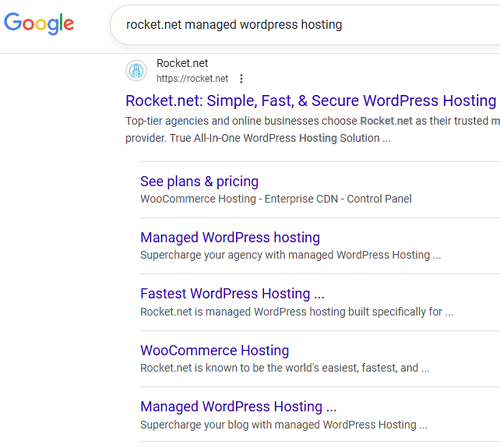
The home page of Rocket.net ranks #1 for the phrase “rocket.net managed wordpress hosting.” The home page of Rocket.net contains the word “WordPress” 21 times.

Screenshot of Google’s Search Results

Kinsta

The top ranked Kinsta page is kinsta.com/wordpress-hosting/ and that page mentions the word “WordPress” 55 times.

WP Engine

The top ranked WP Engine web page is wpengine.com/managed-wordpress-hosting/ and that page mentions the word “WordPress” 27 times.

A fair one-to-one comparison of managed WordPress host providers, selected from Automattic’s own list, shows that WP Engine is not using the word “WordPress” more often than its competitors. Its use falls directly in the middle of a fair one-to-one comparison.

Number Of Times Page Mentions WordPress

  • Rocket.net: 21 times
  • WP Engine: 27 times
  • Kinsta: 55 times

What About Other Managed WordPress Hosts?

For the sake of comparison, I compared an additional five managed WordPress hosts that Automattic omitted from its comparison to see how often the word “WordPress” was mentioned on the top-ranked web pages of WP Engine’s direct competitors.

Here are the results:

  • WPX Hosting: 9
  • Flywheel: 16
  • InstaWP: 22
  • Pressable: 23
  • Pagely: 28

It’s apparent that WP Engine’s 27 mentions put it near the upper level in that comparison, but nowhere near the level at which Kinsta mentions “WordPress.” So far, we only see part of the story. As you’ll see, other web hosts use the word “WordPress” far more than Kinsta does, and it won’t look like such an outlier when compared to generalist web hosts.

A Comparison With Generalist Web Hosts

Next, we’ll compare the generalist web hosts listed in Automattic’s comparison.

I did the same kind of search for the generalist web hosts to surface their top-ranked pages for the query “managed WordPress hosting” plus the name of the website, which is a one-to-one comparison to WP Engine.

Other Web Hosts Compared To WP Engine:

  1. InMotion Hosting: 101 times
  2. Greengeeks: 97 times
  3. Jethost: 71 times
  4. Verpex: 52 times
  5. GoDaddy: 49 times
  6. Cloudways: 47 times
  7. Namecheap: 41 times
  8. Liquidweb: 40 times
  9. Pair: 40 times
  10. Hostwinds: 37 times
  11. KnownHost: 33 times
  12. Mochahost: 33 times
  13. Panthen: 31 times
  14. Siteground: 30 times
  15. WP Engine: 27 times

Crazy, right? WP Engine uses the word “WordPress” less often than any of the other generalist web hosts. This one-to-one comparison contradicts Automattic’s graph.

And just for the record, WordPress.com’s top-ranked page wordpress.com/hosting/ uses the word “WordPress” 62 times, over twice as often as WP Engine’s web page.

Will Automattic’s SEO Claims Be Debunked?

Automattic’s claims about WP Engine’s use of SEO may be based on shaky foundations. The claims about how keywords work for SEO contradict Google’s own documentation, and the fact that WordPress.com’s own website ranks for the phrase “Managed WordPress Hosting” despite not using that exact phrase appears to debunk their assertion that search engines factor the number of times a user’s keywords are used on a web page.

The graph that Automattic presents in their counterclaim does not represent a comparison of direct competitors, which may contribute to a biased impression that WP Engine is aggressively using the “WordPress” keywords more often than competitors. However, a one-to-one comparison of the actual web pages that compete against each other for the phrase “Managed WordPress Hosting” shows that many of the web hosts in Automattic’s own list use the word “WordPress” far more often than WP Engine, which directly contradicts Automattic’s narrative.

I ran WP Engine’s Managed WordPress Hosting URL in a Keyword Density Tool, and it shows that WP Engine’s web page uses the word “WordPress” a mere 1.92% of the time, which, from an SEO point of view, could be considered a modest amount and far from excessive. It will be interesting to see how the judge decides the merits of Automattic’s SEO-related claims.

Featured Image by Shutterstock/file404

https://www.searchenginejournal.com/automattic-seo-counterclaim/559328/


The Same But Different: Evolving Your Strategy For AI-Driven Discovery via @sejournal, @alexmoss

The web – and the way in which humans interact with it – has definitely changed since the early days of SEO and the emergence of search engines in the early to mid-90s. In that time, we’ve witnessed the internet turn from something that nobody understood to something most of the world cannot operate without. This interview between Bill Gates and David Letterman puts this 30-year phenomenon into perspective:

[embedded content]

The attitude 30 years ago was that the internet was not understood at all and nor was its potential influence. Today, the concept of AI entering into our daily lives is taken much more seriously to the point that it is something that many look upon with fear – perhaps now because we [think] we have an accurate outlook on how this may progress.

This transformation isn’t so much about the skills we’ve developed over time, but rather about the evolution of the technology and channels that surround them. Those technologies and channels are evolving at a fast pace and causing some to panic over whether their inherent technological skills will still apply within today’s Search ecosystem.

The Technological Rat Race

Right now, it may feel like there’s something new to learn or a new product to experiment with every day, and it can be difficult to decide where to focus your attention and priorities. This is, unfortunately, a phase that I believe will continue for a good couple of years as the dust settles over this wild west of change.

Because these changes are impacting nearly everything an SEO would be responsible for as part of organic visibility, it may feel overwhelming to digest all these things – all while we seemingly take on the challenge of communicating these changes to our clients or stakeholders/board members.

But change does not equal the end of days. This “change” relates to the technology around what we’ve been doing for over a generation, and not the foundation of the discipline itself.

Old Hat Is New Hat

The major search engines have been actively telling you, including Google and Bing, that core SEO principles should still be at the forefront of what we do moving forward. Danny Sullivan, former Search Liaison at Google, also made this clear during his recent keynote at WordCamp USA:

[embedded content]

The consistent messages are clear:

  • Produce well-optimized sites that perform well.
  • Populate solid structured data and entity knowledge graphs.
  • Re-enforce brand sentiment and perspective.
  • Offer unique, valuable content for people.

The problem some may have is that the content we produce is moreso for agents than for people, and if this is true, what impact does this make?

The Web Is Splitting Into Two

The open web has been disrupted most of all, with some business models being uprooted by taking solved knowledge and serving it within their platform, appropriating the human visitor, which they rely on for income.

This has created a split from a complete open web into two – the “human” web and the “agentic” web – where these two audiences are both major considerations and will differ from site to site. SEOs will have to consider both sides of the web and how to serve both – which is where an SEO’s skill set becomes more valuable than it was before.

One example can be seen in the way that agents now take charge of ecommerce transactions, where OpenAI announced “Buy it in ChatGPT,” where the buying experience is even more seamless with instant checkouts. It also open-sourced the technology behind it, Agentic Commerce Protocol (ACP), and is already being adopted by content management system (CMS), including Shopify. This split between agentic and human engagement will still require optimization in order to ensure maximum discoverability.

When it comes to content, ensure everything is concise and avoid fluff, what I refer to as “tokenization spam.” Content isn’t just crawled; it’s processed, chunked, and tokenized. Agents will take preference to well-structured and formatted text.

“Short-Term Wins” Sounds Like Black Hat

Of course, during any technological shift, there will be some bad actors who may tell you about a brand-new tactic that is guaranteed to work to help you “rank in AI.” Remember that the dust has not yet settled when it comes to the maturity of these assistance engines, and you should compare this to the pre-Panda/Penguin era of SEO, where black hat SEO techniques were easier to achieve.

These algorithm updates closed those loopholes, and the same will happen again as these platforms improve – with increased speed as agents understand what is truly honest with increased precision.

Success Metrics Will Change, Not The Execution To Influence Them

In reality, core SEO principles and foundations are still the same and have been throughout most changes in the past – including “the end of desktop” when mobiles became more dominant; and “the end of typing” when voice search started to grow with products such as Alexa, Google Home, and even Google Glass.

Is the emergence of AI going to render what I do as an SEO obsolete? No.

Technical SEO remains the same, and the attributes that agents look at are not dissimilar to what we would be optimizing if large language models (LLMs) weren’t around. Brand marketing remains the same. While the term “brand sentiment” is a term used more widely nowadays, it is something that should have always been a part of our online marketing strategies when it comes to authority, relevance, and perspective.

That being said, our native metrics have been devalued within two years, and those metrics will continue to shift alongside the changes that are yet to come as these platforms deliver more stability. This has already skewed year-over-year data and will continue to skew for the year ahead as more LLMs evolve. This, however, could be compared to events such as replacing granular organic keyword data with one (not provided) metric within Google Analytics, the deprecation of Yahoo! Site Explorer, or devaluation of benchmark data such as Alexa Rank and Google PageRank.

Revise Your Success Metric Considerations

Success metrics now have to go beyond the SERP into visibility and discoverability as a whole, through multiple channels. There are now several tools and platforms available that can analyze and report on AI-focused visibility metrics, such as Yoast AI Brand Insights, that can provide better insight into how your brand is interpreted by LLMs.

If you’re more technical, make use of MCPs (Model Context Protocol) to understand data more via natural language dialogs. MCP is an open-source standard that lets AI applications connect to external systems like databases, tools, or workflows (you can visualize this as a USB-C port for AI) so they can access information and perform tasks using a simple, unified connection. There are several MCPs you can work with already, including:

You can take this a step further by coupling this with a vibe coding tool such as Claude Code, where you can use it to create a reporting app that uses a combination of the above MCP servers in order to extract the best data and create visuals and interactive charts for you and your clients/stakeholders.

The Same But Different … But Still The Same

While the divergence between human and agentic experiences is increasing, the methods by which we, as an SEO, would optimize for them are not too dissimilar. Leverage both within your strategy – just as you did when mobile gained traction in the same way.

More Resources:


Featured Image: Vallabh Soni/Shutterstock

https://www.searchenginejournal.com/the-same-but-different-evolving-your-strategy-for-ai-driven-discovery/558619/


CMS Market Share Trends: Top Content Management Systems (Oct 2025) via @sejournal, @theshelleywalsh

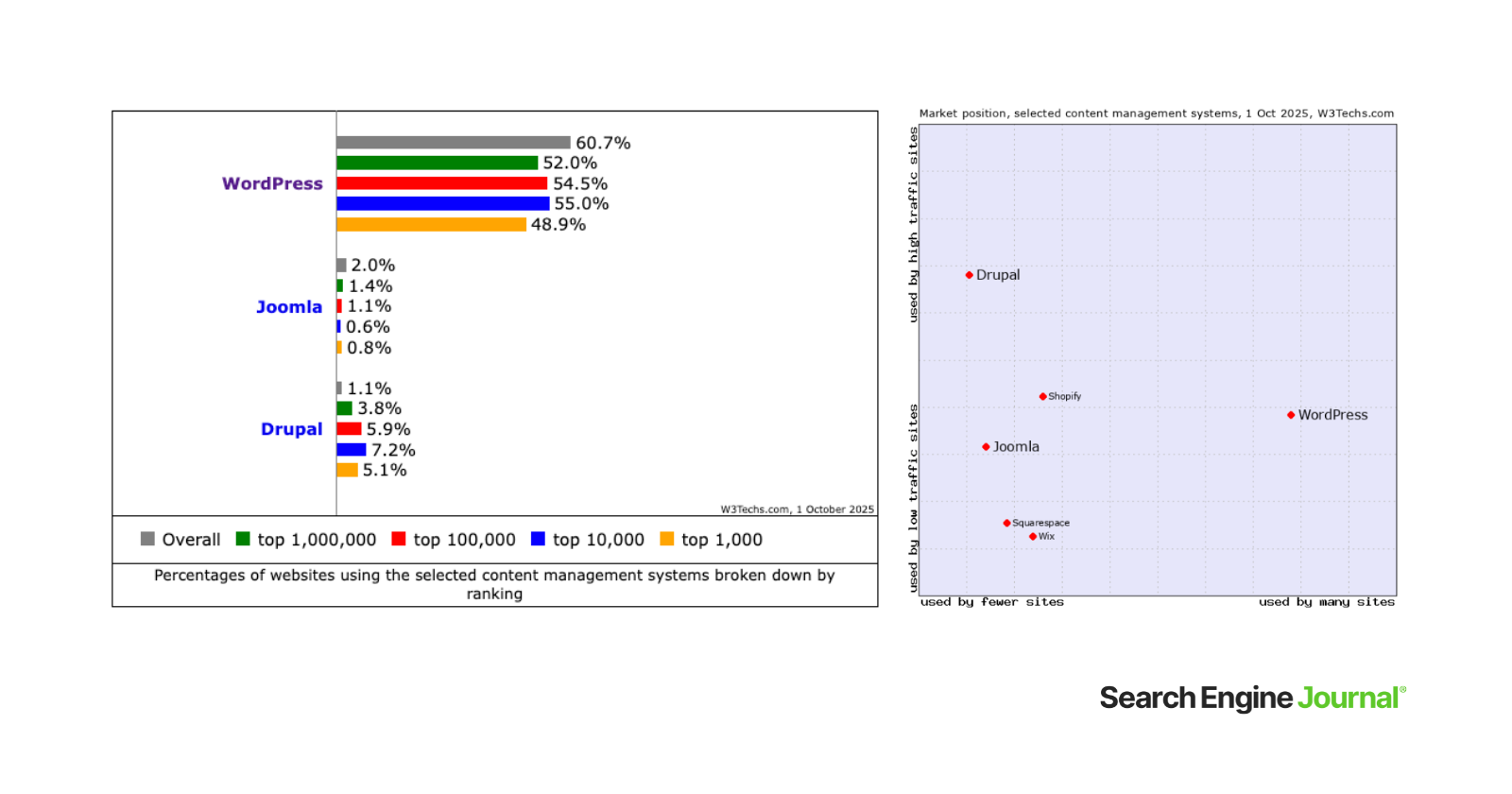
WordPress remains the dominant force in content management systems, powering 43.3% of websites surveyed and holding a 60.7% share among sites using a CMS, according to W3Techs (October 2025). That is still a commanding lead, but it marks a sustained decline from its peak of 65.2% in 2022 and is back to the same level as 2018, prior to the pandemic boom.

For executives and technical teams, this shift signals more than a market statistic.

As WordPress shows its first significant slide in two decades, SaaS competitors like Shopify, Wix, and Squarespace are steadily gaining ground, offering businesses simpler, managed solutions with lower technical overhead. At the same time, the share of websites running without any CMS has dropped to 28.6%, which continues the broader industry trend toward structured platforms and hosted builders.

It means that choosing the right CMS today is less about preference and more about a strategic decision, with measurable impact on site performance, security, costs, and scalability.

This report breaks down the current CMS landscape, compares the top platforms, and outlines how the latest shifts influence platform strategy and technical execution.

How Large Is The CMS Market?

According to W3Techs, 71.4% of websites have a CMS, and Netcraft reports over 281 million domains.

From this, we can assume that the current market size for content management systems has risen to over 200 million websites.

Top 10 CMS By Market Share (Globally), October 2025

CMS (as of October 2025) Launched Type Market Share Usage
No CMS 28.6%
1 WordPress 2003 Open source 60.7% 43.3%
2 Shopify 2006 SaaS 6.8% 4.8%
3 Wix 2006 SaaS 5.7% 4.1%
4 Squarespace 2004 SaaS 3.4% 2.4%
5 Joomla 2005 Open source 2.0% 1.4%
6 Webflow 2013 SaaS 1.2% 0.9%
7 Drupal 2001 Open source 1.1% 0.8%
8 Tilda 2014 SaaS 1.1% 0.8%
9 Adobe Systems 2013 Open source 1.0% 0.7%
10 Duda 2008 SaaS 1.0% 0.7%

Data from W3Techs, October 2025. (WooCommerce and Elementor are not listed in the table above as they’re WordPress plugins and not standalone CMS platforms.)

What is the most widely used CMS?

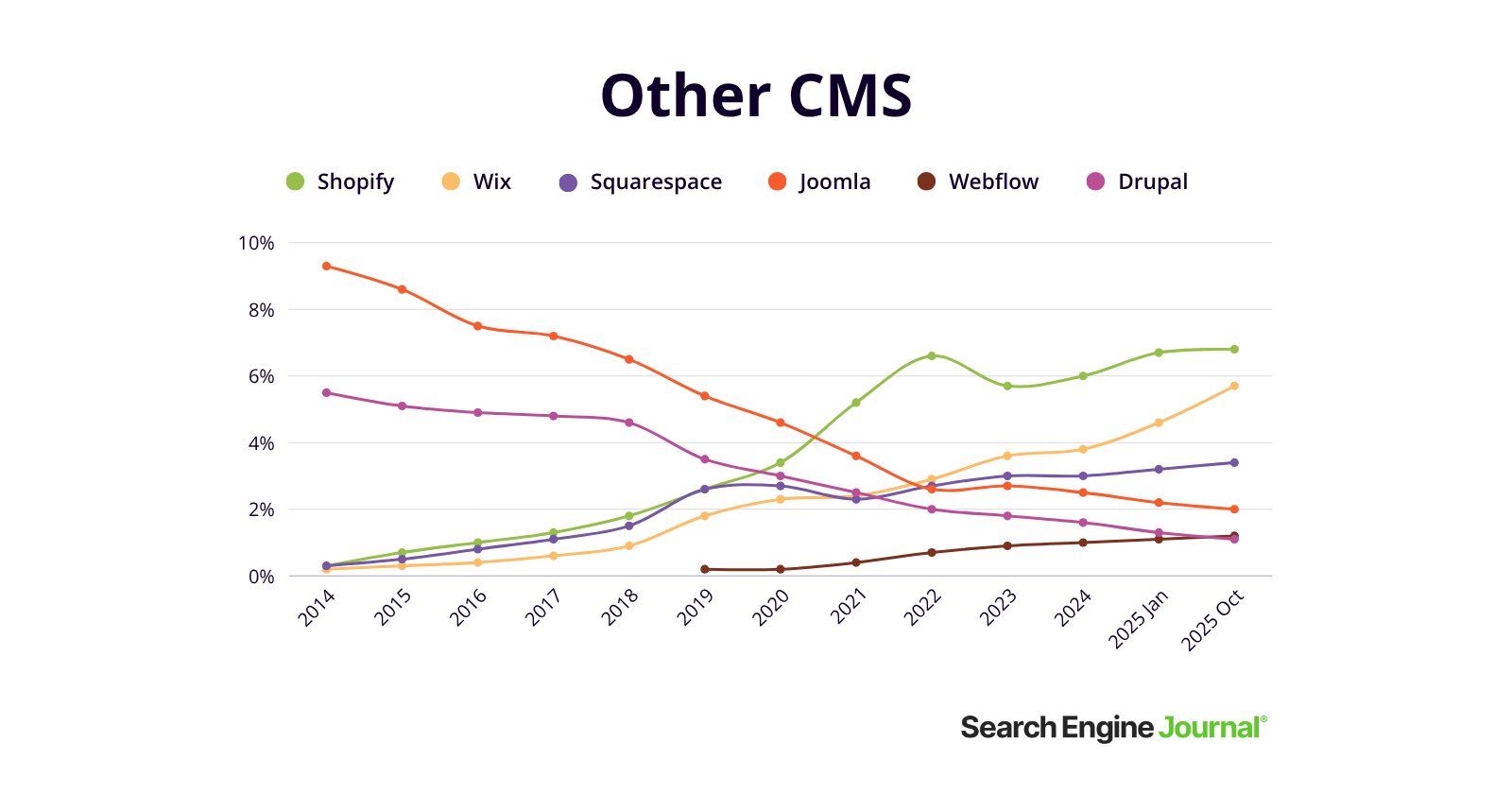
Other CMS

*Graphs are separated due to the dominance of the WordPress market share.

WordPress

WordPress remains the most widely used CMS, a position it has held since its launch in 2003. Its usage across all websites grew by 105% from 2014 to 2022, cementing its role as the default platform for much of the web.

But its long-standing growth curve is now in a downturn; we’re seeing a market share decline of nearly seven percentage points in the last three years. It’s a trend that could continue as easier-to-use platforms gain ground and some users report frustrations with plugin compatibility, core updates, and security management.

Read more: Should You Still Use WordPress?

Shopify

As the second-most popular CMS today, Shopify’s market share stands at 6.8% and is used by 4.8% of all websites surveyed.

Its strength is no accident: Shopify consistently performs well in Core Web Vitals benchmarks, making it competitive even in technical metrics.

From an SEO and business perspective, this means that Shopify offers executives a CMS option designed to support both performance and long-term growth.

Wix

Wix has made one of the more noticeable gains this year, now powering 4.1% of websites surveyed. The platform’s steady climb reflects broader market traction among small businesses. Case in point: A Reddit business owner notes its convenient and user-friendly features.

For executives, the takeaway is clear: Wix is positioning itself beyond a lightweight website builder that consistently invests in branding and platform capabilities, making it a viable contender for mid-market adoption.

Squarespace

Squarespace has shown steady growth over the past decade, with its CMS market share growing from 0.3% in 2014 to 3.4% today, with 2.4% of  websites surveyed now using the platform.

Its growth could be attributed to the increasing demand for low-maintenance, design-forward platforms.

Read more: WordPress Vs. Squarespace – Which One Is Better?

Joomla, Webflow, And Drupal

Joomla and Drupal were among the top 3 until 2021, and since then, they have seen a steady decline in market share, now accounting for only 2.0% and 1.1%, respectively. This shift likely reflects a broader trend where more user-friendly, SaaS-based platforms capture the attention of small businesses and non-technical users.

At the same time, Webflow has emerged as a contender, climbing to 1.2% of the CMS market share. Its growth reflects demand for design-led platforms that allow businesses to streamline development without heavy technical dependencies, with professionals noting speed as a real differentiator.

No CMS

Between 2024 and October 2025, websites operating without a CMS dropped by 2.8 percentage points, continuing a trend away from custom-coded solutions. During the same period, websites using WordPress grew by just less than 1%.

The decline in “no CMS” websites signals an ongoing trend toward more structured, manageable platforms for site creation.

No CMS vs WordPress

WordPress Vs. Joomla Vs. Drupal Market Share

Screenshot from W3Techs, October 2025

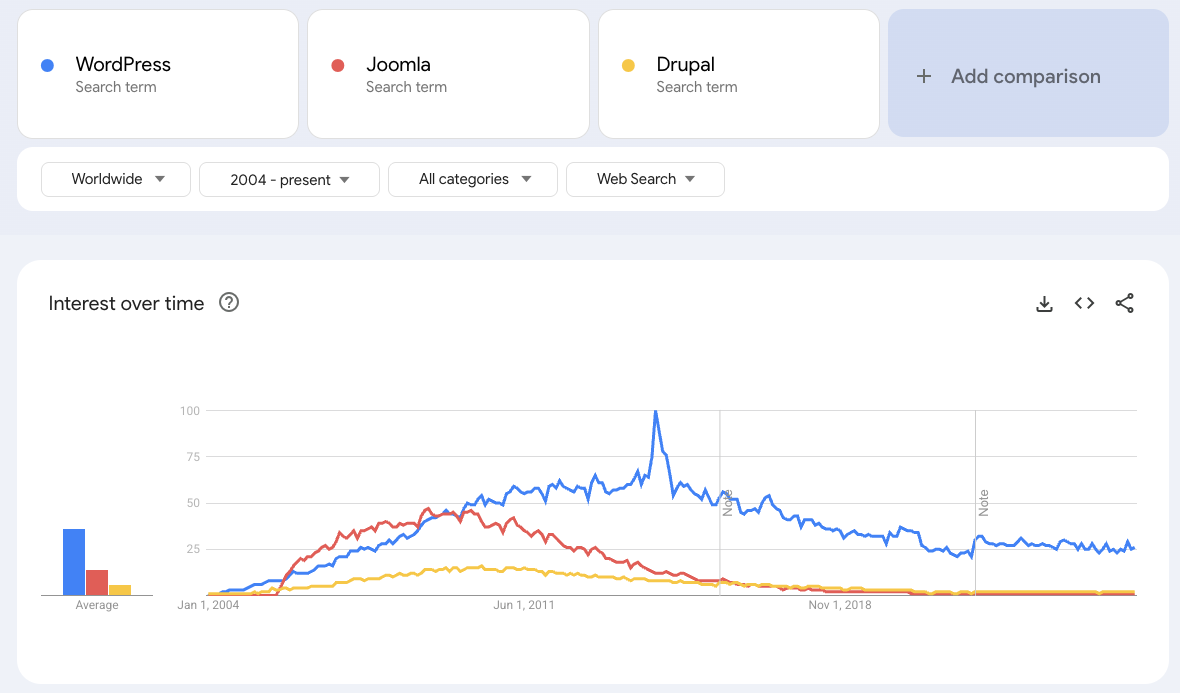
Since 2024, Joomla has decreased its market share by 20%, while Drupal has declined by 31%. Together, they once held almost 15% of the CMS market share in 2014 – now that figure sits at just over 3%.

They’ve slipped from the No. 2 and No. 3 spots to No. 5 and No. 6, overtaken by faster-growing platforms like Wix and Squarespace in 2022.

Joomla, in particular, had strong momentum early on – briefly surpassed WordPress in search interest until around 2008, according to Google Trends – but it hasn’t kept pace with modern platform demands.

Screenshot from Google Trends, October 2025

Why did these popular content management systems decline so much?

It’s most likely due to the strength of third-party support for WordPress with plugins and themes, making it much more accessible.

The growth of website builders, such as Wix and Squarespace, indicates that small businesses want a more straightforward managed solution, and they have started to nibble on market share from the bottom.

Website Builders Market Share: Wix Vs. Squarespace

Website Builders Market Share: Wix Vs. SquarespaceScreenshot from W3Techs, October 2025

Over the full period from October 2024 to October 2025, the market share of:

  • Shopify grew by 4.6%.
  • Wix grew by 32.6%.
  • Squarespace rose by 9.7%.

If we look at the website builders, their growth is a strong indication of where the market might go in the future.

SaaS web builders such as Wix and Squarespace don’t require coding knowledge and offer a hosted website that makes it more accessible for a small business to get a web presence quickly. No need to arrange a hosting solution, install a website, and set up your own email. A web builder neatly does all this for you.

WordPress is not known as a complicated platform to use, but it does require some coding knowledge and an understanding of how websites are built. On the other hand, a website builder is a much easier route to market, without the need to understand what is happening in the back end.

Read more: Wix Changed How Websites Are Built And Why You Should Pay Attention

Elementor

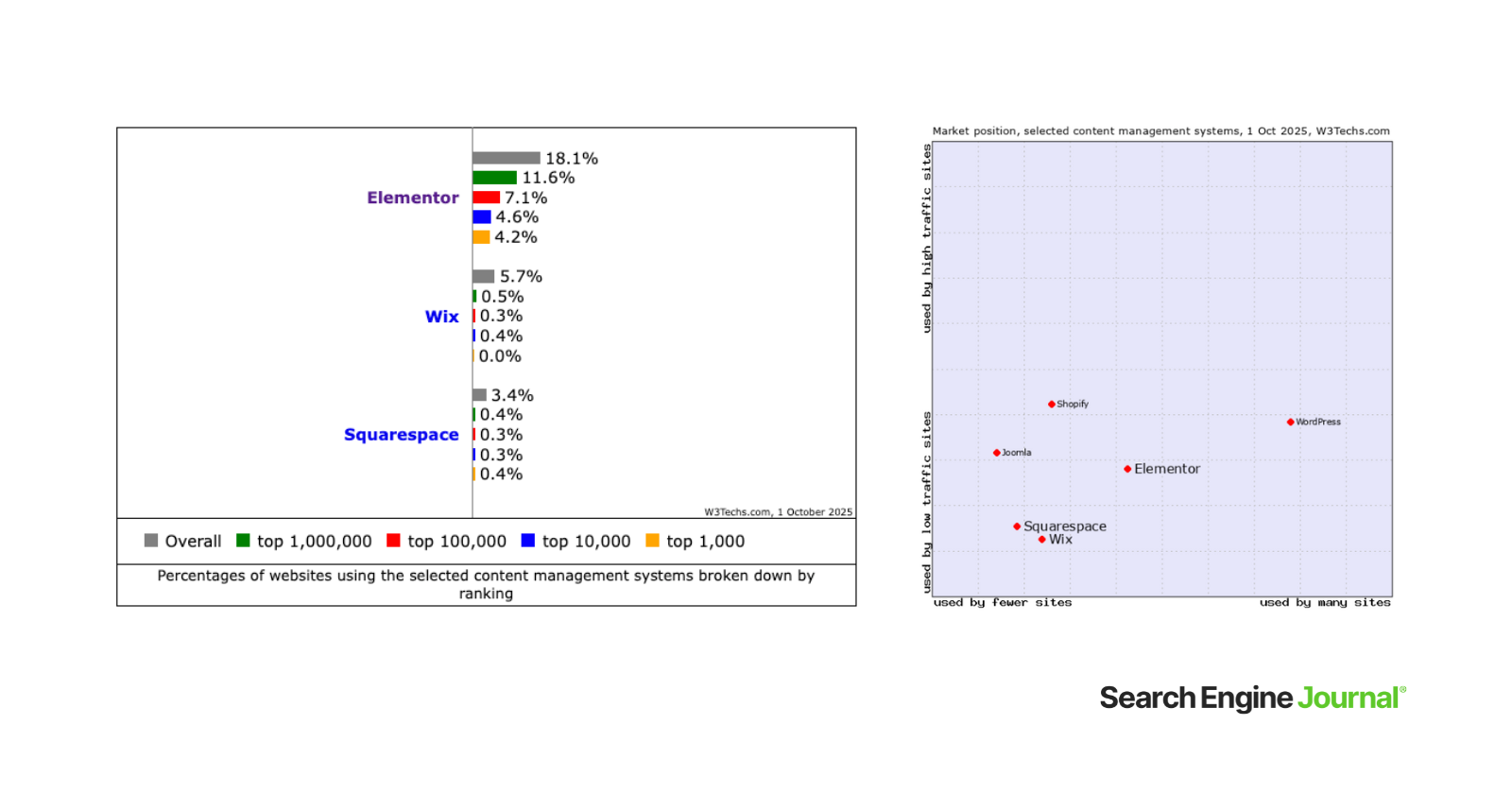
Elementor is the most widely used WordPress page builder, installed on 18.1% of all websites with a known CMS and 12.9% of all sites surveyed (not shown below) – more than Wix and Squarespace combined – though it functions as a plugin within WordPress, not a standalone CMS.

ElementorScreenshot from W3Techs, October 2025

While not a CMS on its own, it’s a major player in shaping how WordPress is used. However, because it’s a third-party plugin and not a CMS, it isn’t listed in the top 10 CMS above.

If we compare the volume of traffic to the number of CMS, we can see that WordPress is in the golden section, up and to the right, clearly favored by sites with more traffic.

Based on usage among higher-ranked domains, Joomla fits into a niche of fewer installs but more high-traffic sites, indicating that more professional sites are using it.

Squarespace and Wix are to the left and down, highlighting that they are installed on fewer sites with less traffic. It strongly indicates that they are used more by small websites and small businesses.

Elementor bridges the gap between the two and has the weight of the WordPress market share, but is used by sites with less traffic. This means the appetite is growing for drag-and-drop, plug-and-play solutions that make having a web presence accessible for anyone. This is the space to watch.

Ecommerce CMS Market Share: WooCommerce Vs. Shopify

Ecommerce CMS Market Share: WooCommerce Vs. ShopifyScreenshot from W3Techs, October 2025

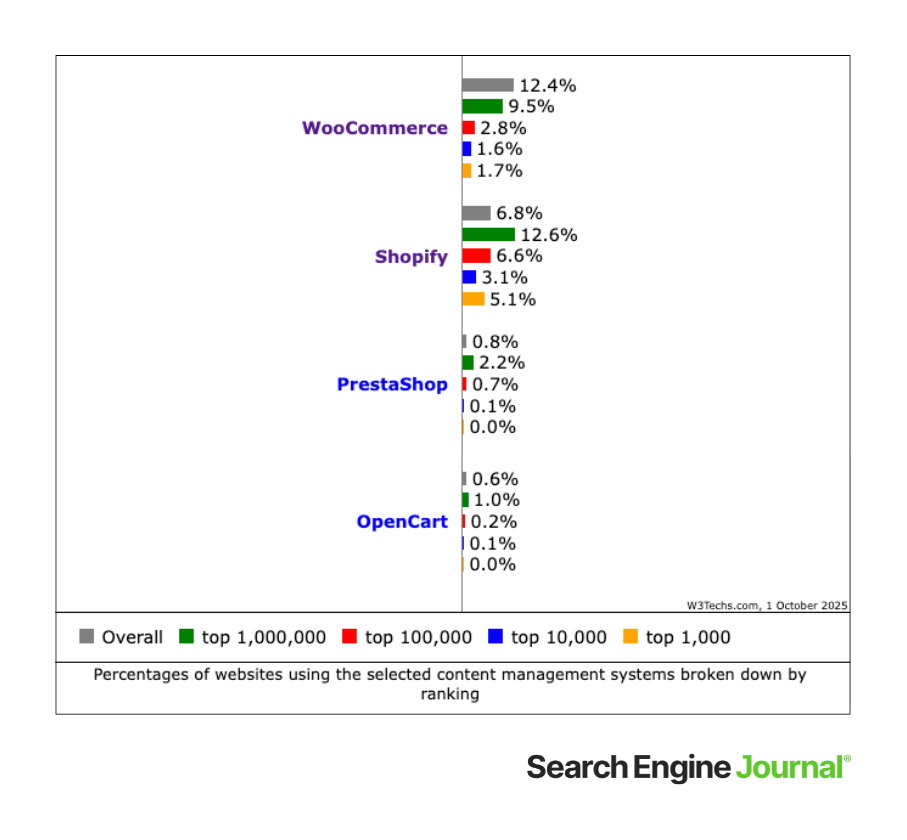
WooCommerce has a market share of 12.4%, while Shopify has 6.8%.

The ecommerce CMS space echoes a pattern similar to that of website builders. WooCommerce powers 8.9% of all existing websites, making it the most widely adopted ecommerce plugin by far. It doesn’t appear in W3Techs’ top CMS list because it is a WordPress plugin, but it’s a key factor in WordPress’s enduring popularity.

Looking at the distribution, we can see a clear pattern emerge. In comparison to other ecommerce CMS platforms, WooCommerce is dominant.

It has more market share than its competitors combined: Shopify (6.8%) + PrestaShop (0.8%) + OpenCart (0.6%) = 8.2% market share.

Screenshot from W3Techs, October 2025

Smaller sites might favor WooCommerce, but it has the WordPress platform’s weight for market access and, therefore, more installs, much like Elementor.

Shopify surged during the pandemic, with market share growing by 52.9% from 2020 to 2021 and then 26.9% from 2021 to 2022, outpacing every other platform. After a dip in 2023, it recovered in 2024 and has since leveled off, holding steady at 6.8% this year.

Why Does CMS Market Share Matter For SEO And Business Strategy?

As the market fragments, these shifts affect everything from site architecture, plugin availability, and technical SEO flexibility.

WordPress continues to lead, but its gradual decline marks a turning point. SaaS competitors such as Shopify, Wix, and Squarespace are steadily gaining traction, offering streamlined platforms that appeal to most businesses.

If more SMBs are switching to website builders, understanding the limitations and intricacies of these platforms for SEO could be a competitive advantage. CMS adoption determines how efficiently teams can build, secure, and optimize sites at scale.

Shopify now runs on 4.8% of all websites surveyed (not just sites with a CMS). With its increasing market share, specializing in Shopify SEO could be a strategic move for an SEO professional.

Wix and Squarespace are growing, too. As more small businesses adopt these platforms, getting fluent in their ecosystems could set you apart in a crowded market.

The reality is that WordPress remains the largest and most competitive ecosystem, but the growth curve has shifted toward challengers. This means one thing for business leaders and SEO professionals: an opportunity to diversify expertise.

Understanding the strengths and limitations of various CMS platforms can inform strategic decisions and align with evolving market demands.

More Resources:


All data collected from W3Techs, October 2025, unless otherwise indicated.  See the W3techs methodology page for where the data is gathered from.


Featured Image: Paulo Bobita/Search Engine Journal

https://www.searchenginejournal.com/cms-market-share/454039/


Perplexity Responds To Reddit Lawsuit Over Data Access via @sejournal, @MattGSouthern

Reddit sued Perplexity and three data-scraping firms in New York federal court, alleging the companies bypassed access controls to obtain Reddit content at scale, including by scraping Google search results.

Perplexity posted a public response, saying it summarizes Reddit discussions with citations and doesn’t train AI models on Reddit content.

The position is consistent with the company’s past statements. Whether it addresses the specific allegations in Reddit’s filing remains an open question.

The complaint names Oxylabs UAB, AWMProxy, and SerpApi as intermediaries. It alleges Perplexity is a SerpApi customer and purchased and/or utilized SerpApi services to circumvent controls and copy Reddit data.

Evidence In The Complaint

Perplexity’s argument is built around a technical distinction. The company says it summarizes and cites discussions rather than training models on Reddit posts.

Perplexity wrote in its Reddit response:

“We summarize Reddit discussions, and we cite Reddit threads in answers, just like people share links to posts here all the time.”

The complaint, however, presents technical claims that call that framework into question.

According to the filing, Reddit created a test post that was only crawlable by Google’s search engine and not accessible anywhere else on the internet. Within hours, that hidden content appeared in Perplexity’s results.

The filing also says that after Reddit sent a cease-and-desist letter, Perplexity’s citations to Reddit increased roughly forty-fold.

Similar Accusations From Publishers

Forbes previously accused Perplexity of republishing an exclusive and threatened legal action.

Wired reported that Perplexity used undisclosed IPs and spoofed user-agent strings to bypass robots.txt. Wired’s

Cloudflare later said Perplexity used “stealth, undeclared crawlers” that ignored no-crawl directives, based on tests it ran in August.

How Perplexity Has Responded

In previous disputes, Perplexity said issues stemmed from rough edges on new products and promised clearer attribution.

The company has also argued that some media organizations are trying to control “publicly reported facts.”

In this latest response, Perplexity frames Reddit’s lawsuit as leverage in broader training-data negotiations and writes:

“We summarize Reddit discussions… We won’t be extorted, and we won’t help Reddit extort Google.”

Why This Matters

This issue matters because it concerns how AI assistants use forum content that your audiences read and that publishers frequently cite.

The legal questions go beyond just training.

Courts may examine if technical controls have been bypassed, whether summarization infringes on protected expressions, and if using third-party scrapers could lead to legal liability for downstream products.

If courts accept Reddit’s anti-circumvention argument, it could lead to changes in how assistants cite or link Reddit threads.

On the other hand, if courts agree with Perplexity’s viewpoint, assistants might start relying more on forum discussions that are less restricted by licensing.

What We Don’t Know Yet

The filing alleges Perplexity obtained data via at least one scraping firm, but the public complaint doesn’t specify which vendor supplied which data or include transaction details.

https://www.searchenginejournal.com/perplexity-responds-to-reddit-lawsuit-over-data-access/559148/


Holiday Email Deliverability: 4 Expert Tips To Reach More Inboxes

This post was sponsored by Campaign Monitor. The opinions expressed in this article are the sponsor’s own.

Does it seem like fewer emails are getting delivered?

Are bounce rates and spam numbers too high for your liking?

Your well-crafted campaigns are at risk.

They are at risk of missing the mark if deliverability isn’t a priority.

Why Are My Email Delivery Scores So Low?

Black Friday, Cyber Monday, and year-end sales push email volume to record highs, prompting mailbox providers (MBPs) like Gmail and Yahoo to tighten spam filters and raise the bar for acceptable sending practices.

How Can I Ensure Marketing Emails Reach Inboxes?

To help your emails reach subscribers when it matters most, our email deliverability experts outline four practical tips for safeguarding inbox placement, without sounding “salesy” or relying on quick fixes.

1. Understand & Strengthen Deliverability For Better Results

What Is Email Deliverability?

Email deliverability refers to whether your message actually reaches the recipient’s inbox.

What Determines Email Deliverability?

Each time an email is sent, the email passes through two critical stages.

Stage 1: Delivery.

  1. Your email is sent to an MBP (e.g., Gmail, Outlook).
  2. It is either accepted or rejected.

Rejections can be hard bounces (invalid addresses) or soft bounces (temporary issues like a full mailbox).

Stage 2: Inbox placement.

Once accepted, MBPs decide whether to:

  1. Place your email in the inbox.
  2. Route it to promotions.
  3. Filter it as spam.

What Causes Marketing Emails To Be Marked As Spam?

The judgment to flag an email as spam depends on:

During peak season, email volume can double or triple, especially around Black Friday/Cyber Monday.

MBPs must guard against spammers, so legitimate senders face stricter scrutiny.

Understanding these mechanics helps marketers avoid being mistaken for unwanted senders and improves inbox placement.

For a deeper dive into how email deliverability works, check out this full guide.

2. Build & Maintain a Strong Sender Reputation

Mailbox providers rely on sender reputation to separate trusted messages from spam.

What Is Sender Reputation?

Two factors determine sender reputation:

  • Audience Engagement. High open and click rates send positive signals. MBPs also track how long recipients read messages, whether they add you to contacts, or delete without opening.
  • List Quality. Permission and relevance are critical. New holiday sign-ups should go through a compliant opt-in process, supported by a welcoming automation that sets expectations.

How Do I Get A Better Sender Reputation?

To keep your reputation strong:

  • Re-engage inactive subscribers early, well before the holiday surge.
  • Remove dormant contacts if they stay unresponsive.
  • Honor unsubscribe requests promptly.

Maintaining this “good standing” ensures your campaigns consistently reach the inbox.

For practical steps, explore best practices for building healthy lists: https://www.campaignmonitor.com/resources/guides/building-an-email-list/

3. Don’t Over-Spice Your Email Program

It’s tempting to send more emails to more people as the holidays approach.

However, sudden changes can trigger spam filters.

MBPs closely monitor sending patterns, and abrupt spikes can undo months of good reputation.

Do:

  • Keep your cadence steady and test any new segments early.
  • Maintain clear, bot-protected signup forms and offer preference options so users can “opt down” rather than unsubscribe entirely.

Don’t:

  • Send to old or inactive lists, or change your sending domain in Q4.
  • Ignore warning signs like falling open rates or rising complaints.

For guidance on email frequency and audience expectations, see Campaign Monitor’s insights on email engagement: https://www.campaignmonitor.com/resources/guides/email-engagement/

4. Monitor Key Metrics Like a Hawk

Even seasoned marketers may see deliverability metrics fluctuate during the holidays. Careful monitoring helps catch issues before they escalate:

  • Bounce rates: Hard bounces above 2% call for immediate action.
  • Complaint rates: Aim for 0.1% or lower to avoid spam folder placement.
  • Opt-out rates: A sudden rise means your frequency or content may need adjustment.
  • Open rates by domain: Consistency across Gmail, Yahoo, and others indicates healthy inbox placement.
  • Reputation signals: Tools like Gmail Postmaster reveal if your domain is being flagged.

Remember that mailbox providers increasingly use AI and machine learning to evaluate sender behavior and content quality. Authentic engagement is key. To learn more about measuring success, visit Campaign Monitor’s email marketing benchmarks: https://www.campaignmonitor.com/resources/guides/email-marketing-benchmarks/

How To Use These Tips To Create High-Deliverability Holiday Email Campaigns

Landing in the inbox is a privilege, not a guarantee, so always be sure to:

  1. Secure explicit opt-in and send only wanted content.
  2. Keep your sender reputation strong with healthy engagement and clean lists.
  3. Avoid sudden changes in cadence or audience.
  4. Watch key metrics and adapt quickly when anomalies appear.

These steps help marketers navigate heavy holiday email traffic while maintaining trust and engagement with subscribers.

Campaign Monitor’s tools can further support these efforts by simplifying list management, automating welcome journeys, and providing detailed reporting, without overcomplicating your workflow.

By combining smart strategy with careful monitoring, you’ll set the stage for a successful holiday season where every email has the best chance to shine in the inbox.


Image Credits

Featured Image: Image by Campaign Monitor. Used with permission.

https://www.searchenginejournal.com/holiday-email-deliverability-tips-campaignmonitor-spa/557374/


OpenAI Releases Shared Project Feature To All Users via @sejournal, @martinibuster

OPenAI announced that it is upgrading all ChatGPT accounts to be eligible for the project sharing feature, which enables users to share a ChatGPT project with others who can then participate and make changes. The feature was previously available only to users on OpenAI’s Business, Enterprise, and Edu plans.

The new feature is available to users globally in the Free, Plus, Pro, and budget Go plans, whether accessed on the web, iOS, or Android devices.

There are limits specific to each plan according to the announcement:

  • Free users can collaborate on up to 5 files and with 5 collaborators
  • Plus and Go users can share up to 25 files with up to 10 collaborators
  • Pro users can share up to 40 files with up to 100 collaborators
    ​
    OpenAI suggested the following use cases:

“Group work: Upload notes, proposals, and contracts so collaborators can draft deliverables faster and stay in sync.

Content creation: Apply project-specific instructions to keep tone and style consistent across contributors.

Reporting: Store datasets and reports in one project, and return each week to generate updates without starting over.

Research: Keep transcripts, survey results, and market research in one place, so anyone in the project can query and build on the findings.

Project owners can choose to share a project with “Only those invited” or “Anyone with a link,” and can change visibility settings at any time including switching back to invite-only.”

Read more at OpenAI: Shared Projects

Featured Image by Shutterstock/LedyX

https://www.searchenginejournal.com/openai-releases-shared-project-feature-to-all-users/559136/