Microsoft Updates Copilot With Memory, Search Connectors, & More via @sejournal, @MattGSouthern

Microsoft announced its Copilot Fall Release, introducing features to make AI more personal and collaborative.

New capabilities include group collaboration, long-term memory, health tools, and voice-enabled learning.

Mustafa Suleyman, head of Microsoft AI, wrote in the announcement that the release represents a shift in how AI supports users.

Suleyman wrote:

“… technology should work in service of people. Not the other way around. Ever.”

What’s New

Search Improvements

Copilot Search combines AI-generated answers with traditional results in one view, providing cited responses for faster discovery.

Microsoft also highlighted its in-house models, including MAI-Voice-1, MAI-1-Preview, and MAI-Vision-1, as groundwork for more immersive Copilot experiences.

Memory & Personalization

Copilot now includes long-term memory that tracks user preferences and information across conversations.

You can ask Copilot to remember specific details like training for a marathon or an anniversary, and the AI can recall this information in future interactions. Users can edit, update, or delete memories at any time.

Search Across Services

New connector features link Copilot to OneDrive, Outlook, Gmail, Google Drive, and Google Calendar so you can search for documents, emails, and calendar events across multiple accounts using natural language.

Microsoft notes this is rolling out gradually and may not yet be available in all regions or languages.

Edge & Windows Integration

Copilot Mode in Edge is evolving into what Microsoft calls an “AI browser.”

With user permission, Copilot can see open tabs, summarize information, and take actions like booking hotels or filling forms.

Voice-only navigation enables hands-free browsing. Journeys and Actions are currently available in the U.S. only.

Shared AI Sessions

The Groups feature turns Copilot into a collaborative workspace for up to 32 people.

You can invite friends, classmates, or teammates to shared sessions. Start a session by sending a link, and anyone with the link can join and see the same conversation in real time.

This feature is U.S. only at launch.

Health Features

Copilot for health grounds responses in credible sources like Harvard Health for medical questions.

Health features are available only in the U.S. at copilot.microsoft.com and in the Copilot iOS app.

Voice Tutoring

Learn Live provides voice-enabled Socratic tutoring for educational topics.

Interactive whiteboards help you work through concepts for test preparation, language practice, or exploring new subjects. U.S. only.

“Mico” Character

Microsoft introduced Mico, an optional visual character that reacts during voice conversations.

Separately, Copilot adds a “real talk” conversation style that challenges assumptions and adapts to user preferences.

Why This Matters

These features change how Copilot fits into your workflow.

The move from individual to collaborative sessions means teams can use AI together rather than separately synthesizing results.

Long-term memory reduces the need to repeat context, which matters for ongoing projects where Copilot needs to understand your specific situation.

Looking Ahead

Features are live in the U.S. now. Microsoft says updates are rolling out across the UK, Canada, and beyond in the next few weeks.

Some features require a Microsoft 365 Personal, Family, or Premium subscription; usage limits apply. Specific availability varies by market, device, and platform.

https://www.searchenginejournal.com/microsoft-updates-copilot-with-memory-search-connectors-more/559129/


Search Engine Journal Is Hiring! via @sejournal, @hethr_campbell

We’re looking for a powerhouse project manager to keep our marketing team inspired and on track.

This is a Philippines-based, fully-remote position working on U.S.-adjacent hours (8 p.m. – 4 a.m. PHT) to be my partner in crime execution on some exciting projects.

We do things a little differently here, and we’ve learned that culture fit is everything. When it’s a match, people tend to stay; nearly half our team has been with us for more than five years.

If you’re the kind of team member who has loads of experience leaning into complex projects, honest conversations, and big ideas, we’d love to meet you.

About SEJ

We help our advertisers communicate with precision and creativity in an AI-driven world. Our campaigns are built on data, empathy, and continuous experimentation. We manage multi-channel strategies across content, email, and social media, and we’re looking for someone who can keep the moving parts aligned without losing sight of the humans behind them.

We’re hiring a Senior Digital Marketing Project Manager to lead strategy execution, client relationships, and team coordination. You’ll help us build marketing systems that are smart, efficient, and grounded in trust.

Why This Role Is Different

This is an AI-first position. You already use tools like ChatGPT, Claude, or Gemini to work smarter, automate workflows, and uncover insights that move the needle. Your success here depends on seeing where AI enhances human creativity … and where it doesn’t.

We’re a team that values autonomy, initiative, and straight talk. We’d rather have one clear, respectful conversation than weeks of confusion. We care deeply about doing great work and making each other better through feedback and shared accountability.

What You’ll Do

  • Manage and optimize complex digital marketing campaigns from strategy to execution.
  • Translate business goals into clear, actionable plans for clients and internal teams.
  • Keep communication flowing: up, down, and across.
  • Identify opportunities to integrate AI tools into analytics and operations.
  • Support a culture of feedback, growth, and curiosity.

Who You Are

  • You’re organized and strategic, but not rigid. You like structure, but you also know when to improvise.
  • You’re skilled at managing both clients and creatives. You can lead with empathy and keep projects on schedule.
  • You don’t shy away from a tough conversation if it means getting to a better outcome.

You’re the kind of team member who says things like:

  • “Let’s make sure we’re solving the right problem.”
  • “I appreciate the feedback! Here’s what I’m hearing.”
  • “How can AI help us work smarter here?”

Why Work With Search Engine Journal?

We’re a remote-first, global team that values:

  • Clarity over chaos.
  • Progress over perfection.
  • Honest collaboration over hierarchy.
  • We’re remote, flexible, and results-focused. You’ll have real ownership, real support, and the chance to do your best work with people who actually care about doing theirs.

If this sounds like your kind of place, see the full job listing and apply here.


Featured Image: PeopleImages/Shutterstock

https://www.searchenginejournal.com/search-engine-journal-is-hiring/558917/


AI Assistants Show Significant Issues In 45% Of News Answers via @sejournal, @MattGSouthern

Leading AI assistants misrepresented or mishandled news content in nearly half of evaluated answers, according to a European Broadcasting Union (EBU) and BBC study.

The research assessed free/consumer versions of ChatGPT, Copilot, Gemini, and Perplexity, answering news questions in 14 languages across 22 public-service media organizations in 18 countries.

The EBU said in announcing the findings:

“AI’s systemic distortion of news is consistent across languages and territories.”

What The Study Found

In total, 2,709 core responses were evaluated, with qualitative examples also drawn from custom questions.

Overall, 45% of responses contained at least one significant issue, and 81% had some issue. Sourcing was the most common problem area, affecting 31% of responses at a significant level.

How Each Assistant Performed

Performance varied by platform. Google Gemini showed the most issues: 76% of its responses contained significant problems, driven by 72% with sourcing issues.

The other assistants were at or below 37% for major issues overall and below 25% for sourcing issues.

Examples Of Errors

Accuracy problems included outdated or incorrect information.

For instance, several assistants identified Pope Francis as the current Pope in late May, despite his death in April, and Gemini incorrectly characterized changes to laws on disposable vapes.

Methodology Notes

Participants generated responses between May 24 and June 10, using a shared set of 30 core questions plus optional local questions.

The study focused on the free/consumer versions of each assistant to reflect typical usage.

Many organizations had technical blocks that normally restrict assistant access to their content. Those blocks were removed for the response-generation period and reinstated afterward.

Why This Matters

When using AI assistants for research or content planning, these findings reinforce the need to verify claims against original sources.

As a publication, this could impact how your content is represented in AI answers. The high rate of errors increases the risk of misattributed or unsupported statements appearing in summaries that cite your content.

Looking Ahead

The EBU and BBC published a News Integrity in AI Assistants Toolkit alongside the report, offering guidance for technology companies, media organizations, and researchers.

Reuters reports the EBU’s view that growing reliance on assistants for news could undermine public trust.

As EBU Media Director Jean Philip De Tender put it:

“When people don’t know what to trust, they end up trusting nothing at all, and that can deter democratic participation.”


Featured Image: Naumova Marina/Shutterstock

https://www.searchenginejournal.com/ai-assistants-show-significant-issues-in-45-of-news-answers/558991/


YouTube Expands Likeness Detection To All Monetized Channels via @sejournal, @MattGSouthern

YouTube is beginning to expand access to its likeness detection tool to all channels in the YouTube Partner Program over the next few months.

The technology helps you identify unauthorized videos where your facial likeness has been altered or generated with AI.

YouTube announced the expansion after testing the tool with a small group of creators.

The tool addresses a growing concern as AI-generated content becomes more sophisticated and accessible.

How Likeness Detection Works

Channels can access the tool through YouTube Studio’s content detection tab under a new likeness section.

The onboarding process requires identity verification. You scan a QR code with your phone’s camera, then submit a photo ID and record a brief selfie video performing specific motions.

YouTube processes this information on Google servers, typically granting access within a few days.

Once verified, creators see a dashboard displaying videos that match their facial likeness. The interface shows video titles, upload dates, upload channels, view counts, and subscriber numbers. YouTube’s systems flag some matches as higher priority for review.

Taking Action On Detected Content

You have three options when reviewing matches.

You can request removal under YouTube’s privacy guidelines, submit a copyright claim, or archive the video without action. The tool automatically fills legal name and email information when starting a removal request.

Privacy removal requests apply to altered or synthetic content that violates specific criteria. YouTube’s announcement highlighted two examples: AI-generated videos showing creators endorsing political candidates, and infomercials with creators’ faces added through AI.

Copyright claims follow different rules and must consider fair use exceptions. Videos using short clips from a creator’s channel may not qualify for privacy removal but could warrant copyright action.

See a demonstration in the video below:

[embedded content]

Policy Differences

YouTube stressed the distinction between privacy and copyright policies.

Privacy policy violations involve altered or synthetic content judged against criteria including whether the content is parody, satire, or includes AI disclosure. Copyright infringement covers unauthorized use of original content, including cropped videos to avoid detection or videos with changed audio.

The tool surfaces some short clips from creators’ own channels. These don’t qualify for privacy removal but may be eligible for copyright claims if fair use doesn’t apply.

Why This Matters

This gives YouTube Partner Program creators direct control over how AI-generated content uses their likeness.

Monetized channels can now monitor unauthorized deepfakes and request removal when videos mislead the audience about endorsements or statements that were never made.

Looking Ahead

The tool will roll out to eligible creators over the next few months. Those who see no matches shouldn’t be concerned. YouTube says this indicates no detected unauthorized use of their likeness on the platform.

Channels can withdraw consent and stop using the tool at any time through the manage likeness detection settings.

https://www.searchenginejournal.com/youtube-expands-likeness-detection-to-all-monetized-channels/558982/


PPC Trends 2026: AI, Automation, And The Fight For Visibility via @sejournal, @MattGSouthern

If you manage PPC campaigns, you’ve seen it. Platforms are making more decisions without asking you first.

Campaign types keep consolidating into AI-first formats like Performance Max and Demand Gen. The granular controls you used to rely on keep disappearing or moving behind automation.

A year ago, Performance Max still felt experimental. Now it’s often the default option, with AI generating ad copy, and automation selecting audiences based on signals you can’t always see. When performance drops, you have fewer levers to pull and less visibility into what’s actually happening.

It can be disorienting to some, and the trend isn’t reversing.

We asked PPC professionals how they’re navigating this shift. Most aren’t pessimistic about AI-first campaigns. Many have found ways to work with platform automation without surrendering the strategic thinking that drives results.

You can use AI tools without losing your expertise in the process.

4 Key Findings From Industry Professionals

We surveyed professionals from agency, platform, and consultancy backgrounds for this year’s report. Clear patterns emerged in how they’re adapting to AI-first campaign management.

1. AI Tools Save Time But Still Need Babysitting

Most professionals now use AI daily for tasks like keyword research and ad copy variations. The tools are good enough to integrate into workflows.

But there’s a catch. Over half identify “inaccurate, unreliable, or inconsistent output quality” as the biggest limitation. AI accelerates production, but it hasn’t replaced the need for human oversight.

One contributor noted that in regulated industries where legal review is required, AI outputs often can’t be used without heavy editing.

The professionals who get results are the ones treating AI as an assistant, not a replacement.

2. “Control” Means Something Different Now

You can’t control exact search terms the way you used to. You can’t set precise bids on individual keywords or force campaigns to follow rigid parameters.

Several contributors argue you still have meaningful control, it just operates differently than before. One Google Ads coach compared it to giving a teenager the destination address and trusting they can navigate there, even if they take a few wrong turns along the way.

The new version of control means setting clear business objectives and providing high-quality conversion data. If your conversion tracking is messy or incomplete, AI will optimize toward the wrong goals.

3. Measurement Got More Honest (And More Uncomfortable)

Cookie deprecation was canceled in Chrome, but measurement challenges haven’t disappeared. What’s changed is how practitioners talk about attribution.

One agency founder admitted that focusing too heavily on perfect attribution might have been a strategic mistake. “Your marketing strategy should hold up even if granular tracking disappears.”

Other contributors emphasize that first-party data collection with proper consent is now essential for survival, especially in lead generation models.

Revenue remains the most reliable source of truth when platform-reported metrics conflict.

The most durable measurement approach involves choosing a limited set of reliable lenses rather than attempting to reconcile data from every available source.

4. Platform-Generated Creative Performs Better Than You’d Think

This finding surprises people. Several contributors report that AI-generated creative assets can perform competitively with human-created versions when they’re prompted effectively.

But “when prompted effectively” is doing substantial work in that sentence.

Quality depends heavily on how well you prompt the tools and how much brand context you provide. The tools still struggle with maintaining consistent brand voice and meeting legal compliance requirements in regulated industries.

Visual generation continues to need improvement, though contributors note it’s getting better for ecommerce product photography.

Most teams have settled on a hybrid workflow where AI handles idea generation and creates variations while humans manage final approval and anything requiring nuanced brand voice.

What Makes This Report Different

Previous years focused on specific platform changes or new features. This year’s questions dig into strategy.

How do you maintain visibility when platforms reduce transparency? What measurement techniques still work when attribution is murky? How do you adapt creative workflows when AI can generate assets on demand?

The contributors include:

  • Brooke Osmundson, Director of Growth Marketing, Smith Micro Software.
  • Gil Gildner, Agency Co-Founder, Discosloth.
  • Navah Hopkins, Product Liaison, Microsoft.
  • Jonathan Kagan, Director of Search & Media Strategy, Amsive.
  • Mike Ryan, Head of Ecommerce Insights, Smarter Ecommerce.
  • Jyll Saskin Gales, Google Ads Coach, Inside Google Ads.

The answers reflect an industry adapting in real time. Some contributors have embraced AI-first workflows fully, while others remain cautious about surrendering too much control. All are experimenting constantly because the platforms aren’t slowing down.

Why Download This Now

If you’re managing campaigns, you’re already wrestling with these challenges. Are you approaching them with a clear strategy, or just reacting to each platform change as it happens?

This report will show you how experienced professionals at agencies, platforms, and consultancies are thinking through the same problems you’re facing right now.

Download PPC Trends 2026 to see how industry professionals are adapting their strategies, maintaining accountability in automated campaigns, and finding ways to make AI-first advertising work without losing the strategic expertise that separates successful campaigns from mediocre ones.

PPC Trends 2026


Featured Image: Paulo Bobita/Search Engine Journal

https://www.searchenginejournal.com/ppc-trends-2026-ai-automation-and-the-fight-for-visibility/558870/


Surfer SEO Acquired By Positive Group via @sejournal, @martinibuster

The French technology group Positive acquired Surfer, the popular content optimization tool. The acquisition helps Positive create a “full-funnel” brand visibility solution together with its marketing and CRM tools.

The acquisition of Surfer extends Positive’s reach from marketing software to AI-based brand visibility. Positive described the deal as part of a European AI strategy that supports jobs and protects data. Positive’s revenue has grown fivefold in the past five years, rising from €50 million to an expected €70 million in 2025.

Surfer SEO

Founded in 2017, Surfer developed SEO tools based on language models that help marketers improve visibility on both search engines and AI assistants, which have become a growing source of website traffic and customers.

Sign Of Broader Industry Trends

The acquisition shows that search optimization continues to be an important part of business marketing as AI search and chat play a larger role in how consumers learn about products, services, and brands. This deal enables Positive to offer AI-based visibility solutions alongside its CRM and automation products, expanding its technology portfolio.

What Acquisition Means For Customers

Positive Group, based in France, is a technology solutions company that develops digital tools for marketing, CRM, automation, and data management. It operates through several divisions: User (marketing and CRM), Signitic (email signatures), and now Surfer (AI search optimization). The company is majority-owned by its executives, employs about 400 people, and keeps its servers in France and Germany. Surfer, based in Poland, brings experience in AI content optimization and a strong presence in North America. Together, they combine infrastructure, market knowledge, and product development within one technology-focused group.

Lucjan Suski, CEO and co-founder of Surfer, commented:

“SEO is evolving fast, and it matters more than ever before. We help marketers win the AI SEO era. Positive helps them grow across every other part of their digital strategy. Together, we’ll give marketers the complete toolkit to lead across AI search, email marketing automation, and beyond.”

According to Mathieu Tarnus, Positive’s founding president, and Paul de Fombelle, its CEO:

“Artificial intelligence is at the heart of our value proposition. With the acquisition of Surfer, our customers are moving from optimizing their traditional SEO positioning to optimizing their brand presence in the responses provided by conversational AI assistants. Surfer stands out from established market players by directly integrating AI into content creation and optimization.”

The acquisition adds Surfer’s AI optimization capabilities to Positive’s product ecosystem, helping customers improve visibility in AI-generated answers. For both companies, the deal is an opportunity to expand their capabilities in AI-based brand visibility.

Featured Image by Shutterstock/GhoST RideR 98

https://www.searchenginejournal.com/surfer-seo-acquired-by-positive-group/558918/


Brave Reveals Systemic Security Issues In AI Browsers via @sejournal, @MattGSouthern

Brave disclosed security vulnerabilities in AI browsers that could allow malicious websites to hijack AI assistants and access sensitive user accounts.

The issues affect Perplexity Comet, Fellou, and potentially other AI browsers that can take actions on behalf of users.

The vulnerabilities stem from indirect prompt injection attacks where websites embed hidden instructions that AI browsers process as legitimate user commands. Brave published the findings after reporting the issues to affected companies.

What Brave Found

Perplexity Comet Vulnerability

Comet’s screenshot feature can be exploited by embedding nearly invisible text in webpages.

When users take screenshots to ask questions, the AI extracts hidden text using what appears to be OCR and processes it as commands rather than untrusted content.

Brave notes Comet isn’t open-source, so this behavior is inferred and can’t be verified from source code.

The hidden instructions use faint colors that humans can barely see but AI systems extract and execute. This lets attackers issue commands to the AI assistant without the user’s knowledge.

Fellou Navigation Vulnerability

Fellou browser sends webpage content to its AI system when users navigate to a site.

Asking the AI assistant to visit a webpage causes the browser to pass the page’s visible content to the AI in a way that lets the webpage text override user intent.

This means visiting a malicious site could trigger unintended AI actions without requiring explicit user interaction with the AI assistant.

Access To Sensitive Accounts

The vulnerabilities become dangerous because AI assistants operate with user authentication privileges.

A hijacked AI browser can access banking sites, email providers, work systems, and cloud storage where users remain logged in.

Brave notes that even summarizing a Reddit post could result in attackers stealing money or private data if the post contains hidden malicious instructions.

Industry Context

Brave describes indirect prompt injection as a systemic challenge facing AI browsers rather than an isolated issue.

The problem revolves around AI systems failing to distinguish between trusted user input and untrusted webpage content when constructing prompts.

Brave is withholding details of one additional vulnerability found in another browser until next week.

Why This Matters

Brave argues that traditional web security models break when AI agents act on behalf of users.

Natural language instructions on any webpage can trigger cross-domain actions reaching banks, healthcare providers, corporate systems, and email hosts.

Same-origin policy protections become irrelevant because AI assistants execute with full user privileges across all authenticated sites.

The disclosure arrives the same day OpenAI launched ChatGPT Atlas with agent mode capabilities, highlighting the tension between AI browser functionality and security.

People using AI browsers with agent features face a tradeoff between automation capabilities and exposure to these systemic vulnerabilities.

Looking Ahead

Brave’s research continues with additional findings scheduled for disclosure next week.

The company indicated it’s exploring longer-term solutions to address the trust boundary problems in agentic browsing.


Featured Image: Who is Danny/Shutterstock

https://www.searchenginejournal.com/brave-reveals-systemic-security-issues-in-ai-browsers/558909/


OpenAI Launches ChatGPT Atlas Browser For macOS via @sejournal, @MattGSouthern

OpenAI released ChatGPT Atlas today, describing it as “the browser with ChatGPT built in.”

OpenAI announced the launch in a blog post and livestream featuring CEO Sam Altman and team members including Ben Goodger, who previously helped develop Google Chrome and Mozilla Firefox.

Atlas is available now on macOS worldwide for Free, Plus, Pro, and Go users. Windows, iOS, and Android versions are coming soon.

What Does ChatGPT Atlas Do?

Unified New Tab Experience

Opening a new tab creates a starting point where you can ask questions or enter URLs. Results appear with tabs to switch between links, images, videos, and news where available.

OpenAI describes this as showing faster, more useful results in one place. The tab-based navigation keeps ChatGPT answers and traditional search results within the same view.

ChatGPT Sidebar

A ChatGPT sidebar appears in any browser window to summarize content, compare products, or analyze data from the page you’re viewing.

The sidebar provides assistance without leaving the current page.

Cursor

Cursor chat lets you highlight text in emails, calendar invites, or documents and get ChatGPT help with one click.

The feature can rewrite selected text inline without opening a separate chat window.

Agent Mode

Agent mode can open tabs and click through websites to complete tasks with user approval. OpenAI says it can research products, book appointments, or organize tasks inside your browser.

The company describes it as an early experience that may make mistakes on complex workflows, but is rapidly improving reliability and task success rates.

See also: Brave Reveals Systemic Security Issues In AI Browsers

Browser Memories

Browser memories let ChatGPT remember context from sites you visit and bring back relevant details when needed. The feature can continue product research or build to-do lists from recent activity.

Browser memories are optional. You can view all memories in settings, archive ones no longer relevant, and clear browsing history to delete them.

A site-level toggle in the address bar controls which pages ChatGPT can see.

Privacy Controls

Users control what ChatGPT can see and remember. You can clear specific pages, clear entire browsing history, or open an incognito window to temporarily log out of ChatGPT.

By default, OpenAI doesn’t use browsing content to train models. You can opt in by enabling “include web browsing” in data controls settings.

OpenAI added safeguards for agent mode. It cannot run code in the browser, download files, install extensions, or access other apps on your computer or file system. It pauses to ensure you’re watching when taking actions on sensitive sites like financial institutions.

The company acknowledges agents remain susceptible to hidden malicious instructions in webpages or emails that could override intended behavior. OpenAI ran thousands of hours of red-teaming and designed safeguards to adapt to novel attacks, but notes the safeguards won’t stop every attack.

Why This Matters

Atlas blurs the line between browser and search engine by putting ChatGPT responses alongside traditional search results in the same view. This changes the browsing model from ‘visit search engine, then navigate to sites’ to ‘ask questions and browse simultaneously.’

This matters because it’s another major platform where AI-generated answers appear before organic links.

The agent mode also introduces a new variable: AI systems that can navigate sites, fill forms, and complete purchases on behalf of users without traditional click-through patterns.

The privacy controls around site visibility and browser memories create a permission layer that hasn’t existed in traditional browsers. Sites you block from ChatGPT’s view won’t contribute to AI responses or memories, which could affect how your content gets discovered and referenced.

Looking Ahead

OpenAI is rolling out Atlas for macOS starting today. First-run setup imports bookmarks, saved passwords, and browsing history from your current browser.

Windows, iOS, and Android versions are scheduled to launch in the coming months without specific release dates.

The roadmap includes multi-profile support, improved developer tools, and guidance for websites to add ARIA tags to help the agent work better with their content.


Featured Image: Saku_rata160520/Shuterstock

https://www.searchenginejournal.com/openai-launches-chatgpt-atlas-browser-for-macos/558900/


The Impact Of AI Mode On SEO – Analysis Of 10 Studies via @sejournal, @Kevin_Indig

I just got back from San Diego and Toronto, where I spoke at Ahrefs Evolve and SEO IRL – both of which were fantastic. A lot of people I met subscribed to the Growth Memo. Thank you all for coming out!

Image Credit: Kevin Indig

I also had the pleasure of facilitating a 3h mastermind with leaders from Redfin, Angi, Clickup, Glean and Ourplace in San Diego. If I’ll do more of these, I’ll let you know.

Boost your skills with Growth Memo’s weekly expert insights. Subscribe for free!

Two weeks ago, we published the largest user behavior study of AI Mode and found groundbreaking results.

This week, I’m connecting the dots between 10 different studies, tests, and data sources to see what the research actually says about AI Mode – and to answer five questions everyone’s asking:

  • How does AI Mode impact click-through rates and SEO traffic?
  • Are people even using AI Mode?
  • Are AI Mode responses accurate?
  • How are AI Overviews and AI Mode similar? How are they different?
  • Can brands still benefit from earning AI Mode visibility, even if clicks are scarce (if not zero)?

In this meta-analysis of the core data our industry produced about AI Mode in 2025, we’ll look at the aggregated research – all in one place. So, I’d bookmark this, as it’s likely a stakeholder is going to ask you for it soon, if they haven’t already.

(If I’m missing any big studies or tests here, send me a DM.)
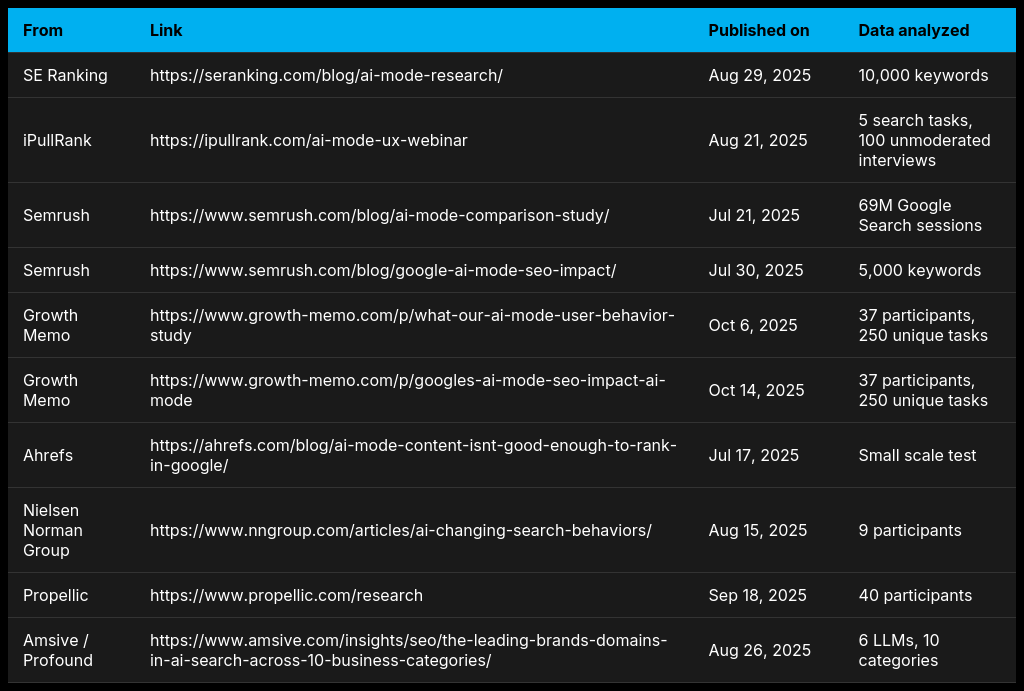
Image Credit: Kevin Indig

Here’s what we do know for sure: AI Mode drastically reduces external clicks.

This is a corroborated finding across the research touchpoints I used for this meta-analysis (including studies, tests, and fresh data).

We live in this reality right now – and can’t afford to ignore it.

Organic traffic stagnation (or even traffic decline) despite ongoing organic growth efforts is the reality today … and will accelerate if/when AI Mode becomes the default Google search experience.
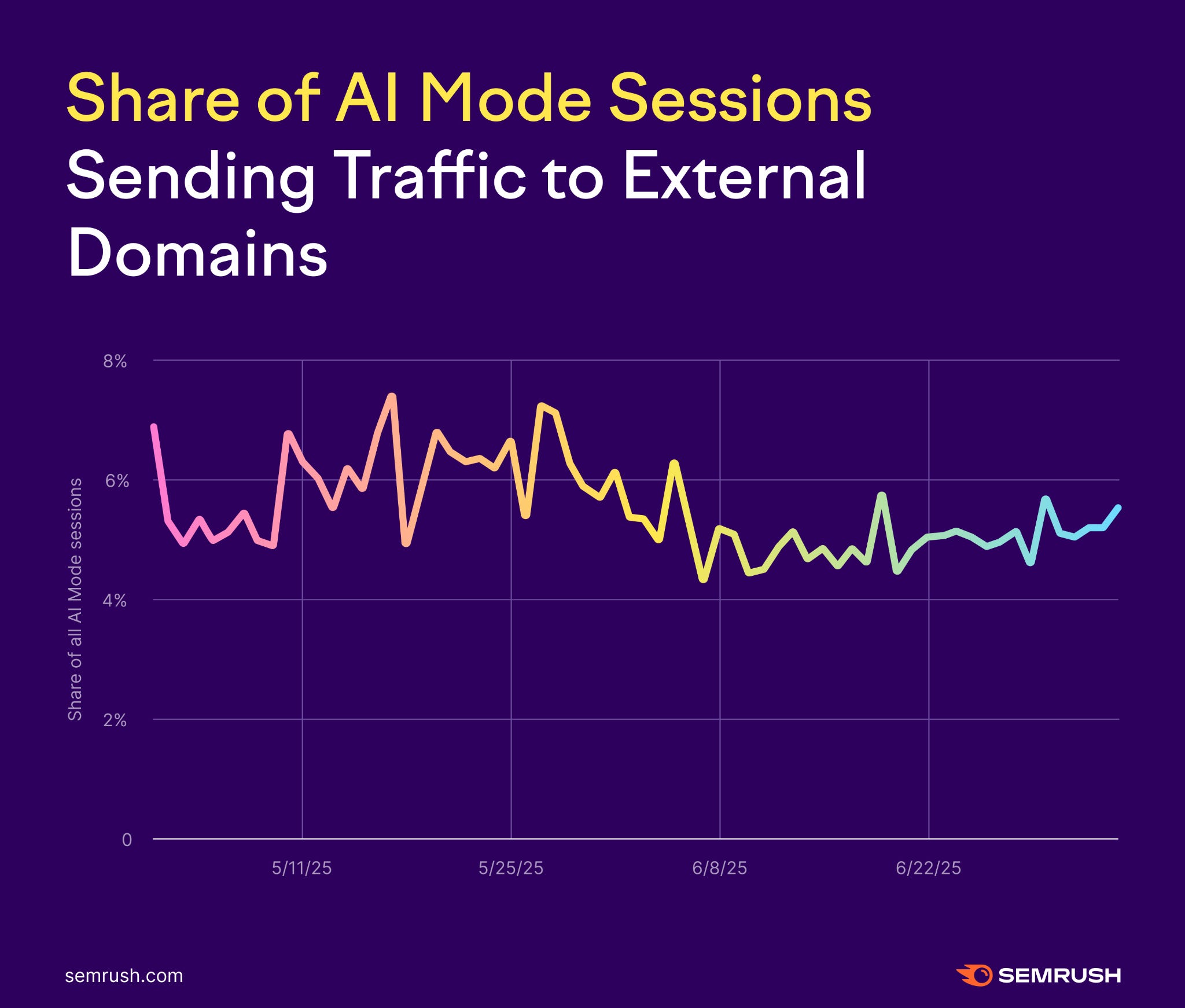
Image Credit: Kevin Indig
  • Semrush’s AI Mode early‑adoption analysis of ~69 million U.S. Google sessions found that 92 – 94% of AI Mode sessions resulted in no external click, and only 6-8% produced any outbound traffic [1].
  • The AI Mode user‑behavior study I published over the last two weeks, directed by Eric van Buskirk from Clickstream Solutions, corroborated this finding: 77.6% of our directed search task sessions had zero external visits, and median external clicks per task were zero.
  • Eric and I also worked together on Propellic’s travel industry study, and it echoes the same sentiments even though it’s industry-specific. Our data showed that for some search tasks, users’ interactions never left AI Mode. Users found enough information from AI-generated answers and moved on, unless they needed to take a final booking step [2].

Traffic does flow in certain cases.

I reported last week in the Growth Memo AI Mode usability study part 2 that shopping prompts produced clicks nearly 100% of the time, while non‑transactional tasks produced almost none.

Likewise, Propellic’s travel study found that planning tasks kept users in AI Mode ( with ≈104 seconds of engagement), but once a decision was made they clicked out to book (spending about ≈38 seconds before the external click).

Keep in mind, AI Mode doesn’t just dramatically reduce clicks, it also shrinks searching sessions: Semrush saw AI Mode sessions average two to three queries versus ~5 in traditional search [3]. That means not only is there less of a chance for traffic, but there’s also likely less of a chance for visibility, too.

  1. Expect massively lower click-through rates from AI Mode compared to classic blue‑link SERPs.
  2. Instead of traffic, think in terms of brand visibility and user influence within AI Mode.
  3. For performance metrics, shift your attention from CTR to brand mentions, dwell time, and conversion during the final, most high-intent step.

Research across our industry this year shows, at least for now, users are slow to adopt AI Mode.

However, Google seems hell-bent on training all searchers to head in that direction via including AI Mode buttons in Chrome and in AIOs on the SERP – even if that could mean less time for users in the SERPs or fewer ad clicks over time. In fact, the Growth Intelligence Brief #8, I reported:

Logan Kilpatrick, who leads the Google AI Studio and Gemini API product, shook the SEO world [on September 6] when he said AI Mode was going to become the default search experience.

Even though he qualified his statement shortly after, Sundar Pichai had already said the same thing on the Lex Fridman podcast back in June.

So get ready. All roads seem to lead to AI Mode, whether users like it or not.

iPullRank’s AI Mode UX study found that only 2-5% of participants used AI Mode across five tasks, while 30-47% engaged with AI Overviews.
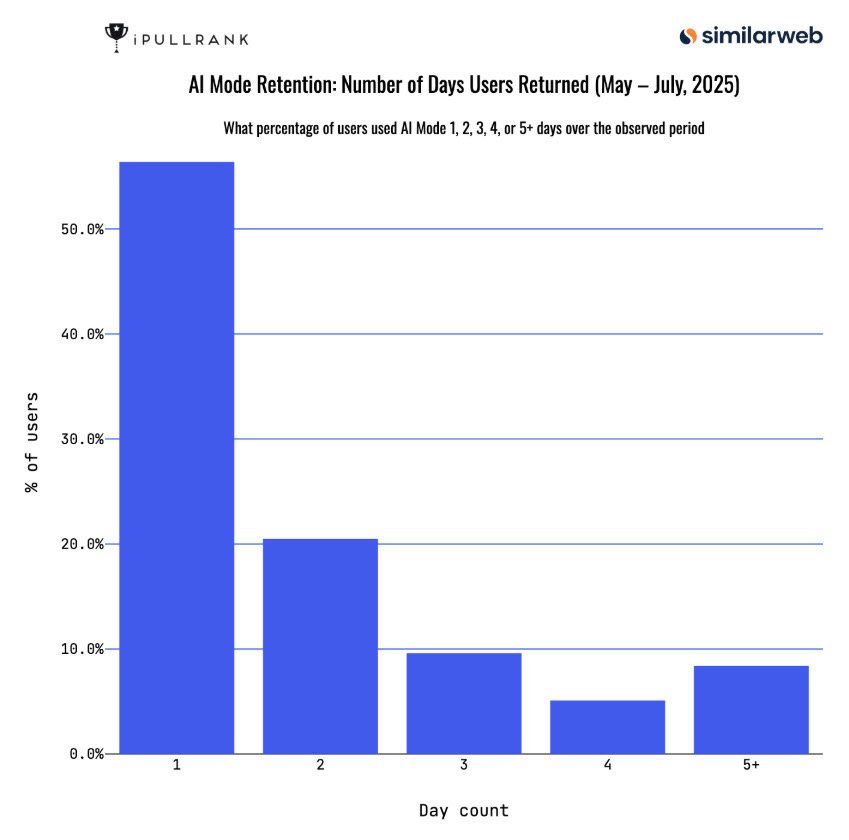
Image Credit: Kevin Indig

And the month before they released their study, iPullRank received Similarweb data showing over 50% of users tried AI Mode once and then bounced [4].

When participants did use AI Mode in the iPullRank AI Mode study, they often consumed the answer, clicked nothing and moved on.

In addition, back in August, Aleyda Solis shared UK adoption of AI Mode slowed after user curiosity seemed to subside after the initial launch.
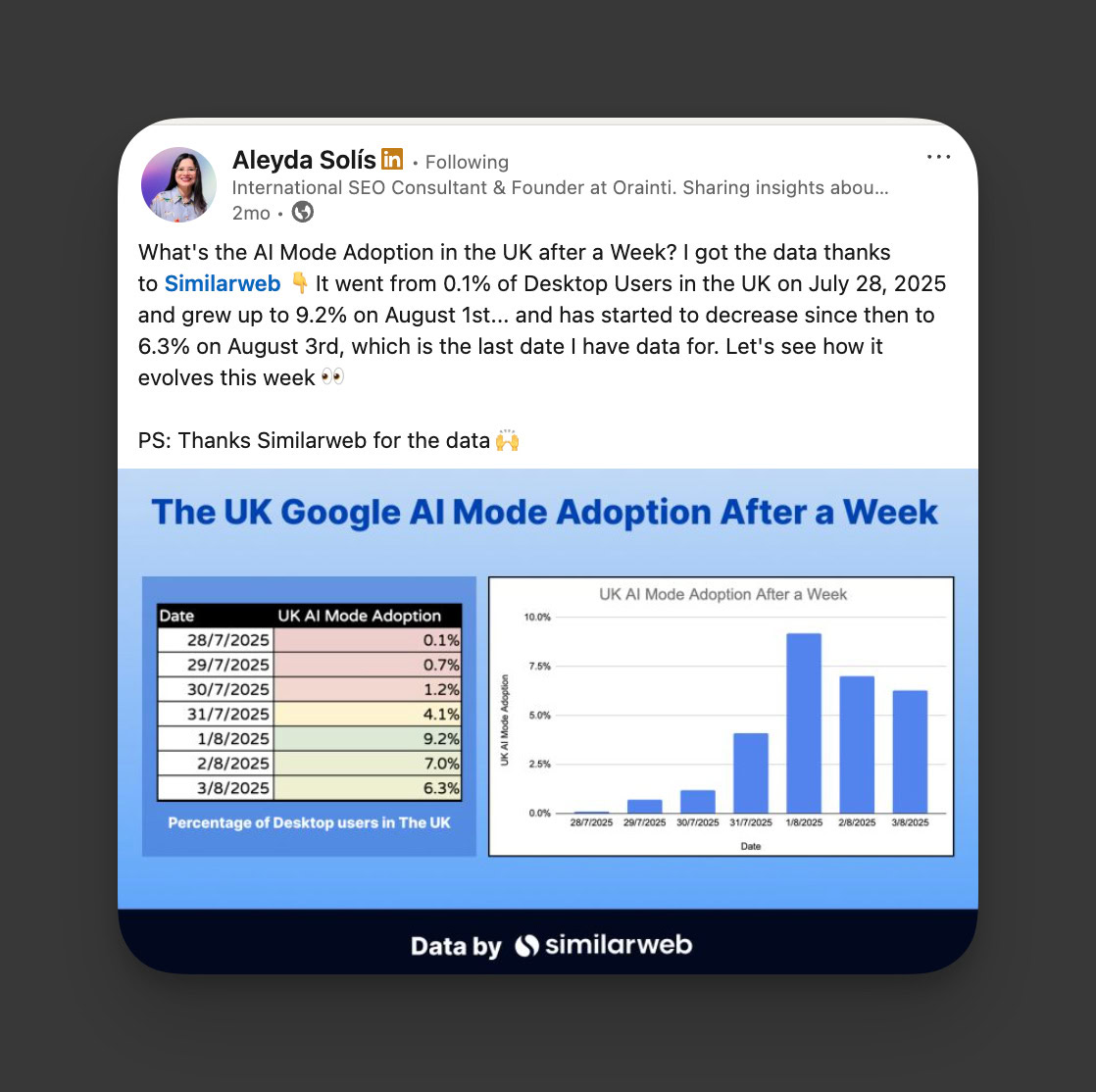
Image Credit: Kevin Indig

So, it makes sense why Google is slow to roll AI Mode out broadly – it doesn’t have product-market fit, yet.

In the Nielsen Norman Group’s (NNG) usability study – UX research that examined how people interacted with AI chats for search as a whole, including AI Mode – noted that after being introduced to AI chat, participants found it helpful for complex information‑seeking tasks. And that generative AI saved time for those tasks by synthesizing the data. [5]

However, participants in the NNG study still cross‑checked facts via classic search, indicating residual skepticism.

Other research highlights inaccuracies and gaps with AI Mode:

iPullRank participants searching for local news or health clinics found AI Mode results to be inaccurate or lacking specificity, so they relied on traditional sites or maps:

“In [the local sports and news headlines] search, many found the AIOs and AI Mode (as well as ChatGPT) to be inaccurate, less trustworthy, and not up to date, but the participants didn’t expect these sources to be timely or accurate in the first place, which is an issue in itself.”

In a small-scale experiment by Ahrefs, Patrick Stox created AI Mode‑generated articles on technical SEO topics that had contained factual errors (e.g., incorrect hreflang advice) and published them live to see if they could rank. The three test pages failed to appear for their target keywords, and the test suggests that AI Mode content may be insufficiently accurate for Google’s own EEAT guidelines.

  1. Users generally trust AI Mode and AI answers on other platforms. Responses can be highly trusted for some high-intent shopping searches and informational queries, but they may contain inaccuracies or unwanted localization.
  2. Users and marketers should treat AI answers as starting points, double‑checking critical information and considering brand authority and verification.
  3. There’s a brand risk inherent to LLMs like AI Mode. Bad actors can use the still nascent and simple functionality of LLMs to spread lies about brands on the web and create bad brand sentiment. This is something you want to monitor with AI visibility trackers.

4. How Are AI Overviews And AI Mode Similar? How Are They Different?

Both AIOs and AI Mode produce synthesized answers drawn from multiple sources, and they both aim to keep users on Google. But users do interact with them differently.

While we found in our research that AI Overviews act more like fact sheets, where users skim to find quick information, AI Mode gets deeper engagement. Users spend on average twice as much time with AI Mode as with AI Overviews.
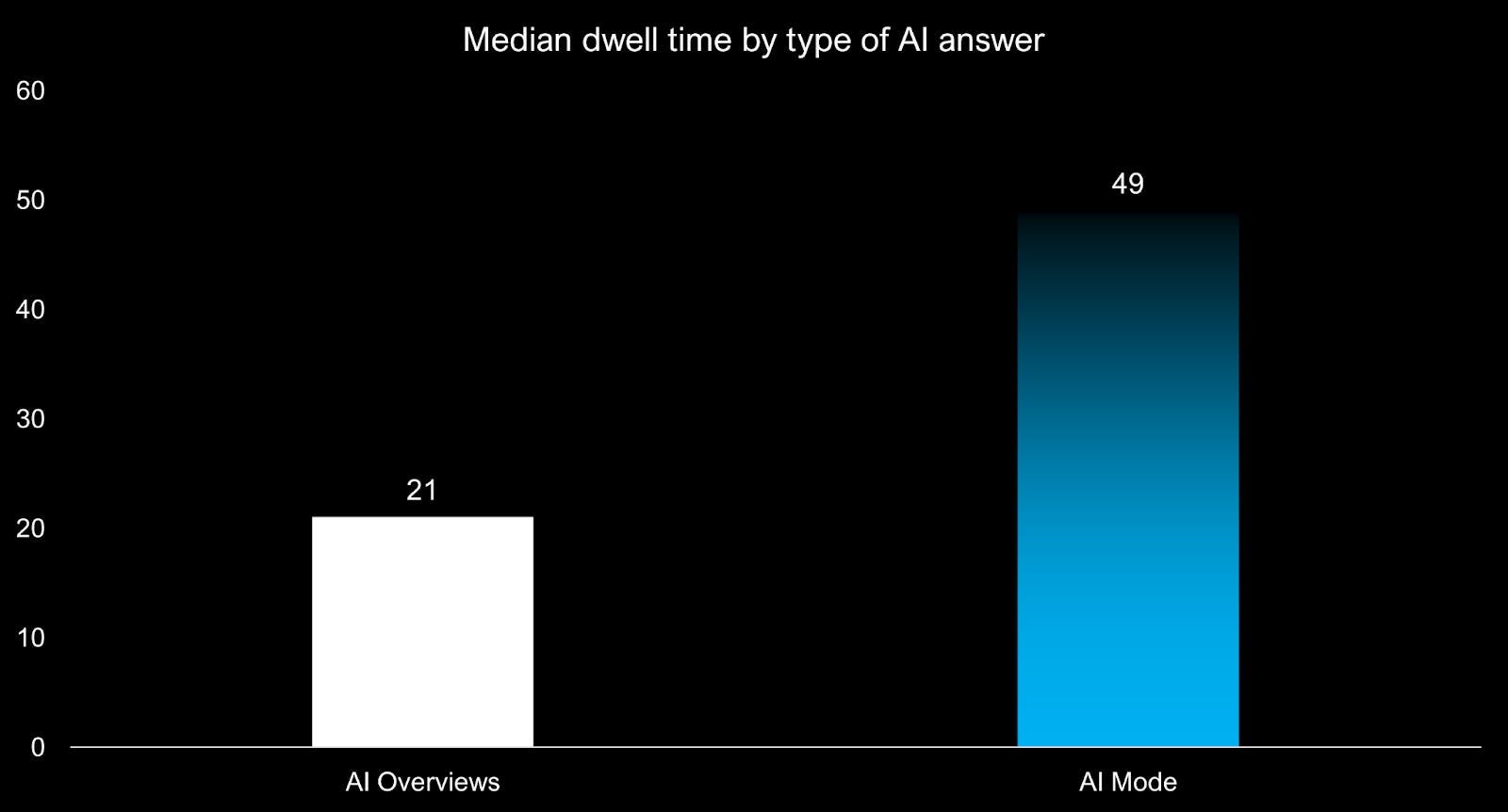
Image Credit: Kevin Indig

Interestingly, in iPullRank’s AI Mode study, users were confused about AI Mode vs. AI Overviews and mostly ignored the “dive deeper into AI Mode” button.

Setting aside the general user confusion, there are two core similarities seen across the 2025 AI Mode research and my analysis of 19 studies about the impact of AIOs:

  1. Brand influence: Visibility in both AIOs and AI Mode depends on strong authority signals, like brand recognition, a quality link profile, and quality content.
  2. Limited traffic: Both experiences reduce clicks. Studies on AIOs showed CTR declines, while AI Mode sessions are overwhelmingly zero‑click.

The differences?

  • Citation patterns: SERanking found more sources (averaging 12.6 links per answer) with a mix of block and inline links in AI Mode, while AIOs often cite fewer sources. AI Mode and AIOs have low overlap with only 10.7% of URLs and 16% of domains overlapping between them.
  • Content length and style: Semrush’s comparison study shows AI Mode produces longer answers (~300 words), similar to ChatGPT, and uses more unique domains (~7 per answer) than AI Overviews (~3).
  • User interaction: AI Mode is accessed via a separate mode (or panel – at least, for now) and offers chat‑style follow‑up, product previews, local packs and business profile cards. AIOs appear inline within classic search and People Also Ask questions and rarely include interactive features (at the date of this writing, at least – we’re seeing more interactive features pop up that take users into AI Mode).
  • Trigger frequency: AIOs aren’t triggered all the time, although Google has increased their rollout across queries over the last year. AI Mode can be invoked by the user or autopopulated for longer, conversational prompts.

5. Can Brands Still Benefit From AI Mode Visibility, Even If Clicks Are Scarce?

Yes – visibility inside AI Mode influences user decisions even without clicks. Here’s how I can answer this confidently: Several studies show that users read AI answers, examine citations and form opinions without leaving Google.

I get this question all the time from my clients: “If Google shows AI Mode and our clicks go away – how do we know whether what we’re doing works?”

Our AI Mode usability study found that participants spent 52-77 seconds reading AI answers per task and often concluded their research within the pane. Propellic’s travel research shows users spending ≈104 seconds planning inside AI Mode and then booking on an external site.
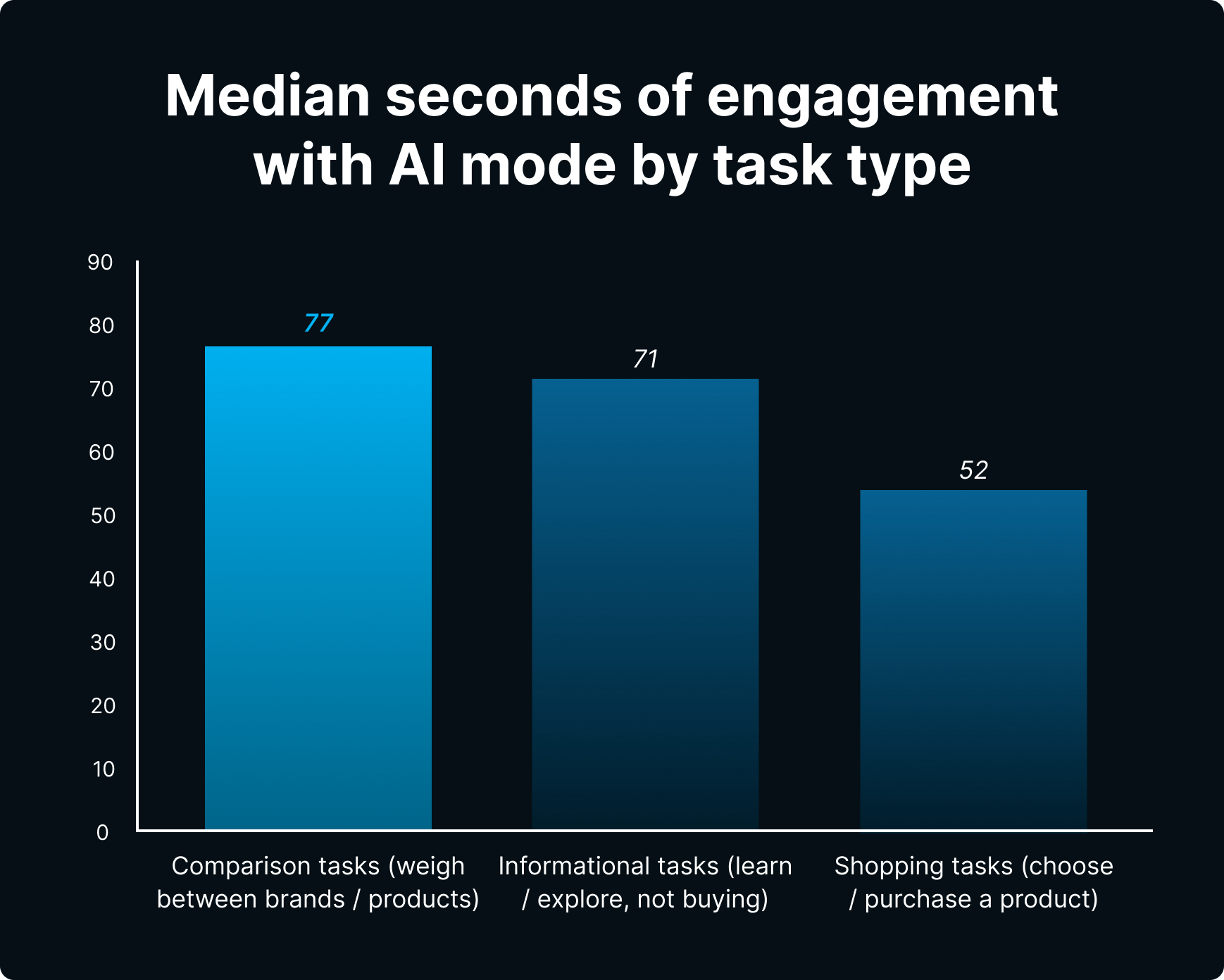
Image Credit: Kevin Indig

High trust scores (4.3/5) imply that brand mentions inside AI Mode transfer authority to those brands.

Participants looked at inline links, citations and product previews but rarely clicked out, unless they had a shopping task to complete.

We also found that brand familiarity meaningfully drives decisions.
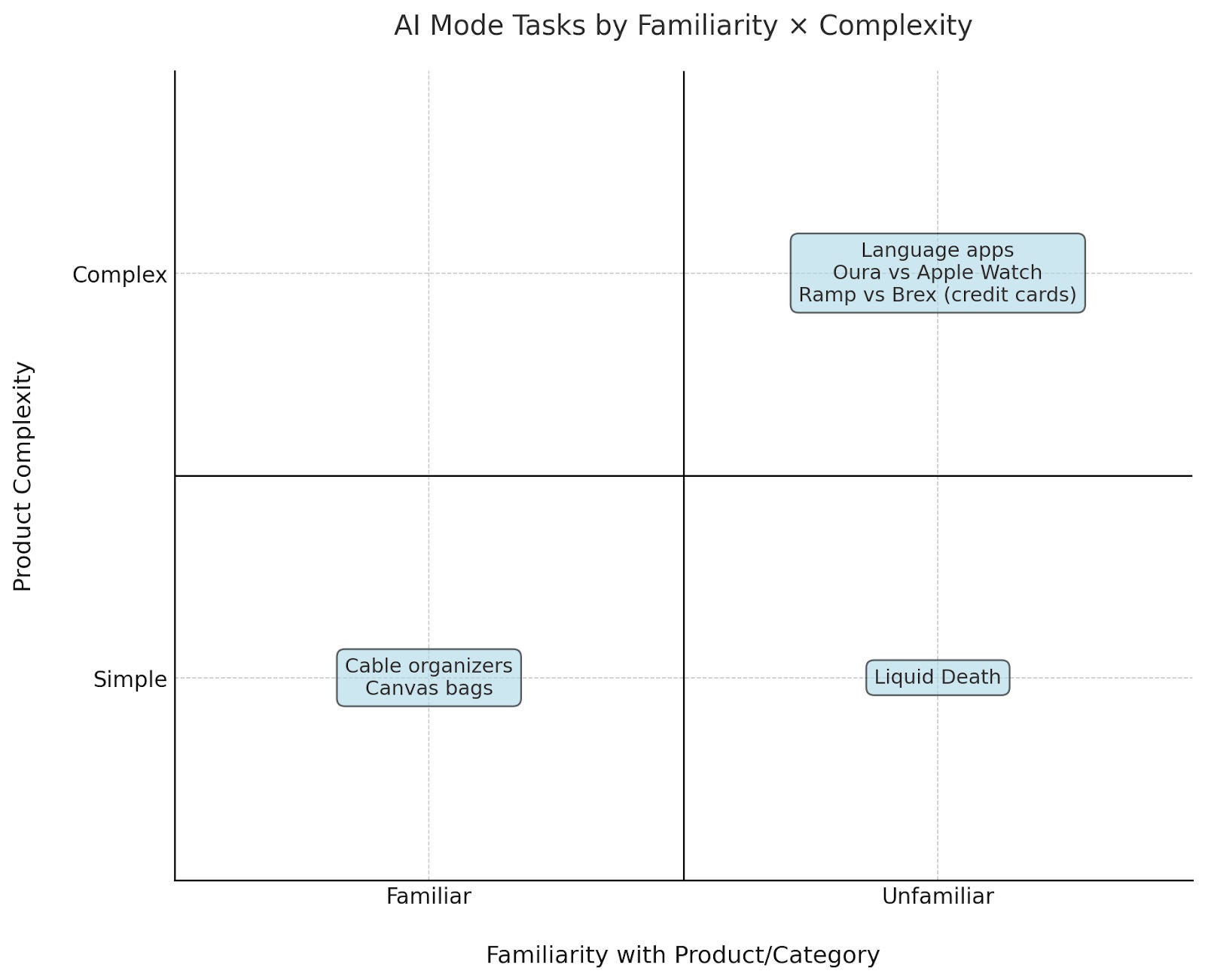
Image Credit: Kevin Indig

In fact, recognized brands were chosen even when other options were available. Thus, being cited (even without a click) reinforces brand recall and can lead to direct visits later.

In short: Treat AI Mode as a branding channel. The goal is to be present where users read, not just where they click.

  1. Attribution and tracking of decisions made in AI Mode is currently impossible, but we know from the research that it matters. If/when AI Mode becomes the default search experience, it will significantly change the way we think about Search.
  2. The best we can do is track AI Mode visibility (how often, when and with what sentiment is our brand mentioned?) and self-reported attribution.
  3. Ads in AI Mode will provide an extra layer of visibility that hopefully lets us quantify and prioritize optimization work.

I’m not taking swings at any of these studies and tests or the teams that developed them. We’re all benefiting from this expensive research these teams are working hard to distribute.

Across our sector, I’m seeing sharp experts and colleagues work diligently to widely and freely share information, and it makes me prouder than ever to be in growth marketing.

It truly feels like so many of us are doing this work together.

But the truth is, LLMs are a black box right now. And there’s so much more we need to know.

While the available studies offer valuable insights, they also come with limitations.

Below is my quick assessment. The intention of including this here is to inspire us all to further problem solve to crack upon these vaults of information.

This study uses a large dataset of 10,000 U.S. queries and repeats queries across three datasets to measure volatility. It analyzes link types and overlap with organic results, providing clear metrics.

But the study lacks qualitative user data and does not evaluate how often AI Mode appears.

This research includes real‑user think‑aloud sessions with 100 participants across multiple tasks. It also provides qualitative insights into user confusion between AI Mode and AI Overviews, which is meaningful.

Usage of AI Mode in this study was extremely low (2-5%), making some findings thin. So, while we received some good data here about how users are searching within Google right now with these new features available, we don’t get solid information about how people use AI Mode specifically.

The data for these two studies is very robust. But for the AI Mode comparison study specifically, I’d like to see research on an expanded view of search intents, other than the classic 4.

In Trust Still Lives in Blue Links – further analysis of the UX study of AIOs I published in May – I demonstrated a clear pattern of new ways users interact with LLM-based search features to validate AI outputs.

We all must expand our understanding of search intent, and having the data/research that more specifically parses out intent would help.

I would be very excited to see a combination of clickstream data with direct observations, broken down by vertical and over time for more AI Mode insights.

Growth Memo – User Behavior & SEO Impact (Parts 1 & 2)

I wouldn’t change anything about the research we’ve put out on AI Mode the last few weeks.

Just kidding.

Our results were specifically limited to the use of AI mode, so I caution against applying the insights from the study beyond the tasks or features tested. Participants knew they were in a study, which obviously can influence their behavior. We also select a broad range of tasks, which covers many intents and use cases but didn’t explore all of them in depth. I hope future research can focus exclusively on aspects like local search or shopping.

I’d also like to replicate the study type across industry types, larger sets of search tasks by search intent, and across LLMs.

Of course, this is an extremely small sample; results may not generalize. But, this is an interesting test of Google itself regardless.

I’d be curious to test more topics, including human‑written baselines.

This study looked at LLM interactions overall, and it wasn’t specific to AI Mode or Google; it also was a smaller sample of 10 participants.

Overall, it would be interesting to test each AI-chat-based search method, including AI Mode, specifically with a larger sample size and measure differences in trust and efficiency.

This was limited to travel vertical, although there are insights here that can be used regardless of industry.

Participants were prompted to use AI Mode, which may not reflect organic behavior – especially if people are naturally avoidant of the feature.

The study measures citations in LLMs, not click behavior or user satisfaction with those outputs or citations.

Overall, I’d love to see more information about AI Mode that includes broader geographic and multilingual datasets as it rolls out more globally, along with investigation into content accuracy and user satisfaction.

Our industry really needs increased sample size + diversity across these usability studies, but to be honest, it’s a huge, expensive undertaking.


Featured Image: Paulo Bobita/Search Engine Journal

https://www.searchenginejournal.com/the-impact-of-ai-mode-on-seo-analysis-of-10-studies/558816/



A Smarter SEO Content Audit: Aligning For Performance, Purpose & LLM Visibility via @sejournal, @coreydmorris

A major category, focus, or pillar (as I have defined it for decades) of SEO is content. Influencing a range of on-page factors, but more so to develop authentic context and authority status over the years, content has been an engine of so much SEO and is a focal point in the shift from keyword-focused to visibility in the era of LLMs, AI search results, and organic search results in integrated thinking.

With a focus on content needs of today, combined with those from the past few years, a popular way to understand content’s effectiveness is to conduct SEO content audits. As we look at content auditing in a more versatile way for broader visibility, I believe it is important to address the fact that audits often fall into one of two extremes:

  • Too shallow to be useful – using an automated tool and lacking data and a point of view.
  • Too deep and detailed to be usable – so much data, so much crawling, and so many topics that it’s difficult for search engines and LLMs to understand the actual focus.

With AI and LLMs changing how content is discovered and interacted with, we can’t afford to rest on the content we have created in the past and to assume past performance will provide future positive results. I believe a better model is a performance and purpose-driven audit that prioritizes actions based on business impact and newer visibility models.

SEO content audits, which evolve to stay relevant in today’s search and AI environment, need to account for the fact that search behavior is shifting. I’m not going to unpack the stats or talk about search market share in this article, but trust that you’re seeing the impact in your stats and dashboards. As we shift with the market, we do have to think more about answers and authority signals.

Even if we have a finely tuned content machine that has every possible AI-driven efficiency built into it, we can’t afford wasted efforts and content bloat. Flooding search engines and LLMs with bloat, whether human-generated or AI-generated (or some combo), is wasted if it isn’t working for us. This is especially true for B2B and lead-generation-focused companies that have longer customer journeys and sales cycles.

Marketing and corporate executives expect performance and find out too late that outdated or ineffective content didn’t translate from keyword rankings to AI visibility. Leveraging a content audit that balances having enough depth, but being actionable and focused on business value, is as important as ever.

How To Conduct A Performance-Driven, LLM-Aware Content Audit

I’m advocating a modern and repeatable framework that replaces traditional SEO content audits with one that is more useful and aligned to how things work today.

1. Define Purpose

We have to start off by getting on the same page with what spurred us to do an audit and what our ultimate goal for the effort is. Whether we’re trying to clean up legacy content overall, to shift focus to LLM visibility that we want to improve, seeking to get more conversions out of existing content, or other noble goals.

It is important to understand what “good” looks like. Whether it is visibility, traffic, authority, engagement, or some other measurable outcome.

2. Segment By Type And Funnel Stage

A challenge of content reviews and analysis is how specific content is prioritized. We want to avoid a one-size-fits-all approach.

That means we need to break down the categories of content for the audit by type. That can include blog posts vs. core landing pages vs. gated assets. However you look and classify the types of content on your site and that your team creates, you’ll want to use this as a filter.

Additionally, you want to look at your content in the same way that you consider your funnel. Whether it is top, middle, and bottom-of-funnel content, or if you look in a different way at customer journeys and classifications, use this as a second important filter and prioritize what you want to analyze and why (going back to the defined purpose of the content audit).

3. Score Content 3P’s (Purpose, Performance, Potential)

This is where our audits and processes start to take a more custom approach based on the steps we’ve completed so far. You’ll need your own custom scoring system. It could be as simple as a 1-3 scale for the categories of Purpose, Performance, and Potential.

Purpose:

  • What is this content meant to do?
  • Is it aligned with:
    • Brand?
    • Positioning?
    • Goals?

Performance:

  • How does it drive:
    • Traffic?
    • Conversions?
    • Citations?
    • Engagement?
  • Does it actually:
    • Bring people in?
    • Move them forward?

Potential:

  • Could it rank or be rendered in answers in AI with updates?
  • Could it be:
    • Repurposed?
    • Repositioned?

As third-party tools continue to add to their data sets and measurement capabilities, you could do your own checks, combining Google Analytics 4, Google Search Console, and ChatGPT to see what content feels useful for LLMs.

4. Determine What Stays

At this juncture, it is time to add a business-focused or aligned lens. Considering content for things like it helps us get found for the right reasons, if it would resonate with our primary audience, and if it would be prominently perceived as expert and authoritative by further stakeholders (current client, journalist, industry colleagues).

For each piece of content that is reviewed within the audit and analysis, arrive at a final decision:

  • Remove: With no performance, future, or purpose, this content can be removed.
  • Combine: This category is typically for topics that are competing or have cannibalization.
  • Update: Whether it is a topic that isn’t optimized, is misaligned in the current iteration, or needs some other type of identified improvement. LLMs prefer sources that are timely, so refreshing content on a regular basis to stay as up-to-date as possible can help improve the longevity of a piece being sourced by AI.
  • Keep: This category is for content that needs no change and that you’ll keep as-is currently.

5. Optimize For Search & LLM Visibility

For the content you have determined that stays or gets updated, you’ll want to consider both search and LLMs and what they reward for your content and brand to be found.

For search engines, starting with intent can often help to not get bogged down in old-school thinking about keywords and help with thinking of topics and the opportunity that exists for visibility in organic search results.

For AI, while this article isn’t a primer for what matters for being found in LLMs, there are things like content structure, clear and authoritative answers, brand signals, and external validation (PR, etc.) that are important here, too, in the edits and updates that you make.

6. Create Prioritized Action Plan

While it might feel like, at this point, the heavy lifting is done and that you’ve got a solid spreadsheet, list, or way that you’ve organized the work so far, this is where the follow-through and implementation can get derailed quickly.

You need to work at this juncture to score or plan out what is required for implementation based on effort vs. impact. Additionally, you need to layer in your team’s capacity, skill sets, and cost (or opportunity cost) of resources. Lastly, you need to organize the effort into sprints or milestones to do over time so it doesn’t become a never-ending project or one that is too big to accomplish.

7. Track Business (Not Search) Metrics

As the content audit work wraps up and turns to implementation of the action plan, you need to make sure you’re set up to look beyond rankings and traffic.

Deeper business-aligned metrics include conversions, form submissions, and demo requests as the bridge from online to sales processes. Quality metrics and key performance indicators (KPIs) still apply as you weave in conversion rate optimization (CRO) efforts and mapping to expected aspects of the customer journey or funnel.

And, as you evolve from SEO metrics to visibility, third-party tools or your own qualification and quantification efforts in customizing GA4 or other data capture and analysis work will be important in understanding the impact of your content auditing and update efforts.

Final Thoughts

Content audits aren’t dead. However, the way we’ve done them in the past likely does need to change. There’s no such thing as a perfect process, tool, or spreadsheet, but we can leverage solid practices that integrate our own goals, potential, and value to our target audiences.

SEO this year and beyond is about visibility, usefulness, and what we can impact across search engines and LLMs.

Remembering that the right audit balances depth with being actionable, the steps I outlined and your team’s dedication and focus can help you see it through to measurable success.

More Resources:


Featured Image: Roman Samborskyi/Shutterstock

https://www.searchenginejournal.com/seo-content-audit-aligning-for-performance-purpose-llm-visibility/556584/