Google Explains Next Generation Of AI Search via @sejournal, @martinibuster
Google’s Robby Stein, VP of Product at Google, explained that Google Search is converging with AI in a new manner that builds on three pillars of AI. The implications for online publishers, SEOs, and eCommerce stores are profound.
Three Pillars Of AI Search
Google’s Stein said that there are three essential components to the “next generation” of Google Search:
AI Overviews
Multimodal search
AI Mode
AI Overviews is natural language search. Multimodal are new ways of searching with images, enabled by Google Lens. AI Mode is the harnessing of web content and structured knowledge to provide a conversational turn-based way of discovering information and learning. Stein indicates that all three of these components will converge as the next step in the evolution of search. This is coming.
Stein explained:
“I can tell you there’s kind of three big components to how we can think about AI search and kind of the next generation of search experiences. One is obviously AI overviews, which are the quick and fast AI you get at the top of the page many people have seen. And that’s obviously been something growing very, very quickly. This is when you ask a natural question, you put it into Google, you get this AI now. It’s really helpful for people.
The second is around multimodal. This is visual search and lens. That’s the other big piece. You go to the camera in the Google app, and that’s seeing a bunch of growth.
And then with AI mode, it brings it all together. It creates an end-to-end frontier search experience on state-of-the-art models to really truly let you ask anything of Google search.”
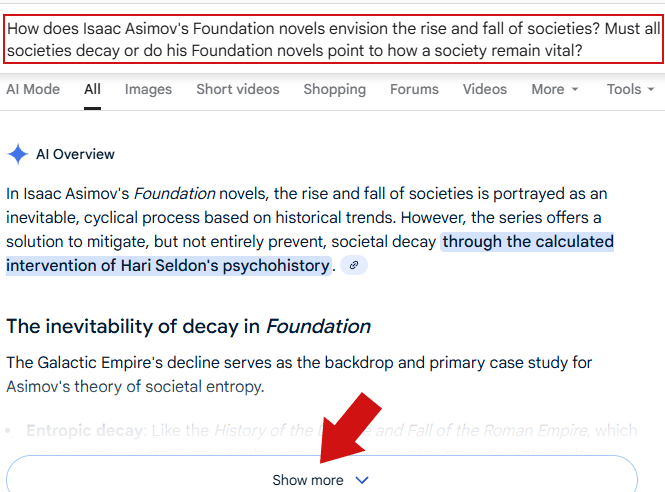
AI Mode Triggered By Complex Queries
The above screenshot shows a complex two sentence search query entered into Google’s search box. The complex query automatically triggers an AI Mode preview with a “Show more” link that leads to an immersive AI Mode conversational search experience. Publishers who wish to be cited need to think about how their content will fit into this kind of context.
Next Generation Of Google: AI Mode Is Like A Brain
Stein described the next frontier of search as something that is radically different from what we know as Google Search. Many SEOs still think of search as this ranking paradigm with ten blue links. That’s something that’s not quite existed since Google debuted Featured Snippets back in 2014. That’s eleven years that the concept of ten blue links has been out of step with the reality in Google’s search results.
What Stein goes on to describe completely does away with the concept of ten blue links, replacing it with the concept of a brain that users can ask questions and interact with. SEOs, merchants and other publishers really need to begin doing away with the mental concept of ten blue links and focus on surfacing content within an interactive natural language environment that’s completely outside of search.
Stein explained this new concept of a brain in the context of AI Mode:
“You can go back and forth. You can have a conversation. And it taps into and is specially designed for search. So what does that mean? One of the cool things that I think it does is it’s able to understand all of this incredibly rich information that’s within Google.
So there’s 50 billion products in the Google Shopping Graph, for instance. They’re updated 2 billion times an hour by merchants with live prices.
You have 250 million places and maps.
You have all of the finance information.
And not to mention, you have the entire context of the web and how to connect to it so that you can get context, but then go deeper.
And you put all of that into this brain that is effectively this way to talk to Google and get at this knowledge.
That’s really what you can do now. So you can ask anything on your mind and it’ll use all of this information to hopefully give you super high quality and informed information as best as we can.”
Stein’s description shows that Google’s long-term direction is to move beyond retrieval toward an interactive turn-based mode of information discovery. The “brain” metaphor signals that search will increasingly be less about locating web pages but about generating informed responses built from Google’s own structured data, knowledge graphs, and web content. This represents a fundamental change and as you’ll see in the following paragraphs, this change is happening right now.
Stein describes how Google is increasingly triggering AI Mode as the next evolution of how users find answers to questions and discover information about the world immediately around them. This goes beyond asking “what’s the best kayak” and becomes more of a natural language conversation, an information journey that can encompass images, videos, and text, just like in real life. It’s an integrated experience that goes way beyond a simple search box and ten links.
Stein provided more information of what this will look like:
“And you can use it directly at this google.com/ai, but it’s also been integrated into our core experiences, too. So we announced you can get to it really easily. You can ask follow-up questions of AI overviews right into AI mode now.
Same for the lens stuff, take a picture, takes it to AI mode. So you can ask follow-up questions and go there, too. So it’s increasingly an integrated experience into the core part of the product.”
How AI Will Converge Into One Interface
At this point the host of the podcast asked for a clearer explanation of how all of these things will be integrated.
He asked:
“I imagine much of this is… wait and see how people use it. But what’s the vision of how all these things connect?
Is the idea to continue having this AI mode on the side, AI overviews at the top, and then this multimodal experience? Or is there a vision of somehow pushing these together even more over time?”
Stein answered that all of these modes of information discovery will converge together. Google will be able to detect by the query whether to trigger AI Mode or just a simple search. There won’t be different interfaces, just the one.
Stein explained:
“I think there’s an opportunity for these to come closer together. I think that’s what AI Mode represents, at least for the core AI experiences. But I think of them as very complementary to the core search product.
And so you should be able to not have to think about where you’re asking a question. Ultimately, you just go to Google.
And today, if you put in whatever you want, we’re actually starting to use much of the power behind AI mode, right in AI Overviews. So you can just ask really hard, you could put a five-sentence question right into Google search.
You can try it. And then it should trigger AI at the top, it’s a preview. And then you can go deeper into AI mode and have this back and forth. So that’s how these things connect.
Same for your camera. So if you take a picture of something, like, what’s this plant? Or how do I buy these shoes? It should take you to an AI little preview. And then if you go deeper, again, it’s powered by AI mode. You can have that back and forth.
So you shouldn’t have to think about that. It should feel like a consistent, simple product experience, ultimately. But obviously, this is a new thing for us. And so we wanted to start it in a way that people could use and give us feedback with something like a direct entry point, like google.com/AI.”
Stein’s answer shows that Google is moving from separate AI features toward one unified search system that interprets intent and context automatically.
For users, that means typing, speaking, or taking a picture will all connect to the same underlying process that decides how to respond.
For publishers and SEOs, it means visibility will depend less on optimizing for keywords and more on aligning content with how Google understands and responds to different kinds of questions.
How Content Can Fit Into AI Triggered Search Experiences
Google is transitioning users out of the traditional ten blue links paradigm into a blended AI experience. Users can already enter questions consisting of multiple sentences and Google will automatically transition into an AI Mode deep question and answer. The answer is a preview with an option to trigger a deeper back and forth conversation.
Robbie Stein indicated that the AI Search experience will converge even more, depending on user feedback and how people interact with it.
These are profound changes that demand publishers ask deep questions about how content:
Should you consider how curating unique images, useful video content, and step-by-step tutorials may fit into your content strategies?
Information discovery is increasingly conversational, does your content fit into that context?
Information discovery may increasingly include camera snapshots, will your content fit into that kind of search?
These are examples of the kinds of questions publishers, SEOs and store owners should be thinking about.
Watch the podcast interview with Robby Stein
Inside Google’s AI turnaround: AI Mode, AI Overviews, and vision for AI-powered search | Robby Stein
[embedded content]
Featured image/Screenshot of Lenny’s Podcast video
YouTube Upgrades Shorts Editor With Timeline View via @sejournal, @MattGSouthern
YouTube is launching an all-new timeline editor for Shorts that puts video clips, overlays, and audio in one unified view.
The update responds to creator requests for more precise controls inside the YouTube app.
What’s New
The editor adds timeline-level controls you can use without switching modes. You can trim and reorder clips via drag-and-drop and use zoom for precise timing and transitions.
“When you’re creating a short, you’ve told us how critical it is to be able to make all of your edits to a video in one place to be able to really make something you’re proud of. We appreciate the feedback and we’ve been listening. So, we’re launching an all new Shorts timeline editor. Now, everything is visible in one place. all of your video clips, overlays, and audio. You can trim, reorder the clips, simple drag and drop. You can zoom in to make precise edits.”
See it in action in the video below:
[embedded content]
Planned Additions
YouTube says it plans to add slip editing, clip splitting, and the ability to add media directly from the timeline. No release window was provided in the video.
YouTube adds:
“And this is just the beginning. We’re making a lot more key improvements, for example, like being able to do slip editing, being able to do splitting, and adding media directly from timeline.”
YouTube also said it will continue expanding Edit with AI, the Gemini-assisted tool that can assemble a first-draft edit with music, transitions, and voiceover.
While integration with the new timeline editor is planned, YouTube didn’t share timing or regional availability.
YouTube said:
“We also plan to continue to expand Edit with AI… to make it even easier for you to craft your vision with Gemini Assistance.”
Why This Matters
A unified timeline brings more of the desktop editing experience into the YouTube app.
The single view reduces mode switching, and the upcoming slip and split controls should improve pacing and transitions without relying on third-party editors.
As YouTube put it:
“The goal is really simple. More creative freedom with less friction. We’re really committed to building easy to use creation tools that help you be your most creative self and make something you’re really proud of.”
Looking Ahead
YouTube didn’t specify when the timeline editor will reach all creators or which regions will get it first.
These updates fit into YouTube’s broader push to enhance Shorts creation tools, following earlier improvements like beat syncing, templates, and AI-generated stickers.
28 Expert-Level Prompt Examples & Templates For SEO via @sejournal, @donutcaramel13
AI provides many ways to augment and assist how SEOs work. From analyzing SERP intent, to brainstorming content strategy for new pages, to running competitive analysis, to producing stakeholder-ready presentations, the possibilities are endless.
You can start out with basic level prompts of a simple paragraph, but to take your prompting to the next level, apply a coding mindset of instruction hierarchy and referencing other documents for context.
Clear input: Assign it a role, be specific about the task, and outline the data you’re providing.
Context: Provide a background so that it understands your overall goal, not just your question.
Constraints: Set guardrails or structure (outlines, rulebooks, style guides, etc.) so that the result will fall within your expectations and avoid off-target answers.
Here is a list of example expert-level prompts put together by our team at SEJ to help with SEO tasks. Adapt to meet your needs:
Keyword Research
1. Jobs-To-Be-Done Query Map
Turn customer struggles into search demand by mapping functional, emotional, and social “jobs” into authentic queries, mapped by funnel stage and content gaps.
# Jobs-To-Be-Done Query Map Generator ## System Context
You are a senior customer research strategist with expertise in Clayton Christensen's JTBD theory, Tony Ulwick's Outcome-Driven Innovation, and SEO content strategy. Your task is to analyze topics through authentic customer job frameworks and translate findings into actionable search query maps. ## Input Data
**Seed Topic:** [INSERT YOUR SEED TOPIC/KEYWORD] ## Analysis Framework
Execute this in sequential phases: ### Phase 1: Customer Job Identification
<reasoning>
Using JTBD principles, identify what customers are truly trying to accomplish when they encounter this topic. Consider:
- **Functional Jobs:** What practical task or problem are they solving?
- **Emotional Jobs:** What feelings are they trying to achieve or avoid?
- **Social Jobs:** How do they want to be perceived by others?
- **Progress Situation:** What circumstances trigger the need for progress?
</reasoning> For each job type, document:
- The specific progress customers seek
- Current solution inadequacies (struggles)
- Success criteria from customer perspective
- Authentic customer language (avoid corporate jargon) ### Phase 2: Search Behavior Translation
<reasoning>
Transform identified jobs into actual search patterns. Reference how customers naturally express problems versus how companies describe solutions. Consider informational, navigational, commercial, and transactional search intents.
</reasoning> For each customer job, generate:
- 3-5 specific search queries customers would actually type
- Problem-focused vs. solution-focused query variations
- Long-tail variations reflecting different customer sophistication levels
- Related "jobs-to-be-done" keywords (how to, ways to, can I, should I) ### Phase 3: Funnel Stage Mapping
<reasoning>
Map each query to the marketing funnel stage where customers typically search for this information. Consider that JTBD queries often capture middle-funnel traffic with high buying intent.
</reasoning> Categorize queries by stage:
- **Awareness:** Problem recognition and job definition
- **Consideration:** Solution evaluation and approach comparison - **Decision:** Implementation confidence and provider selection
- **Retention:** Value maximization and job expansion ### Phase 4: Content Strategy Development
<reasoning>
Recommend content types that best serve each customer job and search intent, focusing on educational value that gradually introduces solutions rather than direct promotion.
</reasoning> ## Output Format Create a comprehensive table with these columns:
| Customer Job | Job Type | Authentic Customer Language | Example Search Queries | Search Intent | Funnel Stage | Content Type Recommendation | Priority Score | ### Additional Analysis Required:
1. **Job Prioritization Matrix:** Rank jobs by frequency and business impact
2. **Content Gap Analysis:** Identify underserved customer jobs
3. **Competitive Job Mapping:** Note how competitors address these jobs
4. **Implementation Roadmap:** Sequence content creation by strategic value ## Quality Verification
Before finalizing output, verify:
- Customer language reflects actual problem expressions, not product descriptions
- Search queries represent authentic search behavior patterns
- Content recommendations serve customer progress, not just SEO metrics
- Funnel mapping reflects realistic customer journey progression
- Job definitions focus on customer outcomes, not product features ## Success Metrics
Evaluate recommendations against:
- **Job Completion Effectiveness:** How well does content help customers make progress?
- **Search Intent Alignment:** Do queries match actual customer search patterns?
- **Content Utility Score:** Would customers find this genuinely helpful?
- **Qualified Engagement Potential:** Likelihood of attracting ready-to-buy traffic Generate your analysis following each phase sequentially. **Focus on delivering the table as your primary output - keep analysis internal and present only the final actionable results.**
2. Query Fan-Out
Expands a seed keyword into 40-60 related queries across six categories (People Also Ask, entities, comparisons, how-tos, problems/solutions, transactional modifiers).
The prompt organizes them into a hierarchical H2/H3 content outline with scoring and rationale, so you get both a complete query set and a blog-ready structure.
## Comprehensive Query Fan-Out Prompt: Patent-Aligned Algorithm Implementation ### Understanding Query Fan-Out: The Technical Framework Query fan-out is a sophisticated multi-stage process where search engines decompose a user's query through several algorithmic steps: ### Input Requirements
1. **Primary Query**: [schema, schema seo, json ld schema] 2. **User Context**: [Beginner/Intermediate/Expert | Industry | Geographic location]
3. **Business Objective**: [Information | Transaction | Navigation | Investigation] 1. **Initial Query Decomposition**: The system identifies the core semantic components and entities within the query
2. **Thematic Clustering**: Components are grouped into distinct themes based on semantic relationships
3. **Hierarchical Expansion**: Each theme generates sub-themes and related concepts in a tree structure
4. **Contextual Rewriting**: Queries are reformulated based on user context and implicit intent 5. **Entity Disambiguation**: The system maps query components to Knowledge Graph entities
6. **Ranking and Filtering**: Generated queries are scored and filtered based on relevance signals ### Detailed Query Fan-Out Algorithm #### Stage 1: Query Decomposition & Entity Recognition **Break the query into semantic components:**
- **Entities**: Identify all named entities (people, places, products, concepts)
- **Attributes**: Extract descriptive properties (size, color, quality, temporal)
- **Relationships**: Map connections between entities (comparisons, dependencies, hierarchies)
- **Actions/Intents**: Identify verbs and implied actions Example: "best sustainable marketing strategies for small e-commerce"
- Entities: [marketing strategies, e-commerce]
- Attributes: [best, sustainable, small]
- Relationships: [strategies FOR e-commerce]
- Intent: [evaluation/selection] #### Stage 2: Thematic Clustering with Semantic Boundaries **Generate 3-5 primary themes where each theme:**
- Represents a distinct informational facet
- Has defined semantic boundaries (what's included/excluded)
- Contains a "centroid" concept (most representative element)
- Includes "peripheral" concepts (boundary elements) **Theme Generation Rules:**
1. Each theme must address a different user need
2. Themes should have 30-70% semantic overlap with seed query
3. Create both "convergent" themes (narrowing focus) and "divergent" themes (broadening scope) #### Stage 3: Hierarchical Query Tree Construction For each theme, build a query tree with these levels: **Level 1 - Root Queries** (Direct theme representation)
- Most general form of the theme
- Example: "sustainable marketing methods" **Level 2 - Aspect Queries** (Specific facets)
- Break root into 3-4 distinct aspects
- Example: "environmental impact of digital marketing" **Level 3 - Detail Queries** (Granular questions)
- Specific, actionable queries
- Example: "carbon footprint of email campaigns calculation" **Level 4 - Context Queries** (Situational variations)
- Modified by user context
- Example: "email carbon footprint for B2B SaaS companies" #### Stage 4: Query Rewriting Mechanisms Apply these rewriting patterns to each base query: **1. Lexical Substitution**
- Replace terms with synonyms/related terms
- "strategies" → "tactics", "approaches", "methods" **2. Structural Reformulation**
- Statement → Question: "sustainable marketing" → "what makes marketing sustainable?"
- Broad → Specific: "marketing strategies" → "content marketing strategies"
- Abstract → Concrete: "best practices" → "step-by-step guide" **3. Intent Transformation**
- Information → Action: "what is X" → "how to implement X"
- General → Comparative: "good strategies" → "X vs Y strategies"
- Single → Multiple: "best strategy" → "top 5 strategies" **4. Contextual Augmentation**
- Add temporal context: "...in 2024", "...post-COVID"
- Add expertise level: "...for beginners", "...advanced techniques"
- Add industry specific: "...for SaaS", "...in healthcare" #### Stage 5: Entity-Based Expansion **Knowledge Graph Integration:**
1. Map each entity to its knowledge graph node
2. Retrieve related entities (parent, child, sibling relationships)
3. Extract entity attributes and properties
4. Generate queries combining entities and attributes **Entity Relationship Patterns:**
- **Hierarchical**: broader/narrower terms
- **Associative**: commonly co-occurring entities
- **Comparative**: similar entities for comparison
- **Compositional**: part-whole relationships #### Stage 6: Scoring and Ranking **Apply multi-factor scoring to each generated query:** ```
Priority Score = (0.30 × Semantic Relevance) + (0.25 × Intent Alignment) + (0.20 × Topic Coverage) + (0.15 × User Context Match) + (0.10 × Query Uniqueness)
``` **Where:**
- Semantic Relevance: Cosine similarity to seed query
- Intent Alignment: Match to specified user intent
- Topic Coverage: How much new information it adds
- User Context Match: Relevance to user's expertise/industry
- Query Uniqueness: Inverse of overlap with other queries ### Output Format Generate a hierarchical structure showing the complete fan-out: ```
SEED QUERY: [Original Query]
│
├── THEME 1: [Theme Name]
│ ├── Centroid: [Most representative query]
│ ├── Root Query: [Level 1]
│ │ ├── Aspect 1: [Level 2]
│ │ │ ├── Detail Query 1: [Level 3]
│ │ │ │ └── Context Variation: [Level 4]
│ │ │ └── Detail Query 2: [Level 3]
│ │ └── Aspect 2: [Level 2]
│ │ └── Detail Query: [Level 3]
│ └── Entity Expansions:
│ ├── Related Entity 1: [Query]
│ └── Related Entity 2: [Query]
│
├── THEME 2: [Theme Name]
│ └── [Similar structure]
``` ### Detailed Output Table | Theme | Query Level | Query Text | Intent Type | Entity Focus | Semantic Distance | Priority Score | Reasoning |
|-------|------------|------------|-------------|--------------|-------------------|----------------|-----------|
| [Theme] | [L1/L2/L3/L4] | [Query] | [Intent] | [Entities] | [0-1 score] | [1-10] | [Why this score] | ### Advanced Pattern Requirements **1. Query Chains** (Sequential Dependencies)
- Create sequences where Query N+1 naturally follows Query N
- Example: "What is X?" → "Why is X important?" → "How to measure X?" → "Tools for X" **2. Faceted Exploration**
- Generate queries exploring different facets simultaneously
- Facets: Cost, Time, Quality, Difficulty, Alternatives **3. Disambiguation Queries**
- When entities have multiple meanings, generate clarifying queries
- Example: "Python" → "Python programming" vs "Python snake" **4. Composite Queries**
- Combine multiple entities/intents in single queries
- Example: "compare [Entity A] and [Entity B] for [Use Case]" ### Validation Requirements Ensure the fan-out structure:
- [ ] Contains 40-60 total queries across all themes
- [ ] Has clear hierarchical depth (4 levels)
- [ ] Shows explicit entity relationships
- [ ] Includes both convergent and divergent expansions
- [ ] Demonstrates contextual variations
- [ ] Maintains semantic coherence within themes
- [ ] Shows natural query progressions
- [ ] Covers multiple user intents ## OUTPUT FORMATTING REQUIREMENTS **CRITICAL: Generate fan-out queries as article headings structure for SEO content creation:** ### Content Context
The fan-out queries should be formatted as **article headings (H2/H3 tags)** that would comprehensively cover the seed keyword topic in a well-structured article. Think of this as creating a complete article outline where each query becomes a section heading. ### Output Structure
Present the fan-out queries as article heading hierarchy: ```
ARTICLE STRUCTURE FOR: [seed keyword]
Target: [original query] | Sections: [X] | Word Count Estimate: [X] ## [H2 Main Section - Theme 1]
### [H3 Subsection]
### [H3 Subsection]
### [H3 Subsection] ## [H2 Main Section - Theme 2]
### [H3 Subsection]
### [H3 Subsection]
### [H3 Subsection] ## [H2 Main Section - Theme 3]
### [H3 Subsection]
### [H3 Subsection]
### [H3 Subsection] ## [H2 Main Section - Theme 4]
### [H3 Subsection]
### [H3 Subsection]
### [H3 Subsection] 🔗 **CONTENT FLOW** (Sequential article progression)
• [H2 section] → [H2 section] → [H2 section]
• [H3 subsection] → [H3 subsection] → [H3 subsection]
``` ### Heading Requirements
- **H2 headings**: Broad theme-based sections (4-6 sections)
- **H3 headings**: Specific subtopics under each H2 (3-5 per H2)
- **Natural language**: Write as actual article headings, not keyword stuffing
- **SEO optimized**: Include target keywords naturally in headings
- **Logical flow**: Headings should follow a natural article progression
- **User intent**: Each heading addresses specific user questions/needs ### Formatting Rules
- **Keep all reasoning and algorithmic steps** - execute the full 6-stage process without displaying
- **Output fan out queries as headings as they would appear in an actual article**
- **Use proper markdown heading syntax (## for H2, ### for H3)**
- **Maximum 25-30 total headings**
- **4-6 H2 sections with 3-5 H3s each. Add numbers in front of for easier scannability**
- **Include content flow showing logical article progression**
- **Headings should be actionable and specific**
-**Generate your analysis following each phase sequentially. Focus on delivering your primary output - keep analysis internal and present only the final actionable results**
3. Content Optimization For Query Fan-Out
Audit your existing content against fan-out queries to expose gaps, shallow coverage, and missed search intents, then rebuild the outline for completeness.
# Content Optimization for Query Fan-Out ## Input Requirements
1. **Existing Content**: [PASTE YOUR CONTENT HERE]
2. **Primary Topic/Keyword**: [MAIN SUBJECT OF YOUR CONTENT]
3. **Target Audience**: [Beginner/Intermediate/Expert | Industry]
4. **Content Goal**: [Inform/Convert/Compare/Guide] ## Automated Query Fan-Out Analysis Process ### Stage 1: Content Decomposition & Entity Extraction
From your provided content, the system will:
- **Extract Primary Entities**: Identify main concepts, products, services, or topics discussed
- **Identify Attributes**: Find descriptive elements (quality, size, time, cost)
- **Map Relationships**: Discover how concepts connect within your content
- **Detect Intent Signals**: Recognize what actions or outcomes your content promotes ### Stage 2: Generate Query Fan-Out from Content
Based on your content's entities and themes, generate the likely query landscape: #### 2.1 Theme Identification Extract 3-5 core themes from your content:
- Each theme = distinct topic cluster within content
- Themes derived from your headings, repeated concepts, and semantic groupings #### 2.2 Hierarchical Query Generation For each identified theme, create:
- **Level 1**: Broad queries about the theme
- **Level 2**: Specific aspects users would ask
- **Level 3**: Detailed implementation questions
- **Level 4**: Contextual variations for different users #### 2.3 Query Patterns to Generate
- **Direct Questions**: What your content explicitly answers
- **Implied Questions**: What users would ask next after reading
- **Gap Questions**: Related queries your content should address
- **Bridge Questions**: Connections between your themes ### Stage 3: Coverage Analysis #### 3.1 Query-Content Matching For each generated query, assess:
- **Fully Addressed**: Query has dedicated content
- **Partially Addressed**: Query mentioned but not detailed
- **Not Addressed**: Query missing from content #### 3.2 Semantic Depth Scoring Evaluate how thoroughly each theme is covered:
- **Surface level** (definitions only): 1-3
- **Moderate depth** (explanations): 4-6
- **Comprehensive** (actionable details): 7-9
- **Expert level** (nuanced insights): 10 ### Stage 4: Gap Identification & Prioritization #### 4.1 Critical Gaps (Must Address)
- Centroid queries of main themes not covered
- Basic "what is" questions unanswered
- Primary entity relationships missing
- User intent misalignment #### 4.2 Opportunity Gaps (Should Address)
- Comparison queries not covered
- How-to/implementation details missing
- Alternative solutions not discussed
- Common problems/objections unaddressed #### 4.3 Enhancement Gaps (Could Address)
- Advanced use cases
- Edge cases and exceptions
- Industry-specific variations
- Future trends/predictions ## OUTPUT FORMATTING REQUIREMENTS **CRITICAL: Generate optimized content outline as article headings structure that addresses all identified query gaps:** ### Content Context
The output should be formatted as an **improved article outline (H2/H3 tags)** that comprehensively covers both existing content and identified gaps. This creates an SEO-optimized content structure that targets all relevant fan-out queries. ### Output Structure
Present the optimized content outline as article heading hierarchy: ```
OPTIMIZED CONTENT OUTLINE FOR: [primary topic]
Original Content: [X] sections | Optimized: [X] sections | New Coverage: [X] query gaps ## [H2 Current Section - Enhanced]
### [H3 Existing subsection - maintained]
### [H3 NEW: Missing query coverage]
### [H3 NEW: Gap query addressing [specific query]] ## [H2 NEW: Major theme missing from original]
### [H3 Foundational query: "What is..."]
### [H3 Implementation query: "How to..."]
### [H3 Comparison query: "X vs Y"] ## [H2 Current Section - Expanded]
### [H3 Existing subsection - maintained]
### [H3 NEW: Advanced use case]
### [H3 NEW: Troubleshooting common problems] ## [H2 NEW: User journey completion]
### [H3 Decision criteria]
### [H3 Implementation checklist]
### [H3 Success metrics] **CONTENT FLOW** (Logical article progression)
• [H2 section] → [addresses gap] → [H2 section]
• [H3 subsection] → [bridges to] → [H3 subsection]
``` ### Heading Requirements
- **H2 headings**: Enhanced existing sections + new gap-filling sections
- **H3 headings**: Specific queries that weren't covered + maintained existing content
- **Gap indicators**: Mark new sections addressing identified query gaps
- **Natural language**: Write as actual article headings for user readability
- **SEO optimized**: Include target keywords and related query terms naturally
- **Logical flow**: Maintain content progression while filling gaps
- **User intent**: Each heading addresses specific identified missing queries ### Formatting Rules
- **Keep all reasoning and algorithmic steps** - execute the full 4-stage process
- **Output fan out queries as headings as they would appear in an actual article**
- **4-6 H2 sections with 3-5 H3s each. Add numbers in front of for easier scannability**
- **Mark new sections** that address identified gaps
- **Maintain existing sections** that already cover queries well
- **Maximum 20-25 total headings** for comprehensive but manageable outline
- **Include content flow showing how sections connect logically**
- **Focus on query coverage completeness** ensuring no major gaps remain
4. Cluster Keyword List By Opportunity
Group keywords into clusters mapped to existing pages or new page needs, calculate opportunity scores, and flag cannibalization risks. (If search volume is included in your export, no extra validation needed.)
[Input Data] Keyword export CSV: [PASTE YOUR CSV DATA WITH KEYWORDS AND SEARCH VOLUMES OR ATTACH AS A FILE] Current site structure: [LIST YOUR MAIN PAGES/CATEGORIES]
[Goal Description] Given a keyword export [CSV], group terms into clusters mapped to pages. Highlight clusters that represent strategic opportunities. Note: When export already includes search volumes from the tool, no extra validation step is required.
[Task Description] Analyze the keyword list and group semantically related terms into clusters. Map each cluster to existing pages or identify needs for new pages. Calculate opportunity scores based on combined search volume, competition indicators (if available), and business relevance. Prioritize clusters that represent untapped or high-value opportunities.
[Output Format] Deliver: * Keyword Clusters (grouped terms with total volume) * Page Mapping (cluster → existing page or "new page needed") * Opportunity Score (based on volume, competition, relevance) * Strategic Recommendations (top 5 clusters to pursue) * Cannibalization Warnings (overlapping clusters)
SERP Intelligence
5. SERP Movement Summarizer
Compare two search engine results page (SERP) snapshots to identify movers, new entrants, drop-offs, and feature changes, then extract competitive implications and recommended actions.
[Input Data] SERP data point 1: [PASTE SERP RANKINGS/SCREENSHOTS FROM DATE 1 OR ATTACH AS A FILE] SERP data point 2: [PASTE SERP RANKINGS/SCREENSHOTS FROM DATE 2 OR ATTACH AS A FILE] Target keyword: [INSERT YOUR KEYWORD]
[Goal Description] Compare SERPs at two points in time [data/screenshots] and summarize ranking shifts, new entrants, and drop-offs.
[Task Description] Analyze the two SERP snapshots to identify all position changes. Highlight significant movements (3+ positions), new domains appearing in the top 10, domains that dropped out, and any SERP feature changes. Provide strategic insights about what these movements suggest about algorithm updates or competitive landscape shifts.
[Output Format] Structure as: * Major Movers (domains with 3+ position changes) * New Entrants (weren't in the top 10 before) * Drop-offs (left the top 10) * SERP Feature Changes * Strategic Implications * Recommended Actions
6. SERP Intent Analyzer
Break down top SERP results to identify dominant and secondary search intents, required content elements, and differentiators for ranking.
Your task is to act as a SERP analyst, interpreting search engine results pages (SERPs) to provide a strategic, actionable content plan. The goal is to create content that not only ranks but also genuinely satisfies user needs and outperforms competitors. Your output must be comprehensive, structured, and directly actionable, leaving no room for ambiguity or hallucination.
Input Data: * Target Keyword: [INSERT YOUR KEYWORD] * Current SERP Data (Top 10 Results): [PASTE THE TOP 10 RESULTS, INCLUDING TITLES, DESCRIPTIONS, AND URLs OR ATTACH AS A FILE] * Optional: Contextual Information: [E.G., YOUR BRAND/WEBSITE, TARGET AUDIENCE, EXISTING CONTENT, OR UNIQUE SELLING PROPOSITION]
Task Instructions: 1. Analyze the SERP: Examine the titles, meta descriptions, URLs, and the content formats (e.g., blog posts, product pages, reviews, "how-to" guides, landing pages) of the top 10 results. This analysis is crucial for understanding how Google has interpreted the user's intent. Pay close attention to any special content result blocks (SCRBs) or SERP features that are present. 2. Identify Search Intent: Based on the SERP analysis, define the primary search intent. Classify it as one of the following, and provide a clear justification: * Informational ("Know"): The user is looking to learn, find an answer to a question, or explore a topic. This is the most common search intent and can range from simple facts to complex, in-depth topics. * Navigational ("Go"): The user is trying to find a specific website or brand (e.g., searching for "Facebook login"). * Transactional ("Do"): The user intends to make a purchase or complete a specific action. * Commercial Investigation: The user is researching products or services before making a purchase (e.g., looking for "best running shoes"). 3. Identify Secondary Intent Signals: Look for other, less dominant user intents or interpretations that are also present in the SERP. For instance, a primarily informational SERP might also contain results that suggest a commercial investigation intent. These secondary signals are key to creating a comprehensive and highly satisfying page. 4. Deconstruct Competitive Content: Analyze the common elements, formats, and patterns among the top-ranking pages to understand what currently satisfies users. Look for: * Content Type & Format: What is the predominant content type (e.g., a guide, a listicle, a product page)? What format is used (e.g., long-form text, video, tables)? * Page Elements: What specific sections or features appear repeatedly? This could include a table of contents, an FAQ section, comparison tables, calculators, or embedded videos. * E-E-A-T Signals: Look for evidence of Experience, Expertise, Authoritativeness, and Trustworthiness (E-E-A-T). For YMYL (Your Money or Your Life) topics, this is especially critical. Note how competitors establish their credentials (e.g., author bios, citations, expert reviews). 5. Synthesize Recommendations: Based on a holistic analysis of the above, provide a structured and actionable content strategy. The recommendations should be specific enough to guide content creation directly.
Output Format:
Your output must be structured with the following sections, using clear and concise language. 1. Primary Search Intent Classification: * State the dominant intent (e.g., "Informational"). * Provide a brief justification based on the top-ranking results and the nature of the query. 2. Secondary Intent Signals: * List any other relevant intents that are present in the SERP. * Provide examples from the SERP data that indicate these secondary intents. 3. Required Page Elements (Must-Haves for Ranking): * Create a bulleted list of essential on-page elements. These are the content sections, features, and topics that are critical to include to compete effectively. * For example: "A detailed 'How-to' section with numbered steps," "A comparison table of key product features," "An FAQ section addressing common user questions (drawn from 'People Also Ask' boxes if present)." 4. Content Format Recommendations: * Specify the ideal content format(s) for the new page (e.g., "Long-form blog post (2000+ words)," "Comprehensive buying guide," "Product landing page with detailed specifications"). * Justify your recommendation by referencing the patterns and successful formats found in the competitive SERP. 5. SERP Feature Opportunities: * Identify any SERP features (e.g., Featured Snippets, People Also Ask, Video Carousel, Local Pack, AI Overviews) that appear in the SERP data. * For each identified feature, suggest a specific content optimization strategy to increase the likelihood of winning that spot. For instance, "To target the Featured Snippet, include a concise, 50-word answer to the core query at the beginning of the content." 6. Competitive Differentiators Needed: * Propose unique elements, content angles, or E-E-A-T signals that will make the new page stand out and offer a superior user experience compared to the top competitors. This section is about going beyond simply matching the SERP and providing true added value. * Examples could include: "Incorporate original research or a proprietary study," "Include an interactive tool or calculator," or "Feature a testimonial or quote from a recognized industry expert."
Content Strategy
7. Intent-Based Title Generator
Create multiple SEO titles targeting different psychological triggers (authority, curiosity, urgency, etc.), all under 60 characters.
Your Task:
Generate multiple title variations for a given topic that target different user intents and psychological triggers, while keeping SEO best practices in mind.
Input Requirements: * Topic/keyword: [insert topic/keyword] * Target audience: [insert audience] Guidelines: 1. Create titles that are clear, natural, and under 60 characters. 2. Use the keyword naturally (avoid stuffing). 3. Provide variations across these frameworks: * Benefit-driven (outcome-focused) * Curiosity gap (tease/incomplete info) * Authority/credibility signal * Urgency/timeliness * Problem-agitation * Contrarian/myth-busting * Social proof * How-to/educational * List/resource format * Comparison/versus Output Format: Present results in a table with: * Framework | Title | Character Count | Emotional Trigger | Best Use Case
8. Update Vs. New Page Decision
Decide when to refresh a page versus create new content, using live SERP data, cannibalization checks, and 24-month trend analysis.
# ROLE
You are a senior SEO analyst with web-browsing capabilities. # INPUT (minimal)
- page_content: """PASTE THE FULL CURRENT ARTICLE BODY HERE OR ATTACH AS A FILE"""
- page_url (optional): https://example.com/path # OBJECTIVE
1) Identify every outdated, incorrect, or low-trust element in the content via fresh external sources.
2) Decide: UPDATE the page under the same URL vs. create a NEW PAGE (or MERGE), based on intent shift, freshness gaps, and cannibalization risk.
3) Provide a succinct, actionable plan. # RESEARCH RULES (no guessing)
- Browse the live web. Prioritize primary sources, official docs, and data within the last 12–24 months (unless evergreen).
- For each fact/date/price/law/feature/stat referenced or implied by the content, verify against at least 1–2 current sources. Capture source title, publisher, and publication/update date.
- Check the current SERP: top ranking pages, their focus/intent, and visible SERP features (e.g., PAA, video, shopping, news, local pack).
- Check user interest trend for the main topic over the last 24 months (e.g., Google Trends or equivalent) and note seasonality vs. structural decline.
- If page_url is given, run a quick site overlap check (site:domain query) to spot internal cannibalization candidates. # ANALYSIS STEPS
1) Extract & Label Facts - From page_content, list every time-sensitive claim (numbers, years, steps, policies, product features, screenshots, tool UIs, brand names, prices). - Mark each as {current / outdated / unverifiable}. For “outdated/unverifiable,” propose corrected text + 1–2 citations. 2) Intent & SERP Fit - Infer the article’s dominant intent from headings and opening sections. - Compare to today’s top SERP results: intent (info/compare/transactional/local), structure (how-to, checklist, tool, glossary), depth, freshness, and unique assets (calculator, template, video). - Note any meaningful SERP shifts since the content’s likely publish/update timeframe. 3) User Interest & Language Shift - Summarize 24-month query trend (rising/flat/declining; seasonal?). - Flag terminology changes (e.g., product rebrands, API deprecations, new policy names) that would make the content feel dated. 4) Cannibalization Risk (0–10) - If page_url is provided, list on-site pages with ≥60% topical overlap or near-duplicate titles. - Score risk using: query/topic overlap intensity (40%), intent similarity (30%), on-site title/slug redundancy (20%), URL proximity (10%). - Show subscores + weighted math and name any URL to consolidate. 5) Feasibility Decision - Choose exactly one: UPDATE vs NEW PAGE vs MERGE vs NO ACTION. - Use this decision logic: • UPDATE if intent is still the same and ≥60% of content remains structurally useful; freshness issues are fixable with revisions. • NEW PAGE if the dominant intent/format on today’s SERP is distinct (e.g., tool/comparison/local pack) or expanding would dilute the current page’s focus. • MERGE if another internal URL already better satisfies the same intent; specify the canonical target and redirect plan. • NO ACTION if demand is structurally declining and the opportunity is low. 6) Implementation Plan (only for the chosen path) - Outline: new H1, H2/H3 structure, entities to cover, examples/screenshots to refresh, required visuals/tools (calculator/template), internal links (source → anchor → target), meta title/description draft, and schema suggestions. - Measurement plan: primary queries, KPIs (impressions, CTR, clicks, avg pos), checkpoints at 28/56/84 days. # OUTPUT (markdown, concise)
- **Decision:** [Update | New Page | Merge | No Action] — one-sentence rationale.
- **What’s Outdated (Before → After):** bullet list with replacements + citations.
- **Intent & SERP Summary:** today’s dominant intent/format, key gaps vs. competitors, notable SERP features.
- **Cannibalization Risk (0–10):** score with subscores & URLs (if page_url given).
- **Implementation Plan:** tight bullets tailored to the decision.
- **Risk & Mitigation:** top 3 risks with concrete mitigations.
- **Sources:** list all citations with titles, publishers, and dates. # CONSTRAINTS
- Do not hallucinate. If a claim can’t be verified, mark “unverifiable” and suggest removal or neutral phrasing.
- Prefer keeping the same URL if intent hasn’t changed and equity is strong; only recommend NEW PAGE when intent/format clearly diverges.
- Keep total output ~400–700 words unless many facts require correction.
9. E-E-A-T Trust Signal Analyzer
Score content for Experience, Expertise, Authoritativeness, and Trustworthiness, and get a prioritized list of improvements to strengthen credibility.
[YOUR TASK] You are an expert SEO analyst and content strategist specializing in Google's Quality Rater Guidelines and the E-E-A-T framework. Your task is to perform a deep analysis of a provided piece of content, evaluating its signals for Experience, Expertise, Authoritativeness, and Trustworthiness. [CONTEXT] The goal is to analyze the provided content against Google's quality standards, specifically focusing on E-E-A-T. You will identify areas where the content can be improved to better demonstrate credibility and expertise, which are crucial for ranking, especially for Your Money or Your Life (YMYL) topics. Your recommendations should be practical and aim to strengthen user trust and search engine recognition. [INPUT DATA] * Content to Analyze: [PASTE YOUR CONTENT HERE] * Author Information: [PROVIDE AUTHOR CREDENTIALS, e.g., Name, Title, Bio, relevant experience, publications, etc.] * Website Context: [DESCRIBE THE SITE'S AUTHORITY AND REPUTATION, e.g., Niche, age, traffic, type of content, etc.] [DETAILED TASK INSTRUCTIONS] 1. Analyze Experience Signals: Evaluate if the content demonstrates first-hand experience with the topic. Look for personal anecdotes, unique insights, or practical examples that show the author has lived experience. 2. Assess Expertise: Determine the level of knowledge and skill displayed. Look for the use of specific terminology, detailed explanations, and a clear understanding of the subject matter that goes beyond a basic overview. The depth and accuracy of the content, as well as author credentials and qualifications, are key to demonstrating expertise. 3. Evaluate Authoritativeness: Judge the reputation of both the author and the website as a go-to source for the topic. Check for author credentials, external citations from reputable sources, and internal linking to other authoritative content on the site. 4. Identify Trustworthiness Signals: Find all elements that build user confidence. Look for clear citations, verifiable evidence, transparency (e.g., disclosure policies), security features (e.g., HTTPS), and professional presentation. Trust is the most important component of E-E-A-T, as untrustworthy pages have low E-E-A-T regardless of other factors. [AI INSTRUCTION & SELF-CORRECTION] * If the provided information in [INPUT DATA] is insufficient or ambiguous, clearly state what information is missing and how it impacts your ability to provide a comprehensive analysis. * Avoid generating generic or placeholder text. If a specific component of the output format cannot be completed with meaningful data, state the reason clearly in the corresponding section. * Prioritize actionable, specific recommendations over general advice. For example, instead of saying "improve content," suggest "add a dedicated author bio with professional credentials and links to verifiable work." [CONSTRAINTS & CONSIDERATIONS] * Reference the Google Search Quality Rater Guidelines in your analysis, specifically for how it defines and evaluates E-E-A-T. * If the content falls under a YMYL topic (e.g., medical, financial, legal), apply the stricter E-E-A-T standards required for these categories. * Your analysis should be objective and based on established SEO principles, not personal opinion. [OUTPUT FORMAT] Provide your analysis in the following structured format.
E-E-A-T Scorecard & Analysis
E-E-A-T Element Analysis & Findings Trust Signal Strength Experience [Describe what signals of experience are present or missing. Use specific examples from the text.] [Present/Missing/Weak] Expertise [Evaluate the level of expertise shown by the author and content.] [Strong/Moderate/Weak] Authoritativeness [Assess the authority of the author and the website. Are they a recognized authority in this field?] [Strong/Moderate/Weak] Trustworthiness [Identify all present trust elements (e.g., citations, transparency) and note what's missing.] [Strong/Moderate/Weak] Export to Sheets Priority Improvement Recommendations
Provide a ranked list of the most critical improvements needed, from highest to lowest priority. 1. [High Priority Improvement]: [Describe the specific change needed, e.g., "Add author bio with credentials."] 2. [Medium Priority Improvement]: [Describe the specific change needed.] 3. [Lower Priority Improvement]: [Describe the specific change needed.] Implementation Examples
For the top 3 priority recommendations, provide concrete, actionable examples of how to implement them. * For [Recommendation #1]: [Provide a specific example of how to implement this, e.g., "Create an 'About the Author' section with a headshot, their professional title, and links to their LinkedIn profile or other published works."] * For [Recommendation #2]: [Provide a specific example.] * For [Recommendation #3]: [Provide a specific example.]
10. 12-Month Content Calendar
Plan a full year of SEO content with seasonal tie-ins, industry events, and keyword themes mapped to business objectives.
[Input Data] Industry/niche: [INSERT YOUR INDUSTRY] Target audience: [DESCRIBE YOUR AUDIENCE] Business goals: [LIST KEY OBJECTIVES] Known seasonal trends: [LIST ANY KNOWN PATTERNS]
[Goal Description] Generate themes for [industry/niche] considering seasonal trends and industry events.
[Task Description] Create a strategic 12-month content calendar with monthly themes that align with seasonal search trends, industry events, buying cycles, and business objectives. Include content types, target keywords themes, and promotional angles for each month.
[Output Format] Monthly breakdown including: * Month | Theme | Content Pillars (3) | Key Topics (5) | Seasonal Tie-ins | Industry Events | Content Types
11. Consolidation Strategy
Analyze overlapping content, recommend merges or redirects, and produce a migration map that preserves SEO equity.
[Input Data] Multiple page contents: [PASTE CONTENT FROM ALL PAGES TO EVALUATE OR ATTACH AS A FILE] Current URLs: [LIST ALL URLS] Current rankings: [PROVIDE RANKING DATA FOR EACH OR ATTACH AS A FILE]
[Goal Description] Identify Redundancies [Paste multiple page contents]. Suggest a consolidation strategy.
[Task Description] Analyze all provided content for topical overlap, keyword cannibalization, and redundant information. Identify which pages should be consolidated, which should remain separate, and how to merge content while preserving SEO value. Consider redirect strategies and content migration paths.
[Output Format] Deliver: * Redundancy Matrix (overlap percentages) * Consolidation Recommendations (merge/keep/delete) * Primary Page Selection (which becomes the canonical) * Content Migration Map * Redirect Plan * Expected SEO Impact
12. Editorial QA Checklist
Run AI-written or draft content through a QA filter for originality, hallucinations, citations, and style alignment before publication.
[Input Data] Draft content: [PASTE YOUR DRAFT] Target keywords: [LIST YOUR KEYWORDS] Brand guidelines: [PASTE KEY GUIDELINES] Source materials: [LIST/LINK SOURCES]
[Goal Description] [Deep research mode only] Evaluate drafts for originality, hallucination, citations, and style.
[Task Description] Perform comprehensive editorial QA checking for factual accuracy, originality, potential AI hallucinations, proper citation usage, style consistency, and brand voice alignment. Flag any unsubstantiated claims, missing citations, or deviations from guidelines. Verify all statistics and claims against provided sources.
[Output Format] QA Report including: * Originality Score (with flagged passages) * Potential Hallucinations/Inaccuracies * Citation Audit (missing/needed) * Style Consistency Issues * Brand Voice Alignment * Fact-Check Results * Priority Revisions
13. Competitor Content Strategy Analysis
Deconstruct competitor content pillars, formats, and engagement tactics to surface strategic differentiation opportunities.
[Your Task]
You are an expert content strategist with deep expertise in competitive analysis, market positioning, and content differentiation. Your role is to conduct a thorough strategic assessment that goes beyond surface-level analysis to uncover actionable competitive intelligence.
Input Parameters
Primary Data Sources
Competitor URLs/Content: [PASTE COMPETITOR CONTENT OR URLS] Your Current Content: [PASTE YOUR CONTENT] Target Market Profile: [DESCRIBE YOUR MARKET - Include demographics, psychographics, pain points, content consumption habits]
Market Context
Industry Sector: [Specify industry/niche] Competitive Landscape: [Brief description of key players] Business Objectives: [Primary goals: brand awareness, lead generation, thought leadership, etc.] Content Distribution Channels: [Where content will be published/promoted] Target Audience Segments: [Primary and secondary audience personas]
Strategic Analysis Framework
1. Content Strategy Architecture Analysis
Examine each competitor's content through these strategic lenses:
Content Mission & Vision: * What overarching story are they telling? * How does their content align with their brand positioning? * What transformation do they promise their audience?
Strategic Pillars: * Core content themes and topic clusters * Expertise areas they're establishing authority in * How content supports their sales funnel stages
Content Ecosystem Mapping: * Content types and formats utilized * Publishing frequency and consistency patterns * Cross-channel content repurposing strategies
2. Audience Intelligence & Targeting
Audience Segmentation: * Primary and secondary audiences being targeted * Audience journey stages addressed * Pain points and aspirations being addressed
Engagement Psychology: * Emotional triggers and persuasion techniques used * Community building and audience retention strategies * User-generated content integration approaches
3. Content Performance Indicators
Engagement Metrics Assessment: * Social shares, comments, and engagement patterns * Content format performance variations * Viral content characteristics and triggers
SEO & Discoverability Strategy: * Keyword targeting approaches and search intent alignment * Content gap analysis in search results * Featured snippet and SERP feature optimization
4. Content Quality & Depth Analysis
Information Architecture: * Content depth vs. breadth strategies * Technical accuracy and credibility signals * Research quality and source attribution
Narrative & Storytelling: * Brand voice and tone consistency * Storytelling techniques and narrative structures * Case studies and social proof integration
User Experience Design: * Content formatting and readability optimization * Visual content integration and design quality * Interactive elements and engagement features
Strategic Differentiation Analysis
5. Competitive Positioning Assessment
Market Position Mapping: * Where each competitor positions themselves in the market * Pricing strategy reflection in content approach * Target market overlap and differentiation
Brand Personality Analysis: * Voice, tone, and communication style patterns * Brand values reflected through content choices * Cultural and social positioning strategies
6. Innovation & Trend Leadership
Content Innovation Assessment: * Early adoption of new content formats or platforms * Experimental content approaches and risk-taking * Technology integration and digital transformation
Thought Leadership Evaluation: * Industry trend prediction and commentary * Original research and data contribution * Speaking at events and industry participation
Gap Analysis & Opportunity Identification
7. Strategic Gap Mapping
Content Coverage Gaps: * Underserved audience segments or use cases * Missing content in the customer journey * Unexplored topic areas with search demand
Format and Channel Gaps: * Underutilized content formats or distribution channels * Emerging platform opportunities * Cross-platform content optimization opportunities
Competitive Vulnerability Assessment: * Areas where competitors show content weaknesses * Outdated or inaccurate information opportunities * Customer complaint themes not addressed in content
Output Deliverables
Comprehensive Strategic Report
Executive Summary * Key competitive insights and strategic implications * Top 3 differentiation opportunities with highest ROI potential * Critical action items for immediate implementation
Detailed Analysis Sections:
1. Competitor Strategy Matrix | Competitor | Core Strategy | Content Pillars | Unique Angle | Audience Focus | Performance Indicators |
2. Content Depth & Quality Comparison * Comprehensive scoring across content quality dimensions * Benchmark analysis of content depth and expertise demonstration * User experience and engagement optimization assessment
3. Unique Value Proposition Analysis For each competitor: * Core value proposition articulation * Supporting evidence and proof points * Differentiation from other market players * Audience resonance assessment
4. Strategic Gap & Opportunity Matrix | Opportunity Area | Market Demand | Competitive Intensity | Implementation Complexity | ROI Potential |
5. Differentiation Strategy Recommendations
Positioning Strategies: * 3-5 specific positioning angles with rationale * Target audience refinement recommendations * Brand voice and messaging differentiation approaches
Content Strategy Pivots: * Topic area expansion or niche focusing recommendations * Content format innovation opportunities * Distribution channel optimization strategies
Competitive Advantage Activation: * Unique strengths to leverage in content approach * Proprietary data, insights, or expertise to highlight * Partnership or collaboration opportunities
6. Implementation Roadmap Phase 1 (0-3 months): Quick Wins * High-impact, low-effort differentiation tactics * Content optimization opportunities * Immediate gap-filling content creation
Phase 2 (3-6 months): Strategic Builds * Major content pillar development * New format or channel experimentation * Thought leadership campaign development
Phase 3 (6-12 months): Market Leadership * Industry-leading content initiatives * Original research and data creation * Community building and ecosystem development
Strategic Success Metrics
Content Performance KPIs: * Engagement rate improvements * Search ranking improvements for target keywords * Lead generation and conversion metrics
Competitive Positioning Metrics: * Share of voice in target topics * Brand mention sentiment analysis * Market position movement indicators
Business Impact Indicators: * Pipeline influence and attribution * Customer acquisition cost improvements * Brand awareness and recall metrics
Analysis Guidelines
Depth Requirements: * Analyze minimum 5-10 pieces of content per competitor * Examine content across multiple formats and channels * Review 3-6 month content publishing patterns
Objectivity Standards: * Provide evidence-based assessments * Acknowledge competitor strengths honestly * Focus on strategic opportunities rather than criticism
Actionability Focus: * Every insight should connect to specific action items * Prioritize recommendations by impact and feasibility * Include resource requirements and timeline estimates
Execute this analysis with the mindset of a senior content strategist who understands that great content strategy is not just about creating better content, but about creating content that serves a larger business strategy and builds sustainable competitive advantages.
14. Scrape Google’s First Page For [Keyword]
Compare your content to top-ranking competitors by depth, format, and UX to identify specific gaps and quick wins.
[Input Data] Target keyword: [INSERT YOUR KEYWORD] Your content: [PASTE YOUR CONTENT OR ATTACH AS A FILE]
[Goal Description] Scrape Google first page for keyword [X], read all articles ranking on the first page, and evaluate how their content is better than my [paste content] and suggest improvements.
[Task Description] Analyze all first-page results for the target keyword. Compare their content structure, depth, unique insights, media usage, and user experience elements against your content. Identify specific elements that make competing content superior and provide actionable improvements.
[Output Format] Comparative analysis: * Top Ranking Factors (common elements in top results) * Content Gaps (what competitors cover that you don't) * Depth Analysis (word count, detail level) * Unique Elements (features you lack) * Improvement Priority List * Implementation Roadmap
On-Page, Schema & Internal Links
15. Internal Link Anchor Text Optimizer
Generate semantically natural, reader-first internal links with descriptive anchor text that aligns with Google’s guidelines.
Context & Role
You are an expert SEO strategist specializing in semantic internal linking that aligns with Google's modern content understanding. Your expertise focuses on creating contextually relevant anchor text that serves both users and search engines by following Google's descriptive anchor text guidelines rather than keyword-stuffing approaches.
Input Data Requirements
Site URL Inventory: * CSV data with site URLs and their corresponding headlines/titles: {CSV_DATA OR ATTACH AS A FILE} * Current article URL being optimized: {CURRENT_ARTICLE_URL} * Current article content/text: {ARTICLE_CONTENT OR ATTACH AS A FILE}
Task Objective
Analyze the provided article content and suggest semantically appropriate internal links with natural anchor text that would genuinely benefit readers. Focus on sentence-level contextual relevance rather than keyword targeting.
Analysis Methodology
Step 1: Content Context Analysis * Identify the main topics and subtopics discussed in the article * Map the semantic themes and natural discussion flow * Locate sentences that could benefit from supporting information * Find contexts where readers would naturally seek additional details
Step 2: Semantic Matching Process
For each potential link opportunity: * Context evaluation: Does the target page content genuinely expand on the current sentence/paragraph topic? * Reader value test: Would a real reader click this link for relevant additional information? * Anchor text naturalness: Does the proposed anchor text make sense when read in isolation? * Semantic alignment: Do the source and target content themes genuinely relate?
Step 3: Anchor Text Optimization
Create anchor text that: * Passes Google's "out of context" readability test * Uses natural, descriptive language * Provides clear context for what the reader will find * Avoids keyword stuffing or artificial optimization patterns
Critical Guidelines
DO: * Create anchor text that clearly describes the target page content * Link only when it provides genuine value to readers * Use natural language that flows with the sentence * Consider the specific sentence context, not just overall topics * Ensure anchor text makes sense when read alone
DON'T: * Force links just because keywords match * Use keyword-rich anchor text without contextual relevance * Link to pages with different semantic contexts than the source sentence * Create anchor text that disrupts reading flow * Suggest links readers would never realistically click
Validation Check:
Before suggesting each link, verify: 1. A real reader would find value in clicking this link 2. The anchor text describes what they'll find on the target page 3. The semantic themes genuinely align between source and target 4. The anchor text reads naturally within the sentence context
Output Format
Semantic Internal Link Recommendations
Article Analysis: * Current Article: https://footework.com/or-and-andor-what-does-that-mean-on-my-title/ * Main Topics Identified: [List 3-5 primary topics discussed] * Link Opportunities Found: [Number of viable linking opportunities]
Recommended Internal Links:
Link 1: * Target URL: https://docs.python.org/3/library/csv.html * Target Page Title: [Headline from CSV] * Source Sentence: "[Exact sentence where link should be placed]" * Recommended Anchor Text: "[Natural, descriptive anchor text]" * Contextual Rationale: [Brief explanation of why this link adds value in this context] * Reader Benefit: [What additional value this provides to readers]
Link 2: * Target URL: https://docs.python.org/3/library/csv.html * Target Page Title: [Headline from CSV] * Source Sentence: "[Exact sentence where link should be placed]" * Recommended Anchor Text: "[Natural, descriptive anchor text]" * Contextual Rationale: [Brief explanation of why this link adds value in this context] * Reader Benefit: [What additional value this provides to readers]
[Continue for all recommended links]
Implementation Notes: * High Priority Links: [Links that provide maximum reader value] * Context Considerations: [Any special placement or timing recommendations] * Alternative Anchor Text: [Secondary anchor text options if primary doesn't fit naturally]
Quality Validation Checklist
For each recommended link: * Anchor text makes sense when read out of context * Target page content genuinely relates to source sentence topic * A real reader would likely click for additional relevant information * Anchor text uses natural, descriptive language * Link enhances rather than disrupts content flow * Semantic themes align between source and target content
________________ Generate internal link suggestions that complement Google's semantic understanding while providing genuine user value through contextually relevant connections.
16. Meta & Snippet Wins
Rewrite title tags and descriptions tailored to live SERPs to maximize click-through rate (CTR) while differentiating from competitors.
[Input Data] Current meta title: [PASTE CURRENT TITLE] Current meta description: [PASTE CURRENT DESCRIPTION] Target keyword: [INSERT KEYWORD] SERP competition: [PASTE COMPETING TITLES/DESCRIPTIONS]
[Goal Description] Rewrite metadata aligned to live SERPs.
[Task Description] Create optimized meta titles and descriptions that stand out in SERPs while incorporating target keywords naturally. Consider SERP real estate, click-through rate optimization, and differentiation from competitors. Ensure compliance with character limits and best practices.
[Output Format] Provide: * 3 Title Tag Options (with character counts) * 3 Meta Description Options (with character counts) * CTR Optimization Rationale * Differentiation Strategy * A/B Testing Recommendations
17. Content Enhancement
Audit a page for internal link gaps, visuals, scannability, and takeaways, then prioritize fixes that lift engagement and conversions.
[Input Data] Content to enhance: [PASTE YOUR CONTENT OR ATTACH AS A FILE] Target keywords: [LIST YOUR KEYWORDS] Competitor examples: [OPTIONAL - PASTE COMPETITOR CONTENT OR ATTACH AS A FILE]
[Goal Description] Analyze [paste content] and suggest where to: Add internal links with anchor text, Add visual content (images, charts, videos), Improve scannability and takeaways.
[Task Description] Review the content for enhancement opportunities across three dimensions: internal linking opportunities with specific anchor text recommendations, visual content gaps where images/charts/videos would improve understanding, and scannability improvements for better user experience and engagement.
[Output Format] Enhancement plan with: * Internal Link Opportunities (location | target page | anchor text) * Visual Content Recommendations (location | type | purpose) * Scannability Improvements (current issue | suggested fix) * Key Takeaway Sections (where to add summaries/highlights) * Implementation Priority Order
Local SEO
18. Location-Specific Content Variations
Create unique, city-specific service page variants with local context, pain points, and schema markup.
[Input Data] Service page content: [PASTE YOUR SERVICE PAGE CONTENT] Target cities: [LIST YOUR TARGET CITIES] Local market insights: [PROVIDE ANY KNOWN LOCAL DIFFERENCES]
[Goal Description] Create location-specific content variations for this service page: [paste content] for these cities: [list cities]
[Task Description] Generate unique, locally-relevant variations of your service page for each target city. Include local landmarks, neighborhood names, local regulations, market conditions, and community-specific pain points. Ensure each variation is substantially unique while maintaining brand consistency.
[Output Format] For each city, provide: * Localized Title Tag * Unique Opening Paragraph * Local Market Context Section * City-Specific Pain Points * Local Proof/Testimonials Placement * Neighborhood/Area Mentions * Local Schema Markup Recommendations
19. Local FAQ Builder
Generate localized FAQ sections that address community-specific questions, regulations, and competitor differentiators.
[Input Data] Business description: [DESCRIBE YOUR BUSINESS] City/region: [INSERT YOUR CITY/REGION] Common customer concerns: [LIST KNOWN CONCERNS OR ATTACH AS A FILE] Local competition: [LIST KEY COMPETITORS]
[Goal Description] Research and create locally relevant FAQ sections for [business description] in [city/region], addressing local customer concerns. This should be done via deep research.
[Task Description] Develop comprehensive FAQ content that addresses location-specific concerns, local regulations, area-specific service details, and regional variations in your offering. Include questions about local availability, area-specific pricing, local competition differentiators, and community-specific issues.
[Output Format] FAQ sections organized by: * General Local Questions (5-7) * Area-Specific Service Questions (5-7) * Local Pricing/Availability (3-5) * Regional Regulations/Compliance (3-5) * Local Competition Differentiators (3-5) * Schema Markup for FAQ
Off-Page: Link Building & Digital PR
20. Backlink Gap Analysis & Outreach Campaign Generator Using Deep Research
Identify precise page-level opportunities and generate personalized outreach emails with evidence.
**[Input Data]**
1. Backlink gap data: [PASTE CSV WITH DOMAINS OR URLs FROM SEO TOOL OR ATTACH AS A FILE] 2. Our website URLs for link placement: [PASTE LIST OF YOUR WEBSITE URLS/PAGES TO PROMOTE OR ATTACH AS A FILE] 3. Your website niche/topic: [DESCRIBE YOUR WEBSITE FOCUS AND VALUE PROPOSITION] **[Research Methodology]**
For each domain/URL in the gap analysis, execute the following research protocol: **Phase 1: Domain Analysis & Page Discovery**
- If input is URL: Extract domain and analyze the linking context
- If input is domain: Explore the entire website structure
- Search the domain for relevant pages where our links would add value: * Site search: "site:domain.com [your niche keywords]" * Check category pages, resource pages, guides, listicles * Find blog posts discussing topics related to your content * Identify outdated content that needs updated resources * Look for broken link opportunities
- For each relevant page found, determine which of your provided URLs would be the best fit
- Document the SPECIFIC PAGE URL from their site that should link to your SPECIFIC URL **Phase 2: Contact Discovery Protocol**
Execute these search queries in sequence:
1. "site:domain.com contact OR about OR team OR editorial OR staff"
2. "site:domain.com author OR editor OR contributor"
3. "[domain name] content manager OR editor OR head of content site:linkedin.com"
4. Check /about, /team, /contact, /write-for-us, /contribute pages
5. Identify author bylines on relevant content sections
6. Search for email patterns: firstname@, first.last@, editor@
7. Cross-reference LinkedIn profiles with domain association
8. If specific page author is identified, prioritize them as contact **Phase 3: Outreach Personalization**
For each opportunity, create email containing:
- Subject line referencing their specific content
- Opening: "I was reading your article [EXACT TITLE] at [THEIR PAGE URL]"
- Context: Specific section/paragraph where your resource adds value
- Value proposition: "I noticed you mention [topic] - we have a comprehensive guide at [YOUR SPECIFIC URL] that expands on this"
- Benefit: How this enhances their reader's experience
- Call to action: Soft ask to review your resource for inclusion
- Length: 150-200 words maximum **[Output Format]**
Domain | Their Page URL (where link should be added) | Our URL (to be linked) | Link Context/Reason | Outreach Email Content | Contact Person | Contact Email **[Matching Logic]**
When pairing their pages with your URLs:
- Exact topic match (highest priority)
- Complementary content (their overview → your detailed guide)
- Resource gaps (they mention topic briefly → you have full resource)
- Update opportunities (their old statistics → your current data)
- User journey fit (their problem description → your solution) **[Example Output Row]**
example.com | example.com/blog/seo-basics | oursite.com/advanced-seo-guide | Their article mentions advanced techniques without detail - our guide provides the depth | "Hi [Name], I was reading your article 'SEO Basics' and noticed you mention advanced link building in section 3. We've created a comprehensive guide at oursite.com/advanced-seo-guide that covers these techniques in detail. Your readers seeking to level up from your basics article would find this valuable. Would you consider adding it as a resource?" | John Smith | john@example.com **[Quality Parameters]**
- Must specify EXACT URLs for both their page and your page
- Must explain WHERE on their page the link would fit (which section/context)
- Email must reference specific content elements from their page
- Prioritize pages with existing outbound links in similar context
- Skip irrelevant pages even if domain is relevant **[Fallback Protocol]**
If specific contact cannot be found:
- Leave contact columns empty
- Still provide the page matching and outreach template
- Note if only contact form is available
Competitive Analysis
21. SWOT Analysis
Build a side-by-side SEO SWOT matrix against a competitor, complete with quantified metrics and five recommended actions.
[Input Data] Your SEO metrics: [PASTE YOUR KEY SEO METRICS OR ATTACH AS A FILE] Competitor name: [INSERT COMPETITOR NAME] Competitor SEO metrics: [PASTE COMPETITOR METRICS OR ATTACH AS A FILE] Market context: [DESCRIBE YOUR MARKET]
[Goal Description] Create a SWOT analysis comparing our SEO strategy vs [competitor name]
[Task Description] Develop a comprehensive SWOT analysis comparing SEO strategies. Evaluate technical SEO, content quality, backlink profiles, keyword rankings, and overall organic visibility. Include quantitative metrics where available and qualitative assessments of strategy effectiveness.
[Output Format] SWOT Matrix with: * Strengths (your SEO advantages) * Weaknesses (where competitor excels) * Opportunities (untapped potential) * Threats (competitor moves to watch) * Strategic Recommendations (5 key actions) * Priority Implementation Plan
22. Competitor Coverage Gap
Identify topics, angles, and formats competitors cover that you don’t, and rank them by search volume and business relevance.
[Input Data] Competitor content inventory: [PASTE URLS OR CONTENT LIST OR ATTACH AS A FILE] Your content inventory: [PASTE YOUR URLS OR CONTENT LIST OR ATTACH AS A FILE] Target audience: [DESCRIBE YOUR AUDIENCE]
[Goal Description] Surface angles/topics competitors cover that you don't.
[Task Description] Identify content topics, angles, and formats that competitors are successfully using but are missing from your content strategy. Analyze not just topics but also content depth, formats, and user intent coverage. Prioritize gaps based on search volume and business relevance.
[Output Format] Gap analysis including: * Missing Topics (competitor has, you don't) * Angle Differences (same topic, different approach) * Format Gaps (content types you're missing) * Depth Analysis (where competitors go deeper) * Priority Gap List (ranked by opportunity) * Content Creation Roadmap
Conversion Rate Optimization (CRO)
23. Landing Page Conversion Audit
Audit a landing page’s value proposition, calls-to-action (CTAs), and trust signals, then recommend A/B tests to lift conversions.
[Input Data] Screenshot: [PASTE SCREENSHOT DESCRIPTION] Conversion goal: [DESCRIBE DESIRED ACTION] Current conversion rate: [PROVIDE IF KNOWN] Target audience: [DESCRIBE YOUR AUDIENCE]
[Goal Description] Suggest conversion improvements for landing pages/screenshots.
[Task Description] Audit the landing page for conversion optimization opportunities. Evaluate headline effectiveness, value proposition clarity, CTA placement and copy, trust signals, page load speed indicators, mobile responsiveness, and friction points in the conversion path.
[Output Format] Audit report with: * Above-the-Fold Analysis * Value Proposition Score (1-10) * CTA Effectiveness Review * Trust Signal Inventory * Friction Point Identification * A/B Test Recommendations * Priority Fix List
24. CTA & Form Friction Optimizer
Analyze CTA copy and form fields to flag friction points, then propose high-converting variations and field reductions.
[Input Data] Current CTAs: [PASTE YOUR CTA TEXT AND PLACEMENT] Form fields: [LIST ALL FORM FIELDS] Conversion funnel: [DESCRIBE YOUR FUNNEL STEPS] Drop-off data: [PROVIDE IF AVAILABLE]
[Goal Description] Review CTAs and forms for clarity, persuasiveness, and drop-off risk. Recommend fixes.
[Task Description] Analyze all CTAs and form elements for psychological friction, unclear messaging, and unnecessary complexity. Evaluate form field necessity, CTA button copy, micro-copy effectiveness, and overall user flow. Identify specific friction points causing drop-offs.
[Output Format] Optimization plan: * CTA Copy Variations (3 per CTA) * Form Field Audit (keep/remove/modify) * Micro-copy Improvements * Friction Score by Element * Progressive Disclosure Opportunities * Expected Conversion Lift
Analytics & Stakeholder Communication
25. Analytics Storytelling
Translate technical SEO metrics into a narrative of business impact – traffic, revenue, and return on investment (ROI) – for executive audiences.
[Input Data] Analytics data: [PASTE DATA OR ATTACH AS A FILE]
Time period: [DATE RANGE] Business context: [BUSINESS GOALS] Audience: [STAKEHOLDER TYPE]
[Goal Description] Transform technical SEO data into client-friendly business insights showing impact on business outcomes. [Task Description] Convert SEO metrics into compelling business narrative. Translate improvements into revenue impact, market gains, or acquisition benefits with clear cause-and-effect relationships. [Output Format] * Executive Summary (3 sentences) * Key Business Wins * Revenue/Traffic Impact * Market Position * ROI Demonstration * Next Steps * Visual Suggestions
26. Competitor Feature Mapping
Extract product features and tools from competitor site structures and map their value propositions to user needs.
Competitor URLs: [PASTE URL STRUCTURE OR ATTACH CSV EXPORT]
Competitor domain: [INSERT DOMAIN]
Your current features: [LIST YOUR FEATURES]
[Goal Description] Analyze competitor site architecture to identify product features/tools; output as feature list with value propositions.
[Task Description] Extract competitor features from URL structure and site architecture. Identify unique functionalities, tools, calculators, or interactive elements. Map each to likely value proposition and user need.
[Output Format] Feature inventory:
* Feature Name | URL Pattern | Value Proposition | User Need | Implementation Complexity | Priority Score
Note: Validate findings manually.
27. Executive Summary Generator
Condense monthly SEO metrics into an executive-ready summary with ROI highlights, top wins, and next-month focus.
[Input Data] Monthly SEO metrics: [PASTE COMPREHENSIVE DATA — TRAFFIC, RANKINGS, CONVERSIONS — OR ATTACH AS A FILE] Previous period: [PASTE PREVIOUS PERIOD DATA — OR ATTACH AS A FILE] Campaign activities: [LIST KEY ACTIVITIES] Budget: [AMOUNT IF RELEVANT] [Goal Description] Create executive summary highlighting ROI and strategic wins from monthly SEO performance. [Task Description] Synthesize SEO data into concise executive summary focusing on business impact. Emphasize C-suite metrics: revenue influence, market share, competitive wins, and efficiency gains.
[Output Format] * Performance Headline (one impactful statement) * ROI Highlight * Top 3 Strategic Wins * Key Metrics Dashboard (5 most important) * Competitive Position Update * Next Month Focus * Investment Recommendation
28. Strategy-To-Presentation Converter
Transform an SEO strategy into a C-suite deck with outcomes, competitive advantage, and a clear narrative arc.
[Input Data] SEO strategy: [PASTE YOUR STRATEGY]
Target audience: [C-SUITE ROLE/DEPARTMENT]
Presentation length: [NUMBER OF SLIDES]
Business priorities: [LIST TOP PRIORITIES]
[Goal Description] Transform SEO strategy into C-suite presentation focusing on business value and competitive advantage.
[Task Description] Convert SEO strategy into executive presentation emphasizing business impact and strategic alignment. Remove technical jargon, focus on outcomes over tactics, create clear narrative from problem to solution to results.
[Output Format] Slide-by-slide outline:
* Slide Title | Key Message | Supporting Data | Visual Recommendation | Speaker Notes
Refining & Validating Prompts
To make prompts fit for purpose, it’s not as simple as plugging in templates, copying and pasting the output, then calling it a day. It’s important to keep refining every prompt as part of your process. As our in-house expert in large language model (LLM) behavior, Brent Csutoras, points out:
“Make sure that your prompts are the right prompts and that you understand the theory behind it.”
“The problem you have is that you are asking a prediction engine to give you the answer it thinks you want based on some rules that you’ve given it.”
In practice, this means testing, adjusting, and pressure-checking your prompts. Refine them until they consistently deliver results that enhance your workflow and productivity.
Here’s his advice to help you do just that:
Practical Recommendations For AI Prompting
Cross-model testing: Run prompts across ChatGPT, Claude, and others. Differences in output expose weaknesses in your structure.
Self-critique loops: Ask the AI to explain how it interpreted your instructions and highlight conflicts or missing steps.
Project-based prompting with artifacts: Build structured “projects” where your instructions, templates, and filtered datasets (artifacts) are predefined. This ensures consistent, high-quality outputs every time.
Continuous improvement: Treat prompts as living documents. Revisit them monthly, track edits, and even have the AI suggest revisions based on past outputs.
We will be updating this list on a regular basis with more prompt ideas and examples to make your SEO more efficient.
Disclaimer: These SEO-focused prompts are not designed to be “one-size-fits-all” because results generated may contain inaccuracies or incomplete data. Always fact-check your outputs against primary sources, review for compliance and accuracy.
Google Tests “Analytics Advisor” Inside GA4, According To Reports via @sejournal, @MattGSouthern
Some GA4 users are reporting that a new conversational interface called Analytics Advisor is appearing inside Google Analytics.
The sighting comes from analytics consultant Himanshu Sharma, who posted screenshots on X:
📢 🥳 Google has begun rolling out ‘Analytics Advisor’ to standard GA4 properties, marking the most significant update in GA4’s history since its launch. This is the GA4 built-in Conversational AI Agent.
A welcome card in the screenshot lists three functions:
Answering data questions with single-number answers and visualizations.
Pointing you to the most appropriate report.
Providing educational guidance based on relevant documentation.
The interface appears as a chat entry point inside a GA4 property.
Google hasn’t issued a help-center article or “What’s New” note for Analytics Advisor, and there is no formal announcement detailing availability, eligibility, or timelines.
Background
At Google Marketing Live, Google described agentic AI tools coming to Ads and Analytics, including a “data expert” for Analytics that surfaces insights and helps troubleshoot issues.
“In Google Analytics, the data expert will proactively show insights and trends, plus enable easy data exploration with simple visuals for improved decision-making and performance. These new capabilities will also help marketers troubleshoot campaign issues.”
The company also previewed a separate Marketing Advisor agent for marketers. Analytics Advisor in GA4 would be consistent with that direction, though Google hasn’t connected these names publicly.
Why It Matters
If this interface rolls out broadly, it could lower the effort required to get quick answers from GA4, especially for teams still learning the product’s structure.
The transparent, step-by-step answers shown in the screenshot may also help you check how an answer was derived before acting on it.
What We Don’t Know Yet
Key details remain unclear, including:
Rollout scope, property eligibility, and regional availability
Whether this is an experiment, staged rollout, or permanent feature
Data handling, controls, and any opt-out settings
We will update this story if Google publishes documentation or confirms details.
Looking Ahead
Check your GA4 properties for a new chat icon or welcome card labeled Analytics Advisor.
If it appears, test on non-sensitive questions first and compare responses to your existing reports before relying on it for decisions.
Google Quietly Signals NotebookLM Ignores Robots.txt via @sejournal, @martinibuster
Google has quietly updated its list of user-triggered fetchers with new documentation for Google NotebookLM. The importance of this seemingly minor change is that it’s clear that Google NotebookLM will not obey robots.txt.
Google NotebookLM
NotebookLM is an AI research and writing tool that enables users to add a web page URL, which will process the content and then enable them to ask a range of questions and generate summaries based on the content.
Google’s tool can automatically create an interactive mind map that organizes topics from a website and extracts takeaways from it.
User-Triggered Fetchers Ignore Robots.txt
Google User-Triggered Fetchers are web agents that are triggered by users and by default ignore the robots.txt protocol.
According to Google’s User-Triggered Fetchers documentation:
“Because the fetch was requested by a user, these fetchers generally ignore robots.txt rules.”
Google-NotebookLM Ignores Robots.txt
The purpose of robots.txt is to give publishers control over bots that index web pages. But agents like the Google-NotebookLM fetcher aren’t indexing web content, they’re acting on behalf of users who are interacting with the website content through Google’s NotebookLM.
How To Block NotebookLM
Google uses the Google-NotebookLM user agent when extracting website content. So, it’s possible for publishers wishing to block users from accessing their content could create rules that automatically block that user agent. For example, a simple solution for WordPress publishers is to use Wordfence to create a custom rule to block all website visitors that are using the Google-NotebookLM user agent.
Another way to do it is with .htaccess using the following rule:
Google Lighthouse 13 Launches With Insight-Based Audits via @sejournal, @MattGSouthern
Google has released Lighthouse 13 with a broad audit consolidation that aligns Lighthouse reports with Chrome DevTools’ newer insight model.
The update is available now via npm and Chrome Canary. It will roll into PageSpeed Insights within about a week and is slated for Chrome’s stable channel with version 143.
Google says the update doesn’t change how Lighthouse calculates performance scores. This update targets non-scored audits only.
Lighthouse 13 Details
Audit Consolidation
Lighthouse 13 replaces many legacy audits with “insights” that mirror DevTools.
Notable examples include:
CLS And Layout:layout-shifts becomes cls-culprits-insight for clearer identification of layout shift causes.
Server And Network:document-latency-insight consolidates redirects, server response time, and text compression checks.
Images:image-delivery-insight replaces modern formats, optimized images, responsive images, and efficient animated content audits.
LCP: Two insights break down Largest Contentful Paint issues: lcp-discovery-insight and lcp-phases-insight. For interaction work, see interaction-to-next-paint-insight (INP).
Third-Party:third-parties-insight replaces the older third-party summary to show external script impact.
Additional replacements address DOM size, duplicated JavaScript, font display, legacy JavaScript, HTTP/2 and modern HTTPS, network dependency trees, render-blocking, caching, and viewport configuration.
Audits Removed Without Replacements
Several audits were removed because they are outdated, inactionable, or low value in modern environments. Additionally, some audits were removed because they were costly to run.
Removed audits include:
first-meaningful-paint
font-size
offscreen-images
preload-fonts
uses-rel-preload
no-document-write
uses-passive-event-listeners
third-party-facades
Minor Differences From Earlier Previews
Google kept non-composited-animations and unsized-images as separate diagnostics to help locate issues that don’t directly cause CLS.
Google also removed font-size and preload-fonts even though those were not in the initial removal list.
Why This Matters
If you rely on Lighthouse for client reporting, you will see fewer line items and more consolidated insights that map to DevTools.
Your scores shouldn’t change just by upgrading, but any automation that keys off audit IDs will need to track the new insight identifiers.
For SEO context, the removal of the font-size audit reflects Google’s position that this is not a current SEO signal, even though legibility remains a UX consideration.
Looking Ahead
Expect Lighthouse and DevTools to stay aligned on the same insight model.
For reporting, consider mapping old audit IDs to the new insights now to avoid broken dashboards when PSI updates.
Multiple WordPress Vulnerabilities Affect 20,000+ Travel Sites via @sejournal, @martinibuster
Two critical vulnerabilities were identified in the WP Travel Engine, travel booking plugin for WordPress that’s installed on more than 20,000 websites. Both vulnerabilities enable unauthenticated attackers to obtain virtually complete control of a website and are rated 9.8 on the CVSS scale, very close to the highest possible score for critical flaws.
WP Travel Engine
The WP Travel Engine is a popular WordPress plugin used by travel agencies to enable users to plan itineraries, select from different packages, and book any kind of vacation.
Improper Path Restriction (Path Traversal)
The first vulnerability comes from improper file path restriction in the plugin’s set_user_profile_image function
Because the plugin fails to validate file paths, unauthenticated attackers can rename or delete files anywhere on the server. Deleting a file such as wp-config.php disables the site’s configuration and can allow remote code execution. This flaw can enable an attacker to stage a remote code execution attack from the site.
Local File Inclusion via Mode Parameter
The second vulnerability comes from improper control of the mode parameter, which lets unauthenticated users include and run arbitrary .php files
This enables an attacker to run malicious code and and access sensitive data. Like the first flaw, it has a CVSS score of 9.8 and is rated as critical because it allows unauthenticated code execution that can expose or damage site data.
Recommendation
Both vulnerabilities affect versions up to and including 6.6.7. Site owners using WP Travel Engine should update the plugin to the latest version as soon as possible. Both vulnerabilities can be exploited without authentication, so prompt updating is recommended to prevent unauthorized access.
YouTube Lets Some Terminated Creators Request A New Channel via @sejournal, @MattGSouthern
YouTube is piloting a policy change that allows some previously terminated creators to request a new channel after a one-year waiting period.
The program will roll out to eligible creators over the coming weeks and months, according to YouTube’s official announcement.
How The Second Chances Pilot Works
Eligible creators will start seeing an option in YouTube Studio (desktop) to request a new channel when signed in with their previously terminated channel credentials.
The YouTube Team wrote:
“We know many terminated creators deserve a second chance… we’ve had our share of second chances to get things right with our community too.”
Creators become eligible to apply one year after termination. During that year, they can still appeal the original decision if they believe YouTube made a mistake.
What A New Channel Includes
YouTube frames this as a fresh start rather than a restoration of the original channel. Creators can rebuild their community and may re-upload prior videos that comply with current Community Guidelines.
Once the new channel meets the YouTube Partner Program criteria, creators can apply for monetization like any other channel.
Eligibility & Exclusions
When reviewing requests, YouTube says it will consider factors such as whether violations were severe or persistent and whether on- or off-platform activity harmed, or could continue to harm, the YouTube community.
YouTube cites channels that endangered kids’ safety as an example that may be disqualified.
The pilot does not apply to:
Creators terminated for copyright infringement
Creators who violated Creator Responsibility policies
Creators who deleted their YouTube channel or Google account
Appeals Versus New Channel Requests
Appeals remain available for one year after termination. YouTube says appeals are evaluated based on how policies apply at the time of the appeal.
Successful appeals reinstate the original channel with its content and subscribers. If the appeal is unsuccessful, the creator may request a new channel after one year.
Why This Matters For Marketers
The pilot softens the finality of termination without fully removing the consequences.
Creators may re-upload compliant videos, but they’ll still need to rebuild from scratch on new channels.
Looking Ahead
YouTube says it will monitor the pilot and adjust as it learns from early applications.
For more details, see the video from YouTube’s Creator Liaison below:
2026: When AI Assistants Become The First Layer via @sejournal, @DuaneForrester
What I’m about to say will feel uncomfortable to a lot of SEOs, and maybe even some CEOs. I’m not writing this to be sensational, and I know some of my peers will still look sideways at me for it. That’s fine. I’m sharing what the data suggests to me, and I want you to look at the same numbers and decide for yourself.
Too many people in our industry have slipped into the habit of quoting whatever guidance comes out of a search engine or AI vendor as if it were gospel. That’s like a soda company telling you, “Our drink is refreshing, you should drink more.” Maybe it really is refreshing. Maybe it just drives their margins. Either way, you’re letting the seller define what’s “best.”
SEO used to be a discipline that verified everything. We tested. We dug as deep as we could. We demanded evidence. Lately, I see less of that. This article is a call-back to that mindset. The changes coming in 2026 are not hype. It’s visible in the adoption curves, and those curves don’t care if we believe them or not. These curves aren’t about what I say, what you say, or what 40 other “SEO experts” say. These curves are about consumers, habits, and our combined future.
ChatGPT is reaching mass adoption in 4 years. Google took 9. Tech adoption is accelerating.
The Shocking Ramp: Google Vs. ChatGPT
Confession: I nearly called this section things like “Ramp-ocalypse 2026” or “The Adoption Curve That Will Melt Your Rank-Tracking Dashboard.” I had a whole list of ridiculous options that would have looked at home on a crypto shill blog. I finally dialed it back to the calmer “The Shocking Ramp: Google Vs. ChatGPT” because that, at least, sounds like something an adult would publish. But you get the idea: The curve really is that dramatic, but I just refuse to dress it up like a doomsday tabloid headline.
Image Credit: Duane Forrester
And before we really get into the details, let’s be clear that this is not comparing totals of daily active users today. This is a look at time-to-mass-adoption. Google achieved that a long time ago, whereas ChatGPT is going to do that, it seems, in 2026. This is about the vector. The ramp, and the speed. It’s about how consumer behavior is changing, and is about to be changed. That’s what the chart represents. Of course, when we reference ChatGPT-Class Assistants, we’re including Gemini here, so Google is front and center as these changes happen.
And Google’s pivot into this space isn’t accidental. If you believe Google was reacting to OpenAI’s appearance and sudden growth, guess again. Both companies have essentially been neck and neck in a thoroughbred horse race to be the leading next-gen information-parsing layer for humanity since day one. ChatGPT may have grabbed the headlines when they launched, but Google very quickly became their equal, and the gap at the top, that these companies are chasing, it’s vanishing quickly. Consumers soon won’t be able to say which is “the best” in any meaningful ways.
What’s most important here is that as consumers adopt, behavior changes. I cannot recommend enough that folks read Charles Duhigg’s “The Power of Habit” book (non-aff link). I first read it over a decade ago, and it still brings home the message – the impact that a single moment of habit-forming has on a product’s success and growth. And that is what the chart above is speaking to. New habits are about to be formed by consumers globally.
Let’s rewind to the search revolution most of us built our careers on.
Google launched in 1998.
By late 1999, it was handling about 3.5 million searches per day (Market.us, September 1999 data).
By 2001, Google crossed roughly 100 million searches a day (The Guardian, 2001).
It didn’t pass 50 % U.S. market share until 2007, about nine years after launch (Los Angeles Times, August 2007).
Now compare that to the modern AI assistant curve:
ChatGPT launched in November 2022.
It reached 100 million monthly active users in just two months (UBS analysis via Reuters, February 2023).
According to OpenAI’s usage study published Sept. 15, 2025, in the NBER working-paper series, by July 2025, ChatGPT had ~700 million users sending ~18 billion messages per week, or about 10 % of the world’s adults.
Barclays Research projects ChatGPT-class assistants will reach ~1 billion daily active users by 2026 (Barclays note, December 2024).
In other words: Google took ~9 years to reach its mass-adoption threshold. ChatGPT is on pace to do it in ~4.
That slope is a wake-up call.
Four converging forces explain why 2026 is the inflection year:
Consumer scale: Barclays’ projection of 1 billion daily active users by 2026 means assistants are no longer a novelty; they’re a mainstream habit (Barclay’s).
Enterprise distribution: Gartner forecasts that about 40 % of enterprise applications will ship with task-doing AI agents by 2026. Assistants will appear inside the software your customers already use at work (Gartner Hype Cycle report cited by CIO&Leader, August 2025).
Infrastructure rails: Citi projects ≈ $490 billion in AI-related capital spending in 2026, building the GPUs and data-center footprint that drop latency and per-interaction cost (Citi Research note summarized by Reuters, September 2025).
Capability step-change: Sam Altman has described 2026 as a “turning-point year” when models start “figuring out novel insights” and by 2027, become reliable task-doing agents (Sam Altman blog, June 2025). And yes, this is the soda salesman telling us what’s right here, but still, you get the point, I hope.
This isn’t a calendar-day switch-flip. It’s the slope of a curve that gets steep enough that, by late 2026, most consumers will encounter an assistant every day, often without realizing it.
What Mass Adoption Feels Like For Consumers
If the projections hold, the assistant experience by late 2026 will feel less like opening a separate chatbot app and more like ambient computing:
Everywhere-by-default: built into your phone’s OS, browser sidebars, TVs, cars, banking, and retail apps.
From Q&A to “do-for-me”: booking travel, filling forms, disputing charges, summarizing calls, even running small projects end-to-end.
Cheaper and faster: thanks to the $490 billion infrastructure build-out, response times drop and the habit loop tightens.
Consumers won’t think of themselves as “using an AI chatbot.” They’ll just be getting things done, and that subtle shift is where the search industry’s challenge begins. And when 1 billion daily users prefer assistants for [specific high-value queries your audience cares about], that’s not just a UX shift, it’s a revenue channel migration that will impact your work.
The SEO & Visibility Reckoning
Mass adoption of assistants doesn’t kill search; it moves it upstream.
When the first answer or action happens inside an assistant, our old SERP tactics start to lose leverage. Three shifts matter most:
1. Zero-Click Surfaces Intensify
Assistants answer in the chat window, the sidebar, the voice interface. Fewer users click through to the page that supplied the answer.
2. Chunk Retrievability Outranks Page Rank
Assistants lift the clearest, most verifiable chunks, not necessarily the highest-ranked page. OpenAI’s usage paper shows that three-quarters of consumer interactions already focus on practical guidance, information, and writing help (NBER working paper, September 2025). That means assistants favor well-structured task-led sections over generic blog posts. Instead of optimizing “Best Project Management Software 2026” as a 3,000-word listicle, for example, you need “How to set up automated task dependencies” as a 200-word chunk with a code sample and schema markup.
3. Machine-Validated Authority Wins
Systems prefer sources they can quote, timestamp, and verify: schema-rich pages, canonical PDFs/HTML with stable anchors, authorship credentials, inline citations.
The consumer adoption numbers grab headlines, but the enterprise shift may hit harder and faster.
When Gartner forecasts that 40% of workplace applications will ship with embedded agents by 2026, that’s not about adding a chatbot to your product; it’s about your buyer’s daily tools becoming information gatekeepers.
Picture this: A procurement manager asks their Salesforce agent, “What’s the best solution for automated compliance reporting?” The agent surfaces an answer by pulling from its training data, your competitor’s well-structured API documentation, and a case study PDF it can easily parse. Your marketing site with its video hero sections and gated whitepapers never enters the equation.
This isn’t hypothetical. Microsoft 365 Copilot, Salesforce Einstein, SAP Joule, these aren’t research tools. They’re decision environments. If your product docs, integration guides, and technical specifications aren’t structured for machine retrieval, you’re invisible at the moment of consideration.
The enterprise buying journey is moving upstream to the data layer before buyers ever land on your domain. Your visibility strategy needs to meet them there.
A 2026-Ready Approach For SEOs And Brands
Preparing for this shift isn’t about chasing a new algorithm update. It’s about becoming assistant-ready:
Restructure content into assistant-grade chunks: 150-300-word sections with a clear claim > supporting evidence > inline citation, plus stable anchors so the assistant can quote cleanly.
Tighten provenance and trust signals: rich schema (FAQ, HowTo, TechArticle, Product), canonical HTML + PDF versions, explicit authorship and last-updated stamps.
Mirror canonical chunks in your help center, product manuals, developer docs to meet the assistants where they crawl.
Expose APIs, sample data, and working examples so agents can act on your info, not just read it.
Track attribution inside assistants to watch for brand or domain citations across ChatGPT, Gemini, Perplexity, etc., then double-down on the content that’s already surfacing.
Get used to new tools that can help you surface new metrics and monitor in areas your original tools aren’t focused. (SERPRecon, Rankbee, Profound, Waikay, ZipTie.dev, etc.)
Back To Verification
The mass-adoption moment in 2026 won’t erase SEO, but it will change what it means to be discoverable.
We can keep taking guidance at face value from the platforms that profit when we follow it, or we can go back to questioning why advice is given, testing what the machines actually retrieve, and trust. We used to have to learn, and we seem to have slipped into easy-button mode over the last 20 years.
Search is moving upstream to the data layer. If you want to stay visible when assistants become the first touch-point, start adapting now, because this time the curve isn’t giving you nine years to catch up.