Preparing C-Level For The Agentic Web via @sejournal, @TaylorDanRW

Artificial intelligence is changing how the web works. Search engines, voice assistants, and generative platforms are altering how people find information and make decisions.

The internet is no longer built only for human visitors. Brands now operate in an environment where both people and intelligent systems interact with their content, reshaping how websites are designed, found, and measured.

Dual Audiences

The modern web now serves two audiences.

Websites are designed not only for people to read and navigate, but also for AI systems that interpret and act on information on behalf of users. This change is as significant as the move to mobile-first design.

Traditional search practices that focused on keyword visibility, human readability, and click-through rates are becoming less effective. AI-generated summaries in search results, along with tools like ChatGPT, Perplexity, and Gemini, surface information directly to users without them visiting a site. Website traffic and engagement data are becoming less reliable measures of success.

Brands need content that performs two functions. It must provide value and clarity for human visitors while also being structured in a way that can be understood and used by AI systems. This calls for new thinking around design, content structure, and data transparency.

Redefining Visibility

Visibility is no longer only about ranking highly on a search results page. It now depends on how often a brand’s information is cited or used by AI systems.

Brands with well-organized data, clear product details, and content that machines can interpret are more likely to appear in AI-driven environments. Websites should utilize modular, structured frameworks that separate content from design, allowing AI agents to easily process the information.

Modern SEO now extends beyond technical optimization and backlinks. It includes preparing data for language models and voice assistants, product feeds, and FAQ content to help make brand information accessible both to people and to machines.

Content strategies also need to evolve. Pages should be written to answer user questions directly, not just target keywords. AI systems prioritize clarity, authority, and logical structure. Brands that provide straightforward, useful information are more likely to appear in AI summaries and responses.

Personalization At Scale

AI is expanding how brands personalize content and recommendations. Machine learning and first-party data allow for tailored experiences at a scale that was not previously possible.

The challenge is maintaining a consistent brand identity while using automated personalization. Without strong frameworks, brand messaging can become inconsistent or lose tone.

To avoid this, organizations should build clear structures, tone-of-voice guidance, and defined data governance. Modular content systems make it possible to create personalized messages without losing consistency. Each variation should feel part of the same brand experience.

A strong data strategy is essential. Customer Data Platforms and analytics tools help brands understand context and behavior, enabling more relevant and timely communication. Human oversight remains important to ensure brand values and tone are respected across automated outputs.

Measuring Success In The AI Era

As AI reduces clicks and sessions, traditional marketing metrics are less meaningful. C-level leaders are focusing more on results than activity. The key question has become how effectively a brand’s content or product is being chosen or recommended by intelligent systems.

Brands can measure performance in three areas:

1. Agent Visibility And Selection

This reflects how often AI systems reference or prioritize a brand’s content. Tracking brand mentions and inclusion across AI platforms is becoming an important new visibility metric.

2. AI-Driven Traffic Referrals

Although click-throughs are fewer, visitors who arrive via AI recommendations often convert more quickly. Measuring how these users behave can reveal intent and content quality.

3. Brand Sentiment And Experience Quality

In personalized environments, success is not only about visibility but also how users feel. Measuring satisfaction, accuracy, and tone across AI interactions is key.

To do this effectively, brands need updated analytics. Tools that assess visibility in generative systems and track AI-driven referrals are beginning to emerge. Integrating these into broader measurement frameworks will be essential.

Preparing For The Open Agentic Web

The next phase of web development is the open agentic web, where AI systems can browse, interpret, and act across sites on behalf of users. These agents can make bookings, complete purchases, and retrieve information without direct user input.

New web standards are supporting this transition. Protocols such as NLWeb are helping make content easier for AI systems to access. This aims to create smoother interaction between users, brands, and intelligent systems.

Businesses should start adapting their digital infrastructure now. Content management systems, APIs, and data models should serve both human users and AI agents. Making information accessible in a structured, secure way will determine how effectively brands participate in this environment.

This shift also brings new decisions. Some brands may allow AI systems to use their content to improve visibility, while others may prefer to limit access. Each approach affects how visible and discoverable the brand becomes.

Leaders should see this as a major transition. Those who act early to build structured, machine-readable foundations will have an advantage. Those who delay risk losing visibility as AI systems become key gateways to information.

What C-Level Needs To Know

Executives should focus on three main areas as the open agentic web develops:

1. Build A Flexible Digital Infrastructure

Invest in structured, modular systems that can evolve with AI standards. APIs, data models, and schemas should be consistent and accessible.

2. Update Performance Metrics

Shift away from traffic and CTRs. Focus on agent selection, task completion, and performance outcomes that reflect both human and machine interactions.

3. Align Teams Around Data And Content

AI integration spans marketing, technology, and product functions. Shared frameworks are needed to ensure tone, data, and strategy stay consistent.

What Brand Teams Need To Do

Marketing teams should turn these strategies into practical action.

They need to create content that answers questions clearly, maintain clean data structures, and design experiences that both humans and machines can interpret. Testing structured formats such as conversational FAQs, knowledge hubs, and metadata-rich content will help future-proof visibility.

Measurement practices must also evolve. Teams should begin testing tools that monitor how often AI platforms reference their content and how structured data contributes to discoverability.

A New Web For Humans And Machines

The web is moving towards closer interaction between people and intelligent systems. Success will depend on how well brands design experiences that are both understandable and trustworthy for both parties.

For business leaders, the goal is to build digital systems that operate clearly and efficiently. For brands, it means creating content and structures that work with AI rather than against it.

The open agentic web will reward brands that connect visibility, personalization, and measurement into a single strategy. Those that act early will help shape how this new phase of the internet develops.

More Resources:


Featured Image: Anton Vierietin/Shutterstock

https://www.searchenginejournal.com/preparing-c-level-for-the-agentic-web/557537/


30-Year SEO Expert: Why AI Search Isn’t Overhyped & What To Focus On Right Now via @sejournal, @theshelleywalsh

Out of many direct conversations I’ve had in the industry, there’s a mixed reaction to how much AI might impact SEO and search. It depends on your business model as to just how much of a catastrophic effect LLM platforms have taken away your clicks and, more importantly, your end business outcomes.

Google still remains the dominant search engine, and right now is still referring the majority of traffic. Although, traffic volumes are significantly reduced, especially for news publishers.

From my conversations, many SEOs believe that despite this Google is not going anywhere and it’s business as usual.

To dig into this topic, I spoke to Carolyn Shelby, who co-founded an ISP in 1994 and has worked in the search industry since for 30 years, working with major brands such as Disney, ESPN, and Tribune Publishing.

Over three decades, Carolyn has seen disruption in the industry many times over, so I asked for her IMHO: Is AI search overhyped?

Her opinion is that focusing on just 1% of a huge share is a good strategy, that we should be focused on technical accessibility and that no one should be ignoring AI search. She also thinks that Google is purposely throttling it’s own progression right now.

The Blogging Economy Is Imploding

Right now, AI and LLMs are dramatically changing search business models and how you can make money online. The biggest impact of this is within blogging for dollars and page views-for-AdSense business models.

As Carolyn said, “It’s not viable going forward as a sustainable business strategy to spin up garbage content sites and slap AdSense all over them and then make enough money to live. Hobby creators or people that are creating out of love will continue to create because they’re doing it for themselves, not for the money. And the amount of money they will make will be enough to maybe buy them coffee every month, but it is not going to be enough to pay their mortgage.

So, the people that are looking for the money to pay their mortgage or buy them a Lamborghini are going to go where there is money to be made, which is over to TikTok and over to YouTube and over to the video platforms.”

This isn’t a temporary disruption. Right now, we’re experiencing a fundamental restructuring of how value is created and captured on the internet.

The influence of TikTok has been building for a few years and is one platform that could be resistant and even flourish in the face of the changes happening in search.

SEO experts I have spoken to cited TikTok as a space where a startup could break into a niche.

1% Of A Trillion Is Traffic Worth Taking

Recently, in a podcast, Carolyn said that less than 1% of traffic comes from AI tools/platforms. On the surface, 1% might seem to be insignificant, but if you consider that 1% of a trillion is 10 billion, that’s a huge amount of traffic.

“If you told me today that if I focused on nothing but ChatGPT and I could guarantee I would monopolize the 1% of traffic, I would jump on that because that is so much traffic.” Carolyn said.

As marketers, we can easily get swept away by the big ‘trillion’ numbers, but if we remember that it can be far easier to gain traction in a smaller niche with less competition than to drown in a crowded space.

For example, SEOs have all been focused on Google because it has so much traffic potential. However, Bing is less competitive and could convert better, so it could be far more beneficial to invest in Bing.

Carolyn believes that the same logic applies to AI platforms. “It’s better to have the traffic from the people that convert, and it’s better to have people coming to your website that are going to convert in general. If you can increase that, increase that.”

Carolyn was clear that in her opinion AI is not overhyped. “I think if you ignore these other opportunities with the LLMs and with AI, then you’re doing yourself a disservice. I wouldn’t call this overhyped. I would call this a shifting mindset, a shift in a paradigm.”

Google Is Holding Back As A Strategic Play

I asked Carolyn if she thought that Google could claw back its dominance, and she has an interesting theory centered on how Google’s Department of Justice battles might be influencing its competitive behavior.

Carolyn explained that during the appeals process, Google needs to prove it’s not a monopoly, which creates an incentive structure.

“They need to prove that they don’t hold absolute control over absolutely everything that happens. Which means they’re going to be inclined to allow other people to encroach on their position because that reinforces their point that they’re not a monopoly.”

Think of it like a driver spotting a speed trap; you slow down until you’re out of range, then floor it again. Google is playing the long game.

Carolyn also identified Chrome data as a critical factor, as it’s Google’s biggest competitive advantage. User signals and behavioral data from Chrome give them insights that drive innovation and performance and forcing the search engine to share this data would fundamentally alter the competitive landscape.

“You take the Chrome data away, that’s a different story. And I think that would be taking the gas out of their engine.” Carolyn commented.

AI Mode Is Here To Stay

We moved the conversation on to AI Mode, and I asked what she thought of the Google AI-generated search results.

Carolyn’s opinion is that Google is not going to roll it back, and it’s here to stay. “I think they’re going to take steps to make sure that we all get used to it and that we all start using it the way they want us to use it to get the best results.”

Carolyn acknowledged that AI Mode creates friction for users conditioned to traditional keyword searches.

“I feel weird asking Google questions like I would ask ChatGPT,” she admitted. “I’m conditioned to interface with ChatGPT in one way and I’m conditioned to interface with Google in a different way and my habits just haven’t changed yet.”

Her belief is that adaptation is inevitable. Google’s dominance means it can guide users toward new interaction patterns.

“They’ll just keep giving us bad answers and we’ll keep trying again because that’s what we do until we figure out how to get the answers that we want out of the machine … together we’ll all keep iterating.”

Google has maintained a position at the forefront of industry development for the last 25 years with constant iteration, and it has wanted to be a personal assistant for years. AI is enabling that to happen.

“It would be ridiculous for Google to say, ‘We’re going to not evolve and we’re going to stay the way we’ve been doing things for 20 years while everyone else is doing AI.’” Carolyn commented. “There’s too much investment in the infrastructure. It’s to everyone’s benefit to learn how to operate within this new environment.”

What SEOs Should Focus On Right Now

My final question to Carolyn was to ask what she thought SEOs should focus on right now.

For me, the actual marketing strategy has been long overlooked in SEO, and Carolyn echoed this in her response to say there are a lot of marketing aspects that have been ignored.

Although in her opinion, the main focus should be on the technical aspects of SEO, not just for search engines but also for LLMs. She emphasized ensuring content accessibility at the machine level.

“I think focusing on the technical fundamentals.” Carolyn explained, “Can the machines [LLMs] traverse your site and retrieve the content and is the content retrievable in the way you need it to be retrievable?”

SEOs should be aware that different LLMs access content differently. Carolyn noted that some platforms, like Anthropic, only capture first-view content, missing anything in toggles or tabs.

“Your job is to figure out what is being found and making sure that the things that the message that you need to have conveyed is in that stuff that is being read. If it’s not, if it’s hidden in something, you have to unhide it.

“There are a lot of different things to do to get to that point, which is what constitutes SEO. Making sure that it’s accessible and it’s the message that you want seen, that if you boil it all down, that is your job.”

The Future Belongs To Those Who Adapt & Adopt

Rather than dismissing AI search as hype, Carolyn thinks we’re witnessing a fundamental transformation that requires strategic adaptation. Business models are changing, and success demands understanding how machines access and interpret content.

“If you ignore these opportunities with the LLMs and with AI, then you’re doing yourself a disservice.”

The future belongs to those who understand that 1% of a trillion is a huge market, who ensure their content is truly accessible to every machine that matters, and who can adopt real marketing.

The professionals who embrace AI will define the next era of SEO.

Watch the full video interview with Carolyn Shelby here:

[embedded content]

Thank you to Carolyn Shelby for offering her insights and being my guest on IMHO.

More Resources: 


Featured Image: Shelley Walsh

https://www.searchenginejournal.com/30-year-seo-expert-why-ai-search-isnt-overhyped-what-to-focus-on-right-now/557802/


WP Engine Vs Automattic & Mullenweg Is Back In Play via @sejournal, @martinibuster

WP Engine filed a Second Amended Complaint against Automattic and Matt Mullenweg in response to the September 2025 court order that dismissed several counts but gave WP Engine an opportunity to amend and fix issues in its earlier filing. Although Mullenweg blogged last month that the ruling was a “significant milestone,” that’s somewhat of an overstatement because the court had, in fact, dismissed the counts related to antitrust and monopolization with leave to amend, allowing WP Engine to amend and refile its complaint, which it has now done.

WP Engine Versus Automattic Is Far From Over

In last month’s court order, two claims were dismissed outright because of technical issues, not because they lacked merit.

Two Claims That Were Dismissed

  1. Count 4, Attempted Extortion: WP Engine’s lawyers cited a section of the California Penal Code for Attempted Extortion. The Penal Code is criminal law intended for use by prosecutors and cannot serve as the basis for a civil claim.
  2. Count 16, Trademark Misuse, was also dismissed on the technical ground that trademark misuse can only be raised as a defense.

The remaining counts that were dismissed last month were dismissed with leave to amend, meaning WP Engine could correct the identified flaws and refile. WP Engine’s amended complaint shows that Automattic and Matt Mullenweg still have to respond to WP Engine’s claims and that the lawsuit is far from over.

Six Counts Refiled

WP Engine refiled six counts to cure the flaws the judge identified in the September 2025 court order, including its Computer Fraud and Abuse Act claim (Count 3).

  1. Count 3: Computer Fraud and Abuse Act (CFAA)
  2. Count 12: Attempted Monopolization (Sherman Act)
  3. Count 13: Illegal Tying (Sherman Act)
  4. Count 14: Illegal Tying (Cartwright Act)
  5. Count 15: Lanham Act Unfair Competition
  6. Count 16: Lanham Act False Advertising

Note: In the amended complaint, Count 16 is newly numbered; the previous Count 16 (Trademark Misuse) was dismissed without leave to amend.

How Second Amended Complaint Fixes Issues

The refiled complaint adds further allegations and examples to address the shortcomings identified by the judge in the previous ruling. One major change is the inclusion of clearer market definitions and more detailed allegations of monopoly power.

Clearer Market Definition

The September 2025 order found that WP Engine’s earlier complaint did not adequately define the relevant markets, and the judge gave WP Engine an opportunity to amend. The amended complaint dedicates about 27 pages to defining and describing multiple relevant markets.

WP Engine’s filing now identifies four markets:

  1. Web Content Management Systems (CMS) Market: Encompassing both open-source and proprietary CMS platforms for website creation and management, with alleged monopoly power concentrated in the WordPress ecosystem.
  2. WordPress Web Hosting Services Market: Consisting of hosting providers that specialize in WordPress websites, where Automattic is alleged to influence competition through its control of WordPress.org and trademark enforcement.
  3. WordPress Plugin Distribution Market: Focused on the distribution of plugins through the WordPress.org repository, which WP Engine alleges Automattic controls as an essential and exclusive channel for visibility and access.
  4. WordPress Custom Field Plugin Market: A narrower segment centered on Advanced Custom Fields (ACF) and similar plugins that provide custom field functionality, where WP Engine claims Automattic’s actions directly suppressed competition.

By defining these markets in greater detail over 27 pages, WP Engine addresses the court’s earlier finding that its market definitions were inadequately supported and insufficiently specific.

New Allegations Of Monopoly Power

The September 2025 court order found that WP Engine had not plausibly alleged Automattic’s monopoly power or exclusionary conduct, and allowed WP Engine to amend its complaint.

The amended filing adds detailed assertions intended to show Automattic’s dominance:

  • Automattic allegedly controls access to the official WordPress plugin and theme repositories, which are essential for visibility and functionality within the WordPress ecosystem.
  • Matt Mullenweg’s dual roles as Automattic’s CEO and his control over WordPress.org’s operations are alleged to enable coordinated market exclusion.
  • The complaint cites WordPress’s scale, powering more than 40 percent of global websites, and argues that Automattic exercises significant influence over this ecosystem through its control of WordPress.org and related trademarks.

These new assertions are meant to show that Automattic’s influence over WordPress.org translates into measurable market power, addressing the court’s finding that WP Engine had not yet made that connection.

Expanded Exclusionary Conduct Examples

The court found that WP Engine framed Automattic’s control of WordPress.org and the WordPress trademarks too vaguely to plausibly show exclusionary conduct or resulting antitrust injury.

The amended complaint addresses this by detailing how Automattic and Matt Mullenweg allegedly used threats and actions involving WordPress.org access and distribution to:

  • Block or restrict WP Engine’s access to WordPress.org resources and community channels.
  • Impose conditions on access to WordPress trademarks and resources through alleged threats and leverage.
  • Pressure plugin developers and partners not to collaborate or integrate with WP Engine’s products.
  • Establish an alleged de facto tying arrangement, linking participation in the WordPress.org ecosystem to compliance with Automattic’s control over governance and distribution.

Together, these examples illustrate how WP Engine is attempting to turn previously vague claims of control into specific allegations of exclusionary conduct.

Abundance Of Evidence

Mullenweg sounded upbeat in his response to the September 2025 ruling:

“Just got word that the court dismissed several of WP Engine and Silver Lake’s most serious claims — antitrust, monopolization, and extortion have been knocked out!”

But WP Engine’s Second Amended Complaint makes it clear that those “serious claims” were dismissed with leave to amend, have since been refiled, and are not yet knocked out.

The amended complaint is 175 pages long, perhaps reflecting the comprehensive scope necessary to address the issues the court identified in the September 2025 order. None of this means WP Engine is winning; it simply means the ball is back in play. That outcome directly contradicts Mullenweg’s earlier claim that the antitrust, monopolization, and extortion counts had been “knocked out.”

Featured Image by Shutterstock/Nithid

https://www.searchenginejournal.com/wp-engine-vs-automattic-mullenweg-is-back-in-play/557905/


The 5 Hidden Organizational Forces That Undermine Enterprise SEO via @sejournal, @billhunt

If you’ve read “From Line Item to Leverage” or “Who Owns Web Performance?,” you know I’ve argued that enterprise SEO failures are rarely due to incompetence or lack of effort. The playbook is known. The teams are capable. The opportunity is massive. Yet results often stall or underdeliver.

Why?

Because the real problem isn’t only technical, it’s organizational. The website might be modern, the content fresh, and the SEO team skilled. But underneath the surface, hidden forces are quietly undermining performance: political turf wars, outdated workflows, key performance indicator (KPI) misalignment, and siloed ownership.

These aren’t bugs in the system. They’re features of how many organizations operate. Until we confront them, no amount of tactical SEO or any of the current alphabet soup of AI optimization schemes will produce strategic outcomes.

​​Across hundreds of enterprise search performance audits, I have found these five forces are the biggest blockers of SEO progress, not crawl errors or content gaps.

Force 1: Structural Silos And The Fallacy Of Distributed Ownership

Many enterprises have convinced themselves that “distributed ownership” is modern and empowering. But when everyone owns the website, no one is accountable for outcomes. Product owns UX. Brand owns messaging. IT owns the CMS. SEO owns … what exactly?

The result is fragmented decision-making and reactive prioritization. Optimization becomes an endless round of ticket submission and compromise. Big problems fall through the cracks because no single person is tasked with connecting the dots.

In “Who Owns Web Performance?,” I broke down the dangers of this model – and the alternative: centralized digital accountability with clear authority to align stakeholders and drive performance.

Force 2: Incentive Misalignment And The KPI Trap

Most enterprise teams aren’t incentivized to care about organic search performance. Developers are measured on delivery speed. Content teams are judged on brand tone. Paid media is chasing return on ad spend (ROAS).

This is the classic KPI trap: When each team optimizes for its success metrics, no one is accountable for shared business outcomes. The result? Collaboration stalls, priorities diverge, and high-impact opportunities like SEO fall through the cracks, not because teams aren’t trying, but because the system pulls them in different directions.

This creates massive opportunity costs. Even when teams want to collaborate, their KPIs pull them in different directions. Without shared goals and visibility, SEO becomes a bottleneck rather than a multiplier.

Force 3: Political Gatekeeping And Departmental Turf Wars

Let’s say the SEO team identifies a technical issue that’s hurting crawlability. They submit a ticket. Nothing happens. Why?

Because the dev team has a different backlog and a different boss.

SEO often finds itself in the middle, lacking the priority, budget, or political capital to push changes through. Decisions are filtered through layers of management that prioritize their own fiefdoms over collective outcomes.

This isn’t personal. It’s structural. But it kills velocity.

We need executive air cover. Someone who sees digital performance as a cross-functional mandate that directly impacts the bottom line, and not a side hustle for marketing.

Force 4: Change Aversion Masquerading As Process

How often have you heard this: “That’s not how we do things?”

It sounds like a process, but it’s really fear. Fear of change, fear of accountability, fear of being wrong.

Enterprise inertia is real. Established brands often cling to workflows that were optimized for a different era – print, events, old-school PR. SEO’s iterative, fast-moving nature clashes with these cycles. That friction slows everything down.

If your content takes six weeks to publish and two months to update a template, you’re not playing the same game as Google.

Force 5: The Devaluation Of Web As A Strategic Channel

Too many executive teams still view the website as a marketing brochure. Something the CMO owns and the IT team maintains.

But as argued in “Closing the Digital Performance Gap,” the website is now a strategic revenue engine, support channel, and trust platform. It’s the digital front door and the only channel you fully control.

When leadership doesn’t treat it that way, performance suffers. Investments are piecemeal. Priorities are reactive. And talent leaves because they’re stuck defending the basics.

Case In Point: When All 5 Forces Collide

At Hreflang Builder, I worked with a large CPG company that had identified a $25 million monthly cross-market cannibalization problem across more than a dozen brands. The culprit? Poor implementation of hreflang elements. Due to different content management systems and web structures, hreflang XML sitemaps were the only option for them.

They had tried to solve the cannibalization problem, but the organization’s decentralized structure made it nearly impossible. Regional development teams, a patchwork of digital agencies, and siloed market ownership meant no one had end-to-end control.

The internal process was a nightmare: 60+ days to make a simple XML sitemap change, with hreflang page alternates maintained manually in Excel files. One-third of the URLs were invalid. Markets weren’t notified of new pages. Updates require submitting support tickets to an already backlogged IT queue.

Let’s connect the dots:

  • Silos (Force 1): Each region wanted its own solution, even though this was a global requirement. No one entity owned the problem.
  • KPI Misalignment (Force 2): Despite measurable cannibalization, SEO fixes weren’t prioritized because they didn’t map to short-term KPIs.
  • Political Turf Wars (Force 3): IT didn’t want to license an external solution nor take responsibility for building an internal solution. The global SEO team wanted a commercial solution. Local teams demanded local control or their agency to manage it.
  • Change Aversion (Force 4): Those managing the manual spreadsheet process resisted change. “It works well enough,” they argued, despite overwhelming evidence that it didn’t.
  • Web Devaluation (Force 5): Even with $25 million in monthly loss, there was no executive mandate or budget to solve it. Management views this as a Google issue, not a business problem.

Everyone acknowledged the cannibalization. Everyone intuitively knew the external solution was cheaper than the losses. But no one wanted to cede control to a centralized fix. This is what happens when no one owns the whole picture.

Why This Matters: These Forces Compound

Each of these forces is dangerous on its own. But together, they form a silent killer of enterprise SEO:

  • The SEO team lacks authority.
  • Other teams lack incentive.
  • Decisions are slow and political.
  • Execution is trapped in a legacy process.
  • And the web isn’t treated as strategic.

In the era of AI-powered search, these organizational flaws are no longer just speed bumps; they’re structural liabilities. AI Overviews and generative engines reward sites that are fast to update, intensely structured, and unified in message. When SEO is hindered by bureaucratic lag, misaligned priorities, or outdated processes, you not only lose rankings but also become invisible in the results entirely.

Web effectiveness now demands real-time coordination across content, data, tech, and performance. That’s not possible when decisions are stuck in silos and SEO is treated as a reactive service ticket.

And here’s the shift no one’s talking about: SEO’s value isn’t just in rankings, it’s in data structure, discoverability, and serving the buyer’s journey. Generative search surfaces answers. If your content isn’t connected, structured, and licensed, or can’t answer fundamental questions, it will be skipped.

Even internal site search, untouched by AI results, is often neglected. We’ve helped clients unlock millions in value by optimizing internal search data, which is frequently the clearest signal of what users want but can’t find.

In this new world, treating SEO as a patchwork of technical fixes is organizational malpractice. It’s time to treat it like the infrastructure for digital visibility it truly is.

A Better Path Forward

Fixing this doesn’t require heroics. It requires leadership.

Executives must:

  • Designate accountable ownership of web performance.
  • Align KPIs across content, dev, and marketing teams.
  • Fund SEO as infrastructure, not just a channel.
  • Remove structural bottlenecks and reframe SEO as a strategy.
  • Govern with outcomes, not outputs.

This is a mindset shift as well as an organizational shift.  Organizations need to move from just optimizing pages to redesigning the organizational systems that enable performance.

Because the real search problem isn’t the algorithm, it’s the org chart.

And that’s fixable.

More Resources:


Featured Image: Roman Samborskyi/Shutterstock

https://www.searchenginejournal.com/hidden-organizational-forces-that-undermine-enterprise-seo/552893/


Our try on tool adds shoes and will expand to new countriesOur try on tool adds shoes and will expand to new countries

Google’s try on tech lets you see what billions of clothing items might look like on you. In the coming weeks it’s expanding to Australia, Canada and Japan, and starting today it’s rolling out to a new category — shoes.

Try on’s state-of-the-art AI accurately perceives shapes and depths, preserving those subtleties when showing you what something would look like on you. Finally, you can answer the age-old question: “Can I pull off these shoes?” 👠

Shoppers in the U.S. are having lots of fun trying clothes on (even sharing their try on images significantly more than standard product listings ) and now there’s even more to check out. To try on shoes, just tap on any product listing on Google, select the “try it on” button and add a full-length photo of yourself. Within moments you’ll see what you might look like in those heels or sneakers.


How To Build SEO Strategies Around Real Customer Behavior via @sejournal, @AdamHeitzman

What if your SEO strategy could predict what customers want before they even search?

The shift from keyword-centric to behavior-driven SEO is important. When you understand why people search, not just what they search for, your content naturally becomes more relevant and your performance more sustainable.

Google processes over 5 trillion searches annually, and many of those queries are completely new. This means traditional keyword research tools miss a massive chunk of actual search behavior. Your customers use language that feels natural to them, not how marketers think they should search.

Here’s how to tap into real customer behavior to build an SEO strategy that actually converts.

Why Customer Behavior Trumps Keyword Volume

Your customers aren’t randomly clicking through Google results; they’re following predictable patterns based on intent, device, and context. Understanding these behaviors is the difference between traffic that bounces and traffic that converts.

Consider this scenario: Two people search for [project management software]. Person A searches at 9 A.M. on desktop, spends 8 minutes reading comparison articles, then bookmarks three vendor pages. Person B searches at 6 P.M. on mobile, skims for 30 seconds, then closes the tab.

Same keyword, completely different intent and behavior. Person A is researching for their team; Person B probably got distracted during a meeting and needs a quick answer.

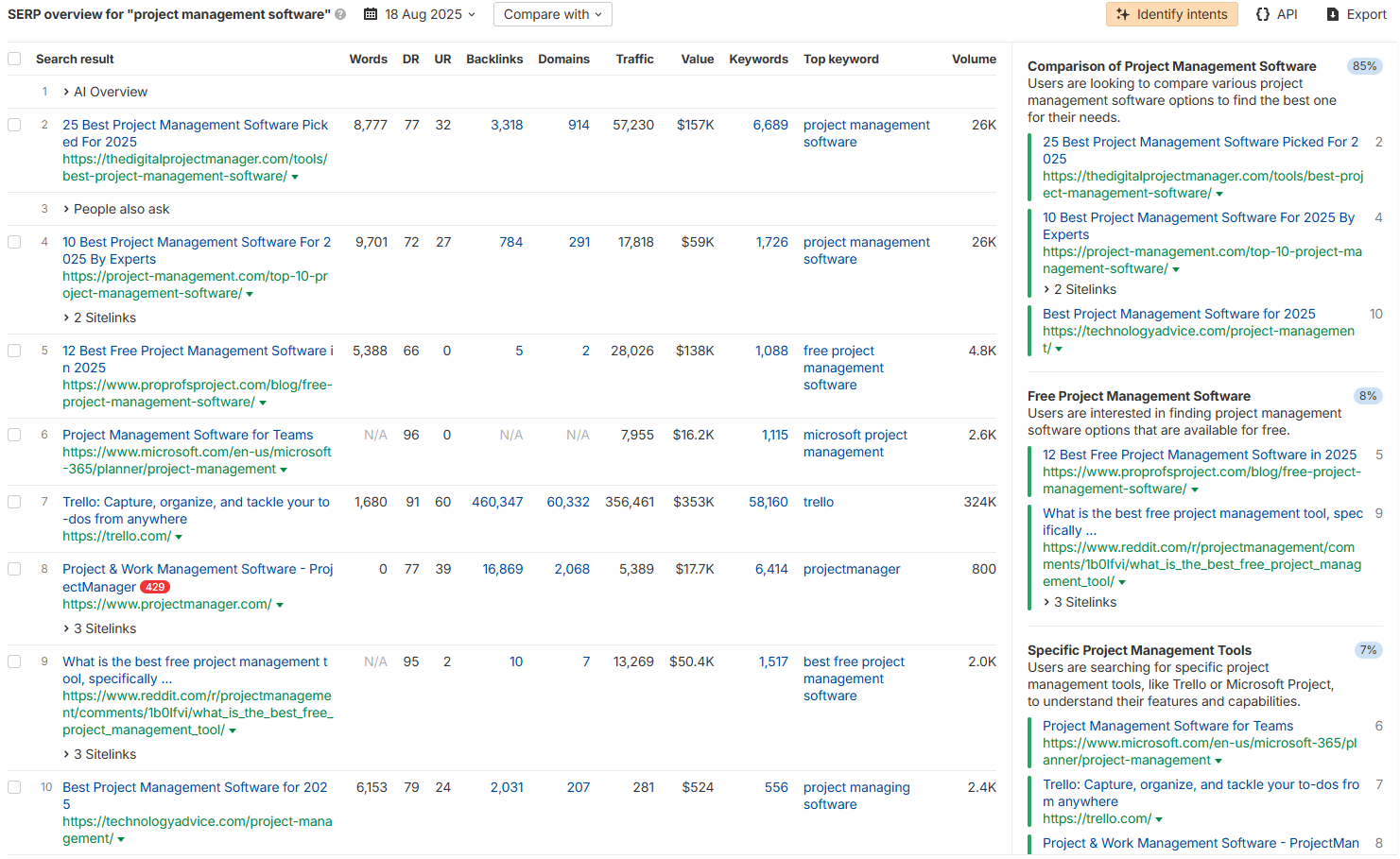
When you analyze “project management software” in the SERPs today, Google reveals three distinct user intents:

Screenshot by author, August 2025
  • Comparison seekers want comprehensive feature-by-feature analysis of multiple tools.
  • Budget-conscious users specifically need free options and pricing information.
  • Tool researchers are investigating specific platforms like Trello or Microsoft Project.

This split intent validates creating separate content pieces rather than trying to serve everyone with one page. You might develop:

  • “15 Best Project Management Software Tools Compared (2025)”
  • “Free Project Management Software: 8 Tools That Don’t Cost a Dime”
  • Individual tool reviews like “Trello Review: Features, Pricing & Best Use Cases”

Each piece targets the same root keyword but serves a specific behavioral intent that Google is already rewarding with page one rankings.

The Psychology Behind Search Patterns

Search behavior follows cognitive patterns that smart marketers can leverage. Anchoring bias means the first piece of information users see heavily influences their decisions. If your search snippet promises “complete guide,” but your page starts with a sales pitch, you’ve broken their mental model.

Social proof bias drives local search behavior especially hard. When someone searches [best pizza near me], they’re not just looking for pizza; they’re probably also looking for validation that others think it’s good, too. Your content should acknowledge this psychological need.

Screenshot from search for [best pizza near me], Google, August 2025

Understanding these patterns helps you create content that feels intuitive rather than forced.

How To Collect Customer Behavior Data That Actually Matters

The best behavior insights come from combining quantitative data with qualitative feedback. Here’s a systematic approach:

Start With Your Existing Analytics

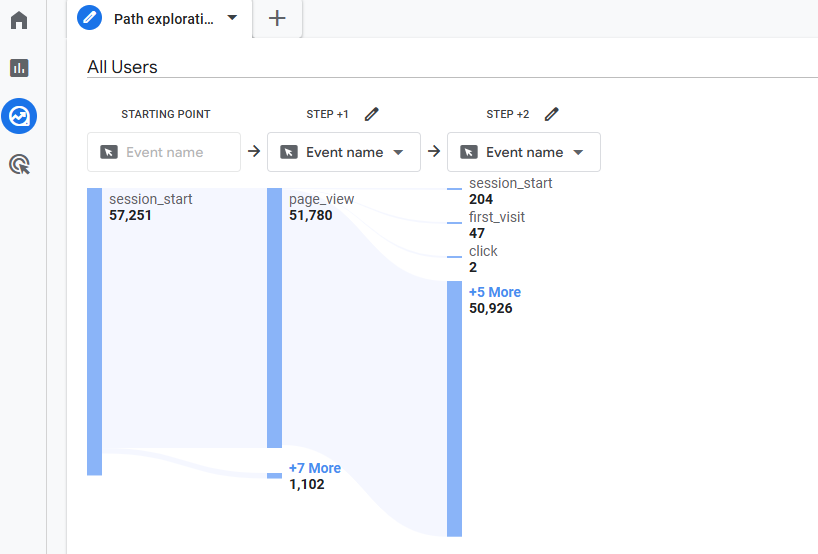
Google Analytics 4 Path Exploration shows how users navigate your site. Look for patterns like:

  • Which blog posts lead to product page visits.
  • Where users drop off in your conversion funnel.
  • What content keeps visitors engaged the longest.
Screenshot from support.google.com, August 2025

Google Search Console can reveal the gap between what you optimize for and what people actually search. Export your query data monthly and look for:

  • Long-tail variations of your target keywords.
  • Questions you haven’t answered yet.
  • Seasonal shifts in search language.

Pro tip: Sort queries by impressions, not clicks. High-impression, low-click queries (aside from highlighting a dominance of SERP features, or AI Overview summaries) often reveal content gaps where you’re visible but not compelling.

Add Heat Mapping And Session Recording

Tools like Hotjar or Microsoft Clarity (free) show you where users actually click, scroll, and abandon pages.

I once worked with an ecommerce client whose heatmaps revealed users repeatedly clicking on product images that weren’t linked to detail pages. We added those links and saw a 23% increase in product page visits within two weeks.

Mine Your Customer Service Data

Your support team handles the questions your website doesn’t answer. Export tickets from the past quarter and categorize them by topic. Common support questions often represent high-value, low-competition search opportunities.

If you’re getting 20 tickets per month about “how to integrate with Slack,” that’s content your competitors probably aren’t creating yet.

Listen To Social Conversations

Monitor industry hashtags, Reddit threads, and LinkedIn discussions in your space. Social media language is usually more casual and authentic than what people type into search; it’s where people complain about real problems using the exact words they’ll later search for solutions.

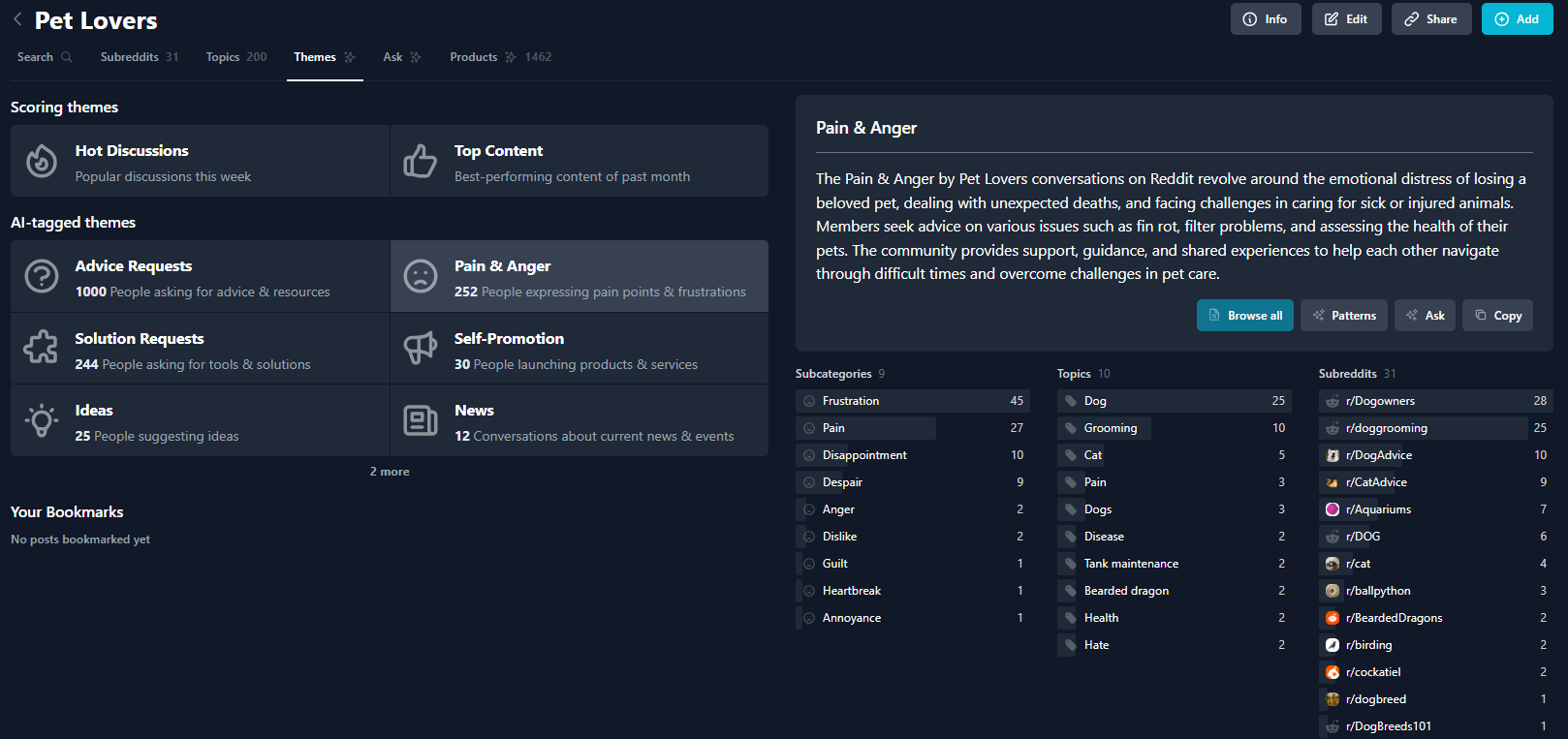
Reddit is particularly valuable because users share unfiltered frustrations and solution requests. Tools like GummySearch help you cut through Reddit’s noise by surfacing curated content themes like “Pain & Anger” and “Solution Requests” within your target audience communities.

Instead of manually scrolling through thousands of posts, you get direct access to the exact language your customers use when they’re frustrated.

Screenshot from GummySearch by author, August 2025

These authentic conversations reveal content opportunities that traditional keyword research misses.

When someone posts “I can’t believe there’s still no simple way to sync data between these platforms,” that frustration will likely become search queries like “easy data sync tools” or “simple platform integration” within weeks.

Translating Insights Into SEO Opportunities

Raw data means nothing until you turn it into actionable content strategies. Here’s how to connect behavior patterns to search opportunities:

Map Content To Customer Journey Stages

Your behavior data reveals different intent patterns that map to specific journey stages:

Awareness Stage Consideration Stage Decision Stage
Broad, educational searches Comparison and evaluation searches Specific product/vendor searches
“Why do small businesses need CRM software?” “HubSpot vs. Salesforce for small teams” “HubSpot pricing plans 2025”
Focus on educational content with minimal promotional elements Create detailed comparisons with pros/cons Optimize for conversion with clear CTAs
Internal links should guide toward mid-funnel content Include pricing, features, and use case scenarios Address common objections directly

Identify Content Gaps Through Competitor Analysis

Use Ahrefs or Semrush to analyze competitor content, then cross-reference with your customer behavior data. Look for topics where:

  • Competitors rank well, but their content doesn’t match user intent.
  • You have unique customer insights they’re missing.
  • Your support data reveals questions they don’t address.

For example, if competitor articles about “email marketing automation” focus on features but your customer interviews reveal people struggle with setup, create implementation-focused content instead.

Optimize For Behavior-Based Keywords

Traditional keyword research starts with seed terms and expands outward. Behavior-driven research starts with customer language and searches for gaps.

  • Instead of: “Best email marketing software”
  • Try: “Easy email marketing setup for non-technical founders”

The second phrase has lower search volume but higher intent alignment. Someone searching for [easy setup] has different needs than someone searching for [best software].

Create Dynamic Content Formats

Your analytics reveal format preferences by device, time, and topic:

  • Mobile users during commute hours: Scannable lists and quick tips.
  • Desktop users during work hours: Detailed guides and tutorials.
  • Weekend browsers: Visual content and case studies.

Don’t create one piece of content and hope it works everywhere. Adapt format to behavior patterns.

Measuring What Actually Moves The Needle

Behavior-driven SEO requires different success metrics than traditional approaches. Rankings matter less than engagement and conversion alignment.

Track Engagement Quality, Not Just Quantity

Traditional SEO celebrates traffic volume, but behavior-driven strategies focus on how well that traffic matches customer intent.

Average session duration becomes a strong indicator of content relevance. When someone spends 8 minutes reading your guide instead of bouncing in 30 seconds, you’ve aligned content with search intent. The key is tracking improvements over time rather than hitting arbitrary benchmarks.

Bounce rate tells a different story when you segment by traffic source. A high bounce rate might be terrible for targeted organic traffic, but completely normal for broad brand searches.

Compare your targeted organic bounce rate against your own baseline rather than industry averages. If you’re seeing consistent improvement month over month, your content is becoming more aligned with user expectations.

Pages per session reveals engagement depth and site navigation effectiveness. Users who visit multiple pages during a session are actively exploring your content ecosystem, suggesting strong topical authority and effective internal linking strategy.

Goal completion rates vary dramatically by industry and funnel complexity, so focus on your own conversion trends rather than external benchmarks. A B2B software company’s “good” conversion rate looks completely different from an ecommerce site’s performance.

Monitor Search Query Evolution

Your target keywords evolve as customer language changes, industry trends shift, and new problems emerge. Set up monthly Search Console exports to track these patterns systematically. New long-tail variations often appear before keyword tools catch them.

Seasonal language shifts reveal opportunities that competitors miss. B2B software searches change dramatically between the Q4 budget planning season and the Q1 implementation periods. Ecommerce terms shift from “best products” in research phases to “deals” and “discounts” during purchase windows.

Pay attention to emerging competitor terms appearing in your query data. When people start searching for “[competitor name] alternative” or “[your product] vs. [new competitor],” you’re seeing market shifts in real-time.

A/B Test Based On Behavior Insights

Your behavior data generates testing hypotheses that go far beyond traditional “red vs. blue button” experiments. Test different content depths for mobile and desktop users; mobile visitors often prefer scannable summaries, while desktop users engage with comprehensive guides. Experiment with heading structures based on user scanning patterns revealed in your heatmap data.

I recently helped a SaaS client test two versions of their pricing page. Version A used traditional feature comparisons organized by product tier. Version B addressed specific use cases revealed through customer interviews, such as scenarios like “growing startup needs better lead tracking” and “enterprise team wants advanced reporting.”

Version B increased conversions by 34% because it matched how customers actually think about solutions rather than how the product team organized features.

Set Up Feedback Loops

Customer behavior evolves constantly, so your measurement strategy needs systematic review cycles.

Create a monthly rhythm where Week 1 focuses on analyzing Search Console and Analytics data for new patterns. Week 2 involves reviewing customer service tickets and social media mentions for emerging language trends. Week 3 is for testing new content approaches based on fresh insights, while Week 4 handles planning next month’s content calendar around discovered opportunities.

This cycle keeps you responsive to behavior changes rather than reactive to ranking drops. Economic shifts, social trends, and industry developments all impact search patterns faster than traditional SEO tools can track them.

The Bottom Line

Behavior-driven SEO isn’t about abandoning keywords; it’s about understanding the humans behind every search query. When you align your content strategy with actual customer actions and intentions, engagement improves naturally and conversions follow.

Start by really listening to your customers through data, support interactions, and direct feedback. Your most successful content will come from solving real problems using language your audience actually uses.

Your customers are already telling you what they want; you just need to pay attention.

More Resources:


Featured Image: tadamichi/Shutterstock

https://www.searchenginejournal.com/how-to-build-seo-strategies-around-real-customer-behavior/554283/


How AI is Helping Brands Convert More Customers [Webinar] via @sejournal, @hethr_campbell

Turn insights into smarter conversions and higher ROI.

AI is changing how customers convert. Are your landing pages and CRO strategies keeping up? 

Each missed lead is lost revenue. 

Relying on traditional tactics is no longer enough.

Join Laura Beussman, CMO of CallRail, and Ryan Johnson, CPO of CallRail, for a live webinar where you’ll learn how top marketing leaders are using AI to prioritize leads, optimize funnels, and drive measurable growth.

What You’ll Learn

  • How to automatically prioritize and convert your best leads.
  • How to spot funnel drop-off points that are costing revenue.
  • CRO tactics to make your marketing funnel work smarter, not harder.
  • How to identify the exact messaging that boosts conversions and ROI.

Why Attend

This webinar will give you the tools to capture more leads, surface actionable insights from interactions, remove friction slowing conversions, and automate your CRO playbook for ongoing growth.

Register now to gain actionable strategies for faster, smarter conversions with AI.

🛑 Can’t attend live? Register anyway, and we’ll send you the full recording.

https://www.searchenginejournal.com/ai-helping-brands-convert-more-customers/557455/


What Our AI Mode User Behavior Study Reveals About The Future Of Search via @sejournal, @Kevin_Indig

Our new usability study of 37 participants across seven specific search tasks clearly shows that people:

  1. Read AI Mode
  2. Rarely click out, and
  3. Only leave when they are ready to transact.

From what we know, there isn’t another independent usability study that has explored AI Mode to this depth.

In May, I published an extensive two-part study of AI Overviews (AIOs) with Amanda, Eric Van Buskirk, and his team. Eric and I also collaborated on Propellic’s travel industry AI mode study.

We worked together again to bring you this week’s Growth Memo: a study that provides crucial insights and validation into the behaviors of people as they interact with Google’s AI Mode.

Since neither Google nor OpenAI (or anyone else) provides user data for their AI (Search) products, we’re filling a crucial gap.

We captured screen recordings and think-aloud sessions via remote study. The 250 unique tasks collected provide a robust data set for our analysis. (The complete methodology is provided at the end of this memo, including details about the seven search tasks.)

And you might be surprised by some of the findings. We were.

This is a longer post, so grab a drink and settle in.
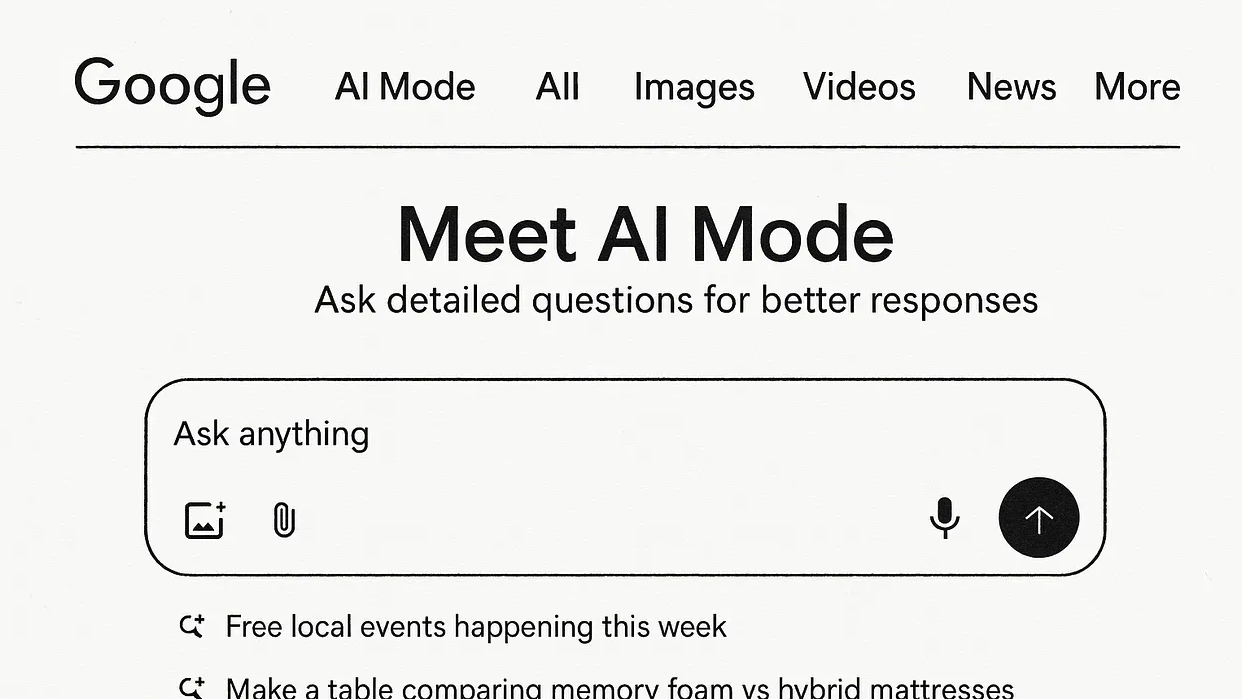
Image Credit: Kevin Indig

Executive Summary

Our new usability study of Google’s AI Mode reveals how profoundly this feature changes user behavior.

  • AI Mode holds attention and keeps users inside. In roughly three‑quarters of the total user sessions, users never left the AI Mode pane – and 88 % of users’ first interactions were with the AI‑generated text. Engagement was high: The median time by task type was roughly 52-77 seconds.
  • Clicks are rare and mostly transactional. The median number of external clicks per task was zero. Yep. You read that right. Ze-ro. And 77.6% of sessions had zero external visits.
  • People skim but still make decisions in AI Mode. Over half of the tasks were classified as “skimmed quickly,” where users glance at the AI‑generated summary, form an opinion, and move on.
  • AI Mode delivers “site types” that match intent. It’s not just about meeting search query or prompt intents; AI Mode is citing sources that fit specific site categories (like marketplaces vs review sites vs brands).
  • Visibility, not traffic, is the emerging currency. Participants made their brand judgments directly from AI Mode outputs.

TL;DR? These are the core findings from this study:

  • AI Mode is sticky.
  • Clicks are reserved for transactions.
  • AI Mode matches site type with intent.
  • Product previews act like mini product detail pages (aka PDPs).

But before we dig in, a quick shout-out here to the team behind this study.

Together with Eric Van Buskirk’s team at Clickstream Solutions, I conducted the first broad usability study of Google’s AI Mode that uncovers not only crucial insights into how people interact with the hybrid search/AI chat engine, but also what kinds of branded sites AI Mode surfaces and when.

I want to highlight that Eric Van Buskirk was the research director. While we collaborated closely on shaping the research questions, areas of focus, and methodology, Eric managed the team, oversaw the study execution, and delivered the findings. Afterward, we worked side by side to interpret the data.

Click data is a great first pass for analysis on what’s happening in AI Mode, but with this usability study specifically, we essentially looked “over the shoulder” of real-life users as they completed tasks, which resulted in a robust collection of data to pull insights from.

Our testing platform was UXtweak.

Boost your skills with Growth Memo’s weekly expert insights. Subscribe for free!

Google’s own Sundar Pichai has been crystal clear: AI Mode isn’t a toy; it’s a proving ground for what the core search experience will look like in the future.

On the Lex Fridman podcast, Pichai said (bolding mine):

“Our current plan is AI Mode is going to be there as a separate tab for people who really want to experience that… But as features work, we’ll keep migrating it to the main page…” [1]

Google has argued these new AI-focused features are designed to point users to the web, but in practice, our data shows that users stick around and make decisions without clicking out. In theory, this could not only impact click-outs to organic results and citations, but also reduce external clicks to ads.

In August, I explored the reality behind Google’s own product cannibalization with AI Mode and AIOs:

Right now, according to Similarweb data, usage of the AI Mode tab on Google.com in the US has slightly dipped and now sits at just over 1%.

Google AIOs are now seen by more than 1.5 billion searchers every month, and they sit front and center. But engagement is falling. Users are spending less time on Google and clicking less pages.

But as Google rolls AI Mode out more broadly, it brings the biggest shift to Search (the biggest customer acquisition channel there is) ever.

Traditional SEO is highly effective in the new AI world, but if AI Mode really becomes the default, there is a chance we need to rethink our arsenal of tactics.

Preparing for the future of search means treating AI Mode as the destination (not the doorway), and figuring out how to show up there in ways that actually matter to real user behavior.

With this study, I sought out to discover and validate actual user behaviors within the AI Mode experience when undertaking a variety of tasks with differing search intents.

1. AI Mode Is Sticky
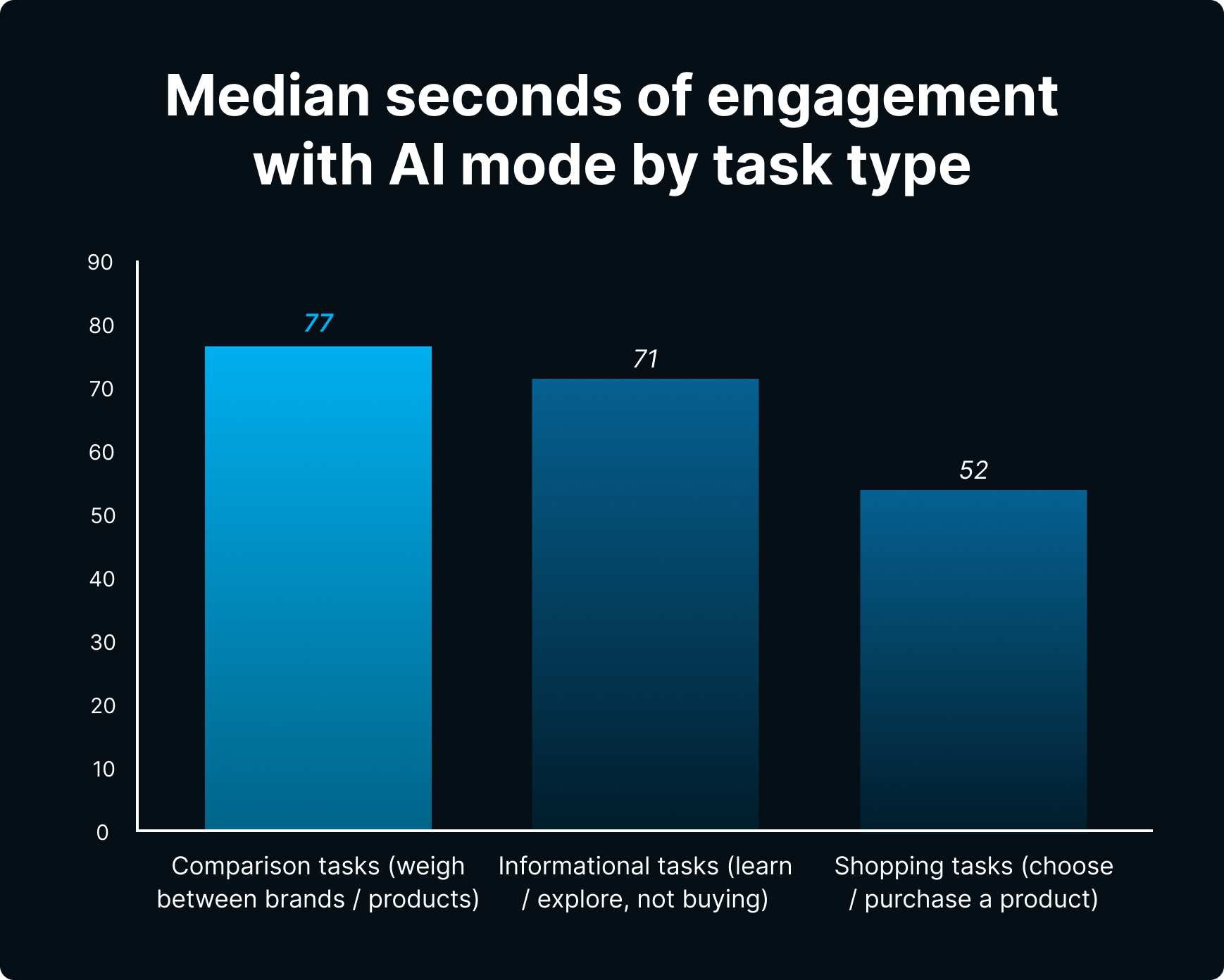
Image Credit: Kevin Indig

Key Stats

People read first and usually stay inside the AI Mode experience. Here’s what we found:

  • The majority of sessions had zero external visits: meaning, they didn’t leave AI Mode (at all).
  • ~88% of users’ first interaction* within the feature was with the AI Mode text.
  • Typical user engagement within AI Mode is roughly 50 to 80 seconds per task.

These three stats define the AI Mode search surface: It holds attention and resolves many tasks without sending traffic.

*Here’s what I mean by “interaction:”

  • An “interaction” within the user tasks = the participant meaningfully engaged with AI Mode after it loaded.
  • What counts as an interaction: Reading or scrolling the AI Mode body for more than a quick glance, including scanning a result block like the Shopping Pack or Right Pane, opening a merchant card, clicking an inline link, link icon, or image pack.
  • What doesn’t count as an interaction: Brief eye flicks, cursor passes, or hesitation before engaging.

Users are in AI Mode to read – not necessarily to browse or search – with ~88% of sessions interacting with the output’s text first and spending one minute or more within the AI Mode experience.

Plus, it’s interesting to see that users spend more than double the time in AI Mode compared to AIOs.

The overall engagement is much stronger.
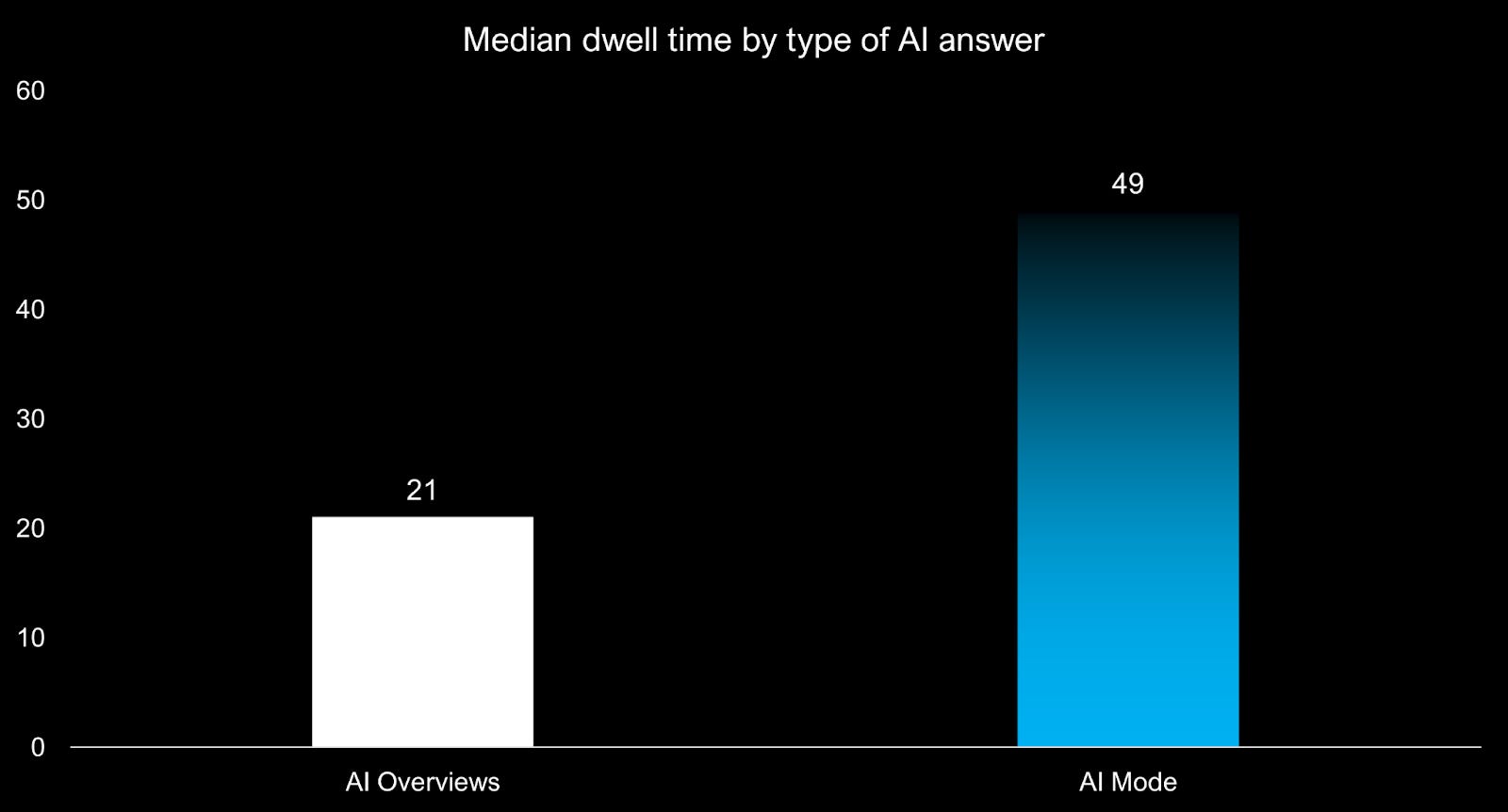
Image Credit: Kevin Indig

Why It Matters

Treat the AI Mode panel like the primary reading surface, not a teaser for blue links.

AI Mode is a contained experience where sending clicks to websites is a low priority and giving users the best answer is the highest one.

As a result, it completely changes the value chain for content creators, companies, and publishers.

Insight

Why do other sources and/or AI Mode research analyses say that users don’t return to the AI Mode feature very often?

My theory here is that, because AI mode is a separate search experience (at least, for now), it’s not as visible as AIOs.

As AI Mode adoption increases with Google bringing Gemini (and AI Mode) into the browser, I expect our study findings to scale.

2. Clicks Are Reserved For Transactions

While clicks are scarce, purchase intent is not.

Participants in the study only clicked out when the task demanded it (e.g., “put an item in your shopping cart”) or if they browsed around a bit.

However, the browsing clicks were so few that we can safely assume AI Mode only leads to click-outs when users want to purchase.

Even prompts with a comparison and informational intent tend to keep users inside the feature.

  • Shopping prompts like [canvas bag] and [tidy desk cables] drive the highest AI Mode exit share.
  • Comparison prompts like [Oura vs Apple Watch] show the lowest exit share of the tasks.

When participants were encouraged to take action (“put an item in your shopping cart” or “find a product”), the majority of clicks went to shopping features like Shopping Packs or Merchant Cards.
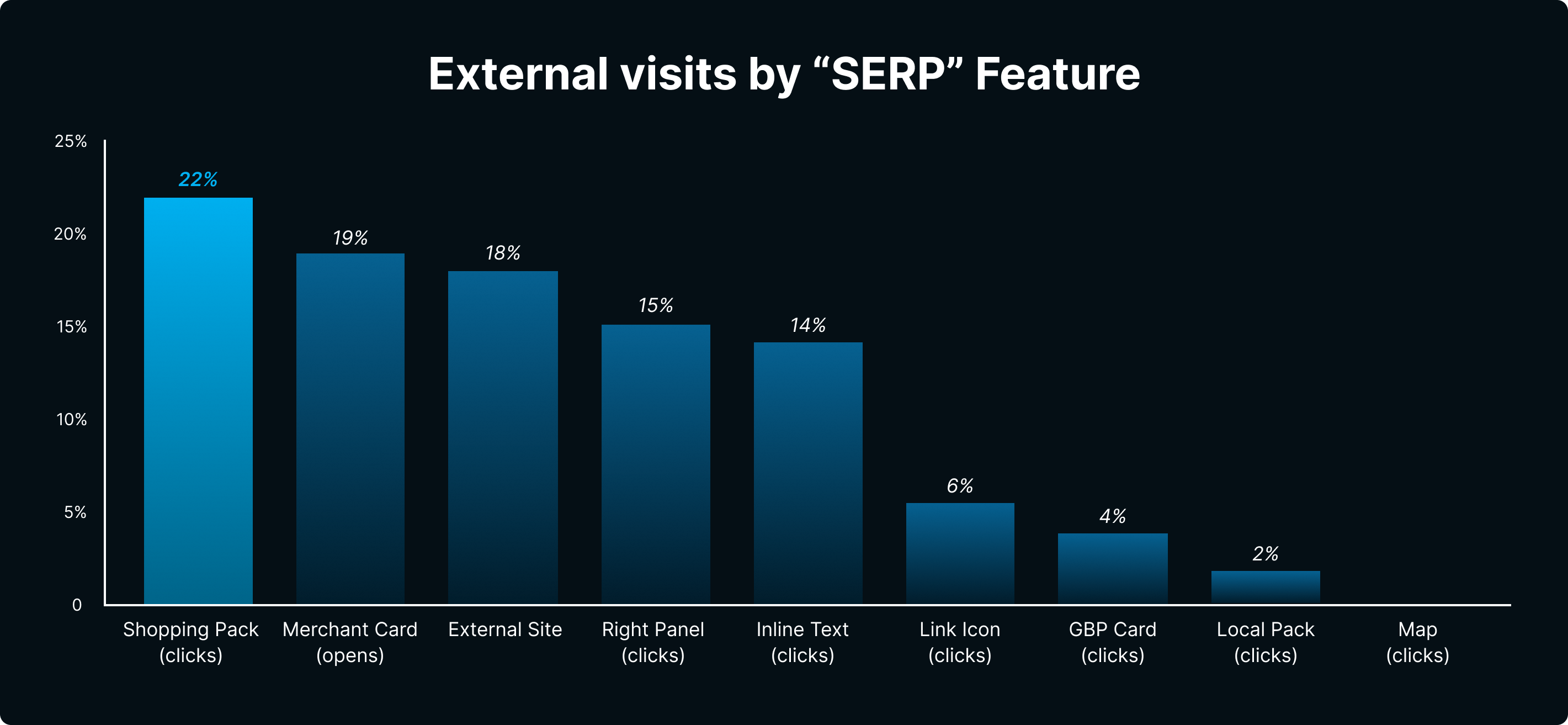
Image Credit: Kevin Indig

18% of exits were caused by users exiting AI Mode and going directly to another site, making it much harder to reverse engineer what drove these visits in the first place.

Study transcripts confirm that participants often share out loud that they’ll “go to the seller’s page,” or “find the product on Amazon/ebay” for product searches.

Even when comparing products, whether software or physical goods, users barely click out.
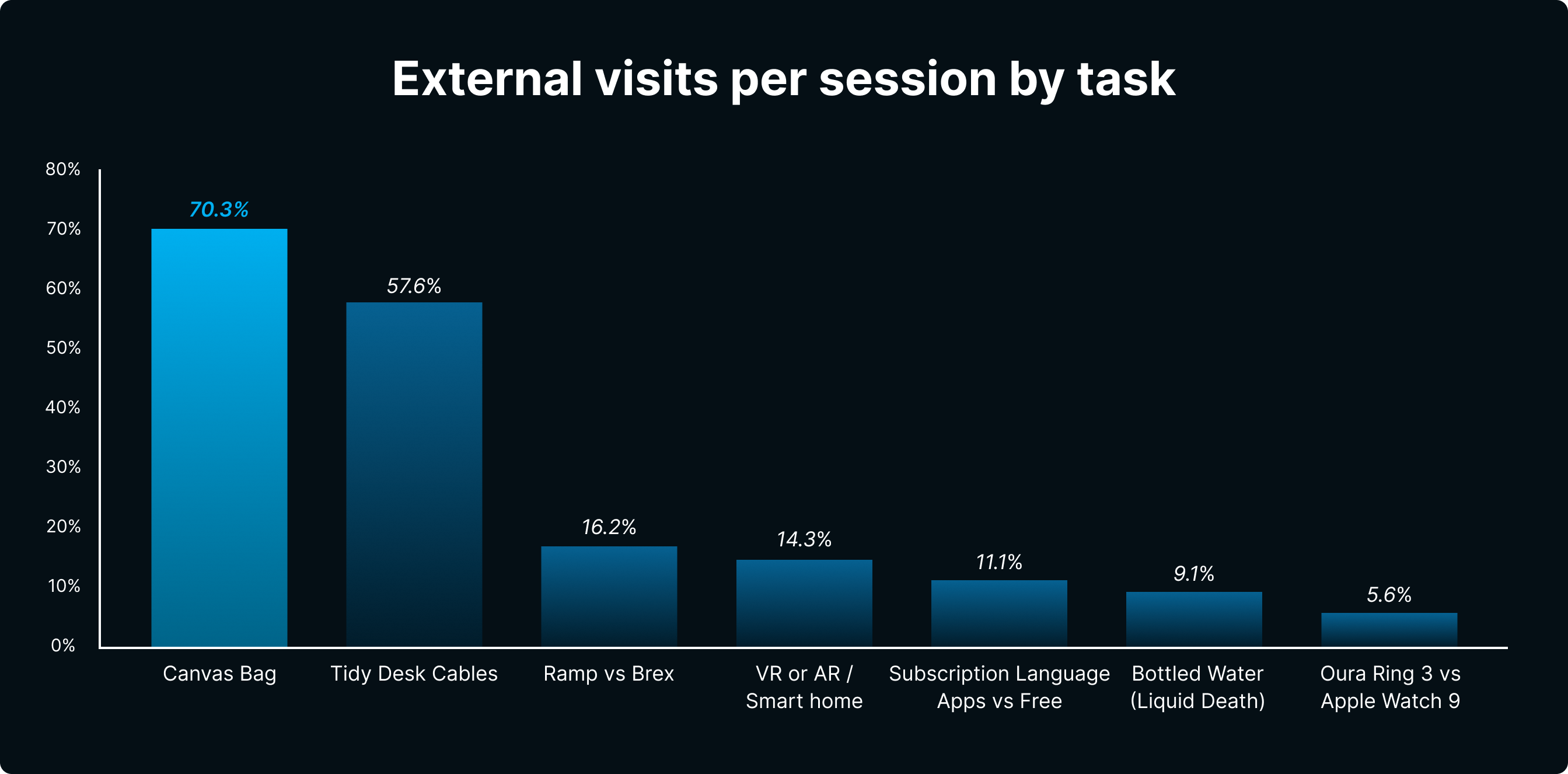
Image Credit: Kevin Indig

In plain terms, AI mode eats up all TOFU and MOFU clicks. Users discover products and form opinions about them in AI Mode.

Key Stats

  • Out of 250 valid tasks, the median number of external clicks was zero!
  • The prompt task of [canvas bag] had 44 external clicks, and [tidy desk cables] had 31 clicks, accounting for two-thirds of all external clicks in this study.
  • Comparison tasks like [Oura Ring vs Apple Watch] or [Ramp vs Brex] had very few clicks (≤6 total across all tasks).

Here’s what’s interesting…

In the AIOs Overviews usability study, we found desktop users click out ~10.6% of the time compared to practically 0% in AI Mode.

However, AIOs have organic search results and SERP Features below them. (People click out less in AIOs, but they click on organic results and SERP features more often.)

Zero-Clicks

  • AI Overviews: 93%*
  • AI Mode: ~100%

*Keep in mind that participants of the AIO usability study clicked on regular organic search results. The 93% relates to zero clicks within the AI Overview.

On desktop, AI Mode produces roughly double the in-panel clickouts compared to the AIO panel. On AIO SERPs, total clickouts can still happen via organic results below the panel, so the page-level rate will sit between the AIO-panel figure and the classic baseline.

An important note here from Eric Van Kirk, the director of this study: When comparing the AI Mode and AI Overview study, we’re not exactly comparing apples to apples. In this study, participants were given tasks that would prompt them to leave AI Mode in 2/7 questions, and that accounts for the majority of outbound clicks (which were fewer than three external clicks). On the other hand, for the AIO study, the most transactional question was “Find a portable charger for phones under $15. Search as you typically would.” They were not told to “put it in a shopping cart.” However, the insights gathered regarding user behavior from this AI Mode study – and the pattern that users don’t feel the need to click out of AI Mode to make additional decisions – still stands as a solid finding.

The bigger picture here is that AIOs are like a fact sheet that steers users to sites eventually, but AI Mode is a closed experience that rarely has users clicking out.

What makes AI Mode (and ChatGPT, by the way) tricky is when users abandon the experience and go directly to websites. It messes with attribution models and our ability to understand what influences conversions.

3. AI Mode Matches Site Type With Intent

In the study, we assess what types of sites AI Mode shows for our seven tasks.

The types are:

  • Brands: Sellers/vendors.
  • Marketplaces: amazon.com, ebay.com, walmart.com, homedepot.com, bestbuy.com, target.com, rei.com.
  • Review sites: nerdwallet.com, pcmag.com, zdnet.com, nymag.com, usatoday.com, businessinsider.com.
  • Publishers: nytimes.com, nbcnews.com, youtube.com, thespruce.com.
  • Platform: Google.
Image Credit: Kevin Indig

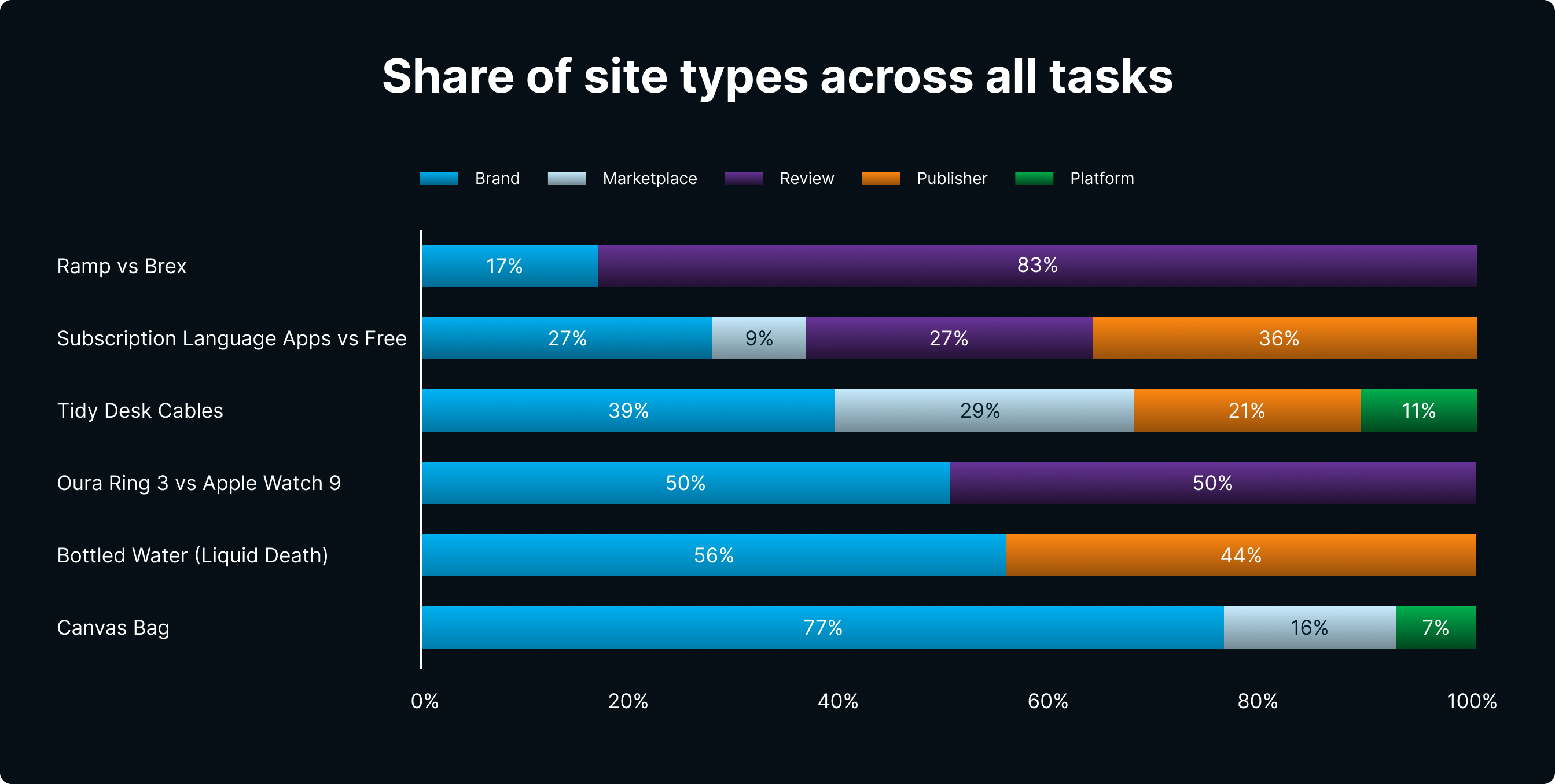
Shopping prompts route to product pages:

  • Canvas Bag: 93% of exits go to Brand + Marketplace.
  • Tidy desk cables: 68% go to Brand + Marketplace, with a visible Publisher slice.

Comparisons route to reviews:

  • Ramp vs Brex: 83% Review.
  • Oura vs Apple Watch: split 50% Brand and 50% Marketplace.

When the user has to perform a reputation check, the result is split brand and publishers:

  • Liquid Death: 56% Brand, 44 % Publisher.

Google itself shows up on shopping tasks:

  • Store lookups to business.google.com appear on Canvas Bag (7%) and Tidy desk cables (11%).

Check out the top-clicked domains by task:

  • Canvas Bag: llbean.com, ebay.com, rticoutdoors.com, business.google.com.
  • Tidy desk cables: walmart.com, amazon.com, homedepot.com.
  • Subscription language apps vs free: pcmag.com, nytimes.com, usatoday.com.
  • Bottled Water (Liquid Death): reddit.com, liquiddeath.com, youtube.com.
  • Ramp vs Brex: nerdwallet.com, kruzeconsulting.com, airwallex.com.
  • Oura Ring 3 vs Apple Watch 9: ouraring.com, zdnet.com.
  • VR arcade or smart home: sandboxvr.com, business.google.com, yodobashi.com.

Companies need to understand the playing field. While classic SEO allowed basically any site to be visible for any user intent, AI Mode has strict rules:

  • Brands beat marketplaces when users know what product they want.
  • Marketplaces are preferred when options are broad or generic.
  • Review sites appear for comparisons.
  • Opinions highlight Reddit and publishers.
  • Google itself is most visible for local intent, and sometimes shopping.

As SEOs, we need to consider how Google classifies our site based on its page templates, reputation, and user engagement. But most importantly, we need to monitor prompts in AI Mode and look at the site mix to understand where we can play.

Sites can’t and won’t be visible for all types of queries in a topic anymore; you’ll need to filter your strategy by the intent that aligns with your site type because AI Mode only shows certain sites (like review sites or brands) for specific types of intent.

Product previews show up in about 25% of the AI Mode sessions, get ~9 seconds of attention, and people usually open only one.

Then? 45% stop there. Many opens are quick spec checks, not a clickout.
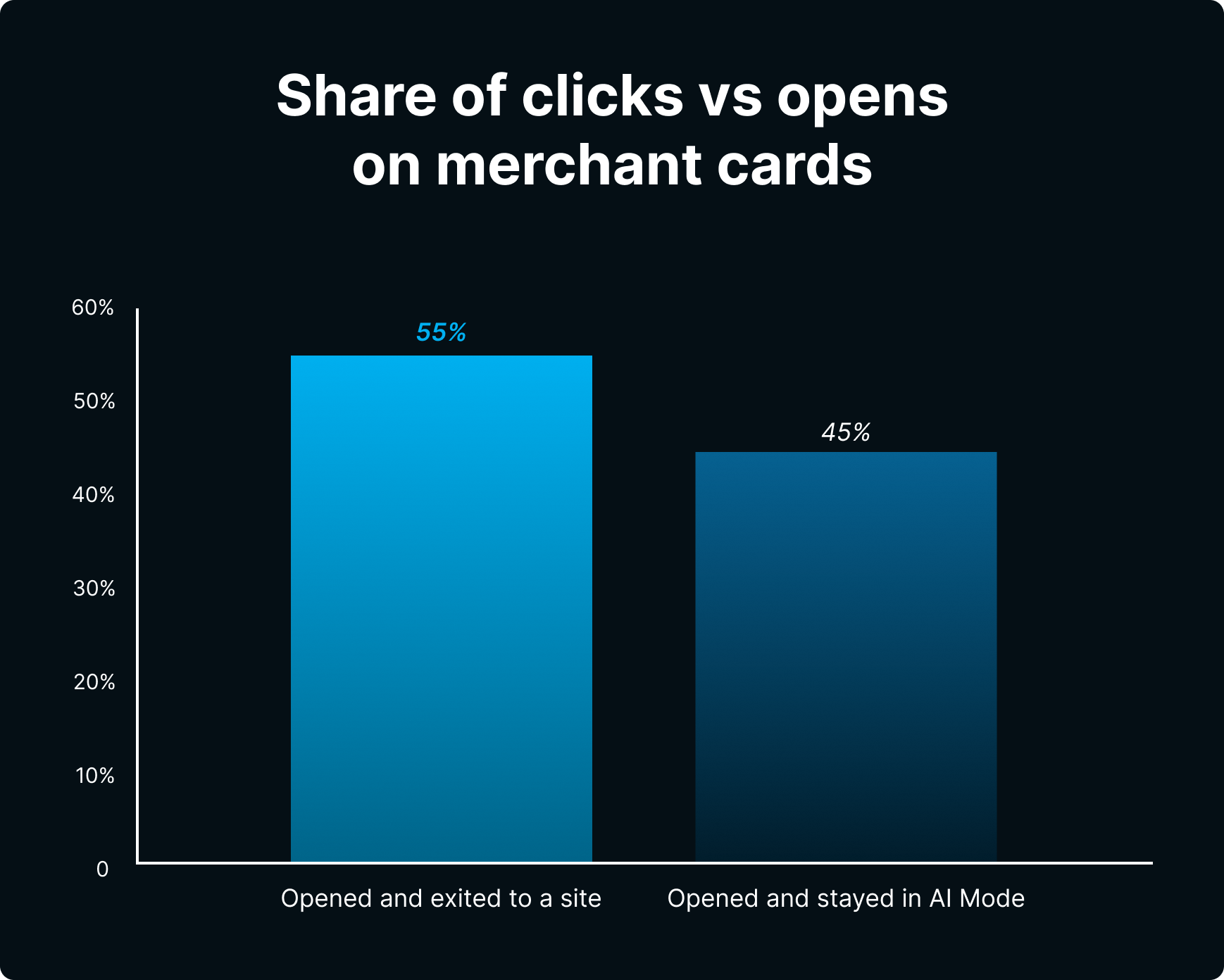
Image Credit: Kevin Indig

You can easily see how some product recommendations by AI Mode and on-site experiences are quite frustrating to users.

The post-click experience is critical: classic best practices like reviews have a big impact on making the most out of the few clicks we still get.

See this example:

“It looks like it has a lot of positive reviews. That’s one thing I would look at if I was going to buy this bag. So this would be the one I would choose.”

In shopping tasks, we found that brand sites take the majority of exits.

In comparison tasks, we discovered that review sites dominate. For reputation checks (like a prompt for [Liquid Death]), exits to brands and publishers were split.

  • For transactional intent prompts: Brands absorb most exits when the task is to buy one item now. [Canvas Bag] shows a strong tilt to brand PDPs.
  • For reputation intent prompts: Brand sites appear alongside publishers. A prompt for [Liquid Death] splits between liquiddeath.com and Reddit/YouTube/Eater.
  • For comparison prompts: Brands take a back seat. [Ramp vs Brex] exits go mostly to review sites like NerdWallet and Kruze.

Given users can now directly checkout on ChatGPT and AI Mode, shopping-related tasks might send even fewer clicks out.[2, 3]

Therefore, AI Mode becomes a completely closed experience where even shopping intent is fulfilled right in the app.

Clicks are scarce. Influence is plentiful.

The data gives us a reality check: If users continue to adopt the new way of Googling, AI Mode will reshape search behavior in ways SEOs can’t afford to ignore.

  • Strategy shifts from “get the click” to “earn the citation.”
  • Comparisons are for trust, not traffic. They reduce exits because users feel informed inside the panel.
  • Merchants should optimize for decisive exits. Give prices, availability, and proof above the fold to convert the few exits you do get.

You’ll need to earn citations that answer the task, then win the few, high-intent exits that remain.

But our study doesn’t end here.

Today’s results reveal core insights into how people interact with AI Mode. We’ll unpack more to consider with Part 2 dropping next week.

But for those who love to dig into details, the methodology of the study is included below.

Methodology

Study Design And Objective

We conducted a mixed-methods usability study to quantify how Google’s new AI Mode changes searcher behavior. Each participant completed seven live Google search prompts via the AI Mode feature. This design allows us to observe both the mechanics of interaction (scrolls, clicks, dwell, trust) and the qualitative reasoning participants voiced while completing tasks.

The tasks:

  1. What do people say about Liquid Death, the beverage company? Do their drinks appeal to you?
  2. Imagine you’re going to buy a sleep tracker and the only two available are the Oura Ring 3 or the Apple Watch 9. Which would you choose, and why?
  3. You’re getting insights about the perks of a Ramp credit card vs. a Brex Card for small businesses. Which one seems better? What would make a business switch from another card: fee detail, eligibility fine print, or rewards?
  4. In the “Ask anything” box in AI Mode, enter “Help me purchase a waterproof canvas bag.” Select one that best fits your needs and you would buy (for example, a camera bag, tote bag, duffel bag, etc.).
    • Proceed to the seller’s page. Click to add to the shopping cart and complete this task without going further.
  5. Compare subscription language apps to free language apps. Would you pay, and in what situation? Which product would you choose?
  6. Suppose you are visiting a friend in a large city and want to go to either: 1. A virtual reality arcade OR 2. A smart home showroom. What’s the name of the city you’re visiting?
  7. 1. Suppose you work at a small desk and your cables are a mess. 2. In the “Ask anything” box in AI Mode, enter: “The device cables are cluttering up my desk space. What can I buy today to help?” 3. Then choose the one product you think would be the best solution. Put it in the shopping cart on the external website and end this task.

Thirty-seven English-speaking U.S. adults were recruited via Prolific between Aug. 20 and Sept. 1, 2025 (including participants in a small group who did pilot studies).*

Eligibility required a ≥ 95% Prolific approval rate, a Chromium-based browser, and a functioning microphone. Participants visited AI Mode and performed tasks remotely via their desktop computer; invalid sessions were excluded for technical failure or non-compliance. The final dataset contains over 250 valid task records across 37 participants.

*Pilot studies are conducted first in remote usability testing to identify and fix technical issues – like screen-sharing, task setup, or recording problems – before the main study begins. They help refine task wording, timing, and instructions to ensure participants interpret them correctly. Most importantly, pilot sessions confirm that the data collected will actually answer the research questions and that the methodology works smoothly in a real-world remote setting.

Sessions ran in UXtweak’s Remote unmoderated mode. Participants read a task prompt, clicked to Google.com/aimode, prompted AI Mode, and spoke their thoughts aloud while interacting with AI Mode. They were given the following directions: “Think aloud and briefly explain what draws your attention as you review the information. Speak aloud and hover your mouse to indicate where you find the information you are looking for.” Each participant completed seven task types designed to cover diverse intent categories, including comparison, transactional, and informational scenarios.

UXtweak recorded full-screen video, cursor paths, scroll events, and audio. Sessions averaged 20-25 minutes. Incentives were competitive. Raw recordings, transcripts, and event logs were exported for coding and analysis.

Three trained coders reviewed each video in parallel. A row was logged for UI elements that held attention for ~5 seconds or longer. Variables captured included:

  • Structural: Fields describing the setup, metadata, or structure of the study – not user behavior; include data like participant-ID, task-ID, device, query, order of UI elements clicked or visited during the task, type of site clicked (e.g., social, community, brand, platform), domain name of the external site visited, and more.
  • Feature: Fields describing UI elements or interface components that appeared or were available to the participant. Examples include UI element type, including shopping carousels, merchant cards, right panel, link icons, map embed, local pack, GMB card, merchant packs, and merchant cards.
  • Engagement: Fields that capture active user interaction, attention, or time investment. Includes reading and attention, chat and question behavior, along with click and interaction behavior.
  • Outcome: Fields representing user results, annotator evaluations, or interpretation of behavior. Annotator comments, effort rating, where info was found.

Coders also marked qualitative themes (e.g., “speed,” “skepticism,” “trust in citations”) to support RAG-based retrieval. The research director spot-checked ~10% of videos to validate consistency.

Annotations were exported to Python/pandas 2.2. Placeholder codes (‘999=Not Applicable’, ‘998=Not Observable’) were removed, and categorical variables (e.g., appearances, clicks, sentiment) were normalized. Dwell times and other time metrics were trimmed for extreme outliers. After cleaning, ~250 valid task-level rows remained.

Our retrieval-augmented generation (RAG) pipeline enabled three stages of analysis:

  • Data readiness (ingestion): We flattened every participant’s seven tasks into individual rows, cleaned coded values, and standardized time, click, and other metrics. Transcripts were retained so that structured data (such as dwell time) could be associated with what users actually said. Goal: create a clean, unified dataset that connects behavior with reasoning.
  • Relevance filtering (retrieval): We used structured fields and annotations to isolate patterns, such as users who left AI Mode, clicked a merchant card, or showed hesitation. We then searched the transcripts for themes such as trust, convenience, or frustration. Goal: combine behavior and sentiment to reveal real user intent.
  • Interpretation (quant + qual synthesis): For each group, we calculated descriptive stats (dwell, clicks, trust) and paired them with transcript evidence. That’s how we surfaced insights like: “external-site tasks showed higher satisfaction but more CTA confusion.” Goal: link what people did with what they felt inside AI Mode.

This pipeline allowed us to query the dataset hyperspecifically – e.g., “all participants who scrolled >50% in AI Mode but expressed distrust” – and link quantitative outcomes with qualitative reasoning.

In plain terms: We can pull up just the right group of participants or moments, like “all the people who didn’t trust AIO” or “everyone who scrolled more than 50%.”

We summarized user behavior using descriptive and inferential statistics across 250 valid task records. Each metric included the count, mean, median, standard deviation, standard error, and 95% confidence interval. Categorical outcomes, such as whether participants left AI Mode or clicked a merchant card, were reported as proportions.

Analyses covered more than 50 structured and behavioral fields – from device type and dwell time to UI interactions, sentiment. Confidence measures were derived from a JSON analysis of user sentiment via transcripts of all users.

Each task was annotated by a trained coder and spot-checked for consistency across annotators. Coder-level distributions were compared to confirm stable labeling patterns and internal consistency.

Thirty-seven participants completed seven tasks each, resulting in approximately 250 valid tasks. At that scale, proportions around 50% carry a margin of error of about six percentage points, giving the dataset enough precision to detect meaningful directional differences.

Sample size is smaller than our AI Overviews study (37 vs. 69 participants) and is meant to learn about U.S.-based users (all participants were living in the U.S.). All queries took place within AI Mode, meaning we did not directly compare AI vs non-AI conditions. Think-aloud may inflate dwell times slightly. RAG-driven coding is only as strong as its annotation inputs, though heavy spot-checks confirmed reliability.

Participants gave informed consent. Recordings were encrypted and anonymized; no personally identifying data were retained. The study conforms to Prolific’s ethics policy and UXtweak TOS.


Featured Image: Paulo Bobita/Search Engine Journal

https://www.searchenginejournal.com/what-our-ai-mode-user-behavior-study-reveals-about-the-future-of-search/557697/




Be Human, Speak To Humans: Effective Social Media Management Is Human-Centered

This edited excerpt is from “The 10 Principles of Effective Social Media Marketing” by Jon-Stephen Stansel ©2025 and is reproduced and adapted with permission from Kogan Page Ltd.

People log into social networks to hear from people, not from brands. They want to connect with their friends, families, and communities. They want to see content that relates to their interests and passions, and speaks to them in some way.

If your post sounds like it was written by a committee of businesspeople and then edited by a team of lawyers, before being approved by your board, no one is going to pay attention – much less purchase your product.

If you want to connect with humans, you need to speak like a human.

Creating Human-Centered Content

This is all well and good, but what does it mean to “be human” on social media? We are all human. How can we be anything else?

While most marketers will have their own definitions of what these two terms mean to them, for the purposes of this book, here are mine:

Human content: Social media content that speaks with a real human voice and not one that sounds like corporate speak or legalese. It speaks to its audience and not at them in a voice that is clear, easy to understand, and unafraid to show emotion or opinion.

Authentic content: Social media content that is true to the voice of the brand speaking. It doesn’t pander, change drastically, or try to be something it’s not, but rather fully embraces its identity and doesn’t shy away from it.

Why are these things important? Because people connect with people they trust. If your brand sounds like every post was written by committee, then run through multiple departments for approval, and then rewritten by legal, the connection is lost. And if your brand tries to be something it’s not, your audience will smell it out from miles away and not be shy about telling you what they think of it.

But if you are human and authentic, something almost magical happens. Your audience stops thinking of you as a brand trying to sell them something and starts thinking of you as a trusted connection.

Create Content For Audiences, Not Algorithms

If there is one evergreen rule of social media algorithms, it’s this: Social media algorithms favor content that keeps users on the platform longer. This only makes sense. Social media platforms are not in the business of helping your business for free. They are in the business of providing eyeballs for paid advertising.

In this respect, social media platforms aren’t that different from old-school broadcast television networks. If audiences find your content interesting and it keeps users on the platform longer, the algorithm will move it to prime time by placing it in the feeds of more users. But if your content fails to keep users on the platform, as demonstrated by view time and engagement, the algorithm will stop showing it.

Trying to tailor all your content to fit the whims of the social media algorithms is at best a Sisyphean task, because even if you somehow master it, the algorithms will change again, and you’ll be back to square one.

So, what’s a frustrated social media manager to do?

I propose that we all stop worrying about and focusing so much time and attention on social media algorithms and instead, put that energy into creating content that appeals to our target audience. Too many social media managers are creating content for the algorithms and not the audiences they serve. This leads to content that is homogenous, bland, and boring.

You can’t paint-by-numbers your way to social media success. The algorithm is out of your control, and focusing too much on pleasing the algorithm often means you are not focusing enough on pleasing your audience.

After all, we are making content for humans, not algorithms.

Avoid The Hard Sell

No one opens Facebook or any other social network on their phone hoping to be sold to. They are there to see updates from family and friends, catch up on the news, or learn more about the things that interest them – and your posts just happen to be alongside those things. So, if you try to sell them your product with every post, demanding that they “Buy now!” like some old-school infomercial pitchman, your content is going to get ignored.

We must never fail to remember that, as brands, we are at best only guests in our audience’s social media feeds and at worst we are intruders. We can’t lose sight of the fact that by following our brands, users are granting us the privilege of showing up in their social media feeds each day. We abuse this privilege at our peril. When we only share self-promotional, hard-sell content, we are being poor guests.

But when we show up with content that is entertaining, educational, human, and personable, we become the type of guests that our followers are eager to invite into their social media feeds and tell their friends about as well. We must always be respectful and mindful of the fact that, by following us, our audience has granted us a privilege that we must continue to earn with each post – lest they decide to kick us out by pressing the unfollow button.

Know Your Audience

You can’t speak to your audience if you don’t listen to them first. What are their likes and dislikes, challenges, frustrations, interests, etc.? Do they skew older or younger? Male or female? Liberal or conservative? Urban or rural? Do a deep dive into your audience. If you can, hang out in the places they are online. Join the Facebook groups they are in. Scroll the subreddits they post on. Read the comments on the YouTube videos they watch. You might even consider going undercover and creating burner accounts to join their Facebook groups and Discord servers to see what they are talking about.

This is a lot easier if you run social media for a sports team or film franchise where fan groups and subreddits abound, but every industry has a community, and just because a community might be small, it doesn’t mean it can’t be loud about voicing its thoughts and opinions. Seriously – there are online communities for people who like scented candles. They are called “fandles,” and if they have groups dedicated to their interest, your brand has people out there dedicated to your industry. Find them and listen to them. These communities may not be as large as those for film franchises or sports teams, but they are no less passionate.

Take the time to learn about your audience: their likes and dislikes, their inside jokes, the language they use or avoid. Get to know their community and the leaders in it. You’ll quickly find that’s worth the effort.

Interact With Your Followers

Unlike television, print, or radio, users can talk back. And by creating and maintaining social media accounts for your brand, you are telling your customers that you want them to do so. If you don’t reply and interact with them, it’s like if you posted your phone number on billboards all around town but never picked up the phone when it rang. Eventually, people are just going to stop calling.

While you don’t need to reply to every single comment you receive, you should make an effort to engage with as many comments as possible and do so in language that is clear, friendly, and conversational, not stilted, reserved, and corporate. Remember that you are a human talking to other humans. It’s social media, not a board meeting.

Remember The Real Reason People Share Content

Here’s a secret most people forget about social media marketing. People don’t share content to help your brand. They share content to say something about themselves. They want to tell their friends and followers that they are the kind of person who has a certain type of humor, cares about certain issues, is interested in certain things. They share content that helps them tell the world who they are. If you help them tell their own story, they will help you tell yours.

If your content tugs at the heartstrings, makes someone chuckle, or teaches your audience something new, they are more likely to share it because it resonates with them and helps them better represent themselves online – not because they want to help your brand get the word out about a new product. No one shares the ad for a used car lot that demands you buy today before the deal ends. But the ad that makes them laugh or cry? That’s the one they share with their friends.

Be Willing To Poke Fun At Yourself

Authenticity requires a certain amount of vulnerability, and for brands, that’s terrifying. No one wants to draw attention to their own flaws and weaknesses, but for brands, often some self-deprecating humor can have the opposite effect. Acknowledging your flaws can often deflect criticism and help your brand to come across as self-aware – which is a very human trait.

When onboarding new clients, one of the first questions I often ask is, “What about your brand – are you okay with making fun of it?” And while this might be seen as a risky question to ask new clients, it’s a profoundly important one. The answer tells you a lot about a brand and how it perceives itself versus how its audience perceives it.

Once you know where a brand’s limits are, you can use self-deprecating humor to help humanize your brand. Start small, maybe by referencing a flaw you are comfortable with making fun of in a reply to a comment or question, then try it out on a post on your main feed. Measure the response from your followers carefully and use your best judgment.

Share User-Generated Content (Ethically)

Sharing user-generated content provides several advantages for brands. Not only does it save them time creating content themselves, often your audience will come up with ideas for content that you may have never thought of. Not only that, sharing content from your followers adds both humanity and authenticity to your social media efforts.

These posts come from real people who actually use your product and are giving their honest view of it. While you might vet what content you choose to share, the posts you are sharing are coming from real people and not filtered through corporate bureaucracy. The content feels real and trustworthy because it’s coming from a real place.

Additionally, by sharing user-generated content, you are encouraging followers to create more of their own content. As your followers see the user-generated content you share, they will be encouraged to create their own in hopes that you will share their content as well. Content begets more content.

You can even encourage user-generated content on print materials, packaging, and at your physical locations. Just a simple message with “Share your experience on social media! Tag [insert your social handle here]” can go a long way to get followers to post themselves using your product or in your store.

However, there are a few important things to keep in mind when sharing user-generated content.

First, be sure to vet those you share content from. Before reaching out to them, do a brief check of their social accounts to make sure they are someone you want to associate your brand with. If they post a lot of inflammatory content, conspiracy theories, or racy photos, you may want to think twice before sharing their content.

And while you might want to repost that tweet about how much someone loves your product, also be sure to check their username before hitting that repost button. The last thing you want to do is share a post from someone calling themselves @puppyhater42069.

You might also consider sending some free product or promotional merchandise to those you share content from. Not only is this a good way to thank them, but it could also lead to more content from them as well. That $25 you spent sending them a t-shirt is well worth the post they eventually make of them wearing it, right?

Chances are, your customers are already creating content about your brand, so why not put it to use?

To read the full book, SEJ readers have an exclusive 25% discount code and free shipping to the US and UK. Use promo code “SEJ25” at koganpage.com here.

More Resources:


Featured Image: MR.DEEN/Shutterstock

https://www.searchenginejournal.com/effective-social-media-management-is-human-centered/555754/


Search Atlas Announces New Features For Agencies via @sejournal, @martinibuster

Search Atlas held an event last week to showcase new capabilities and improvements to their SEO platform, which make it easier for digital marketers to scale SEO and take on more clients.

The new features enable marketers to more easily handle on-page and off-page SEO, paid search, track LLM visibility and impact, and scale Google Business Profile management. That’s just a sample of all the new functionalities coming to the platform.

OTTO PPC Retargeting

Search Atlas introduced a new retargeting feature in OTTO PPC. This feature is designed for agencies and advertisers that manage paid media. It simplifies campaign setup with a quick-start wizard that enables retargeting site visitors, which the company claims can be launched in under 60 seconds.

Manick Bhan, founder of Search Atlas explained:

“The hardest thing about taking paid media business from a client is doing it justice, doing a good job, right? Because every time they get a click, they’re paying for it. The best way that you can show a client ROI on paid media is through retargeting. Run a retargeting campaign, retargeting the traffic that they already have on their website.

We wanted to be able to make this easy for you, so all you have to do is enable it inside OTTO PPC, and you’re able to run retargeting campaigns now. So we have a wizard set up for you — just a couple clicks and you can launch a retargeting campaign in less than 60 seconds. It’s that easy.”

GBP Galactic

Search Atlas announced a feature for digital marketers who manage Google Business Profiles for clients. The GBP Galactic feature now includes Service Area Business (SAB) support. GBP Galactic offers integration with social media auto-posting to Facebook and Instagram, with plans to add more social networks soon.

Bhan explained the social network autoposting:

“We’ve learned the LLMs they want to see your information not just on your website and GBP profile, they want to see your data in the social media platforms.. So what we can do now is, one time, build our GBP posts, and publish to all social networks, which will increase your visibility in the LLMs. And instead of having to use third-party tools to do this, it will be completely integrated.”

Bhan also shared about their citation network:

“We also added support for service area businesses in our citations product, so now you can even build aggregator network citations and put yourself into the aggregator networks for your service businesses… Because normally these aggregator networks, they want an address. We figured out how to do it so we can get you in without one. Pretty cool.

…ChatGPT, Claude, all the LLMs pay for the data from all the aggregator networks. So if you want to put your local business into the aggregators, as well as into all the websites, the aggregator networks are a shortcut to being able to do that and upload directly to ChatGPT.”

LLM Visibility

Another useful feature is LLM visibility tracking and sentiment analysis. LLM visibility is now measurable directly in Search Atlas. It also tracks brand presence across ChatGPT, Claude, and other LLMs and identifies visibility trends beyond Google Search.

Related: LLM Visibility Tools: Do SEOs Agree On How To Use Them?

Expanded Press Release Network

Bhan announced that Signal Genesys, a press release company they acquired last year, has expanded its distribution to financial news and a local news media network.

Bhan commented:

“The financial news network costs a whopping $10. And then the news media network costs about $20. So these are really cost-effective, especially for agencies. If you are working with clients and you need to keep prices low for yourselves, there’s a lot of margin in there for you.

And these networks in particular we found were indexed very well in ChatGPT.”

On-Page SEO

Interesting feature launched in their OTTO product is a module called Domain Knowledge Network which assists users in building topical relevance with a semantic interface, just speak instructions to it and it will analyze the brand and suggest a content topic structure.

I asked Search Atlas for more information and this is their explanation of this feature:

“In OTTO, Domain Knowledge Networks (DKN) are AI-powered maps of your brand’s niche. Basically they show all the key topics, entities, and their relationships which gives you a clear blueprint for building content clusters, internal linking, and boosting your authority in search. The idea is to help users create a unified content plan backed by your strategy and brand’s expertise.”

Related: The Complete Guide to On-Page SEO

Revamped WordPress Plugin

Their WordPress plugin has been overhauled to make it more user-friendly. It now includes one-click installation to connect WordPress directly to Search Atlas, two-way synchronization that keeps OTTO data and WordPress in sync in real time, and auto-publishing that enables SEO fixes generated in OTTO to be deployed directly into WordPress.

Universal CMS Integration

Search Atlas is aiming to become CMS-agnostic, able to integrate with any website regardless of the CMS, for publishing blog posts and landing pages in one click through their Content Genius feature. Right now, Search Atlas can work with Drupal, HubSpot, Magento, Wix, and WordPress. They are also testing integration with Joomla, Shopify, and Webflow. Soon, they’ll be able to integrate with ClickFunnels, Contentful, Duda, Ghost, and Salesforce.

Near Future: OTTO Agent

OTTO Agent represents the future of Search Atlas’s agentic revolution, replacing traditional UI-driven workflows with natural language commands. It’s currently available as a beta program. Users can speak to the platform (via text or voice) to perform SEO actions directly. Otto Agent can execute end-to-end actions: site audits, fixes, title, meta, and image optimization, GBP posts, and content generation.

After spending the day listening to their presentations, it became evident that OTTO Agent typified Search Atlas’s approach toward developing a useful SEO platform. Having come from an SEO agency background, they understand what agencies need and aren’t waiting for competitors to act first; they’re moving forward with features they feel agencies will find useful.

OTTO Agent is an example of that forward-looking approach because it is built on the idea that managing SEO will become agentic, conversational, and autonomous.

I didn’t know much about Search Atlas before attending the event, but now I have a better understanding of why so many agencies embrace it.

Featured Image by Shutterstock/Digitala World

https://www.searchenginejournal.com/search-atlas-announces-new-features-for-agencies/557725/