OpenAI Launches Apps In ChatGPT & Releases Apps SDK via @sejournal, @MattGSouthern

OpenAI has launched a new app ecosystem within ChatGPT, along with a preview of the Apps SDK, enabling developers to create conversational, interactive applications based on the Model Context Protocol.

These apps are now accessible to all logged-in ChatGPT users outside the European Union, across Free, Go, Plus, and Pro plans.

Early partners include Booking.com, Canva, Coursera, Expedia, Figma, Spotify, and Zillow.

How ChatGPT Apps Work

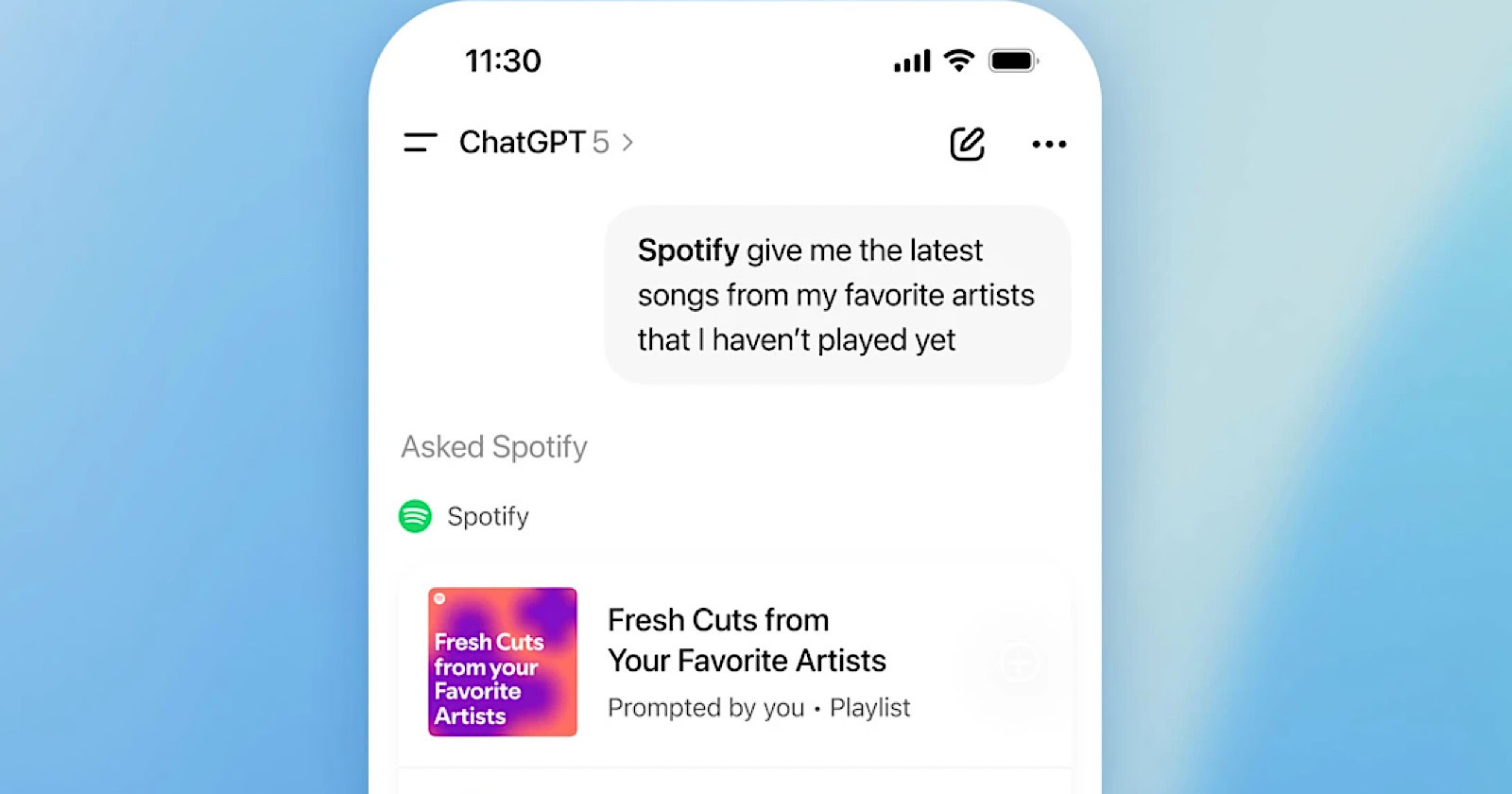
Apps naturally integrate into conversation, and you can activate them by name, such as saying, “Spotify, make a playlist for my party this Friday.’

When using an app for the first time, ChatGPT prompts you to connect and clarifies what data might be shared. For example, OpenAI demonstrates ChatGPT suggesting the Zillow app during a home-buying discussion, allowing you to browse listings on an interactive map without leaving the chat.

John Weisberg, Head of AI at Zillow, said:

“The Zillow app in ChatGPT shows the power of AI to make real estate feel more human. Together with OpenAI, we’re bringing a first-of-its-kind experience to millions — a conversational guide that makes finding a home faster, easier, and more intuitive.”

Developer Opportunities & Reach

OpenAI positions the Apps SDK as a way to “reach over 800 million ChatGPT users at just the right time.”

The SDK is open source and built on MCP, allowing developers to create their own chat logic and custom interfaces. You can also connect to your own backends for login and premium features, and easily test everything through Developer Mode in ChatGPT.

OpenAI has provided detailed documentation, design guidelines, and example apps to support developers.

Submission & Monetization

Developers can begin building immediately. OpenAI has announced that formal app submissions, reviews, and publication will commence later this year, along with a directory for browsing and searching apps.

Additionally, the company plans to disclose monetization details, including support for the Agentic Commerce Protocol, which enables instant checkout within ChatGPT.

Safety & Privacy

All apps must follow OpenAI’s policies, be audience-appropriate, and have clear third-party rules. Developers should provide privacy policies, collect only necessary data, and be transparent about permissions.

OpenAI’s draft guidelines also require apps to be purposeful, avoid misleading designs, and manage errors effectively. Submissions must demonstrate stability, responsiveness, and low latency; apps that crash or hang will be rejected.

Rollout & Availability

Today’s rollout does not include EU users, but OpenAI has announced plans to introduce these apps to that region soon.

Additionally, eleven more partner apps are scheduled for release later this year. OpenAI also intends to expand app availability to ChatGPT Business, Enterprise, and Education plans.

Looking Ahead

Apps that appear within AI-led conversations could transform the way services are found and accessed.

Instead of relying on traditional rankings or app-store positions, visibility might be driven more by conversational relevance and demonstrated value within the chat.

Teams responsible for app functionality should think about how users will naturally request these services and identify the key moments when ChatGPT is likely to recommend them.

https://www.searchenginejournal.com/openai-launches-apps-in-chatgpt-releases-apps-sdk/557682/


YouTube View Drops Likely Tied To Ad-Block List Change via @sejournal, @MattGSouthern

Creators have reported view declines on YouTube since mid-August.

YouTube’s official Liaison account says the change wasn’t on YouTube’s side and points to a widely shared explanation on X: an ad-blocking list update that interferes with how views are logged.

What YouTube Has Said

Responding to creators, YouTube’s Creator Liaison wrote:

“The change wasn’t on YouTube’s side… this is the most common explanation I’ve personally seen.”

The post links to an analysis that attributes the decline to the EasyPrivacy update. YouTube hasn’t announced any separate product or policy changes related to view counting.

What Changed

Tech creator ThioJoe highlighted an EasyPrivacy update that added a rule blocking the request youtube.com/api/stats/atr.

The thread argues that blocking this request may prevent the player from sending the data YouTube uses to log a view.

The EasyPrivacy commit shows the single-line addition in easyprivacy_specific.txt for ||youtube.com/api/stats/atr.

EasyPrivacy is a community-maintained filter list developed by the EasyList project. Ad blockers use these lists to determine which network requests to block. EasyPrivacy specifically targets tracking requests like analytics and behavioral beacons to help reduce data collection.

Several popular ad blockers, such as uBlock Origin Lite, include EasyPrivacy as part of their default or recommended list of filters.

Why This Affects YouTube Views

When a YouTube video plays, the player sends small background requests to log what happened. Think of them as receipts that say a playback started or progressed.

The thread at the center of this discussion points to one of those requests, …/api/stats/atr, as being blocked by the EasyPrivacy change.

If that request is blocked, a playback may not be recorded as a view in analytics even though the video still loaded for the viewer.

What Creators Reported

Posts discussing the issue indicate that the timing of the drops coincides with the EasyPrivacy change, and the rule was incorporated into uBlock Origin Lite shortly afterward, according to posts in the same thread.

These posts also note that the impact is most noticeable on desktop, where browser extensions are more common, while mobile app viewing seems less affected. Some creators have mentioned that their RPM remained relatively stable despite a decrease in raw views, and their like-to-view ratios increased because likes still count even when some views do not.

These insights come from public threads and are not official platform-wide metrics from YouTube.

Why This Matters

If you noticed unexplained drops starting mid-August, some of the decline might be due to ad-blocked sessions rather than a change in audience interest or YouTube policies.

For reporting and planning, compare trends on desktop and mobile, review revenue and watch-time alongside view counts, and note the affected period for teams and clients.

The key takeaway is that updates to third-party filter lists can influence your analytics data even if the platform itself remains unchanged.


Featured Image: miss.cabul/Shutterstock

https://www.searchenginejournal.com/youtube-view-drops-likely-tied-to-ad-block-list-change/557665/


Builderius Brings AI-Assisted GraphQL Development To WordPress via @sejournal, @martinibuster

Builderius WordPress website builder announced the ability to develop sites using GraphQL together with AI. The new functionality enables developers to use the power of GraphQL with the assistance of AI.

Why GraphQL

GraphQL can be a more efficient way to fetch data than traditional approaches in WordPress, using visual query builders, PHP, or REST API. It enables websites, or in this case Builderius, a visual builder for WordPress, to fetch only the specific data they need in one request, reducing the inefficiencies of how dynamic data is typically fetched within WordPress. Unlike the WordPress REST API, which delivers fixed sets of data from multiple endpoints, GraphQL gives developers more control and efficiency by returning exactly what’s asked for in a single query.

AI-Assisted Learning Setup

Builderius provides schema documentation and setup instructions that enable AI tools (like Claude or ChatGPT) to function as teaching assistants for learning GraphQL. Users are able to learn GraphQL through step-by-step project work as the AI guides them, explaining, structuring, and improving queries. This approach helps users learn GraphQL concepts while applying them in actual WordPress projects, supporting both productivity and ongoing learning.

Builderius is providing schema documentation and configuration guides that enable AI tools to act as interactive learning partners for getting started using GraphQL within Builderius. Instead of merely generating code, the AI integration helps users understand the structure and reasoning behind queries, enabling them to apply GraphQL concepts effectively in real development work. This approach blends hands-on learning with practical application, helping developers become proficient while building dynamic WordPress sites.

According to Builderius:

“Once configured, you can simply start new conversations by asking what you want to build. The AI will remember its role and your learning progression across all chats in the project.

…Your AI will explain the relationship between built-in WordPress queries, custom GraphQL queries, and dynamic data tags. You’ll understand how data flows from your queries into your visual layouts, with concrete examples.”

Read more at Builderius:

Master GraphQL by Building: AI as Your WordPress Development Partner

Featured Image by Shutterstock/Jozsef Bagota

https://www.searchenginejournal.com/builderius-brings-ai-assisted-graphql-development-to-wordpress/557539/


Google’s AI Mode: What We Know & What Experts Think via @sejournal, @martinibuster

AI Mode is Google’s most powerful AI search experience, providing answers to complex questions in a way that anticipates the user’s information needs. Although Google says that nothing special needs to be done to rank in AI Mode, the reality is that SEO only makes pages eligible to appear.

The following facts, insights, and examples demystify AI Mode and offer a clear perspective on how pages are ranked and why.

What Is AI Mode?

Google’s AI Mode was introduced on March 5, 2025, as an experiment in Google Labs, then swiftly rolled out as a live Google search surface on May 20. AI Mode is described as its most cutting-edge search experience, combining advanced reasoning with multimodality. Multimodality means content beyond text data, such as images and video content.

AI Mode is a significant evolution of Google Search that encourages users to research topics. This presents benefits and changes to how search works:

  • The benefit is that Google is citing a greater variety of websites per query.
  • The change is that websites are being cited for multiple queries, beginning with the initial query plus follow-up queries.

Those two factors present challenges to SEO. For example, do you optimize for the initial query, or what can be considered a more granular follow-up query? Most SEOs may consider optimizing for both.

Query Fan-Out

Similar to AI Overviews, AI Mode uses what they call a query fan-out technique, which divides the initial search query into subtopics that anticipate further information the user may need.

Query fan-out anticipates the user’s information journey. So, if they ask question A, Google’s AI Mode will show answers to follow-up questions about B, C, and D.

For example, if you ask, “What is a mechanical keyboard?” Google answers the following questions:

  1. What is a mechanical keyboard?
  2. What are mechanical switches?
  3. What happens when a key is pressed on a mechanical keyboard?
  4. What are keycaps and what materials are they made from?
  5. What is the role of the printed circuit board (PCB)?
  6. How are mechanical switches categorized?

The following screenshot of the AI Mode search result shows the questions (in red) positioned next to the answers, illustrating how query fan-out generates related questions and creates answers for them.

Screenshot of query fan-out in AI Mode, September 2025

How I Extracted Latent Questions From AI Mode Search Results

The way I extracted the questions that query fan-out is answering was by doing an inverse knowledge search, also known as reverse QA.

I copied the output from AI Mode into a document, then uploaded it to ChatGPT with the following prompt:

Read the document and extract a list of questions that are directly and completely answered by full sentences in the text. Only include questions if the document contains a full sentence that clearly answers it. Do not include any questions that are answered only partially, implicitly, or by inference.

Try that with AI Mode to get a better understanding of the underlying questions it generates with query fan-out. This will help clarify what is happening and make it less mysterious.

Content With Depth

Google’s advice to publishers who want to rank in AI Mode is to encourage them to create content that engages users who are conducting in-depth queries:

“…users are asking longer and more specific questions – as well as follow-up questions to dig even deeper.”

That may not mean creating giant articles with depth. It just means focusing on the content that users are looking for. That approach to content is subtly different from chasing keyword inventory.

Google recommends:

  • Focus on unique, valuable content for people.
  • Provide a great page experience.
  • Ensure we can access your content.
  • Manage visibility with preview controls. (Make use of nosnippet, data-nosnippet, max-snippet, or noindex to set your display preferences.)
  • Make sure structured data matches the visible content.
  • Go beyond text for multimodal success.
  • Understand the full value of your visits.
  • Evolve with your users.

The last two recommendations require further clarification:

Understand The Full Value Of Your Visits

This is an encouragement to focus on delivering the information needs of the user and to note that focusing too hard on the “click” comes at the expense of providing what an “engaged” audience is looking for.

Evolve With Your Users

Google frames this as evolving along with how users are searching. A more pragmatic view is to evolve with how Google is showing results to users.

What Experts Say About Content Structure For AI Mode

Duane Forrester, formerly of Bing Search, advises that content needs to be structured differently for AI search.

He advises:

“…the search pipeline has changed. You don’t need to rank – you need to be retrieved, fused, and reasoned over by GenAI systems.”

In his article titled “Search Without A Webpage,” he expands on the idea that content must be useful as forming the basis of an answer:

“…your content doesn’t have to rank. It has to be retrieved, understood, and assembled into an answer.”

He also says that content needs to be:

“…structured, interpretable, and available when it’s time to answer.

This is the new search stack. Not built on links, pages, or rankings – but on vectors, embeddings, ranking fusion, and LLMs that reason instead of rank.”

When Duane says that content needs to be structured, he’s referring to on-page structure that communicates not just the hierarchy of information but also offers a clean delineation of what each section of content is about.

In my opinion:

  • Paragraphs should consist of sentences that build to an idea, with a clear payoff at the end.
  • If a sentence doesn’t have a purpose within the paragraph, it’s probably better to remove it.
  • If a paragraph doesn’t have a clear purpose, get rid of it.
  • If a group of paragraphs is out of place near the end of the document, move it closer to the beginning if that’s where it belongs.
  • The entire document should have a clear beginning, middle, and end, with each section serving as “the basis of an answer.”

Itai Sadan, CEO of Duda, recommends:

“Use clear, specific language: LLMs rely on clarity first and foremost, so avoid using too many pronouns or any other vague, undefined references.

Organize your content predictably: Break your content up into sections and use headings, like H2 and H3, to organize the unique ideas central to your article’s thesis.”

Mordy Oberstein, founder of Unify Marketing, explains that the focus on attribution took precedence for the average digital marketer:

“What resonates with the person hasn’t fundamentally changed, and I don’t think we’ve realized that. I think we’ve forgotten. I think we’ve completely forgotten what resonance is as digital marketers because of the advent of two things with the internet:

  1. Attribution
  2. The ability to track responses

Businesses were seemingly OK with digital marketers doing whatever it took to get that traffic, to get that conversion, because that’s just the Internet, so everyone just goes along.

Now, with AI Mode, attribution no longer exists in the same way.”

Mordy’s right about attribution. AI Mode cannot be tracked in Google Analytics 4 or Google Search Console. They’re lumped into the Web Search bucket, so there’s no way to tell where it’s coming from. It can’t be distinguished from regular organic search in either GA4 or GSC.

The attribution question is a big issue for digital marketers. Michael Bonfils of Digital International Group recently discussed the issue of attribution from the perspective of zero-click searches.

Bonfils says:

“But the organic side, there is an area … that is zero click. So zero click is for those audience members who don’t know what that means, zero click means when you are having a conversation with AI, for example, I’m trying to compare two different running shoes and I’m having this, ‘what’s going to be better for me?’

I’m having a conversation with AI and AI is pooling and referencing … whatever winning schema formats and content that are out there … but it’s zero click. It’s not going to your site. It’s not going there. So without this data that really affects … organic content strategy.”

And that dovetails with what Mordy is getting at, that SEOs are conditioned to view internet marketing through the “attribution” lens, but that we may be entering a kind of post-attribution period, which is what it largely was pre-internet. So, the old marketing strategies are back in, but they were always good strategies (building awareness and popularity); it’s just that digital marketers tended to engage more with attribution.

Mordy shares the example of someone researching a brand of sneakers, who asks a chatbot about it, then goes to Amazon to see what it looks like and what people are saying about it, then watches video reviews on YouTube, and then goes to AI Mode to review the specs. After all that research, the consumer might return to Amazon and then head over to Google Shopping to compare prices.

He concludes with the insight that resonating with users has always been important, and that very little has changed in terms of consumers conducting research prior to making a purchase:

“That was all happening before. But now the perception is that it’s happening because of LLMs. I don’t think things have fundamentally changed.”

I think that the key insight here is that the research is still happening exactly as before, but what’s changed is that the opportunities to expose your business or products have expanded to multimodal search surfaces, especially with AI Mode.

The screenshot below shows how Nike is taking charge of the conversation on AI Mode with both text and video content.

Screenshot of citations and videos in AI Mode, September 2025

Connect Your Brand To A Product

It’s becoming evident that connecting a brand semantically to a service or product may be important for communicating that the brand is relevant to whatever you want it to be relevant for.

Below is a screenshot of a sponsored post that’s indexed by Google and is ranking in AI Mode for the keyword phrase “what are ad hijacking tools.”

Screenshot of sponsored post ranking in AI Mode, September 2025

SEO Makes Content Eligible For AI Mode

SEO best practices are necessary to be eligible to appear in AI Mode. That’s different from saying that standard SEO will help you rank in AI Mode.

This is what Google says:

“To be eligible to be shown as a supporting link in AI Overviews or AI Mode, a page must be indexed and eligible to be shown in Google Search with a snippet, fulfilling the Search technical requirements. There are no additional technical requirements.”

The “Search technical requirements” are just the three basics of SEO:

  • “Googlebot isn’t blocked.
  • The page works, meaning that Google receives an HTTP 200 (success) status code.
  • The page has indexable content.”

Google clearly says that foundational SEO is necessary to be eligible to rank in AI Mode. But it does not explicitly confirm that SEO will help a site rank in AI Mode.

Is SEO Enough For AI Mode?

Google and Googlers have reassured publishers and SEOs that nothing extra needs to be done to rank in AI search surfaces. They affirm that standard SEO practices are enough.

Standard SEO practices ensure that a site is crawled, indexed, and eligible for ranking in AI Mode. But there is implication that the signals for actually ranking in AI Mode are substantially different from standard organic search.

What Is FastSearch?

Information contained in recent Google antitrust court documents shows that AI Mode ranks pages with a technology called FastSearch.

FastSearch grounds Google’s AI search results in facts, including data from the web. This is significant because FastSearch uses different ranking signals from what’s used in the regular organic search, prioritizing speed and selecting only a top few pages for AI grounding.

The recent Google antitrust trial document from early September offers this explanation of FastSearch:

“To ground its Gemini models, Google uses a proprietary technology called FastSearch. … FastSearch is based on RankEmbed signals—a set of search ranking signals—and generates abbreviated, ranked web results that a model can use to produce a grounded response. …

FastSearch delivers results more quickly than Search because it retrieves fewer documents, but the resulting quality is lower than Search’s fully ranked web
results. “

And elsewhere in the same document:

“FastSearch is a technology that rapidly generates limited organic search results for certain use cases, such as grounding of LLMs, and is derived primarily from the RankEmbed model.”

RankEmbed

RankEmbed is a deep learning model that identifies patterns in datasets and develops signals that are used for ranking purposes. It uses a combination of user data from search logs and scores generated by human raters to create the ranking-related signals.

The court document explains:

“RankEmbed and its later iteration RankEmbedBERT are ranking models that rely on two main sources of data: __% of 70 days of search logs plus scores generated by human raters and used by Google to measure the quality of organic search results.

The RankEmbed model itself is an AI-based, deep learning system that has strong natural-language understanding. This allows the model to more efficiently identify the best
documents to retrieve, even if a query lacks certain terms.”

Human-Rated Data

The human-rated data, which is part of RankEmbed, is not used to rank webpages. Human-rated data is used to train deep learning models so they can recognize patterns that correlate with high and low-quality webpages.

How human-rated data is used in general:

  • Human-rated data is used to create what are called labeled data.
  • Labeled data are examples that models use to identify patterns in vast amounts of data.

In this specific instance, the human-labeled data are examples of relevance and quality. The RankEmbed deep learning model uses those examples to learn how to identify patterns that correlate with relevance and page quality.

Search Logs And User Behavior Signals

Let’s go back to how Google uses “70 days of search logs” as part of the RankEmbed deep learning model, which underpins FastSearch.

Search logs refer to user behavior at the point when they’re searching. The data is rich with a wide range of information, such as what users mean when they search, and it can also include the domain names of businesses they associate with certain keywords.

The court documentation doesn’t say all the ways this data can be used. However, a Google antitrust document from May 2025 revealed that search log (click) patterns only become meaningful when scaled to the billions.

Some SEOs have theorized that click data can directly influence the rankings, describing a granular use of clicks for ranking. But that may not be how click data is used, because it’s too noisy and imprecise.

What’s really happening is more scaled than granular. Patterns reveal themselves in the billions, not in the individual click. That’s not just my opinion; it’s a fact confirmed in the May 2025 Google antitrust exhibit:

“Some Known Shortcomings of Live Traffic Eval
The association between observed user behavior and search result quality is tenuous. We need lots of traffic to draw conclusions, and individual examples are difficult to interpret.”

It’s fair to say that search logs are not used to directly impact the rankings of an individual webpage, but are used to learn about relevance and quality from user behavior.

FastSearch is not the same ranking algorithm as the one used for organic search results. It is based on RankEmbed, and the term “embed” suggests that embeddings are involved. Embeddings map words into a vector space so that the meaning of the text is captured. For SEO, this means that keyword relevance matters less, and topical relevance and semantic meaning carry more weight.

Google’s statement that standard SEO is all that’s needed to rank in AI Mode is true only to the extent that standard SEO will ensure that the webpage is crawled, indexed, and eligible for the final stage of AI Mode ranking, which is FastSearch.

But FastSearch uses an entirely different set of considerations at the LLM level to decide what will be used to answer the question.

In my opinion, it’s more realistic to say that SEO best practices make webpages eligible to appear in AI Mode, but the ranking processes are different, and so new considerations come into play.

SEO is still important, but it may be useful to focus on semantic and topical relevance.

AI Mode Is Multimodal

AI Mode is multimodal, meaning image and video content rank in AI Mode. That’s something that SEOs and publishers need to consider in terms of how user expectations drive content discovery. This means it may be useful to create image, video, and maybe even audio content in addition to text.

Optimizing Images For AI Mode

Something that is under your control is the featured image and the in-content images that go with your content. The best images, in my opinion, are images that are noticeable when displayed in AI Mode and contain visual information that is relevant to the search query.

Here’s a screenshot of images that accompany the cited webpages for the query, “What is a mechanical keyboard?”

Screenshot from AI Mode, September 2025

As you can see, none of the images pop out or call attention to themselves. I don’t think that’s Google’s preference; that’s just what publishers use. Images should not be an afterthought. Make them an integrated part of your ranking strategy for AI Mode.

Creative use of images, in my opinion, can help a page call attention to itself as useful and relevant. The best images are ones that look good when Google crops them into a square format.

Google AI Mode is multimodal, which means optimizing your images so that they display well in AI Mode search results. Your images should be attractive regardless of whether they are displayed as either a rectangle (approximately 16:9 aspect ratio) or a square (approximately 4:3 aspect ratio).

Mordy Oberstein offers these insights on multimodal marketing:

“AI Mode is looking at videos, images, and yes, you could do all of that. Yes, you should do all of that – whatever is possible to do while being efficient and not getting misdirected or losing focus – yes, go ahead. I’m all for creating authoritativeness through content. I think that’s an essential strategy for pretty much any business.

AI Mode is not just looking at your website content, whether it’s your image content, audio content, whatever it may be, it’s also looking at how the web is talking about you.”

AI Mode Is Evolution, Not Extension

AI Mode is not just an extension of traditional search but an evolution of it. Search now includes text, images, and video. It anticipates follow-up queries and displays the answers to them using the query fan-out technique. This shifts the SEO focus away from keyword inventory and chasing clicks and toward considering how the entire user information journey is best addressed and then crafting content that satisfies that need.

More Resources:


Featured Image: Jirsak/Shutterstock

https://www.searchenginejournal.com/googles-ai-mode-what-we-know-what-experts-think/555482/


The CMO & SEO: Staying Ahead Of The Multi-AI Search Platform Shift (Part 2)

Where is search going to develop? Is ChatGPT a threat or an opportunity? Is optimizing for large language models (LLMs) the same as optimizing for search engines? These are some of the critical questions that are top of mind for both SEOs and CMOs as we head into a multi-search world.

In Part 2 of this two-part interview series, I try to answer these questions based on data from our internal research to provide some clear direction and focus to help navigate considerable change. If you haven’t already, go back and read Part 1.

What you will learn in this Part 2:

  • Traditional Search Engine Results Page (SERP) Evolution: Why traditional search isn’t dying but fundamentally transforming, where it still excels, and how it is part of Google’s integrated approach to AI evolution.
  • Google AI Mode Strategy: How AI Mode and AI Overview operate as the same strategy at different thresholds, with AI Mode being 2.1x more likely to include brands while AI Overview remains highly selective.
  • Agentic AI Revolution: Why 33% of organic searches now come from AI agents browsing on behalf of users, creating real-time interactions that demand immediate content accessibility.
  • Search Funnel Transformation: How the customer journey has evolved from linear progression to unpredictable funnel-stage jumping, with AI handling research while conversion still happens through traditional organic channels.
  • The Three Pillars Framework: Why CMOs need reporting for early AI shift detection, automation for seamless AI-readiness, and strategic recommendations to influence how AI tells their brand’s story.

Do You Think There Is Any Future For Traditional SERP Search, Or Do You Think It Will Become Obsolete?

I think we’re witnessing more of an evolution than an extinction. Traditional SERP search has a future, but it’s going to look completely different.

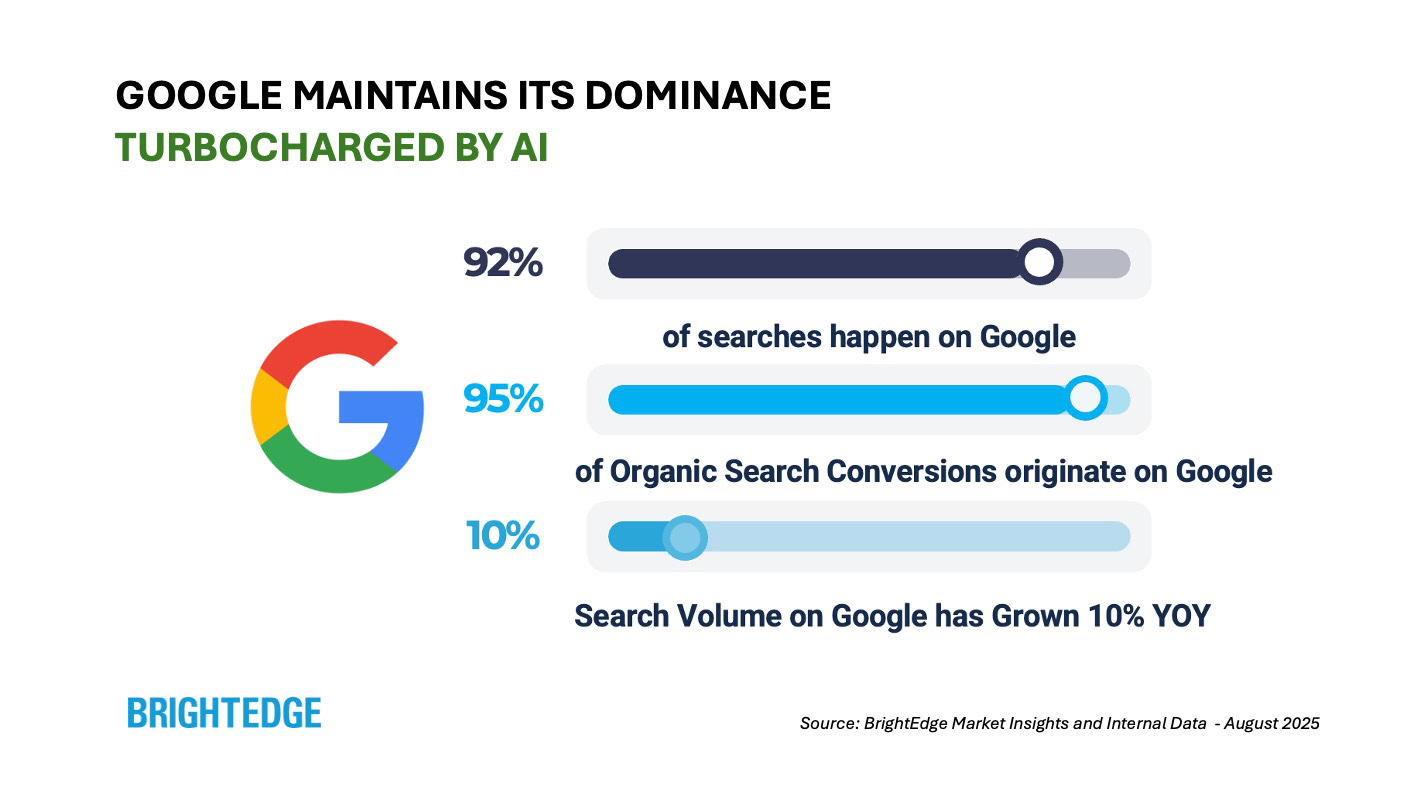
According to our internal data, 92% of all searches happen here. And when it comes to meaningful actions, such as downloads, sign-ups, or purchases, 95% start on Google. Search volume hasn’t gone down – it’s actually grown 10% year-over-year. With AI Mode, Google is layering AI directly into the experience.

The takeaway is clear: AI hasn’t replaced traditional SERPs; it’s utilizing and aligning with them.

Image from author, September 2025

Where Traditional Search Still Excels

Traditional search still absolutely shines in certain areas. When you’re dealing with complex queries or personal searches, those traditional SERPs still provide something AI cannot: depth, discernment, and diverse perspectives. Ecommerce is a perfect example – when shopping, I still want to see those traditional listings to compare sources, read different reviews, and check various offers.

Traditional SERP’s And Google’s Integrated Approach

Google is handling this integration cleverly. They’re not replacing classic SERPs; they’re augmenting them. Google’s Gemini model powers AI Overviews that appear above traditional listings, creating comprehensive summaries from multiple sources. Classic SERPs provide the foundational data, and AI distills and presents it in new, user-centric ways.

For brands and CMOs, this creates a new optimization challenge. You’re not just thinking about traditional SEO anymore; you need to optimize for AI inclusion, too. If you get cited in an AI summary, your visibility increases dramatically. It’s an interesting paradox where fewer traditional listings appear, but cited sources gain more prominence.

We’re seeing conversational capabilities, multimodal search with images and video, and direct answers that go way beyond static blue links. Users can now ask follow-up questions, search with photos, or engage in natural language conversations – capabilities that would have been impossible with traditional link-based results.

When AI Search Meets Traditional SEO

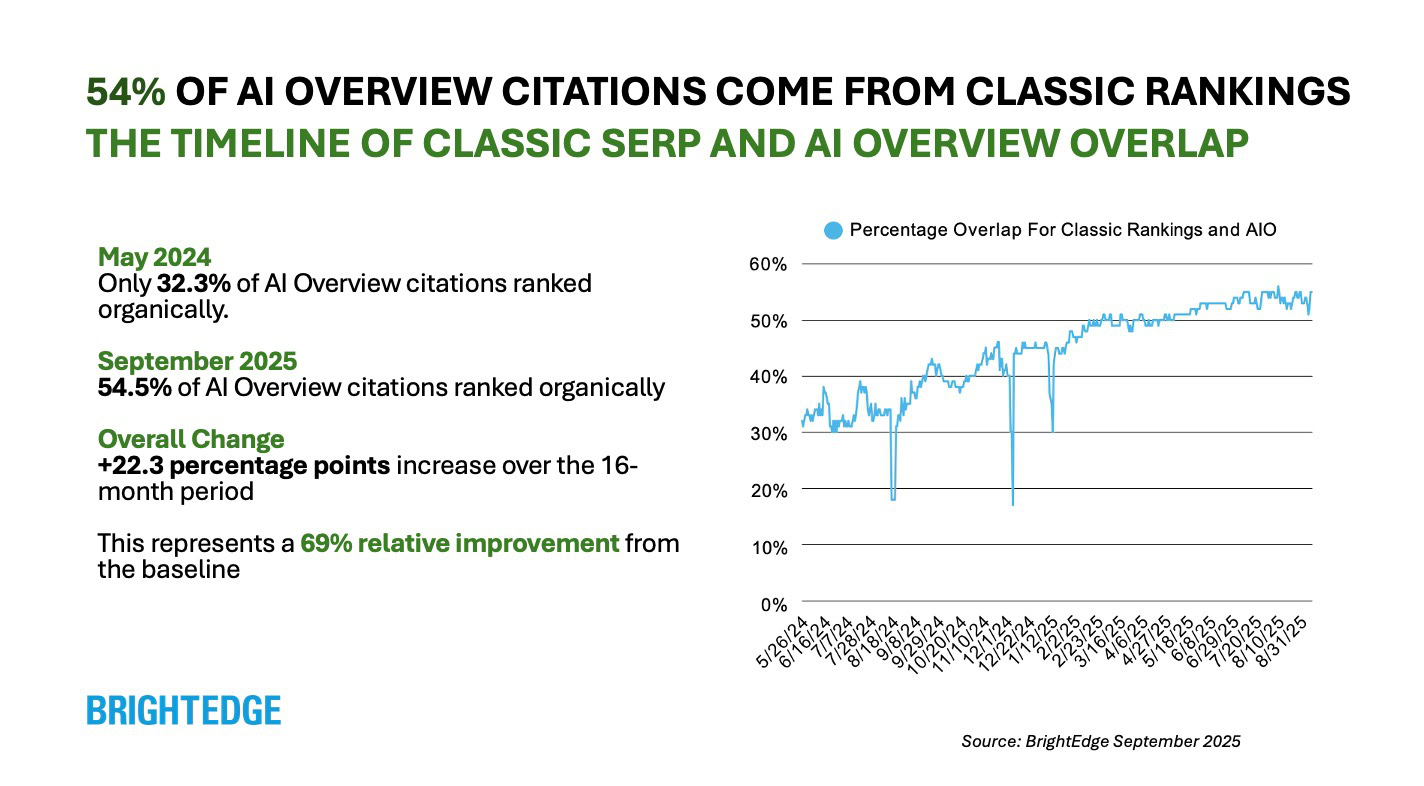
The overlap between AI citations and traditional search results has grown 22.3% since 2024. However, this varies significantly by industry, making your vertical a key factor in strategy development.

The variation is substantial. Ecommerce saw minimal change at 0.6 percentage points, while Education increased by 53.2 percentage points. Your industry determines the approach you should take.

In YMYL sectors like Healthcare, Insurance, and Education, overlap reaches 68-75%. When trust is critical, Google tends to favor content that already performs well in traditional search rankings.

Ecommerce operates differently. Overlap remained flat, and AI Overview coverage actually decreased by 7.6 percentage points. Google appears to maintain separation between shopping queries and AI answers, likely to preserve the transactional flow that drives commerce.

Image from BrightEdge, September 2025

The Interconnected Search And AI Engine Ecosystem

What’s happening is that AI Overviews are acting as content curators, selecting which sources to reference and cite. This means your content needs to be clear, authoritative, and structured in ways that both humans and AI can easily understand and extract value from. The fundamentals of relevant content – quality, clarity, technical optimization – they’re more critical than ever.

The likes of ChatGPT and Perplexity tap into traditional search engines for factual grounding, so this interconnected ecosystem is becoming the norm. It’s not just about ranking on SERPs anymore; it’s about being discoverable across multiple channels: social search, AI interfaces, traditional SERPs, and whatever comes next.

The New Traditional CMO, SEO, And AI Reality

But those traditional foundations remain crucial – they just serve both humans and AI now. For straightforward, fact-based queries, AI can generate instant answers, removing the need to browse multiple results. But for anything complex, local, or transactional, those classic blue links still appear, sometimes as fallback options, or often as primary results depending on the query type.

However, it’s worth noting that AI Overview shares the screen with classic SERPs and ads. Still, your visibility may significantly increase when you get cited in an AI-generated summary, a paradox in which traditional results may decline, but referenced sources tend to become more prominent.

Keeping Pace With Change

The pace of change is also something CMOs need to prepare for. Google’s AI Mode is evolving incredibly quickly – features, user interface (UI) presentation, and citation logic change frequently. You need to invest in technology and teams that provide real-time insights into SERP and AI Mode visibility. Keep new AI entrants on your radar, and their experimentation and pilot projects, which are crucial for understanding what drives referenced visibility and conversions through AI sources.

Source: BrightEdge report, September 2025

The role of traditional SERPs is not dying. AI and traditional search work hand in hand; it’s now Google’s default approach, and both systems co-exist beautifully, serving diverse needs within the same search journey.

Learn More: Google Speculates If SEO ‘Is On A Dying Path’

What Do You Think CMOs Should Consider About How Google AI Mode Might Change An Enterprise Approach?

This is one of the most significant strategic shifts CMOs are facing right now, and it’s happening fast. Google’s AI Mode is fundamentally changing how enterprise visibility, engagement, and measurement work across search and discovery channels.

Understanding Google’s AI Strategy: AI Overviews And AI Mode

Our recent analysis reveals that AI Mode and AI Overview are not distinct strategies. They’re the same strategy but operating at different thresholds.

Think of it this way: AI Mode acts as the broad discovery engine. It’s 2.1x more likely to include brands (compared to AI Overviews), surfaces more unique brands overall, and maintains pretty stable week-over-week patterns. When it shows sources, you’ll see fewer but more prominent source cards. It’s casting a wide net with lower barriers to entry.

  • AI Overview, on the other hand, is the dynamic curator. It’s much more selective – only including brands in 43% of responses – but shows significantly higher volatility, which tells us the algorithm is actively evolving.
  • AI Mode provides stable, broad discovery, whereas AI Overviews are where Google tests new ranking approaches with much higher selectivity. It’s clever – they’re serving different user needs while continuously refining their AI capabilities.

The Multi-Query Reality Of Google AI Search

An AI query is never just one search anymore. AI Mode runs dozens of queries on behalf of the user before showing an answer.

That one question – “What’s a good treadmill for beginners?” – becomes dozens of searches instantly. Google breaks it down into features, price comparisons, reviews, safety tips, compact options, and warranty information. The AI runs these searches in parallel, pulls results, and stitches them together into a single conversational answer.

It’s no longer about matching one keyword. You’re competing to be included across the entire web of related questions that the AI asks on the user’s behalf.

AI Mode And Living In The Browser

Think about how much time you spend in your browser every day. Now imagine if it could actually think alongside you. That’s exactly what’s happening with Google Chrome’s latest AI features, and honestly, it’s pretty mind-blowing.

Here’s what’s new: AI Mode lets you ask complex questions right in the address bar – no more opening countless tabs just to find answers. Planning a trip? Chrome’s multi-tab intelligence can now pull information from all your open tabs and create one coherent plan. And soon, agentic browsing will let Gemini handle the boring stuff like booking appointments while you focus on what actually matters.

The cool thing is, AI Mode isn’t replacing Google – it’s just giving us a smarter way to use it. Think conversational search, but built right into where you already spend most of your time.

For CMOs and marketing teams, this means rethinking how people will find and interact with your content. We’re not just optimizing for search anymore; we’re optimizing for conversation.

The CMO Content Strategy And Keeping Pace With Change

Your content strategy needs a complete rethink. AI Mode pulls directly from content to generate overviews and summaries, which means you can’t just optimize for traditional SEO anymore. Your content needs to serve both AI and human audiences simultaneously. The goal is not just to rank anymore; it’s also to be selected for AI-generated overviews.

CMOs need to prepare for the pace of change. Google’s AI Mode is advancing at a rapid pace, with frequent shifts in features, UI presentation, and citation logic. You need to invest in tools and teams that provide real-time insights into SERP and AI Mode visibility.

How Are Agentic AI Agents (Crawlers And Bots) Changing The Search Funnel? How Might These Changes Impact Roles On The CMO And The SEO Team?

We’re seeing a major shift in how content gets discovered and delivered, as new types of AI agents engage with websites and surface information in real-time conversations. AI agents are now browsing on behalf of users. Unlike classic crawlers, it’s not about indexing pages to be served up later; it’s real-time interactions. If you have a dead page, or it can’t interpret what your content is saying, you lose that moment.

The Rise Of AI Agent Website Interaction

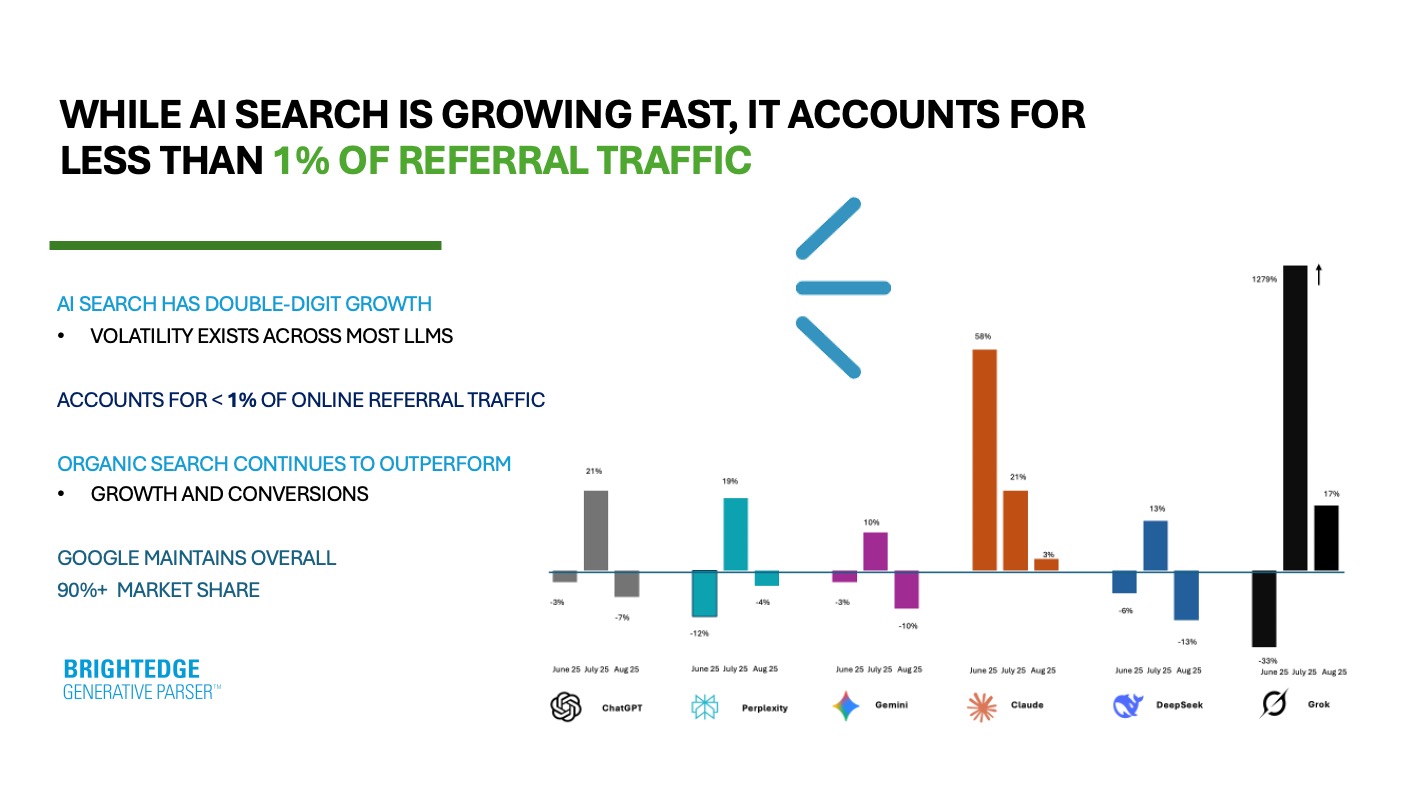
They’re acting like digital assistants – researching, comparing, recommending. If your page is slow, or your content isn’t clear, they move on instantly. They are your future customers – potential new clients – arriving through AI. In the last month, we’ve seen visits from ChatGPT’s new Agent crawler double in visits to customer websites. 33% of all organic searches are from these agents. The growth is massive.

The AI Agent Preprocessing Layer

This creates a preprocessing layer that influences every subsequent customer interaction. Unlike traditional crawlers that simply index content, these systems navigate websites, submit forms, compare options, and make recommendations on behalf of the user in real-time. Each visit represents AI doing a search on your customer’s behalf, looking for content to help explain, recommend, and help your customers in a conversation.

How This Impacts The Evolution Of The Customer Journey

The awareness phase has evolved from user-driven discovery to “pre-aware” algorithmic surfacing where AI agents proactively recommend options based on context, preferences, and behavioral patterns – often before users consciously realize they need information. Modern buyer behavior no longer follows a straight-line progression. Instead, customers jump between funnel stages unpredictably, sometimes moving directly from initial awareness to making purchases, or cycling back to discovery phases for related products.

  • AI Search Users: Enter the funnel at the research and exploration stage, asking questions and gathering information to inform their decisions. They’re seeking understanding, not yet ready to transact.
  • Organic Search Users: Demonstrate clearer purchase intent, often searching for specific products, services, or solutions. They know what they want and are closer to conversion.
  • The Journey Dynamic: Many users begin with AI-powered research but ultimately convert through organic search or direct channels – making AI search valuable for top-of-funnel discovery despite its lack of direct conversions.

The Research Vs. Conversion Channel Reality

As AI search functions as a research channel, not a conversion channel, this confirms that AI systems are handling awareness and consideration stages, while conversion still requires traditional touchpoints. We found that 34% of AI citations come from PR-influenced sources and 10% from social platforms, demonstrating that traditional SEO concepts like E-E-A-T (Experience, Expertise, Authoritativeness, Trustworthiness) remain critical but must now work at machine scale across multiple platforms.

Immediate CMO Transformation Requirements

Foundation Strengthening: Companies must rapidly enhance SEO fundamentals – structured data, content authority, and technical excellence – that determine whether AI agents can find, understand, and cite their content. Brands not only need to keep the door open to agents, but they also need to embrace them, so they are not invisible to the AI agent processing layer I mentioned earlier.

New Measurement Frameworks: Marketing teams must develop new measurement frameworks that capture AI citation frequency, cross-platform visibility, and influence within AI responses, even when traffic attribution is impossible. Key metrics include brand visibility monitoring, AI presence testing, reference share analysis, and indirect conversion tracking.

CMO And Marketing Team Structure

The team structure evolution reflects a fundamental shift from departmentalized hierarchies to fluid, cross-functional pods. Technical teams become increasingly AI-augmented for scale, content teams shift from creation to curation and refinement, and new integration teams bridge SEO with data science and machine learning departments.

Concluding Thoughts: The CMO, SEO, And AI Reality Check

Here’s the critical takeaway: While you’re optimizing your funnel for AI discovery, remember that organic search is still where conversions happen. AI search serves as the research phase, helping users discover options and gather information.

But when they’re ready to take action – making a purchase, signing up, or downloading – they’re still turning to traditional organic search results. They recognize that AI discovery feeds into the organic funnel. Your SEO foundation becomes the conversion engine that AI discovery feeds into.

The smartest CMOs and marketers aren’t choosing between AI and organic search. They’re using proven SEO strategies as their foundation while adapting for AI discovery.

More Resources:


Featured Image: Roman Samborskyi/Shutterstock

https://www.searchenginejournal.com/the-cmo-seo-staying-ahead-of-the-multi-ai-search-platform-shift-part-2/556130/


Maximize Your AI Visibility Before Your Competitors Do [Webinar] via @sejournal, @lorenbaker

AI-driven search is rewriting the rules of discovery. 

ChatGPT, Perplexity, and Google AI Overviews are changing how customers find brands. Traditional rankings no longer guarantee visibility. 

Are you appearing where it matters most?

Discover proven strategies to boost your AI mentions and citations.

What You’ll Learn in This Session

Pat Reinhart, VP of Services & Thought Leadership at Conductor, and Luiza Shahbazyan, Sr. R&D Product Manager at Conductor, will show you exactly how to win in the age of AI search. You’ll learn:

  • How to maximize your brand’s visibility across AI answer engines.
  • Key signals that influence AI citations, including content authority and digital PR.
  • Practical strategies to earn mentions and strengthen trust signals.
  • How to adapt your SEO workflows for Answer Engine Optimization (AEO).

Reserve Your Spot Today

Register now to get actionable tactics and data-backed insights that help your brand show up in AI results.

🛑 Can’t attend live? Sign up anyway, and we’ll send the full recording straight to your inbox.

https://www.searchenginejournal.com/maximize-your-ai-visibility-before-your-competitors-do/556164/


Google Search Experiencing Ongoing Service Disruption via @sejournal, @MattGSouthern

Google reports a data center issue is causing a partial Search disruption, affecting some pages in certain locales.

  • Google confirms a data center issue causing a partial Search disruption.
  • Check the official Search Status Dashboard for updates.
  • Avoid reactive site changes.

https://www.searchenginejournal.com/google-search-experiencing-ongoing-service-disruption/557529/


Microsoft Launches New Bing Places For Business via @sejournal, @MattGSouthern

Microsoft has rolled out a redesigned Bing Places for Business platform, moving business listing management to bing.com/forbusiness and introducing a new recommendation tool with streamlined import workflows.

The platform lets businesses create and manage listings across Bing Search and Bing Maps at no cost. Consolidating the experience under the Bing.com domain is meant to make the product easier to find and use.

Why Did Microsoft Rebuild It?

Microsoft says the redesign follows months of research with business owners who reported difficulty discovering the product, navigating the interface, and importing locations at scale.

Microsoft wrote:

“Before we wrote a single line of code, we spent months listening to business owners about their challenges and goals.”

Here’s what Microsoft added after those discussions.

What’s New?

Improved Google Business Profile Import

For multi-location brands and agencies, Microsoft has overhauled the Google import flow.

The update aims to preserve key attributes, such as names, hours, and contact details, while also introducing more efficient management features, including dashboards, bulk editing, and real-time status updates.

Recommendation Tool

A new Recommendation Tool evaluates listing health and suggests specific additions, such as photos, website and social links, hours, and category-specific items. For restaurants, that can include menu links or online ordering.

The feature is designed to help owners who may be newer to local SEO prioritize high-impact fields.

Automatic Migration

Current Bing Places users and their listings are being migrated automatically. Logging in with existing credentials redirects to the new experience.

What’s Next

Microsoft says more updates will roll out in the coming months, including deeper integrations with Bing Maps and Copilot and expanded support for agencies and partners.

Why This Matters

A Bing Places profile can appear in Bing search results and on Bing Maps. That includes the map results and the place page people see when they click through for directions, call, or website info.

Claiming and keeping your listing up to date helps Microsoft show accurate location, hours, and contact details across Bing’s local results and Maps. In short, you control what customers see when they find you on Bing.

The improved Google import process simplifies keeping your Bing listing in step with your Google Business Profile.

Availability

The new Bing Places for Business is live at bing.com/forbusiness.


Featured Image: PixieMe/Shutterstock

https://www.searchenginejournal.com/microsoft-launches-new-bing-places-for-business/557520/


New Report Reveals An 8% Mobile Landing Page Conversion Gap via @sejournal, @MattGSouthern

A report from Unbounce shows that unoptimized mobile landing pages are costly, finding 83% of visits come from mobile devices, yet desktop pages convert 8% better.

Based on over 57 million conversions and 41,000 pages, the study highlights the need for the industry to adapt as mobile traffic increases but underperforms.

Highlights From The Report

Mobile Optimization: The Overlooked Priority

Unbounce’s Conversion Benchmark Report has a clear message:

“If you’re still building your landing pages for desktop first, with the mobile version being just a quick box to check before publishing, chances are you’re missing out big time.”

While mobile accounted for the vast majority of landing page visits, desktop pages outperformed by a notable margin.

The report asserts:

“An 8% gap in conversion rates is significant, but it gets even worse when you look at the number of conversions lost. If all industries optimized their pages, we might have reported over 1.3 million more conversions.”

Industry-Wide Benchmarks

Unbounce’s research indicates that the median conversion rate across all industries is 6.6 percent, with specific verticals varying from 3.8 percent to 12.3 percent.

Marketers can use this benchmark as a reference point, the report notes:

“Higher than the median? Your page is converting better than most. Lower than the median? Your page is converting worse than most.”

It warns that benchmarks only measure how often conversions happen, not their value or quality. This is especially important for campaigns aimed at high-value leads or sales, where just the raw conversion rate might not provide the full picture.

Simple Copy Converts

The research highlights that simpler language on landing pages tends to perform better.

Pages written at a 5th to 7th grade level see an 11 percent conversion rate, which is 56 percent higher than pages at an 8th to 9th grade level, and more than twice as effective as professional-level writing.

Unbounce warns:

“There’s a high likelihood that your conversion rate will drop as you add more difficult words to the page.”

Complex words with three or more syllables have a negative impact, showing a 24.3 percent decrease in connection with conversion rates.

As Unbounce puts it:

“Simple copy converts.”

Email & Paid Social Lead

Analyzing conversion performance across paid and organic channels, the report reveals that email is the top performer with an average conversion rate of 19.3 percent.

Paid social platforms such as Instagram (17.9 percent) and Facebook (13 percent) also perform well, surpassing paid search channels like Google Ads.

Why This Matters

As digital marketing evolves to prioritize mobile users and attention spans become shorter, maintaining fresh and optimized landing pages is key to ensuring your campaigns succeed.

These findings align with industry trends toward minimal UX, more A/B testing, and re-evaluating marketing channels.

Looking Ahead

Unbounce’s study serves as a reminder to examine landing pages more closely, particularly on mobile devices, and benchmark results against industry standards.

The full report provides practical advice, including optimizing for various devices, simplifying landing page messaging, and implementing A/B testing. Acting on these insights could help recover lost conversions.


Featured Image: Roman Samborskyi/Shutterstock

https://www.searchenginejournal.com/new-report-reveals-an-8-mobile-landing-page-conversion-gap/557513/


AMA: Reddit Marketing Veteran Shares What Works On The Platform via @sejournal, @brentcsutoras

Part of our work at OGS Media with Reddit is making it easier for brands to get on the platform the right way: transparent, authentic, and really connecting with your audience. Some of that happens through our partnership, working with various teams at Reddit, testing new features, and sharing insights from the brands we’re currently managing.

Another part of that is through hosting Ask Me Anything (AMAs) like the one I did last week on r/RedditForBusiness.

The questions that came in reminded me why this work matters. After nearly two decades on the platform and working with brands like TikTok, Purple, and Asurion, I see how brands are genuinely trying to figure out Reddit. The AMA drew questions from marketers across industries, from early-stage startups to enterprise brands, all working to understand how to show up authentically.

Let me walk you through the biggest themes that emerged and what actually works on Reddit.

The Biggest Mistake Brands Make (And Why It Happens)

Multiple people asked variations of the same question: “What’s the biggest mistake brands make when they first start marketing on Reddit?”

“Most brands find Reddit through their online marketing teams. They see that Reddit is showing up in Google search results or they see it in LLMs. But when looking at who should give Reddit a try, it still ends up landing in their online marketing teams. Online marketers have been held to ROI numbers for so long, it’s how they look at their engagement on Reddit.

There’s an interest in being on Reddit because it’s popular and important, but there’s not enough time spent understanding why Reddit is important and that’s what I think is the biggest mistake brands make.”

The root problem? Brands need to understand what makes Reddit so powerful in the online user’s journey, how subreddits operate as individual communities with their own rules, culture, and expectations. How the journey to learning and making decisions is as important as the outcome.

When one marketer asked how to avoid the anti-promotional backlash, I explained:

“As for the line between contribution and self-promotion, I think that’s often more of a feeling than a line. It takes understanding the community, what they expect and need, what they appreciate and what they despise. The best marketers know how to ‘read the room’ and know their audience, start with being helpful first, and wait for that moment when what they have to offer is what you’re asking for, so that they’re never selling you something, but rather helping you out with a solution they just happen to have.”

Why Traditional Social Media Strategy Fails On Reddit

A marketer with years of experience asked why traditional social media approaches don’t translate to Reddit success. The answer gets to the heart of what makes Reddit different:

“It really comes down to a large segment of the world wanting to engage in conversation, versus just watching streams for updates and entertainment.

It was long after social media really came out that marketers started really looking at it for the exposure and traffic it could drive. This created two avenues: a megaphone to share information and customer service.

Neither of these helps people who are on a journey to learn something, engage in conversations or discussions around a topic of interest, or to find a solution to a problem they need solved.

Traditional social media doesn’t work here because it is not about conversation, it is about promotion and marketing.”

The fundamental shift brands need to make? Stop thinking about Reddit like Facebook or LinkedIn with stricter rules. Instead:

“Start thinking about Reddit like a networking event, a cocktail party, a social event. How would you approach and engage with an actual event, versus posting content on a social media platform.

It simply comes down to the intent.”

Reddit operates more like walking into a conference where each subreddit is a different breakout session with its own culture, expectations, and unwritten rules. You can’t just grab the microphone and start pitching; you need to listen, contribute, and earn your place in the conversation.

This understanding leads directly to what actually works on Reddit.

The Do’s And Don’ts For Reddit Success

When asked for the top do’s and don’ts, I broke it down to the essentials:

Do:

“Really become a Redditor:

  • Find communities that you are a good fit to belong to (from the Redditor point of view).
  • Focus on engaging and helping Redditors through discussion.”

Don’t:

“Give this task to your marketing team (well, not only your marketing team).

  • Treat subreddits like categories.
  • Focus on KPIs outside Reddit.”

That first “don’t” surprises people, but it’s critical. Here’s the thing: Marketing teams are trained to chase quarterly numbers, to show immediate ROI, to justify every dollar spent. But Reddit operates on relationship timelines, not campaign cycles.

When you hand Reddit to someone who’s measured on conversion rates and cost-per-click, they’re going to treat it like another performance channel. They’ll miss what actually matters, the compound value of becoming part of the conversation, of genuinely helping solve problems, of building trust that turns your brand into the solution people recommend when someone asks for help six months from now.

The real ROI on Reddit isn’t in the traffic you drive this quarter; it’s in becoming the answer that shows up in Google searches and AI responses for years to come because you took the time to build authentic authority in your communities.

How Long Does Reddit Success Actually Take?

This came up multiple times, so here’s the realistic timeline:

“Some of our clients see Reddit become their primary funnel within three months. Some rank with their content prominently within 30 days. Some show up everywhere in LLMs inside six months. Some clients get information that changes their whole business within three months. One very large brand turned around its brand sentiment in about nine months. So it is just dependent on what impact means to you.”

But the general rule: Six to 12 months for meaningful impact, assuming you’re doing it right.

The Product Promotion Question Everyone Asks

One of the most practical questions was how to succeed without actually selling products. I responded:

“Overall, the premise is you don’t sell products on Reddit. You solve problems. Help people with their actual problems, and they’ll ask what you recommend. That’s when you mention your solution. However, some communities do want product posts, like fashion or deal subreddits. It depends on what you’re selling. But the smart move is be helpful first, then run ads where people need your product. You get conversions from ads plus trust from being genuinely useful.”

This is where a lot of brands get tripped up. They think “no selling” means they can never mention their product. That’s not it at all. It’s about context and timing.

What Startups And Enterprise Brands Both Need To Know

Interestingly, questions came from both ends of the spectrum, pre-launch startups and established enterprise companies. The answer was the same for both:

“I think that the pathway for every brand, early stage, prelaunch, or established, should be about understanding what their audience on Reddit really needs from them, what their customers journey through Reddit looks like, and what the opportunities are for the brand to connect with those customers at the right time, with the right conversations, and with the intent to help them move through their journey to completion.”

The process is the same regardless of company size. It takes time, it takes commitment, and it informs the brand what their customers actually need, what they think about the industry, the brand, and its competitors.

The Authenticity Challenge

When someone asked about responding to criticism, here’s the reality check:

“What I will say, is that arguing and getting defensive almost NEVER works. Remember you and the people you are talking with are humans, so what would you do in real life? I never think it hurts to give a quick and honest apology (through DM if needed). Something human. People soften when they realize they are talking to another person.”

This ties back to the networking event concept. If someone called you out at a conference, you wouldn’t start arguing with them in front of everyone. You’d handle it like a human being.

What Should Brands Do In Their First 90 Days On Reddit?

Another practical question that came up was what brands should actually focus on during their first three months on Reddit. Based on our work with enterprise clients, there’s a specific methodology that works.

The biggest temptation for new brands is to jump in and start posting immediately. That’s exactly backwards.

Month 1: Foundation And Discovery

The first month isn’t about your brand at all; it’s about becoming a genuine Redditor. We have our clients’ team members join communities related to their personal interests first. Love cooking? Join r/cooking. Into photography? Find your camera subreddit. This isn’t marketing; it’s learning how Reddit actually works.

Simultaneously, we’re conducting what we call “deep audience immersion.” Before posting a single thing, we spend weeks analyzing subreddit discussions to understand what your audience actually cares about. We map user journeys, identify pain points, and document the language and tone that resonates within each community.

During this phase, we also establish your brand subreddit as a “home base” and create one to two employee accounts for future engagement. But these accounts don’t engage with business topics yet. They’re building karma and credibility in personal interest areas.

Month 2: Authentic Engagement Begins

Month 2 is when we start engaging authentically within your industry communities, but still not promoting anything. Team members begin participating in discussions where their expertise adds genuine value. The key is engaging as knowledgeable individuals who happen to work at your company, not as company representatives.

We’re also developing content during this phase, but it’s all based on real user conversations we’ve observed. Every post, comment, and engagement has a purpose rooted in solving actual problems we’ve seen discussed.

Month 3: Strategic Content And Smart Timing

The third month is when content strategy kicks into high gear, but it’s informed by everything we’ve learned. We map high-traffic discussions and ensure your brand is present when it matters most, without being intrusive.

We call this “smart engagement timing,” appearing in conversations not because we’re pushing an agenda, but because we genuinely have something valuable to contribute.

The Results

This approach works. One client, Devicie, went from relative obscurity to authentic industry credibility within their first quarter. They saw a 2,000% increase in Reddit visibility, 528 total upvotes across community-driven posts, 271% growth in meaningful conversations, and enterprise leads sourced directly from Reddit engagement.

But more importantly, Reddit became an engine for their entire business strategy, informing everything from product development to sales conversations.

The 90-day approach isn’t about quick wins, but rather building the foundation for long-term success that compounds over time.

The Investment Question

Multiple people asked whether Reddit should replace other marketing channels. Here’s the perspective:

“I don’t know that I would ever put all my eggs in one basket, but I would say that for me, and for a lot of people I know in the SEO space, Reddit is a very important investment to make. The largest impact you can have to search right now in my opinion, as well as for LLM search, is to have high quality problem solving discussions that include your brand on Reddit.”

And when someone joked about trends we’ll cringe at in 10 years, the response was simple:

“Questioning whether Reddit is a good investment to make for your brand.”

What This All Means

The questions from this AMA reinforce what I’ve been seeing for years: Brands know Reddit is important, but they’re approaching it with the wrong frameworks. They’re trying to apply Facebook advertising logic to a platform that operates more like a collection of professional associations or hobby clubs.

The brands that succeed on Reddit understand this fundamental difference. They show up as humans first, experts second, and companies third. They solve problems instead of pushing products. They invest time in understanding communities instead of treating them as advertising categories.

Most importantly, they recognize that Reddit success isn’t about gaming the system; it’s about genuinely participating in it. That takes longer than running ads, requires more nuance than posting content, and demands more authenticity than most marketing teams are used to providing.

But for the brands that get it right? Reddit becomes more than a marketing channel. It becomes a competitive advantage that’s incredibly difficult for competitors to replicate.

If you have questions about Reddit marketing, feel free to jump into the original AMA thread or connect with me on LinkedIn, where I post most of my Reddit thoughts.

More Resources:


Featured Image: Courtesy of r/RedditforBusiness

https://www.searchenginejournal.com/ama-reddit-marketing-veteran-shares-what-works-on-platform/557199/