SISTRIX Reports Sharp Drop In ChatGPT Web Searches via @sejournal, @MattGSouthern

SISTRIX reports that ChatGPT is triggering live web searches far less often for people who use the app without logging in.

In daily spot-checks over the last two weeks, the share of answers that called the web fell from above 15% to below 2.5%. SISTRIX does not assign a cause and notes the observation applies to anonymous sessions.

What Changed

SISTRIX says it “analyses numerous ChatGPT responses to a wide variety of prompts” each day and recently “noticed that ChatGPT uses web searches significantly less frequently.”

It adds that, “at least when using the app without an account,” the measured rate of responses completed via a web search declined sharply in the period reviewed.

SISTRIX doesn’t publish a sample size, list of prompts, or detection method in the post.

SISTRIX also writes that ChatGPT has “traditionally” relied on Bing for web lookups and references rumors of Google data being used, but it doesn’t claim a direct link between any specific backend change and the measured decline.

Related Context

Microsoft Bing Search APIs Retirement

Microsoft announced that the Bing Search APIs were retired on August 11.

Some third-party tools have migrated to alternatives. This doesn’t prove a change inside ChatGPT, but it’s a relevant ecosystem shift.

Google’s SERP Access Changes

SISTRIX separately documented that Google no longer supports the “num=100” parameter and now returns 10 results per request, increasing the effort required to collect SERP data at scale.

Again, this is context rather than causation.

Recent ChatGPT Product Notes

OpenAI’s release notes list “improvements to search in ChatGPT” on September 16, without detailing backend sourcing.

That update may be unrelated to the SISTRIX measurement, but is worth noting in the same timeframe.

Why This Matters

If ChatGPT is consulting the web less frequently in anonymous sessions, you might notice fewer answers citing current sources and a greater reliance on the model’s internal knowledge for those users.

This could influence how often recent news is referenced in responses for users who aren’t logged in, although the behavior may differ for Plus or Enterprise accounts.

Looking Ahead

SISTRIX’s observation is limited to a specific time frame and anonymous usage. Currently, there’s no confirmed information from OpenAI about how frequently ChatGPT performs live lookups overall, and SISTRIX hasn’t provided a reason for the recent drop.

The most cautious conclusion is that one independent measurement showed a sharp short-term decline, which deserves further testing.


Featured Image: matakeris.creative/Shutterstock

https://www.searchenginejournal.com/sistrix-reports-sharp-drop-in-chatgpt-web-searches/556835/


Newfold Digital Sells MarkMonitor As Part Of Strategic Refocus via @sejournal, @martinibuster

London-headquartered corporate domain management company Com Laude announced the acquisition of its competitor, MarkMonitor, previously one of the holdings of Newfold Digital.

Newfold Digital Simplifies Portfolio

Newfold Digital owns many top Internet brands like Yoast, Bluehost, Register.com, and Domain.com, all businesses that focus on small and medium-sized businesses. This divestiture may be a sign that Newfold Digital may be shifting away from the enterprise market and toward focusing its portfolio of web services on the SMB end of the market.

The official Newfold Digital press release states:

“The sale is part of Newfold Digital’s strategy to simplify its portfolio and double down on the areas where it can deliver the greatest value to customers – its core brands, Bluehost and Network Solutions. ”

Stu Homan, Head of MarkMonitor, commented:

“With this acquisition, Markmonitor has found owners who value our dedicated corporate services as much as our customers do. Com Laude is deeply committed to preserving and building upon our ability to continue to deliver industry-leading customer service while growing to new levels with dedication and investment.

Our entire team is excited to bring Com Laude’s advanced tools and services to our customers, and to be part of the most exciting development in corporate domain services since Markmonitor invented the white glove service model twenty-six years ago.”

Previous to the acquisition, Com Laude was a competitor of MarkMonitor, offering services that were similar to MarkMonitor but with key differences and technologies like an AI-powered domain management dashboard.

Com Laude is headquartered in London, United Kingdom, and MarkMonitor is in Boise, Idaho, which is not commonly regarded as the center of Internet commerce or technology but is actually a growing regional technology hub.

Benjamin Crawford, CEO of Com Laude, remarked:

“Markmonitor is the best-known name in domain services for corporate customers, having virtually invented the category twenty-six years ago, and since then grown a long list of blue-chip customers with its “white glove” customer service. Com Laude offers market leading advanced tools and bespoke services in domains and online brand protection, developed for the world’s largest companies and most valuable brands. Together we will be uniquely positioned to protect and grow the digital presence of any company that needs assistance with its domain names, internet infrastructure and security, online brand protection, internet policy and compliance, and online strategy.”

Read Com Laude’s announcement:

Com Laude to Acquire Markmonitor in a Landmark Transaction

Featured Image by Shutterstock/thodonal88

https://www.searchenginejournal.com/newfold-digital-sells-markmonitor-as-part-of-strategic-refocus/556814/


Google App Adds Search Live For Real-Time Visual Search via @sejournal, @MattGSouthern

Google has rolled out Search Live in English in the United States, bringing real-time, camera-aware conversations to the Google app on Android and iOS.

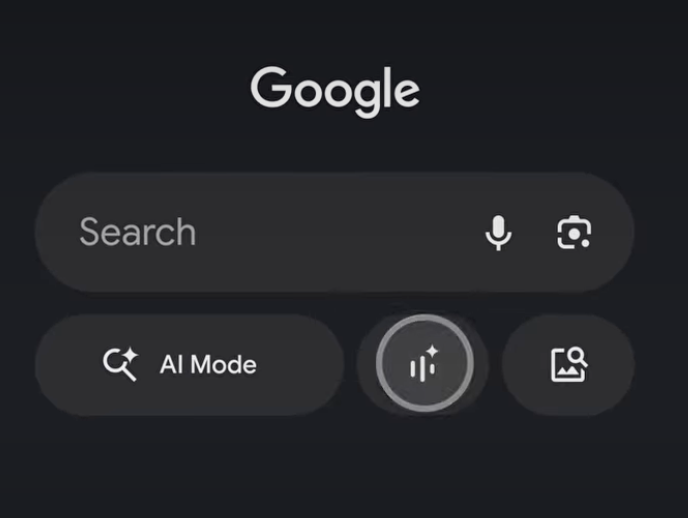
You can tap the new Live icon under the search bar, or open Google Lens and choose Live to start an interactive voice conversation that can also see what your camera sees.

Rajan Patel, VP of Engineering for Search at Google, highlights the launch in a post on X:

How It Works

Search Live has two entry points. In the Google app, you can start a voice conversation and optionally enable video input.

Look for the icon shown below:

Image Credit: Google

In Lens, camera sharing is on by default so you can immediately ask questions about what is in front of you and get follow-ups with links to dig deeper on the web.

Google highlights practical scenarios such as hands-free trip planning, quick how-to guidance for hobbies, step-by-step troubleshooting for electronics without typing model numbers, support for school projects, and picking a board game by scanning several boxes at once.

See it in action in this launch video:

[embedded content]

Why This Matters

Search Live moves queries from typed text to camera and voice, with answers arriving while people are actively engaged in tasks.

You can capture these searchers by prioritizing content that answers specific, in-the-moment questions. Ensure that your visual information is accurate and easily recognizable.

Local businesses should consider keeping storefront photos, product imagery, and key details current since people can now point, ask, and get links in real time.

Looking Ahead

Search Live is only launching in English in the U.S. for now, but Google says more languages and regions are coming.

This launch continues Google’s push to move everyday search beyond the keyboard. Businesses that prepare their content and visuals for that shift will be better positioned when the rollout expands

https://www.searchenginejournal.com/google-app-adds-search-live-for-real-time-visual-search/556816/


From Line Item To Leverage: How Web Performance Impacts Shareholder Value via @sejournal, @billhunt

Despite years of digital transformation talk, too many CEOs and CFOs still treat the corporate website as a necessary marketing expense, a sunk cost with limited upside. I have far too many CEO’s of billion-dollar companies who view it simply as an expensive interactive brochure, setting the tone for the company and dooming the web as just that, a brochure without strategic value.

But the modern website is not just a cost center. It’s a capital asset. One that, when strategically managed, generates revenue, lowers acquisition costs, accelerates growth, and protects brand equity.

In my previous articles (“Closing the Digital Performance Gap” and “Who Owns Web Performance?“), I outlined how poor internal ownership and misaligned incentives drag down web effectiveness. Now it’s time to reframe the economic value of performance. Because digital visibility, findability, and functionality aren’t just tactical wins – they affect shareholder value.

Web Execution: Expense Or Asset?

Let’s speak the CFO’s language. If you build a new manufacturing line, you evaluate its contribution to output and margin. If you invest in a retail expansion, you track foot traffic, conversion, and revenue per square foot.

Why don’t we evaluate digital the same way?

Here’s how most companies currently think:

  • SEO: Free traffic driver.
  • Content: Sales and marketing copy.
  • UX: Design polish.
  • Analytics: Reporting tool.

Here’s how performance-minded leaders think:

  • SEO: Organic demand capture engine.
  • Content: Business development asset.
  • UX: Funnel velocity multiplier.
  • Analytics: Optimization flywheel.

When you stop viewing digital as overhead and start seeing it as infrastructure, the return on investment (ROI) math changes completely.

How Underperformance Drains Enterprise Value

If your digital infrastructure is fragmented, under-optimized, or reactive:

  • You spend more on paid channels to make up for poor organic performance.
  • You lose visibility to competitors in AI and search environments.
  • You deliver confusing or outdated experiences that erode brand trust.
  • You waste employee and agency hours chasing after misaligned key performance indicators (KPIs).

None of these are minor problems. They compound.

They show up in:

  • Lower customer lifetime value (CLV).
  • Higher customer acquisition cost (CAC).
  • Missed revenue from unindexed products or inaccessible content.
  • Declines in organic search traffic and authority that paid cannot make up for.

The Invisible ROI Leak: Misalignment

As explored in “Who Owns Web Performance?,” when multiple teams touch the website – but no one owns outcomes – you get:

  • Wasted spend on underperforming campaigns.
  • Lost traffic due to crawlability errors and excessive technical issues.
  • Duplicated content with no central taxonomy.
  • Security or compliance risks from unmanaged pages.

These are not theoretical. They show up on the balance sheet as missed revenue, higher CAC, and lower conversion rates.

The Capital Efficiency Of SEO And Organic Visibility

Capital efficiency is one of the most underappreciated components of shareholder value, but increasingly, it’s a critical factor in CEO evaluations. Boards and investors are looking beyond topline growth to assess how effectively a company turns investment into output to achieve growth. That means efficient, repeatable, high-margin systems like SEO and web performance become strategic levers, not support functions.

SEO is often dismissed as “free traffic,” but that’s misleading. It’s not free and has been rebranded into MBA-friendly buzzwords like “organic visibility” and “owned media.” But behind those terms is real effort. SEO teams must optimize content that was often created in a vacuum, retrofit pages with structured data, and resolve infrastructure gaps just to make that content accessible to search engines. These are real costs and costs that wouldn’t exist if SEO were embedded earlier in the workflow. When viewed holistically as a strategic function, SEO becomes a high-efficiency, compounding return channel. One that gets stronger with alignment and investment, and weaker with neglect.

Properly funded and governed SEO:

  • Reduces dependency on paid media.
  • Enables customer self-service and support at scale.
  • Increases discoverability across multiple intent stages.
  • Builds durable search equity and authority.
  • Fuels AI citations and rich result presence.

More importantly, it improves capital efficiency, the ability to turn inputs (budget, time, content) into outputs (qualified leads, revenue, brand trust) with minimal waste.

AI Search Just Raised The Stakes

Search is no longer about blue links – it’s about recommendation systems. AI Overviews, summary blocks, and generative results are now front and center. If your content isn’t:

…then you’re invisible. Or worse – you’re used as a data source without receiving attribution.

As I wrote in “The New Role of SEO in the Age of AI,” platforms now monetize the experience, not just the click. They extract content, retain the user, and collect behavioral data to improve their own models.

“If your content can’t be reused, monetized, or trained against – it’s less likely to be shown.”

Your site is not just competing with others – it’s competing with the platform itself.

Let’s Talk Shareholder Value

When SEO and digital performance are working:

  • You lower CAC.
  • You increase CLV through better segmentation and nurturing.
  • You strengthen brand equity via visibility and trust signals.
  • You improve operational efficiency through centralized platforms and reusable modules, and reduce customer support costs through effective self-service experiences.
  • You protect valuation by owning your digital demand footprint.

When they aren’t working, you erode those same advantages.

Let’s take a real-world example.

I worked with a public company preparing to spin off half its business into a new entity. The leadership’s attention was focused almost entirely on launching the new brand and website, yet there was no plan for preserving or migrating organic search performance. The new entity’s success depended on leveraging an existing client base, maintaining current sales momentum, and hitting aggressive growth targets. But SEO wasn’t even on the radar.

I was brought in to develop the business case for making organic search a strategic pillar of the post-divestiture digital platform. I argue that we would only get senior executive buy-in not by forecasting traffic loss, but by reframing SEO’s contribution across the three drivers of shareholder value:

  • Financial: Conservative modeling, based on current performance rates, showed that a poorly managed migration could result in $350 million in lost lead value. In addition, regaining that visibility via paid media would require tens of millions in unplanned ad spend.
  • Operational: The company continued operating in 45 countries across 10 languages. Without localized optimization and scalable global templates, international lead pipelines would suffer dramatically.
  • Strategic: To stand apart from the legacy business and support complex enterprise sales cycles, the new digital platform needed to rapidly establish authority, build trust signals, and differentiate itself not only in search but in ease of use and depth of information.

By speaking the language of shareholder value and showing how SEO impacted financial outcomes, operational continuity, and long-term strategic position, we secured executive alignment. SEO was integrated early into the platform roadmap, ensuring scalability, visibility, and global readiness from day one.

A Call To Action For Senior Leaders

If you’re a CEO, CMO, or CFO reading this, ask yourself:

  • Do we treat the website as a strategic asset or a sunk cost?
  • Is there executive ownership of performance or just distributed responsibility?
  • Are we capturing, measuring, and maximizing organic opportunity – or plugging gaps with paid media?
  • Is our content structured and usable by AI systems, or just accurate but invisible?

This is about mindset and governance, not just tactics.

Final Thought: Web Performance Is A Leverage Point

As digital channels drive more business outcomes, functions once considered tactical (like SEO or load speed optimization) can now contribute meaningfully to operational leverage, customer acquisition, and profitability turning them into strategic priorities.

Your website is where your brand, product, content, and promise converge. It’s your most visible, scalable, and measurable asset.

Treating it like a brochure is like owning an F1 race car and only polishing the paint.

When you design for performance, staff for cross-functional excellence, and govern for outcomes – you stop leaking value and start building leverage.

Because in today’s market, digital performance isn’t just good marketing. It’s good business.

And good business drives shareholder value.

More Resources:


Featured Image: Master1305/Shutterstock

https://www.searchenginejournal.com/from-line-item-to-leverage-how-web-performance-impacts-shareholder-value/552889/


And The Truth? This Writing Style Screams AI via @sejournal, @cshel

Six months ago, you could spot AI-generated text by its polished grammar, rigid essay structure, suspicious fondness for em dashes – and, of course, the inevitable emoji bullets (🔥🚀✨). The real giveaway, at least to my eye and ear, isn’t the emojis or the punctuation. It’s the cadence.

AI writing has a rhythm problem. The sentences are clipped. Overly dramatic. Split into one-line paragraphs that feel more like infomercials than journalism.

“The truth? This wasn’t SEO causation. It was a stock market correction.”
“They were left behind. They were angry. They weren’t your people.”

On the page, this is nails-on-chalkboard grating. It doesn’t read as conversational. It reads as performative. In my opinion, this is, without a doubt, AI’s most recognizable stylistic fingerprint.

A Brief History Of The AI Cadence

This rhythm predates AI. It has been the language of speechwriters, preachers, and copywriters long before GPT entered the chat. Think Reagan’s addresses, Clinton’s campaign rallies, Obama’s campaign speeches, Churchill’s wartime broadcasts, and Blair’s conference speeches. Each leaned on rhythm and repetition to generate a great deal of emotion out of a speck of substance. Pair that with Captain Kirk’s famously staccato delivery, televangelists’ sermons, or TED Talks built around dramatic pauses, and you see how cadence can make small or mundane ideas feel powerful and deep.

That style used to stay in its lane. Where print valued density and clarity, speech valued brevity and rhythm. Readers could re-read; listeners could not. Editors enforced writing standards and styles and the economics of print rewarded information density over theatrics. As a result, this cadence lived solely in spoken word. It lived in speeches and sales copy, and not in essays and articles.

AI collapsed those boundaries. Because LLMs cannot (or chose to not) differentiate between a stump speech, a YouTube transcript, and a white paper, they overindex patterns designed to persuade aloud and repurpose them for the written page. Now, we are inundated with technical articles that read like motivational talks.

Why AIs Default To This Cadence

The AI cadence is not an accident – it’s a reflection of what models were most heavily trained on. Large language models have been fed a disproportionate amount of spoken-word material: transcripts of speeches, news reports, debates, interviews, webinars, podcasts, and video scripts. These aren’t “written texts” in the traditional sense; they are spoken performances converted into text.

Why so much spoken-word data? Because it’s cheap and plentiful. Back when I was running my ISP, I loved radio and TV for advertising and news mentions because it was far less expensive than buying or winning space in print. Broadcasters had 24 hours a day to fill, and local stations were always desperate for content. Print, on the other hand, is expensive. Every page of a newspaper, magazine, or book costs money to produce, and publishers limit content to what is necessary or affordable. As a result, far more hours of audio and video have been produced than carefully edited prose — and much of that material ends up transcribed. Those transcripts give the models a vast mountain of “written-down speech” compared to a relatively smaller body of curated, edited text.

The difference is subtle but important: a transcript is in a written medium, but it is not writing in a written style. It preserves the cadence of spoken delivery — short bursts, rhetorical pauses, fragments. Models overindex this rhythm because it dominates the dataset.

Even when prompted to avoid it, the models can’t resist drifting back into this rhythm. They might manage a few sentences of varied prose, but the gravitational pull of the AI cadence always drags them back. It’s now the default groove burned into their training.

The Em Dash Problem

That overindexing also explains a related AI tell: the sudden overuse of em dashes. In polished writing, dashes were historically used sparingly for emphasis or interruption. In speech, however, pauses are constant. Transcripts often mark those pauses with dashes. For a model swimming in transcripts, the dash becomes a default punctuation mark, because it functions as the written equivalent of a spoken pause. The result is copy littered with dashes – not because the ideas require them, but because the training data normalized them.

Punctuation As Breath

Punctuation has always been about more than grammar. Periods, commas, and dashes are signals for how we pause and where we breathe. They are like rests in music, telling the reader when to stop, inhale, and reset before continuing. Well-edited prose balances those pauses so the rhythm feels natural.

The AI cadence breaks this balance. When every thought is chopped into fragments, you’re effectively told to breathe after every line. Reading an article like this feels like hyperventilating: shallow breaths, constant interruptions, no sustained flow. It makes everything sound catastrophic, urgent, or world-shattering, even when the subject matter is mundane. Gentle readers, not every sentence or every idea warrants that level of drama.

Where this leaves us is that when models generate text, they parrot back the structures they’ve seen most often: speech rhythms and speech punctuation, presented as though they were the standard for written communication. They are not. They’re salesmanship with line breaks and pauses dressed up as prose.

Why Readers React To It

This cadence feels powerful at first. It mimics natural speech. It creates rhythm. It feels dramatic without requiring depth. That’s why it pops in feeds.

However, the longer it is stretched out, like in long-form content, or the more a reader is exposed to the same cadence over and over and over again, the power you once felt collapses into disdain. This breathy, short-sentence delivery leads to:

  • Oversimplification which flattens nuance.
  • Repetition that manipulates more than it informs.
  • Every line to demand attention ensuring none of them earn it.
  • Readers to suspect style is substituting for substance.

Here is the deeper problem: when everything is delivered as if it were earth-shattering, readers begin to doubt the authenticity of the message itself. It’s Syndrome’s hypothesis in The Incredibles: “When everyone is super, no one is.” If every sentence screams urgency, then nothing actually carries weight.

Historically, this kind of relentless, crisis-driven cadence has also been a manipulation tactic. Political demagogues, televangelists, and snake-oil salesmen leaned on hyperbole precisely because they lacked evidence. When AI reproduces that same rhythm on the page, it inherits the credibility problem too. Readers may not articulate it consciously, but they feel it: if you have to shout every line, maybe you don’t have enough substance to stand on quietly.

Just as keyword stuffing once became a hallmark of low-quality SEO, this cadence is already becoming the hallmark of low-quality AI. Readers recognize the rhythm before they absorb the message. When the medium distracts from the message, trust erodes.

A Tale Of Two Paragraphs

AI cadence in practice:

“The algorithm changed.
Sites lost traffic.
Panic spread.
And the industry?
It declared SEO dead – again.”

Now, the same idea written for readers:

“When the algorithm changed, many sites saw a drop in traffic. The panic was predictable. Within days, familiar headlines declared SEO dead once again. The cycle repeats every few years, and every few years it proves wrong.”

The difference here is obvious: one is an infomercial and the other is writing.

How To Spot It

Editors and readers can train themselves to notice:

  • Long runs of one-sentence paragraphs.
  • Rhetorical questions with no depth (often beginning with conjunctions like And or But…
  • Sentence fragments pretending to be profound.
  • Sermon-like pacing that seems to expect a chorus of ‘amens’ (or applause, if you’re lucky)…

Simply put, once you have seen it, you cannot unsee it: it is the literary equivalent of a laugh track.

How To Write Like A Human Again

How do we remedy this situation? Short of, I suppose, doing our own writing?

  • Vary sentence length instead of defaulting to extremes.
  • Use rhetorical questions sparingly – only when they genuinely add depth.
  • Group related ideas into paragraphs; readers can handle more than one sentence at a time. Unless you are writing FOR toddlers, do not treat your readers as though they ARE toddlers.
  • Prioritize clarity and voice over performative drama. Note here that the goal isn’t to sound casual at all costs, but to sound intentional, rational, and backed by data.

Why It Matters For SEOs And Marketers

AI writing tools are embedded in nearly every workflow. Left unchecked, they will flood the web with copy that reads like an endless sales pitch. Professionals must edit not just for facts but for voice.

That means:

  • Training teams to recognize and break the AI cadence.
  • Creating style guides that emphasize varied sentence and paragraph structure.
  • Editing AI drafts with rhythm in mind, not just keywords.
  • Writing for humans who read – not just platforms that skim.

Respecting the reader’s time and intelligence is, in the end, the real optimization.

Is There Ever A Place For This Style?

Yes, of course, but like most things, in moderation. Staccato writing is effective for:

  • Ad copy where space is limited.
  • Video scripts where pacing drives attention. (Your LinkedIn vertical videos and IG Reels? Have at it. This is where the staccato AI cadence shines.)
  • The occasional LinkedIn post engineered for scanning.

However, should this become the default writing style for articles, blogs, or essays? Abso-effing-lutely not. It cheapens the content and undermines credibility.

In Closing

AI has introduced more than just new tools. It has also normalized certain stylistic tics that don’t belong in most forms of writing. Among these, the AI cadence problem is the most recognizable and the most damaging when left unchecked.

Writers, editors, and marketers need to treat the presence of AI cadence in their writings the same way we treated keyword stuffing a decade ago: as a major red flag. The difference between human and AI writing isn’t just factual accuracy. It’s rhythm, intent, and voice.

The real divide isn’t human versus machine. It’s generic versus intentional. Intentional writing that is structured for clarity, rooted in substance, and respectful of the reader will always stand out.

More Resources:


Featured Image: N Universe/Shutterstock

https://www.searchenginejournal.com/and-the-truth-this-writing-style-screams-ai/555854/


Are AI Search Summaries Making Evergreen Articles Obsolete? via @sejournal, @martinibuster

Ahrefs’ Tim Soulo recently posted that AI is making publishing evergreen content obsolete and no longer worth the investment because AI summaries leave fewer clicks for publishers.  He posits that it may be more profitable to focus on trending topics, calling it Fast SEO.  Is publishing evergreen content no longer a viable content strategy?

The Reason For Evergreen Content

Evergreen content can be a basic topic that generally doesn’t change much from year to year. For example, the answer to how to change a tire will generally always be the same.

The promise of evergreen content was that it represents a steady source of traffic. Once a web page is ranking for evergreen topics, publishers basically just have to make sure that it’s updated if the topic has changed in some way.

Does AI Break The Evergreen Content Promise?

Tim Soulo is suggesting that evergreen content, which can be easy to answer with a summary, is less likely to send a click because AI summarizes the answer and satisfies the user, who may not need to visit a website.

Soulo tweeted:

“The era of “evergreen SEO content” is over. We’re entering the era of “fast SEO.”

There’s little point in writing yet another “Ultimate Guide To ___.” Most evergreen topics have already been covered to death and turned into common knowledge. Google is therefore happy to give an AI answer, and searchers are fine with that.

Instead, the real opportunity lies in spotting and covering new trends — or even setting them yourself.”

Is Fast SEO The Future Of Publishing?

Fast SEO is another way of describing trending topics. Trending topics have always been around; it’s why Google invented the freshness algorithm, to satisfy users with up-to-date content when a “query deserves freshness.”

Soulo’s idea is that trending topics are not the kind of content that AI summarizes. Perplexity is the exception; it has an entire content discovery section called Perplexity Discover that’s dedicated to showing trending news articles.

Fast SEO is about spotting and seizing short-lived content opportunities. These can be new developments, shifts in the industry or perceptions, or cultural moments.

His tweet captures the current feeling within the SEO and publishing communities that AI is the reason for diminishing traffic from Google.

The Evergreen Content Situation Is Worse Than Imagined

A technical issue that Soulo didn’t mention but is relevant here is that it’s challenging to create an “Ultimate Guide To X, Y, Z” or the “Definitive Guide To Bla, Bla, Bla” and expect it to be fresh and different from what is already published.

The barrier to entry for evergreen content is higher now than it’s ever been for several reasons:

  • There are more people publishing content.
  • People are consuming multiple forms of content (text, audio, and video).
  • Search algorithms are focused on quality, which shuts out those who focus harder on SEO than they do on people.
  • User behavior signals are more reliable than traditional link signals, and SEOs still haven’t caught on to this, making it harder to rank.
  • Query Fan-Out is causing a huge disruption in SEO.

Why Query Fan-Out Is A Disruption

Evergreen content is an uphill struggle, compounded by the seeming inevitability that AI will summarize the content and, because of Query Fan-Out, possibly send the click to another website that is cited because it offers the answer to a follow-up question to the initial search query.

Query Fan-Out displays answers to the initial query and to follow-up questions to the initial search query. If the user is happy with the summary to the initial query, they may become interested in one of the follow-up queries, and one of those will get the click, not the initial query.

This completely changes what it means to target a search query. How does an SEO target a follow-up question? Maybe, instead of targeting the main high-traffic query, it may make sense to target the follow-up queries with evergreen content.

Evergreen Content Publishing Still Has Life

There is another side to this story, and it’s about user demand. Foundational questions stick around for a long time. People will always search “how to tie a bowtie” or “how to set up WordPress.” Many users prefer the stability of an established guide that has been reviewed and updated by a trusted brand. It’s not about being a brand; it’s about being the kind of site that is trusted, well-liked, and recommended.

A strong resource can become the canonical source for a topic, ranking for years and generating the kind of user behavior signals that reinforce its authority and signal the quality of being trusted.

Trend-driven content, by contrast, often delivers only a brief spike before fading. A newsroom model is difficult to maintain because it requires constant work to be first and be the best.

The Third Way: Do It All

The choice between producing evergreen content and trending topics doesn’t have to be binary; there’s a third option where you can do it all. Evergreen and trending topics can complement each other because each side provides opportunities for driving traffic to the other. Fresh, trend-driven content can link back to the evergreen, and this can be reversed to send readers to fresh content from the evergreen.

Trend-driven content sometimes becomes evergreen itself. But in general, creating evergreen content requires deep planning, quality execution, and marketing. Somebody’s going to get the click from evergreen content, it might as well be you.

Featured Image by Shutterstock/Stokkete

https://www.searchenginejournal.com/are-ai-search-summaries-making-evergreen-articles-obsolete/556721/


From SEO To GEO: How Can Marketers Adapt To The New Era Of Search Visibility? via @sejournal, @Semji_fr

This post was sponsored by Semji. The opinions expressed in this article are the sponsor’s own.

For three decades, SEO has been the cornerstone of digital visibility.

Keywords, backlinks, and technical optimization determined whether your brand appeared at the top of search results.

However, the landscape is shifting, and it’s likely that if you’re reading this article, you already know it.

With generative AI tools like ChatGPT, Google AI Overviews, Gemini, or Perplexity, users no longer rely solely on lists of blue links.

Instead, searchers and researchers receive synthesized, conversational answers that draw content from high-authority sources.

The message is clear: ranking alone is no longer enough.

To be visible in the age of AI, marketers need a complementary discipline, Generative Engine Optimization (GEO).

To do so, you need concrete methods and best practices to add GEO efficiently into your strategy.

What Is Generative Search Optimization (GEO)?

Generative Search Optimization (GEO) is the practice of ensuring that your content is selected, understood, and cited by large language models (LLMs) and generative engines.

How Does GEO Differ From Traditional SEO?

Traditional search engines use bots to crawl webpages and rank them.

LLMs synthesize patterns from massive pre-ingested datasets. LLMs and answer engines don’t index; they use them as their conversational padding.

What Is A Pre-Ingested Data Set?

Pre-ingested datasets are content that is pulled from websites, reviews, directories, forums, and even brand-owned assets.

This means your visibility no longer depends only on keywords

What Do I Need To Do To Show Up In AI Overviews & SERPs?

To increase your visibility in LLMs, your content must be:

Put simply: GEO ensures your brand shows up in the answers themselves as well as in the links beneath them.

How To Optimize For LLMs In GEO

Optimizing for LLMs is about aligning with how these systems select and reuse content.

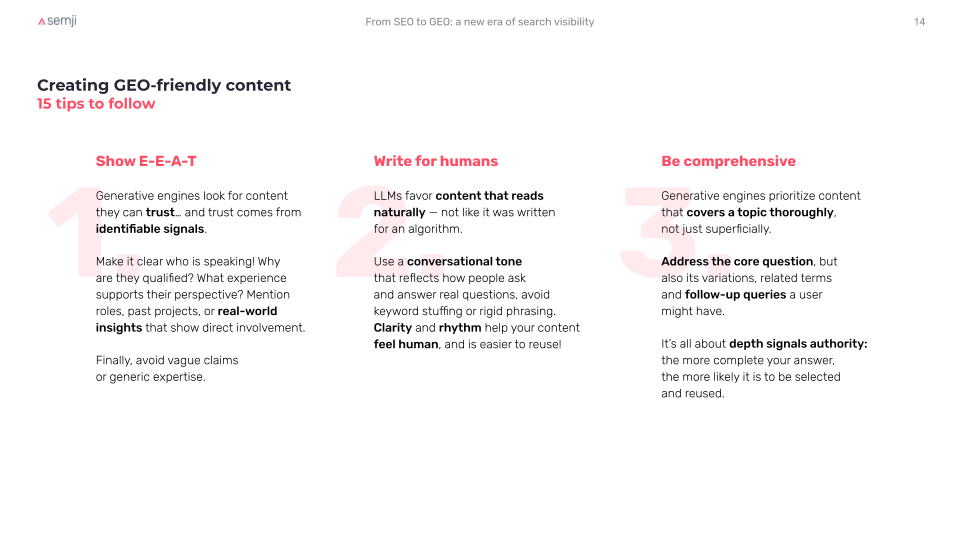
From our analysis, three core principles stand out in consistently GEO-friendly content:

1. Provide Structure & Clarity

Generative models prioritize content that is well-organized and easy to parse. Clear headings, bullet points, tables, summaries… help engines extract information and recompose it into human-like answers.

2. Include Trust & Reliability Signals

LLMs reward factual accuracy, consistency, and transparency. Contradictions between your site, profiles, and third-party sources weaken credibility. Conversely, quoting sources, citing data, and showcasing expertise increase your chances of being cited!

3. Contextual & Semantic Depth Are Key

Engines rely less on keywords and more on contextual signals (as it has been more and more the case with Google these last years–hello BERT, haven’t heard from you in a while!). Content enriched with synonyms, related terms, and variations is more flexible and better aligned with diverse queries, which is especially important as AI queries are conversational, not just transactional.

3 Tips For Creating GEO-Friendly Content

In the GEO guide we’re sharing with you in this article, 15 tips are delivered–here are 3 of the most important ones:

1. Be Comprehensive & Intent-Driven

LLMs favor complete answers.

Cover not just the main query but related terms, variations, and natural follow-ups.

For example, if writing about “content ROI,” anticipate adjacent questions like “How do you measure ROI in SEO?” or “What KPIs prove content ROI?”!

By aligning with user intent, not just keywords, you increase the likelihood of your content being surfaced as the “best available answer” for the LLMs.

Learn how to do this.

2. Showcase E-E-A-T Signals

GEO is inseparable from trust. Engines look for identifiable signals of credibility:

  • Author bylines with expertise.
  • Real-world examples, roles, or case insights.
  • Transparent sourcing of statistics and references.
  • And many more opportunities to prove your credibility and authority.

Think of it as content that doesn’t just “read well,” but feels safe to reuse by the LLMs.

3. Optimize format for machine & human readability

Beyond clarity, formats like FAQs, how-tos, comparisons, and lists make your content both user-friendly and machine-friendly. Many SEO techniques are just as powerful and efficient in GEO:

  • Add alt text for visuals.
  • Include summaries and key takeaways in long-form content.
  • Use structured data and schema where relevant.

This dual optimization increases both discoverability and reusability in AI-generated answers.

Why It’s Essential To Optimize For LLMs

Skeptical about GEO? Consider this: 74% of problem-solving searches now surface AI-generated responses, and AI Overviews already appear in more than 1 in 10 Google queries in the U.S. AI Overviews, Perplexity summaries, and Gemini snapshots are becoming default behaviors in information-seeking. The line between “search” and “chat” is blurring.

The risk of ignoring GEO is not just lower traffic—it’s invisibility in the answer layer where trust and decisions are increasingly formed.

By contrast, marketers who embrace GEO can:

  • Defend brand presence where AI engines consolidate attention.
  • Create future-forward SEO strategies as search continues to evolve.
  • Maximize ROI by aligning content with both human expectations and machine logic.

In other words, GEO is not a trend: it’s a structural shift in digital visibility, where SEO remains essential but is no longer sufficient. GEO adds the missing layer: being cited, trusted, and reused by the engines that increasingly mediate how users access information.

GEO As A New Competitive Advantage

The age of GEO is here. For marketing and SEO leaders, the opportunity is to adapt faster than competitors—aligning content with the standards of generative search while continuing to refine SEO.

To win visibility in this environment, prioritize:

  • Auditing your current content for GEO readiness.
  • Enhancing clarity, trust signals, and semantic richness.
  • Monitoring your presence in AI Overviews, ChatGPT, and other generative engines.

Those who invest in GEO today will shape how tomorrow’s answers are written.

Want to explore the full framework of GEO?


Image Credits

Featured Image: Image by Semji. Used with permission.

https://www.searchenginejournal.com/seo-geo-boost-visibility-semji-spa/556132/


Pew: Most Americans Want AI Labels, Few Trust Detection via @sejournal, @MattGSouthern

A new Pew Research Center survey reveals a gap between people’s desire to know when AI is used in content and their confidence in being able to identify it.

Seventy-six percent say it’s extremely or very important to know whether pictures, videos, or text were made by AI or by people. Only 12% feel confident they could tell the difference themselves.

Pew Research Center wrote:

“Americans feel strongly that it’s important to be able to tell if pictures, videos or text were made by AI or by humans. Yet many don’t trust their own ability to spot AI-generated content.”

This confidence gap reflects a rising unease with AI.

Half of Americans believe that the increased presence of AI in daily life raises more concerns than excitement, while just 10% are more excited than worried.

What Pew Research Found

People Want More Control

About 60% of Americans want more control over AI in their lives, an increase from 55% last year.

They’re open to AI helping with daily tasks, but still want clarity on where AI ends and human involvement begins.

When People Accept vs. Reject AI

Most support the use of AI in data-intensive tasks, such as weather prediction, financial crime detection, fraud investigation, and drug development.

About two-thirds oppose AI in personal areas such as religious guidance and matchmaking.

Younger Audiences Are More Aware

Awareness of AI is highest among adults under 30, with 62% claiming they’ve heard a lot about it, compared to only 32% of those 65 and older.

But this awareness doesn’t lead to optimism. Younger adults are more likely than seniors to believe that AI will negatively impact creative thinking and the development of meaningful relationships.

Creativity Concerns

More Americans believe AI will negatively impact essential human skills.

Fifty-three percent think it will reduce creative thinking, and 50% feel it will hinder the ability to connect with others, with only a few expecting improvements.

This suggests labeling alone isn’t sufficient. Human input must also be evident in the work.

Why This Matters

People are generally not against AI, but they do want to know when AI is involved. Being open about AI use can help build trust.

Brands that go the transparent route might find themselves at an advantage in creating connections with their audience.

For more insights, see the full report.


Featured Image: Roman Samborskyi/Shutterstock

https://www.searchenginejournal.com/pew-most-americans-want-ai-labels-few-trust-detection/556697/


Review Signals Gain Influence In Top Google Local Rankings via @sejournal, @MattGSouthern

A new analysis from Search Atlas quantifies the interaction between proximity and reviews in local rankings.

Proximity drives visibility overall, while review signals become stronger differentiators in the highest positions.

This study examines 3,269 businesses across the food, health, law, and beauty sectors.

It shows that for positions 1–21, proximity influences 55% of decisions, while review count accounts for 19%. In the top ten, proximity’s influence decreases to 36%, but review count increases to 26%, with review keyword relevance reaching 22%.

Search Atlas writes:

Proximity is the top driver of local visibility.

The study also notes:

Proximity does not always dominate in elite positions.

What It Means

You’ll have a better chance of achieving top results by focusing on earning more reviews and naturally incorporating service-specific terms into reviews, rather than relying on your pin’s location on the map.

The report suggests that Google understands review text semantically. Using service-specific language in reviews can help your rankings for high-value queries.

How To Apply This

Think of proximity as your default setting. It’s fixed, so focus your attention on the inputs you can control.

When crafting your review requests, aim for natural, service-specific language. For instance, “best dentist for whitening” tends to work better than “great service.”

Also, ensure that your GBP name and profile details are aligned. The research shows that matching your business name to the search intent, such as “Downtown Dental Clinic” for someone searching “dentist near me,” can make a positive difference.

Sector Behavior

While the overall pattern remains consistent, shoppers can exhibit different behaviors across categories.

Per the report:

  • For Law, proximity tends to be the most important factor, with reviews playing a secondary role.
  • In Beauty, reputation signals are more influential. While proximity is still key, review volume and keywords are also important.
  • When it comes to Food, review content and profile relevance become especially valuable, particularly in crowded markets.
  • Health balances proximity with strong reviews and service alignment in reviews.

Looking Ahead

This study quantifies something practitioners have long suspected: proximity earns you a look, but review content helps you secure the top spot in the close contest.

If you can’t change your location, shape the language around it.

For more data on GBP ranking factors, see the full report.

Methods & Limits

The authors applied XGBoost to grid visibility, GBP metadata, website content, and reviews, achieving a global model that explains approximately 92–93% of the variance.

They emphasize that feature importance indicates correlation, not causation. Additionally, they warn that proximity might be overstated due to fixed grid collection and note that their results represent a snapshot in time.

Use these insights as guidance, not a strict rulebook.


Featured Image: Roman Samborskyi/Shutterstock

https://www.searchenginejournal.com/review-signals-gain-influence-in-top-google-local-rankings/556664/


Making SEO Personas Actionable Across Teams via @sejournal, @Kevin_Indig

Here’s what I’m covering this week: How to get the most out of personas in your day-to-day work across SEO, content, and the broader org.

Because in the AI-search era, personas built from organic queries and prompts have value for every touchpoint: ad copy, sales scripts, support docs, product messaging.

They carry the unfiltered language of your audience (their fears, hesitations, and demands) straight into the hands of the teams shaping your funnel.

If you’re not operationalizing search-data-based personas across departments, you’re missing one of the few forms of market intelligence that scale across SEO, marketing, sales, and product.

Personas shouldn’t live stagnantly in a slide deck. I’ll show you how to make them pull their weight across the org.

Image Credit: Kevin Indig

Boost your skills with Growth Memo’s weekly expert insights. Subscribe for free!

Last week, I showed you how to create search personas based on data you already have available, along with how to use an LLM-ready persona card to extract custom insights.

But the best persona in the world doesn’t help if it collects dust in your Google Drive.

This week, I’m digging into how to make these search persona insights actionable – not only across your SEO processes and production, but also across broader teams that SEO work touches.

However, before we dive in, I want to share a few notable perspectives on search personas that came up in conversation on this LinkedIn thread:

Malte Landwehr, CPO & CMO at Peec AI, gave this visual example in the thread (with additional context) that resonated strongly. From his own research and testing, he shared a visual detailing LLM visibility for various headphones based on prompts for personas and use cases.

The findings? LLMs recommended different brands/products based on different persona-based prompts.
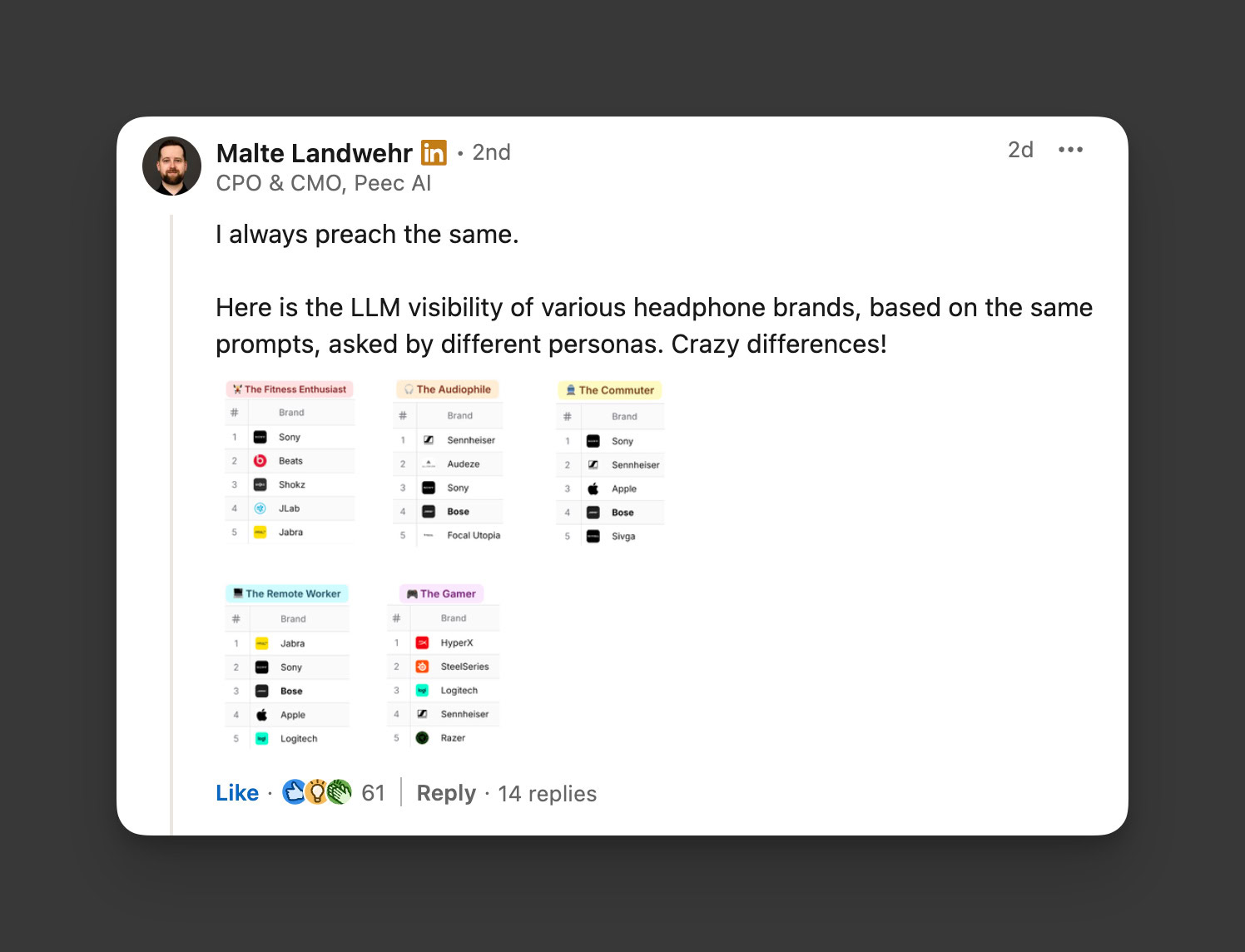
Image Credit: Kevin Indig

And below, David Melamed brings up an interesting and important question below.

Image Credit: Kevin Indig

I agree with David: The more personalized search results are, the less you can segment or generalize across a group.

But if you check out our conversation in the comments, David absolutely gets it, and his concerns are valid.

He shares that “more long tail content and citations across more unique niches, scenarios and comparisons should beat out persona driven content” and that “looking at questions, related searches in search console, and Google and Microsoft ads search term reports… [along with] experience and other voice of customer research (listening to calls, analyzing reviews, reddit threads, complaints, etc..)” would be a helpful approach.

And that’s what I tackled last week in Personas are critical for AI search (part 1 on the persona topic): To succeed with user personas for SEO – and make them valuable and usable – the goal is to build custom, unique search personas from your actual in-house data and long-tail Google Search Console.

So, David brought up a valid point, one that’s aligned with how we should be building useful search personas for today.

Lastly, Elisa Daniela Montanari sums up how a lot of us feel about the shift toward qualitative research (along with mentioning her goals to upskill as an SEO by diving into user research tactics):
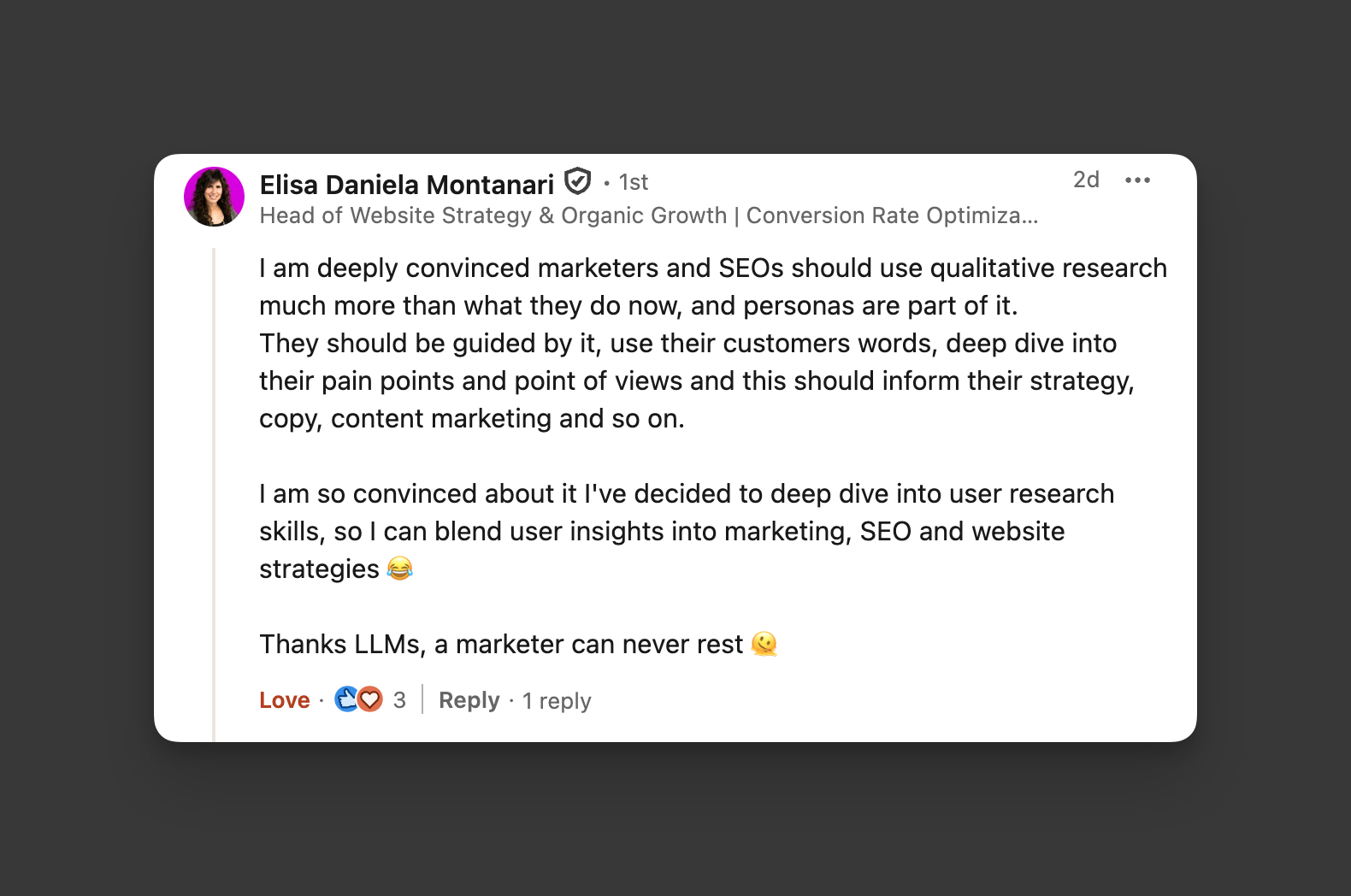
Image Credit: Kevin Indig

And with these conversations in mind…

I’d argue that high-quality, customer-centered SEO research captures unfiltered questions, painpoints, and intents at scale, across the entire journey – and that makes it one of the most versatile forms of market intelligence that you can use across your brand as a whole.

So if organic query and prompt research is so valuable and versatile, how do you ensure they’re actually used?

Because all strategists everywhere have had that stupidly challenging moment: After doing all the labor-intensive data-gathering of building user personas for SEO, it’s time to get your team or clients to use those insights regularly across SEO production.

You need to prep your findings so they’re not left gathering cobwebs in the dark corners of the cloud.

1. Create An Internal Knowledge Hub For Core Search Personas

Not another slide deck or spreadsheet that gathers dust. A simple, easily-accessible hub that is a living, breathing document.

Translate data into the formats your team and stakeholders already use: dashboards, one-page briefs, funnel visualizations.

Think Notion, Airtable, Asana, Google Sheets, Slack Canvas – wherever your team is already working and discussing production.

Key contributors need to have access to fluidly comment and update as organic questions and pain points surface across your audience.

2. Build A Clear Narrative Around How And Why Using These Personas Is Valuable

Position SEO research/persona use as a “horizontal competency” that makes every department smarter.

Kick off persona use with a short session showing:

  • Real queries from your personas.
  • How those queries reveal pain points, objections, or jobs-to-be-done.
  • Where competitors are (or aren’t) meeting those needs.
  • Inform the team on how users are interacting with AI-based search results (see Trust Still Lives in Blue Links for details on the four AIO intent patterns).

A three-minute Loom video can do wonders.

Use the data you have (Google Search Console, Semrush, Ahrefs, LLM prompt monitoring tools) to back up the importance of use.

At the end of this memo, I have a slide deck template for premium subscribers that will help you build this narrative and guide effective persona implementation across teams.

3. Train Contributors On How Personas Will Be Used Across Production – And Follow Through

Train your SEO/content contributors that personas don’t just shape blog posts – they inform all communication touchpoints in the customer journey.

If you’re also using search personas to inform your sales and customer care team interactions (and you should – more on that below), create examples of how to use personas across all communication channels.

Highlight missed opportunities (e.g., ad copy vs. organic messaging mismatch, customer support docs hidden from search, sales scripts that could benefit).

And although this means extra work for leaders, managers, or editors, this part is crucial: Let your team know that briefs that don’t specify personas will be rejected or sent back for revision. That also goes for drafts that don’t speak directly to defined personas and their search behaviors/needs.

Yes, it’s an added step on an often-already-overloaded plate of a marketer, but this is how you ensure they’re successfully implemented across your work over time.
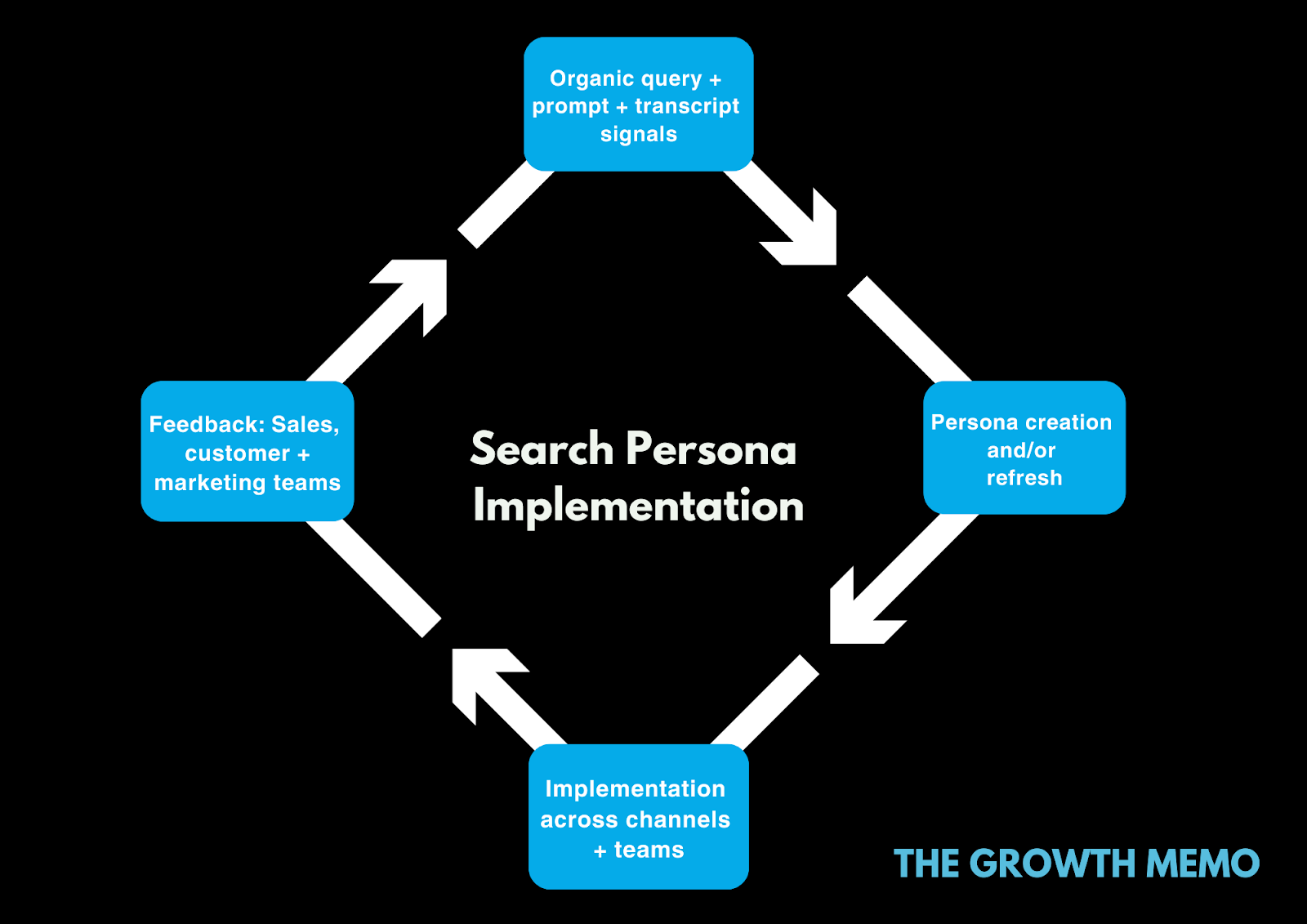
Image Credit: Kevin Indig

Here’s where your personas stop being a strategy deck or training session and start shaping what users experience.

1. Incorporate Persona Data Into Every Content Brief

Your search persona data is there to help you direct every brief beyond target queries and products/services features to mention.

Use it to inform your content producers of the following:

  • Unique, data-backed pain points.
  • Real customer/lead questions that need answering.
  • Proof points needed to reduce hesitation.
  • What authority signals resonate with your target reader.
  • Behaviors that impact interactions with the page.
  • Copy on the page.

In every content brief, flag actual language from queries, call transcripts, or reviews that should be used on the page. Create a copy bank that’s tagged into your content briefs that your writers, editors, and LLMs can pull from.

For example, if your persona says “integration headaches,” don’t water it down to “implementation challenges.” Use their words.

2. Use Search Persona Data To Inform Page Structure

Match the flow of the page to how specific personas are likely to consume information.

Some personas need trust-driven validation upfront (editorial quality signals, branded logos, stats, testimonials). Others need efficiency first, then a CTA.

Here’s a practical way to estimate what each of your search personas needs on the page:

  • Follow guidance (and use the regex) provided in Personas are critical for AI search to extract GSC long-tail queries that can contain indicators of specific search personas.
  • Select a specific URL or page that comes up for multiple long-tails for a consistent search persona type.
  • Examine on-page user scrolling and clicking behavior via your heatmap tool.
  • Look for places users pause, scroll past, or toggle back and forth between information. Strong behavioral patterns (skips, hesitations, long-tread times) point to places to better optimize page structure based on search persona type.

Once you’re done gathering information based on user behavioral patterns, audit your on-page modules, formats, and design capabilities to ensure you have all pieces needed to create pages that fulfill those specific needs.

Enlist your product and/or web design team to create what’s needed to serve a better on-page experience.

Then, include direction in each brief of what sort of modules and information structuring is needed based on search persona type.

3. Map To Topic Clusters In The Brief

Specific search personas naturally gravitate toward certain topics or proof points.

A searcher who uses technical language for their queries may cluster around integrations and APIs and need to see clear documentation is available for how to use them, while a user with economic or decision-making intent may cluster around ROI topics.

Build semantically related internal linking paths that explicitly connect those journeys for your SEO personas. Use your topic map (if you’ve built one) and revisit your keyword universe as needed.

4. Personas Should Inform Your AI-Assisted Workflows

Use search persona details as inputs to LLM prompts and/or incorporate them into your AI-assisted content generation, like AirOps workflows.

Instead of “write an article about X with the search intent of Y,” frame it as “write for a skeptical buyer evaluating vendors – include comparisons and third-party validation.”

Or better yet? Use your persona cards (see Personas Are Crucial for AI Search for a detailed guide) to help guide additional prompts personas might use in LLMs when attempting to solve queries related to your brand.

Below, take a look at how this could work in practice, using the four distinct AIO intent patterns from the additional analysis of the UX study of AIOs found in Trust Still Lives in Blue Links:

  1. Efficiency-first validations that reward clean, extractable facts (accepting of AIOs).
  2. Trust-driven validations that convert only with credibility (validate AIOs).
  3. Comparative validations that use AIOs but compare with multiple sources.
  4. Skeptical rejections that automatically distrust AIOs for high-stakes queries.

Let’s say you work for a fintech startup that provides easy-to-use business insurance for small to midsize businesses.

Here’s how you might use personas to inform content production for efficiency-first and trust-driven search behaviors:

Example 1: Junior operations coordinator at a 20-person marketing agency → accepting of AIOs (efficiency-first) → queries “What’s the average cost of business insurance for a 20-person company?” → Likely to validate range via the AIO → Takeaway for your brand: Create content geared to businesses with small teams and/or junior learners that includes straightforward facts and ranges that are easily extractable, so it’s cited in AIOs. Make your pricing explanations scannable and structured. Internally link to other knowledge guides for project managers or operations leads at small to midsize businesses.

Example 2: Small business owner in healthcare services → validate AIOs with second-clicks (trust-driven) → queries “Do I need business insurance for HIPAA compliance?” → Likely to read the AIO but won’t act until they see credible signals → citations from legal/insurance authorities → Takeaway for your brand: Position your content with authoritative references (link to .gov or .org sources) and highlight compliance expertise so your page is validated by trust; include case studies and/or social proof of authority; Internally link to other guides for healthcare service businesses.

How To Know Search Persona Implementation Is Working

Watch for these signals:

  • Higher engagement time and more downstream actions on the page.
  • Lower bounce rates on persona-driven pages.
  • More citations and visibility in AIOs and LLM outputs (your copy matches how users ask questions).
  • Increased assisted conversions: Pages designed for a specific persona show up more often in multi-touch journeys or are incorporated strategically and/or organically into follow-up communications by sales/customer teams.
  • Sales/Customer service team feedback loop: Fewer “this didn’t answer my question” moments.

Amanda jumping in here: In March of this last year, I led one of my clients to pivot hard to persona-focused content. Not only have we seen an increase in AIO inclusion, AI Mode citations, and LLM visibility for these niche terms, but we’ve also experienced a boost in visits to our core guides that were geared toward our broader audience. After this pivot, we’re seeing anywhere between a 20-60% month-over-month increase in organic visits from ChatGPT, and a ~40% increase month-over-month in visible AIO inclusion, to include our older core content as well. Although some of this growth is likely due to increased overall ChatGPT adoption and increase in Google’s use of AIOs across queries, here’s the takeaway (and my hypothesis): As you create niche content for personas, it’s possible you could also see a lift in your core content as it’s served to these specific groups of searchers – based on what these tools know about (1) the end user and (2) who your brand serves best. But only time (and more experiments) will truly tell.

The reality is, no matter how well you implement search personas into your SEO and content production, SEO and growth marketing teams can’t win on their own.

Search personas have the real opportunity to contribute to results when the rest of the org picks them up and runs with them throughout lead and customer touchpoints.

The trick is to make it dead-simple for every team to see why personas matter for their work and how to apply them.

Plus, a big advantage of bringing other teams on board is that SEO-driven personas – built from real search queries, prompts, social chatter, and call transcripts – arm everyone with the exact language customers use.

That means you can reduce hesitations, preemptively answer questions, and build trust across every channel of communication.

Below, here’s a quick list of guidance to help you collaborate with other teams on how to use search persona data.

And in the next section, I’ll jump into how to create intentional feedback loops so your personas stay fresh, useful, and relevant.

Email Marketing

  • Work with email teams to trigger sequences based on persona signals (query intent by pages visited, topics visited).
  • Example: If someone hits three pricing-related pages, route them into a nurture path designed for a search-data-informed persona that includes supportive content often visited by those users.
  • Benefit: Aligns your SEO insights with lifecycle marketing, reducing drop-off between discovery and conversion.

Paid Media And Advertising

  • Lift search-persona informed language directly into ad copy → track if it increases CTR because you’re speaking the way customers search.
  • Map objections to creatives: For example, run ads that emphasize compliance and audits if you have search data illustrating a segment of users who have detailed questions about security of your software.
  • Test messaging by persona to learn faster which angles convert.
  • Benefit: SEO persona research de-risks your paid spend by validating copy before it goes live.

Social And Community

  • Translate persona pain points into campaign themes and engagement prompts.
  • Highlight UGC that shows peers solving the same persona pain point = social proof!
  • Build Reddit or forum campaigns where you provide helpful answers framed through persona lenses.
  • Benefit: Social teams stop guessing what will resonate – they get ready-made hooks from organic customer query data and in-house transcript research.

Sales

  • Use personas to shape sales scripts to reduce organic hesitations, along with your follow-up email templates.
  • Provide a list of key characteristics or organic phrases discovered in your SEO user persona research for sales to easily pick up on what scripts or content to use.
  • Equip reps with content “proof kits” (case studies, calculators, benchmarks) that map to persona objections.
  • Example: Lead comes in from organic content around “integration headaches.” Sales can immediately address hesitations with comparison docs + customer proof.
  • Benefit: SEO insights close the loop. Your leads feel heard because the same language follows them from organic query to sales call.

Customer Support

  • Build FAQs, hub pages, and documentation around persona pain points and natural language so customers can self-serve faster.
  • Train reps on marketing and educational language developed for personas to keep communication consistent across the lifecycle.
  • Feed recurring support questions back to SEO/content as new opportunities.
  • Benefit: Less friction for customers, more organic opportunities uncovered for SEO.

Product And/Or Product Marketing

  • Tie persona insights to feature positioning: “Which persona is this release for?”
  • Test messaging against persona objections to see what sticks before launch.
  • Document frameworks: “For Persona A, highlight speed. For Persona B, highlight compliance.”
  • Benefit: SEO personas become market intelligence, not just marketing intel. This helps product teams ship smarter. Unanswered questions or unsolved organic problems are great opportunities for new features.

One of the biggest pitfalls with doing the work to create search personas is then treating them like static, lifeless relics afterward.

A 2015 B2B study conducted by Cintell found that 71% of companies who exceeded revenue goals had documented personas – and nearly two-thirds of those orgs had updated them within the last six months.

(Listen, I am well aware 2015 is approximately 47 internet years ago – but I’d argue core human decision-making behavior takes much longer to change than a decade.)

No matter the study’s age, the message rings true today: Marketing and user personas win when they’re kept alive.

SEO personas make this easier than traditional personas because they’re rooted in fluid signals, like real search queries, prompts, and customer language that evolve as quickly as the market and trends do.

If you’re closely monitoring GSC data, Semrush, or AIO/LLM interactions, you’ll see shifts in questions and pain points before most competitors.
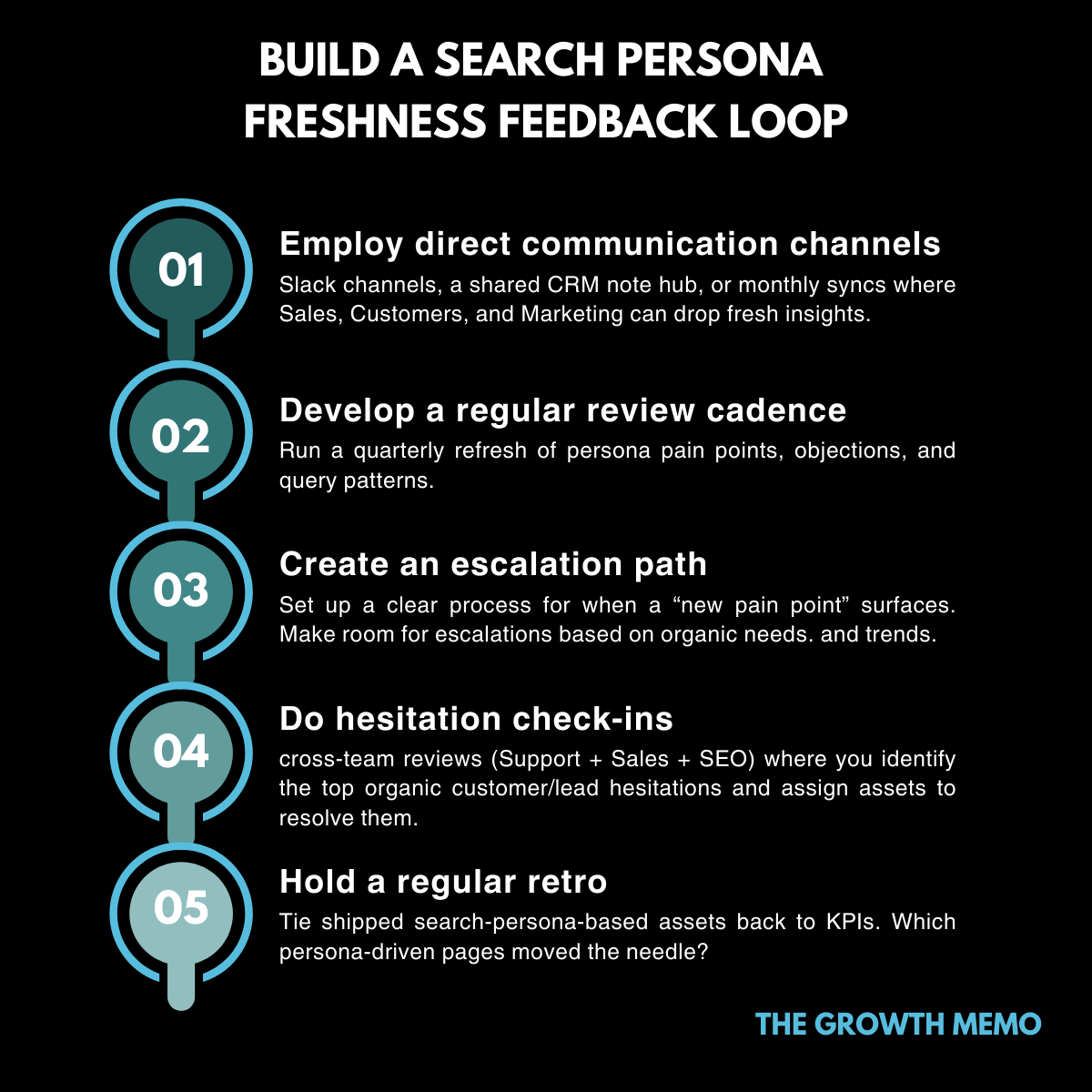
Image Credit: Kevin Indig

How to operationalize a persona freshness feedback loop across your team:

  • Employ direct communication channels: Create dedicated Slack channels, a shared CRM note hub, or monthly syncs where Sales, Customers, and Marketing can drop fresh objections, questions, or hesitations they’re hearing. If you’ve got power users or partners who can drop in routine feedback and thoughts, even better.
  • Develop a regular review cadence: Run a quarterly refresh of persona pain points, objections, and query patterns. Layer in branded search trends, referral data, and AIO/LLM interactions to validate updates.
  • Create an escalation path: Set up a clear process for when a “new pain point” surfaces. Sales hears it first → SEO/content teams get it next → new content or updates ship fast → implement/inform across marketing channels. How do you make room for organic escalations in your SEO/content production systems?
  • Do hesitation check-ins: Bi-weekly or monthly cross-team reviews (Support + Sales + SEO) where you identify the top organic customer/lead hesitations and assign assets to resolve them: case studies, how-to videos, tools and calculators, testimonials/reviews, community feedback on social channels.
  • Hold a regular retro: Tie shipped assets back to KPIs. Which persona-driven pages moved the needle? Which didn’t? Prune or upgrade pages that aren’t solving the problem.

The big takeaway here is search personas are never one-and-done.

They’re a dynamic, qualitative and quantitative data-based operating system for your marketing, sales, and product teams … and if you keep the feedback loop tight, they’ll keep paying dividends.


Featured Image: Paulo Bobita/Search Engine Journal

https://www.searchenginejournal.com/making-seo-personas-actionable-across-teams/556618/