The State Of SEO 2026: How To Survive

Two-thirds of SEO professionals say original content creation is their secret weapon, but there’s a problem nobody talks about.

While content creation drives the best results, it’s also the hardest thing to scale. Over 40% of professionals say it takes more time than any other SEO task.

Our fifth annual State of SEO report shares insights from 371 SEO professionals in 52 countries. It highlights what’s working in SEO today and where the industry is headed.

Find out how professionals are responding to AI disruption, which tactics are most effective, and where teams plan to invest resources. Most respondents have four or more years of experience, so these insights come from people who have lived through many changes in the industry.

Download the report to learn about:

  • Which SEO activities deliver the strongest return on investment (ROI) right now.
  • How teams are using AI in their workflows.
  • The biggest challenges holding SEO back.
  • Investment priorities.
  • Why professionals are concerned about AI but stay optimistic about budgets.

Get the information you need to plan your SEO strategy for 2026.

Three Paths Are Emerging In SEO

As teams navigate AI disruption, the data reveals three distinct strategies forming across the industry:

  • AI-Heavy Adopters (22%) are betting on scale through automation.
  • Authority Builders (49%) are doubling down on E-E-A-T (Experience, Expertise, Authoritativeness, and Trustworthiness) and human expertise.
  • Hybrid Strategists (58%) are finding the middle ground, using AI to enhance human-created content.

Each path has merit, but the data shows clear patterns about what’s working now.

Original Content Creation Still Drives SEO Success

When we asked what had the most positive impact this year, original content creation topped the list at 66%. Content updates came second at 42.6%. Technical SEO improvements were close behind at 42.3%.

This shows that original content remains key to SEO success. However, as stated earlier, it takes significant time.

The industry has found a solution. Most teams (the 58% Hybrid Strategists) plan to create human-written content with AI support. They want quality over quantity, using AI to save time while maintaining human oversight.

Interestingly, cross-department collaboration currently shows the lowest impact at just 9%, yet 37% of companies plan to increase it. This gap represents a major opportunity for teams willing to break down silos.

Activities with the greatest positive impact

Download the full State of SEO 2026 report to see how successful teams manage their content work.

AI Tools Are A Competitive Necessity And Threat

The tools data tells us a lot about how SEO has changed. Analytics and reporting tools are most popular with respondents, leading at 56%. AI writing assistants have jumped to fourth place at 42.3%. That’s the same use as technical SEO tools.

Cross-functional platforms also scored high at 51.2%. Teams want all-in-one solutions instead of many separate tools.

While teams use AI, it also concerns them. A notable 77% worry that AI answers will reduce website clicks. That’s their biggest concern about the future.

This puts SEO professionals in a tough spot. They need AI to compete, but they see it as their biggest threat.

most critical seo tools and platforms

E-E-A-T Is The Industry’s Answer To AI Disruption

Almost half of respondents (49%) plan to invest in E-E-A-T next year.

This focus on Experience, Expertise, Authoritativeness, and Trustworthiness shows how the industry plans to fight back against AI threats. The thinking makes sense: AI can summarize existing information, but it can’t replicate real-life experience or original research. By focusing on E-E-A-T, teams build defenses that AI can’t break through.

This explains why topical authority and content architecture also rank high at 33% of investment plans. Teams want to become the go-to experts in their fields.

Algorithm changes remain the top challenge at 59%. Content workflow problems come second at 32%. But teams aren’t waiting around; they’re preparing through AI training (42% of companies) and better collaboration between departments (37%).

This strategic shift requires continued investment, which brings us to an encouraging finding about budgets.

[Chart: Future Investment and Innovation Plans]

SEO Budgets Stay Strong Because Results Remain Solid

Despite AI concerns and algorithm chaos, SEO investment stays strong. Only 43% of companies cut any SEO spending last year. And 65% expect no cuts next year.

Why this confidence? The results speak for themselves. When we asked about outcomes, 60% reported more organic traffic. Another 34% saw more leads and conversions. These results explain why companies keep investing even as the landscape shifts.

Teams also focus more on business impact when measuring success. Organic traffic leads at 74%, while qualified leads and sales rank second at 60%. Teams are moving past vanity metrics to prove real business value.

This combination of proven results and strategic adaptation explains the industry’s resilience.

[Chart: Recent SEO Investment Reductions]

Building Your 2026 SEO Strategy

The data paints a clear picture: SEO faces real challenges from AI disruption and constant algorithm changes. Technical problems affect 28% of teams, while 26% struggle with leadership support.

But the industry is responding strategically. About 42% of companies are training staff on AI. Another 36% are teaching current best practices. Teams that combine AI efficiency with human expertise and E-E-A-T principles are positioning themselves to thrive.

Whether you see yourself as an AI-Heavy Adopter, Authority Builder, or Hybrid Strategist, this report gives you the roadmap for 2026 planning. It includes insights from professionals managing SEO in every major market.

Download the State of SEO 2026 report now. Use it as your planning guide for the year ahead. Get complete analysis of tool adoption, scaling challenges, measurement methods, and expert advice on handling the AI transition.

The industry faces real challenges. But the data shows a strong community that’s finding ways to succeed.State of SEO 2026


Featured Image: Paulo Bobita/Search Engine Journal

https://www.searchenginejournal.com/the-state-of-seo-2026-how-to-survive/555368/



5 Ways Content Marketers Can Build Consumer Trust Through Responsible Personalization And AI via @sejournal, @rio_seo

In a digital-first era, customer loyalty is no longer an expectation. It’s something that can’t be bought or bribed, but rather earned through intentional action. Yet content marketers can build consumer trust when given the right framework and strategy.

Undoubtedly, technology will continue to evolve, and as it does, so will customer expectations. Content marketing leaders are put in a tough position, where they must navigate a delicate balance between leveraging technology innovations while still ensuring human connection remains at the forefront.

Your customers crave human-centric connection, and new research reveals consumers are rewarding the businesses that prioritize transparency, personalization, and ethical AI usage. The brands that put their customers at the heart of their business and truly understand what motivates them to take action will win.

Recent research from Forsta, surveying more than 4,000 consumers across the U.S. and UK, highlights a rising trend: Customers are increasingly willing to pay more, stay longer, and advocate for brands they trust.

Trust isn’t just a soft metric that’s nice to sporadically review. Instead, it’s becoming one of the most prominent ways to assess business performance and drive long-term value. For content marketing leaders, this marks a shift in the playbook, which we’ll delve into throughout this post.

Using research-backed insights, we’ll examine five strategies to build consumer trust in an increasingly competitive environment to drive growth and forge stronger customer relationships.

How To Build Trust Through Content Marketing

Cost effectiveness is no longer as persuasive as it once was. In fact, according to the aforementioned study, 71% of consumers (U.S. – 71%, UK – 72%) would rather choose a business they trust with their data over one that’s more affordable.

That staggering figure alone highlights a notable shift in what drives purchasing decisions. Slashing prices doesn’t move the needle; trust does.

For content marketing leaders, a significant opportunity is within reach. Consumers are telling us exactly what they want, decoding any preconceived notions. They want to buy from businesses that respect their privacy, communicate openly, and personalize their experiences in a way that resonates with them individually.

Trust has evolved to become the cornerstone of modern brand-building, and content marketers should adapt and evolve to earn business.

1. Personalize With Purpose

Content marketers understand the importance of personalizing customer experiences. For example, sending a mass email to your audience without proper segmentation or targeting is about as useless as shouting into a void.

Additionally, given the astounding rise and usage of AI, personalization is now easier than ever to achieve. Knowing personalization remains a top demand, it’s no longer nice to have. It’s a must.

However, consumers aren’t giving away their personal information in exchange for custom-tailored experiences. They’re becoming more attuned to how businesses use their data and, in turn, have become more selective when sharing personal information.

If the value exchange isn’t obvious, transparent, or respectful, consumers may second-guess engaging with your business.

The study asked respondents what mattered most when it came to personalization, and the answer may surprise you: The majority stated efficiency.

The most appreciated personalized experience isn’t targeted ads or dynamic pricing; it goes back to the basics. Consumers want personalization that’s efficient and responsive when they seek help. They want to feel heard and supported without being passed from agent to agent.

This finding flips traditional personalization logic on its head. Instead of focusing solely on selling products or services, content marketing leaders must also examine how personalized support can reduce friction and enhance the customer journey.

Key Takeaway: Shift how you think about personalization. It’s no longer about “attention-grabbing” but rather “value-delivering.”

Use both structured and unstructured data to identify where your greatest opportunities lie, from examining your reviews to your chat logs. Then, write content that addresses those concerns to educate and empower your target audience.

2. Be Transparent About AI Usage

AI is already redefining how businesses operate and how they engage with consumers. From leveraging AI tools to create search engine-optimized content outlines to performing keyword research to ensure content aligns with search intent, AI enables scale and speed humans simply can’t match.

But customers are still wary of what’s AI and what’s not. When they feel deceived, trust erodes, and so too can revenue. The study found that 38% of consumers (U.S. – 38%, UK – 40%) would lose trust in a brand if they discovered AI-generated content or interactions weren’t disclosed.

This doesn’t mean AI usage should be abolished. Instead, it reinforces that transparency is non-negotiable.

Customers want to know when and where AI is being used, and this information shouldn’t be hidden in plain sight. Your AI policies should be front and center, easily located on your landing pages and website’s privacy policy.

Key Takeaway: AI isn’t a replacement for human writers, but should rather be viewed as a helpful assistant. Brands must clearly disclose AI usage, offer opt-outs when appropriate, and stay away from using AI to fully draft content.

3. Ensure Every Experience Is A Positive One

Customer loyalty is fragile. Negative experiences are remembered, and businesses may not get a second chance to right their wrongs, as evidenced by the following finding.

More than 60% of consumers (U.S. – 63%, UK – 62%) said they would stop buying from a brand after just one or two negative experiences. This leaves little opportunity for error before customers take their hard-earned money elsewhere.

This begs the question: What types of mistakes are unforgivable? It’s often not the major mistakes that you’d expect, but rather the accumulation of small grievances.

Over half of consumers (U.S. 53%, UK – 51%) said that inconveniences like long checkout lines or slow customer service can do more damage than something you’d expect to be more catastrophic, like sending out an email for a sale that’s no longer active.

The little things add up, and customers are quick to move on even if it happens just once.

Key Takeaway: Marketing and customer experience leaders must build feedback loops to catch and fix small annoyances before they become a bigger issue, like affecting your business’s bottom line.

Both teams should stay aligned to ensure nothing falls through the cracks, such as a faulty form on a gated content’s landing page or a broken call-to-action (CTA) link in an ebook.

4. Focus On Human Connection

Despite the rise of digital tools, the data is clear: Consumers still want and value human interaction. A chatbot may help to solve a quick issue, but many want to speak to and engage with an actual human. If this isn’t an option, your business runs the risk of creating a trust deficit with potential customers.

Unsurprisingly, over half (58%) of U.S. respondents said they value the ability to talk to a real person when they need support. Customers don’t want to get stuck in a phone tree; they want real support in real-time.

This doesn’t mean abandoning digital transformation, but it should strike a delicate balance with empathy. Human connection is valued throughout all stages of the customer journey, whether engaging with a social post or responding to a promotional email. Make human connection seamless and simple.

Key Takeaway: Digital tools can be helpful for enabling quick support, but they shouldn’t eliminate the option for human connection, especially when escalation is necessary. Invest in omnichannel experiences that offer the best of both worlds.

5. Ensure Value In Exchange For Data

Consumers are still willing to share their data, but only if they believe they’ll get something worthwhile out of it.

Banks, for example, are largely seen as trustworthy, with 69% of U.S. and 81% of UK consumers agreeing they trust banks to handle their data responsibly.

In contrast, social media platforms and AI tools (like ChatGPT, Gemini, Perplexity, and more) rank lowest when it comes to trust.

For content marketing leaders, this adds a layer of complexity to strategies for success. We know customers do want personalized experiences, but it comes with conditions. They expect brands to use their data only for meaningful interactions, not for profit or intrusive profiling.

The value exchange must be evident, meaning content standards must be set high. Content can no longer be drafted to meet a quota or stuff some keywords.

In addition to drafting relevant and helpful content that matches search intent, marketers should clearly disclose:

  • What data you collect.
  • What they’ll get in exchange for it.
  • How you protect it.
  • Why you collect it.

Key Takeaway: Make data transparency a part of your brand promise. Clearly disclose the benefit consumers will receive in exchange for their personal information. Create content that resonates with your audience, solves their pain points, and offers them clear value.

Framework For Turning Trust Into A Strategic Asset

To truly operationalize trust, marketing leaders must move beyond surface-level gestures and embed it into every layer of their customer journey. Trust must no longer be treated as a compliance issue but rather as a growth strategy.

Brands that build a reputation for responsible data use, transparent AI disclosure, exceptional customer experiences, and prioritize human connection will stand out in today’s marketplace.

Key actions for content marketing leaders to take include:

  • Audit CX for friction: Map key points of failure across your digital journey. Understand the types of content that are converting best and what needs reassessment. Continually measure content marketing performance to identify what’s landing well with your audience.
  • Be radically transparent: From AI disclosures to privacy policies, it’s better to overcommunicate to your audience. Share how and when AI is used.
  • Use AI responsibly: AI simply can’t match the expertise, strength, and emotion of human writers. Therefore, it should be used as an aid rather than a crutch when it comes to drafting content.
  • Reframe personalization: Personalization is a must, but not at the cost of frustrating customers. Use personalization strategically, ensuring it serves utility over novelty.
  • Empower cross-functional teams: Every team should have visibility into shared trust key performance indicators (KPIs) so each team understands how they can help grow consumer trust.

The future of marketing isn’t just about accelerating AI, personalization, or even digital transformation. It’s about trust.

Trust is what turns first-time buyers into lifelong advocates. It’s what enables brands to charge a premium, recover from mistakes, and stand out in crowded markets. In an era where consumer skepticism is high, trust must be earned through every stage of the customer journey, from first click to collecting payment.

For content marketing leaders, the takeaway is clear: Trust is your brand’s most valuable asset. Invest in it wisely.

More Resources:


Featured Image: DILA CREATIONS/Shutterstock

https://www.searchenginejournal.com/ways-content-marketers-build-consumer-trust-responsible-personalization-and-ai/554228/


Google Uses Infinite 301 Redirect Loops For Missing Documentation via @sejournal, @martinibuster

Google removed outdated structured data documentation, but instead of returning a 404 response, they have chosen to redirect the old URLs to a changelog that links to the old URL, thereby causing an infinite loop between the two pages. Although that is technically not a soft 404, it is an interesting use of a 301 redirect for a missing web page and not how SEOs typically handle missing web pages and 404 server responses. Did Google make a mistake?

Google Removed Structured Data Documentation

Google quitely published a changelog note announcing they had removed obsolete structured data documentation. An announcement was made three months ago in June and today they finally removed the obsolete documentation.

The missing pages are for the following structured data that is no longer supported:

  • Course info
  • Estimated salary
  • Learning video
  • Special announcement
  • Vehicle listing.

Those pages are completely missing. Gone, and likely never coming back. The usual procedure in that kind of situation is to return a 404 Page Not Found server response. But that’s not what is happening.

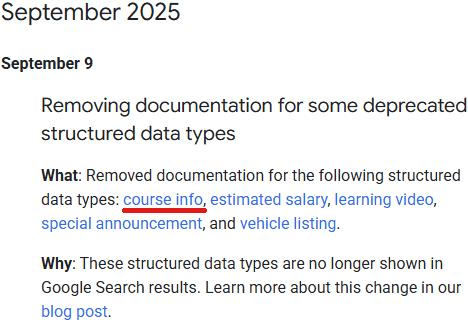
Instead of a 404 response Google is returning a 301 redirect back to the changelog. What makes this setup somewhat weird is that Google is linking back to the missing web page from the changelog, which then redirects back to the changelog, creating an infinite loop between the two pages.

Screenshot Of Changelog

In the above screenshot I’ve underlined  in red the link to the Course Info structured data.

The words “course info” are a link to this URL:
https://developers.google.com/search/docs/appearance/structured-data/course-info

Which redirects right back to the changelog here:
https://developers.google.com/search/updates#september-2025

Which of course contains the links to the five URLs that  no longer exist, essentially causing an infinite loop.

It’s not a good user experience and it’s not good for crawlers. So the question is, why did Google do that? 

301 redirects are an option for pages that are missing, so Google is technically correct to use a 301 redirect. However, 301 redirects are generally used to point “to a more accurate URL” which generally means a redirect to a replacement page, one that serves the same or similar purpose.

Technically they didn’t create a soft 404. But the way they handled the missing pages creates a loop that sends crawlers back and forth between a missing web page and the changelog. It seems that it would have been a better user and crawler experience to instead link to the June 2025 blog post that explains why these structured data types are no longer supported  rather than create an infinite loop.

I don’t think it’s anything most SEOs or publishers would do, so why does Google think it’s a good idea?

Featured Image by Shutterstock/Kues

https://www.searchenginejournal.com/infinite-redirect-loop/555583/


AI Is Changing Local Search Faster Than You Think [Webinar] via @sejournal, @hethr_campbell

For multi-location brands, local search has always been competitive. But 2025 has introduced a new player: AI. 

From AI Overviews to Maps Packs, how consumers discover your stores is evolving, and some brands are already pulling ahead.

Robert Cooney, VP of Client Strategy at DAC, and Kyle Harris, Director of Local Optimization, have spent months analyzing enterprise local search trends. Their findings reveal clear gaps between brands that merely appear and those that consistently win visibility across hundreds of locations.

The insights are striking:

  • Some queries favor Maps Packs, others AI Overviews. Winning in both requires strategy, not luck.
  • Multi-generational search habits are shifting. Brands that align content to real consumer behavior capture more attention.
  • The next wave of “agentic search” is coming, and early preparation is the key to staying relevant.

This webinar is your chance to see these insights in action. Walk away with actionable steps to protect your visibility, optimize local presence, and turn AI-driven search into a growth engine for your stores.

📌 Register now to see how enterprise brands are staying ahead of AI in local search. Can’t make it live? Sign up and we’ll send the recording straight to your inbox.

https://www.searchenginejournal.com/ai-is-changing-local-search/554853/


Google Gemini Adds Audio File Uploads After Being Top User Request via @sejournal, @MattGSouthern

Google’s Gemini app now accepts audio file uploads, answering what the company acknowledges was its most requested feature.

For marketers and content teams, it means you can push recordings straight into Gemini for analysis, summaries, and repurposed content without jumping between tools.

Josh Woodward, VP at Google Labs and Gemini, announced the change on X:

“You can now upload any file to @GeminiApp. Including the #1 request: audio files are now supported!”

What’s New

Gemini can now ingest audio files in the same multi-file workflow you already use for documents and images.

You can attach up to 10 files per prompt, and files inside ZIP archives are supported, which helps when you want to upload raw tracks or several interview takes together.

Limits

  • Free plan: total audio length up to 10 minutes per prompt; up to 5 prompts per day.
  • AI Pro and AI Ultra: total audio length up to 3 hours per prompt.
  • Per prompt: up to 10 files across supported formats. Details are listed in Google’s Help Center.

Why This Matters

If your team works with podcasts, webinars, interviews, or customer calls, this closes a gap that often forced a separate transcription step.

You can upload a full interview and turn it into show notes, pull quotes, or a working draft in one place. It also helps meeting-heavy teams: a recorded strategy session can become action items and a brief without exporting to another tool first.

For agencies and networks, batching multiple episodes or takes into one prompt reduces friction in weekly workflows.

The practical win is fewer handoffs: source audio goes in, and the outlines, summaries, and excerpts you need come out. Inside the same system you already use for text prompting.

Quick Tip

Upload your audio together with any supporting context in the same prompt. That gives Gemini the grounding it needs to produce cleaner summaries and more accurate excerpts.

If you’re testing on the free tier, plan around the 10-minute ceiling; longer content is best on AI Pro or Ultra.

Looking Ahead

Google’s limits pages do change, so keep an eye on total length, file-count rules, and any new guardrails that affect longer recordings or larger teams. Also watch for deeper Workspace tie-ins (for example, easier handoffs from Meet recordings) that would streamline getting audio into Gemini without manual uploads.


Featured Image: Photo Agency/Shutterstock

https://www.searchenginejournal.com/google-gemini-adds-audio-file-uploads-after-being-top-user-request/555565/


Google Drops Search Console Reporting For Six Structured Data Types via @sejournal, @MattGSouthern

Google will stop reporting six deprecated structured data types in Search Console and remove them from the Rich Results Test and appearance filters.

  • Search Console and Rich Results Test stop reporting on deprecated structured data types.
  • Rankings are unaffected; you can keep the markup, it just won’t show rich results.
  • API returns continue through December.

https://www.searchenginejournal.com/google-drops-search-console-reporting-for-six-structured-data-types/555560/


Structured Data’s Role In AI And AI Search Visibility via @sejournal, @marthavanberkel

The way people find and consume information has shifted. We, as marketers, must think about visibility across AI platforms and Google.

The challenge is that we don’t have the same ability to control and measure success as we do with Google and Microsoft, so it feels like we’re flying blind.

Earlier this year, Google, Microsoft, and ChatGPT each commented about how structured data can help LLMs to better understand your digital content.

Structured data can give AI tools the context they need to determine their understanding of content through entities and relationships. In this new era of search, you could say that context, not content, is king.

Schema Markup Helps To Build A Data Layer

By translating your content into Schema.org and defining the relationships between pages and entities, you are building a data layer for AI. This schema markup data layer, or what I like to call your “content knowledge graph,” tells machines what your brand is, what it offers, and how it should be understood.

This data layer is how your content becomes accessible and understood across a growing range of AI capabilities, including:

  • AI Overviews
  • Chatbots and voice assistants
  • Internal AI systems

Through grounding, structured data can contribute to visibility and discovery across Google, ChatGPT, Bing, and other AI platforms. It also prepares your web data to be of value to accelerate your internal AI initiatives as well.

The same week that Google and Microsoft announced they were using structured data for their generative AI experiences, Google and OpenAI announced their support of the Model Context Protocol.

What Is Model Context Protocol?

In November 2024, Anthropic introduced Model Context Protocol (MCP), “an open protocol that standardizes how applications provide context to LLMs” and was subsequently adopted by OpenAI and Google DeepMind.

You can think of MCP as the USB-C connector for AI applications and agents or an API for AI. “MCP provides a standardized way to connect AI models to different data sources and tools.”

Since we are now thinking of structured data as a strategic data layer, the problem Google and OpenAI need to solve is how they scale their AI capabilities efficiently and cost-effectively. The combination of structured data you put on your website, with MCP, would allow accuracy in inferencing and the ability to scale.

Structured Data Defines Entities And Relationships

LLMs generate answers based on the content they are trained on or connected to. While they primarily learn from unstructured text, their outputs can be strengthened when grounded in clearly defined entities and relationships, for example, via structured data or knowledge graphs.

Structured data can be used as an enhancer that allows enterprises to define key entities and their relationships.

When implemented using Schema.org vocabulary, structured data:

  • Defines the entities on a page: people, products, services, locations, and more.
  • Establishes relationships between those entities.
  • Can reduce hallucinations when LLMs are grounded in structured data through retrieval systems or knowledge graphs.

When schema markup is deployed at scale, it builds a content knowledge graph, a structured data layer that connects your brand’s entities across your site and beyond. 

A recent study by BrightEdge demonstrated that schema markup improved brand presence and perception in Google’s AI Overviews, noting higher citation rates on pages with robust schema markup.

Structured Data As An Enterprise AI Strategy

Enterprises can shift their view of structured data beyond the basic requirements for rich result eligibility to managing a content knowledge graph.

According to Gartner’s 2024 AI Mandates for the Enterprise Survey, participants cite data availability and quality as the top barrier to successful AI implementation.

By implementing structured data and developing a robust content knowledge graph you can contribute to both external search performance and internal AI enablement.

A scalable schema markup strategy requires:

  • Defined relationships between content and entities: Schema markup properties connect all content and entities across the brand. All page content is connected in context.
  • Entity Governance: Shared definitions and taxonomies across marketing, SEO, content, and product teams.
  • Content Readiness: Ensuring your content is comprehensive, relevant, representative of the topics you want to be known for, and connected to your content knowledge graph.
  • Technical Capability: Cross-functional tools and processes to manage schema markup at scale and ensure accuracy across thousands of pages.

For enterprise teams, structured data is a cross-functional capability that prepares web data to be consumed by internal AI applications.

What To Do Next To Prepare Your Content For AI

Enterprise teams can align their content strategies with AI requirements. Here’s how to get started:

1. Audit your current structured data to identify gaps in coverage and whether schema markup is defining relationships within your website. This context is critical for AI inferencing.

2. Map your brand’s key entities, such as products, services, people, and core topics, and ensure they are clearly defined and consistently marked up with schema markup across your content. This includes identifying the main page that defines an entity, known as the entity home.

3. Build or expand your content knowledge graph by connecting related entities and establishing relationships that AI systems can understand.

4. Integrate structured data into AI budget and planning, alongside other AI investments and that content is intended for AI Overviews, chatbots, or internal AI initiatives.

5. Operationalize schema markup management by developing repeatable workflows for creating, reviewing, and updating schema markup at scale.

By taking these steps, enterprises can ensure that their data is AI-ready, inside and outside the enterprise.

Structured Data Provides A Machine-Readable Layer

Structured data doesn’t assure placement in AI Overviews or directly control what large language models say about your brand. LLMs are still primarily trained on unstructured text, and AI systems weigh many signals when generating answers.

What structured data does provide is a strategic, machine-readable layer. When used to build a knowledge graph, schema markup defines entities and the relationships between them, creating a reliable framework that AI systems can draw from. This reduces ambiguity, strengthens attribution, and makes it easier to ground outputs in fact-based content when structured data is part of a connected retrieval or grounding system.

By investing in semantic, large-scale schema markup and aligning it across teams, organizations position themselves to be as discoverable in AI experiences as possible.

More Resources:


Featured Image: Koto Amatsukami/Shutterstock

https://www.searchenginejournal.com/structured-datas-role-in-ai-and-ai-search-visibility/553175/


Anthropic Agrees To $1.5B Settlement Over Pirated Books via @sejournal, @MattGSouthern

Anthropic agreed to a proposed $1.5 billion settlement in Bartz v. Anthropic over claims it downloaded pirated books to help train Claude.

If approved, plaintiffs’ counsel says it would be the largest U.S. copyright recovery to date. A preliminary approval hearing is set for today.

In June, Judge William Alsup held that training on lawfully obtained books can qualify as fair use, while copying and storing millions of pirated books is infringement. That order set the stage for settlement talks.

Settlement Details

The deal would pay about $3,000 per eligible title, with an estimated class size of roughly 500,000 books. Plaintiffs allege Anthropic pulled at least 7 million copies from piracy sites Library Genesis and Pirate Library Mirror.

Justin Nelson, counsel for the authors, said:

“As best as we can tell, it’s the largest copyright recovery ever.”

How Payouts Would Work

According to the Authors Guild’s summary, the fund is paid in four tranches after court approvals: $300M soon after preliminary approval, $300M after final approval, then $450M at 12 months and 450M at 24 months, with interest accruing in escrow.

A final “Works List” is due October 10, which will drive a searchable database for claimants.

The Guild notes the agreement requires destruction of pirated copies and resolves only past conduct.

Why This Matters

If you rely on AI tools in content workflows, provenance now matters more. Expect more licensing deals and clearer disclosures from vendors about training data sources.

For publishers and creators, the per-work payout sets a reference point that may strengthen negotiating leverage in future licensing talks.

Looking Ahead

The judge will consider preliminary approval today. If granted, the notice process begins this fall and payments to rightsholders would follow final approval and claims processing, funded on the installment schedule above.


Featured Image: Tigarto/Shutterstock

https://www.searchenginejournal.com/anthropic-agrees-to-1-5b-settlement-over-pirated-books/555438/


Google Publishes Exact Gemini Usage Limits Across All Tiers via @sejournal, @MattGSouthern

Google has published exact usage limits for Gemini Apps across the free tier and paid Google AI plans, replacing earlier vague language with concrete numbers marketers can plan around.

The Help Center update covers daily caps for prompts, images, Deep Research, video generation, and context windows, and notes that you’ll see in-product notices when you’re close to a limit.

What’s New

Until recently, Google’s documentation used general phrasing about “limited access” without specifying amounts.

The Help Center page now lists per-tier allowances for Gemini 2.5 Pro prompts, image generation, Deep Research, and more. It also clarifies that practical caps can vary with prompt complexity, file sizes, and conversation length, and that limits may change over time.

Google’s Help Center states:

“Gemini Apps has usage limits designed to ensure an optimal experience for everyone… we may at times have to cap the number of prompts, conversations, and generated assets that you can have within a specific timeframe.”

Free vs. Paid Tiers

On the free experience, you can use Gemini 2.5 Pro for up to five prompts per day.

The page lists general access to 2.5 Flash and includes:

  • 100 images per day
  • 20 Audio Overviews per day
  • Five Deep Research reports per month using 2.5 Flash).

Because overall app limits still apply, actual throughput depends on how long and complex your prompts are and how many files you attach.

Google AI Pro increases ceilings to:

  • 100 prompts per day on Gemini 2.5 Pro
  • 1,000 images per day
  • 20 Deep Research reports per day (using 2.5 Pro).

Google AI Ultra raises those to

  • 500 prompts per day
  • 200 Deep Research reports per day
  • Includes Deep Think with 10 prompts per day at a 192,000-token context window for more complex reasoning tasks.

Context Windows and Advanced Features

Context windows differ by tier. The free tier lists a 32,000-token context size, while Pro and Ultra show 1 million tokens, which is helpful when you need longer conversations or to process large documents in one go.

Ultra’s Deep Think is separate from the 1M context and is capped at 192k tokens for its 10 daily prompts.

Video generation is currently in preview with model-specific limits. Pro shows up to three videos per day with Veo 3 Fast (preview), while Ultra lists up to five videos per day with Veo 3 (preview).

Google indicates some features receive priority or early access on paid plans.

Availability and Requirements

The Gemini app in Google AI Pro and Ultra is available in 150+ countries and territories for users 18 or older.

Upgrades are tied to select Google One paid plans for personal accounts, which consolidate billing with other premium Google services.

Why This Matters

Clear ceilings make it easier to scope deliverables and budgets.

If you produce a steady stream of social or ad creative, the image caps and prompt totals are practical planning inputs.

Teams doing competitive analysis or longer-form research can evaluate whether the free tier’s five Deep Research reports per month cover occasional needs or if Pro’s daily allotment, Ultra’s higher limit, and Deep Think are a better fit for heavier workloads.

The documentation also emphasizes that caps can vary with usage patterns, so it’s worth watching the in-app limit warnings on busy days.

Looking Ahead

Google notes that limits may evolve. If your workflows depend on specific daily counts or large context windows, it’s sensible to review the Help Center page periodically and adjust plans as features move from preview to general availability.


Featured Image: Evolf/Shutterstock

https://www.searchenginejournal.com/google-publishes-exact-gemini-usage-limits-across-all-tiers/555433/


Google’s Antitrust Ruling: What The Remedies Really Mean For Search, SEO, And AI Assistants via @sejournal, @gregjarboe

When Judge Amit P. Mehta issued his long-awaited remedies decision in the Google search antitrust case, the industry exhaled a collective sigh of relief. There would be no breakup of Google, no forced divestiture of Chrome or Android, and no user-facing “choice screen” like the one that reshaped Microsoft’s browser market two decades ago. But make no mistake – this ruling rewrites the playbook for search distribution, data access, and competitive strategy over the next six years.

This article dives into what led to the decision, what it actually requires, and – most importantly – what it means for SEO, PPC, publishers, and the emerging generation of AI-driven search assistants.

What Led To The Decision

The Department of Justice and a coalition of states sued Google in 2020, alleging that the company used exclusionary contracts and massive payments to cement its dominance in search. In August 2024, Judge Mehta ruled that Google had indeed violated antitrust law, writing, “Google is a monopolist, and it has acted as one to maintain its monopoly.” The question then became: what remedies would actually restore competition?

The DOJ and states pushed for sweeping measures – including a breakup of Google’s Chrome browser or Android operating system, and mandatory choice screens on devices. Google countered that such steps would harm consumers and innovation. By the time remedies hearings wrapped, generative AI had exploded into the mainstream, shifting the court’s sense of what competition in search could look like.

What The Court Decided

Judge Mehta’s ruling, issued September 2, 2025, imposed a mix of behavioral remedies:

  • Exclusive contracts banned. Google can no longer strike deals that make it the sole default search engine on browsers, phones, or carriers. That means Apple, Samsung, Mozilla, and mobile carriers can now entertain offers from rivals like Microsoft Bing or newer AI entrants.
  • Payments still allowed. Crucially, the court did not ban Google from paying for placement. Judge Mehta explained that removing payments altogether would “impose substantial harms on distribution partners.” In other words, the checks will keep flowing – but without exclusivity.
  • Index and data sharing. Google must share portions of its search index and some user interaction data with “qualified competitors” on commercial terms. Ads data, however, is excluded. This creates a potential on-ramp for challengers, but it doesn’t hand them the secret sauce of Google’s ranking systems.
  • No breakup, no choice screen. Calls to divest Chrome or Android were rejected as overreach. Similarly, the court declined to mandate a consumer-facing choice screen. Change will come instead through contracts and UX decisions by distribution partners.
  • Six-year oversight. Remedies will be overseen by a technical committee for six years. A revised judgment is due September 10, with remedies taking effect roughly 60 days after final entry.

As Judge Mehta put it, “Courts must… craft remedies with a healthy dose of humility,” noting that generative AI has already “changed the course of this case.”

How The Market Reacted

Investors immediately signaled relief. Alphabet shares jumped ~8% after hours, while Apple gained ~4%. The lack of a breakup, and the preservation of lucrative search placement payments, reassured Wall Street that Google’s search empire was not being dismantled overnight.

But beneath the relief lies a new strategic reality: Google’s moat of exclusivity has been replaced with a marketplace for defaults.

Strategic Insights: Beyond The Headlines

Most coverage of the decision has focused on what didn’t happen – the absence of a breakup or a choice screen. But the deeper story is how distribution, data, and AI will interact under the new rules.

1. Defaults Move From Moat To Marketplace

Under the old model, Google’s exclusive deals ensured it was the default on Safari, Android, and beyond. Now, partners can take money from multiple providers. That turns the default position into a marketplace, not a moat.

Apple, in particular, gains leverage. Court records revealed that Google paid Apple $20 billion in 2022 and paid $26.3 billion in 2021  – the figure is not to any one company, but Apple likely represents the largest recipient – to remain Safari’s default search engine. Without exclusivity, Apple can entertain bids from Microsoft, OpenAI, or others – potentially extracting even more money by selling multiple placements or rotating defaults.

We may see new UX experiments: rotating search tiles, auction-based setup flows, or AI assistant shortcuts integrated into operating systems. Distribution partners like Samsung or Mozilla could pilot “multi-home defaults,” where Google, Bing, and an AI engine all coexist in visible slots.

2. Data Access Opens An On-Ramp For Challengers

Index-sharing and limited interaction data access lower barriers for rivals. Crawling the web is expensive; licensing Google’s index could accelerate challengers like Bing, Perplexity, or OpenAI’s rumored search product.

But it’s not full parity. Without ads data and ranking signals, competitors must still differentiate on product experience. Think faster answers, vertical specialization, or superior AI integration. As I like to put it: Index access gives challengers legs, not lungs.

Much depends on how “qualified competitor” is defined. A narrow definition could limit access to a token few; a broad one could empower a new wave of vertical and AI-driven search entrants.

3. AI Is Already Shifting The Game

The court acknowledged that generative AI reshaped its view of competition. Assistants like Copilot, Gemini, or Perplexity are increasingly acting as intent routers – answering directly, citing sources, or routing users to transactions without a traditional SERP.

That means the battle for distribution may shift from browsers and search bars to AI copilots embedded in operating systems, apps, and devices. If users increasingly ask their assistant instead of typing a query, exclusivity deals matter less than who owns the assistant.

For SEO and SEM professionals, this accelerates the shift toward zero-click answers, assistant-ready content, and schema that supports citations.

4. Financial Dynamics: Relief Today, Pressure Tomorrow

Yes, investors cheered. But over time, Google could face rising traffic acquisition costs (TAC) as Apple, Samsung, and carriers auction off default positions. Defending its distribution may get more expensive, eating into margins.

At the same time, without a choice screen, search market share is likely to shift gradually, not collapse. Expect Google’s U.S. query share to remain in the high 80s in the near term, with only single-digit erosion as rivals experiment with new models.

5. Knock-On Effects: The Ad-Tech Case Looms

Don’t overlook the second front: the DOJ’s separate antitrust case against Google’s ad-tech stack, now moving toward remedies hearings in Virginia. If that case results in structural changes – say, forcing Google to separate its publisher ad server from its exchange – it could reshape how search ads are bought, measured, and monetized.

For publishers, both cases matter. If rivals gain traction with AI-driven assistants, referral traffic could diversify – but also become more volatile, depending on how assistants handle citations and click-throughs.

What Happens Next

  • September 10, 2025: DOJ and Google file a revised judgment.
  • ~60 days later: Remedies begin taking effect.
  • Six years: Oversight period, with ongoing compliance monitoring.

Key Questions To Watch:

  • How will Apple implement non-exclusive search defaults in Safari?
  • Who qualifies as a “competitor” for index/data access, and on what terms?
  • Will rivals like Microsoft, Perplexity, or OpenAI buy into distribution slots aggressively?
  • How will AI assistants evolve as distribution front doors?

What This Means For SEO And PPC

This ruling isn’t just about contracts in Silicon Valley – it has practical consequences for marketers everywhere.

  • Distribution volatility planning. SEM teams should budget for a world where Safari queries become more contestable. Test Bing Ads, Copilot Ads, and assistant placements.
  • Assistant-ready content. Optimize for concise, cite-worthy answers with schema markup. Publish FAQs, data tables, and source-friendly content that large language models (LLMs) like to quote.
  • Syndication hedge. If new index-sharing programs emerge, explore partnerships with vertical search startups. Early pilots could deliver traffic streams outside the Google ecosystem.
  • Attribution resilience. As assistants mediate more traffic, referral strings will get messy. Double down on UTM governance, server-side tracking, and marketing mix models to parse signal from noise.
  • Creative testing. Build two-tier content: a punchy, fact-dense abstract that assistants can lift, and a deeper explainer for human readers.

Market Scenarios

  • Base Case (Most Likely): Google retains high-80s market share. TAC costs rise gradually. AI assistants siphon a modest share of informational queries by 2027. Impact: margin pressure more than market share loss.
  • Upside for Rivals: If index access is broad and AI assistants nail UX, Bing, Perplexity, and others could win five to 10 points combined in specific verticals. Impact: SEM arbitrage opportunities emerge, and SEO adapts to answer-first surfaces.
  • Regulatory Cascade: If the ad-tech remedies impose structural changes, Google’s measurement edge narrows, and OEMs test choice-like UX voluntarily. Impact: more fragmentation, more testing for marketers.

Final Takeaway

Judge Mehta summed up the challenge well: “Courts must craft remedies with a healthy dose of humility.” The ruling doesn’t topple Google, but it does force the search giant to compete on more open terms. Exclusivity is gone; auctions and assistants are in.

For marketers, the message is clear: Don’t wait for regulators to rebalance the playing field. Diversify now – across engines, assistants, and ad formats. Optimize for answerability as much as for rankings. And be ready: The real competition for search traffic is just beginning.

More Resources:


Featured Image: beast01/Shutterstock

https://www.searchenginejournal.com/googles-antitrust-ruling-what-the-remedies-mean-for-search-seo-and-ai-assistants/555086/