The Problem With Always-On SEO: Why You Need Sprints, Not Checklists via @sejournal, @coreydmorris

There’s a lot that goes into SEO. And, now, more broadly into being found online and online visibility overall, whether we’re talking about an organic result in a search engine, an AI Overview, or through a large language model (LLM).

With SEO being a discipline that often takes a long time (compared to ads and some other channels and platforms), with a large amount of complexity, technical aspects, contradictions of how it works, and even disagreements, it has to be organized in a way that can be implemented.

Over the years and decades, this has resulted in the acceptance of specific “best practices,” along with the fact that it is a longer-term commitment. That, ultimately, has led to the use of checklists and specific cadences to accomplish what is typically seen as an “ongoing” and never-ending discipline.

In full disclosure, you’ll find articles written by me that talk about checklists and ways to structure the work that is important to be visible and found online. I’m not saying we have to throw them out, but we can’t simply do the list or activities.

“Always-on SEO” sounds great in theory: ongoing optimization, constant monitoring, and steady progress. But in reality, it often becomes a nebulous set of tasks without priority, strategy, or momentum.

This article challenges the default mindset of treating SEO as a perpetual checklist and proposes a sprint-based approach, where work is grouped into focused time blocks with measurable goals.

By approaching SEO in strategic sprints, teams can prioritize, measure, adapt, and improve – all while staying aligned with larger business goals.

The Problem With Perpetual SEO Checklists

What I often see with SEO checklists is a lack of prioritization. Everything becomes a task, but nothing is deemed critical.

The checklist might have “right” and “good” things in it, but it isn’t weighted or prioritized based on any level of strategic approach or potential level of impact.

And, when there’s a lack of direction, we often can end up with a set of actions, activities, or tactics that have no clear end or evaluation defined. This ends up getting us into a place of just “doing SEO” without being able to objectively say what the result was or how things were improved.

Like any digital marketing channel, activity without the right anchor or foundation, in SEO, can result in wasted effort.

Technical fixes and content updates may not support meaningful business goals and can be a huge investment of time and money that ultimately don’t impact the business. And, activity without results or clear direction can drive SEO teams and professionals to boredom or burnout.

I’ve taken over a number of situations where a business thought SEO didn’t work for them or that the team was not competent enough due to stakeholder confusion.

When activity doesn’t generate results and you find it out a year into an investment, it is hard to recover, especially when no one really knows what “done” or what success looks like in the effort.

I say all of this not to bring up pain, say that checklists aren’t good, or even that the ongoing tactics aren’t right. I’m simply saying we have to have a deeper understanding and meaning behind what we’re doing in SEO.

What Sprint-Based SEO Looks Like

SEO sprints are focused and time-bound (e.g., four weeks) efforts with specific goals tied to strategy. Rather than working on everything at once, you work on the highest-impact priorities in chunks.

Common sprint types:

  • Content optimization sprints.
  • Technical SEO fix sprints.
  • Internal linking improvement sprints.
  • New content creation sprints.
  • Authority/link building sprints.

You can also combine types into a custom sprint. Regardless of whether you stay in a category or make one that contains blended themes or tactics, it needs to be anchored to an initial strategy, plan, or audit for your first one.

Each sprint ends with measurable outputs, documented outcomes, and clear learnings. The first one might be rooted in an initial plan, but each subsequent sprint will include a retrospective review from the previous one to help fuel continuous learning, efficiencies, improvements, and ultimate impact.

Benefits Of SEO Sprints

A quick win benefit is gaining focus. Pivoting away from a generic checklist to sprint structure results in solving a defined problem, not tackling a vague backlog.

As noted earlier, sprints are time-based as well. By having the right length (not too short or small of a sample size, yet too long and repeating tactics that aren’t effective), you gain the benefits of agility and an adaptable longer-term approach overall.

Agility in sprints allows you to adjust based on performance and new insights. Checklists are not only generic or often disconnected from strategy, but are getting out of date constantly with shifts in online visibility optimization sources and methods.

Accountability and team clarity come more naturally as well. It’s easier to report on and justify value with clear before/after comparisons and to keep people engaged and in the know on what’s happening now and what’s next.

This matters for overall business alignment of key performance indicators (KPIs) and not getting too deep and lost in the jargon, technical aspects, and “hope” for return on investment (ROI) versus seeing shorter-term, higher-impact efforts.

Sprints can be tied directly to goals (revenue, lead generation, funnel support) and not just rankings or other KPIs that are upstream and further removed from business outcomes, and shorter-term expectations can take pressure off of long-term waiting for something to happen.

How To Implement Sprint-Based SEO

Start with strategy. Identify what matters to the business and where SEO fits. Define sprint themes and objectives, and make them specific enough to be meaningful and measurable.

Example: “Improve organic conversions for top 5 services pages” vs. “Improve rankings.”

Build a backlog or tactics plan, but don’t treat it like a checklist. Use it to feed sprint plans, but not overwhelm day-to-day work.

In short:

  • Plan your first sprint: Choose one clear objective, timeline, and outcome.
  • Track and review: Report on progress, document what was done, and define what’s next.
  • Iterate: Use learnings from each sprint to improve the next.

When (And Where) “Always-On” SEO Still Applies

Certain things do need continuous attention. I’m not saying that it is right for 100% of your sprints to be 100% custom.

There are recurring things that could, or likely should, go into sprints or be monitored and maintained by regular or routine audits or checklists, e.g., crawl errors, broken links, technical issues, etc.

But, this maintenance work shouldn’t be the SEO strategy. It should support it. Use “always-on” as infrastructure or basics, not direction, and remember that the checklist isn’t the strategy, and if you have one, it is a planning tool, not necessarily your tactical plan and roadmap to ultimate SEO ROI.

Why It’s Time To Rethink “Always-On” SEO

I’ve hit on it enough, but I will wrap up by reminding you that endless to-do lists don’t move the needle.

Checklists can be good things and full of the “right” tactics. However, they often lack strategy and don’t serve shorter attention spans or allow for enough agility.

Sprint-based SEO helps teams be more strategic, productive, and aligned with the business overall, with room to implement prioritized tactics, tied to overall goals, and adjust to market and business needs and conditions.

Shifting your team from “always-on” to “intentionally paced” is a move to start seeing results and not just activity.

More Resources:


Featured Image: wenich_mit/Shutterstock

https://www.searchenginejournal.com/the-problem-with-always-on-seo-why-you-need-sprints-not-checklists/554236/


Let’s Look Inside An Answer Engine And See How GenAI Picks Winners via @sejournal, @DuaneForrester

Ask a question in ChatGPT, Perplexity, Gemini, or Copilot, and the answer appears in seconds. It feels effortless. But under the hood, there’s no magic. There’s a fight happening.

This is the part of the pipeline where your content is in a knife fight with every other candidate. Every passage in the index wants to be the one the model selects.

For SEOs, this is a new battleground. Traditional SEO was about ranking on a page of results. Now, the contest happens inside an answer selection system. And if you want visibility, you need to understand how that system works.

Let's Look Inside An Answer Engine and See How GenAI Picks WinnersImage Credit: Duane Forrester

The Answer Selection Stage

This isn’t crawling, indexing, or embedding in a vector database. That part is done before the query ever happens. Answer selection kicks in after a user asks a question. The system already has content chunked, embedded, and stored. What it needs to do is find candidate passages, score them, and decide which ones to pass into the model for generation.

Every modern AI search pipeline uses the same three stages (across four steps): retrieval, re-ranking, and clarity checks. Each stage matters. Each carries weight. And while every platform has its own recipe (the weighting assigned at each step/stage), the research gives us enough visibility to sketch a realistic starting point. To basically build our own model to at least partially replicate what’s going on.

The Builder’s Baseline

If you were building your own LLM-based search system, you’d have to tell it how much each stage counts. That means assigning normalized weights that sum to one.

A defensible, research-informed starting stack might look like this:

  • Lexical retrieval (keywords, BM25): 0.4.
  • Semantic retrieval (embeddings, meaning): 0.4.
  • Re-ranking (cross-encoder scoring): 0.15.
  • Clarity and structural boosts: 0.05.

Every major AI system has its own proprietary blend, but they’re all essentially brewing from the same core ingredients. What I’m showing you here is the average starting point for an enterprise search system, not exactly what ChatGPT, Perplexity, Claude, Copilot, or Gemini operate with. We’ll never know those weights.

Hybrid defaults across the industry back this up. Weaviate’s hybrid search alpha parameter defaults to 0.5, an equal balance between keyword matching and embeddings. Pinecone teaches the same default in its hybrid overview.

Re-ranking gets 0.15 because it only applies to the short list. Yet its impact is proven: “Passage Re-Ranking with BERT” showed major accuracy gains when BERT was layered on BM25 retrieval.

Clarity gets 0.05. It’s small, but real. A passage that leads with the answer, is dense with facts, and can be lifted whole, is more likely to win. That matches the findings from my own piece on semantic overlap vs. density.

At first glance, this might sound like “just SEO with different math.” It isn’t. Traditional SEO has always been guesswork inside a black box. We never really had access to the algorithms in a format that was close to their production versions. With LLM systems, we finally have something search never really gave us: access to all the research they’re built on. The dense retrieval papers, the hybrid fusion methods, the re-ranking models, they’re all public. That doesn’t mean we know exactly how ChatGPT or Gemini dials their knobs, or tunes their weights, but it does mean we can sketch a model of how they likely work much more easily.

From Weights To Visibility

So, what does this mean if you’re not building the machine but competing inside it?

Overlap gets you into the room, density makes you credible, lexical keeps you from being filtered out, and clarity makes you the winner.

That’s the logic of the answer selection stack.

Lexical retrieval is still 40% of the fight. If your content doesn’t contain the words people actually use, you don’t even enter the pool.

Semantic retrieval is another 40%. This is where embeddings capture meaning. A paragraph that ties related concepts together maps better than one that is thin and isolated. This is how your content gets picked up when users phrase queries in ways you didn’t anticipate.

Re-ranking is 15%. It’s where clarity and structure matter most. Passages that look like direct answers rise. Passages that bury the conclusion drop.

Clarity and structure are the tie-breaker. 5% might not sound like much, but in close fights, it decides who wins.

Two Examples

Zapier’s Help Content

Zapier’s documentation is famously clean and answer-first. A query like “How to connect Google Sheets to Slack” returns a ChatGPT answer that begins with the exact steps outlined because the content from Zapier provides the exact data needed. When you click through a ChatGPT resource link, the page you land on is not a blog post; it’s probably not even a help article. It’s the actual page that lets you accomplish the task you asked for.

  • Lexical? Strong. The words “Google Sheets” and “Slack” are right there.
  • Semantic? Strong. The passage clusters related terms like “integration,” “workflow,” and “trigger.”
  • Re-ranking? Strong. The steps lead with the answer.
  • Clarity? Very strong. Scannable, answer-first formatting.

In a 0.4 / 0.4 / 0.15 / 0.05 system, Zapier’s chunk scores across all dials. This is why their content often shows up in AI answers.

A Marketing Blog Post

Contrast that with a typical long marketing blog post about “team productivity hacks.” The post mentions Slack, Google Sheets, and integrations, but only after 700 words of story.

  • Lexical? Present, but buried.
  • Semantic? Decent, but scattered.
  • Re-ranking? Weak. The answer to “How do I connect Sheets to Slack?” is hidden in a paragraph halfway down.
  • Clarity? Weak. No liftable answer-first chunk.

Even though the content technically covers the topic, it struggles in this weighting model. The Zapier passage wins because it aligns with how the answer selection layer actually works.

Traditional search still guides the user to read, evaluate, and decide if the page they land on answers their need. AI answers are different. They don’t ask you to parse results. They map your intent directly to the task or answer and move you straight into “get it done” mode. You ask, “How to connect Google Sheets to Slack,” and you end up with a list of steps or a link to the page where the work is completed. You don’t really get a blog post explaining how someone did this during their lunch break, and it only took five minutes.

Volatility Across Platforms

There’s another major difference from traditional SEO. Search engines, despite algorithm changes, converged over time. Ask Google and Bing the same question, and you’ll often see similar results.

LLM platforms don’t converge, or at least, aren’t so far. Ask the same question in Perplexity, Gemini, and ChatGPT, and you’ll often get three different answers. That volatility reflects how each system weights its dials. Gemini may emphasize citations. Perplexity may reward breadth of retrieval. ChatGPT may compress aggressively for conversational style. And we have data that shows that between a traditional engine, and an LLM-powered answer platform, there is a wide gulf between answers. Brightedge’s data (62% disagreement on brand recommendations) and ProFound’s data (…AI modules and answer engines differ dramatically from search engines, with just 8 – 12% overlap in results) showcase this clearly.

For SEOs, this means optimization isn’t one-size-fits-all anymore. Your content might perform well in one system and poorly in another. That fragmentation is new, and you’ll need to find ways to address it as consumer behavior around using these platforms for answers shifts.

Why This Matters

In the old model, hundreds of ranking factors blurred together into a consensus “best effort.” In the new model, it’s like you’re dealing with four big dials, and every platform tunes them differently. In fairness, the complexity behind those dials is still pretty vast.

Ignore lexical overlap, and you lose part of that 40% of the vote. Write semantically thin content, and you can lose another 40. Ramble or bury your answer, and you won’t win re-ranking. Pad with fluff and you miss the clarity boost.

The knife fight doesn’t happen on a SERP anymore. It happens inside the answer selection pipeline. And it’s highly unlikely those dials are static. You can bet they move in relation to many other factors, including each other’s relative positioning.

The Next Layer: Verification

Today, answer selection is the last gate before generation. But the next stage is already in view: verification.

Research shows how models can critique themselves and raise factuality. Self-RAG demonstrates retrieval, generation, and critique loops. SelfCheckGPT runs consistency checks across multiple generations. OpenAI is reported to be building a Universal Verifier for GPT-5. And, I wrote about this whole topic in a recent Substack article.

When verification layers mature, retrievability will only get you into the room. Verification will decide if you stay there.

Closing

This really isn’t regular SEO in disguise. It’s a shift. We can now more clearly see the gears turning because more of the research is public. We also see volatility because each platform spins those gears differently.

For SEOs, I think the takeaway is clear. Keep lexical overlap strong. Build semantic density into clusters. Lead with the answer. Make passages concise and liftable. And I do understand how much that sounds like traditional SEO guidance. I also understand how the platforms using the information differ so much from regular search engines. Those differences matter.

This is how you survive the knife fight inside AI. And soon, how you pass the verifier’s test once you’re there.

More Resources:


This post was originally published on Duane Forrester Decodes.


Featured Image: tete_escape/Shutterstock

https://www.searchenginejournal.com/lets-look-inside-an-answer-engine-and-see-how-genai-picks-winners/555038/


Ask A PPC: How Do I Nail A PPC Job Interview For Google & Meta Ads? via @sejournal, @navahf

It is a wild job market right now, and if you’re applying for a PPC role, you’re probably feeling the pressure to stand out in interviews that are increasingly demanding and often unclear in their expectations.

Whether you’re interviewing for a specialist, manager, or hybrid media role, one thing is certain: You need to be ready to demonstrate platform expertise, strategic thinking, and the ability to connect performance with business outcomes.

One reader put it this way:

“I’m preparing for a performance marketing job, specifically in PPC, and I want to focus on Google and Meta ads. Have you any advice that would help me with interview preparation for these roles?”

This question is particularly timely because it doesn’t just ask about one platform. It is looking for dual fluency in Google and Meta, which represent paid search and paid social. That nuance matters.

Stopping there, however, is a mistake. Savvy employers will appreciate an applicant who can speak to Microsoft Ads, TikTok, LinkedIn, Pinterest, Reddit, and emerging platforms, even if those channels are not in scope right now. That breadth of perspective signals that you’re not just a button-pusher; you’re a strategist.

Below is a breakdown of the three core areas most interviewers will evaluate: Paid Search, Paid Social, and General Marketing and Culture Fit.

Paid Search Interview Prep (Google, Microsoft, Etc.)

Modern paid search, especially within Google, demands more than keyword-level tactics. You need to understand how campaigns serve business objectives.

Expect strategy questions like, “X business has Y budget and Z goals – what kind of campaign would you run and why?” Strong candidates will be able to discuss budgeting frameworks, auction mechanics, audience segmentation, and creative message mapping.

You will likely be asked about reporting. Expect to reference tools like Looker Studio, Google Analytics 4, Power BI, Adobe, or Triple Whale. Even speaking confidently about one tool while showing awareness of others can be impressive.

Mention tools like Microsoft Clarity when discussing conversion rate optimization. Behavioral analytics insights reinforce that you understand the full user journey and do not treat campaigns as isolated events.

One frequently asked question involves account structure. You might be asked, “Why would you structure a campaign/account this way?” Never cite “best practices” or default methods as your rationale. Interviewers want reasoning rooted in context, goals, and a test-and-learn approach.

Stay current on innovations. Be ready to speak about features such as Performance Max, audience expansion tools, or any other platform updates that impact strategy. Share why you find them valuable and how you would explain their relevance to a client.

To stand out even further, draw comparisons between Google and Microsoft Ads, or highlight how Reddit and Amazon are bringing new energy to the paid search space.

Paid Social Interview Prep (Meta, TikTok, LinkedIn, Etc.)

Paid social requires creative fluency, audience empathy, and an understanding of privacy constraints. These platforms are less about exact keyword intent and more about relevance, scale, and emotional resonance.

Prepare to talk about platform-specific ad types and creative strategies. Discuss how you would use Facebook, Instagram, WhatsApp, and Threads, and how your tactics might differ on TikTok, LinkedIn, YouTube Shorts, or Reddit.

Understand how platforms organize their campaign hierarchies. For instance, Meta emphasizes the ad set level for budgeting and targeting, whereas Google does not. Create a reference sheet for yourself so you can confidently speak to the differences during interviews.

Expect questions around creative production and reporting. Interviewers may ask, “What would you do if the client is picky about creative but refuses to supply any?” or “How would you prove that your campaign delivered results if the client questions the attribution?” These are behavioral and strategic tests rolled into one.

Be prepared to explain your approach to budgeting. Paid social often involves very large or very small budgets, and employers want to hear how you allocate funds based on audience size, objective, and creative lifecycle.

Show an understanding of creative testing frameworks, including how you develop variations of hooks, visuals, or calls to action across placements and formats.

General Marketing And Culture Fit

Some parts of the interview will focus less on tactics and more on how you think and collaborate. These are just as important to prepare for.

Be ready to answer questions like, “Tell me about a campaign that worked – and one that didn’t.” Use those stories to demonstrate analytical thinking, cross-functional collaboration, and your ability to learn from both success and failure.

You will also likely get questions about how you communicate performance. You might be asked how you handle underperformance and how you keep stakeholders aligned and informed during those periods.

Come prepared with thoughtful questions of your own. Ask, “What’s behind hiring for this role?” This can give insight into whether the role is tied to growth, turnover, or team restructuring. It also helps you gauge whether expectations are realistic.

Another useful question is, “What does success look like in this role?” This will tell you whether the role is tied to long-term strategic goals or short-term revenue. Follow that up with, “How will I be measured in the first six months versus the next two years?” This demonstrates that you are serious about growth and longevity.

Culture questions are also important. Asking, “Do people tend to hang out or do their own thing?” invites a conversation about the team dynamic, without feeling overly formal or forced.

Preparation Support

You do not need to prepare alone. Use AI tools like ChatGPT, Copilot, or Gemini to help you simulate interviews, organize your thoughts, or analyze job descriptions. Ask the AI to role-play as an interviewer and challenge you with platform-specific or scenario-based questions.

Use those tools to map out which metrics, frameworks, and features align with each platform. You want your prep to feel structured so you can walk into the interview with clarity and confidence.

Ultimately, interviews are not just an audition. They are a dialogue. Prepare thoroughly, think critically, and lead with the mindset of a strategist. That is how you stand out in a sea of applicants, and that is how you set yourself up for success.

If you have a PPC question you want answered in a future edition of Ask the PPC, send it in. Whether you’re prepping for interviews, troubleshooting performance issues, or pitching channel expansion, we are here to help.

More Resources:


Featured Image: Paulo Bobita/Search Engine Journal

https://www.searchenginejournal.com/ask-a-ppc-how-do-i-nail-a-ppc-job-interview-for-google-meta-ads/554816/


Google Antitrust Case: AI Overviews Use FastSearch, Not Links via @sejournal, @martinibuster

A sharp-eyed search marketer discovered the reason why Google’s AI Overviews showed spammy web pages. The recent Memorandum Opinion in the Google antitrust case featured a passage that offers a clue as to why that happened and speculates how it reflects Google’s move away from links as a prominent ranking factor.

Ryan Jones, founder of SERPrecon (LinkedIn profile), called attention to a passage in the recent Memorandum Opinion that shows how Google grounds its Gemini models.

Grounding Generative AI Answers

The passage occurs in a section about grounding answers with search data. Ordinarily, it’s fair to assume that links play a role in ranking the web pages that an AI model retrieves from a search query to an internal search engine. So when someone asks Google’s AI Overviews a question, the system queries Google Search and then creates a summary from those search results.

But apparently, that’s not how it works at Google. Google has a separate algorithm that retrieves fewer web documents and does so at a faster rate.

The passage reads:

“To ground its Gemini models, Google uses a proprietary technology called FastSearch. Rem. Tr. at 3509:23–3511:4 (Reid). FastSearch is based on RankEmbed signals—a set of search ranking signals—and generates abbreviated, ranked web results that a model can use to produce a grounded response. Id. FastSearch delivers results more quickly than Search because it retrieves fewer documents, but the resulting quality is lower than Search’s fully ranked web results.”

Ryan Jones shared these insights:

“This is interesting and confirms both what many of us thought and what we were seeing in early tests. What does it mean? It means for grounding Google doesn’t use the same search algorithm. They need it to be faster but they also don’t care about as many signals. They just need text that backs up what they’re saying.

…There’s probably a bunch of spam and quality signals that don’t get computed for fastsearch either. That would explain how/why in early versions we saw some spammy sites and even penalized sites showing up in AI overviews.”

He goes on to share his opinion that links aren’t playing a role here because the grounding uses semantic relevance.

Related: Google Confirms Links Are Not That Important

What Is FastSearch?

Elsewhere the Memorandum shares that FastSearch generates limited search results:

“FastSearch is a technology that rapidly generates limited organic search results for certain use cases, such as grounding of LLMs, and is derived primarily from the RankEmbed model.”

Now the question is, what’s the RankEmbed model?

The Memorandum explains that RankEmbed is a deep-learning model. In simple terms, a deep-learning model identifies patterns in massive datasets and can, for example, identify semantic meanings and relationships. It does not understand anything in the same way that a human does; it is essentially identifying patterns and correlations.

The Memorandum has a passage that explains:

“At the other end of the spectrum are innovative deep-learning models, which are machine-learning models that discern complex patterns in large datasets. …(Allan)

…Google has developed various “top-level” signals that are inputs to producing the final score for a web page. Id. at 2793:5–2794:9 (Allan) (discussing RDXD-20.018). Among Google’s top-level signals are those measuring a web page’s quality and popularity. Id.; RDX0041 at -001.

Signals developed through deep-learning models, like RankEmbed, also are among Google’s top-level signals.”

User-Side Data

RankEmbed uses “user-side” data. The Memorandum, in a section about the kind of data Google should provide to competitors, describes RankEmbed (which FastSearch is based on) in this manner:

“User-side Data used to train, build, or operate the RankEmbed model(s); “

Elsewhere it shares:

“RankEmbed and its later iteration RankEmbedBERT are ranking models that rely on two main sources of data: _____% of 70 days of search logs plus scores generated by human raters and used by Google to measure the quality of organic search results.”

Then:

“The RankEmbed model itself is an AI-based, deep-learning system that has strong natural-language understanding. This allows the model to more efficiently identify the best documents to retrieve, even if a query lacks certain terms. PXR0171 at -086 (“Embedding based retrieval is effective at semantic matching of docs and queries”);

…RankEmbed is trained on 1/100th of the data used to train earlier ranking models yet provides higher quality search results.

…RankEmbed particularly helped Google improve its answers to long-tail queries.

…Among the underlying training data is information about the query, including the salient terms that Google has derived from the query, and the resultant web pages.

…The data underlying RankEmbed models is a combination of click-and-query data and scoring of web pages by human raters.

…RankEmbedBERT needs to be retrained to reflect fresh data…”

A New Perspective On AI Search

Is it true that links do not play a role in selecting web pages for AI Overviews? Google’s FastSearch prioritizes speed. Ryan Jones theorizes that it could mean Google uses multiple indexes, with one specific to FastSearch made up of sites that tend to get visits. That may be a reflection of the RankEmbed part of FastSearch, which is said to be a combination of “click-and-query data” and human rater data.

Regarding human rater data, with billions or trillions of pages in an index, it would be impossible for raters to manually rate more than a tiny fraction. So it follows that the human rater data is used to provide quality-labeled examples for training. Labeled data are examples that a model is trained on so that the patterns inherent to identifying a high-quality page or low-quality page can become more apparent.

See also: Google Shares Valuable SEO Takeaway About Quality Raters Guidelines

Featured Image by Shutterstock/Cookie Studio

https://www.searchenginejournal.com/google-antitrust-case-ai-overviews-use-fastsearch-not-links/555220/


8 Generative Engine Optimization (GEO) Strategies For Boosting AI Visibility in 2025 via @sejournal, @samanyougarg

This post was sponsored by Writesonic. The opinions expressed in this article are the sponsor’s own.

AI search now makes the first decision.

When? Before a buyer hits your website.

If you’re not part of the AI answer, you’re not part of the deal. In fact, 89% of B2B buyers use AI platforms like ChatGPT for research.

Picture this:

  • A founder at a 12-person SaaS asks, “best CRM for a 10-person B2B startup.”
  • AI answer cites:
    a TechRadar roundup,
    a r/SaaS thread,
    a fresh comparison,
    Not you.
  • Your brand is missing.
  • They book demos with two rivals.
  • You never hear about it.

Here is why. AI search works on intent, not keywords.

It reads content, then grounds answers with sources. It leans on third-party citations, community threads, and trusted publications. It trusts what others say about you more than what you say about yourself.

Most Generative Engine Optimization (GEO) tools stop at the surface. They track mentions, list prompts you missed, and ship dashboards. They do not explain why you are invisible or what to fix. Brands get reports, not steps.

We went hands-on. We analyzed millions of conversations and ran controlled tests. The result is a practical playbook: eight strategies that explain the why, give a quick diagnostic, and end with actions you can ship this week.

Off-Page Authority Builders For AI Search Visibility

1. Find & Fix Your Citation Gaps

Citation gaps are the highest-leverage strategy most brands miss.

Translation: This is an easy win for you.

What Is A Citation Gap?

A citation gap is when AI platforms cite web pages that mention your competitors but not you. These cited pages become the sources AI uses to generate its answers.

Think of it like this:

  • When someone asks ChatGPT about CRMs, it pulls information from specific web pages to craft its response.
  • If those source pages mention your competitors but not you, AI recommends them instead of your brand.

Finding and fixing these gaps means getting your brand mentioned on the exact pages AI already trusts and cites as sources.

Why You Need Citations In Answer Engines

If you’re not cited in an answer engine, you are essentially invisible.

Let’s break this down.

TechRadar publishes “21 Best Collaboration Tools for Remote Teams” mentioning:

  • Asana.
  • Monday.
  • Notion.

When users ask ChatGPT about remote project management, AI cites this TechRadar article.

Your competitors appear in every response. You don’t.

How To Fix Citation Gaps

That TechRadar article gets cited for dozens of queries, including “best remote work tools,” “Monday alternatives,” “startup project management.”

Get mentioned in that article, and you appear in all those AI responses. One placement creates visibility across multiple search variations.

Contact the TechRadar author with genuine value, such as:

  • Exclusive data about remote productivity.
  • Unique use cases they missed.
  • Updated features that change the comparison.

The beauty? It’s completely scalable.

Quick Win:

  1. Identify 50 high-authority articles where competitors are mentioned but you’re not.
  2. Get into even 10 of them, and your AI visibility multiplies exponentially.

2. Engage In The Reddit & UGC Discussions That AI References

Social platformsImage created by Writesonic, August 2025

AI trusts real user conversations over marketing content.

Reddit citations in AI overviews surged from 1.3% to 7.15% in just three months, a 450% increase. User-generated content now makes up 21.74% of all AI citations.

Why You Should Add Your Brand To Reddit & UGC Conversations

Reddit, Quora, LinkedIn Pulse, and industry forums together, and you’ve found where AI gets most of its trusted information.

If you show up as “trusted” information, your visibility increases.

How To Inject Your Brand Into AI-Sourced Conversations

Let’s say a Reddit thread titled “Best project management tool for a startup with 10 people?” gets cited whenever users ask about startup tools.

Since AI already cites these, if you enter the conversation and include your thoughtful contribution, it will get included in future AI answers.

Pro Tip #1: Don’t just promote your brand. Share genuine insights, such as:

  • Hidden costs.
  • Scaling challenges.
  • Migration tips.

Quick Win:

Find and join the discussions AI seems to trust:

  • Reddit threads with 50+ responses.
  • High-upvote Quora answers in your industry.
  • LinkedIn Pulse articles from recognized experts.
  • Active forum discussions with detailed experiences.

Pro Tip #2: Finding which articles get cited and which Reddit threads AI trusts takes forever manually. GEO platforms automate this discovery, showing you exactly which publications to pitch and which discussions to join.

On-Page Optimization For GEO

3. Study Which Topics Get Cited Most, Then Write Them

Something we’re discovering: when AI gives hundreds of citations for a topic, it’s not just citing one amazing article.

Instead, AI pulls from multiple sites covering that same topic.

If you haven’t written about that topic at all, you’re invisible while competitors win.

Consider Topic Clusters To Get Cited

Let’s say you’re performing a content gap analysis for GEO.

You notice these articles all getting 100+ AI citations:

  • “Best Project Management Software for Small Teams”
  • “Top 10 Project Management Tools for Startups”
  • “Project Management Software for Teams Under 20”

Different titles, same intent: small teams need project management software.

When users ask, “PM tool for my startup,” AI might cite 2-3 of these articles together for a comprehensive answer.

Ask “affordable project management,” and AI pulls different ones. The point is that these topics cluster around the same user need.

How To Outperform Competitors In AI Generated Search Answers

Identify intent clusters for your topic and create one comprehensive piece on your own website so your own content gets cited.

In this example, we’d suggest writing “Best Project Management Software for Small Teams (Under 50 People).”

It should cover startups, SMBs, and budget considerations all in one authoritative guide.

Quick Win:

  • Find 20 high-citation topic clusters you’re missing.
  • Create comprehensive content for each cluster.
  • Study what makes the top versions work, such as structure, depth, and comparison tables.
  • Then make yours better with fresher data and broader coverage.

4. Update Content Regularly To Maintain AI Visibility

AI platforms heavily favor recent content.

Content from the past two to three months dominates AI citations, with freshness being a key ranking factor. If your content appears outdated, AI tends to overlook it in favor of newer alternatives.

Why You Should Keep Your Content Up To Date For GEO Visibility

Let’s say your “Email Marketing Best Practices” from 2023 used to get AI citations.

Now it’s losing to articles with 2025 data. AI sees the date and chooses fresher content every time.

How To Keep Your Content Fresh Enough To Be Cited In AIOs

Weekly refresh for top 10 pages:

  • Add two to three new statistics.
  • Include a recent case study.
  • Update “Last Modified” date prominently.
  • Add one new FAQ.
  • Change title to “(Updated August 2025)”.

Bi-weekly, on less important pages:

  • Replace outdated examples.
  • Update internal links.
  • Rewrite the weakest section.
  • Add seasonal relevance.

Pro Tip: Track your content’s AI visibility systematically. Certain advanced GEO tools alert you when pages lose citations, so you know exactly what to refresh and when.

5. Create “X vs Y” And “X vs Y vs Z” Comparison Pages

Users constantly ask AI to help them choose between options. AI platforms love comparison content. They even prompt users to compare features and create comparison tables.

Pages that deliver these structured comparisons dominate AI search results.

Common questions flooding AI platforms:

  • “Slack vs Microsoft Teams for remote work”
  • “HubSpot vs Salesforce for small business”
  • “Asana or Monday for creative agencies”

AI can’t answer these without citing detailed comparisons. Generic blog posts don’t work. Promotional content gets ignored.

Create comprehensive comparisons like: “Asana vs Monday vs ClickUp: Project Management for Creative Teams.”

How To Create Comparisons That Have High Visibility On SERPs

Use a content structure that wins:

  • Quick decision matrix upfront.
  • Pricing breakdown by team size.
  • Feature-by-feature comparison table.
  • Integrations.
  • Learning curve and onboarding time.
  • Best for: specific use cases.

Make it genuinely balanced:

  • Asana: “Overwhelming for teams under 5”
  • Monday: “Gets expensive with add-ons”
  • ClickUp: “Steep learning curve initially”

Include your product naturally in the comparison. Be honest about limitations while highlighting genuine advantages.

AI prefers citing fair comparisons over biased reviews. Include real limitations, actual pricing (not just “starting at”), and honest trade-offs. This builds trust that gets you cited repeatedly.

Technical GEO To Do Right Now

6. Fix Robots.txt Blocking AI Crawlers

Most websites accidentally block the very bots they want to attract. Like putting a “Do Not Enter” sign on your store while wondering why customers aren’t coming in.

ChatGPT uses three bots:

  • ChatGPT-User: Main bot serving actual queries (your money maker)
  • OAI-SearchBot: Activates when users click search toggle.
  • GPTBot: Collects training data for future models.

Strategic decision: Publications worried about content theft might block GPTBot. Product companies should allow it, however, because you want future AI models trained on your content for long-term visibility.

Essential bots to allow:

  • Claude-Web (Anthropic).
  • PerplexityBot.
  • GoogleOther (Gemini).

Add to robots.txt:

User-agent: ChatGPT-User
Allow: /
User-agent: Claude-Web
Allow: /
User-agent: PerplexityBot
Allow: /

Verify it’s working: Check server logs for these user agents actively crawling your content. No crawl activity means no AI visibility.

7. Fix Broken Pages For AI Crawlers

Just like Google Search Console shows Googlebot errors, you need visibility for AI crawlers. But AI bots behave differently and can be aggressive.

Monitor AI bot-specific issues:

  • 404 errors on important pages.
  • 500 server errors during crawls.
  • Timeout issues when bots access content.

If your key product pages error when ChatGPT crawls them, you’ll never appear in AI responses.

Common problems:

  • AI crawlers triggering DDoS protection.
  • CDN security blocking legitimate bots.
  • Rate limiting preventing full crawls.

Fix: Whitelist AI bots in your CDN (Cloudflare, Fastly). Set up server-side tracking to differentiate AI crawlers from regular traffic. No errors = AI can cite you.

8. Avoid JavaScript For Main Content

Most AI crawlers can’t execute JavaScript. If your content loads dynamically, you’re invisible to AI.

Quick test: Disable JavaScript in your browser. Visit key pages. Can you see the main content, product descriptions, and key information?

Blank page = AI sees nothing.

Solutions:

  • Server-side rendering (Next.js, Nuxt.js).
  • Static site generators (Gatsby, Hugo).
  • Progressive enhancement (core content works without JS).

Bottom line: If it needs JavaScript to display, AI can’t read it. Fix this or stay invisible.

Take Action Now

People ask ChatGPT, Claude, and Perplexity for recommendations every day. If you’re missing from those answers, you’re missing deals.

These eight strategies boil down to three moves: get mentioned where AI already looks (high-authority sites and Reddit threads), create content AI wants to cite (comparisons and fresh updates), and fix the technical blocks keeping AI out (robots.txt and JavaScript issues).

You can do all this manually. Track mentions in spreadsheets, find citation gaps by hand, and update content weekly. It works on a smaller scale, consumes time, and requires a larger team.

Writesonic provides you with a GEO platform that goes beyond tracking to giving you precise actions to boost visibility – create new content, refresh existing pages, or reach out to sites that mention competitors but not you.

Plus, get real AI search volumes to prioritize high-impact prompts.


Image Credits

Featured Image: Image by Writesonic. Used with permission.

In-Post Image: Image by Writesonic. Used with permission.

https://www.searchenginejournal.com/boost-search-visibility-geo-writesonic-spa/554057/


Google Quietly Raised Ad Prices, Court Orders More Transparency via @sejournal, @MattGSouthern

Google raised ad prices incrementally through internal “pricing knobs” that advertisers couldn’t detect, according to federal court documents.

  • Google raised ad prices 5-15% at a time using “pricing knobs” that made increases look like normal auction fluctuations.
  • Google’s surveys showed advertisers noticed higher costs but didn’t realize Google was causing the increases.
  • A federal judge now requires Google to publicly disclose auction changes that could raise advertiser costs.

https://www.searchenginejournal.com/google-quietly-raised-ad-prices-court-orders-more-transparency/555190/


What To Expect AT NESS 2025: Surviving The AI-First Era via @sejournal, @NewsSEO_

This post was sponsored by NESS. The opinions expressed in this article are the sponsor’s own.

For anyone who isn’t paying attention to news SEO because they feel it isn’t their relevant niche – think again.

The foundations of SEO are underpinned by publishing content. Therefore, news SEO is relevant to all SEO. We are all publishers online.

John Shehata and Barry Adams are the experts within this vertical and, between them, have experience working with most of the top news publications worldwide.

Together, they founded the News and Editorial SEO Summit (NESS) in 2021, and in the last four years, the SEO industry has seen the most significant and rapid changes since it began 30 years ago.

I spoke to both John and Barry to get their insights into some of the current issues SEOs face, how SEO can survive this AI-first era, and to get a preview of the topics to be discussed at their upcoming fifth NESS event to be held on October 21-22, 2025.

You can watch the full interview at the end of this article.

SEO Repackaged For The AI Era

I started out by commenting that recently, at Google Search Central Live in Thailand, Gary Illyes came out to say that there is no difference between GEO, AEO, and SEO. I asked Barry what he thought about this and if the introduction of AI Mode is going to continue taking away publisher traffic.

Surprisingly, Barry agreed with Google to say, “It’s SEO. It’s just SEO. I fully agree with what the Googlers are saying on this front, and it’s not often that I fully agree with Googlers.”

He went on to say, “I have yet to find any LLM optimization strategy that is not also an SEO strategy. It’s just SEO repackaged for the AI era so that agencies can charge more money without actually creating any more added value.”

AI Mode Is A Threat To Publisher Traffic

While AI Overviews have drawn significant attention, Barry identifies AI Mode as a more serious threat to publisher traffic.

Unlike AI Overviews, which still display traditional search results alongside AI-generated summaries, AI Mode creates an immersive conversational experience that encourages users to continue their search journey within Google’s ecosystem.

Barry warns that if AI Mode becomes the default search experience, it could be “insanely damaging for the web because it’s just going to make a lot of traffic evaporate without any chance of recovery.”

He added that “If you can maintain your traffic from search at the moment, you’re already doing better than most.”

Moving Up The Value Chain

At NESS, John will be speaking about how to survive this AI-first era, and I asked him for a preview of how SEOs can survive what is happening right now.

John highlighted a major issue: “Number one, I think SEOs need to move up the value chain. And I have been saying this for a long time, SEOs cannot be only about keywords and rankings. It has to be much bigger than that.”

He then went on to talk about three key areas as solutions: building topical authority, traffic diversification, and direct audience relationships.

“They [news publishers] need to think about revenue diversification as well as going back to some traditional revenue streams, such as events or syndication. They also need to build their own direct relationships with users, either through apps or newsletters. And newsletters never got the attention they deserve in any of the different brands I’m familiar with, but now it’s gaining more traction. It’s extremely important.”

Quality Journalism Is Crucial For Publishers

Despite the AI disruption, both John and Barry stress that technical SEO fundamentals remain important, but to a point.

“You have to make sure the foundations are in place,” Barry notes, but he believes the technical can only take you so far. After that, investment in content is critical.

“When those foundations are at the level where there’s not much value in getting further optimization, then the publisher has to do the hard work of producing the content that builds the brand. The foundation can only get you so far. But if you don’t have the foundation, you are building a house on quicksand and you’re not going to be able to get much traction anyway.”

John also noted that “it’s important to double down on technical elements of the site.” He went on to say, “While I think you need to look at your schema, your speed, all of the elements, the plumbing, just to make sure that whatever channel you work with has good access and good understanding of your data.”

Barry concluded by reaffirming the importance of content quality. “The content is really what needs to shine. And if you don’t have that in place, if you don’t have that unique brand voice, that quality journalism, then why are you in business in the first place?”

The AI Agents Question

James Carson and Marie Haynes are both speaking about AI agents at NESS 2025, and when I asked Barry and John about the introduction of AI agents into newsrooms, the conversation was both optimistic and cautious.

John sees significant potential for AI to handle research tasks, document summarization, and basic content creation for standardized reporting like market updates or sports scores.

“A lot of SEO teams are using AI to recommend Google Discover headlines that intrigue curiosity, checking certain SEO elements on the site and so on. So I think more and more we have seen AI integrated not to write the content itself, but to guide the content and optimize the efficiency of the whole process.” John commented.

However, Barry remains skeptical about current AI agent reliability for enterprise environments.

“You cannot give an AI agent your credit card details to start shopping on your behalf, and then it just starts making things up and ends up spending thousands of your dollars on the wrong things … The AI agents are nowhere near that maturity level yet and I’m not entirely sure they will ever be at that maturity level because I do think the current large language model technology has fundamental limitations.”

John countered that “AI agents can save us hundreds of hours, hundreds.” He went on to say, “These three elements together, automation, AI agents, and human supervision together can be a really powerful combination, but not AI agent completely solo. And I agree with Barry, it can lead to disastrous consequences.”

Looking Forward

The AI-first era demands honest acknowledgment of changed realities. Easy search traffic growth is over, but opportunities exist for publishers willing to adapt strategically.

Success requires focusing on unique value propositions, building direct audience relationships, and maintaining technical excellence while accepting that traditional growth metrics may no longer apply.

The future belongs to publishers who understand that survival means focusing on their audience to build authentic connections that value their specific perspective and expertise.

Watch the full interview below.

[embedded content]


If you’re a news publisher, or an SEO, you cannot afford to miss the fifth NESS on October 21-22, 2025.

SEJ readers have a special 20% discount on tickets. Just use the code “SEJ2025” at the checkout here.

Headline speakers include Marie Haynes, Mike King, Lily Ray, Kevin Indig, and of course John Shehata and Barry Adams.

Over two days, there are 20 speakers representing the best news publishers such as Carly Steven (Daily Mail), Maddie Shepherd (CBS), Christine Liang (The New York Times), Jessie Willms (The Guardian), among others.

Check out the full schedule here.


Featured Image: Shelley Walsh/Search Engine Journal/ NESS

https://www.searchenginejournal.com/what-to-expect-at-ness-spa/554101/


The CMO & SEO: Staying Ahead Of The Multi-AI Search Platform Shift (Part 1)

Some of the critical questions that are top of mind for both SEOs and CMOs as we head into a multi-search world are: Where is search going to develop? Is ChatGPT a threat or an opportunity? Is optimizing for large language models (LLMs) the same as optimizing for search engines?

In this two-part interview series, I try to answer these questions to provide some clear direction and focus to help navigate considerable change.

What you will learn:

  • Ecosystem Evolution: While it is still a Google-first world, learn where native AI search platforms are growing and what this means.
  • Opportunity vs. Threat: Why AI platforms create unprecedented brand visibility opportunities while demanding new return on investment (ROI) thinking.
  • LLM Optimization Strategy: Why SEO has become more vital than ever, regardless of the AI and Search platform, and where specific nuances to optimize for lie.
  • CMO Priorities: Why authority and trust signals matter more than ever in AI-driven search.
  • Organizational Alignment: Why CMOs need to integrate marketing, PR, and technical teams for cohesive AI-first search strategies.

Where Do You Think The Current Search Ecosystem Might Develop In The Next 6 Months?

To answer the first question, I think we are witnessing something really fascinating right now. The search landscape is undergoing a fundamental transformation that will accelerate significantly over the next six months.

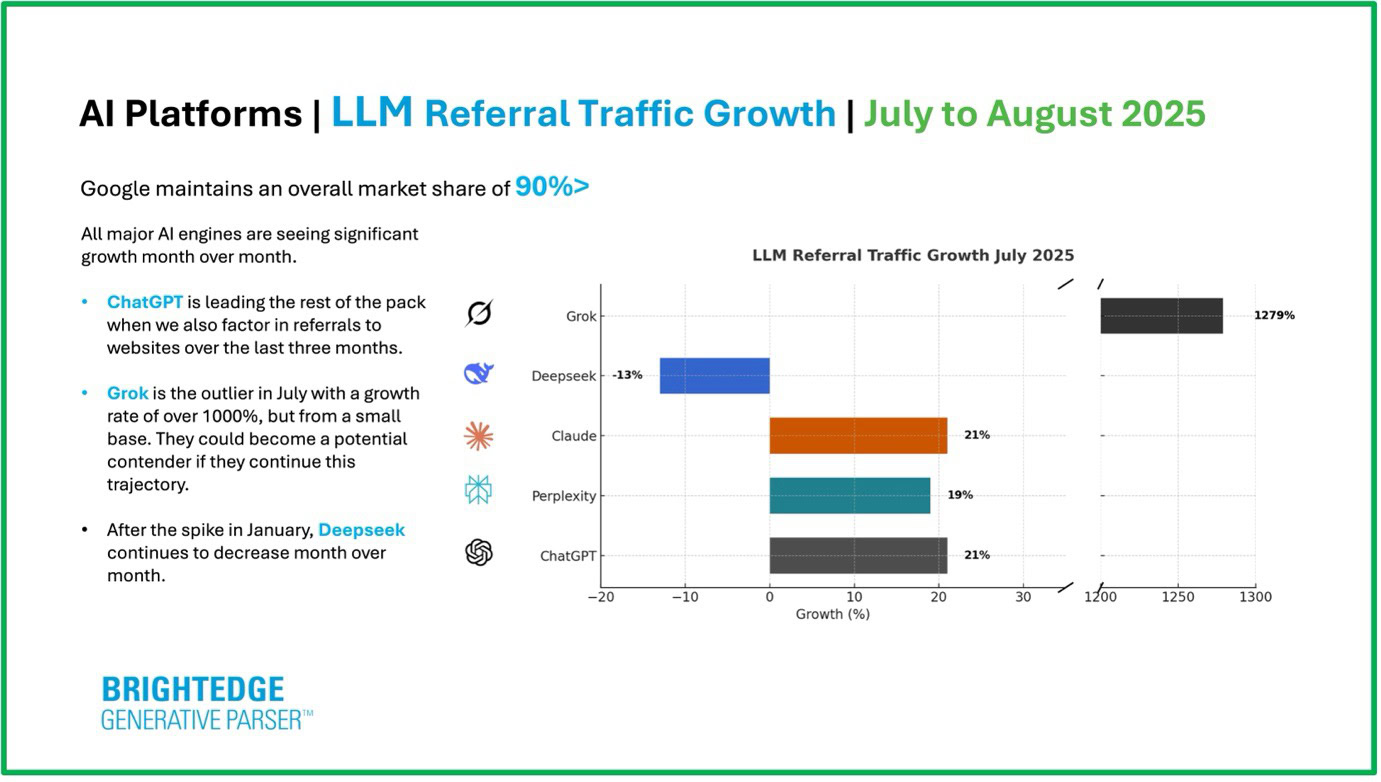
While Google still dominates with about 90% market share, AI-powered search platforms are experiencing explosive growth that is impossible to ignore.

Let me put this in perspective. ChatGPT is showing 21% month-over-month growth and is on track to hit 700 million weekly active users.

Claude and Perplexity are posting similar numbers at 21% and 19% growth, respectively. But here is what has caught my attention: Grok has seen over 1,000% month-over-month growth. Source BrightEdge Generative Parser and DataCube analysis, July 2025.

Sure, it is starting from a tiny base, but that trajectory makes it the dark horse to watch. Meanwhile, DeepSeek continues its gradual decline following its January surge, which highlights the volatility in this emerging market. I will share more on that later.

In A Google First World, User Behavior Is Also Evolving On Multiple AI Platforms

What is particularly interesting is how user behavior is evolving. People are not just switching from Google to AI search — they are starting to mix and match platforms based on their specific needs. I am seeing users turn to:

  • ChatGPT for deep research.
  • Perplexity for quick facts.
  • Claude, when they need reliable information.
  • Google when they want comprehensive breadth.
Image from BrightEdge, August 2025

The CMO AI And SEO Mindset Shift

From a marketing perspective, this creates a massive change in thinking. SEO is not just about Google anymore – though that is still where most of the focus needs to be.

Marketers will need to consider optimizing for multiple AI engines, each with its own distinct data ingestion pipelines. For ChatGPT and Claude, you need clear, structured, cited content that AI models can safely reuse. For Perplexity, timeliness, credibility, and brevity matter more than traditional keyword density.

It is no longer about optimizing just for clicks; it is about optimizing for influence and citations and making sure you appear in the proper context at the right moment within all these distinct types of AI experiences.

The Search Bot To AI User Agent Revolution

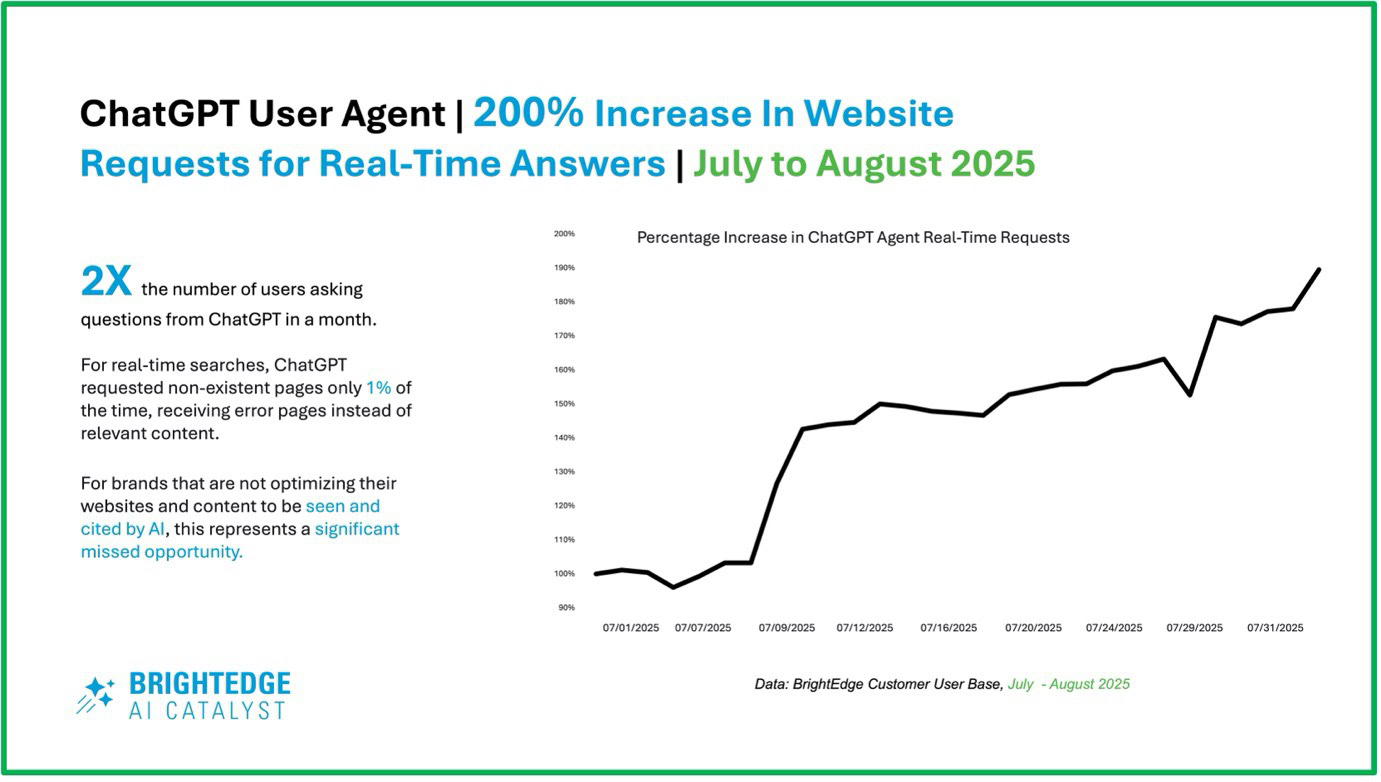
ChatGPT and its ChatGPT-User agent are leading the charge.

In July, BrightEdge’s analysis revealed that ChatGPT’s User Agent real-time page requests nearly doubled its activity. In other words, it shows that users relying on real-time web searches to answer questions almost doubled within just one month.

For example, suppose you are looking to compare “Apple Watch vs. Fitbit” from current reviews. In that case, the ChatGPT user agent is acting as your browsing assistant and operating on your behalf, which is fundamentally different from traditional search engines and crawlers.

Image from BrightEdge, August 2025

In summary, I believe the next six months will establish what I term a “multi-AI search world.” Users will become increasingly comfortable switching between platforms fluidly based on what they need in that moment. The opportunity here is massive for early adopters who figure out cross-platform optimization.

Is The Rise Of AI Platforms Like ChatGPT An Opportunity Or A Threat That CMOs Need To Be Aware Of?

It is all opportunity.

Each AI platform is carving out its own distinct identity. Google is doubling down on AI Overviews and AI Mode. ChatGPT is making this fascinating transition from conversational Q&A into full web search integration.

Perplexity is cementing itself as the premier “answer engine” with its citation-first, mobile-focused approach, and they are planning deeper integrations with news providers and real-time data.

Claude is expanding beyond conversation into contextual search with superior fact-checking capabilities, while Microsoft’s Bing Copilot is positioning itself as this search-plus-productivity hybrid that seamlessly blends document generation with web search.

The rise of AI platforms represents both a transformative opportunity and a strategic challenge that CMOs must navigate with sophistication and strategic foresight.

Learn More: How Enterprise Search And AI Intelligence Reveal Market Pulse

CMOs And The Shift From Ranking To Referencing And Citations

And that brings me to a huge mindset shift: We are moving from “ranking” to “referencing.” AI summaries do not just display the top 10 links; they reference and attribute sites within the answer itself.

Being cited within an AI summary can be more impactful than just ranking high in traditional blue links. So, CMOs need to start tracking not just where they rank, but where and how their content gets referenced and cited by AI everywhere.

Technical Infrastructure Requirements And CMOs Leaning Into SEO Teams

On the technical side, structured data and clear information architecture are no longer nice-to-haves – they are foundational. AI relies on this structure to surface accurate information, so schema.org markup, clean technical SEO, and machine-readable content formats are essential.

Image from BrightEdge, August 2025

Brands, The CMO, And The Authority And Trust Premium

Here is something that is becoming critical: Authority and brand trust matter more than ever. AI tends to pull from sites it considers authoritative, trustworthy, and frequently cited. This puts a premium on long-term brand-building, thought leadership, and reputation management across all digital channels.

You need to focus on those E-E-A-T signals (Experience, Expertise, Authoritativeness, Trustworthiness) for both humans and AI algorithms.

The CMOs’ SEO And AI Competitive Advantage

The CMOs who are proactively adapting to these shifts – rethinking measurement, technical SEO, brand trust, and cross-team integration – are the ones positioning their enterprises for continued visibility and influence.

The move to AI-driven search is rapid, but savvy enterprise marketers are seeing this as an opportunity to deepen brand engagement and become a trusted source for both human users and AI engines.

It is challenging, but the potential upside for brands that get this right is enormous.

It is a whole new way of thinking about ROI.

Learn More: How AI Search Should Be Shaping Your CEO’s & CMO’s Strategy

Do You Think Optimizing For LLMs Is The Same As Search Engines, As Google Suggests?

Following Google Search Central Live in Thailand, and Gary’s advice that SEOs don’t need to optimize for GEO, I think that Gary’s absolutely right, and putting any acronym debates behind us, foundational SEO remains the same, particularly with Google search.

SEO has never been more vital, and AI is accelerating the need for specialists in this area. Your website still needs to be fast, mobile-friendly, and technically sound. Search engines and AI systems alike need to crawl and index your content efficiently. Technical optimizations like proper URL structures, XML sitemaps, clean code, and fast loading times are still paying dividends.

The CMO, SEO, And LLM Optimization Fundamentals

Now, when we talk about optimizing for all LLMs, there is a similarity in the reality that success still lies in core SEO – primarily technical SEO – and content fundamentals.

Strong internal linking helps AI crawlers understand how your pages connect. Make sure all pages are easily crawlable. Answer related questions throughout your content using clear headings, schema markup, and FAQ sections, and figure out what people are trying to accomplish to give them the answer and be the cited source in AI results.

LLM Platform-Specific Differentiation

However, as more brands are being discovered and interpreted across multiple AI platforms, it is also vital to understand that each has its own interface, logic, and way of shaping brand perceptions.

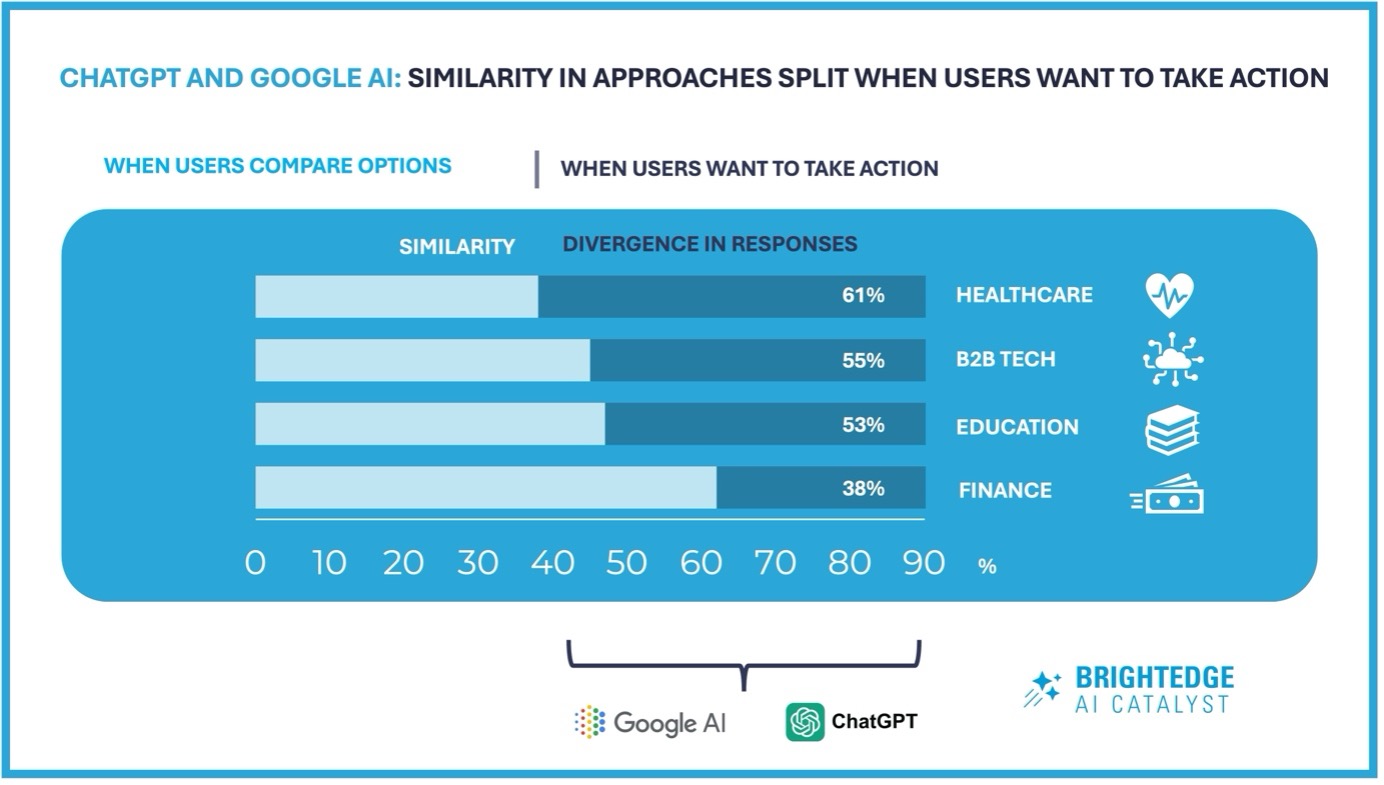
Each platform has developed distinct strengths: ChatGPT Search provides a comprehensive narrative context. Perplexity shines with visual integration and related content. Google AI Overview excels at structured, hierarchical information.

Here is a nuanced example. When users ask comparison questions like “what’s the best?,” ChatGPT and Google’s approaches are similar. But when users ask action-oriented questions like “how do I?,” they part ways dramatically. ChatGPT acts like a trusted coach for decision-making, while Google AI remains the research assistant.

Image from BrightEdge, August 2025

Trust Signal Variations

Different platforms also show distinct trust signal patterns. Google AI Overviews tends to cite review sites and community sources like Reddit, asking “what does the community think?”.

ChatGPT appears to favor retail sources more frequently, asking, “where can you buy it?”. This suggests these platforms are developing different approaches to trust and authority validation.

Three-Phase AI Optimization Framework For The CMO And Marketing Teams

Here is a framework for organizations to follow.

  • Start by tracking your AI and brand presence across multiple AI engines. Monitor how your visibility evolves over time through citations and mentions across AI Overviews, ChatGPT, and beyond.
  • Next, focus on understanding variations in brand mentions across key prompts. Quickly identify which prompts from ChatGPT, AI Overviews, and other AI search engines generate brand mentions so you can optimize your content efficiently.
  • Finally, dive deeper into specific prompts to understand why AI systems recommend brands. Utilizing sentiment analysis provides precise insights into which brand attributes each AI engine favors.

Learn More: The Triple-P Framework: AI & Search Brand Presence, Perception & Performance

The CMO: AI, Search, And Cross-Team Integration Thinking

One thing I am seeing work well is tighter integration across marketing and communications teams. Paid and organic strategies must align more than ever because ads and organic AI overviews often get presented together – your messaging, branding, and targeted intent need to be entirely consistent.
Plus, your PR and content teams need better coordination because off-site mentions in media, reviews, and authoritative sites directly influence who gets cited in AI summaries.

Conclusion: Embracing The Multi-AI Search Transformation

The CMOs who are proactively adapting to the shifts are positioning their organizations for sustained competitive advantage in this evolving landscape.

Big Picture, to put this all in perspective.

The 3 Big Questions From CMOs On AI And Search

  1. AI would kill Google: No, it has turbocharged it.
  2. SEO is dead: No, it’s actually more important than ever. AI is reshaping search, which means we need to understand what this transformation entails. Generative Engine Optimization (GEO) builds upon core SEO foundations and requires more integrated, higher-quality technical approaches.
  3. Everything changes? The more things change, the more they stay the same.

In Part 2 of this series, topics covered will include the future of traditional SERP search and how agentic SEO might change the search funnel. Learn how these changes impact the role of SEO and all teams that fall under the CMO remit.

More Resources:


Featured Image: jd8/Shutterstock

https://www.searchenginejournal.com/the-cmo-seo-staying-ahead-of-the-multi-ai-search-platform-shift-part-1/554017/


The Behavioral Data You Need To Improve Your Users’ Search Journey via @sejournal, @SequinsNsearch

We’re more than halfway through 2025, and SEO has already changed names many times to take into account the new mission of optimizing for the rise of large language models (LLMs): We’ve seen GEO (Generative Engine Optimization) floating around, AEO (Answer Engine Optimization), and even LEO (LLM Engine Optimization) has made an apparition in industry conversations and job titles.

However, while we are all busy finding new nomenclatures to factor in the machine part of the discovery journey, there is someone else in the equation that we risk forgetting about: the end beneficiary of our efforts, the user.

Why Do You Need Behavioral Data In Search?

Behavioral data is vital to understand what leads a user to a search journey, where they carry it out, and what potential points of friction might be blocking a conversion action, so that we can better cater to their needs.

And if we learned anything from the documents leaked from the Google trial, it is that users’ signals might actually be one of the many factors that influence rankings, something that was never fully confirmed by the company’s spokespeople, but that’s also been uncovered by Mark Wiliams Cook in his analysis of Google exploits and patents.

With search becoming more and more personalized, and data about users becoming less transparent now that simple search queries are expanding into full funnel conversations on LLMs, it’s important to remember that – while individual needs and experiences might be harder to isolate and cater for – general patterns of behavior tend to stick across the same population, and we can use some rules of thumb to get the basics right.

Humans often operate on a few basic principles aimed at preserving energy and resources, even in search:

  • Minimizing effort: following the path of least resistance.
  • Minimizing harm: avoiding threats.
  • Maximizing gain: seeking opportunities that present the highest benefit or rewards.

So while Google and other search channels might change the way we think about our daily job, the secret weapon we can use to future-proof our brands’ organic presence is to isolate some data about behavior, as it is, generally, much more predictable than algorithm changes.

What Behavioral Data Do You Need To Improve Search Journeys?

I would narrow it down to data that cover three main areas: discovery channel indicators, built-in mental shortcuts, and underlying users’ needs.

1. Discovery Channel Indicators

The days of starting a search on Google are long gone.

According to the Messy Middle research by Google, the exponential increase in information and new channels available has determined a shift from linear search behaviors to a loop of exploration and evaluation guiding our purchase decisions.

And since users now have an overwhelming amount of channels, they can consult in order to research a product or a brand. It’s also harder to cut through the noise, so by knowing more about them, we can make sure our strategy is laser-focused across content and format alike.

Discovery channel indicators give us information about:

  • How users are finding us beyond traditional search channels.
  • The demographic that we reach on some particular channels.
  • What drives their search, and what they are mostly engaging with.
  • The content and format that are best suited to capture and retain their attention in each one.

For example, we know that TikTok tends to be consulted for inspiration and to validate experiences through user-generated content (UGC), and that Gen Z and Millennials on social apps are increasingly skeptical of traditional ads (with skipping rates of 99%, according to a report by Bulbshare). What they favor instead is authentic voices, so they will seek out first-hand experiences on online communities like Reddit.

Knowing the different channels that users reach us through can inform organic and paid search strategy, while also giving us some data on audience demographics, helping us capture users that would otherwise be elusive.

So, make sure your channel data is mapped to reflect these new discovery channels at hand, especially if you are relying on custom analytics. Not only will this ensure that you are rightfully attributed what you are owed for organic, but it will also be an indication of untapped potential you can lean into, as searches become less and less trackable.

This data should be easily available to you via the referral and source fields in your analytics platform of choice, and you can also integrate a “How did you hear about us” survey for users who complete a transaction.

And don’t forget about language models: With the recent rise in queries that start a search and complete an action directly on LLMs, it’s even harder to track all search journeys. This replaces our mission to be relevant for one specific query at a time, to be visible for every intent we can cover.

This is even more important when we realize that everything contributes to the transactional power of a query, irrespective of how the search intent is traditionally labelled, since someone might decide to evaluate our offers and then drop out due to the lack of sufficient information about the brand.

2. Built-In Mental Shortcuts

The human brain is an incredible organ that allows us to perform several tasks efficiently every day, but its cognitive resources are not infinite.

This means that when we are carrying out a search, probably one of many of the day, while we are also engaged in other tasks, we can’t allocate all of our energy into finding the most perfect result among the infinite possibilities available. That’s why our attentional and decisional processes are often modulated by built-in mental shortcuts like cognitive biases and heuristics.

These terms are sometimes used interchangeably to refer to imperfect, yet efficient decisions, but there is a difference between the two.

Cognitive Biases

Cognitive biases are systematic, mostly unconscious errors in thinking that affect the way we perceive the world around us and form judgments. They can distort the objective reality of an experience, and the way we are persuaded into an action.

One common example of this is the serial position effect, which is made up of two biases: When we see an array of items in a list, we tend to remember best the ones we see first (primacy bias) and last (recency bias). And since cognitive load is a real threat to attention, especially now that we live in the age of 24/7 stimuli, primacy and recency biases are the reason why it’s recommended to lead with the core message, product, or item if there are a lot of options or content on the page.

Primacy and recency not only affect recall in a list, but also determine the elements that we use as a reference to compare all of the alternative options against. This is another effect called anchoring bias, and it is leveraged in UX design to assign a baseline value to the first item we see, so that anything we compare against it can either be perceived as a better or worse deal, depending on the goal of the merchant.

Among many others, some of the most common biases are:

  • Distance and size effects: As numbers increase in magnitude, it becomes harder for humans to make accurate judgments, reason why some tactics recommend using bigger digits in savings rather than fractions of the same value.
  • Negativity bias: We tend to remember and assign more emotional value to negative experiences rather than positive ones, which is why removing friction at any stage is so important to prevent abandonment.
  • Confirmation bias: We tend to seek out and prefer information that confirms our existing beliefs, and this is not only how LLMs operate to provide answers to a query, but it can be a window into the information gaps we might need to cover.

Heuristics

Heuristics, on the other hand, are rules of thumb that we employ as shortcuts at any stage of decision-making, and help us reach a good outcome without going through the hassle of analyzing every potential ramification of a choice.

A known heuristic is the familiarity heuristic, which is when we choose a brand or a product that we already know, because it cuts down on every other intermediate evaluation we would otherwise have to make with an unknown alternative.

Loss aversion is another common heuristic, showing that on average we are more likely to choose the least risky option among two with similar returns, even if this means we might miss out on a discount or a short-term benefit. An example of loss aversion is when we choose to protect our travels for an added fee, or prefer products that we can return.

There are more than 150 biases and heuristics, so this is not an exhaustive list – but in general, getting familiar with which ones are most common among our users helps us smooth out the journey for them.

Isolating Biases And Heuristics In Search

Below, you can see how some queries can already reveal subtle biases that might be driving the search task.

Bias/Heuristic Sample Queries
Confirmation Bias • Is [brand/products] the best for this [use case]?
• Is this [brand/product/service] better than [alternative brand/product service]?
• Why is [this service] more efficient than [alternative service]?
Familiarity Heuristic • Is [brand] based in [country]?
• [Brand]’s HQs
• Where do I find [product] in [country]?
Loss Aversion • Is [brand] legit?
• [brand] returns
• Free [service]
Social Proof • Most popular [product/brand]
• Best [product/brand]

You can use Regex to isolate some of these patterns and modifiers directly in Google Search Console, or you can explore other query tools like AlsoAsked.

If you’re working with large datasets, I recommend using a custom LLM or creating your own model for classifications and clustering based on these rules, so it becomes easier to spot a trend in the queries and figure out priorities.

These observations will also give you a window into the next big area.

3. Underlying Users’ Needs

While biases and heuristics can manifest a temporary need in a specific task, one of the most beneficial aspects that behavioral data can give us is the need that drives the starting query and guides all of the subsequent actions.

Underlying needs don’t only become apparent from clusters of queries, but from the channels used in the discovery and evaluation loop, too.

For example, if we see high prominence of loss aversion based on our queries, paired with low conversion rates and high traffic on UGC videos for our product or brand, we can infer that:

  • Users need reassurance on their investment.
  • There is not enough information to cover this need on our website alone.

Trust is a big decision-mover, and one of the most underrated needs that brands often fail to fulfill as they take their legitimacy for granted.

However, sometimes we need to take a step back and put ourselves in the users’ shoes in order to see everything with fresh eyes from their perspective.

By mapping biases and heuristics to specific users’ needs, we can plan for cross-functional initiatives that span beyond pure SEO and are beneficial for the entire journey from search to conversion and retention.

How Do You Obtain Behavioral Data For Actionable Insights?

In SEO, we are used to dealing with a lot of quantitative data to figure out what’s happening on our channel. However, there is much more we can uncover via qualitative measures that can help us identify the reason something might be happening.

Quantitative data is anything that can be expressed in numbers: This can be time on page, sessions, abandonment rate, average order value, and so on.

Tools that can help us extract quantitative behavioral data are:

  • Google Search Console & Google Merchant Center: Great for high-level data like click-through rates (CTRs), which can flag mismatches between the user intent and the page or campaign served, as well as cannibalization instances and incorrect or missing localization.
  • Google Analytics, or any custom analytics platform your brand relies on: These give us information on engagement metrics, and can pinpoint issues in the natural flow of the journey, as well as point of abandonment. My suggestion is to set up custom events tailored to your specific goals, in addition to the default engagement metrics, like sign-up form clicks or add to cart.
  • Heatmaps and eye-tracking data: Both of these can give us valuable insights into visual hierarchy and attention patterns on the website. Heatmapping tools like  Microsoft Clarity can show us clicks, mouse scrolls, and position data, uncovering not only areas that might not be getting enough attention, but also elements that don’t actually work. Eye-tracking data (fixation duration and count, saccades, and scan-paths) integrate that information by showing what elements are capturing visual attention, as well as which ones are often not being seen at all.

Qualitative data, on the other hand, cannot be expressed in numbers as it usually relies on observations. Examples include interviews, heuristic assessments, and live session recordings. This type of research is generally more open to interpretation than its quantitative counterpart, but it’s vital to make sure we have the full picture of the user journey.

Qualitative data for search can be extracted from:

  • Surveys and CX logs: These can uncover common frustrations and points of friction for returning users and customers, which can guide better messaging and new page opportunities.
  • Scrapes of Reddit, Trustpilot, and online communities conversations: These give us a similar output as surveys, but expand the analysis of blockers to conversion to users that we haven’t acquired yet.
  • Live user testing: The least scalable but sometimes most rewarding option, as it can cut down all the inference on quantitative data, especially when they are combined (for example, live sessions can be combined with eye-tracking and narrated by the user at a later stage via Retrospective Think-Aloud or RTA).

Behavioral Data In The AI Era

In the past year, our industry has been really good at two things: sensationalizing AI as the enemy that will replace us, and highlighting its big failures on the other end. And while it’s undeniable that there are still massive limitations, having access to AI presents unprecedented benefits as well:

  • We can use AI to easily tie up big behavioral datasets and uncover actionables that make the difference.
  • Even when we don’t have much data, we can train our own synthetic dataset based on a sample of ours or a public one, to spot existing patterns and promptly respond to users’ needs.
  • We can generate predictions that can be used proactively for new initiatives to keep us ahead of the curve.

How Do You Leverage Behavioral Data To Improve Search Journeys?

Start by creating a series of dynamic dashboards with the measures you can obtain for each one of the three areas we talked about (discovery channel indicators, built-in mental shortcuts, and underlying users’ needs). These will allow you to promptly spot behavioral trends and collect actions that can make the journey smoother for the user at every step, since search now spans beyond the clicks on site.

Once you get new insights for each area, prioritize your actions based on expected business impact and effort to implement.

And bear in mind that behavioral insights are often transferable to more than one section of the website or the business, which can maximize returns across several channels.

Lastly, set up regular conversations with your product and UX teams. Even if your job title keeps you in search, business success is often channel-agnostic. This means that we shouldn’t only treat the symptom (e.g., low traffic to a page), but curate the entire journey, and that’s why we don’t want to work in silos on our little search island.

Your users will thank you. The algorithm will likely follow.

More Resources:


Featured Image: Roman Samborskyi/Shutterstock

https://www.searchenginejournal.com/the-behavioral-data-you-need-to-improve-user-search-journeys/553560/



Interaction To Next Paint: 9 Content Management Systems Ranked via @sejournal, @martinibuster

Interaction to Next Paint (INP) is a meaningful Core Web Vitals metric because it represents how quickly a web page responds to user input. It is so important that the HTTPArchive has a comparison of INP across content management systems. The following are the top content management systems ranked by Interaction to Next Paint.

What Is Interaction To Next Paint (INP)?

INP measures how responsive a web page is to user interactions during a visit. Specifically, it measures interaction latency, which is the time between when a user clicks, taps, or presses a key and when the page visually responds.

This is a more accurate measurement of responsiveness than the older metric it replaced, First Input Delay (FID), which only captured the first interaction. INP is more comprehensive because it evaluates all clicks, taps, and key presses on a page and then reports a representative value based on the longest meaningful latency.

The INP score is representative of the page’s responsive performance. For that reason**,** extreme outliers are filtered out of the calculation so that the score reflects typical worst-case responsiveness.

Web pages with poor INP scores create a frustrating user experience that increases the risk of page abandonment. Fast responsiveness enables a smoother experience that supports higher engagement and conversions.

INP Scores Have Three Ratings:

  • Good: Below or at 200 milliseconds
  • Needs Improvement: Above 200 milliseconds and below or at 500 milliseconds
  • Poor: Above 500 milliseconds

Related: Get Ready For Google’s INP Metric With These 5 Tools

Content Management System INP Champions

The latest Interaction to Next Paint (INP) data shows that all major content management systems improved from June to July, but only by incremental improvements.

Joomla posted the largest gain with a 1.12% increase in sites achieving a good score. WordPress followed with a 0.88% increase in the number of sites posting a good score, while Wix and Drupal improved by 0.70% and 0.64%.

Duda and Squarespace also improved, though by smaller margins of 0.46% and 0.22%. Even small percentage changes can reflect real improvements in how users experience responsiveness on these platforms, so it’s encouraging that every publishing platform in this comparison is improving.

CMS INP Ranking By Monthly Improvement

  1. Joomla: +1.12%
  2. WordPress: +0.88%
  3. Wix: +0.70%
  4. Drupal: +0.64%
  5. Duda: +0.46%
  6. Squarespace: +0.22%

Which CMS Has The Best INP Scores?

Month-to-month improvement shows who is doing better, but that’s not the same as which CMS is doing the best. The July INP results show a different ranking order of content management systems when viewed by overall INP scores.

Squarespace leads with 96.07% of sites achieving a good INP score, followed by Duda at 93.81%. This is a big difference from the Core Web Vitals rankings, where Duda is consistently ranked number one. When it comes to arguably the most important Core Web Vital metric, Squarespace takes the lead as the number one ranked CMS for Interaction to Next Paint.

Wix and WordPress are ranked in the middle with 87.52% and 86.77% of sites showing a good INP score, while Drupal, with a score of 86.14%, is ranked in fifth place, just a fraction behind WordPress.

Ranking in sixth place in this comparison is Joomla, trailing the other five with a score of 84.47%. That score is not so bad considering that it’s only two to three percent behind Wix and WordPress.

CMS INP Rankings for July 2025

  1. Squarespace – 96.07%
  2. Duda: 93.81%
  3. Wix: 87.52%
  4. WordPress: 86.77%
  5. Drupal: 86.14%
  6. Joomla: 84.47%

These rankings show that even platforms that lag in INP performance, like Joomla, are still improving, and it could be that Joomla’s performance may best the other platforms in the future if it keeps up its improvement.

In contrast, Squarespace, which already performs well, posted the smallest gain. This indicates that performance improvement is uneven, with systems advancing at different speeds. Nevertheless, the latest Interaction to Next Paint (INP) data shows that all six content management systems in this comparison improved from June to July. That upward performance trend is a positive sign for publishers.

What About Shopify’s INP Performance?

Shopify has strong Core Web Vitals performance, but how well does it compare to these six content management systems? This might seem like an unfair comparison because shopping platforms require features, images, and videos that can slow a page down. But Duda, Squarespace, and Wix offer ecommerce solutions, so it’s actually a fair and reasonable comparison.

We see that the rankings change when Shopify is added to the INP comparison:

Shopify Versus Everyone

  1. Squarespace: 96.07%
  2. Duda: 93.81%
  3. Shopify: 89.58%
  4. Wix: 87.52%
  5. WordPress: 86.77%
  6. Drupal: 86.14%
  7. Joomla: 84.47%

Shopify is ranked number three. Now look at what happens when we compare the three shopping platforms against each other:

Top Ranked Shopping Platforms By INP

  1. BigCommerce: 95.29%
  2. Shopify: 89.58%
  3. WooCommerce: 87.99%

BigCommerce is the number-one-ranked shopping platform for the important INP metric among the three in this comparison.

Lastly, we compare the INP performance scores for all the platforms together, leading to a surprising comparison.

CMS And Shopping Platforms Comparison

  1. Squarespace: 96.07%
  2. BigCommerce: 95.29%
  3. Duda: 93.81%
  4. Shopify: 89.58%
  5. WooCommerce: 87.99%
  6. Wix: 87.52%
  7. WordPress: 86.77%
  8. Drupal: 86.14%
  9. Joomla: 84.47%

All three ecommerce platforms feature in the top five rankings of content management systems, which is remarkable because of the resource-intensive demands of ecommerce websites. WooCommerce, a WordPress-based shopping platform, ranks in position five, but it’s so close to Wix that they are virtually tied for position five.

Takeaways

INP measures the responsiveness of a web page, making it a meaningful indicator of user experience. The latest data shows that while every CMS is improving, Squarespace, BigCommerce, and Duda outperform all other content platforms in this comparison by meaningful margins.

All of the platforms in this comparison show high percentages of good INP scores. The number four-ranked Shopify is only 6.49 percentage points behind the top-ranked Squarespace, and 84.47% of the sites published with the bottom-ranked Joomla show a good INP score. These results show that all platforms are delivering a quality experience for users

View the results here (must be logged into a Google account to view).

Featured Image by Shutterstock/Roman Samborskyi

https://www.searchenginejournal.com/interaction-to-next-paint-9-content-management-systems-ranked/555090/