6 AI Marketing Myths That Are Slowing You Down & Draining Your Budgets via @sejournal, @duchessjenm
Think AI can fully run your marketing strategy on autopilot?
Wondering why your AI-generated content isn’t delivering results?
Feel like your AI tools should be doing more, without another string of prompts?
Bust the myths. Fix your funnel. Get AI working with your budget, against it.
If you’re under pressure to make more profit with less budget, AI should help. But the reality is, most teams fall into one of two traps: overtrusting generic AI outputs or fearing the tools entirely.
This webinar on-demand challenges the “set it and forget it” myth that’s costing brands thousands, and reveals how smarter prompting and strategic oversight can transform your campaigns.
Burned Out On Fluffy AI Content? Your Audience Is, Too. Let’s Fix That.
You’ll walk away with a clear plan to turn AI into a performance partner, not a passive tool or a job threat. From better prompts to performance insights, we’ll help you level up.
You’ll Learn:
Hear from Bailey Beckham, Senior Partner Marketing Manager at CallRail, and Jennifer McDonald, Senior Marketing Manager at Search Engine Journal, two marketing experts who will help you unlock AI’s full potential, optimize your marketing strategies, and elevate results without fear of it taking your job.
Learn to work smarter with AI, not against it, and make it an invaluable tool in your marketing arsenal.
Watch webinar on-demand to learn how to get your content recommended by AI & LLMs, plus loved by humans.
However, WordPress isn’t just a plug-and-play CMS. If you’re in the marketing team or the CMO, you may find yourself inheriting and using a WordPress site that will most likely have a less-than-ideal stack setup.
Don’t accept that this is just the setup you have. If your tech stack isn’t aligned correctly, it could directly hinder some of your own goals.
While it may seem that you should delegate all technical decisions to the development/IT team, these decisions may overrule wider business goals.
As such, it may be time to audit your installation and setup in order to break free of these stack limitations.
If you’re a CMO, this post will cover the different considerations when thinking of the optimal WordPress tech stack that also aligns with your own goals.
What A Tech Stack Includes
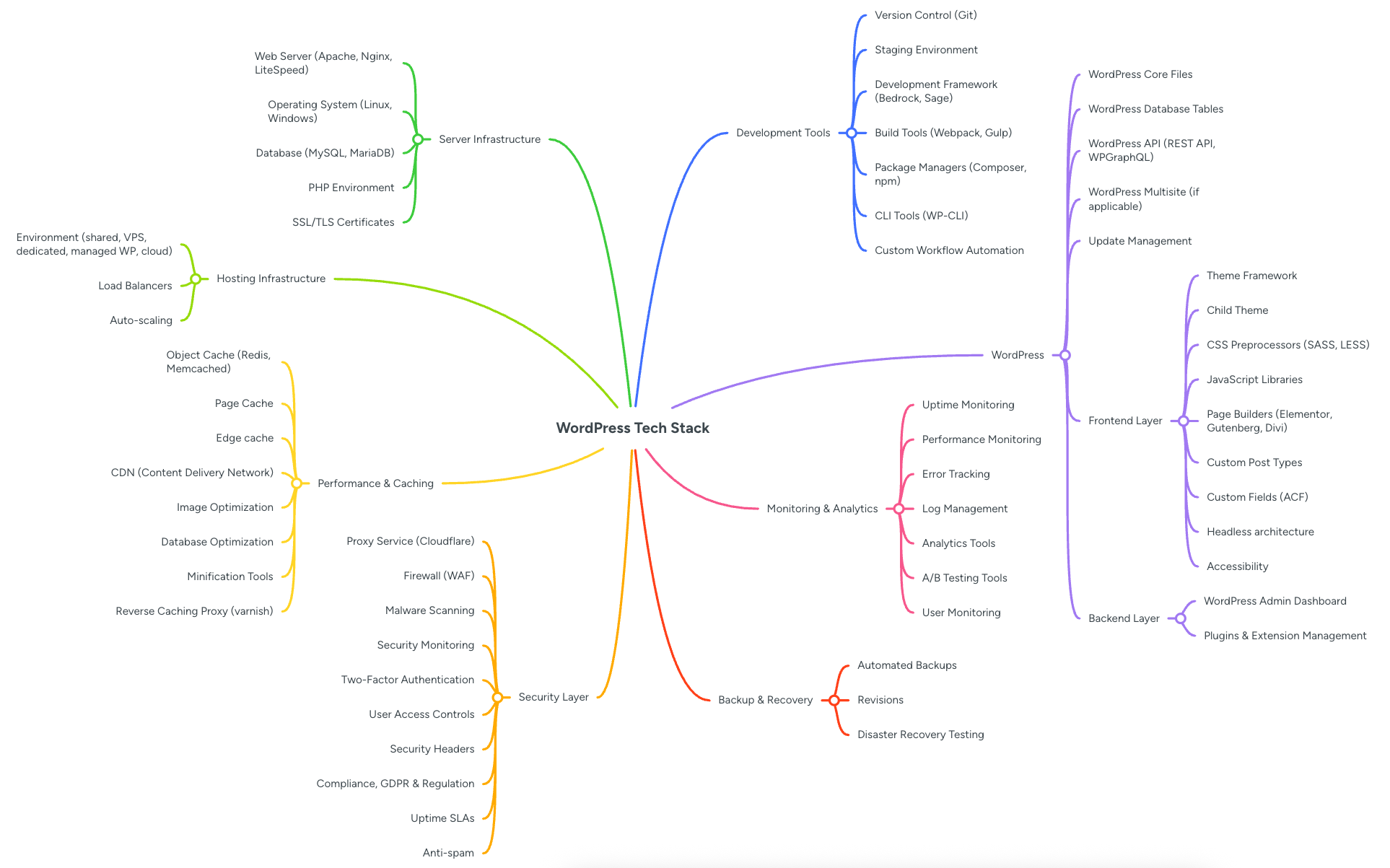
From a top-level, the WordPress tech stack involves the following:
There’s a lot to consider. With that, let’s delve into what you, as a CMO, should be asking yourself and others to ensure this stack is at its best.
The Invisible Cost Of Cheap Hosting
Shared hosting might seem cost-effective, but in my experience, it’s often the most expensive choice in the long term.
When your site shares resources with hundreds of others, performance becomes unpredictable. This can affect many things, from general speed and performance, but also how search engines and large language models (LLMs) crawl/discover your site, as well as how a human may experience the site itself.
Dedicated servers or managed WordPress hosting may be a larger investment, but in turn reduces technical overheads while providing the infrastructure needed for growth and scale.
For the level up from this, WordPress-based Cloud hosting is the most robust solution, but would require more technical expertise to manage.
What CMOs Should Ask:
Are we on shared hosting or dedicated infrastructure? If the former, why?
Are all server resources, such as PHP, up to date?
What happens to site performance during traffic spikes?
Who is responsible for server-level maintenance, optimizations, and security?
For potential traffic spikes, are there solutions and safeguards in place, such as load balancers?
Can we grow and scale with our current solution?
Performance: The Business Metric Disguised As A Tech Metric
Developers and technical SEOs alike will obsess over PageSpeed/Lighthouse scores, but things such as Core Web Vitals aren’t just technical benchmarks but also conversion metrics in disguise.
A one-second delay in mobile load times can impact mobile conversions by up to 20%. If Largest Content Paint (LCP) exceeds 2.5 seconds, then your next sale is at high risk before there’s a chance to convert them.
Performance optimization in WordPress isn’t straightforward when looking forensically. Many “solutions” can create new problems. Even well-intentioned optimizations and fixes over the longer term can cause conflicts or other knock-on effects. Over time, this becomes a “Frankenstein” site of many elements patched together in an attempt to keep it ‘alive’ that becomes expensive to unravel and can cause the site to be a “write-off”. This practice is more common than you think.
What CMOs Should Ask:
How does our site perform on PageSpeed Insights, GTmetrix, and YSlow? What can be improved? How do we perform against competitors?
Is caching properly set up? Are we considering all levels (server, object, page, CDN, etc.)?
Do we have all minification tools set up correctly?
Is our database architecture the best it can be? How can this be improved?
What and how often is our database cleaned? Does this include revisions?
How are our images performing? Have they been optimized? Are we using more modern formats such as WebP?
Who owns the performance metric?
This isn’t about chasing perfect scores; it’s about ensuring your technical foundation supports rather than potentially sabotaging your marketing objectives.
Deciding On A Theme Should Be Long-Term
There are thousands of WordPress themes out there.
In a perfect scenario, the theme itself would be custom-built, incorporating WordPress’ own Gutenberg block editor, as it’s part of the core. As well as this, full site editing functionality makes this process even easier.
If your budget can’t stretch to custom-built theme development, it’s then extremely important to choose the right theme.
Ensure that you research the theme properly, making an informed choice that is performance-led to complement the stack, not convenience-led for editors.
But remember, your choice of theme is more long-term than installing a plugin you find you don’t need a month/year later. Because of this, themes should have a more considered and informed approach.
Bonus Consideration: Page Builders
Generally, the people who end up using WordPress on a day-to-day basis are not the same people who developed it or set it up.
Because of this, there can sometimes be clashes when it comes to what someone in your marketing team wants versus what should be implemented with technical best practice.
Page builders such as Elementor and Divi do offer a lot more freedom and flexibility for page creation and design, but come with the downside of potential code bloat and resource allocation.
Ensure that your decisions are not influenced too much by this request, because that is what it is, a request.
What CMOs Should Ask:
How does our current theme/builder choice impact site performance?
Is our current theme built for purpose? Is it a theme that caters to the masses, or is it developed specifically for me or my niche?
Are we locked into a specific page builder? What does the builder offer that Gutenberg and FSE don’t? What are the migration implications?
Are our choices forming a good balance between design flexibility with technical performance?
Do we have the development resources to support our chosen approach?
Are there conflicts between the page builder and other resources/assets?
Plugin-ception
“There’s a plugin for that.”
This is a phrase we’ve all heard or said before – myself included. There will be a plugin for that, yes – but it shouldn’t be the answer every time you want to extend functionality.
While I do have a select number of “core” plugins that I confidently choose to use on any site, this does not mean that I would choose to install a plugin because it solved one problem that may not be enough to substantiate installing if it warrants the technical debt the plugin will add.
Estimates suggest, the average WordPress site runs 20-30 plugins, with many serving overlapping functions or creating conflicts.
Bonus: Some Plugins Require Attention Post-Installation
There are some plugins that have a simple “plug and play” approach. But whenever I install anything, I always delve further into its setup, configuration, and how this can impact the performance of a site.
One thing to know is that, in general, you should not approach any plugin with an “install and ignore” mindset.
Check the settings. Go through the first-time configuration (FTC). Audit the configuration.
Furthermore, plugins not only provide valuable under-the-hood optimizations and enhancements, but also present an opportunity for the site to evolve alongside your business and marketing activities.
Actively using these plugins means your stack continues to benefit from the latest features, innovations, and improvements.
What CMOs Should Ask:
How many plugins are currently active on our site?
When was our last plugin audit?
What plugins are we dependent on for our core business functions?
Have all plugins been configured correctly?
Are the plugins that require ongoing work being used?
Are there conflicts with other plugins?
Are there any incumbent plugins stopping the development of the site as a whole?
(More aggressive) What will happen to the wider business goals if [Plugin X] is no longer used?
The more plugins that are installed, the higher the risk of incompatibility, conflicts, and security vulnerabilities.
Security: Be Proactive, Not Reactive
One would think that security is always the top priority to ensure the safe operation of any website. Incorrect.
Breaches can devastate not just the site, but in turn, your brand reputation, while also incurring large immediate costs and most likely some loss of earnings in the future as a result.
While on the more extreme end of the scale, earlier this year, some hackers breached a number of large UK retailers, including Marks and Spencer, causing £300 million in lost profits, with no real measurement on how this has affected them since.
It doesn’t take long or cost much (in some cases, the solutions are free) to add some layers of security to your stack.
Whether it’s adding rules within Cloudflare or installing Sucuri or Wordfence, don’t just leave your site unprotected while you “sit tight and assess” – take proactive steps to secure your stack.
Is everything up to date? This includes not just WordPress core, themes, and plugins, but also on a server level, such as PHP.
Maintenance: Forgotten Until Required
WordPress maintenance often gets treated as a technical afterthought, but I consider this to be a critical marketing function.
Outdated plugins not only create conflicts that have knock-on effects on both the frontend and backend of the site but also expose you to security vulnerabilities that I just covered above.
The choice between manual and automatic updates reflects deeper strategic priorities.
Manual updates provide more control but require dedicated resources and staging environments for testing prior to deployment. Automatic updates may reduce maintenance overhead, but there is always a risk of conflicts during critical business periods.
What CMOs Should Ask:
Who is responsible for WordPress core, plugin, and theme updates? Do they have all the required access in case of disaster scenarios?
Who is responsible for legal, compliance, and privacy on the site?
Is everything up to date? If not, is there a reason for this?
Do we have staging environments for testing changes before anything is deployed to a production environment?
What’s our rollback plan if an update breaks critical functionality?
How do we balance security needs with stability requirements?
“Frankenstein” Sites Only Get You So Far For So Long…
If you have a theme that is now years old, perhaps five or more, it’s likely that over time the theme (unless extremely well maintained) will eventually cause issues and conflicts, more so when you want to grow and scale.
Optimizing the site over time is obviously suggested, but after a prolonged amount of time, this becomes more challenging and less possible without conflicts arising.
What CMOs Should Ask:
When was the last time a theme was chosen?
When was it last audited? Is the theme still fit for purpose today?
Is a theme update causing conflicts with other resources and plugins?
Are there legacy plugins or other functionality that prevent essential updates to WordPress or PHP, forcing the site to remain on outdated versions (therefore limiting access to new features, improved security, or better performance)?
Are ad hoc maintenance costs and “patchwork” over two to three years costing more than a potential rebuild (i.e., Is it a “write-off”)?
Key Takeaways
Below is a high-priority checklist that you can act on now:
Priority
Action Item
Stakeholder(s)
Critical
Audit the current hosting environment and audit invisible costs.
CMO, Tech Lead, Finance
Critical
Review plugin presence and usage: configuration, conflicts, necessity.
Tech, SEO, Product, Marketing
Critical
Implement and verify up-to-date security layers (e.g., Sucuri, WAF).
CTO, IT
High
Define clear responsibilities for updates, rollbacks, and compliance.
Product, Legal, Marketing
High
Schedule routine theme and plugin audits.
Dev/Project Manager
High
Set up or review staging/testing environments for changes.
Tech Lead/DevOps
Medium
Plan for a long-term theme or potential rebuild if “Frankenstein.”
CMO, CTO
Medium
Calculate ongoing maintenance costs vs possible site overhaul.
Finance, CMO, CTO
Your WordPress stack should never be considered “set and forget.”
Don’t wait for something to break, because when something does, it will most likely cause more loss than any proactive investment to ensure there isn’t one.
Research Shows How To Optimize For Google AIO And ChatGPT via @sejournal, @martinibuster
New research from BrightEdge shows that Google AI Overviews, AI Mode, and ChatGPT recommend different brands nearly 62% of the time. BrightEdge concludes that each AI search platform is interpreting the data in different ways, suggesting different ways of thinking about each AI platform.
Methodology And Results
BrightEdge’s analysis was conducted with its AI Catalyst tool, using tens of thousands of the same queries across ChatGPT, Google AI Overviews (AIO), and Google AI Mode. The research documented a 61.9% overall disagreement rate, with only 33.5% of queries showing the exact same brands in all three AI platforms.
Google AI Overviews averaged 6.02 brand mentions per query, compared to ChatGPT’s 2.37. Commercial intent search queries containing phrases like “buy,” “where,” or “deals” generated brand mentions 65% of the time across all platforms, suggesting that these kinds of high-intent keyword phrases continue to be reliable for ecommerce, just like in traditional search engines. Understandably, e-commerce and finance verticals achieved 40% or more brand-mention coverage across all three AI platforms.
Three Platforms Diverge
Not all was agreement between the three AI platforms in the study. Many identical queries led to very different brand recommendations depending on the AI platform.
BrightEdge shares that:
ChatGPT cites trusted brands even when it’s not grounding on search data, indicating that it’s relying on LLM training data.
Google AI Overviews cites brands 2.5 times more than ChatGPT.
Google AI Mode cites brands less often than both ChatGPT and AIO.
The research indicates that ChatGPT favors trusted brands, Google AIO emphasizes breadth of coverage with more brand mentions per query, and Google AI Mode selectively recommends brands.
Next we untangle why these patterns exist.
Differences Exist
BrightEdge asserts that this split across the three platforms is not random. I agree that there are differences, but I disagree that “authority” has anything to do with it and offer an alternate explanation later on.
These are the conclusions that they draw from the data:
“The Brand Authority Play: ChatGPT’s reliance on training data means established brands with strong historical presence can capture mentions without needing fresh citations. This creates an “authority dividend” that many brands don’t realize they’re already earning—or could be earning with the right positioning.
The Volume Opportunity: Google AI Overview’s hunger for brand mentions means there are 6+ available slots per relevant query, with clear citation paths showing exactly how to earn visibility. While competitors focus on traditional SEO, innovative brands are reverse-engineering these citation networks.
The Quality Threshold: Google AI Mode’s selectivity means fewer brands make the cut, but those that do benefit from heavy citation backing that reinforces their authority across the web.”
Not Authority – It’s About Training Data
BrightEdge refers to “authority signals” within ChatGPT’s underlying LLM. My opinion differs in regard to an LLM’s generated output, not retrieval-augmented responses that pull in live citations. I don’t think there are any signals in the sense of ranking-related signals. In my opinion, the LLM is simply reaching for the entity (brand) related to a topic.
What looks like “authority” to someone with their SEO glasses on is more likely about frequency, prominence, and contextual embedding strength.
Frequency: How often the brand appears in the training data.
Prominence: How central the brand is in those contexts (headline vs. footnote).
Contextual Embedding Strength: How tightly the brand is associated with certain topics based on the model’s training data.
If a brand appears widely in appropriate contexts within the training data, then, in my opinion, it is more likely to be generated as a brand mention by the LLM, because this reflects patterns in the training data and not authority.
That said, I agree with BrightEdge that being authoritative is important, and that quality shouldn’t be minimized.
Patterns Emerge
The research data suggests that there are unique patterns across all three platforms that can behave as brand citation triggers. One pattern all three share is that keyword phrases with a high commercial intent generate brand mentions in nearly two-thirds of cases. Industries like e-commerce and finance achieve higher brand coverage, which, in my opinion, reflects the ability of all three platforms to accurately understand the strong commercial intents for keywords inherent to those two verticals.
A little sunshine in a partly cloudy publishing environment is the finding that comparison queries for “best” products generate 43% brand citations across all three AI platforms, again reflecting the ability of those platforms to understand user query contexts.
Citation Network Effect
BrightEdge has an interesting insight about creating presence in all three platforms that it calls a citation network effect. BrightEdge asserts that earning citations in one platform could influence visibility in the others.
They share:
“A well-crafted piece… could: Earn authority mentions on ChatGPT through brand recognition
Generate 6+ competitive mentions on Google AI Overview through comprehensive coverage
Secure selective, heavily-cited placement on Google AI Mode through third-party validation
The citation network effect means that earning mentions on one platform often creates the validation needed for another. “
Optimizing For Traditional Search Remains
Nevertheless, I agree with BrightEdge that there’s a strategic opportunity in creating content that works across all three environments, and I would make it explicit that SEO, optimizing for traditional search, is the keystone upon which the entire strategy is crafted.
Traditional SEO is still the way to build visibility in AI search. BrightEdge’s data indicates that this is directly effective for AIO and has a more indirect effect for AI Mode and ChatGPT.
ChatGPT can cite brand names directly from training data and from live data. It also cites brands directly from the LLM, which suggests that generating strong brand visibility tied to specific products and services may be helpful, as that is what eventually makes it into the AI training data.
BrightEdge’s conclusion about the data leans heavily into the idea that AI is creating opportunities for businesses that build brand awareness in the topics they want to be surfaced in. They share:
“We’re witnessing the emergence of AI-native brand discovery. With this fundamental shift, brand visibility is determined not by search rankings but by AI recommendation algorithms with distinct personalities and preferences.
The brands winning this transition aren’t necessarily the ones with the biggest SEO budgets or the most content. They’re the ones recognizing that AI disagreement creates more paths to visibility, not fewer.
As AI becomes the primary discovery mechanism across industries, understanding these platform-specific triggers isn’t optional—it’s the difference between capturing comprehensive brand visibility and watching competitors claim the opportunities you didn’t know existed.
The 62% disagreement gap isn’t breaking the system. It’s creating one—and smart brands are already learning to work it.”
Track, Prioritize & Win In AI Search [Webinar] via @sejournal, @hethr_campbell
AI search is reshaping buyer discovery.
Every week, 800 million searches happen across ChatGPT, Claude, Perplexity, and other AI engines.
If your brand isn’t showing up, you’re losing leads and opportunities.
Join Samanyou Garg, Founder of Writesonic, on September 10, 2025, for a webinar designed to help marketers and SEO teams master AI visibility. In this session, you’ll learn practical tactics to measure, prioritize, and optimize your AI footprint.
AI-driven search is no longer optional. Your brand’s presence in AI answer engines directly impacts traffic, leads, and revenue. This session will equip you with a step-by-step process to turn AI visibility into real business results.
Save your spot now to learn actionable strategies that top brands are using to dominate AI search.
Can’t attend live? Register anyway, and we’ll send you the full recording.
SEO Has Been Tactical For 20 Years. GenAI Forces The Strategy Question via @sejournal, @DuaneForrester
For as long as I’ve been in this industry, there’s been debate about whether SEO is strategic or tactical. Most SEOs would like to believe their work is strategic. Many executives see it as tactical. The truth is somewhere in between, and the arrival of generative AI is forcing a new level of clarity.
This matters because “strategy” and “tactics” are not synonyms. In business, strategy is the plan. Tactics are the moves. Confusing the two doesn’t just muddy language. It leads to wasted resources, stalled initiatives, and misplaced expectations for what SEO can and cannot deliver.
Defining Strategy Vs. Tactics
Image credit: Duane Forrester
Business literature has been clear on this for decades, and voices like Porter, Mintzberg, and Drucker shaped how leaders everywhere talk about strategy. Their framing applies directly when we examine SEO’s role today.
Michael Porter is widely recognized as the father of modern competitive strategy. A professor at Harvard Business School, he framed strategy as “choosing to run a different race, because it’s the one you’ve set yourself up to win.” His book “Competitive Strategy” remains one of the foundational texts in business thinking (his book on Amazon – not an affiliate link).
Henry Mintzberg is one of the most cited academics in management and organizational theory. He is famous for noting, “Strategy is not the consequence of planning, but the opposite: its starting point.” He also developed the 5 Ps framework — Plan, Ploy, Pattern, Position, and Perspective — which captures strategy as both deliberate and emergent (Mintzberg’s “The Strategy Concept I: Five Ps for Strategy”).
Peter Drucker is often called the father of modern management. His work shaped how companies think about leadership and decision-making. He emphasized that “the task of leadership is to create an alignment of strengths so strong that it makes the system’s weaknesses irrelevant.” His book “The Practice of Management” is considered a landmark in defining management’s role in aligning strategy with organizational outcomes (Drucker biography at the Drucker Institute).
Tactics, by contrast, are the practical steps. They’re what frontline teams execute, usually with short-term horizons. A strategy might be to compete on customer trust instead of low prices. The tactics are testimonial campaigns, return policies, and training staff to deliver exceptional service.
Other business functions get this distinction. In sales, strategy is deciding to prioritize enterprise accounts. Tactics are outreach sequences and demo scripts. In PR, strategy is positioning the brand as an industry leader. Tactics are pitching journalists and writing press releases. SEO is no different.
The confusion comes because SEO often has to “do it all.” Practitioners are expected to identify opportunities, set priorities, and then execute the work. That’s where the labels blur.
Strategy And Tactics In Traditional SEO
Looking back at the history of SEO makes the divide easier to see.
Early 2000s, PageRank era: Strategy was simple. Invest in being discoverable on Google. Tactics included link building, directory submissions, and keyword-stuffed pages. Companies that treated SEO purely tactically often succeeded short-term but collapsed when penalties arrived. The strategy was clear. Pursue visibility on Google, while the tactics were the link farms, keyword stuffing, and directory submissions that executed it.
2010–2015, Panda and Penguin: Google cracked down on low-quality content and manipulative links. Strategy shifted to “quality and sustainability.” Tactics became pruning thin content, disavowing bad links, and investing in editorial teams. Content farms like Demand Media scaled on tactics, but lacked sustainable strategy, and they were decimated by Panda. Here again, leadership set the strategic shift toward quality, and SEO carried it out through content pruning and link cleanup.
2015–2020, Mobile and Core Web Vitals: Strategy was “meet users where they are.” They were on mobile and wanted fast experiences. Tactics were responsive design, structured data, and site speed audits. Companies that made this strategic shift early (e.g., news outlets investing in AMP) gained advantage. The strategic goal was serving users where they were, while SEO implemented the tactical fixes that delivered on it.
2020s, BERT and passage indexing: Strategy tilted toward semantic relevance, competing not just on keywords but on meaning and intent. Tactics were writing for topics, structuring content for passage-level retrieval, and emphasizing context. Strategy tilted toward meaning; tactics followed in the form of topic clusters and passage-level optimization.
At every stage, leadership set the strategy (“we need growth from search”), and SEO executed the tactics. Advanced SEOs sometimes influenced strategy by warning about risks or opportunities, but the bulk of work remained tactical.
Strategy And Tactics In GenAI Optimization
Generative AI reshapes the landscape. Instead of 10 blue links, users now get synthesized answers. That changes both the strategic questions and the tactical execution.
Strategic choices now include:
Deciding whether to compete for visibility across multiple AI engines (ChatGPT, Perplexity, Gemini, Claude, etc.).
Choosing where to allocate budget: competing for evergreen visibility in broad topics, or dominating narrow niches where AI coverage is weaker.
Determining how much to invest in retrievability testing and monitoring as an organizational function.
Tactical execution now includes:
Structuring content into retrievable chunks sized for vector search.
Running retrieval tests across platforms to measure exposure.
Optimizing semantic density so each chunk is information-rich and self-contained.
Adding schema and structured data to clarify entities and facts.
Tracking machine-validated authority by measuring whether your content is surfaced or cited in AI responses.
Query fan-out work to determine opportunities and identify semantic overlap.
These tactics look new, but they build directly on the foundation of traditional SEO. Schema is simply structured markup, refined. Semantic density is the next evolution of topical relevance. Retrieval tests are the modern equivalent of checking indexation. GenAI optimization doesn’t replace SEO; it evolves from it.
GenAI Optimization: Is It A Strategy Or Tactic?
The sudden surge of interest in “GenAI optimization” is a perfect case study in this strategy-versus-tactics debate.
Everyone is talking about chunking, embeddings, and retrievability as if they are strategy. They aren’t. They’re tactics. And treating tactics as strategy is a classic oversimplification, something the industry has been guilty of for decades.
At the strategic level: Businesses decide that GenAI visibility is essential. They commit budget to becoming retrievable and authoritative across AI systems. They set goals to be cited in machine answers for their core vertical.
At the tactical level: Teams restructure content into chunks, add schema, run retrieval probes in ChatGPT or Perplexity, and measure citation frequency.
Both layers are needed. The risk comes when companies mistake tactical execution for strategy.
The Cost Of Misalignment
When strategy and tactics are misaligned, businesses lose, and the losses are measurable.
Missed opportunities: If leadership hasn’t set a strategy for GenAI visibility, tactical work is scattershot. Teams optimize content but don’t know which queries, topics, or surfaces matter. Competitors with clearer strategies win the ground.
Lost revenue: Without strategy, companies may secure citations in AI answers that don’t align with customer value. The result is visibility without conversion.
Wasted budgets: Chasing every GenAI trend without a clear North Star leads to investment in tools and audits that deliver no meaningful ROI.
Eroded trust: When executives believe they’ve funded a strategy but only see tactical outputs, confidence in SEO teams drops. Leadership expected market impact and the team only delivered structural updates.
The lesson is blunt: Businesses don’t usually fail because tactics are poorly executed. They usually fail because tactics aren’t anchored in strategy.
Why SEO Has Been Seen As Tactical
For two decades, SEO has been defined by tactical output. Executives set the strategy (“We need organic growth”), and SEO was tasked with delivering through audits, fixes, optimizations, and publishing.
This framing wasn’t wrong as it reflected the organizational structure. Strategy was set higher up; SEOs carried it out. That’s why SEO often struggled to win budget or a seat in strategic planning meetings. It was seen as execution.
The AI-Driven Shift
Generative AI changes that equation. Machines are absorbing tactical SEO tasks. Today, AI tools can generate meta descriptions, suggest keywords, build internal linking recommendations, even create structured schema markup. Some platforms simulate retrieval patterns directly. What once required specialized SEO execution is increasingly automated.
That doesn’t eliminate SEO. It elevates it. If tactical execution is becoming commoditized, the value shifts to strategy.
This mirrors Microsoft’s research on AI’s occupational impacts, which distinguishes between user goals (strategic intent) and AI actions (tactical execution). Humans set the “why.” AI delivers the “how.”
For SEO, the same shift is underway. The tactical layer is being automated. The strategic opportunity is to lead on visibility, authority, and trust in AI-driven ecosystems.
Drawing The Line With Examples
Traditional SEO in financial services: The strategy is to dominate “retirement planning for millennials.” The tactics include create calculators, publish evergreen guides, optimize metadata, and build relevant backlinks.
GenAI optimization in sustainable investing: The strategy is to ensure the brand is a trusted citation in AI answers on ESG funds. The tactics include run retrieval checks in Perplexity, embed structured citations, optimize chunks for semantic clarity, and measure citation frequency in ChatGPT and Gemini.
One sets the direction. The other executes the playbook.
Why This Feels Touchy
Many SEOs call their work strategic because they connect content, technical architecture, and authority signals into a broader picture. In many organizations, they’re the only ones framing visibility at all, but that doesn’t make every action strategic.
That deserves credit. But precision matters. Running an audit is not strategy. Updating a robots.txt file is not strategy. These are tactical actions. If we blur the line, we diminish our influence at precisely the moment AI is eroding the value of tactics.
Where The Balance Lies
So, is SEO strategic or tactical? The honest answer is both, but not equally.
Historically, SEO has been tactical.
Today, SEO carries strategic implications, especially as AI reshapes discovery.
The opportunity is to make the leap: from executing optimizations to shaping how organizations appear in machine-driven answers.
The balance is this: Tactics still matter. You can’t ignore schema, chunking, or retrieval testing. But the differentiator is strategy: deciding which battles to fight, which surfaces to win, and how to align SEO with the company’s long-term positioning.
Why This Matters For SEOs
This isn’t a semantic debate. It’s about influence and survival.
If SEO is seen as tactical, it’s underfunded, siloed, and brought in too late.
If SEO is seen as strategic, it gets budget, resources, and a seat in the boardroom.
The GenAI shift creates a once-in-a-generation opening for SEOs to redefine their value. As AI absorbs more tactical execution, the real opportunity is for SEOs to align with company-level strategy and expand their scope into visibility, trust, and authority. Those who recognize the difference between strategy and tactics will step into leadership. Those who stay focused only on tactical execution risk being automated out.
Closing Thought
For 20 years, SEO has been tactical excellence in service of growth. With GenAI, the tactical layer is shifting to machines. That makes strategy the defining frontier.
Not because SEOs suddenly became strategists, but because the environment demands it. The question now is: will SEOs step into that role, or will someone else claim it?
Ask An SEO: How Do You Prioritize Technical SEO Fixes With Limited Dev Support? via @sejournal, @HelenPollitt1
Today’s question cuts to the heart of resource management for SEO:
“How do you prioritize SEO fixes when technical debt keeps piling up and you can’t get dev resources?”
In this article, we’ll look at different prioritization methods and what you can do when you have more work than support to do it.
What Is Technical Debt?
Let’s first take a look at what we consider “technical debt” in SEO.
In development, this term refers to long-standing issues with the website that have grown due to poor management, or “quick-fixes” that have not stood the test of time.
In SEO, we tend to use it to signify any code-based issue that is fundamentally affecting optimization efforts. Typically, these are issues that cannot be fixed by the SEO function alone, but require the input of front or back-end development teams.
So, when the bulk of the work required to fix SEO technical debt falls to other teams, how do you make sure the most important work gets completed?
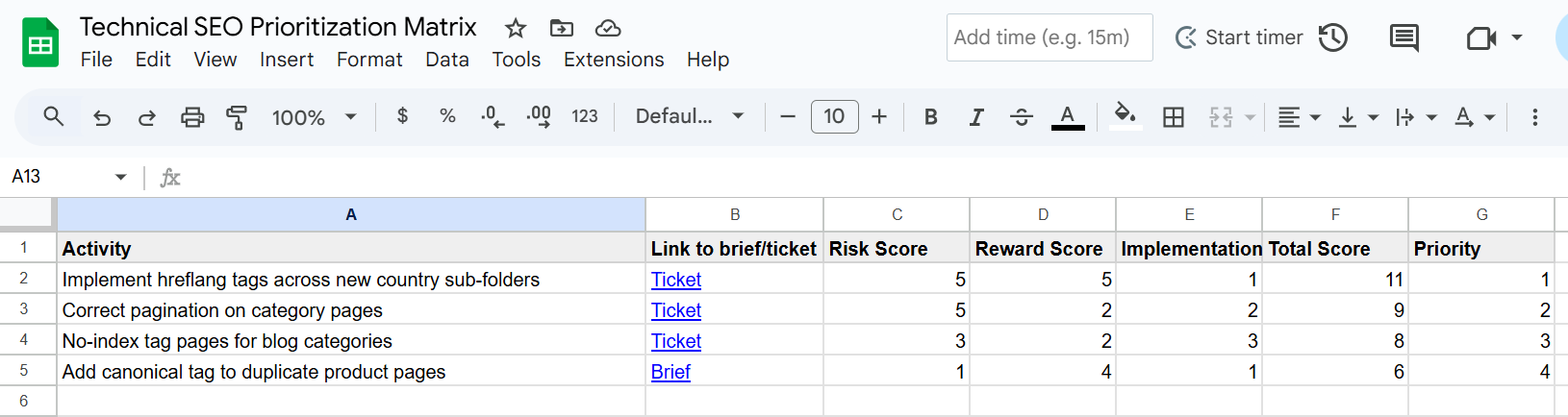
Prioritization Matrix
In order to prioritize the work, you should look at three core aspects. These are the associated risks of the work not being completed, the potential benefits if it is, and the likelihood of it being implemented.
You may even want to create a matrix that details the overall score of a technical item. Then, use that to prioritize them. Discuss each item with the stakeholders whose teams will need to be involved in its implementation.
Get a better idea of the full scope of the work. From there, you can assign a figure to each category of “risk”, “reward”, and “implementation likelihood.”
Example of a technical SEO prioritization matrix (Screenshot by author, August 2025)
Risk
Start by calculating the risk to the business if this work isn’t carried out.
Consider aspects like financial risk, i.e., “If we don’t carry out this work then our product pages will be no-indexed. Currently X% of revenue from those product pages is generated by organic traffic and therefore by not completing this work we risk $Y of revenue each year.”
It could also be a risk to the website’s performance. For example, by not fixing a Cumulative Layout Shift (CLS) issue across a group of pages, you may risk conversions as well as rankings.
Get a better idea of the level of risk associated with not fixing that technical debt. Then, assign it a score from 1 (low risk) to 5 (high risk).
Reward
In a similar way, consider the positive implications of carrying out this work. Look at how implementing these fixes could affect revenue, conversion rate, customer satisfaction, or even how it could save money.
For example, “We know that we have a lot of duplicate pages that are not generating revenue but are repeatedly crawled by search bots. We know that every time a bot crawls a page, it costs us $X in server hosting costs; therefore, if we remove those pages we can save the company $Y each year.”
Look primarily at the financial benefits of carrying out the work, but consider also some secondary benefits.
For example, will this work help users complete their goals more easily? Will it aid them in discovering new products or perhaps enjoy a better user experience?
Consider whether the work will benefit other channels beyond organic search. Your technical debt fixes may improve the landing page experience for a group of pages that are used for paid advertising campaigns as well as organic traffic. The benefit of that work may be felt by the paid media team as well as the organic search team.
Assess each of your planned tasks and assign them a value between 1 (low reward) and 5 (high reward).
Implementation Likelihood
When what you are asking is actually an extremely involved, expensive project that the development team doesn’t have the capacity to do, then it won’t get done. This might sound obvious, but often when we are trying to prioritize our technical requests, we think about their impact on our key performance indicators (KPIs), not their strain on the development queue.
Through talking with engineering stakeholders, you may realize that some of your tasks are more complicated than you originally thought. For example, a simple editable content block being added to a page might actually require a whole content management system (CMS) to be built.
Discuss your activities with stakeholders who understand the true requirements of the work, from the teams involved to the hours of work it will take.
From there, you will have a greater understanding of how easy or quick this work will be. Then, you can assign it a score from 1 to 5 of its likelihood of being implemented (1 being highly unlikely and 5 being highly likely).
Prioritization Method
Once you have assigned a score under each of the three categories for all of the technical debt fixes that you want to have carried out, you can prioritize the work based on the sum of all three categories’ scores. The higher the score, the higher a priority that work is.
Additional Ways To Get Dev Resources
Now, just because you have prioritized your fixes, it does not mean your development team will be keen to implement them. There may still be reasons why they are unable to carry out your requests.
Here are some additional suggestions to help you collaborate more closely with your technical team.
Discuss The Work With The Team Leader/Product Manager
The biggest hurdle you may need to overcome is usually sorted through communication. Help your development team understand your request and the benefits of carrying out these technical fixes.
Meet with the tech team lead or product/project manager to discuss the work and how it might fit into their workload.
There may be better ways for you to brief your technical team on the work that saves them “discovery” time and therefore gives more opportunity to work on your other requests.
Invest more time with the development team upfront in creating a brief for them that goes into all of the necessary detail.
Batch Issues In One Ticket
A tip for getting more of your work through the development queue is batching requests into one ticket. If you group together items that need to be worked on across the same group of pages, or template, it will mean developers can make multiple changes at once.
For example, if you want hard-coded page titles changed on your product pages, as well as their header tags and breadcrumbs added, put them all into one ticket. Instead of three separate requests for the development team to schedule in, they now have one larger ticket that can be worked on.
Show The Value Of Your Work To The Development Stakeholders
Show the value of your work to the stakeholders’ goals. So, in the instance of the development team, think about how your suggested fixes might benefit them. Find out what their KPIs or goals are and try to position your work to show the benefits to them.
For example, development teams are often tasked with monitoring and improving the performance of webpages. Part of this may be managing the budget for the server. You may be asking for a group of redirect chains to be removed, but the work isn’t getting prioritized by your development team. Demonstrate the value of removing redirect hops in reducing the load on the server, and therefore server costs.
If you can demonstrate how reducing the technical debt benefits both the SEO team and the development team, it is much more likely to get implemented.
Get Buy-In From Other Teams
On that note, look at getting buy-in from other teams for your work. When the activity you have proposed will not just benefit SEO, but also CRO, or PPC, then it may generate enough support to have it prioritized with the development team.
Show the value of your work beyond just its SEO implications. This can add weight to your request for prioritization.
Summary: Managing Technical Debt Is More Than A To-Do List
Managing technical SEO debt is never as simple as keeping a to-do list and working through it in order. Internal resources are often limited, competing priorities will arise, and most likely, you need the help of teams with very different goals. By weighing risk, reward, and implementation likelihood, you can make more informed decisions about which fixes will have the most impact.
Just as important is how you communicate those priorities. When you position SEO requests in terms of broader business value, you increase the chances of securing development time and cross-team support.
More Resources:
Featured Image: Paulo Bobita/Search Engine Journal
WordPress Trademark Applications Rejected By USPTO via @sejournal, @martinibuster
The United States Patent and Trademark Office has rejected the WordPress Foundation’s applications for trademarks on the phrases “Managed WordPress” and “Hosted WordPress.” But WordPress isn’t walking away just yet.
A final Office action refusing registration was issued by the US Patent and Trademark Office. The WordPress Foundation has the option to request a reconsideration, which is what they have done. They also have the option to appeal the decision.
Final Office Action
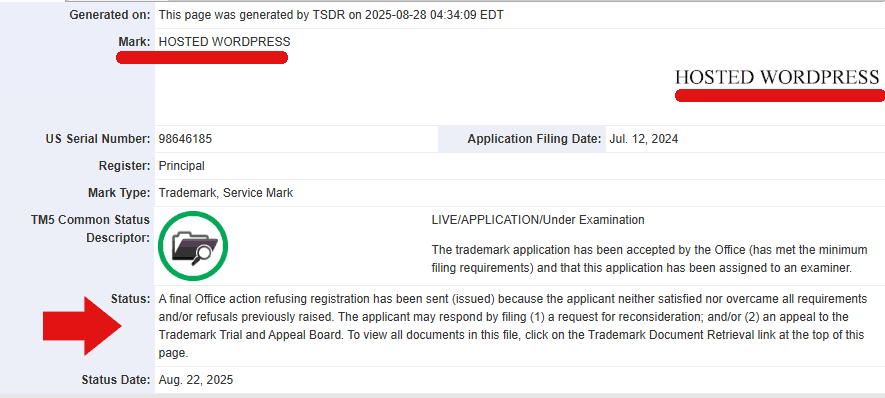
The Trademark Office published the following notice for the “Hosted WordPress” trademark application:
“A final Office action refusing registration has been sent (issued) because the applicant neither satisfied nor overcame all requirements and/or refusals previously raised….
SUMMARY OF ISSUES MADE FINAL that applicant must address:
• Disclaimer Requirement
• Identification of Goods and Services
• Applicant Domicile Requirement
DISCLAIMER REQUIREMENT Applicant must disclaim the wording ‘MANAGED’ because it is merely descriptive of an ingredient, quality, characteristic, function, feature, purpose, or use of applicant’s goods and services….
Applicant may respond by submitting a disclaimer in the following format: No claim is made to the exclusive right to use ‘MANAGED’ apart from the mark as shown.”
Screenshot of Document Close-Up
Description Of Goods And Services Vague And Overly Broad
The USPTO also found that the WordPress Foundation’s description of goods and services is too vague and overly broad, especially regarding the phrase “website development software,” and asks them to clarify whether it is downloadable (Class 9) or offered as online services (Class 42). The USPTO suggested acceptable wording that they can adopt, as long as it accurately reflects what they provide.
Response To Managed WordPress Trademark Application
The Trademark Office also issued the following response for the trademark application for Managed WordPress:
“DISCLAIMER REQUIREMENT Applicant must disclaim the wording ‘MANAGED’ because it is merely descriptive of an ingredient, quality, characteristic, function, feature, purpose, or use of applicant’s goods and services…. Applicant may respond by submitting a disclaimer in the following format:
No claim is made to the exclusive right to use ‘MANAGED’ apart from the mark as shown.”
The Process Is Not Over
The WordPress Foundation is continuing its efforts to obtain trademarks for both “Managed WordPress” and “Hosted WordPress.” It has filed a Request for Reconsideration after Final Action for each trademark application, which asks the USPTO to reconsider its refusals based on amendments, arguments, or evidence. These requests are a final procedural step before an appeal, although they are not themselves appeals.
Traditional keyword-driven search engine results pages (SERPs) are being disrupted by AI-driven experiences that anticipate, summarize, and even act on users’ needs.
As generative AI tools like Google’s AI Overviews and platforms such as Perplexity become more prominent in the Search journey, the marketer’s task expands: It’s no longer just about ranking well on Google but being visible wherever decisions begin.
For multilocation businesses, this presents both a challenge and an opportunity. AI is flattening the competitive playing field, restructuring what influences purchasing decisions, and automating formerly human-led interactions.
Here are four key takeaways to help local marketers understand what’s changing, what strategies are needed right now, and what the future holds.
Strategy 1. You Must Navigate Google’s AI-First Search Experience To Stay Visible
Google’s inclusion of AI Overviews has introduced an entirely new kind of SERP.
These AI-generated summaries often sit atop the page, pushing traditional blue links down. Unlike the 10-blue-link layout of old, AI Overviews synthesize answers across sources, citing a few but effectively removing the need to click.
What To Look For, Learn About & Incorporate
Google’s AI Mode, now available as a Labs experiment, prioritizes user intent by stitching together information to answer nuanced queries (e.g., “best affordable Thai near me for a date”) into a conversational response.
Structured data or map pack signals alone do not supply enough context to be recognized in a modern AI-first search experience.
Strategy 2. Adopt An Enterprise-To-Local Strategy To Capture Both Informational & Local Intent
DAC’s study of over 700 real SERPs across four major verticals (Apparel, Auto Services, Financial Services & Insurance, and Home Services) revealed a clear divergence between the kinds of queries that trigger AI Overviews (AIOs) and those that surface the traditional Maps Pack.
Only 1% of queries triggered both features in the same SERP. When both appeared, the AIO came first, pushing the Maps Pack below the fold.
What To Look For, Learn About & Incorporate
AIOs dominate informational queries, while Maps Packs dominate transactional or locational ones:
Queries beginning with question words (“how,” “why,” “what”) triggered AIOs 28% of the time, but Maps Packs <1%.
“Near me” queries triggered Maps Packs 100% of the time and never triggered an AIO.
Pluralized terms (e.g., “jackets”) were more likely to trigger AIOs than singular or specific terms.
Marketers, especially those managing multilocation brands, need a bifurcated strategy:
Create localized landing pages with clear CTAs and schema markup.
Use local backlinks and citations to build trust.
Strategy 3. Gain Visibility In Alternate Search Experiences With A Distributed Content Footprint
Many users, especially younger generations, are increasingly bypassing traditional search engines altogether.
Inject your brand into new channels and open your windows and doors to complete visibility.
Perplexity AI has seen a remarkable rise in adoption, with around 22 million monthly active users in 2025, positioning it as a major alternative search platform.
Perplexity can geolocate the user and surface locally-relevant searches through its own web crawling, but also offers specific Local Search functionality that is enriched by a Yelp integration, and a restaurant booking capability that integrates with OpenTable – highlighting the importance of strong business listing data partnerships for any AI-based search that wishes to challenge Google’s dominance.
Reddit has become a trusted resource for recommendations, given the importance consumers are placing on social proof. Reddit commands strong loyalty among younger users, with over 70% of its user base being Millennials or Gen Z.
Its long-lasting content delivers value over time; 34% of Reddit posts continue to be viewed more than a year after posting. While Reddit does not offer an explicitly local search function, local business discovery is discussion-based.
Local content can be prioritized in the interface through the user’s geolocation, and explicitly local subreddits (e.g., r/Vancouver) can become forums for brands to build authentic connections with local customers.
TikTok is also a strong contender. A 2024 Adobe study revealed that 64% of Gen Z and 49% of Millennials have used TikTok as a search engine. While TikTok does not provide a maps-based search, its “Nearby” feed supports the discovery of content posted by local creators.
TikTok is currently testing an experimental feature that will place user-generated reviews into the Comments section when a place or local business has been tagged in the content.
In this way, TikTok can support local brand discovery through a blend of metadata, location tagging, and algorithmic signals. TikTok’s rapidly evolving paid search capabilities also support geotargeting as granularly as the zip code level.
The generational differences in Search behavior are clear. Gen Z often turns to TikTok and Reddit for inspiration and discovery rather than Google.
Millennials blend traditional, AI-assisted, and visual search, while Gen X and Boomers still lean toward Google, though they’re increasingly open to AI-generated summaries.
What To Look For, Learn About & Incorporate
To reach these diverse platforms and audiences requires tailored content. Video-first assets optimized for TikTok, Reels, and YouTube cater well to short-form, visual-first consumption.
On forums such as Reddit and Quora, building textual credibility through authentic, conversational answers is key.
Pinterest thrives on visuals and moodboards, while FAQs, how-to guides, and structured content (with schema markup) are crucial for AI engines that reward clear, structured information.
In this evolving landscape, marketers must build a distributed content footprint to ensure a presence wherever people are searching, and where AI tools may source it.
As AI platforms increasingly summarize content from various social and community channels, your brand’s participation in those discussions becomes essential, not just for visibility, but to be cited accurately.
Strategy 4. Prepare For The Future Of Agentic Local Search
We are entering the agentic era, where users don’t just search, they delegate.
Google’s experimental “Call with AI” feature allows users to let an AI assistant call local businesses on their behalf. This transforms search from a real-time human task into an asynchronous agentic process.
What To Look For, Learn About & Incorporate
Key Impacts:
Proximity matters less: If AI finds a better deal 20 minutes away, you may be willing to make the trip
Price pressure increases: Transparent price comparisons and AI-led negotiations could initiate a race to the bottom
“Vibes” matter less: Warm greetings won’t influence the AI. Decision-making shifts from emotional to transactional.
Big brands lose leverage: Without human biases for logos or familiarity, small businesses can compete if they meet the decision criteria
Operational Challenges
Call volume may spike, but call value drops; your business could receive 100 AI-generated inquiries while winning only a few sales.
Unanswered calls = lost sale. AI agents will move on quickly if a call goes unanswered.
Scalability issues: AI can contact 100 businesses in seconds. Human-staffed phones can’t scale similarly.
Long-Term Adjustments
Structured pricing data must be public and machine-readable.
Agent-to-agent negotiation will require new infrastructure, with bots communicating with each other to confirm inventory and schedule appointments.
Local search becomes asynchronous: Agents might initiate requests at midnight and complete transactions during business hours, with no human involved.
Evolving Local Search, Enduring Foundations
There has been a seismic shift in how users discover brands and make decisions.
Businesses, especially multilocation enterprises, must adapt to a new hybrid model where visibility is dictated by both informational depth and local precision.
What’s Changing:
AI reshapes SERPs: Google’s AI Overviews and AI Mode prioritize synthesized answers and intent-matching over clickable links, reducing organic link visibility.
Query types split visibility paths: Informational queries are now more likely to trigger AI Overviews, while transactional/local queries still favor Maps Packs; rarely do both appear together.
New platforms drive discovery: Reddit, TikTok, Perplexity, and Pinterest are no longer fringe sources – they are now primary discovery tools for younger generations.
Agentic search emerges: Users increasingly delegate tasks to AI (e.g., “Call with AI”), reshaping search from human-led interactions into asynchronous, bot-to-bot transactions.
Operational pressure increases: Businesses must prepare for surges in AI-driven interactions, increased price competition, and reduced influence of brand familiarity or emotional cues.
What’s Staying The Same:
Relevance and trust still rule: Google’s EEAT ranking principles remain crucial for AI visibility.
Local optimization is still vital: For transactional/local intent, the Maps Pack remains dominant. Accurate business listings, reviews, and structured local content continue to impact discoverability.
Content matters: Informational, structured, and platform-tailored content remains the cornerstone of any successful visibility strategy, only now must it live across multiple channels and formats.
Brand credibility drives citations: AI systems rely on trustworthy sources, so being the “answer” in AIOs or Perplexity depends on being referenced as a reputable, visible voice across the web.
To thrive in this transformed landscape, marketers must double down on creating a distributed content footprint, intent-driven optimization, andtechnical readiness for AI delegation, while still leaning on the fundamentals of trust, relevance, and local authority.
At DAC, we help brands thrive in this complexity with strategies that balanceinformational depth, local precision, and future-ready adaptability. Our recent analysis of700+ SERPs across four major industriesreveals how AI Overviews and Maps Packs divide visibility and what multilocation brands must do to capture both.
If you’re ready to turn today’s search disruption into tomorrow’s growth, get the full insights in our new whitepaper.
Google Says GSC Sitemap Uploads Don’t Guarantee Immediate Crawls via @sejournal, @martinibuster
Google’s John Mueller answered a question about how many sitemaps to upload, and then said there are no guarantees that any of the URLs will be crawled right away.
A member of the r/TechSEO community on Reddit asked if it’s enough to upload the main sitemap.xml file, which then links to the more granular sitemaps. What prompted the question was their concern over recently changing their website page slugs (URL file names).
That person asked:
“I submitted “sitemap.xml” to Google Search Console, is this sufficient or do I also need to submit page-sitemap.xml and sitemap-misc.xml as separate entries for it to work? I recently changed my website’s page slugs, how long will it take for Google Search Console to consider the sitemap”
Mueller responded that uploading the sitemap index file (sitemap.xml) was enough and that Google would proceed from there. He also shared that it wasn’t necessary to upload the individual granular sitemaps.
What was of special interest were his comments indicating that uploading sitemaps didn’t “guarantee” that all the URLs would be crawled and that there is no set time for when Googlebot would crawl the sitemap URLs. He also suggested using the Inspect URL tool.
He shared:
“You can submit the individual ones, but you don’t really need to. Also, sitemaps don’t guarantee that everything is recrawled immediately + there’s no specific time for recrawling. For individual pages, I’d use the inspect URL tool and submit them (in addition to sitemaps).”
Is There Value In Uploading All Sitemaps?
According to John Mueller, it’s enough to upload the index sitemap file. However, from our side of the Search Console, I think most people would agree that it’s better not to leave it to chance that Google will or will not crawl a URL. For that reason, SEOs may decide it’s reassuring to go ahead and upload all sitemaps that contain the changed URLs.
The URL Inspection tool is a solid approach because it enables SEOs to request crawling for a specific URL. The downside of the tool is that you can only request this for one URL at a time. Google’s URL Inspection tool does not support bulk URL submissions for indexing.
LinkedIn Study: Professionals Trust Their Networks Over AI & Search via @sejournal, @MattGSouthern
LinkedIn reports that professionals are more likely to seek workplace advice from people they know than from AI tools or search engines.
A new LinkedIn study finds that 43% turn to their networks first, with nearly two-thirds saying colleagues help them decide faster and with more confidence.
Key Findings
LinkedIn’s research indicates that professional networks rank ahead of AI and search for advice at work, with 43% naming their network as the first stop.
Sixty-four percent say colleagues improve the quality and speed of decision-making. The study also notes an 82% rise in posts about feeling overwhelmed or navigating change, suggesting that people are looking for clarity from trusted human voices.
Pressure To Learn AI
Learning about AI is causing stress for many people. Over half (51%) say upskilling feels like a second job, 33% feel embarrassed about their knowledge, and 35% feel nervous discussing AI at work.
Additionally, 41% say the fast pace of AI changes affects their well-being. Younger workers, especially Gen Z, are more likely to exaggerate their AI skills compared to Gen X.
Among those aged 18 to 24, 75% believe AI cannot replace the intuition from trusted colleagues. This aligns with the finding that people prefer advice from known experts, especially when the stakes are high.
Implications For B2B Buying And Marketing
The study shows that 77% of B2B marketing leaders say audiences rely on both a company’s channels and their professional networks. Millennials and Gen Z now represent 71% of B2B buyers, leading marketers to invest in trusted individuals within those networks.
Eighty percent of marketers plan to increase spending on community-driven content featuring creators, employees, and experts. They believe that trusted creators are key to building credibility with younger buyers.
This highlights that social discovery and community participation matter as much as search rankings. Content that’s easy to share and linked to recognized experts may reach more people than generic brand messages.
Why This Matters
As professionals turn to their networks for advice, you may need to adjust how you build trust and generate demand.
You can do this by encouraging your employees to share messages, working with trusted creators, and creating expert-led content that’s easy to find on social media.
While traditional SEO and paid ads still matter, networks can affect how people find, discuss, and validate your content before they visit your website.
Looking Ahead
As more people use AI, professionals are learning to combine new tools with their own judgment. Marketers can gain lasting benefits by focusing on building real relationships, rather than just mastering AI tools.
Methodology
The findings are based on research commissioned by LinkedIn and conducted by Censuswide. The study included 19,268 professionals and 7,000 B2B marketers from 14 countries, conducted from July 3 to July 15, 2025.
The percentages and program details mentioned above are taken directly from LinkedIn’s pressroom post.