Google Brings Loyalty Offerings To Merchant Retailers via @sejournal, @brookeosmundson
Google has announced a new set of Merchant loyalty offerings, giving retailers a way to surface existing member perks.
Retailers who have loyalty offerings to their customers, such exclusive pricing, shipping, and points, can now show across both free listings and paid Shopping ads.
In addition to the loyalty offering, Google Ads is introducing a new loyalty goal to help brands optimize toward higher-value customers rather than focusing purely on short-term clicks.
The move, which officially launched on August 26, 2025, signals Google’s deeper investment in connecting retention strategies with its commerce ecosystem.
For retailers already managing robust loyalty programs, this rollout could be an opportunity to strengthen visibility and attract repeat shoppers directly within Google surfaces.
What is the New Loyalty Offering?
Merchant Center retailers can now activate a loyalty add-on within Merchant Center to display member benefits in Google Shopping results.
This includes member-only pricing, shipping perks, or points. This can appear across Search, the Shopping tab, free listings, as well as Wallet.
To go along with this loyalty offering, Google Ads is now offering a loyalty goal.
This gives advertisers the ability to steer Smart Bidding toward audiences with a higher lifetime value. This means campaign optimization shifts from a narrow one-time transaction focus to a longer-term view that considers repeat purchases and retention.
Where do Loyalty Perks Show Up?
Loyalty benefits can now appear across multiple touchpoints. Shoppers may see a member price next to the standard price or a shipping perk highlighted in listings.
Image credit: Google Ads, August 2025
In the United States, retailers using Customer Match can show personalized loyalty annotations to identified members.
Google also allows member pricing to appear for unknown members in the U.S. and Australia, with more countries currently in beta testing.
This shift makes loyalty more visible during product research and comparison, when shoppers are deciding where to buy.
Who Can Take Advantage of Loyalty Offerings?
The program is currently available in the U.S., U.K., Germany, France, and Australia. Merchants must have an existing loyalty program and enable the loyalty add-on within Merchant Center.
To qualify, member pricing discounts must be at least 5% off or five units of local currency. Only national-level loyalty pricing is supported, and if a site-wide promotion is running, that will override any member pricing in ads.
Importantly, retailers need to use the dedicated “loyalty_program” attribute in their product feed. This supplies details like:
Member price
Points
Shipping benefits
Other member perks.
Google requires consistency between submitted feed data and what appears on-site.
Customer Match is required to show known-member personalization in ads within the U.S. Google is also piloting its use in free listings.
How do Retailers Get Started?
Retailers should begin by enabling the loyalty add-on in Merchant Center. Membership tiers and benefits must be clearly defined.
Feeds should be updated with the correct “loyalty_program” attributes. Customer Match lists need to be uploaded and kept current to unlock personalization for U.S. shoppers.
From there, testing the new loyalty goal in Google Ads will be key. Advertisers should compare performance against other bid strategies and review Merchant Center’s loyalty reporting to measure impact.
Highlighting Membership Value
Google’s loyalty features give retailers new ways to highlight membership value where it matters most: at the point of discovery. By surfacing perks in Search and Shopping, brands can differentiate themselves before the click.
The addition of a loyalty goal also encourages smarter optimization. Campaigns can focus not just on conversion volume but on the quality and long-term value of customers.
For retailers with established loyalty programs, this rollout is worth exploring now. It connects retention strategies with acquisition in a way that could drive measurable impact.
What To Do When the Click Disappears: Surviving SEO In The AI-Driven SERP via @sejournal, @AdamHeitzman
You may have noticed your organic traffic looking different lately. Rankings fluctuate wildly, your content appears in AI summaries one week and vanishes the next, and users are increasingly getting their answers without ever visiting your website.
When 58.5% of searches end without a click, that carefully optimized content you spent weeks perfecting might be feeding AI answers instead of driving traffic to your site.
We’re witnessing the biggest shift in search since Google’s early days. Traditional SEO tactics aren’t enough anymore.
You need a strategy that works when AI systems become the middleman between your content and your audience.
The New Search Reality: AI Is Eating Your Clicks
Let’s be honest about what’s happening.
Google’s AI Overviews now appear for over 11% of all searches according to BrightEdge research, pulling information from multiple sources to create comprehensive answers above your organic results. Users get what they need without clicking through.
But, it’s not just Google. Perplexity processes over 780 million searches monthly, while ChatGPT’s browsing feature handles complex queries that users used to need multiple website visits to answer.
Your Content Is Working, Just Not How You Expected
Here’s what’s particularly frustrating: Your content is often powering these AI responses, but you’re not getting credit or traffic for it.
Search for [email automation] on Google and you’ll see a comprehensive AI Overview that defines the concept, explains how it works in four detailed steps, lists benefits, provides examples, and even mentions specific tools like ActiveCampaign and Mailchimp.
This response synthesizes information from multiple sources into one complete answer that eliminates the need to visit any individual website.
The user gets a definition, step-by-step process, benefits, examples, and tool recommendations all in one place.
Meanwhile, the original content creators who researched and wrote about email automation triggers, personalization strategies, and platform comparisons see their expertise repackaged without receiving the traffic they would have earned from traditional search results.
Screenshot from search for [email automation], Google, July 2025
This is the new normal. Voice search and conversational AI are training users to expect complete answers, not blue links to explore.
Zero-click searches aren’t killing SEO; they’re evolving it. Your content needs to work harder in this new environment.
What Marketers Need To Rethink
Forget everything you know about traditional SEO success metrics. The game has fundamentally changed.
Shift Your Focus: From Rankings To Mentions
That coveted No. 1 ranking? While still valuable, it’s becoming less reliable for driving traffic when AI systems deliver answers directly to users.
Rankings still matter, especially for commercial queries where users want to browse options. But, for informational searches where users seek quick answers, your content’s value now extends beyond its position in organic results.
Think about it this way: When someone asks ChatGPT or Google AI Mode about your industry, does your brand get mentioned? That’s your new battleground.
Your New Success Metrics
Instead of obsessing over click-through rates, you need to start tracking metrics that capture AI influence on your brand:
Brand mentions in AI responses across platforms tell you whether your content is being cited and referenced.
Branded search volume spikes often follow AI feature appearances.
Conversion assists where organic search was part of the user’s journey but not the final touchpoint.
Customer surveys asking, “How did you hear about us?” reveal AI influence that analytics can’t capture.
I’ve seen clients with flat traffic numbers but 200% increases in brand mentions in AI responses. That’s invisible growth that traditional analytics miss entirely.
Practical Strategies That Work
Here’s how to adapt your SEO approach for AI-powered search. These are strategies I’ve tested with clients across different industries.
Make Your Content AI-Friendly
The most important shift you can make is structuring your content for AI comprehension.
Place your main answer within the first one to two sentences of any piece of content. Think of it like writing a news article where the lead paragraph contains all the crucial information.
If someone asks, “What are the benefits of meditation?” your opening should be, “Meditation reduces stress, improves focus, and enhances emotional well-being through regular practice.” Then expand with details, examples, and supporting evidence.
Look at this great example from NerdWallet:
Screenshot from NerdWallet, July 2025
This approach serves both human readers who want quick answers and AI systems that prioritize clear, immediate responses. When Google’s AI Overview or ChatGPT pulls from your content, that opening statement becomes your brand’s voice in the answer.
I’ve seen this strategy increase AI citation rates by 40% for clients who consistently implement it.
Key formatting strategies that work:
Structured formats: Transform dense paragraphs into FAQs, numbered lists, and tables that AI can easily parse.
Clear headings: Create content hierarchy with H2 and H3 headings that AI can follow.
A well-structured FAQ section doesn’t just help users. It becomes a goldmine for AI systems looking for clear question-answer pairs.
Consider transforming complex pricing information into tables rather than burying details in lengthy paragraphs.
Build Citation-Worthy Authority
Creating content that AI systems want to reference requires a fundamental shift from aggregating existing information to generating original insights.
Publish studies, proprietary data, and exclusive interviews that can only come from your organization.
LLMs prioritize original sources over aggregated information, making your research significantly more likely to be cited and attributed.
Instead of stating facts directly, frame them as insights from your organization. “According to our research at [Company Name]” or “Based on our analysis of 10,000 customer surveys” signals to AI systems that the information comes from a specific, credible source.
This technique helps ensure that when LLMs pull information from your content, they’re more likely to include your brand name in the response.
If you’re in the gardening space, don’t just write one article about composting. Create a comprehensive resource covering composting basics, troubleshooting common problems, seasonal considerations, and advanced techniques, then link these pieces together strategically.
This clustering approach works because LLMs assess credibility partly based on depth and breadth of coverage.
Sites that demonstrate comprehensive knowledge on topics are more likely to be seen as authoritative sources worth citing.
I’ve watched brands jump from occasional mentions to consistent AI citations by implementing this strategy over six to 12 months.
Diversify Beyond Traditional Search
Don’t put all your eggs in the Google basket. AI systems pull information from diverse sources, and expanding your content distribution increases your chances of being included in LLM training data and responses.
Recent research from Ahrefs analyzing 78.6 million AI responses across Google AI Overviews, ChatGPT, and Perplexity reveals which platforms get cited most frequently.
The data shows clear patterns in what each AI system prefers to reference.
Platforms worth prioritizing based on AI citation data:
YouTube: Dominates Perplexity citations (16.1% mention share) and ranks high in AI Overviews (9.5%), making video content crucial for AI visibility.
Reddit: Heavily favored by Google AI Overviews (7.4% mention share) but absent from ChatGPT and Perplexity’s top citations.
News and industry publications: ChatGPT shows a strong preference for news outlets like Reuters and Apple News, making media coverage valuable.
Wikipedia: Leads citations across all three platforms, emphasizing the importance of having your brand or expertise documented on authoritative reference sites.
The research reveals that different AI systems have distinct preferences.
Google’s AI Overviews favor user-generated content from Reddit and Quora, while ChatGPT prioritizes news sources and authoritative publications.
Perplexity shows the strongest preference for YouTube content alongside Wikipedia.
Each platform has its own content style and audience, so adapt your messaging accordingly.
A LinkedIn post about industry trends might become a source for business-related AI responses, while a YouTube video explanation could be referenced for educational queries.
The key is maintaining consistent expertise and messaging across all channels.
Testing your content directly in different AI platforms gives you immediate feedback on how it’s being interpreted and used.
Ask ChatGPT questions related to your expertise and see if your content appears in the responses. Query Perplexity about industry topics you’ve covered.
This direct testing helps you understand how different AI systems process and present your information, allowing you to refine your approach based on real results.
Measuring Success In A Post-Click World
Traditional metrics aren’t telling the whole story anymore, and honestly, this is where most marketers struggle with the transition to AI-era SEO.
You’re used to clear, quantifiable metrics like organic traffic and click-through rates. Now you need to track influence that often happens without any direct interaction with your website.
Track AI Visibility Across Platforms
Start by monitoring featured snippets and AI Overview inclusions. These placements often indicate that AI systems are pulling from your content, even if they don’t generate the clicks you’re used to seeing.
Set up alerts for when your content gets featured because these appearances frequently correlate with increases in branded search volume and direct traffic.
Check if your brand appears when users ask AI tools about your industry. Search for your company name in ChatGPT, Perplexity, and Google’s AI Overview to see how you’re being represented.
You might discover that your brand is being mentioned in contexts you didn’t expect, giving you insights into how AI systems perceive your authority.
Social media monitoring becomes more important in this landscape because people often discuss insights they learned from AI summaries.
Set up tracking for mentions where people reference concepts or data points that originally came from your content, even if they don’t directly cite your brand.
These conversations indicate that your content is influencing discussions, even when traditional attribution models miss the connection.
Attribution Modeling For Invisible Influence
The challenge with zero-click searches is that they force you to rethink how you measure content success.
A user might read your advice in an AI summary today, then visit your site directly next week after remembering your brand name. Traditional last-click attribution completely misses this connection, making your SEO efforts appear less valuable than they actually are.
Implement first-touch attribution models that credit SEO for starting customer journeys, even when other channels complete the conversion.
Survey your new customers about how they first discovered your brand, and you’ll often find they mention seeing your content in search results or AI responses weeks before converting. This qualitative data fills in gaps that analytics can’t capture.
Look for patterns where direct traffic increases after your content gets featured in AI responses. Create custom UTM parameters for content that frequently appears in AI summaries.
While you can’t track every citation, you can identify trends in how AI-discovered content influences broader marketing performance.
Watch for increases in newsletter signups, demo requests, or branded searches following AI feature appearances.
Google Analytics 4’s attribution modeling can help you understand these multitouch journeys better than previous versions. Configure it to show conversion assists where organic search was part of the user’s path but not the final touchpoint.
This reveals the true value of your SEO efforts in an environment where direct attribution becomes increasingly difficult.
Tools And Techniques For Modern Measurement
SparkToro helps you understand where your audience discovers content and which sources they trust.
Use it to identify if your brand is being mentioned in the same contexts as industry leaders, indicating you’re gaining mindshare even without direct clicks.
This competitive intelligence reveals whether your AI strategy is working compared to others in your space.
Beyond traditional tools, create a systematic monitoring approach using multiple AI platforms.
Set up monthly checks to see if your citation frequency is increasing and which topics generate the most AI references.
Document examples of how your content gets referenced and summarized to understand what formats work best.
Remember that influence in AI responses often correlates with long-term brand growth, even if immediate traffic metrics look flat.
While comprehensive research on AI citation impact is still emerging, the pattern mirrors what we’ve seen with other “zero-click” features like featured snippets, brand exposure through authoritative citations can drive awareness and consideration that results in direct searches and conversions over time.
The key is connecting these invisible influences to eventual business outcomes.
Building Long-Term Resilience In An AI-First World
The brands that thrive in this new landscape will not just adapt to current changes.
They will anticipate what comes next and build systems that can weather the unprecedented volatility that AI-powered search brings.
Prepare For AI Volatility
Traditional core Google algorithm updates happen a few times per year and usually follow predictable patterns.
With each model update, LLMs can change their behavior, creating unprecedented volatility in search visibility that most SEO professionals haven’t experienced before.
Your content might appear in ChatGPT responses one week and disappear the next. This isn’t a bug or a penalty. It’s how LLMs work.
They constantly learn and adjust their understanding of what constitutes authoritative information based on new training data and updated models.
Instead of panicking over daily fluctuations, track broader patterns in brand mentions, branded search volume, and conversion trends.
These metrics provide more stable indicators of your content’s impact than individual AI citations, which can vary significantly based on model updates and algorithmic adjustments.
Your brand needs to be what I call “retypeable,” the kind of name people remember and search for when they’re ready to take action.
When users encounter your brand in an AI summary, they should immediately associate it with your core value proposition and remember it later when they’re ready to engage.
Build Flexible Systems
Set up processes to review and refresh your most important pages quarterly.
LLMs prioritize current information more heavily than traditional search engines, so maintaining content freshness becomes critical for sustained AI visibility.
Develop relationships with other authoritative sources in your industry through collaborations, partnerships, and cross-references.
The more your brand appears in connection with recognized authorities, the stronger your credibility signals become for AI systems.
These relationships create natural mentions across different content formats and platforms that extend beyond what you can control directly.
The Future Of SEO Is About Influence, Not Clicks
The shift to AI-powered search is changing not just how people find information but also how brands build authority and trust.
Companies that recognize this early and adapt their strategies accordingly will own the conversation in their industries, while others struggle to understand why their traditional SEO efforts aren’t delivering the same results.
Your content is still working. It’s influencing decisions, building brand awareness, and driving conversions.
You just need new ways to measure and optimize for its impact in an environment where visibility doesn’t always equal clicks, but influence still equals business growth.
Closing The Digital Performance Gap: Why The C-Suite Must Take Web Effectiveness Seriously via @sejournal, @billhunt
Over the years, I’ve worked with numerous companies that engaged me to create world-class Search organizations and win the global search game, only to block the majority of the initiatives required to achieve that goal. This disconnect often stems from how the C-suite perceives its website.
In too many boardrooms, the site is still seen as a digital brochure and an expense managed by marketing, with limited scrutiny or strategic oversight. Yet, that same site touches nearly every phase of the customer journey, investor perception, partner evaluation, and talent acquisition.
This article brings those ideas together under a single call to action: It’s time for executive leadership to own web performance as a measurable, managed business function.
What Is The Digital Performance Gap?
The Digital Performance Gap is the measurable distance between your online potential and actual business outcomes. Most companies are leaking performance through misaligned teams, disconnected key performance indicators (KPIs), outdated platforms, or siloed operations.
Symptoms include:
Underwhelming organic traffic and conversions.
Disconnected websites across departments or geographies.
Content that ranks but doesn’t convert (or worse, can’t even be found).
Slow responsiveness to AI shifts and platform changes.
Tools and vendors operating without return on investment (ROI) oversight.
In short: You’re paying for a Ferrari and driving it like a lawnmower.
From Pit Crew To Performance System: A Better Analogy
Imagine you’re the owner of an F1 racing team. You’ve got the budget, the ambition, and a roster of great people – from engineers to mechanics to a world-class driver.
However, the engine design was handled by a team that never consulted with the race strategist. Your telemetry data doesn’t reach the pit wall. The car is fast in theory, but coordination is poor, and outcomes are inconsistent.
Sound familiar?
That’s how many enterprise websites operate. Everyone is working hard in their silos. But without integrated planning, shared goals, or clear leadership, the system can’t perform at its full potential.
Web effectiveness isn’t just about the “driver” (e.g., SEO or content teams)—it’s about the entire vehicle and how the organization supports it. And the C-suite? They’re the race directors. When the director doesn’t orchestrate the team, the whole system suffers.
In elite racing, the pit crew doesn’t just change tires. They analyze data, forecast risks, and adapt in real time. Their split-second coordination with the driver wins races. That’s what a web performance system should look like–fully integrated, real-time, and strategically directed.
But instead of this synergy, most digital organizations resemble a collection of vendors and internal teams using different playbooks, judged by different KPIs, and waiting for executive direction that never comes.
You can’t win the race if the engine team is optimizing for safety, the strategist is optimizing for top speed, and the pit crew is trying to meet tire budget KPIs. That’s not cross-functional excellence, it’s cross-functional chaos.
Web Effectiveness Is A Business Metric
Web Effectiveness is the degree to which your digital presence delivers against real business goals.
Relevance (structured content that solves user needs).
Integration (connected to customer relationship management or CRM, data layers, product feeds).
This isn’t marketing fluff. It’s operational excellence.
When no one owns it, everyone loses.
IT may control infrastructure.
Marketing manages messaging.
Sales owns conversion.
Legal redlines half the useful copy.
But no one owns the outcome. That’s a leadership failure.
The High Cost Of No Ownership
When the C-suite doesn’t take web performance seriously, the costs compound:
Visibility declines. You’re outranked by competitors who understand AI’s new rules.
Opportunity evaporates. Valuable search terms go unanswered – or worse, answered by the platforms themselves.
Budgets get wasted. You pay for tools, agencies, and tech that aren’t integrated or even used.
Your story gets told by others. Generative engines summarize what they find. If your content isn’t structured or visible, you’re not even in the conversation.
Even companies that only exist online often fail to fully leverage the very platform that drives their value.
What Executive Ownership Looks Like
Executive ownership doesn’t mean micromanaging metadata – it means ensuring that:
Web outcomes are tied to business KPIs.
Budgeting reflects strategic priority, not departmental silos.
SEO, UX, content, and dev teams are operating under a unified model.
Vendor evaluations include contribution to visibility and performance.
Someone is accountable for closing the performance gap.
Consider creating a Web Effectiveness Center of Excellence or appointing a Digital Effectiveness Officer to champion this mandate.
A Framework For Closing The Gap
To transition from fragmented efforts to strategic impact, organizations require a shared operating model. Here’s a high-level Web Effectiveness Framework:
Governance: Who owns what? Are responsibilities clear?
Visibility: Can search engines and AI systems discover, interpret, and cite your content?
Experience: Are you delivering what users need – on every device, in every format?
Optimization: Are you using the platforms, features, and data you already pay for?
Measurement: Are you tracking impact, not just traffic?
This framework can be scaled across divisions, regions, and lines of business. The key is treating your site not as a brochure, but as your most valuable digital asset.
Final Thought: Time To Step In
Closing the Digital Performance Gap starts with a mindset shift: from cost center to growth platform. From tactical ownership to strategic leadership.
Today’s website is no longer just a reflection of your brand—it is your brand. It’s where customers decide to trust you, where partners evaluate your credibility, and where investors form first impressions. Yet far too often, this central asset is owned by no one, governed by outdated workflows, and limited by KPIs that belong to another era.
Let’s be clear: digital excellence doesn’t happen by accident. It’s the result of intentional alignment between leadership, teams, and technology. And that alignment starts with the C-suite.
CMOs must champion performance and not just promotion. CTOs must prioritize enablement and not just uptime. CEOs must encourage cross-functional alignment, efficiency, speed, agility, and clarity to ensure optimal performance.
Web effectiveness should no longer be framed as a project, initiative, or marketing tactic. It’s a performance system. A business function. A shared responsibility. And if you don’t have someone responsible for web performance at the leadership level, it’s time to create that role. A Digital Effectiveness Officer, a Center of Excellence, or, at a minimum, a cross-functional ownership council that brings visibility, accountability, and forward momentum.
Because here’s the truth: If you don’t own your website’s performance, someone else will define your digital reputation—and capture your audience. Bring web effectiveness into the boardroom. Align your teams. Close the gap.
Perplexity’s Discover Pages Offer A Surprising SEO Insight via @sejournal, @martinibuster
A post on LinkedIn called attention to Perplexity’s content discovery feed called Discover, which generates content on trending news topics. It praised the feed as a positive example of programmatic SEO, although some said that its days in Google’s search results are numbered. Everyone in that discussion believes those pages are one thing. In fact, they are something else entirely.
Context: Perplexity Discover
Perplexity publishes a Discover feed of trending topics. The page is like a portal to the news of the day, featuring short summaries and links to web pages containing the full summary plus links to the original news reporting.
SEOs have noticed that some of those pages are ranking in Google Search, spurring a viral discussion on LinkedIn.
Perplexity Discover And Programmatic SEO
Programmatic SEO is the use of automation to optimize web content and could also apply to scaled content creation. It can be tricky to pull off well and can result in a poor outcome if not.
A LinkedIn post calling attention to the Perplexity AI-generated Discover feed cited it as an example of programmatic SEO “on steroids.”
They wrote:
“For every trending news topic, it automatically creates a public webpage.
These pages are now showing up in Google Search results.
When clicked, users land on a summary + can ask follow-up questions in the chatbot.
…This is such a good Programmatic SEO tactic put on steroids!”
One of the comments in that discussion hailed the Perplexity pages as an example of good programmatic SEO:
“This is a very bold move by Perplexity. Programmatic SEO at scale, backed by trending topics, is a smart way to capture attention and traffic. The key challenge will be sustainability – Google may see this as thin content or adjust algorithms against it. Still, it shows how AI + SEO is evolving faster than expected.”
Another person agreed:
“SEO has been part of their growth strategy since last year, and it works for them quite well”
The rest of the comments praised Perplexity’s SEO as “bold” and “clever” as well as providing “genuine user value.”
But there were also some that predicted that “Google won’t allow this trend…” and that “Google will nerf it in a few weeks…”
The overall sentiment of Perplexity’s implementation of programmatic SEO was positive.
Contrary to what was said in the LinkedIn discussion, Perplexity is not engaging in “programmatic SEO,” nor are they trying to rank in Google.
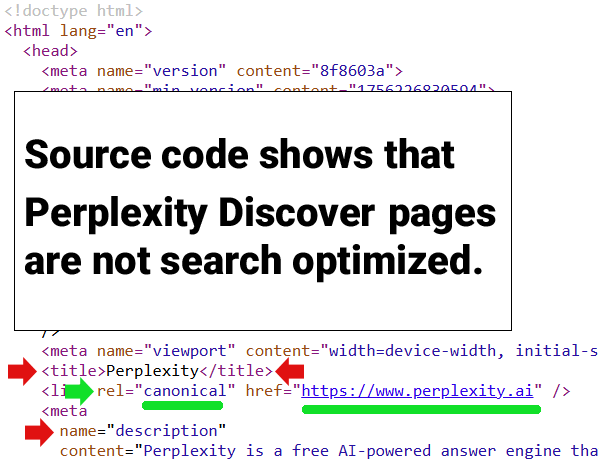
A peek at the source code of any of the Discover pages shows that the title elements and the meta descriptions are not optimized to rank in search engines.
Screenshot Of A Perplexity Discover Web Page
Every single page created by Perplexity appears to have the exact same title and meta description elements:
<title>Perplexity</title>
<meta name=”description” content=”Perplexity is a free AI-powered answer engine that provides accurate, trusted, and real-time answers to any question.”/>
It’s clear that Perplexity’s Discover pages are not optimized for Google Search and that the pages are not created for search engines.
The pages are created for humans.
Given how the Discover pages are not optimized, it’s not a surprise that:
Every page I tested failed to rank in Google Search.
It’s clear that Perplexity is engaged in programmatic SEO.
Perplexity’s Discover pages are not created to rank in Google Search.
Perplexity’s Discover pages are created specifically for humans.
If any pages rank in Google, that’s entirely an accident and not by design.
What Is Perplexity Actually Doing?
Perplexity’s Discover pages are examples of something bigger than SEO. They are web pages created for the benefit of users. The fact that no SEO is applied shows that Perplexity is focused on making the Discover pages destinations that users turn to in order to keep in touch with the events of the day.
Perplexity Discover is a user-first web destination created with zero SEO, likely because the goals are more ambitious than depending on Google for traffic.
The Surprising SEO Insight?
It may well be that a good starting point for creating a website and forming a strategy for promoting it lies outside the SEO sandbox. In my experience, I’ve had success creating and promoting outside the standard SEO framework, because SEO strategies are inherently limited: they have one goal, ranking, and miss out on activities that create popularity.
SEO limits how you can promote a site with arbitrary rules such as:
Don’t obtain links from sites that nofollow their links.
Don’t get links from sites that have low popularity.
Offline promotion doesn’t help your site rank.
And here’s the thing: promoting a site with strategies focused on building brand name recognition with an audience tends to create the kinds of user behavior signals that we know Google is looking for.
Google Wants To Show More Links In AI Mode via @sejournal, @MattGSouthern
Google says it’s actively working to surface more source links inside AI Mode.
Robby Stein, VP of Product for Google Search, outlined changes designed to make links more visible.
Stein wrote on X that Google has been testing where links appear inside AI answers and that the long-term “north star” is to show more inline links.
He added that people are more likely to click when links are embedded with context directly in the response.
Stein stated:
“We’ve been experimenting with how and where to show links in ways that are most helpful to users and sites… our long term north star is to show more inline links.”
1/ Excited about the work the team is doing to create AI experiences in Search that highlight useful links and encourage onward exploration. We’ve been experimenting with how and where to show links in ways that are most helpful to users and sites, and you’ll be seeing some of…
Google has launched carousels that surface multiple source links directly inside AI Mode responses on desktop. Stein said mobile support is coming soon.
The idea is to present links with enough context to help people decide where to go next without hunting below the answer.
2/ We’ve found that people really prefer and are more likely to click links that are embedded within AI Mode responses, when they have more context on what they’re clicking and where they want to dig deeper. We’ve launched embedded link carousels in AI Mode responses on desktop,…
Google is rolling out model updates that decide where inline links appear within the response text.
The system is trained to place links at moments when people are most likely to click out to see where information came from or to learn more.
Stein noted you might see fluctuations over the next few weeks as this is deployed, with a longer-term push toward more inline links overall.
3/ We’re also launching some model updates to improve how we show inline links (links that are embedded directly within text) in AI Mode responses. We train the model to understand where and when people are most likely to want to click out, see where info is coming from and learn…
Separately, Google’s Web Guide experiment uses a custom Gemini model to group useful links by topic.
It launched in Search Labs on the “Web” tab and, for opted-in users, will begin appearing on the main “All” tab when systems determine it could help for a query.
Google introduced Web Guide in July and indicated it would expand beyond the Web tab over time.
4/ We’re also expanding our Web Guide experiment in Labs, which is a new approach to intelligently surfacing and organizing the most useful web links with AI – even for your hardest queries. We’ve gotten some really positive feedback as we’ve tested this on the “Web” tab. So in…
How Google presents links in AI Mode can influence how people reach your site.
Placing carousels within the answer and adjusting inline placements differ from links that appear only below the response. This may change click behavior depending on the query and presentation.
Looking Ahead
Google is trying to strike a balance between innovation and supporting publishers. Expect continued testing around link density, placement, and labeling as Google refines AI mode.
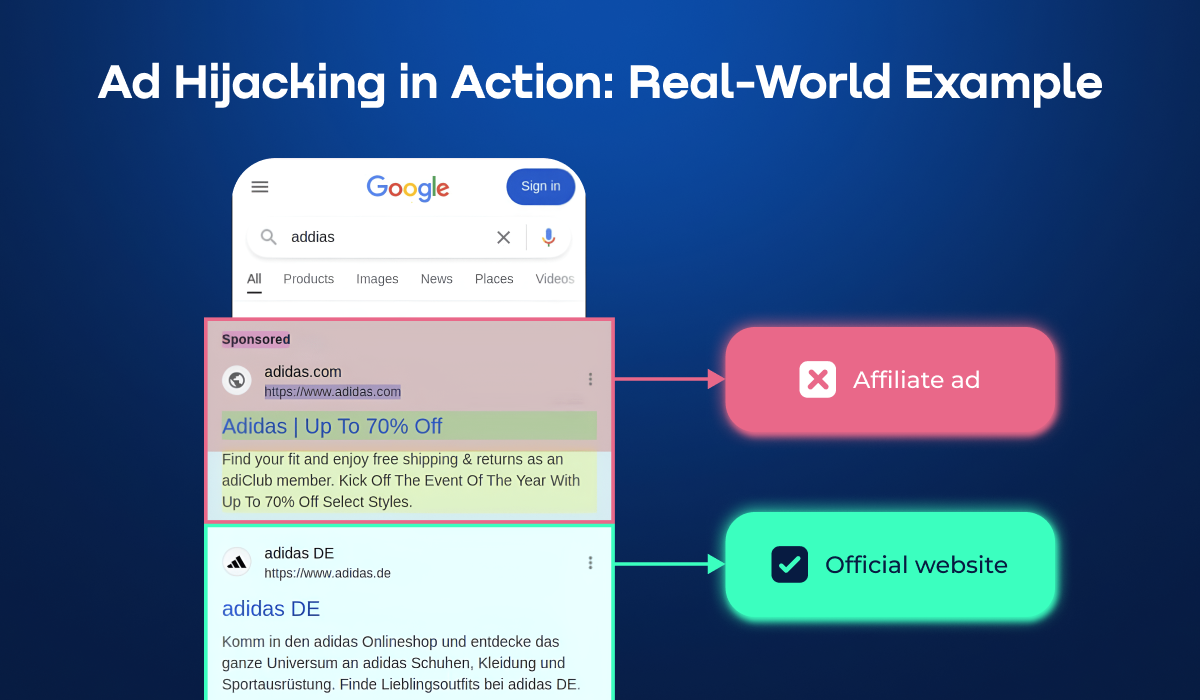
Ad hijacking, by definition, is a form of advertising fraud where someone pretends to be your brand in paid search ads (like Google or other platforms). The fraudsters copy your brand name, your ad style, even your messaging, so the ad looks real.
But when a customer clicks, they’re sent somewhere else.
Image created by Bluepear, August 2025
There are two common types:
Affiliate ad hijacking.
Competitor ad hijacking.
What Is Affiliate Ad Hijacking?
Affiliate ad hijacking happens when partners in your affiliate program bid on your brand name.
They:
copy your ad (same headline, same style) so it looks like the real thing.
The Result: The customer thinks they’re clicking on your official site because the ad looks the same. But behind the scenes, the affiliate redirects the traffic through their own tracking link.
You end up paying them a commission for a customer who was already looking for you. This inflates your costs, pollutes your data, and makes it harder to measure real performance.
Example: A user searches for [Super Tools]. An affiliate runs an ad with the headline “Super Tools Official Site,” but the link is an affiliate redirect. You pay them a cut, even though they didn’t bring in new traffic.
Image created by Bluepear, August 2025
What Is Competitor Ad Hijacking?
Competitor ad hijacking is when a rival company copies your brand in search ads to steal your traffic.
They:
bid on your brand name,
use ad text that looks like yours,
sometimes even mimic your domain.
The Result: Customers click, thinking they’re going to your site. But instead, they land on the competitor’s website.
This tactic lets competitors capture high-intent traffic. As a result, you lose potential sales, while they gain market share. Without PPC brand protection, your brand presence can be weakened, allowing competitors to grow faster at your expense.
Example: A competitor bids on “Super Tools” and runs a lookalike ad. The user clicks, expecting your site, but lands on the competitor’s product page instead. You lose a sale and possibly the customer’s trust.
As you see, search hijacking is already a serious threat to your brand and budget. It’s made even worse by how well the violators hide their tracks.
Secret Tactics That Are Used To Hide Ad Hijacking
Non-compliant partners use smart tactics to avoid being seen by brand owners or their teams. Here’s how they do it:
GEO targeting. Ads are shown only in specific countries, cities, or regions. If you’re not in that area, you’ll never see them – but your local customers will.
Dayparting. Hijackers run ads at night, on weekends, or during holidays when your team is less likely to notice them.
Cloaking and dynamic redirects. They use scripts to show one version of the ad or landing page to Google (to pass review) and a different one to users – usually a fake or affiliate redirect.
Smaller search engines. Many hijackers avoid Google and run campaigns on Bing or other second-tier platforms, where rules are looser and tracking is weaker.
Without proper hijacking prevention, these tactics make it easy for hijackers to hide and hard for your team to catch them in time.
Direct Impact Of Ad Hijacking On Your Company
The impact of affiliate ad hijacking goes far beyond a few stolen clicks. It damages performance, costs money, and creates serious risks for your business:
Lost ad budget. You pay commissions to affiliates who didn’t bring you new traffic; they just hijacked what was already yours.
Higher CPC and more competition. Hijackers bid on your brand keywords, driving up your costs and competing against your own campaigns.
Broken attribution. Without hijacking prevention, your analytics get messy. It becomes harder to measure what’s really working because affiliate hijacking inflates performance data.
Reputation damage. Users may land on shady or misleading pages. They won’t know it’s not your site – they’ll just stop trusting your brand.
Compliance risks. If you’re in a regulated industry (finance, health, etc.), fake ads and unapproved messaging can create legal trouble or policy violations.
Search hijacking doesn’t just hurt your numbers. It makes you question the data you rely on, wastes hours chasing false leads, and forces you to fight for traffic that was already yours.
Image created by Bluepear, August 2025
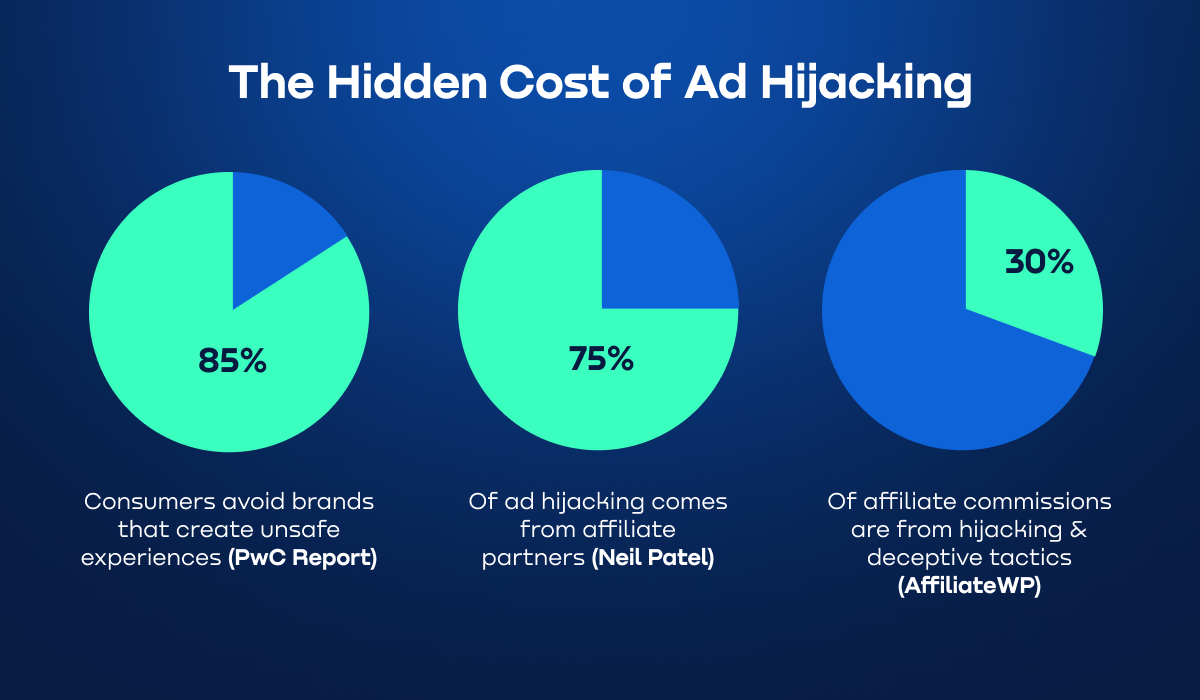
85% of consumers avoid buying from brands that generate unsafe experiences, and ad hijacking falls into that bucket (PwC Report).
75% of ad hijacking comes from affiliate partners exploiting tracking gaps to earn unearned commissions (Neilpatel).
Up to 30% of affiliate commissions come from hijacking and similar deceptive tactics (AffiliateWP).
Ad hijacking caused an estimated $12.6 billion in losses in 2023, based on 15% of the $84 billion lost to ad fraud globally (Juniper Research).
How To Spot And Prevent Ad Hijacking
What actually works on PPC brand protection? To uncover real issues, you need tools and methods that go beyond surface metrics:
Step 1: Quick Manual Checks
Run branded keyword searches and audit SERPs – look for near-identical copy linking to another domain.
Watch for anomalies in performance (CPC spikes, conversion drops, affiliate surges).
Review affiliate conversion patterns – unusual regional spikes may signal fraud.
Geo-test with VPNs or third-party tools to uncover geo-targeted hijacks.
Track impression share – sudden drops without budget changes mean new competition.
Step 2: Scalable Prevention Tactics
Behavioral simulation: Mimic real user searches across devices and browsers to reveal hidden hijacks.
Proof collection: Document ads, redirects, affiliate IDs, and keywords for enforcement.
Real-time alerts & auto takedown: Get notified instantly and stop fraudulent ads before they drain your budget.
By combining manual checks and scalable tools, you can take control before search hijacking quietly eats into your ad spend.
Manual checks can’t keep up with how ad hijacking works today. Hijackers often run ads only in certain regions, at non-working hours, or under specific conditions. They use cloaking and redirects that can’t be detected with regular checks.
Most teams lack the time and capability to ensure hijacking prevention through manual monitoring alone.
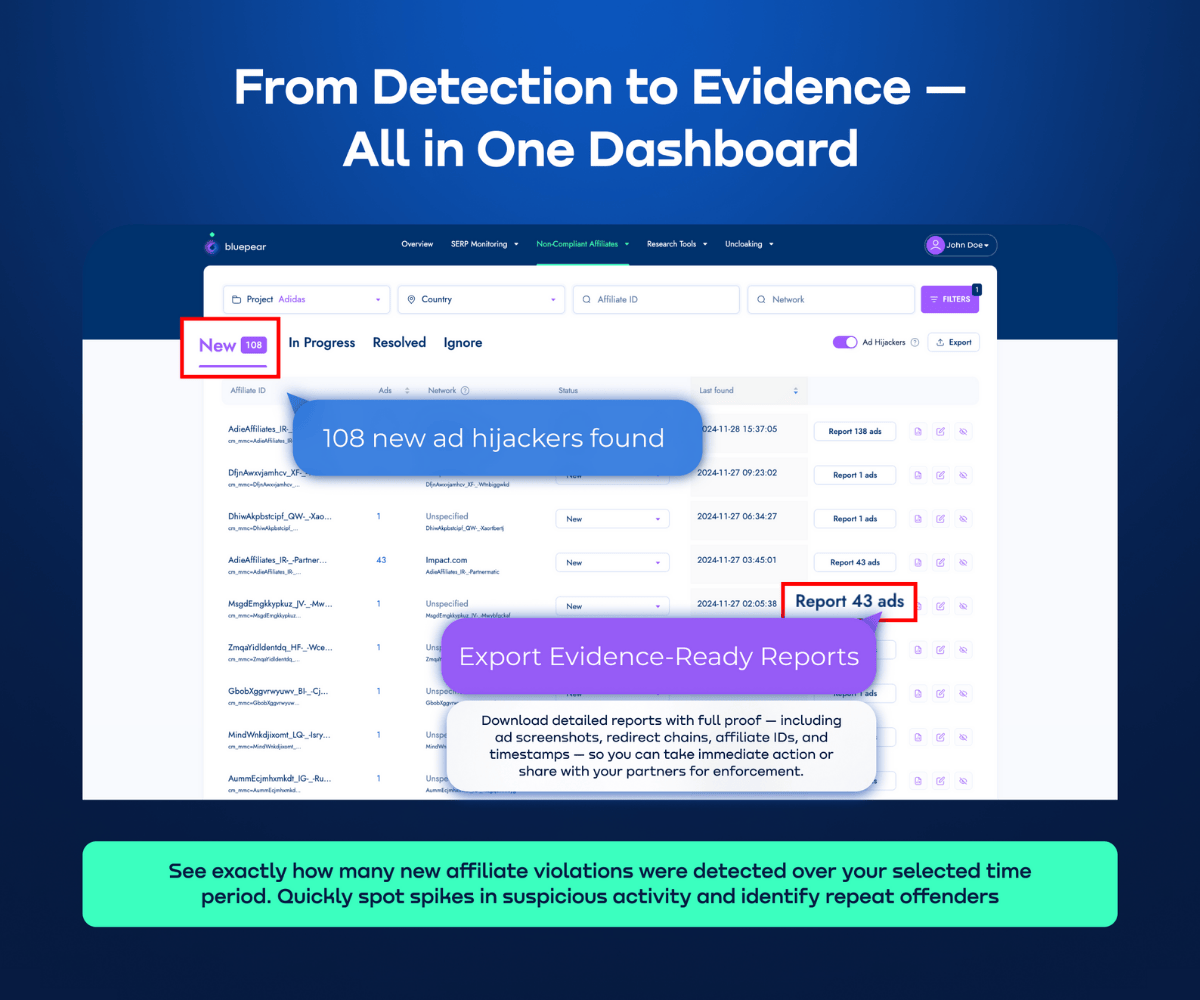
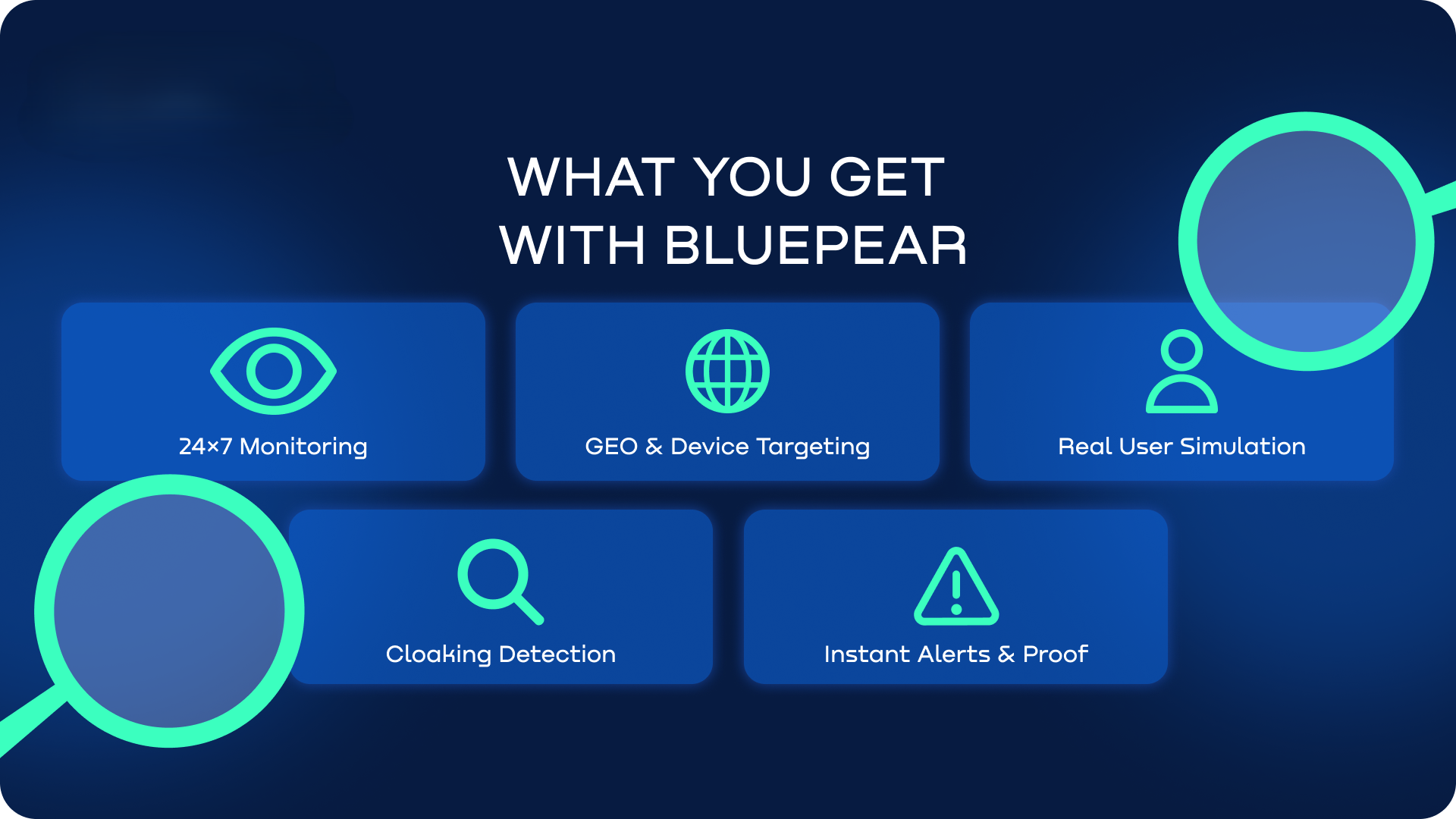
That’s why ad hijacking tools like Bluepear are essential – as PPC brand protection software, they automate continuous scanning of search results to catch every sneaky ad trying to hijack your traffic and budget.
Here’s how Bluepear helps to fight against ad hijacking:
Simulates real user behavior. Bluepear mimics how actual customers search (using different devices, times, and locations) to trigger hidden hijack ads.
Uncovers hidden redirects and de-cloaks landing pages. It follows the full click path to spot when a user is being secretly redirected or sent to a misleading page.
Collects clear evidence. Every violation is logged with full details: screenshots, affiliate IDs, keywords, redirect chains – all in one report.
Sends instant alerts and supports takedowns. When a hijack is detected, you get an alert right away. Bluepear provides clear evidence so that you can remove bad ads fast to stop further damage.
Ad hijacking tools aren’t an excess. If you want to survive in a world of smart fraud, automated PPC brand protection is a must.
Image created by Bluepear, August 2025
Protect Your Brand From Ad Hijacking
Ad hijacking quietly eats into your ad budget, distorts your performance data, and damages user trust. Manual audits rarely catch it. Hijackers use GEO targeting, dayparting, and cloaking to stay hidden while stealing high-intent traffic and commissions.
Are you sure no one is hijacking your branded ads?
Bluepear helps you catch what others miss. The ad hijacking tool automatically checks SERPs from different GEOs, devices, and browsers to keep your brand protected from fraud.
Perplexity Launches Comet Plus, Shares Revenue With Publishers via @sejournal, @MattGSouthern
Perplexity announced Comet Plus, a monthly subscription that pays participating publishers when people read their work and when AI systems use it to answer questions.
The company says subscriber payments go to partners, with a small portion retained to cover compute costs.
How Comet Plus Works
Comet Plus will be available for $5 per month. Existing Perplexity Pro and Max subscribers will have Comet Plus included.
Subscribers get direct access to participating publisher sites, answers informed by those sources, and agent workflows that can complete tasks on those sites. The offering is tied to the Comet browser and assistant.
About Revenue Sharing
Perplexity positions Comet Plus as a compensation model for an AI-centric web.
Publishers are paid for three interaction types:
Human visits
Search citations
Agent actions.
Perplexity’s example of “agent traffic” is Comet Assistant scanning a calendar and suggesting relevant reading from publisher sites.
The idea is to reflect how people now consume information across browsing, AI answers, and agent workflows.
Perplexity wrote:
“Comet Plus is the first compensation model… based on three types of internet traffic: human visits, search citations, and agent actions.”
Availability
Interested publishers can email publishers@perplexity.ai to request to join the program.
Why It Matters
For publishers and marketers, the model expands monetization and measurement beyond traditional clicks.
Websites are testing a range of responses to AI usage of their content, from blocking crawlers to signing licenses.
Comet Plus differs from flat-fee deals by tying payouts to actual user and assistant activity, which could align compensation more closely with real demand.
Looking Ahead
Perplexity says it will announce an initial roster of publishing partners when the Comet browser becomes available to all users for free.
Early adoption, reporting transparency, and real revenue for partners will determine whether this model becomes a viable framework or stays a niche experiment.
ChatGPT Vs. Google At Every Stage Of The User Journey via @sejournal, @Kevin_Indig
Boost your skills with Growth Memo’s weekly expert insights. Subscribe for free!
More data shows ChatGPT isn’t taking market share away from Google.
Instead, it’s expanding the range of use cases and blurring the line between searching for information and performing tasks.
I looked at Similarweb data to understand how this affects four different stages of the user journey across Google and ChatGPT:
Usage.
Behavior.
Outbound clicks.
Converting.
What I found is that ChatGPT adoption is, essentially, a 400,000-pound locomotive barreling down the tracks with no intention of stopping anytime soon.
User conversations within ChatGPT are rich in context, which leads to higher conversion rates when intent shifts from information seeking or generating to buying.
Lastly, and also most notably for SEOs and growth marketers, ChatGPT is sending a lot more users out to the web.
Of course, all of these stats are still small in comparison to Google.
However, no effort from Google has been able to slow the momentum of ChatGPT’s runaway train. About the data I used in this analysis:
Data source: Similarweb (shoutout to Sam Sheridan).
Time period examined: July 2024 – June 2025 (last 12 months) vs. July 2023 – June 2024 (previous 12 months).
I also examined U.S. vs. UK user behavior.
Image Credit Kevin Indig
People are rushing to ChatGPT.
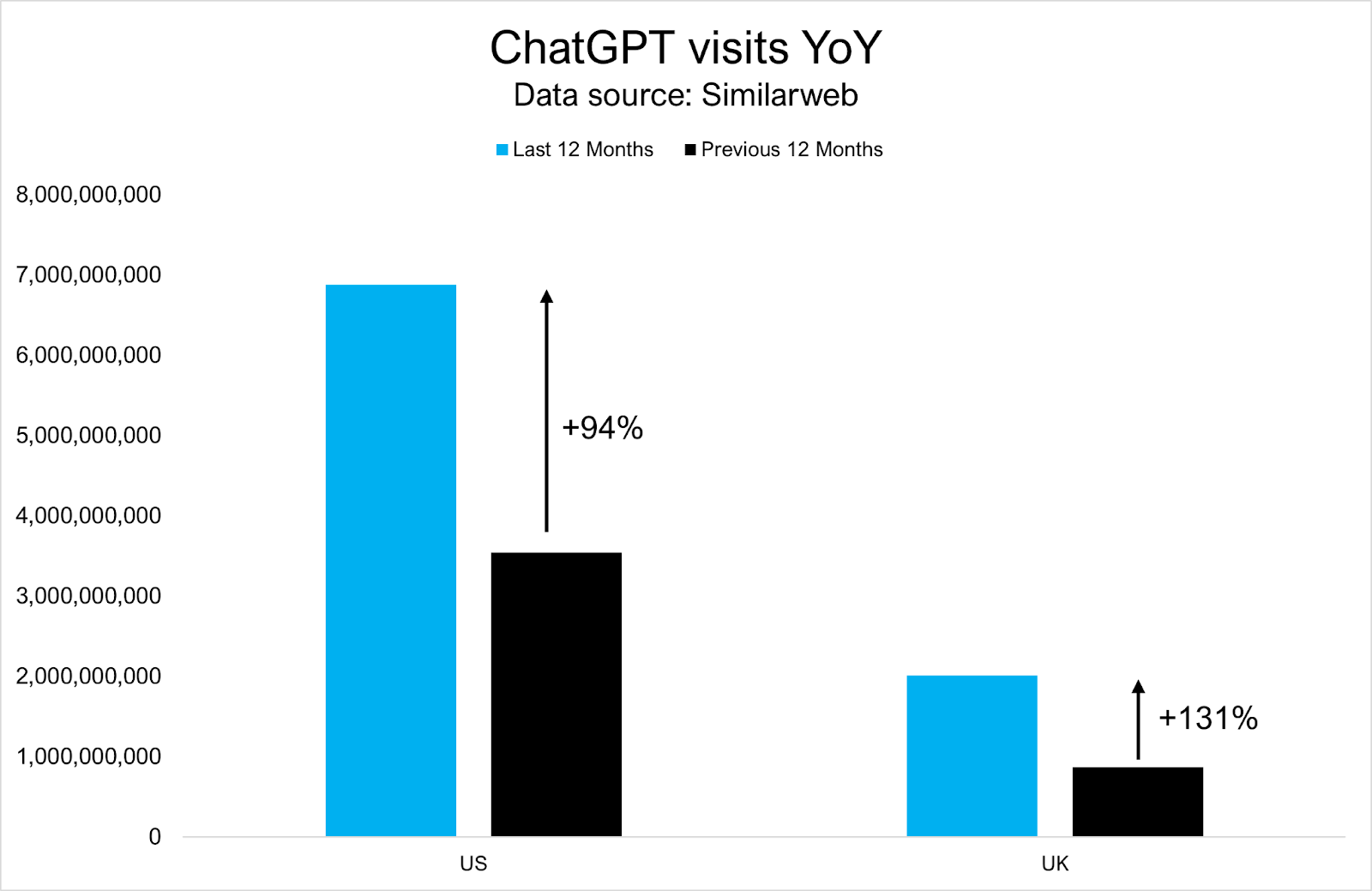
Over the last 12 months in the U.S., ChatGPT visits grew from 3.5 to 6.8 billion visits (+94%).
In the UK, it was even faster: 131% YoY, from 868 million to 2 billion.
Over the same time span, Google growth stagnated. Here’s what the data showed:
U.S. stagnation: -0.85% (196 vs. 194 billion).
UK stagnation: -0.22% (35.56 vs. 35.49 billion).
Image Credit: Kevin Indig
To put it into perspective: Google had almost 200 billion visits in the U.S. over the last 12 months, compared to ChatGPT’s 6.8 billion.
So, ChatGPT has a mere 3.4% of Google’s total visits.
However, if growth rates hold steady, in theory, ChatGPT could hit Google’s volume in the next five years.
My hypothesis: It’s almost guaranteed that ChatGPT won’t hit Google’s visit volume because there are too many moving parts (energy/chip limitations, training data, quality improvements, regulation, etc.).
But consider that Google has declined by -0.85% (~2 billion visits) year-over-year, and you can see where this is going.
Visits can only tell you so much.
Recent data from Semrush and Profound suggests that one-third to two-thirds of user intent when interacting with AI chatbots is generative, meaning users use ChatGPT to do and less to search [1, 2].
Leaked chats from ChatGPT and other AI chatbots confirm the aggregate data.
So, even when we compare visits to ChatGPT vs. Google, they’re not leading to the same outcome.
But, against that argument, I will say that Google morphs more into a mirror of ChatGPT with AI Mode – and every generative intent has a high chance of including information along the conversation journey that is sourced to other sites or creators.
The conversational nature of AI chatbots means intent is fluid and can change from one prompt to the next.
Along the way, it’s likely users come across information in their conversations that would’ve been a classic Google Search for products or solutions.
At the end of the day, ChatGPT is continuing its adoption as the fastest-growing product on earth to date.
What does that mean for you?
Stay the course.
Keep tracking referral traffic, conversions, and topic visibility on Google + ChatGPT.
Optimize for visibility with a strong focus on classic SEO.
Keep an ear to the ground and learn as much as you can. Things are evolving fast, and clarity will come with time.
Quick reminder here: I recently transitioned my WhatsApp group over to Slack. I share ongoing news and learnings throughout the week openly and freely, so it’s a great place to stay updated without all the extra (and sometimes overwhelming) noise. No need to be a premium subscriber to get access to the main discussion channel. Join here!
Old habits are hard to break.
People are used to searching on Google a certain way, while ChatGPT is a green field.
For the overwhelming majority of us, our first experience with ChatGPT was a conversation, so we all adopted it as the default way to engage.
Image Credit: Kevin Indig
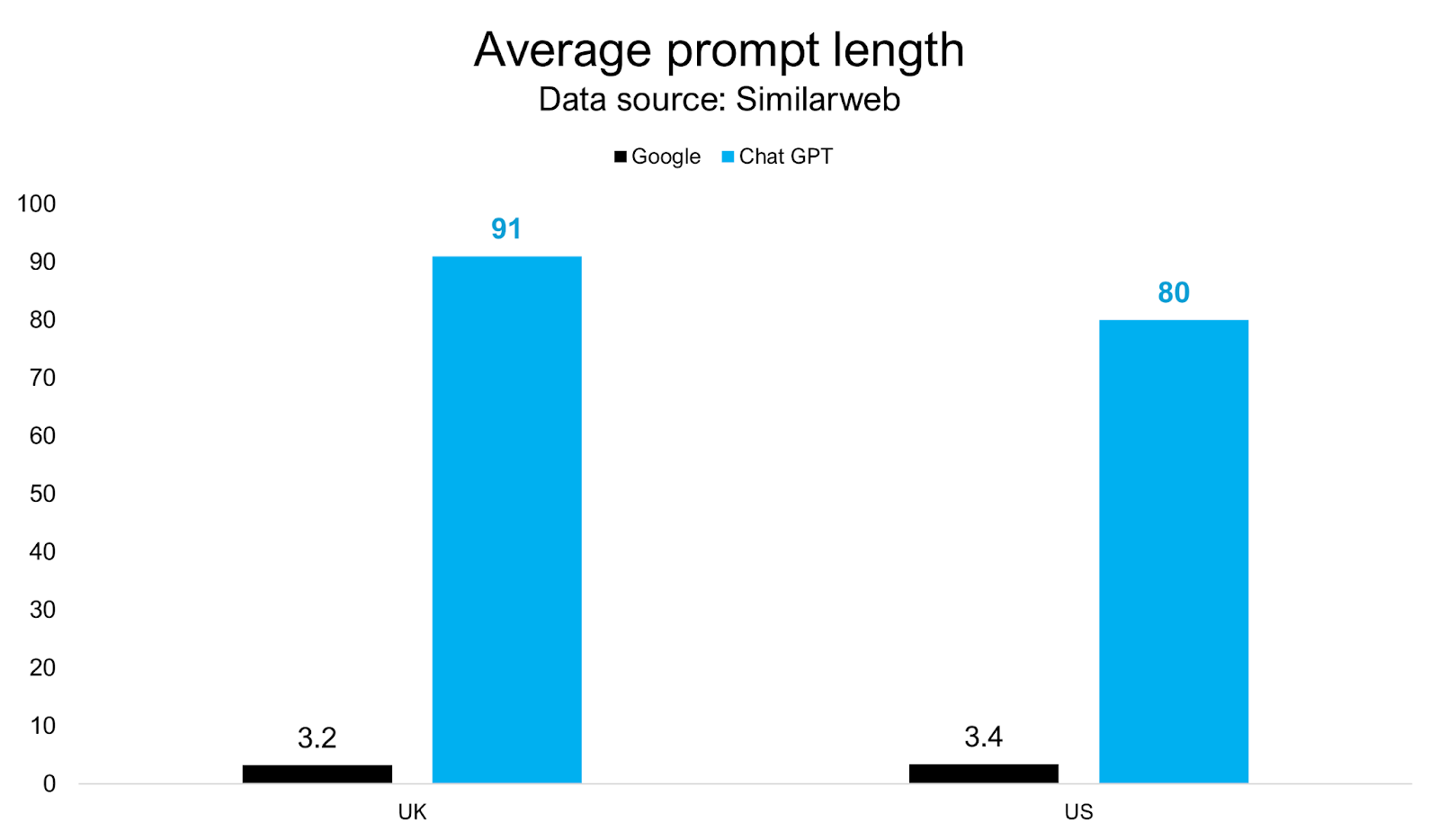
As a result, the average query prompt length on ChatGPT vs. Google is:
80 words vs 3.4 in the U.S.
91 words vs. 3.2 in the UK.
Even informational prompts are 10 times longer (~38 words) on ChatGPT than on Google. People ask more detailed questions, which reveal much more about themselves and their intent.
Together with a growing context window, ChatGPT returns much more personalized and (usually) better informational answers – I’m still waiting on consistently better commercial/purchase intent outcomes.[3] AI chatbots compress the user journey from many queries over several days to one conversation with lengthy prompts.
For you, this means it’s even more critical to monitor the right prompts.
As referral traffic from Google reached historic lows, ChatGPT’s referral traffic reached new highs.
Image Credit: Kevin Indig
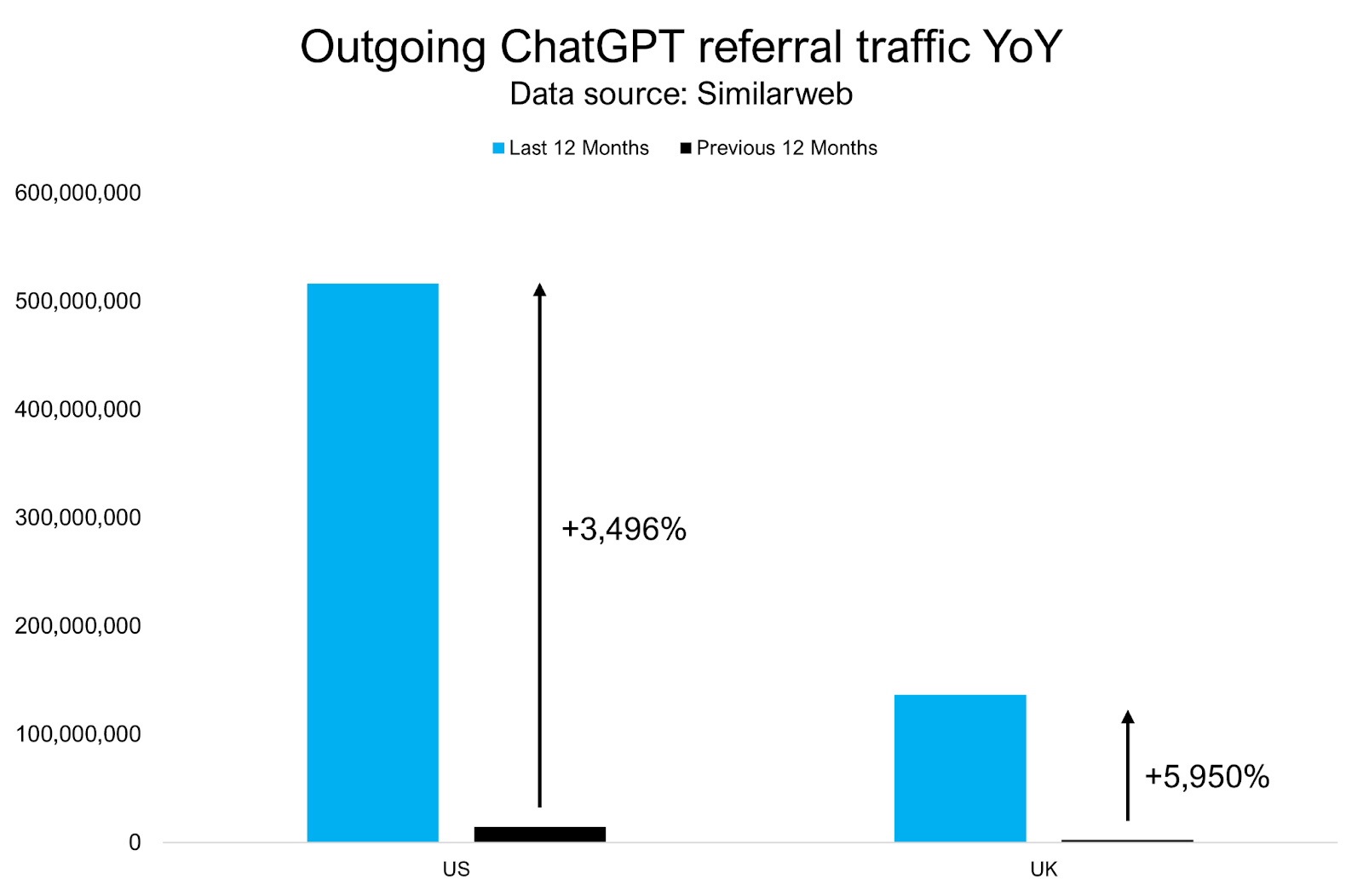
Over the last 12 months, ChatGPT’s U.S. referral traffic to websites jumped by +3,496% (UK: +5,950%), from 14 to 516 million (after cleaning up referrals to Openai.com, which are mostly authentications).
In comparison, Google’s outgoing referral visits grew only +23% in the U.S. and 19% in the UK.
When you consider Google referrals include navigational searches (people navigating to the homepage of a brand) and ad clicks (ChatGPT doesn’t yet have ads), 23% is not much at all.
ChatGPT’s referral traffic to external websites makes up ~27% of Google’s (1.9 billion, in the last 12 months), based on the data. That feels high, in my field observation.
Also consider that ChatGPT’s goal is not necessarily to send out traffic but to keep the conversation going until users have the optimal response.
That being said, referral traffic has grown and continues to do so. Until recently.
According to Profound, ChatGPT’s referral traffic was down -52% between July 21 and August 20. [4] And that’s significant.
Time will tell whether this is just an experiment or a final decision.
For you, this means you should see more ChatGPT referral traffic over the last 12 months if you optimize well.
You might not see an increase of +3,500%, but if you’re not seeing at least some growth, it’s likely your competitors are.
Conversions from ChatGPT are small in comparison with Google (in volume), but they’re growing rapidly.
The whole narrative of investing in AI visibility optimization (AEO/GEO/LLMO) banks on the fact that it will continue at the same pace and become meaningful.
So far, it seems like that bet will work out.
Image Credit: Kevin Indig
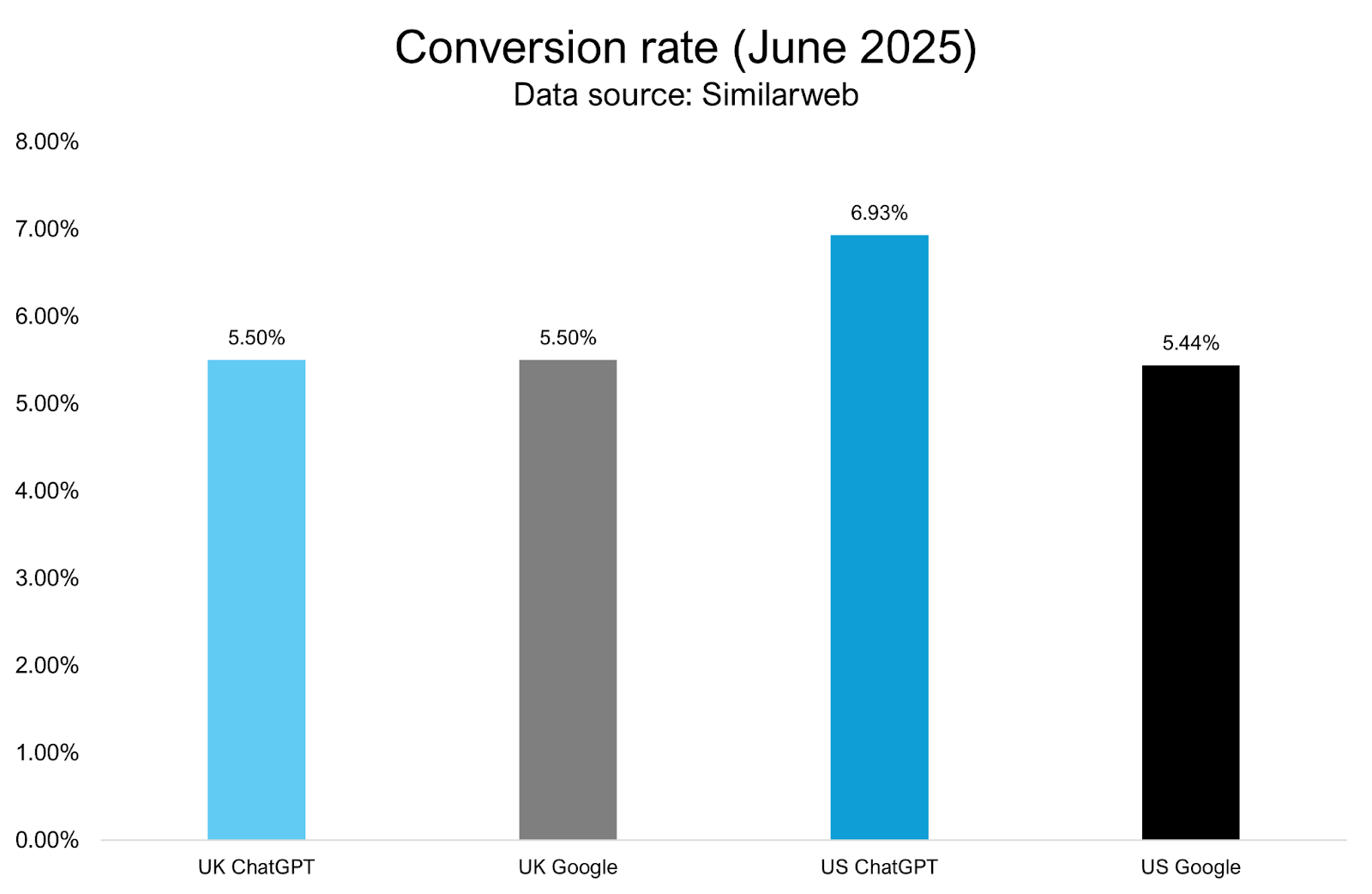
When ChatGPT sends traffic to sites, the conversion rate is usually higher than Google’s. As of June 2025:
ChatGPT’s conversion rate of transactional traffic was 6.9% in the U.S. compared to 5.4% for Google.
In the UK, ChatGPT reached 5.5%, which is on par with Google.
ChatGPT sends higher-quality traffic to websites, at least in the U.S.
I define quality in this context as “higher intent,” meaning visitors are more likely to convert into customers.
The reason ChatGPT traffic is of higher quality is that users get answers to their questions in one conversation. When they click out, they’re “primed” to buy.
To me, the bigger question is how purchase decisions are influenced before a click happens (or even when no click-out happens).
For you, this means:
Look at which pages get referral traffic. Take the average referral traffic and optimize pages that get some but below-average clicks.
Optimizing for citations matters because citations are what get clicked. Look at the citation gap between your competitors and your site.
Look for conversion optimization opportunities (in-line CTAs, lead gen assets, quizzes, etc) on pages that get ChatGPT referral traffic. Using a standard heatmap tool will point you to areas of the page that are ideal for a little CRO.
ChatGPT has all the ingredients to become the next big user platform on which other companies can build – just like Google 25 years ago:
Usage is growing.
Behavior is rich in context.
Referral traffic is shooting up.
Conversions happen at a healthy rate.
Now, traffic and conversations just need more volume.
They’re still tiny in comparison.
Featured Image: Paulo Bobita/Search Engine Journal
Recent research highlights intriguing paradoxes in consumer attitudes toward AI-driven marketing. Consumers encounter AI-powered marketing interactions frequently, often without realizing it.
According to a 2022 Pew Research Center survey, 27% of Americans reported interacting with AI at least several times a day, while another 28% said they interact with AI about once a day or several times a week (Pew Research Center, 2023).
As AI adoption continues to expand across industries, marketing applications – from personalized recommendations to chatbots – are increasingly shaping consumer experiences.
According to McKinsey & Company (2023), AI-powered personalization can deliver five to eight times the ROI on marketing spend and significantly boost customer engagement.
In this rapidly evolving landscape, trust in AI has become a crucial factor for successful adoption and long-term engagement.
The World Economic Forum underscores that “trust is the foundation for AI’s widespread acceptance,” and emphasizes the necessity for companies to adopt self-governance frameworks that prioritize transparency, accountability, and fairness (World Economic Forum, 2025).
The Psychology Of AI Trust
Consumer trust in AI marketing systems operates fundamentally differently from traditional marketing trust mechanisms.
Where traditional marketing trust builds through brand familiarity and consistent experiences, AI trust involves additional psychological dimensions related to automation, decision-making autonomy, and perceived control.
Understanding these differences is crucial for organizations seeking to build and maintain consumer trust in their AI marketing initiatives.
Cognitive Dimensions
Neurological studies offer intriguing insights into how our brains react to AI. Research from Stanford University reveals that we process information differently when interacting with AI-powered systems.
For example, when evaluating AI-generated product recommendations, our brains activate distinct neural pathways compared to those triggered by recommendations from a human salesperson.
This crucial difference highlights the need for marketers to understand how consumers cognitively process AI-driven interactions.
There are three key cognitive factors that have emerged as critical influences on AI trust, including perceived control, understanding of mechanisms, and value recognition.
Emotional Dimensions
Consumer trust in AI marketing is deeply influenced by emotional factors, which often override logical evaluations. These emotional responses shape trust in several key ways:
Anxiety and privacy concerns: Despite AI’s convenience, 67% of consumers express anxiety about how their data is used, reflecting persistent privacy concerns (Pew Research Center, 2023). This tension creates a paradoxical relationship where consumers benefit from AI-driven marketing while simultaneously fearing its potential misuse.
Trust through repeated interactions: Emotional trust in AI systems develops iteratively through repeated, successful interactions, particularly when systems demonstrate high accuracy, consistent performance, and empathetic behavior. Experimental studies show that emotional and behavioral trust accumulate over time, with early experiences strongly shaping later perceptions. In repeated legal decision-making tasks, users exhibited growing trust toward high-performing AI, with initial interactions significantly influencing long-term reliance (Kahr et al., 2023). Emotional trust can follow nonlinear pathways – dipping after failures but recovering through empathetic interventions or improved system performance (Tsumura and Yamada, 2023).
Honesty and transparency in AI content: Consumers increasingly value transparency regarding AI-generated content. Companies that openly disclose when AI has been used – for instance, in creating product descriptions – can empower customers by helping them feel more informed and in control of their choices. Such openness often strengthens customer trust and fosters positive perceptions of brands actively embracing transparency in their marketing practices.
Cultural Variations In AI Trust
The global nature of modern marketing requires a nuanced understanding of cultural differences in AI trust. These variations arise from deeply ingrained societal values, historical relationships with technology, and norms around privacy, automation, and decision-making.
For marketers leveraging AI in customer engagement, recognizing these cultural distinctions is crucial for developing trustworthy AI-driven campaigns, personalized experiences, and region-specific data strategies.
Diverging Cultural Trust In AI
Research reveals significant disparities in AI trust across global markets. A KPMG (2023) global survey found that 72% of Chinese consumers express trust in AI-driven services, while in the U.S., trust levels plummet to just 32%.
This stark difference reflects broader societal attitudes toward government-led AI innovation, data privacy concerns, and varying historical experiences with technology.
Another study found that AI-related job displacement fears vary greatly by region. In countries like the U.S., India, and Saudi Arabia, consumers express significant concerns about AI replacing human roles in professional sectors such as medicine, finance, and law.
In contrast, consumers in Japan, China, and Turkey exhibit lower levels of concern, signaling a higher acceptance of AI in professional settings (Quantum Zeitgeist, 2025).
The Quantum Zeitgeist study shows that regions like Japan, China, and Turkey exhibit lower levels of concern about AI replacing human jobs compared to regions like the U.S., India, and Saudi Arabia, where such fears are more pronounced.
This insight is invaluable for marketers crafting AI-driven customer service, financial tools, and healthcare applications, as perceptions of AI reliability and utility vary significantly by region.
As trust in AI diverges globally, understanding the role of cultural privacy norms becomes essential for marketers aiming to build trust through AI-driven services.
Cultural Privacy Targeting In AI Marketing
As AI-driven marketing becomes more integrated globally, the concept of cultural privacy targeting – the practice of aligning data collection, privacy messaging, and AI transparency with cultural values – has gained increasing importance. Consumer attitudes toward AI adoption and data privacy are highly regional, requiring marketers to adapt their strategies accordingly.
In more collectivist societies like Japan, AI applications that prioritize societal or community well-being are generally more accepted than those centered on individual convenience.
This is evident in Japan’s Society 5.0 initiative – a national vision introduced in 2016 that seeks to build a “super-smart” society by integrating AI, IoT, robotics, and big data to solve social challenges such as an aging population and strains on healthcare systems.
Businesses are central to this transformation, with government and industry collaboration encouraging companies to adopt digital technologies not just for efficiency, but to contribute to public welfare.
Across sectors – from manufacturing and healthcare to urban planning – firms are reimagining business models to align with societal needs, creating innovations that are both economically viable and socially beneficial.
In this context, AI is viewed more favorably when positioned as a tool to enhance collective well-being and address structural challenges. For instance, AI-powered health monitoring technologies in Japan have seen increased adoption when positioned as tools that contribute to broader public health outcomes.
Conversely, Germany, as an individualistic society with strong privacy norms and high uncertainty avoidance, places significant emphasis on consumer control over personal data. The EU’s GDPR and Germany’s support for the proposed Artificial Intelligence Act reinforce expectations for robust transparency, fairness, and user autonomy in AI systems.
According to the OECD (2024), campaigns in Germany that clearly communicate data usage, safeguard individual rights, and provide opt-in consent mechanisms experience higher levels of public trust and adoption.
These contrasting cultural orientations illustrate the strategic need for contextualized AI marketing – ensuring that data transparency and privacy are not treated as one-size-fits-all, but rather as culture-aware dimensions that shape trust and acceptance.
Hofstede’s (2011) cultural dimensions theory offers further insights into AI trust variations:
High individualism + high uncertainty avoidance (e.g., Germany, U.S.) → Consumers demand transparency, data protection, and human oversight in AI marketing.
Collectivist cultures with lower uncertainty avoidance (e.g., Japan, China, South Korea) → AI is seen as a tool that enhances societal progress, and data-sharing concerns are often lower when the societal benefits are clear (Gupta et al., 2021).
For marketers deploying AI in different regions, these insights help determine which features to emphasize:
Control and explainability in Western markets (focused on privacy and autonomy).
Seamless automation and societal progress in East Asian markets (focused on communal benefits and technological enhancement).
Understanding the cultural dimensions of AI trust is key for marketers crafting successful AI-powered campaigns.
By aligning AI personalization efforts with local cultural expectations and privacy norms, marketers can improve consumer trust and adoption in both individualistic and collectivist societies.
This culturally informed approach helps brands tailor privacy messaging and AI transparency to the unique preferences of consumers in various regions, building stronger relationships and enhancing overall engagement.
Avoiding Overgeneralization In AI Trust Strategies
While cultural differences are clear, overgeneralizing consumer attitudes can lead to marketing missteps.
A 2024 ISACA report warns against rigid AI segmentation, emphasizing that trust attitudes evolve with:
Media influence (e.g., growing fears of AI misinformation).
Regulatory changes (e.g., the EU AI Act’s impact on European consumer confidence).
Generational shifts (younger, digitally native consumers are often more AI-trusting, regardless of cultural background).
For AI marketing, this highlights the need for flexible, real-time AI trust monitoring rather than static cultural assumptions.
Marketers should adapt AI trust-building strategies based on region-specific consumer expectations:
North America and Europe: AI explainability, data transparency, and ethical AI labels increase trust.
East Asia: AI-driven personalization and seamless automation work best when framed as benefiting society.
Islamic-majority nations and ethical consumer segments: AI must be clearly aligned with fairness and ethical governance.
Global emerging markets: AI trust is rapidly increasing, making these markets prime opportunities for AI-driven financial inclusion and digital transformation.
The data, drawn from the 2023 KPMG International survey, underscores how cultural values such as collectivism, uncertainty avoidance, and openness to innovation, shape public attitudes toward AI.
For example, trust levels in Germany and Japan remain low, reflecting high uncertainty avoidance and strong privacy expectations, while countries like India and Brazil exhibit notably higher trust, driven by optimism around AI’s role in societal and economic progress.
Measuring Trust In AI Marketing Systems
As AI becomes central to how brands engage customers – from personalization engines to chatbots – measuring consumer trust in these systems is no longer optional. It’s essential.
And yet, many marketing teams still rely on outdated metrics like Net Promoter Score (NPS) or basic satisfaction surveys to evaluate the impact of AI. These tools are helpful for broad feedback but miss the nuance and dynamics of trust in AI-powered experiences.
Recent research, including work from MIT Media Lab (n.d.) and leading behavioral scientists, makes one thing clear: Trust in AI is multi-dimensional, and it’s shaped by how people feel, think, and behave in real-time when interacting with automated systems.
Traditional metrics like NPS and CSAT (Customer Satisfaction Score) tell you if a customer is satisfied – but not why they trust (or don’t trust) your AI systems.
They don’t account for how transparent your algorithm is, how well it explains itself, or how emotionally resonant the interaction feels. In AI-driven environments, you need a smarter way to understand trust.
A Modern Framework For Trust: What CMOs Should Know
MIT Media Lab’s work on trust in human-AI interaction offers a powerful lens for marketers. It breaks trust into three key dimensions:
Behavioral Trust
This is about what customers do, not what they say. When customers engage frequently, opt in to data sharing, or return to your AI tools repeatedly, that’s a sign of behavioral trust. How to track it:
Repeat engagement with AI-driven tools (e.g., product recommenders, chatbots).
Opt-in rates for personalization features.
Drop-off points in AI-led journeys.
Emotional Trust
Trust is not just rational, it’s emotional. The tone of a voice assistant, the empathy in a chatbot’s reply, or how “human” a recommendation feels all play into emotional trust. How to track it:
Sentiment analysis from chat transcripts and reviews.
Customer frustration or delight signals from support tickets.
Tone and emotional language in user feedback.
Cognitive Trust
This is where understanding meets confidence. When your AI explains itself clearly – or when customers understand what it can and can’t do –they’re more likely to trust the output. How to track it:
Feedback on explainability (“I understood why I got this recommendation”).
Click-through or acceptance rates of AI-generated content or decisions.
Post-interaction surveys that assess clarity.
Today’s marketers are moving toward real-time trust dashboards – tools that monitor how users interact with AI systems across channels. These dashboards track behavior, sentiment, and comprehension all at once.
According to MIT Media Lab researchers, combining these signals provides a richer picture of trust than any single survey can. It also gives teams the agility to address trust breakdowns as they happen – like confusion over AI-generated content or friction in AI-powered customer journeys.
Customers don’t expect AI to be perfect. But they do expect it to be honest and understandable. That’s why brands should:
Label AI-generated content clearly.
Explain how decisions like pricing, recommendations, or targeting are made.
Give customers control over data and personalization.
Building trust is less about tech perfection and more about perceived fairness, clarity, and respect.
Measuring that trust means going deeper than satisfaction. Use behavioral, emotional, and cognitive signals to track trust in real-time – and design AI systems that earn it.
To read the full book, SEJ readers have an exclusive 25% discount code and free shipping to the US and UK. Use promo code ‘SEJ25’ atkoganpage.com here.
More Resources:
References
Hofstede, G (2011) Dimensionalizing Cultures: The Hofstede Model in Context, Online Readings in Psychology and Culture, 2 (1), scholarworks.gvsu.edu/cgi/viewcontent. cgi?article=1014&context=orpc (archived at https://perma.cc/B7EP-94CQ)
ISACA (2024) AI Ethics: Navigating Different Cultural Contexts, December 6, www.isaca. org/resources/news-and-trends/isaca-now-blog/2024/ai-ethics-navigating-different-cultural-contexts (archived at https://perma.cc/3XLA-MRDE)
Kahr, P K, Meijer, S A, Willemsen, M C, and Snijders, C C P (2023) It Seems Smart, But It Acts Stupid: Development of Trust in AI Advice in a Repeated Legal Decision-Making Task, Proceedings of the 28th International Conference on Intelligent User Interfaces. doi.org/10.1145/3581641.3584058 (archived at https://perma.cc/SZF8-TSK2)
KPMG International and The University of Queensland (2023) Trust in Artificial Intelligence: A Global Study, assets.kpmg.com/content/dam/kpmg/au/pdf/2023/ trust-in-ai-global-insights-2023.pdf (archived at https://perma.cc/MPZ2-UWJY)
McKinsey & Company (2023) The State of AI in 2023: Generative AI’s Breakout Year, www.mckinsey.com/capabilities/quantumblack/our-insights/the-state-of-ai-in-2023- generative-ais-breakout-year (archived at https://perma.cc/V29V-QU6R)
MIT Media Lab (n.d.) Research Projects, accessed April 8, 2025
OECD (2024) OECD Artificial Intelligence Review of Germany, www.oecd.org/en/ publications/2024/06/oecd-artificial-intelligence-review-of-germany_c1c35ccf.html (archived at https://perma.cc/5DBS-LVLV)
Pew Research Center (2023) Public Awareness of Artificial Intelligence in Everyday Activities, February, www.pewresearch.org/wp-content/uploads/sites/20/2023/02/ PS_2023.02.15_AI-awareness_REPORT.pdf (archived at https://perma.cc/V3SE-L2BM)
Quantum Zeitgeist (2025) How Cultural Differences Shape Fear of AI in the Workplace, Quantum News, February 22, quantumzeitgeist.com/how-cultural-differences-shape-fear-of-ai-in-the-workplace-a-global-study-across-20-countries/ (archived at https://perma.cc/3EFL-LTKM)
Tsumura, T and Yamada, S (2023) Making an Agent’s Trust Stable in a Series of Success and Failure Tasks Through Empathy, arXiv. arxiv.org/abs/2306.09447 (archived at https://perma.cc/L7HN-B3ZC)
World Economic Forum (2025) How AI Can Move from Hype to Global Solutions, www. weforum.org/stories/2025/01/ai-transformation-industries-responsible-innovation/ (archived at https://perma.cc/5ALX-MDXB)
 Image credit: Google Ads, August 2025