Perplexity Comet Browser Vulnerable To Prompt Injection Exploit via @sejournal, @martinibuster

Brave published details about a security issue with Comet, Perplexity’s AI browser, that enables an attacker to inject a prompt into the browser and gain access to data in other open browser tabs.

Comet AI Browser Vulnerability

Brave described a vulnerability that can be activated when a user asks the Comet AI browser to summarize a web page. The LLM will read the web page, including any embedded prompts that command the LLM to take action on any open tabs

According to Brave:

“The vulnerability we’re discussing in this post lies in how Comet processes webpage content: when users ask it to “Summarize this webpage,” Comet feeds a part of the webpage directly to its LLM without distinguishing between the user’s instructions and untrusted content from the webpage. This allows attackers to embed indirect prompt injection payloads that the AI will execute as commands. For instance, an attacker could gain access to a user’s emails from a prepared piece of text in a page in another tab.”

A post on Simon Willison’s Weblog shared that Perplexity tried to patch the vulnerability but the fix does not work.

A developer posted the following on X:

“Why is no one talking about this?

This is why I don’t use an AI browser

You can literally get prompt injected and your bank account drained by doomscrolling on reddit:”

Things aren’t looking good for Comet Browser at this time.

https://www.searchenginejournal.com/perplexity-comet-browser-vulnerable-to-prompt-injection-exploit/554575/


The 5-Step Process To Setting Crystal Clear PPC Goals via @sejournal, @MenachemAni

Many agencies and marketers believe that success in paid media is primarily down to the quality of your ads or the specificity of your landing pages.

While those elements are important, they’re meaningless unless they sit on a foundation of alignment with client needs.

The cleanest account structure and flawless creatives may hit every platform benchmark, but any success will be short-lived if you’re not clued into what’s actually important to your clients.

Higher revenues, more profit, better lead quality, shorter sales cycles – this is what typically matters to the people paying the bills.

At JXT Group, we make sure that the foundation is laid before building a single campaign by gathering a clear picture of how our clients make money, who their ideal customers are, and what a proper conversion looks like.

Here are the five phases we use to engineer that experience.

1. Understand The Business Model

Financially, most Google Ads clients can be split into one of two business models: those that sell products at face value and those that want leads who convert at a later date, typically through an offline interaction.

Verticals like ecommerce and info products sell their goods (physical or otherwise) at face value, allowing you to see revenue figures inside of Google Ads.

Verticals like local services and SaaS rely on capturing interest in the form of phone calls, form fills, and chat sessions. These leads may or may not turn into actual sales later.

Anyone dealing with physical products also has to factor cash flow, procurement costs, shipping fees, and return rates into both how much they can spend as well as how much return they need on their ad spend.

This means that the same 4x return on ad spend (ROAS) can be great for one brand with low expenses, but put another underwater.

It’s why you cannot use platform metrics like ROAS while ignoring what actually results in net profit after fulfillment.

And leads need to be both high in quality and catered to promptly; otherwise, brands run the risk of low final conversion rates.

As marketers, we want to drive the right type of leads at a cost that matches a client’s close rates and order values, resulting in longer feedback loops and tighter customer relationship management (CRM) integration so we can optimize to actual revenue.

2. Match Goals To Client Priorities

Simply put, not every client is chasing the same outcome.

Some want to scale aggressively and are comfortable with a higher cost-per-acquisition (CPA), while others are laser-focused on efficiency and won’t move unless the numbers are dialed in.

I’ve worked with brands whose main goal was a clean presence, ensuring their ads show only on high-quality placements and live up to their internal values.

There are other niche goals, like outbidding a certain competitor or positioning themselves with a certain audience. All of these are valid, but they require different approaches.

Obviously, you can’t do anything until you figure out what matters most to the client. It might sound obvious, but too many agencies make assumptions based on platform key performance indicators (KPIs).

Just because Google says a campaign is performing “well” doesn’t mean it’s aligned with your client’s goals.

We start by asking the right questions, such as:

  • What would success look like six to 12 months from now?
  • Is your first priority profitability, growth, market share, or brand presence?
  • Would you rather trade volume for efficiency or efficiency for volume?

Once that’s established, we structure everything else around it:

  • How much budget is required.
  • Which campaign types to run and how to structure them.
  • What bid strategies we use.
  • How broad or narrow our targeting needs to be.
  • Messaging on ads and landing pages.
  • Negative keyword lists.
  • Targets for impression share, ROAS/CPA, and other KPIs.

Without these first foundational layers, everything else you do is just guesswork.

3. Set Comprehensive And Specific Goals

Once we understand the client’s business model and goals, it’s time to layer in our expertise. This part involves setting realistic goals that balance client desires with what we know is possible.

We’ll typically call on our vertical knowledge, experiences with past clients, and our understanding of unit economics and fulfillment to paint a complete picture.

There’s no room for mistakes like setting an arbitrary ROAS goal without asking what that revenue actually does for the business. After all, a 3x ROAS doesn’t mean much if the margins are thin or there are hidden costs later on.

With lead generation, the conversion doesn’t end with our intake form. In fact, it’s only the first step. The real value happens offline, when the lead turns into a paying customer, and Google has no visibility.

That gap is where the greatest insights and opportunities lie, and it’s vital that we account for it.

Here’s how to goal-set so that media performance ties back to real-world business needs.

Ecommerce

1. Look at the numbers behind the numbers.

This means breaking down the client’s cost structure.

What’s the cost of goods sold? How much does shipping cost per order? Are there fulfillment fees, returns, or seasonal procurement issues? How many other vendors get paid whose fees need to be accounted for in the ROAS target?

These offline costs directly impact ad sustainability.

2. Understand margins at the SKU or category level.

Not every product has the same margin, so some items can scale at a lower ROAS while others need to stay profitable at first touch.

We try to segment products by margin so we can set different targets where it makes sense.

3. Factor in blended performance.

A customer might enter the funnel through Google Ads but convert through another channel, like email.

We’ll study how Google fits into the entire ecosystem rather than trust a narrow window of last-click attribution, so that we can temper expectations based on how it all fits together.

4. Set realistic ROAS targets.

Once we understand the financials, it’s time to work backwards.

What’s the minimum ROAS needed to break even? What target ROAS will let the brand hit profitability goals?

This becomes our baseline and gives us a platform from which to build situational variance for things like seasonal demand, new product launches, and what competitors are doing.

5. Clarify the business objective behind the spend.

Not all brands spend on ads for the same reason. Some want to acquire new customers, others want to clear out inventory, and others still are launching a new product or range.

Each of these goals needs its own approach to bidding, creative, and measurement.

Lead Generation

1. Map the full conversion journey.

What happens after a lead submits a form or makes a call? Who follows up, how quickly, and what’s the typical close rate?

There is a full post-click sales flow that exists after someone registers their interest. If we don’t understand it, we’re optimizing in the dark.

2. Quantify the value of a lead.

Different leads have different values, and Google is not privy to any of this unless you share that data back as offline conversions.

For lead gen clients, we look at historical data on how many leads turn into sales and how quickly, what the average deal size is, and what the margin looks like.

Then, we set up integrations between Google Ads and their CRM to feed this data back and optimize against it.

3. Use the funnel to set a target CPA.

Once we know things like typical deal value and close rate, we can reverse engineer our way to a CPA that leaves enough margin on the plate.

For example, needing 30 leads to close one deal worth $1,000 gives us very limited margins and runs the risk of blowing through the market.

A client that closes 1 in 10 leads with a $5,000 average sale gives us a much higher ceiling on what they can pay per lead while staying profitable.

4. Control anything we can post-click.

Lead gen gives us a greater opportunity to influence conversions after they click. This means landing page user experience and messaging, form length and format, automated email follow-ups, and CRM workflows.

Small changes here can have an outsized impact on close rates and lead quality.

4. Employ Active Listening During Conversations

Meeting with a new client is a bit like hanging out with someone new for the first time. They might not be willing to dive deep or share as openly as we’d like, but it’s our job to make them feel comfortable enough to do so.

Surface-level answers will only take us so far. To set a truly solid strategy, we want to listen to what’s in the spaces between their words.

What are they really trying to solve? Are they really after more profit or market share, or do they just want cleaner reporting now that they have investors to answer to?

A client might say they want “more leads” when what they really need are better leads that their sales team can actually close, but you’ll never see that light if you take everything they say at face value.

Active listening shows up in the details:

  • Picking up on how the client talks about their sales process, not just the form submission.
  • Hearing concerns about inventory issues before pushing hard on a best-seller.
  • Noticing when a CEO cares more about market visibility than ROAS.

It’s a skill that takes time to develop, but it’s also the only way to avoid misalignment and really build trust.

Get this right, and your client will feel like you’re there to make them look great and are willing to run through brick walls for them.

5. Ask Probing, Leading Questions To Reveal The Full Picture

Potential clients who put up walls need you to cut through the noise.

These questions will help you get to the real motivation behind their desire to spend on paid search, as well as allow you to spot red flags that might indicate a difficult client.

Business Direction

  • What would success look like to you in the next six to 12 months? This helps them move beyond “more leads” or “better ROAS” and focus on outcomes.
  • If Google Ads disappeared tomorrow, what would break in your business? This reveals how critical paid media is to their revenue engine.
  • Is this about profitability, growth, or positioning? Few clients won’t say “all three,” but keep pressing, and they’ll tell you what they’d sacrifice first.
  • Are you looking to maintain, grow, or exit? You should know if they’re scaling to sell, which changes everything about risk tolerance and KPIs.

Finance & Economics

  • What’s your average profit margin after all costs, e.g., ads, fulfillment, labor? If they don’t have this information ready and can’t/won’t source it, that should be a red flag about their openness.
  • What do you pay to acquire a customer? What’s the most you can afford to pay? See if they’re thinking in terms of lifetime value or just looking at front-end performance.
  • Do we need to factor in any fixed costs that most media buyers wouldn’t know about? It opens the door to discussions about warehousing, returns, sales commissions, etc.

Lead Quality & Sales Process

  • What do you consider to be a “qualified” lead? This forces them to define quality, which is far superior to treating all leads the same or leaving the definition vague.
  • What happens after a lead comes through? You want to know how long it usually takes to close a deal and what their team does to facilitate that. The answer will show you how strong or weak their internal follow-up process is.
  • How often do you listen to sales calls or review what’s happening post-click? If the answer is never, it tells you the magnitude of the support they’ll need to improve close rates. This might not be something you can control.

Bottlenecks & Internal Dynamics

  • Who has the final say on marketing and business decisions? You’ll avoid many headaches and painful back-and-forth by establishing this upfront.
  • What have you tried in the past that didn’t work, and why not? Ask this to get insight into previous agency relationships, internal friction, or unrealistic expectations.
  • If we start today and in six months you’re unhappy, what will have gone wrong? This one is gold as it can expose fears, past traumas, and give you a roadmap on how to hit alignment.

But, even if you get all these answers and follow all the advice in this article, communication with your clients is the key to establishing a relationship where you’re trusted and given space to operate.

Without proactive and consistent two-way communication, their perceptions may not align with what you’re doing.

Remember: You’re The Expert, But You’re Not In Charge

One thing many agencies and marketers tend to forget as they manage thousands and millions of dollars in ad spend is that we build on leased land. These are not our accounts and campaigns, and we don’t pay the advertising bills.

So, even though it’s important for clients to defer to our expertise, ultimately, they’re the ones who call the shots when it comes to direction and strategy.

The other angle to this is that it’s not our job to make ourselves look good or even to get a solid case study out of an engagement; those are bonuses.

Our job is to service client needs, maximize results within the spend allocated to us, and make our clients look phenomenal in front of the people they answer to.

More Resources:


Featured Image: ugguggu/Shutterstock

https://www.searchenginejournal.com/process-to-setting-crystal-clear-ppc-goals/551684/


How To Leverage AI To Modernize B2B Go-To-Market via @sejournal, @alexanderkesler

In a post “growth-at-all-costs” era, B2B go-to-market (GTM) teams face a dual mandate: operate with greater efficiency while driving measurable business outcomes.

Many organizations see AI as the definitive means of achieving this efficiency.

The reality is that AI is no longer a speculative investment. It has emerged as a strategic enabler to unify data, align siloed teams, and adapt to complex buyer behaviors in real time.

According to an SAP study, 48% of executives use generative AI tools daily, while 15% use AI multiple times per day.

The opportunity for modern Go-to-Market (GTM) leaders is not just to accelerate legacy tactics with AI, but to reimagine the architecture of their GTM strategy altogether.

This shift represents an inflection point. AI has the potential to power seamless and adaptive GTM systems: measurable, scalable, and deeply aligned with buyer needs.

In this article, I will share a practical framework to modernize B2B GTM using AI, from aligning internal teams and architecting modular workflows to measuring what truly drives revenue.

The Role Of AI In Modern GTM Strategies

For GTM leaders and practitioners, AI represents an opportunity to achieve efficiency without compromising performance.

Many organizations leverage new technology to automate repetitive, time-intensive tasks, such as prospect scoring and routing, sales forecasting, content personalization, and account prioritization.

But its true impact lies in transforming how GTM systems operate: consolidating data, coordinating actions, extracting insights, and enabling intelligent engagement across every stage of the buyer’s journey.

Where previous technologies offered automation, AI introduces sophisticated real-time orchestration.

Rather than layering AI onto existing workflows, AI can be used to enable previously unscalable capabilities such as:

  • Surfacing and aligning intent signals from disconnected platforms.
  • Predicting buyer stage and engagement timing.
  • Providing full pipeline visibility across sales, marketing, client success, and operations.
  • Standardizing inputs across teams and systems.
  • Enabling cross-functional collaboration in real time.
  • Forecasting potential revenue from campaigns.

With AI-powered data orchestration, GTM teams can align on what matters, act faster, and deliver more revenue with fewer resources.

AI is not merely an efficiency lever. It is a path to capabilities that were previously out of reach.

Framework: Building An AI-Native GTM Engine

Creating a modern GTM engine powered by AI demands a re-architecture of how teams align, how data is managed, and how decisions are executed at every level.

Below is a five-part framework that explains how to centralize data, build modular workflows, and train your model:

1. Develop Centralized, Clean Data

AI performance is only as strong as the data it receives. Yet, in many organizations, data lives in disconnected silos.

Centralizing structured, validated, and accessible data across all departments at your organization is foundational.

AI needs clean, labeled, and timely inputs to make precise micro-decisions. These decisions, when chained together, power reliable macro-actions such as intelligent routing, content sequencing, and revenue forecasting.

In short, better data enables smarter orchestration and more consistent outcomes.

Luckily, AI can be used to break down these silos across marketing, sales, client success, and operations by leveraging a customer data platform (CDP), which integrates data from your customer relationship management (CRM), marketing automation (MAP), and customer success (CS) platforms.

The steps are as follows:

  • Appoint a data steward who owns data hygiene and access policies.
  • Select a CDP that pulls records from your CRM, MAP, and other tools with client data.
  • Configure deduplication and enrichment routines, and tag fields consistently.
  • Establish a shared, organization-wide dashboard so every team works from the same definitions.

Recommended starting point: Schedule a workshop with operations, analytics, and IT to map current data sources and choose one system of record for account identifiers.

2. Build An AI-Native Operating Model

Instead of layering AI onto legacy systems, organizations will be better suited to architect their GTM strategies from the ground up to be AI-native.

This requires designing adaptive workflows that rely on machine input and positioning AI as the operating core, not just a support layer.

AI can deliver the most value when it unifies previously fragmented processes.

Rather than simply accelerating isolated tasks like prospect scoring or email generation, AI should orchestrate entire GTM motions, seamlessly adapting messaging, channels, and timing based on buyer intent and journey stage.

Achieving this transformation demands new roles within the GTM organization, such as AI strategists, workflow architects, and data stewards.

In other words, experts focused on building and maintaining intelligent systems rather than executing manual processes.

AI-enabled GTM is not about automation alone; it’s about synchronization, intelligence, and scalability at every touchpoint.

Once you have committed to building an AI-native GTM model, the next step is to implement it through modular, data-driven workflows.

Recommended starting point: Assemble a cross-functional strike team and map one buyer journey end-to-end, highlighting every manual hand-off that could be streamlined by AI.

3. Break Down GTM Into Modular AI Workflows

A major reason AI initiatives fail is when organizations do too much at once. This is why large, monolithic projects often stall.

Success comes from deconstructing large GTM tasks into a series of focused, modular AI workflows.

Each workflow should perform a specific, deterministic task, such as:

  • Assessing prospect quality on certain clear, predefined inputs.
  • Prioritizing outreach.
  • Forecasting revenue contribution.

If we take the first workflow, which assesses prospect quality, this would entail integrating or implementing a lead scoring AI tool with your model and then feeding in data such as website activity, engagement, and CRM data. You can then instruct your model to automatically route top-scoring prospects to sales representatives, for example.

Similarly, for your forecasting workflow, connect forecasting tools to your model and train it on historical win/loss data, pipeline stages, and buyer activity logs.

To sum up:

  • Integrate only the data required.
  • Define clear success criteria.
  • Establish a feedback loop that compares model output with real outcomes.
  • Once the first workflow proves reliable, replicate the pattern for additional use cases.

When AI is trained on historical data with clearly defined criteria, its decisions become predictable, explainable, and scalable.

Recommended starting point: Draft a simple flow diagram with seven or fewer steps, identify one automation platform to orchestrate them, and assign service-level targets for speed and accuracy.

4. Continuously Test And Train AI Models

An AI-powered GTM engine is not static. It must be monitored, tested, and retrained continuously.

As markets, products, and buyer behaviors shift, these changing realities affect the accuracy and efficiency of your model.

Plus, according to OpenAI itself, one of the latest iterations of its large language model (LLM) can hallucinate up to 48% of the time, emphasizing the importance of embedding rigorous validation processes, first-party data inputs, and ongoing human oversight to safeguard decision-making and maintain trust in predictive outputs.

Maintaining AI model efficiency requires three steps:

  1. Set clear validation checkpoints and build feedback loops that surface errors or inefficiencies.
  2. Establish thresholds for when AI should hand off to human teams and ensure that every automated decision is verified. Ongoing iteration is key to performance and trust.
  3. Set a regular cadence for evaluation. At a minimum, conduct performance audits monthly and retrain models quarterly based on new data or shifting GTM priorities.

During these maintenance cycles, use the following criteria to test the AI model:

  • Ensure accuracy: Regularly validate AI outputs against real-world outcomes to confirm predictions are reliable.
  • Maintain relevance: Continuously update models with fresh data to reflect changes in buyer behavior, market trends, and messaging strategies
  • Optimize for efficiency: Monitor key performance indicators (KPIs) like time-to-action, conversion rates, and resource utilization to ensure AI is driving measurable gains.
  • Prioritize explainability: Choose models and workflows that offer transparent decision logic so GTM teams can interpret results, trust outputs, and make manual adjustments as needed.

By combining cadence, accountability, and testing rigor, you create an AI engine for GTM that not only scales but improves continuously.

Recommended starting point: Put a recurring calendar invite on the books titled “AI Model Health Review” and attach an agenda covering validation metrics and required updates.

5. Focus On Outcomes, Not Features

Success is not defined by AI adoption, but by outcomes.

Benchmark AI performance against real business metrics such as:

  • Pipeline velocity.
  • Conversion rates.
  • Client acquisition cost (CAC).
  • Marketing-influenced revenue.

Focus on use cases that unlock new insights, streamline decision-making, or drive action that was previously impossible.

When a workflow stops improving its target metric, refine or retire it.

Recommended starting point: Demonstrate value to stakeholders in the AI model by exhibiting its impact on pipeline opportunity or revenue generation.

Common Pitfalls To Avoid

1. Over-Reliance On Vanity Metrics

Too often, GTM teams focus AI efforts on optimizing for surface-level KPIs, like marketing qualified lead (MQL) volume or click-through rates, without tying them to revenue outcomes.

AI that increases prospect quantity without improving prospect quality only accelerates inefficiency.

The true test of value is pipeline contribution: Is AI helping to identify, engage, and convert buying groups that close and drive revenue? If not, it is time to rethink how you measure its efficiency.

2. Treating AI As A Tool, Not A Transformation

Many teams introduce AI as a plug-in to existing workflows rather than as a catalyst for reinventing them. This results in fragmented implementations that underdeliver and confuse stakeholders.

AI is not just another tool in the tech stack or a silver bullet. It is a strategic enabler that requires changes in roles, processes, and even how success is defined.

Organizations that treat AI as a transformation initiative will gain exponential advantages over those who treat it as a checkbox.

A recommended approach for testing workflows is to build a lightweight AI system with APIs to connect fragmented systems without needing complicated development.

3. Ignoring Internal Alignment

AI cannot solve misalignment; it amplifies it.

When sales, marketing, and operations are not working from the same data, definitions, or goals, AI will surface inconsistencies rather than fix them.

A successful AI-driven GTM engine depends on tight internal alignment. This includes unified data sources, shared KPIs, and collaborative workflows.

Without this foundation, AI can easily become another point of friction rather than a force multiplier.

A Framework For The C-Level

AI is redefining what high-performance GTM leadership looks like.

For C-level executives, the mandate is clear: Lead with a vision that embraces transformation, executes with precision, and measures what drives value.

Below is a framework grounded in the core pillars modern GTM leaders must uphold:

Vision: Shift From Transactional Tactics To Value-Centric Growth

The future of GTM belongs to those who see beyond prospect quotas and focus on building lasting value across the entire buyer journey.

When narratives resonate with how decisions are really made (complex, collaborative, and cautious), they unlock deeper engagement.

GTM teams thrive when positioned as strategic allies. The power of AI lies not in volume, but in relevance: enhancing personalization, strengthening trust, and earning buyer attention.

This is a moment to lean into meaningful progress, not just for pipeline, but for the people behind every buying decision.

Execution: Invest In Buyer Intelligence, Not Just Outreach Volume

AI makes it easier than ever to scale outreach, but quantity alone no longer wins.

Today’s B2B buyers are defensive, independent, and value-driven.

Leadership teams that prioritize technology and strategic market imperative will enable their organizations to better understand buying signals, account context, and journey stage.

This intelligence-driven execution ensures resources are spent on the right accounts, at the right time, with the right message.

Measurement: Focus On Impact Metrics

Surface-level metrics no longer tell the full story.

Modern GTM demands a deeper, outcome-based lens – one that tracks what truly moves the business, such as pipeline velocity, deal conversion, CAC efficiency, and the impact of marketing across the entire revenue journey.

But the real promise of AI is meaningful connection. When early intent signals are tied to late-stage outcomes, GTM leaders gain the clarity to steer strategy with precision.

Executive dashboards should reflect the full funnel because that is where real growth and real accountability live.

Enablement: Equip Teams With Tools, Training, And Clarity

Transformation does not succeed without people. Leaders must ensure their teams are not only equipped with AI-powered tools but also trained to use them effectively.

Equally important is clarity around strategy, data definitions, and success criteria.

AI will not replace talent, but it will dramatically increase the gap between enabled teams and everyone else.

Key Takeaways

  • Redefine success metrics: Move beyond vanity KPIs like MQLs and focus on impact metrics: pipeline velocity, deal conversion, and CAC efficiency.
  • Build AI-native workflows: Treat AI as a foundational layer in your GTM architecture, not a bolt-on feature to existing processes.
  • Align around the buyer: Use AI to unify siloed data and teams, delivering synchronized, context-rich engagement throughout the buyer journey.
  • Lead with purposeful change: C-level executives must shift from transactional growth to value-led transformation by investing in buyer intelligence, team enablement, and outcome-driven execution.

More Resources:


Featured Image: BestForBest/Shutterstock

https://www.searchenginejournal.com/how-to-leverage-ai-modernize-b2b-go-to-market/552632/


Non-Profit Organization Announces Free Domain Names via @sejournal, @martinibuster

A non-profit organization that is supported by Cloudflare, GitHub, and other organizations has open-sourced domain names, making them available with no catches or hidden fees. The sponsor of the free domain names explains that their purpose is not to replace commercial domain names but to offer an open-source alternative for developers, students, and people who want to create a hobby site for free.

The goal is to encourage making the Internet a free and open space so that everyone can publish and express themselves online without financial barriers.

DigitalPlat

The open source domains are offered by DigitalPlat, a non-profit organization that’s sponsored by 1Password, The Hack Club (The Hack Foundation), twilio, GitHub and Cloudflare.

The Hack Foundation is a certified non-profit organization of high school students that receive support from hundreds of supporters including Google.org and Elon Musk. The organization was founded in 2016.

According to their website:

“In 2018, The Hack Foundation expanded to act as a nonprofit fiscal sponsor for Hack Clubs, hackathons, community organizations, and other for-good projects.

Today, hundreds of diverse groups ranging from a small town newspaper in Vermont to the largest high-school hackathon in Pennsylvania are fiscally sponsored by The Hack Foundation.”

A notice posted on The Hack Foundation donation web page explains their connection to DigitalPlat:

“The DigitalPlat Foundation is a global non-profit organization that supports open-source and community development while exploring innovative projects. All funds are supervised and managed by The Hack Foundation, and are strictly regulated in compliance with US IRS guidance and legal requirements under section 501(c)(3). “

DigitalPlat FreeDomain

The free domain names can be registered via DigitalPlat and the free domains project is open source, licensed under AGPL-3.0.

An announcement was made by the GitHubs Projects Community on X with a link to a GitHub page for the free domains where the following domain extensions are listed as choices:

  • .DPDNS.ORG
  • .US.KG
  • .QZZ.IO
  • .XX.KG

Technically, those are subdomains. But so are .uk.com domains.

The official GitHub page for the domains recommends using Cloudflare, FreeDNS by Afraid.org, or Hostry for managing the DNS for zero cost.

The .KG domain is from the country code of Kyrgyzstan. DPDNS.ORG is the domain name of DigitalPlat FreeDomain. .US.KG is operated by the DigitalPlat Foundation, a non-profit charitable organization that’s sponsored by The Hack Foundation.

The Open-Source Projects page for the free domains explains the purpose and goals of the free domain offers:

“The project is open source (licensed under AGPL-3.0), transparent, and backed by The Hack Foundation, a U.S. 501(c)(3) nonprofit. This isn’t a trial or a limited-time offer—it’s a sustainable effort to increase accessibility on the web.”

Full directions for registering a free domain name can be found here.

Featured Image by Shutterstock/TenPixels

https://www.searchenginejournal.com/free-domain-names/554514/


Tips For Running Competitor Campaigns In Paid Search via @sejournal, @timothyjjensen

Paid search professionals constantly debate the merits of running paid search campaigns bidding on competitor brand names. Questions such as the following may arise:

  • Is bidding on your competitors ethical?
  • Are the high costs-per-click (CPCs) worth spending the budget on?
  • Are you actually reaching people with buying intent?

In this article, I’ll talk through answers to these questions and more to help you understand if a competitor search campaign might be right for your brand.

Competitor Bidding Ethics

Google and Microsoft allow you to bid on your competitor’s name within keywords (and this right has even been tested in the courts here and here.), but you cannot directly mention a trademarked brand name (that you don’t have the rights to use) in ad copy.

In addition, even if you don’t include their name, you should not write your ad copy in a way that a user thinks they may be going to your competitor’s site instead of yours.

For instance, you might use the headline “Official Site” (without mentioning whose official site you’re pointing to). When a user sees that in conjunction with having searched for the competitor’s name, they may naturally think they’re going to that company’s site.

Finally, the landing page should also clearly feature your brand’s name and logo in order to avoid deception.

Cost-Benefit Analysis Of Competitor Bidding

Let’s face it: competitor keywords can have expensive CPCs. High competition around these keywords in many industries drives up cost.

You’ll also generally struggle to achieve a decent quality score due to other companies’ brand keywords naturally being deemed less relevant to your ads and landing pages, which can also impact cost.

Because of the high potential cost, competitor bidding does not make sense for all industries or brands.

For instance, if you’re selling products with a low profit margin, bidding on these pricy keywords may not work. Generally, this tactic works best for higher cost, higher margin products and services, as it’s easier to still yield a return on investment (ROI) after higher costs-per-acquisition (CPAs) and lower conversion rates.

Be careful also about entering competitor bidding “wars” for the sole reason that other brands are bidding on your name. This action can quickly lead to rising CPCs for all with little payoff.

One scenario where I’ve seen competitor bidding work best is when a company offers a very specific, complex service that’s difficult to sum up in a search query but has established brands that the right prospects would be familiar with.

For instance, if you’re promoting software for a particular type of industrial machine, niche buyers may be aware of companies that already provide that software.

Once you’ve established a use case for competitor bidding, you should establish a list of brands to use.

Determining Competitors To Bid On

When figuring out which competitor brands to bid on, you should rely on a combination of both internal company data as well as ad platform data.

First of all, talk with key stakeholders in marketing and sales to determine who the brand considers to be top competitors.

Who has similar products and services? Which brands target similar prospects (whether by location, demographic, or company traits)?

Note that this list may not and likely will not contain all potential competitors.

If you have established paid search campaigns already, use auction insights to see the top brands showing up for the same queries as yours. Of course, these may not all be completely relevant and will require some vetting through.

Once you’ve compiled a list, it’s time to think through the keywords you’ll bid on.

Who Is (And Isn’t) Your Audience

Be careful about going unnecessarily broad in the keywords you’re using in competitor campaigns.

Generally, if you’re just bidding on the brand name alone, you’re likely reaching a lot of existing customers looking to log in, place online orders, or find a nearby location without giving a second thought to anything else.

For instance, Apple isn’t going to sell many MacBooks by bidding on the word “Microsoft.”

Ideally, you want to reach people who are in a research phase, indicated by wording in their search query:

  • [Brand name] + cost/pricing
  • [Brand name] + compare/vs
  • [Brand name] + reviews
  • [Brand name] + pros/cons
  • [Brand name] + alternatives
  • [Brand name] + features

While a potentially riskier strategy, as people may be in a heated moment, you could also test targeting people experiencing issues and potentially in the market to switch:

  • [Brand name] + support
  • [Brand name] + troubleshoot
  • [Brand name] + cancel

Create Your Ads

Now, think through the ad copy you’ll put in front of prospects searching for competitors. Take some time to review competitor ads and offers, considering how your calls-to-action (CTAs) will stack up.

Think through areas where you “win” against certain competitors and highlight those. Remember that these may vary based on the brand you’re bidding against.

For instance, you may have lower costs than a certain competitor and highlight pricing for those searches, while you may have higher costs than another competitor but have unique features to highlight.

Also, look at how your offers compare. If one competitor offers a seven-day demo and you offer a 30-day demo, feature that in your ad.

This also should be an area you regularly monitor and adjust CTAs based on how competitors tweak their ads and offers.

What Happens After The Ad?

One maxim applicable to any paid search campaign is that what happens on the search engine results page up to the ad click is only one portion of the user experience.

A significant portion of the decision process happens after reaching the landing page, beyond what you can control in keywords and ad copy.

Think through what your prospect is seeing based on the context that they were researching a competitor. Your homepage probably isn’t the best place to land them, and the same sales landing page you use for more general keywords may not be ideal either.

Assuming a user is comparison shopping, placing some content on your landing page positioning your brand against others will likely help.

For instance, you could create a table showing how your features and pricing stack up vs. competitors (either mentioning specific names or providing industry averages).

You could also hone in on trust signals that set your brand apart. Highlight industry awards you’ve won. Mention the number of accounts serviced. Talk about how many integrations you have with commonly used products.

If you need to establish a baseline for comparing against other companies, prompt a large language model (LLM) to put together a list of features for your brand and a list of top competitors.

Provide the URLs for pages that would contain products/services to flesh this out.

Launch And Monitor Results

Once you have your competitor campaigns fleshed out, it’s time to get them off the ground and see what performance looks like.

In addition to ensuring proper conversion tracking and watching for lead/sale quality, you’ll also want to keep an eye out for both how current competitors change up their offers and new competitors entering the space that may be worth targeting.

With a carefully thought-out setup and proper monitoring, you may find that competitor search campaigns allow you to capture leads or sales from queries you were not previously reaching.

On the other hand, you may discover that for your industry, the CPAs and conversion rates aren’t worthwhile, but as with anything in PPC, you ran a test and learned the results.

At the very least, take stock of potential competitors in your field and consider testing if you are looking to expand your reach in paid search.

More Resources:


Featured Image: SvetaZi/Shutterstock

https://www.searchenginejournal.com/tips-for-running-competitor-campaigns-in-paid-search/551657/


Google: Why Lazy Loading Can Delay Largest Contentful Paint (LCP) via @sejournal, @MattGSouthern

In a recent episode of Google’s Search Off the Record podcast, Martin Splitt and John Mueller discussed when lazy loading helps and when it can slow pages.

Splitt used a real-world example on developers.google.com to illustrate a common pattern: making every image lazy by default can delay Largest Contentful Paint (LCP) if it includes above-the-fold visuals.

Splitt said:

“The content management system that we are using for developers.google.com … defaults all images to lazy loading, which is not great.”

Splitt used the example to explain why lazy-loading hero images is risky: you tell the browser to wait on the most visible element, which can push back LCP and cause layout shifts if dimensions aren’t set.

Splitt said:

“If you are using lazy loading on an image that is immediately visible, that is most likely going to have an impact on your largest contentful paint. It’s like almost guaranteed.”

How Lazy Loading Delays LCP

LCP measures the moment the largest text or image in the initial viewport is painted.

Normally, the browser’s preload scanner finds that hero image early and fetches it with high priority so it can paint fast.

When you add loading="lazy" to that same hero, you change the browser’s scheduling:

  • The image is treated as lower priority, so other resources start first.
  • The browser waits until layout and other work progress before it requests the hero image.
  • The hero then competes for bandwidth after scripts, styles, and other assets have already queued.

That delay shifts the paint time of the largest element later, which increases your LCP.

On slow networks or CPU-limited devices, the effect is more noticeable. If width and height are missing, the late image can also nudge layout and feel “jarring.”

SEO Risk With Some Libraries

Browsers now support a built-in loading attribute for images and iframes, which removes the need for heavy JavaScript in standard scenarios. WordPress adopted native lazy loading by default, helping it spread.

Splitt said:

“Browsers got a native attribute for images and iframes, the loading attribute … which makes the browser take care of the lazy loading for you.”

Older or custom lazy-loading libraries can hide image URLs in nonstandard attributes. If the real URL never lands in src or srcset in the HTML Google renders, images may not get picked up for indexing.

Splitt said:

“We’ve seen multiple lazy loading libraries … that use some sort of data-source attribute rather than the source attribute… If it’s not in the source attribute, we won’t pick it up if it’s in some custom attribute.”

How To Check Your Pages

Use Search Console’s URL Inspection to review the rendered HTML and confirm that above-the-fold images and lazy-loaded modules resolve to standard attributes. Avoid relying on the screenshot.

Splitt advised:

“If the rendered HTML looks like it contains all the image URLs in the source attribute of an image tag … then you will be fine.”

Ranking Impact

Splitt framed ranking effects as modest. Core Web Vitals contribute to ranking, but he called it “a tiny minute factor in most cases.”

What You Should Do Next

  • Keep hero and other above-the-fold images eager with width and height set.
  • Use native loading="lazy" for below-the-fold images and iframes.
  • If you rely on a library for previews, videos, or dynamic sections, make sure the final markup exposes real URLs in standard attributes, and confirm in rendered HTML.

Looking Ahead

Lazy loading is useful when applied selectively. Treat it as an opt-in for noncritical content.

Verify your implementation with rendered HTML, and watch how your LCP trends over time.


Featured Image: Screenshot from YouTube.com/GoogleSearchCentral, August 2025. 

https://www.searchenginejournal.com/google-why-lazy-loading-can-delay-largest-contentful-paint-lcp/554418/


Google Confirms New Google Verified Badge for Local Services Ads via @sejournal, @brookeosmundson

Google just announced a new unifying identity for its Local Services Ads (LSAs) verification badges.

Called Google Verified, the badge will replace several different trust signals that advertisers and consumers have been seeing over the years.

This includes the Google Guaranteed, Google Screened, License Verified by Google, and the Money Back Guarantee program.

Starting in October 2025, eligible LSAs that pass the necessary screenings will display this streamlined mark: a single badge designed to communicate credibility in a more consistent way.

Why is Google Consolidating Badges?

In the past, Google’s verification system was fragmented.

Different types of businesses had different badges, and consumers were left guessing what each one actually meant. Was a “Screened” provider more trustworthy than a “Guaranteed” one? Did a license verification carry more weight than a money-back promise?

The lack of consistency made it harder for advertisers to explain their value and for consumers to make decisions.

By rolling everything into one identity, Google Verified aims to simplify the process for everyone involved.

The badge will not only appear across Local Service Ads but will also include transparency for consumers. When a user taps or hovers over the badge, they can see the specific checks a business has passed.

How Does This Change Impact Advertisers?

For marketers and business owners, the simplified badge system removes some of the confusion around what signals matter.

Instead of juggling multiple programs, the message is now clear: your business is either Google Verified, or it’s not.

That said, the bar for participation may feel higher. Businesses that don’t keep their documentation, licensing, and other requirements up to date risk losing the badge.

Since Google has indicated it may only show the badge when it predicts it will help users make decisions, credibility and visibility could become even more closely linked.

In short, advertisers who maintain verification stand to benefit from increased trust, while those who lag behind could see their ads appear less competitive.

This update doesn’t require marketers to overhaul their entire strategy by any means. However, there are a few practical steps you can take to ensure a smooth transition by October.

  • Review eligibility now. Make sure your licenses, insurance, and background checks are up-to-date before October.
  • Build in reminders. Treat verification like an ongoing compliance process, not a one-time task.
  • Educate clients or internal teams. If you manage LSA campaigns for others, help them understand that the badge isn’t just a cosmetic update. It reflects ongoing credibility.
  • Monitor performance post-launch. Once the new badge rolls out, watch for shifts in click-thru rate (CTR) and conversion rates. If verification gives a measurable lift, you’ll want to highlight that value in your reporting.

A Shift Toward Ongoing Trust

Google Verified may look like a rebrand on the surface, but it’s also a signal that trust in digital advertising is moving toward continuous validation.

For businesses, this means credibility is not something you earn once; it’s something you prove over and over again.

For advertisers, the key takeaway is simple: don’t treat this as a one-time update. Verification will become an expectation, not a nice-to-have, and it could influence not just how consumers view your ads but how often those ads are shown.

https://www.searchenginejournal.com/google-confirms-new-google-verified-badge-for-local-services-ads/554360/


Semantic Overlap Vs. Density: Finding The Balance That Wins Retrieval via @sejournal, @DuaneForrester

Marketers today spend their time on keyword research to uncover opportunities, closing content gaps, making sure pages are crawlable, and aligning content with E-E-A-T principles. Those things still matter. But in a world where generative AI increasingly mediates information, they are not enough.

The difference now is retrieval. It doesn’t matter how polished or authoritative your content looks to a human if the machine never pulls it into the answer set. Retrieval isn’t just about whether your page exists or whether it’s technically optimized. It’s about how machines interpret the meaning inside your words.

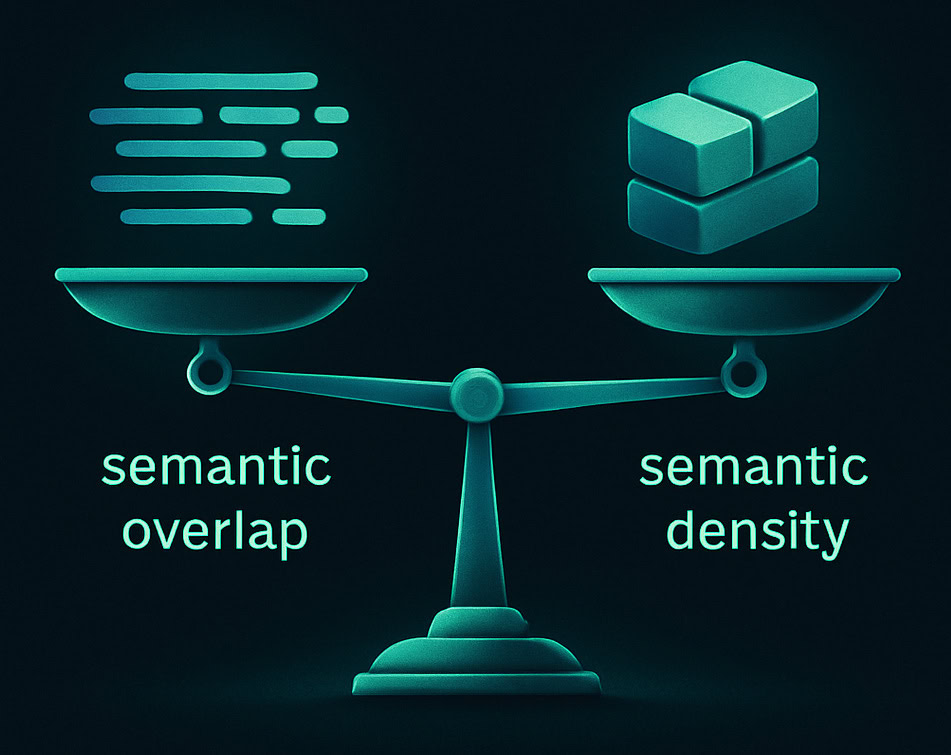
That brings us to two factors most people don’t think about much, but which are quickly becoming essential: semantic density and semantic overlap. They’re closely related, often confused, but in practice, they drive very different outcomes in GenAI retrieval. Understanding them, and learning how to balance them, may help shape the future of content optimization. Think of them as part of the new on-page optimization layer.

Image Credit:: Duane Forrester

Semantic density is about meaning per token. A dense block of text communicates maximum information in the fewest possible words. Think of a crisp definition in a glossary or a tightly written executive summary. Humans tend to like dense content because it signals authority, saves time, and feels efficient.

Semantic overlap is different. Overlap measures how well your content aligns with a model’s latent representation of a query. Retrieval engines don’t read like humans. They encode meaning into vectors and compare similarities. If your chunk of content shares many of the same signals as the query embedding, it gets retrieved. If it doesn’t, it stays invisible, no matter how elegant the prose.

This concept is already formalized in natural language processing (NLP) evaluation. One of the most widely used measures is BERTScore (https://arxiv.org/abs/1904.09675), introduced by researchers in 2020. It compares the embeddings of two texts, such as a query and a response, and produces a similarity score that reflects semantic overlap. BERTScore is not a Google SEO tool. It’s an open-source metric rooted in the BERT model family, originally developed by Google Research, and has become a standard way to evaluate alignment in natural language processing.

Now, here’s where things split. Humans reward density. Machines reward overlap. A dense sentence may be admired by readers but skipped by the machine if it doesn’t overlap with the query vector. A longer passage that repeats synonyms, rephrases questions, and surfaces related entities may look redundant to people, but it aligns more strongly with the query and wins retrieval.

In the keyword era of SEO, density and overlap were blurred together under optimization practices. Writing naturally while including enough variations of a keyword often achieved both. In GenAI retrieval, the two diverge. Optimizing for one doesn’t guarantee the other.

This distinction is recognized in evaluation frameworks already used in machine learning. BERTScore, for example, shows that a higher score means greater alignment with the intended meaning. That overlap matters far more for retrieval than density alone. And if you really want to deep-dive into LLM evaluation metrics, this article is a great resource.

Generative systems don’t ingest and retrieve entire webpages. They work with chunks. Large language models are paired with vector databases in retrieval-augmented generation (RAG) systems. When a query comes in, it is converted into an embedding. That embedding is compared against a library of content embeddings. The system doesn’t ask “what’s the best-written page?” It asks “which chunks live closest to this query in vector space?”

This is why semantic overlap matters more than density. The retrieval layer is blind to elegance. It prioritizes alignment and coherence through similarity scores.

Chunk size and structure add complexity. Too small, and a dense chunk may miss overlap signals and get passed over. Too large, and a verbose chunk may rank well but frustrate users with bloat once it’s surfaced. The art is in balancing compact meaning with overlap cues, structuring chunks so they are both semantically aligned and easy to read once retrieved. Practitioners often test chunk sizes between 200 and 500 tokens and 800 and 1,000 tokens to find the balance that fits their domain and query patterns.

Microsoft Research offers a striking example. In a 2025 study analyzing 200,000 anonymized Bing Copilot conversations, researchers found that information gathering and writing tasks scored highest in both retrieval success and user satisfaction. Retrieval success didn’t track with compactness of response; it tracked with overlap between the model’s understanding of the query and the phrasing used in the response. In fact, in 40% of conversations, the overlap between the user’s goal and the AI’s action was asymmetric. Retrieval happened where overlap was high, even when density was not. Full study here.

This reflects a structural truth of retrieval-augmented systems. Overlap, not brevity, is what gets you in the answer set. Dense text without alignment is invisible. Verbose text with alignment can surface. The retrieval engine cares more about embedding similarity.

This isn’t just theory. Semantic search practitioners already measure quality through intent-alignment metrics rather than keyword frequency. For example, Milvus, a leading open-source vector database, highlights overlap-based metrics as the right way to evaluate semantic search performance. Their reference guide emphasizes matching semantic meaning over surface forms.

The lesson is clear. Machines don’t reward you for elegance. They reward you for alignment.

There’s also a shift in how we think about structure needed here. Most people see bullet points as shorthand; quick, scannable fragments. That works for humans, but machines read them differently. To a retrieval system, a bullet is a structural signal that defines a chunk. What matters is the overlap inside that chunk. A short, stripped-down bullet may look clean but carry little alignment. A longer, richer bullet, one that repeats key entities, includes synonyms, and phrases ideas in multiple ways, has a higher chance of retrieval. In practice, that means bullets may need to be fuller and more detailed than we’re used to writing. Brevity doesn’t get you into the answer set. Overlap does.

If overlap drives retrieval, does that mean density doesn’t matter? Not at all.

Overlap gets you retrieved. Density keeps you credible. Once your chunk is surfaced, a human still has to read it. If that reader finds it bloated, repetitive, or sloppy, your authority erodes. The machine decides visibility. The human decides trust.

What’s missing today is a composite metric that balances both. We can imagine two scores:

Semantic Density Score: This measures meaning per token, evaluating how efficiently information is conveyed. This could be approximated by compression ratios, readability formulas, or even human scoring.

Semantic Overlap Score: This measures how strongly a chunk aligns with a query embedding. This is already approximated by tools like BERTScore or cosine similarity in vector space.

Together, these two measures give us a fuller picture. A piece of content with a high density score but low overlap reads beautifully, but may never be retrieved. A piece with a high overlap score but low density may be retrieved constantly, but frustrate readers. The winning strategy is aiming for both.

Imagine two short passages answering the same query:

Dense version: “RAG systems retrieve chunks of data relevant to a query and feed them to an LLM.”

Overlap version: “Retrieval-augmented generation, often called RAG, retrieves relevant content chunks, compares their embeddings to the user’s query, and passes the aligned chunks to a large language model for generating an answer.”

Both are factually correct. The first is compact and clear. The second is wordier, repeats key entities, and uses synonyms. The dense version scores higher with humans. The overlap version scores higher with machines. Which one gets retrieved more often? The overlap version. Which one earns trust once retrieved? The dense one.

Let’s consider a non-technical example.

Dense version: “Vitamin D regulates calcium and bone health.”

Overlap‑rich version: “Vitamin D, also called calciferol, supports calcium absorption, bone growth, and bone density, helping prevent conditions such as osteoporosis.”

Both are correct. The second includes synonyms and related concepts, which increases overlap and the likelihood of retrieval.

This Is Why The Future Of Optimization Is Not Choosing Density Or Overlap, It’s Balancing Both

Just as the early days of SEO saw metrics like keyword density and backlinks evolve into more sophisticated measures of authority, the next wave will hopefully formalize density and overlap scores into standard optimization dashboards. For now, it remains a balancing act. If you choose overlap, it’s likely a safe-ish bet, as at least it gets you retrieved. Then, you have to hope the people reading your content as an answer find it engaging enough to stick around.

The machine decides if you are visible. The human decides if you are trusted. Semantic density sharpens meaning. Semantic overlap wins retrieval. The work is balancing both, then watching how readers engage, so you can keep improving.

More Resources:


This post was originally published on Duane Forrester Decodes.


Featured Image: CaptainMCity/Shutterstock

https://www.searchenginejournal.com/semantic-overlap-vs-density-finding-the-balance-that-wins-retrieval/554251/


Google AI Mode Adds Agentic Booking, Expands To More Countries via @sejournal, @MattGSouthern

Google is adding agentic booking features to AI Mode in Search, beginning with restaurant reservations for U.S. Google AI Ultra subscribers enrolled in Labs.

What’s New

Booking Reservations

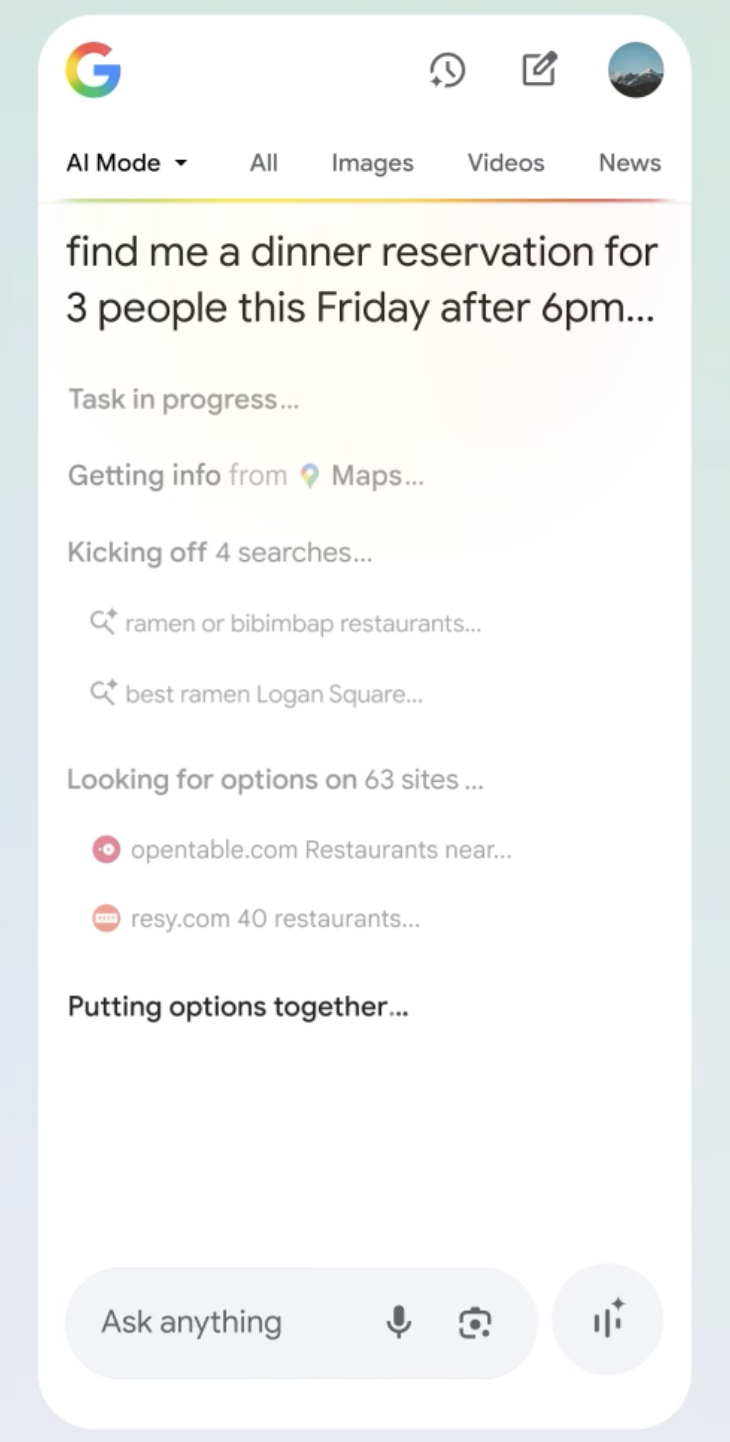
AI Mode can interpret a detailed request, check real-time availability across reservation sites, and link you to the booking page to complete the task.

For businesses, that shifts more discovery and conversion activity inside Google’s surfaces.

Robby Stein wrote on The Keyword:

“We’re starting to roll out today with finding restaurant reservations, and expanding soon to local service appointments and event tickets.”

Screenshot from: blog.google/products/search/ai-mode-agentic-personalized/, August 2025.

Planning Features

Google is introducing planning features that make results easier to share and tailor queries.

In the U.S., you can share an AI Mode response with others so they can ask follow-ups and continue research on their own, and you can revoke the link at any time.

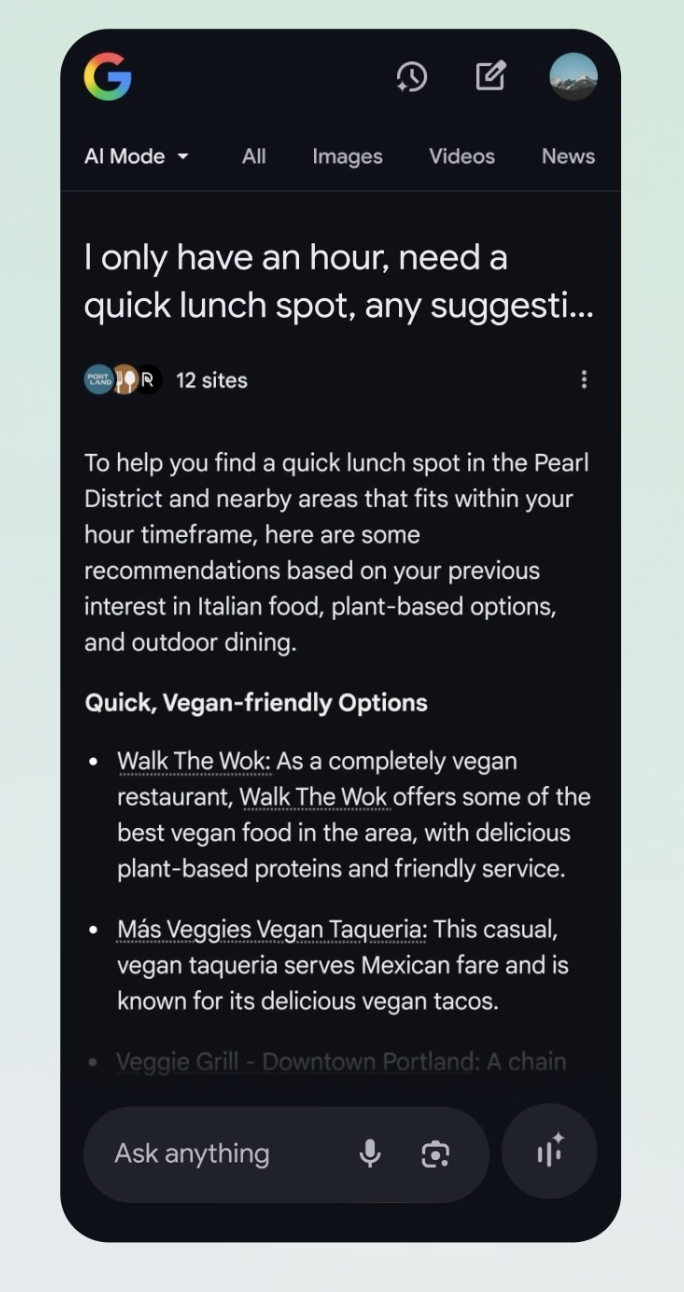
Screenshot from: blog.google/products/search/ai-mode-agentic-personalized/, August 2025.

Separately, U.S. users who opt in to the Labs experiment can receive personalized dining suggestions informed by prior conversations and interactions in Search and Maps, with controls in Google Account settings.

How It Works

Under the hood, Google cites live web browsing via Project Mariner, partner integrations, and signals from the Knowledge Graph and Maps.

Named partners include OpenTable, Resy, Tock, Ticketmaster, StubHub, SeatGeek, and Booksy. Dining is first; local services and ticketing are next on the roadmap.

Availability

Availability is gated. Agentic reservations are limited to Google AI Ultra subscribers in the U.S. through the “Agentic capabilities in AI Mode” Labs experiment.

Personalization is U.S. and opt-in, with dining topics first. Link sharing is available in the U.S. Global access to AI Mode is expanding to more than 180 countries and territories in English, with additional languages planned.

Looking Ahead

AI Mode is moving from answer generation to task completion.

If your category relies on reservation or ticketing partners, verify inventory accuracy, hours, and policies now, and make sure your structured data and Business Profile attributes are clean.

Track how bookings and referrals appear in analytics as Google widens coverage to more tasks and regions.

https://www.searchenginejournal.com/google-ai-mode-adds-agentic-booking-expands-to-more-countries/554345/


Ask An SEO: Should Small Brands Go All In On TikTok For Audience Growth? via @sejournal, @MordyOberstein

This week’s Ask An SEO question is about whether small brands should prioritize TikTok over Google to grow their audience:

“I keep hearing that TikTok is a better platform for small brands with an easier route to an audience. Do you think that Google is still relevant, or should I go all in on TikTok?”

The short answer to your question is that you do not want to pigeonhole your business into one channel, no matter the size. There’s also no such thing as an “easier” way. They are all hard.

I’m going to get the obvious out of the way so we can get to something beyond the usual answers to this question.

Your brand should be where your audience is.

Great, now that we didn’t spend four paragraphs saying the same thing that’s been said 100 times before, let me tell you something you want to consider beyond “be where your audience is.”

It’s Not About Channel, It’s About Traction

I have a lot of opinions here, so let me just “channel” my inner Big Lebowski and preface this with … this is just my opinion, man.

Stop thinking about channels. That’s way down the funnel (yet marketers make channels the seminal question all the time).

Start thinking about traction. How do you generate the most traction?

When I say “traction,” what I really mean is how to start resonating with your audience so that the “chatter” and momentum about who you are compound so that new doors of opportunity open up.

The answer to that question is not, “We will focus on TikTok.”

The answer is also not, “We will focus on Google.”

The answer is also not, “We will focus on YouTube.”

I could go on.

Now, there is another side to this: resources and operations. The question is, how do you balance traction with the amount of resources you have?

For smaller brands, I would think about: What can you do to gain traction that bigger brands have a hard time with?

For example, big brands have a very hard time with video content. They have all sorts of production standards, operations, and a litany of people who have a say, who shouldn’t even be in sniffing distance of having a say.

They can’t simply turn on their phone, record a video, and share something of value.

You can.

Does that mean you should focus on TikTok?

Nope.

It means you should think about what you can put out there that would resonate and help your audience, and does that work for the format?

If so, you may want to go with video shorts. I’m not sure why you would limit that to just TikTok.

Also, if your age demographic is not on TikTok, don’t do that. (“Being where your audience is” is a fundamental truth. Although I think the question is more about being in tune with your audience overall than “being where they are.” If you’re attuned to your audience, then you would know where they are and where to go just naturally.)

I’ll throw another example at you.

Big brands have a hard time communicating with honesty, transparency, and a basic level of authenticity. As a result, a lot of their content is “stale,” at best.

In this instance, trying to generate traction and even traffic by writing more authentic content that speaks to your audience, and not at them, seems quite reasonable.

In other words, the question is, “What resonates with your audience and what opportunities can you seize that bigger brands can’t?”

It’s a framework. It’s what resonates + what resources do you have + what vulnerabilities do the bigger brands in your vertical have that you can capitalize on.

There’s no one-size-fits-all answer to that. Forget your audience for a second, where are the vulnerabilities of the bigger brands in your space?

They might be super-focused on TikTok and have figured out all of the production hurdles I mentioned earlier, but they might not be focused on text-based content in a healthy way, if at all.

Is TikTok “easier” in that scenario?

Maybe not.

Don’t Pigeonhole Yourself

Every platform has its idiosyncrasies. One of the problems with going all-in on a platform is that your brand adopts those idiosyncrasies.

If I were all about Google traffic, my brand might sound like (as too many do) “SEO content.” Across the board. It all seeps through.

The problem with “channels” to me is that it produces a mindset of “optimizing” for the channel. When that happens – which inevitably it does (just look at all the SEO content on the web) – the only way out is very painful.

While you might start with the right mindset, it’s very easy to lose your brand’s actual voice along the way.

That can pigeonhole your brand’s ability to maneuver as time goes on.

For starters, one day what you had on TikTok may no longer exist (I’m just using TikTok as an example).

Your audience may evolve and grow older with you, and move to other forms of content consumption. The TikTok algorithm may gobble up your reach one day. Who knows.

What I am saying is, it is possible to wake up one day and what you had with a specific channel doesn’t exist anymore.

That’s a real problem.

That very real problem gets compounded if your overarching brand voice is impacted by your channel approach. Which it often is.

Now, you have to reinvent the wheel, so to speak.

Now, you have to adjust your channel approach (and never leave all your eggs in one basket), and you have to find your actual voice again.

This whole time, you were focused on speaking to a channel and what the channel demanded (i.e., the algorithm) and not your audience.

All of this is why I recommend a “traction-focused” approach. If you’re focused on traction, then this whole time, you’ve been building yourself up to become less and less reliant on the channel.

If you’re focused on traction, which inherently focuses on resonance, people start to come to you. You become a destination that people seek out, or, at a minimum, are familiar with.

That leaves you less vulnerable to changes within a specific channel.

It also helps you perform better across other channels. When you resonate and people start to recognize you, it makes performing easier (and less costly).

Let’s play it out.

You start creating material for TikTok, but you do it with a traction, not a channel mindset.

The content you produce starts to resonate. People start talking about you, tagging you on social, mentioning you in articles, etc.

All of that would, in theory, help your web content become more visible within organic search and your brand overall more visible in large language models (LLMs), no?

Let’s play it out even more.

One day, TikTok shuts down.

Now, you have to switch channels (old TV reference).

If you focused more on traction:

  1. You should have more direct traffic or branded search traffic than you had when you started your “TikTok-ing.”
  2. You should have more cache to rank better if you decide to create content for Google Search (just as an example).

The opposite is true as well. If Google shut down one day, and you had to move to TikTok, you would:

  1. Have more direct traffic than when you started to focus on Google.
  2. Have more cache and awareness to start building a following on TikTok.

It’s all one song.

Changing The Channel

I feel like, and this is a bit of a controversial take (for some reason), the less you “focus” on channels, the better.

The more you see a channel as less of a strategy and more of a way to actualize the traction you’re looking to create, the better off you’ll be.

You’ll also have an easier time answering questions like “Which channel is better?”.

To reiterate:

  • Don’t lose your brand voice to any channel.
  • Build up traction (resonance) so that when a channel changes, you’re not stuck.
  • Build up traction so that you already have cache when pivoting to the new channel.
  • It’s better to be a destination than anything.
  • All of this depends on your vertical, your resources, your competition, and most importantly, what your audience needs from you.

The moment you think beyond “channels” is the moment you start operating with a bit more clarity about channels. (It’s a kind of “there is no spoon” sort of thing.)

More Resources:


Featured Image: Paulo Bobita/Search Engine Journal

https://www.searchenginejournal.com/ask-an-seo-should-small-brands-go-all-in-on-tiktok-for-audience-growth/551676/