Common Hosting Defenses Ineffective Against WordPress Threats via @sejournal, @martinibuster

Patchstack published a case study that examined how well Cloudflare and other general firewall and malware solutions protected WordPress websites from common vulnerability threats and attack vectors. The research showed that while general solutions stopped threats like SQL injection or cross-site scripting, a dedicated WordPress security solution consistently stopped WordPress-specific exploits at a significantly higher rate.

WordPress Vulnerabilities

Due to the popularity of the WordPress platform, WordPress plugins and themes are a common focus for hackers, and vulnerabilities can quickly be exploited in the wild. Once proof-of-concept code is public, attackers often act within hours, leaving website owners little time to react.

This is why it is critical to be aware of the security provided by a web host and of how effective those solutions are in a WordPress environment.

Methodology

Patchstack explained their methodology:

“As a baseline, we have decided to host “honeypot” sites (sites against which we will perform controlled pentesting with a set of 11 WordPress-specific vulnerabilities) with 5 distinct hosting providers, some of which have ingrained features presuming to help with blocking WordPress vulnerabilities and/or overall security.

In addition to the hosting provider’s security measures and third-party providers for additional measures like robust WAFs or other patching providers, we have also installed Patchstack on every site, with our test question being:

  • How many of these threats will bypass firewalls and other patching providers to ultimately reach Patchstack?
  • And will Patchstack be able to block them all successfully?”

Testing process

Each website was set up the same way, with identical plugins, versions, and settings. Patchstack used a “exploitation testing toolkit” to run the same exploit tests in the same order on every site. Results were checked automatically and by hand to see if attacks were stopped, and whether the block came from the host’s defenses or from Patchstack.

General Overview: Hosting Providers Versus Vulnerabilities

The Patchstack case study tested five different configurations of security defenses, plus Patchstack.

1. Hosting Provider A Plus Cloudflare WAF

2. Hosting Provider B + Firewall + Monarx Server and Website Security

3. Hosting Provider C + Firewall + Imunify Web Server Security

4. Hosting Provider D + ConfigServer Firewall

5. Hosting Provider E + Firewall

The result of the testing showed that the various hosting infrastructure defenses failed to protect the majority of WordPress-specific threats, catching only 12.2% of the exploits. Patchstack caught 100% of all exploits.

Patchstack shared:

“2 out of the 5 hosts and their solutions failed to block any vulnerabilities at the network and server levels.

1 host blocked 1 vulnerability out of 11.

1 host blocked 2 vulnerabilities out of 11.

1 host blocked 4 vulnerabilities out of 11.”

Cloudflare And Other Solutions Failed

Solutions like Cloudflare WAF or bundled services such as Monarx or Imunify failed to consistently address WordPress specific vulnerabilities.

Cloudflare’s WAF stopped 4 of 11 exploits, Monarx blocked none, and Imunify did not prevent any WordPress-specific exploits. Firewalls such as ConfigServer, which are widely used in shared hosting environments, also failed every test.

These results show that while those kinds of products work reasonably well against broad attack types, they are not tuned to the specific security issues common to WordPress plugins and themes.

Patchstack is created to specifically stop WordPress plugin and theme vulnerabilities in real time. Instead of relying on static signatures or generic rules, it applies targeted mitigation through virtual patches as soon as vulnerabilities are disclosed, before attackers can act.

Virtual patches are mitigation for a specific WordPress vulnerability. This offers protection to users while a plugin or theme developer can create a patch for the flaw. This approach addresses WordPress flaws in a way hosting companies and generic tools can’t because they rarely match generic attack patterns, so they slip past traditional defenses and expose publishers to privilege escalation, authentication bypasses, and site takeovers.

Takeaways

  • Standard hosting defenses fail against most WordPress plugin vulnerabilities (87.8% bypass rate).
  • Many providers claiming “virtual patching” (like Monarx and Imunify) did not stop WordPress-specific exploits.
  • Generic firewalls and WAFs caught some broad attacks (SQLi, XSS) but not WordPress-specific flaws tied to plugins and themes.
  • Patchstack consistently blocked vulnerabilities in real time, filling the gap left by network and server defenses.
  • WordPress’s plugin-heavy ecosystem makes it an especially attractive target for attackers, making effective vulnerability protection essential.

The case study by Patchstack shows that traditional hosting defenses and generic “virtual patching” solutions leave WordPress sites vulnerable, with nearly 88% of attacks bypassing firewalls and server-layer protections.

While providers like Cloudflare blocked some broad exploits, plugin-specific threats such as privilege escalation and authentication bypasses slipped through.

Patchstack was the only solution to consistently block these attacks in real time, giving site owners a dependable way to protect WordPress sites against the types of vulnerabilities that are most often targeted by attackers.

According to Patchstack:

“Don’t rely on generic defenses for WordPress. Patchstack is built to detect and block these threats in real-time, applying mitigation rules before attackers can exploit them.”

Read the results of the case study by Patchstack here.

Featured Image by Shutterstock/tavizta

https://www.searchenginejournal.com/common-hosting-defenses-ineffective-against-wordpress-threats/554320/


Inspiro WordPress Theme Vulnerability Affects Over 70,000 Sites via @sejournal, @martinibuster

A vulnerability advisory was published for the Inspiro WordPress theme by WPZoom. The vulnerability arises due to a missing or incorrect security validation that enables an unauthenticated attacker to launch a Cross-Site Request Forgery (CSRF) attack.

Cross-Site Request Forgery (CSRF)

A CSRF vulnerability in the context of a WordPress site is an attack that relies on a user with admin privileges clicking a link, which in turn leverages that user’s credentials to execute a malicious action. The vulnerability has been assigned a CVSS threat rating of 8.1.

The advisory issued by Wordfence WordPress security company warned:

“This makes it possible for unauthenticated attackers to install plugins from the repository via a forged request granted they can trick a site administrator into performing an action such as clicking on a link.”

The vulnerability affects Inspiro theme versions up to and including 2.1.2. Users are advised to update their theme to the latest version.

Featured Image by Shutterstock/Kazantseva Olga

https://www.searchenginejournal.com/inspiro-wordpress-theme-vulnerability-affects-over-70000-sites/554297/


Google Quietly Announces Search Partner Network Placement Visibility via @sejournal, @brookeosmundson

Google quietly rolled out a change advertisers have wanted for years: site-level reporting for the Search Partner Network.

Until now, advertisers could only opt in or out, with little understanding of where their ads actually showed.

This update finally gives visibility into where budgets are spent outside of Google.

Google lists this as an August 2025 update in its Help Center, however it wasn’t announced widespread.

Read on to understand the update from Google, how advertisers are reacting, and what you can do with this new level of information.

What Changed in Search Partner Reporting?

The new reporting applies to Search, Shopping, and App campaigns. You’ll now see which partner sites served your ads and how many impressions each one received.

Think of it as the kind of placement data we already get in Performance Max, just extended to Search Partners.

This update follows other moves Google has made to address long-standing concerns about partner quality.

Earlier this year, they introduced brand safety pre-screening options with IAS, DoubleVerify, and Zefr. They also said parked domains will be opted out by default before the end of 2025.

This visibility layer feels like the missing piece that makes the rest of those updates more usable.

How Are Advertisers Reacting to This Update?

The update on Search Partner Network reporting was first found by Anthony Higman, who took to X (formerly Twitter) to share his opinion.

Higman stated:

Still Most Likely Wont Be Participating In The Search Partner Network But This Is Unprecedented And What ALL Advertisers Have Been Requesting For Decades! Honestly NEVER Thought I Would See This Day.”

Others gave some versioning mixture of applauding Google for giving data to advertisers that they’ve been asking for for years, while also being somewhat skeptical.

Mike Ryan replied to Higman with his thoughts:

I mean, good step but also, it’s the PMax version: impression data only.

Aaron Levy shared his thoughts on LinkedIn, stating that this is a major step in the right direction for Google.

Why This Matters & How to Take Action

Without Search Partner Network reporting, it was tough to justify opting in. Now advertisers finally have data to audit where ads run, decide if it fits brand standards, and see if partner traffic adds any real value.

That said, the update is only as good as the action that advertisers take with the information available.

Some sites won’t align with brand guidelines. Others may generate clicks but fail to drive quality conversions.

The difference is you can now point to actual data when making decisions, rather than relying on gut feel.

Here’s some quick pointers to make this update actionable:

  • Run a quick placement audit. Pull the report and check for sites that don’t align with your brand. Exclude what’s clearly not a fit.
  • Look beyond impressions. While this reporting is only limited to impressions, use your own conversion data to figure out which placements are driving useful traffic versus noise.
  • Revisit opt-in of campaigns. Many advertisers avoided Search Partners altogether because of the black box. Now it may be worth testing again, but do it with defined guardrails and success metrics.
  • Pressure test Smart Bidding. Google leans on Smart Bidding to balance Search Partner performance, but don’t assume it’s perfect. Keep an eye on conversion quality and modeled conversions before scaling.

Final Thoughts

If you’ve been skeptical of Search Partners, this update is a chance to take another look with data on your side.

If you’ve already been opted in, you finally have a way to prove which placements help your campaigns and which ones don’t.

Bottom line: advertisers now have a long overdue view into the Search Partner Network. With more visibility comes a bit more control, and smarter conversations about whether Search Partners deserve a place in your Search campaigns.

Will you be opting into Search Partner Network with this new reporting update?

https://www.searchenginejournal.com/google-quietly-announces-search-partner-network-placement-visibility/554294/


The B2B SEO Trap: Why High-Intent Visibility Can Still Underperform via @sejournal, @coreydmorris

In B2B SEO, typically, the ultimate goal is to attract high-intent searchers who convert into qualified leads.

But, not all high-intent visibility translates to sales-ready traffic, especially in long sales cycles or complex buying journeys.

As we get deeper into an era of diminishing importance of keywords that translate directly into attributable clicks, a focus on quality of traffic is as important as ever.

Don’t get me wrong. Quality has long been a critical component and key performance indicator (KPI) in the sense that most of us know our conversion rates and stages of the funnel someone might be in related to intent with B2B and lead generation.

However, now, as much as ever, we have to scrutinize intent and the traffic quality even more.

When SEO teams over-prioritize high-intent visibility and focus under the false assumption that intent equals urgency, we can find that we’re not getting the conversions or leads that we expect.

In this article, I’m unpacking seven ways to help go deeper with mapping visibility to actual funnel stages, differentiating decision-makers vs. influencers, and building SEO content that nurtures, qualifies, and educates before the handoff to sales.

1. The Myth: “If It’s A Bottom-Of-Funnel Topic, The Traffic Is Ready To Convert”

While we may think about our website, our content, and analytics data in customer journeys and conversion funnels, our target audience doesn’t.

Maybe my nerdy search brain thinks that way when I’m consuming content on a website I’m interested in, but most of the world doesn’t.

There are too many variables that impact someone’s conversion decision to fully unpack here. I can personally tell you that a couple of times, I filled out forms while lying on the floor next to one of my kids in bed, falling asleep.

And, other times, I sat with a tab open on my giant desktop work monitor for months before eventually finding that tab again and filling out the form.

Those are two extreme examples, but as more possible ways to be found (e.g., AI search) enter play, we’re going to see myriad behaviors and paths that we couldn’t have anticipated just a few years ago.

Things are not going to make sense in a simple way, and what might seem like a home run conversion will be frustrating when you dig into the data, and things that might have felt like top of funnel that convert quickly will be equally (but pleasantly) surprising as well.

2. B2B Searchers Are Often Researching, Comparing, Or Gathering Info, Not Buying

Beyond the intent challenges and varying entry points and sources I noted above, we have a hand to play at times as well in how and where someone converts.

Our best converting content can still be standing in the way of getting the actual conversion. Just like the head scratchers that we might find when someone converts quickly without seemingly spending much time on the site or in “research” mode.

With more answers being given within search engines and large language models (LLMs), a lot of the research is done before someone gets to our site.

That being said, whether our content is helping inform AI, getting us found off-site, or to do the traditional education work on our site, we have to understand that, even on what might seem like a high intent page, someone might still be in research and information gathering mode.

They might be seeking pricing (if we disclose it) or building their own deck of us, plus competitors, to help with their own decisions for buying or outreach.

When we make too many assumptions, put someone on a singular navigation path, or take away options, we risk losing the opportunity for them to continue their research journey.

We’ve got to find a balance between prominent calls-to-action (CTAs) and long-form content so there’s more flexibility for the user based on what their intent is in that visitor or session that we worked so hard to get.

3. How To Differentiate Between User Intent And Sales-Readiness

I’ve talked a lot about intent already. What I haven’t unpacked is how sales-ready someone is.

Our brand story, content, and user experience can be persuasive and do the job of getting a form submission or phone call.

However, if someone isn’t “sales-ready,” they likely are going to consume everything up to the point of a conversion action, then leave. They may come back often up to that point and leave.

This might lead us to think there’s something wrong with the form, or the CTA, or the content itself. Sure, that could be the case and should be validated. But, it could also be that they simply aren’t ready to buy.

As an agency owner, I also operate a B2B business that relies on lead generation. I can personally validate that while we have received a lot of seemingly bottom-of-the-funnel traffic, my team has been told by prospects that they were ready to buy, but not ready to talk to anyone, as they were told to slow down the process or await a final budget approval before reaching out.

It’s frustrating, but that’s seemingly the nature of the world economically these past couple of years (probably not a “hot take”).

4. Why One-Size-Fits-All CTAs (E.g., “Request A Quote”) Often Fail In B2B

I admit that I’ve been guilty of slapping the one-size-fits-all, generic CTA in the footer or sidebar of all pages of a site.

As I noted earlier, we need to expect the unexpected with matching intent to content and funnel levels. We should definitely review and evaluate our CTAs.

In line with my note above about someone possibly being close to a conversion but not sales-ready, if we have other areas of value we can provide like additional content they can subscribe to or ways to engage with us to get further acquainted (ex: webinars, Q&As, etc), that don’t involve a direct sales process, then we can further engage with them and stay in front of them in a way that is welcome based on where they are right now.

5. Using Content To Build Trust And Qualification, Not Just Capture Form Fills

When we rush someone to a form submission and they’re not ready to buy, not prepared for the sales process, or qualified, we often get feedback from sales about discrepancies related to marketing qualified leads (MQLs) vs. sales qualified leads (SQLs) or how leads are accepted by sales.

Wasting time on sales internally, while frustrating, someone who wasn’t prepared for (or qualified for) the process is a loss for both sides.

Building trust through quality content, differentiation, setting expectations on what happens after the form submission, and other trust signals like transparency of pricing can go a long way to ensuring higher rates of conversions to customers.

Don’t forget that quality trumps quantity if we look at additional metrics and KPIs in our marketing-to-revenue process.

6. How To Structure B2B Content Around Intent Clusters, Not Just Funnel Stages

If you aren’t convinced yet from what I’ve shared about how user behavior can differ from what we might expect or predict, then maybe thinking about content specifically will help.

In the zero-click searches and AI search push that has taken focus away from specific keyword and has put it more on visibility, one piece consistently is important: the content you create.

In topics, clusters, or however you want to think about how the content is organized on your website, you still need to focus on how it is presented to the user.

Starting with the user intent and mapped to where they are in the funnel, then working backwards, we can see where we have gaps in content and what we need to support answering all questions possible and moving the prospect forward in the process.

This will serve you well for search engines today and LLMs and AI-generated search results today and tomorrow.

While we used to (and in some cases still approach it today) as topics driven by keywords, I’m advocating for thinking about topics in how someone might be moving through a customer journey.

What questions are they asking at the phase they are in? Have we anticipated everything? Have we accidentally assumed too much about their knowledge or their sales-readiness?

We’re not going to be able to think of everything. Much like long-tail keywords and queries, we can see people doing a lot more research and probing in AI research.

My company got a lead from ChatGPT a few months ago, and we could see that they visited our site seven times from ChatGPT in the process before eventually filling out our form. This is not user behavior that we would have planned for or anticipated just a few years ago.

7. Creating SEO Content For Both Decision-Makers And Gatekeepers

We can’t control who comes to our website. Humans aren’t as blockable as robots and web crawlers. However, we don’t need to be worried about those who might not be the ultimate prospect or decision-maker.

Whether you’re seeing traffic from AI engines, search engines, or those that never convert and seem like unqualified human visitors, I encourage you to still work on building your authority position, be helpful with your content, and to know that you might be helping get critical information to gatekeepers (human or systems) that go further upstream to a human who is a decision-maker.

Whether you’re educating the search committee for a Request for Proposal (RFP) process, an assistant or intern doing field research, or something automated trying to learn so it can feed good info to a decision-maker, it isn’t wasted effort, even though narrow thinking and reviewing of conversion metrics at the bottom of the funnel may make it seem that way.

Final Thoughts

Customer journeys, funnel thinking, search intent, and how it all works together in generating conversions and leads for B2B focuses can be complex and hard to track. It is getting even harder.

That doesn’t mean that we should give up or try to force everyone through a narrow funnel or one-size-fits-all approach.

We can’t predict all the ways that our content will be understood, consumed, and engaged with.

What we can do is be helpful, leverage a strong brand, be transparent, and do everything we can to present users (and other sources) with a complete picture of our products, services, and how we are the right fit (or not) for our website visitors.

Leveraging our moments of visibility to generate quality traffic, but understanding that the bottom of the funnel isn’t a slam dunk to convert, and what it all can mean, can go a long way for engaging and re-engaging bottom of the funnel traffic to get every conversion we deserve.

More Resources:


Featured Image: vittaya pinpan/Shutterstock

https://www.searchenginejournal.com/the-b2b-seo-trap-why-high-intent-visibility-can-still-underperform/551751/


Quality Audiences: Why Lower Traffic Might Be Better via @sejournal, @rio_seo

There once was a time when digital marketers chased traffic.

The more traffic a website attracted, the more marketers felt satisfied and closer to attaining their goals.

But, this once golden metric is no longer a tell-tale sign of success.

Gone are the days of forecasting growth solely on the number of visitors coming to a website.

Today, lower traffic might actually be better than driving a plethora of unqualified, uninterested leads to your website.

Undoubtedly, consumer search behavior looks much different than it once did. AI is stealing click-throughs, third-party cookies are essentially disappearing, and audiences give more thought to whether to click through to a website.

Quality over quantity is the name of the game, and marketers are now shifting their focus towards driving better traffic rather than more traffic.

In this post, we’ll dissect why less traffic might be “more” and better for your business, how to shift your content marketing strategy to attract high-quality visitors, and share actionable insights for driving business results with your target audience.

The Traffic Trap: Why More Isn’t Always Better

At first thought, a high volume of traffic sounds ideal. The thought of hundreds of thousands of visitors flooding your site and purchasing your products or services would be a dream. But, that’s unfortunately not reality in most cases.

It’s a vanity metric that looks impressive in presentations but doesn’t necessarily move the needle when it comes to sales.

According to a recent study, the average website conversion rate across 14 different industries is a dismal 3.3%. That means for every 1,000 visitors, fewer than 25 of those will actually convert. And, depending on your sector, your conversion rate might be even lower.

Additionally, consider if your content isn’t optimized for the right keywords. You could be attracting traffic with zero intention or motivation to convert.

In this case, these searchers are likely to bounce once they realize what you’re selling, they have no interest in buying.

The numbers may look inflated, but if the quality is lacking, those numbers are meaningless.

At the end of the day, sales and revenue are the ultimate goals for any business. Drawing in the right audience leads you closer to that goal, even if the numbers aren’t legendary.

Because here’s an uncomfortable truth: Traffic is easy to obtain; quality traffic is hard.

AI Has Forever Changed The Search Landscape

There’s been much discussion around the impact of AI in the search landscape, and even some of the most seasoned SEOs are scratching their heads, wondering what to do.

Google’s rollout of AI Overviews and the rising use of ChatGPT and other generative AI tools have significantly altered the way users search for products and services.

Searchers no longer need to click through on a website to get the information they need. Instead, they’re receiving AI-generated summaries that often answer their question right away.

This has resulted in businesses across the board seeing a notable decrease in traffic. Even top-ranking content that’s been thriving in the search engine results pages (SERPs) for years has taken a hit.

Bustle, the entertainment and lifestyle site, saw search traffic behave erratically last spring, around the time AI summaries were introduced. Some stories surged to 150,000-300,000 views, while most others barely cracked 1,000.

In turn, SEOs and content marketers are being forced to face a new reality – what many are referring to as “zero-click search 2.0.”

But, just as we have done with all the previous major changes in the search landscapes, the good news is we’ll live and we’ll adapt.

It takes a mindset shift, where instead of relying on high-ranking content to drive traffic, the new goal must be to create valuable, intent-focused content that targets long-tail queries, offers helpful information, solves a problem, and is well-written (which means not relying on AI to fully draft content for you).

Subject matter experts are in higher demand than ever before as relevance and trust become more paramount than ever before.

The Power Of Qualified Traffic

When we talk about qualified traffic, it’s important to clearly define what exactly this means, as it can have divergent definitions.

For the purposes of this post, quality audiences include searchers who:

  • Match and align with your target personas and demographic.
  • Arrive with specific intent (ready to make a purchase or are further along in the sales journey).
  • Engage meaningfully with your content (visiting multiple pages on your site, higher dwell times).
  • Often find you through word-of-mouth, email, referrals, reviews, or targeted search.
  • Use long-tail queries to help them solve a problem they’re facing.

Now, think about the content you’re creating and what’s in your pipeline.

If you’re drafting generic blog posts, surface-level articles, or are relying entirely on AI to draft your content for you, you may be attracting visitors, but you likely aren’t motivating buyers.

The same can be said for advertising efforts that cast too wide of a net. The result? An influx of searchers that may have no intention of converting and no interest in your business.

Your traffic count may look great, but there’s no success behind drawing in these visitors.

Consider that an email marketing provider found that email marketing has an average return on investment (ROI) of $36 for every $1 spent.

It’s well known and documented that email marketing tends to be one of the highest drivers of ROI.

The reason for this is that your email audience is usually pre-qualified and opted in to receive communication from you. They know your business and what you sell, and are therefore more likely to take action.

Similarly, referral traffic and direct traffic often yield higher conversion rates than social media or display ads.

Getting the right people to your site is essential, and the tactics that accomplish this should be your primary focus.

Quality Content = Better Business Outcomes

There’s a reason why nearly half of technology companies say their content marketing budgets will grow this year. Because content works – when it’s done right.

Content shouldn’t be created to cast a wider net. It should be created with intentionality to grow your brand recognition, build trust with your audience, and offer the type of value that keeps people coming back.

Here’s how quality, helpful content focused on the right audience and pain points pays off:

1. Higher Conversion Rates

Personalized content is a powerful driver of consumer behavior.

In fact, 76% of people say tailored content influences their decision to consider a brand, and 78% say it makes them more likely to buy again.

This statistic highlights the need for content that’s personalized and targeted to searchers’ needs.

Content that speaks to a specific persona or pain point is more likely to convert than a pointless listicle that’s stuffed with basic information.

2. Improved Customer Lifetime Value (CLV)

You don’t want your customers to be one and done. Instead, you want them to come back to you any time the need arises. You want to be the brand they choose and trust over your competitors.

When you draft content that is deeply relevant, helps users understand your products, educates them on all your services, or guides them towards making a more informed decision, they’re likely to keep returning for more.

3. Lower Customer Acquisition Costs (CAC)

No salesperson wants to sit through a multi-year process, anxiously awaiting the day a prospect may or may not decide to move forward.

Targeted content and lower funnel content attract qualified leads that lead to shorter sales cycles and lower the cost to acquire a new customer.

This empowers sales teams to focus on closing rather than convincing, educating, or determining if a prospect is worth their while.

4. Stronger Brand Equity

When customers find your content to be valuable, they’re more likely to share your content with their followers on social media and refer you to their friends.

Bridging the gap between awareness and consideration means building trust and drafting insightful, research-backed content.

This is why content drafting can’t be left solely to AI but should be left in the hands of skilled human writers who’ve consulted subject matter experts to deliver the highest value content possible.

Content Quality Indicators

As aforementioned, traffic alone isn’t enough to measure the quality of your content. There are numerous signals that can help you assess whether your content is working.

A few key metrics content marketers should assess when evaluating the strength of their content marketing efforts include:

  • Bounce Rate: The bigger the bounce rate, the bigger the concern. According to Siege Media, a good bounce rate for a blog is 70%, with the average being 80%. Anything more, and there is likely a fatal flaw between content and audience expectations that should be examined.
  • Scroll Depth: Similar to bounce rate, it’s unhelpful if your browsers aren’t scrolling down enough to potentially become buyers. This could suggest myriad issues, such as your call to action (CTA) being too far down on the page or your content not resonating with your target audience.
  • Time on Page: Are customers coming to your website but leaving shortly after? Short sessions on your website may imply low engagement, or your content simply isn’t relevant to the audience. This is often the case when your keywords don’t align with search intent, which raises the importance of thorough keyword research.
  • Conversion Pathways: Each of your website pages likely has the goal of getting people to take action, whether that’s filling out a form, requesting a demo, or purchasing a product. If people aren’t clicking your CTAs, it’s important to assess what the problem is. Perhaps your CTA is the wrong color or doesn’t use compelling language. A/B testing can help you assess where the real problem lies.

These metrics help you understand not just how many people arrived, but how many stayed and why.

The Go-To Content Marketing Strategy To Drive Qualified Traffic

It’s time for a mind shift for content marketers. We’re not abandoning growth, and we’re not neglecting traffic, but we’re being more intentional about our goals.

More traffic doesn’t mean more sales. It’s time to redefine our strategies to secure success and highlight content marketing as a value-add. Here’s the new playbook for driving qualified traffic:

1. Redefine What Success Looks Like

Success looks different today than it did even a few years ago. Today, success is contingent on attracting quality leads, keeping people on your website, assessing the time to conversion, and digging into your content engagement rates.

We’re also looking at any red flags in user experience, such as long page load times, CTAs that are too far down, and intrusive ads popping up.

2. Segment Your Audience

Your target audience is likely diverse, which means they inherently have different needs and preferences.

To ensure your content hits the mark, it’s crucial to segment your audience appropriately by buyer personas, new versus returning users, behavioral signals, age, and more to ensure your content lands.

For example, a Gen Z customer searching for a financial services business will want vastly different information than a Boomer, who may be looking for information about retirement or estate planning.

3. Align Content With The Funnel

Content must be created for all stages of the funnel.

For example, a first-time buyer will likely want more awareness-level content, whereas someone at the decision stage likely wants to read case studies or product reviews.

Audit your existing content to ensure you have a healthy mix of content at each stage of the funnel, including:

  • Top of Funnel (ToFu): Awareness content that builds trust and captures attention (but should still target a specific persona).
  • Middle of Funnel (MoFu): Educational content that helps users compare solutions, such as whitepapers, ebooks, product one-pagers, and more.
  • Bottom of Funnel (BoFu): Case studies, reviews and testimonials, product demos, and more.

4. Invest In First-Party Data

Knowing who’s interested in your business can help you reach the right people at the right time.

First-party data is invaluable, and can be sourced through email subscribers, webinar attendees, and form fills.

These are the people your business wants to develop relationships with, and can do so through drip campaigns, feedback loops, and tailored content offers.

5. Optimize For Intent, Not Just Keywords

Informational keywords can be helpful, but they often aren’t going to lead to quick conversions.

It can be helpful to focus on human-centered SEO, long-tail keywords (which usually are specific and solve a problem), and other types of intent-based keywords.

Leverage third-party tools like Semrush, Ahrefs, or MarketMuse to uncover the why behind searches, how competitive search terms are, and how often they’re searched for.

Quality Will Win The Future Of Content Marketing

In a digital-first era that’s rife with competition, it’s necessary to differentiate your business from others.

While your competitors may be generating content quickly and at scale using AI, your brand can gain a competitive edge by doubling down on authenticity and building human-first content.

Lower traffic may be getting your business down, but it’s important to remember that doesn’t necessarily translate to lower value. In fact, for many brands, trimming the fat and focusing on quality audiences only leads to greater wins.

The next time you’re analyzing your data and notice a dip in traffic, there’s no need to get into panic mode. Ask yourself:

  • Did the right people visit?
  • Is our content useful?
  • Are these visitors driving growth?

After all, traffic is just a number.

More Resources:


Featured Image: Roman Samborskyi/Shutterstock

https://www.searchenginejournal.com/quality-audiences-why-lower-traffic-might-be-better/551293/


How AI Search Can Drive Sales & Boost Conversions [Webinar] via @sejournal, @brentcsutoras

AI search has completely changed the way customers make decisions. If you’re still just tracking data instead of driving sales from AI search, you are missing out.

Join Bart Góralewicz, Co-Founder of ZipTie.dev, on September 3, 2025, for an insightful webinar on how to map customer journeys in AI search and turn those insights into measurable sales.

What you will learn:

Why attend:

Brands that win in AI search are not just watching their metrics. They are understanding how customers discover and decide to buy. This session will give you the tools to drive higher conversions and grow revenue with AI search.

Register now to learn practical strategies you can apply right away. Can’t attend live? No problem! Sign up, and we will send you the recording.

https://www.searchenginejournal.com/ai-search-can-drive-sales-and-conversions/553647/


Standby As Google Cannibalizes Itself (While Also Devouring All Of Us) via @sejournal, @Kevin_Indig

In 2023, I wrote about a provocative “what if”: What if Google added an AI chatbot to Search, effectively cannibalizing itself?

Fast-forward to 2025, and it’s no longer hypothetical.

With AI Overviews (AIOs) and AI Mode, Google has not only eaten into its own search product, but it has also taken a big bite out of publishers, too.

Cannibalization is usually framed as a risk. But in the right circumstances, it can be a growth driver-or even a survival tactic.

In today’s Memo, I’m revisiting product cannibalization through a fresh AI-era lens, including:

  • What cannibalization really is (and why it’s not always bad).
  • Iconic examples from Netflix, Apple, Amazon, Google, and Instagram.
  • How Google’s AI shift meets the definition of self-cannibalization – and where it doesn’t.
  • The four big marketing implications if your brand cannibalizes itself in the AI-boom landscape (for premium subscribers).

Image Credit: Kevin Indig

Boost your skills with Growth Memo’s weekly expert insights. Subscribe for free!

Today’s Memo is an updated version of my previous guide on product cannibalization.

Previously, I wrote about how adding an AI chatbot to Google Search would mean that Google would be cannibalizing itself – which only a few companies in history have successfully accomplished.

In this updated Memo, I’ll walk you through successful product cannibalization examples while we revisit how Google has cannibalized itself through a refreshed lens.

Because … Google has effectively cannibalized itself with the incorporation of AI Overviews (AIOs) and AI Mode, but they haven’t found a way to monetize them yet.

And publishers and brands are suffering as a result.

So who wins here? (Does anyone?) Only time will tell.

Product cannibalization is the replacement of a product with a new one from the same company, typically expressed in sales revenue.

Even though most definitions say that cannibalization occurs when revenue is flat while two products trade market share, there are a number of examples that show revenue can grow as a result of cannibalization.

Product cannibalization, or market cannibalization, is often seen as something bad – but it can be good or even necessary.

Let’s consider a few examples of product cannibalization you’re likely already familiar with:

  • Hardware.
  • Retail.
  • SaaS/Tech.

Hardware companies, for example, need to bring out better and newer chips on a regular basis. The lifecycle of AI training chips is often less than a year because new architectures and higher processing capabilities quickly make the previous generation obsolete.

Right now, chips are the hottest commodity in tech – companies building and training AI models need them in massive quantities, and as soon as the next generation is released, the old one loses most of its value.

As a result, chipmakers are forced to cannibalize their own products, advancing designs to stay competitive not only with rival manufacturers but also with their own previous breakthroughs.

But there are stark differences between cannibalization in retail and tech.

Retail cannibalization is driven by seasonal changes or consumer trends, while tech product cannibalization is primarily a result of progress.

In fashion, for example, consumers prefer this year’s collection over last season’s. The new collections cannibalize old ones.

In tech, new technology leads companies to replace old products.

New PlayStation consoles, for example, significantly replace sales from older ones – especially since they’re backward compatible with games.

Another example? The growth of the headless content management system (CMS), which increasingly replaces the coupled CMS and pushes content management providers to offer new products and features.

Netflix made several product pivots in its history, but two stand out the most:

  1. The switch from DVD rental to streaming, and
  2. Subscription-only memberships to ad-supported revenue.

On November 3, 2022, Netflix launched an ad-supported plan for $6.99/month on top of its standard and premium plans. (It has since increased to $7.99/month. See image below.)

During the pandemic, Netflix’s subscriber numbers skyrocketed, but they came back to earth like Falcon 9 when Covid receded: Enter the “Basic with ads” subscription that promoted retention.

Image Credit: Kevin Indig

Another challenge for Netflix? Competitors. Lots of them – and with legacy media histories.

Initially, the strategy of creating original content and making the experience seamless across many countries resulted in strong growth.

But when competitors like HBO, Disney, and Paramount launched similar products with original content, growth slowed down.

When Netflix launched the ad-supported plan, only 0.1% of existing users made the switch, but 9% of new users chose it (see below).

A look at other streaming platforms suggests the share will increase over time. Here’s a quick look at percentages of subscribers on ad-supported plans across platforms:

  • Hulu has 57%.
  • Paramount+ – 44%.
  • Peacock – 76%.
  • HBO Max – 21%.
Image Credit: Kevin Indig

However, Netflix’s new plan is not technically considered product cannibalization but partial cannibalization based on price.

The product is the same, but through the new plan, it’s now accessible to a new customer segment that previously wouldn’t have considered Netflix.

Additionally, it prevents an existing customer segment from churning since the recession shuffles the spending behavior of customer segments.

We can conclude that the new ad-supported Netflix plan is not the same type of cannibalization as its streaming service.

In 2007, internet connections became strong enough to open the door to streaming. Netflix was not the first company to provide movie streaming, but the first one to be successful at it.

The company paved the way by incentivizing DVD rental customers to engage online, for example, with rental queues on Netflix’s website. But ultimately, the pivot was the result of technological progress.

Another product that saw the light of day for the first time in 2007?

The iPhone.

When it launched, the iPhone had all the features of the iPod and more, making it a case of full product cannibalization.

As a result, the share of revenue from the iPod significantly decreased once the iPhone launched (see image below).

Even though you could argue it’s a “regular case” of market cannibalization when looking at revenue streams from each product, it was a technological step-change instead of partial cannibalization based on pricing.

Image Credit: Kevin Indig

However, big steps in technology don’t always lead to a desired replacement of an old product.

Take the Amazon Kindle, for example.

Launched in 2007 – just like Netflix’s streaming product and the iPhone (something was up that year) – Amazon brought its new ebook reader, Kindle, to market.

It made such an impact that people predicted the death of paper books. (And librarians everywhere laughed while booksellers braced themselves.)

But over 10 years later, ebooks stabilized at 20% market share, while print books captured 80%.

The reason is that publishers got into pricing battles with Amazon and Apple, which also started to play an important role in the ebook market. (It’s a long story; but you can read about it here).

Amazon attempted to cannibalize its core business (books) with the Kindle (ebooks), but couldn’t make product pricing work, which resulted in ebooks often being more expensive than print editions. Yikes.

The technology changed, but consumers weren’t incentivized to use it.

Let’s look at two final examples here. These two companies acquired or copied competitors to control partial cannibalization:

  • YouTube videos are technically better answers to many search queries than web results. Google saw this very early on and smartly acquired YouTube. Video results took some time to fill more space in the Google SERP, even though they technically cannibalize web results. But today, they’re often some of the most visually impactful results (and often the first results) that searchers see.
  • Instagram saw the success of Snapchat stories and decided to copy the feature in order to mitigate competitor growth. Despite the cannibalization of regular Instagram posts, net engagement with Stories was greater. (And speaking of YouTube, you could argue that YouTube Shorts follow the same principle.)

With all this in mind, we can say there is full and partial cannibalization based on how many features a new product replaces.

Pricing changes, copied features, or acquisitions lead to partial cannibalization that doesn’t result in the same revenue growth as full cannibalization.

Full cannibalization requires two conditions to be true:

  1. The new product must be built on a technological step change, and
  2. Customers need to be incentivized to use it.

With this knowledge foundation in place, let’s examine the shifts in the Google Search product over the last 12-24 months.

Let’s apply these product cannibalization principles to the case of Google vs. ChatGPT & Co.

In the original content of this memo (published in 2023), I shared the following:

If Google were to add AI to Search in a similar way as Neeva & Co (see previous article about Early attempts at integrating AI in Search), the following conditions would be true:

  1. AI Chatbots are a technological step-change.
  2. Customers are incentivized to use AI Chatbots because they give quick and good answers to most questions.

However, not all conditions are true:

  1. AI Chatbots don’t provide the full functionality of Google Search.
  2. It’s not cheaper to integrate an AI Chatbot with Search.

I’ve been clear about my hypothesis for a while now. As I shared in my 2025 Halftime Report:

I personally believe that AI Mode won’t launch [fully in the SERP] before Google has figured out the monetization model. And I predict that searchers will see way fewer ads but much better ones and displayed at a better time.

And I highlighted this in Is AI cutting into your conversions? also:

Google won’t show AI Mode everywhere, because adoption is generational (see the UX study of AIOs for more info). I think AI Mode will launch at a broader scale (like showing up for more queries overall) when Google figures out monetization.

Plus, ChatGPT is not yet monetizing, so advertisers go to Google and Meta – for now. And that’s my hypothesis as to why Google Search is continuing to grow.

Keep in mind, to successfully cannibalize your existing product, you need customers to want to use it. And according to a recent report from Garrett Sussman over at iPullrank, over 50% of users who tried Google’s AI Mode once and didn’t return. [Source] (So it seems Google’s still figuring out the incentivising part.)

Even with the advancements we’ve seen in the last six to 12 months with AI models – and the inclusion of live web search and product recommendations into AI chats – I’d argue that they’re useful for information-driven or generative queries but lack the databases needed to give good answers to product or service searches.

Let’s take a look at an example:

If you input “best plumber in Chicago” or “best toaster” into ChatGPT, I’d argue you’d actually get less quality results – for now – than if you input the same queries into Google. (Go try it for yourself and let me know what you find. But here’s a walk-through with Amanda Johnson hopping in to illustrate this below.)

At the same time, these product and service queries are the queries that search engines with an ad revenue business model can monetize best.

It was said that ChatGPT costs at least $100,000 per day to run when it first crossed 1 million users in December 2022. By 2023, it was costing about $700,000 a day. [Source]

Today, it’s likely to be a significant multiple of that.

Keep in mind, Google Search sees billions of search queries every day.

Even with Google’s advanced infrastructure and talent, AI chatbots are costly.

And they can (still) be slow – even with the advancements they’ve made in the last 12 months. Current and classic Google Search systems (like Featured Snippets and People Also Ask) might provide a much faster answer.

But, alas, here we are in 2025, and Google is cannibalizing its own product via AIOs and AI Mode.

Right now, according to Similarweb data, usage of the AI Mode tab on Google.com in the U.S. has slightly dipped and now sits at just over 1%. [Source, Source]

Google AIOs are now seen by more than 1.5 billion searchers every month, and they sit front and center. But engagement is falling. Users are spending less time on Google and clicking fewer pages. [Source]

But Google has to compete with not only other search engines that provide an AI-chat-forward experience, but also with ChatGPT & Co. themselves.

Below, I’ve listed out important considerations for your brand if you might utilize product cannibalization as a strategy.

You’ll want to:

  1. Reframe cannibalization as a strategic option for the brand rather than a failure.
  2. Use the full vs. partial cannibalization lens.
  3. Test the two success conditions.
  4. Protect your core offerings while you experiment.
  5. Use competitive cannibalization defensively.
  6. Monitor, learn, and adjust.

In the next section, for premium subscribers, I’ll walk you through what to watch out for if you decide to use product cannibalization as a growth strategy.

1. Reframe Cannibalization As A Strategic Option

  • Don’t default to seeing product cannibalization as a failure; assess if it can protect market share or accelerate growth.
  • Audit your product line and GTM strategy to identify areas where you could self-disrupt before a competitor does.

2. Use The Full Vs. Partial Cannibalization Lens

  • Full cannibalization works best when there’s a tech leap and strong customer incentives.
    • Example: Apple iPhone replacing iPod – all iPod features plus far more capability led to the iPod’s rapid decline.
  • Partial cannibalization via pricing, features, or acquisitions is less risky but may not deliver big growth.
    • Example: Netflix ad-supported plan – same streaming product, but a lower-cost tier opened the door to new segments and reduced churn risk.
  • Map current and future offerings against these two categories to decide your approach.

3. Test The 2 Success Conditions

A cannibalizing product is more likely to succeed when both are true:

  • Tech Leap: Offers a meaningfully better way to solve the problem.
    • Example: Netflix DVD → Streaming in 2007 leveraged faster internet speeds to change the delivery model entirely.
  • Customer Incentive: Lower cost, better performance, more convenience, or status.
    • Example: YouTube acquisition by Google made richer, more visual answers possible in Search, improving the user experience.

If both apply → pursue full cannibalization.

If one applies → pursue partial cannibalization with controlled scope.

4. Protect Your Core While You Experiment

  • Identify high-revenue segments and shield them from early disruption.
    • Example: Google keeping AI Mode away from highly monetizable queries like “best credit card” until the ad model is ready.
  • Test self-disruption in lower-stakes markets to validate demand before scaling
    • Example: Instagram Stories rolled out in a way that boosted net engagement while protecting the feed’s ad inventory.

5. Use Competitive Cannibalization Defensively

  • When a rival launches a threat, choose between:
    • Acquire: Google acquiring YouTube to control the rise of video as a search answer format.
    • Copy: Instagram adopting Stories from Snapchat to stop user migration and grow engagement.
    • Differentiate: Amazon Kindle – a tech leap that tried to move readers from print to digital, but without a price advantage, adoption plateaued.

6. Monitor, Learn, And Adjust

  • Track engagement, revenue mix, and adoption by segment.
    • Example: Similarweb data on AI Mode – U.S. usage holding just over 1%, signaling limits to adoption speed.
  • Adjust rollout pace based on generational adoption patterns and competitor moves.
    • Example: Google AIO engagement drop – showing that placement alone doesn’t guarantee sustained user interest.

A good example is how to do this is Chegg.

The company has been obliterated by Google’s AI Overviews and even sued Google. Chegg’s value was answers to homework questions, but since almost every student uses ChatGPT for that, their value chain broke. How is the company reacting to this life-ending threat?

In my Q2 Marketplace Deep Dive, I explain that Chegg has found a lifeboat:

Chegg has launched a new tool, Solution Scout, that allows students to compare answers from ChatGPT & Co. with Chegg’s archive.

Instead of trying to beat AI Chatbots, Chegg hits them where it hurts: in the hallucinations.

LLMs can make stuff up, which is especially painful when it comes to learning and taking tests. Imagine you spend hours internalizing the wrong facts!

Solution Scout validates AI answers with Chegg’s archive of human-sourced material. It compares the answer from foundational models and highlights differences and consensus.


Featured Image: Paulo Bobita/Search Engine Journal

https://www.searchenginejournal.com/standby-as-google-cannibalizes-itself-while-also-devouring-all-of-us/554088/





Are Google’s AI Travel Results Uncovering More Hidden Gems? [Data Study] via @sejournal, @TaylorDanRW

Google’s AI-generated results reshape how people search, and Google has said that websites should expect traffic fluctuations and that prior success in organic Search does not guarantee future success in the new ecosystem.

This is a big claim, and it’s been debated whether “Hidden Gems” are getting more visibility in modern Search and I’m doing my best to work through as much data as possible to identify if the claims from Google above have substance.

Google’s Hidden Gems initiative is its effort to highlight genuine, first‑hand content from smaller corners of the web.

It was first revealed in May 2023 and fully integrated into the core algorithm later that year, with official acknowledgment in mid-November 2023.

It targets posts with first-hand knowledge, personal insights, and unique experiences usually found on forums, blogs, social platforms, and niche sites.

Rather than favoring only high-authority domains, it now surfaces these overlooked “gems” because they offer genuine and practical perspectives from creators and brands, not powered by the traditional SEO metrics and big brand budgets.

Hidden Gems has the objective of:

Improving how we (Google) rank results in Search overall, with a greater focus on content with unique expertise and experience.

This brings me to the travel sector and the notion of Hidden Gems.

It has been a long-held belief in the travel sector that Google favors bigger travel brands. When I worked in regional agencies that had travel clients, this was almost a party line when pitching SME and challenger travel websites.

Now search is evolving, and we’re seeing more and more Search features either powered by or directly interfacing with AI, is this now an opportunity for challenger travel brands to gain further visibility within Google’s Search ecosystem?

Methodology

To investigate, we analyzed a dataset of 5,824 URLs surfaced in Google’s AI-generated results for travel-related queries.

As part of the methodology, we also reviewed traditional SEO metrics such as estimated site traffic, domain rating, and total number of domain keywords to validate a qualitative review of whether a site functions as a powerful travel brand or a challenger brand.

Each URL was manually reviewed and tagged based on whether Google identified it as a Hidden Gem. We compared their visibility, domain authority, and how often they appeared in AI results.

Quantity Vs. Frequency

The dataset revealed a nuanced dynamic: While Hidden Gems were more diverse, they were not more dominant.

From the 5,824 cited URLs, we identified 1,371 unique domains. We classified 590 of these as Hidden Gem domains compared to 781 established domains.

However, those 781 established domains appeared 4,576 times in total, a much higher return rate than the 1,248 total appearances of the Hidden Gems.

This suggests that while AI mode is surfacing a wide variety of lesser-known sources, it still leans heavily on established brands for repeated visibility.

As you would expect, domains we identified as not being “Hidden Gems” had a greater weighting of higher DR than not.

Image from author, August 2025

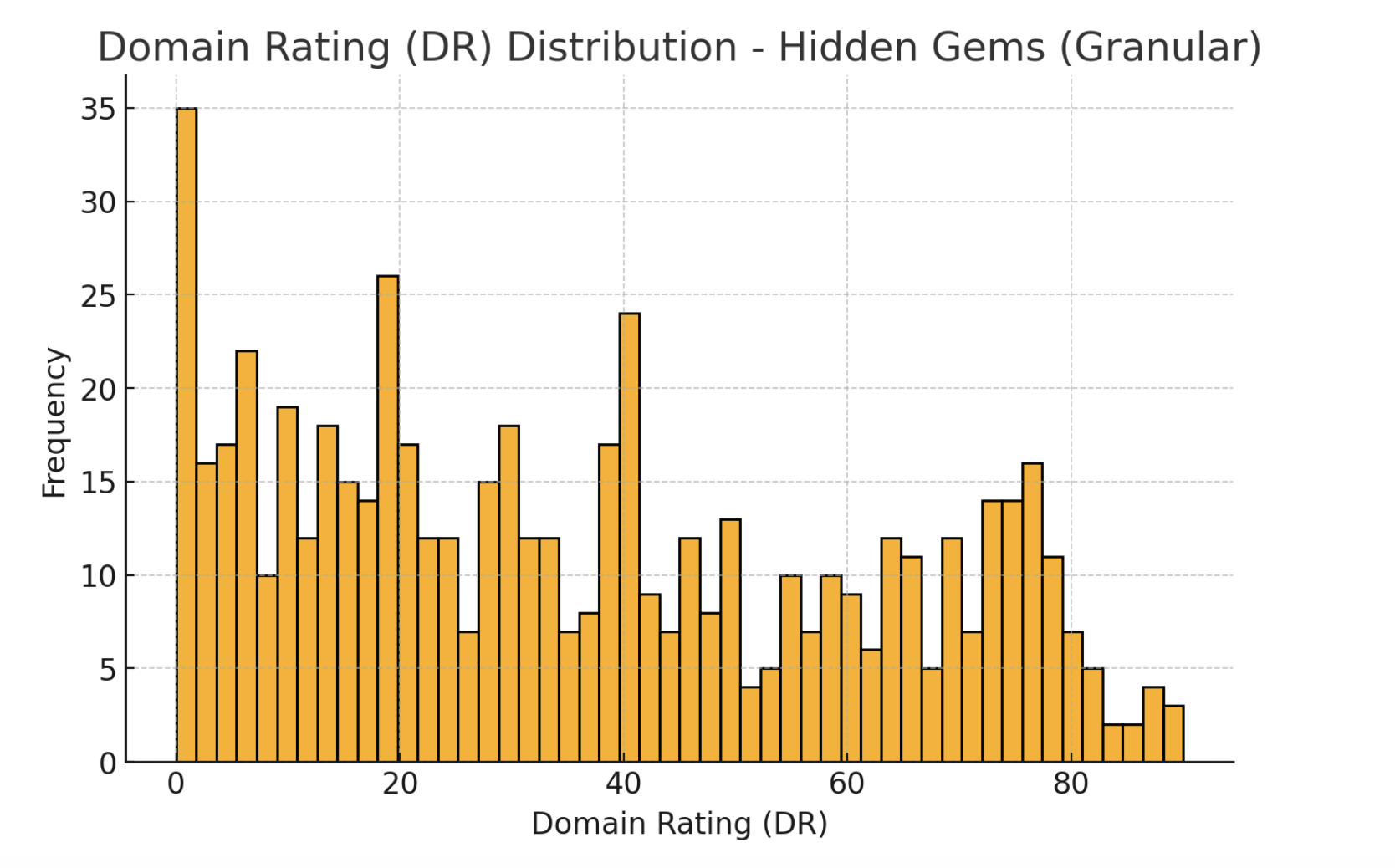
By contrast, the domains we identified as being Hidden Gems were not weighted in the opposite direction, but instead much more evenly spread out.

Image from author, August 2025

In other words, Google is sampling widely from the long tail but serving frequently from the head of the distribution.

Authority Still Has A Role

While traditional SEO has long placed emphasis on authority metrics like Domain Rating (DR) or Domain Authority (DA), our analysis shows that their influence may be diminishing in the context of AI-led search.

This shift aligns with broader trends we’ve observed in Google’s evolving ranking systems.

Instead of relying heavily on link-based authority, AI Overviews and similar experiences appear to prioritize content that demonstrates depth, originality, and strong alignment with user intent.

Authority hasn’t disappeared, but it’s been repositioned. Rather than acting as a gatekeeper for visibility, it’s now one of many factors, often taking a back seat to how well a piece of content anticipates and satisfies the user’s informational needs in the moment.

What This Means For Travel Brands

Hidden Gems are showing up in Google’s AI results, but they’re not displacing the giants. They’re appearing alongside them, offering more variety but less dominance.

For challenger brands, this represents both an opportunity and a challenge.

First-Hand Content Gains Ground

The opportunity is clear: Content that is specific, genuine, and useful is getting noticed, even from smaller or lesser-known sites.

AI-powered results seem to be more willing to include pages that deliver practical insights, first-hand experience, and niche relevance, even if they lack the traditional signals of authority.

This creates new openings for brands that previously struggled to compete on backlinks or brand strength alone.

Repetition And Recall Still Matter

But the challenge is equally clear in that visibility is not evenly distributed.

While Google may sample from a broader range of sources, the repetition and prominence still favor the dominant travel brands.

These brands appear more frequently, benefit from greater brand recall, and are more likely to be clicked simply because they’re familiar.

So for newer or challenger brands, the question becomes: How do you turn presence into preference?

Where Should I Be Focusing?

Consistency Of Presence

It starts with consistency. One or two appearances in AI Overviews won’t move the needle.

Travel brands need to think about sustained visibility, showing up across a range of topics, formats, and moments in the user journey.

That means building out content that doesn’t just answer common queries but anticipates nuanced needs, inspires curiosity, and offers unique, first-hand insight.

Clarity Of Voice

Next comes clarity of voice. AI systems are increasingly sensitive to content that signals credibility, experience, and originality.

Brands that find and articulate a clear editorial voice, whether that’s luxury travel with a local twist, slow travel for sustainability, or adventure itineraries from people who’ve actually been there, are more likely to stand out.

Intent Understanding

Finally, there’s an intent understanding. Challenger brands must shift from thinking in keywords to thinking in moments.

What’s the user trying to imagine, plan, solve, or feel at this point in their journey? How can your content speak directly to that?

A New Definition Of Authority

The travel giants still have scale on their side, but challenger brands now have a better chance to earn visibility through authenticity and depth. That’s a different kind of authority, one rooted in relevance and resonance.

For travel SEOs willing to rethink what authority means, and for brands ready to invest in meaningful, user-first content, AI-powered search is no longer just a threat. It’s an invitation.

Not to play the same game the giants are playing, but to play a different one, and win in different ways.

More Resources:


Featured Image: SvetaZi/Shutterstock

https://www.searchenginejournal.com/are-googles-ai-travel-results-uncovering-more-hidden-gems/553132/


OpenAI Announces Low-Cost Subscription Plan: ChatGPT Go via @sejournal, @martinibuster

OpenAI is rolling out a new subscription tier called ChatGPT Go, a competitively priced version that will initially be available only to users in India. It features ten times higher message limits, ten times more image generations, and file uploads than the free tier.

ChatGPT Go

OpenAI is introducing a new low-cost subscription plan that will be available first in India. The cost of the new subscription tiere is 399 Rupees/month (GST included). That’s the equivalent of $4.57 USD/month.

The new tier includes everything in the Free plan plus:

  • 10X higher message limits
  • 10x more image generations
  • 10x more file uploads
  • Twice as much memory

According to Nick Turley of ChatGPT:

“All users in India will now see prices for subscriptions in Indian Rupees, and can now pay through UPI.”

OpenAI’s initial announcement shared availability details:

“Available on web, mobile (iOS & Android), and desktop (macOS & Windows).

ChatGPT Go is geo-restricted to India at launch, and is able to be subscribed to by credit card or UPI.”

Featured Image by Shutterstock/JarTee

https://www.searchenginejournal.com/openai-announces-low-cost-subscription-plan-chatgpt-go/554082/


Google Trends API Alpha: Mueller Confirms Small Pilot Group via @sejournal, @MattGSouthern

Google says the new Trends API is opening to a “quite small” set of testers at first, with access expanding over time. The company formally announced the alpha at Search Central Live APAC.

On Bluesky, Google Search Advocate John Mueller tried to set expectations for SEO professionals, writing:

“The initial pilot is going to be quite small, the goal is to expand it over time… I wouldn’t expect the alpha/beta to be a big SEO event :)”

Google’s own announcement also describes access as “very limited” during the early phase.

What Early Testers Get

The API’s main benefit is consistent scaling.

Unlike the Trends website, which rescales results between 0 and 100 for each query set, the API returns data that stays comparable across requests.

That means you can join series, extend time ranges without re-pulling history, and compare many terms in one workflow.

Data goes back 1,800 days (about five years) and updates through two days ago. You can query daily, weekly, monthly, or yearly intervals and break results down by region and sub-region.

At the launch session, Google showed example responses that included both a scaled interest value and a separate search_interest field, indicating a raw-value style metric alongside the scaled score. Google also said the alpha will not include the “Trending Now” feature.

Why There’s High Interest

If you rely on Trends for research, the consistent scaling solves a long-standing pain point with cross-term comparisons.

You can build repeatable analyses without the “re-scaled to 100” surprises that come from changing comparator sets.

For content planning, five years of history and geo breakdowns support more reliable seasonality checks and local targeting.

Looking Ahead

The small pilot suggests Google wants feedback from different types of users. Google is prioritizing applicants who have a concrete use case and can provide feedback.

In the meantime, you can continue to use the website version while preparing for API-based comparisons later.


Featured Image: PhotoGranary02/Shutterstock

https://www.searchenginejournal.com/google-trends-api-alpha-mueller-confirms-small-pilot-group/554078/