Google Says Why It May Ignore Robots.txt And Negatively Impact SEO via @sejournal, @martinibuster
Google’s John Mueller answered a question about robots.txt and explained an easy-to-miss mistake that can impact your SEO and website indexing goals. The specific issue was related to search box spam getting indexed by Google, but this mistake can happen to anyone in general under any context.
Website Search Box Spam
The person who asked the question on Reddit was suffering from a search bar spam attack. What spammers do is search with a query that reflects their spammy niche, and they add a link or a website name. What happens next is that the search bar generates a URL that can be referenced to generate the spammy search result.
And that’s what was happening to the person who was asking the question. Their response was to add a line in the robots.txt file to prevent Google from indexing the file. But Google was indexing those spammy search-generated URLs anyway.
Google Indexed Pages Blocked By Robots.txt
Someone posted on Reddit that their client’s Shopify search box was generating spammy web pages in response to spammer queries and that Google was indexing them despite a robots.txt file prohibiting Google from indexing those pages. What the client did was redirect those spammy URLs to another web page. The person asking the question didn’t ask how to stop the pages from being indexed (which is what they should have been asking); they asked if those redirected URLs should be marked 404 instead.
“Working on a client’s Shopify store where we have the /search added as a disallow in robots.txt, however these search results are still indexed inside of Google.
However, if I try to open one of these pages, they have a redirect set and they redirect to another collection page on the store. Should we display a 404 page instead? What is the easiest way to fix this?”
Why Robots.txt File Caused Spam To Be Indexed
Google’s John Mueller took the extra step to identify and review the client’s robots.txt file and identified an error that was causing Google to ignore the directive prohibiting Googlebot from indexing search results pages.
Mueller responded:
“Also, not sure if it’s your site, but the one I found with similar indexed URLs had sections for “user-agent: Googlebot” (in the “START: Custom Rules” block in comments) as well as a lot more in the “user-agent: *” section further down. With robots.txt, the more specific rules win, so if you have a user-agent: Googlebot section, it will *only* use that section. If you want to apply all the rules in the “user-agent: *” section, you need to copy them. Also, if that’s your site, then you can just list all the user-agents that you want to have shared rules for together, eg:
user-agent: googlebot
user-agent: otherbot
user-agent: imgsrc
user-agent: somethingpt
disallow: /fishes
disallow: /orange-cats
… etc …”
User-Agent Specific Directives Take Precedence
What happened is that the client was relying on Google to follow the directives in a line that’s aimed at all user agents, “user-agent: *”, but because there’s another section of the robots.txt file that’s specific to Googlebot, Google ignored the “user-agent: *” directives and obeyed the one that specifically addressed Googlebot.
That may sound like a quirk in the way robots.txt works, but it actually makes sense because this enables users to target specific crawlers with unique rules and target everyone else with a different set of rules.
How To Be Safe From Search Box Spam
WordPress and Shopify both have ways to mitigate search box spam.
WordPress and Shopify both have ways to mitigate search box spam.
Shopify Search Box Spam Mitigation
Shopify’s website has a tutorial on how to automatically add a noindex directive to all search results. This will effectively prevent indexing of all search results pages. However, it’s necessary to not block search pages with robots.txt for this to work.
Using a noindex directive is more effective than using robots.txt because robots.txt does not control indexing; it only controls crawling.
“You can hide pages that aren’t included in your robots.txt.liquid file by customizing the <head> section of your store’s theme.liquid layout file. You need to include some metatag code to stop the indexing of particular pages.
From your Shopify admin, go to Online Store > Themes.
Find the theme you want to edit, click the … button to open the actions menu, and then click Edit code.
In the layout folder, click the theme.liquid file.
To exclude the search template, paste the following code on a blank line in the <head> section:
It’s quite easy to mitigate search box spam with WordPress. Users of the Yoast, Rank Math, and AIOSEO SEO plugins have their search results pages automatically set to noindex by default. Additionally, some page builders and themes like Divi (and its Extra theme) will automatically not generate spammy words and URLs in response to searches and instead will inject a few sentences saying that the search produced no results.
Robots.txt Knowledge
Effective SEO requires a wide range of knowledge. Robots.txt contains some quirks that can cause it to be less effective than intended, so it’s useful to read up on the official specifications in order to keep up to date.
Emergency Brand Audit: What AI Says About Your Locations via @sejournal, @lorenbaker
A 3.3-star car wash just won the AI answer.
When Annie Jackson, Director of Revenue Operations and Growth at GatherUp, asked Google for a no-touch car wash that fits an SUV in Norfolk, VA, Google returned a 3.3-star business and answered the clearance and hours questions above the star rating itself. Query match outranked rating.
That example frames the session Jackson presented with Jason Wertham, Vice President of Review Defense Operations at GatherUp: AI tools assemble their description of each location from reviews, listings, and public web mentions, then repeat that description to customers who never reach your website.
Jackson and Wertham walked through the four-prompt emergency audit they run to surface what ChatGPT, Google AI Overviews, and Ask Maps say about a multi-location brand today, then the build, manage, defend rollout that changes the answer.
The recap below covers the findings. The prompts, the rollout, and the audit handout live in the full session. Watch it on demand.
How Do Customers Use AI To Find Local Businesses Now?
They ask a full question and accept the summarized answer. In GatherUp consumer data collected in fall 2025, 55% of consumers had consulted Google or Bing AI summaries, 48% had asked ChatGPT about a local business, and 31% had asked multiple times.
Jackson’s car wash query shows what that looks like in practice. Instead of “car wash near me,” the search was “no-touch car wash for my SUV in Norfolk, VA.” Google pulled from its 300 million places and 500 million review contributors to return one business, with clearance height and 24/7 hours answered inline.
“Google answered my questions, but this business is actually showing up as a 3.3 star,” Jackson said. “It’s surfaced the context of my query above the star rating.”
Wertham added that these tools now factor in who you are and when you ask. “The time of day when you’re actually doing this query in Google Maps could impact which businesses are getting returned in those results,” he said. An LLM that knows you own an SUV or a large dog applies that context to every future local query, whether you restate it or not.
Not from the listing itself: Google, Yelp, and the other major directories block LLM crawlers from reading review content on business profiles. Reviews still support local rankings and conversion on the listing; they only enter AI answers through surfaces LLMs can crawl.
“The major directory service providers, Google, Yelp, and others, they do not allow LLM tools like ChatGPT and Claude to scrape or crawl the review data on the business listing,” Wertham said. “You’ll notice they’re not citing specific reviews from those platforms.”
The same reviews become crawlable the moment you republish them. Post them to public social channels or embed them in review widgets on your own site and, in Wertham’s words, “now they’re fair game for the LLM tools to be pulling in.”
That determines which queries you can win. When a customer asks for “popular” or “highly reviewed” businesses, the LLM searches for review text it can access. Review content confined to the directory contributes nothing to that answer.
“If you’re relying on the review platforms to do that for you, it’s not going to be enough,” Wertham said.
It matters less than review recency and velocity. No AI answer in the session’s audit examples cited an average star rating; every one cited review content.
The consumer data points the same direction: 45% of users prioritize review recency over star rating, 60% trust detailed written reviews over rating-only reviews, and 70% prefer a review request within 72 hours of the transaction.
Wertham noted that consumers routinely override Google’s default “most relevant” review sort and switch to “newest,” because the most recent review predicts the experience they will get. A high average built on years-old reviews carries less weight than a current, steady stream.
“I’d rather go to a business with 1,000 reviews and a 3.9 or 4.2 than 30 reviews and a 5.0,” Wertham said.
Why Does AI Give A Different Answer About Your Business Every Time?
Because LLM answers behave like a slot machine, one query is never a reliable read. Jackson cited SparkToro research in which different people asked LLMs the same question across devices and accounts, and the results never returned in the same order.
“Asking AI a question is kind of like a slot machine,” Jackson said. “It’s going to be giving back similar data, but each time it’s going to look a little differently.”
Position is the wrong metric for AI visibility. Total citations, the breadth of sources feeding the answer, predicts whether your brand appears at all. Your brand can miss one device’s answer entirely and lead the next.
Google published its own guide to optimizing for generative AI and updated it this month. Wertham flagged one change with teeth: the AI slop penalty. Google now detects low-value AI-generated content and, in his words, is “essentially penalizing businesses” for it. Generic AI blog posts and glorified FAQ scraping targets now cost you rather than getting ignored.
Q: What is the fastest thing I can do this week to change what AI says about my company?
“Address your listings. Make sure your listings are all correct and all consistent, whatever platforms you’re on. And then make sure that you are evangelizing your reviews off of the third-party directory where you’re receiving them. Post them to your social media platform, post them to a section of your website.” Jason Wertham, 49:23 in the on-demand recording.
“Make sure you have the basics down. Get the basics down, make sure those are set, and then you can move into the more elaborate things.” Annie Jackson, 50:30 in the on-demand recording. Jackson illustrated the point with a local restaurant whose Facebook page listed the owner’s personal cell number; he never knew why the calls kept coming.
Q: How long before content changes actually show up in AI answers?
Annie answered: small facts move fast, positioning moves slowly. Store hours and phone numbers update quickly, but “what you’ve been known for will take a little bit longer,” generally two weeks to a month with a long tail beyond that. She pointed to your own website as the fastest lever: a new offering has to appear on your own channels first, because reviews will not announce it for you. Full answer at 54:19 in the on-demand recording.
Q: My weakest location has old bad reviews that keep showing up. Do I have to wait for them to age out?
Jason answered: age fades a review’s relevancy naturally, but keyword-heavy reviews and reviews from Local Guides hold ranking longer, and emoji reactions keep a review from slipping even when they add no upward momentum. Policy-violating reviews stay disputable at any age; his review defense team removes reviews more than ten years old regularly. The reliable fix is volume and velocity, since recency outweighs content in long-run relevancy. Full answer at 47:33 in the on-demand recording.
Q: How should franchisors handle this when each franchisee controls their own profile?
Jason answered: franchise reputation management fails at the consistency gap, because each franchisee owns their listing while the brand absorbs the AI answer. Establish best practices, offer white-labeled or partner tools franchisees will use, and put a playbook in their hands. He also suggested running the audit prompts on behalf of franchisees and coaching them on the results, since one location’s wrong AI answer costs the whole brand. Full answer at 55:46 in the on-demand recording.
Watch The Full Webinar
The on-demand session contains the four emergency audit prompts and downloadable handout, the complete build, manage, defend rollout, the monthly measurement method, the review defense walkthrough for disputing policy-violating reviews, and Jackson’s AI narrative audit offer. Watch the full webinar on demand.
The AI Overviews YouTube Gap: The Platform Your Team Skipped For 20 Years via @sejournal, @gregjarboe
I uploaded my first YouTube video in August 2006. It was 42 seconds long, promoted an 11-part Christian Science Monitor series about a kidnapped journalist named Jill Carroll, and picked up a grand total of 1,908 views. My client at the time wasn’t impressed by that number, and honestly, neither was I.
Then, the story ran. More than 450,000 unique visitors flooded CSMonitor.com in the next 24 hours, seven times the site’s daily average that July. Page views broke past 1 million, up from a normal day of 121,247. A video almost nobody watched had just driven the biggest traffic day the site had ever seen.
That gap, between what a video earns on its own platform and what it triggers everywhere else, is the whole story of YouTube marketing. It was true in 2006. It’s true now, except the stakes have gone from one newsroom’s traffic spike to a $60 billion slice of the U.S. economy, and most SEO, content marketing, and social media departments still haven’t caught up.
The Proof Arrived On LinkedIn, Not In A Business Publication
YouTube CEO Neal Mohan posted the company’s 2025 U.S. Impact Report last week, built on research from Oxford Economics. YouTube’s creative ecosystem contributed more than $60 billion to U.S. GDP last year and supported over 540,000 full-time equivalent jobs. Every one of the 50 states now has at least 10 channels pulling more than 1 million monthly views. Creators who once needed to relocate to a media hub can now build a real business from anywhere, and the money they earn flows back into hiring local editors, renting studio space, and paying local suppliers.
YouTube’s own blog post by Alexandra Veitch, published the same week, filled in a number Mohan didn’t mention. Seventy-six percent of small- and medium-sized businesses with a YouTube channel say the platform helped them grow their customer base by reaching new audiences. That’s a distribution channel most marketing departments never built.
I’ve watched this ecosystem grow from the outside in and the inside out for two decades. The SEO and content marketing industry treated YouTube as a nice-to-have side channel for far too long, and that decision is now costing them exactly the audience Google’s AI systems are learning to trust most.
Why The Gap Matters More In 2026 Than It Did In 2006
YouTube videos are surfacing inside AI Overviews with increasing frequency, often as the primary cited answer rather than a supplementary link. A platform your department may have deprioritized for years is becoming one of the more reliable ways to get cited inside the answer engines reshaping search.
Departments that spent two decades building text-based content and backlink profiles now find themselves without the relationships, the production workflow, or the institutional muscle memory to show up where a growing share of searchers, and AI systems, are actually looking.
The Fix Isn’t A YouTube Strategy, It’s A Partnership Strategy
Building an in-house YouTube presence from zero in 2026 is slow, expensive, and probably the wrong first move for most brands. The faster path runs through the 540,000 full-time creators the Oxford Economics research already counted. Somewhere in that number is a creator who already has the audience, the production skill, and the credibility inside your product category that your department spent 20 years not building.
That means marketers need to do three things, starting now.
Identify creators who are relevant and influential in your specific category, not the biggest names in your budget range. A mid-sized channel with genuine authority in a niche will outperform a broad lifestyle creator every time a purchase decision is on the line.
Fold influencer partnerships directly into SEO, content, and social workflows, rather than running them out of a separate influencer budget line with separate goals. The creator’s video needs to be treated as content that earns citations and drives search visibility, not just a one-off sponsorship.
Measure the referral and citation effect, not just the view count. My 1,908-view video wasn’t designed to build an audience on YouTube. It was designed to persuade the editors at CNN.com, MSNBC.com, Yahoo News, AOL News, The Huffington Post, and Boing Boing to prepare stories about “Hostage: The Jill Carroll Story.” And their news coverage moved 450,000 people to The Christian Science Monitor’s website. The lesson has never changed. A creator partnership’s value shows up downstream, in traffic, in AI citations, and in conversions, far more than it shows up in the video’s own view counter.
My Take
Marketers who are still asking whether they need a YouTube strategy are asking the wrong question 20 years too late. The right question is which creators already own the audience and credibility your department was supposed to build, and how fast you can get a real partnership in place before a competitor gets there first. The agencies and in-house teams that treat influencer marketing as a separate line item from SEO and content strategy are going to keep losing ground in an AI search environment that doesn’t care which budget produced the video, only whether it earned the citation.
I didn’t plan to become a video marketer in 2006. A reporter’s kidnapping story and a 42-second clip did that for me. Twenty years later, the lesson is the same one Neal Mohan’s numbers just confirmed at scale. The audience was never the hard part. Showing up where it already lives is.
Search Growth Slows, Publishers Weigh Leaving Google – SEO Pulse via @sejournal, @MattGSouthern
Welcome to the week’s Pulse: updates affect the legal footing of the SERP tools you rely on, what it’s worth to keep your content in Google’s index, and where the revenue behind Search is heading.
Here’s what matters for you and your work.
Search Revenue Grows 17%; Pichai Points To Gemini 4
Alphabet reported Q2 2026 earnings, with Google Search & other revenue up 17% year over year to $63.27 billion. The growth rate eased from 19% in Q1, the first slowdown after four quarters of acceleration. On the earnings call, Pichai pointed to Gemini 4, now in pretraining, as the model Google needs to compete at the frontier.
Key facts: In the earnings release, CEO Sundar Pichai said the company’s “popular AI features are driving Search query growth,” and Chief Business Officer Philipp Schindler attributed the increase to strong vertical performance, led by retail. Alphabet also raised its 2026 capital spending forecast to $195 billion to $205 billion. In the call’s Q&A, Pichai named coding and agentic coding as areas where Google needs to improve.
Why This Matters
Search is still growing by billions a quarter, and Google credits its AI surfaces. The slowdown is one data point, not a trend, but it lands alongside another raise in spending meant to make AI the engine of a business that just grew slightly slower. How that bet plays out will shape which surfaces you optimize for and which ad formats reach your audience.
Court Dismisses Google’s DMCA Claims Against SerpApi
A federal judge dismissed Google’s DMCA claims against SerpApi, ruling that blocking automated access to public search results isn’t copyright circumvention when those results contain no copyrighted content.
Key facts: The judge granted SerpApi’s motion to dismiss both anti-circumvention claims under the Digital Millennium Copyright Act. Claims based on results without copyrighted content were dismissed without leave to amend, while claims involving licensed images in results were dismissed with permission for Google to amend within 21 days. The court rejected SerpApi’s argument that Google lacked the right to sue, and found Google plausibly alleged circumvention of its SearchGuard system.
Why This Matters
Many of the tools practitioners rely on, from rank trackers to SERP monitors, depend on scraped search results, and this round mostly went their way. The court held that getting past an access control isn’t a DMCA violation when the results behind it contain no copyrighted content. Google can still amend its narrower claims, and a district court order doesn’t bind other courts. For now, the decision gives scraping-based tools language to cite.
What People Are Saying
Rand Fishkin, co-founder and CEO of SparkToro, wrote on X:
“If you crawl the web, or rely on any product that does, you should be deeply grateful to @serp_api today.”
Independent SEO consultant Nick LeRoy posted on X:
“I’m not as anti-Google as most, but this is a fantastic victory for the industry (thanks @serp_api)”
“Wow, the Google lawsuit against SerpAPI was dismissed 🤯 I wonder if we will see more Google scraping from the LLMs and tracking tools now… And a lot more noise in our GSC reporting 😕”
Publishers Put Conditions On Staying In Google Search
USA Today Co. CEO Mike Reed says the company is prepared to delist from Google in the next six to twelve months, according to Adweek. Several large publishers are weighing whether staying in the index is still worth the exchange.
Key facts: A Wall Street Journal report this week said Reddit is reevaluating its $60 million per year licensing deal with Google, Politico and Reuters are considering limits on Google’s crawler, and People Inc. described blocking Google entirely as an option.
Why This Matters
Major publishers are now saying publicly what it would take to leave. If licensing becomes the answer, the value of content in Google’s index turns into a negotiated number instead of an assumed trade for traffic, and those negotiations could shape the terms smaller publishers get.
What People Are Saying
Cyrus Shepard, founder of Zyppy, wrote on LinkedIn after reading the Journal report:
“The reward to publishers is no longer there, and still declining.”
Former Ad Age editor Jack Neff, reacting on LinkedIn to Adweek’s earlier report on July 10, raised the cost side:
“If publishers blocking Google crawlers becomes widespread, I do truly fear how much worse the quality of AI Overviews can become as Gemini access to professional content gets further throttled.”
EU Issues First DMA Fines Against Google, With Data-Sharing Terms Already Set
The European Commission fined Google €890 million on July 23, its first penalties against the company under the Digital Markets Act, one week after adopting binding decisions that require Google to share anonymized search data with rivals.
Key facts: The Commission issued a €460 million fine for favoring Google’s own shopping, hotel, transport, and sports results over comparable third-party services, and a €430 million fine for restricting developers from steering users outside Google Play. The separate July 16 decisions require Google to share anonymized query, click, view, and results-position data with eligible rivals, including AI chatbots that qualify as search engines, and to open Android to competing assistants.
Why This Matters
The self-preferencing finding puts EU results-page layout under a compliance deadline, so how Google displays its services against third-party listings could change there within 60 days. The data-sharing decisions could eventually widen which search engines and chatbots can build competitive retrieval systems, and with that, who cites sources and sends referral traffic. Neither decision changes rankings on its own, and what becomes visible will depend on how Google complies.
Theme Of The Week: Everyone Is Renegotiating With Google
Google Faces Pressure From Three Directions
A court ruling, publisher negotiations, and EU enforcement are putting pressure on Google from three directions.
Court
Dismissed Google’s DMCA claims involving search results without copyrighted content.
Legal pressure
↓
Publishers
USA Today Co. says it may leave Google Search within six to twelve months. Others are weighing crawler limits or licensing terms.
Commercial pressure
→
At the centerGoogle
$63.27BQ2 Search & other revenue+17% year over year
$195–205B2026 capex forecast
←
European Commission
Google received €890M in DMA fines. Separate decisions set search-data sharing and Android requirements.
Regulatory pressure
Every story this week is a party redrawing its deal with Google. A federal court narrowed which legal tools Google can use against companies that collect its results. Publishers are turning their presence in the index into a negotiation. The EU is fining how Google lays out its results page while compelling its search data outward. And the earnings show what sits on Google’s side of the table, a $63 billion quarter from Search with record spending riding on AI.
The exchange that defined the open web for two decades, content and access in return for traffic, is being repriced from every direction at once.
AI Search is Working. How to Prove It With Real Tests. via @sejournal, @hethr_campbell
Adding FAQ sections to a set of test pages lifted AI citations. Removing them dropped citations back down.
That reversion is the difference between correlation and causation, and almost no team measuring AI search today can produce it.
That standard of proof anchored the latest SEJ webinar with seoClarity’s Mark Traphagen, VP of Product Marketing & Training, Mihir Naik, Senior Product Manager, AI, and Suraj Lalchandani, Sr. IT Project Manager. Their core argument: “Visibility scores tell you if you showed up. Page-level performance and split testing tell you if what you did actually mattered.”
The session walked through the split testing methodology seoClarity’s enterprise clients run across ChatGPT, Claude, Perplexity, Gemini, and Google’s AI surfaces: how to build a funnel-spanning golden set of prompts, how to construct a control group when LLMs will not let you A/B test, and where Google’s new first-party Search Console AI data fits.
Can You Finally See AI Search Visibility In Google Search Console?
For a subset of sites, yes. On June 3, Google launched dedicated Search Console reports for AI Overviews and AI Mode, showing page by page how often each URL appears inside Google’s AI search features.
Lalchandani called it the biggest measurement upgrade AI search testing has received. “This has been the hardest thing to measure in AI search. Everyone was sampling. Everyone was inferring. But now Google is just giving it to you.”
First-party data straight from the source carries a different level of trust than any third-party tool. But the team was direct about the limitations: the new reports cover only part of what an AI search testing program needs, and ChatGPT, Claude, and Perplexity still require structured third-party tracking.
The ones where you are almost winning. The team builds a golden set of prompts spanning the full AI search funnel, awareness through retention, with every prompt tagged by stage, then sorts each prompt into tiers by where the brand currently stands in the AI’s response.
Tier 1 prompts are the easy wins. As Lalchandani put it, “You’re relevant, but AI just hasn’t been given a URL worth linking to.”
Tier 2 is the heavier lift, and one bucket of prompts gets dropped from testing entirely, a move that surprised many attendees.
You cannot split live traffic 50-50, so you build a control group instead: a set of correlated pages that acts as your noise filter against model updates and algorithmic shifts.
“Without a control group, every result would be guesswork,” Lalchandani said. “With one, you can tell a real win from the background noise.”
Timing is the discipline most teams skip. The methodology sets a specific baseline period before any change goes live and a minimum test window after, because AI search does not respond overnight the way traditional SEO sometimes does. Cut the window short and, in Lalchandani’s words, “you could be reading noise.”
The FAQ Test That Proved Causation, And Two Tests That Did Not
seoClarity ran the same methodology for three clients and got three very different outcomes, which is exactly the point.
The FAQ test was the clear win. With roughly 1,000 prompts under measurement, adding FAQ sections to test pages pushed citations up versus control, and they stayed elevated as long as the change was live. Then the team reverted the change. “The citations fell back down. That’s the second half of proof. Not that citations just went up when we added FAQs, but that they went back down when we took them away. That’s causation, not correlation.”
The other two tests, one on meta descriptions and one on listicle formatting, ended very differently, and the reasons why hold lessons for anyone about to invest in either tactic. See how both tests played out in the full session.
Naik’s framing: every result is a win, because you have evidence instead of guesses. That is more than most teams in AI search have today.
Q: How do you measure AI authority when there is no clean authority metric?
“AI authority is basically how much the model trusts you as a source for this topic. I don’t think there’s a clean number for it or a single number for it, but there’s a couple of signals that you can stack to give you kind of a working picture.”
Lalchandani named four stackable signals, starting with citation share on your top prompts and cross-engine consistency, because “consistency across engines just means that you become the authoritative source in your category for specific kinds of questions.” He walks through all four, and how to track them, in the full session.
Q: Can AI bots read FAQ answers hidden behind collapsible toggles?
“Collapsible can mean many different things. It’s how you are having it collapsible.”
It depends entirely on implementation: one common setup keeps collapsed FAQs fully readable to AI search engines and Google, and another makes the content invisible to both, because “even Google will not click around on your site.” Lalchandani explains which is which in the recording, with his standing advice attached: “If you’re unsure of something, just test it out. It takes effort, but it’ll give you a sure answer.”
Q: What is the ROI of an AI citation that does not drive referral traffic?
“You want to be cited because you are controlling the answer that is actually going to be showing up.”
Even without a click, Naik explained, your cited page shapes the narrative inside the answer, especially in comparison queries where citations do the heavy work of positioning both brands. The question shifts from traffic to representation: are your USPs highlighted correctly, is the comparison set right, are inaccuracies surfacing. Lalchandani added a cautionary example from a real restaurant client that shows exactly what happens when AI cannot reach your content, told in full in the recording.
Q: Is traditional SEO still a factor in moving the AI findability needle?
“Absolutely. It is foundational. It is the foundation.”
Traphagan noted that seoClarity’s longest-standing clients, the ones with well-optimized content and technically healthy sites, are also performing best in AI search, with AI optimization as the extra layer on top. Lalchandani added: “When we run tests with our clients, we’ve rarely, if ever, found a situation where something works for SEO and does not work for AI search.”
Watch the Full Webinar
The on-demand recording contains everything the recap holds back: the golden prompt set build, the tier definitions, the control group construction with exact baseline and test windows, the platform-by-platform crawler reference, the meta description and listicle results, and the schema and markdown test blueprints. Register to watch the full session on demand.
AI Browsers Are Backward Because Agents Never Needed The Visual Layer via @sejournal, @slobodanmanic
An AI agent does not need the visual layer of your website, and it should never have needed it. That one idea is why the whole category of AI browsers is backward. We spent years building websites design-first and lost the web’s semantics, its accessibility, and the fundamentals underneath them along the way. So when a machine shows up to actually use the web, it cannot find the meaning we stopped encoding, and instead of putting that meaning back, the industry gave the machine a browser to work through and a screen for us to watch. On July 9, 2026, OpenAI retired ChatGPT Atlas, the standalone AI browser it launched only nine months earlier, and the death of the best-funded version of that idea is a good moment to say plainly why it was never the right one.
Atlas Lasted 9 Months
OpenAI launched Atlas in October 2025 as a standalone browser with an agent built in, positioned as a challenger to Chrome. On July 9, 2026, it announced the end. Atlas stops working on August 9, and its browsing folds into the ChatGPT desktop app and a Chrome extension. OpenAI’s own help-center article is titled “Evolving Atlas into ChatGPT for browser-based agentic work,” which is a generous way to describe discontinuing a browser about 30 days after the announcement.
It is not the first product OpenAI launched with a keynote and cut a few months later. Sora, its video app, was discontinued in April 2026, reportedly after earning only a couple of million dollars in total revenue against the cost of running it. Sora lasted six months. Both were cut in a “defend the core” push led by OpenAI’s applications chief, Fidji Simo.
The reason Atlas died matters more than the fact that it did, and OpenAI gives you a reason worth reading skeptically. The company’s line is that it is not walking away from agents on the web, only moving that capability out of a standalone browser and into the app people already use. That may well be true. It is also the kind of thing a company says when it kills a product and would rather call it an evolution than a retreat. OpenAI has not shared usage or cost figures for Atlas, so the tidy “wrong container” explanation sits right next to a plainer one: not enough people wanted a browser they had to be talked into. You do not need to settle which it is, because the deeper reason does not depend on OpenAI admitting anything.
The common read of these shutdowns is technical: the CAPTCHAs and the JavaScript walls that trip up anything trying to act on a modern website. That friction is real, but it was never the deep reason. Visual browsing was always a bad way to do this. At best, it is a necessary evil, the bridge you cross while the web still is not built for agents. I mapped the browsers carrying this wave earlier this year, and the arrival they represent is settled: Agents are coming to your website whether or not any single browser survives. What is not settled is the shape, and Atlas dying makes it plain. A machine built to squint at a page made for human eyes was always the wrong end state. One shutdown looks like engineering. Two, from the outfit with more money and distribution than anyone else building these, is the shape.
Vision Agents Are The Bet Everyone Else Is Doubling Down On
Atlas dying does not mean the AI browser is dead. Perplexity’s Comet, The Browser Company’s Dia, and Gemini inside Chrome are all still live, and underneath them a bigger bet is getting louder: vision-based agents, the “computer use” models that operate a website the way a person does, by looking at the rendered screen and clicking what they see.
The selling point is genuinely seductive. A vision agent works on any website with zero effort from the website’s owner. No integration, no standard to adopt, no cleanup. You point it at the same page a human sees and it figures out the rest. If that is the future, then arguing that agents need a machine-readable web sounds naive, because the entire appeal of a vision agent is that it does not need one. This is the tide, and it is worth taking seriously.
We Built A Web That Forgot How To Talk To Machines
Websites were built design-first, and somewhere in the process we lost the web’s semantics, its accessibility, and all the other fundamentals. The cause was not laziness, it was incentives. The focus went to developer experience and to frameworks that make it easy to build components that look a certain way, without anyone caring much whether those components are fundamentally correct underneath. A button became a styled <div> with a click handler. A form control became a bundle of nested elements that renders fine and mean nothing. To a person, all of it works, because a person brings eyes and a lifetime of pattern-matching to the page. To a machine, a <div> that behaves like a button is not a button. It is a box.
None of this is new, and the people who have been paying for the missing semantics are not AI agents. They are the people who use screen readers and other assistive technology. A screen reader cannot tell that the styled box is the checkout button, and neither can an agent, because both read the same thing: the accessibility tree the browser builds from your markup. A bare <div> never enters that tree as a button, so it is invisible to both, no matter how obvious it looks on screen. The accessibility community has described this exact failure for years, mostly to an industry that treated it as a compliance checkbox. The AI agent is the new screen reader. It is the same wall, hit by a much larger and much better-funded population, which is the only reason the industry suddenly cares.
The AI Browser Is A Workaround For A Broken Web
Once you see that agents read meaning and not pixels, the AI browser flips from a breakthrough to a workaround. Under the hood, an agent does not look at your page so much as read it, walking the same document structure and accessibility tree a screen reader walks. So what does a browser you can watch actually add? A window for a person to look through. Not for the agent, which reads the structure without rendering anything, and not for you, who needs to watch an agent read a page about as much as you need to watch a server answer a request. The watchable browser was theater from the start.
Pixels come in only as a fallback. When a page’s structure is broken enough, the accessibility tree is useless, and the agent, or the vendor behind it, falls back to looking at the rendered screen. Vision is the patch for a web that lost its semantics, not the way agents were built to work, and even the patch does not need a window you sit and watch. The cause under all of it is the same: a web that lost the ability to speak to machines.
There is a second reason these browsers exist, and it is less flattering. A visual agent clicking through a website in real time is a demo. It is something a company can put on a stage and impress people with, which is a large part of why they get built and hyped, especially at OpenAI. The receipt is the lifespan. A product built to be shown off more than used tends to have a short one. Atlas launched against Chrome with a keynote and was gone in nine months. When the spectacle is the point, the shutdown is only a matter of time.
Vision Agents Step Over The Mess Instead Of Cleaning It Up
The vision-agent bet, the one that says the machine should look at the page like a person, is the perpetual workaround. It is stepping over the mess on the floor every single day instead of cleaning it up once. Every visit, the agent re-derives from pixels what the page could have told it directly. That is slower, more expensive, and more fragile than reading the meaning, and it stays that way forever, because nothing underneath ever gets fixed. The labs can double down on it as much as they like. Working around something broken, instead of fixing it, is a bad long-term bet even when the short-term demo lands.
To be fair, vision agents do work on any website today with no effort from the owner, because the semantic web is broken enough that looking at the page is often the only reliable option right now. That is exactly why telling everyone to adopt a standard has never fixed this on its own. But “the workaround is the only thing that works today” is an argument for repairing the underlying web, not for pretending the workaround is the destination. The website that stays broken pays the vision-agent tax on every single visit. The website that fixes its fundamentals stops paying it.
The Fix Is The Fundamentals You Already Owed The Web
The move for anyone who runs a website is two things, and the first one is free: Learn to tell hype from real. Atlas’s birth and its death were both more hype than news. The launch was a browser war that was never going to happen, and the shutdown is a company cutting a side project to defend its core. Neither should move your strategy, because neither was ever about your website. Once you can see the visual browser for the demo it is, you stop chasing every new shell the labs put an agent inside.
The second thing is the work, and it is not glamorous. Put the fundamentals back. Are your messaging and story consistent across your website, so a machine reading it comes away with the same understanding a person would? Is your website easy to load and easy to read, without a wall of JavaScript standing between the agent and your content? Can a machine identify what your business is, read what is on the page, and actually use it? That is the whole of Machine-First Architecture, and none of it was invented for AI. It is the accessibility and the semantics the web always owed its users, finally worth doing because the cost of skipping them stopped being invisible.
Do that, and you are ready for any agent, in any shell, no matter what the labs hype next. A website that reads cleanly to a machine does not care whether that machine arrives in a standalone browser, a desktop app, a Chrome extension, or something nobody has announced yet.
The work in front of you was never a new burden invented by AI. It is the web done right, the way it should have been done for the people who needed it long before the machines showed up. Atlas is a footnote by August. The next agent, in whatever shape it takes, will still arrive at your website and try to understand it. Give it something to read, and you win no matter which browser dies next.
YouTube Explains What Can Stop A Channel Getting Paid via @sejournal, @MattGSouthern
YouTube outlines three content categories that could disqualify a channel from the YouTube Partner Program (YPP). These categories are detailed on YouTube’s channel monetization policy page and were explained by Matt Halprin, Vice President of Trust and Safety at YouTube, in a Creator Insider video.
The Three Categories
1. Generic/Repetitive
When content looks templated or barely changes from one upload to the next, YouTube categorizes it as generic or repetitive. The policy page cites examples like characters repeating the same situation and outcome, image slideshows with little narrative, and AI-generated videos built from generic templates.
Using the same intro and outro is fine as long as the body of each video is different.
2. Off-putting Content
The ‘Off-putting content’ category includes videos that lean on emotionally manipulative formulas or shock. Examples include showing animals in exaggerated distress and realistic visuals faking a celebrity death or disaster.
Halprin said channels with too much of this can lose YPP access whether or not the videos use AI.
3. AI Personas In Sensitive Topics
The AI personas category covers channels that use AI-generated individuals to deliver information on sensitive topics, including health, legal issues, finances, or politics. AI personas are allowed in other contexts.
Why This Matters
The old “inauthentic content” label gave creators little idea of what actually put their channel’s earnings at risk, The three named categories offer a clearer definition of what can earn and what can’t. So, a channel that gets removed from the Partner Program, or turned down when it applies, has a better read on the problem.
Halprin said the update doesn’t change what the company already enforces, noting that “there’s no change in our underlying policy at all.”
Looking Ahead
Videos that fit in the above-listed categories are ineligible to earn money, but they can still stay on YouTube if they follow community guidelines.
To keep your videos monetized, build in real variation instead of leaning on templates, stay away from shock-driven formats, and if you use an AI persona, don’t present it as an expert on sensitive topics. Using AI to help make videos is still fine.
Are We Repeating History & Risking Backlink Penalties Again? via @sejournal, @TaylorDanRW
The race to monetize AI visibility services, claiming new acronyms and extending existing fields of practice as whole new trenches of engineering, is something we’ve witnessed a lot over the past couple of years.
We’re seeing new entrants to the market because they see a gap, but no one is really stopping to ask the question: Why does a gap exist in the first place?
The truth is simple. The gap has, more often not been left open by accident, but rather created deliberately off the back of Google changing its tack and introducing penalties for the exact same manipulation practices that people try to repackage today as solutions for AI visibility.
In the early days of SEO, it was very different from how it is now, regardless of AI and Google’s overall search features. How Google indexed and how Google weighted weak factors that led to ranking order, have changed significantly over the years. The two main mechanisms of manipulation have always been content and links.
The rise and fall of AI-generated content, and how there is a misunderstanding between content production and Google’s crawl economics, I’ve already covered in another article. What we’re now starting to see is a very confident entry into the market of services playing on the link side of how visibility is generated, based on a market gap where people are trying to exploit without actually understanding where and why those bad habits were driven underground.
A Short History Of Backlink Manipulation
Google’s Penguin algorithm, which is now a part of the core algorithm, was a series of standalone updates that focused on penalizing link manipulation practices. Not only in the volume of backlinks, but also the over-optimization of anchor text, unnatural patterns of gaining links, random and sudden spikes with little justification as to why the spike existed, and also patterns of websites linking out to random websites and non-sequential content themes.
Google does this now algorithmically at scale. If we can quickly and easily see the link manipulation going on, just by using exports from third-party tools or even in the user interface of third-party tools, we can guarantee that Google and Bing are also able to see this manipulation at scale.
Backlink Manipulation Penalties Still Exist
A common misconception about Penguin becoming a part of the core algorithm is that Google simply ignores spammy links – that you could almost run free and buy backlinks and manipulate your profile to your heart’s content, and you won’t receive a penalty because Google would have to ignore the bad efforts. Anyone believing this is gravely misinformed.
Over the past year, I’ve seen more link-based penalties occurring than in the five years before it. That’s because people have bought into buying backlinks for AI purposes without understanding, and potentially ignoring, the underlying consequences of how they appear within Google and Bing’s indexes. Being present for various fan-out, grounding, and stacked queries also plays a role in AI visibility, let alone the fact that you need to be strong and visible when it comes to being included in training data.
Buying backlinks from a marketplace has been a risky practice ever since Penguin was introduced. Failing to acknowledge and understand that doing something for AI doesn’t make it an agnostic SEO practice, and you could very easily damage one while having a minimal impact on the other.
How Gurus Are Accidentally Saving The Industry
There is a certain irony to new entrants to the organic visibility market pushing these practices. What we’ve learned from them, they also are very likely aligned with the commentary that SEO is dead and a dead-end channel for investment, but what they’re actually doing is securing the future of SEO for the rest of us.
By repackaging tactics we regard as short-termist or spammy, what they’re actually doing is creating a large pile of clutter and signal noise that Google will inevitably sweep through and ignore or penalize, just as it has done during every previous cycle since Penguin was introduced. When the signal noise is gone and cleared, only those who have not been penalized and not engaged in these tactics will remain.
SEO has always been about understanding human search intent, providing accurate answers, and building genuine authority over periods of time.
Technology may be evolving from standard lists of links to conversational answer engines, but the fundamental economics of how Google crawls and understands websites, and the fundamental economics of how Bing does the same, are relatively the same, albeit with an added layer of AI in terms of processing layered on top.
Far from killing the industry, the current wave of spam will only make high-quality SEO work more valuable than ever before.
Alphabet Q2 Earnings Show $5.85 Billion Negative Free Cash Flow via @sejournal, @martinibuster
Alphabet’s second quarter earnings results show that Google is earning massive amounts of money but is also spending so much that it reported a negative free cash flow due to infrastructure spending.
Massive Earnings
Q2 2026 revenue is $119.8 billion, which is up 24% year over year.
Where The Money Comes From
The earnings release shows that Search & Other account for most of the earnings, $63.3 billion. Google Cloud accounts for $24.8 billion, Google subscriptions, platforms & devices accounts for $12.9 billion, and YouTube ads brought in $11.1 billion.
Google Search & other: $63.3 billion
Google Cloud: $24.8 billion
Google subscriptions, platforms & devices: $12.9 billion
YouTube ads: $11.1 billion
Total revenue: $119.8 billion
Google’s strategy of diversifying their revenue streams is clearly paying off. Google earned $2.9 billions dollars more in the second quarter from Search & Other than it did in the first quarter, an increase of +4.8%.
The difference between first and second quarters show that Google is consistently earning more across all of its businesses.
Earnings Growth Q1 2026 – Q2 2026
Google Cloud: +$4.8B (+23.8%)
Google Search & other: +$2.9B (+4.8%)
YouTube ads: +$1.2B (+12.2%)
Google subscriptions, platforms & devices: +$0.5B (+4.2%)
Many in the search marketing and publishing communities are unhappy because Google’s AI search strategy sends less clicks to websites than classic search did. Another complaint is that Google is hoarding traffic within its own ecosystem of services and websites.
Is that the reason why YouTube’s earnings soared by 12.2% this quarter over last and Search earnings increased by nearly 5%?
$5.85 Billion Dollars Negative Free Cash Flow
Perhaps the most surprising detail to come out of the earnings result is that Google is running a negative free cash flow of nearly six billion dollars.
Negative free cash flow does not mean that Alphabet lost money this quarter, they did not. It means Alphabet spent more cash than it generated after accounting for capital investments.
Free cash flow: -$5.855 billion
Alphabet’s second quarter operating cash flow was $39.069 billion. Their capital expenditures equaled $44.924 billion. Their free cash flow for Q2 2026 was -$5.855 billion (operating cash flow minus capital expenditures).
Google’s investor presentation explained why they are running a negative free cash flow in the second quarter of 2026:
Alphabet’s presentation explained why they’re spending so much:
“We’re innovating at scale with incredible velocity.
Since launching Gemini 3 last November, our momentum has accelerated. We’ve rolled out increasingly capable generative media models; shipped features across Chrome and the Gemini app, launched Antigravity and our first model in our Gemini 3.5 series.
Recently at our I/O annual developer conference, we showcased new advances across models, coding, and agents. This progress reflects our deep focus on delivering tangible value to people in the products they use every day.
Supporting all of this at scale for our users, while also serving enterprises and developers around the world, requires massive compute investments.
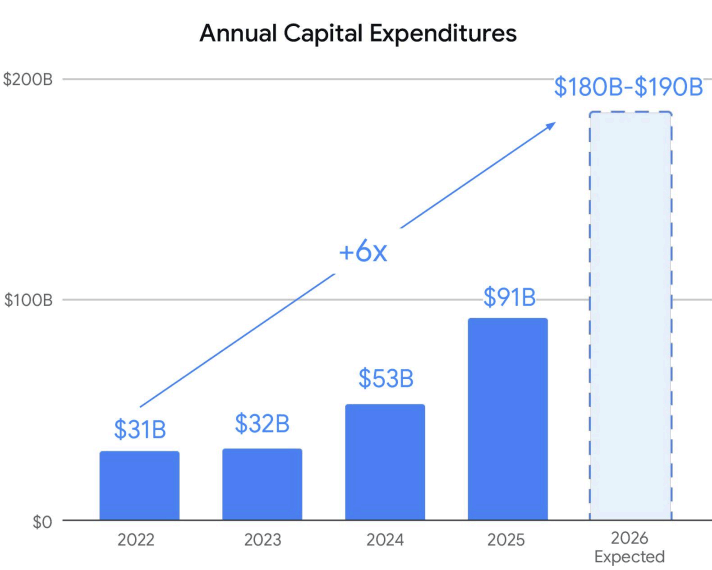
In 2022, we spent approximately $31 billion in CapEx. This year, we expect that number to be 6 times larger than 2022 and double last year’s at $180-190 billion. And next year, we expect it to significantly increase compared to 2026. The overwhelming majority of this spend will be in technical infrastructure.”
The Q2 earnings release says Alphabet raised $49.6 billion through an equity offering, specifically stating that the proceeds would be used for “capital expenditures to scale AI infrastructure and global compute.”
That’s interesting because it shows how extraordinary AI-related spending has become because Alphabet is not funding it all from operations, it also raised tens of billions of dollars in new equity to help finance their massive investment in AI data centers.
Capital Investments Spiraling Upward
The earnings release shows that Alphabet spend $44.924 billion dollars on “Purchases of property and equipment.” That’s about double the amount spent in the second quarter of 2025, $22.446 billion dollars.
What were those properties and equipment? A BBC report quoted Google’s Chief Financial Officer explained that 60% of that was for buying servers and 40% was for data centers.
The quoted explanation:
“Anat Ashkanazi, Google’s chief financial officer, noted on a call with financial analysts that the company had shown negative free cash flow due to growing capital expenditures, essentially all of which was related to AI spending.
She said the company spent $45bn in the second quarter, with 60% of the cost going towards servers and the remaining 40% going towards data centres.”
The Q2 release featured a graph showing that Google’s expenditures are spiraling upward, with estimates that the year will end by spending six times what Google spent in 2022, at the beginning of the generative AI boom.
Takeaways
Alphabet reported strong revenue growth across its businesses.
Search remains Alphabet’s largest revenue source, while Google Cloud is its fastest-growing business.
Revenue increased across every major business segment from Q1 to Q2, showing strong momentum across a diversified range of services and products.
Alphabet generated enormous profits while simultaneously reporting a $5.85 billion dollar negative free cash flow.
Negative free cash flow was caused by spiraling AI infrastructure spending.
AI infrastructure investment has become so large that Alphabet supplemented operating cash with a major equity raise to help finance it.
Capital expenditures are accelerating at an extraordinary pace, with spending expected to reach six times 2022 levels by the end of 2026.
The spending is primarily funding servers and data centers that support Google’s long-term AI strategy.
Google Went ‘Not Provided’ In 2011 And Blinded Us, ChatGPT Just Shipped Its Version via @sejournal, @DuaneForrester
The attribution you are waiting for from ChatGPT is coming, and it is not coming to you. I ran a survey this month (it’s still open; please take it) asking whether dedicated AI visibility platforms are worth paying for, and I deliberately never asked about attribution. It showed up anyway. One consultant wrote that the whole problem is tying visibility, citations, and mentions to dollars. An agency owner managing over a dozen clients answered the “what’s your biggest-unanswered-question” prompt with a single word and an exclamation point: attribution! Another respondent put it more wearily: that tracking is only the first step, so what comes next.
Image Credit: Duane Forrester
Two different frustrations hide inside that one word, attribution. One is whether a tracker reads your AI visibility accurately at all. The other is whether that visibility can be tied to revenue. This piece is about the second. The first runs underneath it, and I come back to it at the end.
That corner has stayed dark for a reason, and it is not the reason most people think. The instinct is to treat missing attribution as a gap some vendor will eventually fill, the way rank tracking filled in twenty years ago. It will not fill in that way. The click-path attribution that organic search practitioners were trained to expect, the deterministic line from impression to session to conversion, is gone, and AI did not kill it. Referral traffic from AI answers is real but tiny, under one percent of total traffic on most sites, which means the thing people are asking for was never going to be answered by watching their own analytics. So let me toss a flashlight at the corner. Here is where attribution stands, why it stands there, and an idea about what you do starting tomorrow.
The Deterministic Era Was Ending Before A Single LLM Shipped
Third-party cookies went into slow deprecation, Apple’s App Tracking Transparency cut off a huge slice of mobile signal, Google Analytics moved to modeled conversions rather than counted ones, and media mix modeling, a technique older than most of the people now using it, came roaring back precisely because the clean deterministic path had frayed. Every one of those shifts happened for its own reasons and none of them involved ChatGPT. LLMs did not break attribution. They arrived after the break and made it impossible to keep pretending. The measurement world you are standing in was already modeled, probabilistic, and permission-dependent before answer engines entered the picture, and that is the ground we are now building on.
Now The Part That Will Annoy You, Because It Is Both Simple And Deliberate
Attribution from the platforms is coming, but it is arriving through the ads door, not the webmaster-tools door. The signal a paying advertiser needs and the signal a free organic practitioner wants are the same signal. A platform will build that signal for the person spending money and withhold it from the person who is not, because there is no business reason to give away for free what someone else will pay for.
We have watched this movie. In 2011, Google encrypted organic search referrals and organic keyword data vanished into the not-provided bucket, while paid search advertisers kept getting richer and richer conversion data. Same query intent, same underlying behavior, monetized on one side and starved on the other. Organic SEO spent a decade angry about it. (Maybe you still are?)
ChatGPT just shipped its version, and you can read both halves of it in OpenAI’s own documentation. On the organic side, the controls OpenAI gives webmasters are switches, not meters. You can allow OAI-SearchBot so you appear in ChatGPT’s answers, or disallow GPTBot so your content is not used in training. Toggles. On or off. What you cannot do is measure via OpenAI. On the paid side, OpenAI has already built a full server-to-server conversions pipeline: a pixel, an events API keyed to an Ads Manager account, standard events like order_created carrying amount, currency, and item-level detail, deduplication between browser and server, and a privacy-preserving identifier to tie exposure to outcome. That is closed-loop conversion attribution. It exists right now. It sits behind an ad account. The organic operator on the same platform gets a robots.txt file and best wishes.
The Sharper Cut Is This
Nobody at OpenAI needed to say Google’s name for this to happen. The not-provided lesson has been in plain sight for more than a decade, in every conference post-mortem and forum thread written since 2011, and the lesson is precise: taking access away costs you years of goodwill, so do not take it away; simply never grant it. Google paid for its mistake because it was a taking, and people fight takings. A designed absence generates no protest, only a low, unfocused unease. That knowledge was ambient. Any competent operator building an answer engine already had it.
Which is why this is not really an OpenAI story. Plot the model companies along a line by their stated reason to exist, a sell-to-serve spectrum if you want a handle for it, meaning where each one sits between built to sell and built to serve. OpenAI is running hard at commerce and ads, so it builds the paid measurement loop first and most visibly. Perplexity is chasing a slice of the discovery-and-shopping pie and moves in the same direction. Google already is an ad company. Anthropic frames itself around safety and long-term benefit and has the least structural reason to build an ads attribution layer at all. The doors differ, and the timing differs, but read the whole line and the conclusion holds in every seat: None of these companies has an incentive to hand free, item-level organic attribution to SEOs. The commercially driven ones gate it behind ad spend. The mission-driven ones simply have better things to build. Do not expect it from ChatGPT is the narrow version. The real version is do not expect it anywhere, sadly.
So Stop Asking 1 Question That Is Actually 3
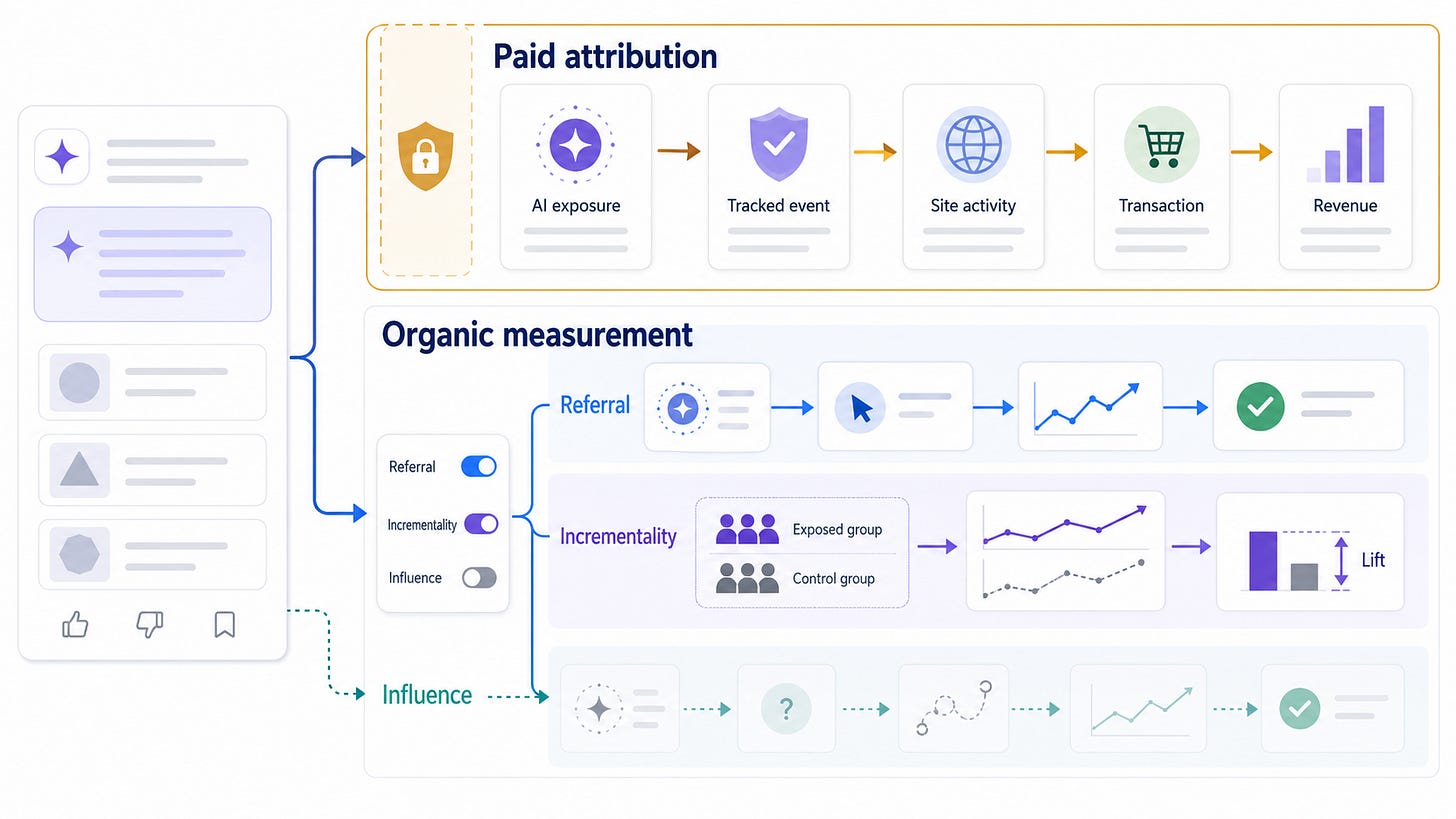
When practitioners say attribution, they are usually blending three different problems that have three different answers. The first is referral attribution, meaning did an AI answer link to you, did someone click, did that session convert. That one is measurable today, because the click carries a referrer into your own analytics. The second is incrementality, meaning not who clicked but whether your visibility caused lift you would not otherwise have gotten. The third is influence, the dark-funnel case, meaning the buyer read your brand inside an AI answer, never clicked, and showed up three weeks later through a branded search. Referral you can see now. Incrementality you can prove yourself. Influence is genuinely hard. The mistake is treating all three as one blocked pipe, when two of them are already flowing and need nothing from the platforms at all.
Here Is The Work, And None Of It Requires Permission From OpenAI
Start with referral classification, and do it properly, because the default is wrong. AI sessions do not reliably self-label, and referrer strings alone will misfile a large share of them into direct or organic. Tag deliberately with UTMs where you control the link, build a classification rule that combines referrer with landing-page and query patterns rather than trusting the referrer field on its own, and treat the number you get as a floor, because unattributable and cross-window purchases bias every honest count downward. That gets you an accurate read on the one layer that is visible.
Then run incrementality yourself, which is the layer most teams skip because it takes design rather than a dashboard. Hold out a set of geographies and change nothing in them while you push visibility work everywhere else, or run on-off tests over defined windows, or track a fixed set of queries before and after a content push and watch what moves. This is causal measurement, and it belongs to you, not to the platform, which means the opacity of the black box does not touch it.
For the dark funnel, borrow the muscle B2B has used for twenty years, because this is not new-hard; it is old-hard wearing a new coat. Self-reported attribution, the how-did-you-hear-about-us field at the point of conversion, catches influence that no pixel will ever see. Branded-demand correlation, watching whether branded search and direct navigation rise as your AI visibility rises, gives you a defensible read at the aggregate level. Brand-lift studies do the same with more rigor when the budget is there. None of it is deterministic, and that is fine, because deterministic is not on the menu for anyone anymore.
Before You Buy Anything In This Space, Run 1 Test On The Vendor
Ask what data source closes the loop, and listen carefully to the answer. If the honest answer is first-party, meaning their agents on your site, your Google Analytics 4, your CRM, then what they sell is real but bounded, and it lives at the referral layer. If the answer implies signal drawn from inside OpenAI or Anthropic, they are either misrepresenting a referrer-detection method or lying to you. There is no third source. That single question separates the credible from the theatrical faster than any feature list.
This Is Where The Discipline Shows
Attribution counts orders from sessions you classified as AI-referred. Some of those buyers would have found you anyway. Incrementality measures the lift you actually caused, and it requires the experiments described above. Report attribution as attribution, and reserve the word incremental for the cases where you ran the test. The vendors who keep that distinction clean read as trustworthy. The ones who collapse it and promise to prove ROI are the 2026 reissue of guaranteed-first-page SEO, and they will age exactly as well, I think.
Look At Who Is Doing This Credibly, And The Thesis Proves Itself
The players with defensible revenue measurement all sidestep the black box and run on first-party data. Some vendors compute attribution by joining their own storefront sessions to checkout events against a sitewide baseline, and the numbers that get reported vary wildly, which is the honest headline. Microsoft Clarity’s study of 1,200 publisher sites found AI-referred visitors converting to sign-ups at eleven times the rate of organic search, while the peer-reviewed work in Marketing Science, 973 sites and 20 billion dollars in revenue, found organic LLM traffic converting below every traditional channel except paid social. I think both are true, and that is the point. The channel is small, high-intent, and wildly uneven, and it is not even measured the same way twice. Others resolve the loop the same first-party way, routing through affiliate infrastructure or handing purchase reporting back to your own analytics. The pattern under all of it is the tell: Everyone credible closes the loop with data you already own, because that is the only door open.
Give It 12 To 24 Months, And The Shape Is Predictable
Referral classification standardizes and gets boring, as the engines increasingly identify themselves and the analytics tools catch up. Attribution proper gets monetized as an ads product, gated and paid, exactly along the line OpenAI has already drawn in its documentation. And the honest vendors converge on the attribution-versus-incrementality language, because the market eventually punishes the ones who oversold. None of that returns free organic attribution to you, because none of it ever had a reason to.
Which Brings Me Back To The Survey, And To The Thing Underneath The Thing
The attribution requests were loud, but they were the sharp, nameable tip of something larger and more corrosive. As I read the early open-text answers together, what surfaces is not mainly a demand for better numbers; it is a refusal to believe the numbers already on offer. Respondents said they do not trust the trackers, that they cannot tell whether any of it is accurate, that they are struggling to invest because they do not trust the results. That is not a feature gap. That is a trust deficit, and part of it is the correct read of a market built on designed absences and overselling. But I would be lying if I put all of it there. Some of that unease is old thinking meeting a new situation, practitioners carrying SEO reflexes into an environment that does not run on them and skipping the work of learning what actually changed, because “GEO = SEO” is a more comfortable story than the truth. I can’t tell you how big that share is and nobody can measure it cleanly; we read it off what we see and hear online, at conferences, etc. But if it is even a third of the industry’s working mindset, that is not something a vendor comes along and fixes. That is a literacy problem, and it belongs to all of us.
If you are wrestling with this in your own stack, tell me where your loop breaks, in the comments or directly, because the playbook here is still being written and the field’s real answers are coming from practitioners, not vendors. And if you want the longer argument for why the underlying systems, not the dashboards, are where this literacy has to live, that is the whole spine of The Machine Layer.