Google Says AI-Generated Content Will Not Cause Ranking Penalty via @sejournal, @martinibuster

Google’s Gary Illyes recently answered the question of whether AI-generated images used together with “legit” content can impact rankings. Gary discussed whether it had an impact on SEO and called attention to a technical issue involving server resources that is a possible outcome.

Does Google Penalize for AI-Generated Content?

How does Google react to AI image content when it’s encountered in the context of a web page? Google’s Gary Illyes answered that question within the context of a Q&A and offered some follow-up observations about how it could lead to extra traffic from Google Image Search. The question was asked at about the ten-minute mark of the interview conducted by Kenichi Suzuki and published on YouTube.

This is the question that was asked:

“Say if there’s a content that the content itself is legit, the sentences are legit but and also there are a lot of images which are relevant to the content itself, but all of them, let’s say all of them are generated by AI. Will that content or the overall site, is it going to be penalized or not?”

This is an important and reasonable question because Google ran an update about a year ago that appeared to de-rank low quality AI-generated content.

Google’s Gary Ilyes’ answer was clear that AI-generated content will not result in penalization and that it has no direct impact on SEO.

He answered:

“No, no. So AI generated image doesn’t impact the SEO. Not direct.

So obviously when you put images on your site, you will have to sacrifice some resources to those images… But otherwise you are not going to, I don’t think that you’re going to see any negative impact from that.

If anything, you might get some traffic out of image search or video search or whatever, but otherwise it should just be fine.”

AI-Generated Content

Gary Illyes did not discuss authenticity; however it’s a good thing to consider in the context of using AI-generated content. Authenticity is an important quality for users, especially in contexts where there is an expectation that an illustration is a faithful depiction of an actual outcome or product. For example, users expect product illustrations to accurately reflect the products they are purchasing and screenshots of food to reasonably represent the completed dishes after following the recipe instructions.

Google often says that content should be created for users and that many questions about SEO are adequately answered by the context of how users will react to it. Illyes did not reflect on any of that, but it is something that publishers should consider if they care about how content resonates with users.

Gary’s answer makes it clear that AI-generated content will not have a negative impact on SEO.

Watch the Q&A at about the 10 minute mark:

[embedded content]

Featured Image by Shutterstock/Besjunior

https://www.searchenginejournal.com/google-says-ai-generated-content-will-not-cause-ranking-penalty/553465/


Google Web Guide: How It’s Reshaping The SERP And What It Means For Your SEO Strategy via @sejournal, @cyberandy

For decades, the digital world has been defined by hyperlinks, a simple, powerful way to connect documents across a vast, unstructured library. Yet, the foundational vision for the web was always more ambitious.

It was a vision of a Semantic Web, a web where the relationships between concepts are as important as the links between pages, allowing machines to understand the context and meaning of information, not just index its text.

With its latest Search Labs experiment, Web Guide (that got me so excited), Google is taking an important step in this direction.

Google’s Web Guide is designed to make it easier to find the information, not just webpages. It is optimized as an alternative to AI Mode and AI Overview for tackling complex, multi-part questions or to explore a topic from multiple angles.

Built using a customized version of the Gemini AI model, Web Guide organizes search results into helpful, easy-to-browse groups.

This is a pivotal moment. It signals that the core infrastructure of search is now evolving to natively support the principle of semantic understanding.

Web Guide represents a shift away from a web of pages and average rankings and toward a web of understanding and hyper-personalization.

This article will deconstruct the technology behind Web Guide, analyzing its dual impact on publishers and refining a possibly new playbook for the era of SEO or Generative Engine Optimization (GEO) if you like.

I personally don’t see Web Guide as just another feature; I see it as a glimpse into the future of how knowledge shall be discovered and consumed.

How Google’s Web Guide Works: The Technology Behind The Hyper-Personalized SERP

At its surface, Google Web Guide is a visual redesign of the search results page. It replaces the traditional, linear list of “10 blue links” with a structured mosaic of thematic content.

For an exploratory search like [how to solo travel in Japan], a user might see distinct, expandable clusters for “comprehensive guides,” “personal experiences,” and “safety recommendations.”

This allows users to immediately drill down into the facet of their query that is most relevant to them.

But, the real revolution is happening behind the scenes. This curation is powered by a custom version of Google’s Gemini model, but the key to its effectiveness is a technique known as “query fan-out.”

When a user enters a query, the AI doesn’t just search for that exact phrase. Instead, it deconstructs the user’s likely intent into a series of implicit, more specific sub-queries, “fanning out” to search for them in parallel.

For the “solo travel in Japan” query, the fan-out might generate internal searches for “Japan travel safety for solo women,” “best blogs for Japan travel,” and “using the Japan Rail Pass.”

By casting this wider net, the AI gathers a richer, more diverse set of results. It then analyzes and organizes these results into the thematic clusters presented to the user. This is the engine of hyper-personalization.

The SERP is no longer a one-size-fits-all list; it’s a dynamically generated, personalized guide built to match the multiple, often unstated, intents of a specific user’s query. (Here is the early analysis I did by analyzing the network traffic – HAR file – behind a request.)

To visualize how this works in semantic terms, let’s consider the query “things to know about running on the beach,” which the AI breaks down into the following facets:

Screenshot from search for [things to know about running on the beach], Google, August 2025
running on the beach fan-outImage from author, August 2025

The WebGuide UI is composed of several elements designed to provide a comprehensive and personalized experience:

  • Main Topic: The central theme or query that the user has entered.
  • Branches: The main categories of information generated in response to the user’s query. These branches are derived from various online sources to provide a well-rounded overview.
  • Sites: The specific websites from which the information is sourced. Each piece of information within the branches is attributed to its original source, including the entity name and a direct URL.

Let’s review Web Guide in the context of Google’s other AI initiatives.

Feature Primary Function Core Technology Impact on Web Links
AI Overviews Generate a direct, synthesized answer at the top of the SERP. Generative AI, Retrieval-Augmented Generation. High negative impact. Designed to reduce clicks by providing the answer directly. It is replacing featured snippets, as recently demonstrated by Sistrix for the UK market.
AI Mode Provide a conversational, interactive, generative AI experience. Custom version of Gemini, query fan-out, chat history. High negative impact. Replaces traditional results with a generated response and mentions.
Web Guide Organize and categorize traditional web link results. Custom version of Gemini, query fan-out. Moderate/Uncertain impact. Aims to guide clicks to more relevant sources.

Web Guide’s unique role is that of an AI-powered curator or librarian.

It adds a layer of AI organization while preserving the fundamental link-clicking experience, making it a strategically distinct and potentially less contentious implementation of AI in search.

The Publisher’s Conundrum: Threat Or Opportunity?

The central concern surrounding any AI-driven search feature is the potential for a severe loss of organic traffic, the economic lifeblood of most content creators. This anxiety is not speculative.

Cloudflare’s CEO has publicly criticized these moves as another step in “breaking publishers’ business models,” a sentiment that reflects deep apprehension across the digital content landscape.

This fear is contextualized by the well-documented impact of Web Guide’s sibling feature, AI Overviews.

A critical study by the Pew Research Center revealed that the presence of an AI summary at the top of a SERP dramatically reduces the likelihood that a user will click on an organic link, a nearly 50% relative drop in click-through rate in its analysis.

Google has mounted a vigorous defense, claiming it has “not observed significant drops in aggregate web traffic” and that the clicks that do come from pages with AI Overviews are of “higher quality.”

Amid this, Web Guide presents a more nuanced picture. There is a credible argument that, by preserving the link-clicking paradigm, it could be a more publisher-friendly application of AI.

Its “query fan-out” technique could benefit high-quality, specialized content that has struggled to rank for broad keywords.

In this optimistic view, Web Guide acts as a helpful librarian, guiding users to the right shelf in the library rather than just reading them a summary at the front desk.

However, even this more “link-friendly” approach cedes immense editorial control to an opaque algorithm, making the ultimate impact on net traffic uncertain to say the least.

The New Playbook: Building For The “Query Fan-Out”

The traditional goal of securing the No. 1 ranking for a specific keyword is rapidly becoming an outdated and insufficient goal.

In this new landscape, visibility is defined by contextual relevance and presence within AI-generated clusters. This requires a new strategic discipline: Generative Engine Optimization (GEO).

GEO expands the focus from optimizing for crawlers to optimizing for discoverability within AI-driven ecosystems.

The key to success in this new paradigm lies in understanding and aligning with the “query fan-out” mechanism.

Pillar 1: Build For The “Query Fan-Out” With Topical Authority

The most effective strategy is to pre-emptively build content that maps directly to the AI’s likely “fan-out” queries.

This means deconstructing your areas of expertise into core topics and constituent subtopics, and then building comprehensive content clusters that cover every facet of a subject.

This involves creating a central “pillar” page for a broad topic, which then links out to a “constellation” of highly detailed, dedicated articles that cover every conceivable sub-topic.

For “things to know about running on the beach,” (the example above) a publisher should create a central guide that links to individual, in-depth articles such as “The Benefits and Risks of Running on Wet vs. Dry Sand,” “What Shoes (If Any) Are Best for Beach Running?,” “Hydration and Sun Protection Tips for Beach Runners,” and “How to Improve Your Technique for Softer Surfaces.”

By creating and intelligently interlinking this content constellation, a publisher signals to the AI that their domain possesses comprehensive authority on the entire topic.

This dramatically increases the probability that when the AI “fans out” its queries, it will find multiple high-quality results from that single domain, making it a prime candidate to be featured across several of Web Guide’s curated clusters.

This strategy must be built upon Google’s established E-E-A-T (Experience, Expertise, Authoritativeness, and Trustworthiness) principles, which are amplified in an AI-driven environment.

Pillar 2: Master Technical & Semantic SEO For An AI Audience

While Google states there are no new technical requirements for AI features, the shift to AI curation elevates the importance of existing best practices.

  • Structured Data (Schema Markup): This is now more critical than ever. Structured data acts as a direct line of communication to AI models, explicitly defining the entities, properties, and relationships within your content. It makes content “AI-readable,” helping the system understand context with greater precision. This could mean the difference between being correctly identified as a “how-to guide” versus a “personal experience blog,” and thus being placed in the appropriate cluster.
  • Foundational Site Health: The AI model needs to see a page the same way a user does. A well-organized site architecture, with clean URL structures that group similar topics into directories, provides strong signals to the AI about your site’s topical structure. Crawlability, a good page experience, and mobile usability are essential prerequisites for competing effectively.
  • Write with semiotics in mind: As Gianluca Fiorelli would say, focus on the signals behind the message. AI systems now rely on hybrid chunking; they break content into meaning-rich segments that combine text, structure, visuals, and metadata. The clearer your semiotic signals (headings, entities, structured data, images, and relationships), the easier it is for AI to interpret the purpose and context of your content. In this AI-gated search environment, meaning and context have become your new keywords.

The Unseen Risks: Bias In The Black Box

A significant criticism of AI-driven systems like Web Guide lies in their inherent opacity. These “black boxes” pose a formidable challenge to accountability and fairness.

The criteria by which the Gemini model decides which categories to generate and which pages to include are not public, raising profound questions about the equity of the curation process.

There is a significant risk that the AI will not only reflect but also amplify existing societal and brand biases. A compelling example is to review complex issues to test the fairness of the Web Guide.

Screenshot from search for [Are women more likely to be prescribed antidepressants for physical symptoms?], Google, August 2025

Medical diagnostic queries are complex and can easily reveal biases.

Screenshot from search for [Will AI eliminate most white-collar jobs?], Google, July 2025

Once again, UGC is used and might not always bring the right nuance between doom narratives and overly optimistic positions.

Since the feature is built upon these same core systems of traditional Search, it is highly probable that it will perpetuate existing biases.

Conclusion: The Age Of The Semantic AI-Curated Web

Google’s Web Guide is not a temporary UI update; it is a manifestation of a deeper, irreversible transformation in information discovery.

It represents Google’s attempt to navigate the passage between the old world of the open, link-based web and the new world of generative, answer-based AI.

The “query fan-out” mechanism is the key to understanding its impact and the new strategic direction. For all stakeholders, adaptation is not optional.

The strategies that guaranteed success in the past are no longer sufficient. The core imperatives are clear: Embrace topical authority as a direct response to the AI’s mechanics, master the principles of Semantic SEO, and prioritize the diversification of traffic sources. The era of the 10 blue links is over.

The era of the AI-curated “chunks” has begun, and success will belong to those who build a deep, semantic repository of expertise that AI can reliably understand, trust, and surface.

More Resources:


Featured Image: NicoElNino/Shutterstock

https://www.searchenginejournal.com/google-web-guide-reshaping-the-serp-and-what-it-means-for-your-seo-strategy/552827/


Google Is Testing An AI-Powered Finance Page via @sejournal, @martinibuster

Google announced that they’re testing a new AI-powered Google Finance tool. The new tool enables users to ask natural language questions about finance and stocks, get real-time information about financial and cryptocurrency topics, and access new charting tools that visualize the data.

Three Ways To Access Data

Google’s AI finance page offers three ways to explore financial data:

  1. Research
  2. Charting Tools
  3. Real-Time Data And News

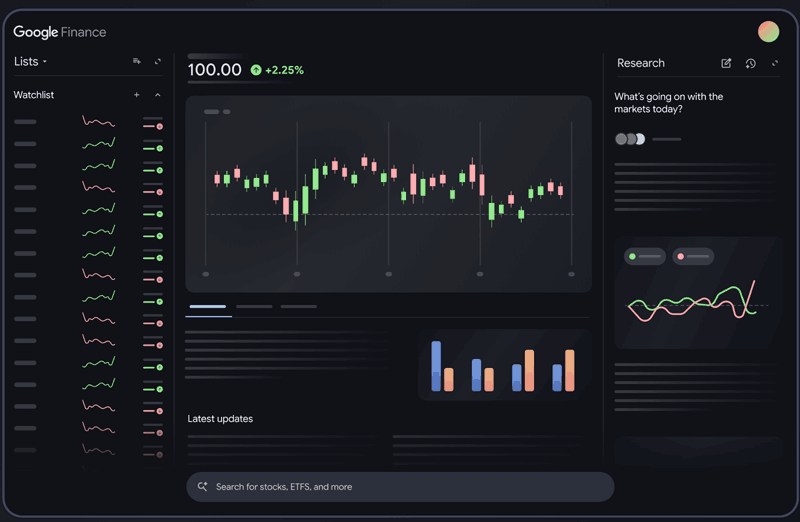
Screenshot Of Google Finance

The screenshot above shows a watchlist panel on the left, a chart in the middle, a “latest updates” section beneath that, and a “research” section on the right hand panel.

Research

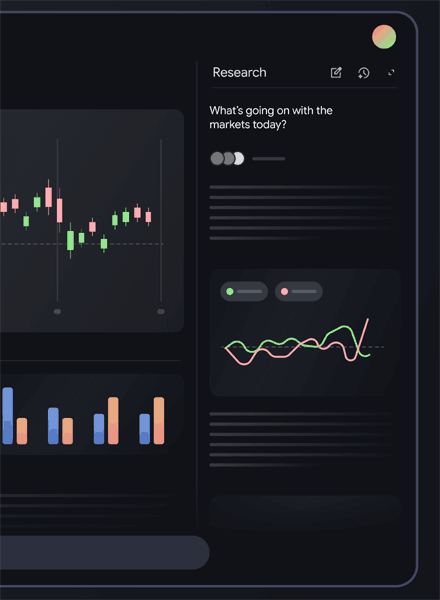
The new finance page enables users to ask natural language questions about finance, including the stock market, and the AI will return comprehensive answers, plus links to the websites where the relevant answers can be found.

Closeup Screenshot Of Research Section

Charting Tools

Google’s finance page also features charting tools that enable users to visualize financial data.

According to Google:

“New, powerful charting tools will help you visualize financial data beyond simple asset performance. You can view technical indicators, like moving average envelopes, or adjust the display to see candlestick charts and more.”

Real-Time Data

The new finance page also provides real-time data and tools, enabling users to explore finance news, including cryptocurrency information. This part features a live news feed.

The AI-powered page will roll out over the next few weeks on Google.com/finance/.

Read more at Google:

We’re testing a new, AI-powered Google Finance.

Featured Image by Shutterstock/robert_s

https://www.searchenginejournal.com/google-is-testing-an-ai-powered-finance-page/553333/


Google: Unique Image Landing Pages Can Help Search Visibility via @sejournal, @MattGSouthern

Google’s John Mueller says giving each image its own landing page can help it appear in image search, while gallery setups may limit visibility.

  • Google recommends unique landing pages for important images instead of JavaScript-only galleries or URL fragments.
  • Responsive images and modern formats improve user experience but aren’t direct ranking factors.
  • Auditing your site’s image URLs could reveal search visibility gains you’re currently missing.

https://www.searchenginejournal.com/google-unique-image-landing-pages-can-help-boost-search-visibility/553282/


How To Stay Visible in AI Search [Webinar] via @sejournal, @lorenbaker

AI search is here. Are you ready for the new rules?

The SEO game has changed. Traditional strategies are no longer enough, and some brands are getting lost in the shift to AI-powered search results.

Join Wayne Cichanski on August 20, 2025 for an exclusive webinar sponsored by iQuanti. Learn how to adapt your SEO strategy and site architecture for AI-driven queries and remain competitive in this new search era.

In this session, you’ll discover:

  • Why user experience, schema, and site architecture are now just as important as keywords
  • Practical steps to remain visible and competitive in evolving search results
  • How to position your brand for discovery in AI-driven queries, not just rankings

Why this session is essential:

With generative AI reshaping search results across platforms like Google, Bing, and ChatGPT, it is crucial to rethink how your content is structured and how people interact with your brand in AI search. Do not get left behind. Optimize for AI-driven search now.

Register today for actionable insights and a roadmap to success in the AI search era. If you cannot attend live, do not worry. Sign up anyway and we will send you the full recording.

https://www.searchenginejournal.com/stay-visible-ai-search-iquanti-webinar/552675/


OpenAI Launches GPT-5 In ChatGPT To All Users via @sejournal, @MattGSouthern

OpenAI has released GPT-5, now the default model in ChatGPT for all users, including those on the free tier.

The new model is positioned as OpenAI’s most capable and reliable system to date. OpenAI emphasizes a stronger focus on accuracy, instruction following, and long-form reasoning.

Available Now To All ChatGPT Users

For the first time, OpenAI is making its latest flagship model available to free users.

GPT-5 is rolling out now to Free, Plus, Pro, and Team accounts, with support for Enterprise and Education expected next week.

Free-tier access includes basic usage of GPT-5, with requests routed to a smaller “GPT-5 mini” variant once limits are reached.

Paid subscribers receive higher usage limits, and Pro users gain access to GPT-5 Pro, a version designed for more complex, resource-intensive tasks.

Accuracy, Reasoning, and Transparency Take Priority

According to OpenAI, GPT-5 significantly reduces hallucinated facts and is more likely to admit when it lacks the context to provide a reliable answer.

Evaluations show GPT-5 produces 45% fewer factual errors than GPT-4o, with up to 80% fewer errors when deeper reasoning is enabled.

The model also performs better on benchmarks tied to real-world problem-solving, such as coding, legal analysis, and health-related queries.

What’s Changed in the System

Rather than a single model, GPT-5 acts as a dynamic system that automatically decides whether to respond quickly or think more deeply, depending on prompt complexity.

Users can also request explicit reasoning with natural language prompts like “think hard about this.”

Other updates include:

  • A redesigned safety system that favors partially helpful answers over blanket refusals
  • Reduced sycophantic responses and more honest communication about limitations
  • Improvements in coding performance, including front-end UI generation and debugging
  • Support for multimodal input, including charts and images

Looking Ahead

GPT-5 is positioned less as a revolutionary jump and more as an effort to build trust through accuracy, reliability, and broader access.

For SEOs and digital marketers who rely on AI tools for drafting, analysis, or ideation, GPT-5’s improvements may help reduce the time spent verifying or correcting outputs.


Featured Image: JarTee/Shutterstock

https://www.searchenginejournal.com/openai-launches-gpt-5-in-chatgpt-to-all-users/553275/


Google Expands Performance Max Controls and Reporting via @sejournal, @brookeosmundson

Google Ads just dropped another wave of updates to Performance Max today.

For those who’ve been asking for better audience targeting, clearer reporting on new customer acquisition, and more transparency around auto-generated assets, these updates will feel like long-overdue upgrades.

Let’s break down what’s new, why it matters, and how advertisers should respond.

What’s New in Performance Max

Google has announced three core areas of updates for Performance Max campaigns:

  1. Expanded audience and campaign controls
  2. Improved new customer acquisition reporting and diagnostics
  3. More granular creative reporting and AI-powered asset recommendations

Most are either rolling out now or available broadly, with some elements in beta. Let’s walk through the details.

Expanded Controls Over Audience Targeting and Search Inventory

Performance Max has long leaned on automation, sometimes at the expense of control. Google is slowly changing that, and this release continues that shift.

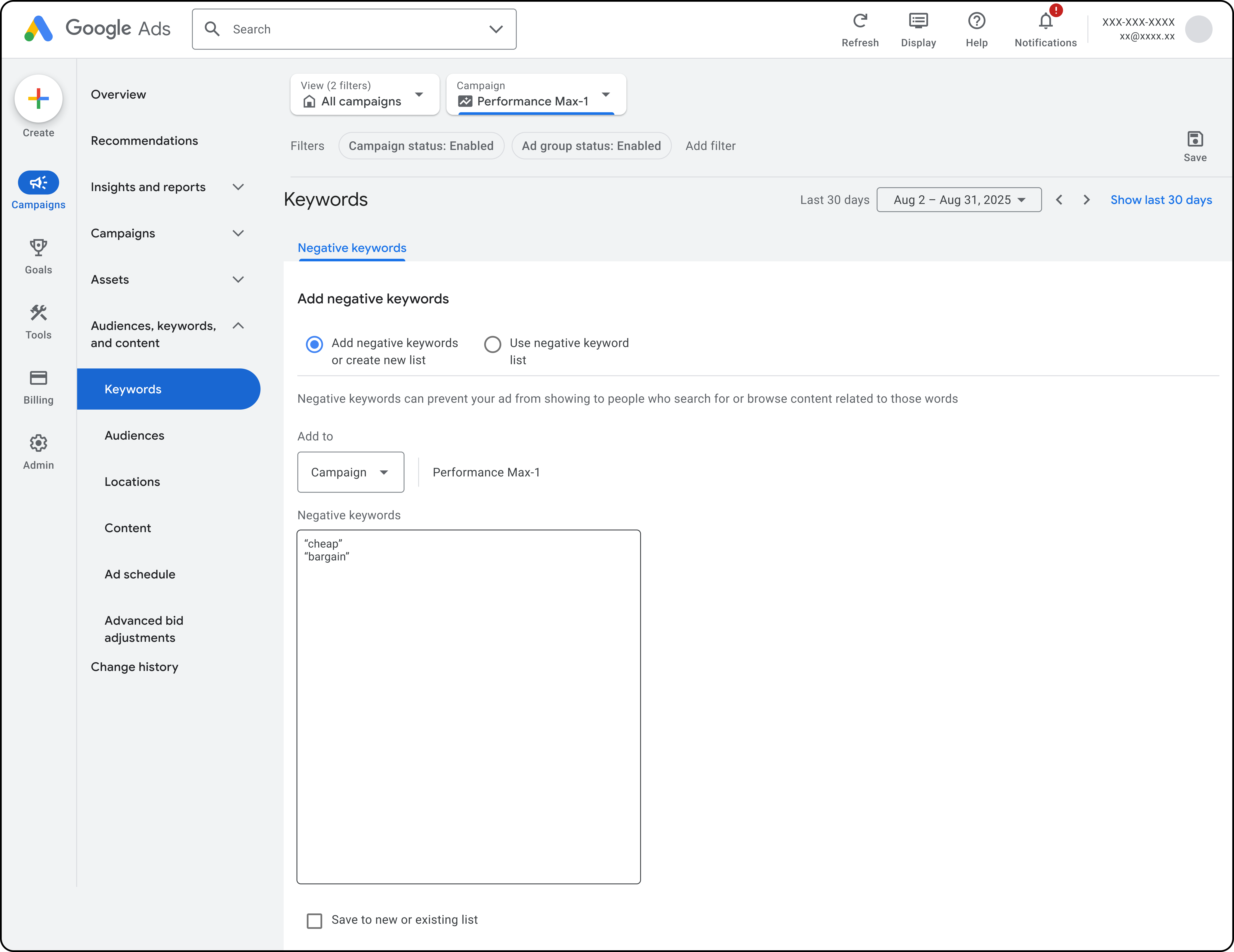
Campaign-Level Negative Keyword Lists

Advertisers can now apply negative keyword lists across Performance Max campaigns. Previously, campaign-level negatives had to be managed individually, which created friction for accounts with dozens of asset groups.

With this update, advertisers can centralize keyword exclusions. For example, excluding terms like “cheap” or “free” across multiple luxury or premium product campaigns.

Campaign-level negative keyword lists in Performance Max.Image credit: Google, August 2025

You still have the option to apply unique negative keywords to individual campaigns, but this rollout makes managing brand suitability far more scalable.

More Search Themes per Asset Group

Google has doubled the search theme limit from 25 to 50 per asset group. This matters for brands that want to influence where their Performance Max ads show up in Search, without leaning on historical keyword builds.

By expanding your search theme input, you’re giving Google more information to better match your ads to queries. It also helps widen your eligible inventory while staying relevant.

Device and Demographic Targeting Updates

You can now fully control which device types your Performance Max campaigns appear on, something that was previously only partially available.

For example, a gaming company can restrict campaigns to mobile devices, or a B2B advertiser can exclude tablets entirely.

Age targeting is now also available, allowing advertisers to exclude or target specific age ranges.

Google is also testing gender-based demographic targeting in beta. These controls bring Performance Max closer in line with what’s long been possible in Search, Display, and YouTube campaigns.

New Customer Acquisition Reporting Gets Smarter

One of the most frustrating parts of new customer acquisition bidding has been the vague “Unknown” label in reporting. That’s changing with today’s updates in Performance Max reporting.

No More “Unknown” Conversions

In lifecycle reporting for new vs. returning customers, Google previously bucketed a portion of conversions as “Unknown”. This left advertisers with limited visibility into actual performance.

Google has now improved the backend logic that determines if a user is new or existing, meaning those “Unknown” labels should be gone moving forward.

This matters for two key reasons:

  • You can now get a more accurate read on how many new customers you’re acquiring.
  • Bidding strategies that rely on new customer signals will become more effective as the data improves.

For even more precision, Google encourages advertisers to update their conversion tracking tags to include the new customer acquisition parameter. This signals to Google whether a conversion is from a new or returning customer, based on first-party data.

New Goal Diagnostics and Recommendations

Alongside the reporting improvements, Google has added new diagnostics that surface goal-related issues in Performance Max.

These include broken or missing conversion tags, goal misconfigurations, or other tracking issues that could be holding back performance.

The diagnostics come with actionable recommendations to help advertisers resolve the problem. While this might not be the most glamorous update, it will save time and frustration during campaign setup and troubleshooting.

Creative Reporting and Asset Control Get a Boost

Asset transparency in Performance Max has been a long-standing pain point. While things have improved in the last year, these new changes go further.

Final URL Expansion Asset Reporting

Advertisers can now view reporting for assets generated through Final URL Expansion (FUE). This is Google’s feature that dynamically creates assets based on landing page content.

You’ll be able to see what text and visuals were created through FUE and how they performed.

Expanded Final URL reporting in Google AdsImage credit: Google, August 2025

More importantly, if you don’t like what Google created, you now have the ability to remove those assets from your campaign.

This is a big win for brands concerned about creative consistency, especially when it comes to legal language or brand tone. While FUE can be useful for scale, it hasn’t always produced on-brand results. So, this added visibility is a welcome change.

AI-Powered Creative Recommendations

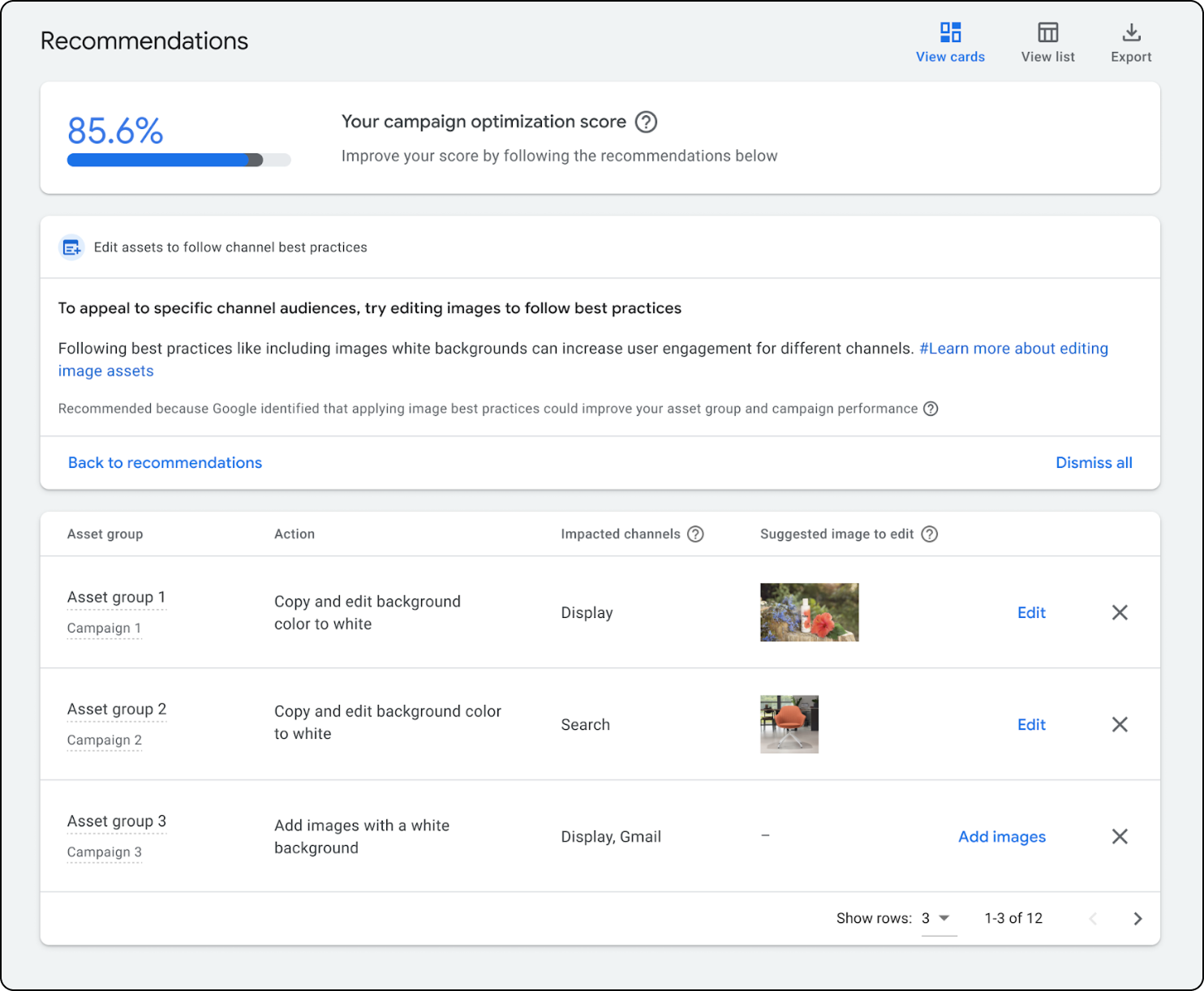
Performance Max will now generate image-specific recommendations to help you improve performance. These suggestions will include both what types of visuals to add and how to optimize existing ones for better performance on various channels (like YouTube vs. Discover).

New creative asset recommendations in Google AdsImage credit: Google, August 2025

Best of all, these recommendations link directly into the built-in AI-powered image editor in Google Ads, so you can make changes right inside the platform without needing to re-upload or redesign assets elsewhere.

It’s clear Google wants advertisers to take a more active role in creative strategy, even inside an automated campaign structure.

Wrapping Up

Google is clearly listening to advertisers’ calls for more transparency and control. These updates to Performance Max mark another step toward striking a better balance between scale and strategy.

While not every advertiser will need to use every new feature, the option to do so means there’s more room to tailor Performance Max campaigns to your business goals, creative preferences, and customer insights.

Whether you’re looking to fine-tune audience reach, fix tracking issues, or clean up your creative assets, there’s something in this update that’s worth your attention.

https://www.searchenginejournal.com/google-expands-performance-max-controls-and-reporting/553264/


Building Brand Identity: How To Define Who You Are

Brand identity is the foundation of your business, from the conceptualization of your services and products all the way to marketing.

Before you can create an effective marketing, SEO, content strategy, or even a business strategy, you need to know who you are as a brand. It’s a step many marketers and business leaders overlook, but it’s the one that makes everything else work.

This episode breaks down why identity is the starting point for your business to have impact.

Editor-in-Chief of Search Engine Journal, Katie Morton, sits down with Mordy Oberstein, founder of Unify Brand Marketing, to discuss how to develop a true brand identity so your marketing strategy has something solid to stand on.

Watch the video or read the full transcript below.

[embedded content]

Editor’s note: The following transcript has been edited for clarity, brevity, and adherence to our editorial guidelines.

Katie Morton: Hey everybody, it is I, Katie Morton, Editor-in-Chief of Search Engine Journal, and today I’m sitting down with Mordy Oberstein, founder of Unify Brand Marketing. Mordy, talk to me. What’s going on?

Mordy Oberstein: Episode three! It’s a thing now. I can’t believe we’ve made it this far. Counting episodes has become a bit of a challenge, though. We might even be on number four.

Katie: Counting is definitely hard! But let’s dive in.

Why Brand Identity Matters

Mordy: Last time, we talked about brand development and the stages of brand development. The first stage of brand development is developing brand identity. So, for the sake of continuity, which is important for branding, let’s talk about how you develop brand identity this time.

Katie: That sounds fantastic. How does one develop brand identity?

Mordy: Before we get into the “how,” let’s talk about why brand identity is so essential. Identity is the foundation of everything your brand or company does. You can’t create a marketing, SEO, or content strategy without first knowing who you are. Everyone skips this step—but it’s crucial.

Also, identity is the thing that allows your audience to connect to you. There has to be a point of connection for marketing to actually be effective. And people can’t connect unless there’s a “you” to connect with.

How To Build Brand Identity

Mordy: And that, in turn, also gives you a lot of focus where brands generally go off the rails is when they start focusing on the wrong things. It’s usually because of a lack of brand identity. So, how do you actually build identity?

The first thing to understand is that identity is not a fake thing. It’s not some make-believe concept like, “Oh, brand identity, it’s a fabrication.” No, identity is a real, living, breathing thing. And because of that, it has to be tied to what you actually do, what your offering really is. There’s no way to put lipstick on a pig.

The second thing I’ll say, before we dive deeper, is that brand identity has nothing to do with your company culture. If you think, “Oh, our identity is our company culture,” you’re doing it wrong. I know that’s a hot take.

The goal of identity is to create something authentic that your audience can connect with. And it needs to have depth for that connection to happen. To have depth, there has to be almost a therapeutic process that goes on. What you’re basically engaging in therapy for your brand.

Engage In Brand “Therapy”

Mordy: What I do with clients (and what you should do internally with your own team) is tap into who you actually are and what you actually want. It’s a process of asking: Why do you do the things you do?

You need to sit down with your team and have a session where you talk about:

  • Why you do what you do.
  • How you see your industry and niche.
  • How you view your product or service.
  • How you see your space and your audience.
  • What you want for your audience, not just practically, but meaningfully.

It’s not about what your audience gets in a practical sense. It’s about the outcome for their lives in a meaningful way.

During this process, you need to take notes like a therapist. As you’re having these discussions, ask yourself: What’s landing? What’s meaningful about this? What feels like something to chew on? Listen for the things that resonate – both in what you’re saying and what your team is saying.

From Reflection To Action: Formalizing Your Brand Identity

The next step is to formalize all of that into a pathway to showcase it. You take everything you discussed, all these concepts, ideas, and meaningful points, and try to concretize them into one unified (no pun intended) concept for yourself.

This means prioritizing. You can’t focus on everything. You have to take some of the meaningful things you talked about and say, “Okay, this is secondary.” You need to decide which points will be your primary focus.

Once you have a centralized concept of who you are, what you do, and why it’s meaningful and once it’s really clear to you – the next step is execution.

Because communication about who you are isn’t in the tagline on your homepage. It’s the nonverbal stuff. It’s latent. It’s everything you do. All the content you create, the activities you engage in should all signal and speak to who you are.

Integrating Identity Into Marketing Strategy

Mordy: This is where you start integrating all the work you did in those sessions into your actual marketing strategy.

It’s a three-step process:

  1. Sit down and have deep discussions to discover what’s meaningful.
  2. Prioritize: Decide which meaningful things you’re going to focus on.
  3. Integrate: Unify those concepts into your brand actions and strategies.

Does that make sense?

Katie: So no competitive analysis at this stage?

Mordy: I would encourage you not to look at your competitors yet. All you’re trying to do is figure out…take away the idea of brand for a second, take away the company. If someone asks you who you are, you don’t answer by thinking about your competition.

Instead, you ask yourself: What’s really meaningful to me? What do I really want? What do I want people to know? What do I like to focus on? All those kind of questions and you start pulling that out.

Katie: Exactly. Authenticity should naturally help differentiate you. It should, right?

Mordy: And that’s another thing, by the way, which is a great point that you bring up. It’s technically possible that you could find an identity of who you are that’s really meaningful, that has a layer of depth, that’s not the surface-level nonsense that a lot of brands fall into. It can be super clear to you, and it can be difficult to differentiate. It could be the exact same thing as another brand, but that’s a very, very unlikely thing. It’s a technical possibility, but I don’t think it’s an existential possibility.

Katie: That makes sense. If you think of a brand as an individual human, no two humans are alike. So neither should two brands be alike.

Mordy: Exactly. If you’re doing this exercise correctly, you’ll naturally create differentiation. And if you feel like you’re not, it means you haven’t dug deep enough yet.

Brand Identity Guides Real-World Implications

Katie: Full disclosure: We actually went through this brand identity exercise with Mordy at Search Engine Journal. It was extremely helpful, and like you said, it also trickled into real world actions. It’s helping to inform some of our product strategy and other things we’re planning on doing in the real world. This branding exercise is not just empty calories, so to speak.

Mordy: Thanks for saying that. That’s awesome.

If your marketing team isn’t getting traction and feels stuck, it’s often because you’re not tapped into who you actually are. But once you are, you feel very much not stuck. You get clarity: “Here’s where our product should go. We shouldn’t go that way; we should go this way.”

It’s where you see companies go off the rails with AI, for example. They just jump on every AI thing because they don’t know who they are. They don’t have the ability to say, “That’s not us.” Or, “Yes, we should get into AI, but it should be done in a way that reflects who we are.”

This identity work also gives you focus, traction, and momentum when you’re feeling stuck. We talked about this last time: knowing who you are is very important for figuring out who you’re for.

Katie: Right. That’s a good point. So it can help target your audience as well, who do you want to help? The other thing I found it’s motivating just from a work ethic standpoint, if you feel like you’re burned out or you’re spinning your wheels or you don’t know why you do what you do, it gives you sort of a North star to really connect with other human beings, with your customer, who are you trying to serve and why?

What is that intrinsic motivation that helps you get out of bed in the morning?

Mordy: It’s super meaningful. From a practical point of view, when teams or companies talk about needing an “internal vision,” what they really mean is they need an internal identity that can be communicated across teams. That’s what I feel you’re actually trying to say.

Aligning Brand Identity: A Picture Frame Business Example

Mordy: Let me give you a weird example. Let’s say I make picture frames. That’s my business: I sell picture frames.

If your identity is just, “We’re about making cheap picture frames,” that’s not meaningful. But if you start asking why you’re doing this, you might discover something deeper. Maybe you and your team really value cherishing memories. That’s your motivation. So, your product, the frame, is a way to help people cherish their memories by displaying them.

Half my pictures are still on my phone. They are not cherished. Print them, put them in a nice frame, display them, cherish those memories. But if you say you’re all about cherishing memories and then sell flimsy, garbage frames, that would be a misalignment.

Another company might say, “We want to add artistic flair to your pictures.” Their identity is about art and design. Two totally different companies doing totally different things with their brand identity. And it’s based on who they actually are, and their products should align.

Sometimes you’ll combine concepts. Maybe you believe in cherishing memories, but you also feel that an artistic frame enhances that experience. So, your core concept becomes: “We help you cherish memories by giving them artistic design that highlights how special they are.”

So that would be taking two concepts and unifying them together to create one core concept that speaks of both aspects of who you actually are. You can do five different things with this, it all depends on who you are in reality.

Katie: I can imagine, too, that you could build entire product lines from that concept. Maybe you serve different customer segments, or maybe it’s one customer who wants variety.

Mordy: Your whole product line should be informed by that decision. If you’re saying, “Cherishing the memory means giving it a really fancy frame,” then your products need to align with that. Imagine you bought a Monet…you wouldn’t put it in a cheap poster board frame. You’d give it a beautiful frame that reflects its value. Your memories are paintings; your pictures are memories.

Your products need to align. You’d create product lines of artistic frames to match your identity. If your products don’t reflect who you are, then either that’s not your identity, or you need to change your product to match it.

Brand Identity Drives Motivation

Katie: That makes sense. As a painter, so I can relate to this example. When I don’t know why I’m creating, I stop. The times that I am aligned with this exercise of figuring out who I am and who I’m trying to connect with, and the identity behind why I would be a painter, I’m so much more motivated to show up and paint.

Any time I get lost in the grind of the work week, it often makes me not paint, because I have different identities at different times, as we all do as human beings. Sometimes my work identity will take over. If the painter identity is weak or ill-defined, I can literally go years without painting.

So to bring it back to the concrete reality of what we’re talking about, the same happens in business. It’s so easy to get off track because people have so many priorities shoved at them all the time. So it’s really easy for businesses to become idea generators. If you don’t have those north star KPIs rooted in our brand identity, it’s so easy to go chase shiny things.

Mordy: …they’re all over the place. Businesses ask, “Why should I do this? Shouldn’t I focus on conversions, revenue, traffic?” But defining your identity helps you do that. You’ll target the right people with the right message and avoid wasting time and money on products, marketing, or content that don’t align with who you are.

When you’re confused, you try everything. You waste a ton of time, resources, and money. But if you sit down for a few hours, clarify your identity, you’ll know, “We need to do this, and not that.”

Mordy: Also, identity evolves over time, just like people. Your brand, who you are, why you do what you do, it changes. That’s normal. But it always needs to be clear to you.

People are creatures of meaning. If you can’t attach meaning to what you do, your audience won’t be able to connect or resonate. You’ll face an uphill battle trying to convince people to spend money with you. On top of that, your team won’t have buy-in. You, as the owner or CEO, might be motivated, but your team needs something meaningful to connect with.

That’s why it’s critical to communicate your identity across the entire organization. Don’t stop at the C-suite or the marketing team. Start having real conversations about this with every team member.

Quick Note On ICPs And Personas

Katie: I have one last question for you, Mordy. The idea of the ICP, how much does that factor into this particular step? How would you categorize that part of this discussion in terms of the ICP and the brand identity?

Mordy: That’s a hard question, it’s a whole topic in itself. I don’t like profiling like that. I like intent-based marketing over persona-based marketing.

Katie: Not to open a can of worms late in the discussion, but talk to me briefly about intent-based versus profiling.

Mordy: I’m more interested in why people do things than which person does which thing. Generally, when you’re more intent-focused, you open up more opportunities. But when you’re persona-focused, you sometimes end up with blinders on.

That’s not to say there’s no room for persona-based marketing. There is. But going back to your question about the ICP (kind of a hot take) shouldn’t be part of this process until you’ve figured out who you are.

Should your ICP, your Ideal Customer Profile, influence who you actually are? Does it change who you are? Think of it like going on a date. Should who the other person is influence who you are as a person? That’s not a recipe for success. You are who you are.

Of course, we’re all multifaceted people, but fundamentally, you are who you are. And because of that, you decide who you should engage with, whether that’s Customer X or Customer Y. Not the other way around.

Final Thoughts

Katie: Let me just add one thing. Let’s say someone is flexible as a brand or as a dater. Imagine a scenario where someone has aspirations, whether in business or relationships. Someone who’s an inexperienced business owner who wants to target a high-value customer, but doesn’t yet have the experience to offer real value.

In that case, you have two options. One is to accept where you are, get back down into your league, and serve the customers you’re best equipped to serve right now. The other option is to level up. Get educated. Improve yourself. If you’re aiming for a target that’s currently out of your league, there are steps you can take within reason to grow into that.

But that’s a whole other business development conversation. For the purposes of this branding exercise, it’s about authenticity and being realistic. It’s about knowing where you can truly add value. And at the heart of it, it always comes back to: Who are you? Like you said, it ties back to brand development.

Mordy: To kind of end off with a very simple example, again, if you micro-level this, it all becomes much easier to see. Let’s say there are two groups I want to hang out with. Group A likes baseball games. Group B prefers the ballet or symphony. Both groups seem cool, but I love baseball. That’s my thing. So I should hang out with the baseball crowd.

I’m not a fancy person. I don’t enjoy the symphony. If you do, that’s awesome, more power to you. But it’s not me. I’m not going to force myself into that crowd. Instead, I’ll lean into the baseball group. I’ll amplify that aspect of myself. I’ll get the jersey, the gear to show them I’m part of their group. Because I actually am.

I’m not faking it. I’m just trying to amplify what I actually am to show you that’s who I am. That’s the difference. One is you’re faking it in order to show people like, “Oh, here we go, this is who I am.” Not you at all.

The other way is, this is who I am, and I’m going to try to communicate that to you by all the things I’m going to do. And I might purposely and consciously try to do things or signal to you that “I’m part of your group. I fit in. Love me.”

Katie: That’s amazing. And just from a business standpoint, when it comes to SEO and acquiring customers and traffic, it’s so important to focus on your niche. You’re not going to be all things to all people, especially now when AI is answering all the basic questions.

You need to double down on who you are and speak authentically to your niche. Stop trying to appeal to too many people. The days of the open web firehose of traffic are done. So adjust and adapt.

Mordy: If you’re for everyone, you’re for no one.

Katie: Exactly. Alright, Mordy, we’re at time. Thank you so much for sitting down with me today. I’m looking forward to the next one.

For a free consultation with Mordy, head over to unifybrandmarketing.com.

And we’re at searchenginejournal.com for more content and discussions. Mordy is also a contributor at Search Engine Journal, and any final thoughts?

Mordy: Yeah, come check out the free consultation. And check out the SEJ content.

Katie: Awesome. Until next time. Bye.

Mordy: Bye.

More resources: 


Featured Image: Paolo Bobita/Search Engine Journal

https://www.searchenginejournal.com/building-brand-identity-how-to-discover-who-you-are/552970/



Claude Opus 4.1 Improves Coding & Agent Capabilities via @sejournal, @MattGSouthern

Anthropic has released Claude Opus 4.1, an upgrade to its flagship model that’s said to deliver better performance in coding, reasoning, and autonomous task handling.

The new model is available now to Claude Pro users, Claude Code subscribers, and developers using the API, Amazon Bedrock, or Google Cloud’s Vertex AI.

Performance Gains

Claude Opus 4.1 scores 74.5% on SWE-bench Verified, a benchmark for real-world coding problems, and is positioned as a drop-in replacement for Opus 4.

The model shows notable improvements in multi-file code refactoring and debugging, particularly in large codebases. According to GitHub and enterprise feedback cited by Anthropic, it outperforms Opus 4 in most coding tasks.

Rakuten’s engineering team reports that Claude 4.1 precisely identifies code fixes without introducing unnecessary changes. Windsurf, a developer platform, measured a one standard deviation performance gain compared to Opus 4, comparable to the leap from Claude Sonnet 3.7 to Sonnet 4.

Expanded Use Cases

Anthropic describes Claude 4.1 as a hybrid reasoning model designed to handle both instant outputs and extended thinking. Developers can fine-tune “thinking budgets” via the API to balance cost and performance.

Key use cases include:

  • AI Agents: Strong results on TAU-bench and long-horizon tasks make the model suitable for autonomous workflows and enterprise automation.
  • Advanced Coding: With support for 32,000 output tokens, Claude 4.1 handles complex refactoring and multi-step generation while adapting to coding style and context.
  • Data Analysis: The model can synthesize insights from large volumes of structured and unstructured data, such as patent filings and research papers.
  • Content Generation: Claude 4.1 generates more natural writing and richer prose than previous versions, with better structure and tone.

Safety Improvements

Claude 4.1 continues to operate under Anthropic’s AI Safety Level 3 standard. Although the upgrade is considered incremental, the company voluntarily ran safety evaluations to ensure performance stayed within acceptable risk boundaries.

  • Harmlessness: The model refused policy-violating requests 98.76% of the time, up from 97.27% with Opus 4.
  • Over-refusal: On benign requests, the refusal rate remains low at 0.08%.
  • Bias and Child Safety: Evaluations found no significant regression in political bias, discriminatory behavior, or child safety responses.

Anthropic also tested the model’s resistance to prompt injection and agent misuse. Results showed comparable or improved behavior over Opus 4, with additional training and safeguards in place to mitigate edge cases.

Looking Ahead

Anthropic says larger upgrades are on the horizon, with Claude 4.1 positioned as a stability-focused release ahead of future leaps.

For teams already using Claude Opus 4, the upgrade path is seamless, with no changes to API structure or pricing.


Featured Image: Ahyan Stock Studios/Shutterstock

https://www.searchenginejournal.com/claude-opus-4-1-improves-coding-agent-capabilities/553062/


The Future Of Search: 5 Key Findings On What Buyers Really Want via @sejournal, @MattGSouthern

Search is changing, and not just because of Google updates.

Buyers are changing how they find, evaluate, and decide. They are researching in AI summaries, asking questions out loud to their phones, and converting through conversations that happen outside of what most analytics can track.

Our latest ebook, “The Future Of Search: 16 Actionable Pivots That Improve Visibility & Conversions,” explores how marketers are responding to this shift.

It offers a closer look at what it means to optimize for visibility, engagement, and results in a fragmented, AI-influenced search landscape.

Here are five key takeaways.

1. Ranking Well Doesn’t Guarantee Visibility

Getting to the top of search results used to be enough. Today, that’s no longer the case.

AI summaries, voice assistants, and platform-native answers often intercept the buyer before they reach your website.

Even high-ranking content can go unseen if it’s not structured in a way that’s easily digestible by large language models.

For example, research shows AI-generated summaries often prioritize single-sentence answers and structured formats like tables and lists.

Only a small fraction of AI citations rely on exact-match keywords, reinforcing that clarity and context are now more important than repetition.

To stay visible, businesses need to consider how their content is interpreted across multiple AI systems, not just traditional SERPs.

2. Many Conversions Happen Offscreen

Clicks and page views only tell part of the story.

High-intent actions like phone calls, text messages, and offline conversations are often left out of attribution models, yet they play a critical role in decision-making.

These touchpoints are especially common in service-based industries and B2B scenarios where buyers want real interaction.

One case study reveals that a company discovered nearly 90% of their Yelp conversions came through phone calls they weren’t tracking. Another saw appointment bookings spike after attributing organic search traffic to calls rather than clicks.

Our ebook refers to this as the insight gap, and highlights how conversation tracking helps marketers close it.

3. Listening Is More Effective Than Guessing

Marketers have access to more customer input than ever, but much of it goes unused.

Call transcripts, support calls, and chat logs contain the language buyers actually use.

Teams that analyze these conversations are gaining an edge, using real voice-of-customer insights to refine messaging, improve landing pages, and inform campaign strategy.

In one example, a marketing agency increased qualified leads by 67% simply by identifying the specific terminology customers used when asking about their services.

The shift from assumptions to evidence is helping brands prioritize what matters most, and it’s making their campaigns more effective.

4. Paid Search Works Better When It Aligns With Everything Else

Search behavior is not linear, and neither is the buyer journey.

Users often move between organic results, paid ads, and AI-generated suggestions in the same session. The strongest-performing campaigns tend to be the ones that echo the same language and value props across all these touchpoints.

That includes aligning ad copy with real customer concerns, drawing from call transcripts, and building landing pages that reflect the buyer’s stage in the decision process.

It also means rethinking what happens after the click.

5. Attribution Models Are Out Of Step With Reality

Most attribution still assumes that conversions happen on a single screen. That’s rarely true.

A manager might discover your brand in an AI-generated search snippet on a desktop, send the link to themselves in Slack, and later call your sales team from their iPhone after revisiting the content on mobile.

Marketers relying only on last-click attribution may be optimizing based on incomplete or misleading data.

The report makes the case for models that include multi-touch, cross-device, and offline activity to give a fuller picture of what drives conversions.

This isn’t about tracking more for the sake of it. It’s about making smarter decisions with the signals that matter.

Rethinking Search Starts With Rethinking Buyers

The ebook, written in collaboration with CallRail, offers more than strategy updates. It is a reminder that behind every metric is a person making a decision.

Marketers who succeed in this new environment aren’t just optimizing for rankings or clicks. They are optimizing for how people think, search, and take action.

Download the full report to explore how buyer behavior is reshaping search strategy.

the future of ai search


Featured Image: innni/Shutterstock

https://www.searchenginejournal.com/the-future-of-search-key-findings-on-what-buyers-really-want/552476/