Google: Many Top Sites Have Invalid HTML And Still Rank via @sejournal, @MattGSouthern

A recent discussion on Google’s Search Off the Record podcast challenges long-held assumptions about technical SEO, revealing that most top-ranking websites don’t use valid HTML.

Despite these imperfections, they continue to rank well in search results.

Search Advocate John Mueller and Developer Relations Engineer Martin Splitt referenced a study by former Google webmaster Jens Meiert, which found that only one homepage among the top 200 websites passed HTML validation tests.

Mueller highlighted:

“0.5% of the top 200 websites have valid HTML on their homepage. One site had valid HTML. That’s it.”

He described the result as “crazy,” noting that the study surprised even developers who take pride in clean code.

Mueller added:

“Search engines have to deal with whatever broken HTML is out there. It doesn’t have to be perfect, it’ll still work.”

When HTML Errors Matter

While most HTML issues are tolerated, certain technical elements, such as metadata, must be correctly implemented.

Splitt said:

“If something is written in a way that isn’t HTML compliant, then the browser will make assumptions.”

That usually works fine for visible content, but can fail “catastrophically” when it comes to elements that search engines rely on.

Mueller said:

“If [metadata] breaks, then it’s probably not going to do anything in your favor.”

SEO Is Not A Technical Checklist

Google also challenged the notion that SEO is a box-ticking exercise for developers.

Mueller said:

“Sometimes SEO is also not so much about purely technical things that you do, but also kind of a mindset.”

Splitt said:

“Am I using the terminology that my potential customers would use? And do I have the answers to the things that they will ask?”

Naming things appropriately, he said, is one of the most overlooked SEO skills and often more important than technical precision.

Core Web Vitals and JavaScript

Two recurring sources of confusion, Core Web Vitals and JavaScript, were also addressed.

Core Web Vitals

The podcast hosts reiterated that good Core Web Vitals scores don’t guarantee better rankings.

Mueller said:

“Core Web Vitals is not the solution to everything.”

Mueller added:

“Developers love scores… it feels like ‘oh I should like maybe go from 85 to 87 and then I will rank first,’ but there’s a lot more involved.”

JavaScript

On the topic of JavaScript, Splitt said that while Google can process it, implementation still matters.

Splitt said:

“If the content that you care about is showing up in the rendered HTML, you’ll be fine generally speaking.”

Splitt added:

“Use JavaScript responsibly and don’t use it for everything.”

Misuse can still create problems for indexing and rendering, especially if assumptions are made without testing.

What This Means

The key takeaway from the podcast is that technical perfection isn’t 100% necessary for SEO success.

While critical elements like metadata must function correctly, the vast majority of HTML validation errors won’t prevent ranking.

As a result, developers and marketers should be cautious about overinvesting in code validation at the expense of content quality and search intent alignment.

Listen to the full podcast episode below:

[embedded content]

https://www.searchenginejournal.com/google-many-top-sites-have-invalid-html-and-still-rank/550182/


DeepSeek App Faces Ban In Germany For Illegal Transfer Of User Data via @sejournal, @martinibuster

German data protection official Meike Kamp has filed a formal request that Apple and Google remove the DeepSeek app from their respective app stores for the illegal transfer of users’ personal data to China, in violation of European Union law.

Meike Kamp, the Commissioner for Data Protection and Freedom of Information, previously requested in May that DeepSeek voluntarily comply with the legal requirements for data transfer to other countries, stop the transfer of data altogether, or remove their app from the Apple and Google app stores.

Failure to respond to those requests resulted in the official taking the next step of filing a report of illegal content to both Apple and Google who will then examine and decide DeepSeek’s future on their platforms.

The data protection commissioner stated (translated from original German):

“The transfer of user data by DeepSeek to China is unlawful. DeepSeek has not been able to convincingly prove to my authority that data from German users:

  • Inside China is protected at a level equivalent to that of the European Union.
  • Chinese authorities have extensive access rights to personal data within the sphere of influence of Chinese companies.
  • In addition, DeepSeek users in China do not have enforceable rights and effective remedies guaranteed in the European Union.

I have therefore informed Google and Apple, as operators of the largest app platforms, about the violations and expect a blocking to be checked as soon as possible.”

Takeaways

  • Enforcement of Data Privacy Laws
    Germany is taking formal steps to enforce EU data privacy regulations by targeting app distribution channels (Apple and Google).
  • International Data Transfer Violations
    DeepSeek is accused of transferring personal user data to China without ensuring protections as required by EU standards.
  • China’s Data Access
    The lack of enforceable user rights and legal remedies in China is a central concern, due to the government’s extensive access rights over data held by Chinese companies.
  • Escalation of Regulatory Action
    A report of illegal content was sent to Apple and Google after DeepSeek ignored a voluntary compliance request.
  • Decision Pending At Apple And Google
    Apple and Google will assess the reported violation and have the option to block the DeepSeek app in Germany.

Germany’s data protection official has formally requested that Apple and Google remove the DeepSeek app from their app stores due to illegal data transfers of German users’ personal information to China. The request follows concerns over Chinese government access to sensitive user data, after DeepSeek failed to comply with EU data protection standards.

Featured Image by Shutterstock/Mijansk786

https://www.searchenginejournal.com/deepseek-app-faces-ban-in-germany-for-illegal-transfer-of-user-data/550172/


Google Rolls Out June 2025 Core Update via @sejournal, @MattGSouthern

Google confirms the June 2025 core update is now rolling out and may take up to three weeks to complete.

  • Google’s June 2025 core update began rolling out on June 30.
  • It may take up to three weeks to complete.
  • Ranking volatility is expected throughout the rollout period.

https://www.searchenginejournal.com/google-rolls-out-june-2025-core-update/550161/


Google Integrates Search Console Insights Into Main Platform via @sejournal, @MattGSouthern

Google has rolled out a new version of Search Console Insights, now integrated directly into the main Search Console interface. This update ends the standalone beta experience.

The new report aims to make it easier to understand your site’s search performance without requiring advanced analytics skills.

What’s New?

Previously accessible through a separate interface, Search Console Insights now lives within the primary Search Console dashboard.

Google describes this as a more “cohesive experience,” bringing insights closer to the tools you already rely on.

The update is designed with non-technical users in mind, including bloggers, small business owners, and content creators seeking to understand how their content performs on Google Search.

Here’s an example of what the integrated experience looks like:

Screenshot from: developers.google.com/search/blog/2025/06/search-console-insights, June 2025.

Highlights From the Updated Report

1. Performance Overview

You can view total clicks and impressions from Google Search, along with comparisons to previous periods.

2. Page Performance

The report identifies which pages are getting the most clicks, along with “trending up” and “trending down” pages, offering insight into what’s working and what may need updating.

3. Achievements Feature Retained

Google is continuing the “Achievements” feature, which celebrates milestones like reaching new click thresholds.

While you can still access past achievements via email links, Google says direct sidebar access will be available in the next few weeks.

4. Search Query Trends

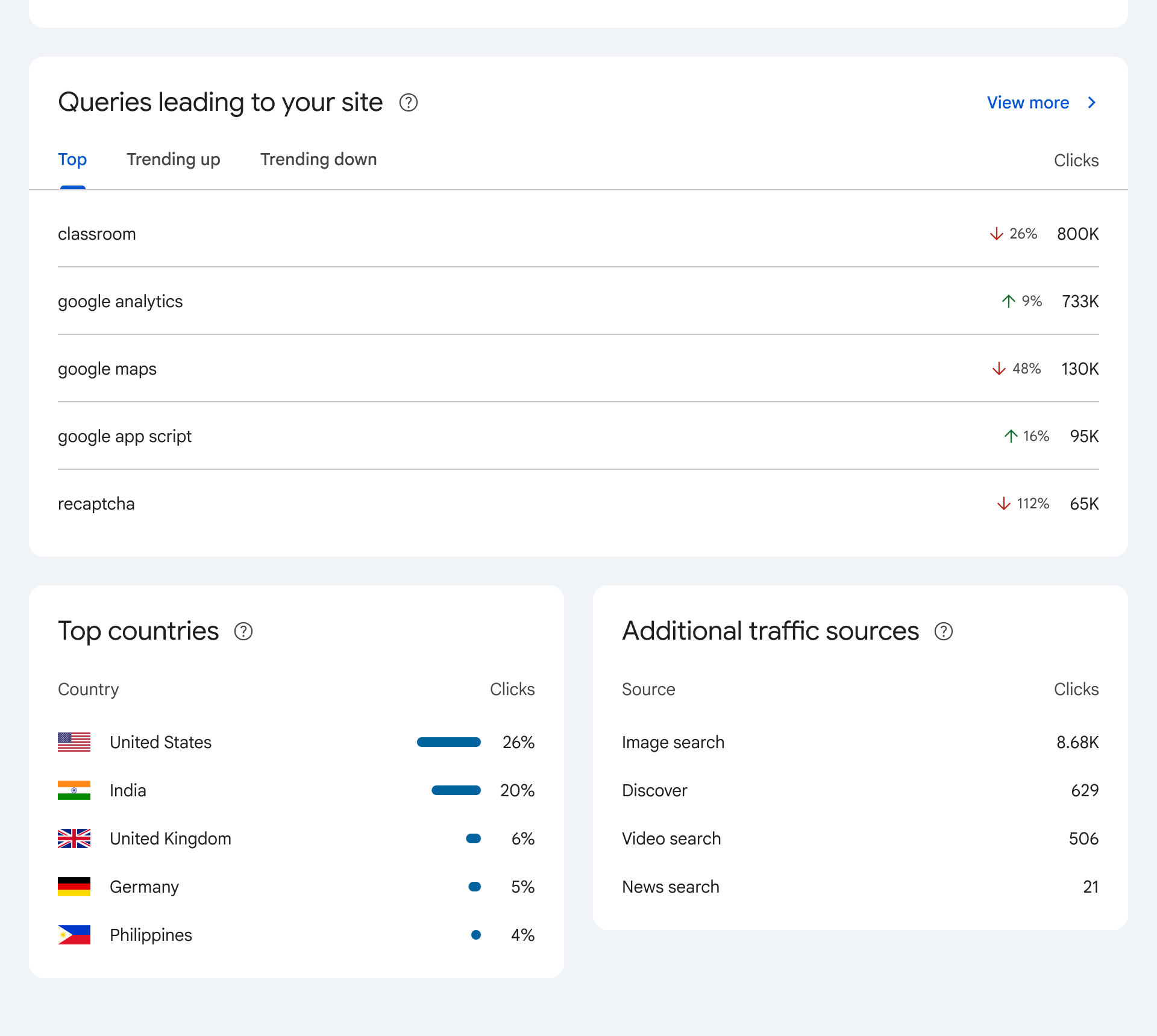
You can see top-performing queries and spot rising trends, which Google suggests can serve as inspiration for new content. Queries with declining performance are also highlighted.

Here’s an example of what this report looks like:

Screenshot from: developers.google.com/search/blog/2025/06/search-console-insights, June 2025.

Gradual Rollout In Progress

The new Insights experience is being rolled out gradually. If you don’t see it immediately, it will likely appear over the coming weeks.

This phased approach allows Google to monitor system performance and incorporate early feedback before releasing the feature to everyone.

How This Helps

By integrating simplified reporting into the main dashboard, Google is bridging the gap between entry-level insights and more advanced analytics.

If you found the existing Performance report overwhelming, this update could offer a more approachable alternative.

For agencies and consultants, the simplified view may also serve as a communication tool for clients less familiar with technical metrics.


Featured Image: Roman Samborskyi/Shutterstock

https://www.searchenginejournal.com/google-integrates-search-console-insights-into-main-platform/550149/


The Strategy Gap: Social Video Is Not PPC Video via @sejournal, @LisaRocksSEM

Video is dominating online across PPC ads and social media channels. Unfortunately, many advertisers still repurpose social videos for paid campaigns.

What works organically on TikTok or Instagram often falls flat in performance-driven environments like YouTube Ads or Performance Max.

This could lead to low engagement and poor conversions.

To compete in today’s attention economy, PPC video needs its own strategy that is built from the ground up with performance in mind.

This article explores why CMOs and senior marketers must treat video as a creative asset, that is, a conversion-driven engine and platform-specific.

The Disconnect Between Social Video And PPC Video

Some marketers start with social video and “cut it down” for paid. However, the two formats fundamentally differ in purpose, intent, and delivery.

Social video is built for engagement, likes, shares, and storytelling that captures attention in a feed.

PPC video, on the other hand, is engineered for a conversion action. It must capture attention, communicate value quickly, and drive a specific action with a call-to-action (CTA) statement.

Repurposing social content for PPC assumes that the creative context uses the same strategy for driving engagement.

Social videos often rely on trends, audio cues, or slow storytelling arcs. Those don’t translate to skippable, conversion-focused ad formats where you have just a few seconds to inform and impact.

The following table outlines the fundamental differences between social and PPC video.

Category Social Video PPC Video
Purpose Brand building, storytelling, and community engagement Lead generation, sales, and performance-driven metrics
Viewer Intent Passive browsing, entertainment High intent, research, or decision-making mindset
Format & Delivery Organic feed content, often square or vertical Paid ad placements; needs variation for 16:9, 4:5, vertical, etc.
Sound/Audio Often relies on music, trends, or narration Must perform without sound; strong visuals are needed
Calls-to-Action Often implied or delayed Immediate and repeated; click-through or conversion-focused
Performance Metrics Likes, shares, video views, engagement rate CTR, conversion rate, ROAS, CPA

Best Practices For PPC Video

PPC video ads should be intentionally created to drive conversions, not just views.

Below are key creative best practices that directly influence campaign outcomes, keeping in mind the details of different platforms:

1. Hook The Viewer Within The First 3 Seconds

Front-load your story arc by getting to the point of the video early, which often involves presenting the value proposition and the desired action.

You only have a moment to make viewers stop scrolling or delay the skip button. Use bold text, motion, or a strong question right away.

Example: “Spending too much on ads? Here’s a fix that saved our client $10,000.”

2. Format Video For The Platform

Each platform has different specs and user behaviors that require a custom approach for each. This is a perfect example where “one size does not fit all.”

YouTube standard videos typically requires horizontal (16:9), aligning with a sound-on viewing environment, while YouTube Shorts are vertical and platforms like Meta often favor square or vertical.

TikTok favors vertical, full-screen videos for sound-off autoplay. Develop your creative asset with this in mind.

3. Include A Clear Call-To-Action Early And Repeat

Don’t rely on a single CTA at the end. Video ads are built for direct response. Reinforce the action you want throughout the video.

Example: Start the video with “Click to get the offer,” and show it again midway and at the end.

4. Lead With The Benefit, Not The Backstory

People want to know what’s in it for them and how you solve their problem. Skip the warm-up and start with a direct benefit or result.

Example: Instead of “Our team spent weeks testing this,” say, “This ad strategy cuts CPC in half.”

5. Design With Platform Audio In Mind

For platforms with silent autoplay (TikTok, Instagram Reels, Facebook Feed): Prioritize visual communication. Many users watch without sound, so ensure your message still lands visually.

Use animated captions and highlight product features with motion text, so nothing is lost without audio.

For YouTube: Recognize that ads often play while users have the sound on.

While strong visuals are still important, leverage sound effectively through voiceovers, music, and sound effects to enhance your message and brand experience, as highlighted in YouTube’s Playbook for Creative Advertising [PDF] under the “Build for sound on” principle.

These elements influence how your video is served, watch time, and whether they take action.

Platform-Specific Video Strategies

Not all platforms serve video in the same way. Understanding how your content is delivered, measured, and optimized across each environment is critical to making PPC video work.

YouTube Ads

YouTube is a high-intent platform, with users actively choosing to watch content. Your ad will most often appear before or during another video.

The key here is overcoming the viewer’s “skip” behavior.

  • Maximize the impact of the skippable first five seconds. Use a bold visual or a clear problem-solution hook to immediately capture attention and provide value, making viewers want to watch more.
  • Build a narrative that fits intent. Educational formats, product demos, or expert commentary perform well here. Consider longer-form content that addresses pain points thoroughly or showcases product features in detail. Leverage storytelling to connect with viewers who are actively engaged.
  • End with a strong call to action. Take users to a landing page or offer page that extends the message.
    • Example: A productivity software brand opens with “Wasting time switching tabs?” then shows how its tool solves it with a single view, ending with “Try it for free today.”

Performance Max

Performance Max distributes video across placements like YouTube, Discovery, and Gmail. This requires a flexible, creative approach built to adapt to various ad spaces.

  • Upload multiple lengths: At minimum, include 6-second, 15-second, and 30-second versions. Varying lengths allow Google’s AI to test and serve the most effective creative for each placement and user.
  • Include strong product visuals: Use the dedicated headline and description fields within the PMax asset library to deliver your primary marketing messages and calls to action. This allows Google’s AI to optimize the pairing of text and video for different platforms and user behaviors. Ensure key messages and branding are visually prominent and understandable without audio.
  • Create for automation: Google optimizes based on performance. Give the algorithm assets that can stand alone, yet are also easy to mix and match. This includes various headlines, descriptions, and calls to action that can be paired with your video assets, allowing Google’s machine learning to find the most effective combinations.
  • Leverage vertical image ads for YouTube Shorts: Google Ads now supports full-screen vertical (9:16) image ads specifically for YouTube Shorts within Demand Gen campaigns. This allows you to repurpose existing vertical image assets from platforms like Meta to reach users in this rapidly growing short-form video environment. Recommended size: 1080×1920.
    • Example: A clothing brand uses 15-second vertical videos with close-up fabric shots and pricing overlays so the system can serve based on what performs.

Meta Video Ads (Facebook And Instagram)

These platforms autoplay silently in-feed, so your creative must speak visually before sound is ever involved.

  • Front-load motion or emotion. Start with an action or a relatable facial expression. Think about creating a visual hook that stops the scroll and intrigues users enough to tap for sound.
  • Use large text overlays and branded visuals. This keeps the message clear and recognizable at a glance. Keep text concise and easy to read on smaller mobile screens. Ensure your branding is integrated early and consistently.
  • Mobile-first approach. Vertical or 4:5 ratio works best for in-feed and Stories. Utilize the full vertical space to immerse viewers and avoid the cropped look of horizontal videos on these platforms.
    • Example: A skincare brand opens with a smiling woman applying cream, with large text: “Sensitive skin? See instant calm.”

Optimize your video creative for the unique consumption habits and delivery methods of each platform, and increase the likelihood of engagement and better performance from your PPC video campaigns.

Making The Business Case To CMOs

CMOs and senior leaders often see video as a single, limited asset: make once, use everywhere.

Now, with the increasing sophistication of digital advertising platforms and the different ways video is consumed, the same approach is not cost-effective or performance-driven.

The increase of short-form video, dominance of mobile, and the emphasis on ad quality across platforms are driving a more strategic approach to video creative.

Consider:

  • Repurposed social content is likely to underperform in PPC environments because it was not created with the same goals in mind.
  • Dedicated PPC video would be expected to increase return on ad spend by aligning creative with media placement.
  • A video designed for PPC would (in theory) have higher engagement. Therefore, should have a higher ad quality score and higher delivery.

Making the business case means shifting from “video as a campaign extra” to “video as a campaign must-have.”

CMOs are ultimately looking for measurable results and a strong return on investment from their advertising spend, and a platform-specific video strategy is the key.

Conclusion: PPC Video Is No Longer Optional

The days of treating all video the same are over, and it’s time to embrace this new approach. Video is now a powerful strategy for driving measurable ad results.

Advertisers should strategically build video with a clear understanding of each platform’s unique environment, their target audience’s intent, and the business goals.

Investing in creative that has a performance-first approach for each platform opens up opportunities for a stronger return on your advertising investment.

The future of successful PPC hinges on your team’s ability to master platform-specific video creation.

More Resources:


Featured Image: Hryshchyshen Serhii/Shutterstock

https://www.searchenginejournal.com/strategy-gap-where-social-video-is-not-ppc-video/546785/


How Enterprise Search And AI Intelligence Reveal Market Pulse

The last few years have fundamentally transformed how businesses and consumers discover, evaluate, and engage with brands.

What began as a digital acceleration in 2020-2021 has evolved into an AI-driven revolution that’s reshaping the entire search landscape in 2025 across every industry vertical.

Where organizations once relied on monthly snapshots and historical data, today’s market reality demands real-time AI intelligence with a 360-degree view across all platforms.

The traditional customer journey – whether B2B, B2C, or D2C – which used to span multiple sessions, site visits, and vendor comparisons, can now unfold in a single AI interaction.

When a decision-maker asks Google AI Overviews, ChatGPT, or Perplexity for the best HR software, skincare routine, or investment strategy, they’re no longer sifting through dozens of links.

AI immediately assembles a shortlist with commentary, pros and cons, and implicit recommendations.

AI Search Revolution: From Information Retrieval To Active Evaluation

Recent BrightEdge data reveals the magnitude of this shift: Impressions on all content have skyrocketed by over 49% since the launch of AI Overviews, while Google still maintains over 90% of market share.

However, the game has undergone a fundamental change. AI isn’t just retrieving information; it’s actively evaluating, framing, and recommending brands before prospects even click a link.

Consider the stark reality facing all marketers: Only 31% of AI-generated brand mentions are positive, and of those, just 20% include direct recommendations.
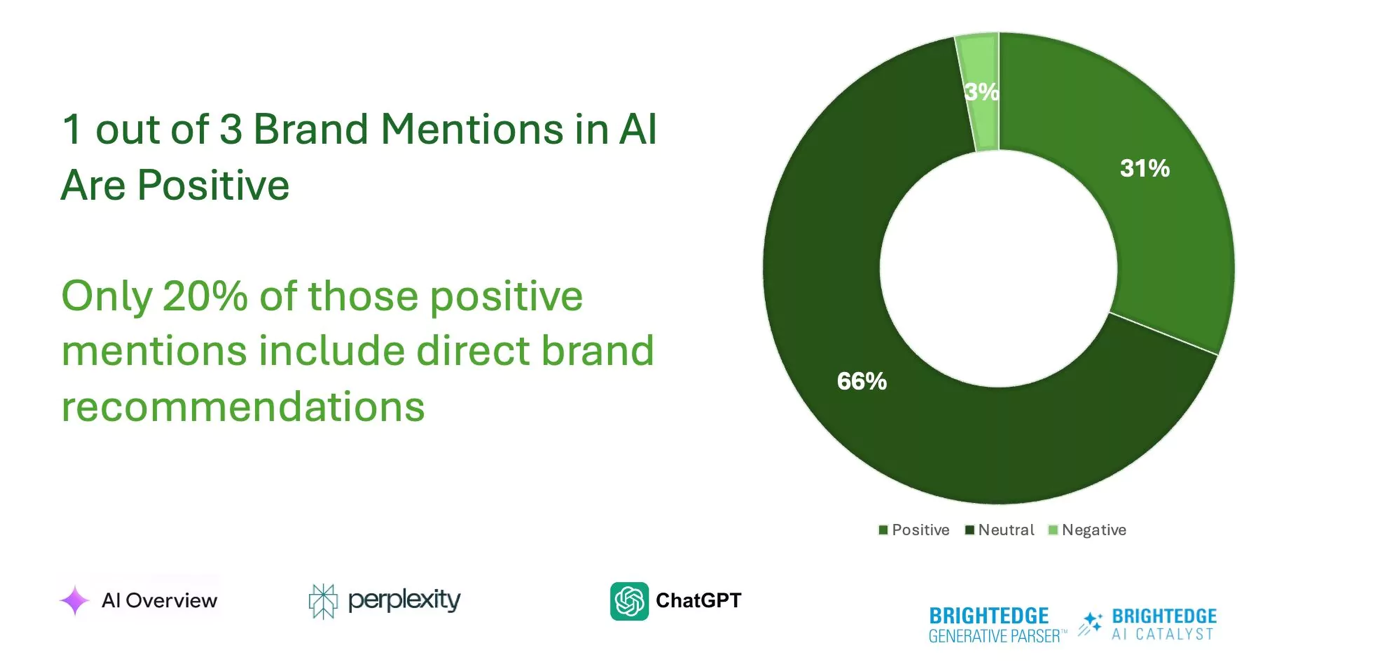
Source: BrightEdge, June 2025

This means that whether you’re marketing enterprise software, consumer products, or direct-to-consumer services, how your brand appears in AI results across Google AI Overviews, ChatGPT, and Perplexity varies dramatically depending on the AI model, its training data, and interpretive logic.

The growth trajectory tells the story:

  • ChatGPT: 21% growth in the last month.
  • Perplexity and Gemini: Remaining about one-tenth of ChatGPT’s size.
  • Claude, Meta, and Grok: Another one-tenth smaller than Perplexity and Gemini.

This isn’t just channel diversification; it’s a complete redefinition of discoverability where AI serves as both gatekeeper and advisor.

Being Aware Of What Is Going On In Your Broader Markets

Understanding The New Market Dynamics

Many marketers have traditionally taken an immediate and microscopic approach to SEO. Without thinking, the focus goes straight to the keyword and the link.

However, working across all market segments requires a shift in mindset towards understanding not just the business but the broader market and economic implications that may affect how you tailor your strategy.

Overall, market factors influence short-, mid-, and long-term strategies. Utilize models such as PEST analysis to understand what is going on in the market from a political, economic, social, and technological perspective:

  • Political: AI regulation, data privacy laws, elections, and new compliance requirements.
  • Economic: AI’s compression of decision cycles, changing sales velocities, and market volatility.
  • Social: Consumer behavior is shifting toward AI-assisted purchasing, altering the dynamics of brand trust.
  • Technological: AI model capabilities, real-time indexing, cross-platform optimization requirements.

The MAP Framework For AI Search Success

Modern marketing intelligence requires mastering three critical dimensions: Mention, Authority, and Performance – what I call the MAP Framework for AI search success.

This framework applies whether you’re marketing SaaS solutions, consumer electronics, fashion brands, financial services, or any product or service in today’s AI-influenced marketplace.

Mentions: Beyond Traditional Rankings

While Google still commands the foundation with over 90% market share, the ecosystem has diversified rapidly.

AI Overviews (AIOs) now appear in over 11% of Google queries – a 22% increase since debuting last year.

More significantly, longer, more complex queries have increased by 49% in AI Overviews since May 2024, specifically designed to support complex B2B decisions.

In contrast, ranking-style content and comparison queries have decreased by 60% and 14%, respectively.

BrightEdge data shows the industries with the strongest AI Overview presence are healthcare, education, B2B tech, and insurance. Travel and entertainment are on the rise, while ecommerce has not seen rapid growth in the past year.

Authority: When AI Forms Opinions About Your Brand

The most critical insight for all marketers is understanding how AI systems interpret and present brand information across every category.

Our research shows significant variation in how brands are portrayed across different AI platforms and industries:

  • Finance brands: Positive mentions align around regulatory compliance and security content.
  • Healthcare brands: Accuracy and credibility drive positive AI sentiment.
  • Technology brands: Innovation and reliability serve as primary AI evaluation criteria.
  • Consumer brands: Customer reviews, product quality, and brand reputation influence AI recommendations.
  • Retail/Ecommerce: Price competitiveness, product availability, and user experience drive AI mentions.
  • Professional services: Case studies, client success stories, and industry expertise shape AI perception.

Whether AI is evaluating enterprise software, consumer products, or professional services, it effectively writes the evaluation criteria and creates shortlists without brands having direct input, making perception management mission-critical across all verticals.

Performance: New Metrics That Matter

Traditional key performance indicators (KPIs), such as rankings, impressions, and traffic, aren’t disappearing, but they’re insufficient for AI-driven discovery.

While impressions on all content have skyrocketed by over 49% since the launch of AI Overviews, click-throughs have steadily declined, with a nearly 30% reduction since May 2024.

Yet, conversion rates remain strong, suggesting that AI successfully qualifies leads before they reach websites.

Essential AI Search Metrics:

  1. AI Mention Rate: Percentage of target queries where your brand appears in AI responses.
  2. Citation Authority: How consistently you’re cited as the primary source.
  3. Share of AI Conversation: Your semantic real estate in AI answers versus competitors.
  4. Prompt Effectiveness: How well your content answers natural language prompts.
  5. Response-to-Conversion Velocity: Speed at which AI-influenced prospects convert.

Monthly reporting cycles have become obsolete. AI-generated results can shift within hours based on content updates, prompt trends, or model training, demanding real-time monitoring capabilities.

Read more: How AI Is Changing The Way We Measure Success In Digital Advertising

Combining Business & Search Intelligence To Understand The Pulse Of The Customer

AI Intelligence With Comprehensive Market Insights

Modern marketing intelligence extends far beyond traditional keyword monitoring, requiring a 360-degree view across all consumer touchpoints and all key AI search engines.

Today’s successful organizations – whether B2B, B2C, or D2C – leverage AI to understand market pulse through multiple lenses:

Real-Time Consumer Intelligence

AI agents now research on behalf of consumers across all categories, from enterprise software to skincare products.

These agents analyze your brand through your digital presence, social proof, customer reviews, and competitive positioning.

They’re becoming sophisticated evaluation consultants that assess everything from product specifications to brand values.

Cross-Industry Predictive Modeling

Advanced business intelligence now incorporates AI behavior patterns to forecast demand shifts across all sectors.

When AI systems consistently recommend specific product categories, highlight particular brand attributes, or emphasize certain consumer benefits, these signals predict broader market movements – whether in B2B procurement, consumer purchasing, or direct-to-consumer trends.

Omni-Engine And LLM Sentiment Analysis

Different AI platforms treat content differently across all industries.

For consumer brands, ChatGPT might emphasize user reviews and social proof, while Perplexity focuses on expert analysis and technical specifications.

For B2B brands, LinkedIn-integrated AI may prioritize professional endorsements, whereas general AI platforms tend to emphasize case studies and return on investment (ROI) data.

Understanding these platform-specific nuances enables strategic content distribution across every marketing vertical.

From Search To AI As The Voice Of Every Customer

In many ways, AI is the voice of the customer across all industries.

Search queries contain intent signals, SERP analysis reveals how customers prefer to consume content, and keyword reports enable us to produce content that resonates – whether for enterprise buyers, individual consumers, or any audience in between.

However, especially in an agentic world, AI is not just forming opinions. It is taking actions for users. In shopping, it can actually make transactions for people.

Keeping a daily pulse on new insights impacting your market and on what is changing in AI responses daily should be of mandatory importance for those who want to benefit from fresh, new opportunities.

For example, a single result and opinion generated by AI in a search can significantly impact revenue in just one day.

During important seasons (especially in retail), subtle category-related demand shifts will require granular action.

New product launches require daily monitoring so stakeholders can see the daily impact and adjust accordingly, leveraging AI to automatically optimize the offering.

Utilizing Business Intelligence To Understand And Visualize The Pulse Of The Market

Real-Time AI Platform Monitoring

More than ever, organizations are seeking business intelligence (BI) to transform data into actionable insights that can be quickly leveraged across traditional search and every AI engine where customers discover solutions.

BI enables marketers to easily analyze insights for larger-than-usual data sets to uncover new opportunities and highlight campaign strategy inefficiencies.

Here is an example from my company:

Source: BrightEdge, June 2025

This type of intelligence can inform you about what is happening now and what has happened in the past across all discovery channels.

Many types of business intelligence can help deliver digestible snapshots of the current state of your market, not just for SEO but also for digital, sales, product, and customer service functions.

Entity-Based SEO For AI Discovery Across All Verticals

Move beyond keywords to comprehensive topic authority, regardless of your industry.

AI prioritizes content from known, trusted entities, making authoritative content three times more likely to be cited in AI responses across B2B software, consumer electronics, fashion, healthcare, financial services, and every other vertical.

Implement robust schema markup, ensure consistent entity references across all digital properties, and build connections with recognized authorities in your space – whether that’s industry analysts, consumer advocates, or subject matter experts.

360-Degree AI Platform Strategy

Success requires presence and optimization across traditional search and every AI engine where your customers might discover solutions. This means:

  • Google Search & AI Overviews: Still the foundation with 90%+ market share.
  • ChatGPT: 21% growth rate, emphasis on conversational discovery.
  • Perplexity: Research-heavy platform with strong citation emphasis.
  • Vertical-specific AI: Industry tools, shopping assistants, and specialized platforms.
  • Social AI Integration: AI features within LinkedIn, TikTok, Instagram, and other social platforms.
  • Voice & Mobile AI: Alexa, Siri, Google Assistant across devices.

Consumer Intelligence Integration

Traditional search data must be combined with the following:

  • Social listening across AI-integrated platforms.
  • Review and rating sentiment from AI-crawled sources.
  • Purchase behavior data as it relates to AI recommendations.
  • Cross-platform brand mention analysis.
  • Consumer journey mapping across AI touchpoints.
  • Competitive intelligence from AI responses.

This approach reveals not just what consumers search for but how AI interprets and presents your brand across every possible discovery moment.

Mobile Vs. Desktop AI Optimization

Mobile and desktop AI Overviews aren’t just different sizes. They’re fundamentally different products targeting distinct user behaviors.

According to BrightEdge Generative Parser data from May and June 2025, these platforms serve different user intents and require tailored optimization strategies.

Key Mobile Vs. Desktop Differences:

Mobile Opportunities:

  • Ecommerce AIOs appear three times more often (13.5% vs 4.5% on desktop).
  • Mobile shows more size variability, suggesting Google is actively experimenting with format and content.
  • Users are in discovery/shopping mode, making mobile ideal for product research and comparison.

Desktop Patterns:

  • Takes 80% more screen space than mobile (1110 px vs. 617 px).
  • AIOs appear 39% more frequently than mobile.
  • More consistent, predictable sizing patterns.
  • Users want detailed, comprehensive information delivery.

As Jim Yu, CEO of BrightEdge, notes: “If marketers are not paying attention to how AI operates on different devices, they may be missing some key opportunities, especially in ecommerce!”

Read more: Newly Released Data Shows Desktop AI Search Referrals Dominate

Strategic Implications:

  • Mobile users require discovery-focused, shopping-oriented content optimization.
  • Desktop users need comprehensive, detailed information architectures.
  • Ecommerce brands must prioritize mobile-first AIO strategies.
  • Content strategy should consider device context alongside traditional keyword targeting.
  • Search marketers must ensure teams optimize for both user experiences simultaneously.

Vertical-Specific AI Optimization

Industry-specialized AI models are emerging for cybersecurity, manufacturing, fintech, and healthcare.

Content strategies must account for domain-specific AI companions that understand industry nuance and evaluate solutions using sector-appropriate criteria.

This can be visualized via daily dashboards, visualizations, and custom-based reports, and can be used to:

  1. Analyze industry trends in real-time across all AI platforms.
  2. Visualize category demand and inventory in real time.
  3. Compare historical data with current trends across traditional and AI search.
  4. Create and forecast based on predictive modeling that includes AI behavior patterns.
  5. Aggregate different sources of data from search engines and AI platforms.
  6. Identify new buyer trends across all customer segments.
  7. Monitor brand presence, perception, and performance.
  8. Find inefficiencies in product or pricing strategy based on AI recommendations.
  9. Identify key correlations between search activity and mentions of AI platforms.
  10. Plan across all discovery channels and map content to key AI touchpoints.
  11. Evaluate marketing campaign effectiveness across traditional and AI-driven channels.

Conclusion

Success in 2025’s marketing landscape requires understanding that AI isn’t just a channel. It’s becoming the primary interface between your brand and potential customers across every industry and buying scenario.

The organizations that master the MAP Framework (Mention, Authority, and Performance) while maintaining a 360-degree view across traditional search, AI engines, and consumer intelligence will be the ones AI recommends when it matters most.

The shift from traditional search to AI-powered discovery isn’t coming – it’s here.

Marketers across B2B, B2C, and D2C who embrace comprehensive AI intelligence tools, implement real-time monitoring across all platforms, and optimize for AI evaluation criteria will capture market opportunities.

In this new reality, staying attuned to the market means understanding not only what customers search for but also how AI interprets, evaluates, and presents your brand across every possible touchpoint.

The future belongs to brands that learn to collaborate with AI, guide its understanding across all platforms, and position themselves to stand out in an era where artificial intelligence often makes the first – and sometimes, final – impression, whether someone is buying enterprise software, choosing a restaurant, or selecting a healthcare provider.

Unless otherwise indicated, any data mentioned above was taken from this BrightEdge study. 

More Resources:


Featured Image: innni/Shutterstock

https://www.searchenginejournal.com/how-enterprise-search-business-ai-intelligence-reveal-market-pulse/549416/


Google’s New MUVERA Algorithm Improves Search via @sejournal, @martinibuster

Google announced a new multi-vector retrieval algorithm called MUVERA that speeds up retrieval and ranking, and improves accuracy. The algorithm can be used for search, recommender systems (like YouTube), and for natural language processing (NLP).

Although the announcement did not explicitly say that it is being used in search, the research paper makes it clear that MUVERA enables efficient multi-vector retrieval at web scale, particularly by making it compatible with existing infrastructure (via MIPS) and reducing latency and memory footprint.

Vector Embedding In Search

Vector embedding is a multidimensional representation of the relationships between words, topics and phrases. It enables machines to understand similarity through patterns such as words that appear within the same context or phrases that mean the same things. Words and phrases that are related occupy spaces that are closer to each other.

  • The words “King Lear” will be close to the phrase “Shakespeare tragedy.”
  • The words “A Midsummer Night’s Dream” will occupy a space close to “Shakespeare comedy.”
  • Both “King Lear” and “A Midsummer Night’s Dream” will be located in a space close to Shakespeare.

The distances between words, phrases and concepts (technically a mathematical similarity measure) define how closely related each one is to the other. These patterns enable a machine to infer similarities between them.

MUVERA Solves Inherent Problem Of Multi-Vector Embeddings

The MUVERA research paper states that neural embeddings have been a feature of information retrieval for ten years and cites the ColBERT multi-vector model research paper from 2020 as a breakthrough but that says that it suffers from a bottleneck that makes it less than ideal.

“Recently, beginning with the landmark ColBERT paper, multi-vector models, which produce a set of embedding per data point, have achieved markedly superior performance for IR tasks. Unfortunately, using these models for IR is computationally expensive due to the increased complexity of multi-vector retrieval and scoring.”

Google’s announcement of MUVERA echoes those downsides:

“… recent advances, particularly the introduction of multi-vector models like ColBERT, have demonstrated significantly improved performance in IR tasks. While this multi-vector approach boosts accuracy and enables retrieving more relevant documents, it introduces substantial computational challenges. In particular, the increased number of embeddings and the complexity of multi-vector similarity scoring make retrieval significantly more expensive.”

Could Be A Successor To Google’s RankEmbed Technology?

The United States Department of Justice (DOJ) antitrust lawsuit resulted in testimony that revealed that one of the signals used to create the search engine results pages (SERPs) is called RankEmbed, which was described like this:

“RankEmbed is a dual encoder model that embeds both query and document into embedding space. Embedding space considers semantic properties of query and document in addition to other signals. Retrieval and ranking are then a dot product (distance measure in the embedding space)… Extremely fast; high quality on common queries but can perform poorly for tail queries…”

MUVERA is a technical advancement that addresses the performance and scaling limitations of multi-vector systems, which themselves are a step beyond dual-encoder models (like RankEmbed), providing greater semantic depth and handling of tail query performance.

The breakthrough is a technique called Fixed Dimensional Encoding (FDE), which divides the embedding space into sections and combines the vectors that fall into each section to create a single, fixed-length vector, making it faster to search than comparing multiple vectors. This allows multi-vector models to be used efficiently at scale, improving retrieval speed without sacrificing the accuracy that comes from richer semantic representation.

According to the announcement:

“Unlike single-vector embeddings, multi-vector models represent each data point with a set of embeddings, and leverage more sophisticated similarity functions that can capture richer relationships between datapoints.

While this multi-vector approach boosts accuracy and enables retrieving more relevant documents, it introduces substantial computational challenges. In particular, the increased number of embeddings and the complexity of multi-vector similarity scoring make retrieval significantly more expensive.

In ‘MUVERA: Multi-Vector Retrieval via Fixed Dimensional Encodings’, we introduce a novel multi-vector retrieval algorithm designed to bridge the efficiency gap between single- and multi-vector retrieval.

…This new approach allows us to leverage the highly-optimized MIPS algorithms to retrieve an initial set of candidates that can then be re-ranked with the exact multi-vector similarity, thereby enabling efficient multi-vector retrieval without sacrificing accuracy.”

Multi-vector models can provide more accurate answers than dual-encoder models but this accuracy comes at the cost of intensive compute demands. MUVERA solves the complexity issues of multi-vector models, thereby creating a way to achieve greater accuracy of multi-vector approaches without the the high computing demands.

What Does This Mean For SEO?

MUVERA shows how modern search ranking increasingly depends on similarity judgments rather than old-fashioned keyword signals that SEO tools and SEOs are often focused on. SEOs and publishers may wish to shift their attention from exact phrase matching toward aligning with the overall context and intent of the query. For example, when someone searches for “corduroy jackets men’s medium,” a system using MUVERA-like retrieval is more likely to rank pages that actually offer those products, not pages that simply mention “corduroy jackets” and include the word “medium” in an attempt to match the query.

Read Google’s announcement:

MUVERA: Making multi-vector retrieval as fast as single-vector search

Featured Image by Shutterstock/bluestork

https://www.searchenginejournal.com/googles-new-muvera-algorithm-improves-search/550070/


YouTube Tests AI Features To Improve Search & Discovery via @sejournal, @MattGSouthern

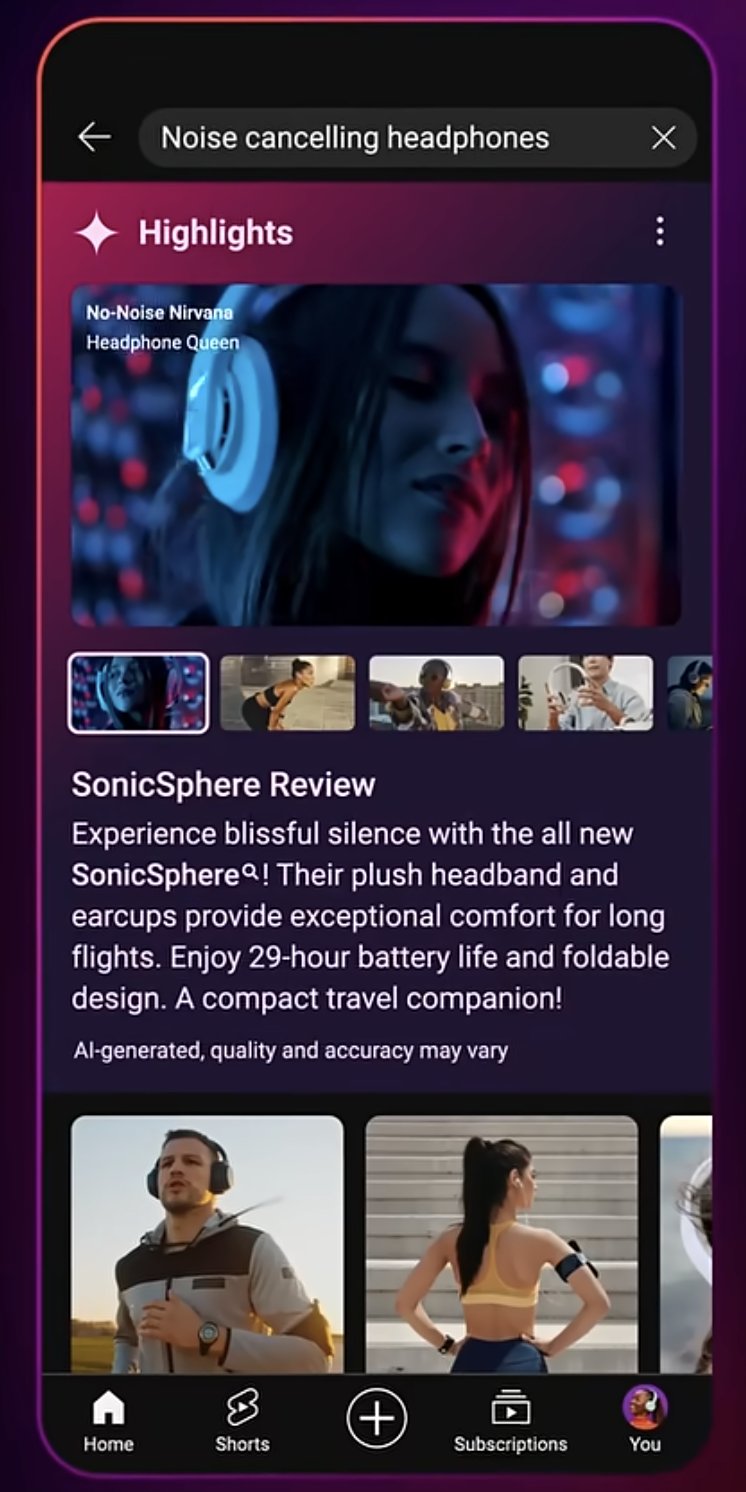
YouTube is rolling out two AI-driven features designed to enhance content discovery and deepen user engagement.

The experimental tools include an AI-powered search results carousel for Premium users and a conversational AI assistant now expanding to some non-Premium accounts in the U.S.

AI Search Results Carousel (Premium Only)

Premium subscribers in the U.S. can now access an AI-generated search results carousel for select query types.

The carousel surfaces curated video suggestions along with brief topic descriptions, helping users explore subjects more efficiently.

For example, searching for “best noise canceling headphones” might trigger a carousel like the one you see below:

Screenshot from: YouTube, June 2025.

This experimental feature:

  • Supports English-language videos
  • Focuses on shopping, travel, and local activities
  • Is available on iOS and Android
  • Will run through July 30

Conversational AI Assistant Expands

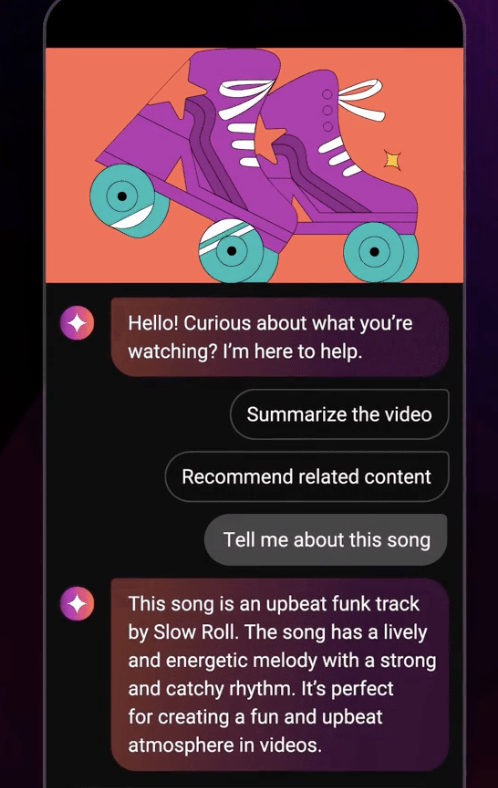
YouTube’s conversational AI tool, previously available only to Premium users, is now being tested with select non-Premium accounts in the U.S.

The tool allows users to:

  • Ask questions about the video they’re watching
  • Get recommendations
  • Quiz themselves on key concepts in educational videos
Screenshot from: YouTube, June 2025.

Implications for Creators and Marketers

Videos related to shopping, travel, or local activities may benefit from prominent placement in AI-curated carousels.

The focus on commercially relevant search types aligns with content that often drives conversions, making this a potentially valuable for affiliate marketers and small businesses.

While promising, both tools are being deployed with restrictions. The carousel is exclusive to Premium members and only supports a narrow range of queries. The conversational tool remains in limited testing with no timeline for wider release.

These limitations suggest that YouTube is still in the data-gathering phase, evaluating how users interact with AI-generated suggestions and whether these tools improve search satisfaction.

Looking Ahead

As YouTube experiments with AI in discovery and learning, creators should focus on producing content that is topically rich and well-structured, especially in categories such as shopping and travel.

Expect further refinements as YouTube incorporates user feedback ahead of potential broader adoption.

https://www.searchenginejournal.com/youtube-tests-ai-features-to-improve-search-discovery/550063/


Mastering Local SEO: A Strategic Imperative For Travel And Tourism Operators via @sejournal, @JRiddall

The travel and tourism industry thrives on inspiration, discovery, and experience. While increasingly being challenged by social media and friend & family referrals, the first point of discovery for many travelers is still a search engine.

For operators in this competitive sector, ranging from boutique hotels and niche tour providers to vacation rental property owners and managers, as well as local attractions, a commanding online presence isn’t just beneficial – it’s fundamental to survival and growth.

This is where Local SEO emerges as a critical driver, connecting businesses with high-intent travelers actively seeking their next destination or experience.

As the search journey includes more AI-driven results, a sophisticated and adaptive Local SEO strategy is crucial.

This guide will navigate the essentials of Local SEO tailored for travel and tourism, incorporating strategies to thrive in the era of Google’s AI Overviews and other AI search platforms.

We’ll explore established best practices and new frontiers to help you enhance visibility, attract qualified leads, and convert searches into bookings.

Why Local SEO Is Non-Negotiable For Your Travel Business

Today’s travelers are digital nomads even before they pack their bags. They meticulously research, compare, and seek out authentic local experiences, with search engines as their primary guide.

A staggering 87% of consumers used Google to evaluate local businesses in 2022, according to BrightLocal, and this trend is particularly pronounced in the travel sector.

A robust Local SEO strategy ensures your offerings are prominent when potential customers conduct geographically specific searches. Consider these compelling reasons:

Hyper-Targeted Visibility

Local SEO puts your business in front of users searching for “boutique hotels in downtown Austin” or “eco-tours near me,” connecting you with an audience demonstrating clear local intent.

Increased Organic Traffic & Direct Bookings

Higher visibility in local search translates to more qualified traffic to your website, reducing reliance on commission-heavy Online Travel Agencies (OTAs).

Enhanced Credibility And Trust

Businesses appearing in top local search results, especially those with strong reviews, are perceived as more trustworthy. Indeed, according to Expedia group, studies show that 95% of travelers read reviews before booking

Competitive Edge

In a crowded marketplace, a sophisticated Local SEO strategy will differentiate your unique local offerings from larger, and perhaps less localized competitors.

Cost-Effectiveness

Compared to paid advertising, organic Local SEO can deliver a higher return on investment (ROI) over the long term by building sustainable visibility.

Building A Future-Proof Local SEO Strategy For Travel

To maximize visibility and capture the attention of modern travelers, operators must build their SEO strategy on several key pillars:

An Optimized Google Business Profile (GBP)

For businesses with a physical presence or those catering to broader service areas, a Google Business Profile is arguably the most potent Local SEO tool currently available.

It’s often the first interaction a potential customer has with a brand online, as Google Maps appears at the top of most local searches.

Here are the key GBP best practices you need to implement to leverage this important channel.

  • NAP Optimization: Claim and thoroughly complete your GBP listing. Ensure the accuracy of your business Name, Address (or service area), Phone number (NAP), website, hours, and a compelling, keyword-rich description.
  • Precise Categorization: Select the most accurate primary and secondary categories truly reflecting your business’s services, e.g., “Boutique Hotel,” “Adventure Tour Operator,” “Vacation Rental Agency.”
  • Service Area Definition: For businesses without a fixed customer-facing location (like tour operators) or those serving a broader region, accurately define your service areas. Google advises that this shouldn’t exceed a 2-hour drive from your base. If you serve an area beyond this 2-hour range, you will need to find ways to convince Google via reviews from customers located in the broader area, local partnerships, or perhaps establishing an actual satellite location.
  • Visual Storytelling: Invest in and share professional, high-resolution photos and videos of your business, properties, tours, amenities, local ambiance, guest experiences, team, etc.
  • Active Engagement via GBP Posts: Regularly use GBP posts to share updates, special offers, upcoming events, new blog content, and local insights. This signals to Google that your business is active and engaged in your community.
  • Review Management: Ask for and monitor customer reviews on GBP. Respond promptly and professionally to all reviews. This not only impacts rankings, but can also heavily influence booking decisions – 76% of consumers would update their negative review to a neutral or positive if a company acknowledged and fixed the complaint. Larger organizations with review volume across multiple locations will want to consider centralized and automated review management solutions such as BirdEye or BrightLocal.
  • Proactive Q&A Management: Monitor and answer questions in the GBP Q&A section to provide valuable information and manage customer perceptions.

Maintain A High-Performance, Locally Optimized Website

Your website is your digital flagship, where inspiration meets transaction.

Websites remain a core focus for all businesses because they are still the place where primary product and service content is housed, as well as for travel businesses where bookings begin, even if they are ultimately completed off-site.

Several components are involved in optimizing a site for local search.

Strategic Keyword Research

Identify terms your target audience uses at each stage of the travel planning funnel, and particularly those used during the Engage and Booking stages.

Focus on location-specific queries (“luxury safari tours Kenya”), property types (“beachfront villas Maui”), and unique selling propositions (“pet-friendly cabins in the Blue Ridge Mountains”).

On-Page Optimization

Craft unique, keyword-rich Title tags, hierarchical heading structures, and internal/external links for every key bottom-of-the-funnel page.

Review keyword rank, search volume, organic search traffic, and conversion data to determine the primary pages to focus on.

Larger organizations will want to take a broader, scalable approach with page templates, but will still hone attention and focus on key locations where some level of authority and visibility has already been established, upon which momentum can be built.

Dedicated Location/Service Pages

If you cater to multiple distinct areas or offer specialized tours/services per location, create unique, detailed landing pages for each location.

These pages should include unique localized content (particularly if services or products differ by location), local team information, testimonials, contact details, and embedded Google Maps.

Image & Video Optimization

Use descriptive filenames and alt text for all visuals, incorporating relevant keywords and location data, where applicable.

Optimize image file sizes for fast loading (the WebP format is recommended) without compromising quality. This is admittedly a challenge for many in the travel space as images and video can make or break a property, tour, or experience listing.

Mobile-Friendly Design

With a significant portion of travel searches and bookings occurring on mobile (mobile devices made up 70.5% of global online travel traffic in 2024), a responsive, fast-loading website is critical.

Furthermore, site speed is a recognized ranking factor, for which tools like Google PageSpeed Insights and Core Web Vitals are available to gauge and diagnose potential bottlenecks.

Rich, Informative Content

Develop content marketing plans to address traveler questions and showcase your local expertise via detailed itineraries, destination guides, “things to do” lists, and booking information.

Structured Data (Schema Markup)

Implement relevant schema, such as:

  • LocalBusiness.
  • Hotel.
  • LodgingBusiness.
  • VacationRental.
  • TouristAttraction.
  • TouristTrip (for itineraries).
  • Event.
  • FAQPage.
  • Article.

Schema helps search engines (and AI models) understand your content contextually.

Relevant, comprehensive structured data will improve your content’s eligibility for rich snippets and AI Overviews in Google, which are showing up in organic search results with increasing regularity across travel and all industries.

User Experience (UX) And Accessibility

A seamless UX with intuitive navigation, clear calls-to-action, and an easy booking process directly impacts conversion rates.

Further, ensuring your website is accessible to people with disabilities (based on WCAG Guidelines) broadens your target audience and is widely considered SEO best practice.

Building Authority With Off-Page SEO And Reputation Management

Off-page signals from relevant local and/or industry-specific sources significantly influence your local ranking and perceived trustworthiness.

Brand mentions, whether linked or not, are being recognized as an important factor in AI Search visibility.

Businesses looking to boost their local visibility need to consider their broad web presence, in addition to the content they control on their website and GBP.

  • NAP Consistency & Local Citations: Ensure your Name, Address, and Phone number (NAP) are identical across all online directories (e.g., Yelp, TripAdvisor, local tourism sites). Inconsistent NAP can harm rankings. Larger operators with multiple locations will want to consider implementing a centralized Listings Management tool like SOCi or Yext.
  • Strategic Link Building: Earn and obtain high-quality backlinks from relevant local organizations (tourism boards, chambers of commerce), travel blogs, local press, and complementary businesses.
  • Local Partnerships & Community Engagement: Collaborate with nearby businesses (restaurants, activity providers, event organizers) for cross-promotion and local link opportunities. Sponsoring and/or physically participating in local events can also help build visibility and relevant local links.
  • Local Influencer Collaboration: Partner with local travel and lifestyle influencers to tap into their engaged audiences with relevant content and messaging, thereby gaining authentic, local endorsements. These types of collaborations generally take time to establish and build trust, but can reap significant benefits by tapping into a loyal, local customer base.

Content Marketing: The Engine Of Local SEO And AI Visibility

High-quality, relevant content is fuel for both visibility in traditional organic and AI-driven search.

  • Audience-Centric Content Strategy: Understand your ideal traveler and their journey. Create content that inspires, informs, and facilitates booking.
  • Hyperlocal & Unique Storytelling: Develop blog posts, guides, videos, and itineraries highlighting your unique offerings and deep knowledge of the local area. Focus on what makes your experience or destination special, sharing authentic stories and insider tips.
  • Answer Questions Directly: Create content, including dedicated FAQ sections, and directly answer common traveler queries. Incorporate a Question and Answer schema to clearly call out this content for search and LLM crawlers. This is vital for appearing in Google’s AI Overviews and being useful to other AI chatbots.
  • Diverse Content Formats: Utilize blog articles, high-resolution photo galleries, engaging videos (destination spotlights, property tours, guest testimonials), interactive maps, and downloadable guides. Short-form video is highly effective on social media.
  • Content Promotion: Share your content strategically via GBP, social media, email marketing, and local partnerships to maximize its reach and opportunity to be shared further.

Thriving In The Era Of AI Overviews And AI Search

We can’t have an SEO conversation today, Local or otherwise, without considering the impact of AI on search.

Google’s AI Overviews and other AI tools like Perplexity and ChatGPT are changing how users find information.

In a recent Whitespark study, it was determined that AI Overviews are appearing for a significant 68% of local business-type searches.

To optimize for this new paradigm at a local level, there are a few things to consider, some of which you’ll note are in line with the SEO recommendations made above:

  • Prioritize E-E-A-T (Experience, Expertise, Authoritativeness, Trustworthiness): AI models, especially Google’s, are designed to prioritize information from sources that demonstrate the four qualities of E-E-A-T. Ensure your content is accurate, well-researched, or proprietary, written by experts (or showcases expertise), and your website projects credibility.
  • Create Comprehensive, Factual, and Well-Structured Content: AI loves well-organized information. Use clear headings, bullet points, and ensure your content thoroughly covers a topic, directly answering common questions. This makes it easier for AI to parse and use your information for generating and displaying summaries.
  • Optimize for Conversational & Question-Based Queries: Think about how users ask questions about your business, products, or services verbally or in natural language. Structure content around these queries (e.g., “What are the best family-friendly hotels in Orlando with a water park?”).
  • Reinforce Entity Recognition: Ensure clear and consistent information about your business (your “entity”) across the web – your name, what you do, where you’re located, and unique offerings.
  • Structured Data Matters Even More: As mentioned, schema markup helps search engines and AI Large Language Models (LLMs) understand the specifics of your content (business, products, etc), thereby improving its ability to be accurately represented in AI-generated results.
  • Ensure Broad Web Presence and Citations: AI models like Perplexity cite their sources. Being mentioned and linked to from other authoritative travel sites, blogs, and news outlets can increase your chances of being referenced.
  • Monitor Your Appearance in AI Search: While direct tracking in AI Overviews and other AI search platforms is still in development, consider leveraging new third-party tools and conducting manual checks to determine if and how your business or content is appearing in AI-generated responses for relevant queries.

Track, Analyze, And Adapt

Any worthwhile and effective Local SEO effort is backed by data.

Use Google Analytics, Google Search Console, and other SEO tools to monitor key metrics, including organic traffic, keyword rankings (especially local), Google Business Profile insights (views, clicks, calls, direction requests), conversion rates, and referral traffic from local sources.

This data will be key to helping you continually refine your strategy as modern SEO (and now GEO or AEO) is a moving target.

The Future Is Local And AI-Enhanced

Local SEO is no longer a niche tactic, but a foundational element of a successful digital marketing strategy for any travel and tourism operator.

By focusing on providing genuine value to travelers, creating exceptional local experiences, and meticulously optimizing your online presence across all relevant platforms, you can attract more customers.

As AI continues to reshape search, the emphasis on high quality, authoritative, and clearly structured content, along with a broad-based, brand-forward web presence, becomes even more important.

Embrace the principles and tactics here, stay agile, and you’ll be well-positioned to navigate the evolving digital landscape and welcome more guests through your virtual and physical doors.

More resources:


Featured Image: RobinRmD/Shutterstock

https://www.searchenginejournal.com/mastering-local-seo-strategic-imperative-travel-and-tourism-operators/547350/


Google Tests ‘Preferred Sources’ To Personalize Top Stories In Search via @sejournal, @MattGSouthern

Google is testing a new feature that allows you to customize the Top Stories section in search results by selecting preferred news sources.

Currently available through Search Labs in the U.S. and India, the experiment gives people more influence over which publishers appear in their news-related queries.

How It Works

Those who opt into the experiment will see a new starred icon in the Top Stories carousel. Tapping it opens a menu where you can choose preferred publications.

Articles from selected sources will be more likely to appear in Top Stories when relevant. These entries will be marked with a star icon next to the site name, but they won’t replace Google’s algorithmic selections entirely.

Google may also display a secondary “From your sources” carousel beneath the main Top Stories section.

A Broader Shift Toward Personalization

The Preferred Sources feature builds on Google’s existing personalization tools, including the ability to highlight content users have frequently visited or show updates since their last search.

A “Try without personalization” option remains available at the bottom of search results, maintaining transparency and user control.

What This Means

For publishers, this change could offer increased visibility, especially for those with loyal audiences who choose them as preferred sources.

However, smaller or newer outlets may struggle to compete with established brands if user selections skew toward familiar names.

The experiment highlights the growing importance of brand recognition, direct audience relationships, and consistent content freshness.

Looking Ahead

This initiative is part of Google’s effort to balance algorithmic discovery with user-driven customization.

While it’s still an experiment, the move suggests Google is exploring ways to give users more say in how information surfaces, without fully abandoning its ranking systems.

If rolled out more broadly, the Preferred Sources feature could reshape strategies for publishers and marketers seeking consistent visibility in Google Search.


Featured Image: Roman Samborskyi/Shutterstock

https://www.searchenginejournal.com/google-tests-preferred-sources-to-personalize-top-stories-in-search/550037/